
Palm Sunday, Pesaha, Pesaha Recipes, Traditions
Kerala Nazranee Pesaha Receipes
Authored by Amprayil on Sunday, March 16, 2008 20:45 - 10 CommentsThe following are recipes for certain unique Kerala Nazranee Pesaha dishes, from different sources/individuals as duly acknowledged after each recipe. Such or similar dishes were and are part of the Pesaha (Maundy Thursday) supper in several Nazranee families in India and overseas. The tradition is thus kept alive by them.
1. Pesaha Appam (Unleavened Bread Kerala Nazranee Style!)
Rice -1.5 cups
Urad Dal withot skin – 0.5 cup
Cumin seeds – 0.5 teaspoon
Garlic – 2 cloves
Coconut, shredded – 1 cup
Salt – as needed
Soak the rice overnight on Wednesday evening.
Heat Urad Dal in a frying pan, stirring continuously. Be careful so that it does not burn. Stop heating when golden brown. Stir and let it cool. Soak this Dal for 2 hours.
Grind all ingredients together. Add water just enough for a viscous batter. Do not grind to a fine paste. The batter should be slightly lumpy. Taste and add salt as needed.
Pour in a baking dish. Steam for 20 minutes. Alternatively, bake at 400 F. Allow it to cool before serving with Pesaha Pal (see below).[1]
_________________________________________________________________________
2. Pesaha Pal (Kerala Nazranee innovation for Wine!)
Coconut Milk – 2 cups (alternatively, use regular milk)
Putt flour – 1 table spoon (alternatively, use Cream of Wheat flour)
Brown Sugar – 2 to 3 tablespoons
Cardamom (powdered) – 2
Salt – for taste
Mix flour and milk in a saucepan. Add brown sugar. Boil for 3-5 minutes until thickened like gravy. Add salt and test for taste. Adjust thickness by adding more flour or milk as needed. Add cardamom. Keep stirring till it cools. Serve with Appam (see above).[2]
__________________________________________________________________________
3. Pesaha Appam
(This is said to be the way the Pesaha Appam is made in the southern side of Kottayam)
(For One Deep Dish) (10-12 pcs.)
Rice Flour – 2 Cups
Cream of Rice – ½ cup
(Option: Soak 2 cups, ie. 1 pound long grain rice in water for 3 hrs, grind coarse,
1 cup grated coconut. Use the coconut water to grind the rice.)
Coconut, grated – 1 cup (Blended)
Dark Brown sugar – ½ cup (More for more sweetness)
Yeast + Sugar – ¼ Tsp + 1 tsp sugar in ¼ cup warm water
(Instead of yeast, save the coconut milk with 1 tsp raw rice grains, 1 tsp sugar , keep it in a warm place for a day, use that mixture to grind the rice. Also, if vellom (chakkara) is used,no yeast is needed. Or, one cup (pressed, not loose) of the crust-free soft bread could be used in place of yeast.)
1 Table spoon farina boiled in ½ cup water (Paavu kachi).
Salt – ¼ tsp or enough to taste
Cumin powder- 1 tsp
Red or small onion – 1 Tbsp (blended)
Grind the mixture 1-4, to an Iddli consistency, add the warm farina porridge (paav kachi), keep in a warm place for 6 hrs. Place ¼ tsp yeast and 1 Tsp sugar in ¼ cup warm water, the solution will froth in 5 minutes, (or the substitutes) add it to the mixture, keep warm for 4 more hours. Before cooking, add the salt and cumin powder, onion paste, pour into a greased pan, cook in a steam bath for 20 minutes, or till it is firm, test with a toothpick.
Raisins and cashews could be sprinkled on top of the Appam before cooking, for more taste and decoration. Usually the first Pesaha Appam is made plain (without the nuts and fruits)
Use the multiples of the measure for more pans of Appam.
Usually 2 cups(200ml.cup) or one pound is enough to make one kinnam appam. Instead of dark brown sugar, if white color is preferred, use ½ cup sugar or more for more sweetness.[3]
____________________________________________________________________________
4. Recipe for Pesaha Appam (INRI appam)
Rice powder (not roasted)-1 cup
Urad dal (uzhunnu)-25 gm
1/2 coconut grinded (medium)
Pinch of cumin
Soak the uzhunnu for a few hours. Grind well.
Grind well the coconut + a pinch of jeera (cumin).
Add everything together and make a dough of idli maavu consistency.
“Keep only for 1/2 hour to ferment.”
(To remind of Pesaha)
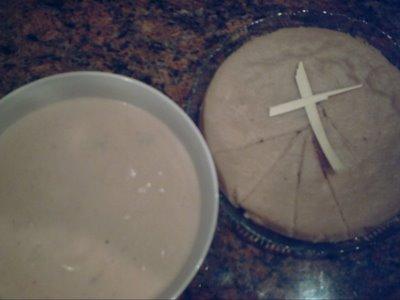
Grease preferably steel plates of medium round shape. Pour batter in one, and make a cross of palm leaf obtained on palm sunday on it. Steam till well done.
Make all other appams same way but with no cross.
Makes about 2 or 3 medium appams.[4]
_________________________________________________________________________
5. Paalukurukku
Roasted rice powder-1 cup
Sarkkara (molasses)-1 cup
Cardamom powder
Coconut-1
Please use freshly grinded coconut for making this, otherwise the taste won’t be good. Take the juice of coconut. You can put the grinded coconut in mixer and add some hot water to grind for 30 seconds. Now the juice comes out easily.1st milk should be kept separately; take 2nd and third milk also. These two should equal 1 litre of milk.
Take molasses and put the in a saucepan, add some water and heat well. While boiling, lather forms; this should be cleaned away. Then add cumin and chukku (dried ginger). Now sieve this through a strainer and you can see lot of stones and dirt in it. This liquid form of molasses should be used in your recipes. I have seen lots of people use molasses directly in recipes, without first melting them. Remember, all these dirt and stones are dangerous, especially for kids. This commonly happens when we prepare aval vilayichathu, where we use it directly. But be sure to melt it first. The consistency can be achieved by adjusting the amount of water added to it.
Take the 2nd and third milk, molasses syrup and roasted rice powder, bring to a boil. Stir continuously, otherwise lumps will form. Mix cardamom powder with 1st milk and add it last. Also add a piece of palm leaf. Before it boils, take off the stove.
As the tradition goes, the head of the family cuts the appam and gives it to other members, oldest to youngest respectively, after dipping in paalukurukku. This is done in great reverence and pious atmosphere.[5]
Picture Courtesy : Inji Pennu –[6]
__________________________________________________________________________
Author Kuruvilla Cherian Amprayil can be reached on amprayilusa at gmail dot com
__________________________________________________________________________
NSC NETWORK Article Footnotes
- Acknowledgement: John Medamana [↩]
- Acknowledgement: Elcy Yohannan Sakarathil [↩]
- Acknowledgement: Anne Thomas, Hyderabad [↩]
- Acknowledgement: Annie Thomas, Hyderabad [↩]
- Acknowledgement: myinjimanga [↩]
NSC NETWORK is a collaborative networking effort of many Syrian Christians who are for traditions, heritage and culture. The primary objective of NSC NETWORK is to build awareness about Nasrani culture, traditions, heritage, sharing different perspectives of history and other relevant information concerning the community.Please read About for policies. © 2007-2009 NSC NETWORK [ http://nasrani.net]
____________________________________________________________________________
Related NSC Network Articles
- Palm Sunday ( Kuruthola Perunnal), Maundy Thursday( Pesaha), Good Friday (Dukha Velli) and Easter among Saint Thomas Christians of India
- Some of the traditions and rituals among the Syrian Christians of Kerala
- Lifestyle of Kerala Syrian Christians
- ‘East of the Euphrates- Early Christianity in Asia’ by T.V. Philip
- ‘The Indian Christians of St. Thomas’ by Dr. Leslie Brown
- Margam Kali – History, Theme, Early References and Modern Developments
- Ancient Churches with traditional dates of foundation & Stone Crosses of Kerala- Saint Thomas Cross, Nazraney Sthambams and other Persian Crosses
10 Responses
M Thomas Antony
Post : 1704
Best recipes from around the web » Kerala Nazranee Pesaha Receipes
Post : 1705
[...] Amprayil wrote a fantastic post today on “Kerala Nazranee Pesaha Receipes”Here’s ONLY a quick extractThe following are recipes for certain unique Kerala Nazranee Pesaha dishes, from different sources/individuals as duly acknowledged after each recipe. Such or similar dishes were and are part of the Pesaha (Maundy Thursday) supper in … [...]
Jack
Post : 1732
The ritual details of the Passover (Pesaha/Pesahach) observed traditionally by the ancient Israelites has been accounted in the Book of Exodus (OT) and the traditions associated with the Nasrani Pesaha have striking resemblance to many of Hebrew Passover details. Thus the following is an attempt to compare the two ritual traditions.
Some of the relative aspects have been stated in detail on the NSC links below; while some details have been missed.
http://nasrani.net/2007/03/25/passover-among-nasrani-syrian-christians-of-kerala/
http://nasrani.net/2007/12/11/cultural-similarities-of-syrian-christians-and-jews/
The similarities :
1). The Pesaha Appam is made of the ingredients as described above in the link provided by Dr. Kuruvilla. The spices used are garlic, cumin seeds (jeerakam) and cheriulli (small onions) by some. These spices/condiments seem to be used in relation to the bitter herbs as mentioned in Exodus Passover rules (Exo. 12:8) and may not be simply to add flavour. Note that no other appam has garlic in it. ! Its debatable.
2). The batter of the Appam is made and traditionally immediately poured into the dish for cooking and not allowed to stand for more than 20-30 mins. This is because the batter may ferment after 20 mins and the very concept of unleavened bread is lost. This is the traditional old Nasrani way still strictly followed in many families. This again is strikingly similar to the Hebrew tradition of making the unleavened Passover bread which again is not allowed to stand for more than 20 mins. Check the link below for details.
Jack
Post : 1733
3). The link mentions that the Appam batter is steamed. This may be a recent method. The traditional method is strictly baking/roast (Chudal) on the fire with firewood placed below and above the baking vessel, again followed by some Nasrani families still. This Baking/roasting without oil method is similar to the commandment in Exodus (Exo. 12:9) followed by ancient Israelites wherein the bread is baked/roasted and not steamed. Exceptions have arisen recently like steaming since gas stoves have replaced the traditional “adapu” cooking.
4). The traditional Nasrani way of baking of the Appam is in a new earthen vessel, (new Mannchatti) brought specially for this baking and not used before. This again is perfectly similar to the Jewish custom wherein the Unleavened bread is baked by the Jews in new/unused/perfectly washed vessel. This is done to avoid contamination by any previous yeast/fermenting agent as per Exodus 12: 15-20. For details check the sub-topic ‘Passover dishware’ in below link.
Reference for more details: http://en.wikipedia.org/wiki/Passover
Jack
Post : 1734
Other traditions and observances
Then there is another tradition wherein the Pesaha appam was/is eaten standing and this is still followed by some in accordance with the Israelite Passover and OT Exodus rules. This may be largely extinct today but observed by some Nasrani families still.
Then the Appam and Pal is neither eaten/shared with non-Nasranis outside the community nor must any of it be taken outside the house. Though friends and neighbours do come and eat, but again this is only by visiting the house where the Appam is made. Similarly Pesaha is not observed in the year wherein someone has died in a family. All these are ancient stringent rules related to observing the Pesaha and again is in perfect accordance with the OT Passover regulations. Many are getting extinct today.
Then while breaking the appam certain prayers/blessings are said by those including non-knanaya Surianis too. But I’m not aware of the details of the Prayers recited. There are no songs as in the knanaya tradition as mentioned in the NSC link. The only distinguishing point between the Knas and non-knas comes here in Pesaha observance.
The Pesaha Appam is called Kalathappam by Nasranis of North kerala and the recipe is almost the same. Kalathappam is said to be of jewish origin.
Indriappam or Inri (derived from INRI of Jesus’s cross) appam is the other name more popular in South Kerala.
While visiting Kerala last month I was able to take part in the Pesaha tradition at my parents’ house. The Appam and Pal were made by my Mom exactly as it used to be when I lived in Kerala during the 70s. I talked to my parents about the tradition. They told me that Pesaha dinner is a very important tradition among all Suriani christians in the area (Piravom, Mulakulam) – includes Jacobites and Marthomites. The tradition in our family is that the oldest (male) member must cut the bread and lead the prayer. This is similar to Jewish passover sader, except that the service is much shorter and we read the account of last supper from the Gospels rather than Exodus.
I also discussed the Suriyai tradition with a Cochini Jewish friend. She told me that the use of rice and coconut milk is really odd. Cochini Jews used wheat to make the unleavened bread and they used a form of grape juice for wine.
John Medamana
George Mathew
Post : 2339
Dear John,
Tell us about the Cochini Jewess. Is the ‘black Jew’ or the ‘Foreign Jew’? (I know Indians of all shades and castes do not like the word ‘Black’, but I use it here to make things clear.
I have met lot’s of Jews but not a single Malabari Jew.
George Mathew
Post : 2340
Dear John Medaman,
We also made Pesaha Appam in Calgary based upon Ampravil Achayan’s receipe. It is good. In our very small circle, there was even some healthy rivalry to be ‘traditional’. We kind of tried to outdo each other and also learned how Nasrani Catholics from the very north of Kerala remember the Pesaha.
Hopefully, next year if God permits, we will have a better remembrance.
Kuruvilla Cherian Amprayil
Post : 2352
Dear George Mathew,
The Pesaha recipes were not mine, I just collected them from various sources as was acknowledged in the posting. In fact items 1 & 2 of them were originally from John Medamana himself, received several years ago when we had some discussions about the Hebrew-Brahmin roots of the Nazranees….
Thanks John for reconfirming the great tradition.
Bibinvarghese
Post : 6863
Syrian Christian cuisine was featured in New York Times.
New York Times Editor and writer of books like Apple’s America , R.W. Apple ran a story on the food and flavors of Kerala
http://www.thehindubusinessline.com/life/2008/09/12/stories/2008091250080200.htm
Elijah
Post : 11432
Indeed very interesting ! How many Israelis are there in South India !
Participate – Your opinion-Leave a Response
NSC NETWORK is a non moderated forum. All are welcome to participate in the debates. We encourage comments, critiques, questions, additional information,corrections and suggestions. We also encourage participants to provide answers/ideas to questions raised on articles or on posts/comments.Links/Videos/Pictures of value to readers are most welcome.We request that please stay on topic, respect other people’s opinions, avoid profanity, offensive statements or anything else that might otherwise violate our policy. Please understand that we reserve the right to edit or delete posts/comments for any reason we deem appropriate. By submitting a post/comment here you grant this site a perpetual license to reproduce your words and name/web site in attribution.
Please note that NSC Network may, in our sole discretion, reject posts/comments for any reason we deem appropriate. Please try to post on relevant discussions and we may in our discretion move discussions to relevant threads.
Get NEW Articles by e-mail / Enter your e-mail
Nasrani Syrian Christians NETWORK Snapshot
- Is this Kala word in anyway related to the hindi word Kala...
- Worth reading ,as it might enhance discussions on Jewish burial and Christian burial in Kerala.
...
- There are many electronic versions of Periplus of Erythrean sea available in the net . One version mentions about "c...
- Thanks Joseph, I got it.
It's not as interesting as I had hoped......
- John Mathew:
I just assumed you could draw email info from the site! Later I remembered it was not so. Here is the ...
- Sir,
I read about Mar Anthrayos and his stay at Mulanthuruthy. It is written that one family opposed him and the kap...
- It appears 'Kala Pattina' or Kalapattana was referred to as Camara by Periplus of the Erythrean Sea (1st century CE)....
- See u have the right to say something and i understand that. Then i dont know what is the matter with feeling good wit...
- Joseph:
I had thought the family history you were referring to was online, and hence could be shared.
Regardless...
- Response to John Mathew:
Personally, I wouldn't like to name names. If you're serious email me directly....
- Joseph:
Out of curiosity what family was it that was making the ridiculous claim?...
- I'm disappointed! The last post is dated October 03, 2009 23:32. No Nazrani to quibble over their ancestry for nearly ...
- Alphy,
The Kodassery could be near Chalakkudi as you have suggested. I have cross checked the information with Kera...
- About calamina. Our Malabar tradition denotes mailappore as the site of martyrdom of apostle Thomas. But some books h...
- There is lot of migration happened in to malabar regarding christianity. i dont think its really a surprise. Only diff...
- About Kalamoun
Nowhere in Syria is there a district or a region, with clear natural boundaries and a cultural and h...
- Kalamoun (Qalamoun)
A north Lebanon city near sea with mountain and caves.
Nearby towns are full of Aramaic spe...
- "How did Rome and Antioch allow then to form such churches ?"
Anything to divide and rule....
- This community has become something of a joke among Nasranis here. Had k'Nayas shared some consistent physical feature...
- Dear pothen...as a historical point of view, what is charam ketty mean?.
honestly we are not familier with this term....
- Timmy- Potten ….I guarantee you wouldn’t say it to my face……
________________________________________
You look tha...
- now these days i get to hear that there is arab christians as we see many have pretty much middleastern features even ...
- Hi there,
The Knanayas I see in Amerika are looking ordinary! They don't look like syrians /white j...
- Shove the intellect up your ass G. Mathew. Maybe nursing wounds because some aunty or girl said Hell No to you. Whatev...
- Tim:
I could care less if you took a DNA test.
Look calling me names shows your immaturity. Anyway, I figured y...
- YOUTUBE WATCH http://www.youtube.com/watch?v=NgiU8yQYsAQ&feature=related...
- and these knanaya neighbour of mine wife is so dawn dark dravidian look women. but i dont blame it. because this fact ...
- Timmy, my neighbor in my apartment is a knanaya man and i admit that he has evident middleastern look and i see these ...
- Does anyone here with a more balanced view of things have any clue of what Timmy the Apostate** means when he says:
...
- Tim:
I could care less if you took a DNA test.
If you want to believe myths, go ahead. I could care less about d...
- Sorry RP, Mathew
I understand its important to relook at history, but l ike I said there are so many factors and var...
- Mr. Mathew you can't handle logic. I gave you numerous reasons as to why your theories may or may not work out. Let's ...
- Parsis distinct form Indians.....are yo kidding me. I dated a parsis from bangalore. No offence bro but you dont't hav...
- Potten ....I guarantee you wouldn't say it to my face.........
- See we both need to understand there is a situation going on with our communites. it quet natural that people get invo...
- Our family histories noted that our great grand father took intivative to bring lot of knanaya nasranis to ranny and t...
- Dear timmy,
I clearly feel many syrian looks in many families and i feel it. Please read over my paragraphs i am not...
- Tim:
There's no need for jealousy on either side of this debate. The Nasranis have a longer recorded history, and w...
- Another gung ho Charam Ketty Party who does not know what he is talking about. See how meaning less he makes the conve...
- "But to be honest, the history/myth-making is quite ridiculous in your community, so much so that anyone with even a s...
- "I’d call it B.S. personally — he seems to link the Knanaya to ex-Manichaeans who converted to Christianity due to Por...
- I am having some doubts as to why this forum was created in the fiirst place......mmmm
To the Admin, Google Portugu...
- I don't feel bad, I simply don't know. I am what I am, what do you want me to do feel sad and depressed about it. Come...
- Timmy:
I agree that the quick comments by Nasranis against "Knanaya" seem mean-spirited; however, you should do som...
- @RP
I guess you'll never know. For all we know, knanyna men could've had affairs with women from other communities an...
- Im a Knanyna Catholic, born and bred in New York, USA. I don't understand why everyone has a problem with us. We don...
- RE: Jewish origins.
I agree with Dinesh's sentiments in that it is quite annoying to see people distort/invent hist...
- Dear Mr. Dinesh Varma,
Your opinions are accepted in all logical sense but I have certain things to add to your "op...
- mr chacko this is not fair...just because i gave a differnt opinion does not make me an idiot. regarding indepth studi...
- Wow Dinesh, and you have done such indepth studies of these rarely seen cochin jew or jews of maharastha to be a exper...
- i dont beleive that the christians in kerala are decendents of jews. then why dont they look like thm. the jremaining ...
- In 1886 the Padroado jurisdiction ended in South Canara but the Portuguese were trying to preserve their influence. S...
- Dear NSC,
Hearty congratulations for such an effort. For a long time i was searching and studyin...
- Re. The theory of Alexandrian tradition.
Are there any evidences to say that the St Thomas Christians at the time ...
- Last sunday we had mass in Syriac (Syro Malabar) at St Thomas Forana Church, Dairy Circle, Bangalore for the feast of...
- Ref: Fake history by Syrian Christian
Now this fellow turning this discussion in to personal one .This has been his...
- Jeevan:
You have not introduced anything useful to the discussion, and have not presented any basis for anything yo...
- Ref: Fake history By Syrian Christian.
Now John has got the same Fever like Thomas Antony .He is changing the state...
- Jeevan:
You're right, there is something fishy about how the Syriac Orthodox got involved in Kerala. I don't know t...
- Ref: Fake history by Syrian Christians.
1) Alexandrian connections: I have already discussed about Alexandrian conn...
- Dear Mr John Mathew,
Although it has nothing to do with this thread and is not relevant to it, I am a Malankara Ort...
- Mr. Iype,
If you have some information to present that corrects my stands taken here in this thread, then I --- and...
- Since i hear about knanaya. what is it really to identify knanayas.- I know that myself or i see many in other denomin...
- Mr John Mathew .
I would like to personally correspond with you. If inclined, do drop a line at suraj underscore ...
- In response to Jeevan:
1. He wrote: "When we search documents based on Syriac script we find Esrangelo inscription ...
- The Alexandrian connection is often mentioned---without any proof.
What evidence do we have with respect to this? D...
- Champakulam Kalloorkkadu St Mary’s Church- The Hidden Pearl in Nasrani History
- “Christianity in India- a History in ecumenical perspective” by HC Perumalil and ER Hambye
- “Kerala, the Cradle of Christianity in South Asia”-a DVD Documentary on the cultural interface of religion and music- An eye opener to the Religio cultural identity of the St. Thomas Christians in Kerala.
- “The Arrival of the Portuguese in India and the Thomas Christians under Mar Jacob 1498-1552” by Dr. Mathias Mundadan
- Catalogue of ancient Nasrani Churches, their affiliations and population statistics in the background of division and attempts of Reconciliation- A review of Literature
- Sixteenth Century Churches – Churches belonging to Catholics and Syriac Orthodox ( 1818 AD-Statistics)
- ‘The Thomas Christians’ by Placid Podipara
- Margam Kali – History, Theme, Early References and Modern Developments
- ‘The Indian Christians of St. Thomas’ by Dr. Leslie Brown
- ‘Jornada of Dom Alexis de Menezes: A Portuguese account of the Sixteenth century Malabar’ edited by Dr. Pius Malekandathil
- Qambel Maran- Syriac chants from South India- a review and liturgical music tradition of Syriac Christians revisited
- Letters of St. Thomas the Apostle to Edessa from India
- ‘St. Thomas Christians and Nambudiris, Jews and Sangam Literature – A Historical Appraisal’, Bosco Puthur (Editor)
- Prelates of Nasranis till the Synod of Udayamperoor- List of early Bishops till 1599 AD
- Hymns of Saint Ephraem (Ephrem) the Syrian, on Apostle Thomas and India
- Lifestyle of Kerala Syrian Christians
- Kerala Nazranee Pesaha Receipes
- Analogical review on Saint Thomas Cross- The symbol of Nasranis-Interpretation of the Inscriptions
- The Syrian Christian Church – An Architectural Overview
- Thomas-Malabar Connection & The Jewish Heritage, A Biblical & Analytical Approach
- Save Syriac
- A Syrian Christian Family Portrait – Circa 1620 A.D.
- Museum- Christian Cultural Centre Golden Jubilee Museum at Pala
- Focus III- Cheppad St. George Church
- What Every Nasrani Needs to Know–And Doesn’t
- ‘The Nazranies’ by Prof. George Menanchery
- ‘East of the Euphrates- Early Christianity in Asia’ by T.V. Philip
- Role, Characteristics, List and Tomb of Archdeacons (Arkadiyakons) of Saint Thomas Christians
- St.George- Geevarghese Sahada traditions and rituals among Nasranis
- Hindu Traditions of St. Thomas –Thondacchan and the Four Silver Coins
- Names, Middle Names and Last Names among the Syrian Christians
- The Tiger and the Syrian Christians: Tipu Sultan’s ‘Padayottam’
- Churches on demolition line – Ramapuram Twin Churches
- The Mural tradition of Kerala Churches
- Raja Thoma Villarvattam – King of the Nasranis
- Focus II- History, Munnu Noyambu and Kappalottam – Marth Mariam Church, Kuravilangad
- The Muziris Heritage Project- News
- Focus I- Ramapuram twin churches, Role, History & Rituals
- Church feast and festivals in Central Kerala-Kottayam
- Palm Sunday ( Kuruthola Perunnal), Maundy Thursday( Pesaha), Good Friday (Dukha Velli) and Easter among Saint Thomas Christians of India
- ‘The Syrian Christians of Kerala, Demographic and Socio-Economic Transition In The Twentieth Century’ by K. C. Zachariah
- SRITE- Project for Preserving the Manuscripts of the Syrian Christians in India
- ‘Glimpses of Nazraney Heritage’ by Prof George Menachery
- Glimpse from History-Gondophares, Roman and Venetian gold coins
- ‘The St. Thomas Christian Encyclopaedia of India’- Volume II , Chief Editor Prof.George Menachery
- ‘The St. Thomas Christian Encyclopedia of India’- Volume I -Prof. George Menachery
- ‘Origin of Christianity in India’ by Dr.Benedict Vadakkekara
- Familytree – Syrian Christians DNA Project Information
- Arrival of Thomas of Cana ( Bishop Thomas of Cana ?), History and references about Southist Community (Thekkumbhagar – Knanaya )
- Arrival of Mar Sabrisho and Mar Piruz, Earliest Reports, Copper Plates, Katheeshangal,Christians & Churches at Quilon
- The Edicts, Copper Plates and Privileges- Quilon (Tarisapalli) plates, Thazhekad edict, Iravi Kortan plate and Cana Thomman plate

Have a look on the following link,
http://www.deepanalam.com/j3f6.htm
Article by Bishop of Palai, Mar Joseph Kallarangatt