
Palm Sunday ( Kuruthola Perunnal), Maundy Thursday( Pesaha), Good Friday (Dukha Velli) and Easter among Saint Thomas Christians of India

Christians in Kerala have seen traditions becoming extinct over the years, be it Holy Week, Christmas, Weddings, Funerals or other ceremonies. But there are some traditions which are observed with out any change. The Pesaha celebrations observed by Saint Thomas Christians is one among them.
One recognizes intimate and deep rooted influences of Judaism on Christian ethos in general. Resurrection, the climax of Christian event and the basis of Christian faith has particular importance among Eastern Christians.
Pesaha, the ritual supper which is the narration of the Paschal event is celebrated amongst Saint Thomas Christians. The observance of Pesaha at home is an unbroken tradition which only the Saint Thomas Christians has in the whole Christian world. It is the real Paschal catechesis in the families. (( Qurbana- The Eucharistic Celebration of the Chaldeo- Indian Church Dr. Varghese Pathikulangara ))
This article focus on the Palm Sunday, Pesaha, Good Friday and Easter celebrations amongst the Nasranis.
Palm Sunday
Oshana Njayarazhcha, which is Palm Sunday in Malayalam is also called as Kuruthola Perunnal. A ceremonial procession around the church, with people holding the palm leaves and singing hosanna forms the highlight of the day.
On Karikkuripperunnal, which is Ash Wednesday in Malayalam, the blessed palm fronds received during the previous year are burnt in the families of Catholic Christians and members of the family mark their foreheads with the ash.

There was a tradition of burning the Kuruthola of previous year during Christmas night outside the Church and was in practice till the beginning of this century among both the Catholics and Jacobites. (( Kalapurakal Anthronius Achan published the rituals of this in 1909 in Syriac ( Methodus Officiorum) ))
Jacobite / Orthodox continues this practice. Recently this Chaldean practice can be seen re introduced among certain Catholic Churches in Kerala.
Pesaha ( Maundy Thursday)
Passover commemorates the Exodus and freedom of the Israelites from ancient Egypt. As described in the Book of Exodus, Passover marks the “birth” of the Jewish nation, as the Jews’ ancestors were freed from being slaves of Pharaoh.
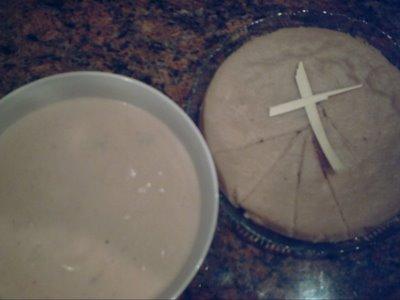
On Maundy Thursday night, the Saint Thomas Christians, observe Pesaha. The breaking of bread, a bread that is broken amidst family members on Maundy Thursday in memory of the breaking of bread by Jesus Christ 2,000 years ago .In memory of this Paschal event, the Saint Thomas Christians have the unleavened bread called Pesaha-Appam along with Pesaha Pal or Passover coconut milk.
Pesaha Observance among Saint Thomas Christians
From the very olden days, Saint Thomas Christians used to make Pesaha Appam and Pesaha Pal at their house. Traditionally, head of the family cooks the Pesaha Appam and Pesaha Pal by woman of the house. During the time of making Pesaha Appam and Pesaha Pal, family members spend their time in prayer. The main ingredients of Pesaha Appam are rice flour and urdu dal and that of Pesaha pal is coconut milk. A cross is made on the Pesaha Appam using the Kuruthola (blessed palm leaves) of the preceding Palm Sunday before it is baked.
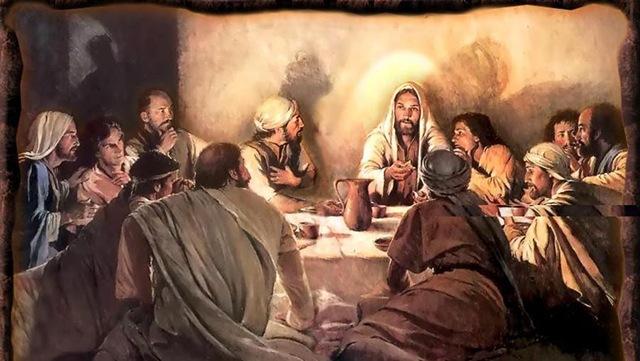
Pesaha (Maundy Thursday) is observed under the leadership of head of family. After the evening prayer, biblical passage about last supper is read while the Pesaha Appam is broken. Head of the family breaks the Pesaha Appam in to thirteen pieces. Thirteen pieces symbolizes Jesus Christ and the twelve Apostles. With prayers, he gives it to the woman of the house after soaking it in the Pesha Pal. It is then distributed amongst the family members according to their age (eldest to the youngest).
Apart from the celebrations at home, there is a special church service with Holy Communion at Pesaha ( Maundy Thursday)
The Current practice is to observe Pesaha once in every year. This is a living tradition among the families of various Saint Thomas Christians namely Syro Malabar, Jacobite, Orthodox, Mar Thoma, Syro Malankara and Chaldean reflecting a common tradition.
Till the beginning of this century this observance was three times an year. (( Kunnukuzhiyil Kochuthomman Appothikari, Parishkaripothi- as quoted in Malabar Church Puthiya Velichathil by Dr. Charles Payngot )) There is a tradition that Pesha is not celebrated in an year when some one of immediate family dies.
In olden days, there was also a tradition of sprinkling the coconut milk used to make Pesha pal in the front doors of the house. (( Article of Dr. Joesph Kallarangat in Deepnalam )).
Pesaha Appam is also known as Indri Appam and Kalathappam in some parts of Kerala.
Some say the name, Indri Appam got originated from INRI ( Mathew, 27,37) but others say that’s speculative and chances are limited.
There are some differences in the way Appam is prepared in Northern and Southern Kerala. In Northern Kerala, the prepared batter for the Appam is poured in a dish and kept over a large pot ( Kalam) filled with sand. Another pot ( Kalam) is kept over the dish filled with burning ember. The Appam is thus baked and known as Kalathappam. (( Malabar Church Puthiya Velichathil by Dr. Charles Payngot ))
In Southern Kerala, Pesaha Appam is baked with steam similar to Vattayappam and known common as Pesaha Appam or Indri Appam.
Good Friday
Good Friday is observed as a day of prayers, penance and fasting to commemorate the crucifixion of Jesus Christ on Calvary Hills nearly 2,000 years ago. Good Friday is of great significance and presently church service starts at 9 a.m. and continues until about 3 p.m., when it is believed that Christ was crucified.
Many of the present practices in Good Friday are result of influence from missionaries. In most churches, the Good Friday highlight is the `Nagarikanickal’ ritual, where the crucifix is carried through the streets/ church premises in a procession.
Amongst the Catholics, the `Way-of-the-Cross’, the 14 stations on Christ’s Journey to Mount Calvary from Pilate’s palace, is re-enacted with the worshippers moving to each station singing hymns as the story, which leads to the betrayal, arrest, trial and crucifixion of Christ, was narrated by the priest.
The most solemn moment is the drinking of ‘choruka’. This ritual of drinking choruka (a decoction made of bitter gourd juice and vinegar) and gruel (kanji) on Good Friday continues to be observed without change. This is given to every person who arrives to attend the Good Friday service and symbolises the event which took place when soldiers mocked Jesus by giving Vinegar while on the cross. Soon after this, the Good Friday service comes to a close in the churches here. Later on, mainly in Jacobite/ Orthodox Churches people line up to eat the gruel (kanji) made out of rice, pulses and mango pickle.
Holy Saturday (Dukha Shani)
Till the beginning of twentieth century most of the Churches among Saint Thomas Christians remained closed on Saturday following the Good Friday. This practice was changed under the missionary influence
Amongest Jacobites/ Orthodox Qurbana is held on Saturday and dearly departed are remembered and prayed for.
Easter Sunday
For all Saint Thomas Christians, the Easter day begins with a visit to a church as early as 2 a.m. Sunday morning, while in some churches the Easter mass began along with the sunrise. The most important meal on an Easter day is a heavy breakfast comprising of appam, made out of rice powder, mutton or chicken stew, steamed bananas, eggs and cakes.
Easter Week Celebrations
Easter week is very important with special church services on Palm Sunday and also every evening including Good Friday. Christians in Kerala celebrate Easter after observing a 50-day lent. The Saint Thomas Christians were very particular in observing lent. This is something which has been specially noted by almost all the missionaries who came to Kerala.
Msgr. Roz S J, the first Latin bishop of the Saint Thomas Christians wrote in 1604,
“ that they ( Saint Thomas Christians) left Crangannore on account of the many molestations of some also religious ( Portuguese missionaries), who did not understand anything at all that was not of the Latin Rite, and declared everything else at once as heresy and superstition, forcing them to eat fish and drink wine in Lent ( fasting days before Easter) against their Rite, though this fasting is more in conformity with the holy canons and the fasting of the orginal church.” (( G Schurhammer, The Malabar Church and Rome ))
Those who do so eat only vegetarian meals and refrain from consuming alcoholic beverages.
Easter falls between March 22nd and April 25th on the first Sunday after the first full moon following the vernal equinox (the time in spring when the day and night are of equal length – March 21st). The liturgical year revolves around the crucified and risen Christ. Easter is the hinge on which the whole church year swings.The fixing of date for Easter was discussed on Syond at Nicca in 325 AD. The decision taken was to celebrate Easter on Sunday that follows the full moon after the 21st of March. [ See below Post –568 from Joseph George. Many thanks to Joseph George for the corrections.]
Picture Courtesy : Inji Pennu – ((Acknowledgement: myinjimanga))
Picture Courtesy : The Hindu
________________________________________________________________________________
Author can be reached on admin at nasrani dot net
Last Update- 04/10/2009
________________________________________________________________________________
thanks for your insights to Nasrani life.
Dear Nasrani,
With all the due respect, let me disagree with the last paragraph of this article regarding the Pessaha – Easter timing. There is a slight correction.
Historically, it was NOT the Resurrection that was commemorated on Passover but it was the Crucifixion! The original Pessaha that started in Egypt with killing of the lamb was a shadow of Christ’s crucifixion. True to His Jewish faith, Jesus celebrated Passover at sunset on the 14th of Nissan (roughly in April) and was executed on the day time of 14th Nissan. A day for Jesus and the apostles were from sunset-to-sunset as per the Jewish calendar and NOT from midnight-to-midnight as we do according to the Roman (Julian) calendar. Throughout the Bible the day starts at sunset and continues until the next day sunset.
Again in the early years of Christianity, Jewish Christians or Nasranis DID NOT observe Passover and Resurrection together; they observed ONLY the Passover along with other Jewish festivals like Pentecost, Unleavened Bread etc. If you read the Acts of the Apostles carefully we can see that the apostles including Paul celebrated all the festivals in Jerusalem. In Acts 18:21, Paul says that “I must by all means keep the coming feast at Jerusalem”. This is several years into his ministry. Again in Acts 20:16 Paul desires to be in Jerusalem on the day of Pentecost. In 1 Corin 5:8 Paul tells all Christians, “So let us keep the feast (of Unleavened Bread)”!
However the earliest Nasranis never celebrated the Resurrection because there were no such commands either from Jesus or from the original apostles. Since the Resurrection and the Crucifixion did not occur on the same day (there were three days gap) the Nasranis could not keep both Passover and Resurrection on the same day! It was impossible.
Jesus commanded the apostles to keep the annual Passover as a memorial of His Death. Apostle Paul instructs the Corinthians how to keep the New Testament Passover in 1 Corin. 11:20-34. All of these are “silent” as far as the commemoration of the Resurrection is concerned.
It is a historical fact that the Gentile Christians in the Western world celebrated the Resurrection as Easter on a Sunday closest to Nissan 14th while the entire East Syrian Christians (Nasranis) and the Greek Christians kept the 14th Nissan Pessach.
In fact this was the first great schism which rocked the churches in the first and second centuries. This controversy is known in history as the “Quartodeciman Controversy”. It is a very interesting account to read. Those who kept the Nissan 14th Passover were called as Quartodecimani. Quartodeciman means 14!
The controversy started when Pope Anicetus from Rome (in fact the name Pope was not used at that time) asked for a uniform keeping of the Easter which was rejected by Polycarp, Bishop of Smyrna famed to be the disciple of Apostle John. Polycarp traveled to Rome to meet Anicetus and both could not convince each other. True to the spirit of the first century they parted in peace.
However the situation changed in the second century when Pope Victor from Rome again commanded all Christians to keep the Easter. This time it was rejected by Polycrates, the disciple of Polycarp. Victor threatened with excommunication. Soon other bishops like Irenaeus (Bishop of Gaul) intervened and the schism was avoided. Finally the controversy was settled in the 325 Synod by which time Polycrates was a memory.
When threatened with excommunication Polycrates responded: “We observe the exact day; neither adding, nor taking away. For in Asia also great lights have fallen asleep, which shall rise again on the day of the Lord’s coming, when he shall come with glory from heaven, and shall seek out all the saints……. and, moreover, John, who was both a witness and a teacher, who reclined upon the bosom of the Lord,……All these observed the fourteenth day of the passover according to the Gospel, deviating in no respect, but following the rule of faith. And I also, Polycrates, the least of you all, do according to the tradition of my relatives, some of whom I have closely followed…..And my relatives always observed the day when the people put away the leaven. I, therefore, brethren, who have lived sixty-five years in the Lord, and have met with the brethren throughout the world, and have gone through every Holy Scripture, am not affrighted by terrifying words. For those greater than I have said ‘We ought to obey God rather than man’… And they, beholding my littleness, gave their consent to the letter, knowing that I did not bear my gray hairs in vain, but had always governed my life by the Lord Jesus”.
Joseph, I like your summary, but I’ll take issue with a few statements. The ‘title’ Pope is derived from the word “papa” meaning father and was used for ALL patriarchs – most especially Rome and Alexandria. The Roman practice of celebrating on the Sunday after 14 Nisan was also the Alexandrian practice.
Dear Michael,
Thanks for the compliments.
I absolutely agree with you regarding the title ‘Pope” as derived from ‘papa’. But the question is whether this title was used in the first and second centuries when “Bishops of Rome” had an issue with “Bishops of Smyrna”.
The Roman practice as derived from Alexandrian practice: I do not find any problem in agreeing with you.
See you after one month.
Is the Appam commonly known as Indri appam or Pesaha Appam ? How did the name Indri appam come up ?
Why is it that the Jacobites burn the Kurothola on Christmas day and Catholics on Ash Wednesday ?
Dear Luke
My guess is since we make cross with palm leaves on the unleavened Pesaha appam, the name came as INRI and then to Indri appam. I have heard most commonly as Pesaha appam among Catholics. This is more common among Catholics.
I don’t know why Jacobites burn Kuruthola on Christmas night. It has been this is what I have seen.
Burning “Kuruthola” on Christmas night and burning “Kuruthola” for Ash Wednesday are entirely different customs. I have read somewhere; do not remember where, probably in here itself, burning fire on Christmas night is a tradition commemorating the burning of fire to keep Little Jesus warm.
Burning Kuruthola on Ash Wednesday-is a different custom. The Roman Catholics celebrate “ash Wednesday”- “chara budhan” as the beginning of lent. For the Eastern Christians, the lent starts on “pethurtha” day- the previous Sunday. The Syriac word “pethurtha” means a looking back or reconciliation. The whole period of the Great Fast is a time of repentance or looking back or reconciliation. The Syriac Catholics, in the past- pre diamper- started the great lent on “pethurtha” Sunday and “celebrated” this as a feast with eating lot of meat etc as no more meat after that day and lent starts on Monday. I do not know, in the pre Diamper period, whether there was a marking of cross with ash associated with the beginning of lent as it seems to be a western custom.
Fr. Varghese Pathikulangara writes- “Anointing with ashes as a sign of beginning the fast is not an Oriental custom. The Mar Thomma Nazranikal were compelled to accept it in the so-called synod of Diamper. Now as they are trying to restore their original identity in its wholeness, they are to correct all such deviations from their identity.” ( http://thenazrani.org/feasts.htm)
Eastern Orthodox celebrates “clean Monday” as beginning of lent. It is also called “ash Monday” in par with “ash Wednesday” but most of the eastern churches do not use ash. But Maronites, the Eastern Church with longest communion with Rome and a church with West Syriac tradition, use ash to mark cross on “ash Monday” ( ref. http://en.wikipedia.org/wiki/Clean_Monday)
The SMC, continued the tradition of starting the lent on pethurtha day even after the Synod of Diamper but celebrated ash Wednesday in par with Roman rite Catholics due to latinisation, but recently, as part of full restoration, has changed to Monday.
I do not know the Orthodox/Jacobites also celebrate ash Monday- using ash to mark a cross on the forehead. Let someone clarify.
Smearing of Ash is not practiced by Jacobite/Orthodox Christians
I would like to know the significance of pesaha pal instead of wine. Please remember, as per the gospels, Jesus Christ used wine and not milk for the last supper
Please, note that “Karikkuripperunnal”, is not “Ash Wednesday” ! For Nazranis, it is Ash Monday.
Kuriperunnal was nothing but Ash Wednesday for Roman Catholics – Latin rites celebrated throughout kerala in olden days