Save Syriac

At a time in history Syriac was synonymous with Nasranis. This article analyze the present situation of Syriac, considering the various factors which influenced the Kerala social sphere.
1. Syriac Language

Syriac is an Eastern Aramaic language that was once spoken across much of the Fertile Crescent. It was a major literary language throughout the Middle East from the second to the eighth century AD. (( -Beyer, Klaus (1986)- “The Aramaic language: its distribution and subdivisions”.
-Göttingen-” Vandenhoeck und Ruprecht” ))
At its broadest definition, Syriac is often used to refer to all Eastern Aramaic languages spoken by various Christian groups; at its most specific, it refers to the classical language of Edessa, which became the liturgical language of Syriac Christianity.
During the first centuries of the Christian era, South India had commercial relations with Mesopotamia and other countries of the Middle East where Aramaic was spoken. Aramaic was the’ Lingua Franca’ of oriental Christianity.
Language is not a mere vehicle of abstract ideas, it is really the authentic expression of a way of life, the living manifestation of a culture. ((Mar Aprem Metropolitan- “Church of the East Mission to India” ))
It became the vehicle of Christianity and culture, spreading throughout Asia as far as Malabar and Eastern China and was the medium of communication and cultural dissemination for Arabs and, to a lesser extent, Persians.
Primarily a Christian medium of expression, Syriac had a fundamental cultural and semantical influence on the development of Arabic which replaced it towards the end of the eighth century.
2. Syriac influence in Malayalam
Malayalam prose of different periods exhibit various levels of influence from different languages such as Tamil, Sanskrit, Prakrit, Pali, Hebrew, Hindi, Urdu, Arabic, Persian, Syriac, Portuguese, Dutch, French and English.
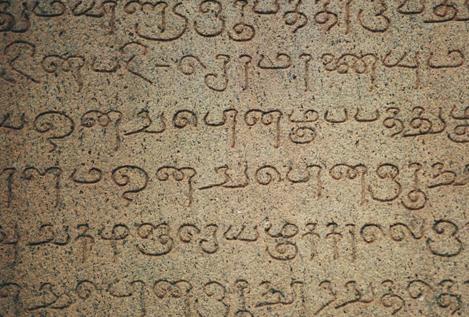
 The Vatteluthu alphabet, which is the ancient Tamil and modern Malayalam script, shows a close Phoenician influence in South India. (( K. P. Padmanabha Menon- “History of Kerala II”, p. 452 ))
The Vatteluthu rounded writing is an abugida writing system used to write some Dravidian languages of South India and Sri Lanka. The earliest written record of Malayalam is the Vazhappalli inscription(ca. 830 AD).
Numerous Syriac words are in use even today in Kerala, e.g., Misiha (Christ), Easo (Jesus), Sleeha (Apostle), Mar (holy), Sleeba (cross), Qurbana (sacrifice), Qudasa (sacrament), Skasa (chalice), Mad’baha (sanctuary), Asan (teacher), became current from very ancient times.
Aboon, Alaha, Almaya, Ameen, Ba’utha, Barekmar, Bukhra, Dayara, Denha, HaikIa, Hannan, Hosanna, Husaya, India (Hindu), Kaldaya, Karozutha, Kasa, Keepa, Madbaha, Mahron, Malakha, Malpan, Mamodeesa, Mar, Maranaya ,Maraneshomeshiha, Marth Mariyam, Maudiyana, Mauthbenmar, Mazmura Methran, Mhaimneenan, Mhshiha, Nasrayan, Parudeesa, Peelasa, Pes’ha, Preeshen, Qabar, Qadisanmar, Qnuma, Qudasha, Qurbana, Ramban, Ramsha, Raza, Resh Pathriyarkees, Ruha, Ruha d’ qudsa, Rushma, Sahada, Samaryan, Sapra, Sedra, Shemmasenmar, Shleeha, Skeepa, Sleeba, Subara, Thakhsa, Uraha, Urara, Yakobaya, Yeerenmar etc..are some of the Syriac words which are in common use in Malayalam language. (( Mar Aprem Metropolitan -“Church of the East Mission to India” ))
3. The Divine Liturgy introduced by St Thomas
Historians are of the opinion that St. Thomas established the early liturgy here in Aramaic (Syriac). St. Thomas provided only the rudiments of the liturgy, but it contained all the elements which later on developed into the full structure. ((Dr. Antony Nirappel -“The Kerala Church” ))
The fundamental structure of the liturgy of the Divine Sacrifice from which the whole liturgy developed in due course seems to have been the same in all churches in the first three centuries. (( Oriental Rites. S. H. League p. 31 ))
In those days, Greek was the chief language of the West; and Syriac, that of the East.
The coins of Augustus and Nero were found in abundance in South India, and the Roman aureus circulated there as currency. (( Annual Report of the Archaeological Department, Cochin State 1947-48 (Ernakulam, 1949))
Hoards of these ancient Roman coins have been dug up from various parts of the country. The coins of Hadrian have been recently discovered at Kurnool. Dio Chrysostome (d. A.D. 117) says that numerous Indian traders were frequently seen in the bazaars of Alexandria. ((Dr.Antony Nirappel-“The Kerala Church”))
A drama written in Alexandria in the first century A.D. has one of its characters speaking Canarese, an Indian language. Evidently, foreign merchants learned Indian languages just as the South Indians had an appreciable mastery of Aramaic.
The Apostles established liturgy in the languages prevailing in the climes they evangelized, chiefly Aramaic in the east and Greek in the west. Since Aramaic (East Syriac), the language of Jerusalem and the Middle East at the time of Our Lord, was known in Kerala due to her overseas commercial enterprises, it is only proper to accept the tradition that St. Thomas established the liturgy here in that language.
On account of their close contact with the Jews, Aramaic was not unfamiliar to the Keralites. ((The Church of Saints Thomas and Bartholomew in Malabar , 1928, pp. 9, 12, 13, 19, Our Rite, Fr. Placid,(Malayalam) Mannanam, 1944, 18, 19))
As we have seen, innumerable very old Malayalam words have come from Syriac. Many of them are current in usage in Malayalam.
4. Importance of Syriac in Indian and Malabar History
Before 2nd c. A.D. the languages that are seen in the inscriptions in India are Tamil, Pali, Arthamakathi, Greek, Aramaic. Sanskrit inscriptions have not so far been uncovered.
The inscriptions of Asoka use three different languages and four scripts. The most important and the largest in number are composed in Prakrit but Asoka also had a few inscribed in Greek and Aramaic. The scripts used for the Prakrit inscriptions were Brahmi and Kharoshthi, and for the others, Greek and Aramaic. The Greek and Aramaic inscriptions are found in Western India and in a group of Asokan inscriptions from Karnātaka in southern India. The Brāhmī inscriptions shows a striking parallels with contemporary Aramaic.
St Thomas cross found at St. Thomas Mount, Mylappor, Pillar Seminary, Goa and different Kerala churches in Muttuchira, Kothanellur, Kadamattam, Kottayam and Alangad are bearing a Pahlavi and Syriac inscription which are dated from 7th Century in C14 dating.
Many historians belive that Syriac script and liturgy – surely the pahlavi script – were in Kerala much before the Devanagari found their foothold in Kerala.
All the Vigrahas or images of Hindu gods and goddesses appearing anywhere in Kerala are datable to a period much later than the time of the Pahlavi crosses of St. Thomas Mount, Goa, Kadamattam, Muttuchira, Kothanellur, Kottayam and Alangad. Of all the rock images in existence in Kerala the Pahlavi crosses are much older than any Hindu Vigraha. ((Christianity older in Kerala, Prof. George Menanchery [K.P.Soundrarajan] ))
Syriac was a spoken language in South India. It was the language of the early liturgy followed by the Syriac Christians of what is now Kerala. To be ordained a priest in the Church till 1960’s, a person had to be able to read Syriac and learn the Syriac liturgy .
In 1578, three lay leaders of the Kerala Nasranis submitted a petition to Pope Gregory XIII, saying, “Our orations are in Syriac or Chaldeae language which our Father St. Thomas gave us. We as well as our ancestors have learned this language.” ((Relationes, Giamil, Genuinae p. 22. ))
 Portuguese in their fight against heresy (?) during the Syond of Diampor destroyed many Syriac books. The books said to be burnt at the synod of Diamper, as given in Jesuits in Malabar Vol.1 are,
1.The book of the infancy of the savior (history of our Lord) 2. Book of John Braldon 3. The Pearl of Faith 4. The Book of the Fathers 5. The Life of the Abbot Isaias 6. The Book of Sunday 7. Maclamatas 8. Uguarda or the Rose 9. Comiz 10. The Epistle of Mernaceal 11. Menra 12. Of orders 13. Homilies (in which the Eucharist is said to be the image of Christ) 14. Exposition of Gospels. 15. The Book of Rubban Hormisda 16. The Flowers of the Saints 17. The Book of Lots 18. The Parsimon or Persian Medicines
In decreces 13, 14 and 15 of session III, of the synod of Diamper the reasons for correcting or destroying the books are given. Some writers point out that this is not an irreparable loss because the copies of them can be had from their places of origin and issue is exaggerated and kept alive with out proving or disapproving for gains. ((Kerala Coast, Portugese, P J Tomy ))
The burning of 18 Syriac books on the Syond of Diampor convened on June 20, 1599 under the leadership of Aleixo de Menezes, Archbishop of Goa shows the importance Syriac language had among the Christians of Kerala.
5. Indian Churches- Syriac tradition
The Syriac Churches in Kerala belong to two traditions- East Syriac ( Chaldean) and West Syriac ( Antiochene). Syro Malabar Church and Chaldean Syrian Church belong to East Syriac ( Chaldean) tradition. Malankara Syriac Orthodox Church, Malankara Orthodox Syriac Church, Syro Malankara Church, Thozhiyur Church and Malankara Mar Thoma Church belong to West Syriac ( Antiochene) tradition.
The Churches with East Syrian tradition use the Anaphora of Addai and Mari as their liturgy. The Churches with West Syriac tradition uses the Anaphora of Saint James as their liturgy.
6. Downturn of Syriac in Kerala
Later developments notably the Second Vatican Council allowed the liturgy to be translated into local languages among Catholic Syrians. Until the 1962, the official liturgy used for worship in the churches of Catholic Syrians was ancient Syriac, although many prayers and hymns were already in the local language, Malayalam.
In Syro Malabar Church, Malayalam Qurbana was celebrated for the first time on 3rd July, the feast of St. Thomas in 1962. Though texts of Qurbana exist officially in Syriac, Malayalam and English, its celebrated mostly in Malayalam now.
At a similar point of time the Syriac Orthodox ( Jacobites) also started using Malayalam as liturgical language. The Qurbana of St James also got translated to Malayalam and currently uses many Syriac prayers and hymns in Malankara Orthodox Syriac Church (Orthodox), Malankara Syriac Orthodox Church ( Jacobite), Syro Malankara Church (Malankara Catholic) denominations.
Under the Anglican influence, in late nineteenth century, the Protestant Syrians started using Malayalam as their liturgical langauge. Malankara Mar Thoma Church uses the reformed liturgy in Malayalam.
7. Syriac of Today
Today, a mere one million people worldwide speak Aramaic. In some small mountain-villages of Syria and Iraq there are both Christian (Orthodox and Catholic) and Muslim communities who speak this language. They co-exist without any enmity due to religious differences and, although the official language is Arabic, at least some of them try to keep the ancient language from dying out.
In Kerala there were demand from a very large section of laity for re introduction of Syriac Qurbana atleast a month , and on festive occasions, and for elementary Syriac education as part of catechism etc. This has got luke worm response from Church leadership.
All the St Thomas Chrsitian churches run large number of “Minority Institutions” and these days Syriac is not getting any prominence as a choice for second language as part of the curriculum. Article 29 (1) of the Indian Constitution stipulates “any section of the citizens residing in the territory of India or any part thereof having a distinct language, script of culture of its won shall have the right of conserve the same”.
Are the “Minority Institutions “ignoring the Syriac language studies doing justice to the Indian Constitution ?
8. Ray of Hope
Syriac is witnessing an expansion in western universities. In the late 1980s, the Oxford University began to offer a Master Degree in Syriac studies. The University of Birmingham followed the suit. In most of the major universities, Syriac is taught either in Semitic departments, religious studies, or both. Mahatma Gandhi University, Kottayam in Kerala has a Ph.D. program in Syriac.
The liturgy and traditions of many of the Eastern churches derive from Syriac, ironically only in south India there is an institute dedicated exclusively to the preservation of these traditions. The St. Ephrem Ecumenical Research Institute (SEERI), established by the Syro-Malankara Catholic Church, Diocese of Tiruvalla in September 1985 near Kottayam, Kerala, is the only institution in the world for advanced learning and research in Syriac heritage and literature. SEERI’s activities and functions are governed by a board of distinguished leaders representing the seven Syriac churches in India – Catholic, Orthodox and Protestant denominations.
SEERI seeks to foster and deepen the mutual understanding of these Syriac churches through close collaboration in the search and study of their common heritage. The institute possesses a spacious library and reading room. The library houses a fine collection of books and publications not formerly available in India. Presently the microfilm collection has over 10,000 pages of mostly unpublished Syriac texts and manuscripts. Equipment for microfilm and microfiche has been installed to grant access to these documents. There is also an ever-expanding section of modern books on various theological subjects.
The institute also conducts a World Syriac Conference, which has been held in September every few years since 1987. Scholars in Syriac language and literature and renowned authorities on Syriac Christian issues, from India and abroad, participate in the World Syriac Conference . These academic gatherings have certainly charged the participants to delve deeply into the Syriac tradition, which in the course of history has proven to be a treasure trove.
We hope conferences of this type will enable the members of the Syriac churches of India to know and appreciate their own precious patrimony and to draw abundantly from it for the spiritual and liturgical renewal of their churches.
Besides the periodicals The Harp (in English, three issues a year) and Nuhro (in Malayalam), SEERI also publishes a series entitled Moran Etho. Monographs include periodic publications in English and the SEERI Correspondence Course (S.C.C.), an English language course on Syriac Christian heritage.
SEERI has been recognized by Mahatma Gandhi University, Kottayam, Kerala and its Centre for Research Studies now awards a doctoral degree in Syriac studies.
9. Conclusion
Scripture, the Fathers and the Liturgical sources, are not simply testimonies of past history or a subject of archaeological interest, they are testimonials in the deepest sense of the word of a ‘story’ between God and his people. They are the knots in the woven fabric of which we are the newest threads striving to interlace with one another to form new cloth.
 The Church’s labour is precisely bringing forth the deeply ingrained new and reshaping an already established deposit. And to do this Church must pore over the sources of her faith keeping before her eyes – or better in her heart, the needs of the world today.
We are not children of a legendary past, instead, believing that the Lord Jesus will come again, we attest that fulfilment lies not behind but ahead of us.
This is not looking back. In fact rediscovering the sources of one’s faith is not moving back, just as authentic prophecy is not moving on.
Going to the sources if we think carefully, is not a temporal itinerary back to the past, but rather a journey which probes deep and goes to the essential. This is a journey which helps us asses the ecclesial nature of our faith, our ideas and our responses to the challenges of today.
The old “ Suriyani Qurbana” and the new “ Malayalam Qurbana of Addai and Mari” and “ Malayalam Qurbana of St. James “ are authentic expressions of the faith and human experience of Syrian Christians.
It does not confront with each other in insoluble contrast, on the contrary sustain and illuminate one another reciprocally.
Pictures
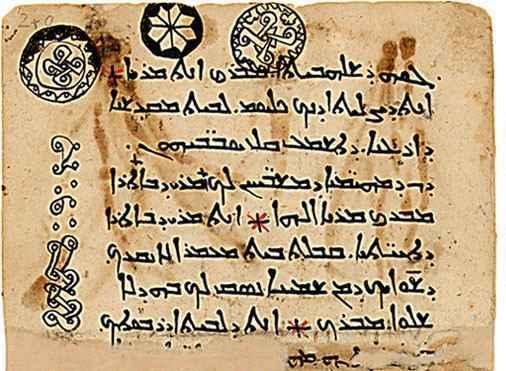
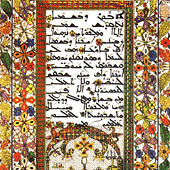
1.The sixth beatitude (Matthew 5:8) from an East Syriac Peshitta. “Blessed are the pure in heart: for they shall see God.”
2. Comparison of Vatteluthu and Syriac alphabets
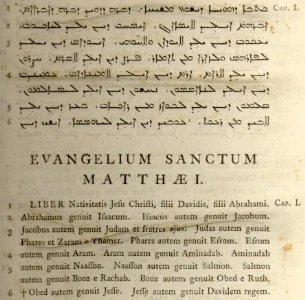
3. Syriac text of Mathew Gospel
4. Lords Prayer in Syriac
_____________________________________________________________________________
Author can be reached on admin at nasrani dot net
_____________________________________________________________________________
Very interesting and timely article when all the churches of Kerala are looking at Pentecostalism and Charismatics for an easy and short cut revival of spirits.
There is no place in the Bible where people were lined up and Jesus or Paul or anyone else went along and tapped them on the head and watched them go down, one after another, and somebody else ran along behind. Can you picture Peter and James — \”Hold it, hold it, hold it!\” — running along behind trying to catch them? And so the model that we\’re seeing, either on stage or on television, is totally different from anything that\’s in Scripture.
Looking at Past is not clinging to old and agree with the statement. “In fact rediscovering the sources of one’s faith is not moving back, just as authentic prophecy is not moving on.”.
Some people told me about the origin of our Christianity earlier is that there were apostle or judo Christianity in Egypt, Armenia , Ethiopia and Russia.
Therefore the same occurrence happened that bishops along with some Syrians brought this apostle or judo Christianity in kerala
People except the Syrian group which are the converted and became the followers of these church traditions in kerala.
People who talk about this idea do not even mention about St Thomas and his missions and there is no Nasrani origin from Jewish settlement.
Some told that it not a good thing to know our origin because it is not a way to heaven and they fail to accept the real history of our Christianity.
They even mentioned that Russian Communism started out of this Judo Christianity.
Thanks
Reviving the spirits by going to sources is the need of the hour. Syriac is almost forgotten.
Good to see that NSC has started addressing current issues. Like I pointed out earlier we people are very busy earning two cents for our daily bread but we do read what you come up with and truly enjoy that. As like anything written this will come handy for people when they have time to sit and look at who they actually are ?
It does take time and effort and we appreciate you and thanks.
I have a personal experience with Syriac language. When I joined college for Pre-Degree, I opted for Syriac as my second language because all my friends took it as we thought we could score more “marks” in exams!!
I reluctantly “learned” it just “enough” for the exams! Today, when I look back, alas, what a golden opportunity I had which I lost!
I forgot all the alphabets. Now the only Syriac words I can remember are Alaha=God, Beth= house, bara=son, Ruhadakhudisha=Holy spirit.
Today I try to learn Hebrew and koine Greek through books and Net and yet I feel I am in nursery school.
During those days, religion was the last thing I looked at and practically I did not know anything about nasrani and syrian roots.
When people said about Syro-Malabar, I used to wonder why they say “Zero-Malabar”!!! I sincerely thought they said zero-malabar because I was zero in everything!
So the practical difficulty here is that when our younger generation gets a chance to learn Syriac they do not realise the value and when they realise the value the opportunity is lost, something which in my case happened.
So I do not know how practical our wish to revive Syriac is.
But one thing should motivate us. The Jews as a nation has revived the DEAD Hebrew as their SPOKEN language after more than 2000 long years! It is a miracle from God just like the partition of the red sea!
The question is: will God do such miracle in the case of Nasranis and Syriac?
I fully agree with Benny (above response) regarding Pentecostalism and Charismaticism. While my intention is not to judge Pentecostals and Charismatics, it should be noted that in the first century, the Apostolic Christianity was known as a “WAY” of life (Acts 22:4, 24:14,22) which was to be “LIVED” not to be just “sung” about and “danced” about! I know that a lot of people who attends such Pentecostal and Charismatic conventions get “peace of mind”. But we should not forget that many desciples of Sathysai baba, Amruthanandamayi, Rajnish and Sabarmala (who do not follow Jesus) also get the same “peace of mind”! (I am sorry if I hurt sombody’s feelings).
Our Nasrani root also says the same thing. The Nasrani word for Christian Way in Malayalam is “MARGAM”. When some one accepts Christ our forefathers said, “Margam Kootuka”!! This is one of our Judeo Christian heritages.
When I hear a lot of “Praise the Lord”s, I believe Jesus foreknew about these two phenomena and that is why He said “Not every one who says to Me Lord, Lord will enter into the Kingdom of Heaven, but the ones who DO the will of My Father in Heaven”(Mat.7:21)(emphasis added).
So let us go to the nasrani root.
NSC, syriac need to be preserved and it need to be given the importance it had in our life.
article 29 (1), minority institutions and syriac, are u trying to twist indian constitution.
does SEERI offers correspondence courses. please reply.
about syriac..
Syriac is born from the aramaic language. Aramaic was formed from hebrew. While the kingdom of judae used hebrew as there mother tounge, people of kingdom of israel used a modified hebrew later developed into aramaic. The aramaic got spread into the asyrian area when Israelis were taken as slaves and got modified into syriac. Jesus Christ who is from nasareth (actually area of kingom of Israel) used aramaic as his mother touge rather than hebrew offical language of kingdom of judae.
there should be some initiative from our side to revive our old mother tounge. of couse our fore fathers had developed malayalam with their contribution of syriac words, we need to preserve our identity. please discuss various sugestions for the revival of syriac
i think first step is to have a basic training of syriac language to those interested nasranis. what and how can we do that??
Pentecostalism and Charismatics are not the only challenges for syrian churches. Indiscipline is the major challenge. It’s a pity that there are cockeyed minds trying to convert Syrian churches to Hindu churches. These are all one side of the coin, the very crocked minds who fuddle activities in the name of evangelization.Last ten years Syro Malabar is only generating negative impact in the equilibrium.
The re introduction and going back to sources for revival of churches will only happen when these elements get properly Christianized.
Syrian Christians are the most patriotic community in India. The community has developed todays status by the guidance of fore fathers with out any of this cockeyed activities and the revival of sprits in churches with Syrian tradition will only happen by going back to sources.
Personally I don’t think any of the Seven Syrian churches are interested in reviving Syriac, they are busy looking for Sanyasis for short cut coaching.
Syriac is not popular in our community because our mother tongue is Malayalam, a pro-dravidian language. In Kerala, people do not study a subject of their taste. The choice of subject is on the basis of its prosperousness after completion (that’s why we have lots of nurses). Moreover, a student’s aim is to get good marks in subjects and eventually build a good career. We really need to think how we can trigger such a passion or taste for learning Syriac. It is difficult in our community, because our people don’t know their traditions and heritage passed through centuries. A kind of patriotism is needed among our community members if we really want to preserve Syriac. If we can’t do this, don’t worry, SEERI and M G University will preserve it.
Some suggestions:
1) Make Syriac as an optional second language in those schools run by the Syrian Christian managements.
2) Elementary education of Syriac in Sunday school.
3) Introduce lecturer/teaching posts in colleges and schools, people will simply start learning it on the hope of a job.
4) My church mass timings are 06:00, 07:30, 09:30 and 17:00. Why cant one of these can be in Syriac? [How many of our younger generation priests know Syriac?].
Who is going to preserve syriac if we cant think about it
If Hindus can think about Sanskrit and Muslims Arabic why cant we do something to keep it at least as an academic subject. What is the purpose of running all educational institutions when we cant do justice to forefathers ?
am a spanish student -on my own-of this beautiful and curious language.the most i study it the most i think it must be not only preserved in church,but used effectively as a communication device,and be the support of literary creation again.i spent some time in turkey and the small christian community there is doing a great effort in the revival of this language.they have even managed to create new vocabulary for nowaday things such as tv or radio,university,etc.
I was very happy to come across this site that endeavours to cultivate an interest in this ancient and beautiful liturgical languare. What is shocking today in the Nazrani community in Kerala is the total lack of awareness about their rich heritage. The nazrani christian names were mostly syriac. I want to draw the attention of readers to this one point now. We had names like Ghivarghese, Kuriakose, Matthai, Yohannan, Thomma, Youseph, Mariam etc. just to mention a few. These have been replaced by English names like George, Cyriac, Matthew, John, Thomas, Joseph, Mary respectively. The old names are today considered old fashioned. The English names have even crept into POC Bible!
This is indicative of the attitude of the newer generations. What is foreign esp. europeon is considered stylistic. I have even come across people who think these Malayalam names are derived from English!
Syriac is beautiful. The mass in syriac with their heavenly music has become rare in our churches. I would like to suggest that we make a conceted effort to reintroduce the syriac mass in our churches at least partially in order to revive the interest in Syriac.
Its feels real good to see many thought provoking comments/ suggestions.
There are many traditionalist in all the St. Thomas Christian churches, but ironically the new age Pentecostals/ Charismatics / Hindutva Christianity minds takes active role in church most of the time making them silent.
In my opinion that’s the main problem and one of the main reason for the degeneration in all St Thomas Christian churches.
Our fore fathers were moving on for the last 2000 years, believing that the Lord Jesus will come again keeping our faith and traditions.
Today we are not even practicing Christianity. Last 50 years with Pentecostals/ Charismatics / Hindutva Christianity, what we have achieved is population growth from 25 % to 19% in Kerala. Its not different in national level also.
We blame our fore fathers for not doing evangelization and we call them illiterate fools and we give a blind eye on stupid blunders today’s generation is doing in the name of evangelization affecting communal harmony.
The traditionalists in all St Thomas churches number much higher, in fact n times than this Pentecostal/Charismatic/ hindutva or the liberals.
On a closer look even the Pentecostal/Charismatic/ hindutva or the liberals, are traditionalist to some extent and the major difference is they tend to give justification to their views on extra practicality in terms of Inculturation, liberal attitude etc.
I think we should be careful in appreciating Inculturation. Most of the time the Inculturation happened or what we see as happening in 2007 in St Thomas Christian churches are rather forced ones. Its very common that in all churches, the leadership is propagating forced Inculturation which is a blunder, in a very systematic way. No one has any objections to the natural Inculturation happens or happened. When it become forced I think, that need a careful judgment and the response should not be different of what it got centuries/decades ago.
As like some commentators on article pointed out, I also think that none of the Seven churches has any real interest in saving Syriac.
But am sure at one point, if the Church leadership continue to look at this as dis passionate onlookers, the future generations might not be generous in commenting about them. May be youth of today doesnot scold them and keep on talking this same thing continuously for long time to deaf ears. But don’t expect that generosity from future generations. They will just scold in a one liner.
The all purpose of ‘ Save Syriac’ article was not just looking at saving a dying language. Its actually the need for looking at sources for revival of faith in churches. We people are so used to short cuts and even for revival of spirits in church our leaderships looks for short cuts.
We take the least pains in understanding what we are and for most of us we came in to existence just from 16th or 17th century, which is not truth.
Some people take the least pains in understanding Indian culture and pose like advocates of Indian culture with out knowing anything about that.
I have seen people saying these are not relevant to us. Those minds try to put a wrong perspective of fundamentalism to these kind of efforts.
We are 110 percent Indian Christians and we don’t need anyone’s certificate for that. Learning Syriac or sticking to our culture doesnot make anyone less Indian.
In fact it makes us more proud being part of this great civilization, show casing great examples of diversity, successful and peaceful co existence for centuries. It should make the community members more nationalistic and patriotic and other religion members proud on the Indian Model of religious tolerance and harmony.
The local culture developed has harmonious exchange of different cultures. It incidentally depends on the time frame people are defining for that and for Christians its mostly the wait for the second coming of Jesus after the resurrection
In fact systematically educating the people about church and traditions and its history uniformly in all our diocese is a very simple task. It don’t even need to be included in 12 years we have on Catechism. Just one or two years is more than enough.
Unfortunately for hiding the in ability of leadership, our leaders are making everything look complex. Then there are three parameters, the minuscule activist for Pentecostal/Charismatic/ hindutva Christianity who tries to make things look complex and vague for their survival. Most of the things about our traditions are established facts which no one need a passion for understanding.
Some fifteen years back, in my parish there was an old retired priest who was there at his ancestral home most of the time in an year. He only celebrate Qurbana in Syriac. Even the mass time was at 5.30 AM in the morning. This Qurbana had good number of participation comparing to my parish’s daily Qurbana in Malayalam at 6:30 AM. After his demise I don’t know of any priest who celebrated Syriac Qurbana there.
Society has changed, People have changed and expecting churches to change accumulating all the western impieties is not fair.
Churches cant behave like television channels switching from DD1 to MTV.
Looking at sources is not clinging to old.
Scriptures, Church fathers, liturgy sources can not change with changing society. Churches should ideally help the faithful in rediscovering the sources of one’s faith to meet the challenges of today.
If we look globally, in Middle East there might be hardly 4-5 lakh members ( less than 1 million for sure, realistic calculation is difficult) of different Patriarchal churches. Due to the politics and volatility of the region each year there numbers are reducing and may be they might end up as handful in one or two decades.
Only in South India we have 5-6 million strong heirs of Syriac Christianity. Though none of the churches are Patriarchal as of now, I think we have the responsibility to keep the traditions and faith alive for future generations. Only we can do that expecting the dying churches in Middle East to do that is very un fair.
In my opinion, it’s a historical responsibility for the members of Kerala Syrian Churches.
@ Tijo
Indian constitution ensures that the country is doing justice to religious and linguistic minorities.
The two Claus of Minority Right are equally important.
Article 29 (1) Any section of the citizens residing in the territory of India or any part thereof having a distinct language, script of culture of its won shall have the right of conserve the same.
Article 30 (1) All minorities whether based on religion or language shall have the right to establish and administer educational institutions of their choice
We talk about Article 30 ( 1) and when its challenged we don’t mind going to any extreme.
But we are silent on Article 29 (1) and none of our educational institutions are ensuring that we are doing justice to the Indian Constitution.
Going forward, we can expect secretrain attitude from govts as population is a major factor in electoral politics. If we go on like this, there will be a time in future when Judiciary makes an observation that minority institutions run by our church are violating the minority rights. When that happens our leadership wont even get the support of anyone from laity for sure, because of the simple reason that Christians are very patriotic and they trust the Indian system and that would be a very valid observation.
SEERI offers many courses and the information you can find at their website [http://seeri.org/index.htm ].
I just came across this information from one of the earlier activities of SEERI.
Syro-Malabar Archbishop Mar Joseph Powathil inaugurated the third World Syriac Conference. He was assisted by Mar Paulos Gregorios of the Syrian Orthodox Church and Mar Timotheos, Syro-Malankara Bishop of Tiruvalla.
Eminent scholars were available for guiding research in the field of Syriac language and literature, patristic thought, liturgy and church history. Liturgical celebrations and prayer services were organized by the different Syriac Christian denominations and were conducted in a truly ecumenical spirit. A prayer service in Syriac was directed by the Rev. M.P. George, the Director of the School of Liturgical Music, Orthodox Theological Seminary, Kottayam.
The only other some what positive step am aware is the “ planned “ Research and Study Centre on Chaldean Legacy of Mar Ephrem at Nallathanny, Diocese of Kanjirapally, Syro Malabar Church.
Its an ecumenical initiative with the Chaldean Church focusing on East Syrian history, culture, liturgy and Saints with particular focus on St. Ephrem.
Its paradoxical that the institutions rich Syro Malabar has not so far taken any initiative to presevre Syriac.
Lets hope that more and more this kind of positive activities and discussions will help St Thomas Christians to develop brother hood and looking for opportunities to preserve our culture and the need of the same.
Church leadership has the responsibilty to do justice to Syriac. There is no single reason which prevents implementation of the suggestions.If they are going to be a continous failure, history will not forgive them.
Dear Nasrani,
I fully agree with your bold statements. What motivated me for this response is your statement: “Our forefathers were moving on for the last 2000 years, believing that the Lord Jesus will come again keeping our faith and traditions”. It is a bold statement to make in this ultra modern world because the belief in the Second Advent is considered an anti-scientific superstition!! I know many Catholic priests who find it difficult to believe in a literal coming of the Lord! (As far as I know what our priests learn in the Seminary is not Biblical truths but “Christianised” Greek and Egyptian philosophies in the name of theology)!
In all my years I have never heard in any of the Sunday Qurbana speeches by the nasrani priests or in any of the Sunday school classes by the nasrani teachers about this Second Coming of the Christ. Not even once! The only exception is my mother who heard about it somewhere else. (In the Sunday schools and church speeches they speak about cultural and social values etc).
Yet later when I studied the Bible, I found out that in fact the Second Coming of Christ is the CENTRAL THEME on which all the apostles and saints bet their life and faced courageously the slashing sword that was flashing against their throat or the hungry lions that were pouncing on their body or the scorching pyre that was engulfing them. And this central theme is one of the major COMMISSIONS entrusted to the Church by Christ and yet the Church is silent on it!
Why? Because we have shifted away from the true Nasrani values.
The more I study about Nasrani Christianity I come to believe that there is a concerted effort from the Church hierarchy, deliberately or otherwise, to conceal our nasrani identity for what reason I do not know. There is a gradual shifting away from our true Nasrani values.
Once a Syro-Malabar priest told me that until the Portuguese, the Syrian Nasranis were CHRIST oriented and after that time we were “converted” to be MARIAN oriented! (History approves this. In Edward Gibbons classic book “The Rise and Fall of Roman Empire” it says that when the Malabar nasranis were introduced to Mariolatry by the Portuguese they reacted strongly stating that they are not idolaters!!).
This shifted our focus. (In fact the Nasranis had a true understanding of Mother Mariam)!
Until the Portuguese we had Peshita Syriac Bible to rely upon. But after that what we had? I am born and brought up in a Syro-Malabar church. In my earlier years nobody in the church referred to the Bible as an authority. At our homes nobody read the Book except may be on Good Fridays from the four gospels about the crucifixion event. (We had only a New Testament Bible).
To me it was taught as a story book full of good stories about David, Solomon, Moses etc. so that it inspires people to lead a good life. Not to be taken literally. So I was shocked when somebody in a quiz program asked the year of crucifixion to me! Later when I read a news report on some issue in Jerusalem in Deepika newspaper I realized this city existed on this earth!
After the Portuguese, who suppressed the Bible and along with it our Nasrani identity? One by one we are losing our identities. I read somewhere that the early Nasranis in Kerala were keeping the liturgy on Saturday Sabbath! In the 1960s we lost the Syriac language also which clearly identified all the Mar Thoma nasranis irrespective of their different denominations.
As you said “save Syriac” is not simply reviving a dead language but “save Syriac” is reviving the rich Nasrani values that went with the Syraic language and the Peshita Bible!
To be objective, it is much afterwards that the interest in the Bible was revived in our church because of a new movement known as “Charismatic”. This charismatic movement was a church effort in response to the Pentecostalism which was attracting so many people out of the church. It is after the charismatic movement that the non-charismatics were encouraged by the church to read the Bible. And it is because of the Bible that I noticed the importance of Nasrani Christianity.
Even many western scholars agree that the Syriac Christianity was the largest and the richest Christian stream compared to the Celtic, Latin and Greek streams of Apostolic Christianity. The Syriac Christianity has reached from Antioch even up to China and Japan for a time and it has even penetrated the family of Genghis Khan!!! (Our Syrian forefathers were more courageous than us!).
Moreover, it was because of the proud, quarrelsome and infighting Jesuits and Carmelites that the doors of China, Japan and Emperor Akbar’s India were closed to Christianity. This legacy still survives.
Today according to many knowledgeable scholars (including the western scholars) we, the Syrian Nasrani Christians in Kerala, are the ONLY relevant surviving REMNANT of this ancient Syriac Christianity that spanned from Palestine to Japan!!
Do our church leaders have “ears to hear” regarding the importance of Syriac in our heritage?
Yes, “today we are not even practicing Christianity”!!!
I think that there is no point in discussing these things in this web forum. As laity, we should take some steps to inform about these discussions to our leaders. At least some of leaders will be happy to do something towards it. All laity in SMC are ignorant and that is why all these indianisation and liberalisation getting deep roots among our people.
Let me say my OPINION is that even before we preserve Syriac
Let’s try to make people aware of what is our possible roots. See I was ultimately thinking that I was a Hindu convert. Here in US, many work places I went and people asked me are u from India? and are u Hindu? Few times I was even replayed that I am a Hindu. That’s how foreigner look at us as Hindus. There is North Indian culture is highly attractive for American community. If I am gona tell them I m a Christian it’s like so rare. I know it’s my fault. Even in India the land we live the movies we see and that culture we practice it’s more of Hindu that Christian.
I was also thinking what are this church traditions? what that has to do with me,? where it came from?
I can be a Hindu convert and I don’t need this traditions so unfamiliar to me. I didn’t even know so many things like how many church denominations we have and who r knanites etc. I know that it’s not a good thing to give too much preference to histories than spending time to know God.
But I think that Syrian Christians should know their roots before they going to loose it for ever.
Once I came across NSC site I start knowing things are different that where this church traditions came from and regarding Hindu converts that there can be some more information regarding our ancestors (nasrani origin) need to reveal. Now I am sort of proud to say that I am a kerala Christian or Nasrani. Also I really feel that importance of saving not only Syriac but also many evidences regarding our roots.
Thanks
SEERI
Following are the details of a communication from Fr. Jacob Thekeparampil,
Director, SEERI for those who are seriously interested in learning Syriac.
Every year during April-June period SEERI conducts a Syriac Certificate Course (under the auspices of Mahatma Gandhi University, Kottayam) for learning Syriac.
SEERI admit graduate students for M.A. (Syriac) programme of M.G. University. After M.A. course, students can enlist their names (after passing the State Government’s eligibility test), for Ph.D programme of M.G. University. SEERI is the Regional and Research centre of M.G.Unviersity.
At present there is no teaching correspondence course in Syriac. SEERI is trying to launch an MA (Syriac) degree through correspondence programme and waiting for University permission for the same.
For those outside India, SEERI helps in directing students to institutions near by for doing preliminary studies and finally they can approach SEERI for advanced studies or for getting admission to M.A./Ph.D programmes. For more information SEERI can be reached through e mail – seeri at bsnl.in [http://seeri.org/ ]
Good article.
But a lot of us are under the impression that the Syriac used in all these churches are the same. Actually there are at least 2 variants of the same used in Kerala alone, broadly classified as West and East Syriacs.
The West-Syriac used in the liturgies of IOC, Jacobites and Syro-Malankara Catholics is, if I am not mistaken, specifically called ‘Turoyo’.
The East-Syriac used by the Assyrian church and Syro-Malabars is Chaldean. There are variants for each of these churches too!
Which is the Lord’s language?….actually is still debatable. What these churches use is probably the closest to that language.
Sujith,
The Syriac used by the West Syrian Churches is called Serto and uses a script that is more cursive and rounded(It resembles Arabic quite a bit). Turoyo is a spoken dialect of the Tur Abdeen area of Turkish Kurdistan.
I think the difference between Eastern and Western Syriac is of pronunciation. I believe if one is known, the other is understood very easily. From the Syriac-Aramaic words one finds in the Gospels, we can more or less be sure that Our Lord did indeed speak a very similar language.
Would like to bring readers attention to the telecast of Syriac Qurbana of Syro Malabar Church by Fr.Jacob Velliyal.
This is going to be telecasted on Dec 23 rd the Sunday 10.30 PM on Shalom Television.
Please promote for a new era of reformation in all Nasrani churches.
http://www.shalomtelevision.com/ajaxtabscontent/sunday.htm
Dear Xavier,
My name is George Mathew and I fully agree that it should have been ‘Geevargheese Mathai’. Knowledge has come too late and I hope that my son will name his chldren in tune with his heritage. I don’t blame my parents or even myself. I understand that we are all product of our times and circumstances.
For your information, I have today discussed with our Marthoma Church at Calgary about bringing in more Syriac into our service. I notice at the Messainic Jews fellowship, the folks there learn Hebrew wiht love eventhough thier mother tounge is English or Polish. If the Messainic Jews learn Hebrew wih gusto, then the Nasrani should learn Syriac with more gusto. (Do you see a rivalry budding again between between the Southists and the Northists?
Thanks for this.Can a basic tutorial about Syriac be included ?
“In decree 13, 14 and 15 of session III, of the synod of Diamper the reasons for correcting or destroying the books are given.”
Can some details be given about these decrees ?
I couldn’t understand some parts of this article – Save Syriac, especially regarding the 18 books which are mentioned.
I have not heard much about these books or its importance or reachability in ancient Kerala.But I guess I just need to check some more resources regarding this, because it sounds interesting.
Very interesting article. It really convince me the need of preservation of Syriac. I have this question after all the need for this in a non questionable way why is that nothing is being done for preservation of Syriac. Why is that none of the churches shows any interest in re introducing Syriac Qurbana. Does it hurts the priests or the Director priests dont have time to learn Syriac or show interest in preserving Syriac.
Thanks for – Save Syriac. I am really interested in learning this language. I studied in Christian schools in Kerala and no where i got an oppurtunity to learn the language or any guidance to learn this. I appreciate all the guidence and motivating comments here !
Present-day scholars claim that the Aramaic language itself passed through many stages of development:
Old Aramaic 975-700 B.C.
Standard Aramaic 700-200 B.C.
Middle Aramaic 200 B.C.-200 A.D.
Late Aramaic 200-700 A.D.
which includes,
a. Western Aramaic- The dialect of the Jews (Jerusalem, the Talmud and the Targums) and the Syro-Palestine dialect.
b. Eastern Aramaic- The dialect of Syriac form, Assyrian Chaldean form, Babylon, Talmudic Aramaic and Mundaie.
Use of the Aramaic language had become common by the period of the Chaldean Empire (626-539 B.C.). It became the official language of the Imperial government in Mesopotamia and enjoyed general use until the spread of Greek (331 B.C.).
Although Greek had spread throughout these Eastern lands, Aramaic remained dominant and the linqua franca of the Semitic peoples. This continued to be so until Aramaic was superseded by a sister Semitic tongue, Arabic, about the 13th century A.D. to the 14th century A.D., when Arabic supplanted Aramaic after the Arab conquest in the 7th Century.
However, the Christians of Mesopotamia (Iraq), Iran, Syria, Turkey India and Lebanon kept the Aramaic language alive domestically, scholastically and liturgically.
In spite of the pressure of the ruling Arabs to speak Arabic, Aramaic is still spoken today in its many dialects, especially among the Chaldeans and Assyrians.
Before concluding, one more vital aspect of the Aramaic language needs to be mentioned and that is its use as the major Semitic tongue for the birth and spread of spiritual and intellectual ideas in and all over the Near East. Being a church with St.Thomas tradition it is of utmost important that it need to be preserved.
Priests of our generation doesnot have much interest in keeping the traditons. The catchy word for them is West and Westernization. Most of them believe that it is because of Westernization the church as an organization has grown.
There is a recent halfhearted interest from certain priests and churches in doing something about Syriac. Those are mostly done to support their business interest and enterprises and to avoid dense criticism from beleivers. They employ that as a marketing tool to keep the faithfull in their side on other issues in education. Priests don’t want to put the extra effort to learn Syriac they rather prefer learning things which makes them professional managers. More than the confused laity, it is the priests who are confused in every bit rock bottom.
I join Felix and Jubin. It is ridiculous that the church run schools and colleges don’t do anything to preserve syriac and they fight in street for teacher appointments. I have learned Syriac with my own effort and i am a die hard fan of this language. If anyone need help i can suggest you some guides and cassettes through which you can learn on their own.
Lord’s Prayer in Syriac- Voice file of an Orthodox priest singing the Lord’s Prayer in Syriac.Lord’s Prayer
we need to have a dictionary of Syriac – to english & malayalam
And it should be in every nasrani family
Mar for Marpappa came from Syriac !! Very interesting !
Is it possible to start a Syriac learning session here.
Well said Benney, We need a dictionary.
Dear Paul,
You suggested cassettes (dvds, cds?) for learning Syriac. Please would you adivse more about it’s availability?
we nasranis are following western aramaic ( syriac) ? any body please clarify
Syro-Malabar Catholic church and the Assyrian Church of the East (Chaldean – Kaldaya sabha) use Eastern Aramaic. All other groups use Western Syriac. In the pre-Portuguese era, Keralite Christians were most probably using Eastern Syriac as most of the loan words are from Eastern Syriac – Malakha (and not Malokho), Sleeha (and not Sleeho).
Kezhakken
Dear Benney:
No. Briefly, the Aramaic family of languages can be divided into two families: Eastern Aramaic and Western Aramaic.
Syriac languages are part of the Eastern Aramaic family. Jesus, I believe, spoke the Western dialect of the language.
Now, *Syriac* (a Eastern Aramaic language) is further divided into two families: Western and Eastern Syriac.
In Kerala, *nowadays* those Christians who use the East Syriac liturgy of the Church of the East (or variants thereof) use the East Syriac language. Those Christians who use the Western Syriac liturgy of the Syriac Orthodox Church use West Syriac.
Both communities in Kerala descend from an original community that, at least in the centuries prior to the 16th century, used only East Syriac and the East Syriac liturgy of the Church of the East. After the 16th century, the community split with one retaining the East Syriac language and a modified version of the East Syriac liturgy, while the other retained the East Syriac language but used the West Syriac liturgy of the Orthodox Church. By the 19th century, the latter community shifted to the use of the West Syriac language.
Much confusion occurs because some try to equate “Aramaic” with “Syriac”. That’s like equating “Dravidian” with “Malayalam”. The former is a family, the latter is an instance of the family.
Thanks for the information
Hi John,
Thanks for the clarification and correction. I meant Eastern Syriac and not Eastern Aramaic.
Kezhakken
looking for someone that can identify ancient script – not interested in posting to the general public – but advice on someone that is qualified
Last sunday we had mass in Syriac (Syro Malabar) at St Thomas Forana Church, Dairy Circle, Bangalore for the feast of Mar Sebastanios. The mass was entirely in Syriac save a song or two in malayalam.
The preist faced the altar rather than facing the people (same like jacobite mass). The choir used some curious instruments apart from the drum, violin and harmonium. It was a traingular metal piece supended on a string and struck with a short metal piece. The celebrant was an old priest from Pala and had a PHD in Syriac Language from Oxford; the mass said to be Cicilian Pala. It was beautiful.
Anybody aware of the Cicilian Pala mass?
Dear Francis,
Cicilian pala is a Choir group from Palai (Kottayam ) Specialized in Syriac Qurbana(suriyani) of Syro-Malabar Church And There are Many Syriac Scholars In Palai Diocese Including the Bishops Mar Yousep Kallarangatt and Mar Yousep Pallikkaparambil.See the comment of mine in the bottom of this page And also
Check these playlist: Syriac Tradition Of Syro Malabar Church :
https://www.youtube.com/playlist?list=PLY0neO0k4VU5C1wPrCEPslVx9xklIHUmI
in this playlist check videos of suriyani qurbana, in most of them choir group is cicilian pala.
” Praise to Your Mercy O Christ Our King “
This is a reply to Xavier Kalangara’s post (11468):
I didn’t realize that Nazranee names today are in english. I should have because it’s so obvious but I didn’t; so thank you for drawing my attention to the fact that the syriac form of “Mary” is “Mariam.” I would love to be called Mariam. I find it more interesting than “Mary” any day.
I am fascinated with Nazranee names as well as the Knanaya and Black Jewish communities’ names. I have noticed that all three communities often share similar last names. Does anyone know why? If these three communities are distinct as they are portrayed, why then do they have similar last names like Daniel and Abraham?
Some things that can be done in order to preserve the syriac language –
1) Name the next generation with syriac names (as per the Nazranee naming tradition) and stop looking for english equivalents. Names like Kuriakose (Cyriac), Matthai (Matthew), Yohannan (John), and Mariam (Mary) are so beautiful! No english equivalent can do them justice.
2) Learn eastern syriac! It is safe to assume that there won’t be a Nazranee community centre teaching syriac all over the world for some time now, so take classes at your local university/college/language institution. It starts with individuals making a difference. The church will soon follow if a large number of individuals are fluent in syriac (well hopefully).
3) Buy the Peshitta Bible.
Paurasthya Vidyapeetam (PVP) Vadavathoor is conducting a diploma course in Syriac by correspondence with monthly contact classes. This is an opportunity that was never before available to all.
The course is envisaged to be a Two Year Diploma course affiliated to the Indira Gandhi Open University. Simplified lecture notes will be distributed to the participants of the course, on the basis of which students may have to do assignments and submit them during the contact class sessions.
Besides PVP, study centers will be in different parts of Kerala and other states according to the availability of the participants from various places. The modality of the course conduct for those outside India has not yet been finalized. Though the process of affiliation to IGNOU is already on the way, in the beginning PVP will be awarding the Diploma Certificates to the students who successfully complete the course.
The Diploma Course will be offered to the Students against the lowest possible expenses. The course includes contact classes, test papers, assignments, general seminar sessions, a dissertation and a final examination.
The fist Contact class is scheduled on 9 October 2010 at the prescribed centers.
Proposed Centers for the Contact Classes
1)PVP, Vadavathoor, Kottayam
2)Mar Thoma Vidyanikethan, Changanacherry
3)Vincentian Generalate, Edappally, Ernakulam
4)Pastoral Centre (PMOC), Thamarassery
5)St. John maria Vianney’s Church, Panikkamkudy, Idukki
6)Good Shepherd Seminary, Kunnoth, Thalassery
7)St. Ephrem’s Theological College, Satna
For admission to the course contact:
Fr Pauly Maniyattu
St. Thomas Ap. Seminary
Vadavathoor, Kottayam
686 010
Phone: 9447959808; 0481-2571807
E-mail: [email protected]
Ernakulam Centre: Ephrem Centre, Opp: Vincentian Generalate. VP Marakar Road, Edappally Toll.
Coordinator at Ernakulam. Prof. Sebastian Parakkal (Mob.9961671191)
First Class: 9th October (Second Saturday). 10.15 am.
Those interested may come directly to the spot, but preferably inform in advance. Registration can be done on the spot.
Mail from Xavier Kalangara.
Wow guys u ppl know a lot abt Syriac. But are there any efforts in Kerala to spread syriac? I heard a couple of months that Angamaly Diocese of Jacobite church was planning to teach Syriac in Sunday schools. Is there any information available on that? Conducting Qurbono in Syriac during Perunnals( as done in some Syro Malabar Churches) is of no use, since no one understands anything. Its better to add more Syriac words, phrases in the beginning and then move onto complete Syriac Qurbono.
They had shown a jacobite Qurbana from Kottayam valiya pally in Shalow tv last week, and it was a great to see Syriac being used a lot. eg: Lords Prayer in Syriac
Well, its going to be a pity if no can actually experience our sacred language!
It is good to know that you are doing something to spread the language of Jesus.I have seen some basic aramaic/syriac course books, but no recordings are available with them. If you make available some cassettes or C.Ds along with the books, it will be easier and convenient for the learners to master the language. I hope this suggestion will be given due consideration.
I am planning to start an aramaic/a syriac language institute in Kathmandu, Nepal.
May God bless you and your mission
George Joseph
Hi George
Please check this link. I am learning from this site.
http://www.learnassyrian.com/home.html
Thanks
John davis
When we abandoned the syrian Holy Mass, we also lost the importance of inheritance. It is therefore necessary to continue the Srrian language Holy Mass as we used to have before 1962 at least once in a year on St. Thomas day or the Patron saints Feast day of all the churches.
My ears are hungry to hear the good old Syrian Prayer..”Kandeeshaa Aalaaha”
Now since the syro Malabar church has more freedom to decide its litergy, Will the Major Archbishop and the bishops listen to this request of a laity?
I absolutely endorse Jose’s suggestion. Please do preserve the Syriac liturgy, especially the prayers. After all, it is only this community which has preserved this ancient language in the world. The Syrians themselves have gone ‘Arabic’.
Dear nasrani jose puliyankunnel,
You can download a complete (hopes) mass-holy mass by knanaya voice from you tube .I tried to get text book of 1962 in malayalam,will be getting shortly.what I observed now,the roman catholic christians does not have time to participate in a complete raza.in most churches in erna-ankamaly diocese,the present generation priest would like to do cutting and shaving in mass .the real factor is Bhakti Abasam instead of a real mass offering.all want to western music.I experienced this and said to assist.vicar.he replied me to go to another church if you don’t like here.what I realized,even major bishop father george alanchery can’t do anything on this matter.I had met him once.nowadays the mass offerins becomes a good occasion to deals financial matters only.
I remember attending Syrian Mass beyond 1962. There was no enough priests who were trained for Malayalam Mass in the first half of sixties and i could recall one young priest came to our Church around 1968 who started Malayalam Mass in my parish. It is really nostalgic to hear Kandeeshaa Aalaaha and Kuriyelaison etc. I also often think and wish that our Church should start Syrian Mass.
Watch Exaltation of Holy Cross in Syro Malabar Church (Sleeve Dahwa Lan)
Youtube URL:
Before we preserve Syriac and many other cultural identities, which we must do, let us preserve and resurrect our Faith. Let us honestly do all that is needed to be true to the LORD our Saviour and work for an identity as one set of people. That is the need of the day.
Dear Mr. George M.C.
The call to ‘preserve Syriac and many other cultural identities’ (quoting you) is made ONLY to those who have sufficiently PRESERVED their FAITH. Jesus is put first and all other things are secondary.
You seem judgemental presuming that I am putting Syriac and other cultural identities before Jesus. This is a very common wrong mindset of some group of Christians in Kerala.. I will say unique to Kerala.
Last Sunday, at our Church, a lady told me ‘Our first preference should be to reach the place where we should go and not what our church heritage is’. I fully agreed with her, but out of politeness to her I did not question her as follows ‘.. They why do you come to worship at this our church and why don’t you go and worship at another church which is also very Christian but have a different heritage?..”
People (particularly Keralites) are always there to find faults with anything one does. This is our nature. Do not presume negatively about us. we are old horses and have seen and heard much much much of this world.
Yes. What does one mean by ‘first’? How does one reach God? All worship involves cultural elements. Without words, hymns, prayers, rubrics, language, signs & symbols, church architecture, vestments and all such elements is there a public worship or liturgy? All these are cultural elements. It is not possible to separate culture from worship. Any person studying about cultural identity is journeying towards a meaningful worship.
Again, as humans, we cannot experience God, removed from all human elements including culture. Such ideas are myths in the minds of some new ‘renewalists’ and ‘some’ charismatics with ideas that faith and worship can be thought of in isolation.
Then again, why does one want to go after all these cultural elements? It is because it is related to his faith: he loves these elements because he is in love with his Saviour with whom these elements are associated. Think about this.
“we are old horses and have seen and heard much much much of this world” so said Shri Mathai Varghese. There is some thing hidden here. Has it helped the ancient Kerala Church? I was not criticizing the call for Syriac revival, we have respect for people like him engaged in preserving our cultural heritage. I was requesting for a renewed effort to also ‘work for an identity as one set of people’. In order that the identity, tradition and culture are preserved, in the coming years it is essential that the new generation must give emphasis to a new identity. Old horses may not run as good as young ones. He asks “why don’t you go and worship at another church which is also very Christian but have a different heritage?”. I do. Having traveled to many places around the world, interacted with diverse groups and participated in their worship, I ask- What is wrong?
When we talk about syriac liturgy revival to preserve our heritage and culture we inherited, it does n;t mean that we give more importance to Syriac than Faith and Unity. The Holy Bible documents the family tree of Jesus from Abraham onward. The Jews had different ‘Gothram’s. When Judas commited suicide, the remaining apostles selected another to complete the 12 Apostles which was Jesus’ own choice! Therefore like a boquea of flowers or a blooming garden of different flowers, let the Rose and the Lilly or daffodles also have a place. Preserving the forgotten Lilly flower- syrian liturgy and language, tradition and culture would be like searching for the lost lamb. Jesus wanted us to search for the lost one.
The languague cannot be revived until and unless some experts in the field come forward to save it in India. Since I am also an Indian Orthodox, I had an interest to learn the Syriac language. Somehow I came to know that there was some university in Kerala which was offering it, accordingly I contacted them for distance education of the same, however, they replied that t was not possible. I differ with their views since it is not possible, learning of the Syriac language can be revived with the help of modern technologies, ie through CDs, DVDs, online classrooms etc. I do request that efforts should be made in this direction with the help of language experts in Syriac.
I agree with Ninan on how to revive the syriac language in Kerala. Probably we could start offering Syriac as a second or third language in all the educational institutions run by the Syriac christian community. This will also encourage people to do BA and MA in syriac so that they could take up teaching jobs in these schools and colleges. It will also provide jobs to few more people from the community just like those learning Arabic. If Hebrew could be revived ny Israel why not syriac by Kerala. If there is a will there is a way . I am just thinking one day we will be speaking in Syraic with our loved ones at home just like our forefathers did centuries ago.
visit these links for Syriac (Suriyani) Qurbana by Mar Yousep Kallarangatt(Bishop Of Palai)
the only Bishop from Syro-Malabar Church who celebrates the Solemn Qurbana in Syriac.
1.Suriyani Qurbana at Kuravilangad Church by Mar Joseph Kallarangatt
https://www.youtube.com/watch?v=f1A3lO7yjHg
2.kaduthuruthy valiyapally thirunal 2013 suriyani mass by Mar Joseph Kallarangattu Diocese of pala
https://www.youtube.com/watch?v=NqgWNEm9qC8
3.Holy Qurbana in Syriac by Mar Joseph Kallarangattu @ Syriac Conference
https://www.youtube.com/watch?v=KR8PU_uwS-U
” Praise to Your Mercy O Christ Our King “