
“Christianity in India- a History in ecumenical perspective” by HC Perumalil and ER Hambye

“Christianity in India- a History in ecumenical perspective” by HC Perumalil and ER Hambye
About the Editors
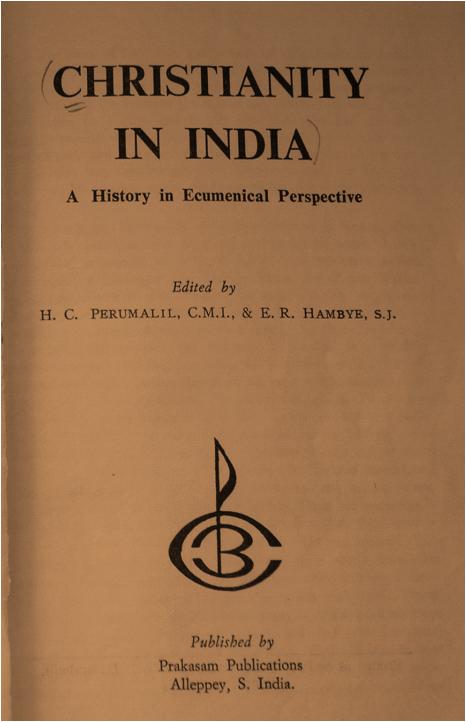
H C Perumalil CMI and E R Hambye SJ are the editors of this Volume published in 1972.
Hormice C Perumalil CMI is a priest who has worked on many mission roles from the Syro Malabar Church. He was the General Manager and General Editor of Prakasam publications, Alleppey. He has published numerous Christian literature in Malayalam and English. He is the Chief Editor of this ecumenical Volume on Christian history of India.
Dr. Edward Rene Hambye SJ, a native of Belgium was a professor of Church History and Eastern Christianity. He has authored numerous articles and books on Christianity in India, Eastern Churches in India and about Syro Malabar Church in particular. He was also associated with many ecumenical initiatives. He also brought in to light many source documents on Christian history in India. He came to India in 1950’s and worked in different roles until 1980’s when he moved to Pontifical Oriental Institute, Rome. He is the associate editor of this volume.
Introduction
The idea of Preparing “History of Christianity in India- a history in ecumenical perspective” (1972) came from the celebration of the nineteenth hundredth year since the death of St. Thomas the Apostle in India.
According to H C Perumalil CMI, there has been several attempts both in India and abroad on publishing the Christian history in India. Some of those contributions fall short of expectations as they were either one sided or lacking jejune. However there were many special studies, on the many local Churches, regions, missionary societies, various works and associations, and personalities.
In the opinion of H C Perumalil, the only possible solution within the frame-work of a medium-size history is the ecumenical one as this approach can lead to a honest evaluation of Christian past in India.
A number of scholars such as K P Kesava Menon , Dr. E. R. Hambye, S.J , Dr. A. M. Mundadan, C.M.I, Dr. G.M.Moraes , Dr. J. Wicki, S.J, Dr. A. Meersman, O.F.M, Dr. Dominic OCD , Dr. N.J. Thomas S.S.T., M E Gibbs, Dr. T. V Philip has contributed in this endeavor.
Contents
Foreword by K P Kesava Menon
Preface by Dr. E. R. Hambye, S.J
CHAPTER 1. Origins of Christianity in India by Dr. A. M. Mundadan, C.M.I
CHAPTER II. Medieval Christianity in India
a) The Eastern Church by. Dr. E. R. Hambye, S.J.
b) The Latin Church by Dr. G.M.Moraes
CHAPTER III. The Portuguese Padroado in India in the 16th century and St. Francis Xavier by . Dr. J. Wicki, S.J
CHAPTER VI. The Latin Missions under the Jurisdiction of Padroado by Dr. A. Meersman, O.F.M
CHAPTER V. The Eastern Church l6th.-l7th centuries by Dr. A. Mundadan, C.M.l.
CHAPTER VI. The Latin Mission under the Jurisdiction of Propaganda (1637-1838) by Dr. Dominic OCD.
CHAPTER VII. The Catholic Church under the Portuguese Patronage Dr. G.M.Moraes
CHAPTER VIII. The Catholic Thomas Christians 1653-1970 Dr. E. R. Hambye, S.J.
CHAPTER IX. The Eastern Orthodox Church in India by Dr. N.J. Thomas S.S.T.
CHAPTER X. Anglican and Protestant Missions 1706-1857 By M E Gibbs
CHAPTER XI. The Catholic Church in India since the mid-19th century by Dr. A. Meersman, O.F.M.
CHAPTER XII. Protestant Christianity in India since 1858 by Dr. T. V Philip
Conclusion by Dr. T. V. Philip
APPENDIX. The Armenian Christians in India Dr. E. R. Hambye, S.J.
Chronological Events
Bibliography and notes
Index
Contents in detail
CHAPTER 1. Origins of Christianity in India by Dr. A. M. Mundadan, C.M.I
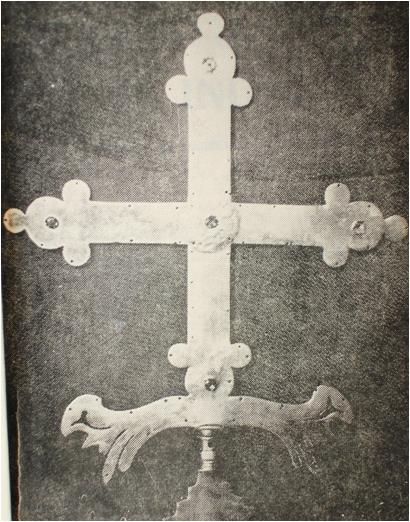
This Chapter discuss about the Apostolic origins, Saint Thomas in India, Saint Bartholomew the Apostle and India, history of Christianity in India after the Apostolic times, The Church of India and Church of Persia.
CHAPTER II. Medieval Christianity in India
a) The Eastern Church by. Dr. E. R. Hambye, S.J.
This Chapter discuss about the relationship between India and the Middle East, Expansion, Organization and Some striking customs.
b) The Latin Church by Dr. G.M.Moraes
The topics covered are John of Monte Corvino passes through India in 1291-1292, Jordan Catlani of Sevarac, founder of latin missions in India, The missions Languish and the Last of the missionaries of the middle age to visit India.
CHAPTER III. The Portuguese Padroado in India in the 16th century and St. Francis Xavier by . Dr. J. Wicki, S.J
This Chapter discuss about the early history, origins of the Portuguese Padraodo Vs Portuguese Patronage, Indian dioceses, further developments, Religious, Missions and Education, Legislation and Titbes, The Padraodo, a tentative estimation, Saint Francis Xavier and India,
CHAPTER VI. The Latin Missions under the Jurisdiction of Padroado by Dr. A. Meersman, O.F.M
This Chapter discuss about the Portuguese enclaves, their forts and settlements- Goa, Bessein, Bombay and neighborhood, Cochin and S India, Chaul, Diu and Sindh, In territories under the Indian princes, De Nobili and Madurai Mission, Bengal, The Mogul Mission, Expansion through Migration and the Eclipse of the Portuguese.
CHAPTER V. The Eastern Church l6th.-l7th centuries by Dr. A. Mundadan, C.M.l.
The topics discussed are Thomas Christians under Mar Jacob, Mar Joseph and Mar Abraham, The Synod of Diamper, Jesuit Bishops under the Padraodo and The Revolt of 1553.
CHAPTER VI. The Latin Mission under the Jurisdiction of Propaganda (1637-1838) by Dr. Dominic OCD
This Chapter discuss about the Religious and political conditions of the areas under the Padraodo in India, Propaganda and the Apostolic Vicariates in Missions, the first Apostolic Vicariate – Idalcan or of the Great Moghul, The 18th Century- Conflicts and problems. The 19th Century- Dawn of a new fire, The Vicariates of Malabar, later on of Verapoly, The Vicariates of Canara, The missions and prefectures of Surat, Madras and Pondichery, Surat mission, the Apostolic prefecture of Madras, the mission of Pondicherry, the missions of Coromandel under the foreign missionary society of Paris, Tibet and Nepal, the Vicariate of Tibet- Hindustan,
CHAPTER VII. The Catholic Church under the Portuguese Patronage Dr. G.M.Moraes
This Chapter is a general review of Catholic Church under the Portuguese Patronage in India.
CHAPTER VIII. The Catholic Thomas Christians 1653-1970 Dr. E. R. Hambye, S.J.
The topics covered in this Chapter are Deep troubles, Bishop Chandy- double jurisdiction, Attempts of Eastern prelates, Catholic Chaldean success and failures, Towards autonomy, Eastern hierarchy autonomy, Internal life and developments, Educational and religious progress, Apostolic Endeavour, Reunion and ecumenism- hopes and frustration and the Syro – Malankara Catholics.
CHAPTER IX. The Eastern Orthodox Church in India by Dr. N.J. Thomas S.S.T.
This Chapter discuss about the Koonan Cross and afterwards, Mar Thoma I, The Jacobite period, Mar Thoma VI alias Mar Dionysios the Great, a strange split, Mar Thoma VII, Mar Thoma VIII, Mar Thoma IX, Mar Dionysios II, Mar Dionysios III, Mar Dionysios IV, Mar Dionysios V and the Mar Thoma Church, the present period or the Syrian Orthodox Church, The first and second Catholicos, Catholicios Baselious Geevarghese II, Another secession- the Malankara Catholics, Catholicos Mar Baselious II, the reunion of the parties, Catholicos Baselious Augen I, Retrospect and prospects.
CHAPTER X. Anglican and Protestant Missions 1706-1857 By M E Gibbs
This Chapter discuss about the early Anglicans, Lutherans at Tranquebar and in Tamilnadu, English societies and missions, W’ Carey and the Serampore Baptists, New British Missionary societies, the first Anglican hierarchy in India, Church Missionary Society and SPG in Tamilnadu, Church Missionary Society in Travancore, Church Missionary Society in Bengal and N India, American Missions in N India, The Gossner Missions, Scotish Presbyteries and educational pioneers, Conclusion.
CHAPTER XI. The Catholic Church in India since the mid-19th century by Dr. A. Meersman, O.F.M.
This Chapter discuss about the Restoration, Re organization and conflicts, Hierarchy in India, Expansion, Adivasi Catholics, Indianisation, World War I and aftermath, National cause and further Indianisation.
CHAPTER XII. Protestant Christianity in India since 1858 by Dr. T. V Philip
This Chapter discuss about the Expansion of Christianity, Protestant Churches and social activities, Protestant Christian community and national movement, Growth of indigenous movements, Inter Church cooperation and Church union movements.
Conclusion by Dr. T. V. Philip
APPENDIX. The Armenian Christians in India Dr. E. R. Hambye, S.J.
Chronological Events
Bibliography and notes
Index
In General
The Book gives a detailed history of Christianity in India from an ecumenical perspective. This appears to be the first major ecumenical initiative about the Christian history of India. The book was published by Prakasam publications, Alleppey (Alappuzha) in 1972.
______________________________________________________________________________
Author can be reached on admin at nasrani dot net
________________________________________________________________________________
This is a very interesting endeavour as this book was published in 1972 about the History of Christianity in India with an ecumenical perspective with different authors from different church denominations.
Defining history is very important for unity among different Christian churches, especially, the St Thomas Christians who are divided into so many groups. They all have their own version of history to claim their superiority and purity compared to others.
In the recent past, there have been various efforts to discuss the history of Syriac Christianity in Kerala in an ecumenical perspective by the Catholic- Oriental Orthodox dialogues under the auspices of Pro Oriente in Kerala and since 1989, there have been a series of dialogues and issued a number of common statements. The famous “Kerala agreement” about inter church marriages is an example. There have been discussions about the history of the church in Kerala, the infamous synod of Diamper in 1599, etc. and published some of the aspects of our history in a joint statement.
The report and suggestions of the Kerala regional symposium organized by Pro Oriente in Kottayam from 30th September to 4th October 1993 suggested that (Quelle/Published in: Booklet 6, Vienna 1995)
1 There is no longer any theological reason for remaining divided, the division is a problem of leadership, heads of churches do not want to give up any position.
2.Creation of a Permanent Ecumenical Bishops’ Conference which might issue common declarations.
3.Possibility of development of ecumenical services for marriage and funeral etc.
These meetings were attended by various Bishops from Syro Malabar Church, Malankara Orthodox Church, Jacobite Syrian church and even the Church of the East in Kerala and they have expressed that the “Christological problems of the Council of Chalcedon are resolved, both the Chalcedonian and the non-Chalcedonian Churches have preserved the true Christian faith throughout history; human language and terminology, however, do not suffice to express divine truths”.
This ecumenical spirit in looking at the history is important especially when we have just remembered the anniversary of Coonan cross oath last week, as different versions of the oath is still prevalent among us.These kind of dialogues are important as different evidences and versions can be discussed between different groups and these discussions are important in perceiving and understanding each other. These are welcomed by all who want to see unity among saint Thomas Christians.
Even though we are separated for centuries, with different groups adopting different liturgy and rituals, we can have a common forum on the grounds of our common heritage and even we can have a confederation of St Thomas Christians. I have read Fr James Chavarappuzha’ in his blog recently where he is dreaming about a Holy Raza celebrated conjointly by different heads of St Thomas Christian churches.He is also talking about restoration of the Archdeaconate.
I think we still have room for unity. We could restore the Arch deaconate in an ecumenical perspective by organising a confederation of Saint Thomas Christians with a common Archdeacon based at the same old Kuravilangadu. It has to be remembered that we had only one Archdeacon at a time even when there were many Bishops. So, we could accommodate our different church affiliations, liturgies, different heads of churches and Bishops with a Single Archdeacon rotated between different denominations. This Arch deacon may not have the powers of our old Archdeacon as our different heads of churches may not want to give up their powers, but this nominal position will be a link between the different St Thomas Churches and can take up a strong role in the socio political and temporal issues, leaving the spiritual side to the existing Bishops. I think this will be a good step towards unity of St Thomas Christians. We can look at the present Inter- church council as a model for this.
Dear Antony,
Interesting, but where do we draw the line at who to admit? The Catholics, Orthodox and the CoE are easily unifiable in the manner suggested because Pro Oriente has done the hard work of ensuring our mutual compatibility in a rigorous manner. But what about the bona fide heterodox Mar Thomites, CSI, Evangelical St Thomas, and Thoziyur? The are included in ecumenical activities out of politeness but they are ultimately incompatible.
It is better not to try to weld socities to make one which have been independent to each other over centuries.All are syriac christians but the divisions over last hundreds of years have metamorphosed into what we are today…orthodox,catholics,Marthomites,CSI……….
An average person of each denomination thinks his or hers is the best,only true christian and the rest are ‘incompatible’.The clergy of each faction instigates the peaple to believe so for their own interests..Not now ,it started from the day one….During the crusades the invading European christian army treated the original christians from Palestine on par with muslims just because they belonged to orthodox church!!!.lSocial mingling between the factions are little to this day to know each other…..
Being syriac christians the advantages are that we dress,eat and think alike to this day…What’s required is acknowledgement of current scenario, respect of other factions than ones own and cooperation in areas wherever is possible.I wonder how many of us have visited churches of other factions, forget about attending qurbanas!!!!Let us start with this…
Marriages could be the best catalyst for interaction of various syrian christian factions provided the girl joins the boy’s church- whatever it is-unless the boy voluntarily wants other way….All these years this is what was lacking….But in spite of all co operations it is better to be independent but respecting others…
Came across this article.
http://expressbuzz.com/cities/kochi/the-vettath-dynasty/231932.html
Maybe someone understands this better
From the article: “owned the unique distinction of throwing up the first Christian king in the whole world.”
Statements like this make our people look utterly retarded.
My Grand Father Alfred Creado, told me when i was very young that we (the East Indians of Bombay) were first brought into the faith by St. Bartholomew and not by what is commonly believed, i.e St. Thomas.
In recent years, it is discovered (and also stated in the Bible) that they travelled in twos. Bombay in those days was not famous as Bombay but as a part of the entire Coast of Canara, and one of it ports Sopara (currently named Nalla Sopara) is mentioned in many ancient texts.
Hence the logical thesis would be that both St. Bartholomew and St. Thomas travelled together to Sopora, then St. Thomas towards the south and St. Bartholomew towards the north.
regards
prem