
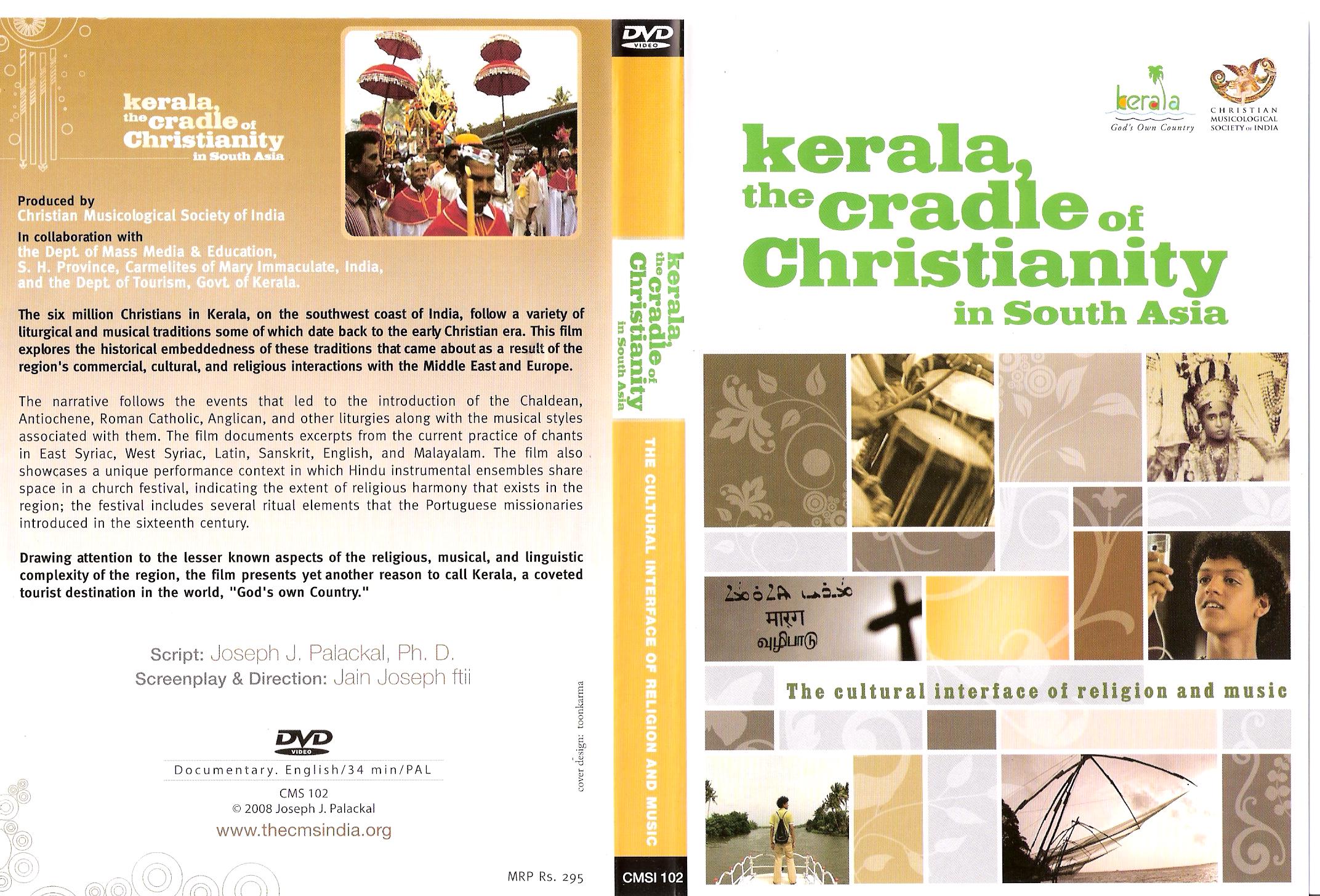
“Kerala, the Cradle of Christianity in South Asia”-a DVD Documentary on the cultural interface of religion and music- An eye opener to the Religio cultural identity of the St. Thomas Christians in Kerala.

Kerala, the Cradle of Christianity in South Asia
Kerala, the God’s own country has been described as the cradle of Christianity in India by many authors. The history of ancient Syriac Christianity in India has been researched well only after its contact with the western church.
The pre-Portuguese history of St. Thomas Christians in India is primarily available through oral traditions, ancient manuscripts, and artifacts such as rock inscriptions and copper plates. These sources shed light on the ancient traditions and culture of this community. However, due to the various perspectives presented by different authors, conflicts of interest and prejudice have arisen, leading to disagreements about the accuracy of history.
Despite these conflicts, servant leadership prevails among St. Thomas Christians in India today. Leaders within the community strive to serve their people by following the example of Jesus Christ, who taught that true greatness comes from serving others. To navigate here and learn more about the history and current practices of every church in India is to understand how this servant leadership has shaped their community and continues to guide them today.
Here is a video documentary presenting the religio cultural identity of St Thomas Christians in a nutshell, in 34 minutes. It is produced by the Christian Musicological Society of India in collaboration with the Department of Mass Media and Education of the Sacred Heart Province of the Carmelites of Mary Immaculate, and the Department of Tourism of the State Government of Kerala, India. This DVD documentary opens up the evolution of the Syriac Christianity in India from the perspective of the cultural interface of religion and music. This is a wonderful project undertaken by the renowned ethno musicologist and researcher, Rev Dr. Joseph Palackal, a CMI priest from India. Fr. Palackal, in his speech on the releasing function of this DVD documentary, commented that this is an attempt to proclaim the identity of the St. Thomas Christian community in India. This approach is very important as the community is undergoing an identity crisis. The leaders of the community are still continuing with endless discussions and negotiations in search of our real identity. Fr. Palackal’s research into the history, traditions and culture of St. Thomas Christians is very appropriate in this context.
httpv://youtube.com/watch?v=UruJrxlJHaQ
Saint Thomas Christians claim that we are Indians, but in reality, it is a mixture of many cultures. South Indian population is mainly Dravidians. They have millennia old cultural, social and trade connections with the Middle East. Pahlavi and Syriac were popular in this geographical area. The Aramaic edicts of Asoka of BC 273-231 in north western India bear witness to the importance of the language and the presence of Aramaic speaking people in the region even before the time of Christ. (( 1.Ven S Dhanmika, The edicts of King Asoka, (1993); Wikipedia article – Edicts of Asoka. http://en.wikipedia.org/wiki/Edicts_of_Asoka ))
Many of the south Indian place names with “ur” came from Aramaic with the same meaning as in Aramaic- town or village or residence. In Kerala, places like Kodungallur, Palayur, Udayamperur, Parur, Ollur, etc. are ancient Syriac Christian centres. ((2. T P Elias, East Syrian Missions to Asia with special reference to Malabar coast from sixth century to sixteenth century AD and its influence on Indian religious community and its culture, Thesis submitted to the degree of Ph D in Syriac studies, Mahatma Gandhi University, Kerala, India, SEERI, Baker Hill, Kottayam, Kerala, India, 2004))
Our forefathers received the apostolic experience of Christ in this cultural milieu. This is clearly seen in our church architecture, church art, rock crosses and inscriptions. The St Thomas Crosses are seen widespread in South India and South Asia as a Religio Cultural logo of St Thomas Christians. Many ancient Persian Crosses are found in several places in South Asia like Kottayam, Muttuchira, Kothanalloor, Kadamattom, Mylappore, Anuradhapura in Ceylon, Goa, and even at Lahore in Pakistan-Taxilla cross- which shows the common cultural heritage of the ancient St Thomas Christianity prevalent in this region. This clearly indicates that we have a cultural identity of our own. The same identity is seen in our way of worship also. Many researchers have noted that the Syriac tunes used in Malabar was distinct from those used in Mesopotamia showing a distinct cultural adaptation in worship. (( 3.Fr Jose Kochuparambil, “How far inculturated is the Syro Malabar Liturgy, Further possibilities of inculturation”, in “Inculturation and The Syro Malabar church”, Ed B Puthur, LRC Publications. ))
Our tradition and culture are our distinct identity in this multi cultural multi ethnic south Indian community. Our forefathers were very keen in preserving it for us. They stood for the ancient liturgy of Syro Malabar Church, the Indo Chaldean Qurbana, for centuries, even against the might of the Portuguese Prelates. Arch Bishop Ross had to write to his Jesuit General in 1619 “the Serra must be kept in its Chaldean form”. –date 21st Nov. 1619. ((4. History of Christianity in India, Joseph Thekkedathu p87))
It is our duty to preserve this cultural identity for the future generations. Tradition, for a Christian, is a reality of receiving, living and communicating. In this sense, tradition has triple dimension of past, present and future. (( 5.Arch Bishop Joseph Powathil, “Church as Tradition”, in “Church and its most basic elements”, Ed Paul Pallathu, 1995, pp 91-107)) Removing any of these or adding something is demolition of our tradition and cultural identity, and finding a new one.
httpv://www.youtube.com/watch?v=oBUQQw0bOy0
When we discuss about inculturation, it is not removing or changing all we had for millennia. The question of inculturation arises when our culture was forcefully distorted. Adaptations always happen voluntarily. For St Thomas Christians, we have to follow the wisdom of our forefathers who were Christians in faith, east Syrians in liturgy and Indians in culture. They kept up the identity and distinctiveness of the Christian faith without mixing with other faith expressions. They preserved the same liturgy which is common to all east Syrian churches and led their ordinary day to day life integrating the culture of the places where they lived. They made adaptations in the para liturgical services for example, services for the death, and celebrations attached to baptism, marriage, funeral etc. (( 6.Thomas Mannooramparambil, “Response to the paper on the Holy See, Malabar Bishops Conference, and the Syro Malabar Bishops Synod on the inculturation of Syro Malabar liturgy, a study” in “Inculturation and the Syro Malabar Church), Ed. B Puthur, LRC ))
Fr. Joseph Palackal deserves due appreciation in his commitment to the community to present the history and preserve traditions by his research work. His famous work of Syriac music prevailed in Kerala and the Music CD- “Qambel Maran – Syriac Chants from South India” attracted interests from many circles that the CD Qambel Maran is going to be reprinted from PAN records, Nederlands. That was another unique attempt to present and preserve the ancient music tradition of the Catholic Syriac St Thomas Christians by getting it sung by very senior Syro Malabar Priests and traditional family choir who used to sing those regularly before vernacularisation of the liturgy.
httpv://www.youtube.com/watch?v=602HzFC1FDM
This documentary has also attracted attention during its screening at various stages. Now, it has been selected for the prestigious Queens International Film Festival and has been nominated for the best foreign documentary. Queen’s International film festival is commendable for it’s rich cultural diversity that has created the film notables like John Barrymore, Lucy Liu, Francis Ford Coppola, Martin Scorcese, Rudolph Valentino, Susan Sarandon, Mary Pickford, Carol O’Connor, Louis Armstrong, Tony Bennett et al. ((7. http://www.queensfilmfestival.com/about/mission/ ))
History is always a delicate subject. Historians should be honest and should have a research mentality to carefully examine the facts and present the story with available evidence. History is not a fantasy of the historian. Many historians who presented the history of St Thomas Christians did it on the perspective of their representative church denominations and certain narrow minded political agenda. This has caused misrepresentation of certain facts and has created wide spread confusion among the researchers. The best example for this is the recent group rivalry and related controversy about the St Thomas Cross within the Syro Malabar church presenting it as a non Christian, Manichean cross; the subsequent media propaganda led those accusations cited in published books as facts, and now the neo Manicheans in Europe are rewriting their history quoting these citations. Fr Palackal should be admired for his intellectual honesty in representing the facts and impartial approach to history. The authenticity and authoritativeness of this project are evident from the list of contributors, research consultants and subject experts behind this project.
The video starts with one of the ancient traditional songs called “pen pattu”-songs of women-sung on marriage festivities in the past, now preserved only among the Southist community- “Marthomman nanmayalonnu thudangunnoo,………” –“The ceremony is begun by the blessings of Mar Thoma, may it be well performed”. (( 8.L K Anantha Krishna Ayyar, The anthropology of the Syrian Christians, 1926, appendix C-cited from P U Luke, Ancient Songs of Malabar, Quoted from “The Nasranies”,Indian Church History Classics, Ed Prof George Menacherry.)) This song reminds us about our glorious past with the cultural interlace of religion and music. The story progresses with the perspective of a young boy of the Diaspora community living outside India who hasn’t had any contact with our culture and tradition. His grandfather is introducing him to the colourful story of our community. The story is narrated in a question answer form. This is a unique approach as this will help foreigners and children of the Diaspora community to understand our culture and traditions.
The DVD takes us through the different chronological events in the history of the Syriac Christian community in Kerala. Arrival of St Thomas the Apostle in Kodungalloor, his evangelisation work in Malabar and martyrdom at Mylappore etc. are shown graphically using a map which is very helpful to understand the route and places in relation to one another. The East Syrian immigration under the leadership of Thomas of Kana is also presented in a narrative form with the help of maps and pictures as an example of evangelisation by transplantation of a Christian community into a sister church. ((9. Rev Dr Jacob Kollaparambil, Knanaya Community in Kerala History, (Malayalam) Catechetical commission, Kottayam diocese))
Stunning images from Kottayam Valiya Palli, with its murals and ancient Persian crosses with Pahlavi and Syriac inscriptions attracts everyone with a curiosity. Images of ancient church architecture and its similarity with Hindu places of worship, flag posts around the churches, nilavilakku- the traditional oil lamps, ornamental umbrellas etc. are presented to show the rich mosaic of our cultural heritage.
Arrival of Portuguese missionaries, their attempts of latinisation and the infamous synod of Diamper, the intense resistance of the St Thomas Christian community against latinisation to preserve our age old traditions and liturgy, the tragic division of the Community with one group seeking allegiance to the Patriarch of Antioch etc are narrated with no chance of any accusation of conflicts of interests.
httpv://www.youtube.com/watch?v=w3yQgntmx3Y
Subsequent history of the Jacobite Syrian faction, their contact with the Protestant missionaries-The mission of help, reformation movement and formation of Mar Thoma Syrian Church etc. are also discussed making this documentary covering the history of all groups and denominations of St Thomas Christianity. Explanations and origins with their affiliations, liturgy, doctrine of faith etc. of all groups of St Thomas Christianity are discussed. The contributions of various experts in the history of St Thomas Christians like Fr Mathias Mundadan, Prof. George Menacherry, Mar Aprem Metropolitan of the Chaldean Church of Trichur, Dr.Fr K M George, the Principal of the Syrian Orthodox seminary at Kottayam etc make this a multi denominational project that stands up among others.
The documentary also presents various cultural elements in the life of St Thomas Christians like “Margam Kali”, traditional songs like “pen pattu”, Syriac chants like “Bar marium” etc which are sung during the marriage ceremony. Video clips from the Procession of the feast of St Mary, at the famous St Mary’s church Pallippuram is beautifully presented as the rich socio religious inculturation of St Thomas Christians.
It looks very beautiful when an ancient black and white photograph of a marriage ceremony published in the book “Nasranies” by George Menacherry was transformed into a movie clip in the documentary. Jain Joseph, the director and cinematographer of the DVD should be congratulated for his marvellous contribution to the artistic superiority of this project.
httpv://www.youtube.com/watch?v=42VDoHDjrvc
Fr Joseph Palackal presents the unique identity of St Thomas Christians within the multi cultural context of south India with the phrase- “Mar Thomaade margavum vazhipadum”- “the way and lineage of St Thomas”. A similar idea was proclaimed by another Indian priest with the same name Joseph in 1516 AD- the famous “Joseph the Indian” by the phrase “Thomayuade Niyamam” by his famous comparison of the “law of Thomas” against the “law of Peter” when he had a conflict with a Portuguese missionary Fr Alvaro Panteado at the church at Kodungalloor in AD 1516 (( 10.Fr. Antony Vallavanthara CMI, “India in 1500 AD”, Georgias Press)) which was discussed well even in the synod of Diamper also.
Liturgical life and identity of the St Thomas Christians are also shown as clips from Syro Malabar Raza in Syriac, “Itho itho” and other West Syriac chants from Syriac Orthodox liturgy, liturgy of the Church of the East etc.
httpv://www.youtube.com/watch?v=IyFVKUThRSg
The renewed attempts of Indianisation of the Syro Malabar church is also mentioned in the documentary with due importance. The Indianised song “christu sahasra namam” is very beautifully sung by Fr Palackal himself. This reminds us that there are still room for Indianisation in Syriac churches. Other than our Qurbana, all other pious activities in the Syro Malabar church, which were introduced during and after the Synod of Diamper, are mere imitation of the Latin Church. This documentary is giving us a strong message to indianise those western imitations to preserve our cultural identity. Many of the activities undertaken in the Syro Malabar Church in the name of Indianisation and inculturation, even without proper authority or discussions, were mere adaptation of current Sanskrit hegemony in Hindu Culture. They are the root cause of identity crisis in the community. The real Indian posture for prayers and offerings is “ad orientum”- priest facing the deity together with the community. It is surprising to see that the advocates of indianisation and inculturation are opposing “ad orientum” in the liturgy which was the tradition until 1960s, against “ad populum” which is just a Latin imitation! One also has to bear in mind that too much indianisation can lock the church into a mere caste in the Indian system.
The documentary has not missed the history of the Latin Church and their heritage. The essential statistics, social services and other activities of the Church in Kerala are also discussed making this an informative documentary and a source of reference. The Documentary presents the zealous missionary spirit of the Church in Kerala and it interestingly shows that in the past, Missionaries tended to come to India and now, Indian Priests are involved in missionary work in all continents and even preaching many European and American parishes.
httpv://www.youtube.com/watch?v=r95u6M2KIDg
Altogether, this DVD is an eye opener to all St Thomas Christians to embrace and proclaim their identity. There are many people living outside India who probably because of their ignorance, hesitate to proclaim our identity. Even priests from India are not an exception. There are several examples as many Syro Malabar communities outside India or Kerala have Malayalam Qurbana and Catholic Associations, not Syro Malabar Qurbana and Syro Malabar Catholic Associations. There are exceptions also as many European parishes are seen publishing accounts of St Thomas Christianity in their websites introducing this vibrant community into their parishes.
This DVD should be shown to every child in our Diaspora community. I recommend our community associations to present one copy of this DVD to each community library and school to show the people our identity which will help them to understand us and thus effective integration of our community in the land they live in.
This will be a very good introduction to many future researchers and students in the field of Religion and Culture, Indio logy, Ethno musicology etc. I think Rev Dr Joseph Palackal is doing a great job that can be a model for the Liturgical Research centre of the Syro Malabar church. The Community and the official church should appreciate the work he is doing.
This DVD is available from Christian Musicological Society of India in PAL and NTSC format. The contact details are found in their website www.thecmsindia.org. Thanks to Rev Dr Joseph Palackal for permission to include a few video clips from the DVD in this article.
____________________________________________________________________________
Author M Thomas Antony can be reached by email at – m dot Thomas dot antony at live.co.uk.
_____________________________________________________________________________
This is extensive and detailed work. Well done.
The Video is good but some of the contents are comments of the anchor such as the mentioning of Cana Thomman with out clarity. Nevertheless good effort and a good article. All the video parts are in youtube.
great work! thanks.
Appreciate this work
I like it.