
Catalogue of ancient Nasrani Churches, their affiliations and population statistics in the background of division and attempts of Reconciliation- A review of Literature

Catalogue of ancient Nasrani Churches, their affiliations and population statistics in the background of division and attempts of Reconciliation- A review of Literature
INTRODUCTION
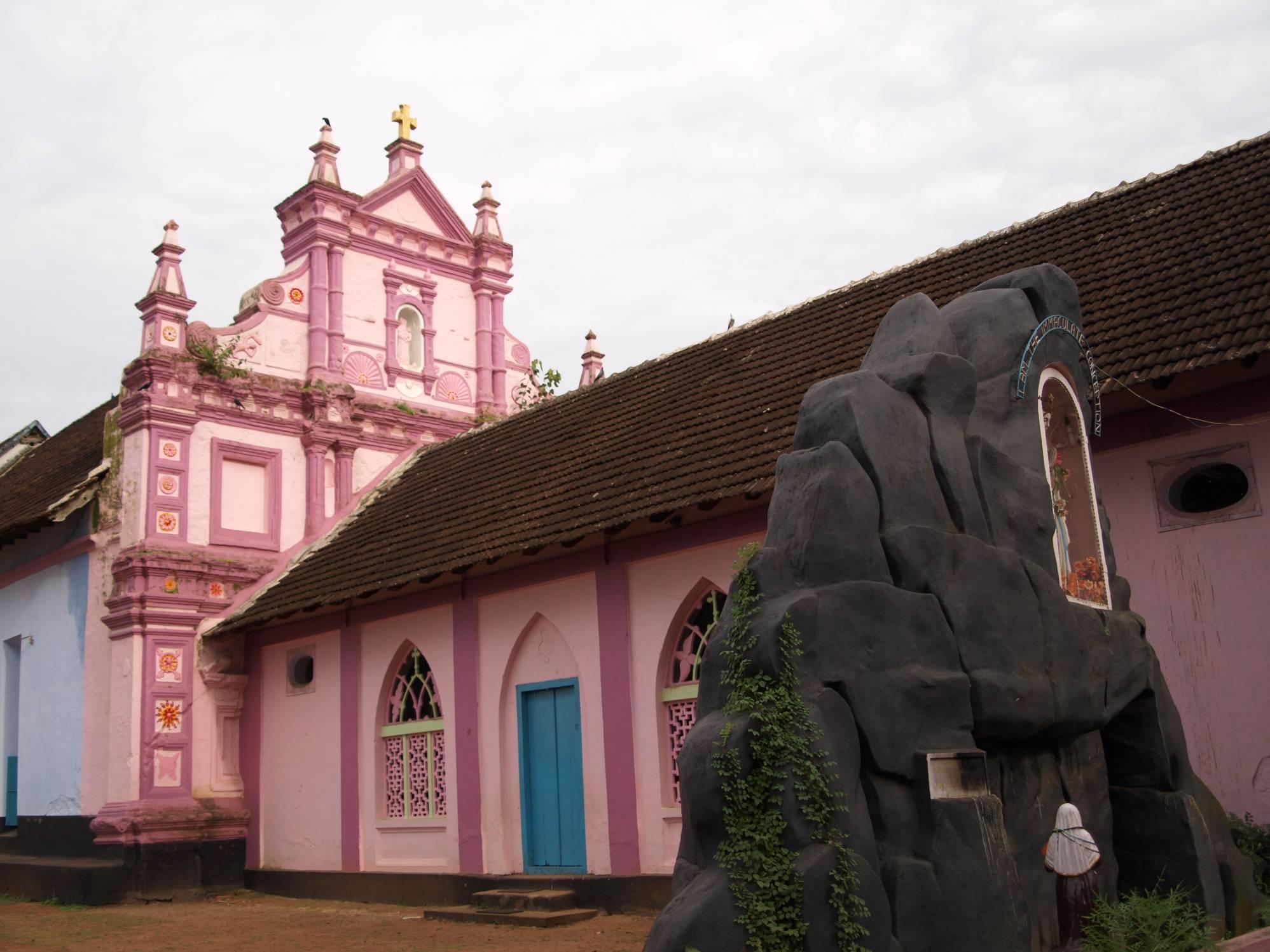
The history of Christianity in Malabar has been well documented after the synod of Diamper. Much information giving light into the ancient period is available as copper plates, inscriptions on rocks, palm leaf documents, artefacts, and oral traditions. Many authors have tried to knit up the loose history from available documents and available oral traditions.
DIVISION OF ST THOMAS CHRISTIANS
Until the time of the synod of Diamper, there was no evidence available to suggest any divisions among the Syrian Christians. After the Synod of Diamper (AD 1599) – the Coonan Cross Oath ( AD 1653 )- prompted the division of the community and both parties claimed over different churches. After the Coonan Cross Oath, the whole Nasrani community was divided into two groups, one continued to be loyal to the Roman Catholic Church keeping the East Syriac liturgy and traditions, called the “old party” or “Pazhayacoor” and the other under the Archdeacon known as new party or “Puthencoor”. Both were using the same liturgy and traditions for some time, but later, the Puthencoor moved towards the Church of Antioch and adopted the West Syriac liturgy and traditions and thus made the name “Puthencoor” appropriate.
As the community was divided, the churches were also divided among them into two groups. There were a third group of churches which remained to be shared between these two communities.
At the time of the Coonan Cross Oath, vast majority of people and churches remained loyal to the Arch Deacon. There are different accounts. “Out of the assumed 200,000 population, only 400 remained loyal to the Portuguese”. (( G T Mackenzie, Christianity in Travancore, 1901, p27 ))
Joseph Thekkedathu reports that “some of them speak of 200 laymen and 15-25 Cathanaars. Others say that there were about 1000 laymen and 15 Cathanaars. In any case, it is clear that they were but an insignificant minority” (( Joseph Thekkedathu, The troubled days of Garcia, quoted in The History of Christianity in India p94 ))
After the Coonan Cross oath, the Arch deacon was consecrated as a Metropolitan by twelve Cathanaars at Alangadu on 22 May, 1653. The available historical evidences show that this revolt was against Arch Bishop Garcia and the Portuguese authorities and not against the Roman Church or Pope of Rome.This is evident from the available documents regarding the declarations on the occasion and a letter sent to the Portuguese captain at Cochin. (( -Archivum Romanum Societatis Iesu, Rome ( Jesuite Archives) Vol 68(1) f 102 f 225 Garcia’s letter to Fr Hyacinth of St Vincent, Vol 68 (2) ff 451-2, Historical Archives of Goa Livro das MongcesVol 25 f 130, all quoted by Joseph Thekkedathu, History of Christianity in India, p93
-Historical Archives of Goa, Livro das Mongces Vol 25 f 121 quoted by Joseph Thekkedathu, History of Christianity In India p94 ))
Angamali Padiyola in 1787 reads “upon this, our forefathers assembled at Muttancherry and took an oath that neither they themselves nor their descendants, should ever have anything to do with the Paulists.” (( A document signed by all the church people of Malankara beginning with Ankamale who were assembled at the large church of Angamale on the first of February (old reckoning) in the year of our Lord 1787, in reference to the increase of true faith, and with regard to the bringing about a real union in our church, and a walk according to the manners and customs of our forefathers quoted by Thomas Whitehouse, Lingerings of light— Appendix E
-(The Padiyola is available online- http://www.smcim.org/angamaly/history.htm ) ))
A Church Mission Society report for 1818-19 states-“After this, all the Syrians assembled at Muttancherry, and thus resolved-These Portuguese having murdered Mar Ignatius, we will no longer join them. We renounce them, and do not want either love or their favour. The present Francis Bishop shall not be our Governor.We are not his children or followers. We will not again acknowledge Portuguese bishops”. (( Abstract of a brief history of Syrians in Malabar, preserved among themselves as genuine history, Church missionary society report for 1818-19 , page 317, quoted by Thomas Whitehouse in Lingering of light—Appendix D ))
The whole St Thomas Christians were in communion with the Pope of Rome through the Chaldean catholic church after the division in the Church of the East in 1552 and with the arrival of Mar Joseph Sulaqa and Mar Elias in 1555. Since the arrival of Portuguese in 1498, the St Thomas Christians were in friendship with them and they were allowed to preach and celebrate mass in the Nasrani churches.Even the Portuguese missionaries established a seminary to train the St Thomas Chrisitians at Kodungalloor in 1541. It has to be noted that two Cathanaars of the St Thomas Christians travelled to Portugal with Portuguese General Cabral and one of them- “Joseph the Indian” as described in the literature visited the Pope Alexander VI. Joseph the Indian was interviewed by some Venicians who published it European languages. (( – India in 1500 AD, Fr Antony Vallavanthara, quoted in Changanasseerry Athiroopatha innale innu vol I p 36
– G T Mackenzie, Christianity in Travancore, 1901 p 12(Mackenzie reports that Guuvea p5 says that it is in Latin and appended to Fasciculus Temporum). An Italian version appeared at Vicenza in 1507 called Paesi novamente retrovati. It is cited also as Novus Orbis or as The Travels of Joseph the Indian. ))
This Joseph The Indian was among the delegation to visit the East Syriac Patriarch Simon in AD 1490 who ordained both of them- Joseph and George- as Priests. (( East Syrian Mission to Asia with Special Reference to Malabar Coast from Sixth Century to Sixteenth Century AD and its Influence on Indian Religion Society and Culture by Elias TP, 2005 Doctoral Thesis to Mahatma Gandhi University, Kerala Guided by Fr Baby Varghese, SEERI, Kottayam ))
The East Syrian prelates at that time were also friendly with the Portuguese. This is evident from the letters of Mar Jabalaha, Mar Denha and Mar Yakob to the Patriarch of Babylon in 1504. ((- Schurhammer, The Malabar church, pp 5-7 quoted in Changanacherry athiroopatha innale innu vol I p 38
– G T Mackenzie, Christianity in Travancore (1901) pp11-12 ))
Because of this background, the Arch Deacon and the leaders claimed the mandate of the Pope of Rome for his consecration as a Bishop. The letters read at the time of consecration claimed that it was according to the authority given by the Pope to Mar Ahattalla. When Mar Gregoriose, the Metropolitan from the Church of Antioch arrived, he was also projected as a Bishop appointed by the Pope. (( Joseph Thekkedathu, The Troubled days of Arch Bishop Garcia. quoted in History of Christianity In India p 94 ))
EFFORTS OF RECONCILIATION
This revolt shook the might of the missionaries, and the Portuguese inquisition team tried to reconcile. Their attempts failed as the Arch Deacon and the leadership were not interested in any negotiations. The Portuguese authorities referred the issue to Rome.
As the Portuguese could successfully convince some of the leaders of St Thomas Christians that this consecration was not legitimate, a section of St Thomas Christians were unhappy about the situation. Two of the 4 advisories of the Arch deacon, Palli veettil Chandy Cathanaar and Kadavil Chandy Cathanaar were among them.
Rome intervened and sent two sets of Carmelite Missionaries to the St Thomas Christians in two routes under the leadership of Fr Joseph Maria (arrived Malabar by AD 1657) and Fr Vincent of Hyacinth, (arrived Malabar by AD 1658).
When it was clear that the Consecration of the Arch Deacon was not legitimate, and the Arch Deacon did not have the mandate of the Pope, many people renounced the Arch deacon. Joseph Maria returned to Rome and got consecrated as a Bishop for St Thomas Christians as Joseph Sebastiani 1659.
Now, St Thomas Christians became freed from the Jesuits and the Arch Bishop Garcia and they have a new Bishop who is not a Jesuit but a Carmelite. This was what the Arch deacon demanded soon after the Coonan Cross oath. (( Historical Archives of Goa, Livro das Mongces Vol 25 f 121 quoted by Joseph Thekkedathu, History of Christianity In India p 94. ))
Within a year, Sebastiani could win 40 churches and by 1663, 84 churches were under Roman obedience and only 32 remained with the Arch deacon. (( G T Mackenzie, Christianity in Travancore (1901) p 30. Quoting Paul of Bartholomew, India Orientalis Christiania ))
Later, Political situation became hostile for the Catholic side as Dutch captured Cochin in 1663 and Sebastiani had to leave. He consecrated Palliveettil Chandy Cathanaar as a Bishop for the St Thomas Christians and Vicar Apostolic of the Arch Diocese of Angamali on 1 February 1663.
This made two rival factions with native leaders, Palliveettil Chandy Cathanaar with a legitimate Bishopric consecration and Mar Thoma I without a legitimate Bishopric consecration which made it easy for Palliveettil Chandy Metran to win more people.
Another factor for the success of the missionaries was the political tactics by the Portuguese by taking the local Rajahs on their sides to make them compel the Christians to submit to the Catholic fold. Fr Hyacinth could expel the Arch Deacon from Kaduthuruthy with the help of the king of Vadakkumkoor and banned fromentering the Kingdom of Cochin. (( Joseph Thekkedathu, History of Christianity in India, p99 quoting from his book The troubled days of Arch bishop Garcia ))
With the help of the Portuguese General, Ignatius Sermento, Sebastiani obtained the submission of several churches in the Kingdom of Cochin. (( Joseph Thekkedathu, History of Christianity In India p 99 ))
Churches at Champakulam and Kudamalur under the King of Purakkad stayed with the Arch Deacon until 1659 when the King of Purakkad ordered them to join the Pazhayacoor. (( Joseph Thekkedathu, The troubled days of Francis Garcia SJ, PP 143-44 quoted in Changanasserry athiroopatha, innale innu, vol II p 266 ))
James Hough in his book describes how cold the reception to Carmelite Bishop Joseph Sebastiani at Champakulam on 25 Aug 1661 even when the Rajah of Purakkad sent an Officer to the occasion to compel people. (( Christianity in India Book 4 P359 James Hough ))
At this point, the Arch Deacon’s position became very critical and he decided to negotiate with the Jesuits in 1655. He sent a Cathanaar to the rector of the Jesuit seminary at Ambalakkadu with the message that he wished to make his submission to the Catholic Church provided it could be effected without loss of honour and without humiliation. (( Joseph Thekkedathu, History of Christianity in India p 100. ))
Further negotiations continued and it was thought that the division among St Thomas Christians was going to end but all changed on arrival of Mar Gregorios from the Church of Antioch in 1665. Mar Gregorios was also received by the Arch Deacon as a Metropolitan sent by the Pope. But Cathanaars and people under the Arch deacon became unhappy on the new way of celebration of Qurbana by the new Bishop Mar Gregorios. Mar Thoma I persuaded him to use the local rite, which he did refusing only to use unleavened bread. (( – LW Browne, Indian Christians of St Thomas page 111 quoted by Joseph Thekkedathu, History of Christianity in India.p 101,
-Stephen Neill, History of Christianity in India ))
This unhappiness also might have helped the catholic side.
CATALOGUE OF ANCIENT CHURCHES
Some authors have tried to catalogue the ancient Nasrani churches in the past. There is documentation available about the churches at the time of the synod of Diamper. Various authors and authorities have catalogued the churches viz. Menesis 1599, Raulini 1745, Du Perron 1758, Paoli 1760, Whitehouse 1873.White house, in his book, interestingly reviewed the available literature at his time and published a comparison table in his book Lingerings of light in the dark land which is very helpful to identify the places as the names of different places are pronounced differently by different authors and some place names have changed over time.
CHURCHES AT THE TIME OF SYNOD OF DIAMPER
This is a list of Christian churches/ congregations present at the time of the Synod of Diamper.The list was compiled by Mr P J Tomy as an appendix to his article Kerala Coast, the Portuguese contributions. This contains both Syrian and Latin churches. This list was compiled on the basis of Antoneo de Gouvea’s book “Jornada do Arcebispo de Goa Dom Frei Alexio de menezes Primaz da India Orientali, Religiosoda Ordem de S. Agostinho. Quando foy as Serras do malavar, & lugaresem que moralo os antigos Chrisaos de S. Thomae & os tirou de muytos erros & obdeiencia da Santa Igreja Romana, da qual passava de mil annos que estavo & reduzio a nossa Sancta Fe Catholica & obediencia da Santa Igreja Romana, da qual passava de mil annosqhe estavao apartados” and its quotations in books by Bernard TOCD, Placid Podipara, D Jessole, and Bishop Arattukulam. (( P J Tomy, Rtd Asso. Professor, Kerala Agricultural University, Kerala Coast, the Portuguese contributions (http://www.keralacoastfate.com/portugese.pdf ))
| 1. Alappuzha | 66. Maramon |
| 2. Alengad with two chapels | 67. Ngarakkal |
| 3. Ambazhakkad | 68. Nediyasala |
| 4. Angamali three churches | 69. Nagappuzha |
| 5. Athirampuzha | 70. Niranom |
| 6. Arthinkal with two chapels | 71. Omallur |
| 7. Akapparambu | 72. Pattamara parur |
| 8. Arakkuzha | 73. Purakkadu |
| 9. Anchikaimol- Ernakulum | 74. Piravom |
| 10. Aranmula | 75. Pala |
| 11. Bharananganam | 76. Pulincunnu |
| 12. Chetwa | 77. Pallippuram |
| 13. Chennamangalam | 78. Poonjar |
| 14. Chennamangalam south | 79. Palluruthy |
| 15. Cheria parur | 80. Pothanikkadu |
| 16. Cheria parur kizhakke palli | 81. Puthiyakavu |
| 17. Changanasserry | 82. Pallikkara |
| 18. Chengannur | 83. Puthechira |
| 19. Chettukulangara | 84. Saudi Dumina NS |
| 20. Chalakkudi | 85. Thumbamon |
| 21. Chermpil | 86. Thekkeparur |
| 22. Cathiath | 87. Thalipparambu |
| 23. Cherpunkal | 88. Thrippunuthura |
| 24. Chungam | 89. Thekkankoottu |
| 25. Cruz-di-Milagre | 90. Thuruthippuram |
| 26. Edappalli | 91. Udayamperoor |
| 27. Edacochin | 92. Vadakara |
| 28. Elangi | 93. Venmani |
| 29. Enamakal | 94. Veliyanadu |
| 30. Kannur | 95. Venduruthy |
| 31. Kozhikkode | 96. Vallarpadam |
| 32. Kochi | 97. Vypin |
| 33. Kodungallur I | 98. Varappuzha |
| 34. Kodungallur II | 99. Vadakkepudukkadu |
| 35. Kollam I | 100. Vadayar |
| 36. Kollam II | 101. Vaypoor |
| 37. Kayamkulam | 102. Vadakkancherry |
| 38. Kottayam Cheria palli | 103. Kothamangalam |
| 39. Kundara | 104. St Jaro Palluruthy |
| 40. Karunagappalli | 105. Malayattoor |
| 41. Kalluppara | 106. Puthuppally |
| 42. Kuravilnangadu | 107. Thottappally |
| 43. Kadamattom | 108. Mattathil |
| 44. Kanjirappalli | 109. Chazhoor |
| 45. Kothamangalam cheria palli | 110. Kalparambil |
| 46. Koratty | 111. Kanjoor |
| 47. Kolencherry | 112. Chowara |
| 48. Kothanellur | 113. Kattoor |
| 49. Kuthiathode | 114. Thumpoly |
| 50. Kunnamkulangara | 115. Ramapuram |
| 51. Kuruppampady | 116. Thevalakkara |
| 52. Kudavechoor | 117. Maungali |
| 53. Karakkunnam | 118. Thiruvanculam |
| 54. Kottekkadu | 119. Nagappara |
| 55. Mulanthuruthy | 120. Kudamalur |
| 56. Muttam | 121. Pullala |
| 57. Mavelikkara | 122. Anakkallumgal |
| 58. Muttuchira | 123. Koranadu |
| 59. Mattancherry | 124. Kottara |
| 60. Mailakkompu | 125. Kuravankulangare |
| 61. Muthalakkodam | 126. Caramattom |
| 62. Moozhukkulam | 127. Palli port south |
| 63. Manjappra | 128. Kandanadu |
| 64. Manasserry | 129. Cheppadu |
| 65. Muhamma | 130. Palayam |
Indistinct locations
| 1. Comiligi | 18. Bareate |
| 2. Quejecca | 19. Calete |
| 3. Blagatte | 20. Idatur- (erattupetta) |
| 4. Cormor | 21. Corcilanate |
| 5. Vinecca palli | 22. Cadagol |
| 6. Covere | 23. Roipur |
| 7. Vallet | 24. Calurcherro |
| 8. Codangoth | 25. Neonanur-(Niranom) |
| 9. Bucin | 26. Calera |
| 10. Mopencherry | 27. Tempucar (Tumpamon) |
| 11. Canna | 28. Mormonor |
| 12. Ginucotte | 29. Colour superior (Kayamkulam) |
| 13. Mudela court | 30. Tempureer |
| 14. Advombare | 31. Tanrgali |
| 15. Mulicor | 32. Cottette(Kottayam) |
| 16. Elongmil- (could be elanji) | 33. Rapolin (Edappalli) |
| 17. Farete- (sounds like Piravom) | 34. Manongate |
The following churches are labelled as Latin rite in the list according to Placid Podipara. (( Historia Ecclesia Malabarical Cum Synoda Deaipral pp. 428-429 quoted by Placid J. Podipara p.104 ))
Varapuzha, Chetwa (Citna by Rantin) Thiruvanathapuram, Pallipuram (Baleport), Chathiathu, Vendurathi, Mattancherry,Dumina NS de salute (Saudi), Manasserry, (St.Luis-Raulin) Mundanveli,Edacochin (Castella-Raulin) S. Andre (Arthunkal-Raulin- with two chapels)
In addition to the above the following churches were also Latin rite according to Bernard TOCD. Kannur, Kozhikode,Kodungallor (two churches) ,Chattukulangara, Kundara, Manongats, Thevalakkara. (( P J Tomy, Rtd Asso. Professor, Kerala Agricultural University, Kerala Coast, the Portuguese contributions (http://www.keralacoastfate.com/portugese.pdf ))
It looks like this list contains many duplications as many places are pronounced differently in different books and time periods and many different pronunciations are listed as different churches. Some of the affiliations are also not correct.
CHURCHES AND THEIR AFFILIATIONS AFTER THE COONAN CROSS OATH.- CATALOGUE OF THOMAS WHITEHOUSE
Thomas Whitehouse has compared the churches according to the local kingdoms, their affiliation to Jacobite Syrian, Catholic Syrian and mixed according to four different authors which make it very helpful to compare and identify the places easily. (( Thomas Whitehouse, Lingerings of Light in a dark land- bring researches intothe past history and present conditions of the Syrian church of Malabar. 1873, Appendix A ))
It seems that the affiliation and region were compiled by Du Perron as on 1758. It seems that some of the places are not keeping with the regions and some of the affiliation is wrong.
Kingdom of Cochin –
| Menesis 1599 | Raulini 1745 | Du Perron 1758 | Paoli 1760 | Whitehouse1873 |
| JACOBITE SYRIAN | ||||
| Molundurte | Molandurte | Molandurte-Holy Virgin | Molunturuti-St Mary | Mulanturutta |
| Caromattan | Caramattam-Holy Virgin | Kadamattom-St George | Kadamattom | |
| Racati | Raakate-Holy Virgin | Rakada | ||
| Meliatur | Maleatour-Holy Virgin | Maleatur-St Thomas-Do Oratory in the mountain | Malleatur | |
| MIXED | ||||
| Little Paru | Paru | Tekeparrour-St John Baptist | Tekenparur | South Parur |
| Narame | Trepuntare | Naramel-Holy Virgin | Nharamel | Trepuntara |
| Caringoschera-Holy Virgin | Caringacera | Karingachery-(? karingachira) | ||
| Momuacheri | Mamlascheri-Holy Virgin | Mamalaceri-St Michael | Mamalasheri | |
| Pallicare | Pallikare-Holy Virgin | Pallicare-St Mary | Pallikkara | |
| Cantanate | Candanate-Holy Virgin | Candanata-St Mary | Kanadanada | |
| Carpumpiali | Kourripoupali-Holy Virgin | Curupeupadi-St Mary | Kuruppampady | |
| Parumattam-Holy Virgin | Perumettam-St Mary | Peyrumattam | ||
| Kadamungalum-Holy Virgin-Ditto Holy Virgin | Codamangalam-St Mary-Ditto St Mary | Kothamangalum | ||
| CATHOLIC SYRIAN | ||||
| Palliporam | Palliport | Palliporam-Holy virgin | Pallipuram-St Mary | South palliport or Pallipuram |
| Muttan | Mutton | Mouttam-Holy Virgin | Muttam-St Mary | Muttam |
| Diamper | Diamper | Odiamper-SS Gervasis & Protasius-Cajoukambalam | Odiamper-SS Gervasis & Protasius | Udiamparur |
| Colongeri | Kolangouri-SS peter & paul | |||
| Pudupalli | Pouttenpali-St Theresia | Puttenpalli-St Theresia | Puthenpalli | |
| Mangalam | Kadamungalum | Codamangalum-St Mary | Kothamungalam | |
| Canhur | Canchur | Cagnour-Holy Virgin | Canhur-St Mary | Kanhura-(? kanjoor) |
| Cheguree | Covere | Shouvere-Holy Virgin | Ciovare-St Mary | Chewurrah |
| Vaipicotta | Canotta | Shenotte-Exaltation of Cross | Cenotta-St Crucis | Chennum |
| Gnarica | Gnarika-Holy Virgin | Nharica-St Mary | Narikal | |
| Valeport | Balarparte-Holy Virgin | Balarpart-(? Vallarpadom) | ||
| Angicaimal | Ernagolta-Holy Virgin | Eranaculata, or Angicaimal-St Mary | Ernaculum | |
| Matanger | Matingeri | Matencheri | Matincera | Muttancherry |
Kingdom of the Samorin
| Menesis 1599 | Roulini 1745 | Du Perron 1758 | Paoli 1760 | Whitehouse |
| MIXED | ||||
| Cottacolongate | Schatta Kolangouri-Holy Virgin-Oratory St Cross | Cahatukulangare | Kunnankulam | |
| CATHOLIC SYRIAN | ||||
| Potincera | Puttenschera-Holy Virgin | Puttenceri-St Mary | Puthenshery | |
| Coroutti-Holy Virgin | Coretti-St Mary | Koruttee | ||
| Schalakouri-Holy Virgin | Cialacudi-St Mary | Shalakudy | ||
| Balianat | Valenate-Holy Virgin | Valeanate-St Mary | Waliyanata | |
| Pallur | Pallur | Pallour-St Macaire | Palur-St Macharius | Palur |
| Cottapili | Cottapari-St Lazarus | Cottapadi-St Lazarus | Cottapaddy | |
| Mattatil | Mattatile-Holy Virgin | Mattatil-St Mary | ||
| Veschour-St Cross | ||||
| ROMAN OR LATIN | ||||
| Ambalakate-St Thomas | Ambalakada | |||
| Mapranate-St John | Mapranam | |||
| Pajour-St Anthony | ||||
| Enemaka-Holy Virgin | ||||
| Schetoua-Nativity of Virgin |
Kingdom of Paru, NE of Cochin
| Menesis 1599 | Raulini 1745 | Du Perron 1758 | Paoli 1780 | Whitehouse |
| JACOBITE SYRIAN | ||||
| Paru | Paru | Paru-St Thomas | Parur-St Thomas | Parur |
| CATHOLIC SYRIAN | ||||
| Paru-SS Gervasis & protais | Parur-SS Gervasius & Protasius | Parur | ||
| Muricolour | Mourikolam-Holy Virgin | Mushicollam | ||
| Manhapara | Mangnapara-Holy Virgin | Manhapra | Mapranam-(? manjapra) | |
| Cottamil-Oratory of St Joseph | Cottamattil-Little St Mary |
Kingdom of Bellouta Tavagi ( Angamali)
| Menesis 1599 | Raulini 1745 | Du Perron 1758 | Paoli 1760 | Whitehouse |
| JACOBITE SYRIAN | ||||
| Angamale | Angamale | Angamale-Holy Virgin | Angamali-St Mary | Angamale |
| MIXED | ||||
| Angamale-Holy Virgin-Ditto St Ormisdas | Angamale-St George-Ditto St Hormisdas | Angamale | ||
| Agaparambin | Aparam-St Gervais | Agaparambil-SS Gervasius & Protasius | Agaparumba |
Kingdom of Mangate or Karta Tavagi
| Menesis 1599 | Raulini 1745 | Du Perron 1758 | Paoli 1760 | Whitehouse |
| CATHOLIC SYRIAN | ||||
| Mangate | Mangate | Mangate-St Mary, the Great-Oratory exaltation of the Cross | Alengatta or mangatta-Blessed Virgin-Two oratories-One belonging to the Carmelites | Allangada |
Klanganour Sorousan, NW of Cochin
| Menesis 1599 | Raulini 1745 | Du Perron 1758 | Paoli 1760 | Whitehouse 1873 |
| JACOBITE SYRIAN | ||||
| Calupare | Calloupar-Holy Virgin | Kallupara | ||
| Rapolin | Edapali or Rapolin-SS Peter & Paul | Edapuli or Rapolin-St george, also SS Peter & Paul | Eddapally | |
| Baipor-Holy Virgin | Vaypur-St Mary | Wiyapur |
Barekangour(Wadakkencore) SE & SSE of Cochin
| Menesis 1599 | Raulini 1745 | DuPerron 1758 | Paoli 1760 | Whitehouse 1873 |
| JACOBITE SYRIAN | ||||
| Coramalur | Caramalur | Codamalour-SS Gervais & Protais | Codamalur-SS Gervasius & Protasius | Codamalur-( Is it Kothanallur?) |
| Ellour-SS Gervais & Protais | Elur-St Stephen | Ellur | ||
| Baragarou | Badagare-St John Baptist | Wadacara | ||
| MIXED | ||||
| Mulicolour | Moulecoulan-St Alexis | Mulaculum | ||
| Prouto | Farete | Parotto-3 Kings | Parotta-3 Kings | Puruwum |
| Cembil | Schembi-St Mary | Cembi-St Mary | Chembil | |
| CATHOLIC SYRIAN | ||||
| Corolongate | Corolongati | Karlongate-Holy Virgin | Corolongatta-St Mary, the Great | Corolnagada-(Kuravilangadu) |
| Elognil | Elagni-SS Peter & Paul | Elangnil-SS Peter & Paul | Elanhil-(? Elanji) | |
| Romram | Ramrat-St Augustine | Ramaratta-St Augustine | Ramapuram | |
| Bariate | Bariate-St Saviour | Badeate-St Saviour | Wuddiar | |
| Bechur | Beschour-St Mary | Veciur or Codavecior-St Mary | Cuday Vaychur | |
| Paligunde | Puligune | Poulingounel-St Mary | Pullingune | Pulingunna |
| Giuncotti | Jungom-St Michael | Ciungatta | Chungum | |
| Modelacort | Modelakorte | Modelacodum-St George | Muddalacoddao | |
| Maila Cambil | Mailacamba-St Thomas | Mailacamba-St Thomas | Milacumbu | |
| Arakoja-Holy Virgin | Aaragoshe-St Mary | (? Arakkuzha ) | ||
| Battatattel-Holy Virgin | Wattathattil | |||
| Neriani-Holy Virgin | Nediale-St Mary | Nediala-( ?Nediasala) | ||
| Nagpili and Ignapili | Nagapare | Nagapoje-Holy Virgin | Nagapushe | Nagapare-( ? Nagapuzha) |
| Carturte | Carturti | Carturte-St paul-Ditto Holy Virgin | Cadaturutto-St Thomas-Ditto St Mary | Cadaturutta-( Kaduthuruthy) |
Tekengour ( Thekkencore) SW of Cochin
| Menesis 1599 | Raulini 1745 | DuPerron 1758 | Paoli 1760 | Whitehouse |
| JACOBITE SYRIAN | ||||
| Maruquitil | Manirgat | Manargate | Manargada-St Mary | Manyarukada |
| Changanagere | Chonganari | Schanganascheri | Cianganaceri-St Mary | Changanashery |
| Changanore | Cenganur | Schenganour-Holy Virgin | Cenganur-St Mary | Chenganur |
| Naranam | Neonaor | Nernate-Holy Virgin | Neranatta | Neranum |
| Calurceri | Kattouscheri/Kallouscheri | Callucera-St Mary | Kalluchery | |
| Moramanor | Maramanil-Holy Virgin | Maramanur | ||
| Cojjeri-Holy Virgin | Coshencere-St Mary | Koranchery-(?Kozhencherry) | ||
| MIXED | ||||
| Cotette | Cottette Ceria | Cotette | Coittotta-St Mary | Cottayam |
| Pudupalli | Poudonpouli-Holy Virgin | Pudupulla | Puthuppalli | |
| Poecitanate | Penoutara-Holy Virgin | Punutra | Punathara | |
| CATHOLIC SYRIAN | ||||
| Cotette | Cottette | Cotatte- another church | Cottayam | |
| Cerpungel | Scherpengue-St Cross | Cerpunghal-St Cross | Cherpungnel | |
| Pulala | Palaia-St Thomas | Palaya-St Thomas, Seminary | Palai | |
| Larat-Our lady of Mount Carmel | Larat | Lalao or Lalum | ||
| Canhara Palli | Cangnharapalli-Holy Virgin | Cangnarapalli-St Mary | Kanyerapally | |
| Paingolt-St Cross | Paincollata-St Cross | Paingalum | ||
| Anacalungel | Anagalenguel-Holy Virgin | Aanacallunghel | Anacalunguell-(?Bharananganam) | |
| Idatur | Iratour-Holy Virgin | Iratushe-St Mary | Yeddatuwa-( ? Irattupetta/aruvithura, unlikely edathua) | |
| Pugnatil | Pungnhate-Holy Virgin | Punhada-St Mary | Punyada-( ? Poonjar) | |
| Caromattan | Kadappelamattan | Cadamettam-St George | Kadamattam-( ? kadaplamattom ? | |
| Kangnhara-Holy Virgin | ( ?Kidangur) |
Porca Shembanasheri Sourouvam ( porcada)
| Menesis 1599 | Raulini 1745 | DuPerron 1758 | Paoli 1760 | Whitehouse |
| CATHOLIC SYRIAN | ||||
| Calucate | Calaorati | Kalourcate-Holy Virgin | Callurcatta-Holy Virgin | Kalurcada-(Champakkulam) |
| Porca | Porca | Porca-St Cross | Porocada-St Thomas | Poracada |
| Allapare | Alapaje-Holy Virgin | Aalapushe-St Mary | Alleppey | |
| Codamalur | Kadamalour-Holy Virgin | Kadamaur-(Kudamaloor) |
Alikoulam Scherravi, and other tavagis and nambouris
| Menesis 1599 | Raulini 1745 | DuPerron 1758 | Paoli 1760 | Whitehouse |
| JACOBITE SYRIAN | ||||
| Coulan | Colour Superior | Kalicoulan-Holy Virgin | Cayamcollan-SS Gervasius & Protasius | Kaiyenkullam |
| Pudagabo | Pudigabo | Poudiagavil-Holy Virgin | Mavelicare | Mavelicare |
| Bemena | Bemmani | Bemanil-Holy Virgin | Bemanil-St Mary | Wemmany |
| Catigapalay | Catiapali | Kartiapalli-St Thomas | Cartyapalli-St Mary | Kartigapally |
| Curiamgolangare | Curiem Colongare | Kojienkolangare or kolnagouri | Teken Collangare | Cheppada |
| Tempone | Tembucur | Tombonour | Tumbanum-St mary | Thombana-(? Thumpamon) |
| Tellycare | Tevelecare | Teulecare | Tevelacare | Thevalacara |
| Omalour | Omolour | Omelur-St Mary | Omallur | |
| Calera | Calera | Kallare | Catare-St Mary | Kallada |
| Caramanate | Caramanate | karamanatara | Cadambara-St Mary | Kadumbanada |
| Gundara | Gundare | Kondoura | Condur-St Mary | Kundara |
| Kottagarekare | Kottarakerry |
Koulan (Quilon)
| Menesis 1599 | Raulini 1745 | DuPerron 1758 | Paoli 1760 | Whitehouse |
| JACOBITE SYRIAN | ||||
| Koulon | Koulon- St Thomas | Quilon |
Ancient Travancore
| Menesis 1599 | Raulini 1745 | DuPerron 1758 | Paoli 1760 | Whitehouse |
| JACOBITE SYRIAN | ||||
| Travancore | Travancotta- St Thomas | Travancore |
POPULATION STATISTICS
We have already seen that at the time of the Coonan Cross oath, vast majority of St Thomas Christians were with the Archdeacon. But, due to the following factors, majority of them returned to the catholic fold-
- The revolt was not against Pope or Catholic Church. The replacement of Jesuits with Carmelites who got the recommendation earlier from Archdeacon
- The Claims of Archdeacon and Party having the mandate of Pope was proved wrong by Carmelite missionaries
- Political tactics of the Portuguese by winning the local Kings in favour of them. This was evident in the kingdoms of Vadakkumkoor, Purakkadu and Cochin.
- Change in the Political scene as the Dutch captured Cochin. The Portuguese were in a troubled time with increasing attacks from Dutch during the entire period. So, they were willing to yield much for reconciliation which was seen in their attitude.
- At one point, Palliveettil Chandy Metran had legitimate Bishopric consecration while Mar Thoma I was still waiting for a legitimate Bishopric consecration.
- Previous relation to the Catholic church and Pope via the Chaldean Bishops at the last part of the Babylonian connection and about 100 years of communion of which the last fifty years under Portuguese Padraodo bishops.
- There was no permanent division till 1665. Only after the arrival of Mar Gregorious, the permanent division happened in the community.
Whitehouse reviews the available data of population statistics by different authors as he comments “some strangely exaggerated statements as to the numerical strengths of the Syrians in former times having found their way into print, and being repeated by one writer after another, some remarks on the subject of statistics are called for”. He continues, (( Thomas Whitehouse, Lingerings of Light in a dark land- bring researches into the past history and present conditions of the Syrian church of Malabar. 1873 Appendix H ))
The oldest well authenticated report about the population statistics of Syriac Christians are seen in the letters of four East Syriac Bishops to their Patriarch Elias in 1504-“There are here about thirty thousand Christian families holding the same faith as ourselves, and they pray to the Lord that we may be preserved unhurt.”
Roulini enlists the churches of the Christians of St Thomas as 113 out of a total of 128.Of these 113, he calls 30 as schismatics –as Jacobite Syrians and the rest 83 as Catholic Syrians. (( Historia Ecclesiae malabaricae Romae 1745 p 428 quoted by
Thomas Whitehouse, Lingerings of Light in a dark land- bring researches intothe past history and present conditions of the Syrian church of Malabar. 1873 ))
Du Perron enlists 31 Jacobite Syrian, 57 Catholic Syrians and 20 mixed. (1758).
Paoli, a Carmelite missionary, lists 118 churches of which 83 were loyal to Rome and 35 independent of Rome.
Mar Gabriel to Visscher, the Dutch Captain- that of the original 64 churches of the diocese, the Syrians had 44 and the Carmelites 20. Whitehouse comments that “he under rated the numerical strength of the Romo Syrian party, but probably had in his mind only the old churches over which his predecessors exercised jurisdiction.” Here, we need to find out what did he mean by Syrians. Mar Gabriel was a Nestorian Bishop who came to Malabar in 1708.When he arrived, a large number of Catholic Syrian and Jacobite Syrian parishes joined him thus creating a middle party under him. All of them returned to their former affiliations after his death. He might have mentioned the number of churches accepting him compared to those of Carmelites. (( Thomas Whitehouse, Lingerings of Light in a dark land- bring researches intothe past history and present conditions of the Syrian church of Malabar. 1873 Appendix H ))
Stephen Neill says in “History of Christianity in India”.
“Attempts to calculate the number of St Thomas Christians and their parishes which adhered to the rival bishops cannot be more than tentative since our authorities contradict one another at every point……………When all factors have been taken into consideration, the figure of two thirds to Chandy and one third to Thomas may be regarded as acceptable. But it seems that the larger churches and those nearer to the main centres of civilisation adhered to Chandy; strong support for Thomas lay in the remote areas, and among those less influenced by the contacts with the west.” (( The History of Christianity in India, The beginnings to AD 1707, Stephen Neill, University of Cambridge, 1984. ))
Richard Collins observes that the number of Jacobite Syrians and Catholic Syrians are almost equal. (( Richard Collins, Missionary enterprise of the east, 1873 ))
Thomas Yates in his book Indian Church History, quotes Fr Paulino (Paoli) who was in Kerala between 1776 and 1789 that according to Bishop Florentines Jesu, of Malabar Vicariate who died in 1773, there were 94000 St Thomas Christians and when the poll tax was in contemplation in Travancore in the year 1787, they were numbered at 100, 000. During the war against Tippoo, 10000 of them lost their lives but still there remains 90,000 Christians following Syro Chaldean rituals. They have in their possession 64 churches, some of them however, were destroyed by Tippoo.The Jacobites have 32 churches, to which belong 50,000. These therefore form altogether 140,000 Christians who adhere to the Syro chaldaic rites.
Thomas Yates also quotes Rev Dr Kerr, (dated Madras 1806) that Jacobite Syrians have 55 churches, and the number of their people as given to the resident of Travancore is 23,000. The Catholic Syrians’ numbers, Yates comments, “it is conjectured, are under rated in the statement given in to the resident”, as it is generally supposed, that they may be estimated at 70 or 80 thousand.
Dr. Kerr continues about Catholic Syrians as quoted by Yates-The Syrian Roman Catholics, were constrained to join the Latin church after a long struggle for the power, of maintaining their purity and independence, are still appear a people perfectly distinct from Latin church, being allowed to chant and perform all the services….They are said to have 86 parishes and are numbered 90,000. (( Thomas Yates, Indian Church History or an account of the first planting of the gospel in Syria, Mesopotamia and India with an accurate relation of the first Christian missions in china, London, 1818. ))
G T Mackenzie, in his book Christianity in Travancore in 1901 observes that the bulk of Syrian Christians in Travancore are Syrian Roman Catholics-“these Syrian Christians are found in central and north Travancore, in the Cochin state and the Malabar district of British India. There are none in south Travancore. The bulk of them are Roman Catholics but nevertheless follow their own Syriac rite. Others adhere to the Jacobite patriarch of Antioch. The remainder approach the protestant standards of doctrine and ritual and are usually called as reformed Syrians, although they themselves dislike that term and call themselves, Christians of St Thomas.” (( G T Mackenzie, Christianity in Travancore(1901) P 1. ))
George Milne Rae observes in his book The Syrian Church of India 1892 that “it is not possible from the census reports as exact classification. The number of Jacobite Syrians may be taken as approximately 330, 000 and the number of Romo Syrians as 110,000.The number of protestant Syrians are comparatively small. (( George Milne Rae, The Syrian Church of India, , Notes to ch XVI. ))
His numbers are not keeping with other authors. He is not providing any references and admits that there are no available census reports. It may be that he was talking about a region in Kerala like Travancore alone.Cardinal Tisserant gives the figure of 1876 for Catholics. The total numbers of Syro Malabar faithful were estimated at 200,000. There were 420 priests, 215 Churches and Chapels, 125 seminarians and 6 houses of the Syrian Carmelites. (( Eugene Tisserant, Eastern Christianity in India, P139 ))
CONCLUSION
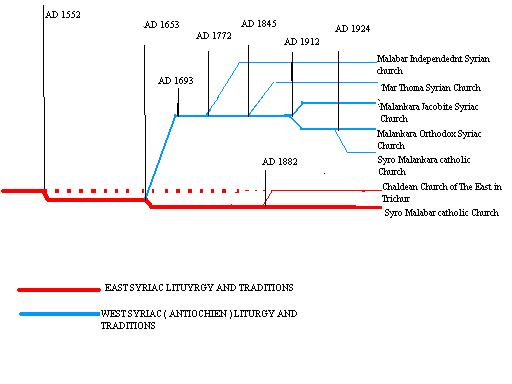
The Syriac churches are further divided and now comprise 7 different branches. They follow basically two different Syriac traditions, the ancient East Syriac and the newly introduced West Syriac traditions. Because of multiple splits and litigations, it is very difficult to estimate an exact population statistics now. There are no available data published from the non Catholic groups where as for Catholic groups, such data is available. The approximate current statistics can be read in demography article.
The different branches of the St Thomas Christians are as follows.
EAST SYRIAC TRADITION
Syro Malabar Catholic Church Catholic Communion
Chaldean Church of Trichur Church of the East
WEST SYRIAC TRADITION
Malankara Orthodox Syriac Church Autocephalous
Malankara Jacobite Syriac Church Church of Antioch
Thozhiyoor Independent Syriac Church Autocephalous
Syro Malankara Catholic Church Catholic Communion
Mar Thoma Syrian Church Protestant reformation
It has to be remembered that some of the Catholic Syriac group ended up in Latin Church also. They are mainly the families of those Priests ordained by Arch bishop Menesis who were not accepted by the St Thomas Christian community and those who did not participate in Coonan cross oath.
Pictures–
1] St Hormiz Church, Angamaly Constructed by Mar Abraham, the last Chaldean Prelate who ruled the undivided St Thomas Christians as his headquarters. Picture by Thomas Antony
2] Saint Thomas Christians East and West Syriac tradition illustration by Thomas Antony.
____________________________________________________________________________
Author M Thomas Antony can be reached by email at – m dot Thomas dot antony at live.co.uk.
_____________________________________________________________________________
Great work. You have put in a lot of effort into this one.
Churches at 34 Indistinct places. Any leads on the present names of these places.
Quejecca : Near Ambalakad, Thrissur : Might be near to the Jesuit house and destroyed by Tippu in 1789.
Canna: Canannore-Kannur
Dear Mr K J Mathai,
Thanks for the information. But how did you relate “Quejecca” to “Ambalakkad” ? Is there a place nearby with a similar pronunciation ? or are there any other links ? I am curious.
Re other indistinct places-
Badeate may be wadayar- (Whitehouse’s comparison list for wadakkumkoor kingdom.)
Covere is Chowara- (see kingdom of cochin- Whitehouses’s comparison list.)
Ginucotte may be chungam-(Roulini describes it as Giuncotti, Paoli as Ciungatta, Whitehouse interpret as chungam–chungattu)
Mulicor may be mulaculum. (Raulini- mulicolour, Du Perron- moulecoulan.)
calete may be kallada. (Roulini – calera, Du Perron kallere, Paoli catare)
Mudela court is modalacodum.
Mormonor- ? maramon
Manongate- is it manarcaud
Dear Thomas
Thank you for all these details. Sorry. I don’t remember from where I got Quejecca as Ambalakkad. It was from some local publication about the church. Interesting that many places in Kerala have been known by more than one name.
Article about Piravom church, its history and name:
Medamana.org
Dear Mr. John Medamana,
I assume (correct me if I’m wrong) you are the one with the ‘Medamana’ sample in the Syrian Christian DNA project with the H haplogroup ? Well, I too have been tested and confirmed to be H. Just curious coz our marker values are a bit similar. So, if my assumption is right I would be interested about your family traditions, claims, migratory traditions and possible history of origins. Whatever info u have handy as of now. As u must have learnt the intriguing nature of our haplogroup I would like to have a discussion on the related aspects with you. You may not post details on this forum.
Please feel free to contact me on my email address mjjackson_12@yahoo(dot)co(dot)in
Looking forward to learn more and possible discover something valuable. Thanks.
Jackson John
Dear Mr Medamana,
It is very interesting to read the history of Piravom church from the link you have provided .It is very informative also. Thanks.
Regarding Col Munro’s intervention to take Piravom church from Pazhayacoor to Puthencoor,
Whitehouse describes it as narrated in your link that the Puthencoor Syrians demanded that the Pazhayacoor Syrians occupying the churches at Piravom, Kottayam valia pally and Changanacherry, Col Munro by an order handed them to Puthencoor.
Actually there were four churches in this incident. Alleppey, Changanacherry, Kottayam and Piravom. Of these, Alleppey and Changanacherry were fully under Pazhayacoor and Piravom and Kottayam were shared between Puthencoor and Pazhayacoor.
There is another account by Fr Bernard TOCD. Mar Dionysius III demanded to take these four churches for his party to the CMS missionaries. The Missionaries made this promise through the then British resident in Travancore, Col. Munro, by an order of Rani Parvathi Bhai in ME 993 ( AD 1818). As Alleppey and Changanacherry were fully under Pazhayacoor, they had to get people from other places to evict local parishioners. In Changanacherry, local parishioners entered into the church and evicted the invaders. The Puthencoor complained and the Government authorities took Kandamkari Philippose Cathanaar and other people from Changanacherry church in custody and sent to Quilon. The wife of the Commanding Officer at Quilon was a Catholic and she complained this to the British Governor at Madras who intervened. By another order of Rani Parvathy Bhai in ME 994, status quo was established for these four churches and Col. Munro was relieved from his job. Thus, Alleppey and Changanacherry were handed back to Pazhayacoor and at Piravom and Kottayam, Pazhayacoor built new churches.
BTW, could you identify where is “paligunde” in the Kingdom of wadakkumkoor ? Your website also mentions about puligunde near piravom. It looks like Whitehouse has catalogued it as Pulincunnu which is in Kuttanaadu not under the Kingdom of Wadakkumcoor.
Question:BTW, could you identify where is “paligunde” in the Kingdom of wadakkumkoor ? Your website also mentions about puligunde near piravom. It looks like Whitehouse has catalogued it as Pulincunnu which is in Kuttanaadu not under the Kingdom of Wadakkumcoor.
Vadakkumkoor kingdom’s HQ was KARIKODE near Thodupzha .
http://idukki.gov.in/formation.htm
Question- Kadamattom Church
This list says Du Perron 1758, (Caramattam ) Kadamattom Church was dedicated to Holy Virgin. Paoli 1760, also says Kadamattom Church was dedicated to Saint George.
The Church now is also known as Saint George Church. http://www.kadamattomchurch.org/
Was this known dedicated to Kantheeshangal ?
Dear Philip,
These lists were compiled by Europeans and hence there are many mistakes.
Re Kadamattom Church, i do not know if it was dedicated to Mar Sabour and Afroath in the past. As you know, all the churches dedicated to Mar sabour and Afroath were rededicated to either all saints or to Garvasees and Proctasees, the twin saints from Milan imported by the Portuguese to mimic the twin saints Mar Sabour and Afroath.
Many ancient churches had dual dedications- Church at udayamperoor was dedicated to saint Mary and also to Mar Sabour and Afroath. I do not know if this was the case for Kadamattom Church also.
Let someone who knows Kadamattom church well explain.
RE- Quadisagal
This is interesting. I was under the impression that Kadamattam Church was earlier dedicated to Quadisagal.
In the list given in the article, Parur and Kayakulam Churches were also dedicated to SS Gervasis & protais. I read somewhere that these Churches were also known as Quadisagal earlier. I overlooked the addition of these two churches to the Quadisagal list (Udaymperoor, Akaparambu, Kothanellur, Kadamattam).
Kayamkulam Church
Wasn’t Jornada mentioning that Menezis changed the dedication of Church at Kayamkulam from Mar Sabor and Prodh to All Saints? From Paulinos list given in this article, the Kayakulam Church was known as dedicated to SS Gervasius & Protasius in 1760. Any further details about Kayamkulam Church ?
North Paravur Church
During the visit of Archbishop Menezis, there were two Churches in Parur ( North Paravur) one dedicated to Saint Thomas the Apostle and the other dedicated to Mar Sabor and Prodh. Archbishop Menezis re-dedicated the Second which was the oldest to All Saints.
As given in this list, after the Split in 17th century, the Church which was dedicated to Saint Thomas Apostle in North Paravur was under Jacobites. The re dedicated Mar Sabor and Prodh Church was with Catholics. This list states that it was known in name of SS Gervasius & Protasius in 1780.
For the North Paravur Church, this would mean that,
1) The renaming by Menezis to All Saints was not successful
2) It was only after 1780, the North Paravur Church was dedicated to Saint Thomas the Apostle from SS Gervasius & Protasius.
It would be interesting to find out if there are more information on these Churches in Parur and Kayakulam. Also any opinions that Kadamattam Church was not part of Quadisagal ?
I was also under the impression that Mar Abo is another name variation of Mar Sabor.
Not a great work..
Fails to mention that, many joined the catholic group, due the attrocities commited by portuguese, and the pampering tactics….
Nothing about kozhukatta ( Arch Bishop Menezea distributed coins in kozhukatta, to induce people to join catholic church..
” Kuzhal undenkil kokkinne pidikkam, kozhukatta undenkil kalloorkadu pidikkam” … goes a proverb, about how the church of kalloorkadu joined catholic group …..:-)
What about the neumerous assasination attempts on Marthoma I and his suceessors ? No wonder why many choose to join the catholic fold…
There was no such assasination attempts. It is true that Bishop Sebastinani tried to capture Marthoma with the help of the Cochin rulers and the Portuguese. The reason given was that he was officiating invalidly as a Bishop of the Church of St Thomas Christians. Marthoma could not produce before the Cochin rulers any brief of appointment from either Antioch or from Rome. It is due to this illegal act and due to the pressure from the Portuguese, that the Cochin rulers assisted Bishop Sebastiani to capture Marthoma.
Dear George,
Thanks for reading the article and your criticism. In the multi denominational politics of Thomasine Christians of Kerala, no one can satisfy each and every group. If you read the article, you can understand my arguments about the reasons for majority joining the Portuguese. I have tried my best to be impartial in the article.
I understand your motive. I feel this as a forum for unity of all Thomasine Christians. As all know, after the unfortunate division of our community, different colonial forces supported different factions and made different propaganda ridiculing the rival faction. Many of those stories are exaggerated. I do not think it is appropriate to propagate those stories again.
I have put a few reasons for majority of Saint Thomas Christians joined the Catholic Syrian group. We can have a healthy debate about that.
Your story of Kozhukkatta happened soon after the Synod of Diamper (AD 1599) when Arch Bishop Menesis visited churches. The Coonan Cross revolt was in AD 1653. The division and group rivalry began only after the arrival of Joseph Sebastiani in AD 1657 and the consecration of Palli Veettil Chandy Cathanaar as Bishop in AD 1663. Until the reconciliation efforts of Rome by the arrival of Joseph Sebastiani in AD 1657, the whole of the Saint Thomas Christians were united under the Arch Deacon. Even with the direct intervention of Rome for reconciliation, Kalloorkkadu Church was with the Arch Deacon until AD 1659 when the King of Purakkadu intervened and forced them to join the Portuguese side. After that, even in AD 1661, when Bishop Sebastiani visited Kalloorkkadu Church, people were forced to receive him by the King.
So, your argument that Champakkulam Kalloorkkadu Church joined Catholic fold because of the pamperings of Menesis by putting gold coins in Kozhukkatta in AD 1599 doesn’t make sense. This logic itself proves that your quoted proverb is another example of propaganda by the rival group.
You have to understand that after the division, both factions were supported by rival colonialists from Europe. Nobody can deny that. Anti Portuguese colonialists also tried their best to get a faction with them and pampered them. While Portuguese did atrocities to the Arch Deacon’s group, the rival European colonialists did the same to the Catholic Syrian group also. Who gave support for the Arch deacon to get Bishops from the Church of Antioch? Was it for helping the Saint Thomas Christians to protect their identity ? Who caused the further division of the Puthencoor community? If the anti Portuguese Colonialists were helping the Puthencoor, they would not have to loose the ancient liturgy and traditions. So, the story of Saint Thomas’ Christians and their division were actually the story of group rivalry of the European Colonialists. They induced us to propagate exaggerated stories against each other and kept us divided for their interests.
Now, if you have any difference in opinion about the arguments I have put in the article about majority joining the Catholic Syrian group, please share them here. We all can learn and understand more.
Dear Thomas Anthony
With due respect, the “Ordination” issue which you are trying to bring up is questionable.
When Archdeacon Thomas was consecrated Mar Thoma I, the entire church was behind him. His ordination was made valid within a small gap of 12 Years by Gregorios Abdul Jaleel Bava. What you are trying to portray is that, the very same people who backed Archdeacon Thomas, later questioned what they themselves did. Are our ancestors such cowards? Or people who were unable to stand steadfast with the very decision made by them?
I would rather hold to the story of “Ordination”, if the Saint Thomas Christians were under ORDAINED leaders for past 1500 years. However, the Saint Thomas Christians were never under anyone ordained, but rather under secular rulers called Arch Deacons. How did suddenly the issue of “ordination” and its importance become of dominance, when we were never under anyone ordained? Question?
The Kozhukatta issue is just one example of the many inducement tactics used by the Portuguese. To claim, that everyone joined the catholic party because of “ordination” is ridiculous. Their were people who were induced, people who were tortured, people who found it more convenient etc etc .
You, yourselves mentioned, “The division and group rivalry began only after the arrival of Joseph Sebastiani in AD 1657 and the consecration of Palli Veettil Chandy Cathanaar as Bishop in AD 1663.” Abdul Jaleel Bava arrived in 1665. So as per your article in a very short span of time, less than 8 years, most of the Christians were thoroughly convinced about the effects of “Ordination’. Also were the activities of Joseph Sebastiani any Christian ?
I agree that you wrote a secular article without much harm to anyone. However narrowing down to just one issue (which as per me, would have been the least of all) is questionable. I am not going to mention anything about what Sebastiani and all others did and answer to all the questions which you posed because, this is a platform for unity. Sorry for being a bit rude.
Dear George,
Thanks for reading the article and for the change in your tone comparing to your post number 22547 dated 26 June 2010.
I have never argued that it was only the consecration issue that caused majority of saint Thomas’ Christians joining the Palli veettil Chandy faction. If you go through the article carefully, I have detailed a number of factors- at least seven. Consecration issue was one among them.
I believe that a significant factor was the lack of legitimate Bishopric consecration for Parambil Thomas ( Archdeacon Thomas – Mar Thomas I) and the related negative propaganda by the Portuguese, when Parambil Chandy was legitimately consecrated as a Bishop and based his seat at Kuravilangadu Church. You can see the churches at Manarcaud and Puthuppally were with Parambil Chandy initially and they moved on to Puthencoor only in 1701, when a non native Bishop was consecrated as the successor of Parambil Chandy.
Your comment “the Saint Thomas Christians were never under anyone ordained, but rather under secular rulers called Arch Deacons.” is surprising. From time to time we had East Syriac prelates. The Bishop of Malabar was called the Metropolitan and the gate of All India as in 8th century documents and the Metropolitan of the throne of saint Thomas and the whole of Christians of India. When there was a period where we did not have a Bishop for 60 years, our community sent a delegation to Babylon to get Bishops in AD 1490. Arch deacon was the leader but the Spiritual authority was the Bishop. We honored the Patriarch of East Syrian Church as our supreme head and remembered the name of the Catholicose Patriarch in our Holy services. After the Synod of Diamper in AD 1599, the position of the Arch deacon was reduced, our community was divided into parishes under Latin Bishops with the Arch deacon as a mere Vicar General.
If you analyse the history, we can see that, even though Arch deacon was the Prince and gate of Saint Thomas’Christians, Epscopacy had a very important role among saint Thomas’ Christians. Many of the sacraments were administered only by Bishops. We can read in many books about east Syrian Bishops quarrelling with Portuguese missionaries about administration of baptism. Raza was celebrated only by Bishops. Whenever there was lack of Bishops in Malabar, our community had sent delegates to Babylon to fetch Bishops. We can see in the history that Joseph the Indian and other two travelling to Babylon to get Bishops and returned with Mar John and Mar Thomas in AD 1492.
We can also see in the history, in AD 1576, there were two East Syrian Prelates in Kerala, one from catholic communion- Mar Abraham and the other from the so called Nestorian- Mar Simon , dividing the whole Saint Thomas Christian community with rival arch deacons. Mar Abraham was based at Angamali with Arch deacon Gheevarghese and Mar Simon was based at Kaduthuruthy with a rival arch deacon.
So, Bishops had a very important role and position among Nasranis.
If consecration was not an issue, why did Mar Thoma I seek help from other eastern Churches to get a legitimate consecration?
The time period 1657-1665 was not a small period. During those 8 years, one group had a legitimate Bishop and the other without a legitimate Bishop with its leadership too inconfident about its status and hence seeking help from all the available sources for a legitimate consecration. At the end, the Catholic group had a native Bishop from Pakalomattom family and based at Kuravilangadu and people were hopeful that there is going to be a new line of native Bishops from Palliveettil Chandy. What else is needed for people to join that faction?
I agree with you, there are many more factors. I have discussed them in the article already.
The exact state of Marthoma christians in Malankara before the coming of the Portuguese is ambigous.
#Catholics try to establish Roman Catholism was prevalent in Kerala from ancient times.
#Orthodox try to establish that Orthodoxy was prevalent in Kerala from ancient times.
Roman Catholicism might have come to Kerala only after the establishment of Caldean church in middle east-15 th CENTURY.-Pazhayakoottar
Orthodoxy might have come to Kerala by 16 th century-Puthiyakootar
##########################################################
#All Nasaranis took Coonen Cross Oath but 82 churches returned to Latin church and 36 churches remained the ORIGINAL style.(Puthiyakoottar)
#When Orthodoxy came to Karala in 1665, they embraced Orthodox faith and were branded by the Other group as Puthen koottar.
#The number of the churches doesnot give an exact number of members with them . This is because some curches may have a membership of 1000 families and some churches may have 100 families.
We can find out this vaguely by calculation.
*Take census of Syro malabar church.
*Take census of Malankara churches.
But we have to adjust the error also.Consider this-
#Syromalabar church, Marthoma church , Malankara catholic church was engaged in missinary works and later converted a lot of people.
*Orthodox church did the missionary work in aq very lesser amount at the time of Saint Gregorios and later all of them joined CSI & Marthoma.Even now new converts are less accepted in Orthodox church compared to other Kerala churches
*Considering all these factors and if others any, we can easily calculate the number of people owed allegiance to Catholicism &Orthodoxy.
#After all ,don’t think that all people in RC or Orthodox are considered same. Some have very good family backgrounds who claims more respectable.
#Another factor is financial status. I don’t think a finacially well to do family consider a poor family equal to them.
Dear Jessop,
The exact nature of Saint Thomas Christians in the pre Portuguese period is getting clearer now.
With the available evidence, we can say that our ancestors were East Syriacs and later connected to Roman Church via the Chaldean Church in AD 1555 with the arrival of Mar Joseph Sulaqa. In AD 1599, the Latins took over the authority over Saint Thomas Christians by the Synod of Diamper until the revolt in AD 1653. Even though the Saint Thomas Christians were connected to the Pope of Rome via the Chaldean Catholic Church since AD1555, there is no evidence to say that they remembered the Pope’s name in the liturgy. But after the Synod of Diamper in AD 1599, The Chaldean Catholic Patriarch’s name was replaced with Pope’s name in the liturgy. Hence, at the time of the revolt, for 54 years, our churches-all of them, the present day communities of Catholic syriac and Orthodox Syriac churches- remembered the name of the Pope in the Qurbana. That means, a generation of saint Thomas’ Christians came into exist with Pope as their spiritual head in their mind. This clearly explains why the Arch Deacon’s party used the name of the Pope for many of their actions. The first contact with the Church of Antioch was with the arrival of Mar Gregorios in AD 1665.
The available historical evidence suggests that all the churches took part in the Coonan Cross oath, but majority returned to Latin Rule, not to Latin Church as you have mentioned, as they kept the Syriac language in worship and kept the ancient Liturgy of Addai and Mari with only some modifications prescribed in the Synod of Diamper.
Regarding your comment about the population statistics, as you have said, numbers of Churches may mislead as there can be large parishes and smaller parishes. This is discussed in the article well. Stephen Neill has clearly reported that
“Attempts to calculate the number of St Thomas Christians and their parishes which adhered to the rival bishops cannot be more than tentative since our authorities contradict one another at every point……………When all factors have been taken into consideration, the figure of two thirds to Chandy and one third to Thomas may be regarded as acceptable. But it seems that the larger churches and those nearer to the main centres of civilisation adhered to Chandy; strong support for Thomas lay in the remote areas, and among those less influenced by the contacts with the west.”
Paulinos De Bartholomew who was in Kerala during 1776- 1789, reported that 90,000 Syriac catholics and 50000 Syriac Jacobites.
Thomas Yates quoting Rev Dr Kerr, in 1806, that Syriac Catholics were about 70- 90,000 and Syriac Jacobites about 23,000.
G T Mackenzie 1901 also observes that majority were Syriac Catholics
George Milne Rae in 1892 reports that Syriac Jacobites 330,000 and Syriac Catholics 110,000.
Except GMR, all report that Catholic Syrians were majority.
A comment about your discussion about conversion. Are you trying to say that SMC is larger than Orthodox due to conversion ? We had a detailed discussion about it many months ago!! I do not want to repeat it again.
You observe that Syro Malabar, Syro Malankara and Marthomites were involved in missionary work and converted a lot of people in them. Orthodox did minimal conversion at the time of Saint Gregorios and all of them joined Mar Thoma church and CSI. Similarly, the missionary work of the Carmelites added people into the Latin Rite of the Catholic church rather than to Syro Malabar due to the same reasons you have mentioned as the cause of Orthodox do not have many converts in it. But I think there were conversions on both sides. . If a church say that we do not accept converts, are they really Christian churches or a mere ethnic group?
The discussion about conversion is out of context, as we are not discussing about the population statistics of present day, but that at the time of the division.
I think these kind of discussions are a feature of classical Indian mind set where the communities are caste conscious. They want to show at any cost that their rivals are inferior to them.
Dear Thomas Antony,
//Even though the Saint Thomas Christians were connected to the Pope of Rome via the Chaldean Catholic Church since AD1555, there is no evidence to say that they remembered the Pope’s name in the liturgy.//
reply- Is there any CATHOLIC CHURCH not remembering its head in Thubden ? This is a vailid question. You say church was Catholic and it didnot rememembered its head/Patriarch. As you know Caldean Patriarch is not the Patriarch of the Nestorian church but instituted by the HH.Roman Patriarch under him.I don’t think he is using the title his holiness.
_________________________________________________________________________________
// Hence, at the time of the revolt, for 54 years, our churches-all of them, the present day communities of Catholic syriac and Orthodox Syriac churches- remembered the name of the Pope in the Qurbana. That means, a generation of saint Thomas’ Christians came into exist with Pope as their spiritual head in their mind.//
This apparently sounds true. But keep in mind that this was done by Portuguese force branding Marthoma christians as Nestorians. The Portuguese was powerful and even the King was under them.
Roman Catholicism is forcefully introduced by the Portuguese.We were eastern christians.
may be Nestorians I am not sure.I am not sure. But we can say that Roman Catholicism came here after 1555 through Caldean Patriarch( But this is a controversial matter -Since POPE is not remembered in Thubden)
We can surely say The Portuguese introduced POPE’S name in Thubden.
_________________________________________________________________________________
Before 1555 what was the condition?
There is a Persian Cross and a few things . Is it enough to prove that We were Nestorians from early days?
You observe that the first contact with the Oriental Orthodox was in 1655? may be true with the present knowledge.We donot know much about before 1555. That portion remains still ambigous. We can make assertions but it needs solid proof.
______________________________________________________________________________
After all in Kerala ,Marthoma christians were not much concerned about the theological matters like catholicism or Nestorianism or Orthodoxy .All this divide started after the Portuguese.
________________________________________________________________________________
About the numbers,I agree with what you said. All churches converted peoples. I am curious to know the present day statistics of Syromalabar, Malankara catholics, Orthodox jacobites, Marthomites .
Do we have this figure?
I am not telling it to brand the church is inferior or superior. After all the syrian christians in Kerala looks i nothing different from Nairs or Other local population.
But conversion is a factor and this was least done by the Orthodox churches compared to Catholic churches and Protestant churches.
As an Orthodox church member, I don’t have anythiong on Catholic church. After all history is history and
we are not much different in faith.
Now a days the Syromalabar church changed a lot in its way to eastern christianity and both the syro malabar and orthodox churches coming more nearer.
A very old thread again, but i really need to correct Mr. Jessop here, in the light of well known history. You said that the Catholics have converted more people than the Orthodox churches; True. But most, if not all converts made by the Colonial catholic missionaries were placed under the Latin rite, implying that the Syrian rite barely witnessed admission of new converts into it during this period. Also, all Catholic converts in the later periods (starting from the mid 19nth century up to the present) were directly admitted to the separate Latin Rite Catholic churches, including in those traditional Syro Malabar areas such as Kuttanad, Meenachil, Kanjirapally, Thodupuzha, Vaikom, Chanaganasserry, Trichur, Irinjalakkuda and Mukundapuram taluks. So one can say that the SMCs have largely managed to retain their ethnic homogeneity through the ages.
But your statement that the Orthodox church barely admitted new converts to their churches is WRONG! Note that the Orthodox churches, unlike the Catholics, never had a parallel system to admit new converts into the Christian faith. CMS missionary accounts of the 19nth century are replete with stories of admission of thousands of neo-converts from the depressed classes (mostly Ezhavas) into the *Syriac Orthodox Church* (since Anglican churches weren’t yet established in many places, plus the Protestant missionaries had close relations with the Puthencoor leaders), particularly in areas around Mallapally, Chengannur, Mavelikkara, Niranom, Kottayam, Kumarakom etc of Central Travancore. This is a fact constantly pointed out by secular historians to disprove the Nasrani claim that they are an ethnically homogenous lot.
Also, you said that those protestant converts under the CMS missionaries were eventually made to join the CSI and Marthoma churches; Only partly true. Note that the admission of untouchables into the Syrian Orthodox church, as per missionary records, began in the early half of the 19nth century, where as the Marthomite church was established only in the latter half. Obviously, there must have been considerable assimilation of these converts into the mainstream Orthodox community, before a section of them split from it to start the “Reformed” church. Well, this may be one of the reasons why most Pazhayacoors (SMCs) mind having marital alliance with people (both boys and girls) from the Puthencoor community of Central Travancore, of course the difference in ecclesiastical traditions and other cultural differences being the major reasons.
And regarding the Malankara Catholics (Reeth), i agree that the church has engaged in active proselytization ever since its establishment in 1930, to make up for the large numbers of Syrian Orthodox/Jacobites who refused to be part of the reunion movement (since only a few Puthencoor parishes around Mavelikkara, Thiruvalla, Konni, Pathanamthitta etc broke away from their parent denomination). The missionary workforce under Mar Ivanios had been on a conversion spree, especially in places around Trivandrum – a region with no traditional Nasrani presence. Note that Trivandrum is the headquarters of this church today, having the the largest share of its faithful. So, you were right when you said that the Malankara reeth Catholics have absorbed recent converts into their fold. But again, the Pazhayacoor SMCs barely associate with the Reeth Catholics, except for ecclesiastical purposes.
“There is a Persian Cross and a few things . Is it enough to prove that We were Nestorians from early days?”
No, this does not prove we were always Nestorians, obviously. What it does say is that the earliest pieces of evidence that concern the Christians of Kerala indicates connections to the East Syriac Church. (And more strongly: that our connections were with the Persian-speaking ethnic minority of that Church: Pahlavi’s attested presence in Kerala is far more ancient than Syriac’s.) There is nothing pre-17th century that indicates any connection to the Oriental Orthodox Churches.
Does this preclude the possibility of West Syriac/Oriental Orthodox connections? No. But it does show that the East Syriac theory has far more weight behind it, than the West Syriac theory. The latter has not one shred of evidence, pre-17th century.
“We donot know much about before 1555. That portion remains still ambigous. We can make assertions but it needs solid proof.”
We do know quite a bit about pre-1555; it’s a commonly reported fallacy that the prehistory is unknown. Mingana, Assemani — Syriac scholars — had a lot to write about us. And some Pahlavi scholars have written about us. The earliest clear reference to our community, by Cosmas, indicates Persian connections. The earliest artifacts indicate Persian connections.
I agree that solid proof is needed for anything, but at the same time one can’t view both theories as equally valid because the East Syriac theory is the only theory that has solid evidence to *at least* attest to the presence of East Syriac Christianity in Kerala up to Cosmas (or at least up to the 10th century). Is there any evidence that attests to West Syriac Christianity prior to Mar Gregorios Abdul Jaleel? No way, Jose.
How much Catholic, the Malabar Nasranis were from AD 1555 to AD 1599 is debatable. We had Mar Joseph Sulaqa and Mar Elias arrived from the Chaldean Patriarchate in AD 1555. (Even before him, one of the four Bishops arrived from Babylon with Joseph, the Indian in AD 1504, Mar Jacob Abuna had been certified as in conformity with the Roman Church by saint Francis Xavier in AD 1545.)
After Joseph Sulaqa, . Mar Abraham came from Non Catholic East Syriac Patriarcate in AD 1557 and was based at Angamali. Mar Abraham was arrested and deported but he joined the Chaldean Patriarchate and returned in AD 1568. So, in effect, both had received pallium from the Popes of Rome. In AD 1578, Mar Simon arrived from Non catholic East Syrian Patriarcate as Mar Abraham became Chaldean. He occupied his seat at Kaduthuruthy with a rival arch deacon Jacob while Mar Abraham and Arch deacon George of Christ based at Angamaly. In 1585, Mar Simon was arrested and deported. During the period 1578-1585, Saint Thomas Christian community appeared to be divided between Mar Abraham and Mar Simon with two rival arch Deacons.
Did they use the Pope’s name in the Qurbana ? It is documented that the Chaldean Patriarch’s name was replaced with the Pope’s name after the Synod of Diamper.
Do Eastern Catholic Churches remember the Pope’s name in their Qurbana or just the names of the Heads of their particular churches ? The story of Syro Malabar Church is different. SMC has been functioning as mere Roman Catholic dioceses with a different rite until only in 1996 when it was recognised as a Sui iuris Church with Major Arch Bishop as the Head of the Church. As SMC did not have a Father and head of the Church on its own, they remembered the Pope in the Qurbana. That may not be the case for other Eastern Catholic Churches.
After the Synod of Diamper, even though the Synod anathematised the Chaldean Patriarch (wrongly), the Saint Thomas Christians continued to remember the Patriarch’s name in the Qurbana along with the Pope’s name! Even the Syro Malabar Church continued to remember the Chaldean Patriarch’s name along with the Pope’s name in the Qurbana until recently in AD 1962 !
Realising that many of the decisions of the Synod of Diamper was unbearable to Saint Thomas’ Christians, Arch Bishop Roz convened a Synod at Angamali in 1603 to make amendments. In 1606, further relaxations to the Angamli Synod by making the Rozian statutes in AD 1606. Usage of the Patriarch’s name continued probably due to these relaxations.
During the time of Mar Jacob Abuna (1504- 1552), we were not in communion with the Roman Church, but Saint Francis Xavier has attested that Mar Jacob was in conformity with the Roman Church. It was during the time of Joseph Sulaqa(1555-1568) that Latin vestments were introduced among saint Thomas’ Christians and usage of unleavened bread for Eucharist. Mar Abraham (1568-1597) introduced Gregorian calendar as in Latin rite and banned marriage of Priests after ordination by his Synod of Angamali in 1583. But Mar Abraham resisted the decisions of the Goan Synod in 1585 which decided to translate the Latin liturgy into Syriac for saint Thomas Christians and to introduce celibacy for all priests.
So, the history of Saint Thomas’ Christians during AD 1555 period and after is very fluctuant. Pazhayacoor was separated from the Chaldean Patriarch forcefully and kept under the Roman Curia with arrangements to continue East Syriac liturgy and rites as modified by the missionaries. The laity and Priests continued the fight for restoration of the ancient Syro Chaldeac rite and even until 1900s, for restoration of connections to Chaldean Church. We can see Mar Thomas Rokos and Elias Melus arrived here on the request of the Catholic Syriac Nasranis. I think it was only after the native Prelates took over the leadership that they wanted to become independent of Chaldean Church and get rid of the Syriac traditions.
Sir,
In your above comment, you have said that Francis Xavier is a Saint. Can you elucidate as to how the person who brought about the Inquisition into amongst us can be called Saint. I mean no harm to anybody, but only wish to know your version.
Could anybody who is knowledgeable in church history please provide some information about Mulanthuruthy church and Piravom Valliyapalli. it would be very appreciated.
Thank you
Mulanthuruthy church published a Souvenir in 1978 and recently with every details about the Church. It is a big one.
Mr. Thomas Antony tries to close the eyes to make darkness. His whole aim is to state that Kerala Christians were under Rome. If they were under Rome, Menesis never tried to capture all the Christians under Rome and destroyed every data. I think the destruction of old books and details was a clever way to cut the relation of Christians with the past. The Canons passed at Diamper and the way they passed can reveal that Menesis was acting like Mafia leader. We can assume the fact that there were Christians in Kerala by the grace of God and Rome then Antioch every one came to catch them in to their nests. I am praying that let the truth be revealed one day. But do not make irresponsible statements publicly. Catholics, all over the world told lies, telling lies of saints to keep the people under the control. You can’t do it nowadays.
Aji:
I’m not a Catholic and have no vested interest in establishing links with Rome; however, you should speak from facts and evidence and not from the raw uninformed anti-Catholic emotional reaction that many ignorant Puthenkoor speak from.
If you look at our history, we can see the following:
1. A dark ages period from the 1st to 5th centuries from which *zero* literary or archeological evidence exists about our community
2. A semi-dark semi-light period from the fifth century up to the 12th century, where we have some evidence that indicates links to the East Syriac Church, which was not politically under Rome, although it did have occasional dialog with the Greco-Roman Churches. (i.e., it was not “untouched” by the Greek Church, since the East Syriac Church has Graecisms and honors the “Greek Malpans”).
3. A fairly bright period post-12th century where we have reports of our community from natives and foreigners, including Roman Catholic monks and missionaries who came to India and dealt with our people.
Regarding 2, like I said, there is no evidence that we were under Rome. Regarding 3, the situation is different.
a. There were Churches started in India by Roman Catholics back in that era, and Christians may have been converted during that era. You can read about the various missions that came to Kollam and what they did.
b. Regardless of (a), which is murky and unclear, we also know that, the schism that occurred in the East Syriac Church in which a segment entered into communion with Rome (the Mar John Sulaqa schism) also affected Malabar. Both factions: the non-Roman Church of the East and the Chaldean Church in communion with Rome, sent bishops to India. There is evidence for this and it is undeniable: the Syriac scholars who’ve studied our community’s literature have found this, and you can check out the SRITE project online for details.
So our history ran like this:
1. murky, unclear (pre-5th century)
2. contact and likely communion with the East Syriac (non-Roman) Church for a long period of time (5th century to the 15th century)
3. contacts with *both* the Church of the East (non-Roman) and the Chaldean Church (16th century)
4. schism into:
a) Pazhayakoor (connection to Chaldean Church basically terminated, now in direct communion with Rome, but using the old Syro-Chaldean liturgy, with many attempts to restore the Chaldean Catholic connection)
b) Puthenkoor (connection to Chaldean Church basically terminated due to inability to reconnect, in various states to confusion, using a hybrid liturgy that started to include elements of a new affiliation with the non-Chalcedonian Church of Antioch).
So, strictly speaking, all of Malabar essentially was in communion with Rome, willingly, for about 200 years. First, during it’s connections with the Chaldeans (not via the Portuguese, but under our Syriac brothers in West Asia who entered into communion with Rome), and second during it’s honeymoon period with the Portuguese whereby Malabar willingly accepted their help, political and spiritual.
If you read Jornada, in fact, you’ll see that many Churches in Malabar, especially in the South which was basically ignored by our generally inept or inconsiderate leaders in Angamaly (the Archdeacons). When Menezis came to the South of Malabar many greeted him, as he celebrated the Qurbana/Mass, conducted baptisms, etc., something that our local priests only did very infrequently.
It’s very popular among the Puthenkoor and also among the Pazhayakoor to decry the Portuguese and the Roman Catholics, and to claim that our own leaders (the Kathanars, the Archdeacons, etc) were great people. But when you look at history, and see what was written back then, it becomes apparent that our own leaders were quite poor, and that sent a lot of people to the newcomers.
In fact, if the Portuguese/Catholics after Menesis has shown more tact, allowing us to retain our Chaldean connections, it’s likely that there would be no Syriac Orthodox Church in Kerala at all. Everyone would be Chaldean Catholic, with perhaps a small, but significant faction that retained a link to the Church of the East, and perhaps some minor Protestant groups (who would likely be far smaller than now, since it was likely the Syriac Orthodox Church’s lack of tact that send a lot of people to Protestantism… I say this as a nominal member of that Church).
Dear Aji Mathew,
I have read a few of your comments in this forum. Sadly, all are negative. See your comments about Cheeran book also. I would like to politely suggest you to try seeing some good things also in others.
You have commented many times about ‘Catholics and their lies’. This shows your hatred. Your comments also refer to Jesus and God. Has Jesus taught us to hate others? You may have some agenda. Have you not seen any good things among Catholics? Are Catholics the only people who propagate lies?
It seems that you have not read the article. I have not put any thing without proper documentary evidence in the article. Regarding the Roman Catholic connection of Thomas Christians, no one can deny the clear Catholic connection after AD1552, with the arrival of Mar Joseph Sulaqa (AD 1555). Since then, there were continuous Chaldean Catholic Prelates in Kerala until Mar Abraham. The pre Diamper Thomas Christians remembered the name of Mar Simon, the then Chaldean Catholic Patriarch in the Qurbana.
Now, who is closing eyes to facts?
Thanks to John Mathew for the detailed clarification.
Aji Mathew: Please try not to use history to make ignorant remarks for hatred and intolerance here. Thomas Antony and John Mathew have politely explained the real version again. Is there any point in repeating hateful comments with incorrect historical connotations again and again ? Abuses are not tolerated and please use the forum for healthy discussion.
Admin,
The above article by Thomas Antony is an emotional retaliation to our discussion about the demography of Malankara Nazranies Vs Romo Syrians. Many of the points raised were not answered by either by you or Thomas Antony. Now I see your comments on Aji’s reaction. I feel your comments are little unjustified .Many times I have seen people in this forum used falls language against their opponents, but you never acted. I can understand your position and the purpose of this site, but please remember history is history and the truth is truth. Today history as a social science adopted modern scientific techniques to find out the veracity of those claims. I am sad to state that all churches have created such foolish stories as history without any scientific evidence to give credibility to their positions. Contributions of Papacy/Catholics are far greater in this regard as compared to orthodox churches.
Look at the case of PALAYUR PALLY STORIES,71/2 CHURCH STORIES,KOONAN KURISHU SATHYAM,PAKALOMATTOM STORIES,STORIES ABOUT QURBANA KRAMAM,EAST SYRIAC –WEST SYRIAC CONTROVERSARIES,STORIES ABOUT DE AMPERITANO SYNEDO,STORIES ABOUT THE ORIGIN OF WORD MALANKARA,MALAYATTOOR STORIES,MYLAPORE STORIES etc. But today I am happy that even some ardent Catholics are against the official historical line of Syro Malabar church. We are not living in medieval centuries controlled by religion but a scientific world.
Some of the ideas expressed here are pure propagandas design to manipulate the truth. That is why those propagators use filthy language on opponents when they have nothing to support their theories.
Any way I like to continue discussion on those Historical subjects only because I don’t want Malankara Nazranies to be a laughable stock in front of secular scientific thought. In order to prevent that I need to oppose all unscientific /illogical /idiotic official historians of KERALA CHURCHES.
Aji Mathew,
Participate in discussion with logical arguments along with evidences. I expect your comments on Posts 16311, 16312, 16313, 16314, 16342, 16504 &16700 (hope you will understand the subject)
Dear bellowed Nasranis (Thomas Christians)
We are blood relatives of a big family and an ethnic group with same apostolic origin. The Unity is a dream for every Nasranis those who know our history. But, If we proceed with microscopic researches and raise unhealthy historical issues about the past, then it won’t help us to reach anywhere in UNITY.
Dear brothers, the Unity is the Strength otherwise our churches may face the same fate of various Syriac churches in the present Middle East. The St.Thomas Churches also face various problems within them, especially the growing threat from Protestantism. So, let us keep away unhealthy complexes, divisions, and think about the possibilities of unity.
Until 1773 AD, we all Thomas Christians were in ONE Church and following the East Syriac Liturgy (the Addai-Mari Anaphora which is known as the Liturgy of the apostles, the earliest Christian Liturgy, which is the only Semitic Judeo-Christian liturgy, and very similar to the worship of apostles/apostolic time). This is the common and basic liturgy of the entire Church of East (East of Euphrates River) especially to all St. Thomas Christians in India.
As we know, due to various reasons, in1653 the very first split occurred in Thomas Christian Church into two and divided as Catholic and Archdeacon’s parties. However, these both parties continued with their apostolic tradition and thus same East Syriac Liturgy.
In 1773, a tiny splinter group from Archdeacons side formed gave birth to Thozhiyoor Church. And this Thozhiyoor Church was the first Church in India who brought in West Syrian Liturgy (St. James liturgy, a Liturgy developed in Greco-Roman empire) of Antiochia. But, the vast majority of the Archdeacons party continued with East Syriac Liturgy until 1860 AD but later they were also forced to accept St. James Liturgy of Antiochia. Since then this party of Archdeacon was known as ‘PuthenkoorKar’ (Jacobites), whereas the Catholic party which is the so-called Syro Malabar Catholics continued with their East Syriac Liturgy under the Latin missionaries, so they were called as ‘PazhayakoorKar’.
Later from this Archdeacons party, other Churches such as Marthomites (1882-84), Indian Orthodox (1910), Malankara Syrian Catholics (1930) were originated on various reasons.
Thanks to the Author M Thomas Antony and to his diagram in the article. But I would prefer another diagram which showed the years clearer with notes, and is given in http://www.nasranifoundation.org/ . An important note about the East Syriac and West Syriac traditions is also given in this page. (Thanks to Nasranifoundation.org.)
For a reasonable dialogue, let us go roll back to 1832-1860, the period in which the Archdeacons side fully absorbed the West Syriac (St. James Liturgy). This is just a 180 or 150 years back which is not a long period compared to the 1950 year history of Thomas Christians.
As the first step for unity, these West Syriac Churches who claim St Thomas as their founding father of their churches, one by one needs to RESTORE the East Syriac Liturgy (Qurbana) and continue as individual Churches as such. Once the restoration of E.S.Qurbana is successful, then proceed to the next step.
Unity does not mean merging all the Thomistic Churches into a particular Church in a day under a particular Church head. Unity cannot be achieved in one step, one day, but sometimes it may take decades. First, may all the West Syriac Churches restore and follow the East Syriac Liturgy (Addi-Mari anaphora) which was the original and common Liturgical tradition of all Thomas Christian Churches, then the Unity of the Thomas Christians become practical and easier.
All these West Syriac Churches should follow the footsteps of Church of East Trichur who restored the pure East Syriac Liturgical Tradition hundred years back. The restoration of East Syriac Tradition and then unity is the only solution to all problems and their survival as strong Syriac community.
Let us pray for our Church leaders and for the Unity of our Thomas Christians.
Sir,
I am confused with “Kattoor” and “Kottara” churches in the list.. I would like to know where those places in the map?? Does those refer to “Kottoor Church” situated near Kolenchery in Ernakulam District. Kottoor Church is dedicated to St. George and seems to be the second oldest of all Churches in Ernakulam District. It is believed to be build in 4th/5th century… Can u please clarify me on this…
Regards,
Manu Kuruvilla
Dear Manu Kuruvila,
As you know, many of the ancient documents use old malayalam. Many authors wrote these place names in thier own languages based on the old malayalm pronunciation. So, modern readers may mis read them. So, identifying the exact place is difficult. P J Tomy’s article where the names Kattoor and Kottara appears is a recent article.
Kattoor is a place near Alleppey. I do not think there is an old church. It may be Kottoor also. Are there any tradition that Kottor Church had representation in the Synod of Diamper ?
Kottara, i think is a place near Kottarackara.
Please go through the catalogue presented by Thomas Whitehouse shown in the article. This is based on 5 different authors. It may be more reliable. I cannot find the name Kottoor in that list.
If you know Kottor Church well, please provide more details about it, which will be beneficial for all the readers here.
Dear M Thomas Antony,
Thanks for the reply. Sir, to my knowledge, KOTTOOR CHURCH is the oldest of all Christian structures in Kerala dedicated to ST.GEORGE (Geevarghese Sahada).. The church is believed to be founded under PALLIPURAM CHURCH near Chertala. Later, when the PIRAVOM CHURCH was founded it got converted as a Kurisupalli of Piravom Church. And later under KADAMATTOM and KOLENCHERY CHURCHES after their foundation..
And the representation of KOTTOOR CHURCH in Diamper Synod is unknown due to lack of historical records.. That’s why I doubted on ‘Kattoor’ and ‘Kottara’ churches in the list.. Another possibility is the location of the church.. Udayamperror is only around 20-25 kilometers from Kolenchery/Kottoor… So there exists a good possibility..
Regards
Manu Kuruvilla
Kottoor is the second oldest of all Christian Churches in Ernakulam District. Kottoor Pally functions as a chapel of St. Peter’s and St. Paul’s Orthodox Syrian Church in Kolenchery, Kerala, India from the 15th Century AD. Thhe date of establishment is unknown.
The Kottoor Pally is said to have been a chapel of Pallippuram Church near Cherthala in the initial periods. From there, it was transferred as a chapel of Piravom Church at its establishment. In the 9th Century AD, when the famous Kadamattom Church was established nearby, it became its chapel. At last, when the Kolenchery Church was constructed in the 15th Century AD, Kottoor Pally became its part as a chapel.
sir,
Good article and great comments. I belong to karunagapally area which is also in the list.But there is nearly hundred churches in this taluk altogether.sir(thomas antony) could you help me to find the orginal?
It is said that in the Census of Travancore in 1836, the Population of Romo Syrian Christians is given as 56184 and Syrians 118,382. Even if we take in to account the Syrian Christians of the Kingdom of Cochin who are not counted in this, does it not indicate that the majority of the original Malankara Church stood with the Puthencoor even in 1836? Can we discard a census report, when it is actually a head count? Is this cenesus report of 1836, reliable and whether it is true?
Johny, would you give the link to this census report? I dont think the figures are correct, as it is evident from various historical records of the 17nth and 18nth centuries that, the first division among the Syrian Christians ended with 84 out of the total 116 Syrian churches standing with Rome (Pazhayacoor), and the others (remaining 32) eventually joining the Antiochean Syrians/Puthencoor.
All the Syrian Churches in the Cochin Kingdom (except Arthatt – Kunnamkulam) stood with the Catholics. Even if you take the Travancore Kingdom alone, the Pazhayacoor churches outnumber the Antiochean Puthencoor ones. For example, 19 of the 22 Syrian congregations of Kottayam district chose to be with the Pazhayacoor. It was 3 congregations – Kottayam, Puthupally and Manarcaud that switched to the Puthencoor faction. (Initially both Manarcaud and Puthupally stood with the Catholics, but switched allegiance following the pressure from the British resident Munroe).
Jacob, there is no link available, but the data is available in the Census Report of Travancore written by V Nagam Aiyah. It must be available for reference in Libraries in Kerala. This data is also quoted in nasrani.net