
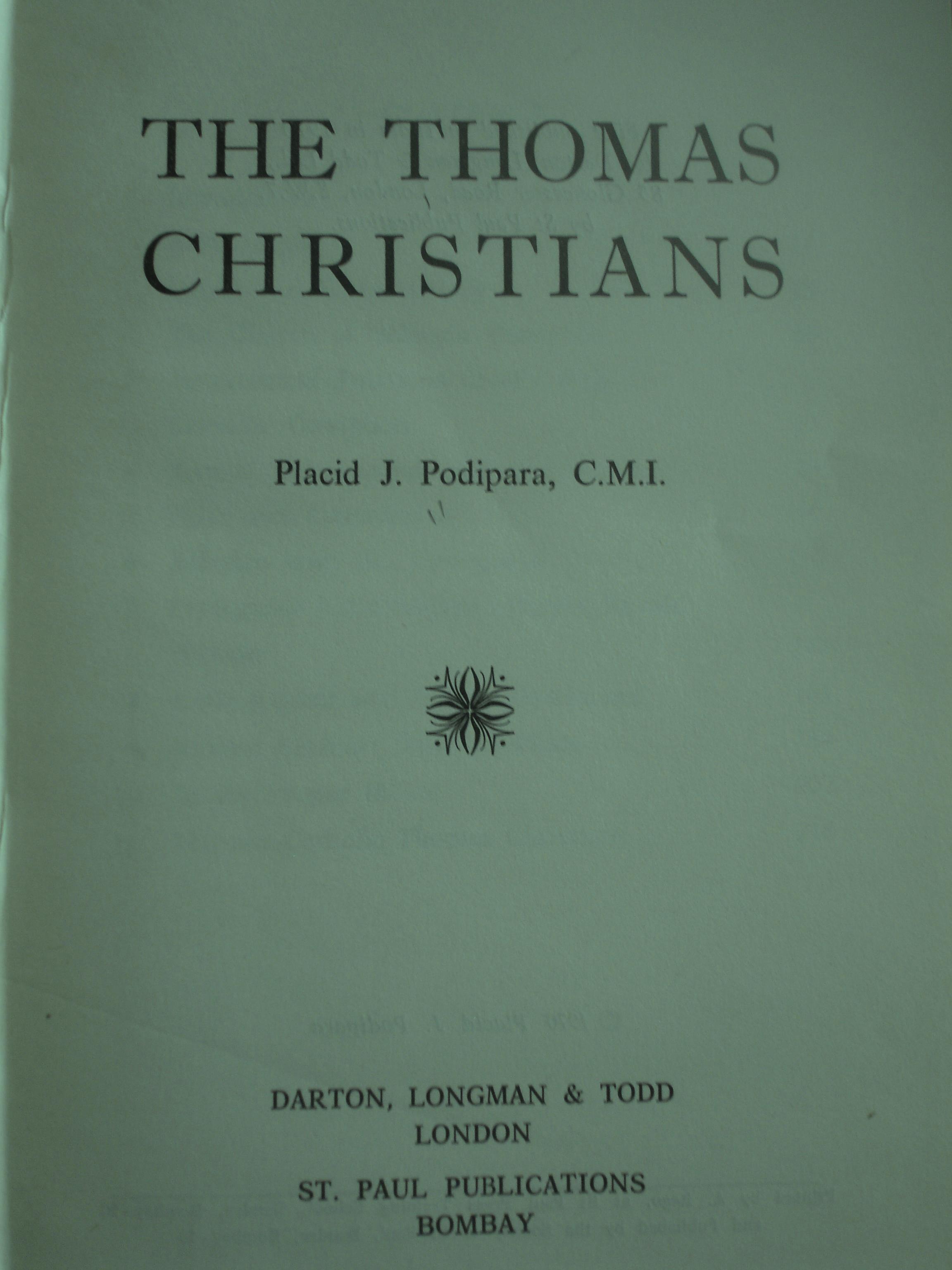
‘The Thomas Christians’ by Placid Podipara

The Thomas Christians by Placid Podipara
Note about the Author
DDDr. Placid Joseph Podipara CMI, is known as the greatest Church historian of India. He has authored more than thirty seven books and numerous articles on Saint Thomas Christians in many languages such as English, Malayalam, German, Latin etc. (( The underlined subtitle gives a gist of the interesting points (‘interesting’ – from my point of view which are not very known) of that particular section . ))
He has also served as Member of the Pontifical commission for codifying Canon Law, Syriac Language examiner of Kerala University, Consultant to the Congregation of Oriental Churches, Member of Pontifical commission for restoring the Syro Malabar Qurbana, Professor of Pontifical Oriental Institute and Urban University, Rome, Consulter for preparing the agenda of Second Vatican Council etc. He holds doctorates in Philosophy, Theology and Canon Law. (( “Placidachan” edited by Varghese Pathikulangara- The list of the books and various articles of Fr. Placid can be read in this souvenir from DENHA Services.))
Contents
Introduction
Bibliography
Fr. Placid states that, formerly there were Thomas Christians in several parts of India, and only those of the south west coast of India have come down to the present day, and they alone are the subject of this treatise.
The south west coastal region of India, which has been home and habitat of the Thomas Christians is known by different names such as Malabar, Malankara, Malanadu, Malavaram, Malayalam and Kerala. It extends more or less from Mangalore in the north to Cape Comorin in the south. From this region, the middle portion of which has been their home for a long time, the Thomas Christian are now spreading out to the other parts of India.
Chera, Chola and Pandya ( Pandy, Pandi, Pandion) were the important kingdoms of South India in the early centuries of the Christian era. Most of the Thomas Christians, known also as Nazrani Mappilas were the subjects of the Chera kingdom ,whose Capital was Muziris or Cranganore. After the fall of this kingdom, they spread to different principalities that rose up in the land. One of these principalities was probably ruled by a Christian chieftain. There were also constant wars, and mutual annexations amongst these principalities.
Until the middle of the XVII century, the Thomas Christians were all one in faith and rite. There after, divisions arose among them, and consequently they are today Catholics and non- Catholics of different rites, the latter belonging to different denominations. All of them are often called Syrian or Syrian Christians, since they have been using Syriac for liturgical purposes with or with out the admixture of Malayalam.
Between both the Catholic and the non Catholic Thomas Christians, there are different ethnical groups similar to the Hindu castes of the place in which they dwell.
Contents in detail
Chapter 1- Origin and Early History
In this chapter, Fr. Placid analyzes the early traditions about Saint Thomas Apostolate where India not mentioned, but not excluded and India mentioned: South India not excluded.He also examine the South Indian tradition ( in Malabar and in Coromandel) about the evangelization of Saint Thomas, the Apostle.
About Coromandel tradition – Even before the Portuguese opened the tomb in Mylapore in the XVIth century, it was believed to have been the tomb of Saint Thomas, and was being visited by both Christian and non Christian pilgrims and travelers.
Three of the five complete MS copies of Mar Solomon of Basora’s ( 1222) “Book of the Bees” speak of Mahluph ( Mylapore) ” a city in the land of the Indians” where “others say” St. Thomas was buried. (( Perumalil A, SJ, The Apostles in India, Fact of Fiction, Patna 1952 ))
Placid also quotes the accounts of Marco Polo ( 1295), Oderick ( Italian Franciscan, 1324,1325), Am’r son of Matthew ( Christian Arab writer, 1340), Marignoli ( Papel legate in China, 1394), Nicholas de Conti ( Italian merchant, 1425-1430) who visited, or mentioned Mylapore before the Portuguese came there in the early part of the XVIth century.
He also dissects the East Syrian attitude towards the South Indian tradition of mission of Saint Thomas, the Apostle, and mentions that this would weaken the theory that East Syrian missionaries or traders introduced Christianity into South India. He also briefly covers the Calamina riddle- that the Saint Thomas died in Calamina of India.
About the early history – The persecution on the coromandel coast is said to have made the local Christians take refuge, in Thiruvancode not far from cape Comorin and in Thodamala in north east Malabar. There were only two families in Thiruvancode in 1970’s and the rest have immigrated in to different parts of Malabar. ( Dhariaikal – Thariaikal are said to be the descendants of these immigrants). There is no trace of ancient Christians in Thodamala. They were hinduised in the XVII th century. (( Mission of Fr. Fenicio SJ, Roz SJ, Report 1604 ( British Museum Add MS.9853) ))
Another persecution or seduction, is attributed to a Hindu conjurer Manikavachakar. Those, who were seduced are said to have become Hindus. A caste of Nairs known as Manigramakar found in Malabar in such places as Quilon, Kayankulam, Mavelikara are said to be the descendants of the seduced. Nevertheless, they keep some customs that might have been Christian. (( Brown, The Indian Christians of St.Thomas pp 76-78))
Chapter 2- The Church of Seleucia- Ctesiphon
According to Placid, in order to get any reliable knowledge about the hierarchical organization of the Thomas Christians, we have to recourse chiefly to the Churches of Seleucia- Ctesiphon and Persia proper.
This Chapter analyses the Seleucia- Ctesiphon organization, rite, break up with the western fathers, turns “nestorain” or theodorian, the glory and decline, faith in general, roman primacy, an exception, and the two rival patriarch lines.
This Church, during the glorious time became an organization of some 250 bishops under several metropolitans. The Patriarch exercised jurisdiction in Assyria, Babylonia, Chaldea, Arabia, Cyprus, Media, Khorosan, Merve, both sides of the Persian Gulf, Persia proper, Turkestan, Socotra, China, Tartary, India and even parts of Indonesia and Ceylon.
Chapter 3- Hierarchical Relations Chiefly with Seleucia – Ctesiphon
This chapter deals with the hierarchical relations of the Thomas Christians with the churches of the Middle East, chiefly with the Churches of Seleucia – Ctesiphon and Persia proper. The topics are divided as doubtful relations, obscure and then clear relations, Antioch claims, Seleucia – Ctesiphon alone, series of Prelates, titles of Prelates, residences of Prelates, Liturgical rite and language.
About clear relations – The clear evidence for the hierarchical relation, between Malabar and Seleucia– Ctesiphon, through Persia proper is furnished by Patriarch Iso’yahb III of Seleucia – Ctesiphon ( c 650-660) in his letter to Simon of Riwardasir of Persia.
About the titles of the Prelates of Saint Thomas Christians – The Prelates had the title of Metropolita Indiarum. Another title was, Metropoliten and Door of All India. (( Paulinus S bartholomaeo, India Orientalis Christians, Rome, 1794, p-88 )).
The term, “Door of All India” or “All India” or “Of India” was being used till as late as the XVIIIth century by the prelates of non Catholic Thomas Christians. At least, two Latin prelates of the Thomas Christians and a Catholic Thomas Christian Vicar Apostolic ( Mar Alexander Parampil 1663-1687) used to add after their names the title, Metropolitan of India or of All India. Even under Latin Prelates, the Archdeacon of the Thomas Christians ( XVII century) used to style himself as ” ( George) Archdeacon of India” (( Jesuit Archives, Rome, Goa,18,f 72-Letter, Dec 1, 1624))
About the Residences of Prelates– The Prelates of the Thomas Christians resided, as tradition says, in Cranganore, Quilon, Angamale, Diamper and Mylapore. Placid mentions that according to tradition, after the VIII/IX century, when Cranganore had lost its importance as a Christian centre, Angamale rose to importance, through Cranganore seems to have resumed its former importance to some extent after some time. At least till the beginning of the XIX century, the representatives of the church of Angamale had the first seat and right to speak first in general assemblies of the representatives of all the Thomas Christian Churches ( Catholic) . Among the non- Catholic Thomas Christians this privilege was enjoyed by the representatives of the Church of Niranam ( after the XVII century).
Chapter 4- Special Organization and Constitution
This Chapter, analyzes the special organization and constitution of Saint Thomas Christians. Along with the factors with dependence on the East Syrian liturgical and rites, the Thomas Christians developed an individuality of their own in the socio political environment of the country.
The topics covered are socio- political life, manner of worship ( churches, sacraments and sacramentals) and Church administration.
Chapter 5- Faith and Communion
Placid says that the Thomas Christians had an organization and constitution distinct from those of the Seleucia – Ctesiphon Church, which they had hierarchical and liturgical relations. The topics covered in this chapter are Faith and Communion.
Chapter 6- Alliance with the Portuguese
The topics covered in this chapter are Portuguese ecclesiastical jurisdictions, Thomas Christians- two Bishops, Portuguese help, more Bishops, friendly relations continue- Mar Jacob, frictions, Muttuchira inscription, friction intensified, after Mar Jacobs death, new Bishops; Mar Joseph, Mar Joseph and Mar Abraham, Council of Goa, 1575, some of Mar Abraham’s other activities, Council of Goa, 1585, accusations against Mar Abraham, two briefs, Mar Abraham’s successor, Dom Menezes; his plans, Dom Menezes in Malabar, Dom Menezes in Malabar, the ‘Synod” of Diamper, the Archdeacon and the Synod, Bishop Roz SJ: Latin regime.
About the Synod of Diamper – Dom Menezes, summoned all priests, other clerics and four lay men elected from each church, even from the churches he had not visited under the pain of excommunication in 1599 . About 130 ecclesiastics and 660 laymen ( elected and specially invited) met at Diamper in the territory of Kingdom of Cochin. The Chaldean Patriarch was condemned as a heretic and schismatic, and they were made to swear that they would not accept any bishop except the one immediately nominated by Rome. The Patriarch ,thus condemned as heretic, was Denha Simon who was in explicit communion with Rome and had been honored with Pallium. Placid, also analysis whether Dom Menezes had any right to convoke and conduct such a synod. The letters of Roz SJ and Campori SJ, who were present at the Syond mentions that, there was no such Synod but only reading of regulations took place, which the people didn’t understand or were not concerned. There are also no documents which says Rome ever approved such a synod.
Chapter 7- Portuguese Latin Regime: Unrest, Revolt, Schism
This Chapter covers the following topics, Roz ( Franics) SJ ( 1599-1624), Brito ( Stephen) SJ ( 1624-1641), Garcia ( Francis) SJ ( 1641-1659), Ahatallah, the Coonan Cross Oath, Archdeacon pseudo-Archbishop, Carmelite commissaries, Mar Alexander Parampil, Puthankuttukar and Pazhayakuttukar, Raphael Figueredo, Custodius De Pinho, Gracia’s successors: Archdeacon Mathew, Padroado and Propaganda jurisdictions, Seminaries, The Carmelites and Schism ?.
About Roz ( Franics) SJ ( 1599-1624)– Roz SJ was nominated as successor to Mar Abraham on Nov 5, 1599. The Metropolitan see of Angamale was made a diocesan suffragon to Goa on Dec 20, 1599. Portuguese Padroado was extended over it in Aug 4, 1600. Bishop Roz SJ was consecrated on Jan 25, 1601.
Bishop Roz SJ had started residing in Cranganore. Quarrels broke out between him and the Francisan Bishop of Cochin regarding jurisdiction over certain places including Cranganore. The latter, usurped certain churches such as the Thomas Christian Churches of Cochin, Mattanchery and Palluruthy. The Bishop of Cochin even had recourse to arms !
The Archiepiscopal title was restored in Dec 12, 1608. The title of Angamale was changed to Cranganore on Dec 3, 1609. Bishop Roz SJ received the pallium on Jan 26,1609, and the Archdeacon imposed it on him. On Dec 22, 1610, the boundaries of Cochin, Cranganore and Mylapore were fixed by Dom Menezes. Cranganore got few Latin churches such as Calicut, Cranganore, Paliport but lost the Thomas Christian churches of Cochin, Mattancherry, Palluruthy and Purakad which came under the Bishop of Cochin with no change, how ever of rite. In this manner the title of All India which belonged to the Prelates of Thomas Christians become extinct and meaningless. The whole of India was parceled out among three Padroado sees. The quarrels between Bishop Roz SJ and the Bishop of Cochin continued and a Jesuit versus Franciscan colour was seen in everything and every where.
Chapter 8- Latin Regime and Further Grievances
The topics covered in this Chapter are, All under Propaganda: Angelus Francis ( Carmelite), Mar Simon, Padroado again: Ribeiro John SJ, Many for Carmelites, Angelus Franics again, Mar Gabriel, Puthanchira and Verapoly, Padroado and Propaganda Prelates ( XVIII Century), new troubles, further troubles, Cariattil and Paremmakal: Padroado Alone, Pandrai ( Paul), Reunion of Mar Dionysius I, Pandari- Kattakkayam Faction, Sankurikal and Seminaries.
Chapter 9- Violent Storms: Dawn of Peace
The topics covered in this and the next chapter, mostly deal with further history of Catholic section of Saint Thomas Christians – Padroado and Propaganda, Prelates till 1838, East Syrian ( Chaldean ) Patriarchs, Propaganda alone; Titular Archbishop, Propaganda Prelates of this period, Chaldean Rokos; Padroado restored, Thondanatt, Bishop Abdiso, Padroado and Propaganda Again, Prelates ( 1864-1887), Chaldean Mellus, Mellusian – Nestorians, Petitions and Visitors, Marcelline, Coadjutor ( Carmelite), Indian Latin Hierarchy ( Propaganda) Cranganore Suppressed, Two Latin Non Carmelite Vicars Apostolic ( Propaganda), Medlycott and Lavigne, Padupurakal, Three Indigenous Vicars Apostolic ( Propaganda) and Seminaries.
About Chaldean Rokos; Padroado Restored – The Thomas Christians had correspondence with the Chaldean Patriarch for a long time. In 1852, some Catholic Thomas Christians asked Patriarch to send them a Bishop and two priests to teach Syriac or at least two priests if the Pope didn’t wish to send a Bishop. They, even threatened that they would become Jacobites if the petition was not granted. A Chaldean Priest, Denha bar Jona, who was staying at Kuravilangadu also gave them help and encouragement. Kudakkachira Antony, along with Thondanatt Antony approached the Chaldean Patriarch Joseph. Patriarch send them back asking to collect signatures for their petition. Kudakkachira Antony died on the way. Thondanatt Antony took up the cause, and brought to Malabar Mar Rokos Thomas a bishop send by the Chaldean Patriarch as Visitor to Malabar ( 1861 May 20th ). Majority of Catholic Thomas Christians followed Mar Rokos Thomas. But Pope Pius IX had already made it clear that the Patirach had no cliams over Malabar. Bernardine, the Vicar Apostolic of Verapoly appointed Fr. Chavara Kuriakos, who was the superior of the CMI fathers as his Vicar general to fight against Mar Rokos Thomas. Fr.Chavara persuaded Mar Rokos Thomas to go back and accompanied him till Cochin where he took a ship to Basora in 1862. The Oriental Congregation consulted Bernardine to consecrate the Vicar General as the Bishop. But the missionaries opposed the step, and depicted Fr. Chavara as an old man, a simpleton who had no sufficient knowledge ! The Churches that had followed Mar Rokos Thomas were allowed to choose between Propaganda and Padroado jurisdiction.
About Chaldean Mellus – Some Thomas Christian priests, especially those of the Catholic- Padroado jurisdiction, with the help of a Chaldean priest Philip Azziz, who was in Malabar tried to get down a bishop from the Chaldean Patriarch. The Chaldean Patriarch Mar Joseph and Mar Mellus Elias had tried in First Vatican Council to get Malabar under their jurisdiction. Chaldean Patriarch Joseph send Mar Mellus Elias to Malabar ( 1874 ). Some 30 Padroado and 2 Propaganda churches followed Mar Mellus Elias in the beginning. Mar Abdiso Thondanatt also joined Mar Mellus Elias. Another Chaldean Bishop, Mar Jacob came to assist Mar Mellus Elias. How ever, Mar Jacob went back to the Chaldean Patriarch chiefly due to the efforts of Nidhiry Mani Kathanar. Mar Mellus Elias was forced to go from Malabar in 1882 and before going back he entrusted his followers to Mar Abdiso Thondanatt and to Augustine ( a Chaldean Corepiscopus who had come to help Mar Mellus Elias).
Mellusian “ Nestorians” – Mar Abdiso Thondanatt died in 1900. They seem to have had no Bishop till 1908. Then, they received a Nestorian ( from the rival line Patriarch ) bishop, Abimlech Mar Timotheus who ruled them till his death in 1945. This created two factions among them. Those, who opposed the Nestorian ( rather Protestant) tenets of Mar Abimlech were lead by the above said Chaldean Corepiscopus Augustine, and were known as Independents and others were known as Suray’s. There were quarrels, and law suits between the two. The Independents finally lost the suits, and joined Syro Malabar Church. The others ( Suray’s) who were a thousand families in 1970’s were divided in to two factions.
Chapter 10- In the Proper Milieu
The topics covered in this chapter are Hierarchy, Further developments, The Prelates, Oriental Congregation, Religious Institutes, Seminaries, Vocations and Missions, The Rite, Why such a long delay ?, A new Offshoot, Syro – Malankara Prelates
Chapter 11- The non-Catholic Thomas Christians
The topics covered in this Chapter are a chronological account about the history of Non- Catholic Saint Thomas Christians in six parts.
Part one covers, The Jacobites, Mar Thomas I – Mar Thomas V, Mar Thomas VI alias Mar Dionysius I, Mar Thomas VII – Mar Thomas IX, Mar Dionysius II – Mar Dionysius IV, Mathew Mar Athanasius, Mar Qurilos and Mar Stephanos, Mar Dionysius V, The Patriarch; Marthomite Church, Two Parties, Law Suits; Reconciliation.
The Patriarch; Marthomite Church– The Jacobite Patriarch, Peter III Ignatius held a synod at Mulanthuruthy in 1876, consecrated six more metropolitans, and divided Malabar in to seven eparchies ( dioceses), instituted an Association consisting of bishops with the representatives of priests and lay men to administer the temporalities of the Church through trustees, and also to elect bishops. The six eparchies are Quilon, Thumpaman, Kottayam,Angamale, Niranam, Kadanat and Cochin. Mar Dionysius V was assigned the eparchy of Quilon and was entrusted with conducting the law suits. Mathew Mar Athanasius passed away in 1875. He was excommunicated by the Jacobite Patriarch, Peter III Ignatius after his arrival in Malabar in 1875. The successor of Mathew Mar Athanasius ( who was earlier consecrated) , Thomas Mar Athanasius carried on with the law suits against Mar Dionysius V . Finally Mar Dionysius V and party got victorious in the court case and others formed a definte independent Church and before they assumed the name Marthomites, they were known as Reformed Jacobites.
The Part two covers the Anjoorians and Part three on the Anglicans. Part four is about Marthomites. Part five about the Mellusians and Part six about Saint Thomas evangelical church.
About Anjoorians – The Anjoor ( Thozhiur) Church originated about the year 1772, when Mar Cyril was expelled from Travancore and Cochin by Mar Dionysius I. Its members have always been very few, and it follows the West Syrian rite. It is now called the “ The Independent Syrian Church of Malabar”. In the beginning, each Bishop used to consecrate his successor. Then the Anjoorians and the Marthomites began to consecrate of each other.
About Mellusians – The Mellusians are the remnants of those Thomas Christians, who followed the Chaldean Bishop Mar Mellus Elias in 1874. They call themselves “Suray’s” and “Chaldeans”. Mar Timotheus ( 1908-1945) was succeeded by Darmo Mar Thomas. Darmo Mar Thomas quarreled with the Assyrian Church of East Patriarch with an anti- patriarchal party in 1963. He consecrated two priests from Malabar, Mookkan and Konikkara as bishops. The former succeeded him as Metropolitan, with the name of Mar Aprem. Till 1908, they used the East Syrian Liturgy used in Syro Malabar Church, and then adopted the rite used in the now Assyrian Church of East.( See the chapter -9 review- About Chaldean Rokos; Padroado Restored-About Chaldean Mellus-Mellusian “ Nestorians”- for more details)
In General
Placid states that the sources for the pre- XVIth century period are very few, disconnected and fragmentary, and he has utilized the most important ones. The post XV century period abounds in sources, but the brevity of the treatise he has in mind has made him leave out many things contained in them.
The first five chapters deal with the pre – XVIth century period and the rest with the post –XVIth century. The second chapter about Seleucian Church might seen a little disproportionate which is something Placid admits. Placid says, the general idea is that Seleucian Church was radically cut off from Rome through schism and heresy, and if this idea about Seleucian Church could be revised a little, the same would be applied to the Thomas Christians also, by those who would not view the latter except in terms of the former.
The book was published in 1970 for Darton, Longman and Todd by St. Paul Publications, Mumbai.
________________________________________________________________________________
Author can be reached on admin at nasrani dot net
________________________________________________________________________________
Fr, am Jiju a Malankara Catholic fm Changanacherry. Fr, can i get the details of books which contain the role of CMI congregation towards reunion held in Malankara.