‘The Indian Christians of St. Thomas’ by Dr. Leslie Brown

‘The Indian Christians of St. Thomas’ by Dr. Leslie Brown
Note about the Author
Dr. Leslie Brown came to Kerala as a missionary of the Church Missionary Society. In his fourteen years of service in India, Dr Bown was instrumental in developing the Anglican communion in India. He was also noted for shaping the worship of Church of South India. Dr. Brown later on worked as the Principal of one of the Theological seminaries. (( http://www.independent.co.uk/arts-entertainment/obituary-the-right-rev-leslie-brown-1135067.html ))
From India, Dr. Brown went on to become a Bishop and subsequently Archbishop of Uganda before returning to England as Bishop of St. Edmundsbury and Ipswich. He is known as one of the last generation of English bishops who gave outstanding service overseas, both to the ecumenical movement and in creating indigenous episcopal leadership in the Anglican Communion.
Contents
The Christians in Malabar, on the coast of South – west India, claim an unbroken relegious tradition from the time of Thomas the Apostle, who visited India in the first century AD. The community is a unique one. Living as a minority group on a busy trade route which has existed at least since Roman times.
In introduction, Dr.Brown analyses prior Anglican works ( Geddes, Buchanan, Hough, Whitehouse, Howard, Rae ) on Saint Thomas Christians history and concludes that their sources of information was limited. He also mentions that none of the contributions from Indian writers so far was from an impartial standpoint. He counts Fr. Placid Podipara, K N Daniel and T K Joseph as outstanding Indian writers.
According to him, there is therefore a need for a fresh investigation of the history of the Malabar Church, written impartial as possible.
He says, this book is concerned with the section of Church called Orthodox. It has Therefore to leave out of consideration the various groups which live apart from that section, once the occasions of separation have been noticed. Thus we shall see that, the Indian Church had a loose – knit unity until 1653, for the last fifty years of that period under Roman obedience. Then about half of the Christians became Jacobite in allegiance ( if not at once in liturgy or theology). The work of English missionaries in the nineteenth century, concurring as it did with personal rivalries and factions among the Indians, led to the secession of the Mar Thoma Church and the conversion of a few families to the Anglican faith. The continuing body of Jacobites has been torn asunder by disputes arising, not from doctrinal differences, but from the clash of persons and their struggle for power. By 1950 the two factions apparently gave up hope of reconciliation and now exist as separately organised churches, the Jacobite, acknowledging the supremacy of the Jacobite Patriarch and the Orthodox, under the Indian Catholicos of the East.
In Introduction, Dr. Brown also notes that the motivies of Western Christians were not always altruistic. He mentions that, after the Syond of Diamper a distinguished Jesuit wrote to his Father General, that the effect of the actions there taken would be of immense service to Portugal as they could put thirty thousand soldiers in the field. The Dutch Officer, Visscher suggests that it would be a good idea to train young Dutchmen in Syriac and Malayalam and bring them out to convert Syrians in to reformed faith and company interest can be protected. Col. Munro, the first British Resident referred his endeavors among the Saint Thomas Christians, as equally important for humanity and the stability of British power.
He also says that, Saint Thomas Christians already made great contributions to India and to the world Church.
Part I
In Part 1, Dr. Brown talks about the history of Saint Thomas Christians, their difficulties with European reformers, their quarrels and schisms. With all these there emerges the picture of a lively Christian Community with a strong flourishing church.
Chapter 1.The Christians of Saint Thomas in the Sixteenth Century
Chapter 2.The Saint Thomas tradition
Chapter 3.The Malabar Church comes in to history
Chapter 4.The Jesuit Archbishops and the Carmelite Mission.
Chapter 5.The Confusions of the Eighteenth Century
Chapter 6.The Modern period
Part II
Part II deals with the social life of Saint Thomas Christians, where their religion plays an important role.
Chapter 1.The Social Life of the Saint Thomas Christians
Part III
In Part III, the forms of religious worship of Syriac Orthodox especially, Sunday services, daily prayers, special offices and occasional offices are explained. The present faith and Identity of Saint Thomas Christians are also discussed.
Chapter 1.The Sunday Service
Chapter 2.The daily prayers and special offices
Chapter 3.The occasional offices
Chapter 4.The Worship and faith of the Saint Thomas Christians before 1600
Chapter 5.The faith of the Saint Thomas Christians today
Chapter 6.The Identity of the Saint Thomas Christians
Appendices 1. System of transliteration
2. Spelling of place-names
3. Glossary
List of Illustrations
-Monolithic stone cross at Kaduthuruthy consecrated by Archbishop Menezes in 1599
-The smaller stone cross in Valyapalli
-The copper plates in possession of Mar Thoma Church
-His Holiness the Catholicos, Mar Baselios Geevarghese II
-Font at Kaduthuruthy Chuch showing Hindu influence in decoration and Stone lamps of Hindu type in the Chuchyard at Chenganoor
-A typical Syrian Christian House
-The Church at Chenganoor
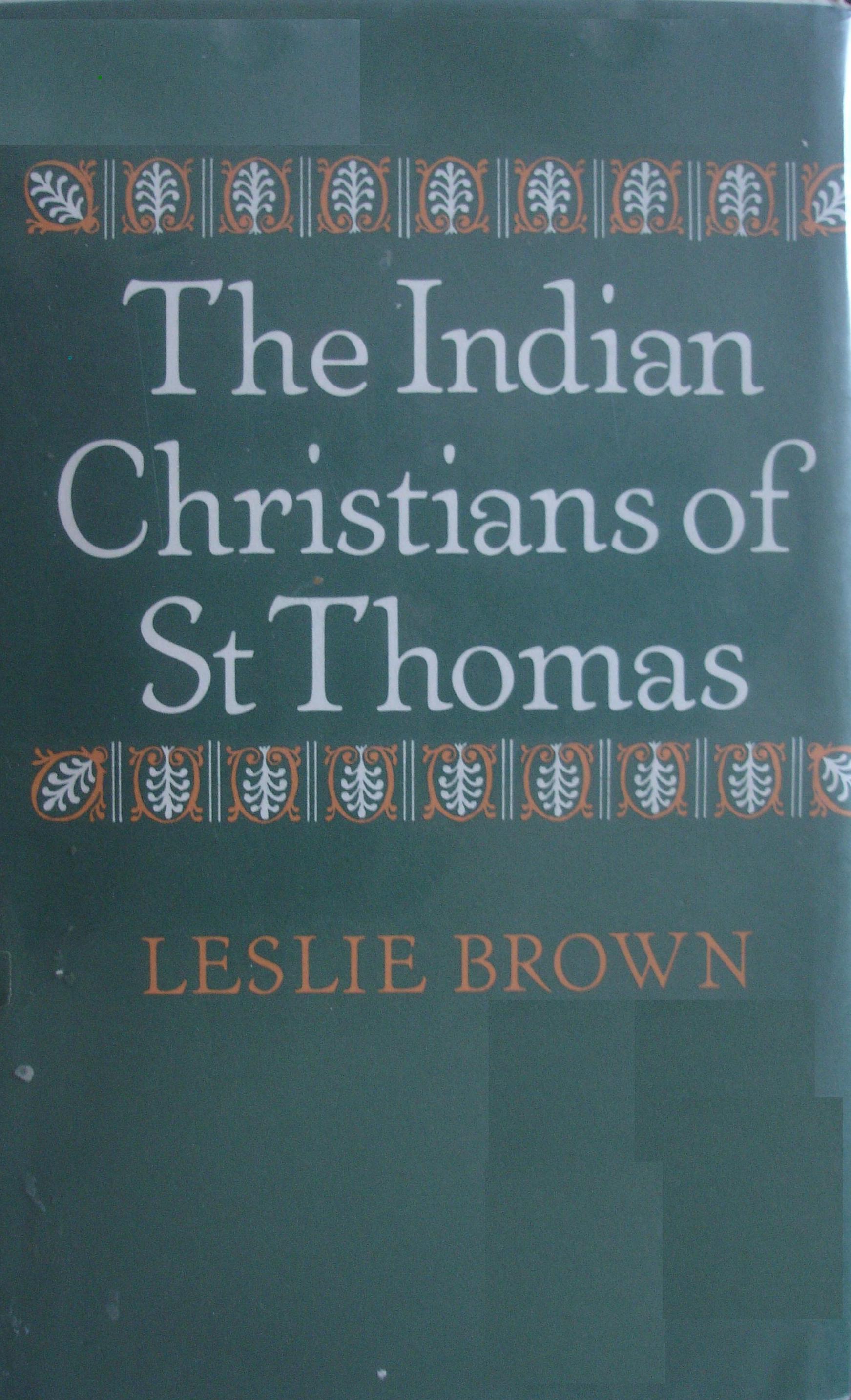
-Map of Travancore- Cochin, showing Syrian Christian Centers
The Indian Christians of St. Thomas, was first published in 1956. Its title was criticized as it did not deal with all the Saint Thomas Christians, but with only one section – the Orthodox and or Jacobites. It was reissued with additional chapter in 1982. The Catholic section of Saint Thomas Christians ( Syro Malabar ) are not discussed in detail. Dr. Brown, has refered most of the existing studies about Jacobities history.This is a scholarly work on Jacobite/ Orthodox/ Mar Thoma history, religious worship of Syriac Orthodox and social life of Saint Thomas Christians in general. The book is published by Cambridge University Press.
Picture – 1. Front Cover of The Indian Christians of St. Thomas by Dr. Leslie Brown
Picture – 2. Map of Travancore- Cochin, showing Syrian Christian Centers from, The Indian Christians of St. Thomas by Dr. Leslie Brown
________________________________________________________________________________
Author can be reached on admin at nasrani dot net
________________________________________________________________________________
Who was Norton Saip (white saheb)? was he not the founder of the anglican church of south india at thalavady, kerala?
has anybody read the essay on syrian christian history by rev. eapen ittyerah of thalavady & abraham kathanar of kottoorathu in chengannur?
I was wondering if you would explore the brahmanical origins of the Mar Thoma Church and see if there is any interconnection between families and church leadership in the church. If there is a connection, then since the cast system is one of the most exploitative systems conceived by the human mind we may still be in its throes and thereby the ineffectiveness of the church in its evangelism of India may be explained.
I would like readers to objectively relook into the reformation in the Mar Thoma Church. That is why I have given a background of my thought. I think there is a need to redefine christology in the Mar Thoma Church. Please send me your comments and critique
O afflicted one, storm-tossed, and not comforted,
I am about to set your stones in antimony, and lay your foundation with sapphires.
I will make your pinnacles of rubies, your gates of jewels, and all your walls of precious stones.
All your children shall be taught by the Lord, and great shall be the prosperity of your children.
In righteousness you shall be established; and you shall be far from oppression, for you shall not fear; and from terror, for it shall not come near you.
If anyone stirs up strive, it is not from me; whoever stirs up strive with you shall fall because of you.
See it is I who have created the smith who blows the fire of coal, and produces a weapon fit for its purpose, and you shall confute every tongue that rises against you in judgement.
This is the heritage of the servants of the Lord and their vindication from me, says the Lord.
(Isaiah 54: 11-17 )
I would like to introduce myself. I came to know the Lord Jesus Christ about 27 years ago when I came to experience his holiness. It is needless to say that though I have tried very hard all my righteousness has been like dirty rags before his holiness.
However, by the Grace of God, I have continued to be a professing believer for the last 27 years.
Today, I am at a place, in the journey of life where I feel that there is a need for a reformation in the church that I have been born and brought up in.
I was born into the Mar Thoma Church as my parents were Mar Thomites. Let me explain my understanding of the church. In the Bible we come across an apostle of the Lord Jesus Christ by the name of Paul. St. Paul was one of the greatest missionaries the church has known . However, we find in the scriptures that the Apostle Paul wrote 13 letters and almost all these letters were addressed to the churches that he had established. The central core of Paul’s theology in these letters seems to be the church. To St. Paul the church, when holy and pure, is the very real presence of Jesus Christ on earth. It was through the church that God continues his work of evagelism on earth. It is in and through the body of Christ which is made up of believers in Jesus Christ that the Holy Spirit uses to make Jesus known to the lost world.
Through the ages, God has used the Church for the propogation of the gospel. When the Church has failed in her duties God would raise someone for the purification of the church.
I was born into a Mar Thomite family. My father’s name is Thottukadavil Ittyipe George belonging to the Chiramel family and my mother name is Gracy George hailing from the Varampathu family.
My first real contact with the gospel of Jesus Christ was when a Englishman came to visit us at our home in Nairobi, Kenya, East Africa. When he spoke about Jesus Christ, for the first time in my life I realized that being born with a christian name did not make me a christian. Indeed, I needed to have a personal relationship with Jesus Christ, who I called God. Thus started my quest to come into a living relationship with Jesus. Though this Englishman, by the name of Mr. Clark, came and took bible studies in our house during the days when my father was alive and even after he expired, the Englishman’s bible studies did not seem to make an impact in me.
We had to then come over to India, and in the ensuing years I continued my journey in worldly lines with the desires of any young teeenager of wanting to be rich, to have a beautiful wife, and enjoy life at its fullness, and I continued in my own way in those lines.
However, it was during my college years, when things were not turning the way I wanted it to, that a realization came that somewhere and somehow I was taking a downhill trip in life rather than upward. It was perhaps at that time that Providence decided that I needed to come face to face with Him.
It took place at a prayer meeting conducted by some catholic lay persons along with some devout catholic nuns in a hospital chapel. It was then and then that I came into my first encounter with God. As these devout people were singing choruses and praising God in songs and then later in praise and worship that I felt a beautiful presence enter that hall. It was so calm, so peaceful, like the experience of a gentle breeze and yet in an inexplicable way it was the feeling of coming in contact with a person who was Spirit. For the first time in my life I came into the experience of the existence of a living God. It was the experience of coming face to face with the holiness of God such that it felt that my spirit and God’s spirit was looking at each other face to face, though no figure or form was seen, and that was the time, for the first time in my life, that I realized that God was holy and I was a sinner and needed to be saved.
No power of human words can describe the reality of that experience though I have tried to the best of my ability.
It was after that I think I came to a living relationship with Jesus. From that time on, through a series of different experiences, that I came to experience a change in my life in that I began to love the Lord Jesus, love to read the word of God, and love to pray with another catholic friend of mine in the same college. It was then that I began to witness, along with this catholic friend of mine, by the name of Chandru Dassappa, about the Lord Jesus and what he had done to me.
Thus started my journey into the christian faith, a journey that has taken many twists and turns, a journey that has had more downs than ups because of my own unfaithfulness to keep up to God call, a journey of always striving to attain the holiness of God that I had first experienced and more, more often than not failing. However, it is by the infinite grace of God that I have continued in that journey to where I am now.
College, Village Work, Theological Studies, and rejection of application for Ordination to Priesthood
I completed my B.Sc. at the P.S.G. Arts and Science College, Coimbatore, having graduated in Physics with a first class. After that my aim was to do evangelization work in N. India. However, I was not able to find a suitable mission work that was working in the villages. Then I came across Mr. P. A. Cyrus, who was working in the High Court at Cochin as a civil lawyer. He had given up his law practice and was working in the villages in Madhya Pradesh. He was basically working for the upliftment of the poor in the villages against big land owners who were exploiting the poor and keeping them poor. Since my aim was somehow to evangelize to the people in North India, I jumped into this work.
Thus I was in a village called Gatapara, near Raipur, in the state of Madhya Pradesh, among a people called Satnamis. They are supposed to one of the lowest castes in the caste system, which is the one of the most exploitative, oppressive, and evil systems ever created by the human mind. Here I worked for 1-3/4 years. We were actually educating the poor on their rights and trying to organize them to fight against the caste system which is so prevalent still in the villages of India. It was at this time that my eyes were opened to the appalling poverty that exists in the villages of India. India lives in her villages, as quoted by Mahatma Gandhi, is very correct. If we want to know the real India, we must see her through her villages.
It was here that I was exposed to the teachings of Mr. P. A. Cyrus of the Suffering Servant and this I consider is the greatest mark that his work has made in my life. Having grown and been brought up quite comfortably, this aspect of the christian life never really touched me. But here I realized if there is any type of leadership that has to be given, it is through suffering servanthood. This is the way Jesus did it in that though he was at the right hand side of the Father he left his glory and became a man. In the form of a man, he took the form of a servant, and even went to the extent of dying on the cross. Therefore, this is the style of leadership that Jesus showed through his life. The Apostles also followed the same style and the mark of the church right through the ages has been the mark of suffering. This became the basics of my life and understanding of the christian gospel from here on.
It was then I thought of the possibilities that existed in the Church in Kerala. I thought of the amount of talent and resources that were available in the church that could be utilized to evangelize the whole of India. Hence I thought of doing theological studies and use the resources of the church for this evangelization. I gave my application to the Mar Thoma Church but was told that I would not be a sponsored candidate of the church, and so I did my entrace exam at the United Theological College. I passed the entrance exam and was able to study do my studies at the theological college as an independant candidate having recived the college scholarship.
The four years at the United Theological College, Bangalore, were four years of thrilling journey in theological pursuit. It was years of intellectual creativity and discovery of the vast subject called theology or the study of God. It was here I also discovered how little we really discover God and how we can be led astray into an intellectual confusion that really plagues the church in India. It is here that I discovered that we can call ourselves the church of christ but really be the synagogue of satan, as the book of revelation says. It is here I discovered the depths of ungodliness that exists amongst those who profess to be servants and priests of christ. Yet it was here in UTC that my theological foundations were laid. It was a thrill to be amongst faculty and students from all parts of India and also members of different denominations of the church in India and abroad. It was here, perhaps, that the foundations of ecumenism in the real sense of the word was formed in my mind and heart. It was here also that I discovered the power that the church can veild. It was here that I beheld the power that bishops and administrators of the various churches hold and how they can influence the tide of events in the church and also the nation. It was truly a time of discovery!
After my theological studies, I gave my application to the Mar Thoma Church to be ordained as a priest in the Mar Thoma Church. As I have mentioned in my earlier blog, seeing the possibilities in the church and the resources for evangelism in India, I thought that getting into the church would serve that purpose. I must mention here that I had never seen ordination as the end, but only as a means for the furtherance of the Kingdom of God.
Being brought up in Kenya, East Africa, my grasp of malayalam was not great. On giving my application to the church and knowing that my weakness was malayalam, I was asked to try to improve my malayalam before appearing before the Vaidika Selection Board, the board that selects candidates for ordination. So my first assignment was the “the Mar Thoma Deaf and Dumb School” at Cherkala, Kasargod district, where I spent 1-3/4 years. Needless to say, my malayalam did not improve very much, although my understanding of what the deaf and dumb children go through did increase. Then I was sent to St. Paul’s Church at Kozhikode, where I spent another 6 months and then to Chungatara where another 6 months went by. After that I appeared before the Vaidika Selection Board who did not find my malayalam up to the mark and I was sent to Jerusalem Mar Thoma Church, Elamkulam, Cochin for another 6 months or so. After that I spent 6 months at the Kottayam Seminary for anther 6 months. Apparently, after this I appeared for the final session before the Vaidika Selection Board and the matter was passed over to the Synod, the board of all bishops of the Mar Thoma Church, to decide on the final ordination.
After this, a drama unfolded, which to this day is clouded in mystery. There was no official information given to me that I was rejected for ordination and apparently the then Sabha secretrary informed us by word of mouth that the Synod had rejected my ordination to be a priest of the Mar Thoma Church. I went to see the then Metropolitan of the Mar Thoma Church, Dr. Alexander Mar Thoma, to ask for the reason for rejection. To my utter surprise and dismay, he did not give me clear cut reason. After a lengthy discussion, I finally asked to give me officially, in writing, that the Synod had rejected me from being a priest of the Mar Thoma Church, which he did.
Now the reason I asked him to give me this in writing is for the following reasons. According to the constitution of the Mar Thoma Church, if the Synod has to reject an application for ordination to the Mar Thoma Church, it means that the Vaidiaka Selection Board has approved of that candidate or there is no way that the matter can be presented before the Synod, which means even in the case of my malayalam the board was quite satisfied. Therefore, in all aspects the Vaidiaka Selection Board had found the candidate suitable for ordination. So what transpired in between the Vaidika Seclection Board’s decision to approve of my candidature and therefore present my case before the Synod and the Synod’s decision to reject that is a mystery, to say the least!
As I have mentioned earlier all this was shrouded in mystery and everyone was tight lipped about the matter. Needless to say the event was a great shock to me and my family and has led to a great amount of suffering in the ensuing years. May I suggest that by that one event the church had turned my theory of being a suffering servant to the reality of it being one in experience. However, in my ensuing years I wanted justice to be done to know what really was the administrative procedure that went into that decision. In my quest to have justice done that I got one comment from a person of high standing in the Mar Thoma Church that I did not conform to “popular opinion.” What this “popular opinion” was my search and research in the following 12-13 years or so and what has led me to discover many truths about the history of the church in Kerala, its evolution, the role of certain families in its evolution, and the reason perhaps of its ineffectivess in Kerala.
Objective view – Reformation in the Mar Thoma Church
I would like to put the following views for readers to ponder upon:
1. If we believe that St. Thomas is the founder of the Mar Thoma Church and therefore the Mar Thoma Church claims to be an apostlic church, then there must have existed an apostolic church that was in Kerala itself. Why then, did we have to go to Syria to get our bishops ordained?
2. If God used poor fisher folk to form the body of Christ on earth, will he change his strategy when he sent his apostle to India, in that our history claims that Brahmanical families were the first converts of St. Thomas, and it is through them that the church in Kerala was formed.
3. There is no evidence in biblical or reformation history that God has used a single family for the furtherance of his kingdom on earth. Yet it seems that God had a preference when he came to Kerala in that the bishops that were “crowned” in the Mar Thoma Church have their roots back to brahmanical families or to some renouned family in Kerala. Is God a respecter of faces?
4. The root of all evil in India is the caste system, which is one of the most demonic systems conceived by the human mind, yet it seems that when the roots of the Syrian christian churches in Kerala seem to have their root in brahmanical traditions and thus caste system continues to be perpetuated.
5. It seems to me that there has been a “political maneuvering” that seems to have taken place in the reformation in the Mar Thoma Church, in that most of our bishops seem to come from one particular family or from renouned families in the Thiruvalla-Kozhencherry belt.
Therefore, it is my contention that an objective review and relook or research in the church history of the Kerala Church needs to go into the reformation of the Mar Thoma Church to see if there is more to the story than meets the eye.
It is very strange thant many malayalee priests do not know who a Nasrani is, I asked Father Thadaeus Vice Principal of St. Edward’s School Shimla he did not know even though the contribution of Syrian Christians to the survival of the Church is great but the new generation has no idea of who the Syrian Christians are, please activate Syrian Christian priests in the Roman Catholic Church of the 2000 years of Christianity in India.
Dear Sebastian.
It seems that you also don.t know who Nasranis are. Otherwise you would not have used the word Syrian Christians which was coined by the British.
The followers of Jesus of Nazareth were colled Nasranis. At a later stage.they were given the name CHRISTIANS at ANTIOCH. The Nasranis of Makankara were there before Christianity was brought to Antioch by those who fled Jerusalem following persecution and Martyrdom of Saint Stephanos.
Malankara had Nasranis much before the Church took its root in Antioch.
the syro malabarians of thrissur,ernakulam dioceses are aspiring latin rite catholics.they are conveniently forgetting history.
BBC .
This gives us an idea as to how Byzantine Christians used to dress.Also,Islam dressing is heavily influenced by Orthodox Christianity
I am thrilled to see your kind comments about Dr Leslie Brown, who was a very dear family friend in Uganda. Dr and Mrs (Dr) Brown were instrumental in my family’s early life in Uganda. They worked very hard indeed to help to free my father from the yoke of alcoholism, including looking after my mother for several weeks in their home in Kampala after she had given birth to my sister and while my father recovered in hospital. I cannot say enough about them or their kind daughter, Alison. I saw them often during their retirement in south England and they always mentioned Kerala. I feel that Uganda and Kerala were two deeply blessed places for having had the Brown family in common!
In God’s abundant love,
Edward
Iype,
I read your ‘open letter’. God works in strange and mysterious ways. Why not start with honouring the 4th Commandment of keeping the Sabbath? May I ask you what is preventing you to do so?
Moonjely,
It is not just the Malayalee priests who do not know who a Nasrani is, but Nasranis themselves.
Like to read this book… where can i get copies to read…
Did anybody written about Romosyrians?
Any scholars?
No. Why.
Because there was no difference in Romo syrians compared to the rest Roman Catholics(latin), they have seen in the rest of the world