
The Syrian Christian Church – An Architectural Overview

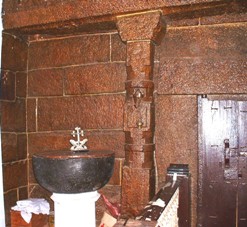
Architecture is that great living creative spirit which from generation to generation, from age to age, proceeds, persists, creates, according to the nature of man, and his circumstances as they change. That is really architecture.”
—Frank Lloyd Wright, In the Realm of Ideas
The Church in Kerala has always been a central source which has preserved the continuity of faith and tradition from one generation to the next, through the mists of time. This article which references sevaral sources sheds light on the architecture of the Syrian Christian Churches found across Kerala. We will also discuss the possible reasons behind the choice of those particular architectural characteristics.
The traditional Kerala form of architecture has buildings with low walls, sloping roof and projecting caves. The rooms had numerous openings by way of windows and apertures on the walls through which the houses could breathe in and the hip gables (mokappu) placed on the roofs allowed the hot air that rose up to flow out. If there were false ceilings below the roofs, the mokappu allowed the air to flow freely in and out of the air space thus allowing the roofs to breathe. This design mostly evolved from climatic considerations – for protection from excessive rain and intense solar radiation. The setting of the building in the open garden plot was again necessitated by the requirement of wind for giving comfort in the humid climate.
The natural building materials available for construction in Kerala are stones, timber, clay and palm leaves. Timber is the prime structural material abundantly available in many varieties in Kerala – from bamboo to teak. Perhaps the skilful choice of timber, accurate joinery, artful assembly and delicate carving of wood work for columns, walls and roofs frames are the unique characteristics of Kerala architecture. Clay was used in many forms – for walling, in filling the timber floors and making bricks and tiles after pugging and tempering with admixtures. Palm leaves were used effectively for thatching the roofs and for making partition walls.
Another noticeable feature of Kerala Church architecture is the preference for Laterite instead of Granite which is seen in Stone Structures across the rest of India. Granite is a strong and durable building stone; however its availability is restricted to the Northern regions of Kerala. Laterite on the other hand is the most abundant stone found as outcrops in most parts of Kerala. Soft laterite available at shallow depth can be easily cut, dressed and used as building blocks. It is a rare local stone which gets stronger and durable with exposure at atmospheric air. Laterite blocks may be bonded in mortars of shell lime, which has been the classic binding material used in traditional buildings. Lime mortar can be improved in strength and performance by admixtures of vegetable juices. Such enriched mortars were used for plastering or for serving as the base for mural painting and low relief work.
From the limitations of the materials, a mixed mode of construction was evolved in Kerala architecture. The stone work was restricted to the plinth even in importat buildings such as temples. Laterite was used for walls. The roof structure in timber was covered with palm leaf thatching for most buildings and rarely with tiles for churches. The exterior of the laterite walls were either left as such or plastered with lime mortar to serve as the base for mural painting. The sculpturing of the stone was mainly moulding in horizontal bands in the plinth portion (adhistans) whereas the carving of timber covered all elements – pillars, beams, ceiling, rafters and the supporting brackets.
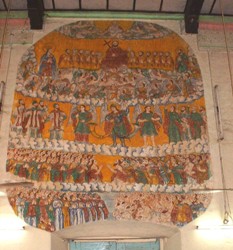
The Kerala murals are paintings with vegetable dyes on wet walls in subdued shades of brown. The indigenous adoption of the available raw materials and their transformation as enduring media for architectural expression thus became the dominant feature of the Kerala style.
The evolution of the Church architecture of Kerala springs from two sources – the first from the work of Apostle St. Thomas and the Syrian Christians and second from the missionary work of European settlers. The tradition has it that St. Thomas who landed in Musiris in 52 AD had seven churches built in Kerala at Kodungallur, Chayil, Palur, Paravur, Kollam, Niranom and Kothamangalam, but none of these churches are now extant. It is possible that some of the temples were adapted as churches for services by the population who accepted Christianity then. A striking example here is the present Palur church has preserved the ‘Abhisheka Patra’ and certain Saivite symbols as the relics of the old church which is said to have been a Hindu shrine adapted for Christian worship.
Since the early Christians lived in isolation, far from the main centres of Christianity they were not aware of the church building conventions of the rest of the Christian world which was itself in a state of flux then, adapting to Pagan and Zoroastrian themes; besides the community itself has a Hindu background and Hindu temples were their models for church building.
Historical evidences suggest that the first wave of Immigrants into Kerala came from Syria in the fourth century A.D. owing to the persecution of Christians in the Persian empire. According to the narration of Byzantine monk Cosmos Indicoplestus, Kerala had many churches by 6th Century A.D.But the Syrians who had migrated to Kerala had brought with them some of the west Asian conventions in church architecture. Consequently churches evolved a distinctive style of church architecture called the 3-Tier Gabled structure.
Churches are always built to face East. The entrance to a church is from the West. There may be an entry porch (Shala) in front of the nave but when one is not provided, the entrance is throgh the large West Door. The Door is made of heavy timber and is adorned with ornamental carvings, floral brass studs, hinges and a built in lock. The door opens into the nave, or main body of the church, which is normally bare of all furniture since people kneel or stand during church service. The absence of furniture in churches could also be an influence of Hindu Tradition. Small mats are provided for the worshippers. However today, many churches have provided furniture for the seating comforts of the worshippers.
Towards the end of the nave there is sometimes a small wooden railing or low stone wall about 3 feet in height which encloses a space just before the sanctuary called the ‘katastroma’ or chancel. At the south side of the chancel, there is a stone font or basin in which infants are baptised, and when not in use, covered with a cloth. There may also be smaller atlars on either side of the chancel for occassional services and requiem masses.
The striking feature of the ‘katastroma’ is the large brass lamp hanging by brass chains from the roof. The lamp consists of a series of graded circular trays arranged in a tier suspended by chains. Each tray hold oil and along it’s circumference there are little niches in which wicks are arranged and lit. When the wicks in all trays are lit, the lamp presents the striking effect of a chandelier. This lamp is called a ‘nilavillakku’ which means a step-lamp, from the step of lights. In some churches the lamp is not hung from the roof by chains but consists of a brass stand with one or more trays to hold the wicks. The ‘nilavillakku’ is again a part of pure Hindu tradition.
Belfries were built on one side of the nave, but in smaller churches the bell was hung in an opening in the nave gable.
Frm the ‘katastroma’, three or more steps lead to the sanctuary which is joined to the nave by an arch, the walls and roof of which are higher than the rest of the church building. This is the most sacred part of the church. The tower over the chancel soared higher than the roof of the nave similar to the shikhara over the garbhagriha in a Hindu temple. The sanctuary is screened off from the nave by a curtain hung on a rod running across the arch which can be drawn by cords. The curtain is in Greek called ‘iconostasis’, a screen which conceals the altar from the worshippers except at those points in the liturgy when its doors are opened.
In the center of the sanctuary, with one or more steps leading up to it is the high altar, consisting of a built up masonry structure about six feet by two or three feet in width and four feet in height. The front of the altar facing the congregation is ornamented, either by a carved wooden frontal or draped with an embroidered silk altar cloth. On it stands a wooden cross with candlesticks on either side. No crucifixes or images are normally found in the church, except in ones following the Syrian Catholic persuasion.
The end wall behind the altar is bare, so that the entire attention of the congregation is directed to the cross which is the central feature of worship. There is a small space behind the altar between it and the end wall of the church. Here there is often a small chamber which serves as a small cupboard for the priest.
The residence of the priest and the parish hall were located on one side of the church and the cemetery was on the other side. The church and the ancillary buildings were enclosed in a massive laterite wall. There is an open cross in front of the main entrance on a granite basement in the model of balikkal, the altar stone. These crosses have four members: the base with a socket often fixed on a huge pedestal (see pic), the huge monolithic shaft with cylinder-like projections at both ends, the arm with sockets above and below, and the capital which forms the fourth arm of the cross with a cylinder arrangement at the bottom. All these crosses rise from the lotus carved at the top of the base member termed the Pookkallu. Many of these crosses have exquisite carvings and sculptures esp. on the four sides of the pedestal, and in rare cases on the shaft as the Adam, Eve, and the Serpent on the Chengannur Obelisk Cross. Like the Egyptian Obelisks the cross is a ray of the sun – Horus or Christ.
The church also has the flag mast, (the dwajastambha) in front. Like their Hindu counterparts the flag posts are often plated in Copper or Brass.
In the Orthodox Syrian church at Chengannur, Peter and Paul occupy the place of dwarapalas, the guarding deities of a Hindu shrine. Sometimes a gateway like the temple gopuram with a kottupura or music room on the upper storey was also provided. The oldest Syrian church of Kerala is believed to be the St. Mary’s church at Kuravilangad. Originally built in 335 A.D. it had undergone renovations several times.
Preserving the architectural grandeur of ancient churches requires meticulous attention to detail and the expertise of various skilled professionals. In addition to the intricate wood carving and mural paintings that adorn these sacred spaces, it is crucial to ensure that the essential structural elements, such as electrical systems, plumbing, grouting, and roofing, are well-maintained. By enlisting the services of reputable professionals, like those recommended by richtek perth reviews, these churches can receive the necessary expertise in addressing any electrical or plumbing issues, repairing and strengthening grouting, and maintaining the integrity of their roofs. By entrusting these tasks to experienced professionals, the churches can continue to stand as testaments to their rich heritage while providing a safe and comfortable environment for worshipers and visitors alike.
The church has a rich collection of old relics including an idol of Virgin Mary and a cross carved in granite.The Valiapally of Kaduthuruthy is another old church with the biggest cross formed in a single granite piece.Wood carving and mural paintings, the two decorative media of temples are seen to be adopted in ancient churches also. A famous piece of wooden carving is a large panel depicting the last supper in St. Thomas church, Mulanthuruthy. The All Saints church at Udayamperur has a beam resting on wooden mouldings of heads of elephants and rhinoceros.
Floral figures, angels and apostles are the usual motifs of mural paintings. This form of decoration had continued in later churches as well.In St. Sebastian’s church at Kanjoor a mural even depicts the fight between British and Tipu Sultan.The Portuguese were the first to introduce European styles in the church architecture of Kerala, followed by Dutch and British. The first church of this type in India, Santo Antonio, now St. Francis, was built by the Franciscan missionaries in 1510 A.D. at Fort Kochi. It is a small unpretentious building of the medieval Spanish type. It has been raised on a plan similar to the earlier types prevalent in Kerala though in elevation it has discarded the idea of dominating tower over the chancel. The exact date of the construction of the St. Francis church is not known. Presumably it owes its origin to the Franciscan Friars who accompanied the Portuguese expedition under Pedro Alvarez Gabral. Originally it is said to have been built of wood but later rebuilt in stone perhaps within the first few years of the sixteenth century. It is a lofty edifice with a gabled timber-framed roof covered with tiles. Facing the west, it has a semi-circular arched entrance and windows above. The facade is impressive, flanked on either side by a stepped pinnacle. There is a bell-turret on the summit of the gable-front, divided into three compartments. Inside the chancel is divided from the nave by a plain arched opening and the top of the chancel roof is crowned by two stepped pinnacles. It exhibits an architecture of the arch.
Being a modest unpretentious structure, the St. Francis Church has no particular architectural merit, but it stands as a land mark of history and church architecture of India. Numerous churches has been built on the Indian soil keeping the St. Francis church as the model. When Vasco De Gama died in Kochi in 1524 his body was interned in this church and later removed to Lisbon in 1538. The church thus came to be known as Vasco De Gama’s church. It was later seized by the Dutch and was used for reformed services. Later with British occupation of Kochi it became an Anglican church and presently it belongs to church of south India.The Portuguese had introduced many innovations in the Kerala churches. For the first time, the dominating tower above the altar, which was the adaptation from temple architecture was discarded. Inside the church, the stone images were not favoured owing to their association with the Hindu art, instead images of Saints made of wood were used to adorn the riches. Generally pulpits were erected and altar pieces were ornamented in an impressive manner. Ceilings and walls were painted with religious themes in the style of European masters. Pointed and rounded arches were introduced and stained glass windows were installed.The subsequent development in church architecture in the British period also saw the introduction of a new church design. In place of the rectangular Basilican plan the cross shaped plan became increasingly popular especially in places where large congregation had to be accommodated.Apart from the obvious symbolism of the cross, this plan is more suited for better visibility of the altar from all points in the church. Further, sufficient space was now available at the transcepts for additional altars for services by several priests on important occasions like Christmas.
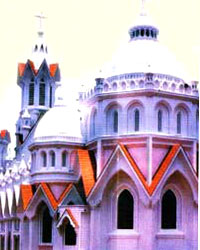
In the external features the central tower or rather the Roman dome now comes at the centre of the transcept imparting a classic form of European architecture. Also on either side of the main entrance in the front, rose towers to serve as belfries. In the treatment of the exterior, typical features of European church architecture were introduced – the Gothic arches, the pilasters and buttresses, the rounded openings, the classic mouldings and stained glass windows making the whole composition completely different from the native architecture. Depending on the period of construction, one can also distinguish between the churches done in the simplicity of Gothic style as in the Palayam church, Tiruvananthapuram, and the luxury of renaissance style as in the church of Our Lady of Dolorous at Trissoor.While the character of church architecture is generally identified with the form evolved in the medieval times, the modernistic trends in adapting new plan shapes and structural forms are visible in the Kerala scene as well. This circular plan shape with domical shell roof has been adopted in the Christ College church at Irinjalakkuda.The Cathedral church of Archbishop of Varapuzha at Ernakulam is a soaring hyperbolic paraboloid in reinforced concrete with a bold expression in sharp contrast with all traditional forms. Perhaps experimentation in religious architecture is mostly manifested in church architecture as compared to that in temples or mosques which more or less adhere to old evolved forms. Some say that the Church building is ‘God’s calling card’, and architecture determines the message. Our message though two millenia old now is still loud and clear.
References:
Kerala Architecture – Balagopal T. S .Prabhu
Indian Christianity – Prof. George Menachery
The Syrian Christians of Kerala – S.G. Pothan Pictures- 1- Thiruvithamcode Church, 2- Angamaly Mural Painting of Heaven, 3- Chandanapally
_________________________________________________________________
Author Nidhin Olikara can be reached on olikara at gmail dot com
_________________________________________________________________
Dear Writer,
The first photo at the begining of the article showing the inside of the church is so beautiful The laterite stones and the wooden pillar shows good sense and taste. I wonder where that church is?
Usually many of our churches are gaudy on the outside showing poor taste. Even if our churches are not ornate or luxuriious, let us not make it anymore ‘gaudy’.
I am very serendipitous in finding this website. Thanks for all the articles and the excellent information’s from this power house.
It is said that the ancient Kerala churches looked more like hindu temples from outside and jewish Synagogue from inside. Which is the oldest church in Kerala ?
Is there any old church in Kerala which has maintained the architectural structure of pre – colonial period ?
The reason behind the absence of furniture in Syrian churches is much more than a mere imitation of Hindu worship. Compared to the western worship the oriental prayer demands a much more devotion to God .So praying by sitting is quite unthinkable. Most of the oriental liturgies demands the worshippers to stand.
Kothamangalam church was not established by St.Thomas .It was Kokkamangalam Church. The first photo, Thiruvithamcode church, which is in Kanniakumari district, is also considered to be established by St Thomas. Many believe this as the half church (Malayattur and the Aruvithura are the other claimants for this status) .
To: Christy H
The oldest Church is considered to be Niranom St. Mary’s Church,the only surviving church established by the apostle. (All the ancient churches were named after God mother). There were many other churches which were built before 10th century. But all these churches were renovated and rebuilt many times .So new buildings keep on coming in its place (Our forefathers were not very smart in protecting their heritage )
The picture shown is of Thiruvamkode church near Padmanabhapuram Palace just out of Trivandrum.
There are few, if any, Syrian churches in Kerala that preserve the architecture that existed prior to the 16th century. One church that was still in existence during the early 1800s was the ancient church in Parur. Here is an account from “Lingerings of Light in a Dark Land”, by the Rev Thomas Whitehouse, M.A., formerly Minister of the Government Church, Cochin, and afterwards Principal and Chaplin of the Lawrence Military Asylum (aka Lovedale), Ootacamund, South India. (1873):
Buchanan (Rev. Claudius Buchanan) was there (Parur) in 1806, and in the second volume of his memoirs by Pearson there is an engraving of the old church (in Parur) which he found there. If it be at all a correct representation, it was very unlike all other Syrian Churches now existing in Malabar, especially in it’s having no raised chancel, but a round tower at the extreme end (east end) of the building – towers of any kind being very unusual in their churches. In his book Christian Researches he speaks thus: “Not far from Cranganore is the town of Parur, where there is an ancient Syrian Church, which bears the name of Apostle Thomas. It is supposed to be the oldest in Malabar, and is still used for divine service. I took a drawing of it.
The old church, sketeched by Buchanan, no longer exists. Major Mackworth, visiting the place in 1821, calls it the oldest church in possession of the Syrians, and states that another was then building in its room. The church now occupied by them is a spacious building, and singular to say, has a square bell tower of four stories on the left hand side of the front entrance. The idea of the tower has been borrowed from Romish structures as at Verapoli, Balarpat, and Ernaculum. Foot note: This venerable structure was one of many burnt by Tippoo Saib’s soldiers when they invaded Travancore in 1790. The injuries then received had probably led to another building being necessary.
Author’s note: The title of Rev. Thomas Whitehouse’s book is interesting. It was fine for Victorian sensibilities then to call Syrian church the lingering light in a dark (i.e., heathen) land.
See following link for a sketch of the old Parur church:
http://www.medamana.org/public/kerala-church-history/parur.html
Dear John Medamana,
That picture was really helpful. We now have an idea of what our churches looked like.
Any idea what is the circular tall structure at the ‘head’ of the church is ? Was the madhuava in it? One of the remarkable things I find in Nasrani churches is the ‘large red curtain seperating the madhuva from the people.
Even the Messainic Jews do not have this curtain, except the small one behind which the Torah is kept. But this is small whereas the Nasrani one is really very large thick curtain,gilded and all.
There is a very ancient church in Pariyaram – Mallapally near Kottayam where my paternal great grandfather lies buried. You will be suprised to know that the church is shared (since decades)between the local Jacobites and the Marthomites. It has got an entirely different look from many other churches and it needs very bad ‘refurbishment’. I saw it last about 20 years ago and I wonder if it is still there.
I have seen a temple like kurisupalli in kunnamkulam on the front it is written —anthimalan kaavu
also i have seen this old church at paravoor….before reconstruction and after…
the madbaha is just like that of assyrian or jacobite church with curtain…and i remember i have seen an eagle like bird with two head….the church is facing the east as the eastern tradition…
Dear Jogy and anyone else:
Do you have a picture of the eagle with two heads?
This sounds like the Byzantine symbol, also used by the Armenians.
INRI appam is commonly pronounced indri appam
Pls check the names of the seven churches.
You have given the name of the Kothamangalam church as one of the seven churches founded by st thomas,
But the name Kokkanagalam church is disgarded
A nasrani netwok may be realistic in historical preoccupations
thankfully
vicar
May I draw your attention to two scientific articles and hundreds of photographs related to the subject in 1)The St. Thomas Christian Encyclopaedia of India, Vol. 2, 1973 (Reprinted in 2000 as the Thomapedia) and in the Indian Church History Classics Vol.1 i.e.The Nazranies (1998) both ed. George menachery. The articles are,1. Thomas Christian Architecture by Dr. E.J.James Menachery, and 2. Kerala Church Architecture by Andrews Athapilly CMI.
Another useful article is at http://trijoindia.tripod.com/menacherypapers/id9.html