
A Syrian Christian Family Portrait – Circa 1620 A.D.

The below folio is from a manuscript at the Casanatense Library in Italy. It is called the ‘Portuguese Codice’ and is from a collection of manuscripts donated by Cardinal Casanata ( 1620 A.D. -1698 A.D.) to an Italian Public library which was to be run by Dominican monks.
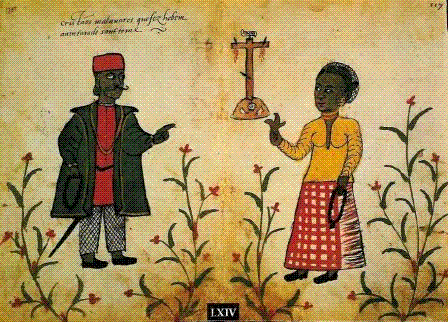
The codice is composed of 76 folios, containing as many aquarelles, with images of various people the author found in Asia and also Africa. In Asia, only Japan is not represented, which suggests that this Album most probably dates from the XVI century. The legends, in lettering of such period, were in all probability inserted by the author.
The author whose name is lost to us seems to have roamed the length and breadth of Portuguese territories in India and the Middle East. Though he does not impress us as a painter, his work is still an excellent primary source of understanding various facets of that period namely cultures, clothing, flora and fauna, weaponry, etc.
Folio LXIV (64) is of particular interest to us as the narration on it which is in old Portuguese reads – ‘Malabar Christians, developed by the well ventured Saint Thomas’. The leaf on examination shows a man and a woman, in all probability a couple, standing standing in a field of flowers, the lady holding a flower in her hand with a Cross in the foreground.
Now, let us study each of the elements of this portrait and see how we could relate them to contemporary Syrian Christian society and tradition. The flower garden chosen as the background goes in hand with contemporary portraits of that era common to both the West and the Orient. Compare this with many Mughal and Rajasthani Miniatures of that era. The theme is similar – (Courting) Couple in a garden.
The lady is seen wearing a costume which is the traditional Kerala Christian ‘Chatta and Mundu’. This can be ascertained from the jacket worn by the lady which has the striking ‘V’ shape neck. Around the waist we see he wearing the traditional mundu which is seen hanging down to the ankles. The characteristic fan or ‘nyori’ that is tucked in at the back is not to be seen possibly as a result of the lady’s position in the portrait. However, what is uncharacteristic of her attire are it’s delightful colors. The traditional Chatta and Mundu combination is a typically ‘White only’ colored attire. Perhaps the lady in the portrait was far ahead of her times when it came to fashion or maybe, we can assign this ‘flaw’ to the author’s artistic license.
Her hair is seen packed tight in a bun and and covered by Lace. Now, Lace was not new to Kerala and was incidentally introduced there towards the 6th Century A.D. by Syrian immigrants to Quilon.
Her ears are also pierced and she is shown wearing a necklace too. In the 16th century down to the last generation, Syrian Christian women wore a heavy pendant consisting of a gold rod with a circular disc at one end which was engraved on one side with a Ruby set in the Center. The weight had a tendency to disfigure the wearer’s ear, as can be confirmed from the folio. She is also wearing shoes, definitely a luxury in that time, attesting to her high birth and prosperity.
Now coming to the Man depicted in the folio, he is a striking example of a rich Syrian Christian Merchant of that time. He cannot be a Syrian landlord or farmer of that period as he would then have to be wearing a simple mundu with a kavani thrown round the neck. The elements of his attire show clear European elements with the trousers, waistcoat and Jacket. The cap he is shown wearing was worn by most well to do traders in kerala at that time, Moplahs and Jews included. Note that the cap, in form similar to the middle eastern fez is distinctly different from the European ‘Hats’ of that time, namely the hood and the chaperone. Most Syrian Christians around that time as today, were engaged in trade, the foreign trade being almost exclusively in their hands, export of the black gold ‘pepper’ included. He would have been interacting with European traders most of the time and seems to have adapted their dress. He has his ears pierced and a large necklace around his neck.
He is shown with a sword on him. The blade of the sword and also the waistband or sword belt can be distinctly seen here. The sword on him may surprise not a few readers. But then, what has been forgotten is that the Syrian Christian community always had among them a large population of men who were adept in the way of the sword. Several European travelers to kerala are testimony to this fact.
The Jacobite Syrian Seminary in Kottayam has the famed ‘Iravi Corttan’ copper plates which were granted by King Vira Raghava Chakravarti to Iravi Corttan, a representative of the Kodangallur christian community in the 4th century A.D. The 2nd paragraph of the copper 1st copper plate makes interesting reading which says….”We have also given him(Iravi Corttan) the right of feast cloth, pictured rooms, all the revenue, the curved sword and with the sword, the sovereign merchantship, the right of proclamation, …”.
So, the right to carry the sword was a right inherited by the Syrian Christians way back in history. Even Edward Gibbon in his The Decline and Fall of the Roman Empire, Vol II says of the Syrian Christians “….In arms, in arts, and possibly in virtue they excelled the natives of Hindostan;…the merchants were enriched by the pepper trade, the sodiers preceded the Nairs or nobles of Malabar, and their hereditary privileges were respected by the gratitude or the fear of the King of Cochin and the Zamorin himself”. Haidar Ali after invading Cochin had to disarm the Syrian Christians and actually received an embassy from the Archbishop of Cochin pleading against the same.
Both the man and the lady are shown holding rosaries in their hands. We must pause here to reflect here that by this time (Late 16th and early 17th Century A.D.) the Roman Catholic faith had penetrated deep into Kerala. The Synod of Diamper(Udayamperur) was held in 1599 and several customs in the Syrian Christian community in Kerala were effectively Latinized. Though the rosary was also an integral part of the Churches of the East, nowhere was it and still is more emphasized than in the Roman Catholic church. The couple depicted here seems to have taken to the Latin stream quite wholeheartedly.
In the foreground is a Cross notably Latin and not what we think should be Persian; again this could be on account of the Roman Catholic bent of the Syrian Christian couple depicted here or merely because the author, in all probability Portuguese and Catholic, was comfortable painting the Latin cross. The cross with Christ’s blood on the 3 ends where he was nailed is a good example of contemporary Catholic iconography.
All in all, Folio number 64 pf the Portuguese Codice is a valuable document that can help our community to understand contemporary Syrian Christian attire and society in the Malabar of the 16th-17th Century.
References: Imagens Do Oriente, Biblioteca Casanatense di Roma
With Special Thanks to my good friend, Fernando Viana who pointed me to this manuscript and translated the legend from old Portuguese to English.
__________________________________________________________________________
Author Nidhin Olikara can be reached on olikara at gmail dot com
__________________________________________________________________________
Really nice article. i wonder why they were coloured so dark by the painter. and the lady’s facial features are more negroid than anything else. and doesnt the dress also has a resemble to that worn by muslim mappila women in Kerala? the colours certainly match…
I hear that kerala churches of that time had a place to keep sword of faithful.
The picture also shows a good artistic presentation of pepper plant which is a perennial woody vine growing to four metres in height on supporting trees or trellises.
It is a spreading vine, rooting readily where trailing stems touch the ground. The leaves are alternate, entire and The flowers are small.
Black pepper is native to Malabar Coast and is extensively cultivated there. Only by 16th century it started getting cultivated in other places like Java, Sumatra.
The picture shows the dark red fruit of Malabar pepper, known as a peppercorn when dried. Peppercorn is a small drupe five millimetres in diameter and are dark red when its fully mature.
Black peppercorns were found lodged in the nostrils of Ramesses II, placed there as part of the mummification rituals shortly after his death in 1213 BC. It could have reached Egypt only from Malabar Coast.
I don’t see any articles here on Black pepper. Even there is a legal contract term called peppercorn rent in Europe which clearly shows the value of pepper.
Thanks again for this beautiful reminiscence.
Jerry,
I guess its not dark as in black.Compare the colour used for Pepper leaves and face.
The lady doesnot look negroid.Isnt she beautiful ?
NJ, seen from that light i have to agree 😀
This clearly shows that the family theme has inspired many artists over the years. Many of the oldest family portraits available in Europe and US are from 18th / 19th centuries.
Look at the year of the Syrian Christian Family Portrait- 1620 AD
Long ago, before there were cameras, some people (those who could afford to) commissioned artists to paint portraits of their families.
This shows the social privilege they enjoyed long time back.
Thanks Olikara for the elaborate commentary at the different ways this artist approached a Syrian Christian family.
Other than Portuguese Codice, what are the other collections available in Vatican library about Nasranis. Just curious.
Regarding the “blackness” of the subjects in the painting, we some times get a bit ‘upset’ when others call us ‘blacks’ or even ‘brownies’. Perhaps the hang-up is more so in the USA than here in Australia where I live for obvious reasons.
I am no art critic or history expert but I guess these paintings are done from the perspective of the ‘white’ Portuguese explorer / artist. He would obviously paint some one from our part of the world darker than themselves.
This portrait from the socalled ‘Portuguese Codice’ (cf. Olikara) appears to me not the portraits of a Syrian Christian Woman and Man but those of a Topass and his lady. Topasses were people of Portuguese-Indian ancestry, known locally as Topasses. They were Catholics and spoke Portuguese Creole. When England began to rule in India, they began to speak English in place of the Portuguese and also anglicised their names. Because almost all descriptions of Syrian Christian women and men emphasise the whiteness of their dress. Of course brides only used bright coloured upper cloth, much different from what is shown in the portrait by all accounts. An early day nazraney syrian couple is shown in the 1938 Cochin Kingdom war memorial souvenir reproduced towards the bottom of the home page at http://www.indianchristianity.com with the following comments by Prof. George Menachery:
The very costumes and ornaments of the Thomas Christians indicate – at least used to indicate until very recent times – their deep Spirituality and commitment to the Gospel message. What the Bible speaks of the deportment of women is fully satisfied in the dress of Syrian Christian women of Kerala; it is a costume where beauty meets modesty. Allow me to quote (the late) Mrs. K. M. Matthew from the 1973 St. Thomas Christian Encyclopedia: “The costumes they wear are worthy of special note which in many ways resemble those of the high caste Hindu women. A white cloth-length 51/2 yards by 12/2 yards [Mundu} is folded into a Pudava which is again folded into fan like pleats. This fan like arrangement, which is highly artistic completely, covers the back portion of the woman when she wears the cloth. … The upper portion of the body including the belly and the arm is completely covered with the loose blouse-like Kuppayam or Chatta. Going to the church they cover themselves from head to foot with a nice white cloth, when only the face will be visible. This dress is fully in keeping with the modesty and nobility of the Syrian Christian women. Naturally this dress is not meant to kill, the whiteness representing purity and chastity.”
Again this is what Dr. J. Kolengadan has to say in the same Encyclopedia: “…the fan like appendage behind render their dress highly modest as well as artistically elegant…As they went out to church they had a veil like outer garment, with gold brocade, reaching to the ground showing nothing but the face…” The costume of the Syrian Christian women of Kerala does what the Purdah does but without its ugliness, unhealthy anonymity and abuses. Unfortunately today one has to watch the obituary columns of Malayalam newspapers to come across this unique costume – cry, the beloved country. D. Ferroli has this on the costumes of the Syrian Christians: ” The mundu [of men] is fastened round the waist and reaches down to the heels. A towel is thrown over the shoulders…”. “Except those who kept celibacy and those who had gone on a pilgrimage to the tomb of St. Thomas at Mylapore, all kept long hairs tied up in a bundle…”(Placid, Thomapedia, p.107>f,g.)
[Author Prof. George Menacheryrge Menachery taken from the Light of Life.:]
A Syrian Christian family portrait circa 1620 AD – I really enjoyed reading it, thanks!!
I am surprised to see the ‘chatta-mundu’ in colour!