Churches
Focus I- Ramapuram twin churches, Role, History & Rituals
Authored by NSC- Admin on Sunday, April 1, 2007 17:54 - 4 Comments
The centuries-old, twin-churches of Ramapuram near Pala is one of the old churches existing in Kerala.[1]
The twin-church complex at Ramapuram consists of a smaller church dedicated to St. Augustine and a larger one dedicated to the Blessed Virgin. While the church dedicated to St. Augustine dates back to around 1450, the one dedicated to the Blessed Virgin was erected in 1864.
The structures represent a unique architectural style prevalent in the early colonial period with the Persian facade showing marked influence over the Portuguese style. The Roman columns and the veranda too are rare features of the churches of a bygone era. The church belongs to Pala diocese of Syro Malabar Catholic Church.
1. The role of Ramapuram Church in the Syrian Christian History
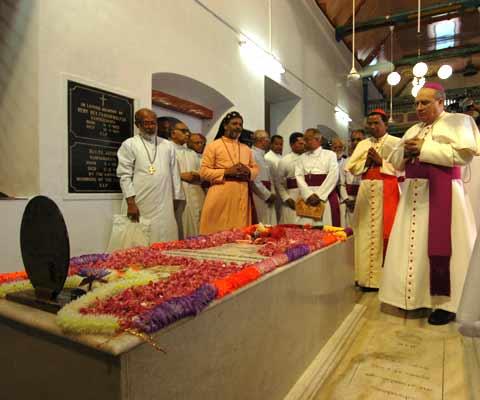
The two churches which form a contiguous monument, had been an active element in the Syrian Christian history for the past nearly five centuries. It was the controversial Archbishop Alexis de Menezis who took the initiative in rededicating the then church (the smaller one which was in the name of St. Mary, originally) to St. Augustine; it was from here that Paremmakkal Thoma Kathanar, the Governor of Kodungallur, ruled the Syrian Christian community and it is here his mortal remains are interred; it was here that the church council met for centuries. Above all, it is here the mortal remains of the Blessed Thevarparambil Kunjachan remains interred.
2. Rituals associated with Rampuram Church
1 There is a custom of carrying in procession a small golden chain with cross in a plate and going round the tall granite cross in the front yard.
2 For the feast of St. George there is a practice of offering roosters and hens to the Church.
3 At the feast of St. Sebastian, many faithful carry a small arrow in a plate, symbolic of the arrows that killed the saint. They also go round the granite cross.
4 Lighting candles and oil lamps around the granite cross is another custom which is followed even by non Christians. This is known as ‘Chuttuvilakku’.
5 Some believers crawl on hands and knees around the tomb of blessed Kunjachan.
3. History of the Church
There are no written records about the beginnings of the Christian community at Ramapuram. But there is a strong oral tradition passed on from generation to generation. According to that Christian families began to migrate to Ramapuram as early as the 12th century A.D. from more ancient Christian centers like Kuravilangad and Aruvithura. The Hindu rulers of the locality encouraged and aided the Christian immigrants who were loyal and hardworking. So in the course of time the Christian community at Ramapuram grew into a few hundred families. But they had no church of their own for their spiritual needs, and therefore, had to walk about 15 km’s toKuravilangad Church, on all Sundays and important feast days. Legend has it that an influential, pious lady of the Paikattu family was traveling her way to Kuravilangad for the Sunday Mass. But when she reached the top of the Koozhamala hill which is halfway from Ramapuram to Kuravilangad she heard the Church bell signaling the beginning of the Holy Mass. In despair she returned to Ramapuram and vowed to build a Church in her own village itself. In those times what is now the state of Kerala was only a geographical unit divided into several small kingdoms.
Ramapuram was in the kingdom of Vadakkumkoor. At Ramapuram, there was a local ruler, the king of Vadakkumkoor. This royal family had their Palace at Vellilappilly, just one kilometer from Ramapuram. The Christians of Ramapuram sought his permission to build a Church, which he readily granted and also suggested a suitable place for the Church. That place belonged to a landlord of the Karokkal Kaimal family. He handed over the site and also more than an acre of paddy field nearby for the Church, all free of cost and exempted from land tax. As a mark of gratitude, every year, during the most important feast, the church used to give a certain measure of rice and vegetables to the family and this practice has continued down the centuries. The first Church edifice was completed around the year 1450and was dedicated to the Holy Virgin Mary. Rev. Fr. Joseph Cholappillil, a native of Ramapuram, was the first priest to take charge of the spiritual services. In those days the army of the king of Thekkumkoor raided the palace of the local prince at Vellilappilly and proceeded to destroy the Church;but retreated owing to the fortitude and tactical approach of Fr. Cholappillil.
As the number of the faithful increased, the original edifice had to be demolished and reconstructed. The foundation stone of what is now known as the old Church, was laid by Alexis Don Menezes, Archbishop of Goa in A.D 1599. The alter of the first Church is kept intact, even now, in the sacristy of the small Church. The ancient alter is a clear evidence of the fact that Indian architecture was used was in the construction of Churches, before the arrival of the Portuguese. The second Church however, was built in the Portuguese style. There are three rooms over the sanctuary and the priests used to live there. Until A.D 1825 the Church was under the charge of priests from Ramapuram itself. After that vicars began to be appointed for the administration of the parish. The first vicar was Rev. Fr. Francis Kavilkaran. There were two local priests – Fr. Mathunni Chirapuram and Fr. Augustinose Palakuzha, to help the vicar. By the passing of years, as the population of the parish increased further, many Christians migrated to the neighboring villages and for convenience built Chapels in those places which later on became independent parish Churches. In 1929 Ramapuram parish was raised to the rank of a Forane Church.
4. Paremmakkal Thoma Kathanar
It was from here that Paremmakkal Thoma Kathanar, the Governor of Kodungallur, ruled the Syrian Christian community.
The life and works of Thomas Paraemakal makes a brilliant chapter in the history of this parish. He was a member of the delegation under the leadership of Fr. Joseph Kariyatty, that traveled to Portugal and Rome for the reunification of the Syro-Malabar Church and to get indigenous Bishops. Their efforts were partly successful and in A.D 1783 at Lisbon Fr. Kariyatty was consecrated Archbishop for the entire Syro-Malabar Church.
But,unfortunately on arrival in Goa, on their way back to Kerala, Archbishop Kariyatty suddenly fell ill and passed away. Before his death he appointed Fr.Thomas Paraemakal as the Governor of Kodungallur (administrator) of the Malabar Church which Fr. Paraemakal courageously led from 1786 to 1799. His headquarters was at Alangad but he had to flee from there following the invasion of Malabar by Tippu Sultan. Then he put up office at the Church at Vadayar. During the final four years he lived at Ramapuram and ruled the entire Syro-Malabar Church. He died in 1799 and was buried in front of the main alter of the Church.
5. Blessed Thevarparampil Kunjachan
Fr. Augustine was short of stature and that was the origin of his pet name `Kunjachan’ (Little Priest) in the local language, Malayalam. He was just an ordinary priest who could not claim eminence in any field of human activity. But he was humble, kind, service-minded and charitably disposed to the poor and the downtrodden people. He stayed in his own parish, St. Augustine’s church Ramapuram as one among the three assistant parish priests for more than 40 years, working specially for the uplift of the Dalits (suppressed people) – the untouchables.
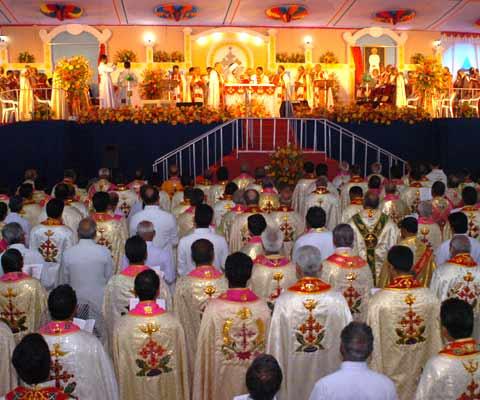
Thevarparampil Kunjachan was proclaimed ‘Blessed’ on 30.04.2006 by Cardinal Varkey Vithayathil, head of the Syro-Malabar Church. The mortal remains of the Blessed Thevarparampil Kunjachan remains interred at Ramapuram Church.
_____________________________________________________________________________
Author can be reached on admin at nasrani dot net
_____________________________________________________________________________
NSC NETWORK Article Footnotes
- Focus is an initiative covering the old significant churches among the Nasrani Syrian Christians. If you have a write up ready about any churches which are not covered so far please drop a mail to admin at nasrani dot net [↩]
NSC NETWORK is a collaborative networking effort of many Syrian Christians who are for traditions, heritage and culture. The primary objective of NSC NETWORK is to build awareness about Nasrani culture, traditions, heritage, sharing different perspectives of history and other relevant information concerning the community.Please read About for policies. © 2007-2009 NSC NETWORK [ http://nasrani.net]
____________________________________________________________________________
Related NSC Network Articles
- Churches on demolition line – Ramapuram Twin Churches
- Focus II- History, Munnu Noyambu and Kappalottam – Marth Mariam Church, Kuravilangad
- Raja Thoma Villarvattam – King of the Nasranis
- ‘The Syrian Christians of Kerala, Demographic and Socio-Economic Transition In The Twentieth Century’ by K. C. Zachariah
- Some of the traditions and rituals among the Syrian Christians of Kerala
- St.George- Geevarghese Sahada traditions and rituals among Nasranis
- ‘The St. Thomas Christian Encyclopaedia of India’- Volume II , Chief Editor Prof.George Menachery
4 Responses
jogy mathew
Post : 9552
i eally suspect about the name of the church real….because…
*In kerala the early built churches wre in the names of st.george….st.thomas or st,mary….there was no other saints known to them..
* one chance…..the name of t5he church has benn changed later…
*another…..the church may not be as old as it is claimed….
Louis Zacharias
Post : 12202
Jogy Mathew’s reading on the name of Ramapuram Church (St. Augustine) is correct. The first church (around 1450) was named after Mary. There was a reconstruction in 1599 when Archbishop Menezes of Goa laid the foundation stone. He renamed the church after St. Augustine (He was an Augustinian Monk). It is the first church dedicated to St. Augustine in Kerala and probably in India. When a second larger church was built around 1840, it was dedicated to Virgin Mary as the original church was.
Mr Gracious: Then you should be part of this >>
http://tholanikunnelfamily.com/history.html
Participate – Your opinion-Leave a Response
NSC NETWORK is a non moderated forum. All are welcome to participate in the debates. We encourage comments, critiques, questions, additional information,corrections and suggestions. We also encourage participants to provide answers/ideas to questions raised on articles or on posts/comments.Links/Videos/Pictures of value to readers are most welcome.We request that please stay on topic, respect other people’s opinions, avoid profanity, offensive statements or anything else that might otherwise violate our policy. Please understand that we reserve the right to edit or delete posts/comments for any reason we deem appropriate. By submitting a post/comment here you grant this site a perpetual license to reproduce your words and name/web site in attribution.
Please note that NSC Network may, in our sole discretion, reject posts/comments for any reason we deem appropriate. Please try to post on relevant discussions and we may in our discretion move discussions to relevant threads.
Get NEW Articles by e-mail / Enter your e-mail
Nasrani Syrian Christians NETWORK Snapshot
- Timmy my love,
Get a grip! Stop feeling sorry for yourself and your community. No one hates you and more importantly,...
- Is this Kala word in anyway related to the hindi word Kala...
- Worth reading ,as it might enhance discussions on Jewish burial and Christian burial in Kerala.
...
- There are many electronic versions of Periplus of Erythrean sea available in the net . One version mentions about "c...
- Thanks Joseph, I got it.
It's not as interesting as I had hoped......
- John Mathew:
I just assumed you could draw email info from the site! Later I remembered it was not so. Here is the ...
- Sir,
I read about Mar Anthrayos and his stay at Mulanthuruthy. It is written that one family opposed him and the kap...
- It appears 'Kala Pattina' or Kalapattana was referred to as Camara by Periplus of the Erythrean Sea (1st century CE)....
- See u have the right to say something and i understand that. Then i dont know what is the matter with feeling good wit...
- Joseph:
I had thought the family history you were referring to was online, and hence could be shared.
Regardless...
- Response to John Mathew:
Personally, I wouldn't like to name names. If you're serious email me directly....
- Joseph:
Out of curiosity what family was it that was making the ridiculous claim?...
- I'm disappointed! The last post is dated October 03, 2009 23:32. No Nazrani to quibble over their ancestry for nearly ...
- Alphy,
The Kodassery could be near Chalakkudi as you have suggested. I have cross checked the information with Kera...
- About calamina. Our Malabar tradition denotes mailappore as the site of martyrdom of apostle Thomas. But some books h...
- There is lot of migration happened in to malabar regarding christianity. i dont think its really a surprise. Only diff...
- About Kalamoun
Nowhere in Syria is there a district or a region, with clear natural boundaries and a cultural and h...
- Kalamoun (Qalamoun)
A north Lebanon city near sea with mountain and caves.
Nearby towns are full of Aramaic spe...
- "How did Rome and Antioch allow then to form such churches ?"
Anything to divide and rule....
- This community has become something of a joke among Nasranis here. Had k'Nayas shared some consistent physical feature...
- Dear pothen...as a historical point of view, what is charam ketty mean?.
honestly we are not familier with this term....
- Timmy- Potten ….I guarantee you wouldn’t say it to my face……
________________________________________
You look tha...
- now these days i get to hear that there is arab christians as we see many have pretty much middleastern features even ...
- Hi there,
The Knanayas I see in Amerika are looking ordinary! They don't look like syrians /white j...
- Shove the intellect up your ass G. Mathew. Maybe nursing wounds because some aunty or girl said Hell No to you. Whatev...
- Tim:
I could care less if you took a DNA test.
Look calling me names shows your immaturity. Anyway, I figured y...
- YOUTUBE WATCH http://www.youtube.com/watch?v=NgiU8yQYsAQ&feature=related...
- and these knanaya neighbour of mine wife is so dawn dark dravidian look women. but i dont blame it. because this fact ...
- Timmy, my neighbor in my apartment is a knanaya man and i admit that he has evident middleastern look and i see these ...
- Does anyone here with a more balanced view of things have any clue of what Timmy the Apostate** means when he says:
...
- Tim:
I could care less if you took a DNA test.
If you want to believe myths, go ahead. I could care less about d...
- Sorry RP, Mathew
I understand its important to relook at history, but l ike I said there are so many factors and var...
- Mr. Mathew you can't handle logic. I gave you numerous reasons as to why your theories may or may not work out. Let's ...
- Parsis distinct form Indians.....are yo kidding me. I dated a parsis from bangalore. No offence bro but you dont't hav...
- Potten ....I guarantee you wouldn't say it to my face.........
- See we both need to understand there is a situation going on with our communites. it quet natural that people get invo...
- Our family histories noted that our great grand father took intivative to bring lot of knanaya nasranis to ranny and t...
- Dear timmy,
I clearly feel many syrian looks in many families and i feel it. Please read over my paragraphs i am not...
- Tim:
There's no need for jealousy on either side of this debate. The Nasranis have a longer recorded history, and w...
- Another gung ho Charam Ketty Party who does not know what he is talking about. See how meaning less he makes the conve...
- "But to be honest, the history/myth-making is quite ridiculous in your community, so much so that anyone with even a s...
- "I’d call it B.S. personally — he seems to link the Knanaya to ex-Manichaeans who converted to Christianity due to Por...
- I am having some doubts as to why this forum was created in the fiirst place......mmmm
To the Admin, Google Portugu...
- I don't feel bad, I simply don't know. I am what I am, what do you want me to do feel sad and depressed about it. Come...
- Timmy:
I agree that the quick comments by Nasranis against "Knanaya" seem mean-spirited; however, you should do som...
- @RP
I guess you'll never know. For all we know, knanyna men could've had affairs with women from other communities an...
- Im a Knanyna Catholic, born and bred in New York, USA. I don't understand why everyone has a problem with us. We don...
- RE: Jewish origins.
I agree with Dinesh's sentiments in that it is quite annoying to see people distort/invent hist...
- Dear Mr. Dinesh Varma,
Your opinions are accepted in all logical sense but I have certain things to add to your "op...
- mr chacko this is not fair...just because i gave a differnt opinion does not make me an idiot. regarding indepth studi...
- Wow Dinesh, and you have done such indepth studies of these rarely seen cochin jew or jews of maharastha to be a exper...
- i dont beleive that the christians in kerala are decendents of jews. then why dont they look like thm. the jremaining ...
- In 1886 the Padroado jurisdiction ended in South Canara but the Portuguese were trying to preserve their influence. S...
- Dear NSC,
Hearty congratulations for such an effort. For a long time i was searching and studyin...
- Re. The theory of Alexandrian tradition.
Are there any evidences to say that the St Thomas Christians at the time ...
- Last sunday we had mass in Syriac (Syro Malabar) at St Thomas Forana Church, Dairy Circle, Bangalore for the feast of...
- Ref: Fake history by Syrian Christian
Now this fellow turning this discussion in to personal one .This has been his...
- Jeevan:
You have not introduced anything useful to the discussion, and have not presented any basis for anything yo...
- Ref: Fake history By Syrian Christian.
Now John has got the same Fever like Thomas Antony .He is changing the state...
- Jeevan:
You're right, there is something fishy about how the Syriac Orthodox got involved in Kerala. I don't know t...
- Ref: Fake history by Syrian Christians.
1) Alexandrian connections: I have already discussed about Alexandrian conn...
- Dear Mr John Mathew,
Although it has nothing to do with this thread and is not relevant to it, I am a Malankara Ort...
- Mr. Iype,
If you have some information to present that corrects my stands taken here in this thread, then I --- and...
- Since i hear about knanaya. what is it really to identify knanayas.- I know that myself or i see many in other denomin...
- Mr John Mathew .
I would like to personally correspond with you. If inclined, do drop a line at suraj underscore ...
- In response to Jeevan:
1. He wrote: "When we search documents based on Syriac script we find Esrangelo inscription ...
- Champakulam Kalloorkkadu St Mary’s Church- The Hidden Pearl in Nasrani History
- “Christianity in India- a History in ecumenical perspective” by HC Perumalil and ER Hambye
- “Kerala, the Cradle of Christianity in South Asia”-a DVD Documentary on the cultural interface of religion and music- An eye opener to the Religio cultural identity of the St. Thomas Christians in Kerala.
- “The Arrival of the Portuguese in India and the Thomas Christians under Mar Jacob 1498-1552” by Dr. Mathias Mundadan
- Catalogue of ancient Nasrani Churches, their affiliations and population statistics in the background of division and attempts of Reconciliation- A review of Literature
- Sixteenth Century Churches – Churches belonging to Catholics and Syriac Orthodox ( 1818 AD-Statistics)
- ‘The Thomas Christians’ by Placid Podipara
- Margam Kali – History, Theme, Early References and Modern Developments
- ‘The Indian Christians of St. Thomas’ by Dr. Leslie Brown
- ‘Jornada of Dom Alexis de Menezes: A Portuguese account of the Sixteenth century Malabar’ edited by Dr. Pius Malekandathil
- Qambel Maran- Syriac chants from South India- a review and liturgical music tradition of Syriac Christians revisited
- Letters of St. Thomas the Apostle to Edessa from India
- ‘St. Thomas Christians and Nambudiris, Jews and Sangam Literature – A Historical Appraisal’, Bosco Puthur (Editor)
- Prelates of Nasranis till the Synod of Udayamperoor- List of early Bishops till 1599 AD
- Hymns of Saint Ephraem (Ephrem) the Syrian, on Apostle Thomas and India
- Lifestyle of Kerala Syrian Christians
- Kerala Nazranee Pesaha Receipes
- Analogical review on Saint Thomas Cross- The symbol of Nasranis-Interpretation of the Inscriptions
- The Syrian Christian Church – An Architectural Overview
- Thomas-Malabar Connection & The Jewish Heritage, A Biblical & Analytical Approach
- Save Syriac
- A Syrian Christian Family Portrait – Circa 1620 A.D.
- Museum- Christian Cultural Centre Golden Jubilee Museum at Pala
- Focus III- Cheppad St. George Church
- What Every Nasrani Needs to Know–And Doesn’t
- ‘The Nazranies’ by Prof. George Menanchery
- ‘East of the Euphrates- Early Christianity in Asia’ by T.V. Philip
- Role, Characteristics, List and Tomb of Archdeacons (Arkadiyakons) of Saint Thomas Christians
- St.George- Geevarghese Sahada traditions and rituals among Nasranis
- Hindu Traditions of St. Thomas –Thondacchan and the Four Silver Coins
- Names, Middle Names and Last Names among the Syrian Christians
- The Tiger and the Syrian Christians: Tipu Sultan’s ‘Padayottam’
- Churches on demolition line – Ramapuram Twin Churches
- The Mural tradition of Kerala Churches
- Raja Thoma Villarvattam – King of the Nasranis
- Focus II- History, Munnu Noyambu and Kappalottam – Marth Mariam Church, Kuravilangad
- The Muziris Heritage Project- News
- Focus I- Ramapuram twin churches, Role, History & Rituals
- Church feast and festivals in Central Kerala-Kottayam
- Palm Sunday ( Kuruthola Perunnal), Maundy Thursday( Pesaha), Good Friday (Dukha Velli) and Easter among Saint Thomas Christians of India
- ‘The Syrian Christians of Kerala, Demographic and Socio-Economic Transition In The Twentieth Century’ by K. C. Zachariah
- SRITE- Project for Preserving the Manuscripts of the Syrian Christians in India
- ‘Glimpses of Nazraney Heritage’ by Prof George Menachery
- Glimpse from History-Gondophares, Roman and Venetian gold coins
- ‘The St. Thomas Christian Encyclopaedia of India’- Volume II , Chief Editor Prof.George Menachery
- ‘The St. Thomas Christian Encyclopedia of India’- Volume I -Prof. George Menachery
- ‘Origin of Christianity in India’ by Dr.Benedict Vadakkekara
- Familytree – Syrian Christians DNA Project Information
- Arrival of Thomas of Cana ( Bishop Thomas of Cana ?), History and references about Southist Community (Thekkumbhagar – Knanaya )
- Arrival of Mar Sabrisho and Mar Piruz, Earliest Reports, Copper Plates, Katheeshangal,Christians & Churches at Quilon
- The Edicts, Copper Plates and Privileges- Quilon (Tarisapalli) plates, Thazhekad edict, Iravi Kortan plate and Cana Thomman plate

(4 votes, average: 4.25 out of 5)
Appreciate the effort and content of your pages, must say it throws light on so much unavailable information.
My root family hails from Mannathoor near Ramapuram and having read you article I would request you to please trace a Syrian immigrant named Tolani as my family name Tolanikunnel is derived from this Syrian name.