
Arrival of Thomas of Cana ( Bishop Thomas of Cana ?), History and references about Southist Community (Thekkumbhagar – Knanaya )

A merchant or Bishop named Thomas of Cana ( also known as Knanaya Thommen or Thomas of Knanaya this being a recent addition) is connected with the history of the community of St. Thomas Christians. The details about this merchant or bishop are shrouded in mystery and there is no agreement on the year/period of his arrival, or from where he arrived, or on what grounds or whether he was a Bishop or merchant.
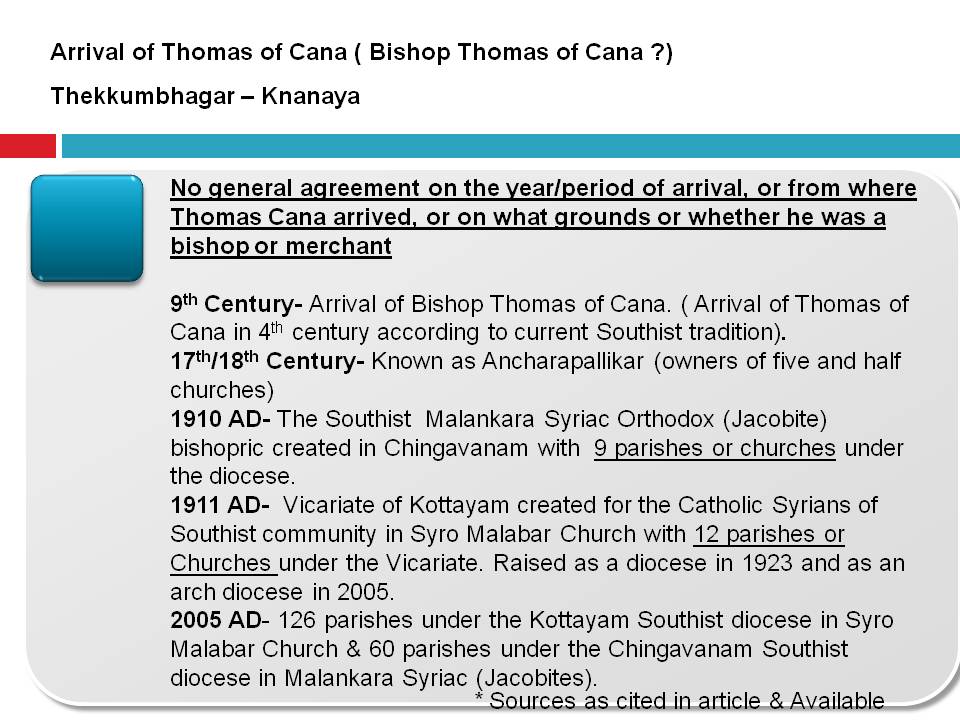
There exist a division among the Christians in Malabar as Northists (Vadakkumbhagar) and Southists ( Thekkumbhagar). The Northists (Vadakkumbhagar) are known as Christians of Saint Thomas. The latter, ie, the Southists ( Thekkumbhagar) are today known with the name “Knanaya”. This division as it seems, has started very late after many centuries after the arrival of Thomas of Cana in 9th century. The earliest Portuguese accounts are silent about such a division and we get some information only by the end of sixteenth century. All of the early Portuguese accounts mentions that there exist Christian community before the arrival of Thomas of Cana in Malabar.
This article examines 1) Arrival of Thomas of Cana ( Bishop Thomas of Cana ?), 2) About the name , 3) About the year of Arrival,4) Southist Version of the tradition ,5) Tekkumbhagar ( Southist)/ Knanaya 6) Bishop Thomas of Cana ,7) About the Northists and Southists division, 8 ) About the Churches at Cranganore 9) Summary
1. Arrival of Thomas of Cana ( Bishop Thomas of Cana ?)
Scholars like Dr. Mingana has been very critical on the legendary nature Kerala Christianity assigns to Thomas of Cana since eighteenth century. There is a tendency especially among Southists to exaggerate the events associated and contributions of Thomas of Cana. There is no general agreement concerning the traditions associated with the arrival of Thomas of Cana. Some assign him as a merchant, and others assign him as a Bishop ordained by Patriarch Timothy 1 in 9th century. Scholars such as J S. Assemani ( 1728) , Lequien ( 1740), S. Giamil ( 1902) , A Mingana ( 1926), Tisserant ( 1957), Hambye etc dates the arrival of Bishop Thomas of Cana in 9th century. According to many scholars Thomas of Jerusalem, a merchant and the Bishop Thomas of Cana are two persons who arrived in Malabar at different times in history.
a) Portuguese references about Thomas of Cana
Some reference about Thomas of Cana, can also be seen in sixteenth century Portuguese writings of Penteado (1518), Dionysio (1578), Correa (1564), Antonio Monserrate (1579), Antonio de Gouvea (1604), Chaldean Bishop Mar Jacob Abuna ( 1533) and on the report of the Bishop Franics Roz in 1604. (( Silva Rego- “ Antonio da, Documentacao para a Historai das missoes do Padroado Portugues do Oriente India “ ( Penteado ( 1518) ), Dionysio ( 1578), Lima Felner- “ Lendas da India” ( Correa ( 1564) ), Joao De- “Da Asia” ( Barros , Lopes de- “ Historia do Descobrimento” ( Castenheda), Wicki Joseph – “ Documenta Indica” ))
| Testimony | Year | Gist of the Report |
| Penteado | 1518 | Armenian merchant. Quarrel between two sons of the merchant. |
| Mar Jacob Abuna | 1533 | Merchant died at Cranganore |
| Correa | 1564 | Adds the Merchant met and stayed with a Servant of Apostle Thomas at Cranganore before buying his own land |
| Dionysio | 1578 | Merchant, Thomas, married a woman of Cranganore. United Christians who are already there and those he converted |
| Monserrate | 1579 | Thomas of Cana found Christians in Quilon and Cranganore, who descended from the disciples of the Apostle Saint Thomas and he united them |
| Bishop Francis Roz | 1604 | Thomas had a wife and a concubine. King gave him land. |
1. Penteado ( 1518)
The earliest reference is from a Portuguese report written by Penteado in 1518 .He narrates the origins of the Christians of St. Thomas both in Quilon and Cranganore to the king of Portugal. The first origins are from the Apostle Thomas. For the period after St. Thomas, as far as Cranganore is concerned, there came an Armenian merchant advanced in age. Since he had no hope of returning home, he bought an unoccupied land with all its income from the King of the place. He got the property rights both of land and water within the bounds of this land. According to the testimony there was evidence for this at that time. He had two sons. His elder son inherited the income of the land which the merchant bequeathed to the church, at the time of his death. The second son was made a judge over his slaves whom the father had bought, freed and converted. Between these Sons there arose disputes. Each gathered a faction around him. The elder son was defeated in a faction fight. He called in the Jews to help him. The Jews expelled from their land not only those Christians under the second son, against whom they were called in, but also the other Christians who had solicited their help. According to him, in 1518, these Jews are the masters over that land. They serve the king of Cochin while to the Christians are reserved merely the honor and the title.
2. Bishop Mar Jacob Abuna
Chaldean Bishop Mar Jacob Abuna in 1533 makes references about a merchant. He writes that, a merchant from the country of Canane came to Mylapore on pilgrimage. After finding that all the houses there are in ruins, and being convinced that nothing could be done to restore them, he passed over to Cranganore. In Cranganore, he bought some land and built on it a church which was there at the time Abuna gave his testimony. The merchant died while living there and was buried in it.
3. Correa (1564)
Correa (1564), follows Abuna’s version but adds that the Armenian merchant met in Cranganore a servant of the Apostle Thomas. The merchant lodged with him before buying his own plot of ground.
4. Dionysio (1578)
Dionysio (1578) puts the arrival of Thomas of Cana after that of Mar Sabrisho and Mar Piruz. He is described as a native of Babylon and a merchant. He embarked at Cranganore and began to trade. Being rich and influential, he made friends with the King of the place. The King gave him a plot of land of about 500 square yards to erect a church in honor of St. Thomas. He united all the Christians who were already there, and those whom he himself had made Christians ( converted) . He obtained many donations from the King for the church. According to this from that time onwards Christianity prospered. The merchant, Thomas, married a woman of that place, and became the peer of the Nairs, the aristocracy of the land, and a warlike people. Only the Nairs served the king because all other castes were low castes when compared with the Nairs. If a low-caste man happened to touch a Nair, the Nair would bathe to remove the pollution of the touch. They live on allowances from the kings. The Christians were the equals of the Nairs in status, and they too live on allowances made to them by the Kings. It would be 752 years since this Thomas came from Babylon. All this is known from an inscription on sheets of iron. Then the author adds that only this was known with certainty about the origins of these Christians from the information gathered from books and from tradition handed down by old people and by catanars ( Kathanars) , i.e., their priests.
5.Monserrate ( 1579)
Monserrate ( 1579) says when Thomas of Cana came, he found Christians in Quilon and Cranganore. They have descended from the disciples of the Aposlte Saint Thomas. These Christians were nominal and they married with Nairs. They just had crosses and Christian names. Thomas of Cana made them a united community and took care to preserve their superiority of caste.
6. Francis Roz’s ( 1603/04- From (British Library MS Add-9853)
Bishop Francis Roz‘s main information is derived from the interpretation of the Copper plates said to be of Thomas of Cana ( the interpretation of that time ?). It says during the time of last Xeram Perumal, Thomas Cananeo came from Babylon. He gave the King a good sum of money. He bought the whole of shrubland and founded on it the Church of Saint Thomas and the bazaar. Howerever, already many years before the Church was built, there was in that place Patanam a Church and a large village of the Christians.
In this Report on the Serra, Bishop Roz also gives an account of the translation of the Olla which the said Xeram Perumal gave to Thomas Cananeo. According to him ( interpretation of the olla ?) , the Xeram (Xoran) Perumal reigning at the time of Mercury of February, on the 7th day of March before the full moon, the same king residing in Carnelur (?), there arrived in a ship Thomas of Cana, a chief man, determined to see the surroundings of the East. The king being informed of it, went out to meet him. Thomas disembarked and stood before the king who spoke to him friendly and imposed on him the surname of Coquarangon Cananeo, after the king’s own name.
Thomas accepted this honor and went to settle down himself in his place. The king gave him for ever the town of Magoder Patanam. Afterwards the king assigned to the new-corner a place covered with brushwood marking its boundaries and asked him to build a town there. Thomas wanted the place for himself and the king granted it to him. Thomas built there a church and his own house; the corner stone of both were laid by the king himself. The whole place was converted into a town which was given by the king to Thomas as an inheritance. On an opportune day the church was inaugurated and the said Thomas entered the church and made his prayers.
Sometime after, Thomas went to the king and offered him presents and formally asked the king to give him and to his descendants the said land. The king accordingly measured 264 eIls with an elephant and gave it to Thomas and his descendants, together with 62 houses which they had built in that place, with gardens and trees, with the circuits and ways and boundaries and the interior pathways. Roz continues to describe the privileges and rights the king gave him.
Bishop Roz also says, “he could find the name of Thomas of Cananeo, among the names of the saints whom the decon names in the Mass, attributing to him that he gave a large sum of money to the King of Malavar to buy that ground of Cranganor”.
Further Bishop Francis Roz opinionated that , he consider “it to be fable what these Christians narrate, namely that the said Thomas had a wife and a concubine from whom are descended the two kinds of Christians living in this Malavar”.
Regarding the lineage Bishop Francis Roz says, these Christians are descending from Thomas of Cana on the father’s side. Their mother was a Malabar heathen who got herself baptized later.
2. About the name
| Reported by | Year | Name |
| Penteado | 1518 | Armenian merchant |
| Mar Jacob Abuna | 1533 | From the country of Canane |
| Correa | 1564 | Thome Cana |
| Dionysio | 1578 | Quinai Thorné |
| Monserrate | 1579 | Mar Thomé |
| Bishop Francis Roz | 1604 | Thome Cananeo |
Penteado (1518) merely calls him an Armenian merchant without giving his name. Mar Jacob Abuna (1533) mentions from the country of Canane. Correa (1564) call him as Thomé of Canane . Dionysio (1578) call him as Quinai Thorné.He was mentioned as Mar Thomé by Monserrate (1579) and Gouvea (1604) and as Thome Cananeo by Roz (1604) .
The Malayalam form is generally Canai Thomman and is better expressed by Dionysio than others. Mar Thomé is from the Syriac.
3. About the year of arrival
The earliest available report seems to be of Dionysio. Dionysio ( 1578) gives the arrival of Thomas of Cana after Mar Sabrisho and Mar Piruz ie, after 9th century. Gouvea ( 1604) also dates the arrival in 9th century. The Dutch writer Visscher ( 1743) also gives the date as 745 AD. Hugh gives the date as 780 AD. Assemani in 900 AD. Paolo gives the arrival as 825 AD. Some of the 16th century records doesn’t mention the dates.
| Reported by | Year | Year of arrival |
| Dionysio | 1578 | After the 9th Century |
| Gouvea | 1604 | 9th Century |
| Visscher | 1743 | 745 AD |
| Hugh | 780 AD | |
| Assemani | 900 AD | |
| Paolo | 825 AD | |
| Local document | 18th Century | 345 AD ( also according to current Southist tradition) |
The Southists ( Thekkumbhagar- Knanaya) tradition gives the year as 345 AD. This is based on an eighteenth century document.
4. Southist version of the tradition
The tradition current among the Southists ( known today with the recently coined term Knanayas) , is that about the year 345 AD, 72 families came to Malabar Coast along with a Bishop under the leadership of Cnai ( Knanaya) Thomman. This was based on the divine intervention of Catholicios of East to send Thomas, a merchant of Jerusalem for the service of Christians of Malabar as they were deprived of priests and partly reverted to idolatry.King Cheraman Perumal honored them with many titles and privileges which were recorded in some Copper plates.
This version is generally based on a record written in Malayalam and Syriac about 1770, and secured through the care of Gavril (Gabriel), a Syriac Orthodox (Jacobite) bishop. The document is now preserved in the University library of Leyden. The contents of this document are not historically reliable. (( JPN “Land Anecdota Syriaca”, Leyden, 1862. Text translated and reproduced in S. Giamil, “Genuinae Relationes”, Rome , 1902 pp 552-64. A similar story is also published from a manuscript in Bodleian Library by F Nau in 1912 ))
In 1939, Joseph Chazhikaden ( a member of Southist Community) promulgated a bold Southist legend. He published a Malaylam book “Tekkumbhagasamudayam Charitram” [History of the Southist Community]. The English version of the book had the title, “The Syrian Colonisation of Malabar”. The English title is not an exact rendering of the Malayalam title of the original book. This book is a rambling collection of the noble origins and tradition of the Southists. A major section is devoted to a remarkably extended division narrative between the Northist ( Christians of Saint Thomas) and Southist ( Thekkumbhagar) . Chazhikaden’s Southists are unique from the most ancient time and their uniqueness is not Christian but Jewish.
5. Tekkumbahagar ( Southists) / Knanaya
There are no evidences that Christians in Kerala were known in different distinguish names prior Sixteenth century.
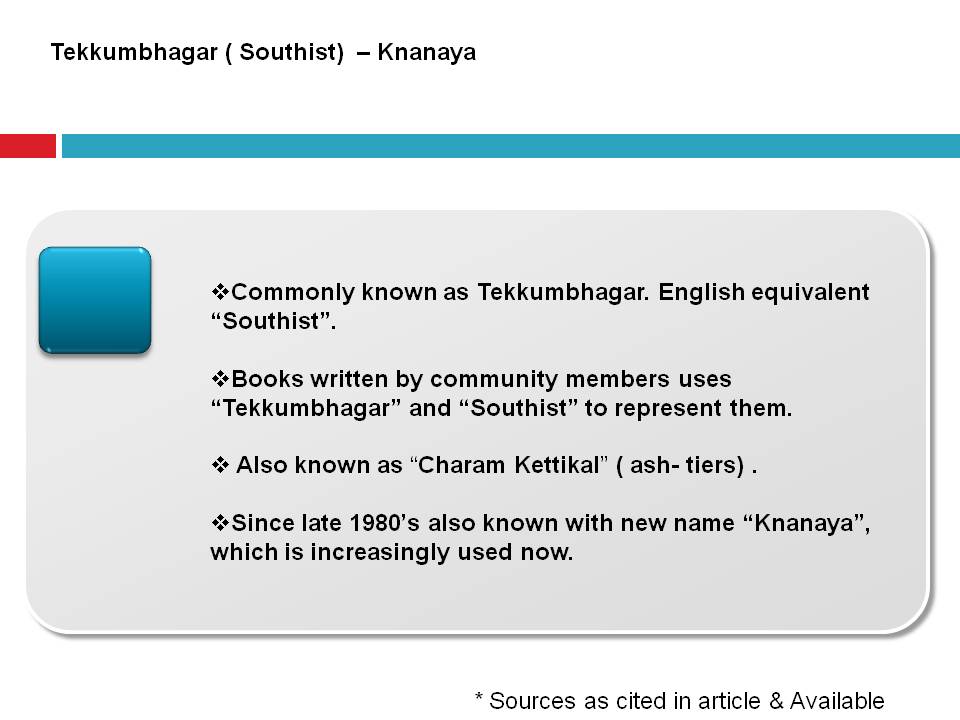
The Malayalam name used to distinguish this division is “Tekkumbhagar“. The English equivalent is “Southist“. They are commonly known as Tekkumbhagar.
The Joseph Chazhikaden book (1939) is titled as “Tekkumbhagasamudayam Charitram” [History of the Southist Community]. The book of Dr. Jacob Kollaparampil (1992) is also titled as “The Babylonian origin of the Southists”.
In late 1980’s some Malankra Syriac Orthodox ( Jacobite) Southist has started using the name “Knanaya“. In less than a decade, the new name Knanaya mostly replaced the old Tekkumbhagar ( Southist) among both the Malankara Orthodox Church ( Jacobite) and Syro Malabar Church ( Catholic) Southists.
The other name commonly used are “Charam Kettikal” ( ash- tiers) . This name has its orgin from an old custom practiced by members of this community in carrying a little ash in the corner of the sari or dhoti (mundu). They were also known as “Anchara Pallikar” in 17th/18th centuries, meaning owners of five and half churches.
6. Bishop Thomas of Cana
Regarding this Thomas of Cana, some of the historians say he was not a merchant but a Bishop send by the Patriarch Timothy 1 in 9th century.
J S. Assemani, who came across the story, makes reference to the arrival in India of Bishop Thomas Cana, about A.D. 825. He believes that his ‘wives’ were the two cities of Cranganore and Angamale where he had jurisdiction. ((‘J. S. Assemani, Bibliotheca Orienlalis, vol. III b, pp.ccccxli ff ))
Furthermore, S. Giamil when studying the Leyden text and Assernani’s explanation logically concluded that there were two missions: first came the merchant, Thomas of Jerusalem, accompanied by Joseph, the anonymous Metropolitan of Edcssa. Then there arrived, in A.D. 8oo, Bishop Thomas Cana. (( S Giamil, “Genuinae Relationes” pp 578-82 ))
A. Mingana while analyzing the Lyden text which mentions the arrival of Thomas of Cana in 345 AD writes, ” if this Thomas is an historical personage, he is different from Thomas Cana, another problematical Bishop of Malabar, in about 823 AD. The scene of this merchant Thomas is placed according to Malabar tradition in 345 AD. In this year the Catholics of East was Barba- Shemin , the nephew of the great Simon bar Sabba ( Bedjan- ” Acta Martyrum” ii, 296-303, Assemani-“Acta Mart,i,111-117, Sozomen -Hist. Eccl,ii,14etc) and was in prison from February 345 to 9 January 346, in which he suffered martyrdom. After him, the See was vacant for twenty years. Before the time Catholics was Shahdost, who was himself martyred in 342 and after him the See had become vacant for two years ( Amr-“De Pant” p-12, Mari-“De Pat”,pp 16-18, Bedjan, ibd,ii,276-280 etc).
In their short time of office, during the persecution of Sapor, not one of the above Catholics whose time was mostly spend in prison could have possibly attended to the business of a merchant Thomas from Jerusalem. The whole story is absolutely unhistorical.
I believe that this very late Malabar Syrian tradition might have made a stupid chronological mistake of about four centuries and a half : but then this unhistorical Thomas was a simple merchant and not a bishop, while the possibly historical Thomas Cana was a bishop. No one can fathom the depth of stupidity to which a late and worthless tradition may lead a critic” (( A Mingana – “ Early Spread of Christianity in India p-476 ))
According to A. Mingana, the Bishop Thomas of Cana lived between 795-824 AD. His seat seems to have been a town in the coast of Malabar. There is hardly any reasonable doubt that if this Bishop Thomas has any historical personality at all, he is to be counted among the monks whom the Patriarch Timothy I selected, as the historian Thomas of Marga inform us, ordained bishops and sent to all the countries of the East.
So according to him, even if there is some historical background for the mission attributed to A.D. 345, it must be distinguished from the coming of Bishop Thomas Cana.
Cardinal Tisserant also mentions that there arrived Persian immigrants with Bishop Thomas about 774 or 795. There is a possibility of identifying Bishop Thomas with a certain monk, Thomas who was ordained as a missionary prelate by Timothy I. (( Tisserant- “Eastern Christianity in India” p-14 ))
E R Hambye writes, the first group of Christian immigrants reached about 774/795 AD. It was led by a Bishop called Thomas, perhaps the monk Thomas consecrated by Catholicios Timothy I. (( E R Hambye, “ The Eastern Church” ))
7. About Northist and Southist division
There exist a division among the Christians in Malabar as Northists (Vadakkumbhagar) and Southists ( Thekkumbhagar). This division as it seems has started very late after the arrival of Thomas of Cana in 9th century. Most of the early Portuguese accounts doesn’t mention about any division among the Christians in Kerala. There is much controversy among the St. Thomas Christians themselves, in assigning the cause for the division as questions of prestige, nobility and caste are involved in the matter. These groups are known in Malayalam as Thekkumbhagar (Southists) and Vadakkumbhagar (Northists).
It is Bishop Franics Roz in the “Report on the Serra ( 1603/1604)”, British Library MS Add-9853 gives some information about the quarrels. It appears that this separation in 1603 lead to the building of separate churches. This was also limited in Cranganore.
The Southists generally claim that they are the descendants of Thomas Cana and of others who came with him from abroad and have kept their blood pure without intermingling with the natives. In 1939, Chazhikaden has taken it to another level claiming that the Southist are Jewish Christians. The Northist, ie Christians of Saint Thomas, according to them whether they lived in Malabar before or after the arrival of Thomas Cana, had mixed with the natives
The Northist version for the cause of the division is given in an old manuscript called Sloane MS, 2743 at the British Museum. The substance of the Northist version is that the Southists are descendants of those in Malabar (Cranganore) consequent to the arrival of Thomas Cana, who entered into marriage relations with the children of a native woman. This native woman was of the Mainatoo caste(Washer Women) who was a servant of Thomas of Cana. Other stories trace the origins of the Southists to a dobi, a washerwoman, whom Thomas of Cana took as concubine.
These arguments revolve on the legitimate and illegitimate children of Thomas of Cana. Traditions associated with Thomas of Cana was a shared tradition among the Christians in Kerala. These arguments might have been invented to express the odium and hatred each community bore against the other.
The Southist claims and charges are expressed in the book of Joseph Chazhikadan, “Tekkumbhagasamudayam Charitram” -History of the Southists- (in Malayalam) published in 1940. They have been disputed from the Northist side by Joseph Kurmanakan in the book, “The Southists and Northists” published in 1941. The latest is “The Babylonian origin of the Southists” published in 1992 by Dr. Jacob Kollaparampil. This is an extension of Chazhikadan theme, where Kollaparampil has refuted some of the charges and expanded on the latest noble Jewish Christian claims of the Southist.
a) Portuguese References about the Northist-Southist division
| Reported by | Year | Gist of the Report |
| Penteado | 1518 | Quarrel between the two Sons of Armenian Merchant and the consequences of the quarrel. |
| Mar Jacob Abuna | 1533 | No mention of any division among the Christians in Malabar. |
| Barros | 1553 | No mention of any division among the Christians in Malabar. |
| Correa | 1564 | No mention of any division among the Christians in Malabar. |
| Goes | 1566 | No mention of any division among the Christians in Malabar. |
| Dionysio | 1578 | No mention of any division among the Christians in Malabar. |
| Monserrate | 1578 | First clear report on division. Two wife of Thomas of Cana. |
| Gouvea | 1604 | Christians of Cana are the Christians with Thomas of Cana lineage. The division was not known among the Christians of Travancore and Todamala |
| Bishop Francis Roz | 1604 | One group were the descendants of Thomas of Cana and the other, the descendants of those Christians who lived there before the arrival of Thomas of Cana. Those descending from Thomas of Cana are on the father’s side (for the mother was a Malabar woman convert). |
| Bishop Francis Roz | 1604 | Gives reasons for the quarrels and what lead to the formation of separate churches at Carturte ( Kaduthuruthy) and Cotete ( Kottayam) for Thekumbhagar. |
| Bishop Francis Roz | 1604 | In 1603, quarrels at Udiamper ( Udaymperoor), and Candanate. Christians of St. Thomas descending from Thomas Cana are few. They are in Udiamper ( Udaymperoor) and in the big church of Carturte ( Kaduthuruthy) and the big Church of Cotete ( Kottayam) and in Turigure. ( Torure ) |
1. Penteado ( 1518)
From the early Portuguese documents, Penteado in 1518 seems to assign the origin of the division when he speaks of the quarrel between the two Sons of Thomas of Cana and the consequences of the quarrel.
2.No mention of any division
Barros (1553—63), Goes (1566), both of who have recorded the origin and history of the Christians, have nothing to say about this division or of quarrels. Correa ( 1564) and Bishop Mar Jacob Abuna ( 1533) who knew the tradition of the arrival of Thomas of Cana also do not mention about the divisions. Even Dionysios (1578) who is well informed of the traditions of the Christians does not talk about the division.
3.Monserrate ( 1579)
Monserrate (1579) seems to be the first to give a clear and detailed account of this division. Thomas of Cam had two wives, one noble woman, and the other a slave though belonging to a good caste, (for it was the Custom of the nobles, to sell away those children born on inauspicious days). The proof of this is: besides the tradition of the ancestry there is among the Christians a strong feeling about birth and caste, those descending from the slave being considered lower. And that both the wives were noble, at least Nair women, is proved by this custom existing in Malabar, that there is no pollution between the Christians of St. Thomas and the Nairs, nor penalty of death, if there is marriage or friendship, all of which arise, according to the custom of the country, for castes higher or lower than these two. What is more likely is that the Christian community originated from both, that is from the glorious Apostle St. Thomas and Thomas of Cana; and also from many Nairs who were daily converted to Christianity. They are a Christianity of 72,000 souls and they are reduced to these two clans by the lie of the land and not because they were descended from those women but because some lived on the southern and the others on the northern bank.
Thus Monserrate gives first the local tradition about the division, and then he gives his own opinion. He says that the division was topographical. However, he does not deny that there might have been the other cause also. It is not clear from the text whether he intends to state, as his opinion, that the one group had its origin from the Apostle and the other from Thomas of Cana. It is difficult to interpret his views in that light when he says that most likely the Christians had their origin from both the Apostle Thomas and Thomas of Cana.
4. Gouvea ( 1604)
Gouvea ( 1604), while mentioning this division inform as that the division was not known among the Christians of Travancore and Todamala. According to him the Christians of Cana are the christians with Thomas of Cana lineage.
5. Bishop Francis Roz ( 1603)
Bishop Francis Roz ( 1603) who strongly defends the importance of the Christians existing in Malabar before the arrival of Thomas of Cana. He says that one group were the descendants of Thomas of Cana and the other, the descendants of those Christians who lived there before the arrival of Thomas of Cana. The descendants of Thomas of Cana always kept themselves without mixing with other Christians. There were two lineages among the Christians of Malabar and according to him, one descending from Thomas of Cana on the father’s side (for the mother was a Malabar woman convert); The other on the father’s as well as mother’s side, descending from the Christians of St. Thomas.
Thus according to Bishop Roz only the latter group (obviously the Northists) are to be called the Christians of St. Thomas. These Christians were more careful than the others ( Southists) to increase the membership of the church and hence received into their community many pagans whom they baptized.
Bishop Roz also indicates the cause of the antagonism between the two groups. Some of the people who had served the sons of Cana had some time or other gone over to the other Christians ( Northists) and received their protection (probably he means to say also that they became Christians). Hence the other party (sons of Thomas Cana), began to antagonize them (though they were rich and honorable), calling them their slaves. This gave rise to much discord between these two groups and there were many quarrels in olden times. It was owing to this that in Carturte ( Kaduthuruthy) and Cotete ( Kottayam) it was found necessary to build separate churches for the one and the other and each party keeping aloof from other.
In the year 1603 (according to him last year- this manuscript is written in 1603 and 1604) there had arisen among those of Udiamper ( Udaymperoor), and Candanate a big quarrel each one defending their own party. Bishop Francis Roz observes: It was a strange thing to see the aversion which one party had for the other, without being able to forget the old things and the fables, which they hold in this matter. The Christians of St. Thomas (here so he calls them also) descending from Thomas Cana are few. They are in Udiamper ( Udaymperoor) and in the big church of Carturte ( Kaduthuruthy) and the big Church of Cotete ( Kottayam) and in Turigure. ( Torure ?) (( Report on the Serra ( 1603/1604), Bishop Francisco Roz SJ, British Library MS Add-9853 ))
b) Modern history of Thekkumbhagar
With the Coonan Cross Oath (1653) and subsequent happening the Christians of Saint Thomas were divided in two groups as Catholics and Jacobites. It is not very clear if there were any exclusive Southist churches during the Syond of Dimaper (1599) . After the Coonan Cross Oath (1653), some of the Portuguese records indicate that one or two Southist Churches ( Churches where they have the control in 17th century) reconciled with Arch Bishop Gracia before his death.
1) Among the Malankara Syriac Orthodx Church ( Jacobite)
One of the four councilors of Archdeacon Thomas was a Southist priest Anjilimootil Ittithomman of Kallicherry. The Malankara Syriac Orthodox Church ( Jacobites in India) were governed by the successors of Mar Thomas I after the ordination of Archdeacon Thomas. Mar Thomas I was followed by Mar Thomas II, Mar Thomas III, Mar Thomas IV, Mar Thomas V and all related to Mar Thomas I and to one another. They also received Bishops from Syriac Orthodox Church of Antioch. There was no division or separate hierarchy based on the segregation as Southist and Northist. The Malankra Syriac Orthodox Church ( Jacobite) saw divisions in 1774 and 1887 but the Southist were not party in this.
Creation of an “exclusive” diocese for Southist among Jacobites
After the incidents which lead to the formation of Malankara Mar Thoma Church (1877) , the Syriac Orthodox (Jacobite) Patriarch of Antioch Abdalla wanted to gain complete authority over Malankara Church. Mar Dionysios, the Metropolitan was a very able man. The Synod of Malankara Church did not want to give more authority than spiritual power to the Jacobite Patriarch. The Syriac Orthodox (Jacobite) Patriarch was incensed. To take control over the Church and to get more people to his side, he consecrated two bishops. One of them was a Southist named Severios who was a close aide of Mar Dionysios, the Metropoliten of the Malankara Syriac Orthodox Church.
By this the Patriarch did gain support of one prominent advisor of Mar Dionysios but he gave official recognition to a division among Syrians as Northist and Southist. Hence in 1910, a Southist diocese was officially formed and recognized in Malankara Syriac Orthodox Chruch (Jacobite) .
What Leslie Brown says in ‘The Indian Christians of Saint Thomas’ is that by this the Syriac Orthodox (Jacobite) Patriarch of Antioch gave recognition to a division among the Syrians which Menezes had tried to heal.
This diocese in Chingavanam was formed with 9 parishes in 1910 and now it has over 60 Churches under the diocese.
2) Among the Syro Malabar Church ( Catholics)
The Catholic Syrians were ruled by Mar Parampil Chandy ( Alexander de Campo). In succeeding century they were under two administration, the Propaganda and the Padrado. All the Christians were together in these administrations as well as during the time ofMar Cariattil Thomas ( Prelate 1782-1786), Paremmakal Thomas Kathanar. There were no separate hierarchy or administration system based on the division as Southist and Northist.
Creation of an “exclusive” Vicariate and then diocese for Southists among Catholics
In 1878, Rome decided on placing the Syrian Christians under separate administration, appointing two vicars Apostolic of the Latin Rite to govern them. One of those latin rite Bishops, Charles Lavinge, the Bishop of Vicariate of Kottayam ( Changanacherry) left behind the same legacy like his predecessors. For the first time in history, he appointed a separate Vicar General for Southist in January 1890. The Northist – Southist divide which was till then sociological in character got ecclesiastical dimensions among Catholics. In 1896 Mathew Makil was appointed as the Vicar Apostolate of the then Kottayam ( Changanacherry) Vicariate of Syro Malabar Church . As a priest he was an advocate for foreign rule among the Saint Thomas Christians. He has submitted petitions that the Southist among the Saint Thomas Christians wish to be under foreign rule.
His appointment created tensions and rift among the people. He has to fled to a Southist church in Kottayam to escape public anger. Based on the reports of missionaries, Rome created an exclusive Vicariate for Southist in 1911 at Kottayam with 12 parishes or churches under the Vicariate in Syro Malabar Church. Mathew Makil was appointed as the Bishop of Kottayam Vicariate in 1911.
This “exclusive” Vicariate was made a diocese in 1923 and as an Arch diocese in 2005. There are at present over 126 parishes under the Kottayam exclusive Southist diocese in Syro Malabar Church.
8. About the Churches at Cranganore
It is difficult to make out from these Portuguese accounts on where exactly the first church of the community stood in Cranganore. The old wooden buildings are said to last for four hundrad years.
According to Bishop Francis Roz ( 1604) , based on a Chaldean book he has read there were three Churches in Cranganore. One dedicated to the Apostle Thomas, another one to Saint Kuriakose and a third one dedicated to Our Lady.
According to Couto, the Apostle landed in Magadover Patanam near Parur and he speaks of a Church left by the Apostle himself there. Bishop Francis Roz also talks about the Parur and says that the present church at Cranganore during the Portuguese time was built by Thomas of Cana. According to Joao Carcere, at the time of his writing ( 1529), the Church which stood in Cranganore had been there from the time of the Aposlte and the pagans williningly or not, paid their respects and offerings to it. Some others such as Abuna, Dionysio, Monserrate mentions that the church at Cranganore was built by Thomas of Cana .
9) Summary
There is no general agreement about the tradition associated with Thomas of Cana. According to many authorities as explained above, there are two missions partially or fully associated with this tradition, first about the merchant, Thomas of Jerusalem, and then the arrival of Bishop Thomas Cana in 9th century.
Thomas of Cana, was a shared tradition among both the Northist and Southist, each one claiming part of the tradition. The early Portuguese records does not mention about any division as Northist and Southist or any families immigration as contained in Southist tradition while referring to the merchant or bishop Thomas. There are also no references about Jewish Christians origins of Southist. In fact, the early 16th Century documents mentions that this merchant or bishop won many converts in Malabar. According to the modern Kerala historians, the Cheraman Perumal’s came to Kerala history scene only after 8th century. It is very unlikely that such a thing happened in 4th century. The Copper plate is also not extant and it has been accused of a forgery by various parties.
The period of arrival of Bishop Thomas of Cana is 9th century as the records about the early tradition indicates. It also seems that the segregation of community as Northist and Southist happened after the arrival of Portuguese. This gradually lead to the formation of separate parishes or churches for the Thekkumbhagar. It seems that Bishop Franics Roz in the Report of Serra of 1604 is mentioning about this segregation while referring to the quarrels of Christians at Udiamper ( Udaymperoor), and Candanate in 1603 and about the churches which came in Southist control at Carturte ( Kaduthuruthy) and Cotete ( Kottayam) ( year not mentioned for the Churches at Kaduthuruthy and Kottayam).
Until the first decade of 20th Century this division as Southist ( Thekkumbhagar) and Northist ( Christians of Saint Thomas) was of sociological character. The ecclesiastical recognition of this division happened only in 1910 among the Malankara Syriac Orthodox (Jacobites) and in 1911 among the Syro Malabar Church (Catholics). That was an unfortunate turn of history. The ecclesiastical recognition and decision was influenced by political factors of the first decade of 20th century among Jacobites and Catholics than historical considerations. The only major unification effort between the Southist and Northist happened during the time of Nidhiry Mani Kathanar in the Catholics section.
Note about the sources–
Portuguese Records:
- Mundadan- ” Saint Thomas Christians 1498-1552″
- Mundadan-” Sixteenth Century Traditions of Saint Thomas Christians”
- Schurhammer ( 1934)
- Nedugant – “ Syond of Diamper Revisited”, Rome
- Mingana -“Early Spread of Christianity in India”
- Bishop Francis Roz Report- British Museum Manuscript BS Add MS 9853 titled “Report from Serra ( 1603/1604)” – Relacao da Serra – by the first latin prelate of Angamali.
Portuguese Records published in full
- Dr. Silva Rego – “ Antonio da, Historia das Missoes do padroado Portugues do Oriente, India Vol I ( 1500-1542)”
- Anonio da- “Documentacao para a Historia da Missoes do Padroado Portugues do Oriente”, India 12 Volumes ( 1947)
- Wicki Joseph SJ- “ Documenta Indica “ 7 Volumes, Rome ( 1948)
- Schurhammer SJ “ Franz Xaver, Sein Leben und seine Zeit” “ Die Zeitgenesischen Quellen zur Geschichte “ “ Epistolae S Francisci Xaverii” “ Historia seraphica da Ordem dos Frades Menores des
Books on Southists/ Thekkumbhagar/ Knanaya
- “Tekkumbhagasamudayam Charitram” [History of the Southist Community] by Joseph Chazhikaden in 1939 ( Southist version)
- “The Southists and Northists” by Joseph Kurmanakan in the book in 1941. ( Northist version- Refutation of Southist claims)
- “The Babylonian originof theSouthists”by Dr. Jacob Kollaparampil in 1992 ( Southist version)
- “Northists and Southists : A Folklore of Kerala Christians” by Richard M Swiderski. ( third party study)
- “Moon God Siva and sacred Thomas -The religious community of the Knanaya in Kerala” by Dr. Kerstin Neumann ( third party study)
Please read the discussion, where different view points are better explained. The article content has been taken from some of the discussion points.
_____________________________________________________________
Author can be reached on admin at nasrani dot net
Last revised- Dec 26th 2009.
__________________________________________________________
Knayaya’s were referred earlier as Thekkumbhavar (ie Southists) .
The social changes of the late nineteenth century included the advance of the Syrian Christians in economic power and social position. This advance exacerbated the divisions within the Syrian Christian community. During the late nineteenth century there was agitation for the establishment of separate parishes and dioceses for the Southists within both the Catholic and Jacobite denominations (Vattukuzhy 1973).
Accompanying this agitation was a loud claim of Southist social and cultural uniqueness. Southist writers such as E. M. Phillipose wrote polemical articles in Christian journals and attempted to establish publications strictly to air the Southist case (Uthupan 1958, 42). This (” unfortunately,” writes Leslie Brown) led to the establishment of a Southist Jacobite bishopric
in Chingavanam (1910) and a Southist Catholic bishopric in Kottayam(1911).
The stories sourrounding the Southist theories emerged during this period.
Taking his inspiration from the essays of E. M. Phillipose, Joseph Chazhikaden conceived and promulgated a bold Southist legend. Chazhikaden was a representative of the strongly Southist area of Uzhavoor in the Diwan of Travancore and after the formation of Kerala in 1956 in the Kerala State legislature. He was a noted wit whose sallies were widely reported in newspapers and are still alive in oral tradition. In 1939 he published a Malaylam book whose English title, The Syrian Colonisation of Malabar, is not an exact rendering of its main Malayalam title, Tekkumbhagasamudayam Charitram (History of the Southist Community).
The book is a rambling collection of evidences for the noble origins and tradition of the Southists.
A major section is devoted to a remarkably extended division narrative. Instead of beginning with the advent of the Syrian expedition in Malabar Chazhikaden pushes the division all the way back to Biblical times.
The original Southists, his legend proposes, were the people of the Southern Hebrew kingdom of Judea. The Assyrians invaded and dispersed the Northern Hebrew kingdom, Israel, sending its people into exile and debasing intermixture.The Southern kingdom persisted, however, thanks to the protection of Alexander the Great, and its subjects retained both their racial and cultural uniqueness. The Romans finally conquered and destroyed the Southern kingdom but they could not compromise Southist cultural solidarity. When the Southists, who had turned to Christianity but still retained their identity, fled before the Muslim invaders to Cranganore, Cheraman Perumal welcomed them but the native Christians, of Northist descent, spurned them when they refused to intermarry and dilute their blood.
Chazhikaden’s Southists are unique from the most ancient time.
Chazhikaden’s book brought forth sharp condemnation from the Northists (Kurmanakan 1941) and ambiguous support from Southists. He ” carefully ” revised the book for republication in 1961, but never consented to or made an English translation. The book is still readily obtainable today from the Knanaya Catholic diocese bookstore in Kottayam.
Contemporary Southists (Knanaya) tell Chazhikaden’s legend.
1.This is not correct, their is no native christian when Knai thoma or Thomman Knananayo or Thomas of Kana came to Kerala in AD-345. St Thomas in India is a Myth Propagated by Catholic church
2. They came to India to escape from Roman church persecution of Jewish Christians
3.
To the confusion regarding the Knanaya community listen to T O Alias in u Tube “Proud to be a Knanaya, unknown facts” would help.
Whoever wrote this article completely lied when they say “no Portuguese sources stated families came with Thomas of Cana”. The official historian of Portuguese India, chronicler Diogo Do Couto wrote specifically that families accompanied Thomas of Cana and out of the 78 churches the St. Thomas Christians had at the time period, he says the descendants of Thomas of Cana and his party are only found in the 5 churches of the Knanaya. The Knanaya were even known as Ancharapallikar or the owners of five and a half churches because of this reason. Do Couto even goes as far as saying the descendants of Thomas of Cana’s party are “Without doubt Armenians by caste, and their sons to the same because they had brought their wives”. This article is extremely bias and completely manipulates sources against the Knanaya Community. They write that the term Knanaya originates in 1980 as well which is complete nonsense, the term has been around since the 1800’s used as a designation of the community and the term itself is recorded in Knanaya folk songs such as the erection of Kallissery Church in 1580.
This is in response to Tom’s comment.
For quite some time I was pondering on the claim that the original knanayas came to the shores of Malabar on a missionary purpose. Is it true? The answer is NO. They came here to escape the persecution that was going on in the Middle East during the 4th century.
Missionaries will not come with 72 families to settle down here. The early Christian missionaries never considered the new converts as “impure” race and readily accepted them among themselves intermingling over a period of time because they believed “there is no Greek and Jew, circumcision and uncircumcision, foreigner, Scythian, slave or freeman, but Christ is all things and in all”(Col.3:11). Also see Gal.3:28 and Rom.10:12).
So the fact as claimed by the Southists that they did not mingle with the Northist nasranis in Kerala to keep their racial “purity/nobility” shows that they lacked the missionary zeal and they did not have the pure Christian spirit.
But above all the very concept of “racial purity” itself is a big MYTH and farce. Even the Second World War is a result of misguided notion of racial purity by Adolf Hitler. In fact all human races are “pure” as both Bible and the medical science say that all human beings came (TWICE) from ONE parent, Adam and then Noah after the flood! The moment a human being mixes with any non-human species like chimpanzee or gorilla and reproduces a hybrid species we can claim that the new species is an impure race. But the Creator is wiser than all human beings put together, for He created a “species barrier” so that this will NEVER happen. As long as it never happens all human beings are “pure” as all of them came from a single parent.
There is/was NEVER a “pure” Jewish race even from the Biblical record. Even the Messiah, Jesus Himself is NOT racially a pure Jew! One of His great grand mothers was not a Jew at all. Ruth, the Moabite was a GENTILE lady who made the famous declaration of faith “Your people shall be my people and your God my God” (Ruth 1:16). Since God accepts anyone who proclaims Him in faith as part of His people He accepted Ruth also and thus she became the mother of King David’s grand father!(Ruth 4:17).
When the Israelites came out from Egypt “a MIXED MULTITUDE” also came out with them and stayed in the Canaan and got intermingled with the children of Israel over a period of time(Exodus 12:38).
Since “God is not a respecter of persons” (Acts 10:34) He has accepted these non-Israeli population also and set the SAME standard for both (Exodus 12:49, Lev 18:26). God asks the Israelites to accept and love these foreigners living among them since He is the same God who made Israel as well as other races (Lev.19:34, Deut.23:16). God accepts their prayers, sacrifices and even the Passover offered by them (Numb 15:14, Exo 12:48).
Let us go still back in time to Abraham’s time. Israelites are supposed to originate from father Abraham. But Bible clearly shows that along with Isaac other non-Abrahamic people also started the race of Israel(Gen.17:12,23).
The Bible also claim that throughout the centuries before Christ, the Pharisees were converting so many “impure” gentiles into Judaism who got mingled with the Jews over a period of time(Matth.23:15).
So from all the above it should be crystal clear that there is no “pure” race as Israel or Jew. It is all a mixture of different races that all started IN FAITH with Abraham and Moses.
The only difference that can make any impact is the centuries of education and moral character that can transform even the most backward man-eaters in Africa into cultured society. If you consider the ancient great civilizations like China, India, Arabia, Greece etc and the present Europe and America, it was always centuries of education with healthy moral principles that have transformed these people into civilized races.
While I accept the knanayas as an endogamous migrant society settled in Malabar long ago some of whose features show clearly Middle Eastern characteristics, I do not “buy” their claim of so called “purity”.
But the question remains who is a pure Jew? The only definition is found in Romans 2:29. He is a pure Jew who is circumcised of the heart and not of the flesh! Ultimately it is God’s acceptance that makes a pure race. Nothing else matters.
(P.S. I am not advocating inter racial marriages. The point is “pure/impure” races).
I have heard that many knanaya people claim that the syrian immigration only happened in their community.
Other than that, all the other christians are just brahmin converts because st thomas time they were brahimins in kerala and converted them in to christianity.
I think knanayas believe that there is no jewish blood in st thomas christians and northist and southist are belong to knanaya group. Accourding to this article, it talks about whole different things. It makes me confused.please send a replay .
philip
Dear Philip,
Claims need not be facts. Any one can make claims. I can claim that I am from the royal lineage of King Nimrod from about 2500 BC! But as long as it remains only a claim without supporting facts it is meaningless.
I advice you to read all the historical articles in this site as well as related sites. (Go to Index).
Once you come across several Biblical, historical, traditional and archaelogical accounts you will see the facts.
Mar Thoma Christians (called as “Northists” by the Knanayas) were always considered as seperate from Knanayas. Together they were known as Syrian Christians though the latter never intermarried with the former group. If both were Knanayas why they did not intermarry? Even most of the Knanaya historians mention that Mar Thoma Christians were existing here prior to Knanaya arrival.
Mar Thoma Christians were neither exclusively Jewish nor exclusively Brahmin in origin. It comprises pre-Christian Jews, Persians, Roman traders, locals etc.
Knanayas were NOT the only syrian immigrants to Kerala and Syriac language was NOT brought to India first by the Knanayas. When Seleucus Nicator of Syria (one of the generals of Alexander the Great) became the ruler of the East upto India, Syriac was already an international language of the East. Even prior to this, Syriac had a great influence on India. The great Indian script Brahmee, from which the “scripts” of all the Indian languages like Hindi, Malayalam etc originated, is HEAVILY influenced by Syriac script!
Also Apostle Thomas who brought Christianity to Indian Hebrews and locals was a Syriac speaking Jew. When Pantaneus, the famous Alexandrian scholar, came to India in 190 AD (one half centuries before Knanayas came to india) he found Syriac literature with the Indian Christians.
As for Jewish blood, please realise that Juda, from whom the Jewish tribe originated is ONLY ONE of the 12 Israel tribes. In some of the Mar Thoma Christians you will find not only Juda’s (Jewish) blood but also Reuban’s blood, Benjamin’s blood, Levi’s blood, Manasseh’s blood, Dan’s blood etc, etc.
We need to dig more and study more about the history of Syrian Christianity instead of simply making “claims”.
All the best for your study.
Lovingly
Syrian Christians were not called St. Thomas Christian until after the fourteenth century and that too by Roman Catholic missionaries. They were called Nasranis or Nasrani Mappila. Bishop Giovanni dei Marignolli, the Franciscan papal legate who built a Roman Catholic church in Quilon, is the first person to use the appellation “St. Thomas” Christians. He did this to distinguish Syrian converts from low-caste Hindu converts in his congregation. This allowed the former Nestorians to retain their caste status as Roman Catholics. The appellation “St. Thomas” Christian is thus of Roman Catholic origin and indicates a social division within the Roman Catholic Church.
I think the Brahmee and Syriac connection is that both written from left to right. Again the question come how a roman General propagate Syriac , is this the language of Romans .
The Vatican officially stated in 1952 that the landing of St. Thomas at Cranganore in 52 CE was “unverified (This statement was contained in a message dated 13 November 1952 that was sent to India’s Christians who were preparing to celebrate the 19th centenary (“21-11-52” to 21-11-1952) of St. Thomas. It is not clear who sent the message, but presumably it was from the Prefect of the Sacred Congregation of Rites at Rome.
To dear Philip
Please re read the article and comments,
especially http://nasrani.net/2007/02/13/defining-a-kerala-syrian-christian/#comment-1190 and http://nasrani.net/2007/02/13/defining-a-kerala-syrian-christian/#comment-1256
Till 19th century there was no Knanaya group.
They themself call as Thekkumbhavar (ie Southists).The name Knanaya is a creation of this century.
Though there was division based on some reason ( historians differ on whats the reason, many parallel theories exists ) between Northist ( Todays St Thomas Christians barring Knanaya ) and Southist ( Todays Knanaya in Syro Malabar and Jacobite ) in earlier times it was not like as it is seen today.
Both of them claim the legacy of Knai Thomman . There were no parallel Bishops as seen today. Even there were times where all the Christians of Kerala did not had Bishops for more than 50-60 years.
The reason for the split as you see today are the divide and rule policy of Portuguese, Jesuits, Carmelite played in Kerala. A divided community wont offer much challenge to anyone.
Todays Knanaya group creation happened in 1900 beginning.
The divergence between Suuthists and Northists were aggravated by power hungry leaders under the influence of some Carmelites.
In the Jacobite the establishment of a Southist Jacobite bishopric in Chingavanam (1910) was due to the inability of leadership. Prominent historian Leslie Brown writes this as ”very unfortunate “.
In Catholic side it is the Carmelite Bishops Zaleski and Lavigne in 1900’s played the tricks to divide the community.
Nidhiry Mani Kathanar was the un disputed leader of Syrian catholics. Carmelties in 1900 tried their best to separte Malabarians from the Chaldeans forever. That was being questioned and challenged by Nidhiry and he led the community against Carmelite rule. The movement was so strong that the Carmelites had no other option than to appoint indigenous Bishops.
The Carmelite accused the leaders of the Syrian Catholics ( Nidhiry ) as schismatic because of their insistence to have native bishops and Chaldean liturgy.The carmelites changed the name of church from Syro Chaldean to Syro Malabar.
In a bid to split the community the Carmelite Bishop Lavigne suggested dividing in to two sections for administration , the Northists and the Southists.
When Carmelite had no way than to leave then Lavigne. recommended ordination of two native Bishops and one was Makkil – a southist , who was secretary to the Carmelite Bishop Marcelline as one of the Bishop. It was a move to sideline Nidhiry and keep the community divided.
So from where the Carmelite got major opposition ( Nidhiry ) , there they installed a Southist Bishop (12,000 Southists and 12 parishes, did not take into account the 90,000 Northists with 64 parishes in Changanasherry )
Though Makil was a complete failure for Syro Malabar, he was successful in creating the division and identity we see today.Finally he had to move from Changanasherry to Kottayam due to opposition.
From what was built by Makkil and from the left overs of Carmelite, in 1939 Chazikadan published a Malaylam book whose English title, The Syrian Colonisation of Malabar, is not an exact rendering of its main Malayalam title, Tekkumbhagasamudayam Charitram (History of the Southist Community).
What you hear today are just stories from this book !
NJ,
I certainly agree with you. Very well written
There can be no more STUPIDITY (forgive me for my language, but I do get mad when I hear such racial exclusivity theories) than suggesting that the Knanaya community is a racially pure one.
I for myself have seen no records from travel writers who suggest the exisatence of such a community in Malabar.
And now common sense, let me throw race at those who call themselves seperate from us racially..
Look at yourself in the mirror..you look like any one of us. Compare yourself to your ‘so-called’ brethren in Syria, Iraq and Lebanon. See the difference. You would be a misfit.
And dont tell me that 15 centuries of staying in India have changed your skin tones and features. That does not happen. The Cochini and Baghdadi jews are proof of this.
And the Parsis of Bombay too. They still look exactly similar to their Zoroastrian counterparts in Iran proper.
It is time to nail this Knanaya nonsense
Nidhin Olikara
Dear Olikara,
An impartial historian like you should not get mad at groups of people who do not want to belong to us. If they want to be seperate, let them be. Let us not hold them.
Let us do our home work of studying more in archaeological and historical records and find out hard facts. These facts alone can make any difference.
Ultimately it is in the blood of Syrain Christians to be split into numerous groups. Can anyone imagine that such a small community to be split into numerous small denominations failing their power?
Even when they made a political party known as Kerala Congress (for secular reasons they do not say it is a nasrani party) see how many times it has split. Such a small party has more splits than any other party!
We “gave in” to the divide and rule policy of Portuguese, Carmelites, Jesuits etc.
Sometimes I wonder if all the nasranis unite and come under one umbrella socially, culturally and politically, will Kerala remain the same? There will be positive changes.
Like Mr. Prakash Jose Kokkattu (above response) I too strongly believe that there should be valuable Syrian Christian records not only in Goa but in Portugal and Spain on one hand and Germany and Vatican on the other. Since these countries were actively dealing with Kerala more than a century there certainly must be manuscripts of correspondences both private and public.
Your recent work on “Syrian Christian Family Portrait” from Portugal is just substantiation of that.
RE: Followers of Mani in Kerala
Does anyone have any information on the Manichaean followers of Kerala? I’ve read some old 19th century books published by British Protestant authors (… of dubious credibility, perhaps! …) that talk of the remnants of Manichaeans in Kerala.
I’m not talking about the controversy regarding whether the Persian crosses (or, as they say on this site, the Nasrani “Menorah”) are Manichaean or not — this author (who I’ll reproduce when I find the bloody book again!) was talking of bona fide Manichaeans amongst the Syrian Christian community (supposedly introduced during the Syrian migrations).
Apparently one of the books banned by the “synod” at Diamper was a magic text on Persian Medicine … which perhaps has some connection with Mar Abo and Kadamattom Kathanar (the author of the book makes this connection, saying that the Kadamattom Church was rife with priests who practiced magic).
Anyways … just thought I’d ask because my parents used to tell me stories of family enemies who had a reputation for conjuring … and I thought perhaps they are referring to remnants of an ancient community of Manichaean spell-casters.
Out of curiosity, how old are reports of the Southist-Northist distinction in Kerala?
For example, did the Portuguese in their reports on our community note a distinct community of Knanaya? Or did that come much later? I’ve heard that one of Mar Thoma I’s (i.e., Thomas Parambil, the leader of the non-Roman faction) advisors—Anjalimootil Itty Cathanar—was supposed to be a Knanaya. Is that just revisionist history written post-17th century, or was their actually a separate community of Southists then?
As well, in articles on the Knanaya it is mentioned that their churches were separate from those of the mainstream Syrian Christians. How long does that practice go back? We have reports of ancient churches that claim to go back to the 4th century — are any of these Knanaya ones? I’d expect that, if the Knanaya story/history, extends back to antiquity we should see pairs of ancient churches. Is that the case in fact?
Finally, some have reported that the J2 haplogroup is present in the Christian communities of Kerala only among the non-Knanaya Syrian Christians, and that the Knanaya sampled so far contain the L group. Are there any preliminary conclusions that can be drawn from this?
I’ve read sociology papers that indicate the Southist-Northist myths tend to be variable. That is, old Northists claim that the Southists are comprised of “converted” local peoples, whereas the Northists are of foreign extraction, while old Southists claim the reverse. I don’t think the fact that Southists tend to practice Jewish/Hebrew customs can be used as proof since (1) the extent to which these customs are of direct descent from Jewish/Hebrew progenitors, or whether they come indirectly via the Hebrew origins of Christianity has not been established and (2) there are cases of imposters immitating Hebrew customs in order to give their (generally backwards) culture a boost.
… So, what does science and historical records tell us about this Northist-Southist divide? Is it fiction?
Dear John,
I have been trying to sit and talk with a Knanya guy for the last few months but have failed. There is a commen story often told by the Northists about the Knanya women/men carrying ash tied at the end of their mundu/kavini. The Northist’s claim is that this practise is proof enough that they are ‘low caste’ people as Knanaya Thomas married washerwomen and it is the practise of all washerfolks to carry ash with them tied to their clothing so as to use it as ‘washing soda’ to bleach the clothes.
Ofcouse, our forefathers cooked up this story and loved to poke the Knanaya with these. The Knanaya love to go about telling that we are impure Hebrews with leanings towards Hinduism.
I was told a few months ago that 50% of the Knanya population of India have mirated to the US. As you know they have lots of women nurses and there are many in Calgary and I am sure that there will lots in Toronto. Not many of them know about their own heritage. I once mentioned to a Knanya that we Marthomties are also Hebrew, the Knanya gave me a ‘funny look’ as if to say I was ‘crazy’. They readily admit that they are of Jewish heritage but I doubt if there are many in Canada/India who have a knowledge base as strong as we in the this NSC forum.
The queries you have raised about the Knanya churches with the NOrthists churches are good. They should be addessed.
The term Suriani/Suryani is an Assyrian word used to denote a group of Assyrian people (Christians) in Syria, Iraq/Kurdistan, Iran, etc. area many of which are the Chaldean Christians today and they are not natives of Iraq or Iran, etc… But a group of people of their own separate identity as Assyrians (as they claim). Read the Assyrian Zinda magazine article for details from the Chaldean bishop. Article named ‘The Lighthouse’…….
http://www.zindamagazine.com/html/archives/2005/3.30.05/index_wed.php
And if we as St. Thomas Christians also call ourselves ‘Surianis’ then there has to be some past community relation between the group above and our’s. Recollect it was the Assyrians among which the Israelite tribes where dispersed and said to be ‘Lost’ following the Assyrian exile.
Chaldean call them as Surianis
Syrian Christian got the name because they use Syriac in their liturgy
Like
Malayalam is a language
Malayalee – who speak Malayalam.
Syriac – Language
Syrians who speak or use Syriac
Northist-Southist debate
Following is a research article published in 1980 at USA by Richard Michael Swiderski which probably explains abt the northist/southist origins combining legends and records and linking both groups to West-Asian Jewish (or others) Christian immigrants and their admixture with high-caste/low caste locals respectively………. or otherwise just another legend created in recent times for division.
http://www.nanzan-u.ac.jp/SHUBUNKEN/publications/afs/pdf/a668.pdf
The following is an extract from the research article above:
“Though there are no living oral traditions to this effect, written sources record that early Brahmin settlements in Kerala grouped themselves into “northern ” and ” southern ” divisions around two rival centers (Veluthat n.d.). The Nayars, an
important Hindu caste in Kerala, also recognized a north/south dividing line (Fuller 1976).
Another important dual classification, the right -left caste division which some Tamil communities (Beck 1972; Appadurai 1974) employ was not found in Kerala usage. It is quite possible that the Christians copied the north/south division from the prestigious Brahmin community as they copied so many other Brahmin traits.”
So also I learnt from the comments of an expert on the topic saying that the Knanaya/Southist endogamous practice only came into effect not longer than 400-500 yrs. back, i.e. after the Portuguese era, due an edict released by one of their bishops. But it is to an extent true that
the Southists tend to emphasize their Jewish roots while the Northists (non-Knas) do not, may be because the Northists already are consciously aware of their Hebraic roots and do not feel the need to harp on it for propaganda.
It is like, a person knows for sure who his father and mother is, and need not go around emphasizing their names. He is simply aware of the fact. But someone who makes new inventions for identity goes about making new claims, claims which do not have proofs. This true as far as the Namboothiri-claim goes of non-Knas in search of social recognition.
Similarly some of the oldest churches in Kerala like the Morth Mariam Syrian Jacobite church at Angamali, which was established in 409 AD and re-modelled in 776 AD (with evidence) is not a Knanaya Church but a Northist church even today. This church is said to be established by Syrian Christian Immigrants (not Knai Thoman faction) in Angamali as said in the church history. Similarly many churches in Trichur dist. like those at Pudukkad, Akaparambu, Ambazhakad, etc. are known to be established in 300 – 500 AD period by Jewish Christian settlers in the areas coming from Middle-east (Ref: Bosco Puthur, 2003)
http://sor.cua.edu/ChMon/Ankamaly/AnkamalyHVMary.html
So also the first Jewish Christian immigration was around 52 AD (not yet officially recorded, I don’t know why but documented in Church and family histories) when such families came here with St. Thomas and were settled at Arthattu, Kunnamkulam and were traders, and many were later dispersed by Tipu Sultan and other Islamic persecutions.These were/are not Knanaya and my own family is a descendent of this group of Jewish Christians in Trichur but I’m not Knanaya. Similarly churches in Kunnamkulam and Arthattu are some of the oldest Syrian churches established by the above community though modelled later as described previously. Oral traditions in various families in Trichur also confirm this fact and the members
belong to various Northist denominations.
http://www.malankaraorthodoxchurch.org/historyofkkm.htm
Hi,
Two things that I have noted
1. If we consider YSearch, there is at least one more Cohen Modal match from a different family(ID D547Q).
2. YSearch has Haplogroup Q and H entries for Syrian Christians – going by the names
Two questions that I had
1. In the familytreedna project, we have 8 Haplogroup L. How did we come to the conclusion that all are Knanaya? Is this verified? If it is, it is shocking news indeed.
2. There is another familytreedna project http://www.familytreedna.com/public/Project%20KANAIM/ which is specifically for Knanayites. However they have not published any results. This is odd considering that the admins details can be found in YSearch (ID – F5S5U, Haplogroup L). Does anyone know what the Y results of this project are?
Any inputs to either of my questions will be really welcome.
regards
Kezhakken
Dear Kezhakken,
I don’t find it ‘shocking at all’. What is wrong if the Knanayites have Hapalog L? It disproves nothing. They have down through the centuries maintained their Jewish heritage. That itself is a strong case in point overriding that they are not J2 or Levite. Admitted that Hapalog L is African but remember that Israel had and still has a border with Egypt (which is African). I don’t think this is an issue.
Sorry George, but Kezhakken has a point that can’t be so easily dismissed.
Being born and raised in the West, can I make the claim that I’m genetically British because I’ve “maintained Anglo heritage” by speaking English, and generally following a liberal Western lifestyle. Or can I claim Greek ancestry because I subscribe to the philosophies advanced by the ancient Greeks? Or can I claim Jacobite Syrian genetic heritage because I have faithfully maintained the customs of the Jacobites? No.
The Knanaya claim to be genetically related to the Hebrews—this is a strong claim, and it needs strong proof to be accepted as anything more than a legend. Just because they follow *some* customs that may be of Jewish origin does not stand as *strong* proof. I know a Knanaya woman who loves eating pork — if I went to a *real* Jew and said this woman claimed Jewish origin, he’d probably die of laughter.
Genes tell a deeper story that heritage, language, culture and customs don’t. People can adopt any custom they want—but they can’t change their genes. Just look at the various nuts around the world that claim to be a member of the lost tribe of Israel. Some have genetic substantiation. Others? Not one iota.
And finally: Egypt is African only so far as geography is concerned. “Racially” the people are Semitic.
Kezhakken brought up an important point (one that’s been on my mind for a while too), and you can’t—in all intellectual fairness—dismiss it by overly-simplistic hand-waving. Since we’re talking science, *rigor* is necessary.
Any genetic experts out there who can shed some light? Hey Jackson? You out there?
Dear George,
Let me first of all make one thing very clear at the outset that ‘L’ Hgp. of Y-DNA is “NOT AFRICAN” either in origin or presence. L type of Y-DNA is seen in two geographically distinct areas. One is in India and Srilanka region (also among the Chitpavan Brahmins of Maharashtra) from South Asia thus forming an Indian-type L. Another presence of L is in Lebanon (rarely in Syria, Iraq) area which is also prominent. This L is the middle-eastern type of L which is very different from the Indian type of L based on marker values.
Another important thing is L haplogroup is considered to be a typical ‘PHOENICIAN’ (ancient Lebanon region) haplogroup among the middle-eastern haplogroup pool and not Israelite/Jewish/Hebraic.
And ancient Egyptians were not Semitic but Hamitic in descent. If we see any middle-eastern or semitic link/heritage today in Egypt (ancient ‘Misr’) either genetically or communally it’s purely due to the Islamic conquest by the Semitic Moors of the ADs.
Dear Jackson,
In the web I read that Hapalog L is African, hence my belief. Will try to at the web article.
and to John,
” The Knanaya claim to be genetically related to the Hebrews”.
The Jews are not a race and even the Hebrews are not a race, though by the OT, the Hebrew is a race. As mentioned earlier several non Hebrews left with the Israelites from Egypt at Exodus.
It was not uncommen for non Jews to embrace Judaism either because they liked it or because ‘their master was Jewish’. They are Jews like Cohen or Levi. Sometimes whole tribes would have embraced Judaism. The Knanayites would have been such people.
It is wrong to say that because they have L Hapalog they are not Hebrew or Jewish. This is fundamentally wrong by religion and anthropolgoy and sociology.
Dear John,
Again, simply because a women who claims she is of Jewish origin eats pork, does not mean that she is not Jewish.
My ex colleauge was a Jewish Levite but it is now about 6 years that he has seen the inside of a synagouge. Thousands of Jews would have been taken into slavery or related and made to do several unJewish things (the captors or master would have loved to do this on the Jews), yet all these unJewish doings (either willingly or unwillingly) does not make them less Jewish.
They become unJewish, when they intentionally and willingly without force excerted on them renounce their Jewishness. Thousands of Jews (eg. film director Polanski) are charged with serious wrongs, does that make t hem unJewish? Is eating pork less unJewish than murder/rape/theft ?
Yeshu and his disciples did not follow Jewish law (eg. washing of their hands before eating and they broke the laws regarding Sabbath), does this mean that they were not Jews?
Let us not limit Jewishness to outward things. Jewishness is in the heart.
1. I am not interested in “Jewishness of the heart.” By that definition, anyone can be a Jew, and this does not get us any closer to the issue of the origin of the Nasrani people.
2. The issue of the Knanaya women eating pork was raised as an example of how the adoption of “customs” is selective, and merely saying I’ve adopted such-and-such Jewish custom, does not legitimize my claim to be a member of the Jewish religion, or a descendant of the Old Testament-era Jews. I read Psalms every morning; this is a tradition I inherited from my father, who got it from his father. Am I now a Jew, because I’ve adopted this one custom? No. Then why is a Knanaya so special: they only adopt *some* customs which *may* come from the Jews. This is not so significant so as to negate the implications of the L haplogroup.
3. You say, the Knanaya may be descendants of other peoples who adopted Judaism, though not being a genetic descendant of Jacob. Maybe: I don’t know — by getting an answer on this L haplogroup issue, perhaps we can get an idea. However, your dismissal of Kezhakken’s comment is premature. Once again: just because you *like* or *dislike* an idea, does not make it true or false.
4. If by Jewish, we are talking about membership in the religion of Judaism, then pork eating, belief in Christ, are *most certainly* important issues. One who disobeys the laws of Judaism (i.e., believing in Jesus as son of God, or eating pork) is not a Jew (e.g., the Messianic Jews are *not* Jews. They are Christians. Go ask a real Rabbi at a real synagogue.)
5. If by Jewish, we are talking descent from the community of Old Testament Jews, then this Jewishness of the heart concept is further squashed—one must be Jewish (or at least Semitic) in the genes for that theory to fly. So far, the general non-Knanaya populace that’s been sampled has shown signs of Semitic origin (and perhaps bonafide descent from “Aaron”). *But* the Knanaya, don’t seem to have this — they have this L thingie. What does that suggest, scientifically? Jackson provided some important info: that L and the Phoenicians have a connection. This is highly significant in my opinion, since the Phoenicians were master sea-faring peoples. Perhaps the Knanaya came from them! This is not shocking … the Phoenicians are all over the Levant, having contributed their DNA very generously (as sea-faring people are often skilled at) … Maybe, the interesting Middle Eastern customs that the Knanaya possess comes from their distinct origins from the Phoenicians (as opposed to our probable Assyrian/Aramaic/Hebraic origins). Of course, I doubt the Phoenicians would be into segregation as the Knanaya are (the Phoenicians seemed to be more into spreading their seed far and wide, they being master “seamen” … pardon the pun).
6. You say: “It is wrong to say that because they have L Hapalog they are not Hebrew or Jewish. This is fundamentally wrong by religion and religion anthropology and sociology.”
Discounting your appeal to anthropology and sociology, yes, you’re right. The Knanaya, you, I, and every other Nasrani are *NOT* Jewish because of one simple fact: we all accept Christ. A person who accepts Christ is not a Jew. Again: go ask a real Rabbi.
But, you’re missing the central issue:
The question of who the Nasranis are, in terms of religious affiliation, is not in question. We are all, except for the atheists among us, Christians. There are *no* Jews among us, except theoretically for some converts (if they exist).
The questions of what the origins of the Nasrani community are *IS* in question: we don’t know. We have some clues (as this site so admirably provides), and we have many theories. And, with this genetic information, perhaps we have some scientific corroboration. Many of us descent from Semitic peoples; some descend from a genetic Aaron; and some have this L haplogroup … What are the implications of this?
It not about detailing about israel or jewishness, we are still checking knanayas are genitically jewish or what their dna tells their identity.I think they as not jewish as they claim but they are ofcourse middleeastern. knanayas were the ones have been louding up their voice about Jewishness while nasranis kept silent .Even nasranis forefathers have sincere attitude towards christianiy faded or almost erased their Jewishness. Now the new generation like us are looking back to see where is our possible orgin. that all we are nasrani christians and something important than Jewishness
Dear John,
You are right, we need to check and study DNAs to help determine to place a person or group into a particular slot. It is an aid but not the full thing. Along with DNA tests, there are other tests which are equally and more relavant.
For instance, if it is now proved that Aaron was not the brother of Moses(meaning not fathered by Moses’s father but by Pharao), does this make all Cohen non Jewish?. Certainly not, all Cohens will certainly be Jewish.
Likewise, there would be 10000s of Jews in Israel today who have L Hapalog. There is no such thing like a Jewish DNA. If an ethnic or subethnic group believed herself to be Jewish and if the people around them accepted them to be of Jewish heritage, then they are 100% Jewish. Ofcourse, one should use DNAs as a tool to study more and get more information.
If there are no Jews in Israel or Lebanon or Iran or anywhere with L Hapalog, I would give this matter some thought. But as it is, I am sure that there are Jews with L Hapalog.
We all know that the Knananites have stuck to a much stronger Jewish heritage than we ‘Northists’ did. They may have ‘teased’ us for being ‘recent Jewish converts’ or ‘pagans converted to Judaism’ etc.. but the fact remains that they have been more loyal to Jewish heritagae than we ‘Northists’ have been.
Let us not exceed the limit by falsely accusing our Knananites Nasrani brothers for not having a Jewish heritage while they do, because this will invite the wrath of God upon us. Careful where we tred.
They accused us earlier for being ‘low-born’, that does not mean that we should accuse them now based upon some DNA tests.
Dear Philip,
Reading between the lines of your comment, I get the feeling that because our forefathers sincerely followed Christianity, our Jewish heritage faded’. You can not be more wrong. I will say the opposite. Because we Nasranis did not sincerely follow our Jewish heritage our ‘Christianity faded’.
You have overlooked the fact that our forefathers were the ‘founding fathers’ of Christianity and it is the Nasranis responsibility to look after the gentile christians. The story of Yeshua must be told through the eyes of a Jew/Nasrani. Please remove the mindset from your (our) mind that we are inferior to the west. I think the ‘west’ has penerated more deep into you than you realize.
For you and me, there is no difference between Judaism and Christianity. It is not just my view, but also those of several or thousands of Jewish Christians.
Dear All,
I am not here for any propaganda or insults against any group or people but to unravel the results of the genetic results. And it is not I but the results that are speaking whatever. My intention is clear and thats unravelling the results based on the tests conducted.
Hi everyone,
Haplogroup L is found in South India/Sri Lanka, Pakistan and in Middle East. But each three are distinctly different sub-groups of Haplogroup L.
When I searched for genetic matches in YSearch, the Knanaya results showed other Indians as closest matches. However there was no perfect match. But, looking at the pattern, I assume that the Knanaya results in fact belong to the South Asian variety of Haplogroup L. So, the claim propagated by the Knanaya that they are descendants of immigrants from the Middle East, does not hold water anymore.
Moreover, the single Knanaya mtDNA result is M*. It doesn’t make much sense to see that both Y and mtDNA results are typical South Asian for a community which claims to be genetically isolated from the rest of the Syrian Christians.
There is reasonable genetic evidence – provided that the data available in the websites are in fact correct – to challenge the Knanaite claim. And in the age of the the Genographic Project, I hope the truth comes out.
One question from my end remains: How many of the Haplogroup L results in the Nasrani familytreedna project are Knanaya?
regards
Kezhakken
Dear Kizhakken
I have noted ur questions from ur two previous posts and will provide u with related info. I have asked Mr. Jacob (project Admin) for details on ur doubt and will provide once I get the answers.
Dear George,
In my experience, the harsher the criticism leveled against a theory, the better the theory subsequently becomes. Earlier, I was harsh in my criticism of the theory that the Nasranis are Jewish (as opposed to general Middle Eastern—read Assyrian—immigrants). This was not because I was against Jewish heritage (the opposite), but because I wanted to see better answers than the overly simplistic “we follow the Sabbath so we were Jews” argument.
Same with the Knanaya. I have no personal feelings either way (e.g., I’m not affected by their taunts that we were low-born: everything I’ve read seems to indicate the opposite—the Northists had a longer history of calling the Southists low born, than the reverse). However, I find the claims of the Knanaya to be fantastic, and I want to see the truth. The Knanaya legends are very recent (at least the documentary evidence is); there could have been any number of sources for it.
I think you have a slight problem separating (a) what you want to believe, from (b) what is factually true, and hence you take such exception to any negative feedback applied to (a).
Finally: “For you and me, there is no difference between Judaism and Christianity. It is not just my view, but also those of several or thousands of Jewish Christians.” Then this is a minority view. Mainstream Christianity and mainstream Judaism are separate religions. There may be cults that spring up claiming to merge the two, but that is, again, their own minority and ill-informed opinion. Sort of like how some Protestants claim to be Orthodox. When “A” and “B” have defined separate meanings, it is no simple matter to claim “A=B”.
The first century “Jewish Christians” were so called because they were former adherents of Judaism who accepted Christ. They were no longer accepted as Jews, although they practiced Jewish customs while accepting Christ. Don’t forget, the bona fide Jews (the ones who had Christ crucified) were at odds with these apostates. “Jewish” in that sense probably meant “culturally Jewish”.
Dear Jackson,
I meant that down through the past 1700 years the Northists and the Southists believed that the Southists were of ‘Jewish Heritage’ and hence even if any DNA says that they are of Japaneese origin, then higher consideration should be given to matters of ‘ones belief’ than on DNA results.
I faced a similar situation when a few months ago a distant relative on my paternal side who should have had similar DNA to mine showed something different. I am still in confusion as to what happened. The day I got my DNA results, a freind advised me that ‘I have opened a can full of worms’. How true that statement is.
I am fully aware that you are not doing anything for propoganda. You want to know the truth.
Thanks and Regards,
Ashok
Dear John,
For me my spiritual beliefs must tie up with my physical beliefs. This is very difficult. A scientist can easlly get annoyed with me.
To make matters more compicated, I don’t believe every word written in the Bible is divenely true. I will only say that the words are divenly inspired. This makes living for me very difficult.
All said, I find myself a very happy man.
Dear George,
You had mentioned that “I only meant that down through the past 1700 years the Northists and the Southists believed that the Southists were of ‘Jewish Heritage’ and hence even if any DNA says that they are of Japaneese origin, then higher consideration should be given to matters of ‘ones belief’ than on DNA results.”.
The Southist claim is not based on matters of belief. On the contrary their claim is strictly related to paternal ancestry. And they claim that they have kept the genetic pool undiluted through strict endogamy. Please refer to the website http://www.familytreedna.com/public/Project%20KANAIM/, which says,
“We are an endogamous community that had migrated from Urha (Edessa) in CE 345 and settled in the ancient port city of Muziris (Kodungallur) in Kerala, South India. The settlers constituted 72 families led by Knai Thoma of Cana and Uraha Mar Ouseph. This ethnic community has successfully maintained its unique identity over the last 1660 years by being very orthodox adherants of Endogamy. ”
regards
Kezhakken
Dear Kezakken,
They have been pretty strict, but I don’t they have been very strict. I suspect that their maternal DNAs will show Indian blood. By appearance, is at times very difficult to differentiate between a Northists and Southists.
I had read the articel you had pointed out. Thanks anyway!
Dear George:
Regarding your statement: “I only meant that down through the past 1700 years the Northists and the Southists believed that the Southists were of ‘Jewish Heritage’ and hence even if any DNA says that they are of Japaneese origin, then higher consideration should be given to matters of ‘ones belief’ than on DNA results.”
Sorry but *NO*.
1. There is no evidence of the first part of your statement. What records do we have that states that Northists and Southists believed that the Southists were of Jewish extraction? The Knanaya story has evolved over the past 300 years. First they were Syrians, now they are Jews. Or sometimes it’s vice versa.
At any rate, the story is only 300 years old. What evidence do we have that the Knanaya existed 1700 years ago? None that I’ve seen. In fact some Catholic and Jacobite writes speak about a ficticious story that was created 300 years ago to explain the Knanaya—and that the story has regrettably led to the creation of separate dioceses.
2. Beliefs do not trump scientific evidence. Stories and creation myths should be considered *until* better evidence arrives. If the DNA says Japanese, then they are Japanese regardless of what their creation myths say.
By the way, your reliance on pure creation myths leads to a dilemma. Why? Because:
A. Some creation myths state that the Northists were the descendants of the Semites and the Knanaya are the descendants of the local Indian peoples.
B. Others state that the Northists were the descendants of the locals and the Knanaya the descendants of the Semites.
Well: if you put so much faith in myths, which one do you believe? How do you make the choice? To believe in B makes the Northists myth-writers look like liars. To believe A makes the Southist writers look like liars.
Forget the myths. They only have their origin in the last 3 or 4 centuries! Look at the genetic evidence (so far). Although not conclusive, it seems that story A has more meat to it.
And many things can explain the loss of Jewish customs among the Northists. Higher wealth and status might have contributed to it, as would have more extensive migrations across Kerala. To say that the Southists maintained the traditions and so are Semitic/Jewish is overly simplistic. And contradicts the evidence so far.
Belief is fine … until science comes along and blows it away.
Dear All,
Whatever be the recent developments it is NOT for mud-slinging but for clearing myths and false concepts been propagated. This in now way divides but further unites if we are ready to remain so.
Mr. George, the L haplogroup you read as been African, is for the mtDNA and not Y-DNA (paternal). Yes “L type of ‘mtDNA’ is African” again I repeat. And the L hgp. we are discussing seen in Knas, is for Y-DNA which I stated as held by scientists and historians to be of Phoenician origin “typically”. mtDNA hgps. are different from Y-DNA hgps. (Eg: A type Y-DNA has another thing to say from A type mtDNA).
Then, another doubt I have is where is this information from, that there are ‘10000s of Jews’ having L haplogroup ? I have checked almost the entire genetic database of Jews from almost all parts of the world as on ftDNA and ysearch but I still have ‘not found’ a single Jew or a person claiming Jewish ancestry to belong to L type of Y-DNA. This is very important. And please do bring to our notice if you find this atleast one or more than one Jewish sample as L. The Jewish genetic database is below.
http://www.jewishgen.org/DNA/
Similarly the Phoenician link of L hpg. may be supported as follows. One of Mr. Jacob’s Knanaya friend has been tested as L and this Kna person’s L based on marker valeues matches an L person from Lebanon. So there is something to think about it. And as per Lebanese genetic information more than 20% of them belong to L haplogroup which is significant. Similarly the Knanaya L’s are middle-eastern type L. So that surely says of their middle-eastern link but fails to say their Jewish descent as per genetics.
Similarly it could be that many of the early Phoenocians converted to Judaism as ancient Judaism surely accepted surrounding nations into their fold by conversions. So the Jewish legacy that the Knanayas “might” carry may be derived in the above manner. Similarly there is a ftDNA project started exclusively and separately for Knanayas recently by some Sundeep Abraham (project Admin). He also has been tested a L hgp. and in his ‘place of origin’ section in the database info sheet he has mentioned his place of Origin as “Cana, Lebanon”. Note that. So I guess when they themselves are becoming sure of their roots then we too have to accept the same or someone does not put something like this as been from “Lebanon” without second thoughts. So the ‘Phoenician/Lebanese genetic link’ is becoming clearer for the Knanayas with ‘Jewishness as part of their cultural heritage’.
This is totally different from been Israelite/Jew genetically as the Northists are showing in their genes (paternally, as of now) which is an altogether different case. And that they (Northists) have least Jewishness left today ‘in culture’ is also another thing but doesn’t disprove their “genetically Israelite Origins” largely.
I will get back to you for more on the Knanaya test results since I have asked Mr. Jacob for more info on the same as all of them tested so far are L.
Dear Jackson,
If there are no Jews with L Hapalog, then as I said the matter whether the Knananyites deserves serious atttention.
But remember, huge chunks of Jews have been killed and huge chunks of Jews have been forcibly converted to other religions. So, this area deserves extra care.
The Northits have used the Southists as ‘Standard Yard Stick’ for their own research into their heritage. It is indeed strange that Phoenicians should have Jewish traditions etc.. Lebanon and Israel are tiny nations and very close to each other. AS you have agreed, the chances of Lebaneese converting to Judaism is very high. And if these Jews are not any more here in the database, then the chances are high that they have been wiped out.
Maybe, our Southists brothers fled such ‘killing’ and came to Malabar. We have very little information. In such a situation I am only advocating ‘let us acknowledge them as we did for the last 1700 years, viz as Jewish Christians’.
Dear John,
I have not so far heard the story that the southists are only 300 years old. I am hearing this for the first time. My Knanaya freinds have told me that they are Jewish and that they came in around ‘300AD’. Since there are no Knanayites in the Marthoma Church (they are everywhere, even in Pentecostals – I read that about 300 are in Hinduism), you being an Orthodox have a better advantage in knowing more about them.
You have now put me on a new trail and forced me into thinking from a different angle. Thanks! We are all small insignificant people trying to know ‘history’.
Dear George,
About the Knanaya ‘strict endogamy’ term it is again proving ‘mythical’ because their maternal DNA is also M* as the other Northists and Indians. As mythical as our Namboothiri origin claims for now.
Dear All,
There is yet another piece of information I would like to add to the genetics part as for now for knowledge and relevant co-relation if any.
As stated, all Knanayas tested so far belong to L hgp. and some of these have middle-eastern matches from Lebanon/Syria. Similarly the L hgp. in middle-east is seen specifically and typically among the ‘Druze’ ethnic community scattered in Lebanon, Israel and Syria. They are Muslims today but an ancient ethnic community and also claim descent from the Biblical Jethro (Moses’s father-in-law) thus are Hebrews but not Israelites/Jews. More than 35% of Druze men are L hgp. which is rare in other ethnic middle-easterners. This L hgp of the Druze is believed to have originated from South Asia/Persia and froms the middle-east type of L today.
Hi Jackson,
Regarding – “As stated, all Knanayas tested so far belong to L hgp. and some of these have middle-eastern matches from Lebanon/Syria.”
Well, I am not sure which result matched results from Lebanon/Syria. This needs to be ratified.
But I do know this. Kindly do see for yourself. (The link takes time to load).
YSearch.org Link
This one – F5S5U – specifically is not Middle Eastern L but South Indian L. Please correct me if I am wrong.
We have at least one Knanaite Y result which is not Middle Eastern, but South Indian. We have at least one Kananaite mtDNA results which is Indian. The claim on paternal ancestry and endogamy from the Knanaite side is – at least mathematically – disproved. But this is not Mathematics. We need more samples. More samples are hidden here – http://www.familytreedna.com/public/Project%20KANAIM/. The project has 13 members but nothing has been revealed so far. Why the secrecy?
I earnestly request the KANAIM project admin to make the results public and end the debate.
regards,
Kezhakken
Dear George,
Sorry for my confusing writing: I didn’t mean to say that the Southist community is only 300 years old. I meant that the *myths* themselves are around 3 or 4 centuries old. They were all put into writing in the last 3 or 4 centuries (by various Catholic and Jacobite/Orthodox writers with possibly vested interests). And they have undergone significant revisions over the centuries.
All I am try to say is that one can not put too much stake into one’s beliefs. After all, we (the Northists) had this Namboothiri myth, which probably started popping up within the last few centuries due to migration, wealth, and our growing political power. So also with the Knanaya: as I understand it, they were forced into various migrations due to Islamic and other attacks on them. Histories can get distorted into grandiose myths under these circumstances, as a community attempts to explain itself in new (possibly more favorable or relevant) terms.
Anyways, Jackson’s information is very interesting and presents a possibly more accurate picture of that community grounded in scientific evidence. It may be like one English or Portuguese writer once said about the Northists and the Southists (in the 18/19th century):
(paraphrasing) “Could it not be that the two communities were simply descendants of two *different* migrations from the Middle East?” So perhaps the Northists and the Southists had different “fathers” who came over from the Middle East (at different times), mixed with the locals, and created two patriarchal communities. They would probably not mix because they were, after all, different communities (“castes”). Remember, yes, the Southists claim endogamy because they don’t marry Northists—but at the same time, the Northists are also endogamous as well: we don’t marry Southists (and non-Northists). And not just because the Southists don’t marry us: the Northists used to claim that the Southists come from low-born local stock, while we were the descendants of pure-born stock. The legend runs both ways: the fact that the Northists lost the legends probably points to two things—(a) we are a more populous community and so don’t need to worry about endogamy (there’s always someone out there for us to marry) and (b) we are generally more affluent and so more prone to losing more “backwards” and provincial customs. Or, perhaps our ancestors just realized that inbreeding leads to problems later on.
Dear Jackson,
I will fully agree with the view that the K’nites maternal side is showing Indian. I knew it otherwise since a long time. Some of their women are indeed Semitic looking, but many are similar to our women.
Strange, I don’t see any difference in the men. Their men and our men look the same. They certainly do not have the very dark skinned ones as we have.
Dear John,
You mentione earlier that there were and are to and fro allegation between the ‘Northists and the Southists’ that the other is ‘low born’.
The Northists did say, but more out of fun than otherwise. But the southists were serious. They backed up what they said by refusing to give us women from their fold. The Northists have always been prepared to give them wives, but never the Southists. They really did consider us ‘low born’.
The Indian blood in them may be from marrying Northists women.
It is unsual that though we have been so close to each other, there yet not a single L Hapalog in the Northists camp.
But I am still not convinced that they are not of Jewish heritage. About a year ago, Jacob did tell me that a Lebaneese man has a good match with one of the Knaites.
Dear John,
There is yet another observation I have made between the Northists and the Southists. Please correct me if I am wrong.
The Northists are more educated than the Southists but the Southists are more wealthier (in average only) than the Northists. The Southists are rarely found in poorer areas like Kollam, Alleppy or Kayamkulam urban areas but more around wealthier places like Ranni, Kottayam, Chingavanam etc..
If only we can get some statistics!
i am from and many neighbours sorrounded my house almost knanites and i have some families in very close contact. But i surprised kna women dna shows indian honestly i saw kna women with non indian features i surprised. I found some really a syrian women or middleastern women. Now i felt their forefathers cut thier foreign looks by marrying dravidan or local women at those early times it just my opnion
Hi Phillip,
Regarding – “Now i felt their forefathers cut thier foreign looks by marrying dravidan or local women at those early times it just my opnion”
How will your explain the genetic evidence for Dravidian paternal ancestry in Knanaya? From the results of the KANAIM familytreedna project admin, the paternal ancestry is Dravidian. I might be harping on the same tune again, but the hunch is a very valid one. The KANAIM project is hiding results.
Speaking about looks, there are many very fair Thiyyas, Nairs, Namboothiris etc who can pass of as people from Near East. Looks in Kerala does not mean much. You will find all sorts of faces in all communities.Physical Anthropology has long been proven as extremely unreliable.
Phillip, please request [email protected] to reveal the results. This should clear off the confusion and reveal the truth.
regards
Kezhakken
Hi,
I compared the markers for ID N13642 listed in the Syrian Christian familytreedna project, whom I am assuming is a Knanaya from the family name. This one also looks Dravidian.
Also, from the family names, there looks to be Northist haplogroup Ls as well.
regards
Kezhakken
Dear George,
1. Regarding wealth and education.
Since the Northist population is significantly higher than that of the Southist, it’s to be expected that the Northists would have dispersed to a significantly higher degree than the Southist, including to less affluent areas (those areas probably were very affluent back a few centuries ago when farming was in vogue—nowadays due to the butchered political climate in Kerala, farming in those areas have become less lucrative, in my understanding, leading to their relative poverty).
2. Regarding inter-marriage and “superiority”
You make it seem like the Northists are dying to marry the Southists, but they continually get rejected. I doubt this is the case. Do you have any evidence of this claim that the Northists have always been ready to give their women over in marriage to the Southists? At any rate, we can’t really judge these things now because it’s been at least a century since the real conflict between the Northists and the Southist occurred. All I know is that from the articles and books I’ve read, there was a mutual lack of desire for intermarriage.
Moreover, it seems that historically the Northists were a more powerful community than the Southists; perhaps there might have been some resentment on the part of the latter. For example, in places where the Southists had their own parish, it was often smaller than the neighboring Northist parish. There are exceptions, but in those exceptional areas, there are often several Northist parishes to be found. In areas where the Southists had no parish, they often only got second dibs on the use of the church. So, under these circumstances, I doubt it can be said that the Northists were begging to marry into the Southist community! Who would want to go down on the social ladder. (Not that I support such elitism; however, it is a fact, that in ancient cultures people rarely married “downwards”.)
Another indicator of the relative relationship between the Northists and the Southists can be found in the Pakalomattom family: they are not Knanaya, right? Yet they were the administrators of the entire Nasrani Church for quite a while — why would that be? Was there a separate administrator for the Knanaya? I doubt it: Anajalimootil Kathanar (the helper of Mar Thoma I) was a Knanaya—why would he support a cleric that was not of his community?
The Assyrians / Syrians were of dubious enlightenment … although their did consecrate bishops from various communities (there was a Chinese Partriach of the Nestorian Church, after all), they didn’t seem to consecrate any of our people until after the 16th century. I find it telling that of all groups in Kerala they would allow a Northist family (Pakallomattom) and not a “pure-blooded” or “high-born” Knanaya family to be in possession of the Arch-deaconate.
3. Regarding looks
I agree with Kezhakken in that relying on looks is a fools game. It depends on sampling! Have we all seen every single Northist and Southist? Not me. All I know is, every Southist I’ve seen in the various Orthodox/Jacobite and Syro-Malabar Churches I’ve gone to, have been, as a rule darker, shorter, and flatter-nosed, than the Northists (with a single exception). In fact, this was what got me interested in the Knanaya story myself–I just couldn’t believe their claim to be of foreign extraction based on looks!
But at the end of the day, looks don’t tell a better story than genes. You can meet short, dark, and flat nosed Arabs and Jews if you look for ’em. And you can find Caucasoid-looking sub-Saharan Africans as well. Like Kezhakken says: “Physical Anthropology has long been proven as extremely unreliable.”
4. Jewish Customs
Finally, regarding Jewish customs. From what I’ve seen on this site, the Northists also practiced Jewish customs. According to some comments, the practice of Jewish customs is not a matter of community (Northist v. Southist) but a matter of geographic location. For example, one person reported that in the northern parts of our realms, Pesaha, etc, are practiced rigorously by both Northist and Southist. Whereas in the southern parts, even the southists don’t practice it. If this is the case, what Jewish customs do the Southists really have that are *exclusive* to them?
5. Mar Thomite/Pentecostal Southists
That is fascinating! I never knew there were Knanaya in the Mar Thomite community! Do they only breed with themselves as well? The reason I ask is when I look at the various Knanaya community groups, they always indicate that the Knanaya belong to one of two groups: Syro-Malabar Catholic and Syrian Orthodox (Jacobite). I’ve never seen a single mention of non-Catholic/Orthodox Knanaya. Moreover, I believe the Knanaya are very particular about their denomination. When Mar Ivanios of the Orthodox Church broke away and created the Syro-Malankara Church, the Knanaya left en-masse and joined the Syro-Malabar. But then again, in Kerala, anything is possible!
There was a marriage happened that my moms mother’s sister married by a knanaya man. and it just happened at that time my aunt said. I asked my relatives who are knas and why don’t we have realation with them . Them my aunt literally told me thekkubagar they are different we don’t make marriage with them. even if we did god going to ask for that for generations that much wrong in it. then i said ok.
It’s not about the fairness i was looking but i felt some thing about the kananaya features a syrian one or something. But i am possitive that ofcourse there is dravidan influence in that community. i just said they probably took different wives beause everybody will protect their patrneal side and keeping their roots coustoms and traditons.I also think that even if knas got mixed earlier as long as people stay in the same community and continue to marriy in that commuity makes it kept going not pure as when check their gentics induvidually may be. i felt that they are immigrant community from sryia egypt lebanon or somthing like that but i don’t think they are from solid jewish community. When it comes to jewish i have known they are even in africa and they got mixed and still kept their strong culture also local customs ex in ethiopica europe, manipur, iraq, etc etc and never heard they kept endogamy or creating boderes. still just my opinion
Dear All
There are many dark skinned male and female thekkumbagors. I think most of the Southist are concentrated in Ranni, Chingavanam, Kaduthuruthy and Uzhavoor. I have seen many dark skinned in all these places.
I agree with all the points mentioned by John Mathew.
The reason for non marriages between Northist and Southist are not because Northist are not getting Southist girls to marry like Mathew said. How many Northist in these areas were ready to marry Southist girls ? Actaully, their is a kind of rivalry still existing in all these locations between Southist and Northist.
Few questions,
1. How many influential Southist families are there in all these places where both live toghther ?
What I have seen is Northist position themselves as elite and were prominent in all these locations in terms of “Parmbaraym”. Even in Ranni, Chingavanam,Kaduthuruthy and Uzhavoor, the Southist “rich” families are “dollar” families. Traditionally there are very less Southist rich or wealthy families.
The credit of Nasrani taking over “ Hospital” career actually goes to Southist and Mar Thomites. More than 90 % of the Southist I know are in hospital careers like nursing. They started it very early in 1960’s and moved to US and are very wealthier. The Northist barring Mar Thomites were late entrants.
These days Southist try to add lot of clout. I have never seen them discussing their history or orgin outside their community. They generally keep silent on discussing their stories but does makes many prejudiced stories..
If I am not mistaken they generally throws out people who ask questions. I think they banned and kicked out NSC Admin from one of their orkut communities ( Admin, please clarify ?)
2. What is the oldest Southist church in Kerala ?
3. What proff is their to say that their were different priests for Southist community before the arrival of Portuguese ?
4. Why is that all Southist Churches ( as far as I know all has a history after the arrival of westerners) are few yards away from Northist church and small in size comparing to Northist church like security gate infront of a house ?
Please don’t misunderstand me. I not blindly against anyone. I heard that in US few months back some Southist priests belonging to Syro Malabar refused to give pastoral care to Northist people. I am interested in knowing what are the real intentions behind such serious activates ? What are the basis and evidences and prof on Southist history and claims?
My understanding from this discussion point to something fishy in the DNA results of Thekkumbagor. Beacuse of some reason they are hiding the result.
From the Ysearch link what appears to me is the Southist samples indicate clear Indian origin.
5. Why is that the results not published where most of the DNA projects tries to keep there work and activities transparent .Why are the Southist project hiding the results ?
Mr. Jackson, Can you please contact the Southist DNA administrator and try to bring some clarity on these issues ?
6. On looks there are many very fair eastern looking Nasranis, there are also many fair Nair girls. Ezhava girls are also not bad. I have seen many beautiful fair Ezhava girls. There are also drak and not very fair every where. I am doubtful how we can use these kind of comparison in nonsubjective discussions.
Dear John,
You are smart. After I wrote that the Southists are not there in poorer areas like Kayamkulam, Kollam, Alleppey etc. it struck me that these places were once the heart of culture and wealth of Travancore until about the 1930s ‘.
It was after this peirod, that all this changed. The interiors like Ranni, Kottayam, Malappally grew in wealth because of rubber.
Smart! particularly since you were not born or raised in Kerala/India.
Dear John,
I meant to write that there are no Knanites amongst the Marthomites, though there are several amongst the Pentecostals.
It is funny, you see Knanties as more Dravidian looking and I see Knanites as more Semetic looking. But I can be wrong. This whole excercise, is making me to relook into many things.
Dear All,
The following info is after verification with Mr.Jacob and also from ftDNA database.
There are 8 samples tested as L haplogroup in the Nasrani database. Of these 3 samples are of Knas and other 5 are Northists. Almost all the Northist L’s are placed under L1 sub-type (This is still under confirmation tests).
All the Knas are tested as belonging L3 group. But from ftDNA’s database a Kna Mr. Makil is placed in L1 as against the other Knas who are all under L3. Mr. Jacob also stated there are a few more Knas who have been tested to be L3 but have refused to publicly join/display their results. So that adds to the Kna database. Similarly we have the Kna project head also tested as L. Their mtDNA is M* as stated earlier.
Now on the sub-clades of L (L1,L2,L3):
L1 (M27, M76) Typical of Dravidian castes of India and Sri Lanka, with a moderate distribution among Indo-Iranian populations of South Asia
L2 (M317) Found at low frequency in Central Asia, Southwest Asia, and Southern Europe
L3 (M357) Found frequently among Burusho, Kalash and Pashtun communities, with a moderate distribution among the general Pakistani population
Burushos are an ethnic community/tribe in extreme North Pakistan. Pashtuns/Patthaans are another ethnic community found scattered in Iran, Afghanisthan and Pakistan and some Pashtun tribes have North Israelite tribes origin legends but genetically disproved and found to be an Iranian stock people with some admixtures. You may search on Google for more details. And L3 is predominant in the above people as in the Nasrani Knanayas who also are L3.
The Northists L1 may well be indicating local Dravidian or Aryan origins for these families (considering other factors also, to find which is true). But that Knas are almost all L3 has been confirmed (whether displayed or not). And since some other sample results of Knas are not publicly displayed though been tested indeed raises eye-brows. But the picture is clearer for a wise person, that they far from been Jewish/Israelites “genetically”.
Dear All,
Now keep those genetic info and results of Knas as L3 (Iran, Pakistan related) on one hand and keep our Thomas history and tradition on other and let’s see if any picture is emerging.
Tradition and history says that St.Thomas arrived in Malabar in 52 AD. Before this, his missionary activity is known to be in Persia (Iran) extending to the Indo-Parthian kingdom till ancient Takshila (Pakistian of today). The Pope also attests than Thomas did evangelize in ancient Pakistan area. The Indo-Parthian king Gondophores’s kingdom is also of this exact region and coins proving this have also been found from North Pakistan to prove this tradition true. This King is also said to been converted with his brother Gad in Thomas tradition.Now combine this with the L3 genetic results of Knas as L3 is common in Pakistani populations. Similarly I also read a pakistani government article which states that in Pakistan there is a group of Christians who claim to be Thomasine christians and today are found in Sindh province of Pakistan.
I don’t know whether I am thinking in the right direction combining tradition and genetic info but seems to give some unavoidable hints which atleast I cannot easily ignore. We can have a discussion on this.
Dear George,
Let me also share another info here I got from my family elders. Once I asked them who are these Knanayas. And they were looking at my face to expect an answer from me. They simply haven’t even heard of such a people or group called ‘Knanaya’. Surprising for me.Then I later told them Knas are Jewish in descent as per claims and the response I got to this was a laugh. They simply laughed it off saying it was a ‘new info’ for them but didn’t say anything else, neither did I dig further. May be because we are Thrissurians that they haven’t even heard of them becoz Knas are concentrated in Kottayam dist. region. But that response I saw cannot be dismissed easily as Philip said.
So I guess these Knanaya exclusivity stories are recent atleast for us North Keralite Nasranis till all this Internet and book material was made for circulation of the same as is the Namboothiri story recent.
As far as i am a ranny guy . i have been exposed to lot of knanites. I truely know that some do have non indian features i saw a knanaya man white as hell. Racially i m thinkin i know they are some kind of group came from somewhere. One nair guy told me they migrated from goa. One knanaya guy hiself told me they were 72 portughese family under knana thommen. Again as far as i knw them they having lot of tradiions like high cast hindu believe me. They are emphasising more on who they are raically instead rooted in bible and biblical matters i think
Hi,
First of all Jackson, thanks for your effort.
Let us analyze the data that we have at hand. We have three Kna results in Nasrani project. Two are L3 one is L1(Makil). Then we have the KANAIM admin, who is very clearly L1. The rest have not been made public. Let us not consider those until those are made public as till then it is just hearsay. We have had enough of that.
Which would mean that 50% of results revealed for Knanaya is South Indian. The presence of a couple of L1s is enough to prove that the claim of racial *purity* is incorrect.
I think the KANAIM project will continue to hide their results, but from what we have seen so far,
1. Knanaite mtDNA is M*. Maternal ancestry of Knanaites is purely Indian, typically South Indian.
2. There is a considerable amount(50% of what is revealed so far) of Y L1 results in Knanaya. A significant part of their paternal ancestry is also South Indian
3. Knanaites purportedly have L3 results. L3 is found in *low* frequency from Pakistan to Middle East among the Arab tribal population. Further analysis and study should reveal what this means.
4. Knanaites have no Jewish ancestry whatsoever from paternal or maternal side.
Northists have Indo-Aryan(R2, H, and Indian R1*), South Indian(L1, J2) and Middle Eastern (very possibly Jewish – J2 Cohen Modal, Q?, Levite R1*) ancestry.
Thanks,
Kezhakken
Dear Kezakken,
You mention that there is J2 of South Indian origin in the Northists camp. Can you please give more details?
Thanks.
Hi George,
There are Syrian Christian Y results in YSearch which are not Cohen Modal. I am assuming that this is Indian and Non-Indo European. However it is found abundantly in North as well but J2 is not something that is tied with Indo-European speakers anywhere. Hence assuming that it should be Dravidian. There are many Hindu J2 in India, please search for Haplogroup J2 in Asia in YSearch.
1. It is my *assumption* that non Cohen Modal J2 found in Northists is Indian. J2 is pan-Indian.
2. Please read Dravidian as Non-Indo European
regards
Kezhakken
Dear Kezhakken,
No geneticist will ever hold J2 is “Indian in origin”. Yes there are few Indians (5-9% max.) who are J2 and these are mainly the Muslims (who have semitic blood admixture) and some Brahmins. But remember that J2 for all reasons is called the most valid and clearest Semitic marker, flowed out from Middle-east elsewhere. And J2 is called a “Jericho culture marker” to be specific. Refer Genographic project marker atlas and National Geographic website. And if few Brahmins also have J2 then it is purely due the above contribution from early semites in Iran who Aryanized and thus arrived in the Indian pool. And I will hold that J2 is ‘not South Indian in origin’ though rarely found in Iyers too but marker values are different from middle-eastern J2 type. Since u have stated some of our J2 is south Indian in origin I would like to see details of the same because I have not yet read a single genetics expert say so.
And do not conclude that L1 is exclusively Dravidian. The Chitpavan Brahmins of Maharashtra have few L1 in them, so that L1 does not speak of South Indian origin exclusively.
R2 is also not exclusively Indo-Aryan because there are plenty of Jews who also are R2. So hold onto that for now. But yes, R2 did originate in Iran/Iraq region and there are views that in middle-easterners some R2’s could be some of the Northern Israelite tribes who were mixed in the above regions as there are many Jews who are R2 also. (Abraham was from Mesopotamia and his father was an idol-worshipper/pagan but a Hebrew). Jews were never a distinct “race” from others around them but did genetically get distinct somewhat due to community isolation.
And as u said we have another family sample who is a J2 Cohen (Abraham Ninan) besides the Manakalathils and I missed out on that. So that takes the Cohen families count to 2 of the total samples.
There is a H sample in ysearch of some P J Ouseph and is matching some North Indian Brahmins and so could very well be of Aryan origin.
Dear Kizhakken,
Yes there are some Indian Hndus J2’s also in ysearch database of Asia. But on comparing all these J2’s including the non-cohen J2’s of our samples u will see that most of our J2’s are genetically distinct from the other J2 Indians, based on genetic distance report. So it talks of our J2’s been almost unrelated to Indian J2 samples.
Dear Kezakken,
I hold the belief of what Jackson said above that the J2s in the Syrian Christian (admin Jacob) is different from the one other J2 in Jacobs database whose ‘owner’ is an Iyer. There is a fair difference which even a non-genetists guy like me can see. The Nasrani values are kind of bunched together, giving an impression that they are related to each other not in the distant past.
By the latest Certificate issued by ‘Family Tree DNA’ I am a ‘J2 with the subHaplogroup M172+
I am pasting info. from Wikipedia, which certainly you would have read. I know Wikipedia can’t be always trusted….
J2 (J2b2+J2a) is mentioned above to be siginificantly present in the South Western part of India (Malabar?).
Would you please comment based upon the above info. By the way the first name appearing in Jacobs ‘Syrian Christian Data Base as ‘George Palasseril is my goodself.
Be a little kind to me, I have kicked the Namboothiri and Brahmin heritage the most and now don’t tell me that I am someone with an Indian genetic heritage. Just joking, I want to know your views.
One sub Haplogroup M172* is mainly found in the Northern Fertile Crescent, the Mediterranean, Iran, Central Asia, and Southern Europe. It is thought to have originated in Anatolia (Turkey and in the province of Kurdistan) i.e. North Mesopotamia, and spread to Europe and to other Middle countries like Lebanon, Palestine, Iraq, and Syria. J2 subclades are also found in the South Caucasus (Georgia, Armenia, Azerbaijan), Iran, Central Asia, and South Asia: for example, Muslim Kurds (28.4%), Central Turks (27.9%), Georgians (26.7%), Iraqis (25.2%), Lebanese (25%), Ashkenazi Jews (23.2%), Sephardi Jews (28.6%), Iranians (23.3%), Tajiks (18.4%), and Pakistanis (14.7%). J2 is not regularly found in Semitic-speaking populations of Africa, such as the Amhara and Tigrinya in Ethiopia (Semino et al. 2004). However, J2 has been found to encompass several subhaplogroups (22 subhaplogroups, including 5 that have high frequencies) that originated in or expanded into different regions: the Iberian Peninsula, Italy, the Balkans, the Aegean, Anatolia (Turkey and Kurds), the Caucasus (Georgia), and Somalia (see ref: Semino et al. 2004). Haplogroup J2 used to be considered a genetic marker of Anatolian Neolithic agriculturalists. It is also very frequent in the Balkans (Greeks 20.6%, Albanians 19.6%) and in Iberia (16.7-29.1%). Its frequency rapidly drops in the Carpathian basin (Ukrainians 7.3%, Croatians 6.2%, Hungarians 2.0%) and in Southeastern Iranian-speaking areas (Pashtuns 5.2%, Pamiris 6.1%). A significant presence of J2 (J2b2+J2a) was detected in western and south-western India (the highest being 21% among Dravidian middle castes, followed by upper castes, 18.6%, and lower castes 14%; Sengupta et al. 2006).
HI,
Regarding J2 for Syrian Christians. I did not look deep into the non Cohen J2 results. I assumed that these were Indian, without further analysis. If our results cluster and are different from other Indian results, then please do ignore my statement on our J2 being Indian. My interest was always on the Knanaya story and I think I did not give enough importance to the Northist part. I also hold the myopic view that Northists have Indian ancestry – mostly that is – and tend to think along the same line. But by the look of that is not he case. George, your case was one of those which I had thought was Indian J2. I should have at least checked the genetic distance in YSearch. It does not show any Indian J2 result anywhere near. So as far as Indian J2 in our results, it looks like I am wrong. But then again I am not after the Northist results.
Regarding L1. It is considered to be the pre Indo European, but post paleolithic migration to India. It has to be the Dravidian speakers. The genetic diversity in India does not strictly follow the state borders or in fact the caste borders. Also L1 is found abundantly in Dravidian speakers but less frequently in North India. L1 is specific to India and I haven’t heard it being present outside India.
As far as R2 is concerned, as per Wikipedia “At least 90% of R2 individuals are located in the Indian sub-continent.”. So and R2 result in the sub-continent (I should become a commentator) is not surprising. If we need to say that these are infact Jewish R2, then we need to prove that – like J2 – our R2 clusters outside the Indian R2. From Ysearch, the nearest matches are Indian. But there is again, no perfect match and the distance is on the higher side. It could go either way, but my hunch is that our R2 and H results are Indian.
thanks,
Kezhakken
PS – I did guess that this George was that George.
Hi,
Thanks again, Jackson! Can you please tell us the IDs of L3-Kna in Nasrani project?
Two possibilities
1. Both Northists and Southists have L3. If this is the case then the Southists are in for more disappointment.
2. We are mistaking L1 for L3. Information that we got might be wrong. There is no L3 in our samples at all. The reason I am proposing this is, L3 is rare even in the Pakistan-Middle East belt. Druze are not many in numbers. My point is that it is unlikely that such a rare haplogroup is found in abundance in a community.
regards
Kezhakken
Dear Kezhakken,
The IDs of the Kna L3’s as in ftDNA database display are ‘N16084’ and another as ‘83541’. Makil is also a Kna and placed in L1, ID is ‘N13642’. Northist (Kollenore) with L is of ID ‘112920’ and matches the earlier two L3 Knas with 10 or 11 marker matches of 12 which indicates very close genetic relation and is even visually evident on comparing. I am pretty sure there are all possibilities it is L3 though not confirmed yet because of the marker values as I said.
U may also refer to the L hgp. project. The question mark u see besides L1/L2/L3 in the heading indicates an attempt to sub-type main family of L based on marker value differences and thus origins.
http://www.familytreedna.com/public/Y-Haplogroup-L/
Hi,
“The K’nites may be from Parthia and their mother’s Jewish.”
From the samples that we know so far, all mtDNA results for Knanaya are M*. If you can still argue that they might have Jewish heritage from maternal side, I am putting forth the argument that Kananites are from planet Krypton. I would say the probability for both to be true, are almost the same – more so, for mine.
Please refer to this link. The KANAIM project admin is desperately trying to make sense out of some M results he has got and finally gets the answer that it is indeed South Asian – http://archiver.rootsweb.ancestry.com/th/read/SMOTHERS-DNA/2007-02/1170584044
The claim is a farce. The project – as is my suspicion – has proven the same. They are hiding the truth! Meanwhile, we continue to try to fit the Knanaya somewhere in the Middle East. No wonder they were able to hoodwink us for centuries.
regards
Kezhakken
Hello keahakkan
i heard many times from knanites that they are from Syria. Even knanites claim that the order of worship suryani thaksa that they brought and even your church has suryani traditions mean the orgin also connected from somewhere is nt it? I read somewhere that some knanites went to Syria and took the citizenship by proving something regarding your history . Have you heard about it?
Hi Everyone,
The KANAIM project in ftdna has been removed?
http://www.familytreedna.com/public/Project%20KANAIM/
regards
Kezhakken
Kezhakken
You nailed the coffin of Charamketti DNA .
It need to be reprimanded. Suspicious, inappropriate behavior straight which for generations Charamkettis were doing.
It is a continuation of the same behavior. Chazikadan wrote a Malaylam book Tekkumbhagasamudayam Charitram (History of the Southist Community) in 1939. When it was translated to English the name of the book title got changed to The Syrian Colonisation of Malabar.
They know magic !
I don’t know why people go beyond the limits of expected behaviour repeating the same sequence..
Any feedback from Group Administrator: Sundeep Abraham [email protected]
He should make the project public.
“This ethnic community has successfully maintained its unique identity over the last 1660 years by being very orthodox adherants of Endogamy.”
What is the Endogamy- I want to know about this ?
Regards
NJ
Dear NJ,
Good Day!
Are we Northist’s any better? If the Southist’s had cooked up the Jewish matter, did not we ‘Northists’ also cook up the Namboodhiri matter?
To be honest, I can understand the Southist’s claim for Jewish heritage which probably arose due to heavy stress arising from their possible association with ‘Manicheanism’ or related, but the Northist’s claim to Brahmin heritage is not explainable or justifiable other than ‘false pride, negative ego or racism’
Hi,
Haplogroup L3 is not completely alien to South India. Please refer to the following link. It’s presence is comparable to that of L1 in the North. Or in other words, there is no reason to be surprised about the presence of L3 in a population indigenous to India or even South India.
http://img294.imageshack.us/my.php?image=indians8xz.jpg
thanks,
Kezhakken
Kezhakken,
Excellent news!
And this is something I have have always believed. My theory has always been the same and simple..Physical features of ethnic groups ALWAYS stand out. The knanayas look like anyone of us, and by us I also include Malayalis of other faiths as well.
So I have always believed, often facing rebuttals from knanayites that the Knanaya community is of the same gene pool as us. If we are Arab, they are Arab, if we are Jewish, they are Jewish and if we are Paraya, they are also Paraya!
Very good news.
Dear Kezhakken and ALL,
This had to come out some day whether people accept or not or whatever arrangements of terms they use – whether Jewish first or Indian first (I still wonder how did they use the term Jewish for their results when there is not even a faint indication). We had been discussing these things long back here and now it’s public from their own mouths. So also the comments on the web link u provided are really funny. It’s a scene like someone has been hit on the head and he’s seeing sparrows flying around his head. Utterly confused comments and yet not ready to accept the truth.
Basically as the Northists are not prepared to leave the ‘Namboothiri’ tag so are the Southists hanging on to their tags. It’s an historical effect of centuries won’t erode so fast. Its only a matter of patience and time that will show who is who as it has been shown till now. Similarly let’s not get too excited because I think such facts are not very surprising because they were THERE, only kept covered for whatever valid or invalid reasons. But one thing is ‘largely’ clear that whatever the Southists are, the Northists are not and vice-versa is also true (genetically speaking). But somewhere a common link is shared for few which may have been in a very distinct past when the two communities were not separated drastically. All general rules have rare exceptions and can be expected here too as in the case of L3 also seen in a Northists sample. But the “endogamy bubble” is finally on the verge of been bursted and their propagandists also acknowledge this somewhere as is clear from their comments which reflects a kind of U-turn in attitudes wherein some among them are questioning this endogamy now.
Since the Southists themselves CHOSE to remain separate we too should leave them alone, I feel, whatever the further developments may be. Also be aware that Community and Geneaological genetics is an extremely touchy subject and must be handled with care, esp. for a community with varied and confused claims. Since Genetics gives more or less a Final SAY to ancestry quests for a community it must be studied carefully before coming to conclusions.
FOR ALL NORTHISTS HERE:
Let us concentrate more on our community studies and take up the rest as part-time interests or the main task will be left unfinished. The greater the sample size the more assuring the outcome. Hence all are encouraged to join the project and contibute to the scientific studies on our community and help in unravelling the mysteries. It will only help us ! Thanks.
Dear Jackson
That was impressive. But end of the day turth can be frustrating…
cheers, BG
I heard Thomas of cana story in a new way. In the year 345 A.D Thomas of cana, an Edessan merchant, came to malabar with 472 families of Mesopotomain Christians. The king assigned to Thomas and his followers extensive lands near his Capital city and they settled down there. Unfortunately there arose a split among the colonists, 400 families standing as one party and the rest remaining sepereate. The group of the 400 famillies stettled in the northern street of the colony and the other group in the southern street Those who settled in the north were called Vadakkumbhagar and those in the south Thekkumbhagar. The Vadakkumbhagar carried on evangelization and added new christians to their community. The Thekkumbhagar did not evangelize any and remained a community distinct and isolated. The arrival of these colonists increased the prestige and strength of the malabar church. The racial admixture and social contact of the indian christians with the foreign race served to improve their quality and to better their political, social and economic status
Hello Nasrani christianies,
I am interested in the history of the Knanayas. Wikipedia says they are syro-aramaic jews. Do they follow latin rite or eastern rite in their mass? What do non knanaya nasranies think of their place in the history of nasranies?
Dear Mapilla:
The history of the Knanayas is rife with myths and has been discussed in a variety of forums. You can search around on NSC to see quite a few of the accounts pertaining to the Knanaya.
You can also read accounts by various Knanaya members, discussing their history. Their accounts tend to advance this “Syro-Aramaic Jew” theory, or various variants. It should be noted that these theories of Knanaya history are highly variable (Jew vs. Syrian vs. Persian; fourth century vs eighth century vs eleventh century) and tend to have their origin in the 17th/18th century (when the Syrian Christians in general were busy spewing all sorts of pseudo-history).
Then you can search scholarly journals to find various articles pertaining to the Knanaya and their place within (or alongside) the Nasrani community. What you’ll find is a mutual set of legends by the Knanaya *and* the Syrian Christians in which each community claims the other to be an “inferior” and “non-pure” one.
The legend/account of Thomas of Cana seems to have been shared between the Syrian Christians and the Knanaya. That is, both historically have claimed descent from Thomas of Cana.
There are reports in some histories about a parallel community of “Manichaeans” who lived along side the Syrian Christians (Britannica 1911 cites W. Germanns 19th century history; there’s also the book “Lingerings of Light …”). But none of those seems to connect the Manichaeans to the Knanaya. However, there seems to be some “original research” (i.e., possibly bogus work) by some guy (I forget his name … you can find his work on the web … I think he’s some kind of an ex-Nasrani Pentecostal whose trying to say that Hinduism and Roman Catholicism are degenerated forms of Christianity with Manichaean/Gnostic influence. Anyways, in the midst of that “theory” — I’d call it B.S. personally — he seems to link the Knanaya to ex-Manichaeans who converted to Christianity due to Portuguese/Nestorian/Jacobite influence).
SO the story of the Knanaya is complicated by several theories, most of which have no shred of credible evidence.
The community nowadays is divided into three: one independent diocese of the Syro-Malabar (hence using the East Syriac liturgy), on independent diocese of the Syriac Orthodox (Jacobites, using the West Syriac liturgy), and miscellaneous Knanaya who joined other groups. I think the Malankara Orthodox also have Knanaya in it; I don’t know if they have a separate diocese—I suspect they do, due to political reasons (i.e., to prevent a hemorhage of Knanaya members to the Jacobite Church).
Regarding what non-Knanaya think, like I said, there’s an excellent scholarly journal article which surveys the various attitudes pertaining to the Knanaya and non-Knanaya. I don’t know what people think in general of the Knanaya, but I suspect there is a majority who don’t care, and a minority who enjoy calling the Knanaya on their mythological stories by challenging the non-existent evidence that the Knanaya myth-writers use. (Personally I’m generally in the camp that doesn’t care, but once in a while I join the other camp, because I personally have a strong distaste for mythological accounts being advanced as theories). I’m sure you can read the various comments on NSC and find examples of both camps.
Dear John,
I agree with your bold opinion on Knanaya Nasrani. But I think something has to be added, to be fair.
Their history is marred with myth, controversy, claims, doubts…..
True, but the same is applicable to the history of entire Nasrani, from view point of a criticizing/ analyzing non-Nasrani !
Knanaya’s history is entangled with Nasrani history, more, they have no stand-alone history except their claims of Thomas Cana origin. Their claim must be true; nobody claim the descendants of TC other than them! And TC is very much alive in history books as truth.
When Nasrani or any ethnic community’s claim of their origin and history of 2000 years, it will be a mixture of truth and beliefs but the gist, backbone will be true laced by legends and many fables and fiction glorified. Mostly the truth become eclipsed and thus unrecognized due to superstitious, glorified claims ! It is universal phenomenon.
Nasrani’s assertion of St. Thomas connection too is similar; the basics are true with many glorifications. Eg: many a Nasrani’s claim of 100% Judeo or Brahmin origin seems glorification: to be of upper cast, but illogical, given the existence of lower castes.
Likewise the Knanaya claim of pure TC origin too seems illogical. The claim would have been true, if they were inhabited for last 16 centuries in a marooned island or so! Even though no 72 nuclear families can survive 1600 years, keeping racial purity; from scientific point of view.
Whatsoever, they know not where they are lead by the belief to: fast extinction !
(Also I wonder how come they with SMC fold when TC is Antiochean ? If the claim of purity is true they should have been the ardent Antiocheans, at least with Jacobite/Orthodox Christianity rather than with ‘Roman-tainted’ SMC ! Any explanation?)
Tail piece: Is scientific reasoning forbidden to believer and Nasrani ? Nasrani will be more credible as ethnic race ‘with’ our basic claims, if we could shed many illogical, superficial, near-superstitious ornamentations we carry on our physic. We may have to rewrite our history and heritage deducting such ‘beliefs’ to be acceptable to scientific yardsticks. Along with us Christ too will be more a credible reality to many Christ bashers. This too is a way of apostolate. Till then we will be a race “claiming” suspicious heritage.
Just analysis, no more judgment. Thanks…..
Dear Sunny,
I believe Thomas of Cana was claimed by both the Nasrani and the Knanaya are their “ancestor”. At least that is what I gathered from my readings long ago on this topic. I can’t cite my references right now, but I can dig them up if needed.
And who said TC was “Antiochene”? I’ve seen Thomas of Cana being referred to as:
-a Jewish Christian from Palestine
-a merchant of “Syria” following the West Syriac Patriarch
-ditto, but following the East Syriac Catholicos
-an “Armenian”
-a Manichaean
I believe the only ones who claim TC was “Antiochene” are Jacobite Knanaya. I’m sure the SMC Knanaya claim a different origin.
Now, TC’s historiocity is far from certain. Maybe he existed … but when and where?
But you’re right, both the Knanaya and the Nasranis seem to have enjoyed mythology over proper history, and I was wrong to imply that only Knanaya history is fictional. But to the credit of the Nasranis, we never seemed to take our fictional histories too seriously — to the extent that we preached/practiced in-breeding (endogamy).
I would think like the Syrian Palestine decedents of course in both nothist and southist thorough several immigrations. and some of these people inspired in kerala culture and shared culture by mixing and lived peacefully I don’t think that there is any superior facts in these immigrant Christians to stay away from new converts. I think these Syrian Palestine Christians blood is on northist but it not really evident so far at this point knanaites have. I believe the immigrants Christians already got mixed in their early times but later on being impure from Syrian origin, some group started not to mixed further and stick together so far they feel as the immigrants ones that why I think they do have a malayali look along with their Syrian Palestine looks and posted a tag as knanaya Christians . Again I heard that knanaties had not been had the name knanaites till 19 the century instead they known as just thekkumbhagar southist. But even in northists some family in our place that I know also carrying these evident middle eastern look why. Some achayans are called as sayaps because of their puchakanna and some blond hair too, One lady I saw which is belong in northist look like so foreign her skin color so fair which is not a major fact still she got lot of other features. But I do believe that lot of northist white skin facts are came from these immigrant side rather that saying it came from brahimn or Aryan side
Dear Mr John Mathew
If you got time and inclination I will sit with you and give a lesson or two about Knanayas and more the hisoty of early chiristianity
Saji Mathew Palliambil
The Knanaya under the leader ship of Mr Thoman Knanayo ( syrian trader ) came to India In AD 345,along with 400 families,accompanied by decans,prestis and A Bishop Urha Mar Asouep.
They landed in Kodungallor and presented then the ruler the Cheraman perumal with Gold and other gifr obtained land and allowed to build their church in Mhadevarpattanam.The ruler given them the previlaged status and positions{ ( 74 nos ) Knanai thoman Copper Plates}
They are Jewsh Christians form South West Asia, and they practised all the jewish traditions like Endogamy,Circusition ,sabath and Passover festival.
They setteled in the south side of the Mahadevar pattanam and in the north side settled the native christians ( who converted to christiany form the native caste).
Even today the Knanaya practise Endogamy and if any one do not follow the same he is expelled form the church.Because the Jew practive Endogamy so the Christian of Jewish orgin practice Endogamy.
If any body need more clarification I will provide.Ask specific questions.
Dear Saji Mathew Palliambil,
No need for private lessons on topics that you don’t seem to have expertise in (judging by your comment which seems only to report only *one* of the many variable myths that exist on the topic). The history of early Christianity is quite well documented, and I’m versed in what’s been written on the topic (there are plenty of books on the topic, including older ones by venerable scholars that are available online at http://www.archive.org, or any good library, for anyone to become sufficiently versed in).
Next, the history of the Knanaya consists, at this point, of mere myths that have been developed and re-developed in the centuries after the Portuguese arrived in Kerala.
1) There is no documented evidence of when Thoma of Cana came to Kerala. Ditto for who he was (Persian, Syrian or Palestinian Jew — all three are mutually exclusive).
2) There is no documented evidence that he came with Mar Joseph, or even that “Mar Joseph” existed. In fact, even the allegiance of Mar Joseph is disputed: (1) Jacobite Knanaya claim he was sent by the Patriarch of Antioch (which is obviously ridiculous), (2) Syro-Malabar ones claim he was sent by the Catholicos-Patriarch of the East Syrian Church. And *BOTH* of these myths dispute the “Jewish-Christianity” of the Knanaya, since both of those Churches are non-Jewish Christian Churches. Jewish Christianity was centered about the Church of Jerusalem and became largely non-existent by the fourth century. Neither Antioch nor Babylon are Jewish Christian Churches!
3) Before the 20th century, the non-Knanaya (i.e., the regular Syrian Christians) claimed Thomas of Cana as their ancestor, and viewed the Knanaya as the illegitimate offspring of Thomas. That is, both communities viewed the other as being impure! However, as the 20th century brought more pressing issues for the regular Syrian Christians, they stopped with the Thomas of Cana business.
4) The Knanaya *DONT* practice *circumcision*.
If you have some *history* to share, please do. But spare the non-provable myths that (1) have no documented basis, and (2) aren’t even fixed (the Knanaya *story* seems to change based on (1) the denominational affiliation of the story teller, (2) the year, (3) whatever other factor you can think of). We’ve all heard the stories, and most of us have reached nothing but dead ends in trying to figure out the documentation that supports your stories.
There are some that claim that the Knanaya are nothing more than the Manichaeans that are *documented* (ref. W. Germann) to have existed *alongside* the Syrian Christians (as of the 15th century). These people claim that the Nestorians and later the Portuguse and later the Jacobites *converted* these Manichaeans to Syrian Christianity between the 15th and 17th centuries. Now, is this true? I don’t know. But it is a *story* just like your *story*. The only difference is that there is:
1) documentation that suggests that a parallel community of Manichaeans existed along side the Nasranis
2) evidence that the Knanaya were always kept *apart* from the Nasranis (in smaller Churches, no less)
There is *no* evidence for any of the Knanaya stories.
If I’m wrong, and you have evidence, please share.
Dear Mr John Thomas
If there is any documentray evidence that St Thomas came to kerala,if so please give the reference so I can go through that.
Dear Saji Mathew
Your best bet would be to go through this NSC writings and comments. They contain lots of information.
Dear Saji Mathew,
You say that the Northerner’s were converted from ‘local casts’. Please support your statement.
John Mathew “…Before the 20th century, the non-Knanaya (i.e., the regular Syrian Christians) claimed Thomas of Cana as their ancestor, and viewed the Knanaya as the illegitimate offspring of Thomas. That is, both communities viewed the other as being impure! However, as the 20th century brought more pressing issues for the regular Syrian Christians, they stopped with the Thomas of Cana business…..”
I was thinking about pointing this out, but you did and saved me from some efforts. You can find an old article from an academic journal about this, online.
Also I want to say that the main stream were never called as Northerner and not required to be so (they had a better name, nazrani.
My main point in this comment is something else: I was told by an old man that the “uncorrupted tradition” ( unlike the present ‘anybody can make a story’ era) is that Thomas of Yarusalem came in BC with some families and settled here. Then the illegitimacy case you suggested occured and main stream seperated them. Many centuries later St. Thomas came, people from both converted to Xianity, but the sepeartion continued. I wait for your take on this point.
Another point I wanted to make is that IF St Thomas converted us we are bound to be mainly jewish because, I hope nobody will be offended, untill Xianity being hijacked by St. Paul the Jesus movement has been exclusively for Jews. Mathew’s Gospel is an example. Luke and Acts are FOR Paul. Conversily, IF it can be proved, say by genitics, that majority of Xian in the first century of Malabar are of Jewish origin (almost impossible to prove, I suppose because of mixing), that supports the arrival of St. Thomas here, assuming the Concil of Jerusalem held later than Thomas visit here in 52. To make the theory better the date of arrival of Thomas may be reconsidered, let us say AD 40!! BTW What is the basis for the EXAT year AD 52, every body is so sure about it, nobody wants to say vagualy as first century or soon after resurrection! I saw some where else an exact DATE of his arrival. There must have some reason for the sugested date and I would like to know, if any of you are aware of it.
One more point: the ‘observation’ of Philip that Thekker is having a more ‘midle easterner look’ is probably wrong. My observation suggests that they are more similar to rest of the people of Malabar than many of the Nasranis are. Philip’s observation might be biased probably he didnot correct his ‘data set ‘ by the ‘immigration/rich’ factor. Dispropotionaly more Thekkar are in less SUNNY countries/areas so they tend to be more fairer than somebody living under sun/kerala, and you might seen many of the just returned/protected from sun, Thekker
From your ‘Research’s” you seem to have traced Knanaya DNA’s to, Indians, Lebenese, Pakistanis, Persian’s, Iranians ,Etc. I request you to to search for more connections say 70/72 nations of the world( of
the old order) probably then we would be able to understand more as to what “Knanaya” is about.. Please
do it if you are really intreasted.
Dear Non-southerner:
Regarding the term “Nasrani” for the “northerners”.
I was reading an article (I’ll dig it up, if you want) on the title “Mappila” and it mentioned that the term applied to the various immigrant groups in Kerala: Jews, Christians, Manichaeans, and Muslims.
And then it gave the terms: Yehudi Mapilla, Nasrani Mapilla, Suriani Mapilla, and Yavana Mappila.
My questions:
1) is this terminology correct?
2) If “Nasrani Mapilla” is the historical term for the Christian northerners, was “Suriani Mapilla” the historical term for the Knanaya/southerners?
3) Could it then be that the Knanaya (the “Suriani Mappila”) were Manichaeans?
Finally, I don’t think the “uncorrupted tradition” you mention is any more valid than the current stories — if our people couldn’t keep a decent history pre-16th century, what are the odds that they could keep a decent history stretching back to the BC era. I don’t buy it. But it’s interesting, nonetheless.
IF knanaites are Jewish at least show some quality in it and show your biblical rooted culture to others instead don’t walk around in fences to collect mylanchi leaves to increase your fairness of your skin and that seems knanites main agenda and their Jewish ness?. If those agenda try to imply in a REAL nasrani family it totally a pagan one and those individual’ s placements will be out from those nasrani houses. Instead nasrani forefather’ s interested in wake up in morning and open his song book and reading his bible and start doing his own business that thinking u look fair that me isn’t it or let me buy a fair and lovely to increase my fairness. A Jewish rooted person are fully dedicated to god which once god asked Abraham to sacrifice his one and only son and he obeyed but God gave his words on him. And a real Jewish based individual knows what YEHOWAH wants a man to be than lot of gentile in the world doing nasty stuff in their life. And he shall obey all his ten commandments and stay away from all gentile pagan culture and that what I believe all real NASRANIS if exsisting today are all about which I can think at this point
the idea of pentecost and thus such a name did not come to be untill the fourth century.
if i remember correctly the idea was voted upon in that very council of Nicea.
I advise googling the encyclopedia irania or the word tarsa or tarsagan .
I believe those communities elsewhere came to light after some inter christian wars, certainly not 1th c. AD
Rome in it’s byzantian form was merciless. ‘mar’ is connected to sasanian communities (f.i. armenia georgia) and christian sogdian i.e. syriac estrangela.
THE SYRIAC PSALTER CONTAINS 5th century zoroastrian words.
Mani also milked the stories of sts. thaddeus and bartholemew sounding almost the same as the legends of Thomas etc. Conversion of royal courts that are all historically unlikely.
Interesting, but the last word about historic ‘facts’ is far from said; it should not be used as lightly as done in this paper.
sincerely
apropos Georgia. On a travel program for MTV about six years back, while visiting an old castle, or at least trying to find it… the anker came upon a guy waving a broadsword at him into the pitchdark mountain night and had to make a running escape.
It turned out, as the translator discovered the next day, to be a real crusader, all be it in ‘father to son ‘ tradition. Totally unaware of goings on in the rest of the world. Still dressed and smelling like a knight.
One translation has ‘tarsa’ pejorative as funking=smelling of sex or really bad smell.
tarsagan- no fear of yhwh
tarsaq sogdian loanword trs’q
new persian tarsa
3th c. zoroastrian priest
middle persian \ SYRIAC
KLSTYD’N – KRISTYANE
N’CL’Y – NASRAYA or DAHLA (yahra)
cf. Heb. notsri and psalm 135.20 Heb. yirei yhwh ‘fearers of the name.’
ark ayits ark ay persian ‘king of kings’, sapur I might have deported greek christians to the east.
noah’s ark- yoah ‘s kingdom? i often wonder about ancient meanings of words especially in myths or stories with a lesson.
two books written also on the spread of christanity in arabia and india.
jacobites, not nestorians for arabia though koran sounds distinctly manichean.
Mingana
as far as i know there are only 3 primary races among humans. they are caucasian, mangoloids and negroids.the caucasinas are seen from white to skinny(eg. cochini jews)
Mr.Kezhakken, I have read many heroic stories of Knanayas. Most of them you can see in Internet, with out any bibliographical information. Do you know more about how the Knanaya community was at the time of the Coonen Cross Oath, Syond of Udayamperoor etc. I am trying to see some real documented history keeping the legends apart.
Dear All
I am a knanaya christian based in Mumbai and have only an oral tradition to go by. I hate to get bigoted about this but if there is diversity of some kind lets welcome it and enjoy it. However if we need to take ourselves too seriously and insist on the distinctions then we must be ready for scientific scrutiny. I guess the DNA tests are a good scientific basis. I am also sure that somewhere in the not too distant past the distinctions were mentioned in historical texts. The places to go hunt would be in the middle east and in the monasteries of the middle east. I dont think the latin church will have much to go by including the Roman catholic because by the time the Pope indulged us the debate had already become political and like we see in the politics of today positions would have hardened. I also feel that as a catholic the more likely historical connection would be found evaluating the jacoba connection as that stayed connected to the middle eastern origins of the kerala church.
Does anyone have any material to read which is based on solid research ? Swiderski according to my father (who incidentally is quoted in Blood Weddings) came to Kerala and made some cursory studies and wrote the book which consequently does not seem grounded. Pity both ways. For those who were wanting proof in support of the Suddists and the naysayers.
Cheers
Paul
Dear All
I am trying to make a small handbook for my kids who study in Mumbai on the heritage of the Syrian Christian and the Knanaya Christian sub grouping. I dont want them to get any false notions of what this means other than an objective assessment. I also want them to be open to all debate which is kept reasonable. Any suggestions on how to organise myself?
regards
Paul Abraham
Can someone point me to some good reference on Knanaya history. I know a plethora material available in Wikipedia and internet .
Are these statements from a website correct.
Before the synod of Udayamperoor in 1599, the Knanites had five churches of their own: Udayamperoor, Kaduthuruthy, Kottayam, Chunkom and Kallissery. In some other churches they had one half the share along with other Syrians (Northists). So Knanites were called Ancharapallikkar (owners of five and half churches).
Under the Chaldean Bishops some records can be interpreted in the sense. that at one time in the sixteenth century the Southists and Northists had their own archdeacons who exercised ecclesiastical jurisdiction over their own respective communities.
From the year 1600 onwards, the Latin Bishops of the Portuguese Padroado as well as of the Propaganda Fide, who governed the St Thomas Christians, respected and preserved this distinction between the Southists and the Northists also ecclesiastically, instituting separate parishes for these communities, and appointing only priests of the respective community as parish priests.
http://www.knanayaitaly.com/kottayam_diocese.html
Dear George Thomas:
Your quote from that website says it all: “…some records can be interpreted…”
1. Do they report *which* records? No.
2. Do they report the text of the records? No.
The info provided, hence, is useless to anyone trying to obtain a scientific understanding of Knanaya history.
Much of what’s been written on the topic by Indians and external observers is similarly useless. For example, that site, a Syro-Malabar one, claims the immigrants as from the East Syriac Church. The Syriac Orthodox faction claims that the immigrants came from Antioch. What does this tell us: that no one actually has any objective info on the topic.
Also, it’s worth noting that in the old days, both the southist and northist communities claimed descent from Thomas of Cana.
The Knanaya also claim Jewish Ancestry and advance some hybrid Syriac Christian/Jewish identity — not understanding that the Jews were not particularly liked by the Syriac Christians. It seems very doubtful that a West or East Syriac Christian community would exist that claimed pride from Jewish ancestry.
There are some decent papers on the matter (I can dig them up) but they don’t shed much light other than to expose the fact that there are *no* objective facts on this issue. The Knanaya seem to have a history of spinning new stories. E.g., the East v. West Syriac thing, the Syriac v. Jewish thing, and now this novel theory that two archdeaconates existed! This is absurd, and seems to be nothing more than a subtle re-writing of history to downplay the very real piece of information that messes up their pretensions: that the Archdeacons — those recorded by history — were definitely NOT Knanaya. So now they say there were two streams of Archdeacons. Please. There is no info on this.
Do I dislike the Knanaya? No. But am I being harsh? Most certainly yes. I have no patience for people who distort and rewrite history. This includes Syrian Christian historians, Knanaya historians, and my favorite distortionists, the Mar Thomites.
Note: The wikipedia article and anything you’ll find on the web on this topic seem to be utterly useless. There are fools on both sides who have written nothing other than 100% fiction on this topic. I’ll look into digging up the sources I’ve found. Again, these sources are only good because they’re impartial: they have no real substantial history to offer, because none exists.
Maybe you can ask that Knanaya priest for some more info on the “Chaldean records” that he’s “interpreting.”
Perhaps it is also significant that the community claims it’s old name as being “Owners of the five (and a half?) Churches”.
This seems to conflict with an origin of the Knanaya in the 4th century — or even in the 10th century. Like some have indicated, the origin of the Knanaya seems to be post-Portuguese, and perhaps due to the divisive tactics of the Carmelites (and imitated, it seems, by the Jacobites).
It may also be significant that Anjilimootil Kathanar, the priest who aided Mar Thoma I of the Puthenkoor, didn’t seem to have any problem being an aide of a non-Knanaya.
At any rate, these silly pseudo-histories that we find on the web are hollow, lacking any depth to all but the most simple-minded of people.
I heard many versions of knanaya stories that knanayas connected to a Muslim race than some connecting it to a Jewish one. One guy said that is why knanayas having mylanchi and marriage traditions like Muslims that it has to be in a luxurious way. If they would have fled Malabar because of religious persecutions from Syria then why they could think not to mix with Hindu or any. Another version says knanaya thommen king named him who was a merchant went to Syria from Malabar and told about Malabar Christian that tons of nairs and namboothris converted in Malabar but the hide to say that they are Christians. Those Christian Syrian decided to go Malabar but made an oath not to mix with Hindu and reached Malabar to give strength to Malabar Christian seems like an purpose tour to Malabar than it says fled Malabar because of religious persecutions.
Here there is a confusion that persecution happened in west Asia or in Malabar. Some even says we are Portuguese decedents from Goa. I heard from a my close relative sumo driver who is my best friend that he witnessed many marriages the reason that he became a driver and could go anywhere and witnessed almost all cultures. and he is saying kana marriage is the worst luxurious one than he could see any other marriage or functions in his life.
What I m also thinking northist and southist can be splited from the same group that the king separated because of different opinions among them. I don’t think we can connect those people who converted by St Thomas who were Jewish or may be the nasranis with northist because they are totally different the this separation is not happening at the same time. I would say if I want to find these west Asian /Syrian people I could see them in all denomination and we can find these sort of Persian west Asian look are on many individuals. I thought then what is knanaya is all about which I think those are just people assumptions that they are original since 3 ad or 6 ad unbelievable. Finally, I would say there had been Syrian or west Asian immigrants fled to Malabar but they mixed sort of and distributing these blood in all denominations who are the people devoted to christianity
Hi,
I am a Kearal Christian did a DNA test and I am exact match with other Knanaya people. I did ask the Geneology department if they had found any matches with the Jews. They couldn’t find a single Jew that remotely matched or has any links with our DNA. If we had Jewish origin there should have been some match with the Jews (atleast some level of matching) . So I am not really sure if we have Jewish origin. We probably have the same traditions but the origin seems a bit doubtful.
The Jews of today who live in Israel and other parts of the world are NOT descendants of Abraham. They are Askenazi Jews. They are descendants of a European tribe called Khazars. That is why they resemble Europeans instead of the Arabs and Palestinians around them.
So, if there is no match between your DNA and that of today’s Jews, that is not surprising. The Nasrani community is the living fossil of the ancient Jewish Christian community found in the New Testament.
Hi,
I am a Kearala Christian did a DNA test and I am exact match with other Knanaya people. I did ask the Geneology department if they had found any matches with the Jews. They couldn’t find a single Jew that remotely matched or has any links with our DNA. If we had Jewish origin there should have been some match with the Jews (atleast some level of matching) . So I am not really sure if we have Jewish origin. We probably have the same traditions but the origin seems a bit doubtful.
Hi Elizabeth Blessy, u want to ask that blessy did your mtdna .right? what i know male have ydna and these can be the same in all patrneal side but in mother/female side it changes on individuals that is why i asked and did you find your mtdna as m* which we found lot of in syrianchristians and knanaya mother/female side. so that is why i m asking to know about it. do you mind say anything about it?
Hi Elizabeth,
As RP has mentioned, mtDNA of Southists and Northists may be very similar as both are undoubtedly Indian.
Now, even If you had tested the paternal lineage, – Y chromosome DNA that is – it is still possible to get an Indian result. If you see the Familytreedna site for Syrian Christians, Southists and Northists both have a lot of L1(South Indian) results. Same is the case with the mysterious L3, both groups have it. The fact that a Northist result is identical to that of a Southist is not surprising. We already have such data. And indeed, in such cases the DNA results have so far pointed to Indian ancestry.
If it is okay with you, kindly share the results (both Southist and Northist) with us in the forum so that we can get this confirmed.
When our entire mtDNA (except for an R) and when about one half – or more – of our Y-DNA is Indian, the fact remains that we are indeed a good part Indians. But then, there is a strong presence of West Asian DNA as well. The commonsensical explanation is that Northists seem to be mixed. Southists do not have any trace of West Asian DNA.
Kezhakken
Hi rp and Kezhakken,
Yes I did my mtDNA. My haplogroup is M*. My HVR1 results are exact match of only Knanaya people. Yes I agree female or maternal side can change but won’t it show some connection atleast with the Jews. I would be interested to know if any male Knanaya has done a yDNA and got any Jew match.
Thanks.
Elizabeth
Hi,
I have joined this discussion with an open mind and am neutral. I don’t want to support any one denomination. I don’t give much importance to denomination because it is man made. Anyone who believes in Our Lord is His child. We all belong to the family of God. There is no denomination there. I am only interested in the ancestory just to know if and how the migration took place.
Thanks,
Elizabeth.
Kezhakken, But whatever it is, both knanaya and northist got some westasian or syrian features. for an easy analysis if kezhakken can take a look for example marthoma tirumenis or any other denominations bishops i think most of them have middleeastern looks. Even if i m a northist but i m still saying some knanaya are looking forigen sort of or i believe sort of an arabic features or something. I do believe in all these but i m not that ok with knanaya saying they were original since long long time ago. So what i want to share is that there are plenty of these westasian looks/features among N/S communites and how is that explain to our dna results. Again recently i heard that L2 halpgroup matched with a cochin jew and it considered as middleeastern. So anyway i mentioned my ideas
To Elizabeth, Kezhakken and others,
I would like to clear some of the misconceptions brewing here lately with regards to Elizabeth’s concerns. Please DO NOT to make conclusions on ancestry just from the haplogroup. I have been saying this on the forum since months and thats how it is in geneaology.
Elizabeth,
Majority of the Syrian Christians tested for their mtDNA (maternal heritage) have shown it to be M* which is almost entirely supposed to be of Indian origin. This possibly is because of local mixing. Meaning local (Christian/Hindu) wives were taken at an early stage of history when the migrants were settling here. Also since your mtDNA results match with other Knanaya’s mtDNA it only means your specific maternal lineage and those Knanaya people’s maternal lineage came from similar (Indian/Asian) maternal sources. So that just says both Knas and non-Knas have an Indian maternal heritage due to whatever reasons. This in no way speaks for the paternal lineage which is the real long-term indicator of origins/ancestry of a community’s members.
Kezhakken and All,
The L haplogroup detected in our samples are NOT OF SOUTH INDIAN origin. The L type of paternal lineage or Y-DNA DID NOT originate in India. You may verify this with National Geographic (not wikipedia please). There is no research evidence to support this theory. L1 is found in India, Pakistan, Iran, Iraq and other middle-eastern countries. L3 is middle-eastern and largely limited to areas of Afghanistan/Pakistan/Iraq/Iran. L2 is almost indicative of mediterranean descent.
So the conclusion that L1 is “South Indian in origin” is totally wrong. Also saying L is Indian in origin is another mistake. There is no literature or evidence to support this statement. L haplogroup (including L1 and L*) is very common in Lebanon (esp. those tracking their descent from semitic Phoenicians) and also found in Syrians, Israelis, etc.
Genealogy genetics goes beyond just seeing haplogroups. It is the characteristic mutations (like SNPs) that give a clearer knowledge of one’s ancestry and this must be studied in combination with community traditions (not folklore), historical data, migration history if any and physical anthropology of one’s family and community members.
PLEASE NOTE: For an additional information, one of the L samples in the Syrian Christian database is an exact match with a Cochin Jew who also is L haplogroup. Another L1 sample of a Knanaya is a match with samples from Lebanon. Also L haplogroup is yet to be detected in other Keralite populations. It (L1) has been detected in Chitpavan Brahmins of Maharashtra whose origins also is disputed and unclear. If you take a look at the Kerala DNA project all the L haplogroup members in that are Nasranis.
So that is enough info I presume to not make wild conclusions and generalizations. And the project administrator has received feedbacks from the DNA testing institute (FTDNA) and holds that the L haplogroup (Y-DNA) tested samples in the Syrian Christian project database are almost all of middle-eastern lineage/origin (both Knanaya and non-Knanaya L samples).
Dear All
I read the different explanations/ interpretations on DNA test results. A possible inference the DNA results can offer with a substantial sample count is too dear. Right now, the sample size is too small and it might not be proper to make any conclusions for any favorite theories by considering the different traditions we have.
I think in this case enough consideration need to be given to the family history, different writings of sixteenth and seventeenth century. This has been suggested earlier on getting more information about different family history and what exactly was reported earlier atleast since we have some written records and evaluate so and so.
Some of the prominent families were, Pakalomattam, Sankarapuri, Kalli, Kalikav, Koykkam, Madeipur, Muttodal, Nedumpally, Panakkamattam, Kottakali which claim conversion from Namputhiris .There were priests in some of these families which even claimed 50th or 61st and so succession ordained by Saint Thomas.
Ramban Pattu mentions Maliekkal and Kadappur as Rambans.
In a report of 1604, there is a mention of four principal families of Saint Thomas Christians who had come from Mylapore. The mentioned family names are Cotur, Catanal, Onamturte and Narimattam.
We know about Mudalali ( settled in Cattanur and Kallada ) family as descendents of eight century immigrants. Tholanikunnel as decedents from Edessa. ( Post -7223, has more information)
Then there are families from Manigrammakkar trade guild ( Some of them are Nairs now and it is said there are families from this guild in Quilon, Kayamkulam, Mavelikara etc), Dhariyaykal trade guild also called as Thiruvankkodanmar ( Some of these families are said to be now in Kundara, Palai, Valavur, Thumapaman, Piravam etc). The Thiruvankkodanmar, especially had Kudumi until three generations back.
Some of the Thiruvathacot Christians claim they are Chetti converts. ( now they are scattered).Tarisa Christians claims Brahmin origin and even had the practice of tying punul on male children after baptism until two or three generations back.
We see a very complex mixture from some of the very known family traditions. What I mentioned above are just some of the local traditions. Some families from Karunagapply, Harippad, Kayamkulam maintain that they are Buddhist converts. Some other families maintain they are Jewish in origin and some others as Persian Christians. There were also gradual additions to the community in all the present denominations.
When we come to the Southist ( Knanaya) story, at least in my opinion what can be read from some of the earlier documents is the claim of their descent from Thomas and his Syrian wife slowly building up with initial records. Thus there is a claim of the blood as pure Syrian. As we gather from the Portuguese writings the initial story of pure Syrian blood was not accepted among the Northist. There were some quotations of some antiquity which say Thomas of Cana married two Indians and settled here.
Well, as time passed this story was adapted very later into as from Mesopotamia and then finally in to a Jewish theory presenting them as Jewish Christians which we hear today. Syrians hence became pure Jews!
It would be proper to remember all this before you take any theories seriously. The inter- marriage among Nasranis were also reported differently in some of the travelogues ( like marrying Nairs in Sixteenth century etc). Overall it’s complex and we know very limited to make any conclusions.
Admin,
I agree with you fully that it is impossible for us to make generalized conclusions of a heterogenous community like ours. And I guess down the ages as per convenience and social demands certain ancestries or theories found more propaganda than the other and thus became blanket terms for the entire Nasrani community.
Also I presume you will not be surprised when I say (and its out there) that the title ‘Ramban/Rambam/Rabban’ is of Jewish origin, a title given to a Jewish religious leader, philosopher and/or teacher of high acclaim in Judaism and the Sanhedrin (Jewish council). This title originated in the 1st cent BC-AD Judaism as the religion was splitting into two schools of thoughts of Hillel and Shammai.
Gamaliel I of the Jewish Sanhedrin of 1st cent. AD was the first person who held the title and he is even mentioned at many places in the Acts of the Apostles having spoken in favour of the early Jewish Nazarene Christian community.
The Jewish encyclopedia writes on the title Rabban/Ramban/Rambam ………………
“It is a title given only to patriarchs, the presidents of the Sanhedrin. The first person to be called by this title was the patriarch Gamaliel I., ha-Zaḳen. The title was handed down from him to all succeeding patriarchs. According to Frankel (“Hodegetica in Mischnam,” p. 58), Gamaliel I. received this title because he presided over the Sanhedrin alone without an ab bet din beside him, thus becoming the sole master.”
“Gamaliel appears also as a prominent member of the Sanhedrin in the account given in Acts (v. 34 et seq.), where he is called a “Pharisee” and a “doctor of the law “much honored by the people. He is there made to speak in favor of the disciples of Jesus, who were threatened with death (v. 38-39): “For if this counsel or this work be of men, it will come to naught: but if it be of God, ye can not overthrow it.” He is also shown to be a legal-religious authority by the two anecdotes (Pes. 88b) in which “the king and the queen” (Agrippa I. and his wife Kypris; according to Büchler, “Das Synhedrion in Jerusalem,” p. 129, Agrippa II. and his sister Berenice) go to him with questions about the ritual. Tradition does not represent Gamaliel as learned in the Scriptures, nor as a teacher, because the school of Hillel, whose head he undoubtedly was, always appears collectively in its controversies with the school of Shammai, and the individual scholars and their opinions are not mentioned. Hence Gamaliel is omitted in the chain of tradition as given in the Mishnah (Abot i., ii.), while Johanan b. Zakkai is mentioned as the next one who continued the tradition after Hillel and Shammai. Gamaliel’s name is seldom mentioned in halakic tradition. The tradition that illustrates the importance of Johanan b. Zakkai with the words, “When lie died the glory of wisdom [scholarship] ceased,” characterizes also the importance of Gamaliel I. by saying: “When he died the honor [outward respect] of the Torah ceased, and purity and piety became extinct” (Soṭah xv: 18).”
“The title “Rabban,” which, in the learned hierarchy until post-Hadrianic times, was borne only by presidents of the highest religious council, was. first prefixed to the name of Gamaliel. That Gamaliel ever taught in public is known, curiously enough, only from the Acts of the Apostles, where (xxii. 3) the apostle Paul prides himself on having sat at the feet of Gamaliel.”
So why the title Ramban/Rabban/Rambam (acronyms) if an exclusive Jewish authoritarian title (as seen above) was also applied to some famous Nasrani men in history is indeed thought-provoking. I dont know its usage in any other community besides the Jews and Nasranis.
I know many would still be shocked to read the origin of the title but this is what it is and not a title of christian or hindu origin ! And therefore the term ‘Ramban Paatu’ itself now carries deeper significance. The fact that ‘Ramban Paatu’ was written somewhere in the 15th-16th cent. AD shows the continued usage of the term ‘Ramban’ unforgotten for 1500 yrs. only to be also found in Judaism (among Judaic religious leaders) !
Also Ramban/Rabban also is apllied to a Jewish master/teacher who in respect and order is higher in degree than a Rabbi (teacher).
Could someone enlighten why did the Nasranis use this title…. a honorary title exclusively reserved for Jewish religious leaders ? Famous examples include Joseph Rabban, Ramban Maliekal as seen in Nasrani traditions/history. There is a long list of this usage.
Hi Jackson,
I understand that your argument is that the L1 results are Middle Eastern. As you have mentioned, the occurrence of L1 does span across a huge area and it’s frequency and diversity is highest in Pakistan. So categorizing the Haplogroup L1 as South Indian is incorrect. But when I had mentioned L1 as South Indian, I was specifically referring to the few L1 results that we have at hand.
I am not an expert – qualified or otherwise – and all I know is to search for genetic matches in YSearch. And here is what I have seen:
I searched for genetic matches for user ID F5S5U, who is the administrator of the Kanaim project in FTDNA. Immediate matches are other Syrian Christians and Indians (both South Indian and North Indian). He is Haplogroup L1 and considering the matches I place him nearer to Indian population than any other. I search for 4324X, a non-Nasrani South Indian result and get F5S5U as close match.
Again I search for NDE3H, who has given the name as Kuzhiamplavil and the outcome is similar.
If I check the Haplogroup L project in FTDNA, our L results do not visibly cluster with Middle Eastern results.
With the information that I have, I can only place our L1 results closer to Indian L1. If FTDNA has come to any conclusion after comparing a larger number of markers, then we need to request them to publish the numbers. But as I said, from the available data I fail to convince myself that our L1 results are also Middle Eastern.
As I have mentioned before, our L3 results are quite unique with DYS385a as 7. I haven’t so far seen this outside our community. L3 is found in India but I haven’t been able to locate any such sample so that I can compare. Our (Syrian Christian) L3 is different from the Pakistani or Afghanistani L3, where DYS385a is 9, if I remember it correctly. But again, L3 does not go beyond Afghanistan/Iran and we cannot consider that as Middle Eastern.
Please do read the news section at FTDNA Haplogroup J project (http://www.familytreedna.com/public/Y-DNA_J/default.aspx?section=news). They have more Syrian Christian J2a4c results, same as that of Mr. Cherian Amprayil.
Kezhakken
Apologies for posting more than once. I just saw that RP has mentioned about the occurrence L2 results among us. Can someone please confirm this?
Kezhakken
Dear Jackson
Ramban or Rabban, is not an exclusive title among Jews or Nasranis. You can see the title among the prominent monks of most of the Eastern Churches. (Some times those in charge of the monasteries).
Monasticism is very much deeply rooted in Oriental Christianity. Some say Syrian monasticism started independently before 3rd century and others say it started in Egypt under St. Antony and Pachomios and was transplanted to Syriac speaking territories. From 4th century onwards we see Syrian monasticism spreading every where and monasteries ( Dayara) emerged everywhere under the leadership of St. Ephrem, Basil, Chrysostom, Theodore and Philoxenos etc.
Some of the prominenet Rambans in Church of East were Rabban Hormizd ( 6th century), Rabban Bar-Idta etc
Historicaly there are some evidences that Monasticism was practiced early by Saint Thomas Christians. Cosmos Indicopleustes ( 535 AD- “They have many martyrs and recluses leading a monastic life”).
When Mar Timothy, the Great was the Patriarch in Selleucia Ctesiphon, it is recorded that many monks traveled to China, India etc .
It was a practice to consecrate monks as Bishops for India from Patriarch of Selleucia Ctesiphon. There is a letter from Mar Timothy I, to a Bishop before he leaves for India, “Many monks voyage to India and China with only a stick and a purse. Consider yourself to have gone by sea with as much money as they had “. There is a Persian monk named Thomas as ordained Bishop for India in 9th century.
In the book “ History of Asceticism in the Syrian Orient” says “ the route from Persia to India was covered with monasteries that created new communication line and enlivened the interchange in the spiritual life between these areas”
Joesph the Indian ( 1501) and Damnio de Goes also confirms that Saint Thomas Christians have monasteries of monks. “Both monks and nuns live in great observance, honesty, chastity and poverty etc.”
In 1606, Francis Roz, the first latin prelate of the undivided church of saint Thomas Christians address “ to the Rabbans” and these Rabbans seems to have been monks.
The Ramban songs or Thoma Parvam was composed first in Niranam by Thomas Ramban in 1601. It claim a prose account handed over in 48 generations by Maliyekkal Ramban.
Today there are Rambans or Rabbans in some of the famous monasteries in Kerala like dayaras of IOC (Pampady dayara, Vettical dayara,Vallikkattu ), Jacobite (Manjanikkara dayara ), Syro Malabar (Mar Sleeva dayara ) etc. Also in Jacobite/Orthodox side , those priests who wants to enter a monastic life are ordained as Rambans and selection of Bishops are from them.
Essentially even the Qurbana of Addai and Mari also originated in a Semitic environment. It is most probable that Jewish religious practice exerted a formative influence on Syriac Christianity in general.
Don’t go overboard with the Jewish ancestry theory.
RE: Rabban.
Jackson wrote: “So why the title Ramban/Rabban/Rambam (acronyms) if an exclusive Jewish authoritarian title (as seen above) was also applied to some famous Nasrani men in history is indeed thought-provoking.”
Rabban is used by all the Syriac Churches, as Admin explained. If you were to read the histories of the Church of the East or the Syriac Orthodox Church, you will find copious examples of West Asian monks using that title.
I would like to echo the statement Admin made about not going overboard with the Jewish ancestry thing. In Christianity (whether Roman, Greek, or Syriac), there is quite a bit of Judaism! This is not due to genetics, but because (speaking historically) Christianity “descends” from Judaism.
Eastern Christianity in particular has many Semitic characteristics—characteristics that are not due to “lost tribes” or Jewish Christianity or genetic descent, but because the Syriacs were Semites. It’s also interesting to note that despite being Semites, the Syriac Christians were also quite anti-Jewish. Not as in European anti-Semiticism, but an intellectual opposition to Judaism and its teachings (versus the teachings of Christ). And if you read further, you’ll find examples of massacres of Syriac Christians by Jews (e.g., Yemen).
So, next time we observe a supposed “Jewish” characteristic in the nasranis, let’s first double check to ensure that the Judaism is (1) not a general Semetic property and (2) not a general Christian borrowing from Judaism.
One only wishes that A. Grant and C. Buchanan would have made a modicum of effort in that respect, thus sparing us from their historical pollution.
Dear Admin and John Mathew,
I highly appreciate your inputs which I learnt now on the usage of the hebrew title ‘Rabban’ among all Eastern Christians. The point I was making (if you read between the lines) which you two also made is the “cultural impact” and influence early Judaism had in shaping Eastern Christianity including Nasranis. We agree here.
Now, what I would like to know from you both is where and when was I linking my post or Nasranis or whoever, with “lost tribes”, “genetics” and “Jewish Christianity” ? What made you come to the conclusion that I was speaking on “ancestry” or “descent” ? Point out the above words (the words you two used to misinterpret the entire topic) in my post and I stop posting on NSC henceforth.
Admin, this was your statement: “Don’t go overboard with the Jewish ancestry theory”.
John Mathew you said you “echo” the above.
Now explain on what basis… when I was talking something else (what else if you ask… the very points you also made…. “Culture/Traditions”) ?
@ Jackson,
Take criticisms in a positive spirit.
If u are here from the very beginning then u will notice that admin also was ‘gung ho’ about jewish ancestry. So may be he just wanted to tell u to go slow.
@admin
Nice to see u take realistic approch
Dear Jackson,
Sorry if I misinterpreted what you were saying. Perhaps I amplified something I thought was there, distorting it beyond its original meaning. My apologies.
What I do know is that from reading posts here, and much of the garbage produced on the internet on this topic, and much of the garbage published in India on this topic, *some* people do seem to amplify tiny bits of their own ignorance about Semitic and Eastern Christianity into some distorted view of how the Kerala Nasranis are descendants of (1) lost tribes (2) Jewish Christians (3) Essenes (4) Zealots, (5) name-your-own-favorite-group. E.g., witness the Knanaya, who actually have less historical artifacts and literature than the regular Nasranis (I think their records start at the modern 17th century), but yet they seem to confidently claim absurdly wild — and diverse — theories about their own history. This is perhaps the most extreme example of a disturbing general trend amongst Kerala Christians — writing history whose foundations have the density of a vacuum.
A. Grant is famous for his idiotic theories on the Nestorians of Urmiah. One only needs to read a fellow Protestant missionary (his book was called “Nestorians and their Rituals” 2 vol, available on Google Books) to see an indictment against Grant’s ignorance. Similarly, Burnell—a fellow Brit—gave a scathing indictment of C. Buchanan’s similarly foolish theories on the Nasranis of Kerala.
So, Jackson, I apologize if my comment was made in error. But I seem to recall you stated in some old post on how one must take genetics in conjunction with the traditions of the community in question. The danger, as I see it, with this is people may mistakenly claim a “Jewish” characteristics in the Nasranis that is merely a general Eastern/Syriac Christian characteristic, and then amplify the worthiness of their own theories with this mistake.
If I could change my post, I would not direct it at you, but at the community in general—let’s be more careful, and not claim a Jewish characteristic when it is actually a Syriac Christian characteristic. E.g., people were making a big deal about “Pesaha” as some unique Nasrani festival. Well, I can show you my West Syriac Penqito (and I’m sure my Pazhayakoor brothers can show me the same in their Hudra) which lists the Sedros, Madrashe, etc., to be recited during “Pesaha” — so is Pesaha really unique to us?
Hi Everyone,
I have some interesting findings on our mysterious L3. As it is evident from the FTDNA Haplogroup L (http://www.familytreedna.com/public/Y-Haplogroup-L/default.aspx?section=yresults) page, the unique characteristic of our L3 results is the value of DYS 385 which is 7,16.
I used the page http://www.hprg.com/hapest5/ to try and predict the haplogroup, when only the values of DYS 385a and DYS 385b are given. It predicted that the expected haplogroup is L with a probability of 99.7%. So it happens that these values are quite unique and are found only in L results.
Then I went to http://www.yhrd.org. And searched for this combination. There were 6 matches in total. One is a Tamil from India and 5 others are marked as Indians from Malaysia and Singapore. Indian population in Singapore and Malaysia are predominantly Tamil.
If you look at the collection of DNA samples obtained by Sengupta at http://www.dnaheritage.com/rootsweb/ you can see that there is an L3 result from Tamil Nadu. From the given abbreviation, I guess that the caste of the individual is Pallan. But this data unfortunately does not have DYS 385 data.
To me, it looks like our(Syrian Christian) L3 is Tamil/Dravidian. We need not go till Afghanistan and cross over to Iran.
50% or more of the Southist results known so far are L3. The story can now be retold as someone traveling from Tamil Nadu – in a boat of course – and settling in Kerala
References to these sites were obtained from http://www.cagetti.com/Genetics/L-haplogroup.html.
Kezhakken
Dear Jackson
The Thoma Parvam we discussed says Thomas made converts from Jews in Tiruvanchikulam. It also talks about conversion from others as well.
If you recollect I was also consistently pointing out the possibility of Jews conversion and making comparisons with jewish on many things and at times from very non credible sources too. That’s a wrong approach. We do can find many literature by a through look at our history and there is no need for many of the Knanaya kind of stories in circulation now. There are still articles here which need correction from my side. Some of the points we harp, are the most probable result because of the fact that Jewish religious practice exerted a formative influence on Syriac Christianity in general. Its natural to see Jewishness everywhere when we look only from that prism.
What John Mathew has mentioned is indeed important and need to be kept in mind by everyone. This is not something to misinterpret or misquote you. After all this is not any blame game. I have also benefited from your posts and am sure many here also feel the very same thing. I do hope that you would be around.
Dear Kezhakken
Its an interesting information on L3, which being 50 % among Southists so far ( If its an indication). Knanayas as someone “traveling from Tamil Nadu – in a boat of course – and settling in Kerala “can not be ruled out.
It might be interesting, if we seriously look at some of the folklore’s active in Seventeenth century onwards. There are few Malayalam books which are collections of these ( stories of Veluthedathi or Vellala (Is Pallan the same community ?), Thomas of Cana bringing people from Sri Lanka etc. Though some of these materials are polemical in intention, it would give some leads. Interestingly, what we find as Southist history in wiki or other places are very polemical in intention and are late opinions suggested by some people from Southist community. In this case, ofcourse there are heavy difference between opinions and what can be considered as history. A comparison of both the polemical materials would be beneficial considering the indications.
Dear Admin,
I will surely be around on NSC. It is a valuable site for sure. Only that I wanted to make my post clear. Thanks anyway for the imputs.
And I really do not understand what Kezhakken is upto trying to disprove a particular community by overdoing and overstating certain things when things have already been made clear.
Kezhakken,
If you have serious issues or doubts about the Knanaya DNA results you should contact the DNA project admin Mr. Jacob and get things clarified rather than put in your own exclusive understandings and individual mode of researching.
———————————————————————————————————————————————-
And finally I would say not as advocacy or support, but the fact is, we (Northists) simply have no right to blame or ridicule the Southists. If the Southists have cooked up some theories, then the Northists have cooked up equal blunders like Namboothiri and upper-caste stories, etc. And it all melts down to culture and traditions more than DNA as we all agree at the end of the day. So for the positive part, the Southists have been more successful and eager to preserve and pass on the Semitic/Jewish culture than most Northists. Of course there are also Northists who too have preserved the same to date. So the solution is not blame game as u said, but that both communities try to learn from the other what is positive and what needs to be preserved. At preserving some of the long forgotten Hebrew customs the Southists should get the credit even if it may originally not be theirs by any possibility.
I am reminded of the proverb ‘Thinnuge illa, theetikyuge illa’ by our attitudes…. I am not justifying the partisan policies of Southists but trying to see the little good points and enrich my own learning experience. If we are so bothered and opposed to Southists and calling their claims and traditions as stories (as if our Northist stories are not blunders) then why do we fail to preserve the same traditions and heritage while they uphold it ? If those traditions and claims are not at all true why are we bothered and opposing at all ?
The fact that we oppose them says, down the line we are struggling to get over the wounds of having lost our heritage and feel intimidated/harmfully nostalgic, when some other sub-community still continues to practice them. If not why this Southist “theories” (if stupid) still make headlines and be discussed on most Nasrani forums and blogs ? The sense and hangover of “having lost” has led to this attitude among us. We need to get over this or the blame game will continue.
The solution: We either get back the lost heritage and customs for ‘all’ Nasranis as we were during pre-portuguese era or just stop squabbling over and ridiculing those who wish to preserve them, irrespective of their DNA and descent and all the crap.
I would also like to add that, we are been misguided and continuing to interpret things to our advantage for in-fighting rather than learn and explore things and use them as a tool for cognitive research. The DNA project is the latest example wherein we are demonstrating this destructive “skill” of ours which makes lay people still believe DNA projects and testings is for divisions and superiority claims. Some have already demonstrated ! I am afraid we will ever get to really learn anything from the same in the process and the project will dig its own grave and hardly get samples in the process.
Just raising my concerns……. Shalom !
Hi Jackson,
I see the point. I was clarifying on the L3. If my repeated taunts related to the Southist claim does not encourage a healthy discussion, then I feel that it is better avoided in future.
I am particularly opposed to the stance taken by certain elements within the Southist community on adoption. Apart from this, I have nothing against the community and have great respect for their industriousness.
Kezhakken
Dear Jackson/All:
Could you please enumerate a list of bonafide Jewish customs followed by the Knanaya? You mentioned your admiration for Knanaya maintenance of the “old” customs. Well, what are these old, unique customs?
Pesaha is not one of them, since that is also a Northist custom. Descent from Thomas of Cana, neither: the Northists claimed the same.
Then what else? The only unique characteristic I came across is they have a unique song “Bar Mariam” — but that’s a Christian song.
So what is so “Jewish” about them other than their myths? I think this is what often irritates Northists: anyone whose seriously studied our history knows that historical records on individual families are quite recent. The only evidence that goes back to antiquity are general assessments of the community of Kerala and/or Indian Christians which point to our connection with the Church of the East—who were definitely not Jews and/or Jewish Christians. Yet, the Knanaya continue to advance their myths as fact. I would liken it to the irritation a scientist feels when confronted with a Creationist. It’s not jealousy, but rather disgust at the diminished intellect of the opponent.
But I’m interested in knowing once and for all what exactly these Jewish characteristics are. So far, I’ve found nothing Jewish in the customs of the Nasranis and Knanaya, except possibly Pesaha. Certainly no circumcision which is the strongest mark of Judaism.
And you too. You use “Shalom”. Fine. But why not “Shlomo” which is Syriac— and the Syriacs that the strongest demonstrated link with the Nasranis!? Or why not Pahlavi which is the oldest West Asian link the Nasranis have? (I’m not nit-picking … I’m just trying to understand your mentality. Is Syriac Christianity somehow defective that you need a Jewish identity? Or do you have bonafide evidence of such Jewish origins. And if so, please tell me because I am interested).
I agree with the Admin’s thoughts on the heterogeneous mix of our people. Even the earliest Jewish coverts of St. Thomas, would have been similar to the brown Jews of Kerala. The earliest generations of Jews had taken local wives and had children. The earliest merchants always traveled alone. Women were rarely taken on journeys across the seas. Even the first generations of British in India had taken Indian wives due to lack of British ladies.
The only chance of having a large number of Jewish women come across to India is through mass influx. Like what happened to the White/pardesi Jews, who fled from Spain and Portugal after 1400’s. They felt the Brown Jews as inferior because they had mixed blood. They also felt they no longer qualify, as Jews – as Jewishness was to be derived from the mothers side. In the beginning White Jews and Brown Jews used to intermingle, but after they had settled into Kerala and understood the caste system, they choose to be endogamous and would not further interact with the brown Jews to maintain their “purity”. This way they had managed to upsurp many of the powers which hitherto belonged to the Brown jews.
Not sure of the Knanya story mimics the story of brown jews and white jews.
Alphy, do you have any more info on how the white Jews usurped the power of the brown Jews? I read an account of how the Paradesi synagogues used to only tolerate the “brown” Jews.
Was this perhaps because the white Jews came as merchants with better foreign ties, thus achieving a higher level of prestige? What happened to the brown Jews? Did they merge with the Nasranis, or have they maintained their separate identity to this day?
Dear All
1.Northists does not have any right to blame Southists.
We need to talk about history based on facts. History, whether it is of the Northists’ or the Southists’ is always open to scrutiny and criticism. Its up to you whether you should scrutinize or not but do not discourage others from it. Considering the situations which led to lack of documents, we should examine with compassion.
2. Namboothiri/ Jew origin
There may be people who are very fond of the Namboothiri/ Jew origin than many of the elements that make up Saint Thomas history. Some people find Namboothiri/ Jew origin not open to criticism while some others find many of the events which led to the formation of different churches not open to investigation and analysis. None of the above seems to be a good approach to me.
In Post -15057 I have mentioned about Thiruvankkodanmar , Tarisa etc who are very much part of the community. There is no easy way to explain these. These also need to be kept in mind in the pursuit of Namboothiri and upper-caste stories
3. About Southists’ preservation of traditions.
I don’t know how many of you are aware that Pulakuli ( 8 days) was active part of the Southist (Knanaya) tradition till 1939. They also had a custom that tendor coconuts should be taken to church. The priest would bless one, drink a little of the water and give to the relatives of the deceased to drink in turn. With my limited understanding, I can add many like these. I get amused by statements like ‘Southists persevered many traditions from extinction’. Does anyone know from when this ’Jewish Christian theory ‘ came into picture in the Southist history ? From when the name ‘Knanaya ‘started to replace ‘tekkumbhagar’ ? I would say that they should do DNA tests with proportionate sample size and make the results public in order to substantiate their claims.
4.Records of History about Southists
There are only few reference about Southists in the recorded history. In 1516, a Portuguese priest named Penteadu talks about an Armenian merchant (without mentioning any name) who came here for economic interest.
Later Dionysio in 1578, writes for the first time the name of Cana Thomas in historical records and says he came after the arrival of Mar Saphor and Mar Prodh for trade and converted locals and lived amongst them.
There is no mention of any Vision, Colony or helping the Church here etc. It talks only about trade interest and put the arrival after Mar Prodh and Mar Saphor.
I have collected some information about what the various travelogues and letters say but don’t have full content of letters. May be someone can share.
5. Brown Jews
Brown Jews seems to have been in existence in 1901. The source is Castes and Tribes of Southern India Vol II – ( Pages- 460 onwards). There seems to be a good probability for what Alphy suggested.
John, The white Jews actually outright discriminated against their brown/black brethren. They did not allow them into the Pardesi synagogues, not did allow them to partake in their feast. Anyone marrying a brown Jew was ostracized and removed from the community. In the last 50 years they started first allowing the black Jews into the courtyard and then later the privilege to sit in the back benches
But the white jews had no qualms in claiming the same privileges bestowed on Joseph Rabban, and took pride in him, even though they recognized him to be a brown/black Jew. The later maharajas took the leaders of the newer pardesi communities as being representative of the Jewsish community as they had convinced the kings that they were more purer.
If you go to the Pardesi synagogue in Cochin, you are given the impression, that the Pardesi Jews are the last of the Jews and the Pardesi synagogue is the only synagogue in Kerala. Currently there are not enough Pardesi Jews to have minyan for the service.
Many times they forget to mention the other bigger synagogues of the black Jews in Chennamngalam and Ernamkulam. The black jews had earlier now defunct synagogues in Ernakulum, Parur, Mala, and the Kadavumbagam and Tekkumbagam synagogues in Mattancheri. There are some 100-150 black jews remaining, the rest of them have migrated to Israel
In a twist of fate now the Pardesi Jews are depended on the black jews to have minyan and for getting kosher food, the only shochet in Kerala is from the black jews..
You can find some more pictures/videos/info of the black Jews here
http://chensyn.com/
http://www.haaretz.com/hasen/pages/ShArt.jhtml?itemNo=683473
httpv://www.youtube.com/watch?v=ZGeAnDinNeE
Re. Southists preserved our traditions.
Many of our ancient traditions are still alive probably because the knanaites tried to keep the traditions. Among SMC, many of the traditions are active mainly in the southern dioceses of Changanacherry, Palai, Kanjirappalli belt. This is because of the presence of “Southists” in the region under the Arch diocese of Kottayam. You can see the best example in “peshaha celebration at home”.
The IOC/Jacobites have mostly lost that tradition at all. Most of my friends of IOC/Jacobites have never heard of that. One of my Marthomite friend thinks it is a Catholic tradition as many of his SMC friends only celebrate it. (If I am wrong, please correct.)
Among SMC, dioceses at Ernaculum- Trichur belt have lost this tradition.
My understanding was that Margam Kali was also a purely “southist” one and many years ago, once I asked one of the priests why we are reviving a “southist” tradition among us.
As Admin has mentioned, many of these traditions were active among SMC until early 1900s and it is clear that when SMC was under foreign prelates, we were very keen in keeping our traditions and when we got our own prelates, they competed each other to get rid of our traditions. When Rome introduced the term “Syro Malabar” instead of “Syro Chaldeans”, our leaders strongly opposed to it and sent letters to Rome. Now, can we expect anyone in SMC want to use the term “Syro Chaldean” ?.
RE: Pesaha
Antony wrote: “The IOC/Jacobites have mostly lost that tradition at all.” I can’t comment about the qualifier “mostly” since I don’t claim to know all Jacobites and/or IOC. But from the ones I do know, every single Jacobite I know from northern dioceses observes the pesaha apam custom, whether Knanaya or non-Knanaya Only a few from the southern ones (Mavelikara-Kollam) do.
I believe someone else made a comment to this effect on NSC. The observance of Pesaha is less due to Catholic/Orthodox or Northist/Southist, but rather due to geographical location. Again, I’m just repeating this — I don’t know every Nasrani/Knanaya and so can’t comment on this.
But how old is the Pesaha appam custom? What is the oldest attested date?
Perhaps this is just a custom that creeped in when the Black/Brown Jews amalgamated with us during the Portuguese/Tippu era — hence, it is not a universal custom, nor such an ancient one. Perhaps *that* is the reason why geography is a factor. Perhaps the nasranis from the regions where the Pesaha appam tradition is observed had more admixture with black jews, while the nasranis of areas where the Pesaha appam tradition isn’t observed didn’t have much admixture with black Jews.
Just an theory …
It would be nice to know whether there are any nasrani families that have a tradition of being descended from the mixture of black jews and Christians, and then correlate this with their observance of the pesaha appam tradition.
Thanks, Alphy.
You know, the more I read about the Black Jews, the more I deplore the pseudo-historical noise put forth by various quarters on the Jewish-Nasrani connection.
Why?
Because there must be a connection, a deep one, and one that we ought to explore and examine properly — scientifically, with evidence. If only the propagandists would quit putting forth the fruits of their ignorant fantasies, perhaps we could learn the truth about our relationship to the Black Jews.
Does anyone have any info on the Shingly rite as used by the Black Jews? Any idea on Nasrani families that intermixed with the Black Jews? Any info on Pesaha observance among the Black Jews?
Hello Everybody,
I found a PhD thesis about the endogamous Knanaya community. I found his book very informative and had a gala time reading it. I am quoting from his thesis. Except for the titles none of the below sentences are mine. It is a direct English software translator and kindly bear with the English. Enjoy reading I will share the details of the book later on.
>>>>>>>>>>>>>>>>>>>>>>>>>>>>>>>>>>
a) Origin of Knan Country
I mention the origin of the Knanaya ‘Knan country’
The name I assume from an article in the newspaper ‘Malayala Manorama’ on 30.4.1995. It is about a Congress Jacobin Knanaya them, the few days previously held.
>>>>>>>>>>>>>>>>>>>>>>>>>>>>>>>>>
b) How Knanaya history is made
The Knanaya specialists aim is to preserve the myth. They control what the community will be forwarded and how. None of the scientists wonders aloud why no Knanaya own language, at least in
Fragments, scattered around. The specialists also silent on the period between Portuguese reports of the 16th and 17 Century and occupied the new Samudayam appearance of the end of the 19th Century. For the Meantime, has no event, not even the name of a bishop, to the Existence of the Knanaya out.
Fathers are key players. Since them the divine instructions directly in Form of a dream story, conveys, sets the story in sacred their existence because of the Knanaya. With them is the beginning of that in one years of the Christian era. As a chronological measure is the time However, no significance, the quality of the annual number of 345 is beyond the Measurable. It means to be close to the origin of everything is founded Knanaya – World understanding, at the beginning divine intervention in the fate of the world in the form of Christian doctrine and the work of the apostles.
>>>>>>>>>>>>>>>>>>>>>>>>>>>>>>>
c) How the name ‘Knanaya’ came (it was after late Mar Clemis became the bishop)
Mar Clemis is always personally involved in the fate of the Knanaya – Samudayam involved. What the community is concerned, relates to him. The “Malankara Suriyani Knanaya Church” is identified with Mar Clemis he embodies the common ‘we’ of his church members. In one of our Discussions I asked him what it meant to be Knanaya. He replied:
“I am proud of my birth-Knanaya. I feel that I have to work here, that I have to give a contribution. It is a homogenous community. The bishop can bring all together. It is a good position but I have no money. Homogenouity means Oneness. It is better to be a Knanaya than to be a Protestant or a Catholic. There you live in a vast field, in a big church. Here you are wanted. You meet the challenge here that is better than going here and thereafter. Mar Clemis is a ‘maker’. The fact that everything on him is, his Plant. He has an idea of the Knanaya identity develops and puts them into practice order. He ‘is’ a tradition that he made it entirely in its meaning and understanding.
Mar Clemis said:”I want Knanaya-songs to be written – from scientists. Other texts from the bible should also be sung. (On the table lies a printed poster. It shows Knai Thoma, a man with a white beard and turban, rich dressed, with a scepter and palm-leaf script in his hands. In the background is indicated the sea and a large sailing ship.) We will place this picture in the third altar, in all churches. We will do that very slowly. Kalli Sherry church has one for evening procession. We feel that we go on like this. Two painters have done it, maybe it is the last version. There are so many paintings of St. Mary.
I am planning another picture, when the Cheruman Perumal receives Knai Thoma but it is difficult to depict the king. Then I Want a Knanaya flag. I went to the USA, so many Jewish communities I visited them and asked: where is David’s flag? But they do not know. I want that for ours. The Jews do not know. But we shall have that. Knanaya Songs thus. I made one, that is not enough. I want a nationally-Knanaya song. The Catholics have pope.songs. We have got a hymn-making is to make a song for us. (He voiced the Indian national anthem.) Then we will only continue to exist. We have so many challenges. Only then girls and boys wants to learn and get the right community feeling. Thoma Knai is our identification, and to prove that we want flag, picture and song. The Knanaya Catholic will have to accept when I do all this. Then they will start calling themselves Knanaya, now only Suddhists. They will follow us. We are more creative and we had a bishop first.In everything they follow us. Mar Clemis successfully used to his community by the names’ Thekkumbhagam ‘and’ Suddhist ‘away. Each Designation in relation to another group acts as the self – unique tradition opposite group. Even in his late eighties written manuscript dive bied names, ‘Suddhist’ and
‘Knanaya’, equivalent to coexist.
Today, it seems, is working Mar Clemis a Knanaya identity, the connection between fathers and tradition Orthodox faith the emphasis is more on the people individually Religious steers. An answer to the question whether the new direction of a solution Patriarchy is included, remains at least for the next few years the area speculation arrested. Many travel Jacobin Apostles Christians believe convinced. They say that the ‘clever Metropolitan’ will make in a few years Relics of Knai Thoma arise, the sacralization still a little pushing, and finally a private patriarchy in the name of Thomas Knai will be found.
>>>>>>>>>>>>>>>>>>>>>>>>>>>>>>>>
d) Unity among Kanayas
The Syriac Orthodox Church interprets the coming of Kerala Knai Thomas as the beginning of the relationship between the antiochenischen and All Indien. Patriarchate and the Catholic Church historian, on the other hand are now recognized on the conviction that the early Indian Church belong to the Eastern Syriac Church. Cherian wrote: “That the Malabar Church came into contact with the Jacobite Church and its patriarch only about the middle of the 17th century is the generally accepted view at present. Few modern historians believe that the connection goes back to the early centuries of the
Christian era. ”
“The Catholics are wrong,” say the Jakobiten, “they came only in the 15-16. century. We have the proper faith. ” Kurian, priests at the seminary in Chingavanam, speaks for all Orthodox Knanaya.
Jacob Kollaparampil said added a second time in March 1995:
“The Jacobite Knanaya destorted the whole history. The Knanaya are not coming from Antioch, but from the Persian Empire. And there is no report that the West-Syrian Church was in India before the 17th century. Only after Coonan Cross with one group remained and became Archbishop Thomas Jacobite. The Non-Knanaya Jacobite accept today that before the Portuguese came there was the East-Syrian Church in India. But the Knanaya use this to anticatholic show their feeling. It is all Polemic. And they continue to mislead the people – maybe with a good intention, I do not know.”
>>>>>>>>>>>>>>>>>>>>>>>>>>
e) Missionary work by Thomas Cana
Mission and life of the forefathers Knanaya remember today with pride.They speak of the ‘Missionary work’ of their ancestors, by a ‘colonisation for evangelization ‘.
Mr. Lukose from Chingavanam, with me as a representative of the Press said the Orthodox Church, said:
“We brought the bible first. St. Thomas converted Hindus, but up to the fourth century these Christians had no bible. There was a Christian community but nobody to guide them, no bishop, no bible, a delaborate Christian community. They said: we need leaders! So who Knai Thommen was on business relations with them asked the bishop, Joseph, and he asked the Patriarch.
Our forefathers who came to Malabar were very Courageous because they came in a wooden boat. We lost everything, we lost the boat and our language. So, can you imagine now why we are proud? ”
A Knanaya Catholic priests in a village near Piravam said in an interview:
“We are Knai Remembering Thoma as the cause and beginning of the Knanaya community in Kerala. Whether there have been Christians before him in India is a question of discussion. Knai Thoma’s coming is a matter of truth.”
>>>>>>>>>>>>>>>>>>>>>>>>>
f) What happens if you question Knanaya origin
You do not always take the easy lay people what they like or have back and forget what does not fit into their picture. Following the publication of the Scripture ‘Symposium on Knanites’, lawyer sought from James Mackil Kottayam a process against Jacob Kollaparambil too.
In his the source texts had Mackil the version of history found under Thoma Knai the two women and a second woman from the Nayar caste.
Kollaparambil defended his work as a scientist the publication of the text of Ros for the sake of completeness would have been warranted. Ros’ version, therefore, is of particular Knanaya vehemently oppose.
He had, in fact knowing that the ‘Southists’ from a’ concubine ‘descended while the Christians, the apostles Descendants of the wife of Thoma Syrian Cana were.
In a Interview showed he was helpless in the face of the allegations Mr Mackils. This brought on a process that demanded a public correction, even by the publisher of the symposium, and even the bishop, and published two further letters to Kollaparambil in which he, as he said, from a sense of responsibility towards the people of the Knanaya argued. Ros’ version, therefore, is of particular Knanaya vehemently oppose. He had, in fact knowing that the ‘Southists’ from a’ concubine ‘descended while the Christians, the apostles Descendants of the wife of Thoma Syrian Canaaneo were.
>>>>>>>>>>>>>>>>>>>>>>>>>
g) About Jewish Link.
The description of the Knanaya tradition in close connection to Judaism in general and to the Jews in Cochin, in particular, serve the same Interest. In the eighties, studies of Jewish Song traditions of the Cochin-Juden show a possible link
The work has Vellian causes, the proximity of Jews and Knanaya out. The essays by P.M.Jussay, “The Wedding Songs of the Cochin Jews and of the Knanite Christians of Kerala ‘ The term “Jewish Christians of Kerala” was coined.
To support his argument looks Vellian society other scientists, such as the Jewish theologian Shalva Weil, an Essay about the similarities of Knanaya and the Jews in Cochin written hat. Shalva Weil, particularly in the fact of Immigration of both groups, and privileges guaranteed to them in the high social status, both groups have always been granted.
Not only is the wedding rites show Vellian out to Jewish roots. Knanaya celebrated the passover, so he told them. Even the blessing of death totals among the Jewish specificity. The impression is created that not only the important phase of the wedding in the life of a Knanaya ritually strengthened, but, as Vellian writes: “As a community, the Kinanites have many special ceremonies related to various situations in life”.
He cites death rites including pulakuli, a ceremonial bath after the funeral ceremony, and sradham, celebratory acts of remembrance days on the deceased.
Striking is that other symbols and rituals of the Jewish religious community absent. For a strictly limited blood purity eight group expected a sign of special affiliation already for early childhood. The Jewish circumcision about which such a unifying featurecould, but do not know Knanaya.
The bulk of the laity is to all of its scientific exploration Community, and describes their attitude Vellian safely clearly than he to my question about the interest in the proximity of the Jews the simple answer was: “It gives them a good feeling to say they are Jewish because Jesus was a Jew.”
‘Jewish-Being’ is more a feeling than a knowledge, separated by a Knowledge of Jewish relatives. The Vellian for Knanaya claimed Blessing of death is a further indication of the discrepancy between what he established cultural ideals and the Laienpraxis. My conversations with Symposium and Shalva Weil demonstrated a possible link between the two groups.
Both authors use the existing reference material to substantiate their theories on the origin and
Togetherness of Jews and Knanaya, by the last remaining unsatisfactory, because they Framework of the hypothetical funds.
The Knanaya does not seek the proximity to the Cochin Jews living in or even to Jewish theology. The religious Over delivery outlined this relationship should not degree of concreteness accept. In fact, a deeper immersion and understanding Jewish history and theology to the holy in the history of the Knanaya Opposition occur, but the Knanaya not realize the actual severity of the fact.
h) His inference
The biggest threat to the religious tradition of the Knanaya today lies in of the alleged experts and scientifically-up verifiable historicity of the story. The classification into a chronological framework and to the protection of the narrative as ‘historical reality’ effect of the takeover in history by Specialists.
Many lay people are confused, they are no longer at ease with the Over delivery.
John,
Re pesaha.
“The observance of Pesaha is less due to Catholic/Orthodox or Northist/Southist, but rather due to geographical location.”
How can it be correct when the SMC of Southern dioceses and the Jacobites of Northern dioceses only observe pesaha ?
What do you mean by Jacobites of Northern dioceses ? Do you mean Trichur Kunnamkulam belt ? If so, the SMC of that belt doesn’t observe pesaha. So, your theory is not winning there. If you mean northern dioceses of Jacobites as Muvattupuzha Koothattukulam belt, ( vs Mavelikkara etc) then that is the geographical area where knanaites are present. Then, the presence of Knanaites in the region is the factor.
I had a colleague from Malta a while ago who told me that Christians of Malta observe pesaha. They are also an apostolic Christian group- St Paul’s Christians. Malta is an island isolated from rest of the World like the Kerala Christians. Could it be that pesaha was a custom of initial christian groups, which became diluted over the time but persisted in isolated pockets like Kerala and Malta ?
BTW, I have a Maronite colleague who said they don’t observe pesaha at home.
I would like to make a point. Pesaha celebrations that it is also person dependent or family dependent. I have seen one family celebrate but at the same time his brother’s or sister’s family do not. As the families become more and more nuclear, I think unless we put a conscious effort these traditions will die out. My opinion is that Jacobites/Orthodox/Marthoma received English education much earlier (especially in Tiruvalla side ) and many grand mothers of these denominations were working women and have never bothered to make appam on a working day and their children too didn’t bother. I also have not made it so far though my friend informed me its not so difficult to make and she made it for the first time and it did taste good. May be I will do it next year.
Dear Thomas Antony and John Mathew
I know that Southists both in Catholic as well as Jacobite side like to present them as protectors and preservers of faith and tradition. This role as protectors of faith in Catholic and Jacobite side is actually based on the position some of their leaders has taken in past.
For eg. in the Jacobite side, after the incidents which lead to the formation of Mar Thoma Church, the Jacobite Patriarch Abdalla wanted to gain complete authority over Malankara Church from Mar Dionysios. The Synod of Malankara Church did not want to give more authority than spiritual power to the Jacobite Patriarch. The Jacobite Patriarch was incensed. To take control over the Church and to get more people to his side, he consecrated two bishops. One of them was a Southist, Severios who was a close aide of Mar Dionysios,
By this Patriarch did gain support of one prominent advisor of Mar Dionysios but he gave official recognition to a division among Syrians as Northist and Southist. Hence in 1910, a Southist diocese was officially formed and recognized in Jacobite Church.
What Leslie Brown says in ‘The Indian Christians of Saint Thomas’ is that Jacobite Patriarch given recognition to a division among the Syrians which Menezes had tried to heal.
In Catholic side, the Southists were against ordination of Indian bishops and these incidents among the Jacobite together with the divide and rule policy of Carmelities influenced the creation of a Southist diocese in 1911. Both these factions say that they were protectors of faith.
The image of preserver of tradition is based on the identity creation started after the formation of these two dioceses.
It is incorrect to say that in Southern belt, among the southern dioceses of SMC traditions are active because of Southist presence in Changanacherry, Palai, Kanjirappalli belt.
In some of these locations we can also see both Jacobite / Orthodox presence as well.
The restoration of east Syrian liturgical heritage in Syro Malabar was initiated by Rome. What motivated many Priests and lay in Syro Malabar towards the restoration of East Syriac heritage are the works of Fr. Placid, who can be called as the modern father of Syro Malabar Church. As far as I understand, this has nothing to do with any effort or position taken by Southists/ Northists in general.
Jacobite Southists are convinced that they are from Antioch and came here in 3rd century. Catholic Southists, after the works of Fr. Placid started saying they are from Persia.( earlier it was Pure Syrians).
In fact, in Southern diocese of Syro Malabar the relation between Southists and Northists were not very smooth after the creation of these diocese. ( Since Southists were against Indian Bishops and later on the Northist were against the consecration of a Southist as their Bishop.).Here the Northists taking inspiration from Bishop Roz sixteenth century account of Southists still call them as Chaaram Kettikal. Also the SMC people from these area are generally more aware of the Southists history and how it evolved than SMC-northern area and other denominations.
We does can see differences in some of the traditions practiced by Northists and Southists in Southern belt. For example Pulakuli, Northists had it after 10 days where Southists celebrated after 8 days. If we examine the life and nature of Saint Thomas Christians neither divisions can claim the role of ‘preserver of traditions’.
My understanding is that Pesaha is celebrated by everyone with some exceptions which can be a result of westernization. What I know from my relatives and heard from friends is that in Syro Malabar, people from Thrichur as well as Ernakulam celebrate it. Generally they call the Appam as Kalathappam.
I know from relatives that it is celebrated among Jacobites/ Orthodox in Ernakulam, Angamaly, Thripunitra and Kothamangalam.
I heard from friends that Southist Jacobites doesn’t celebrate it in Tiruvalla since they think that it is a catholic tradition.
Also quoting from ‘Life of the Thomas Christians in the light of the newly discovered documents’ By Dr. Charles Payngot, till the beginning of 19th centaury, Pesaha was celebrated three times a year namely Fourth Wednesday of Great Lent (Mid Lent) , Nalpatham Velli ( 40th day of Lent) and Maundy Thursday.
In some of the books published before 1980’s this is mentioned as a Chaldean tradition. May be that only recently this has been treated as similarity to ‘Jewishness’. I remember that in some diocese of Syro Malabar there were advices from clergy encouraging Pesaha at home and may be these might have helped in continuing this more in certain areas.
Hello Everybody,
I hope you have read my posts. I know it is difficult to read but this gives lots of information about Knanaya. I will give a snapshot of the thesis.
The PhD thesis by Kerstin Neumann from Rotenburg / Fulda presented in Marburg, in August 1998 is entitled ‘Moon God Siva and sacred Thomas -The religious community of the Knanaya in Kerala’ for the award of Doctor of Theology, The Department of Evangelical Theology,Philipps-Universität Marburg.
http://archiv.ub.uni-marburg.de/diss/z2000/0392/
The work was funded by Ecumenical Council of Churches in Geneva, the German federal government and the academics of the Evangelical Church of Kurhessen and Waldeck.
The material for the work has been collected during several research stays in Kerala from 1991 to 1995. Dr. Kerstin Neumann stayed with many Knanaya and non Knanaya (whom he calls Apostle Christians for differentiation purposes only )families. He talked with the both Kunnacherry Bishop head of the Catholic Knanaya(http://www.catholic-hierarchy.org/bishop/bkunn.html) and Late Metropolitan
Abraham Mar Clemis of Syrian Orthodox branch(http://www.knanayavaliyapally.com/AbrahamMorClemis.aspx) and got permission to do a field research work among the members of their churches. He had extensive discussions with both Vellian and Kollaparambil and describes how Kollaparambil did ‘research’ to find an original country for their Samudayam so that their origin can be traced back to David.
Dr. Kerstin Neumann has recorded the dates of the interview with Bishops, Priests and even laymen. He describes christian history in Kerala, the various versions and there is an extensive list of references.
contd…..
contd….
Dr. Kerstin Neumann interviews with Metrapolitian Abraham Mar Clemis reveals the actual picture and how a ‘authentic’ history for the Kananaya people was being generated.Well, I can say this, He has successfully removed the name Southists. I believe the Late Metrapolitian was very successful in His intent of raising the stature of Kananya people. If you realy do not know the history, and hear the history from a Knanaya person now, you will even believe that they came from the promised land Cana. Also, now when you see the paintings of Knai Thomman and the reception by Cheraman Perumal, you should know whom to thank.(post 15304 – even if you have not read any of my previous posts you must read this.)
May be Metrapolitian Abraham Mar Clemis talked openly because of the rivalry between Catholic Knanayas and Jacobite Knanayas.
He quotes “Since 10.7.1980 is a new, now reigning patriarch Ignatious Zakka I, on the throne of Peter in Damascus. He combines a warm Friendship with Mar Clemis. The two men are fellow students, and it shows that Mar Clemis this close relationship to use”
He writes on Canonisation of Thomas Cana “Patriarch Ignatious Zakka I replied to the request Mar Clemis’ after only a two month investigation. On 26.2.1990 he sent a telex after Chingavanam in which he Mar Clemis announced that his request positively answered. A letter dated 6 March repeated confirmation in the Number of names of saints named KNAI … THOMA as a ‘Saint’ who has an important part in the history of our Knanaya community in India “.
Quoting Dr. Kerstin Neumann “Mar Clemis is a charismatic leader figure, a strong interest in power with diplomatic tact and charming manners to combine white. I was in the Mar Ephrem’s Seminar in Chingavanam always warmly welcomed and entertained; Mar Clemis took time for extensive discussions with me.He introduced me to key documents Available, I was allowed to read unpublished book manuscript. I had the impression of an open-minded, generous promoter conveys dignity, even the not so much as a public official had to be addressed, which I rather even be allowed to subscribe friendship. He has in his answers to my questions never hidden, but very clever to information circumvent known. Only the subsequent review of interviews with him, opened me that he never had a crucial information on its own was. I had individual aspects to find him then, and could only respond then reckon with further information or a personal opinion on receive.”
While about Bishop Kunnachery he writes,”I had only one chance to meet Dr. Kunnacherry. Our anymore lasted less than fifteen minutes and was very formal. He met me as a high public official, distanced, polite, and apparently used to Respect to be treated. After seeing him – without his questions – On my studies and my interest in the Knanaya information was received I will permit my work. For any further a ssistance He referred me to the Knanaya scientist Jacob and Jacob VellianKollaparambil.”
There are many questions which Dr. Kerstin Neumann raises, like why an endogamous society like theirs have no language and why there is no mention of this in any written document.Why no circumcision? and so forth.
my musings
It would be nice if some one get a better translation and I wish our fellow ‘Knanayites’ will step forward for a healthy discussion.
After wading through the thesis, I would like to say this,
Universally, ones identity is very important to him/her. So first you are a Man/Woman, secondly from a Particular nationality then maybe religion or Job and so worth.
So in Kerala, which is Caste influenced society, your religion and caste is a very important identity. And if you are christian, being a Jewish Christian amongst the ‘vast field’ of ordinary Catholics/Jacobites/Orthodox/Protestants gives a nice feeling since Jesus was a Jew.
Knanya leaders and ‘Scientists’ have followed Paul Joseph Goebbels (German politician and Reich Minister of Propaganda in Nazi Germany)to the letter and made Knanayites a Jewish Christians after repeating it a thousand times.
Dear M Thomas Anthony,
You said the SMCians of the Trichur-Kunnamkulam belt don’t observe pesaha !!!???
This statement is either a white lie or reflects “complete ignorance”. I am an SMCian from Trichur and we as many of the SMCian families here, very much celebrate the Pesaha in the traditional manner every year ! And there are no people who call themselves “Southists” or “Knanayas” in these areas. So your fantasy-theory that Pesaha is a Southist contribution is outright laughable. And I, like the other Northists here wouldnt use the term “Knanaya” for “Southists” for reasons we all know here.
So you may add the above info to your knowledge database and not repeat the blunder again !
My opnion is that as far as i know, me as a marthomites I don’t know who are the ones not obseving peshaha. What are these people saying marthomites and orthodox are not observing it and while having this syrian hasha kramam for the whole week and oshana sunday. Is it because they converted from low caste?. Whoever have that doubt go to these non kna churches and observe these people who these probably are but they don’t worry about and hijack any culture i think , so much surprise. Ok marthomites are not making appam with cocanut milk and same on othodox knanites too and my place Ranny full of orthodox knanaites celebrating it as same as non kna. And tell that scientist to observe northist who they are?
If knanites were endogamous and pure since unknown or unreachable 3rd century, then they should look pure white and sort of european features even if they r middleeastern and what the explanations that most of them they look pakka ordinary or black except some. What about these similar westasian looks among northist? which i m thinking we need to learn more about west asian immigrations joined among whole malankara syrian christians.
Dear Jackson,
Sorry, if I hurt you. It was my observation when I lived in Trichur for 3 years in mid 1990s with my family. I am very glad to hear that Syro Malabarians in that region are very keen in keeping our traditions.
I remember when I was a young boy, the priest in the nearby Latin church who was a Syro Malabarian from Wadakkancherry, observed pesaha personally at his residence. It was a silly generalisation by me with my limited observations, just like the people who are writing essays here about Nasrani DNA project with only 30 people’s test results.
There was an argument among the Syro Malabar priests of Ernaculum- Trichur belt that we are not Syriac Christians and we are not oriental Christians. They say we are “Roman Catholics” and many in the region put “Roman Catholic” as their religion/caste in the records. Jackson, could you reveal what is in your SSLC records?
Anyway, I am very happy about the fact that SMC in all regions are keeping our traditions and understand our Syriac heritage
Re Knanaites,
I am not a Knanaya.
I haven’t said that pesaha – the celebration of appam and coconut milk at home, not in the church- is a southist contribution, but I think they played a significant role in keeping many traditions like pesaha, maargam kali etc. when the northists were competing to become latinised.
A best example is the issue of the corrections on the book, Christianity in Travancore by GT Mackenzie, submitted by Nidheerickal Mani Kathanaar.
The missionaries propagated that the Malabar Nasranis were Nestorians and they have converted them to Catholics. Nidheerickal Mani Kathanaar published his articles stating that we were in communion with Rome through the Chaldean church well before the arrival of the Missionaries and what the missionaries have done here were to cause a split and the schism. The then Arch Bishop of Verapoly complained to the congregation for the propagation faith in Rome that the Syrians are publishing and teaching against the missionaries and pictures them as the cause of the splits and schisms. The congregation for the propagation faith in Rome sought explanations from the then three Syro Malabar Bishops- Loise Pazheparambil, John Menacherry and Mathew Makil.
The Northist Bishops of Ernaculum and Trichur- Pazheparambil and Menacherry -were afraid to say it was true and replied that we will take all our efforts to prevent such propaganda in Kerala. It was only the southist Bishop Mar Makil dared to sent a reply to Rome that it was true and we were always in correct faith and it was not the missionaries who brought us to the correct faith. Our orthodoxy is not something new but it was inherited from our forefathers-ex his clare patebit orthodoxiam syro malabarensium non esse quid novi in hisce diebus sed per traditionem veteruim usque nunc perdurasse. He also added to his reply that the missionaries were publishing articles hurting the Syrian Catholics and no one has taken any actions about it. He concluded that it was a good effort by the author to publish that the true faith was preserved in India amidst the pagan faiths as an example for the catholicity of the Universal catholic church and establishing that the Syrian Catholics were in true faith is a honour to the holy see and God.
Ref. Charles Paingott CMI, Nidheeriachan charithra rekhakalil OIRSI
Dear Easo Pothen:
Thanks for providing info on the thesis.
It’s good that someone is taking an objective look at matters. I do feel that with the distortion, novel theories, and propaganda being put forth on this issue (by both Southists and non-Southists), the actual history will be soon buried beneath fiction, making it very difficult for future historians to unravel the actual history of that community.
Dear John,
Thanks.
If only Knanayas have enough guts to come and discuss about their ancestry in detail.
To Knanayas (I think you are also reading this)
I wish you realize that as Christians it does not matter who your father or mother are, but that you believe in Christ.
In the thesis Dr. Neumann writes that,
Quote Mr. Lukose, whom I met in Chingavanam, is the only critical voice left, who says: “I do not like to say, we are a caste. Now we believe in saying that we belong to the Jews. What is the benefit of that? I do not find pleasure to say, I am a Jew. I want to say, I am a Christian with a special tradition and with a special share. Before God we are united, not before the people. Why can not we join together – all the churches? Sects exist because of different interpretations. But, we believe in God, we should. We can not come together because we believe in churches, not in God.” unquote
Yes, it is important to know your roots but what is the point in claiming as somebody whom you are not. It is also important to record the correct history.
Its better we realize that the way genealogical science progresses, may be History (together with written records) and journey of mankind through ages will indeed be written with the help of Science. (Dinosaurs didn’t write down that they walked on this earth).
Now claiming that you are a Jew is a matter of pride. If after a few generations, being a ‘pelayan’ is more important, will your history be reinvented again (? ) or will you fall back to “Ros’ version” of the theory and say the Jew theory was one of our brilliant inventions by our scientists of the 20th century ?
May be you are indeed people from Middle East, may be you really are Jews or some amongst you have Jewish ancestry. Be truthful to yourselves and find out who you are. If you are unwilling to discuss, YOU ARE CHICKEN !!!!
Dear Easo:
You wrote: “If only Knanayas have enough guts to come and discuss about their ancestry in detail.”
I don’t think it’s a matter of guts — it’s a matter of information. There is very little information on the subject, so it seems that the leaders of the Southists are just writing a history from scratch. And the Southist masses — like any people — follow these leaders.
I don’t think the individual Southist has anything to do with this — it looks like corrupt leaders such as their archbishops, priests, “scientists” are the problem. One must also include the Pope and the Patriarch of Antioch as facilitators — by creating separate dioceses, by issuing silly pronouncements on the “history” of the community without independent research, these individual have helped the former propagandists.
The Pope, for example, went on and made a big deal about the lack of evidence supporting St Thomas’ arrival in India. That is fine — it is a truism, and the Malabar Christians shouldn’t have complained, since the complaint made us look like vain idiots. But at the same time, why isn’t the Pope (and the Patriarch for that matter) not similarly dealing with the absence of any information — indeed, *less* information exists about the Southists than exists about the Northists — pertaining to their myths?
Many of the Southists distortion of history are totally silly. E.g., in an article on the shooting in a Southist Jacobite Church in the US, the priest displayed his profuse ignorance of matters by claiming that the Southists are proud since they brought Syriac and the Qurbana to India. Now, to be honest, I don’t care if the Southists claim to be Jews; the absence of Jewish customs simply makes them look like fools. But to claim that *my* religion came from them, is getting a little personal. My ancestors didn’t convert to Syriac Christianity because of a group of inbreeders — there’s no evidence for that! Indeed there is plenty more evidence to suggest the Assyrian and Persians who were responsible for bringing Syriac Christianity to India, not only brought their religion but also their genes!
(1) It is known that the Saphor Iso migration brought immigrants who had no problem mixiing with Indians — indeed we know more about the Saphor Iso immigration than any purported “Southist” immigration. There are families to this day in Kallada/Kollam (Thulassery Mannapurath, Muthalaly, etc) claiming to be descendants of those migrants — and these descendents, who have proof, intermarry with Indians, and have done so for generations. They don’t inbreed like the Southists.
(2) A Catholicos of Babylon wrote letters authorizing the marriage of Persians and Indians. So the phenomena must have been a significant one.
(3) Our semitic genetic markers — J2 in the Northists.
(4) More recent examples such as the family Tholanikunnel (mentioned on NSC), the family of Mar Andrews (the ancestral uncle of St Gregorios), the family of Mor Yuhakkim Coorilos, etc.
So, for the Southists to claim they brought Syriac Christianity to the rest of us — on the basis of no information whatsoever — is highly wrong. Their distortion of history must be countered with facts.
Who do you think these marthomite tirumenis look like? or search for more tirumenis and what are these features tell. andthey became tirumenis from ordinary marthomite families. i think it obvious that these identities on many individiuals does not matter which denominations is. It not happening only in knanaya…seems need to learn more. http://www.qatarmarthoma.org/images/thirumeni.jpg
Many of the Knanaya who makes these claims are aware that there are not any historical documents to prove those. Some of these are made up to project a community build up and make the people feel special. There have been wicked people in the Knanaya and continue to exist. Indeed every group and every community that has ever existed has them.
All people with a reasonable level of intelligence and a sense of truth and those who have done a modicum of research into these events and history, come to the above said conclusion.
In an ethical world any falsifying the facts of a church history is in dereliction of their duty to the general public and to themselves as human beings and as people of the church of god. It is therefore tantamount to fraud. Therefore those involved should stop the misrepresentation and deliberate fraudulent distortion of the facts.
Dear All
I wanted to add what Scholars such as J S Assemani, S Giamil, Lequien, Mingana writes about the historicity of Thomas of Cana mission in AD 345. I could not find these in the thesis Eso Pothen ( I did not spend much time translating that) contributed some time back. In the thesis, i could find the observations of Gouvea, Bishop Francis Roz, a Jacobite document of 1770 (Leyden text ) etc as mentioned.
J S Assemani, who was aware of the stories mentioned by Gouvea as heard from Malabar, make reference to the arrival in India of Bishop Thomas Cana, about AD 825. He believes that his two wives were the two cities of Cranganore and Angamale where he had jurisdiction.
S Giamil, while studying the Leyden text and Assemanis explanations logically concluded that there were two missions: first came the merchant, Thomas of Jerusalem, accompanied by Joseph, the anonymous Metropolitan of Edessa: then arrived and in AD 800 Bishop Thomas Cana.
Lequien also writes in similar lines that, Bishop Thomas of Cana is the monk whom Patriarch Timothy I selected and ordained as Bishop referring to historical documents about a Bishop named Thomas who was send to India in the same century.
According to A Mingana, even if some historical background for the mission attributed to AD 345, it must be distinguished from the coming of Thomas of Cana.
A Mingana further mentions that there was no Bishop named Jospeh in Edessa.
But we know how different the stories are written in Wikipedia and at other places about Knanaya history. We hear of vision of Catholics of East about sending Thomas of Cana in AD 345 in our local Eighteenth century documents. It appears that who ever has written those stories in Eighteenth century did not care to check the original sources.
A Mingana writes, “ The scene of the merchant Thomas is placed in AD 345 according to Malabar tradition. In this year the Catholics of East was Barba- Shemin, the nephew of the great Simon bar Sabba ( Sources- Bedjan, Assemani, Sozomen etc) and was in prison from 345 to 346 and he suffered martyrdom. After him the See was vacant for twenty years. Before the time Catholics of East was Shahdost and he was martyred in 342 and the See was vacant for two years ( Source- Amr, Mari,Bedjan etc)” A Mingana very clearly mentions that, in their short time of office, during the persecution of Saphor, not one of the above Catholics whose time was mostly spend in prison could have possibly attended to the business of a merchant Thomas of Jerusalem. The whole story is absolutely unhistorical.
A Mingana further says “ I believe that this very late Malabar Syrian tradition might have made a stupid chronological mistake of about four centuries and a half : but then this historical Thomas was a simple merchant and not a bishop, while the possibly historical Thomas Cana was a bishop. No one can fathom the depth of stupidity to which a late and worthless tradition may lead a critic”
I have not read anything so far which indicates these scholars: A Mingana, J S Assemani, S Giamil, Lequien were wrong
Anyways, what is mentioned in Wikipedia about Knanaya history is just “JUNK”.
It’s not just wikipedia of course.
Recently, as some one pointed out earlier, there was a website of a SMC Knanaya diocese or priest in which he claimed that the archdeaconate of old was split in two (Nasrani and Southist). Absolute BS, of course. I think the encouragement that the Pope and Patriarch have given these historical frauds (i.e., the writers of this fiction, not individual Southists themselves) is a shame.
This is curious too. I can understand the Patriarch of Antioch’s support for the “Knanaya” — the Patriarch and his office doesn’t have the means or the interest in conducting proper research into Malabar (the days of scholars like Patriarch Barsoum are long gone it seems). However it is still indefensible — lack of means does not justify lack of rigor (or laziness). At the very least the Patriarch ought to indicate the lack of records justifying the “Knayaya” historical claims — it should not endorse the fiction. And it should severely reprimand fraudulent pseudo-history writing by bishops — especially when such propaganda is anti-Christian (endogamy is not a Christian doctrine).
But why Rome? Rome has copious scholars (and not just any kind of scholars — it has *good* scholars. As obnoxious as I find some of their biased commentary, I can’t deny that they have excellent standards of diligence and rigor when presenting facts, and often clearly separate facts from commentary), and plenty of resources. Despite the large SMC population, Rome has had no problem commenting on the lack of evidence concerning Thomas’ arrival in India (I actually agree with this; there is no hard evidence, and there is nothing wrong with calling it as it is). But why doesn’t it exhibit a similar degree of rigor concerning the Southists? This is very disappointing. And, like I said, boggles the mind.
Too bad that thesis dug up by Eso Pothen was in German … Google translate helps though.
Re Southists and Northists in SMC,
As the Vicar General of Changanacherry, Nidheerikal Mani Kathanaar had plans to abolish the Northist- Southist caste distinguish ion among the Pazhayacoor by appointing Southists priests in Northist churches and vice versa to promote intermarriages and to abolish endogamy. Mani Kathanaar wrote “I was the first person to advocate the abolition of the caste distinction between the Northists and the Southists; after consulting with the late Fr. Joseph Tharayil, the Southist councillor to Bishop Lavinge, and some other chief members of the Southist community, we resolved to get a written consent of the influential men of both the parties, to appoint some Southist priests to Northist parishes and vice versa as vicars and through their exhortation and influence to get consent of intermarriage between the two sects, which would gradually lessen and finally abolish the long existing distinction without any violent measure. But the idea was abandoned on account of the pre mature death of Fr Joseph Tharayil and my removal from vicar general ship”.
(Ref. Father Nidheeri, A history of his time, Abraham M Nidheeri)
I think we need such a leader now. If Mani Kathanaar had support for this in 1800s, I think more people will support such a move in this era of information and communication, where people can understand the difference between a Christian church and an ethnic group.
The European Bishops always wanted to create two rival groups in Pazhayacoor by supporting the Southists. Divide and rule policy. They convinced the Southists that they might not get justice under Northist Bishops and hence the Southists were always loyal to the foreign Bishops where as the Northists were rebellions and sent lots of petitions to Rome against the foreign Bishops and demanded indigenous Bishops.
Rome was mis represented the facts in Malabar by the European Bishops for their benefits. The European Bishops wanted to delay Malabar Syrian Catholics becoming Bishops for their community and represented Rome that the indigenous priests are not mature enough to become Bishops, they are not well trained in Catholic doctrines and if they become Bishops, they might join the schismatics- Puthencoor- as both the communities are so emotionally related. (At that time, none of the priests were trained in Rome and hence the community sent Mar Kurialacherry to Rome to groom as a Catholic Bishop.)
When Charles Lavigne was the Bishop of Changanacherry, Nidheerickal Mani Kathanaar was the vicar general. Later, Lavigne appointed Mar Makil as the second vicar general for Southists only. This was just to widen the rift between the two communities. Later, Lavigne preferred Mar Makil as a Bishop sidelining Mani Kathanaar. Mar Makil as the Vicar General, had no authority over the Northists as he was the VG for Southists only. But now, Mar Makil became a Bishop over Southists and Northists which caused unrest among the majority Northists which prompted Rome to create a Southist diocese and to appoint a Northist as the Bishop for Northists- Mar Thomas Kurialacherry. It may be seen as supporting the Southist legends but actually was an effort of damage control.
I have been observing that there have been no new comments for some time. What happened?
My thoughts
Well I m think there can be chance St Thomas Christians. but I think he converted either Israelites or Jews and some others.
It say in many church history and many book clearly says that what lead St Thomas to Malabar of his own people and lot of books and church history supports the first converts were Jews or Israelites
There is an article of lost Aramaic bible, act of St Thomas, also Jewish copper plate, bene Israelites in Mumbai claim to be in India since Bcs
May be some Vedic Brahmin may be converted . Compare to knas they are isolated and completely west Asians. but not namboothris they meant . and these information’s might our forefathers heard and claim. may be early forefathers hid the truth ..later some forefather misunderstood as namboothris converted. But it 100%true that middle eastern migrations and joined there
Perhaps there is Mar Thoma Christians of Jews Israelites and some Vedic Brahmins . but Indian contest everyone highlight Brahmin story. or even Jewish adopted Brahmin title and that is their nature I think.
But still knanaya Thommen northist , Mar sabor iso and Mar proth immigrants , Nestorians Chaldeans are among the crowd, and there is noted Armenian immigrants. even if they are not solid Jewish still when lot of Jews converted to Christians they left Jews land and lived in Syrian Lebanon , Jewish Christian Egypt, Assyrian Babylon, Armenia now migrated to Malabar because those kings in kerala welcomed Jews and other and gave em rights
Well there is some family have that Brahmins but cannot rule out Brahmins as a whole community. why Brahmins have to mix with Dravidian. but we can understand enculturation of west Asian. because they want to indianized because they scare persecution by some others.
If I claming to be a Brahmin in our Christian community means my convert forefather must be a Brahmin and his wife his kids and that those wife and up to me have to be a Brahmin till 2009 to claim to be a Brahmin and that is just a claim and only few families has that origin.
I read a book says there is Armenians immigrations. just recently I read that there was a Armenian man and we was a alcoholic and he lived and once he got an accident and sink and died in a river think kalada river something. chaldans are meant to be kaldayakar mean from Babylon and it noted as immigrants.
Every family has the book and written as Brahmin converted and how is that sounds? while sort of Jewish or middle astern look are there. and people see these kind of white skin and say it from Brahmins…even it say some W Asian pretend as Brahmins the time Brahmin was popular …before they mix or intermarried Persian was also white skinned and claim as Brahmins but some stories like that.
Like me and Jackson agreed some families has that origin of Brahmins converted but now lot of Christians claim Brahmins convert saying St Thomas walk around and show miracles and tons of Brahmin converted to Christian which is not logics and those families still Middle eastern wife reached and can be mixed and a Semitic or W Asian nature is spreaded out unless there is another huge chunk of Indian convert joined our Syrian Christian community
So actually if we really look knanaya but I don’t know kanas have a formula to know each other but I see their west Asian features so far in both are almost same but we re bit fluid community and still some converts joined us and their generation mixed and intermarried among us and these middle astern look also distributed I think.
But knas has border but we don’t but still there is presence of Brahmins there and may are claim to Brahmins just they want like that. while knas claim we are Jewish or from Syria and u guys are just flat Brahmin converts and these are the reason behind it and still both community pretty much the same
In a way we cannot reject we have some Brahmins can be there. but not a lot as people just throwing stones on us. but the reality we all are still influence to west Asian land that blood are among us.
If we go by y-dna paternal dna it will be confusing I think. Even knas didn’t get impressive Semitic dna . but we cannot reject they are not influence to west Asian land maternally or paternally even if it does show that they have south Indian which is recently it proofs . Same on us too. that is why if we look there can be some convert dna on y -side but at least mtdna side influence of west Asians mixed in many families and that nature all over the nasrani Christian community I think
yes regarding chaledean or kaldhayakar immigration is a noted one and East Syrian rite and us like west Syrian rites.
And it noted history it says in the book and middle Eastern Nestorian are among the crowd and experts says like in my account there is Alexander deep in these kind of knowledge many mid-eastern immigration in different times happened and mixed with us except knanaya ..even expert say there is not such community long time only it pop up recently….So these are the point i just want to write
That was a very informative posting (#16847) from Thomas Anthony. Thank you. It accorded me a clearer perspective on the politics of it all – which I suspected all along – but could not put a finger on it, until now.
RP:
You “think”, eh? A lot of people have “thoughts” about what our origins are — that doesn’t necessarily mean much.
Also, your reliance on various stories and Church “histories” from Kerala is dangerous if you actually want to learn facts. In Kerala, there seems to be a trend: one idiot writes something, and then a hundred idiots cite the first one. All of a sudden one lie, one distortion, one figment of one fool’s imagination … becomes a “fact” cited by everybody. This is how propaganda works; it is *not* how history or science — or any scholarly pursuit — works.
Some points from your post:
1. “It say in many church history and many book clearly says that what lead St Thomas to Malabar of his
own people and lot of books and church history supports the first converts were Jews or Israelites.”
First, no one even knows if Thomas came to India. So anyone who claims to know “why” Thomas came to India, is spouting fiction. Church history books say a lot of things … most are uselessly propagandistic partisan political-biased polemics.
2. “There is an article of lost Aramaic bible, act of St Thomas, also Jewish copper plate, bene Israelites in Mumbai claim to be in India since Bcs”
The article on the lost Aramaic Bible was written by some monkey from an Indian newspaper with no knowledge of facts; a non-Nasrani, I believe, who likely just talked to some Orthodox priest who lay some big fat hyperbolic story. The Buchanan Bible, as it’s called, is, according to scholars, from the 12th century or so, and was likely brought to Kerala by the West Syriac fathers who came to help the Puthenkoor in the 17th and 18th centuries. It is not from the Jews, since it is a Bible, with a New Testament.
Sure, there may have been Jews in Kerala from antiquity. And without a doubt they may have intermarried with the Nasranis. But the Nasranis were not a Jewish community — they seemed to be a very absorptive community of Christians, by all indications. Nothing indicates Jewish Christianity’s existence in Kerala. That doesn’t mean it never existed in Kerala — it just means that *WE DO NOT HAVE ANY KNOWLEDGE* concerning the truth of that hypothesis. Anyone claiming definitive knowledge on the Jewish Christianity issue is spouting myths.
On the other hand we have plenty of evidence to support our Church of the East connection from about the 5th century. And the CoE, like the Jacobites, and the Chalcedonians, were definitely not Jewish. There was bad blood between the Christians and the Jews in the Middle East by that point due to various massacres which both sides perpetrated on each other. Some evangelicals and Protestants like to make a connection between Judaism and Syriac Christianity — that is often due to their ignorance in confusing *Semitic* and *oriental* characteristics for Jewish ones.
3. “I read a book says there is Armenians immigrations. just recently I read that there was a Armenian man and we was a alcoholic and he lived and once he got an accident and sink and died in a river think kalada river something.”
The term “Armenian” you’ve read is most likely a corruption of Aramean (Assyrians, basically). Although there were bonafide Armenians that migrated to various parts of India, I don’t think many of them were connected to the Nasranis. (Though, they also patronized Mylapore).
The person you’re talking about is Mar Andrews of Kallada. I’d be careful about mindlessly reciting what you’ve read. Some of us (Orthodox) hold Mar Andrews to be a saintly man who was prescribed local alcohol to deal with various intestinal problems he had when in Kerala. He is the great-…-great Uncle of Mar Gregorios of Parumala, incidentally. (The alcoholic insult is an element of local propaganda; it seems that in Kerala, consumption of alcohol is viewed negatively. Perhaps that’s due to the Malayali inability to drink moderately? In the Middle Eastern Churches, alcohol — wine and beer — is an important part of functions and celebrations. There is no negative stigma attached to alcohol consumption.)
ok what john mathew saying is right. Actually if we are thinking there is no proof of anything for sure. but we sure believe that st thomas came to india. we dont have proof but we cannot reject it 100%. many experts think that someone brought the gospel at that first century. If knanayas are claiming knanaya thomen decednts and they claiming there are orginal without any mix till 2009 .then we cannot believe either. and knanaya thommen came in ad 300 and it not that far away to st thomas time than what we are now. that does not mean that it is all the way a made up story. Regarding the jewish facts john mathew is right since i m representing a normal guy as i observed and what it probably think it happened see some one going to come up with the same ideas and thing seem kinda going smooth.
what i observed as in the begining basically what stuck in my mind was south indian are dravidian but we have sort of a middleastern features or somekinda white features other than being dravidian. Then there were it all started out and some of those people are on these idea. and that is what we all curious to discuss and mr johm mathew knows all that. Even i ment to say jewish on us or semitc on us even semitc only means the decendents of shem. instead what i m trying to prove the immigrants of west asian land and i feeling like that. i alway include knanaya because they are the one stil exixt in our community close live in the faith of west asian land and apostile st thomas and many of em where my neighbour in my home town. And hearing stories from them then i got the interest to know who are nasranis and syrian chrisitans of india.
In addition to that mr johm mathew and i withnessed many comment that praising jewish presence, dna by many known people like ambrakayil, gerorge mathew and many others and they got all their comments very much sucess and i dont have to explain much to you.
Hi there,
I have been looking for what little info on the L3 hg for a while and chanced upon this discussion.
I recently got myself tested as L3* on 23andme.com. I’m a Punjabi Jatt , as far as i know most Punjabi Jatts are r1a1. L3 is very rarely found in india , as far as i know 2 rajputs and a pallan tribal group were found to have it ( from research papers). But we cannot take that to mean that it is south indian , the same way r1a1 is found in large amounts in the kallar tribals. So far the highest concentration is in North West Pakistan and interestingly the kalash populations have it in as high as 26% of their group , they also have a private subclade l3a which is only so far found in them. As the ftdna results for the l3 shows , there may have been a division of the l3 into 2 new subclades. As i was snp tested i do not know which i belong , but it is very likely i cluster to the pakistani/pashtun samples as our origins are afghan/ central asia.
L3 is also found in small amounts all over the mideast/turkey as well, so it wouldn’t be wise to assume the l3 that you guys have is south indian in origin as it is very rare there.
I am getting ftdna test done so that we can establish some proper subclades for l3 as it is very lacking and no researcher has so far written anything on it so far.
Anyone thing you guys should do is to do a autosomal test , as paternal y-d hg doesn’t really mean much , you could have had a l3 guy marry in 10 generations ago. 23andme does such a test and you can compare your simlarity to other persons of jewish descent etc. I find myself clustering closer to turks/pakis/iranians than to indians for example.
Good luck!
what we hear all are fake do not believe…now these time which is the time of cheating …lot of em we hear are fake….there was lot of jews converted and they mix with dravidians and our local and living the way they wanted and that is the truth and nobody cannot trace em …they are living in christ and look for the second comming of christ . jew are wise people and god chosen people and those wise and intellegent people know god and the world and they know it through profects . and they are not silly to claim jewish and get some recoginision from the rest of the world…and they are more than that . jews people who got converted and mixed never going to claim as jewish because they can think well and they do not want to be in trouble…other wise they could have calim earlier and those wise jews know there is no benifit to claim like that and they know the gentile world and what they going to do about it….people who claim and said they are jews went back to israel …no jews is in a unsafe mannner with gentiles and say they are jewish and that is not going to happened. if kananya or any community i challenge if they ever have the real blood of jewish never claim for it . other than that what they doing is seems fake because their culture and behavious itselfs prove like that.
Hello John
Sorry for such a late reply. Thekkumbagar history is one of creative writing at its zenith.
When you try to talk history with Southists, they are so gung-ho about the pure blood, Syrian, Jewish tradition etc and the moment we start talking by quoting evidence that the ‘knanaya’ name was started in 1992, all their smugness vanishes and they refuse to talk any further.
This is the modus operandi. To an ignorant in history, they will shout from the roof tops about their ancestry, purity and what not. But if you have a basic idea , they wont talk at all.
No chauvinist Southist will respond but he will create article in Wikipedia about their ‘inbreeding’ and about their pure DNA. ( Of course, he knows his DNA is Indian ).
One generation earlier, the least educated people were the Southists. It was generally difficult to find marriage alliance for the educated women of the Southists community. There were many inter marriages in 1970’s and 1980’s. Sensing the challenge, these Scientists came up with the Jewish story in early 1990’s.
These people don’t have any documents to prove that they even existed in sixteenth century but they don’t see this as a hindrance for their assertions like they brought bible, they brought liturgy etc
They claim that the Kottayam diocese was created because of their purity was accepted by the Catholic Church. These people don’t realize that they can’t destroy all the records of their 1910 diocese which was created because of the infighting amongst the clergy.
In spite of documents, which clearly states the reason for the creation of Kottayam diocese as infighting; the southists still maintains the rationale behind this as acceptance of ‘purity’ by the Catholic church. I am digging more on what M.T Antony wrote on this subject and may be he can share more..
Hello Everybody,
I hope that at least this time a Southist will take me up on this.
I wanted to share with you all a ‘theory!!’ about the origin of Southists.
These people don’t even have any relationship with Thomas of Cana. They are the Vellala converts to Christianity who escaped the persecution from Kaveripattanam.
There is an evidence for this. A palm leaf manuscript titled “Keralattil Marga Valiute Avastha” preserved till date by the Syrian Christian family of Karuthedathu in Mavelikara has mentioned the migration of Vella converts from Kaveripattanam in fourth century.
According to this in AD 339, the Vellala converts to Christianity in Kaveripattanam were persecuted by the King and because of this 72 families embarked on a boat or vessel and came to Korakkeni, where there were already Christians.
They came in a boat, there were 72 families and reached somewhere already Christians are there.
Check out the similarity of events in the oral traditions…..that there were 72 families…they came in 4th centuary….they came in a boat….they belonged to one race.
So quoting from Kezhakken post no. 15158,
“To me, it looks like our(Syrian Christian) L3 is Tamil/Dravidian. We need not go till Afghanistan and cross over to Iran. 50% or more of the Southist results known so far are L3. The story can now be retold as someone traveling from Tamil Nadu – in a boat of course – and settling in Kerala”
So Kezhakken hit the nail right on the head…
Any Southists up for a discussion !!
RE: Southists
Okay, I’m posing a hypothesis here in the hopes that people will assail it and through that process we’ll get some actual information. (Easo: I read your theory, however, I am reluctant to believe anything that invokes dates earlier than the 10th century. I don’t believe that a palm leave record will last from the 4th up to now, and hence can not on the surface accept the theory you proposed. However, if you have some further information that bolsters the claim, I would like to hear about it.)
Here’s my hypothesis:
a) we know that Kodungallur (Cranganore) had both Black Jews and Christians
b) we know that the Black Jews suffered some sort of schism in the 13/14th century
c) both communities used to be relatively prosperous due to trading, etc.
d) that prosperity started to decline with the rise of Arab/Muslim power over the seas
e) due to (b) and (d) the prosperity of the Black Jews began to decline
f) with rising Muslim power in the North of Kerala, there may also have been persecution of Jews
g) due to (f) and perhaps due to Nestorian missionary activity, Jews may have converted to Syriac Christianity …
h) … with the stipulation that they would maintain their *own* ethnic group, intermarrying only with other Jewish converts (i.e., endogamy)
i) with the conversion, their Jewish history slowly morphed into a Christianized one: hence “Joseph Rabban” (the grantee of the Jewish copper cheppad) became “Mar Joseph” the Syriac Christian bishop.
Some problems that I see:
1) how did the Southists get possession of a Pahlavi Cross? Is the Pahlavi Cross that the Southists own one of the older crosses, or a replica?
2) How did Thomas of Cana figure in? The Northists used to claim descent from Thomas of Cana — why would the Southists also claim descent from a Northist ancestor? Perhaps the Thomas of Cana story was an important facet of the Kerala Syriac Christian community (since, Catholic observers in the 13th century and earlier saw a highly corrupt kind of Christianity — a sort of Thomas worship)? So when the Jews converted, they also appropriated the Thomas of Cana story to give them legitimacy?
Ok, I know this is only a hypothesis, but it is one that fits the facts that I’ve discovered. I’m not claiming that this is the truth, but I would like to solicit comments from other knowledgeable people out there so I can modify and/or change the theory.
There are too many exaggerated theories concerning the Southists. The Southists claim one thing, and then the Northists claim the inverse — none of these claims are helpful, so I’ve presented a neutral claim which occurs post-10th century.
Jackson:
I have two scientific papers on Cochin Jews, “Genetic Studies on Cochin Jews in Israel” by Cohen et al., from 1980.
Perhaps you could read them and offer a preliminary opinion on whether there is any connection between the Southist results on FTDNA and this. Email me (or NSC admin) and I’ll send them to you, if you like.
i think southist also have west asian features, and as they claim they dont have any impressive dna. we cannot make our theory to them. but it the matter that what ever southist holding that is the samething northist holding. but southist seems to ignore others which something commentable to their orgins. may be southist collected the features but not the ydna that the northist holding. which i think southist were so careful about in marriages and start collecting the features and start making the claims. northist are the orginals and seems to mix with indian bit more than southist. i think there was some nasranis, or westasians or syrians came to kerala and there were so innocent and sincere to christianity . but there was some low caste people start to grab these individuals and collecting those features in their community to get rid of low cast nature and start claim that they are royal blood. if we look at these innocent syrians features are in all group but in northist group it did not happened that syrians mixed in it then it mixed further or didnot care to stick together as syrians. i think these phenomean can be seen. innocent syrians or westasian had no intention for endogamy. but they love kerala and joined with those few chrisitians in our small kerala. probably velluthedanmar or nair or dobby probably behind in these dramatic community. well its an idea tat i feel on them
Dear Easo Pothen
First of all, thanks for the link about the thesis. As I understood from translation, the author of the thesis mostly relied on “Symposium on Knanites”. Almost all of the early Portuguese accounts he mentions in brief has been published in full by some other authors. I have used the English translation of these in the article. As mentioned in the thesis, it is certainly true that with all the new Scientist theories, the real history of Southists will be lost.
I also felt that there was no mention about the opinions of major Orientalist like Assemani in the history of Southist in thesis.
On the theory which you proposed about the origin of Southists- I have only read brief about the palm leaf manuscript “Keralattil Marga Valiute Avastha”. What I have read is akin to what you have mentioned. I think it was T K Joseph who brought this to the limelight. I have not read his article in Kerala Society Papers, which discuss about this. So my response is not very accurate and this is based on some references I read from the papers of Dr. K S Mathew etc about this.
There is a similarity in the events associated with Southists history. I think the author of the manuscript “Keralattil Marga Valiute Avastha” uses Christian era which indicates that the manuscript is not very old. I am not sure how old is this ! Well, the Leyden text which gives the vision of Catholicos and voyage of Thomas of Cana is also written in eighteenth century. This is not a point, as there is not much antiquity to the generally used documents in Southist history.
This document “Keralattil Marga Valiute Avastha” has been used generally to identify the history of the local Christian merchant guild called Manigramam. Manigramam was an association of merchants working at various ports such as Quilon ( Copper plate has reference about them), Kodungalloor ( Irvi Kortan plate has reference), Kaveripattanam, Tittadatanapuram etc. I don’t know if Manigramam is stated in this document or it is an observation put forward.
Do you have more information about this manuscript?
Does anyone have an opinion on my connection of “Mar Joseph of Edessa” (from the common Southist story) with Rabban Joseph of the Black Jews?
Does anyone know when the Mar Joseph story started?
I don’t think the Southist story is completely explained by claiming they are converts from a local Indian group — the supposed presence of unique songs and marriage practices amongst them seems to contradict this theory. I also don’t believe in the Mar Joseph/Thomas of Cana story — Thomas of Cana was also claimed as a Northist ancestor, and there’s no evidence of a Mar Joseph. Plus the endogamic practices of the Southists contradict Syriac Christian (West or East) origins — Christians are not endogamous, since the policy seems to conflict with Christian universalism.
However, if they are converts from a group of Black Jews — *that* might just be possible…, and it would explain a lot of things.
Of course, it still doesn’t explain how the Southists got possession of Pahlavi Crosses…
Dear John
I don’t have a definite opinion about the origin of Southist. My gut feeling is that, the details about the division and origin should be there in some documents in the archives in Portugal, Spain or with Jesuits. I don’t buy the Southist legends, as we all know it has been changing continuously through out the decades. That is, I don’t even see any constant tradition among them. The most recent is the Jewish Christian stories. I wont be be surprised if it has been proved later that the division we see today as Northist- Southist started based on some silly reason.
On the hypothesis you put forward, there are few points worth pursuing in my opinion.
1. I see the mentioning of “Joseph Rabban (the grantee of the Jewish copper cheppad) became “Mar Joseph” the Syriac Christian bishop” as interesting; as we don’t have any information about the Mar Joseph mentioned in Southist history other than traditions. (?) Kuravilanagdu church has some traditions associated with Mar Joseph from Edessa but again no documents as far us I know. I will confirm from when onwards Mar Joseph came in Southist traditions.
2. It could be that the Copper Plates Southist claim as given to them by the Cheraman Peruaml ( 9th century) may be the original Jewish copper plates (?).The Portuguese writing mentions about the Thomas of Cana plates ( also called as Mar Jacob plates). Another probability is that the original Thomas of Cana or Mar Jacob Plates, can be some deed Bishop Thomas of Cana got for the Church in Cranganore in 9th century from the King Cheraman Perumal. The Portuguese writings indicate that the language used was also Arabic, which support this. Since it doesn’t exist, cant say more.
3. I don’t know what exactly happened Meshuhararim Jews ( mixed origin). Did the Meshuhararim join Christianity after the attack by Zamorin and Muslims in Cranganore in 1524 (?).
The problems adding to what you mentioned to your hypothesis,
1. No such information is provided in any Portuguese earlier accounts or reference where the division is mentioned and other missionary accounts. ( as far us I know)
2. Jews also doesn’t have any tradition that many of them got converted to Christianity. ( Are there any ?)
3. The Southists in reality doesn’t have any tradition which says that they were Jews. The customs they have are similar to Northist like Pulakuli, with some difference. On a lighter vein, they have ‘the decorating of hands of the bride with henna and Oppana..does that make them muslim converts? I am trying to get some more customs from southist. My understating now is that only in 1992, they started the claim of Jewish Christians. (?)
4. No reference about this in Syond of Diamper decrees. This is keeping in the mind that, there was an organized effort in Syond of Diamper ( 1599) even to bring back those Christians who have reverted to some form of Hinduism. ( Thodamala etc)
Until some 1524, it is said that Jews, Christians, Nairs etc lived in Cranganore.
The Raja of Cranganore had quarrels with the Samorin of Calicut. King of Cranganore was a vassal of Samorin of Calicut and seeing that King of Crnaganore was secretly allying with King of Cochin, the Samorin of Calicut attacked Crnaganore sometime in 1524. In this attack, many houses and churches of Christians were burnt down. Some time earlier the Christians who had monopoly of Pepper cultivation had removed Muslims from middlemen role by the actions taken by Mar Jacob. The Muslims were revengeful and this would have also contributed to the destruction. The Church in the name of Apostle at Cranganore was also burnt. It is said that when Muslims turned against Christians, Nairs helped the Christians.
Jews also suffered in the attack. Regarding the Black Jews at Cranganore, there was a division Meyuhasim ( pure lineage) and Meshuhararim ( mixed origin). It is said that this infighting was also a major reason which lead the destruction of their settlements in Cranganore in 1524, and eventual movement towards Cochin and other areas.
It is said that among the Meyuhasim, there was a quarrel between the two descendents of Joseph Rabban regarding succession. This split them in to two groups. Both these groups sought the help of Zamorin to put down other. Meshuhararim advised Zamorin to pretend to help both and cheat them. The Zamorin using this opportunity with the help of Muslims attacked Cranganore and destroyed both the settlements of Meyuhasim and Meshuhararim. Then the Paradesi Jews became prominent. They even started claiming the Copper Plates as their own. I don’t know what exactly happened to the Meshuhararim. (?)
Alphy, some time back mentioned that Southist might have copied some of these stories from Cochin Jews.
In Bishop Roz Report of 1604, he mentions that only in 1603, there were quarrels at Udiamper ( Udaymperoor), and Candanate. Erection of separate churches for Southist only started from there (?). He also says in 1604, The Christians of St. Thomas descending from Thomas of Cana are few. They are in Udiamper ( Udaymperoor) and in the big church of Carturte ( Kaduthuruthy) and the big Church of Cotete ( Kottayam) and in Turigure. ( Torure ?) etc.
In 1578, there were about Sixty Churches for Saint Thomas Christians. There are no reports which mention anything about any of the churches belonging to any separate group. The number of Churches increased during the course of time, and by the year 1644 there were about 94 of them. (?) From the Roz report it appeared to me that only from 1603, they started having their own Church.(?)
I am not sure from when onwards they came to be known as Ancharappallikkar (?). It seems that gradually they had five churches of their own at Diamper, Kaduthuruthy, Kottayam, Chunkom and Kallissery. May be studying the history of these Churches would give more information (?).
Thanks Admin for your detailed response.
I was under the impression that underneath the layers of myths, there were some (or at least one) “different” traditions involved (e.g., something about different songs they sing, which I believe I learned from Joseph Palackal’s writing on the ethnomusicography of the Nasranis — his CD, which M. Thomas Antony reviews — has a sample song, I think).
Do you have any ideas about which archives in Portugal or Spain might contain the records regarding our community? I ask just in case I or any other Nasrani makes it to one of those countries one day — we can try to take a deeper look for these records.
John Mathew,
Please could u send the papers to my email address… mjjackson_12@yahoo(dot)co(dot)in, since I do not have your id. Will read them and do the needful. Thanks.
Jackson
Dear Easo,
Regarding the creation of the southist diocese of Kottayam in SMC.
I have already mentioned that the majority northists were unhappy with the appointment of Mar Makil, a southist as the first native bishop of the Vicariate of Kottayam at Changanacherry. This was because,
1 Mar Makil was involved in sending letters to Rome against appointment of native bishops.
2 Mar Makil was close to Charles Lavigne, who was not liked by the Catholic Syrians. He always tried to sideline Nidheerickal Mani Kathanaar, who was the strong leader of the Catholic Syrians at that time from north to south regions.
3 Makil was the secretary to Mar Marsaline, a Portuguese Archbishop of Verapoly.
4 Centuries old superiority of northists over sudists made this appointment an insult to the superior northists who are the majority.
5. Mar Makil was the first person who used the term “Syro Malabar” instead of “Syro Chaldean” for Pazhayacoor against their wish, probably for the interest of the European Bishops or to please them.Later, Rome also used the term “Syro Malabar”. The whole community was against this and sent several letters etc to Rome against it to reinstate the term “Syro Chaldean”
This led wide spread public unrest against Mar Makil. Several letters were sent to Rome and at last, the then three native bishops of the catholic Syrians jointly sent a report to Rome to create a solution to this divide in Changanacherry. As Mar Makil was consecrated as a Bishop already, the only option was to create a sudist diocese for him and consecrate a northist as bishop of Changanacherry. Thus, the Vicariate of Kottayam at Changanacherry was divided into the diocese of Chaganacherry and a new diocese at Kottayam.
The real emotion at that time period can be seen in this letter sent by Northists to Pope Pius X in 1908-
“In support of our complaints from a social point of view, we beg to call your Holiness’ kind attention to the past history of the church in Malabar. The sudists, too low and too insignificant to be counted in the general community, were not allowed to be ordained priests; and though there were native bishops even from the time of the apostle, St Thomas, not one of them has been a sudist. The consecration of Mar Makil, a sudist is the first instance of the violation of our admitted superiority and privilege for centuries. Although later on, the sudists were allowed to be ordained as priests through the exertions of Latin bishops, there is no instance of a sudist priest governing even a northist parish. We are therefore extremely sorry that the Vatican with all its proverbial respect for the precedents would think it fit not only to deprive us of or time honoured superiority and privilege but also to subject us to the rule of a sudist bishop-which is indeed a great national insult. Our only consolation when we think of all this is , that Rome has been kept in the dark as to the true state of affairs, and that she will soon rectify this unhappy error.”
Ref. Changanacherry athiroopatha innale, innu, (1998), Published by the Arch diocese of Changanacherry)
From this letter, it seems that southists were not allowed to become priests in the past. Has anybody got any more information about this?
( I personally do not support any ideas comparing people superior or inferior)
I don’t think northist/southist is superior/inferior. From the practices of the southists(endogamy) they would like to keep themselves different. Whats thier genetic study suggests? All are of same group?
Its better to rely on genetic studies than archaelogica/historical studies in this case.
M Thomas Antony,
Your quote said it all! Whenever I look around I see southist are more similar in appearence to natives than Nasranies, make sense now.
The confidence in Southist in propogating lies without any guilt (an example of their fearlessness to God) had resulted in Abhaya case. Clearly the accused are atheist: Wolf in sheep’s skin.
Hi Admin & John,
Thanks. “According to this in AD 339, the Vellala converts to Christianity in Kaveripattanam were persecuted by the King and because of this 72 families embarked on a boat or vessel and came to Korakkeni, where there were already Christians.” This is what is written in the manuscript. The story is so similar to the Knanaya myth and their DNA tests prove it too. That was the reason for my theory.
Thanks Thomas.
A fact from Knanaya appeared on Wikipedia’s Main Page in the Did you know? column on 6 March 2005. The text of the entry was as follows:
• “…that the Nasrani Menorah is the symbol of the Knanaya community in South India, acknowledged as Christian Jews by the Vatican? “
Did Vatican acknowledge Knanayas as Jewish Christians?
What exactly did the Vatican acknowledge with the creation of a separate Southist diocese? Does anyone have an excerpt to share? I doubt there would have been any reference to “”Christian Jews” since “Jewish Christianity” is regarded as heterodox by the Orthodox and Catholic Churches. Does the Vatican and/or the people responsible for the East Catholic Churches have anything to say about this “Jewish Christian” claim by the Southists?
Also, are the Southists responsible for this “Nasrani Menorah” misidentification? The Pahlavi inscription — undeniably Christian — and the common Christian style of that Cross (ref: the Georgian and Armenian crosses, the East Syriac and Wes Syriac crosses in the Middle East, Central Asia and China, and the Ravenna Cross in Italy detract from the “Menorah” claim. As does the fact that the same and/or similar design is used in Goa, Ceylon, other parts of Kerala where Southists have no tradition of existing.
While the common knowledge circulating amongst the public will be faulty and infected with these memes, at least there’s some small comfort that when more intelligent people consult the scholarly body of literature (that last main contributor of which is Gignoux, it seems) they’ll learn the more orthodox nature of our past.
When did the information given in “Weekipedia” started to be seen as authentic. Of course the “Persian” Cross looks “Eastern”. Kana is the port in Arabia or Yemen. These overblown stories of “Jewsihness” started only after one of the Knananites wrote up a fake histroy book in 1950. Then another Knanaanite lady translated it when she was in South Africa. Southern Kingdom of Judea? There is no end to perversion. Let me tell you. The one real reason the two groups were separate could be that Kana people could have been Arabic in origin and already existing Christians had Persian connection when they came in. If you guys really want to be Jewish why don’t you apply for immigration to Israel. They will be very happy.
I want to point out just one more thing. It is just not in Catholic Church that we have Northist and Southist, it is in Old jacobite church too. That is why there are a lot of Jacobite Syrian Christians belonging to Kna families. They actually marry from Kna Catholics. So there is this group even before Diamper Synod. It can be also said that this group tries to be endogamous. Even a century ago there were many stories behind it. Only within the last decade the “Jewishness” came out. This happened probably after a lots of Kna Mallus went to Canada and USA and started realizing the “greatness” of Jews. Why not have a Jewish ancestry if you can have it. Very exotic!!
The truth is that Thomas of Kana (which is a port on the southern part of Arabia) came from Edessa. There is no connection what soever to the Cana of Jesus/ Wine fame, which is a small town in Judea. Most probably we had Persian connection at that time. Please note that even Persian Christians are called Syrian Christians, becaus ethey use Aramaic / Syriac liturgy. Historically Persia is our nearest and by first century there were many Christians in the area. They used to send Bishops to Malabar and we even have their Khabars in kerala. Now, probably the Thomas of Kana set himself apart from local Christians and somehow, the division continued on based on stories that are not completely “Christian”. The term “Thekkumbhagar” is completely local in origin and there is no need to make new stories. THis came from the area wherever early settlers decided to stay or to go to once a separation occured.
Portugese were very good at making stories – including the Brahmin conversions. In AD 52, we can say for sure that there were not many Brahmins in Kerala. Actually there was more chance of finding Brahmins in Parthia or Persia at that time than in Kerala.Mr. John Mathew seems very desparate to establish some Jewish connection- even if it is as “Black Jew”. LOL
emmarcee:
You wrote: “The truth is that Thomas of Kana (which is a port on the southern part of Arabia) came from Edessa.”
Really? Where does this “fact” come from? As far as I’ve seen, this is a part of the standard mythology and is not more a “fact” than any of the “Jewish” myths. That is, there is no evidence concerning Thomas of Kana’s arrival, no less that he came from Edessa. Do you also believe he brought along a “Mor Joseph of Edessa” in accordance with the Patriarch of Antioch’s instruction? Fiction.
Also, your story (and it is a story, not history) ignores the *fact* that the Northists also claimed descent from Thomas of Cana. How do you explain that?
You wrote: “Kana is the port in Arabia or Yemen”.
Which one is it, you idiot?
You wrote: “They [the Persians and/or East Syriacs] used to send Bishops to Malabar and we even have their Khabars in kerala. ”
Where? There is only one Persian khabar I’m aware of, and that is Mar Abo’s in Thevelakkara — assuming that Mar Abo is the same as Mar Aphroth or Mar Sabor, both of whom are reported to have come around the 10th century. Fortunately, our ancestors possessed sufficient reverence for that cleric, as to bury him and mark his grave. But, apart from Mar Abo, there are no other *old* khabars in Kerala. Note: *Old* here means pre-16th century.
I don’t doubt that the Persians/East Syriacs sent bishops … however, I do doubt that we have any existing evidence.
You wrote: “.Mr. John Mathew seems very desparate to establish some Jewish connection- even if it is as “Black Jew”. LOL”
Are you as stupid as your writing suggests? I’m not even a Southist — and I’m certainly not a subscriber to the “Nasrani as Jew” BS that some morons are advancing on the basis of “faith” rather than “fact”.
My post in which I ask about the possibility of a Black Jewish origin for the Southists was referring to the fact that both the Southists and the Black Jews claim some connection with a Rabban Joseph (some myths present this as “Mor Joseph of Eddessa”). This seems to be a very curious common characteristic between the Black Jews and the Southists, that should be investigated since it is believed that many Jews did convert to Syriac Christianity over the last several centuries. Others here (who have also been critical of Southist myths) have also indicated that the Southists copper plates are possibly just a reference to the Jewish copper plates— which were given to the Black Jews but now reside with the White Jews (another curiosity … how did that occur?).
Again, I don’t believe the Southist myths — but they are a separate community and so I am interested in understanding how that separation occurred.
I want to see facts — and I want to ensure that myths are clearly labeled. What you’ve written is *as* contaminated with myth as what the Southists write. BS all around.
Finally, cite your source regarding “Kana is the port in Arabia or Yemen.” This is interesting to me … in all likelihood, the Black Jews of India are Himyaritic Jews (i.e., Jews from Yemen). Scholars investigating the Jews of Malabar have indicated similarities between the Malabar and Yemenite Jews.
But … I don’t have much faith that you’ll provide something tangible and/or credible … you seem to be as dull as the other propagators of myths.
You wrote: “The one real reason the two groups were separate could be that Kana people could have been Arabic in origin and already existing Christians had Persian connection when they came in.”
This is possible, but it is in need of facts to support the claim. It is also rife with holes. Why would there be Arabic/Persian tensions? The Church of the East integrated Arabic-speaking Syriac-speaking Persian-speaking peoples with those of other ethnic groups. I doubt such ethnocentric bigotry would have been a characteristic of the old Persian Christians in Kerala. I think there might be something more here than mere language and/or cultural differences…
OK, John. Apart from the name callng, I understand that you are deep into this. Tell me, did n’t you know it was always and always claimed that Knananites came from Kanai Thomman and also that other Syraians called them Vella because Kanai Thomman married from a Veluthedathi? Do we really have anything more than thes e “myths’ , traditions and guesses to establish anything?. Is n’t your “suspicion” of black jews converting to Knas actually without any factual basis but just your hu
nch? Sould I call you imbecile?
I found “port of Kana” in one of the ancient maps at the southern point of Arabian peninsula. Try googling “port of cana, southern gates of arabia – Google books). He came from Edessa which was a great center of Eastern Orthodoxy. This is what I am proposing. Probably they set themselves apart because they knew the old Christians of Kerala had connection with Persian Church.
Why are going ballistic about the Persian Church. In all possibility our early church started through our connection with persia. You can see that there is only so many miles you can cover by sea in the first and second century. Where do you think our names like “Mani” “Thomman” came from? Historically Nestorian Church was very missionary. Only when they were uprooted by Islam and trade roots were cut off by Arabs, we started having connection with the real Orthodoxy of East. The Connection to catholic Roman Curch through Chaldean Church is as good a myth as anything the Catholic clergy spreads. The imortance of Papal Rome increased only when Arabs/Turks destroyed Eastern Christian Centers.
I will leave a piece from New Advent for your belief in our Persian Connection. Was it you who was wondering why we have “pahlavi” in the Persian cross?
From New Advent (Catholic)
Their early prelates
Of the prelates who governed the Church in India after the Apostle’s death very little is known; that little is collected and reproduced here. John the Persian, who was present at the Council of Nice (325), is the first known to history claiming the title. In his signature to the degrees of the Council he styles himself; John the Persian [presiding] over the churches in all Persia and Great India. The designation implies that he was the [primate] Metropolitan of Persia and also the Bishop of Great India. As metropolitan and the chief bishop of the East he may have represented at the council the Catholics of Seleucia. His control of the Church in India could only have been exercised by his sending priests under his juridiction to minister to those Christians. It is not known at what date India first commenced to have resident bishops; but between the years 530-35 Cosmas Indicopleustes in his “topographia” informs us of the presence of a bishop residing in Caliana, the modern Kalyan at a short distance from Bombay. That residence was, in all probability, chosen because it was then the chief port of commerce on the west coast of India, and had easy access and communication with Persia. We know later of a contention which took place between Jesuab of Adiabene the Nestorian Patriarch and Simeon of Ravardshir, the Metropolitan of Persia, who had left India unprovided with bishops for a long period. The Patriarch reproached him severely for this gross neglect. We may take it that up to the period 650-60 the bishops sent to India, as Cosmas has said, were consecrated in Persia, but after this gross neglect the patriarch reserved to himself the choice and consecration of the prelates he sent out to India, and this practice was continued till the arrival of the Portuguese on the coast in 1504.
Le Quien places the two brothers Soper Iso and Prodho on the list of bishops of India, but Indian tradition gives it no support, and in this the British Museum Manuscript Report and Gouvea (Jornada, p. 5) concur. The brothers were known as church-builders, and were reputed to be holy men. Moreover, to include Thomas Cana in the lists of bishops is preposterous on the face of the evidence of the copper-plate grant. The “Report” mentions a long period when there was neither bishop nor priest surviving in the land, for they had all died out; the only clerical survival was a deacon far advanced in age. The ignorant Christians, finding themselves without prelates, made him say Mass and even ordain others, but as soon as prelates came from Babylon they put a stop to this disorder. The next authentic information we have on this head comes from the Vatican Library and has been published by Assemani (Bibli. Or., III, 589). It consists of a statement concerning two Nestorian bishops and their companions and a letter the former written in Syriac to the Patriarch announcing their arrival, dated 1504; there is a translation in Latin added to the documents. In 1490 the Christians of Malabar dispatched three messengers to ask the Nestorian Patriarch to send out bishops; one died on the journey, the other two presented themselves before the Patriarch and delivered their message; two monks were selected and the Patriach consecrated them bishops, assigning to one the name of Thomas and to the other that of John. The two bishops started on their journey to India accompanied by the two messengers. On their arrival they were received with great joy by the people, and the bishops commenced consecrating altars and ordaining a large number of priests “as they had been for a long time deprived of bishops”. One of them, John, remained in India, while the other Thomas, accompanied by Joseph, one of the messengers, returned to Mesopotamia, taking with them the offerings collected for the patriarch. Joseph returned to India in 1493, but Thomas remained in Mesopotamia.
Other Historians beleive that that this “kalian” cannot be Kalyan of Bombay but Kalliani in Kerala (Northern Kollam? – I forgot). Bombay was not a great trading port as the ports of Kerala and Gujarat at that time.
I did n’t see your last paragraph. By 800, probably Syrian Christians of Arab land is already persecuted by raising Islam. Already there is division between Persian Nestorians and Orthodoxy. I would n’t say it will be unnatural for people to set themselves apart in these calamitous situations.
emmarcee:
I think the problem here is you are a late-comer, and you’ve seen only one post of mine (in which I presented a hypothesis and invited informed criticism), and have come to some ridiculous conclusion that I am somehow ignorant or “against” our connections with the Persian / East Syriac Church. I’ll leave it to you to read more of NSC to learn how wrong you are.
I don’t know nor care for Kerala Christian oral traditions. I seek knowledge, and not folk history. Hence, I reject the myths about St. Thomas’ arrival in 52 AD, and I reject the Southist myths about Thomas of Cana as well. I reject the Southist Thomas of Cana stories because it seems that in the old days both Northists and Southists claimed origin from Thomas of Cana.
emarcee, you don’t even know the myths: the oldest stories of Thomas of Cana go like this:
1) Thomas of Cana came from somewhere in West Asia
2) He came with a foreign wife, and many fellow immigrants
3) In Malabar he was received well, and was granted a city
4) He married a local woman
5a) The Northists claim that the Northists are the descendants of Thomas of Cana’s children with the *foreign* woman, who later intermarried with the local Christians; they claim that his children with the local woman formed the basis of the “lower class” Southist community
5b) the Southists claim the reverse
However, for some reason, the Northists stopped with the Thomas of Cana business in the last few centuries. It seems they had better things to do.
Now, like I said, I don’t give a second thought to these myths, other than to deride them. For me, Kerala Christian history starts with Cosmas Indicopleatus and the Persian Christian settlements. It continues up to the 10th century, supported by copious documented exchanges between Malabar and the East Syriac Church, the immigration of Mar Sabor and Mar Aproth, and of course the Pahlavi Crosses. And then, there are the sporadic reports by the Europeans (seeing Nestorians and quasi-pagan Christians) throughout the 12-15th century. By the 16th we have definite knowledge of what happened.
Regarding the Southists, I don’t know about their origins. I know that since the 18th century there has been a continuous evolution in their stories. I discount the affiliation with Thomas of Cana, because there’s no evidence of Thomas of Cana. There’s nothing at all; there’s no evidence of him, any Eddessan connection, and of any Mar Joseph. *However* there is, to me, something fishy about:
1) the similarity between the Black Jew and Southist reference to a Rabban/Mar Joseph
2) the reports by some on NSC of the possibility that the Tjomas of Kana cheppds are identical to the Black Jew cheppads
But, at no point did I ever claim that the Southists were Black Jews. That’s why I’m comfortable calling you an imbecile, and have no faith that you can do the same to me: you claimed your *myth* to be *truth*, whereas I just raised the question. To be honest, I’ve gotten sick of all the Southist-bashing that I’ve seen (people claiming all sorts of idiotic myths, to counteract the idiotic myths the Southists dream up), and I wanted to propose something that might actually have a basis in fact (taking “Mor Joseph” as my starting point). Note: I’m not a Southist, and I’ve even — I’m ashamed to admit — engaged in Southist-bashing.
And, regarding my hypothesis, I asked others on NSC to assail (criticize) this hypothesis, in the hope that some facts pop up. That is, I want to move the discussion of the Southists from the typical hyperbole and/or insults to something grounded in fact.
Again, emmarcee, you are new here, it seems, and have no knowledge of my previous “debates” with others who have tried to force “Jewish-origin” myths. My perspective was, and still is, that there is no evidence that the Malabar Christians were anything other than *East Syriac Christians*.
You wrote: “He came from Edessa which was a great center of Eastern Orthodoxy. This is what I am proposing. Probably they set themselves apart because they knew the old Christians of Kerala had connection with Persian Church.”
emmarcee, stop now while you’re still ahead, and go and *read* some more books and scholarly papers, because your knowledge is highly flawed. *Edessa* is not a center of “Eastern Orthodoxy”, it is a center of Syriac Christianity. The two are completely different. Both the East Syriacs and the West Syriacs see Edessa as a spiritual home. The East Syriac “Nestorians” claim to be the true orthodox faith; the Jacobites call them heretics. The West Syriac “Jacobites” claim to be the true orthodox faith; the Eastern Orthodox call them heretics. The Eastern Orthodox claim to be the true orthodox faith; the Roman Catholics call them heretics. And vice versa. “True Orthodox” is a variable, subjective term. As such it does not belong in a scholarly debate.
You seem to be trying to claim that the Southists were Jacobites from Edessa, and so separated themselves from the Northists due to a theological division. This has a severe flaw. The oldest liturgical works that exist in Kerala are *East Syriac* ones (mostly 14-15th century, with a 12th century manuscript reportedly stored in the Vatican). The oldest West Syriac liturgical works in Kerala are all from the time of Mor Gregorios Abdul Jaleel onwards (post 17th century). There is nothing to suggest that the Southists brought the West Syriac tradition to Kerala. What you are proposing is *wrong*. It also conflicts with the fact that the Catholic Southists claim that Thomas of Cana was sent by the East Syriac Catholicos-Patriarch. And the modern Southist myth is that Thomas of Cana was a Jewish Christian.
All this tells me is that *NO ONE* knows who Thomas of Cana is! Thomas of Cana is a variable that people assign whatever they want to. As such, he is not a reliable foundation for any theory.
The question now is: who is this Mar Joseph that some Southist myths refer to? Is it only the Jacobite Southists that claim Mor Joseph of Edessa accompanied Thomas? Or do the other Southists also refer to Mor Joseph? What are the oldest stories concerning Mor Joseph?
You wrote: “Was it you who was wondering why we have “pahlavi” in the Persian cross?”
No, you imbecile, it wasn’t me. Perhaps you are referring to my questioning why the *Southists* (who claim Jewish origin) have a Pahlavi Cross. I understand why the Northist Syriac Christians of Kerala have Pahlavi Crosses — those are our most ancient artifacts, and the Northists have always claimed to be Christian in origin. But how did the Southists — who claim Jewish origin (or even Jacobite origin, if we take your moronic theory seriously) — get the Pahlavi *Christian* Cross? It doesn’t fit their myths … unless their myths are wrong, or they obtained the Cross through some other means.
Ok Man, Your strategy seems to be the rightful use of “shoot them down” , so you can continue to “propose” whatever BS you are dreaming up. I am new to the site and of course you bet I am irritated by the Knananities misplaced aspiration to be in teh Jewish fold.
But for a person who is claiming to know a great lot about the Kerala Syrian Chrisitianity, you seem to be lacking the correct perspective. (That is a word I just tend to use).
How did you “assume” that I have not read anything about the Knaa myths or whatever else you are supposed to be the king of?
Syriac Christian? and Eastern and Western Syriac Christians? Could you please explain to me how you concocted those names? the etymology?
It is ASSYRIAN CHRISTIAN – OR SYRIAN CHRISTIAN – WHOEVER USES ARAMAIV DERIVED LANGUAGES IN THE LITURGY.
Again, as I said, EDESSA was a great seat of Eastern Christianity. This is where they took the relics of St. Thomas to, supposedly from India. Nisibis, which was joined to Persian Empire, in 3rd century, was the main early seat of Nestorian theology. Edessa as such went with Rome and Byzantine, thus Eastern ORTHODOX.
Your contention that both sides claim they are “Orthodox” does not stand. I kow the word meaning of Ortho-duxo. But we are talking about the legally and internationally accepted term of “Eastern Orthodox: as in the churches which accepted Nicean Creed.
Yes, also, there is evidence that Thomas Of Cana was a merchant from “Edessa” (if my memory is right).
Another thing I found in your writing was that you completely avoid the term “Kananaya Christians” which is the original name of the community. “The name Thekkumbhagar” (which you have anglicised -to Southist- which is better for Jewishness proponents) is used only by the other faction and vice versa. I would say this is like saying “Black and white’ instead of other accepted terms of Afr-americans or Caucasians.
John you should probably start to write in standard terms – otherwise your research may end up nowhere.
emarcee:
You really don’t know what you’re talking about. You don’t even know what East and West Syriac refer too? These are standard terms! Break out of your provincial Indian Christian education (woefully deficient) and at least read some Sebastian Brock to learn what the *standard* terms are.
You claim to know the meaning of the word “orthodox”. Who cares? The meaning is clear, but the application is subjective. Look at the Muslims: they consider themselves to be the True Religion, and the rest to be infidels. But the same is the case with the Christians. And the Jews. Anyone can call themselves a “True” Believer. The term is *variable*.
The words “orthodox” and “catholic” are neutral terms meaning, essentially, canonical universal. When Christian sects use those terms in their titles, the assumption is:
a) that they are the True Universal Apostolic Church of Christ
b) that the others are not.
Hence, all sects consider themselves to be orthodox and catholic. The Nestorians call themselves a “Catholic” Church and the Roman Catholics call themselves a “Catholic” Church. The Eastern Orthodox call themselves “Orthodox” and the Oriental Orthodox call themselves “Orthodox”. However, *all* four groups consider the other to be un-catholic and un-orthodox. The Eastern Orthodox, in particular, consider the Syriac/Malankara Orthodox to be heretics, and vice versa.
You wrote: “But we are talking about the legally and internationally accepted term of “Eastern Orthodox: as in the churches which accepted Nicean Creed.”
You are fantastically ignorant, and are in severe need on an education. You are *wrong*. The Eastern Orthodox label is the label applied to the Byzantine Orthodox Churches (i.e., those that accept Chalcedon, and the other Synods upto the 11th century) — the label does *not* apply to the Oriental Orthodox Churches (which includes the West Syriac “Jacobite” Church) which only accept the first three Synods.
Here are the divisions of old Christianity:
a) Church of the East (East Syriac tradition): accepts first 2 councils
b) Oriental Orthodox Churches (including the West Syriac “Syriac Orthodox” or “Jacobite” Church): accepts first 3 councils (rejects Chalcedon)
c) Eastern Orthodox: accepts Chalcedon + others upto the 11th century
d) Roman Catholic: accepts Chalcedon + others upto and after the 11th century
All of the above consider themselves to be the *true* faith, and apply the labels “Orthodox” and/or “Catholic” to indicate that belief. And all of the above consider the other to be un-orthodox.
In fact, the Nicene Creed is not an indicator of anything — all of the above sects follow the Nicene Creed; that doesn’t stop each from considering the other to be heretical. If you’re Orthodox (or Jacobite) go to the ultra-conservative monks at Mount Athos and ask them what they think of you — they’ll call you an unorthodox Monophysite heretic because the Oriental Orthodox Churches (Malankara or Syriac) reject the fourth “ecumenical” council.
You wrote: “How did you “assume” that I have not read anything about the Knaa myths or whatever else you are supposed to be the king of?”
Because, from what you’ve written, it is clear you only know the Jacobite “Knanaya” myths. You don’t seem to know the Syro-Malabar Knanaya myths (who claim Thomas of Cana was sent by the East Syriacs). And you don’t seem to know that the Northists used to claim descent from Thomas of Cana too. You don’t seem to know much of anything. None of those above myths are Jewish either—they predate the recent Kna Jewish myths: and they still conflict with each other!
Southist is the historical term as far as I’ve read; Knanaya is the recently invented term. Again, consult some books on the topic rather that regurgitating the myths your grandparents or Church websites may have told you. The term “Southist” doesn’t imply anything Jewish. (Some Kna have claimed that this is a reference to the southern kingdom in Israel — a laughable claim.)
I’ll use your term, though, since you don’t know sufficient history to be able to cope with the term “Southist”. You say you are “irritated” by the Knanaya myths — that seems to be the case with many people who are proposing ridiculous anti-theories. The Kna seem to want to inflate their status, and people like you want to deflate them — on purely emotional grounds.
Let’s just eliminate the emotional responses, and look for facts.
Again, I don’t think I’ve ever proposed a theory as fact (unlike you who believes (a) Knanaya is a historic term, (b) that the Knanaya were Jacobites from Edessa). I merely asked for comments on the Rabban Joseph hypothesis.
You have nothing substantial to offer here. You don’t have sufficient knowledge to contribute to this discussion. Go back to reciting your myths, fool.
I am not sure of the veracity of the below claims of Knanya’s from Chapter I
Some of the things heard was the Catholicose of the East or a Metroploitian had a dream (one version has he heard it from merchants) that the Thomas Christians in Malankara had shortage of ministers. So he sends 72 families under Thomas of Cana to to help strengthen and re-invigorate the weakened St. Thomas Christians of India. And the date derived from Knaithomman Chepped or Knaithomman Copper plates, granted (?) in 345 AD with seventy-two privileges engraved on it.
But “if” the above date [345 AD] was true……I doubt it would have to do completely with the pathetic state of the St. Thomas Christians. In reality the the Christians in the persian empire were in a worse situation during those times. From 337-350 Persian(Sassanids) under Shapur II (ruler 309 to 379) wages wars against Roman empire. And in response to the Christianization of the Roman Empire under Constantine I (emperoror 306-337), starting with edict of Milan in 313, Shapur II considers all Christians in his kingdom as a fifth column and beging violent pesecution.
340-363 was considered as The Great Persecution of the Persian church.
344 Martyrdom of Catholicos Shimun bar Sabbae, 5 bishops and 100 priests
345 Martyrdom of Catholicos Shahdost
346 Martyrdom of Catholicos Barbashmin
From http://nestorian.org/nestorian_timeline.html
This situation rather than the compassion for St. thomas Christians could have led to the exodus of the Knanaya christians from Persia. To escape they get a hold of a merchant who had trade relations with India, Knanya Thoman. And under his leadership reaches India, escaping persecution. Considering the martyrdom of multiple Catholicose during the period, I am not sure if there is much truth to the claims that they were send under his instruction. But such an excuse would have made them more acceptable in this foreign land among their fellow believers.
This hypotheses would make the Knanya christians Persian christians, and could explain presence of the Persian Crosses in the knanya churches.
All the above depends on the AD345 date.
Alphy:
The problem I have with this is the Pahlavi Crosses are dated to the 7th century or later (ref: Phillipe Gignoux, Burnell, etc.) on the basis of the nature of the inscription. Next, most of the Pahlavi Crosses are in the possession of non-Knanaya — whether it be the Syriac Christians of Kerala, the ruins of Ceylon, Goa, or Mylapore.
I think that it is highly likely that Persian Christians immigrated to Malabar due to the aforementioned persecutions and for economic reasons. However, I doubt they formed endogamous communities as there is a letter from the East Syriac Catholicos (between the 4th and 11th century … I don’t have the source on hand, but I can dig it up — I believe I posted it elsewhere on this site) authorizing intermarriage between Persian and Indian Christians.
Does Mar Joseph figure in all Knanaya stories, or just recent ones?
Do the copper plates you refer to exist anywhere? Copies?
Oops, sorry Alphy, I should have read the article you linked to.
Okay, so Mar Joseph is not just a Jacobite Southist figure, he’s also in the Syro-Malabar Southist stories.
Maybe if we could get our hands on the Portuguese translation, we could learn some more… and compare it with some of the other Indo-Semitic cheppeds in Kerala (the Kollam ones, the Black Jewish ones).
I highly doubt the 4th century date though … we don’t have anything in Kerala that’s been around that long… If we did those “anonymous” historians the article refers to would be famous!
The Syriac Orthodox Church is an autocephalous Oriental Orthodox church based in the Middle East, with members spread throughout the world. It parted ways with Eastern Orthodoxy and Roman Catholicism over the Council of Chalcedon in 451, which the Syriac Orthodox Church rejects. It is a major inheritor of Syriac Christianity and has Syriac, a dialect of Aramaic, as its official language. The church is led by the Syriac Orthodox Patriarch of Antioch.
Official name
The church is often referred to as Jacobite (after Jacob Baradaeus) or Monophysite, but it rejects these names. In 2000, a Holy Synod ruled that the name of the church in English should be the “‘Syriac Orthodox Church”. Before this it was, and often still is, known as the “Syrian Orthodox Church”. The name was changed to disassociate the church from the polity of Syria. The official name of the church in Syriac is ʿIdto Suryoyto Triṣuṯ Šuḇḥo; this name has not changed, nor has it changed in any language other than English.[6]
I posted the above to only show that only a SOB KAA tholican will write that Jacobite Church is not “Orthodox ” because it did not part take in Chalcedonian Council. I will get mor etime when I retire and sit in Canada eating from social security. Till then, whenever I see stupidity this Fool will jump in. Adios.
and Nicene creed is nothing when you are talking about Orthodoxy!!
emmarcee is a fool, as is obvious from his meager posts.
I’m a Jacobite, as most of the people here know. Unlike him, however, I can separate my canonical affiliation from the pursuit of history.
Unable to state facts, however, the coward left. Good riddance!
Johny, all you know is to call others “you fool”, “Idiot”, as you keep on pushing your own version of history and classifications for your own convenience. In your own classification, (I acknowledge that I did not read that post fully at the time) you include the Jacobites group under Orthodoxy and you accept that East Syrian Church as not Orthodox. Right? Isn’t this the same thing I said? – Catholic, 2 orthodox churches mainly ( I think may be 5 or 6? – in the Chalcedonian accpeting), and fully Persian by history.
For clarification, is n’t this East Syrian the same as the Nestorian Church ? (so called – but they are denying now?).
I would like to stick with the name “(a)Syrian”, because they seem to have changed to “Syriac” only because some people were getting confused with Syria the country.
Dear Alphy
Regarding kanaya thommen also read from a syric study note have given in a college that
In the year 345 A.D Thomas of cana, an Edessan merchant, came to malabar with 472 families of Mesopotomain Christians. The king assigned to Thomas and his followers extensive lands near his Capital city and they settled down there. Unfortunately there arose a split among the colonists, 400 families standing as one party and the rest remaining sepereate. The group of the 400 famillies settled in the northern street of the colony and the other group in the southern street Those who settled in the north were called Vadakkumbhagar and those in the south Thekkumbhagar. The Vadakkumbhagar carried on evangelization and added new christians to their community. The Thekkumbhagar did not evangelize any and remained a community distinct and isolated. The arrival of these colonists increased the prestige and strength of the malabar church. The racial admixture and social contact of the indian christians with the foreign race served to improve their quality and to better their political, social and economic status. And many do mention that they came in malabar because of persecution in those west asian land. that when chrisitaniy became popular. Rome tried to make it underthem. whoever did not accept got killed or ranaway from those places. So these can be the reason for all immigraions to malabar.
emmarcee:
Those terms were aptly used — you clearly do not know much about general Christianity, other than your own classification system based on a superficial education. Yes, that’s right — it is your classification system that is in error. Consult any source on Christianity and you’ll see what the difference between “Eastern” and “Oriental” Orthodox are. And you’ll see how the terms “Catholic” and “Orthodox” are used by all sects.
My classification system is not ad hoc — it is based on commonly accepted terms. The term “Orthodox” is used by two broad groups of churches both of which consider the other to be heretics:
a) the Oriental Orthodox “miaphysites” (which includes the Syriac Orthodox Church)
b) the Eastern Orthodox “chalcedonians” (which includes the Greek Orthodox Church)
*Those* are the standard terms. Don’t believe me? Go and research for yourself.
Now, the term “Assyrian” is not even universally accepted by all “Syriac” speaking peoples: have you even talked to Middle Eastern Syriac Orthodox people? Go to New Jersey and try to push the “Assyrian” label on the Orthodox there. Perhaps in Cali the term may be safely used. Now go to Europe and try the same. At best you’ll get a verbal scolding; at worst you’ll loose some teeth. Many prefer to be called “Aramean”, believing “Assyrian” to be a term introduced by missionaries.
“Syrian” isn’t even accepted — since it is a Greek term, and the Syriac-speaking peoples are a little bitter about the Greeks.
-“Syrian” is a term that applies to a geographical location, that doesn’t even really coincide with the home land of the Syriac-speaking peoples (which is Northern Mesopotamia; Tur Abdin, Mardin, Ur — areas that are mostly in Turkey and Iraq).
-“Syriac” is the commonly-accepted term for the class of languages spoken by both the East Syriac and West Syriac Christians — hence, it is very accurate to call the Churches that use the Syriac language as “Syriac” Churches. It is far more accurate than “Syrian” — a Greek term for a piece of land that has little to do with the Syriac-speaking peoples. Don’t believe me? Go and consult some Syriac scholars. If you really are a Jacobite from the US, you should find plenty of Middle Eastern Syriac Orthodox Rabbans that you can ask. Or you can read the works of Brock, consult the books published by Gorgias Press (run by a Syriac Orthodox layman and Syriac scholar), consult the articles published by the Patriarch and his bishops, etc. You’ll find out how wrong you are (and how accurate it was for me to label you an ignorant idiot …). In fact, you’ll knowledge is so decrepit, that I doubt you’re an Orthodox /Jacobite — I have a hard time believing any of my compadres could be that dull.
The “Syriac” peoples themselves call themselves “Suryoyo”: “speakers of Syriac”. Nothing to do with Syrian, or Assyrian.
-East Syriac applies to the eastern group of Syriac languages and the liturgical tradition developed in that language (used by the Nestorians and the Chaldeans: the term East Syriac is commonly used to designate both those groups who have a shared liturgy and history)
-West Syriac applies to the western group of Syriac languages and the liturgical traditions developed in that language (used by the Syriac Orthodox “Jacobites”, the Maronites, and the Syriac Catholics)
-Assyrian is a contentious term — many Syriac-speaking people object to that term and prefer “Aramean” — again you, out of your manifest ignorance, “like to use” Assyrian, not knowing that it is a controversial one.
emmarcee — you claim I am being ad hoc, I claim you are being ad hoc. However, on reading both of our comments, any objective reader with any knowledge of general Christianity will see that your claim is erroneous. Go and read Sebastian Brock’s primers on the subject (Sebastian Brock is an English Syriac scholar, who is recognized by the Patriarch as a *Malphono* — teacher — of the Syriac Orthodox Church).
Finally, on the topic of “Orthodox” you clearly misread what I was saying. This is not a missionary website: you spouting about how the Catholics are SOBs because they accept Chalcedon, and how we are the *true* Orthodox does not help anything. These matters — “true-nes”, etc — are subjective matters that can’t be debated, because they are up to personal beliefs. I personally object to Chalcedon, but I try not to let that contaminate my arguments by objecting to the use of the terms “Catholic” and “Orthodox” by Chalcedonian Churches. I use the standard terms — again, emmarcee, you don’t really know what you’re talking about.
Perhaps I was too abrasive — but when one reads the same BS put forth by ignorant people, one tends to get irritated. Go and read some more — you have nothing substantial to contribute at this point, you have no knowledge of these matters. You seem to have been educated by propaganda texts and Church websites — bad sources for a scholarly debate. Go and read some authorities on the topic — start with Brock who is, once again, an authority recognized by Patriarch Zakka as a Malphono (Syriac scholar). You will find that my terminology is highly standard.
RP,
It was not just the Portugese who tried to convert Syrian christians. There were many more Christians in malabar and now only very few pockets are left because of the Atrocity of Hyder Ali and Tipu who came all the way to Thrichur during their Padayottam. This is why there are only very few pockets of Syrian jacobites north of Cochin – like Kanjagaad? ( I can’t remember exactly the name of the place, where people ran to from different places during this time of terror). It is recorded that Christians in the malabar area had gun weilding militias.
This fools theory is that there are more Catholics in Cochin area because of the Raja’s connection with the Portugese. It is all business as usual.
The Jacobite Syrians who did not have support from anybody had to settle mostly in the Northern Travancore area, running between small chieftains – Swaroopams. If they are in trouble in one place they will just move to another small swaroopam area. They had to clear mostly jungly areas, fighting with hard soil to get their life back together. Things probably started getting better once British trade and more stability came in.
Can the KiIng of the Hill, History Pundit tell us , if the main Knanaya areas are more towards old market areas (like Kottayam) – denoting a tendency to be more business oriented. Did the Portugese try to split the community by creating stories about Kanai Thomman? Just like they probably created stories of St. Thomas converting Brahmins in AD 52.
John,
I have a colleague/ good friend who is a Persian Syrian Christrian with whom I always talk history: he refers to the language as Aramaya and always refer to his community as “Syrians”. You will find a lot of them on west coast whether they are Catholics, Protestanta or Chaldean Church. The name and language came from Assyrians of the ancient past, who ran over Northern Kingdoms and made them use this language. Yes I remember him saying something like “Syrayano”.. just as given in the Weekipedia. (The Church’s name in local language stays as–..). So it all depends on whom you ask probabaly. Weekipedia entry by the church people themselves show that the original name was Syrian Church and they changed recently to Syriac, to avoid confusion with Syria the country.
BTW, when I read it again and thought about it, there could be something in your “Black Jews”. What could have happened to the Jewish merchants of Kerala, when they met the Portugese?. Definietly they must have been in cross roads because already the Arabs were established in Calicut by that time.
Did the Portugese claim a Cheppedu (Ofcourse the disappearing act – like the plates of Joseph Smith) so that they can take over the land that was granted to the Jews? as in Tharisaappilli? Claiming that the Rabban was a Bishop from Edessa? Very possible. Knowing how history gets manipulated all the time. (Southern kingdom of Judea makes me laugh even now).
emmarcee
RE-17758
Your understanding about the geographical distribution of Nazranies is erroneous .Malankara Nazranies are concentrated in and around old capitals or market places while Romo- Syrians are more centered around coastal belt or nearer areas with few exceptions. Knanayas have few pockets but they are not majority even in these pockets. Best example is Kottayam.
emmarcee:
We all have friends from this or that culture, who try to “inform” us about the “truth”. No offense, but such knowledge is questionable at best. I don’t claim to know more than your friend knows; but I would rather trust my scholars than anecdotal evidence. This is akin to your dislike of wikipedia—I share this dislike, because it includes too much “novel research”, anecdotal evidence, etc. Utterly useless.
For example, one obvious error in your friend’s statement is that he believes the ancient Assyrians were the fathers of Syriac / Aramaic. This is definitely *not* true: the language certainly did *not* come from the Assyrians of the distant past.
The old Assyrian conquerors spoke a language descended from Akkadian. The Arameans were an ethnic minority community within the empires of the Assyrians (the Arameans never seemed to have been skilled in warfare, and were basically dominated by X or Y throughout their long history). Due to their mass dispersal through out the empire, however, it was their language — *Aramaic* — that ended up becoming the lingua franca of the Middle East. This process is called “Arameanization” by Assyriologists. It’s a bit of poetic justice … a people who were conquered, ended up culturally conquering their conquerors. Aramaic was so influential that it crept into Pahlavi too. Of Akkadian — the language of the Assyrians — nothing really lives, except what permeated into Aramaic.
You don’t like wikipedia, and neither do I. It’s decent for objective topics like mathematics or science, but it’s horrible for cultural and religious topics. Great — so go to a library and read about this and you’ll discover what I’m saying is standard knowledge; it’s not novel research, just a reporting of facts. The ancient Assyrian conquerors were not the originators of the “Syriac” language.
This is but one of the many reasons why there is a huge controversy in the Syriac Orthodox community (and the broader Assyrian/Aramean community) regarding the use of the term “Assyrian” as opposed to the term “Aramean”.
The Persian Christians (Nestorians and Chaldeans) seem to have no problem with the terms Assyrian and/or Chaldean — but many Jacobites and Syriac-speaking people feel that those terms are inaccurate terms misapplied to the Syriac-speaking peoples by foreign missionaries (Assyrian was favored by the Protestants in labeling the Nestorians, Chaldean was favored by the Catholics in labeling the East Syriacs in communion with Rome).
The point: Assyrian is no better a term than Syrian or Aramean. All are contentious. The only “unloaded” term that can be used — and it is used by scholars — is Syriac. As in “Syriac Christian”, “Syriac Orthodox”, “Syriac Catholic”, “East Syriac Church”, “West Syriac Church”, “Syriac tradition”, etc.
But many — especially Indian so-called “scholars” — are still quite lazy, and use the erroneous term “Syrian” (“Syrian language”, “Syrian Christian”, “Syrian Orthodox”, “Orthodox Syrian”, etc.). And others, due to recent tradition, or political inclination, favor the loaded terms “Assyrian” or “Aramean”. For the latter, the best compromise that I’ve seen is the hybrid “Assyrian/Aramean”, which some nationalists have started to use to ensure there is unity.
But to really show you how useless anecdotal evidence from “friends” are, why don’t you plan a trip to New Jersey and meet some of the MIddle Eastern Jacobites there. Or even better, go to Germany or Sweden. Try to push the “Assyrian” term on them and see what results… Ethnic groups are notorious for hyperbole and inaccurate knowledge — just look at the Southists, and the “Jewish” Nasranis.
For me, if it can’t be written in a refereed scholarly journal, then it isn’t worth using. That’s why, like I said before, Indian Christian history starts (for me) at the very earliest in the 5th century with Cosmas. And that’s why I reject any of the fantastic dates proposed by Indian scholars like AD 52, AD 72, AD 345, and silly statements on Church websites like “this Church was build in the 4th century by …”, or “Thomas of Cana came in AD 345 with 72 families and Mar Joseph of Edessa/Ur who was deputed by the East/West Syriac Patriarch who had a dream on May 1st at 4:30am GMT …” …
Come on! The oldest docs we have in Kerala are from the 12th century and they are Nestorian: *nothing* exists before that (that’s been found). The oldest epigraphy: 7th century Pahlavi. Before that? Nothing other than second hand reports by the occasional Nestorian Patriarch or traveler. With such scanty evidence, how could you have any confidence so as to make such definitive statements?
Regarding the Crosses
As far as I understand, Southists do not have any relation to the Saint Thomas Cross. The entire history of Southist is based on hypothesis, which is with out any evidences. If there was even some possibility, they would have presented the evidence long time back, as they do with everything else. The only thing which link Southists is the presence of the cross in one of their church. That’s only in one Church, which was built later in time, when compared to other churches, where the Cross is found. The Kottayam Southist Church was built in sixteenth century (?). I don’t know how one of these Cross came into Southist possession. Some early accounts such as Jornada says that the Crosses found in Mylapore called Saint Thomas Cross, were seen in all the Churches of Saint Thomas Christians. They claim that they came from somewhere and lived in Cranganore and dispersed to other parts in sixteenth century. Till a century back, Southist were known as Ancharapallikar. The oldest Church which carries this Cross, as I understand is Muttuchira, which is a Saint Thomas Christian Church. The oldest Cross in India is Mylapore Cross. Goan Cross is also dated belonging to 6th century. The Kerala crosses are dated between 6-8th centuries. Anyone has more information about the dating of these Crosses.(?) Florated Persian Cross are also at Niranam and Kottakavu, which belong to Saint Thomas Christians.
I have revised the article about Crosses and did the corrections we discussed and added some more information.
It is said that, the Church of Persia had liturgical celebration in Pahlavi. Bishop Ma’na of Rew Ardashir made a Pahlavi translation of Bible in 420 AD. A copy of this Bible in Pahlavi language was excavated in 1966 in Turfan in China. This is now kept at Berlin. ( Gerd Gropp). The Persian Christians in China or anywhere else were not practitioners of endogamy.
The historical evidence we have, as per from tradition and records is a link with Mar Sapor and Mar Peroz. That is based on the Pahlavi. These Crosses, which were found in locations in the Indian Ocean rim carry Pahlavi inscriptions, and so are the copper plates granted to Mar Sapor and Mar Peroz, which also bear Pahlavi signatures. ( Gerd Cropp- “ Christian Maritime Trade of Sasanian Age in the Persian Gulf” is a good source on the Persian Maritime trade )
Persian Christians has never been endogamous anywhere as far as I know. Around Six hundred and thirty gravestones have been excavated from a single cemetery in Turkestan. The names written indicate that people from China, India, east and West Turketan, Mongloia, Persia et co – existed there. Some of the names in gravestone are “Terim the Chinese”, Banus the Uighurian”, Sazik the Indian”, Tatta the Mongol” etc. There is no inbreeding as far as I know in Eastern Christianity.
These are some of the statements made by Emmarcee. Can he share more information ?
1. ” Kananaya Christians” is the original name of Southists.- Based on what information ?
2. “Portugese were very good at making stories – including the Brahmin conversions”. Which Portuguese account mention this ? What does other Portuguese sources say ?
3. “There is evidence that Thomas Of Cana was a merchant from “Edessa”- What is the evidence ?
4. About the population statistics and locations. What Jeevan stated is also wrong. Please provide some statistics, if possible century wise in support of these claims. If you could, Please post these demographic details in the thread on demography. Any idea about how many Catholic Churches were destroyed in Tippu’s padayottam ?
To admn:
There is always higher possibilty of using Pahlavi in liturgy when they wanted to be seen as one with the ruling dynasty. Persian church probably did not want to be seen as an enemy of the state as they were trying to survive at the time of persecution. Also, could Pahlavi add any missionary value to spreading the religion to the northwest India, Afghanistan? Possibly?
ooo. admn:
I will be careful next time. You caught me. These are all my own theories. No proof. I wouid love to go researching . May be another liftime. But for now I beleive I am very good at connecting the dots. I go with the hunch and test it out.
Kananya: .. I did not know that there was no evidence of this community before Portugese (as somone mentioned in this blog) . What I knew was that this community split when the Jacobites split from Catholic domination in 16th century. So I believe there wwas such a community, which kept its endogamous relation even after Coonan Cross satyam.
Now legend of Kanai Thomman is not a new one. Even my grandmother knew this. Whereas Thekkumbhagar seems to be a word used by Vadaakkumbhagar (a term I don’t usually come across – may be because I don’t live with the “Southists”)). So to me, it seems like the Thekkumbhagar is just a term denoting the “other people”.. it is really not about a “Southism”.. but more like Southerner.
I don’t really beleive that there was an original legend that both parties came from Thomas Canai – th e number one story by Northerner is that Knas are children of Veluthedathi (so Charamketti) by Thomas. There is no major legend by Northerner claiming a genetic link to Thomas. May be an year ago I read a detailed study by a young westerner regarding these legends. I was doing a rearch after I heard for the first time that they are Kerala Jews!!
Portugese:
It is evident that the story of Barhmin conversion is a concocted one. The legend is of enough antiquity that by now every Suriani Christiani in Kerala beleives that his or her family came from Pakalomattom. People have even started making their own family legends tracing this ancestry. Now, when and who would have done this and aided this? Who had power over the entire Christian group of Malabar around 4 centuries ago? Definitely these stories came out before the English era. English did not care much about Christians. Dutch did not have enough power and they were more protestant (?)/ Who was involved with re-writing of Kerala’s church history and destruction of old liturgy? Who was more ant-Brahminic as they knew they are the leaders of the idolators? Who found St.Thomas mount in Madras?
The Roman Catholic Clergy who came with the Portugese studied the local culture and politics and formed a detailed game plan. They had known that St.Thomas came to India, but did not know where or any details as to what he could have done.
Can somebody do a real research into these Paattukal – I am sure that they will find the Malayalam used in those songs are not older than 4 or 5 centuries. When people make up pseudo histories they leave evidence behind.
Edessa – I have to withdraw the whole thing. May be it was something that I just “read” somwhere. Each time you read and research, these things appear differently. This time it is the Bishop from Edessa – could be an invention.
RE: emmarcee:
He wrote: “I don’t really beleive that there was an original legend that both parties came from Thomas Canai – th e number one story by Northerner is that Knas are children of Veluthedathi (so Charamketti) by Thomas. There is no major legend by Northerner claiming a genetic link to Thomas.”
Oh! E doesn’t “believe” it eh? That’s E’s tool — faith and belief. If only science would permeate the vacuum between his ears. “The number one story …” … is that the number one story your grandmother told you? Or do you have some ranking system we should know of?
Obviously this individual basis his entire world view on the limited knowledge he has access too, and allows his “faith” to contaminate and filter that knowledge. What a useless source of information …
You can consult:
Northists and Southists: A Folklore of Kerala Christians
Author(s): Richard Michael Swiderski
Source: Asian Folklore Studies, Vol. 47, No. 1 (1988), pp. 73-92
to learn that the legends of Thomas of Cana’s two wives are indeed very old. The article discusses the history of the various “Knanaya” legends, from the earliest “two wive theory” that both Northists and Southists propagated, to the 20th century fantasies of E.M.Philippose and the “Knanaya as Jew” BS.
I don’t know when and why the Northists stopped claiming descent from Thomas of Cana, but it certainly appears that in the past they also claimed descent from Thomas of Cana.
There must be other reasons for the Southist practice of endogamy other than “foreign” origin hypothesis. In Kollam there are plenty of families that claim to have come with Mar Sabor and Mar Aproth during the 10th century immigration — however, *none* of them practice endogamy. And, as Admin mentioned, there is no report of endogamy amongst the Syriac Christians of West Asia, or other Eastern Christian populations — such racialist ideas are decidedly un-Christian.
emmarcee likes to play his childish games of connect the dots — unfortunately, the dots he uses are imprecise and corrupt … due — once again — to his sheer lack of knowledge.
Johny,
It must be your superior skills making you dependent on the Swiderski’s writing. This is the same thing I read last year or so. It is not real research. I don’t want to blame the writer because he is just going around asking questions. Answer depends on who you are asking, You are the one getting into conclusions. You have to decide which is the most prevalent idea. If I say that you were born as a bastard, and all the others in your village says I am lying, will my version be counted as “one of the legends?”. You yourself says that you don’t know why the Vadakkumbhagar stopped claiming the ancestry. Sooner or later we may have to come to a consensus. Southern Kingdom of Judea should be out of the window. The only thing we know is that “Thekkumbhagar” southerners (not southist – as if they made a pledge to stay on South? ) were content to marry into their own people. May be
If I remember correctly at the end of the book/ Paper, the writer does not give any conclusion. Looks like you are the person depending on legends than using your own brain to throw out the unwanted info and put pieces together.
My professor used to say: Information is nobody’s personal property. You can read books, you can google, you can check weeki whatever: what matters is how you use the information. I would continue to be a child.
E:
Swiderski is not inventing facts; he cites older sources. Nor is Swiderski my only source. I only cited him to counter your ridiculously confident assertion that there were no Northist claims to Thomas of Cana.
At any rate, I could care less about this topic because I’ve read too many baseless stories connected to Thomas of Cana—I’m more interested in exploring Rabban Joseph of the Black Jews and Mar Joseph of Southist legends. Unlike you, I haven’t drawn and connections yet; however, I would like more information. (In addition to your sheer lack of knowledge, this is another difference between you and I: you are quick to draw conclusions, while I am always on the fence, looking for more information.)
Like I said before, any reference to “Thomas of Cana” is suspect to me since there’s no evidence concerning him. I merely provided a cite to Swiderski to show that there indeed are old legends regarding Thomas’ two wives. This is something that the old Portuguese writer’s refer to too — this is significant since the Ports are the oldest of the modern writers on our history. You may not like them (that’s your prejudice) but they are the only ones out there who wrote about things in that era.Our native Indian historians, folk traditions, and stories circulated by grandparents and priests are pretty much useless due to the high content of hyperbolic fantasies.
And regarding your question about bastards: yes, as far as I’m concerned:
a) if ones person, A, says “x” without proof, and
b) if n people, B1, B2, … Bn, says “y” without proof
then as far as I am concerned “x” and “y” are both **assertions without proof** that both deserve to be in the same bin (i.e., the bin of useless facts) until more information comes to light where they can be weighed and placed in an order of value.
The weight that should be applied to “x” or “y” should come not from the number of people who claim “x” or “y” but from the amount of factual evidence that supports “x” or “y”. History is not by consensus or anecdote (have you even read my refutation of your Persian Christian friend’s erroneous history of Syriac, yet?) but by evidence, science, and logic.
E:
I’m surprised to learn that you actually went to a university, let alone have any form of formal schooling. It’s unbelievable that anyone with a modern education could have such ignorance of basic logic and science.
At any rate, you’ve been asked for information by two people now, but have only printed more anecdotes, and referred to your “faith-based” mental filter. And this is after you said you’d leave because you were tired of my slaughtering of your useless “facts”.
If you do indeed have an education, and perhaps have some ability to read books (as opposed to relying on your grandparent’s fairy tales, anecdotal evidence, etc.) perhaps you should put this literacy (if you do possess it) to work and consult some sources in a library or a scholarly journal. Perhaps remove the biases of your faith, and try to filter information objectively based on how much *evidence* is there, rather than simply how many people have made the claim.
Then come back, and perhaps you’ll be able to actually make a cogent statement without inserting your foot in your mouth.
(And I still can’t believe that you are a Jacobite… this is highly disillusioning — so much so that I refuse to believe it…).
O don’t blame the Persian, I have done my own reading. The guy uses these terms when he talks about “Syrians” of – for example “California”.
BTW, are you one of the admn too? or am I running into assumption? I am easily corrected.
I’m definitely not Admin and am in no way associated with this site; in fact, I’m a relative new-comer (~2 years).
The Admin is a much nicer person who never resorts to personal insults, even when confronted with BS.
I only the other hand, am not so mature.
Dear John Mathew
About the Archive- Portugal was ruled by Spanish kings also and some of the governmental archives are in Spain and some other in Portugal. I heard that there are many which are not cataloged. I don’t know where those are. Dr. Silva Rego has published some of these accounts. Two books of Mundadan, ” Saint Thomas Christians 1498-1552″ and ” Sixteenth Century Traditions of Saint Thomas Christians” is completely based on various information from different archives and libraries. But he has not provided complete translation of some important documents which he has used in these books.
About Southist origin-What makes the possibility you suggested interesting to me is based on the fact that I am not aware of any other Christian community who does inbreeding. Are there any ?. This factor itself makes all their meager claims regarding Syriac Christianity null.
It may be due to these reasons that the Southists Scientists from 1992 started propagating the Jewish Christian identity.
As far as I understand, the songs Southist claim which indicate that they came in 345 AD and with a colony and Bishop etc are few songs such as “ Nallorososilam”, “ Innu ni nannale” etc. I am not aware of any MS of these songs. I don’t know certainly the antiquity. I have not read anyone other than Southists harping on this songs as evidence. What I understand is the sources of these songs are a book published by Lukose in 1910. He himself has not mentioned how he got the songs, that is there are no MS as far as I understand. I read that songs are in modern Malayalam.
About Mar Joseph- The Mar Joseph, in the Southist tradition, is definitely Jacobite in Origin. Gouvea, Roz, Couto and other early Portuguese authors doesn’t mention any Bishop who came with Thomas of Cana. So are Sebastiani, La Croze, Assemanus, Raulin etc.
His first appearance with out a name is in the Leyden text written in Eighteenth century, (1720) by someone named Mathew. The author of the text just mentions that “the Bishop who saw the vision, and later went with emigrants to Cranganore”. There is no mention of any name. The name actually came in some articles written by CMS missionaries in nineteenth century, which they claim got from Jacobites. I heard that in one of those article, the Bishop was named as Mar Joseph. There are some articles I read based on this which say Bishops came from Antioch.
About Kottayam diocese- The reason for the creation of a separate diocese for Southist in Kottayam as mentioned by most Catholic writes ( Hambye – “Catholic Thomas Christians” ) is the appointment of Makkil as Bishop in Changanassery. In the Papal Bull for the creation of Kottayam diocese, they are mentioned as Southist. ( Suddistica) ( The names Southist and Northist is written differently in Vatican documents. Southists are written differently as Suddists, Sudists which are Italinaisms ( in Italian”south” is “sud”) . Northists are also written as Norddist, Nordist etc)
The reasons for the Catholic Southist diocese creation is mentioned by Thomas Antony ( 1911). Among the Jacobite, the Patriarch Abdalla created a Southist diocese to get a prominent supporter of Mar Dionysios to his side in the faction fight. A co- trustee of Mar Dionysios was ordained as a Southist Bishop and he thus became a staunch supporter of Patriarch in the faction fight. ( Leslie Brown- The Indian Christians of Saint Thomas” page -152)
May be a Southist can share more information on this. Emmarcee does not even appear to know the intricacies of southist stories.
Emmarcee
Have you read what I posted in the article? Almost all the information which I could get from reliable and well known sources are enumerated there. Do you have any contrary information to share? If so, pls do that with the references.
Also, please try to talk by citing sources. Regarding this particular topic, we have read lot of junk.
About the liturgy in Pahlavi- what I wrote was: it is said that it was Pahlavi in Church of Persia. This is hypothesis, and if you read research papers you can see the arguments supporting the hypothesis. As far as I know, there are no concrete evidences for Pahlavi as liturgical language. The Church of Mesopotamia (Ctesiphon) had the liturgical celebrations in Syriac. In case of Church of Persia as well, there are evidence that the Canons of Simon, Metropolitan of Riwardashir, who died about 670 was written in Pahlavi as well as Syriac.
Regarding the Portuguese- I expect you to cite sources, when you make these statements. You seem to have improper idea about what you talk about. Of course, you might have read and heard many things but it is apparent that you are too bad with data and even have not read at least one Portuguese account.
Your entire statements reek of lack of knowledge about Colonial influence, be it Portuguese or Dutch or English. Did the Portuguese re-write the history of Christians in Kerala? They just documented what they found and heard. So did the Dutch and English. The Portuguese dominance which did not last long was focused in certain areas, and there also it was challenged quite often. It is the Christians who asked Portuguese help, and they did make use of Portuguese in reinforcing many of the privileges they enjoyed earlier. The Southist stories as we heard today ( any version) are not written in Portuguese time. The document ( Leyden text) which claim the vision, emigration etc is dated in eighteenth century. It is not from Portuguese period.
Swiderski – If the content is not palatable, does that mean it disqualifies from being real research This is one of the best materials available on this topic in comparison to the stories Southists writes about Biblical times. Do you have any evidence to suggest that the major points mentioned in Swiderski’s paper are wrong ? If so, please pick some of his observation and cross examine for our understanding.
Thomas of Cana, a shared tradition- In the Report on the Serra ( 1603/1604), Bishop Francisco Roz SJ, British Library MS Add-9853, it is written that, The Christians of St. Thomas (here so he calls them also) descending from Thomas Cana are few. They are in Udiamper ( Udaymperoor) and in the big church of Carturte ( Kaduthuruthy) and the big Church of Cotete ( Kottayam) and in Turigure. ( Torure ?) .
Thomas of Cana is a shared story among the Southist and Northist. As quoted above Bishop Roz says that the descendents are among the Saint Thomas Christians in Udaymperoor, Kaduthuruthy, Kottayam and Torure.
Thekkumbhagar- Even the books published by Southist carries the title Thekkumbhagar. It has already been discussed that Knanaya is a new term invented in 1991. If you have difference of opinion, please cite sources.
admn,
“Cross- Examination” is not “valid” and “scientific” as per “some” “scholars” in your site. (Ofcourse at the same time they don’t hesitate to assert their on “gut feelings” as in the case of the “Black Jew” case.
Even though you are doing a great service to the Kerala Christian history, I still find a little skewed to the original myths of Apostolic tradition. You are also giving too much of sympathy and reverance to Portugese historians. I can only guess where that comes from. Even if there is something mentioned in a 16th or 17th century book, as you know, it does not need to be reflecting facts. It would only show that “there is existance of such a myth”. It is not scientific proof of anything. Concrete evidence comes from archeological studies. History as John Mathew sees it is not a perfect science to start with – it is very imperfect.
If you know of any study on Malayalam used in the famed old historical “pattukal” (Narration of history), I would like to know what year (and what location) these songs were formed. To me, that study will be much more scientifc than dwelling in the writings of Cathiolic Portugese writers.
emmarcee:
Unfortunately you are a product of the standard “Puthenkoor” education system where the Portuguese were demonized, perhaps more than necessary. I was also a product of the same system (as is evident from some of my idiotic first posts on this site); this was corrected not by my Syro-Malabar friends (not that I have any problem with that; I only state this explicitly lest you accuse me I’m a Catholic in Orthodox clothing).
Rather, I was corrected after looking at the available historical sources myself.
It seems that the Nasranis were not perfectly faithful “Christians” throughout their history. There were periods where various sections of our community lapsed into paganism, or quasi-paganism. Then there were periods where our community seemed to act in vile, un-Christian ways towards other castes, there are reports of polygamy (not that I have a personal problem with that, but it isn’t standard Christian living), etc. And we had also lost much of our (purported) economic and political power.
In many ways, our contact with the Ports helped to improve much of this — as fellow Christians, they initially helped to rebuild and improve many of our old, decrepit Churches (e.g. look at our oldest Churches — they all have Portuguese facades), to bring the outlying parts of our community back from being un-serviced, bringing back the quasi-pagans to orthodox Christianity, bolstered our political and economic status, etc.
For us Jacobites, they did another service. In bringing the community from Nestorianism to Catholicism, they helped us make the transition to the Syriac Orthodox faith. Nestorianism and Jacobitism are essentially on diametrically opposite Christological ends (despite the common language, tradition and culture). The Catholics and Greek Orthodox (Chalcedonians) are on the middle ground. I doubt the Orthodox would even have existed had it not been for the Catholic intermediary.
The Jacobites and the Orthodox have demonized the Ports and, by extension, the Roman Catholics for a long time. This is unfortunately and ill-advised — although it may have made some political sense, it also paved the way for the Protestants to infect the Puthenkoor. By demonizing a faith, the RCs, that is in many ways very congruent to Orthodox, we enabled the Protestants (a faith that is completely at odds with Orthodoxy) to make unfortunate inroads to our community.
Emmarcee, if you’re a Jacobite in the US, then you’ve definitely seen the results. How many of our Churches are infected with idiotic choirs massacring the old tunes, and other morons trying to modify and MarThomitize our faith? Look at our bishops and priests — educated in seminaries with Protestant affiliations. Absolute BS. Our fathers made a big mistake in demonizing the RCs. And you are making a historical error in trying to ignore them completely — the Catholics have a high sense of scholarship, and are very keen on reporting facts. They also include nauseating commentaries too — but that is usually separated from the reporting.
Look at the Catholic encyclopedias — yes, they are theologically biased, but that bias doesn’t taint the reporting. It is only added as a commentary.
Okay, I’ll leave it to you to discover this for yourself.
Some of our teachers in the jacobite and Orthodox Church do a real disservice to the truth. Not all teachers, but some. For example, Mor Adai Study Center publishes a “Four Historical Documents” including Claudius Buchanan, but ignoring the far more important Catholic writers. What foolishness! Buchanan problem never wrote a single informed word in his life. His facts were tainted by ignorance and bias. His reporting *and* his commentary were both biased and flawed. Yet, because he was an anti-RC writer, he’s celebrated by some Puthenkoor.
Don’t go that route E! Engage your critical mind and ignore the moronic propaganda.
It is only in Kerala where Orthodox-Protestant ties (e.g., Orthodox-MarThomite, etc) are stronger than Orthodox-Catholic ties. In most of the world, the Orthodox and the Catholics stand together, despite a hostile history. Theology ought to be thicker than politics.
Even Patriarch Aphrem Barsoum — arguably the best scholar in the Syriac Church of the 20th century — was educated in a Catholic seminary. Compare him to the ignorant bishops we have in Kerala educated in Protestant seminaries. No contest.
John, You are running wild with your praise of the RC. I get it too. Give the devil its due. Even globally, no matter what the Protestants say, Christianity would have withered if not for the aggressive strategy of the Roman Church. Islam would have spread the whole world and probably we will be sitting in a Madrassa at this time. In Kerala a lots of developments came to Christian life because of the Christian colonialists. Overall, new technolgy came in with the colonialists which included language development.
But, please do not tell me that the Portugese Catholic clergy and missionaries did not have any underlying “scheme” for the native Christian brothers they found in “Malabar”. If you are neutral like you claim, how could you discard the atrocities they embarked on whoever was not under the Pope. Just the other day I was reading about the letters they sent out to their authorities in Portugal, detailing their scheme to make an army of native Christians, to fight for for their own colonial purpose. YOu should also note that this era witnessed one of the most notoriously aggressive Catholic programs of eliminating anybody who questioned Catholic authority. How Christian was it?
Only because our forefathers (a species with spine – as we say in Kerala) confronted them and opposed them, the Catholic clergy had to change their program of getting rid of anything that was Syrian/ Persian in origin. Do you deny that? (No Catholic encyclopedia will not tell you that)
If you care about the “truth of history” more than your own spirituality, (as you claimed) how could you write so leniently about the colonialists? If you are a real student of history, you would have seen this is the same ploy they used from Middle East to South America. Making a deal with colonialist devils never helped anybody in the long run. The use of history is to learn something from what happened in the past- not to quote senslessly what appeared in what book.
I am not just trying to bring in emontionality to the table.
Yes, there could have been some people who gained financially from this. For true history of the area, did this change anything?
The Catholic encyclopedias are so full of lies that they have twisted the whole story of the Syrian church of India. I would not blame them, but I will blame those people who tell me I should implicitly believe what is written by the Catholic Church.
In this site, I saw a particular usage – The Coonan Cross Tragedy! Tragedy?
If you are above petty spiritual hang ups, why are you so worried about the Protestants. Except for certain ridiculous faith attitiude (will not pray for the departed!!) , I still think those churches are filled with spirit than ritualistc old churches. If you beleive in history, why can’t you see that the songs and tunes need to change with the times? The Persian/middle eastern tunes were for another time. New wine needs a new wineskin casket?
Historically speaking do you think anything bad would have happened if we continued Nestorian connection? Ofcourse the Persian church would have gone exinct. We would have contacted one of the other middle eastern churches and continued as before.
Even your term “Puthiya Koottukar” “reeks” of Catholic bigotry. May be you received too much of Catholic teaching. Well, I think anyway I have to accept you as a brother Christian.
E:
Thankfully, you’re not the kind of Orthodox I’m accustomed too. If you see more in common with the Protestants than the Catholics, then that explains much!
The term “Puthenkoor” is apt: the Orthodox follow a new rite, that of St James. It’s newer (in Kerala) than the East Syriac rite that the Nestorians and the Syro-Malabar follow. Nothing wrong with the term, as far as I can see.
If the Nestorians went extinct, we would have no other Church to contact: all other Churches consider them to be heterodox. We’d probably have became Chaldeans or Syro-Malabars …
You say our fathers had a spine for standing up to the Ports. Don’t forget that Catholics also stood up to them. Also don’t forget how our fathers basically committed a great error in letting the Anglicans in. So we weren’t perfectly un-spineless ourselves.
You need more perspective, more knowledge, more … of a lot of things.
E:
RE: “If you are above petty spiritual hang ups, why are you so worried about the Protestants”
I never said the former.
The four Apostolic Churches differ from each other in a few respects, basically concerning the theological formulae they use. According to recent discussions between all four, however, it seems that these disputes are more due to the differences in nomenclature between Syriac, Greek and Latin, than due to substance. In particular, all 4 Churches generally recognize the validity of each others orders and sacraments. Intermarriage is not a big deal either.
The Protestants are an entirely different animal. It is not as you claim, merely a simple matter of “faith” or some simple differences. They have different ideas on the universe, essentially. The differences are too great to enumerate here. I’ve don’t so piecemeal in previous emails when dealing with Protestants or crypto-Protestants (as you seem to be). This is a huge subject in and of itself.
Personally, I feel all sects are self-serving. I don’t personally trust the Patriarch or Catholicos more or less than the Pope. They are not concerned about me, I believe, and I’m unconcerned about them. I don’t feel our Priests are any more or less noble or self-serving than the Catholic missionaries back in the 17th century. As far as I’m concerned, everyone out there wants to use me for something. The Ports wanted a native army of Indian Christians. Well so did our own bishops. The Orthodox bishops (the Mar Thoma series) used to brag about their militias. It’s all BS and the people are fodder.
So that’s why I can disassociate myself from my Church affiliation, and try to deal with everyone on an objective matter (or so I try). Because I know that my Church would stab me in the back if it was profitable.
To be honest, Orthodoxy for me is the books I have on by bookshelf containing the prayers of the old hermits, monks, and Fathers. It is not the Priests, Bishops, and laypeople of the institution. This is probably heterodox thinking actually — we’re supposed to feel that the Body of Christ is the Church, the people, etc. I don’t. For me, the Church, Christianity, is an idea. And the idea can be committed to books and transmitted. That’s what I believe. I don’t believe in the Institution, etc. I believe in the ideas; for me, the bishops, priests, etc., are all liabilities, except when they perform the rituals. Then they animate the ideas stored in the books, and for that brief 2 hour window, they are meaningful to me.
I call myself Orthodox, but that is because the books I have were authored by the old Orthodox Syriac fathers. I don’t call myself Orthodox because I feel “one” with the broader Orthodox community. I could care less about any community.
Since the Catholic books (I mean the writings of the Catholic fathers) are similar in content to those of the Orthodox ones, I also feel at home with those writings. Hence, I have a soft spot for Catholicism.
I have no such admiration for the vacuous rambling of the idiots to bore Protestantism. For me, their writings are vacuous testaments to the depths to which the human mind and spirit could descend.
Emmarcee- regarding your Post- 17793. Why blame someone else for your ignorance? I thought you were a Southist, who at least knew some of these. It seems that you don’t have any opinion about the quotations I used in the article. You don’t appear to be what you claim. Your opinions are vacuous. You circumvent the issue thereby making meaning full conversation impossible. What I asked was to mention your sources and cite references. Is that too difficult to do, if you have done the reading you claim?
I have seen many like you, and there is nothing strange if we consider the stupid materials created about history by those who have no deep knowledge about what they talk.
I am not doing any service. I am just trying to understand the history better and so are the others here. Of course, in the process we were overwhelmed with BS.
You wrote about the ‘myth’ of apostolic tradition. What has been quoted about the Apostolate of Saint Thomas are from early church fathers of different apostolic tradition. This information is from different church doctors, patriarchs, monks, missionaries and others.
Apostolic tradition is not like the fancies nepotistic Southist started creating from eighteenth century,or the inferior material the Anglicans created in nineteenth century. It is so much accredited that, which even made renewed historians like A Mingana remark “It is the constant tradition of the Eastern Church that the Apostle Thomas evangelized India, and there is no historian, no poet, no breviary, no liturgy, and no writer of any kind who, having the opportunity of speaking of Thomas does not associate his name with India.”
If you have sources, please feel free to use the threads relating this topic and share your sources.
A number of sources used in this site are from early church fathers . Of course while talking about 16th/17th centuries, I have used materials by Portuguese extensively and different Catholic missionaries. This is because those are the finest information available. Depending on who wrote each account, there are errors based on their own interpretations, which can be understood. There are no other worthwhile sources. If you have particular opinion about an any Portuguese writing ( there are many), please cite sources and share your specific opinion.
I had conversation with many Southists, and till date no one has asked me details about their ( as they claim) songs. You seem to be a different Southist. From the posts you made so far, what I understand is that you don’t have any idea about 14th or 15th or 16th centuries. How do all these really matter to a person who doesn’t care about the available records to go around few songs?
Emmarcee in Post- 17800, has claimed with out mentioning any sources that Portuguese and Catholic missionaries committed many crimes.
I am not whitewashing anything they have done. Can you take a two decade period ( say 1500-1520), or any other period which we have not much discussed, and explain with sources the atrocities committed.
Did the Portuguese help or did they torture the Christians ? Did the Portuguese destruct churches or did they build churches for native Christians ? Did they make Christians to take arms for their cause ? Share and enlighten us with sources.
By 1662, it was Dutch Protestants who became the Masters. I have not read about any other colonist other than the Dutch Calvinist who destructed church in Kerala. They destroyed church in Cochin and even converted another Church to their store room. They made the Christians especially the Latin Christians to take arms for their cause. Did they make any serious attempt to recruit people to their creed? But, by large the later Dutch period were peaceful for the Christians.
When the British came, according to Colonel Munro it was his birth right to interfere in the Jacobite affairs. The Anglicans, who blamed the Catholics, did many cursive activities to make Malankara Jacobites to accept the views of Church of England. It was the strong position taken by some of the Jacobite leadership, and their efforts in strengthening the spiritual relationship with Antioch that saved them. Other wise, history would have been different and the entire Jacobites in Kerala would have been one of the constituent in CSI when the communion was built.
Do you have any particular reason to blame Portuguese and hail the Dutch and British? Also, are you aware of interesting statements made by Dutch and British about why they need the Christians here. Please respond with sources.
I believe that Knanayas have some Jewish ancestry but it has been greatly diluted. I have Nasrani friends who are extremely dark with completely South Indian features; you really cannot tell them from other South Indian people; the only difference is religion and some Syrian ancestry far, far back. But then, the Northern Indians usually have more Aryan heritage, so the “Syriac-Keralite Christians” are no more outsiders than they are. We are all equally “Indian” no matter our genetics.
Dear jake,
it not really the matter to look foreign regarding nasranis.
it the matter that we are understanding more regrading our past histroy than we are going behind world history and indian histroy..what about our history?
yes we are indian that if we look lot of em just acceptin knanaya and they are the immigrants
more than that there many west asian immigranion happened and i would think or feel that lot of kerala nasrani populatons are of these west asians features may locally married and pouplated
actually there is no proof for knanaya thommen immigraion while we have mar sabor iso and mar porth immigrations proof exist in marthoma and orthodox library
there is proof of armenian immigratons , nestorian chldean , bar yeshu etc
these stock were here in malabar and the settled and populatied that we think ton of brahimn converted and say we all are came from brahimns and that is wrong i think
if we think why brahimn have to mix with dravidians but many west asian did married locally and indianized and our west asian traditions still kept
this is also similar to muslim community
if our forefather were rooted in chrisitanity and been centuries in kerala must have these west asian influnces like muslim have still and strongly rooted arabic influences
i sw many kanaya black but dravidian features claiming they r still orginal since they migrated 3rd centurey
i sw many west asian features northist more surprising than southist communities.
i think the real middleastern people or syrians feel each other even if they locally married and i dont think that these west asian much care about being orginal keeping features and making claims that they reality they migrated and lived as keralaites till now.
since i hear about knanaya. what is it really to identify knanayas.- I know that myself or i see many in other denomination or relatives a syrian look i felt even before i came to these websites. That why we need to know clearly what happened in the past. Why people are really going behind identity and being racial. I may say other than knanaya i can show nice west asian features in many non kanaya families and i observerd, many are not worried such an idenity and they are simply laughing those agendas.
But we can think our christiany has this west asian influences as a whole nasranis and it the matter of biblical bonds that many nasrani forefather so much devoted to christianity and got blessing and that is what a true christianiy. I would think this is possible of jewish presence as st thomas converted in our community. which i think a semitc culture non pagen one. One of my friend close to mala jewish area that he saying for sure that many jewish converted to christianity and they did not have no choice for centuries and few orthodox jews did not convert.
Even if we look ethiopeans (many of my co workers )has westasian features thus i call these spreaded group as semitc or a semitic culture that mainly they dont eat pork and they cut the meat and let the blood out and they cook clean meat,serving small cup of tea, making bread sit in group and sharing kissing each other to welcome or to say goodbye. I would say knanaya agenda seem to me a pagen one. As Knanayas seems syrians now they may have protughese blood seems them a racisit attutde
Nasranis meant to marry local or dravidian wives thus the generations got more to the indian blood that they adopted and lived in indian soil. Many of the nasranis ancient histories burned by protughese the reason they want em to join latin and they burned histories to earase their semitic background and it almost lost after 15th century. If Knanayas did not go through these historical event then still kananayas have no solid proofs and having claims as who they are. knanayas seems to think being knanaya a big deal or something but as far i see many nasranis simply dont care about this subjects. Again i might say even if syrians locally married syrians feel themselves. I would appreicate knanaya community that they stick together but their agenda should not be higlitig racism.
Many knanayas are themselves confused that they are syrian jewish or something. But tested samples of knanayas ydna is no showing clearly jewish or atleast semitic makers as they claim One expert told me what knanaya hold a persian cross of 9 th century and the copper plate exist today is mar sabor iso and mar proth group , there is also noted armeanian immigration, nestorian, chaldeans, are among the crowd. Bar yeshu another bishops who brought a small syrian immigraion
If knanaya were jewish still syrian are diffenent. syria assrura kingdom. Even one knanaya man told me that they religion close to muslim that they from syria and they have a luxrious marriage tradition like mylanchi as mulims. Again that relating it to a muslim tradition not jewish.Even the imigration time 3rd century muslims were not exist in middleast and it came much later in middleast. and many of these claims of knanayas often a failure. I may think migratied west asians were jewish because many jewish christian believers and syrian assyrians lived together as christians after christ. I would think if such a semitc community much care of their community that they should circumsised, do not touch pork, observe sabbath, all that and that not really seems to happen in our community yet we can feel the west asian presences. We could say that there were aramic speaking people like syria to bablyon that they fled to malabar because of persections.
One of my friend a historian and expert in history said total nasrnis had contact with westasia and bishops often reached kerala in arab ship by wind and stayed malabar and after few months later when the wind heading towards middleast the ship go back to surya and bishiops often brought families from west asia. If non knanayas (jacobites or orthodox)has noting to do with anthioh in the past then why they had to look of anthiohan bishop to appoint their next bishop in malabar. He even remember a history that when protughese been blocking bishops came to malabar then some orthodox prest changed appearance, went to anothola turkey where an anthiohan bishop held at jail and these preasts went there spoke arabic to him got his hand blessings and came back to malabar and became bishiops. There is also another orthodox history that a bishop changed his appearace and acted as a crew member in a ship and reached malabar and prest found him and got him in a church after passing a jungle and his got in church and did his service and after a week he died. Mr alexander a historian not at all agree there was such isolated knanaya community exist in the past but southist but northist southist has a different story of their division from syrian immigrants. Regarding these stories northist and southist hold many stories. He is so confident that his father and his grandfather lifestyles were more semitic and also featured semitic and he himself felt like to pick up language or syric and arabic while he was in middleast. and many unknowlingly considered him as a arabic man. He think if any family were brahimn and they were not touch meat at all. If some faimily from protughese then they loved pork. He felt his family has armeanian backgound.
Know that it just recently centuries that all the suryani church worship converted to malayalam before it was all in syric mean many of these members were rooted to suryanis. There were syric missonaries converted many and marry them thus the community has converted ones and migratied ones from west asian and this is not at all a big deal This is pretty much same on muslim community either.
I think many people are so much disturbed in their idenity matter and many are seeking a recognision by other that they are jewish or something. As far as i can think and our forefathere were really stand for true chrisitianity and they we very strict and devoted and i would say it not really their nature to hold the pride that they are jewish or westasian. But it still a reality that many forefather were from west asia and now we have a syrian chrisitian community along with other hindu commmunity in malabar. It being a political sencse that knanaya catholic they are the only diosis as knanaya and having jewish traditons of cocunut milk and Pessiah. but there are plenty of knanaya orthodox diosis also and they having peshiah celbration almost same as non knanaya my hometown PTA.
I would takes it as a pribe that we had such a past from this biblcal area that god give as privilage to being like that to be a good chrisitan —
Since i hear about knanaya. what is it really to identify knanayas.- I know that myself or i see many in other denomination even CSI or relatives a syrian look That why we need to know clearly what happened in the past.
I could see other than knanaya i can show nice west asian features in many non kanaya families and i observerd, many are not worried such an idenity and they are simply laughing those agendas.
But we can think our christiany has this west asian influences as a whole nasranis. This is possible of jewish presence as st thomas converted in our community. which i think a semitc culture non pagen one.
EVIDENCE: One of my friend close to mala jewish settlement that he saying for sure that” many jewish converted to christianity and they did not have no choice for centuries and few orthodox jews did not convert”.still it was not really converting but they accepted yeshu messiah and aramic worships. he was in contact with many jewish who left israel from mala. It is a fact that Mala jewish synagogae and cemetry still exist.
Even if we look ethiopeans (many of my co workers )has westasian features these are spreaded group as semitc or a semitic culture that mainly they dont eat pork and they cut the meat and let the blood out and they cook clean meat,serving small cup of tea, making bread sit in group and sharing kissing each other to welcome or to say goodbye. knanaya agenda seem to me very immature claims.
Nasranis meant to marry local or dravidian wives thus the generations got more to the indian blood that they adopted and lived in indian soil.
FACT: Many of the nasranis ancient histories burned by protughese the reason they want em to join latin and they burned histories to erase their semitic background and it almost lost after 15th century. If Knanayas did not go through these historical event then still kananayas have no solid proofs and having claims as who they are. knanayas seems to think being knanaya a big deal or something but as far i see many nasranis simply dont care about this subjects. If syrians locally married syrians feel themselves.
Many knanayas are themselves confused that they are syrian jewish or something. But tested samples(FACT) of knanayas Ydna is not showing clearly jewish or atleast semitic makers as they claim.
FACT : An expert says what knanaya hold a persian cross of 9 th century and the copper plate exist today is mar sabor iso and mar proth group , there is also noted armeanian immigration, nestorian, chaldeans, are among the crowd. Bar yeshu another bishops who brought a small syrian immigraion . AND the copper plate still exist relate to mar sabor iso and mar proth immigration 9 th centure at marthoma sc tiruvilla and orthodox old seminary kottayam. The appearance of cheramal perumal regarding knanaya story actually being a king at 9 th century that this king give copperplate to maruvan sabor iso and mar proth.
FACT : If knanaya were jewish still syrian are diffenent. syria surya suryanikal sun worshippers but semitic. There is also assyrian assuryia non sun worshippers but semitics.There is a fact that migratied west asians were jewish because many jewish christian believers and syrian assyrians lived together as christians after christ.
FACT : a semitc community much care of their community that they should circumsised, do not touch pork, observe sabbath, all that and that not really seems to happen in our community yet we can feel the west asian presences. We could say that there were aramic speaking people like syria to bablyon that they fled to malabar because of persections.
FACT: Some commented that knanaya at the 3rd century brough suryani and churches using suryanis but 1600 to back centuries was considered as nestorian sytle of aramaic worship (Pazhayacure) Patros simhasanam. After (1700) putthencure yakoob simhasanam new baba appointed from jerusulem then only the malabar jacobites and some migration also noted and yakobaya syrian liturgy holy qurbana then adopted to other denominations. Mr Alexander mentioning ” some suryani nasranis surrendered (abhayam cholli) to Rome and made them a diosis Kottayam named they were the immigrant one as knanaya catholic amd got benifit from Rome. Thus It being a political sense that knanaya catholic they are the only diosis as knanaya and having jewish traditons of cocunut milk and Pessiah. but there are plenty of knanaya orthodox diosis also and they having peshiah celebration almost same as non knanaya my hometown PTA.
FACT: One of my friend a historian Mr Alexander an expert in history said “total nasranis had contact with westasia and bishops often reached kerala in arab ship by wind and stayed malabar and after few months later when the wind heading towards middleast the ship go back to surya and bishiops often brought families from west asia.”
ORAL HISTORIES: If non knanayas suryanis has noting to do with anthioh in the past then why they had to look of anthiohan bishop to appoint their next bishop in malabar?
He even remember a history that “when protughese been blocking bishops came to malabar then some orthodox prest changed appearance, went to anothola turkey where an antiochian bishop held at jail and these preasts went there spoke arabic to him got his hand blessings and came back to malabar and became bishiops”.
He said another orthodox history that “a west asian bishop changed his appearace and acted as a crew member in a ship and reached malabar and preast found him and got him in a church after passing a jungle and his got in church and did his service and after a week he died”.
These is also stories of parumala tirumeni being semmashen and being assisting bishiop from west asia and surving stories small pox etc etc prove syrian contacts of nasrani in the past
Mr alexander a HISTORIAN not at all agrees “there was such isolated knanaya community exist in the past but southist. But northist southist has a different story of their division from syrian/ Westasian or semitic groups”
(PERSONAL EXPERIENCES) He is so confident that his father and his grandfather lifestyles were more semitic and also featured semitic and he himself felt like to pick up language or syric and arabic while he was in middleast. and many unknowlingly considered him as a arabic man”. He felt his family has armeanian backgound.” He think if any family were brahimn and they were not touch meat at all. If families from protughese then they loved pork” Yet it also a fact that some brahimn families converted to chrisitanity by st thomas. “knanaya also a noted place in Turkey” he mentioned.
General concept that non knanaya are of hindu converts that while southist have borders. northist do not have borders that others may enter in to it. An expert point out that even if it happens many generation may not have to mix with others other than west asian orgin in that nasrani community.
FROM BOOKS informations that when st thomas came palayoor preached about yeshu messhiah, many jews did not converted to christanity as many assume but acceped yeshu messiah but they been practising jewish customs. They were known as naszranes. then it called nasranis. There are researches finding that they were naszranes sect early jewish people accepted yehshu messiah but continuing living as a part of jewish sect found their dead sea scrolls that rome found em in the mountains that they still escaped and dispersed further to malabar as early naszranies as nasranis.
There were some vedic brahimns says as few families also converted that many jews/isrealites taken brahimn wives and adopt their family names like shankaramangalam ,pakallomatton etc. and also such few brahimns converted and intermarried. Thus nasrani also had the orgin from brahimn travad.These people were considered Mar Thoma christian ( st thomas christians) later on syrian and assyrian christians joined them.
Also know that brahimn community is a minority who lives close to temples that many think that 1000s of brahimn converted at 1st century by st thomas was a hoax. Brahimn history only going back to 8-9 centry then only nairs and then hinduism in kerala. before kerala was part of tamil dravidian place that only possible religion buddism from Ashoka spreaded all the way to srilanka cambodia etc.
Informations we have that when st thomas tried to evangalize mylapore that he could see brahimns there and that could irritate many brahimns and become revangeous to st thomas and died
FACT :Story of Vattipanam of Queen of england gave it to the orthodox in malabar that money was in distribution to the churches of syria was another issiue in the past.
FACT: Know that it just recent centuries that all the suryani church worship transilated to malayalam before it was all in syric mean many of these members were rooted to suryanis. There were syric missonaries converted more of local populations and marry them thus the community has converted ones and migratied ones from west asia intermarried and this is not at all a big deal. There was oral infos that tradition existed that different times bishiop came from surya (syria) few families came and settled malabar and often had marriage between earliest one and latest immigrants.
ORAL INFORMATION regarding knanaya that there was syrian came malabar may be of knanaya thommen group or 9 century group often had accidental contact with some fair skinned lower cast women.and these women often got pregnant carrying syrian child and the mainstream nasrani families did not accept these kind of generation at that time. and they were revengeous to nasrani community and kept the syrian blood as much they can over centuries while nasranis themselves offically married locally.
KNANAYA ORAL INFORMATION: Even one knanaya man told that they religion close to muslim that they from syria and they have a luxrious marriage tradition like mylanchi as mulims. Again that relating it to a muslim tradition not jewish. Even the imigration time 3rd century muslims were not exist in middleast and it came much later in middleast but ismailis something different that really unknown to our history. and many of these claims of knanayas often a failure.
KNANAYA ORAL INFORMATIONs there were ton of nair and namboothirs converted by st thomas. afterwards an armenian merchant came malabar at the 3rd century and saw bad circumstance of early christians suffereing persecutions in kerala and he went to syria and told the syrians that they are christian in malabar suffering persecution and syrian took an oath non to mix with hindus but migrate malabar and strengthen the christians.
Nasrani forefathers (Nasrani traditons )were really stand for true chrisitianity and they we very strict and devoted and not really their nature to hold the pride that they are jewish or westasian. Thus the TRADITIONS became unimportant to nasranis compare to southist. It the matter that none of us dont know the history of past but it more reliable to think that west asian influnce over total nasrani population in the past.
Im a Knanyna Catholic, born and bred in New York, USA. I don’t understand why everyone has a problem with us. We don’t bother anyone. History is told by the victors and unfortunately many artifacts and historical claims are lost to time. We are proud of our culture and we have the right to be just like anyone else. Period. As for your DNA tests, no single jew can prove they are pure! There can be many reasons for other identifying markers entering the gene pool…..rape…war….extramarital affairs, etc. I for one don’t care, it has always been non-knanaya’s who hate the fact that we say we’re jewish by blood. Why does it make you so upset. Is it so hard to believe we were jewish at one point, migrated to Syria and later settled in India? Thanks Jackson for clearing that up. Do you know why we don’t convert others to christianity, ask the Parsis. When they came from Iran, the Gujurati King at the time granted them land but on the condition that they do not convert the locals. Could this be the same reason initially? Plus, in ancient India, hindus were extremely strict about caste and rules. Even today, conversion is a touchy topic, look at Orissa. The truth is and I have seen it with my own eyes, Christian priests with money from various NGO’s and the Vatican seduce the poor to convert with promises of money, education and food. If you were a beggar with a family to feed, it would be easy to see why one would convert. Let me make it clear I am not against conversion, just against using material objects to entice others to convert. If someone converts for such reasons it isn’t for God, it is for greed or desperation. Coming back to the Knanyna Church, we are recognized by the Vatican. The issue is constanly raked up by other christian communities, who seek power (money) and status via the Vatican. The bottom line is we are all christian.
@RP
I guess you’ll never know. For all we know, knanyna men could’ve had affairs with women from other communities and that’s probably why you see some similiariities. Also, you forgot about the practice of endogamy. But what you fail to realize is what happens to a person once they marry outside the Knanyna Church. They’re banned from taking part in the Church. This could be another possible reason for similiar features. As for the “knanyna people” that you talked to, maybe they don’t know much. I think the problem is outsiders like yourself make it a bigger deal than it really is.
Your statement:
“Nasrani forefathers (Nasrani traditons )were really stand for true chrisitianity and they we very strict and devoted and not really their nature to hold the pride that they are jewish or westasian. Thus the TRADITIONS became unimportant to nasranis compare to southist. It the matter that none of us dont know the history of past but it more reliable to think that west asian influnce over total nasrani population in the past.”
It seems like you’re a nasrani, so be it. I think the communities that lived among us made it a bigger deal than it was, and we simply had to adjust to it. When the Portuguese came, they destroyed a lot of historical artifacts and forced us to change our christian ways to suit Latin Rome.
Timmy:
I agree that the quick comments by Nasranis against “Knanaya” seem mean-spirited; however, you should do some research into your own community, and find out how significantly the history of your people has varied. At one time you were Persians, at other Syriacs, and at another Jews. Then some of your historians thought they could make a connection to specific Jews in Babylon. It’s quite a story. There was a German who did a Ph.D. on the topic, which is online. You can read that to learn about how a Jacobite bishop was responsible for much of this.
As for extracting power and money from the Vatican, you’ll also find it’s the other way around. The Jacobites created a separate diocese for the Southists (as your community was originally known), in order to cause a disturbance and siphon of Catholic Southists (who did not have a diocese). So the Catholic Southists agitated and got a diocese of their own.
Do yourself a favor and actually try to establish your community’s history with research, and you’ll see how quickly the trail goes cold, replaced by a long history of varying stories invented by varying personalities.
As for me, I do believe that the Southists have a connection to Judaism. It seems to me that you were a splinter group of the Black Jews, which is how you got the “Mar Joseph” idea (Rabban Joseph helped found the Black Jews). As the Muslims put pressure on the Black Jews, a segment probably converted to Christianity, but desired to maintain genetic segregation.
The “Thomas of Cana” plates have never been found; likely this is a vague remembrance of the Jewish plates your community once had.
This is my theory, and it’s as good as any of the other myths that exist out there.
Regarding what kind of Jewish origins: I think you’ll be disappointed to learn that the Jewish Priesthood lineage seems to be absent from the Southists. For that, the Nasranis possess the marker. Several Nasranis seem to possess the J2 Cohen Marker (ref: George Mathew’s posts), and several possess J2. I’m told that a Black Jew tested L — which to me seems to be corroboration for my theory. But why don’t you do a DNA test and find out what it shows?
I don’t mean to be adversarial, so if I come across that way, I apologize. But to be honest, the history/myth-making is quite ridiculous in your community, so much so that anyone with even a slight appreciation for logic, reason, and evidence would be put off. So with a scientific eye, why don’t you re-assess your history and find out how solid it actually isn’t. (Of course, silly posts like RP’s make no sense, and seem more like jealousy than anything.)
I don’t feel bad, I simply don’t know. I am what I am, what do you want me to do feel sad and depressed about it. Come on now, this is our history. LET’S MAKE ONE THING CLEAR ASK ANY KNANYNA PERSON WHERE THEIR ROOTS ARE FROM AND YOU ‘LL HEAR ONE WORD, JEWISH. Do you think a group of people just made this stuff up from their imagination? It would take a mass hypnotism and for how many centuries? You ask for proof as in writing, unfortunately in ancient Kerala writing down historical events wasn’t very popular and mostly done on palm. Copper plates? I don’t have a clue. Can you tell me where grandmother’s glasses are now? Nobody in our community has ever said we are syrians, persians, armenians, etc. Exactly where in the middle east, I can only make a honest assumption. Babylon doesn’t far fetched at all, when you think logically . In fact, jews migrated thoughout the world. In present day Iran, you have iranian jews did you know that. Being a jew means being part of 12 tribes of Israel. Does modern day Israel have blood samples for every tribe. NO! In fact, these blood samples can only be tested against two particular family lines. There are even claims of a lost 13th tribe. A previous post by Jackson states there is proof between cochin jews. I can’t say it speaks of all Knanyans, but it does speak volumes. Let’s think logically for a moment, is it hard to see folks “mingling” with one another. It might have been a different time, but we are humans after all. My father;s brother had many artifacts but they were sadly lost in Kuwait during the 1st Persian Gulf War. For a moment lets think logically again, is it possible throughout the centuries various members of the community suffered greatly during wars and invasions? If it can happen in the 21st century, why not the 4, 5, 6 or 16 centruy? As I said before and I’ll say it again. History is always told by the victors. Think about it you are looking for historical facts from the Portuguese. The same folks who committed the Goan Inquisiton (worse than the Spanish) for nealry 400 years and guess what? We only found out about it thru a French prisoner who was imprisoned there for a few years. Remember we barely heard of Pazhassi Raja and he’s from my parents’ hometown, Kottayam. Within my family, I have an uncle and cousin born with red hair. I have family members with asian features (there is recent research that links jews to the Northeast). I even have a nephew with cat eyes (different colored eyes). Who cares…I don’t but you do! Unfortunately, all the research in the world won’t be able to satisfy many individuals’ disdain towards members of my community. Simply because proof without a doubt is beyond our capacity to prove due to various factors. The previous post by RP subtly reminded me that he isn’t the only person who is jealous. I’m not sure why he and others are jealous but I have some ideas mainly regarding marriage. What a good friend of mine would say (he is jacobite) is that Knanyna guys were thendi’s but our women were gorgeous! I spent sometime in bangaIore and malus treated me differently. I am not interested in this nonsense. I am marrying a white American woman who I love dearly. I grew up in the New York throughout my life and not a single person believed me when I told them I was Indian. Before I depart, I firmly believe this is a problem plaguing not just malus but all of India. The Brits did a good job dividing, but now we got to do a better job uniting us.
My view…..look we ‘re a bunch of christian jews who were trying to make a living in the middle east. An opportunity knocks at our door and some families took it. We went to India, help repopulate the community and made some trade contacts. Atlas, we made the best of it. End of story.
I am more than willing to take a DNA test if you’re more than willing to pay of it. Seems to bother you more than me.
The problem with your theory is that you are questioning it. Not us!
I am having some doubts as to why this forum was created in the fiirst place……mmmm
To the Admin, Google Portuguese Inquistion and please try to take a less biased approach to this forum . You critized Emarcee but failed to critique other on the very same post who made wild opinions and theories without any proof as well. Double Standards, tsk tsk. Sounds like this site was created by some other malu christians so that they could crib all day. This is really pathetic.
“I’d call it B.S. personally — he seems to link the Knanaya to ex-Manichaeans who converted to Christianity due to Portuguese/Nestorian/Jacobite influence).”……………………..The funny part and this is where is gets interesting, my good friend’s father had his bllod tested and guess what he had markers indicating descent from Tokoyo, Hong Kong, and Singapore. When I think about it, there are many families who have memebers who definitely have oriental features.
“But to be honest, the history/myth-making is quite ridiculous in your community, so much so that anyone with even a slight appreciation for logic, reason, and evidence would be put off. ”
Hold up, you act as if myth making is endemic to our community…..look at all religions. You see we don’t go around questioning others. It seems someone is jealous, extremely jealous. Looks like all this is due to politics of long ago and unfortunately things haven’t died down. It seems many of you guys are hung up that we have pride for our community and maybe you don’t.
Another gung ho Charam Ketty Party who does not know what he is talking about. See how meaning less he makes the conversation. Are these people so hopeless!! Do these guys really care about history ?
The evidences are better for theories that these Southists are ex- concubines or ex- Manichianes or some Muslims who converted to Christianity or even some leftover black jews or may be some parayas and other low caste converts to Christianity or may be the Vellala Chetty’s of Thamizhu nadu. These are better than any of the recent hypothetical stories floated by Southists.
People don’t care if you tell that I have this story from 16th century document. What does the 16th century documents talk about you – that you guys are concubine. When you say contrary story based on the fertile imagination of your very recent grandfather Chazhikadan, others are not up to buy what you omit.
You guys are CHICKEN for a true reason.
Tim:
There’s no need for jealousy on either side of this debate. The Nasranis have a longer recorded history, and we know who our fathers are. The oldest evidence that exists in Malabar pertains to our community, and as far as I see, the myth-making on our side only pertains to Church history (Orthodox v Catholic v Protestant) and not on the lines of ancestry.
And the Southists can claim some pride in being a distinctive community, as well.
However, let’s be clear: if you look at how the Southist story has changed over the years you’ll see that the claim of being “Jewish” is recent, and not ancient at all. In fact, I’m not that old (a few decades) and I remember the time when my Southist friends were claiming to be Syrians, with no claim of Judaism.
The claims that have been made by your leaders are highly variable.
(Finally: there are white people in our community as well, who get mistaken for being Europeans or Arabs or Jews or whatever. And there are dark people in your community. These silly anecdotes have no place in a substantial debate. But I doubt you have any interest in a logical debate.)
Dear timmy,
I clearly feel many syrian looks in many families and i feel it. Please read over my paragraphs i am not strongly commenting things to somebody ..instead i posted oral informations we heard.
I came to know kerala christian history by an agressive talk from a knanaya man. and i felt like to laugh one dravidian featured knanaya man talking they were orginal people that came from syria unreacheable 3rd century. I would say many of the nasranis are not much in to debate and discrimiating history , but they simply laughing at these agendas. I recently asked these fact to many of my elders and experts i found em in orkut and emails. I bit felt this racist attitued in our own kerala christian denomination recently and surprised recently. I was thinking many of our denomnation being syrian chrurch that i thought that we had some syrian or middleastern or west asian influences on us untill i heard these surpsing history from an aggressive kananaya men and i got offended. Then i came to know this websites and start posting and staring infromations and this is not a big deal. Timmy people often have right to share thing and this is not wrong so dont be worried too much. If i am jealous how can i propagate things without any proofs or atleast valuable opnion and how can i suceed in it. Please explain reading again my comments. I know all about knanaya tradition that i am from ranny and i was sourrrounded by many knanaya families. That time i was not aware of different denominations and histories. and i heard from many kananites that we were from syria, none of em say they are jewish. I am pointing out things because i really fell odd from these histories that i even kinda feel middleastern and many family members especially from my mother families. Could these observation and many people conducting dna project are agree witht the same thing. Rape and war can reason to have genitics but we have clear decent immigration record and Informations that is how the geneitics it showing. i was trying to express some of these fact to my little writings.
Our family histories noted that our great grand father took intivative to bring lot of knanaya nasranis to ranny and this forefather in honoured and burried in ranny kananay church. My mother mother sister married to a knanaya familiy. My mother house neighbour was a knanaya and they were so close and intimate that they let em come for all their ceremonies and getting opnion from em. Actually i meant to involve in these commenting for learning process and to find more syrian christian histoires. many jews who migrated never been practiced endogamy and they adopted local customs than anybody else. Parsis are the one who strictly practice endogamy and they are really distinct from the look from rest of the indians. ethipean jews, manipuri jew, beni israelites who left from maharastra are the examples. they were just like rest of the mumbai people. but they found their distict vessels and tradition they kept. these i am point out not to be aganist to timmy but to learn more. as far i involved in websites and talking to experts we went more ahead that we stuck in to traditonal northist and southist history and people are really practically involving in this matter that i am sure. yes since am being narsani i heard many syrian influenced stories from non kananaya orthodox marthomites and knanayas. both have many stories to tell but i consider my self to learn more. The experts i talked to are really confident and if they start explaining thing no going to finish at least 5 hours and i recorded on my cell phones. There are not at all influeced to jewish itself. Jews and arabs often travel and had contact with womens but if the mother jew they consder the generation as jewish. He is explainng, noha history, askenazi generations, messoptomia, mediterarian area, who are aryans from arrat mountain. abraham was a central asian guy migrated to west. brahimins , hinduism all that and dont misunderstand that i am for jewish . but am trying to understand as whole centralsian aryan jews that we need to learn more about and how all connected as i hear from Mr alexander.
See we both need to understand there is a situation going on with our communites. it quet natural that people get involve in it and have some studies or opnionregarding this matter. it not really to be mean with these matter. See an example that my wife learned syric from an actual college a priest give these classes and i am having her notes and i came across some histories that
“In the year 345 A.D Thomas of cana, an Edessan merchant, came to malabar with 472 families of Mesopotomain Christians. The king assigned to Thomas and his followers extensive lands near his Capital city and they settled down there. Unfortunately there arose a split among the colonists, 400 families standing as one party and the rest remaining sepereate. The group of the 400 famillies settled in the northern street of the colony and the other group in the southern street Those who settled in the north were called Vadakkumbhagar and those in the south Thekkumbhagar. The Vadakkumbhagar carried on evangelization and added new christians to their community. The Thekkumbhagar did not evangelize any and remained a community distinct and isolated. The arrival of these colonists increased the prestige and strength of the malabar church. The racial admixture and social contact of the indian christians with the foreign race served to improve their quality and to better their political, social and economic status. And many do mention that they came in malabar because of persecution in those west asian land. that when chrisitaniy became popular. Rome tried to make it underthem. whoever did not accept got killed or ranaway from those places. So these can be the reason for all immigraions to malabar.”
so hope u are not going to tell that prest being jealous and made this wricked this history. that we need to understand everybody have their own reason to handle this same subject even if kanaya have a different prespective and that is why i am consider these matter to learn more
See we both need to understand there is a situation going on with our communites. it quet natural that people get involve in it and have some studies or opnionregarding this matter. it not really to be mean with these matter. See an example that my wife learned syric from an actual college a priest give these classes and i am having her notes and i came across some histories that
“In the year 345 A.D Thomas of cana, an Edessan merchant, came to malabar with 472 families of Mesopotomain Christians. The king assigned to Thomas and his followers extensive lands near his Capital city and they settled down there. Unfortunately there arose a split among the colonists, 400 families standing as one party and the rest remaining sepereate. The group of the 400 famillies settled in the northern street of the colony and the other group in the southern street Those who settled in the north were called Vadakkumbhagar and those in the south Thekkumbhagar. The Vadakkumbhagar carried on evangelization and added new christians to their community. The Thekkumbhagar did not evangelize any and remained a community distinct and isolated. The arrival of these colonists increased the prestige and strength of the malabar church. The racial admixture and social contact of the indian christians with the foreign race served to improve their quality and to better their political, social and economic status. And many do mention that they came in malabar because of persecution in those west asian land. that when chrisitaniy became popular. Rome tried to make it underthem. whoever did not accept got killed or ranaway from those places. So these can be the reason for all immigraions to malabar.”
so hope u are not going to tell that prest being jealous and made this wricked this history. that we need to understand everybody have their own reason to handle this same subject even if kanaya have a different prespective and that is why i am consider these matter to learn more
i should point out that i also having red and always pop gold beard on my cheeks that i noticed that me and my wife family being marthomite. long time by elbow hair was goldish and friends often round it picked it up i remember. I heard from my mother in law that her brother was fair and gold hair at young age and people called him sayap but it just disappeared .now his daugher has sort of black goldish hair and this could come to em thought so much evident middleastern grandmother i noticed.my wife back hair is almost reddish and she never even think to put color on her hair. i would consider to learn more about total nasrnai populaton
Potten ….I guarantee you wouldn’t say it to my face……
Parsis distinct form Indians…..are yo kidding me. I dated a parsis from bangalore. No offence bro but you dont’t have a clue. She had more Indian features than me.
Mr. Mathew you can’t handle logic. I gave you numerous reasons as to why your theories may or may not work out. Let’s keep it simple. Look another jealous person is Potten. So you guys are arguing that nasrani’s are jews and knanya aren’t? Funny don’t you think! You guys just want to debunk something that cannot be proven or disproven anymore. So get over it. My Grandmother had blond hair but I suspect it was due to oil. Sorry, my family don’t use Henna to make their hair red. You ever think to ask yourselves why are married grown men so obsessed with us. Hatred and jealous, everything that is Un- christian like. I MADE IT CLEAR PAY FOR MY TEST AND I WILL TAKE A DNA TEST. Funny seems you missed a couple of my points and no rebuttals to my thoughts. You are asking people in the community who don’t know themselves. I grew with your kind all my life trying to put me down saying knanyas don’t exist. Well guess what I am living proof. Go to a source…….there a couple of folks on this site itself who made it very clear that would sit and explain thing s to you. have you made any attempts to contact them. Seems like your motives are very clear, just like the recent ruling by the Vatican that stated Knanya cannot have their own diocese. Seems like politics to me, don;t you think. Let’s be honest, why do you think the Vatican changed their ruling? Think …damnit,,,think……who gains who loses….think. I can’t do everything for you guys. Atlas, as for your proof…….your proof is BS. Most of you guys state family friends or someone who happened to be knanya,…..what proof is that. How many youngsters care about this…..it comes and goes…how many attend Sunday School? Finally, we practice endogamy yet it is very possible that affairs occurred. I have friends of all types of demonations, I don’t discrimnate and neither my family. It is a community and we enjoy each other’;s company for the most part.
Sorry RP, Mathew
I understand its important to relook at history, but l ike I said there are so many factors and variables. Did we ever take into account, invasions by tipu and other malus. It so easy to see why DNA may have changed over time. The only way you can be completely pure is if you lived on an Island with no contact no other community. I think endogamy started as a means to ensure continuity of the community just like the parsis. But for us to say parsis are distinct, no way. With my hand on the bible, my ex looked desi.
Tim:
I could care less if you took a DNA test.
If you want to believe myths, go ahead. I could care less about debunking Southist myths as well. Unlike the Southists, I know who my fathers are and were and do not have no invent self-aggrandizing myths to bolster my identity.
I never said the Southists weren’t Jews and the Northists were. I did say that the Northists actually have certain sub-groups who have various DNA markers common to Jews and the Cohenim. I also did say that the Southists definitely do not seem to have those markers. So it definitely seems that both communities have different origins, at least on the patriarchal line.
Again, you can do what you want. But you came on here with all guns shooting asking why people doubt the Southist story. Well, that’s because some of us have a stronger intellect that you seem to posses, and have decided to do some hard work, dig up the old sources, and look at our history. Personally, I don’t care about Southist history because they are a minority that has not produced much in terms of Malabar Christian culture. All of the great leaders were definitely Northists, as were all the administrators (Pakallomattom), as were all of the major Malpans. That’s what I’m focussing on. But on the way, I’ve pickup up elements of Southist history from the oldest sources.
Do I wish to debate this with you? No, you seem to have a chip on your shoulder and that makes you basically useless as a person to have a scholarly debate.
If you want to see a scholar’s take on your community (as opposed to the self-aggrandizing myths your leaders make) go and dig up the PhD thesis that was done on your community.
If you don’t want to, that’s fine to.
Personally, I can sympathize with you getting ticked off by people who insult the Southists. But I don’t think I’ve insulted the Southists; I’ve merely pointed out the high variability in the stories that the Southists have created over the years. That’s all. I’ve also criticized my own community for sloppiness and variability as well.
Does anyone here with a more balanced view of things have any clue of what Timmy the Apostate** means when he says:
“… just like the recent ruling by the Vatican that stated Knanya cannot have their own diocese…”
**Since he’s clearly not a practitioner of endogamy, putting him at odds with that communities breeding policy.
Timmy, my neighbor in my apartment is a knanaya man and i admit that he has evident middleastern look and i see these same phenomenom on same other demomination. but since that community is not for migratory history based then these fact kept silent. But in Knanaya community even if an average look guy eager to say they are from middleaast. Many of the co worker often believe i many from egypt or middleast and i have to explain to em that i m a southindian keralite.
just now me and that knanaya neighbout went for shopping and talked about his gulf army life and all that. and he also sw timmy’s post and he just laughed. i think some of few other kanaya i met in work place also kinda feel each other as middleastern. there were all the fuss in about. but i see many non knana has middleastrern or syrian feature and i used to kept these in that mind. that is why i kinda search histories and posting my findings. paris may look indian…yes i don t have much clue. there is a biju in houston who does sound and he married to a indian look pasi and we met at at party. i am not blaming a knanaya dravidian featureed guy is not knanaya but i see his middleastern fact but he has also a syrian look …yes i feel it. but i want knanaites to accept that these phenmemon on many non kanaya families that a syrian look i could easly find or i am thinking these strong biblical backgroud of many nasrnai families is because of jewish presence or sure a mediterian influeces there. you know i am just sharing.
and these knanaya neighbour of mine wife is so dawn dark dravidian look women. but i dont blame it. because this fact not a surprise to me. i asked him he said oh her grand fatther was dark…but u know i smile.anyway one thing that i am not aganist but as knanaya claim and there didnot mixed up much then the ydna should show more to the semitic one or we are looking forward to it and i wish u could have those…and if so it so cool.. but nasrani community accepting of mix ups. and it really a nice fact that nasrani ydna showing jewish matches and r1a1 as mine and my mother familiy has clear askenazi jewish matches .
httpv://www.youtube.com/watch?v=NgiU8yQYsAQ&feature=related
Tim:
I could care less if you took a DNA test.
Look calling me names shows your immaturity. Anyway, I figured you wouldn’t care because in your peanut sized brain I figured you wouldn’t want the truth to hit you where the sun don’t shine. I simply thought you were so interested in what my blood would say…so put your money where mouth is. Simple. Look there is no ring on finger yet lol, so I am not in the bad side of the community yet. There is debate about allowing those who married out but it will take time. As I might leave the community, there is a young community who is over zealous to the Knanya cause. so be it.
Rp thanks for responding in a manner conducive for discussion. There is definitely some mixing. One of my good friends looks tamil and a few uncles also. As far as DNA testing goes, how can any conclusion be made when only a handful of folks from the knanaya community have done genetic testing. I wish some uncles from the community who definitely look jewish did so. Growing up I never felt my ancestors may be from the middle east. But I also see some others who are very dark looking. One of my good friends knanya jacobite who is dark told me when she was on a bus in kerala, locals could tell she was Knanya. How, I don’t know because was pretty dark (I guess facial features).
G. Mathew
Listen scholarly debate went out the window when you and others attacked and demeaned the knanya community. Look back at your previous posts. And guess what? I’m waiting for a comeback.
Shove the intellect up your ass G. Mathew. Maybe nursing wounds because some aunty or girl said Hell No to you. Whatever. Digging up facts…what bloody facts? Nada. just beacause nasrani community may have it, doesn’t mean anything. How do you know nobody from our community didn’t marry into yours? Do you idea how many Knanyas married out all these years. Looking up facts but the facts seem to completely be one sided. Why don’t you post the links to Phd plz.
You are full of crap beacuse you state you want scholarly debate yet you go and ask some knanya “friend” for info. Yeah great debate asshole.
Hi there,
The Knanayas I see in Amerika are looking ordinary! They don’t look like syrians /white jews. They are not better looking than other syrian christian too. Infact some of their people and even priests are blacker than other syrian christians. But I don’t dent the fact that the northist syrian christians looks very different(wide range). May be knanayas having jewish blood,or some genes , but out ward appearance is just like any of the average northist syrian christian.
If an average northist and southist stand together, you cannot differenciate them from their features/colour or heigt/any physical appearance!!
now these days i get to hear that there is arab christians as we see many have pretty much middleastern features even they became little tanned. but there is acturally a jewish nazranes even if many have dravidian looks …i belive that is a hidden story that nobody get to comment about. that is on many normal christian community. i think we all being nasty with these subject i think some way we are being arab christians i think that this arab christian all over in syrian church which i think all these joined malabar after many jewish converted by st thomas at early century…u knw i m sharing something new …mr ambooken my friend lived close to mala jewish settlement given surety that many converted to christianity later on ..because they didnot have no choice. only orthodox jews didnot converted. and mr ambooken said many jews then litterely married to fellow hindus and spreaded out. well ambooken said they did not have much middleaastern look as we feel the look of syrian among us or we can call those arab christian. we are being the immaturety of arab pride or sort of superioty thinking yelling and being aggressive as we are jewish and forgeting the importance of good christians. mr ambooken said these jews were very fair and more close to european look than typical beardish arab looks. and they simply just married to local population as it noted. we all need to understand god set us in to the indiansoil for evangalization of hindus and gospel has to reach all over the world and as marthomites believe everysingle marthomites evenif being syrian influenced church be a missonary for the gospel of god to reach all over india and we must aleast to do something than we are involving in this racist matter.
Timmy- Potten ….I guarantee you wouldn’t say it to my face……
________________________________________
You look that bad ? If that is unbearable, try plastic surgery.
There was this Charam Ketty uncle in Ranni. Daily after three four bottles from the local toddy shop, he has his performance in streets. If one day he claims Thekkumbhagar ( as he calls after drinks, -this “Knanaya” name Charam Kettys repeat these days is a new name came in use after 1990’s- after getting kicks from toddy he uses the old antique name Thekkumbhagar) came from Grece, the next day he will claim they are from Anadaman and Nicobar Islands.
You sound worst than him. He was an uneducated mess and you seem to be a gung ho stupid Charam Ketty. If you want others to buy your story, try to convince them by giving evidences. On the other hand if you are not aware, try politeness and be frank that your great ( not so great) grandfather Chazhikadan had this story and as his grandson you are repeating this with no evidences and strings attached. Try a simple disclaimer that this is fertile imagination.
You and the Charam Ketty toddy uncle of Ranni has same culture, same tone and language. He was an uneducated mess and so are you as it seems. Try debating when your overall culture is improved.
Dear pothen…as a historical point of view, what is charam ketty mean?.
honestly we are not familier with this term..is there any historical stories for it..or could you explain to us?
This community has become something of a joke among Nasranis here. Had k’Nayas shared some consistent physical features with that of the the Jews one could understand. Many of k’Nayas have ordinary desi features. Some look a bit different but that is the case with our communities too, we also have a fair share of fair complexioned, cat-eyed, brown-haired and long-nosed ones amongst us.
In spite of their tall claims to racial purity k’Nayas may at their best prove themselves as a part of a bastardized race. Maybe that’s why they keep inventing new forefathers every now and then. If their claims make them feel better let them say whatever they want. But they did a bad thing by splitting the already splintered traditional churches on imaginary ethnic lines.
You marry a non-k’Naya and you are thrown out of the church ! How did Rome and Antioch allow then to form such churches ?
“How did Rome and Antioch allow then to form such churches ?”
Anything to divide and rule.
Timmy my love,
Get a grip! Stop feeling sorry for yourself and your community. No one hates you and more importantly, no one is “jealous” of you or your community’s history. In fact, I admire your community for having the courage to promote a non-Indian identity in an Indian environment. I also like that the Knanaya youth compared to some of the Northist Nazranee youth I know, have a strong sense of identity (even if that identity is debatable) and are actually aware of their history (even if their history is debatable).
However you have to admit that your history has a lot of holes. Even wikipedia can’t decide on the accuracy of your history and that says a lot, because wikipedia is not even reputable source. You can continue to be in denial OR actually research your history and stop being so defensive and touchy.
Regarding your claim that the Northists are “jealous” of your supposed Jewish ancestry, I must disagree. Some Northists, through DNA test results, proved to have the Jewish Priesthood lineage, which was of course highly unexpected since the Northists always claimed to be descendants of the Hindu Priestly class. Even with the DNA results, most Northists remain adamant on preserving their Hindu Priestly Class origin story and in turn, ignore their possibly Middle-eastern Jewish genes. So you see, there’s no way that the Northists are “jealous” of your comunity’s supposed Jewish history. They would rather have a Hindu ancestry.
It’s a bit twisted really. The Northists have evidence of a Jewish ancestry (through DNA tests and practices) but would rather carry on with their forged Hindu Priestly class history while the Southists have no evidence of a Jewish past and yet they cling on to their supposed Jewish origin. Basically, the community that actually has evidence of a Jewish ancestry does not acknowledge it while the other community with no evidence of a Jewish ancestry embraces their non-existent Jewish origin. Ya gotta love the Northists and the Southists. Both with identity crises of their own.
I am amazed at how some people here still hold physical features as though they are the ultimate determinants of a person’s identity. Physical features are just that – physical features – and nothing beyond that. If anything, they usually mislead people.
My hunch is that the Knanaya people were once Manicheans. Sorry Timmy, if that really is your name. I can’t fathom why a grown man would resort to such a childish adaptation of the name “Tim” or “Timothy”.
Conclusion: The Northists and the Southists both have identity crises of their own. Physical features don’t determine a person’s identity or ancestry.
שלום (you do understand that, don’t you?) Timmy!
PS – Why are there more male participants as opposed to women? Yikes.
//Conclusion: The Northists and the Southists both have identity crises of their own. Physical features don’t determine a person’s identity or ancestry. //
This conclusion not seems to be true. Yes, It is the physical features that matters. Physical features comes from the ANCESTORS.
Jessop:
I think Mary was making a correct assessment about physical anthropology. Anecdotal comments about one’s physical characteristics are far from being scientific. Go and read some history of science and you’ll see that physical anthropology of this sort was thrown out long ago. Why? Because, while, yes, physical characteristics come from one’s ancestors, there is no clear way of separating physical characteristics from one’s ancestors. There is a many to one mapping, hence one can’t go in reverse.
One has millions of ancestors. Even at a depth of only four ancestors back one can have 16 different ancestors. Which one contributed to your characteristic? It’s impossible to tell. And look at any one community: there is high variation between peoples. And the anecdoctal junk evidence people offer demonstrates this: everyone knows a fair, dark, short, tall, blue-eyed, mongoloid nasrani, southist, jew, brother, sister, father, cousin, etc, etc. So what does that prove? You show me your anecdote, and I’ll show you ten more than tell the reverse story.
DNA is a far better tool, which enables an accurate portrayal of who one’s patriarch was and who one’s matriarch was: which, for patriarchal societies such as ours, are very relevant.
Dear John,
I never said DNA analysis is not a far better tool. Now a days every laymen knows this and taken for granted. But I was responding to that very knowligible “”MARY”” about her conclusion. When was DNA analysis started?
Ofcourse it is a better tool, not only better ,but it is the only one scientific tool available now for tracing the ancestry. But we should understand that many of these physical characters are determined by genes. This is applicable only in pure races.Especially in the case of Northists, It is a highly mixed population.So in this case DNA analysis is a better tool. But from physical characters one can say something. For example , When some body see you in US you are easily identified as an INDIAN/srilankan. Why? Why you are not identified as an middle east Syrian?(The example said not particularly for you but for the Malabarese)
Mr. Jessop,
“For example , When some body see you in US you are easily identified as an INDIAN/srilankan. Why? Why you are not identified as an middle east Syrian?(The example said not particularly for you but for the Malabarese)”
I disagree. Not every Indian looks like an Indian, not every Sri Lankan looks like a Sri Lankan, and lastly, not every Syrian looks like a Syrian! I have been mistaken for a South American, Canadian Aboriginal, Afghan, and Middle-Eastern person. My brother on the other hand, is often mistaken to be Sri Lankan. See what I mean by physical features often mislead a person’s judgement?
“Especially in the case of Northists, It is a highly mixed population.So in this case DNA analysis is a better tool. ”
In this statement, you agree that DNA tests are far better in determining your ancestry. But later on in your reply, you revert back to saying that physical features determine one’s race. You are contradicting yourself. There is no logic in your reasoning, therefore it fails to make any sense to me.
Oh and Mr. Jessop, I don’t claim to be “knowledgeable” but I do stand by my conclusion. Cut out the sarcasm. I don’t see any need for it.
RE: Southists being Manichaeans
This is debatable as well …
I don’t think there’s much to this theory. Have any Manichaean artifacts been found in Malabar? No, not to my knowledge. Yes, the ingredients are there in Malabar (Persians, Buddhists, Syriac Christians), but the evidence isn’t. A.C. Burnell was positive he’d find a Manichaean relic in India, but that didn’t pan out. He was forced to admit that the Pahlavi Crosses are undeniably Christian relics — the oldest relics of any Abrahamic religion in Malabar, I might add.
Whitehouse refers to a community of “different” people living alongside the Nasranis of Kayamkulam (the 1912 Ency. Britannica seems to extrapolate this to mean Manicheans), and speaks of how they — fed up with being treated as second-class citizens by the Nasranis — decided to become absorbed to the Nair caste. But this doesn’t seem to reflect on the Southists, as Kayamkulam isn’t, AFAIK, a Southist town.
Now for the Jewish theories. Yes, as Mary says the DNA evidence (preliminary) seems to indicate that some Nasrani families have markers that suggest West Asian, and in some cases, Cohenim, descent. And it doesn’t seem that the Southists shares this origin — what I’ve seen (which is paltry because the Southist DNA projects don’t seem to advertise their disappointing results), is that the Southists are generally L.
But, then again, the Southists seem to maintain one or two unique customs. I think most of the so-called “Jewish” customs (of the Nasranis or the Southists) are utterly false — being Christian as opposed to Jewish — but it seems they have some kind of unique “yell” that is emitted during marriages, and some unique blessing that seems “Jewish” (of course, the blessing could easily be used by Christians, who also revere the Jewish Patriarchs, so this is not a definitive proof of anything). Perhaps the yell (which seems to be an Arabic-like trait, no?) is an indication of a Yemeni Jewish past?
Certainly the Black Jews of Kerala (who seem to possess some Yemeni Jewish background based on some musicological studies by Shalwa Weil, I think; I’ve also heard someone claim that the Black Jews have the L type, but I lack the source now) have a record of a schism in their pre-16th century past. And they have a record of a Joseph Rabban who was an early leader.
Perhaps this explains some of the Southists origins:
1. they split from the Black Jews, retaining a memory of their forefather/leader Joseph Rabban
2. they later became Christian, perhaps under the influence of Mar Thomas of Cana (who seems to have been one of the East Syriac prelates who visited India in the 12th century)
3. Joseph Rabban was retconned to “Mar Joseph of Edessa”
4. They maintained endogamy and some other elements of their Jewish past (though, notably, not circumcision — a wise choice!)
The “Mar Joseph of Edessa” story is obviously a fraud. First, we have no history of anything in Malabar prior to the 8th century (apart from Cosmas seeing Persian Christians in Malabar in the 5th century). Second, the stories on Mor Joseph are variable: the SyroMalabar Southists claim him as being deputed by the Catholicose-Patriarch of Babylon (i.e., a Nestorian) while the Jacobite Southists claim the deputation was from the Patriarch of Antioch. So which one is it? This is likely a latter-day retconning of history.
I think my proposal is a far better theory than (1) the Southist’s theories that confuse Syriac Christians and Jews, or (2) the Manichaean one. The Black Jew theory at least has some parallels to our actual history. It also seems to match up with the AD 325 date the Southists like to give — if we take the AD to be ME, then yes, it seems 825+325 = 1150 AD which coincides somewhat with when Mar Thomas of Cana (the East Syriac bishop) came.
The only think I find objectionable about the Southists, is the re-writing of history to claim that *they* brought the Syriac rite to Malabar. That is utter BS without any merit whatsoever. But their claim to Jewish ancestry does seem to have some — slight — merit if we take them to be apostates from the Black Jews who later converted and merged with the (more powerful) Syriac Christians.
//I disagree. Not every Indian looks like an Indian, not every Sri Lankan looks like a Sri Lankan, and lastly, not every Syrian looks like a Syrian! I have been mistaken for a South American, Canadian Aboriginal, Afghan, and Middle-Eastern person. My brother on the other hand, is often mistaken to be Sri Lankan. See what I mean by physical features often mislead a person’s judgement?//
This generally not true. A trained eye can easily catch you, a layman may not. A real afgan is a pashtun ,is certainly different from you. Even a Sindhi or Baluchi is different from you. You are different from the Sikh.From the first instance a European Identify U as an Asian. How?
The physical characters were used to determine the type of people especially in pure races like Pashtuns.But if you are mixed it is not easy. Then DNA is a better tool. A blonde hair blue eyed man with certain characters can be identified as a particular group. Can you distinguish the europenas? But a trained europen can do. Can you really distinguish the different English? But a trained Englishman can do.
So I never said Physical characters are applicable in all cases. But where do these physical characters come from?It is hereditary;that means genetic ;that means DNA.
You and your brother may be different because of the difference in gene expressions.
So mary , I like you because you talk like a men
i dont think we dont need to explain too much and confused with it..yes there is a sort of middleastern suryani looks evident or mildly on many nasrani population. and there is some kind a arabic middleastern semitc touch i can find compare to aryan hindu communities. and this is somewhat evident fact and yes nasranis intermarried a lot. but we know thing more than we tired with explaining thing and i think this is both southist and northist. it s not the matter i am not implying a theory that i felt these thing in my mind but recently some knanites offened to say we are the syrian came from syria and rest of you guy are brahimns converts and we brought suyrani text at 3rd century. while there is no trace of west syric in malabar that Yakobaya kramam is from Jerusalem. It is from the early century till now. Nothing to do with Kananaya. Malayalees brought this to Kottayam recently with in 200 years. There was a period between 1700 and 1900 Malayalee church was under Roman-Portugese Kramam-Then Koonankurshu sambhavam, later problem with Anthyokia, so the leaders in Kottayam went to Jerusalem and the Bava of Jerusalem came to Kottayam.There is no border between east and west. present day Israel and Lebanon are in the west. Nesthorians where all in Iraq and Persian area
may be east of the River. In the middle east there were no such community as Kananaya until recently, around couple of years earlier. The difference were Romans, Greeks, Anthyokian, Assyrians (Nesthorians) Alexandrians (Coptic), Persians. Suriyani did mean
surya-yani. If he study Persian culture language he may understand. Earlier Persia was from India to Mediterenian. Need to study some history and cultural background of those lands from India to Mediteranian and Europe. There are names such as Roohani, Nasrani, Iessani, Mirchandani, etc… Abraham’s time was about 4000 + years ago. The present DNA is based on people living today. We do not have the DNA of Abraham. Even though Abraham was from Central Asia, all his children and later Generation lived in the West Asia and got their children from west Asian family for last more than 4000 years, so less chance they might have central Asian DNA. It is very natural that west Asian people are Mediterranean. Lot of inter cultural marriage happened during those years.Israel is the Name of Jaacob son of Isaac later it become a country in the country of israel there are other people other than Jews. again That was how the early Christians were Jews. Even now the Suryiani church Yerusalem has all the parallel Koodaha from the Jewish. Nazranis where Semetic in Origin (Nasrani mapila) among arab and muslim community, they used the word Nasrani to identify Muslims from Suriyani, malayalees because they both had very close cultures and had very good relationship. Romans from the begening tried to distroy Nasranis.70 C E In fulfillment of the prophecy of Jesus (Luke 19:41., 21 I 20-24) Jerusalem was destroyed by Titus after the crushing of the first Jewish revolt. 132-135 After the crushing of the second Jewish revolt of Bar Kokhba Hadrian rebuilt Jerusalem as a Roman city and called it Aelia Capitolina. Roman temples were built over Jewish and Christian sacred sites. The Jews were forbiden to enter the city under penalty of death. 330 Constantine converted Jerusalem into a Christian city. The first Ordained Church Bishop was Yacob (James). The name Nazraani is confusing. Present Jerusalem Orthodox Church is the Closest one to the First Church in Yerusalem. Please see the video again from the bigening to the end and pay full attention.
Jessop:
You’re taking it as a foregone conclusion that the Southists are pure. First, the notion of purity is ridiculous, when you consider the manner in which humans reproduce — sexually — in which two individuals essentially mix. The only pure race is one that doesn’t reproduce, and hence, would be extinct. So all humans who are alive now, are the product of some sort of mixing. And since mixing of relatives is a historic taboo, all have mixed outside their own family. So when you say purity, you are talking about something that doesn’t exist.
But let’s take a weak form of purity: let’s say purity means they all have the same haplotype —can you establish this by DNA results for the Southists? Perhaps — I don’t know. If so, then they are all L, and definitely *NOT* Cohenim. Perhaps that’s why the Southists were historically excluded from the priesthood until the Latins and the Jacobites came…
How could you then explain the tremendous variation of Southists features. A cursory search for examples on the Internet, for examples, shows a great diversity of types in the Southist community. I’m not trying to prove anything by this: only trying to provide an observation which is against what you’re trying to prove. The Southists are definitely not homogeneous physically, and as a rule they don’t all look Middle Eastern to any greater degree than Northists do.
The Northists are basically endogamous, usually marrying only their kind (i.e., other Northists). Of course, they don’t seem to have the expulsion rules of the Southists (which are themselves controversial amongst the Southists). In fact, the first Europeans to note the Malabar Christians noticed that there were two endogamous communities: Northists and Southists.
Yet the Northists are quite heterogeneous genetically: Semites (J2), Persians (likely the R1a — ref: the Tharakan and Thevalakarra results on the Syr Chr DNA project; Tharakan and Thev., are likely representatives of the 10th century Mar Sabor immigration to Kollam), various “Indian” types, etc. So, although endogamous, they are far from “pure”.
You comment about a “trained” person being able to distinguish types (to downplay the fact that Mary reports that she has West Asian characteristics: do you even know Mary and how she looks like?). What sort of training are you talking about? What school does one have to enter to learn to “train” oneself. Looks like the same old unscientific junk that people like to throw around when science fails to justify their myths. Rather than resort to this, you should rather blame the clerics such as E.M. Philip, and Mor Cleemis who deliberately fabricated myths to carve out an alternative history.
We all have anecdoctal stories about x y and z. Like I said, you show me your Middle Eastern looking Southists and I’ll show you my ME looking Northists. For example, look at the Catholicoi of the Malankara Orthodox and Jacobite Churches for example. I’ll put them up against any of the “Knanaya” bishops any day in a (admittedly foolish) fight over who looks more Jewish. I can expand that list to include Mor Gregorios of Parumala, many of the bishops from the classical era of the Jacobite and Orthodox Churches in India, and many of the malpans of the same. Add to that Mani Kathanar and many of the great malpans and clerics of the Syro-Malabar who weren’t Southists (the majority of course). We all have anecdotal evidence. All of which is useless since we also have anecdotal evidence that contradicts the former!
Another final anecdote: it seems that J2 Cohen is present in Pakallomattom. Have you seen the Pakallomattom bishops of the last two centuries (from the Orthodox, Catholic, Jacobite and Mar Thomite Churches)? Most of them look utterly Indian—yet they (unlike the Southists) have actually Jewish DNA pumping through their veins. Note: few if any of the actual Middle Eastern looking bishops — the Catholicoi I mentioned above — are from Pakallomattom, yet they look Middle Eastern. Anecdotes are so utterly useless.
Catholicsm distroyed the Syro-Malabar community.
As anybody can see, the lack of Abraham’s Y chromosome in some people (women) made them to disobey commandment 6, which in the past few centuries made our DNA this much corrupted. Many of those ugly looking Syrian catholics may still have Y chromosome from Abraham but other 45 chromosmes might bee from Pulayas, Parayas who at the right oppertunity joined the syrian christians to boost their life and ego. Some idiot forefathers thought that women only provide a womb (and heridty exclusively comes from man) and so allowed it to happen. But later when they realised that they made a mistake their Y chromosome (commadment 5) did not allow them to do anything. This scenario was encouraged by many frustrated roman trained catholic preists upon their realization that their genes are not going to survive anyway. They let the community be corrupted by finding refuge in rich Rome and their theology. They went so far that the basic thing of life (race) was replaced by religion and made even the word race an ugly thing not even to pronounce.
I never said southists are pure or northists are impure. I have no hatred to either of them.
//when you consider the manner in which humans reproduce — sexually — in which two individuals essentially mix. The only pure race is one that doesn’t reproduce, and hence, would be extinct.//
This statement is quite ambigous.Everything is relative. When we say pure ,we are assigning some characters to that group ,which they generally express.This character may be seen in other groups also but cannot generalize.
The southist people are not much different from the Northists. Some of them are white and some are black. This is the case in northist too.Both are not pure races.
//In fact, the first Europeans to note the Malabar Christians noticed that there were two endogamous communities: Northists and Southists.//
I understand that northists were not endogamous and they were usually intermarried with hindus too.
If they were endogamous how can they be so heterogenous?
//the Tharakan and Thevalakarra results on the Syr Chr DNA project; Tharakan and Thev., are likely representatives of the 10th century Mar Sabor immigration to Kollam), various “Indian” types, etc. So, although endogamous, they are far from “pure”. //
By waht means you claim they were endogamous?
//You comment about a “trained” person being able to distinguish types (to downplay the fact that Mary reports that she has West Asian characteristics: do you even know Mary and how she looks like?). What sort of training are you talking about? What school does one have to enter to learn to “train” oneself. Looks like the same old unscientific junk that people like to throw around when science fails to justify their myths.//
Science is nothing but provable truths which was developed by trial and error method. Trianing is also a form of convensional science. But now a days people think that science means only hightech science.
I will tell you an example in Organic chemistry. If you are given an unknown compound &asked to identify and provide a possible structure for that ;what you do?We can analyse these compounds with IR and NMR spectrum or Mass spectrometry. But instruments donot have intelligence. They provide some signals based on the presence and abscence of some groups or atoms.These signals are not the compound. But a trained man should interpret the spectrum, logically think and propose a structure based on many many facts. This needs good training.
Then about Marys west asian characteristics- certainly I know how much west asian looks she has unless she had been intermarried with a west asian.
//it seems that J2 Cohen is present in Pakallomattom. Have you seen the Pakallomattom bishops of the last two centuries (from the Orthodox, Catholic, Jacobite and Mar Thomite Churches)? Most of them look utterly Indian—yet they (unlike the Southists) have actually Jewish DNA pumping through their veins. //
I give the least importance to these type of things. Jewish DNA? what is it actually?I know so many Malabary blacks are claimimg jewish DNA.May be a jewish person might have married a ezhava converted woman. Their offsprings also claim jewish DNA. Their present looks attests this.
I don’t see much greatness about pakalomattom. For various reasons the members from that family became bishops. That doesnot mean they did it because they were SO CALLED cohanims.The black malabari needs something to boast to hide their inferiority complex.
to jessop’s comment over finding a unknown compound there you go.You said the fact ..yes basedon some functional groups,physical and the chemical characteristics we conclude the compound.You agreed it s right…Thats the same thing southist did.Our ancesitors couldnt able to find any IR NMR GCor LC that time.How cave man tried to know that time during those time,how they find the directions?After all what makes a group of people so jealous for the southist? we never bother anyone like this..after all faith of a religion depends on the people who believe it not for the others…we never force do so….
@mathew
After all there is no meaning in keeping endogamy. If you were identified as a pure race it can be justified. But southists just like the northists are a mixed race. Great diversity in their physical features justify this.Believe me when I hear Knanaya, the first face coming coming to my mind is an ugly looking woman always BOASTING about knanaya. If her face justifies what she says ,its ok;but her facial features look like a wide short nosed ezhava. At least one thing you can advice your members is that, please don’t boast about knanaya unless they look a real west asian!!!!
Mathew:
I don’t know whether anyone is jealous of the Southists. I think it is more that people are reacting to an obviously fabricated history.
For example, when I see a Mar Thomite claiming to be a reformed Orthodox, I response. Not because I’m jealous. Personally, I pity them for their dissolution into heterodoxy and heresy. But I feel the need to correct their erroneous reporting of facts. The Mar Thomites are Protestant and should not claim to be something they’re not (“reformed” Orthodox, which is nonsensical as the “reformation” was inconsistent with orthodoxy).
Similarly, if the Southists claimed to be descendants of Black/Brown Jews or their converts, and left it at that, that would be fine — there may be some justification for this (notwithstanding the absence of real Judaic practices amongst them).
What is wrong is they claim to have brought the Syriac rite to India. This is ridiculous and false. They claim to have come in 345 AD with a “Mor Joseph of Edessa” which is not based on anything. They claim to have been sent by either: (1) the Jacobite Patriarch of Antioch and/or (2) the Nestorian Patriarch of Babylon — both of whom were enemies of each other. This is nonsense.
The main problem with the Southists is not their community but their idiotic bishops and priests who contaminate their actual history with historical forgeries. If the Southists could get beyond the vile distortion of history engaged by Mor Clemis and his Catholic counterparts, they would be a lot closer to the truth, and a lot further from spouting silly histories with copious holes and falsities.
If the Southists were an important community, then your claim of jealousy would be valid. But the Southists have always gotten the short end of the stick: smaller Churches, lack of priestly ordination (in ancient times), lack of control of the archdeaconate, etc. Why would anyone be jealous of this?
probably some one is looking for umbralla eyebrow and long noise enough to qualify em to say they are middleastern. or they want to be proud that they are close to a european look so they are more likely to be friend with whites that they look close to a white guy..woh. i think i see these tendency is many southist. and they kind a feel like they saying they are migrated ones while they live in kerala and living and loving eating our nadan dishes. woh. people are really getting crazy with this matter. i think all the syrian chruch ancient and existing bishops already had this thick features and they lived and died in kerala. many migrated histories does prove this matter. . Whatever the reason does not matter some middleastern blood in kerala but what if they r not married to the exact ones? if they did not married to their exact ones in kerala then they mixed and it proves. and it does not make sense that they want others accept em that they are orginal. i give validity to a natural fact that these blood on lot of nasranis populations and they living as good christians.
John’s theory of Yemeni Jews became Southists should be taken seriously and needs to be researched.
We know that Patriarch Thimothy I (AD 779-823) tried to amalgamate the supposedly existed two castes of the then East Syriac Christians- the Indian St Thomas Christians and the Persian Christians in that period. We have to assume that the Persian Christians would not have stayed away from that instruction even if Indian group decided to do so due to their inborn caste feelings. It looks like the two groups amalgamated to become the present Syriac Christian community in Kerala. Now, this endogamous group who keep their purity must be a later addition to the community. That means, the Southist group originated probably post AD 823.
Then, are they the Sabour Afroath group? John Mathew has always argued that the Sabour- Afroath group got mixed in well. Then the Southists should be some other group who came in or originated after AD 823. (Are they anyway related to Mar Afroath ? Two of Mar Afroath’s Persian Crosses are in Kottayam valiya palli. If it was Mar Afroath, their legendary leader would have been Mar Afroath rather than Canai Thomas which has more historical grounds.)
I am going through the book “Kerala Society Papers” now. “Kerala Society papers” is a series of research papers published in 1928 which talks about a Sloane MS 2743 kept in British Museum, London ( KSP Series 9 p200). This is a Portuguese text by the Vicar of the Ernaculum Church dated 1676 AD or after with six lines of notes.
It reads:-
“The King Sacara Vittia ( Chakravarthy- Emperor) gave a woman, a native of this Kingdom as interpreter and cook to the said Canai Thomas and they say that this person was a woman whose occupation was that of mainatto- washer woman and washing clothes and consequently of sevile and low caste. And the children of this woman, instructed by the said Canai Thomas in the faith of Our Lord Jesus Christ were the progenitors and founders of the Christians of St Thomas who are called the South…………..”.
This can be taken as the oral or other tradition prevailed in AD 1676 period.
Are there any other old documents describing the story of Southists available?
Well,Comments on a religion should not be based on a person whom we met in our life that could quote as blindness not wisdom…Any one can make comments like this …ugly woman!!! so on and so forth…before making such comments look back into your community…Do you all compete for miss universe or mr universe..may be i dont know ..if so i agree to your point….and i am proud to be from that region…great…first try to understand that the enviorment that we live in have a great place to do with the physical features of living things..ok..Well thomas where were your great intellectual people when Gov.Menasis made the forceble conversions.Where they were attending some G8 or UN general assembely.There was only a few brave hearts to protest(may be that made call us the real blood) that is the reason as you say we got the smaller part of the stick…we never thought of the ratio of the stick but our motto was to uphold the religious faith not the ratio of stick…we are happy what we have and we always talk with respect of other religion….
@Mathew,
I am not against your community. But just I mentioned the boasting nature of that woman that did not correlate with her physical features. Certainly your clan is a good people practicing endogamy for some reasons. I don’t deny the fact that many of the woman in Northist community is not good looking. I used the word ugly just in protest of her boasting.It is a fact that majority of the Southist community are ordinary in looks,but there are very good looking people too.This is the case in Northist community also. In northist community, the mixing is more since they are not endogamous. You are just simply boasting about your bravery.What is a real blood? In America you are one among the blacks or you selfimagine that you are a west asian or white man dreaming infront of the mirror?This type of boasting provocates others.
Cardinal Gracias and Cardinal Toppo Dedicate the St. Thomas Christian Encyclopaedia of India to the Nation
GUWAHATI, March 3
The publication of the three volumes of the St. Thomas Christian Encyclopaedia of India is a worthy model for the world Churches and an incomparable achievement and contribution of the Church in India, stated Oswald Cardinal Gracias in Guwahati, dedicating the work to the nation. The publication of the third and final volume is something of which the Encyclopaedia team can be justly proud, but they should not rest on their oars but must continue their much needed work of service to the Church in India today, His Eminence went on to say. Telespore P. Cardinal Toppo dedicated the volumes to the world Christian community. The two Cardinals officially released the Encyclopaedia by exchanging copies of the work, in the presence of Archbishops and Bishops from all over India and members of the CBCI Commissions. Archbishop Andrews Thazhath, Prof. George Menachery the Editor of the Encyclopaedia, and Dr. George Plathottam the secretary of the CBCI Commission for Media also spoke on the occasion.
The Encyclopaedia comprises the contributions of hundreds of well-known scholars from all over India and abroad. There are articles on almost every aspect of Christianity in india, dealing with all chronological, denominational, and geographical divisions. The more than thousand illustrations on art plates, half of them on full colour art plates, in addition to the dozens of maps including a whole Christian and Linguistic atlas of India, and the graphs, tables, figures, and sketches go to make the work an exhaustive reference tool. Each major article is supported by bibliographies and inclusive end-notes, making the encyclopaedia an indispensible reference work for seminaries and teheological colleges. universities and colleges, and libraries of ecclesiastical establishments and headquarters and formation houses of religious congregations.
Dear M. Thomas Antony:
Thanks for responding to my theory, and for presenting some of what you’ve found. Some comments:
0. As far as I know, the letter of Patr Timothy authorizes the intermarriage of Persian Christians and Indian Christians, so perhaps rather than being an attempt at integration, it was an authorization to allow the intermarriage — perhaps the people were requesting clarification. Though, I can’t imagine why: the East Syriacs seemed to have been a cosmopolitan Church. Perhaps, like you said, it was the caste consciousness of the Indians that necessitated the explicit authorization.
1a. Yes, I’ve argued that the Mar Sabor group got mixed with the existing Nasranis because that immigration still has people in Kollam district who claim origin from it: Muthulaly in Kallada/Kollam, Thulassery Manapurathu in Kallada/Kollam, and possibly others. Tharakan in Thevalakarra claims origin with Mar Abo, who they call “Nisam Timotheos”. And none of those communities are definitely not endogamous. They’re proud of their origins, but they have no bars on marriage.
1b. On the SyrChr DNA project, you’ll find a Tharakan and a Thevalakara sample, by the way. I don’t know who those people are, but if they are from the Thevalakkara families that claim origin with Mar Abo, then it’s interesting to note that they are Ra1 — which is, if I’m not mistaken, a possible indicator of Persian (non-Semitic) origin.
2. The Mar Aproth theory is very interesting, but I’m not sure I can agree with it. I don’t see how Mar Sabor’s community could be cosmopolitan while that of Mar Aproth would be insular. But it’s possible, of course.
Then again, the Mar Aproth Churches in Kerala seem to all be Northist Churches, no? Are any within the geographic domain of the Southists? Is even one “Kadesshangal” Church Southist? But it is a curiosity as to how the Southists got a Persian Cross. (Of course, Kottayam Valiapally might be an exception, since the rule is that the Northists are in possession of most of the Persian Crosses).
Further, I can’t see rigorous endogamy as being from *any* Christian society. Even modern “ethnic” Christian societies may prefer their children to marry within the group, but they do not “expel” people from the group when intermarriages occur. The Syriacs and the Persians too would likely not have practiced endogamy, since those cultures have a long history of cross cultural intercourse: Greeks, Arabs, Syriacs, Persians, Armenians, Romans, etc., have long engaged in mixing (the Lebanese being the best example of this).
Hence, the rigorous endogamy of the Southists to me is a strong indicator that they came from a non-Christian Jewish background. Their L type seems to agree with a Yemeni Jewish background — i.e., Black Jews. Their story of “Mar Joseph” parallels Joseph Rabban, as is their talk of copper plates that no longer exist (perhaps because their non-apostate brothers, the Black Jews, kept the plates). And the well-known schism that occurred with the Black Jews is another pointer. Finally, the purported roots of the Southists in Kodungalloor are another pointer.
It’s too bad Mor Clemis and the other writers of fiction lacked the intellectual strength to at least forge theories with some basis in reality.
(Executive summary: in simple language, I am arguing *for* a Jewish origin of the Southists. I’m also rejecting claims of the Southist’s Syriac Christian origin, since this lacks any basis whatsoever (and of course, the two are exclusive to each other; one can’t be a Syriac Christian and a Jew, it makes no sense. For those who don’t understand, pick up either (1) if you’re East Syriac, the Hudra, or (2) if your West Syriac, the Penkito, and read how the Syriac Christians describe the Jews.)
Finally, As far as i see southist nature does not prove me they are jewish..seems like they meant to drink liquor give an affection that they are migrated people..and they kept shouting the nature the we are not indians with a slavary mind instead they are provoking. one southist man always an expert commenting who is ashari, chovan, nair thing i notice he felt big deal with these subject. he is really good at using pan parag while he has lot of jewish stories to tell. I feel there had been some immigrants from semitic area came and intermarried and some reason some group are collecting these features and making claim. and being agressive. while i see many nasranis families living so calm and peaceful and simply laughing with these agendas yet these semitic features are there also.
Mr. Mathew,
I must confess that I haven’t had the time to do an extensive amount of research on the Manichaean theory. I managed to read a few essays suggesting the possibility of Manicheans residing in Malabar (which is how I got the idea in the first place), but that’s about it. This is also why I specifically used the word “hunch” when I first conveyed my theory.
Your theory sounds realistic. It never occurred to me that a portion of the Black Jews might have been the founders of the Southist community. It fits quite nicely, better than any theory I’ve come across so far. However, I do have some doubts about it. Perhaps you can clear them for me.
The Nazranees and the Black Jews were both immigrants to Malabar. As far as the DNA results go, large portions of the Nazranees are semitic and a few even carry the Cohenim gene. From the little research I have been able to do in my spare time, I learned that the Nazranees and the Black Jews maintained cordial relations and even had a sense of brotherhood. Both of these communities received copper plates and were looked upon in a favorable light by the monarchy and the local people. Basically, the Nazranees and the Black Jews were equal in terms of status. Moreover, the Northists do have some customs that seem Jewish (even if they may not be Jewish). The Nazranees and the Southists on the other hand, had a rocky relationship from the start. As you know, the Nazranees treated the Southists despicably. They excluded them, looked down upon them, practiced endogamy to avoid mixing with them, and separated themselves from the Southist community entirely. If the first Southists were Black Jews, why then would the Nazranees be unwilling to associate with them (the Black Jews that is)? After all, some Nazranees are Jewish by blood and others are Semitic. In addition to having a great history together, the Nazranee community is composed of a few Black Jews who converted to Christianity (some willingly and some others, not so willingly). In any case, the two communities (the Nazranee and the Black Jewish communities) respected each other and were similar in a few cases. I think the Nazranee community would have no problem in marrying the Black Jews and even including them in the Nazranee community.
What would make the Nazranees despise a community so much as to refuse to associate or marry members from that community? Perhaps if they were people from the lower class who were complete pagans (neither Christian, Jew, or Muslim)? The Nazranees were conscious of status and power. Therefore, they would probably have looked down upon and refused to intermarry with the lower classes (although they might have had concubines from those classes). The only people that fit this description are the Brown Jews (Meschurarim) who were manumitted slaves of the Jewish community. The Brown Jews had a history of slavery, their ancestors were probably lower class Hindu people, and they have zero semitic blood. Moreover, their former masters (the Malabar Jews) excluded them from their own community even though they converted to Judaism. I have no evidence to support this theory, so it’s just a thought. I am aware that the Southists DNA results don’t go with this theory. However, we are aware of only three or four DNA results so far.
Quotes:
“They maintained endogamy and some other elements of their Jewish past”
I think they were forced to maintain endogamy because the Nazranees excluded them to such an extent that they had no choice. After all, the Nazranees were the only other Christian community in Malabar.
My gran’s input on the matter of Southist endogamy:
It was the opposite. The Nazranees maintained endogamy. It was the Southist men who hoped to marry Nazranee women but of course that never happened. So it was only the poor (but good) Nazranee families who married the Southists because they had no choice. Also, the Southist men apparently took care of all the expenses because they were rich. When I asked my gran about why we never intermarried with the Southists, she said that their ways were different and that was the only answer I was given.
“Perhaps the yell (which seems to be an Arabic-like trait, no?) is an indication of a Yemeni Jewish past?”
Yup, yelling is so very Arab! I think a portion of the Black Jews’ ancestors were actually Yemenite Jews too. A lot of essays are in favour of this theory. Tests (can’t remember exactly which ones but I can dig them up for you.) done on them indicate a closer relationship between them.
PS – Thanks for answering Mr. Jessop’s posts, Mr. Mathew. I couldn’t have answered them better myself.
Mary,
You raise an interesting point, a hole in my theory. If the Black Jews and Nasranis got on historically well, then why would they treat the Southists improperly? I don’t know. Maybe I’m wrong, or maybe there’s a reason.
I’d like to learn more about the relationship that existed between the Black Jews and the Nasranis. It seems that there was cooperative ventures for sure, but there also seems to have been some problems. If you look at the account in Jornada, the Christians and the Jews had some fights—whether this was due to Portuguese interference, I don’t know.
Syriac Christianity is not all that friendly to Judaism. There are historical examples of great violence between done between adherents of both in West Asia (e.g., Yemen, where the Jews there engaged in a mass slaughter of the Christians). So perhaps there was some of that in Malabar. Certainly the liturgical poetry is not all that … “friendly”.
I know there’s a modern tendency of Nasranis to wipe that aside and make the trivial assumption that the use of Aramaic, and the Semitic origin necessitates some bond, but that’s overly simplistic. (Nathan Katz’ work is an excellent example of “scholars” who make the same error.) Before becoming Christian, the Semitic Arameans and Assyrians were pagans, and not Jews. The use of Aramaic by Jews (like the use of Greek) was due to imperialism, and not because Aramaic was a “Jewish” language. One can read surveys of Syriac literature and find that “the literature of Syriac is essentially a Christian literature”.
Anyways … I’m sure my theory has holes, and is probably wrong. I’d like to understand more of historical data about the situation — about the Black Jews and the Southists in particular — to help refine the theory.
Finally, I also recall reading some accounts of how the Northists abused the Southists in the past, but lack the citations for this since it was long ago and when I wasn’t really interested in this division. Do you have any references to this?
i heard from an expert that There were no Jews fighting against Christians. Jews were scattered after AD70 until 1948. Romans were The Crusaders. Any one did not accept Roman Church and Authority, either Killed tortured so many people both Jewish, Jewish-Christians moved out from the Roman land Later in the 1100s Arabs captured Romans and they converted many to Islam. Muslims and Arabs did not have any hostility toward Jews or Jewish Christians know as Nasranies. Western scholers do not understand what happened in The Arabian, Persian lands, There are written informations in Suriyani, and other middle eastern culture.
RP;
Your expert is not an expert then. The massacre of Christians by Jews in Yemen is well known.
Mr. Mathew,
“You raise an interesting point…”
Why thank you.
“Anyways … I’m sure my theory has holes, and is probably wrong.”
I wouldn’t discard your theory just yet. Perhaps there was a possible animosity between the Black Jews and the Nazranees, that hasn’t been discovered yet. During the Portuguese era in Malabar, the Malabar Jews were persecuted for their faith. The Nazranee community too suffered under their rule because of their resistance to Catholicism and the fact they adhered to some aspects of the Mosaic Law. It was after the Portuguese left that the Nazranees started claiming Hindu priestly status. Some reasons for this claim might be to probably draw attention away from the fact that they were not native to the land and/or their possible Jewish heritage. In order to preserve this claim, they might have detested anything and anyone Jewish. This might explain their treatment of the Southists (that is, if we’re going with your theory of the Black Jews being the founders of the Southist community). However, the Southists claim of Jewish ancestry is fairly recent, is it not?
“I’d like to learn more about the relationship that existed between the Black Jews and the Nasranis.”
Same here. This is my area of interest actually. I will be heading to Malabar (or I should say Kerala) in three months, to actually do some hardcore research.
“Syriac Christianity is not all that friendly to Judaism. There are historical examples of great violence between done between adherents of both in West Asia…”
It is important to note that Malabar is not West Asia and West Asia is not Malabar. The only reason I emphasize this distinction is because the atmosphere and demography in Malabar was altogether different. Malabar’s population was heterogeneous with a large Hindu and Muslim population. The Jewish and Nazranee communities were minorities. In addition, Malabar was largely made up of immigrant communities. This may seem simplistic but the Jews and Christians did get along surprisingly well. Of all the essays I’ve read about the Malabar Jews and Christians, not one mentioned any sort of quarrel or display of hatred between the two groups. Of course this doesn’t mean there weren’t any. In Israel, the Cochin Jews are one of the only groups of Jews who didn’t have any problems with the Christians. I don’t know why this is but it may be due to the fact that both groups were similar in some cases – genealogy and practices.
I came across this interesting little tidbit of information in this essay – Dempsey, Corinne. “Lessons in Miracles from Kerala, South India: Stories of Three “Christian” Saints.” History of Religions. 39.2 (1999): 150-176. Print. – In the Marthasmuni church in Peroor, there are two menorahs present. This is of course terribly unusual, not to mention odd. Apparently, the menorahs are there in remembrance of a Jewish saint (?), called Marttasmuni, who refused to eat pork and give up Judaism in Iraq.
I am not familiar with Syriac Christianity, so you must excuse my ignorance. I have a question for you – how old is Syriac Christianity in Kerala? The answer may help explain the relationship between the adherents of Syriac Christianity and Judaism in Malabar.
“Finally, I also recall reading some accounts of how the Northists abused the Southists in the past…Do you have any references to this?”
This is the only one I saved. Come to think of it, there aren’t a lot of essays out there on how the Northists abused the Southists in the past, perhaps this is another tale or exaggeration? I am seriously starting to doubt everything I believe in, so far. However, I do remembering come across far more essays that deal with this subject last september (till december) but I deleted them and saved only this one because I simply didn’t know what to believe.
Swiderski, Richard. “Northists and Southists: A Folklore of Kerala Christians .” Asian Folklore Studies. 47.1 (1988): 73-92. Print.
Being a non historian and a knanaya, i find it very interesting that only non knanayas are engaged in proving our history wrong. is it bcoz they are finding it offensive that we are of jewish lineage or is it bcoz we refuse to marry them. Your lineage may or maynot be jewish, we dont care. We are.
By the way, my husband and I have middle eastern features. And i do know for a fact that environment plays a lot of havoc on genetics.
Mary:
Regarding the history of Syriac Christianity in Kerala. It seems that the history of Christians in Kerala *is* the history of Syriac Christianity in Kerala. That is, barring the legendary stuff about St Thomas (which I personally don’t really believe in anymore, not that this is relevant), our history starts with Cosmas’ observations: seeing Persian Christians. Persian Christians were Syriac Christians, of course. The earliest artifacts of any Semitic religion in India would be the Pahlavi Crosses in India — which are most likely monuments of “Nestorian” activity.
I’ve read some of Dempsey’s work; it’s mostly junk, in my opinion. The author provides a very superficial look at Kerala with useless reports from Indians. For example, Mart Smooi is a Jewish “saint” (ref: the book of Maccabees). But her devotion was brought to Kerala late: within the last 2 centuries by Indian Jacobites who visited West Asia and brought back devotion to Mart Smooni. So the presence of a Church devoted to Mart Smooni means nothing; she is revered by the Greeks, Latins, and Jacobites, and her cult was brought to India by Jacobites very late.
Dempsey’s report of a Menorah is curious — but is this just (the same old tired) misreading of the standard candles that Nasrani Churches have (nay, all Syriac Churches, Indian or not) have? Or perhaps the Pahlavi Cross which is definitely not a Menorah.
I’ve seen the paper of Swiderski. I was hoping there were more reports of this.
May I ask what sort of research you’re doing in Kerala? I’m actually very curious about any scholarly work in this area (as opposed to the noxious historical “research” conducted by Indian Church historians).
christine..it not really the matter that non knanaya to tell knanaya are not really jewish…and i personally think knanayas are not really jewish itself..instead it obvious here is lot of middleastern feautured syrian christians in both community. and we kind a know abut these fac yet we dont have much of clear immigrantion history yet it generally says ancient time we marthomites orthodox etc etc which all syrian christians had ancient west asian contact and we have to admit it. and we are not the community to tell you are not something and we are something . there were we need to study what really had been happened in the past.
Christine:
You’re treating both communities as homogeneous with respect to opinions, whereas in fact there are a variety of opinions from both Nasranis and Southists regarding Southist history. Not all Nasranis are critical of Southist claims, and not all Southists buy into the “Knanaya” story which was developed during the first half of the 20th century. If you look at this site, there are Nasranis who have defended Southists and their contributions, and their are also Southists who’ve expressed disbelief in the “Knanaya” story.
I don’t claim to know the motives of everyone, but I’m sure some are motivated by a desire to understand history. And perhaps some are annoyed by what they perceive to be a highly-variable retelling of history (first Persian/Syriac, then Jewish). I doubt it’s due to the intermarriage prohibition though — because as far as I can see, the Northists seemed to have a historic aversion for Southist as well.
Now, the idea that the Southists are “Jewish” is not an old claim at all; as far as I’ve seen, these claims started during the first half of the 20th century. Prior to that, the claim was Syriac, and or Persian origin. The story of Thomas of Cana being a Jew sent by a Syriac Christian Patriarch/Catholicos is obviously false. 1) Which is it: Nestorian Catholicos or Jacobite Patriarch? 2) How is it that a Jew decided to be sent by a Christian, with a Christian accompanying Metropolitan? Back in the 4th century, the Jews and Christians were mortal enemies. The story makes *no* sense. A German scholar has actually studied the origins of the mythology: most of which was codified by the Jacobite bishop Mor Clemis in the 20th century.
Also, “Middle Eastern” looks is definitely not specific to the Southists. We all have our examples of Middle Eastern-looking friends, family, etc., from both sides. And we have counter examples too.
Now, your statement: “And i do know for a fact that environment plays a lot of havoc on genetics.” is interesting. So are you saying that somehow being in India changed the *genetic* makeup of the Southists? This is very strange indeed. At the end of the day, what we do know (at a preliminary level) is that the J2 type — which is a Semitic marker found in many, if not most, Jews — is present in the Nasranis, and not the Southists. The Southists seem to be testing L.
I personally do believe the Southists are Jews. But not mainstream Jews—the mainstream “J2” Jewish type is found in the Northists and not with the Southists. Rather, Yemeni Jews, Black Jews, and/or their Brown Jew converts is the most likely candidate.
And the environment certainly wouldn’t play a role in changing an L to a J2 or a J2 to and L. That kind of stuff persists, at least for the timescales we’re talking about (centuries, one or two millenia).
I don’t know what Southists think in general. But I’m sure that — just like with the Nasranis — they must have people who are critical and want to understand the truth. Similar to how many Nasranis want to dig under the “Brahmin convert” BS that the Nasranis have been spouting. Perhaps an NSC-like site for Southists exists somewhere, where people are trying to learn more based on a scientific, critical approach, as opposed to a blindly dogmatic approach.
If you look at the Indian cultural situation, Indian people are strict endogamous with respect to their castes. See the Nairs only marry the Nairs, Ezhavas only marry Ezhavas, Syriac Christians only marry Syriac Christians and similarly, the Southists only marry Southists. Even when Syro Malabars are in catholic communion for about 400 years, still SMC-Latin marriages are very rare. This is due to the strong caste feeling in the Indian community. Many communities have practices of out casting the members even today for various reasons, but due to public outcry and legal issues, it is not usually publicised. Those members will not get support from their caste hierarchy; will not get the “desakkuri” for marriage etc.
You have to remember, until 1900 period, Syrian Christians were also proud to say we are a caste- eg. Nidheerickal Mani Kathanaar and Nasrani jathi aikya sangham-(Society for Nasrani caste Unity.). The Arch deacon was the “jathikku karthavyan”- administrator of the caste. So, I am not too surprised about the practice of endogamy which is a reality even today in all communities in Kerala.
Re. very strict endogamous practice among Southist community-
As all know, Southists and Northists among the Syriac Christians of Malabar behaved like two castes. Hence they were two castes with the same religion and hence endogamous within their castes. There are suggestions that Southists were considered a bit inferior to Northists in the past-( ref. Sloane MS 2743 dated AD1676 kept in British Museum, London, Letter sent from Northists of the Vicariat of Changanacherry to Rome against the Southist Bishop Mar Makil) As Southists were a very small community, and there were no other Christian community around, they became strictly endogamous within that small community.
100 years ago, no one in Keralan Society can think about intercaste marriages. In the modern world, after the social renaissance in Kerala especially with teachings of Sri Narayana Guru etc against caste system and its evils and promoting inter caste marriages, things are a little bit improved now, but still I would say, intercaste and inter religious marriages are rare.
Now, it may be the later day attempts of Southists to redefine and justify the reasons for endogamy is creating stories to project them Jewish pure blood and strict rules to out caste the members if they marry from other communities. Projecting superior is a basic instinct of Indians where caste feeling is inborn in their blood. Every group is projecting themselves superior and push the rest as inferior. The best example is the Northist claim of Brahmin origin.
Re Syrian christian DNA project. I am still very sceptical about this project. This project doesn’t have a control group. Unless it is proved that the rest of the Keralan Community doesn’t have the so called specific Jewish DNAs, then only we can say that this results are unique for Syriac Christians.
First thing to prove is that the presence of Jewish DNAs among Northists is statistically significant comparing to the rest of Keralan community
The argument that specific Jewish DNAs are not reported in Southists yet should also be taken considering statistical principles. Comparing the population of Northists and Southists, how many Southists should be tested against a specific number of Northists to compare the results to show that this finding is statistically significant?
I do not consider having Jewish or Brahmin DNAs is something great. The Christian churches are not ethnic groups, but they are groups with different traditions and rituals due to the experience of Christianity in a certain cultural milieu. ( Arch Bishop Joseph Powathil) Northists and Southists are same in this context. There were attempts by Nidheerickal Mani Kathanaar with the support of prominent Southist leaders to slowly amalgamate both Communities but that failed.
Mr. Mathew,
“Dempsey, Corinne. “Lessons in Miracles from Kerala, South India: Stories of Three “Christian” Saints.” History of Religions. 39.2 (1999): 150-176. Print.”
This was my first time reading Dempsey. I agree with your take on her work. This particular essay is not scholarly or well researched, mainly because it is composed of reports from common people around Kerala. It reads like a journal. I didn’t pay attention to the essay on the whole, but when I saw the picture of the menorah in the church, it caught my attention; and yes, it is a menorah. Of course, this doesn’t mean anything and I’m sorry I didn’t specify that in my previous post. The menorah in a church setting was just odd and somewhat hilarious because it looked so out of place, and I thought I’d share. I guess I’ll stop sharing such oddities from now on. I’ll spare you from my odd sense of humor Mr. Mathew.
“’I’ve seen the paper of Swiderski. I was hoping there were more reports of this.”
Swiderski did write a book on the Knanaya community. It’s called The Blood Weddings: The Knanaya of Kerala. I’m sure you’ve come across it by now.
“May I ask what sort of research you’re doing in Kerala?”
Sure. As I mentioned earlier, I am interested in the history of the Black Jewish community and their relationship with the neighboring Nazranee community. In other words, the relationship between the Jews and Christians in Kerala. So this is my focus and area of concentration. I am not so much interested in their present relationship quite obviously; it’s the past I’m concerned about.
This is not outside my usual research because I study the Holocaust and anti-Semitism in Europe. The smooth coexistence of Jews and Christians in Kerala fascinates me. I am hoping to come across some historic conflicts between the two communities; and if there weren’t any major conflicts, then I would be interested in exploring the cause of the peaceful relationship between them. It’s like you said, Syriac Christians and Jews did not have a peaceful history in the Middle East, so I wonder why Kerala should be any different.
Mary:
I’m personally very interested in the Black Jews, particularly because so little (of worth) has been written about them.
Regarding the “peaceful” coexistance in the past, however, I wouldn’t say it was all cozy. What I have read from third party observations of the Jews and Christians of Kerala (i.e., reports from the European Catholic missionaries of the 12th – 16th centuries) indicates that the Jews and Christians did fight each other on occasion.
One writer (I forget who, but it should be easy to figure out who since there are not that many writers from that era) wrote that the Jews and the Christians have frequent battles, which the Christians usually one. In the Jornada of Menezes (the latest account, 16th C), you’ll read some detailed accounts of some fights that broke out between the two.
One may claim that the anti-Semiticism of the Portuguese may have had something to do with the latter fights — but the earlier accounts seem to indicate that perhaps there were some native reasons for the conflict as well.
Certainly if you inspect the East Syriac liturgy (and the West as well), you’ll find harsh criticism of the Jews as the “nation of the crucifiers.”
Mr. Mathew,
“What I have read from third party observations of the Jews and Christians of Kerala (i.e., reports from the European Catholic missionaries of the 12th – 16th centuries) indicates that the Jews and Christians did fight each other on occasion.”
I’m sorry to be such a bother but can you possibly locate those accounts, by any chance? I just need the title of the work and the author. Thanks.
Mary:
There were two references.
When I came across the first, I wasn’t looking for it and so did not pursue the matter. What I do remember is I think I was searching for info on the Jews of Kollam (Quilon), and the reference was quoting from one of the early European monks who came to Malabar (e.g., Jordanus, John of Florence, etc.). It was definitely pre-16th century, and talked about how the two tend to fight each other.
The second reference was the Jornada of Archbp. Menesis. You can get this from the Liturgical Research Center of the SyroMalabar Church in Cochin. The admin of NSC has posted an excellent article on this book on this site.
Regarding your research. I don’t know if you intend to pursue the Southist-as-Black-Jew angle, but if so, it might be worthwhile to check out the oldest Southist parishes (Kadurthuruthy, etc.) for evidence of this. From my understanding of things, it seems the Jews and Southists likely fled the north in the 15th/16th, and came down to Cochin and Kottayam. So perhaps the schism of the Southists from the Jews starts there?
As well, I hope you do find something interesting about the Jews of Kollam, since it seems the oldest evidence (i.e., non-oral tradition) of Jews in Kerala would be the copper plates of “Tarisapalli” in which there are Hebrew signatures. These would be far older than the next piece of evidence of Judaism in Kerala which are the 12th c cemeteries NE of Cochin.
Good luck — if I find better refs I’ll share. Otherwise, if any publications come out of your research please share the citations here.
I came across below article about Christianity in Arbela. from http://en.wikipedia.org/wiki/Arbil
Christianity in Arbela
“Arbela was an early center of Assyrian Christianity. By AD 100 there was a bishop seated in the city. Most of the early bishops had Jewish names, suggesting that most of the early Christians in this city were converts from Judaism.[4] The conversions worked both ways, with some early Assyrian Pagans and Christians converting to Judaism then back again.
The queen of Adiabene (which was a Neo Assyrian kingdom) adopted Judaism, however the majority population were ethnic Assyrians who began to adopt Christianity from the 1st Century AD, and the area became a Christian stronghold. It served as the seat of a Metropolitan of the Assyrian Church of the East.
From its Christian period come many church fathers and well-known authors in Syriac, the classical language off-shoot of Aramaic. The 13th century Syriac writer Gewargis Warda Arbillaya [from Arbil] identifies the Christian population of Arbil and neighboring areas as Assyrian in a prayer dedicated to the Rogation of the Ninevites.”
My belief as I had mentioned before is that the Knanya were Persian christians (or a section of them who decided to remain endogamous) escaping persecution under Shapur II (ruler 309 to 379). From above we see that some of the persian christians were Jewish converts and some of them were not ethnic Jews to begin with. This could be knanaya link to Jews. Were the Persian Jewish christians endogamous? Did they intermarry with other persian christians who were assyrians?
I also believe that this migration also brought over and entrenched the east syrian liturgy in kerala as most of these christians belonged to the Assyrian church of the east and continued contacts with the mother church.
It may be intresting for some of you, that Francis Ittykkora a fictional Nazrani created (2009) by T D Ramakrishnan is of Jewish orgin. I am glad that atleast some of the hindu writers, fictionist or non fictionist (MGS Narayanan) have no problem in accepting that the nucleus of present day Nazrani community arised out Jewishness. Only some vested interested Nazranies (who accidently made a fortune and tries hard to earn respect too) want to rewrite history so that they can also belong to elite Nazrani community , by hook or crook.
My maternal grand father is from the Knanaya stock of Kallissery ‘Parayil’ in Chengannur. His uncle and father accepted the Lord as their personal saviour and was baptised by ‘Kumbanat Mammen’ (who incidentally had brought them to the saving knowledge) on the banks of the river there. People gathered on both sides of the river it seems on the day of the baptism expecting trouble from the Knanaya community who had vowed to disrupt the baptism service and the ceremony and to kill my great grand father and great uncle for betraying their community. Consequence of their missionary zeal, they were driven out of that place by the KNANAYA community and had to settle elsewhere.
My Grand father very frankly told me that they were the offsprings of the union between Knai Thomman and the washerwoman and which is why the northies of the pure ‘Antioch” stock would not give their sons or daughters in marriage to them.
Lord’s disciple St. Thomas came to Kerala because he was ‘chosen by lot’ by other disciples to seek out and preach the gospel to the Jewish in India as part of an erroneously held theological conviction by the Lord’s disciples that gospel that the word of God was to be praeched only to the Jewish. Since the knowledge of the existence of the Jewish community in Cochin present from King Solomon’s time was common knowledge in Antioch it was natural that Thomas would come to Kerala in 52 AD via what is now known as Pakistan and then Knai Thomman would follow with his entourage later in 345 AD when persecuted. Knai Thomman came with a small party firts and went back to Antioch (with an intention) to bring with him bishops, deacons and 72 families, (money and manpower) and took over the humble christian assemblies planted by St. Thomas and made them into churches.
With that kind of mind set imported, is it not natural that the divisions flourish and debates continue even as of today..
Knai Thommaen was obviuosly not a good man in the sense that he was not a true believer of teh teachings of Lord Jesus Christ. Being a Christian he had an illicit affair with a washerwoman. He had become a nominal Christian. He called himself Christian yet he was holding on to Jewish heritage and would not give up the ‘Old Law’ and Mosaic customs like many of Lord’s disciples and others which itself was a cause of schism between Paul and other apostles. Paul opposed Peter in the face when he started endorsing James’s (Lord’s brother) view that early christians had to be circumcised in order to become true christians. Paul empasised in his teachings taht chritians are under a new law as the old law had paased away with the sacrifice of Lord Jesus Christ on teh cross of Calvary.
Knai Thommen was a merchant and his building of ‘Seven and half’ churches with his money had nothing to do with missionary zeal and the advancement of the Christ’s gospel. It was only to show the local already available christians who were true believers (converted by St. Thomas) his muscle and money power and then try to subdue them with the ‘imported’ teachings to them. The original believers simply had to move away and gather elsewhere because of the imported teachings that Knai Thommen was trying to Impose on them through the new churches built by him. His people got a taste of his own medicine later when teh Portugese held a Synod at ‘Udayamperoor’ in the15th century with the help of teh King of Cochin and forced all christians in Kerala to follow the Pope!!
Lord’s disciple Thomas planted assemblies which were founded on the teaching of Lord Jesus Christ in letter and in spirit. They were humble gathering usually held at homes of believers. This was the practice in the apostolic tradition of early christianity in Antioch and in Jerusalem. Churches came later and imposing church buildings ensued. The face of Christianity was changing also in Antioch which had become the centre of Chritianity since th fall of Jerusalem in 70 AD.
In the 1st Century itself in Antioch the converted Jewish Christians were facing persecution by the Romans probabl;y instigated by the ‘Other Jewish’ and moved away to Hedessah which was part of the Persian/Babylonian empire and is now in Iraq. Jewish Christians later had to flee Hedessah when Catholic percecution widened and affcted them and probably around the same time Knai Thommen informed them of that faraway land called ‘Muziris’ where Jewish had been settling in peace from King Solomon’s times and which now also had a settlement of Jews and locals converted to Christioanity by Lord’s own disciple St. Thomas.
Their route to Kerala was the well traveresed ancient route along the river Tigris/Euphrates reaching what is now the area of Kuwait/river mouth of ‘Shaat al Arab’ to the Arabian Gulf and the Ahwaz side of Pesia where historically Jewish people were treated good for centuries, along waht is now Pakistan, supping and rejoicing with the believers converted by St. Thomas there, probably also stopping by in What is now Gujrat and seeing christians there, then to Kerala.
What they did after reaching Kerala in anybody’s guess.
True: Knai Thommaen had an illicit affair with a washerwoman.
True: The offsprings were ill treated and held as slaves by teh so called true sons of Knai Thommen.
True: They were called brown Jews????? ( I am not sure but I believe this is the only probablity)
Later came more Jewish Christian converts to Kerala to settle. Chaldea Syrians are Jewish Christians and came from Persia but their stock is Jewish.
The real Jewish ‘Jewish’ migrated to Kerala from Spain fleeing from Inquisition and from Baghdad and other places only after the 14th century. They were anyway European and of mid Esatern pure stock and kept themselves pure throughout and had settled in Chendamangalam and also ‘Saudi’ in Fort Cochin (before it became Fort Cochin while it was still with Chendamangalam Paliyam). When Fort Cochin area was given to teh Portugese by the Paliath Achan they persecuted the Jewish living in Saudi and all of them ran to the mattancherry palace of teh King of Cochin looking for shelter and they were given a place to stay in and around the old palace area. (The Dutch later built teh mattancherry palace for teh King of Cochin). They also built a Synagogue there and this in my knowledge never ever entertained brown Jews to come and worshup there.
as far as i am concerned their is a clear distinction between Knanaya people and Syro Malabar people. i can not explain this distinction but i have seen it many times i have relatives that are members of both of these communities and i could always sense a difference in their behavior. i am a Knanite and i don’t completely understand my heritage. the rest of you have pointed out many holes in the commonly known southist theory. but what i don’t understand is that how can a group of people just out of nowhere adopt a culture that is not theirs. i think its a little far fetched to think that Knanaya people just made all this up to raise their status in society. but i am intrigued by John Mathews theory about knanaya people as a group of black Jews that converted to Christianity and chose to become endogamous. i am also intrigued by pothens theory of Knanites being a group of people from Tamil Nadu. but i would like to point out that their is NO evidence to back up these claims so that makes these theories just as invaluable and as the commonly known Knanaya theory
Joseph:
The commonality between the Southist’s stories (Mar Joseph, some minor quasi-Jewish practices, references to them seeming to start in the 15th-16th century and not before) and those of the Black Jews (Joseph Rabban, bonafide Jewish origins, a schism in the 15th-16th century causing a split in the community, respectively) constitute far more substantial foundations for a theory than the absolute lack of evidence that the modern day “Knanaya” movement uses (e.g., origins as Jewish Zealots, or Babylonian Jewish refugees, or South Kingdom refugees, or people who are simultaneously Jews and Syriac Christians in the *4th* century: a paradox because the latter was, like the Greeks and Romans, unfriendly to Judaism in the 4th century).
Just pointing out that my hypothesis has far more substance than the myths propagated by both Southists and anti-Southists on the topic of Southist history. There’s a nice German thesis which outlines the origins of the modern Knanaya theory as coming from a 20th century Jacobite bishop who desired to create an identity for his community. (Why? Perhaps because the Knanaya/Southists had no defined coherent history prior to that, with all the historical pretenders creating a confusing array of silly myths and counter myths).
Joseph:
Also: “but what i don’t understand is that how can a group of people just out of nowhere adopt a culture that is not theirs.”
This happens quite a bit. Look at NRIs in North America. Look at Jews and Christians in the Middle East that converted to Islam, and who now engage in honor killings. Look at our own ancestors, some of whom came from West Asia, yet who all now are decidedly Malayali in culture. For example, in the Puthenkoor community, you can look at St Gregorios: his recent ancestors were from TurAbdin. Yet, if you look at his family (who exist to this day) you couldn’t tell. Or the Mar Thomites have a “bishop”, Yukhakim, who has more recent Syriac ancestry with no trace of it in his culture.
Or look at how the two brother communities, the Syro Malabar and the Syriac Orthodox, diverged, purely due to doctrinal affiliations. They are one people, yet culturally they have unique traits. Ditto for the Mar Thomites/CSIs and the Orthodox. Or the Rite and the Orthodox. All of these are examples of the same people who, due to doctrinal affiliation, came into contact with different cultures and thus absorbed some of that influence and created distinct societies.
Not that this proves anything. I’m just showing that it is very easy for a people of one “culture” to adopt a new one very quickly due to various reasons. On a personal level: when I was studying Syriac, I became a huge fan of Syriac and Syria culture, and overrode my previous “Malankara” culture with Syriacisms that none of my ancestors even possessed. It was quite ridiculous, and I finally snapped out of it when I took stock and realized that Syriac culture is essentially a dead culture that killed itself, while Indian culture continues.
When people get ideas into their head, they get sufficient will power to attempt absurd changes. But on the topic of the Southists, I don’t believe they’re faking Jewishness. What I do think is that they are Black Jews who converted in the 15th/16th century, who unfortunately have rewritten their story in recent years. The truth may be far more interesting than the myths…
pardon me for being a little behind on knanaya history but can one of u clarify if the copper plates said to have been granted to knai thomman by cheramar perumal have ever been retained and examined.
it would also be greatly apreciated if one of you could clarify about the genetic testing done on knanaites and non knanaites because it seems like their was a discrepancy about where the L3 marker is found.
and another thing i was wondering is that if knanites are black Jews that converted to Christianity in the 15th/16th centuries then why did Portuguese missionaries and other foreign observers notice a division amongst the native Christians. if the st. Thomas Christians openly accepted converts and intermarried with them than why was their a rivalry between the black Jews and the northists?
i may say some thing i recently come to know that let me say i m outsider not belong to any of those syrian chruch. and what the knanayas and the orthodox are from one of the west asians but knanayas say we are not mixed but othodox say we are patrneally westasisn which the church belong to and we either married locally or orthodox collected their convert in those syrian church. i m thinking that the early ancient nasranis who can be jewish, brahimns or non syrian but persians may not belong to syrian church, because st thomas also evengalised Umera in persia and conversion story in kerala and umera is similar.. so they might have been had different form of christianity early times.one said there had been some nestorians adopted lot of hindu styles and even had hindu syle of worship. but at the same time sabbath and pessiah seems to celebrate. i dont think that we can give knanaya an external jewish ancestroy other than they very much saying their inspriation of mar ignious saka of anthiochian
.so they could be a semitic people just close to israel but once they got in malabar turned out become jewish. still early nasranis might have joined may be csi, evenglical vervad, ,marthomites or roman catholic that they did not seems to become part of syrian chruch even after coonon kurshu sathyam. but the things is these syrian orthodox familes daughter could married to nasranis hence they could be some suryanism in the mother side and many could cofused regarding this matter, instead patrneal side is valid.
Rivalry between the Black Jews and the Northist’s? Where did you pick this information up? Kindly explain.
i was talking about how the Portuguese recorded a division amongst the local christians and that their was a violent rivalry between the two parties so we can assume that they were the southists and the northists. so if john mathews theory that southists are converted black jews then why would a group of non endogamous christians( black jews ) that became endogamouse have a rivalry with a non endogamouse group of christians.
Interesting question, but not difficult to address. Why does a heterogeneous population of racially and culturally mixed people (us Indians) become so averse to race mixing when we emigrate? I don’t know, but the phenomena obviously exists. Perhaps the black jews converted for political reasons, but wanted to remain separate. Or perhaps the existing christians didn’t want to accept the newcomers: nasranis don’t seem to like converts very much even to this day (despite all this endogamy/nonendogamy talk, both groups are basically endomagous, not mixing with each other).
I am not refusing the above comment but i am just saying what i knew. So my the knanites in Ranny which i directly heard from them they are the community inspired by anthiochean. or their whispering talks like we came from syria.
They really seems to be proud of jacobites sects that they are the ones are orginal or rest of their groups are intemarried as different sections of orthodox or jacobites or others are brahimns.
.
regarding black jews what my opnion was that these community could not even accepted any dravidianism even if they community obviously showing that presence.
It like what i observed as that there are some people are white or syrian looks or their skin types really seems that they may came from syria.
Such few type only qualify to me that they are little different from the so called community called knanaya.Majority ot people featured among the communities same as ordinary malayaless and they culture, behaiviour, life syles does not even qulitfy to them that they are syrians.
but if we observe they r people as a whole nasranis has surprising features of a non indian skin tone or they hair and features can be seen which seems to me are west asians.
I dont think that nasani identity is just the people who are belong to syrain church or just having suryanism. Even pentacoastal pastor can be a nasrani and he knows his identiy through his biblical passions.
I have seen that and they are not belong to none of the knanaya community. and they dont have any clue about knanayas. Or none of them dont even worry about these community at all.
There was an event even notted that a little argument the soutish people like in the other side of the river pumba and the northist lived in the other side
.
But once i remember there was an rss problem arised regarding nilikcal problem both knanites and nasranis stood up. so for me things are really clear to me without expecting an answer from someone. but i thought i just want to speak out a littlebit.
Other than that one evangalical church family i know they are my aunts neighbors
They are the ones i ve seen that they had worst non indian features.
They been leading a very normal life that they used to have cows or they used to help neighboring house for their living which the time i knew them in early days
now their son and daughter grew up get married to and their sons went aboard.
now their parent re in their home and one of their youger daughter and their grand father litterly had blound hair and all of them have a fair skin really seems a non indian skin tone.
How do we define these kind of phenomen. we goin to become really a failure if a community stood up and tried to define their stories.
today i was reading a book called knanite history heritage and culture it was written by a priest of the kottayam diocess so it may not be the most reliable source but in the book it claims that ancient knanaya songs and ancient cochin jews songs are strikingly similar can sombody who is familiar with the the cochin jews and their history confirm this
Joseph,
If the priest is still around, he may be contacted and asked for more information. For the present, you can share the page in the book with us. The scholastic level of the priest is important to establish. Good old John Mathew sar can help in this.
I refer the following passage to all from the book “History of Syrian Church of India by Ignatius Yacoub III
(Patriarch of Antioch) translated by Matti Moosa. This book covers the history of Syrian Church of India from its founding by apastle Thomas in 52A.D until the first half of twentieth century. “that the church was subject to the Sea of Antioch is evidenced by emigration in 345 A.D of seventytwo Syrian families of Edessa (Al-Ruha) to Malabar. They came to be known as Canaanites——–“. The endogomy practiced by Kananites from time immemmorial whether it is good or bad is circumstancial evidence for the existence of the community and it is not a myth.
Zachariah
i was puzzled to think that if antiochean representing group of community may be called knanites were in here since 3rd century, then these west syric rites been in malabar since that time.
Who are really the representatives of west syric of antoiochians are jacobites and these churches seems to orginated in recent centuries.
if knanites are that much sure about their endogamy, then i am not sure about their feautres that i am not arguing for that but i m learning what are the real facts
there can be a chances of persian nestorians before that and st thomas also evangalize perisan and these stories are matches each other. so oral information regarding chuches had ancient persian contact seems true.
see we need to really work out the difference between what knanyas and jacobites.
These in conflict between orthodox and jacoties sort of sense that we came from the recent antiochian tradtion . so we still accept antiochan bishop and administration.
otherwise knanayas should be an ancient community has totally a different jewish community converted to christianity. but from my neighboring knanyas from my hometown i grew up only reflecting recent jacobites connectin to antiochean.
or knanaya story itself is a true story not related to jacoties instead early percuted syrian palastinean aramic chrisian fled to malabar and joined the chrisians.
or these stoies hijacked to certain manipulated communites.
or what proves that the nasrani communities become persecuted by portughese and lost document. or if so called knanaites had their history then what more explanations regarding this?
i did not even want to get in to topic of middleastern syrian looks on many nasrani families.
The endogomy of the Southists is obviously not a myth.
What is a myth are the copious theories concerning the origin of the Southists in which they are portrayed as Jews from Edessa who arrived in the 4th century but also simultaneously members of the Syriac Orthodox and/or Nestorian Churches. This makes no sense at all.
Patriarch Jacob was hardly a scholar of history; he simply repeats the mainstream myth around in kerala at that time. I’m sure the Syro-Malabar Southists would take exception to the identification of the Southists as being subject to the Jacobite sea. Their story would be that the Southists were subject to the Nestorian Church.
When did the “Knanaya” identity start anyways? Sometime in the 20th century.
Names undergo changes. The names of Indian states have undergone changes and so also have names of countries, religions and communities. History many times are based on word of mouth passed on from generation to generations and not on documentary proofs and belief.
It is not that one fine morning a group of people sat together and plotted that we wiill form a separate community and make a story of our orgin and that became a reality from time immemmorial. Highly unimaginable. For what benefit they get out of it. ?
Zachariah
Highly unimaginable, eh? There’s an entire Ph.D. thesis on this topic. Specifically, it discusses the reinvention of the Southist identity that occurred during the 20th century. One of the major bishops involved with this, Severios, is even quoted in it: his aims were clearly spelled out *by himself*. He wanted to boost the community from being a people with a past to one with a “glorious” past. He says this explicitly. I’ve mentioned this thesis before, as have others, on this forum. Patriarch Jacob was a contemporary of this bishop Severios, and likely was just parroting with Severios fed him. For we all know that the Jacobites have zero documented connection with Malabar prior to the 17th century.
If you look at what we know of Southist history, their origins were never quite clearly known. All we know is that they kept separate form the Northists. All this stuff about being Canaanites or Southern Kingdom Jews or Babylonian Jews is modern fiction, which I think is based on a kernel of truth: the Southists were, very likely, descendants of Jews who had settled in India a long time ago. For some reason, they left Judaism (perhaps Islamic persecution against the smaller Jewish community pushed them towards an alliance with the numerically superior Christians?). But this bunk about coming with “Mor/Mar Joseph of Edessa” is nothing more than pure retroactive history writing to give them some credibility as Christians—after all, how would they get separate dioceses and metropolitanates if they were merely Jewish converts to Christianity? No, they needed to take their story back to the old days and claim to be some sort of hybrid Jew/Christian mix with simultaneous connection to (1) ancient Jews of Israel (2) the Nestorians and (3) the Jacobites. It’s absurd, because no self-respecting Nestorian or Jacobite would call themselves a Jew — ancient Syriac Christianity is pretty anti-Semitic (at least towards Jews who remained Jews after Christ came — you can read about this), just as anti-Semitic as Roman or Greek Christianity.
History is being re-written constantly. Recently a Southist was claiming that a parallel arch-deaconate existed in Malabar, one for the Southists and one for the Northists. This is an obvious fabrication to counter the uncomfortable reality that the highest position in Malabar were occupied by Northists. If the Southists had an arch-deaconate, then why did Itty Thoma Kathanar help the Northist Mar Thoma? Why didn’t he assist his own archdeacon? Because said rival arch deacon did not exist.
Anyways, people reinvent themselves all the time. Entire cultures reinvent themselves. Look at all of recent claimants to Judaism from Africa and India. Some of them may have Jewish roots; many of them are frauds, as determined by Jewish scholars in Israel.
If one doesn’t have a history; re-writing it is very easy and profitable. Just look at the Northists with their stories of St Thomas converting 7 families. We can barely see clearly past the 13th century, have only artifacts of the 8th, and faint echoes from the 5th … yet people still claim as incontrovertible fact that St Thomas came to Kerala and converted 7 specific families. I’d like to believe it, but it has no solid basis. Our (i.e., the Northists) ancestors were likely Persian immigrants who intermarried with Indians as (1) evidenced by Cosmas, (2) evidenced by our oldest inscriptions which are in Pahlavi, (3) evidenced by old families in Kollam who still recall their migration from Persia. Yet know one will say that; no, they’d rather predate their family to some mythical Brahmin convert by St Thomas than to their true fathers, who were ordinary, hardworking people who fled Zoroastrian and later Islamic persecution in Iran.
Dear Zachariah you don’t have to that extent to justify something.
how can someone succeed in plotting stories. it never going to work and knanaites going to be knanites and nasranis going to nasranis for ever.
this is just an opportunity and I accidentally get in to this site and interested to spend time on.
this is only the place what my opinion and others also can put their thoughts or experiences.
none of the above thoughts are not written as a clear history to someone to believe. many are try to communicate the logic in it.
If Zachariah has opinions or logic information to communicate to us the please do it so. and would welcome 100% to accept it.
How come knanaites seems to aggressively try to define nasrani history while there is lot of things need to consider who they are. For ex Nasrani are low born, Hindus pagan and southist are exempt from it and they are superior to others.
How can we give up the fact that early Jewish converts to nasranis, About the a Syrian Palestinian Aramaic Christians , Perisian Nestorians influences , Armenian immigration to Malabar, what about the clear evident mass immigration of 9 th century immigration to Malabar. so these are among the crowd.
Nasranis seems to celebrate pessaih not adopted from any other community.. it just the matter that none of the nasranis do not care about these subjects.
If such s mass conversion of Brahmins or Hindus converted it would have been reflected many ways and it should not become a hidden history hard to define.
Or if such population converted why they have to married locally or having Dravidian influences.
So not all the brahimn stories can be true, I believe it more like perisan influences just matches up with brahimn in many case yet some brahimn famiies are converted.
Many Brahmin origin history book are just traditionally unique and many elders just say its written as it is but many elders I knew are not sure about it.
We know that how Kerala is culturally sharp and how this Brahmin in the ancient time easily jump in to meat dishes and I may say about alcohol.
still regardless of nasranis true identify the sense of suryanism is so evident in the community. and I am thinking that could be the Syrian influences spread inside the nasani community?
Again I felt that true identify of Syrians was that they seems to mix with converts and these woman would have married in to converted families and these Christian blood spreaded out and turned out become one. And there is no discrimination thoughts regarding this. For example, some suryanis are now mixed with Latin and basically Syrian are now began to flow in Latin communities too.
In case of true nasrani families, I believe a point seems to true that does not matter nasrnais take woman in their families that fathers side does not going to change. And any woman came in to their families and the son and daughter are belong to that particular community only.
If my opinion annoyed to southist then think if their fathers are from west Asia then it not going to change and yes they have the heritage from west Asia nobody cannot change it anyway and
I believe that what nasrani community stand for.
I knew an oral history Ethiopian Jews taken wife from Brahmin families.
Or maybe today knanites can be Syrians later on some group began to stick together and become a community. but there is nothing wrong with people want to take a look or speak out some non logical facts in it.http://www.youtube.com/watch?v=uzJJ-cOb2vU&feature=related
does anybody here know about any DNA tests done on cochin jews or chitpavam brahmins of maharashtra?
The central dogma of christiandom in India is the following:
That St.Thomas the appostle arrived in Malabar coast to propogate the teachings of Christ. That some locals including Brahmins followed him and converted to christian belief. After a long spell of 3 centuries Thomas of Cana from edessa with 72 families arrived Crangannore. This Syrian Immigration is the beginning of Syrian rites and Jacob’s Thaksa which is followed by the Present day Syrian Christians of Jacobite and Catholicose factions and to some extent Marthomites. That the Portugese came in the 16th century and succeeded in converting a large section of these christians to Roman Cathotholic faith. That Protestant missionaries in large numbers came to India during the British rule and lured people to protestanism. Then came the penticostal churches and established roots in several parts of the country.
If the above central dogma is not accepted it would be a futile exercise to discuss further regarding the exact years, composition of people, geographical origins of immigrants etc,etc.
Shyness of accepting this central dogma has resulted in rhetoric outbursts of a low quality in respect of human immigration which happened in the history of christiandom in India.
Pariarch Yacoub III of Antioch may not be a scholar of History. But he is a scholar of history of the church which he heads. His account of the history of the church which he heads is more authentic than the several portugese historians who have biased and distorted history for obvious reasons.
Kurian Zachariah
Kurian,
I am not sure whether you have gone through the discussion on this forum about the DNA results of the Southists. There might have been a migration of Christians from Persia (or wherever) under the leadership of Thomas (of Cana or wherever). But the people who call themselves Knanaya these days cannot be the descendents of immigrants.
1) Maternal ancestry of all the (Knanaya) results known so far is purely Indian (Haplogroup M). How can a community of immigrants, who later on have been practicing maniacal endogamy end up with pure Indian mtDNA?
2) Paternal ancestry is also entirely Indian (L and J2b?). Some are most probably similar to that of Tamil results.
You can repeat the fabricated storyline a million times. You can brainwash your progeny at will. You can claim that all Southists are snow-white and have red (or purple) hair. But in reality, these elaborate acts of pretense will not get you anywhere. Scientific evidence is against you.
Kezhakken
Kurian,
The accepted dogma which you report is *only* accepted by a minority of the most fanatical Puthenkoor, that is, those who follow the West Syriac rite in India. And even among the Puthenkoor a large minority of scholarly ones already understand and accept that we were Nestorians before the Portuguese arrived.
A minority of the more fanatical Syriac/Malankara Orthodox members try to claim that the connection with the Nestorians was some how a temporary occurrence and that we were Jacobites (using the liturgy of Saint James) before that. This of course has zero evidence. All evidence starting from the earliest reports of Christians in malabar (Cosmas) to the latest reports in the 15th century point to a non-Jacobite Nestorian origin. The Jacobites were hardly a significant population east of Iraq. The Nestorians were a huge Church from Cyprus to China, and included India.
Even among Southists your dogma is not accepted. The Syro-Malabar Southists believe Thomas of Cana came from Edessa as a representative of the East Syriac patriarch! Now, what does that tell you? Jacobites claim Thoma d-Cana was a Jacobite, Catholic ones claim he was a Nestorian. Obviously *no* one knows who he was.
Finally, Thomas of Cana was believed by the Northists to be their father, and that the Southists were nothing but the offspring of Thomas of Cana and a slave/servant of his. So even this is a contentious matter.
(What I think is that the Southists have no connection to Thomas of Cana. The Southists were, in my theory, Black Jews, who separated from the Black Jew community and joined the Christians. [Perhaps they were “Brown Jews” fed up with being treated as second class citizens by the Black Jews; perhaps this is why the Southists lack the J2 haplogroup?] But when they joined the Christians they maintained some echoes of their past:
a) they remember their father Rabban Joseph, but Christianized his memory as Mor/Mar Joseph of Edessa
b) they maintained their “genetic purity” by not intermarrying with the Northists
When they joined, they appropriated the memory of a Northist father, Thomas of Cana, and claimed Thoma as their father mixing him with Rabban Joseph.
The theory that the Southists were Syriac Christians from ancient times is likely false; Syriac Christians intermarried copiously: they mixed with Greeks, Romans, Armenians and Georgians in the West, Copts and Ethiopians in the South, and Persians in the East. It is *highly* unlikely and out of character that they would come to India and maintain a segregated lifestyle. But the Southists may have been Black or Brown Jews; that would explain the endogamy thing very well.)
Regarding Patr Jacob’s scholarship: I’m sorry to say this (because I’m a member of the same Church) but the Syriac Orthodox Church has only produced a handful of proper scholars in the last century: Aprem Barsoum, Philoxenus Dolabani and Julius Cicek; Patr Jacob was no scholar. And those were mainly scholars of Syriac, not history. Patr Jacob was in no position to comment on matters of Kerala Christian history prior to the arrival of Mor Gregorios Abdul Jaleel, since there is no record of Kerala in the Syriac Orthodox Church prior to that. Patr Jacob was a scholar that managed to preserve much of the Beth Gazzo, but he was not a historian. I learned Syriac so that I could try to uncover West Syriac sources that talk about Malabar. There’s nothing; I invite you to learn Syriac to reproduce this effort. You’ll be enlightened and someone (initially) disappointed to learn that, yes, we were really Nestorians.
“His account of the history of the church which he heads is more authentic than the several portugese historians who have biased and distorted history for obvious reasons.”
Not really. Almost every one who writes about Malabar history is biased; everyone has an angle and it seems that no one is able to present an objective survey of our history, other than secular scholars. Brock and Perczel have written quite a bit of useful stuff on our history; if you want to speak from fact rather than dogma you’d be well-advised to do some reading of what they say. If you want to claim that they are biased, I’d note that Brock received a commendation from the Patriarch of Antioch, so he’s not an anti-Syriac Orthodox writer.
Dogma is rarely useful in obtaining a scientific understand of history (or anything for that matter).
i though the L3 DNA in knanayas was from Pakistan? and how many mt DNA tests of knanayas are their?
Wow! you’ve got some good theories John
Regarding Black jews, this is could be the reason as i heard from the the adminstrator of syrian chrisitian dna project that cochin jews as malayalee jews are matching with knanayas as L haplogroup.
But they were trying to see it matches people with lebanon. and they found one like that as administratror said.
Pretty much all the middleastern makers are all some kind of J halpogroup, and People in Israel showing J2s and other whole lot of middleastern populations are J1 or many J catogerios.
Another facts is that i know Mr Ambooken who personally have close relations with the jews who lived in Mala, says many jews also joined nasranis by simply married to nasrani families or hindus and become christians..
He said Jews did not have any choice over centuries and many converted and joined to christians.
And he also mentioned as a seperate fact to me that some black jews from cochin are now with knanaya christians.
recently i heard from close related elder said that yehudha women married to nasrani families too.
and many elders saying that Thomas of cana is the primary father of nasranis and Thomas of cana to southist is from someother reationship and southist are not good at listening these matters.
Nestorianism started after the Council of Ephesus in 432 A.D where as Thomas of Kana and 72 families came to Malabar in 340 A.D. Therefore, the statement that thomas of Kana and his goup were Nestorians are far from truth.
I squarely blame the Knananites themselves (at least some of them) who have the habbit of boasting about the purity of blood, Jewis blood etc.etc. This might have excited others and incurred all the funny names they have been called and this need to be ignored as they are out of the main line of discussion.
In my previous post, I have mentioned the central dogma of christiandom in India and the four landmarks on of them being the Syrian immigration under the leadership of Thomas of Kana. No feedback have been received except some baseless theories about Kananites. There seem to be a confusion among these posters. In one place it is stated that Knanaya is a fabrication. In another place it is stated that the knanites are the descendents from slaves of Thomas of Kana. Remember that Thomas of Kana has come with 72 families and not alone. I am positive that the immediate feed back I am going to get is that this 72 family is a fabrication. This is not going to take us anywhere. This type of incongruities will arise if the central dogma mentioned in my previous post is not accepted.
Kurian Zachariah
John Mathew,
You did a good job! Your observations are right. The present escavations too say the theories you have observed. Recently I came to know that there are some hints regarding the early Chrisitians in “Hortus Malabaricus’. I don’t have a copy of it. There were Jews and Jewish colony in Kerala even at the time of King Solomon. The Alabaster Box that is broken by Mary at the feet of Jesus was from Kerala. On the day of Pentecost there were people from Kerala. They came back and spread the gospel in Kerala. For hundreds of years there were Christian fellowships without any heirarchy as like the churches in the first century in Kerala. Pantaneus and Cosmos also testified the presence of Christians in Kerala. I pray and hope that let the truth be revealed in the coming days. Let Christ alone be glorified.
Aji Mathew
Kurian,
Okay, yes, there were no Nestorians back then, and by the same token there were no Jacobites back then either (the Jacobites were only organized after the Nestorians). I was sloppy in my use of Nestorian — I should have said “Syriac Church”.
Note: the Church of Antioch (the ancestor of the Jacobites) was *Greek* back in those days, so the term Syriac Church refers to the Church that eventually became the Church of the East (i.e., the Nestorians, not the Jacobites). When the Jacobite Church formed, they split from the Greek Church and incorporated some of the Syriac Church’s literature to form a Syriac version of the Greek Church, which continues to this day as the Syriac Orthodox Church. (That is, the Jacobite Church was the 5th century version of the Malankara Orthodox Church: the latter split from the Syriacs to form a new Indian identity, the former split from the Greeks to form a new Syriac identity). The point is: Thomas of Kana is attributed by different groups to have been deputed to India by different patriarchs — this is hardly a good sign! This means no one really knows about Thomas of Cana.
Now, back to your concept of the central dogma. The basic comment here: the timing of Thomas of Cana’s immigration to India is unknown. Some say the 4th century probably to align up with the persecution of Persian Christians back then, but there is no hard basis to the AD 340 date, and most of the historians who talk about this are more inclined to date the immigration to the 8th-11th century. You can read about this; real scholars have talked about this (in contrast to the unscholarly Indian polemicists and story writers who basically are an embarrassment).
Go and look for sources with regards to the Thomas of Cana immigration. There are none. No plates, no nothing. There’s just some faint memory of it. (Contrast this to the immigration of Kollam Christians in the 10th century; there are still families who remember this. And there are copper plates that attest to this. And there are supposed graves of bishops who came from that era.)
You can talk dogma; I’ll talk facts, and here they are:
1. earliest uncontroversial references to Malabar Christians: Cosmas Indico. 5th century
2. oldest Christian monument in Kerala: 8th century (?) Pahlavi crosses
3. earliest pieces of evidence concerning immigrations: copper plates that concern the Kollam Christians who migrated to Kerala from Persia around the 10th century.
There is nothing else. Everything else is dogma; fiction; myth; legend. Nothing else has any basis. You show me your dogma, I’ll show you other dogmas that contest it.
Now, for the AD 340 thing, I think that was a bit of creative writing by the Syrian Christians in Kerala during the 19th and 20th centuries to give some meat to their sparse and largely nonexistent history. That’s the cold hard truth. And the same silliness gets repeated today as dogma. You may claim my theories as baseless; fine, but that is curious because I can cite things that are historically uncontroversial that can support my theory, while you can’t. Perhaps if you are really committed to understanding our history you’ll do some more reading from sources other than webpages and wikipedia. Perhaps you’ll consult some more authoritative scholarly sources, learn Syriac, and then come with some proper perspective on how much of Nasrani history is actually fiction dreamed for various reasons (I refer to both Southist and Northist myths).
The book i had mentioned earlier also talks about where Knanayas came from, the book states that Thomas of Cana did not come from Canaan but rather he came from Kynai which is a town located 70 kilometers south of Baghdad. Kynai, Ezra, Uruk (Uraha), and the country of Huz also known as Uz are all located in ancient Babylon(all these places are mentioned in ancient Knanaya folk songs) as opposed to some Knanaya stories that say that the Southist originate from the southern kingdom of Judah. In the 90’s Fr. Jacob Kollaparambil and Fr. Jacob Vellian traveled to these cities to find information regarding the Knanayas. the research team soon realized that their were no Knanayas or Jewish Christians in modern day Kynai or any of the other cities but in a nearby village they found a group of people called the Benimalek which translated means sons of the king(the book mentions how in the ancient Knanaya song Munnam Malankara the Knanayas are called rajamakel which means children of the king) the Benimalek say that according to oral traditions they hail from Kind David. they interviewed and elderly Benimalek man named Yousif Kakos who gave a description of his wedding in 1940. from the interview they found that the unique Knanaya wedding ceremonies(antham charth and mailanchi ideel) are also practiced by the Benimalek. this was very intrigueing to me so i just wanted to share but i would like to make it clear that i am not claiming that Knanaites are Benimalek.
it would be very interesting if we could get some DNA tests done on these “Benimalek”
I have mentioned the central dogma of christiandom in India and the four landmarks on of them being the Syrian immigration under the leadership of Thomas of Kana from syric note given in pambady college an achen officially teach to the student.
In the year 345 A.D Thomas of cana, an Edessan merchant, came to malabar with 472 families of Mesopotomain Christians. The king assigned to Thomas and his followers extensive lands near his Capital city and they settled down there. Unfortunately there arose a split among the colonists, 400 families standing as one party and the rest remaining sepereate. The group of the 400 famillies stettled in the northern street of the colony and the other group in the southern street Those who settled in the north were called Vadakkumbhagar and those in the south Thekkumbhagar.The Vadakkumbhagar carried on evangelization and added new christians to their community. The Thekkumbhagar did not evangelize any and remained a community distinct and isolated. The arrival of these colonists increased the prestige and strength of the malabar church. The racial admixture and social contact of the indian christians with the foreign race served to improve their quality and to better their political, social and economic status.
This way of claim also refer in two books i read.I am not writing this to support the todays knanaya claim is correct since it has to do with nasrani based on this paragraph.Instead there might some syrian palestian persian or mesopotomian christians might have reached malabar and there were not ofcourse todays jacobites who brought west syriac taksa.
The Central Dogma is the backbone of Christiandom in India. Orgin of Knanaya community seems to be one landmark in the Central Dogma which is the most disputed one. Unfortunately Knananites are unable to provide convincing documentary evidence to support their believed origin except circumstantial evidence.
where as the Knanaties are united in their belief the rest are disunited in their opinion on Knananaites. This is understandable. One can certainly talk of the ancientness of this community by a visit of their churches such as the Kottayam Valiapally which has a history of almost 500 years. The church and thePersian cross with Pahlavi inscriptions is one the tourist map of Kottayam.
Kurian zachariah
Kurian,
There is absolutely no relationship between history (especially mythical pseudo-history) and Christianity. In India, our forefathers said the Nicene Creed, not some bogus historical fiction that you term the “Central Dogma” (by the way, try that Central Dogma on a Syro-Malabar Southist and we’ll see how far you get). The basis of Christianity are the principles of Christ, and the teachings of the fathers — not some foolish set of stories pieced together in the last 200 years to cover up the almost non-existent history of our community. If you can’t grasp this, you should try harder and actually study our history using real sources. Giving this historical fiction a capitalized title — Central Dogma, as you put it — doesn’t confer any authority. Most who’ve studied our history see that dogma as just another one of the many stories that popped up in the last 200 years to give various political factions some basis for their meaningless fights.
And if you think Kottayam Valiyapally is an ancient Church, you’ve obviously not studied our history nor our Churches. Kottayam Valiapally is a young Church compared to the truly ancient ones in Malabar. It may be ancient for your community because your community is a recent one with historical references only *starting* at around the 15th century. But for the general Nasranis (the Northists) a 16th century Church is no ancient Church. Most of ours stem from the 8th to 10th centuries, with some claimants to the 6th (I’m not sure about the veracity of the early claimants, but the 8th to 10th century ones have some basis).
The Pahlavi Cross at the Kottayam Valliyapally is the only one that your community possesses, and may be a late copy (certainly Burnell believed that) due to the Estrangelo inscription. All others (Pahlavi only) are in Northist Churches (Kadamattom, etc.), plus Goa, Ceylon and Mylapore. If the Pahlavi cross has any connection to your community (as opposed to it being a copy made by your ancestors when they became Christians), explain how Pahlavi — a Persian language — was used by Eddesan Syrian Christians? This makes no sense. Pahlavi was used by Northist /Nasrani ancestors — certainly all of our oldest historical documents (the sassanams of the Nasranis) bear witness to our partial origin in the Persian Empire. But your community, according to your Central Dogma, is supposed to come from Edessa, right? People from a Greek/Syriac city, using Pahlavi and waxing nostalgically about Nineveh?
There are two contentious issues in the Central Dogma. One of them is the landing of Appostle Thomas in Malabar coast in A.D 52. This has been contested by Western church historians mainly Prof.Ray. The brilliant book “Indian Church of St.Thomas” written in English by the Indian auther E.M.Philip extesively covers this field. He concludes this book with a statement that unless otherwise proved St.Thomas works in India is a reality and not a myth.
The second contentious issue is the Syrian Immigration of 72 families under the leadership of Thomas of Kana and the origin of the Knanaya community. To a Knananite discounting this as a silly story with all kinds of adjuctives will tantamount to a sacrilegious act if not blasphemic. Because Thomas of Cana is now declared as a saint and remembered in all Knanai churches during the holy mass. They have preserved this belief with sacred fervour which stood the test of time. Circumstantial evidence is key in arriving at conclusions more than books. The protagonsits of a theory will always question the competeness of authors who are opposed to their theory. Where as circumstantial evidences are right in front of you and you don’t need a hind eye to see it.
Anah Thomas
“They have preserved this belief with sacred fervour which stood the test of time.”
If you consider one or two centuries to be the “test of time” then sure. This belief is hardly two centuries old, and has several permutations many of which are incompatible with each other. Mor Clemis Abraham did a good job of forging a single historical myth for the Jacobite Southists, but before him there were a plurality of stories on this matter.
Dear John Mathew,
This video i am posting to watch and see the validity in it.
Is it has any logical truth in it?
httpv://www.youtube.com/watch?v=XMt5b–tfOc
I am impressed by the Central Dogma of Christiandom in India inuntiated by Kurian Zachariah. He has correctly stated that if this central dogma is not accepted, it would be futile to discuss further. All kinds of incongrous arguments will follow in such cases. For example, in one of the posts it is stated that the Knananite community has only 200 years history. True. that the name might have originated late. But the community existed before that. Kottayam Valiapally was built in the year 1550. Look at the year in which Angilimoottil Ittythommen Kathanar (Knanaya) gave leadership to Koonan Kurusu Pledge. These are all evidences in front of you and people should get figures right.
I am convinced that The Central Dogma is the skeleton. This skeleton is to be filled with the right muscles to get the life of Christiandom in India. It should not be filled with biased and mutually discordant and perverse informations.
Anah Thomas
On the video >>
Good history lesson except for the :
– Antiochean connection with Mar-Sabor & Afroth
– Statement that “..we would always be under the Antiochean patriarch..” during the coonen cross revolt
The video is a Jacobite Version with some bias linking what ever they can to the See of Antioch. These are some contradictions.
1) 345 AD – that the Thomas of Cana is from Edessa and the Antioch connection. This version is the story we know from today’s knowledge as first recorded in 18th century . There were many stories which were recorded before that.
2) 822 AD – that Mar Sabor and Mar Aphroth are from Antioch. I doubt if there are any records of any Antioch connection in this story. They were from the Persian Church with out any doubt.
3) AD 1599- The notion that few Suriyani Christians joined Latin rite is wrong. There were no Churches which were outside the jurisdiction of latin rite bishops. Everyone was under the latin rite Bishops. It is in this period that the churches were renovated and new churches which were built. It was the Portuguese government which paid salary to priests for many decades until 1653.
4) 1653- Coonan Cross Oath details are again wrong- it is plain Jacobite version.
5) After the split, it was Latinized East Syrian – Chaldean rite in both the Catholic and in the Arkediyakon party. Arkediyakon party changed to west syriac later on. Here in the video for the East Syrian- Chaldean rite, the commentator claim as Latin rite, which is wrong.
6) Itty Thomman Kathanar is known as forger among Catholics but Jacobites has another version. Kallusherry Church stories are fascinating but were made up in last few decades.
Recently an expert/historian poined out that,Kottayam valiyapally is ancient one posible from the 4th century. But present pally is not that one.
In their website I saw claims some people came from Jerusalem, Eddessa, and Persia and all that. There ware no Christian communities specially Kananaya In Jerusalem in the first century, Neither in Edessa or Persia.
Edessa in Turkey earlier than 4th century information not available people claim different stories.
RL:
Could you please tell us where you learned about the supposed 4th century origins of Kottayam Valiapally?
I believe it is on very good record that the K.V. is a 16th century Church. The Southists themselves claim that they migrated from Kodungalloor in the 16th century.
If K.V. existed prior to the 16th century, then it may not have been a Southist Church. It is interesting because there is another Church (a Syro-Malabar one) that is now a Southist parish, but it used to be a Northist one. A East Syriac cleric favored the Southists in some dispute and the Northists moved off: a very interesting occurrence because it is known that in the Nasrani caste system, the Northists occupied a “superior” position to the Southists (I don’t buy into such caste junk, but I merely report it); certainly the Archdeacons were Northist.
The Southists have a variety of claims that are often mutually exclusive: Assyria, Persia, Judea are three very different places with very different cultures. Moreover an Antiochian patriarch from the 4th century is different from a Persian catholicos in the 4th century: the former is Greek, the latter is Syriac (but not Jacobite), and both were basically anti-Semitic. Would either be likely to maintain Jewish festivals, or to maintain Jewish traditions since neither the Greeks nor the Syriacs were Jewish?
I think applying Occam’s razor is very apt over here. The 15-th-century-Black-Jew-convert-to-Christianity theory sounds a lot more plausible than the flights of fantasy — all mutually inconsistent — that some claim the Southists (now “Knanaya”) have held for millions (!) of years.
John Mathew you say that the northists are superior in caste? as far as l have heard all Christians are of the same caste, but i have heard from my father that in kottayam back in the early 1900’s (before Indian independence and the the annexation of kerala kottyam was under the kingdom of travancore) the southists wore a turban like cloth around their head and carried around pocket knives and that the travancore kingdom police didnt require southists to remove their turban like clothes or knives. i don’t know if this is fact but it would be interesting to find out what caste the southists belong to.
Joseph,
I don’t believe in this caste junk, but if you look at some of the facts:
a) the local leaders of Malankara (the archdeacons) were all non-Southist.
b) when the southists started to get a diocese, there was a negative reaction from the Northists who objected to this historical inversion in which they may be subject to a Southist priest (this direct quote is reported here somewhere here on NSC, by M. T. Antony; he also doesn’t agree with this caste foolishness, but he reported the quote).
it appears that the Southists had certain limitations ecclesiastically and were looked upon as not worthy to minister to Northists.
Now, how others looked at both peoples is another matter. Perhaps the Southists in KTM were performing a service for the kingdom, and hence had certain privileges? Or perhaps the kingdom took the side of the Southists in KTM. It is known that the Southists and Northists were often at each others throats (this is reported by various authors); perhaps in KTM the Southists had the favor of the local leader.
This is not without precedent. When the unfortunate schism occurred, splitting the Puthenkoor and the Pazhayakoor, local kings that were pro-Portuguese favored the Pazhayakoor. This circumstance was inverted under the British. Is this because there are “caste differences”? No. It’s because of religious bias in which the local ruler favored one community over the other.
I think according to the caste system all Christians, Jews and Muslims were outside of the normal realms, but they occupied special positions based on what the brought to the kingdom. When the 9th century immigration happened, Marwan SabrIsho was given governance over Anjuvannam and Manigrammam. Perhaps this was because he brought something new that the king felt was more worthwhile than what the older inhabitants were contributing.
Is it caste here or just plain old utility?
As an aside, like your other post (by the way, do you have the title of that book), this one brings up an interesting point: Southist dress. Here’s a picture of an Indian Jew family:
http://www.biblediscovered.com/jewish-hebrew-people-in-the-world/indias-jews/
Could you or your father comment on whether this is similar or not to what the Southists used to wear?
After looking at some Southists sites, it looks like my theory isn’t so novel. They all realize the closeness of their practices and those of the Black Jews of Kerala. They’ve just added a little bit of fiction to transfer their heritage from a pure Jewish one to a Syriac Christian one (the Syro-Malabar Southists link to the Church of the East, the Jacobite ones to the Patriarch of Antioch).
the book i mentioned earlier is called knanite community history and culture the author is fr. Jacob Vellian.
and my father described it as being a turban like white cloth that was wrapped around the head with two sides sticking up, he also said that knanaya men usually carried around pichathees(small pocket knives). when in the vicinity of police people were generally required to remove their head clothes and untuck their mundu so that the mundu would touch their feet. this would be a sign of respect to the police who are authoritative figures. and he said that knanaya men were not required to remove their head dress or dispatch their pocket knives.
and i don’t think that the fact that northists didn’t want southists priests to lead mass can be used as evidence supporting the claim that northists were superior in caste. as far as I’ve heard both communities are of the same cast but chose to remain separate because of mutual hatred and harsh rivalry. and i think its unlikely that the king would favor a lower caste over a higher caste because higher castes tended to be wealthier and influential. i don’t know for what political reason a king would favor such a small community that you claim is lower in caste. anyways i think we can all agree that southists and northists are two separate communities that were always separate. my father is from a town in kottayam where their were riots and even bloody violence between southists and northists even around the 1970’s he was around 13 or 14 years so he grew up with this rivalry at heart so he to this day is very proud to be knanaya.
Few Kananites know their full history and contributions to Christianity in India. Their knowledge is limited to fact that they belong to a unique community immigrated from Urha under the leadership of Thomas of Kana . Though there is a burning desire in them that they their sons and daughters should get married from the same community as per tradition they have not made any serious attempt to explain to their children that their immigaration is one of the landmarks of origin of Syrian Christians and that
They are the people who brought Syrian liturgy . The name Syrian Christian originated from them
Because of this uniqueness they are directly under the Patriarch of Antioch in the case of Jacobites and The Pope in the case of Catholics.
Their forefathers undertook the ardorous journey of travelling to Malabar coast , from Kodungallore to Kaduthuruthy to further south to Kottayam, Neelamperoor, Veliyanadu, Ranny and places nearer to rivers
where they have settled. In short they had a special mission and the same is now well recognized by knowledgable people.
In view of the above they should live up to their mission and make more contributions to the Kerala society at large
Jacob Kuruvilla
This same way of dressings had on my mother’s family and my step mother families in ranny or in nasrani familes..
These appachens seems to argrculture and murkuu. Same as chandham charthu long time when there is no caterings and people used to gather in families and make dishes for 3 days. so each nights everybody kind of get together . this was all the nasrani practices. Even among nasranis at different areas has more traditions so these knanaya traditons to nasranis is not a surprise. Now days we have catering and we dont get together like ancient times.
I have in the past mentioned that the L3 results found in Southists might point towards Pakistan. I was wrong, and I will explain why.
If you go to “http://www.familytreedna.com/public/Y-Haplogroup-L/default.aspx?section=yresults”, three results are classified under the title “L3 cluster #1 DYS385a = 7”. Two of these are Southists and one is a Northist (Kollenore). Other L3s in this page have been classified under two categories “L3 cluster #2 DYS454 = 11” and “L3 not clustered”. If you look at the DYS markers, you can see that the non-Nasrani L3 (which is mostly Pakistani and Afghanistani) has CYS385a = 9, where as the Nasrani L3 has DYS385a = 7. In the Syrian Christian FTDNA page, there are at least three Southist results listed with L3 DYS385a = 7 (Joseph John, Boban Joseph and Kandoth). Among the other two L3 DYS385a = 7, Kollenore is a Northist family name from Thrissur. It is not clear whether the remaining result, “Steephen” is a Northist or a Southist.
DYS385a = 7 is quite unique in the sense that neither FTDNA nor YSearch has any non-Nasrani result with DYS385a = 7. Also, it is (or at least it looks like) found only in Haplogroup L.
YHRD (http://www.yhrd.org/) has a Haplotype search where you can enter DYS numbers and search. Please search for matches for the Southist L3 DYS385a = 7. If you enter DYS19=15, DYS389I=13, DYS389II=29, DYS390=22, DYS392=14, DYS393=12, DYS385=7,16, DYS458=19 and search, you will get two *exact* matches from the Kuruman (tribe) population in Tamil Nadu (also known as Urha in the Southist circles). No other matches are found.
If you want to know how unique DYS385a = 7 and DYS385b = 16 is, search for that and you will get matches from “Maharashtra, India [Mahadev Koli]”, “Sri Lanka [Sri Lankan]”, “Singapore [Indian]”, “Tamil Nadu, India [Kuruman]”, “Malaysia [Indian]” and “Southern India, India [Tamil]”. Please note that Indians in Singapore and Malaysia are mostly Tamils.
May be this land of Urha once sprawled from the fish markets of Maharashtra to the forests of Jaffna.
I had once mentioned that Pallars have L3. Now we have exact matches between Southists and Tamil tribes.
Kezhakken
Wasn’t their a close match between a knanaya DNA and a Lebanese mans DNA?
“long time when there is no caterings and people used to gather in families and make dishes for 3 days. so each nights everybody kind of get together”
RL: the knanaya chantham charthu and mailanchee ideel are far from just a simple get together these customs are practiced exclusively by the knanaites. these traditions have biblical themes and ancient songs are sung during these rituals these ancient songs are called purathana pattukal. even third party observers such as Richard M. Swiderski hesitate when criticizing knanaya wedding customs and ancient songs because they seem to be the best evidence to suggest that knanaites have a middle eastern connection. purathana pattukal are very ancient in linguistic style and can be divided into many categories from biblical songs to songs about knanaya history. its also interesting to note that ancient knanaya songs and the songs of cochin jews show striking similarities. comparative studies have been done that show many commonalities in theme and composition. most knanaya history also comes from these ancient songs(i understand that over the years many elements of knanaya history have been fabricated by certain people depending on denomination) the date of 345 A.D.,72 families and places from which the knanaites came are all described in the ancient songs. the fact that northists do not practice these customs or have any remnants of ancient songs can’t easily be dismissed as being because of their wealth and prosperity that caused them to give up these traditions.
Kezhakken : May be this land of Urha once sprawled from the fish markets of Maharashtra to the forests of Jaffna.
I had once mentioned that Pallars have L3. Now we have exact matches between Southists and Tamil tribes.
+++ Very Informative . Well, the story of humanity is written in our genes, and thanks to modern science and technology, we are finally able to read it.
Inbreeding is part of the caste system in India. Is there any need to look across the border for reasons for “inbreeding” when we have had tens of thousands of caste doing this until few decades back ?
Southists falls in one of these rare remaining caste communities in India. India is the heaven for Caste System and Southists are just one of the Caste communities originated in India. Tens of thousands of castes in India were able to successfully come out from inbreeding, alas it’s a pity that there are so called Christians who still lives in rigid caste system and still invent all fake stories to support that.
Joseph,
I would be careful about claiming that the Northists lack proof of their antiquity.
In fact, as far as the various “West Asian-oriented” communities of Kerala go, it is only the Northists, that is the general Nasranis, that have actual pieces of evidence that (1) exist and (2) predate all others.
The Northists have the oldest artifacts (1) the old copper sassanam that were granted to our fathers, and (2) the Pahlavi crosses (both correlate with each other as well; in Churches where our Persian fathers came to, the Pahlavi Crosses exist). Moreover, we *know* the names of some of our fathers and can say that they were Christian: Sabr-Isho (a Christian name) and Iso-Dat (a Christian name).
There is nothing that the Southists possess that comes close. What the Southists do possess are their ancient wedding songs and customs that indicate a Jewish origin for the Southists. But what kind of Jewish origin? Were they of they priestly class? No, so far no Southist has demonstrated the J2-Cohen marker (that some Northist families, interestingly enough, possess). Were they of the general Jewish stock? Well, if by general Jewish stock one means possessing the J2 haplogroup, then no there either, Southists seem to possess “L”.
So what do the songs tell us? I read some papers by Jewish scholars on this (I posted her name here a long time ago as well; S. Weil I think she was), and they seem to indicate that the Southists songs bear strong resemblance to Yemeni/Himyaritic Jews. Interestingly enough, Yemeni Jews are the likely ancestors of the Black Jews of Kerala.
So applying Occam’s Razor here it’s clear that the likely origin of the Southists is Jewish—*Black*/Yemeni Jewish.
Now, as for the AD 345 date and the claims of Syriac Christian origin, the Southists claims for this are recent. Those songs you indicate (not the wedding songs, but the other “historical songs”) are as young as, or younger than, and just as unreliable as, Northists songs that were written after the Portuguese arrived. Northists claim AD 52 and Thomas the Apostle, Southists claim AD 345 and Joseph of Eddessa.
Now, what makes these songs unreliable? Apart from (1) their late date, (2) their discrepancies, and (3) the ridiculousness of the dates, there’s the fact that the two factions of the Southists can’t even get their stories straight. So was it Mor Joseph of the West Syriac/Greek Church, or was it Mar Joseph of the Syriac Church? If you can’t even get that straight, then how can anyone believe these songs? They are nothing but variable, partisan creations of the last 300 years (at most). Perhaps Mo/ar Joseph is none other than a modification of Rabban Joseph, the father of the Black Jews.
Let’s also comment on (3) the dating. If the Southists are of Jewish origin then their ancient authors of these songs wouldn’t use AD 345: the AD dating scheme is a Western Christian scheme. If the Southists are of Syriac Christian origin, then ditto: the Syrian Christians used the era of Alexander the Great for all dating. I’ve read a lot of Syriac manuscripts: they date from the era of Alexander, not Christ (interestingly enough). Hence, any author of a song using “AD” dates must be a modern one (I swipe at both Northists and Southists here: the Northists songs that claim AD 52 are are silly and modern as the Southists ones that claim AD 345.).
Let’s face it: all the actual evidence the Southists possess (the marriage songs) indicate they were Jews of Yemeniy/Himyaritic origin — definitely not Syriac Christians. The Black Jews themselves have stories that talk of a schism that occurred somewhere in the 14/15th century: interestingly enough, the same date when the Southists start appearing in history. Let’s not forget: all of your Churches are new ones, build in the 16th century or later. Ours (the Northists) go back to the 10th century: back to the era when our fathers (who we know by name and possess records mentioning them, SabrIsho, IshoDat, etc.) came to India from Persia as East Syriac Christians.
This post is also directed to Kuruvila’s recent post on the great contributions of the Southists. Your own post indicates confusion: is the patriarch of Antioch or the Pope or the Catholicos of Selucia-Ctes.? They’re all different people.
Rather than invent heinous myths claiming that you brought Syriac Christianity to India (Kuruvila), you should show some humility and honor the fathers of the Northists who created a viable community that was wealthy and sufficiently powerful that it could induce your ancestors, the Black Jews, to convert to Christianity to escape the persecution your ancestors suffered at the hands of the various Muslim groups that were oppressing the Jews of Cranganore. Ever thought of that? If you had stuck with your Black Jew fathers, you would have suffered their fate: persecuted by the Muslims, persecuted by the Portuguese, and persecuted by your own brothers, the Paradesi Jews who considered the Black Jews to be inferior.
Converting to Christianity in the 15th century, your Black Jewish forefathers managed to escape all of that by joining a far more viable, powerful community. One that knows its fathers, and still has the links and evidence to prove it.
John, i was not trying to say that northists lack proof of antiquity i was merely replying to rl’s post suggesting that knanaya wedding traditions are just regular nasrani get togethers that used to be practiced by the northists. i was just pointing out that knanaya wedding traditions and ancient songs are some of the things that set the southists apart from the northists. and i think its interesting to note that ancient knanaya songs seem to have many old testament themes which suggest jewish origins. knanaya wedding customs can also be compared to many old Jewish wedding customs. and i think its interesting to note that Joseph of uraha is only mentioned in one of the ancient knanaya songs and that particular song seems to be the one with the most anachronisms and most modern in language. but many of the other songs seem to be very ancient usually written in old Malayalam or Tamil and some Sanskrit words. but the barumariyam is a knanaya song sung on the day of the wedding at church and its in Syrian. i have never heard of any ancient northists songs could you please post a link to one or something.
and can sombody please clarify about the knanaya DNA. i have read almost all the comments regarding knanaya DNA and somebody mentioned a knanaya L being matched with a man in lebanon and now i here about knanaya DNA being matched with tribal tamil populations. was the knanaya person matched with the man in lebanon also an L3 or was he the L1?
Dear John,
Baru Mariyam Is From Syro-Malabar Church’s Chaldean Liturgy, Its Syrian Bcoz Chaldean Church Is Syrian Church And Syro-Malabar Follows The Chaldean Liturgical Tradition.And Syro-Malabar Church Have ” Qurbana Qadisha “,”Raza” And Hymns In Syriac.And It Is Not Commonly Used After Vernacularization Of Syro-Malabar Liturgy In 1960-1965 . Until That
Syro-Malabar Liturgy Was In Syriac. Please visit The Links Below To Know Northists,Church That U Belongs to and Understand Origin Of Baru Mariam.
Syro-Malabar: https://www.nasrani.net/2007/01/14/saint-thomas-christians-history-of-divisions-churches/
Anuthapageetham-syro malabar syriac mass : http://www.youtube.com/watch?v=hEyBJQEe3Fo
Halleluia-syro malabar syriac mass : http://www.youtube.com/watch?v=mgu9ZqJ3IIs
QURBANA IN SYRIAC : http://www.youtube.com/watch?v=rACyNMX4LS8
Please Respect Northists,Bcoz All Your Liturgical Things,Church And Customs And Traditon,
Language and Many Things & Everything Is Thiers. Knanites Have Nothing ( Pattanam Onnilla Bhasha Ath Onnilla, Shudhanana Kasoliqa Marthoman Vazhikkalla )Owns Only Endogamy.
John
I do not claim to be an expert on any of these things, but is there any concrete proof for the Southists’ Black Jewish ancestry besides the songs and the L in a couple of them . As far as the songs are concerned, from what I can gather Jewish, Christian (including the Northists) and Muslim communities (all from Malabar) had their wedding songs. I think the Kerala Muslims also practise Mylanchi (as well as songs) as do many Hindu communities in S. India.
My father’s family comes from Akkaparambu (he is in his eighties). During his childhood, on the night before weddings, people gathered to sing songs (mostly Margamkali), and up to the sixties they practised ‘the shaving of the groom’ anthamcharthal, I think. To this day the Northist communities in these parts have ‘mathram- vakkal’ where people gather at the bride’s home and she is given a sweet. I think many of these customs bear close resemblance to the so called southist customs; although they are becoming increasingly rare among the Northists today. As far as dietary practises are concerned, do the Southists abstain from pork and other forbidden foods as my grandparents and other Jacobite famillies in these parts did in previous generations?
Following the dispersal of Christians and Jews from Malabar, is there any evidence that there were Jews in areas that were commonly inhabited by the Southists? My father says that in his youth he had known the Black Jews- they were known to be very zealous for their law far more than their white counterparts. Claudius Buchanan mentions the presence of Black Jews in Kandanad or Angamaly. My father (whose grandmother comes from Kandanad) mentioned that inter-marriage between those Jews and Christians were not unknown before their migration.
Interestingly it seems to me that the claims for Jewish ancestry became common only after all the real Black Jews left India (and were not around to either confirm or refute these claims).
I am a knananite. My nephew(a Knananite) who is settled in U.S. participated in the Genographic project of National Geographic in U.S. Here is the result summary:
He belongs to the Haplogroup R1, M173
Would anybody who is knowledgable in the field let me know the inference you draw from this result.
Kuruvilla
anna i have never heard of northists practicing any of these customs like chantham charthal, could you please provide some more information ?
There is an unexplainable difference between Nasranis and Knanayas exist.It something that we can feel the middleasterism on many nasrani families and individuals.
If all the people were clear in this matter then there were no confusion.
Many of the knanaites know about nasranis in hometown and their features yet knanites want to become separated being in a community.But one thing I accept that even if Northist have suryani influence, they have some ignorance or only end up accepting as Hindus converted.On the other side average knanaya a south Indian look dawn Dravidian man I know ready to argue to me that we are the original people without mix came from Syria etc etc etc…
Few relatives with middle astern evident individuals that I asked then where do we came from ? …suddenly he said we were Brahmins etc etc..My mother house and a knanaya house wee neighbors and I feel my mothers father being a grand father and seems more original west Asian than typical keralites means I think he as less Dravidian influences.And knanites families were in good relationship with them and as I heard these family let my mother family let them participate in ceremonies or functions
For some hidden reasons knanites and nasranis does not go well. Like John mathew said the Persian cross which belong to the 9 th century immigration of mar sabor iso and mar proth. Once I went to a knanaya house here in Austin and they kept this same cross as special as this belong to them?
If knanayas were strong in their culture and roots How come knanayas not being leadership or representing group of Syrians?
Why knanayas become aggressive, silent and becoming only a subgroup compare to nasranis.
Syriac as a worship liturgy since long time and think where do we get these marthomites orthodox or full Syrian Persian featured tirumenis that they came from?
Don they came from regular keralites nasrani families? Recently there were jacotites bishops went to Damascus and had meeting with suryayo group and that proves their relationship to them and how come knanites not become part of them?. How come when Mar ignatious saka visit Malabar , the only denomination received their groups were jacobites. As I know the fact that some jacobites group by appointin new baba from Jerusalem reached after cunon kurshu sathyam and thus West Syriac and new anthiochean traditions seem to become part of nasrnais.
Then these new ones possibly can be a new comers if existed and we can accept them as more recent immigrants and having any special traditions. Some catholic in some part of Kerala claim they are the one made this kala such as margam kali and Christian kooladi pattukal. As I heard from Mr. Alexander, there were Nestorian group and patriarch group since long time but east syric were at that time used. And some time a bishop reached Malabar from sheema. Or Persia different period of times. Whenever bishops reached Malabar families also came along with them by pattamaris kind of boat. He feels his forefathers might from Armenia. As he was in California he could go to an Armenian restaurant and he could meet owner family of that restaurant. He saw a grandmother and her features and behavior similar to his grandmother. Suddenly he found a photo of gee Varghese sakadha and virgin Mary. Then the Armenian family told them that they are part of Armenian orthodox church . And these photos were exactly similar to these photos in Kerala. He says the kottayam valiapally was remodeled even it was an ancient one.Suryanis were in Kerala none of them really had any clue of these exact histories. People used to travel by walk for kilometers or ride in kalavandi for better prospect like cultivations. Later one they go by the history of family by how long this family been there for that particular place, or what their culture. As he mentioned that if they were Brahmins they did not touch meat. If a families from Portuguese then they love pork. If families from West Asia then they slaughter cow in right way and let the blood out and clean and cook. As he mentioned the kathanarmarr played an important role by hiding the origin history to few nasrani generations and they might have married the converts and let them in the church.
Anna,
If concrete proof existed, then I doubt the plethora of theories and myths would exist concerning the Southists. Although, by that same token, there is concrete proof that the Nasranis were East Syriac in the past, yet there are still those who adamantly insist that the prehistoric religion of the Nasranis was the Jacobite/West Syriac faith.
All I can say is I haven’t seen concrete proof for anything. I was merely applying Occam’s Razor to present what I see to be the most simplest and plausible theory for the Southists.
Could you write some more about what your father told you concerning the Jews and Christians of Kerala in the old days? For example, was it only the Black Jews that had relations with Nasranis or also the White Jews? Any ideas on why the White Jews are reputed to have treated the Black Jews so poorly?
Regarding the settlement question: even if there was a negative answer (i.e., if Southist settlements did not have a preexisting Black Jew settlement) that wouldn’t necessarily hurt my theory. I’m proposing that perhaps there is some connection between the Black Jew schism of the 14-16th century (reported in some literature) and the genesis of the Southists. The Southists, in their own stories, claim to have migrated to their current domains (Diamper, Kottayam, etc.) from Cranganore, right? Certainly their presence in those areas seems to have arisen after the 15/16th century.
Note: my theory on the Jewish origin of the Southists does not preclude a Jewish origin for some Northists. As the DNA results of some Nasranis have shown, there is a large segment of our people with J2, and J2-Cohen. This may explain the pork-abstinence that your family follows. Others on this forum have also mentioned prohibitions against mixing milk and meat that their families followed. This seems like Jewish influence.
There seems to be several strains of Nasranis/Northists. There are those who may be of Jewish origin, and who still maintain certain customs (as you’ve indicated). There are also those who are of West Asian *Christian* origin: that is, people who descent from the various Persian Christian immigrations that occurred from before the time of Cosmas up to the time of Mar Sabor and Mar Aphroth. I don’t think these peoples follow any particular customs like the Jewish ones you’ve observed (I descent maternally from one of these families, and I’ve never encountered any prohibition against pork eating nor any problem with mixing meat and milk). There is also a strain of people who are reported to have migrated from Tamil Nadu and whose Church is south of Thiruvanathapuram. There is also a large strain of people who migrated from Nilackel to Kanjirapally/Kadampanad (I descent paternally from this, and to my knowledge my father’s family has no observable Jewish customs that could not be explained away as actually being Syriac Christian customs).
It would be nice to learn more about your people. What interests me is that they have Jewish customs but are also associated with a Church that honors the Persian immigrants Mar Sabor and Mar Aphroth.
Abstain from eating pork
I think this was generally the case among the Nasranies of Kerala until recently. My family (from Kottayam) never bought pork meat during 1980s and 90s, I guess this was the case prior to that. My mother’s family (from Pala) also was not using pork at their home, although pork meat was popular in their neighborhood, as I know that their ‘homely grown pigs’ (not only theirs but also others) were sold, slaughtered and distributed in the village. I think people abstained from pork meat just due to fact pigs eat crap. This attitude has changed after the advent of pig farms.
mixing milk products and meat
I agree that this is a custom among the Jews. Nasranies also follow this. This is the reason why they have Pulisseri during their celebrations. At my home, I was adviced during my childhood to avoid mixing curd/buttermilk with fish curry or meat. But is it really because of their Jewish ancestors? In Ayurveda also there is such a rule. Could this practice among us is due to the influence of Ayurveda? Some scientific studies also proved that this is right, I can provide details if needed.
Syrian or suryanis seems to mix with converts. I dont think that such west asian orgin came in one place and practiced endogamy. I see like a syrian features women married to a csi family which her father might have seem kerala orgin family. Still the syrian fact or a suryani is there on many kerala christian. Like ethiopena orthodox people i know they have so much of middleastern culture and african culture. the make small tea serve in group, eat in group, making bread , celebrating pessiah all that. see what we can find there that jewish element are there. If someother community ever claim we are the only immigrants and rest are different to them , does not hold the water or not at all make sense.
Thats why john mathew theory is more applicable to me that southist might have these orgin yet they are claiming to be pure suryanis.
My father side says they came from plathottom famlily migrated out from bhranganam to pumba ranny. There are also branches in nilackal. mallapally all that. Our family ydna was found out as R the classified as r2.I found one individual another alexander same to this match and he joined the assyrian project. These can be these jewish mothers came to nasrani families. as i suspect my grand mother. if so these heritage can be from the mother side. That is why we all having this hertage and become part of the new covenent and people should not worry about fighting for communities.
I don’t think it is entirely impossible to get in touch with members of the Cochin Jewish community in Kerala. I wasn’t going to participate in this discussion again (partly b/c my earlier posts remain a nagging source of embarrassment to me and future posts will have same effect) but I couldn’t stand by any longer, especially when I have a few resources (acquaintances within the Cochini community) that might help.
When I was in Kerala two months ago, networking led me to a Black Jewish family. The gentleman of the family is not a historian but he is aware of his history (more than the average person) and does keep updated on the latest developments. However, he speaks no english but his wife is fluent in it. Anyway, he knew the whereabouts of the Brown Jews (Indian slave converts to Judaism) and confirmed that there were no any Cohens or Levites in the Black Jewish community. Turns out, the Brown Jews are alive and well – in Israel. However, I cannot vouch for the accuracy of his answer, especially since he himself appeared to be somewhat unsure about it (although it might largely be due to the fact that he wasn’t prepared to dive into the knitty gritty of things b/c he did say that he would have gathered all his resources and would have been better prepared to answer me, had he known that I was going to go into so much detail). But his final verdict was that they are in Israel. So make of this what you will. He was however sure when he confirmed that there are no Cohens in their community.
This gentleman also suggested that I send him a questionnaire, if I happen to have any further questions. So if we collectively compose some sort of questionnaire dealing with cochini-nasrani-southist history, then I could post it to him (since he doesn’t have an email address) or I could send it through one of my acquaintances in Kerala. Once he sends the completed questionnaire back to me, I could post its contents on NSC. If we are doing this however, bear in mind, that I will be able to send it to him only next year (jan. to be precise) because he is engaged till then. Although he might not have all the answers, it’s worth a shot.
RL:
I agree because the facts are so: if you look at families that trace their origin to the West Asian migration (Thulassery Manapurathu, Muthulali, Tharakan, etc.) they have absolutely no trace of endogamy, and these are the actual descendants of a Syriac Christian immigration. If you look at the Syriac Christian DNA page on Family Tree DNA you can see these guys: if I’m not mistaken, they’re represented by the R1a group. (I’m assuming this, based on the “Tharakan” individual found there).
You’ve also added a further interesting tidbit … regarding the Nilackel sub-community. If they are R2, then perhaps they represent the indigeonous Indian component of our community. Of course, this is wild speculation, because I know nothing of the family origins of the other R2s. And R2 may also have a central asian origin as well, and so can represent another migratory group.
Any experts who could comment on this?
Dear John Mathew….Also my mother side seems more west asian one came out also r1a1. and they have bascially askenazi jewish fact…but remember i not goin to give credit . as mr alexander in california an expert in nasrani history had the same r1a1 match with my mother family say he saw many chineese has the same r1a1, many sings or sardar has same match, same marvadis has the same match, and many middleastern all came out as exact matches. He claim that there was a time of muslim persecution and including many parsis, assyrians, jewish all moved from there middleastern area to some part of india. mugals afgan , china areaas.Mr alexander felt in his best knowledge that their father side from armenia. but he also feel one of his mom or grandmother family from an hindu family. their family name says as it is…
Mary,
This is an excellent idea — thanks for offering to do this.
If you don’t mind I have a few questions.
1. Does he have any information concerning the 15/16th century schism in the Black Jew community? Why did it happen, and what happened to the two groups?
2. Can he clarify on the lack of Cohenim in the Black Jew community? Who performed the priestly functions? Were there ever Cohenim in their community? Who was Rabban Joseph — I assume that a title like Rabban (teacher) would imply he had some connection to the priestly class, no?
3. Can he comment on why the White Jews looked down upon the Black Jews? I understand the Brown Jews may have been converts, but the Black Jews were bonafide Jews. Was it the lack of Cohenim? Apparently, according to some articles when a White Jew entered a Black Jew temple, the Black Jews were required to relinquish the best spots to the White Jew. How did such a system arise?
4. Does he have any opinion on how some Cohenim ended up in the Nasrani community? I thought this was due to intermarriage between Black Jews and Nasranis, but due to (2) this may not be the case. Was there another community of Jews in Kerala?
5. Can he comment on my theory that the schism of the Black Jews gave rise to the Southist community? Does he have any information on the Southists, or Black Jewish perspectives of Southists?
6. How strict was endogamy in the Black and White Jew communities? Since there are instances of Black Jews marrying Nasranis, was endogamy a low-priority policy among the Black Jews?
7. Does he have any information on the apparent connection between the Black Jews and Yemeni/Himyaritic Jews? S. Weil had posited possible links between the two communities on the basis of the music of the Black Jews, I believe.
8. Does he have any information on the Jewish communities that were supposed to exist elsewhere in Kerala, such as Kollam? The copper plates of Tarsapally or Thevelakkara mention Anjuvannam, which was supposedly a large Jewish guild that had members in Kollam.
9. The oldest Hebrew inscriptions in Kerala date from the 12th century; can he offer any reason for this relatively late date? (The earliest references to the Jews of Kerala would probably be the copper sassanams of the Nasranis that refer to the Anjuvannam of the 9th century. Then there are mythical claims for Jews in Kerala from the era BC, but these have no physical evidence.)
Check this:
“Claims that the Malabari [Jews] were somehow lesser Jews naturally outraged [… the Black Jews … ] who claim they are descended from what was known as the old “southside” synagogue that once existed in Cranganore. … The Malabari [Jews] believed it was *they* who descended from kings.”
p. 37 of “The Last Jews of Kerala: The Two Thousand Year History of India’s Forgotten Jews”
By Edna Fernandes
Doesn’t this sound like the Southist claims?
It looks like when the Paradesi Jews arrived in Kerala, they usurped the history of Joseph Rabban from the Black Jews and claimed to be the oldest *purest* Jews of Kerala (even thought that was a fabrication— the White Jews came from Europe). They segregated themselves from the Black Jews and, due to their power and prestige (since they knew European languages and could establish trade with other powers) put the Black Jews into an inferior position.
What does this show? Other than the obvious closeness between Black Jew and Southist stories, it shows how easy history can be manufactured. The Paradesis very effectively co-opted Black Jew history, and continue to rewrite it. If you visit the Paradesi Synagogue, the stories there claim that Rabban Joseph was of their own.
And this:
In “The Asiatic journal and monthly miscellany, Volume 6” there’s a section on the Jews of Malabar, and on p. 7 you can learn a bit more about how their community had a set of governors consisting of 72 heads.
It would be interesting if we could correlate the traditional names of the Southist originating clans with the stories of the Black Jews, and see if there’s any connection.
The parallels between the two communities are strikingly similar; I don’t know how anyone can seriously accept the “Syriac Christian” theory advanced by the now-Christian Southists. It’s obviously a fabrication, and the Black Jew-origin theory makes far more sense and requires far less assumptions and distortion of history.
I’ve found the date of the Black Jew schism as well: it’s reported that Joseph Azar and his brother had a fight in around 1340 AD. The resulting chaos destroyed the Black Jew community in Shingly and resulted in the southward movement of Black Jews to Cochin.
Now, wasn’t there an East Syriac bishop named Mar Thoma who came to Kerala in or after the 14th century? Perhaps he’s the Thomas that the Southists refer to: that is, he was the person responsible for Christianizing the Black Jews into the new “Southist” community. And that community moved down through Malabar, maintained its endogamy, and started Churches: correlating well with the fact that Southist Churches in Malabar all date from the 15th century and later.
There are reports of conflicts that occurred in various Southist/Northist parishes located in the regions where the Southists migrated; perhaps the foreign bishops played the typical power games that Syriac Christian bishops play, splitting the community, favoring one side, etc., to gain power.
John that is spectacular news! but one question were the black Jews endogamous or did they become endogamous? and where exactly did the black Jews come from i have heard that they were northern kingdom Jews who fled Israel in 70 C.E.? but i have also heard that they are from Yemen. anyways the theory makes even more sense now. if we do some more research on this subject we’ll probably be able to find even more similarities between the two communities. and i was searching the internet about the 7 clans mentioned in the knanaya story and on this website it names them as: Bagi, Belkuth, Hadai, Kujalig, Koja, Mugmuth, and Thegmuth. i dont know where exactly this information is from or what language this is
Joseph,
Although I’m sure that the Black Jews were likely endogamous, it really isn’t crucial. If the theory has merit, then when a sub-community of Black Jews converted (if), they may have added endogamy to make sure that their community didn’t get absorbed into the mainstream Nasranis. My theory is that they converted for survival reasons; a good parallel would be the various crypto-Jewish communities of Europe that nominally converted to Christianity to ensure that they would be able to survive.
The situation may have been slightly different here, but I still think that the original founders of the Southists wanted to remain as a separate, but viable community, and so may have added endogamy if it didn’t exist previously. Just like most Malayalis try to be endogamous once they reach America; their trying to hold on to something that would enable to be continuous with their ancestors, while reaping the benefits of living under better circumstances.
But, I do believe the Black Jews were endogamous; a look at the White Jew/Black Jew/Brown Jew separation and caste system clearly illustrates such tendencies.
I want to mention a hole with my theory: the fact that one southist Church has two Persian Crosses. Now these may have been reproductions made in ancient times) — but this needs to be established. It’s a flaw with my theory that the Southists were Black Jew converts, and not Syriac Christians. It’s a small hole, but it needs to be addressed.
Regarding the origin of Jews in India, I think the candidates are all of:
-Jews from the very ancient era (traditions that state they came from the era you suggested)
-Yemeni Jews & Himyaritic Jews (as established by S. Weil’s analysis of the wedding songs)
-Jews from the Persian Empire (the same homeland as the Persian Christian immigrants)
It’s very interesting … Perhaps you can go further and figure our the names of those clans, and their origin. I would say either Hebrew, or Himyaritic Semitic, or Arabic. (There’s a young Southist Jacobite bishop who’s name is Ayoub. This is an Arabic form of Job; it’s not Syriac, and not Malayalam as far as I can see. Perhaps this means something, or perhaps it doesn’t.)
Anyways, perhaps you can dig into Southist literature with my theory in mind, and see if anything pops out.
Again, I don’t my theory is necessarily the *Truth*; it is merely the result of my application of Occam’s Razor, and my elimination of absurdities. But it would be nice if someone were to go through real Southist literature and see if any parallels exist; since the community wanted survival I think their myths may contain kernels of truth that have been “polished over” to give a Syriac Christian veneer (the latter is necessary, practically speaking, for the Syro-Malabar and Jacobite Southists to justify their separate dioceses. If they were to acknowledge this Jew convert notion, then that may trigger some repercussions, as the basis for their separate dioceses would be uncanonical).
John i also read on the internet that the Black Jews came at different times and that the community is made up of the immigration led by Joseph Rabban and by Jewish merchants who had settled in Kerala. somebody had mentioned earlier that their nephew who is knanaya had gotten tested as R1 M173. i read somewhere that this haplogroup has middle eastern origins perhaps Persian. so maybe Thomas of Kynai was a Jewish merchant who perhaps brought along Jewish families from the Persian empire and this community and the existing Black Jews became one because of their Jewish faith and later one part of that community became Christian like you stated in your theory. the reason i say this is because knanaites seem to perform margamkali just like the rest of the Syrian Christian community. and margamkali might be of Persian origin.
i also found some videos on youtube about the Black Jews:
http://www.youtube.com/watch?v=Q2a2bxhAdOQ
Busting the Knanaya Myth:
I used to make statements to people that the Syrian Christians of Kerala were originally Namboodiris converted to Christianity by St.Thomas. I received the the counter question as follows:-
The Kerala population today is 3 crores of which 18% is Christian and Syrian Christian constitute a major portion. Namboodiri population today is 2 lakhs. It means to say that if this conversion had not taken place the Namboodiri population today would have been more than 40 lakhs instead of todays 2 lakhs and would have been a formidable force in Kerala. Therefore, there is no circumstantial evidence for the Brahmin theory.
The Knananites practice strict endogomy includig dismembership for those marrying from outside Knanaya community. There is a burning desire in Knanaya parents that their sons and daughters marry form own community irrespective of economic status, and other considerations. This is reminiscent of Abraham searching for bride for Isacc. Even among Parsis this strictness does not exist. And this system has been practiced from time imemmorial and the Knanaya heritage is passed on from generatin to generation by word of mouth.
Circumstantian evidence is a vital clue for arriving at logical coclusions. The bottom line is we are unable to prove the Namboodiri theory and unable to disprove and bust Knanaya theory of Syrian origin.
Jacob Kuruvilla
Joseph,
By the same token, it would also be interesting to understand who the Northists were.
Like I said in an earlier post, the standard Nasranis, who I perhaps too quickly gave the label “Northist” also come from various groups, including very old communities of converts and migrants who were observed in Kerala as early as the 5th century to more recent migrants who arrived during the wave of immigration during the era of Mar Sabor and Mar Aphroth.
Now, Mary in an earlier post indicated that the Black Jews did not have any Cohemin nor Levites; yet, we find J2 Cohen amongst the Nasranis (and not, as far as I’ve seen reported, amongst the Southists). Where did this come from?
Well, if you look way back you can see posts by George Mathew and others who were excited to find J2 Cohen in their Y DNA results. And I think some very believable theories were propagated here suggesting that the term “Brahmin” we find in Northist legends may have actually meant “Priest”, as in Jewish Priest. So these people probably descend from Jewish communities in Kerala that had Jewish Priests, Cohenim, in them. I think some of the J2 Cohenim results were found in at least one member of Pakallomattam, the family that from the 14th century ruled some of the Church via the position of Archdeacon.
Note the late date I gave for Pakallomattam: the 14th century date is based on the fact that we really have no evidence that Pakallomattam (or Kaliankal, or any of the other “main” families) goes back further. Perhaps they represent another *late* conversion to Christianity from a Jewish community in Malabar?
Perhaps some of the Nasranis also descend from a different community of Jews in Kerala; specifically, perhaps the North/South divide between Jews in Cranganore made it through to the converts to Christianity from Judaism, and that is why we have Northists and Southists? This is basically what the legends say: but I’m stripping out the Christianity from the legends since that is obviously untrue (endogamy is not a facet that is even remotely defensible by any Christian principle). That is, the Northists and the Southists were *both* originally non-Christian Jews living in Shingly. Then the catastrophe happened, and both migrated outwards and southwards, somehow becoming Christian in the process, but retaining their old animosity. And this is how we have two communities, Northists and Southists in Ernakulam-Kottayam that are historically in competition, but that do not have any ancient histories surrounding them.
The lands the migrated to, had existing communities of Christians that descended from the oldest days, including the 9th century (and earlier) Persian East Syriac Christians. The Northists intermarried with the existing Christians and formed the current Nasrani community; the Southists remained separate.
A 19th century Bristish observer suggested the same (but still maintained the two groups were Christian, which is what I am disputing here): perhaps the two communities just descend from different immigrations. And like the White Jews excluded their brothers the Black Jews; perhaps the Black Jews and this group of Cohenim-containing community excluded themselves from each other.
At any rate, there must be some interesting history behind all of this, that I hope gets uncovered. It may explain how (1) the Ss and the Ns were so violently in competition, (2) how Pesaha exists in both the Ns and the Ss, (3) how Pesaha does not exist in all Nasranis, just some of the northern ones, and (4) how J2-Cohen came to be found in the Ns when it didn’t exist in the Black Jews (according to Mary’s contact).
Northists oral traditions hold that st Thomas converted them to Christianity. the Northists were probably made up of Jewish immigrants, local Indians from high and low castes, Persian immigrants and various other migratory groups. so these Christians probably settled on the northern side of Kodungalloor and maybe if your theory is correct the Black Jews(knas) settled on the southern side. later when the Muslims invaded Kodungaloor the Nothists and the Southists dispersed throughout Kerala and like you said in the process converted to Christianity. maybe the Northists claimed to have been superior because they are older Christians since they converted centuries before the Southists. I propose this because if the Southists were of a lower caste why would they often engage in quarrels with the Northists, i don’t think people of a low caste would fight a superior caste that is wealthier and more influential. perhaps the reason is because Northists saw themselves as superior because they were Christians first, similar to how the Nasrani community in general see themselves as superior compared to the Latin Christians who were converted much later by the Portuguese. And maybe the reason why northists have little jewish customs or folk songs (besides the observance of pesaha) is because they converted to Christianity willingly and much earlier while the Black Jews(knas) converted much later in history and only so that they could survival. But as far as i am concerned at the end of the day i think the fact that Southists practice many ancient Jewish traditions is more important than the fact that they don’t seem to have any mainstream Jewish ancestry( J2 Cohen).
i think we might be very close to understanding the southist northists divide, if we are able to obtain a larger sample of DNA for both the southist community and the northist community and compare them to foreign populations and take an in depth analysis of the customs and oral traditions both communities we will surely find why these two communities exist.
Friends
This discussion is very enlightening. It took me considerable hours for the last two days to read all the posts here. Thanks to John Mathew, Kezhakken, Easo Pothen, Thomas Antony, Jackson ( to name a few) I have learnt that my knowledge in these matters are obsolete. I was carried away with the BS, my Knanaya friends were throwing at me including stories that they came from Greece. I have also learnt some genetics. All I want to say is that even carefully crafted historical propaganda can not stand passage of time with self promotion. It is better to study history with open mind than with all the pre occupied stories as stories can even be created with a decade of changes.
hey john,
i just read an article which elaborated on the descent of the people from kannan. as per the article the people of kannan are descendants of moses who were alloted the land and settled there.
moses had two wives one was tzipporah and the other was an ethiopian princess; a dark skinned princess. if this be the case, then the claims of the knanaya to be jewish descendants but possessing the african gene hold water.
Nivi,
I don’t really have any response to theories that try to extend family tree knowledge back to the prehistoric era.
But I would say one thing:
1) Cohens claim to be of the priestly Levite class of the Jews
2) in particular, they claim to be the descendants of Aaron, the brother of Moses
3) Moses and Aaron came from the same father and so should have the same “patriarchal” DNA marker
4) The hg of modern Cohenim — regardless of where they are in the world — is called the Cohen Modal hg and is J2-something-or-other (you can wiki it, or go through posts on NSC)
5) AFAIK: J2-Cohen has not been found in Southists, only Northists
Hence, the theory your subscribing to likely has dubious merit: the sons of Moses, whether they were from a Chinese wife, a Semitic wife, or an African wife, would all carry the same patriarchal marker.
I don’t contest the likely Jewish origin of the Southists. I do contest the ridiculous Syrian/Jewish Christian theory because the Syrian Christians of West Asia were as anti-Semitic as the Roman and Greek Christians — so if any Jewish converts to Christianity *from Assyria/West Asia* came over, they would likely *not* have maintained Jewish customs. Since the Southists do maintain Jewish customs, I think the likely theory is that they came as Jews from West Asia/Persia/Yemen, and then later converted to Christianity sometime between the 13th and 16th centuries.
We should remember that as per the various Copper Sassanams granted to the Persian Christians of medieval Kerala, the ancient kings assigned the Anjuvannam (the ancient Jewish community of Kerala), Manigrammam, and the Venad militia as helpers of the Persian Christians — so that close proximity and the eventual superior strength of the Christians may have induced members of Anjuvannam to convert and join the Syriac Christians. Later on, when the other Jewish communities (the Black Jews) started to feel pressure from Islamic invaders or due to their own schisms, a second wave of conversions may have happened.
The former conversions may be why we see Syriac Christians in Kerala with Jewish DNA. The latter conversions may be the root of the Southists.
Just a thought.
Alex Eapen,
I think one major problem in Southist/Nasrani relations are the ridiculous theories and counter theories. Both communities are responsible for this: the Southists with their ballooning claims of Syrian Christian *and* Jewish origin (so that they now claim to have brought the East and/or West Syriac liturgy to Kerala—an obvious falsity that spits in the face of the legitimate *Christian* fathers of the Persian/Syrian Christians of Kerala), and the Northists with their counter-theories that insult the Southists, and their moronic theories that St Thomas came to India and converted Brahmins to Christianity and celebrated the East/West Syriac Qurbana in India in 52 AD (utter nonsense!).
I’m guilty of some of this too: when I started to read the modern fabricators invent fiction that claims that the East Syriac/West Syriac rite was brought to India by the Southists, and that there was a parallel archdeaconate in India — both of which are false — I’m ashamed to admit my first reaction was anger.
But that has since subsided. I think that beneath it all, there is some interesting history, and I’d like to find that out. I think the first step is to take the Southist theories and filter them to remove the obvious anarchronisms and impossibilities, and see what remains. And what remains, to my eye, is quite simple: the Southists are basically Black Jewish converts to Christianity. When and why: that’s an interesting story that we need to find out.
john,
thanks for the prompt reply.however, your statement about the sassenams etc is not something i can remember cause i do not know much about the detailed history of kerala, having never stayed there.
but i do possess an interest in this discourse, and the statement i made about moses’s wife was something i found online.
i admit a lack of indepth knowledge with regards to the situation and claims made by the knanaya; genetic or otherwise.i was hoping to learn a little from the person who seemed to have the most to comment on this discourse.i would have loved to continue to ask you more details. but i think i shall stop because the reply i got seemed from that of a rather biased and rude mind.
thanks.
Dear John
Very well.. There is nothing much to substantiate all the extravagant claims. Beyond all these, there is a very interesting history. The theory that southists were recent Jewish converts does hold water if they really have any Jewish customs. May be the persecution by Muslims made them to do so to get protection or it can be any one of the reasons you mentioned. It is very confusing after reading all the posts- that there are nothing much to demonstrate Jewish claims of southists. There are posts which compare the Southist DNA with the Pallar Community of Tamil Nadu. I think it can also be a possibility given the nature of caste system practiced by them the so called endogamy. Why is that the Southist DNA information not made available to public at Familytree DNA ? I think they already smell a rat !!!
Dear Nivi
Whats rude or biased ? Your post about Knanaya being Jewish descendants possessing through Ethiopian princess was really laugh for gags. Do you guys always look where you can find Jewish ancestry. Don’t be so contempt with all the false pre historic claims. It is so easy to make pre historic claims which are laugh for gags. Moses with two wives is a polygamy claim. I don’t know if Knanays are looking at Polygamy from Endogamy. What ever it is, this does not change your y-DNA as it is paternal.
So far on this forum Knanaya DNA has been compared to Phoenicians, Arabs, Persians, Pakistanis, Tamil populations…etc..etc. Kezhakken is the one responsible for propagating most of the DNA posts on this forum and he continues to try and assert certain things when they have already been made clear. he has continually ignored my questions about Knanaya DNA(and in particular my question about a Knanaya mans DNA being in close match with a Lebanese man) and he seems to come into the conversation once in a while to explain his new findings about Knanaya DNA based on Y searches. he has admitted many times before about the errors he has made, he even claimed that J2 is Indian in origin and that L3 is a south Indian DNA marker in earlier posts and hes made assumptions about the DNA based on the family name. i am not willing to consider most of this DNA information on this forum as accurate or reliable because obviously they are biased.
and nivi i would have to disagree i think that John Mathew is probably one of the least biased and rude participants in this discussion he has maintained a certain level of maturity throughout this conversation while others have resorted to simple name calling and mud slinging. so nivi i would urge you not to leave but stay and learn about this history and soon we will reach the truth. we have all been criticized but in a discussion like this you need to take criticism in a positive way, the whole point of this forum is so that all of us can share out knowledge and inputs that are not diluted by biased opinions so that we can reach a conclusion.
Alex:
I think that a lot of what people call “Jewish” in our community or that of the Southists can be ascribed actually to elements of Christianity that were taken from Judaism.
But it does certainly seem that the marriage songs of the Southists are a fossil of their prior Jewish origin. I haven’t studied this, but I’ve read reports of people who claim that they are reminiscent of Black Jewish marriage songs. Perhaps Joseph could elaborate, since he must have intimate knowledge of this.
Pesaha too is an obvious Jewish custom practiced by both Nasranis and Southists—although like M T Antony has suggested (I believe), it seems to be followed far more rigorously by the Southists. My family certainly doesn’t observe this.
I think these are legitimate fossils of Judaism. If you read Nathan Katz or Asahel Grant or Buchanan you’ll see a lot of true junk: Katz claims the velvet hats of Southists Jacobites is a Judaic fossil (false; they are basically an Ottoman anarchronism adopted by the Jacobites of India; the Jacobites in Syria don’t use them anymore, having shed themselves of their Ottoman shakles; the Jacobites in West Asia use the proper vestment: a true skull cap like that of the Pope), he claims the kiss of peace to be evidence of Judasim (wrong: it’s a Jewish practice appropriated by all Christians), the use of Syriac (another mistake: non-Jewish Christians use Syriac, in fact Syriac is a non-Jewish language, a pagan language which was later Christianized). So there’s a lot of noise, I agree. But I think it’s safe to say that some real fossils of Judaism exist in the Southists; one should of course double check to be sure.
Dear John,
YOu will remember me. YOu are not always wrong, but sometimes you are wrong. Your interest in this is high and is laudable.
Here is something regarding Jacobite caps of the priests. For your and other’s information, the Jacobites broke away from the giant CoE many centuries ago and got influenced by the Greek.
A proof of this Greek influence on the Jacobites are the black velvet caps of their priests. For your information, I know of Syrian men (laymen) in the Kollam area wearing similar caps about 80 to 100 years ago. However, the laymen had golden embroidery on the cap with a leaf cut just at the center of the forehead. This was perhaps only aristrocracy.
HEre is a letter I received direct from an Orthodox priest dated 10 Sept. 2010.
**************
Dear George Mathew
The Skull cap of Syrian Orthodox Priest can be purchased from Shops that Sell Orthodox goods. This cap is similar to the Skull cap of Greek Orthodox Priest. Thanks for your interest.
regards
George Alexander
Chief Coordinator-Department of Public Relations
& Spokesperson
Orthodoxy Beyond Limits Forum
http://www.theorthodoxchurch.info
Hail Orthodox Christian Unity
******************************************************************
I also notice that this forum is totally occupied with all things Jewish. I have passed all this about 3 years ago. The Malabar Nazerene is a mix of ‘Ephraim Nazerene and Judha Nazerene’. Those from Nineveh to Kollam are Ephraim and those Muzuri and Parayur are more of Judha. The two brothers have met and fused into ONE in Malabar, thus part fullfilling the great prophecy of Ezekiel about ‘Two Sticks being joined into ONE’.
the southist DNA is mostly in match the other south indian population, particularly with the tamil pallar community. dear, Joseph, your dislike against Kezhakken is understandable. so are most of the typical Southist jewish hunters as most of the southists are. Kezhakken’s discourse has been very useful and informative. if you want more clarity, why don’t you help in making the Knanaya DNA details public ? why do they hide the data ? are they so afraid to reveal the details public ? some people may find Kezhakken’s ventures to disclose the Southist dna details even after the efforts to hide the DNA results unbearable !!!
Mr.Kezhakken and Uraha:
Mr.Kezhakken may be an expert in fish markets but his knowledge of Knanaya is rudimentary if not nil. I suggest that Mr.Kezhakken should read a recent article by Dr.D.Babu Paul, I.A.S entitled “Let not the Urava of Uraha dry up ” in which he traces the origin of the Eight Day lent (Ettu Nomb) to Uraha from where Knanaya people have originated. Ettu Nomb is not in the Nombs of Syrian Orthodox Church. Dr.Babu Paul narrates the background of this Nomb and the Knananites have brought this Nomb to Bharath which is now venerated in all christian churches.
Mr.Kezhakken and others are also advised to read the writings of Kaniamparambil Kurian Coreepiscopa . In one of the article he states that but for the efforts and sacrifices of famous priests like Edavazhikkal Philipose Kasisa and CoriPhilipose (Knananites) the entire Syrian Christian church would not have been there as it would have submitted to Protestanism.
The sacrices of Anjalimoottil Ittythommen Kathanar and Koonan Kurisu Pledge is well known and need not be mentioned here. Let Mr.Kezhakken come out of his cocoon and see the light instead of meddling with his little knowledge of genetics and Human Migration. Dr.Lalji Singh (CCMB,Hyderabad) who brought DNA fingure printing to India as a tool to establish paternity says that for establishin races by this technique requires large samplings by appropriate statistics. One cannot establish races by stray cases of Y chromosome DNA base sequences. Secondly, the gene which control the enzyme Tyrosinase the rate limiting enzyme in the synthesis of Melanine pigment of the skin undergo mutation and revert back due to environmental factors over a period of several centuries. Regading, HaplogroupR1, M173, I have not received any feed back. Please do so.
Thanks,
Jacob Kuruvilla
Jacob Kuruvila:
Please correct your ignorance: the 8 day lent is a general lent of the Syriac Orthodox Church, and has nothing to do with the Southists. If it’s present only in the Jacobites of Malabar, then it was brought to Malabar by the Syriac bishops after Mor Gregorios Abdul Jaleel.
See: http://www.socdigest.org/articles/03sep09.html
The Southists are likely Black Jew converts to Christianity, and hence nothing *Christian* in the Syriac Christian Churches of India comes from the Southists.
Don’t forget that Itty Thomman Kathanar was the assistant to the Northist Archdeacon Thoma.
E. Philip was well known for his lack of historical knowledge: he was a writer of historical fiction, like many of the Northist and Southist pseudo-historians of Malabar. He made no real contribution to the Syriac Christians; compare his fiction to the real knowledge propagated by the Konat Malpans, who were truly responsible for the establishment of the new Jacobite faith in Malabar.
The original Syriac Christian faith in Malabar was brought by our East Syriac fathers from the Persian Empire. The Southists likely converted to this Christian faith, from their previous Judaism, due to persecution and internecine warfare.
I’m not disputing the Jewish origins of the Southists, merely your distortion that attribute the origin of Syriac Christianity in Kerala to the Southists.
And as for DNA, I have no doubts that you’ll fine the same markers in the Southists that you do in the Black Jews. Perhaps you can get your friends in the Southist community to release their general y-DNA results…
danniel: i don’t have any distaste for anyone on this forum i am merely stating that if you look through this whole discussion you will find that Knanaya DNA has been compared to Phenocians, Arabs, Persians, Pakistanis, and Tamil populations. i am not a “Southist Jewish hunter” as you have referred to me as i am a southist who is interested in his history and wants to find out the truth behind it. everybody seems to have an interest in the DNA results of Knanayas i am also one of those people thats why i have asked many times before about clarification on the Knanaya DNA. i have yet to receive a response from these Y search specialists. if it turns out that southists are Tamil converts to Christianity then i will surely accept that but so far i have heard Knanaya DNA being compared to Middle-eastern populations as well on this forum, somebody had mentioned that a Knanaya friend of the Admin of the Syrian Christian DNA project had been tested in the L haplogroup and that this Knanaya person has a close match with a Lebanese man, somebody had also mentioned about their Knanaya nephew being tested as R1 M173, and somebody had mentioned that the Black Jews have also been tested in the L haplogroup. i have asked multiple times about this and nobody has answered, it seems that those of you who have hatred towards Southists seem to try and emphasize that Southists posses South Indian DNA and continually ignore the questions about middle-eastern DNA in Southists.
and John Mathew here is a link to Knanaya folk songs. i have read that the Knanaya songs vaashvenna vazhoo and ponnaninjeedum (both are mylangi ideel songs) are two songs in particular that are very similar to the marriage songs of Black Jews
link to Knanaya folk songs: http://kcschicago.com/new/songs.htm
hey all,
gotta admit though great forum.
however, can see a major tilt in majority of the discussions towards a similar conclusion(biased in my opinion)…….
remember, before the wright brothers nobody believed humans would fly…….
every opinion even the absurd ones need to be considered carefully before being snubbed……
dear alex eapen i suggest you laugh all you want but don’t gag!
your opinion counts…..:-)
thanks joseph!
well am not a malayalee. so i guess my interest is for naughts…
created a furore with a simple statement, had no idea about the mapping of the y-chromosome.
thanks anyways for wanting me to stay………guess may not though!
dear alex eapen,
check out the old testament for instances of polygamy. polygamy is still practised among certain tribes in israel. it’s not my claim.
and i wouldn’t call the the lifetime of moses prehistoric. check out the meaning of prehistoric!
to whomsoever it may concern,
any proof that amram was the father of moses?
the targum pseudo jonathan, mentions jochebed the mother of moses, as also having been the wife of elitzaphon ben parnach!
all we have is proof of the written word.
Mr. Kezhakken, cows, Kurumans and catamarans:
“Regading, HaplogroupR1, M173, I have not received any feed back. Please do so.” : Jacob Kuruvilla
The colour of a cow is brown. Can you tell which breed is it?
The question mentioned above is absurd as it does not provide enough information so that it can be answered.
“HaplogroupR1, M173” does not indicate anything at all (may be apart from the fact that the subjects have two legs, two hands, one nose etc). I assumed that you would have done the very least that is expected before jumping around. Google it, that is. Please have a look at http://en.wikipedia.org/wiki/Haplogroup_R1_(Y-DNA). R1 is a Haplogroup with huge dispersion. It is found in all the populated continents. It is even found among Cameroonians, Native Americans and Australian Aborigines. However, if we get to know if it is R1* or R1a or R1b, we can narrow it down further. R1b for instance is extremely rare in India. Whereas, R1a is very common in India across all populations, tribal and non-tribal. If you see the Northist samples, majority are R1a1 (subset of R1a which is a subset of R1).
Can you post the DYS markers for the R1 result? We will search for matching samples and then attempt to jump around like springboks.
“One cannot establish races by stray cases of Y chromosome DNA base sequences” : Jacob Kuruvilla
You can ascertain paternal ancestry with Y chromosome DNA and maternal ancestry with Mitochondrial DNA (mtDNA) results.
Now, have you seen the Southist mtDNA results? All are M. Can you explain how people from Urha can end up with mtDNA M?
Are you claiming that even though some Southists share paternal ancestry with the Tamil Kurumans and have mtDNA M, they are racially Urha-n? Did the Kurumans take a catamaran (“othu pidichu” of course) to Asia Minor and then migrate back to Kerala? They can just walk (again “othu pidichu”) in through the Kottayam-Kumili road to Kerala.
“Kezhakken is the one responsible for propagating most of the DNA posts on this forum” : Joseph.
I am reading the DNA samples and I am making conclusions from these. By the way, why are you not “propogating” the results of the Kanaim FTDNA project, even when it has been around for ages?
There was a time when I believed that Southists were immigrants (even though I had my own doubts). But, when I started looking at the DNA results, I was appalled at the level of fraud which has been perpetrated. From the results that I have seen, Southists are Indian and are most probably Tamil.
“He has continually ignored my questions about Knanaya DNA(and in particular my question about a Knanaya mans DNA being in close match with a Lebanese man” : Joseph
The only Lebanese match that I know is the one cooked up by Sundeep Thamarapally, the admin of the KANAIM project in FTDNA, which has very surprisingly hidden all the results for more than 8 years or so. (Why? What is there to hide?) His(Sundeep’s) results in Y-Search came up as Haplogroup L1. He has even put his location as Cana, Lebanon. Search for the ID – F5S5U. But if you search for genetic matches, you get Indian results. Cana, Lebanon but with Indian matches. Strange.
Similarly, Raju Makil – a Southerner – whose results is L1 also matches with other Indian Hindus. I do not know of any Southist L1 result which matches only with Lebanese and not with Indians. You cannot come up with the “Sundeep Thamarapally” argument that Lebanese and Druze have L. There different flavours of L just as there are different flavours of R1. Show us the Lebanese matches. What is the ID? Publish the DYS markers.
Please note that the Northist J2a4h matches with Cohanim but not with any other sample from the Indian sub-continent.
“he has admitted many times before about the errors he has made, he even claimed that J2 is Indian in origin and that L3 is a south Indian DNA marker in earlier posts” : Joseph
When I am convinced that I have made a mistake I admit it publicly.
But there is more to it.
Initially, it was only known that there were J2 Northists who have very close(almost identical) matches with Kaplans(Cohens). It was not known what sub-haplogroup they belonged to. Certain sub-haplogroups of J2, such as J2b are very common in South India. Hence I myself was not entirely convinced about the Jewish angle on the Northist DNA.
However, later on it was made clear that most of Northist J2 are J2a4h. This is extremely rare in India. Some Northsits also have J2a4c. It is said that J2a4c, is found only in Iraq and India at very low frequencies. But so far I have not seen any J2a4c results outside Northists, anywhere in the world in the publicly available data.
Once this was known, it was clear that the J2 we were talking about was not the J2 which is generally found among South Indians. As more information was provided, things became clearer to me.
Can you ask Sundeep Thamarapally, your fellow Southist to provide us more information on your(Southist) results? It will make things clearer. If I am wrong, I will admit it, publicly.
I never said that L3 is South Indian. L3 as per most sources in the internet is mostly confined to Pakistan and places around there. Later on when I read that Kallars (Tamil) had L3 results, I mentioned that L3 is found in South India, albeit very rarely. Now we have identical matches for Southist L3 in YHRD. You need not look further. Southist L3 are very similar (almost identical) to Tamil (Kuruman) tribal results. My hunch proved to be correct here.
“H’es made assumptions about the DNA based on the family name” : Joseph
Is Makil a Southist family name? You decide for yourself. Is “Sundeep Thamarapally” a Southist?
The other L results which I am referring as Southist were made known to us during the initial stages of the discussion, when someone mentioned that all Southist results were coming up as L. Search the forum and read for yourself. This information is from the “FTDNA Syrian Christian” admin.
Thanks,
Kezhakken
(The expert on fish markets infested with fraudsters who claim to have ridden catamarans from Nilgiris to Asia-Minor and then back to Kottayam)
Thanks Kezhakken. I guess my theory doesn’t hold water if what you’ve found is correct. Unless I replace “Black Jew convert” with “Brown Jew convert”.
kezheken: i have nothing against you, like i had stated before i am perfectly fine to accept that southists have Tamil DNA if that is the case i am not an expert genealogist thats why i have asked for clarification but nobody has replied. Jackson mentioned that L3 was Pakistani and that the L have been found in Lebanese populations. i cant confirm that a Knanaya man has been matched with a Lebanese man its information i had picked up on this forum that is why i asked for clarification. it just seemed like your conclusions have changed throughout the discussion first you agreed with Jackson on the Pakistani claims but then you started saying that its wrong and that the L3 in Southists is from Tamil tribal populations. and i hate how whenever a Southist brings up DNA we have to be ridiculed because one member of our community has made a DNA project and concealed the results of it. why are you holding us accountable for the actions of one individual in our community? and one more question is the L tested in Black Jews( info i picked up from this forum) also south Indian?
Mr. Nivi
You want proof of the things that are mentioned in the Bible. What is the proof that you are alive? How do you know that you are the son of the parents whom you simply believe? Have you believed that they are your parents and you are their son? Have you taken the DNA of your sister and brother or relatives and then believed, they are so? If you wish to be a polygamist, go with your idea. Do not take the Bible to support you. God has punished everyone in the Bible who violated His commandments. And He will punish you definitely for God is not a respecter of persons. Believe what does the Word of God says.
In Christ,
Aji Mathew
“Thanks Kezhakken. I guess my theory doesn’t hold water if what you’ve found is correct.”
Not at all. The similarity between the two communities (Southists and the Black Jews) is too striking to be ignored. Also, what if part of the ancestry of the Black Jews is Indian? That is, what if they converted to Judaism at some point of time.
The community of Black Jews is a very small one and if you are getting a perfect match with a Southist, there is a great possibility that there is something to look forward to there…
i just want to share this… and these have more Halpogroup r informations
http://r2dna.org/index.php?
Mr.Kezhakken and Uraha:
Mr.Kezhakken slowly comes out of his shell. In that let him read further from Malankara Malpan Kaniamparambil Kurian Corepiscopa revered by all
As a scholar par excellence:
“Sabha becomes Sabha only with Episcopacy and that was the case before the Syrian Immigration to Malankara of Joseph Bishop, Thomas of Cana and 72 families with priests and Decons in the year 345A.D. This Syrian immigration gave new impetus to the existing native Christian converts languishing without episcopacy.”
Have these native Christian converts received the new impetus from fraudsters of Uraha the fish market of Maharashtra. Shameful question !
“The Syrian group sent by Patriarch of Antioach and landed in Kodungallore via sea route brought Jacobian Thaksa in Syriac language which is now used in all Syrian Christian religious rites.”
Or did the native Christian converts got the Syrian rites from Tamil Nadu from Palliar community who came to Malankara via Jaffna. Again a shameful question !
“The Christian converts received the Holy Mooron and the Pulip from Antioch from the landed immigrants from Syria and and these thailams are used in the baptism and the pulip is venerated in Holy mass.”
Are these holy passages taken place through the hands of Karumans from Tamil Nadu who travelled in Katamarans via Kumaly to Kottayam. Or they are Judea Christian who landed Kodungallore, then to Udaimperoor, Kaduthuruthy, Kottayam and further south.
Have they not built some of the ancient churches. It will be a new information for Mr.Kezhakken that the one of the oldest church Mulanthuruthy church was originally built by Kananites accordin to the church archives. This fact can be verified from Palathunkal family of Mulanthuruthy.
“The term Syrian Christian originated from the fact the religious rites were Jacobian in Syriac language taught to the native Christian converts by the priests and the bishop Joseph who landed in Malankara in the year 345A.D who are now the present Knanaya community”.
The revered Malpan then adds: “The Malankara Christiandom is decorated by the evershining Manideepam of Knanaya Samudayam. Some people are shy to accept this fact though in the heart of heart they know these are facts”.
Mr.Kezhakken with his half baked knowledge of Genetic data which is not peer reviewed and published in high impact factor journals in Genetics and human migration is confusing people or trying to reinvent the wheel.
Jacob Kuruvilla
Jacob:
Let’s remove all emotion from this discussion at look at facts.
Kezhakken is not using sources of dubious merit: he’s looking at scientific results (genetics) and providing an observation.
You: are merely using myths. Fr. Kaniamparambil is an excellent scholar of Syriac and has made many worthy contributions to Syriac literature: for that he is renowned. He is definitely not a scholar of history, and so his historical “facts” are suspect. In fact, he is only repeating the standard line of the Syriac Orthodox Church in India which attempts to establish that the Patriarch of Antioch had connections with India prior to Mor Gregorios Abdul Jaleel’s arrival in the 17th century. This is a political position that is taken by that Church; it is not based on an iota of historical data.
(If you desire to actually learn history, and try to look at sources to establish what we were in the past, you’ll discover this rapidly. We had no historically verifiable connections with Antioch prior to the 17th century. And until the 19th century even us Jacobites were using a hybrid liturgy that included a blend of the available Catholic, Nestorian and Jacobite sources. That process is continuing today: slowing old usages from our non-Jacobite past are being purged and replaced by “proper” Jacobite usages.)
Anyways, the point: you are not bringing any of use to the discussion. There is nothing of use in the historical work of Fr. Kaniamparambil: because he is a Syriac scholar, not a history one. The tradition that the Southists are Jacobites from Edessa is a modern invention of the Jacobite “Great Metropolitan” Abraham Mor Clemis. He invented this to give the newly-named “Knanaya” a better identity in the Jacobite Church.
I think Mor Clemis committed a great disservice to the Southists, however, in overwriting the true Jewish origins of the Southists. In reinventing history to be more properly Jacobite, he effectively buried the memory of your Jewish fathers.
If you prefer to follow this modern mythology, go ahead. But why bother spouting this tired old false junk on this forum? We already have a good productive debate between Joseph and Kezhakken, both of whom are providing new data that has objective merit. You bringing up E.M. Philip’s and Fr. Kaniamparambil’s inaccurate history trivializes your own position because the majority of Southists are Syro-Malabar, and they would all reject the Jacobite fantasies of the former authors (both of whom were unable to accept the actual reality that we were “Nestorians” in the past).
By the way, talk to a Syro-Malabar Southist about the “Jacobite origin” theory and see what response you get. The writers of this theory were obviously very short-sighted in creating a thin mythology that was easily broken by the Syro-Malabar/Jacobite division in the Southists.
But even Southist websites mention the uncanny resemblance between Southist folk songs and Black Jew folk songs. The mythology is slowly eroding and we’ll one day come at a more accurate history.
I think the possibility of Southists being Brown Jew converts to Christianity would be unlikely because from what i have heard the Brown Jew community is even smaller in numbers than the Black Jews. and Brown Jews were only converted to Judaism by their white Jewish masters who only came around the 15th/16th centuries but their are Southists churches that have been confirmed to be from that time period. So that means that if Southists were Brown Jews then they had to have converted to Christianity immediately after converting to Judaism. its interesting how culturally and historically Southists have more similarities with the Black Jews but are genetically more similar to Tamil tribal populations (if Kezheken is correct). if this is the case then Southists will probably soon be known as the biggest liars of all time. it just doesn’t seem logical to me that a community that processes clear Jewish cultural heritage would be genetically Tamil, if Southists had exact matches with local Malayalees i wouldn’t be as surprised but Tamil tribals just seems unbelievable. just my opinion though.
Jacob Kuruvila : Thekkumbagar history is one of creative writing at its zenith. You have a rare breed of people who are shameless in making claims on anything under the sun. Yet, these same people hide verifiable facts and destroy historical evidences about their true history to support their new found 21st century creative writings. What Kezhakken posted are verifiable facts. That the Southist DNA is South Indian, both paternally and maternally. If you want to prove his observations wrong, you have to simply give verifiable data which shows that his observations are wrong. There is no point in name calling. DNA markers cannot be destroyed even if we don’t like is. The only thing you can do is “HIDE” the results as long as it is possible and that you guys are already doing at the “FTDNA Knaim Project”. Is there anything “NEW” which the Southists friends can bring in to table?
Kezhakken has given verifiable facts for the perusal of anyone who is interested in verifying the markers of Knanaya. I did that with the data he has given and found his observations valid. What we are talking is about a maternal DNA which is M, which is completely South Indian. The paternal ancestry from the data given is again South Indian. What kind of arguments for Uraha one can make with a hidden DNA project?
Jacob, if you can post your markers, we can see where it match? Until when the “FTDNA Knanim project” is planning to hide the data ? Any justification on continuing the “endogamy” when no one is “PURE” according to the very same 21st century Knanaya definitions !!
Any opinions ( non emotional) about this thesis: This is from a person neither southist nor northist.
The PhD thesis by Kerstin Neumann from Rotenburg / Fulda presented in Marburg, in August 1998 is entitled ‘Moon God Siva and sacred Thomas -The religious community of the Knanaya in Kerala’ for the award of Doctor of Theology, The Department of Evangelical Theology,Philipps-Universität Marburg.
http://archiv.ub.uni-marburg.de/diss/z2000/0392/
The work was funded by Ecumenical Council of Churches in Geneva, the German federal government and the academics of the Evangelical Church of Kurhessen and Waldeck.
These are some facts on Episcopacy, Thaksa you have mentioned. Please challenge if there are any proofs. I took these from here only. As John advised, there is no reason to be emotional and repeat the same thing unless if you have “EVIDENCES”.
>>Episcopacy>>> – Fact No;1- Southists had to wait until 1920 to get a bishop of their own. They got their first Bishop when Severios , a trusted southist aide of Mar Dionysios betrayed him in 1920. Southist Catholics got their first bishop in 1921. It was another story. Until that time they were under Northist Bishops. Have you heard about Mar Thoma I and Mar Chandy Pallivettil ?. FYI, They are the first known bishops from an Indian Christian community in 17th century. They were Northists both from the Pakalomattam family. It is after 3 centuries Southists got a bishop. Southists has to wait 3 centuries to get a favorable time. They did that by betraying Mar Dionysios in 1920.
There aren’t any records which prove the Southist Claims that they brought Episcopacy before 19th century. Oh, yeah, after betraying Mar Dionysios in 1920 Southist Jacobites started weaving fairy tales !!!
>>>Jacobian Thaksa in Syriac language>>>- Fact No-2 – Jacobite Thasksa was brought to Malankara after the split in 17th century. The whole of Jacobite Thasksa was not introduced in Malankara at once. It was a substitute for the Chaldean rite. Southists have no role again on this.
>>>Holy Mooron and the Pulip from Antioch>>>- Fact No- 3- The sacraments were in Malankra at the pre Portuguese period. Read the report of Joseph the Indian in pre Portuguese period. Southists don’t even have any pre Portuguese record which claim that they ever existed !!!
>>>Oldest Southist Church>>>- Do you mean that the oldest southist church is Mulanthuruthy church. What is the proof for this ? Did they not had any churches until the time ? Any idea how many churches where there in Malankra at the time of Syond of Diamper or in 17th century ? How many churches were in Southist control ? What are the evidences ? Are there any evidences apart from 20th century creative writing ?
>>>”Syrian Christian” Term>>>- Fact No-4 It is the Dutch who started calling the Christians “ Syrian Christian” . Are you claiming that Southist has any connections (concubines?) with the Dutch to take credit in this term ?
>>>Against Protestantism>>>- What Jacob Kuruvila forgot is that there is only one Bishop in India who was ever known as “the great” by impartial historians. He was Mar Dionysios the great. Does it tell anything about Mar Dionysios the great and how he fought against Protestantism- ?. Please don’t forget the fact that Southist did not even have a Bishop in 19th century when Protestantism threatened Malankra Church.
>>>Missionary Activity>>>- The only southist missionaries are some of the priests who joined different Catholic missionary congregations. There were very dedicated missionaries from Southists. One of those missionary is a Bishop in Latin Catholic Church diocese in India. This is a late development and not very common. Are there any evidences that the Southists ever did any direct missionary activity before they got their diocese in 1920 ?
Mr.John Mathew,
If I present scientific data the same would have been peer reviewed and published in high imact factor journals in the appropriate field. No harm in sharing unpublished data with mutually trusted peers for the sake of advances in science. I have done it several times in the past in good spirit.
DNA fingure printing and human migration data should be from an enormous body of evidences and not on stray data. I reiterate that.
Jacob Kuruvilla
Mr.Easo Pothen:
Read the M.A.Thesis of Fr.P.T.Geevarghese who later became Mar Evaniose of Malankara Reath in which he has estblished That Malankara Sabha was Jacobian and not Nesthorian.
This is backed up by proper evidences and references of published literature. You give evidence for Nesthorianism by writers who want to put down the Patriarch of Antioch.
Lalji Singh of CCMB Hyderabad lells me that Lineage die out over time. and that Y chromasomal results are incoplete. One has to do mDNA and autosomal gene before making immature statements like Tamil, Black jew etc. which no expert on Molecular Anthropology will touch. Lineage of Knanaya was several ceturies before the Watson and Crick discovered the DNA structure. This is based on
1, Social Anthropolgy,
2. Physical Anthroplogy
3. Circumstantial evidences
For everything you ask evidence, then give evidence for the washerwomen story of Thomas of Cana. What is the name of that lady. Thomas of Cana lived several generations ago. You are thorough about whom he married . First study your own lineage at least of preceeding few generation
before casting aspersions on others who lived several centuries ago.
Jacob Kuruvilla
“DNA fingure printing and human migration data should be from an enormous body of evidences and not on stray data. I reiterate that.”
Let us just say someone comes up with an argument that all swans are white. All it takes is one black swan to disprove this theory. You do not need an “enormous body” of black swans.*
Sundeep Abraham’s L1 is different from Raju Makil’s L1. All the Southist L3 seem to be very close, so we can consider them as one paternal lineage. We have 3 different paternal lineages among Southists which are Indian.
So far 3 confirmed black swans. 0 confirmed white swans.
* – courtsey Nassim Nicholas Taleb.
Jacob,
Sure, but do you really want to bring up high impact factor journals?
After all, it was you that was citing the rubbish written by EM Philip and Fr. Kaniamparambil, none of whom wrote anything (concerning history) that anyone outside of political Church circles would consider to be worth anything. (I say this despite my respect for the latter due to his Syriac scholarship).
In this debate, we are all hardly scholars. But when we compare oral traditions of recent vintage versus preliminary DNA results, the latter will always trump the former. Bring some actual ancient oral traditions: that is worth something.
But stuff written in the last 100 years (200 years max) by various propagandists (from both parties, Northist and Southist) is useless.
So far I think the useful evidence is:
1) the ancient Southist wedding songs and customs
2) various historical matters pertaining to the Black Jews
3) the dating of Southist Churches
4) the various sparse DNA results
Junk histories from partisan scholars is … junk.
I re-read parts of the German thesis on the Southists… it brought out one major flaw in my Southist-as-Black-Jew theory: circumcision. Now, Pesaha, and wedding songs aside, what is the halmark of Judaic culture: I think that is circumcision. That goes right back to Abraham (Pesaha is Mosaic, and the wedding songs are later as well) — that is fundamental.
If the Southists were Black Jew converts, why did they not retain circumcision? Do the Black Jews circumcise?
Joseph:
You once brought up some connection to Benimalek as mentioned by a Southist writer. Could you provide some more details?
I ask because the Church in Piravom is alleged to have previously been a Southist parish; once the Pazhayakoor/Puthenkoor division occurred, the Church passed from the Southist Catholics to the Nasrani Jacobites.
As you may know, the history of the church claims that it was once known as the “Church of the 3 Kings”.
The official name is St Mary’s I believe, and I don’t think I saw anything in their pertaining to the 3 Magi that visited Jesus when he was born (as the tradition holds). But if it really was a Southist parish, perhaps there’s some connection between this strange tradition and the Benimalek (“Sons of the King”) story you mentioned.
“Read the M.A.Thesis of Fr.P.T.Geevarghese who later became Mar Evaniose of Malankara Reath in which he has estblished That Malankara Sabha was Jacobian and not Nesthorian.
This is backed up by proper evidences and references of published literature. You give evidence for Nesthorianism by writers who want to put down the Patriarch of Antioch. ”
No it isn’t. Mor Ivanios’ thesis is just one more example of literature that was used by members of the Puthenkoor to justify their move away from the old rite.
You claim that the evidence of Nestorianism is just by people opposed to the Patr. of Antioch. This is the typical juvenile idiotic arguments propagated by the politicians of my Church (I’m Puthenkoor too; Syriac Orthodox). It’s wrong.
Sebastian Brock is a renowned Syraic scholar; his scholarship was recognized by the Patr of Antioch as well. He’s regarded as a Malphono of the Syriac Orthodox Church. Yet in his published articles discussing the Christians of Malabar, he notes that the Syriac Orthodox connection started in the 17th century. There is not one *shred* of evidence that says that the Malabar Christians were anything other than East Syriac Christians prior to the arrival of Mor Gregorios Abdul Jaleel.
I remember when I was younger and considerably more ignorant, I used to try really hard to find evidence of Jacobitism in Kerala in ancient times to justify to myself that my Church was teaching me the proper history. Eventually the weight of all the proper evidence totally squashed the plethora of simplistic, idiotic, ad hoc *lies* put forth by the various apologists of the Puthenkoor.
There is no evidence for the West Syriac religion in Kerala. None. Go and talk to your fellow Southists in the Syro-Malabar Church, who will laugh at you: they are following the oldest Christian rites of Malabar (albeit perhaps somewhat influenced by the unfortunate Latinization of the last four centuries), not you, and not I.
Other fiction from the Puthenkoor:
1) That “Tarisapalli” was really “Threesai Shubaho Palli” meaning Orthodox. Nope! Tarisapalli was Tarisapalli. Likely a corruption of Tarsapalli: that is, Palli of the Tarsas, where Tarsa was a Pahlavi/Persian term for Christian.
2) That Pahlavi (that language of the Persian Crosses) was a Jacobite language. Nope! The Pahlavi-speaking Christians were of the East Syriac Church. The Jacobites hardly penetrated East of Mosul. They were a tiny Church in ancient times; a small splinter group from the original Greek Church of Antioch which due to Chalcedon became diophysite. The East Syriac Church by contrast was a huge Church which represented several different ethnic groups.
3) That there is evidence of the use of the West Syriac liturgy in antiquity. Nope! Even during the Jacobite period from the 17th to 19th centuries, the Puthenkoor were using hybrid liturgies that were only purged of the Chaldean and Latin elements after the Mavelikara and Mulanthuruthy Synods. The oldest Jacobite texts in Kerala, written by Indians, were in the East Syriac script.
Jacob, do you have anything else to bring up here other than discredited fiction by politician clerics from the Puthenkoor? Anything useful?
“Y chromasomal results are incoplete. One has to do mDNA and autosomal gene”
We have already discussed Y DNA and mtDNA. All available results are Indian.
Do you really want to look at the autosomal results? Have you at the very least bothered to Google it? Read about it once and see.
Because, the moment you say that, you yourself are admitting that Southists have interbred with others.
Kezhakken
John:
That is interesting i dont know much about the history of individual churches so i am probably not the one to ask but i can provide you the little information i have about the Benimalek though.
The Benimalek were described as a group of people who live around the fertile crescent in Iraq. the book says that the Benimalek claim to be the descendants of the king but the book suggests that they might hail from king David and the author used this as proof that Knanayas are of Jewish stock. the Benimalek are chaldean christians and most of their wedding customs are now almost extinct and only practiced rarely. what i found most interesting was the fact that the wedding customs were very similar, the two groups mutually practice mylanchi ideel, antham chartal and adichuthura. The Benimalek come from small villages that are nearby to cities mentioned in Knanaya songs such as uruk, ezra, kynai and the country of Huz. Ezra is a city named after the Jewish Prophet names Ezra who advocated for the practice of endogamy. The book mentioned that in one of the Knanaya folk songs it says that Thomas of Kynai and the 72 families went to the tomb of Ezra to get blessing before embarking on their journey to India. Not much information more information is given about them in the book besides the similarities in wedding customs mentioned above and the geographical similarities to the Knanaya legend.
also this past week i came across a picture in Apnades which is a knanaya newspaper published by the Kottayam diocese which i subscribe to. on the back cover their are pictures of newly wed Knanaya couples and one couple caught my eye because the bride was wearing a crown and the groom was wearing a turban like cloth which i found strange. when i looked back at this book it says that the crown is called a venthanmudy and that the turban and the Venthanmudy are of the 72 privilege granted to Kynai Thomman by the Chera king. the book also compared it to a Jewish crown. it would be interesting to see if the privileges Southists say they were granted have any resemblance between the privileges granted to the Black Jews.
perhaps before jumping to conclusions on DNA tests we should first analyze the ethnic and cultural heritage of the Southists. This is why i was skeptical of the DNA results because it seemed like the DNA results almost completely contradict the cultural heritage of the Southists. i understand that cultural diffusion can occur but how could the Southists end up with traditions that are strikingly similar to that of the Black jews and of this Benimalek Tribe if Southists are of Tamil populations who have no connection with Jews or any other middle eastern group like the Benimalek.
M/s.John Mathew,Kezhakken and Easo Pothen:
You said it right.Knanaya diocese is of relatively recent origin. Mar Severiose the first
Bishop of the Knanaya diocese was consecrated after the first Knanaya committee was formed and the Patriarch of Antioch granted separate diocese for the Knanaya community. However, the Knanaya community did exist as a distinct entity in Malankara with its small population ever since the forefathers landed in Kodungallore in 345A.D.
The community zealously guarded its solidarity, ethnicity and allegiance to the Holy Sea Of Antioch ever since they landed in Malankara though a vertical split has occurred with one group joining The Roman Catholics. But this group also keep up their ethnicity. This zealousness is the trait of Knananites is identified as the trait of Simon the Zeolote.
During the passage of time they grew in number and relocated to other parts of Malankara due to various compulsions establishing places of worship, engaging in avocations such as trade, commerce and agriculture. When the critical mass feasible for a separate diocese was reached the same was granted by the Holy Sea of Antioch. Till that time the Community was part of the undivided Malankara orthodox Syrian Church. This is history.
Mr.John Mathai: As regards Mr.E.M.Philip, I have never mentioned his name along with Malpan Kaniamparambil Kurian Coreepiscopa. However, since you mentioned his name
A few lines about Mr.E.M.Philip. Mr.E.M.Philip’s contributions spread beyond the boundaries of Knanaya community. His masterpiece work original written in English “Church of St.Thomas in India” was primarily meant to challenge the European historian advocated that St.Thomas was a myth and the apostle never landed in Malankara and spread the gospel. He has done extensive research in the subject and the book is backed up by extensive body of evidences. The book is extensively quoted by several authors including Mar Ivaniose’s M.A.Thesis, Prof.C.V.Cherian,Ph.D and so on. This book though has a high citation index contain only one small chapter on Knananites. Even the Knananites (some) complain that he has not done much for the community. Therefore it is inappropriate to call him “partisan”.
True. Mar Dynesius was a great bishop. Mr.E.M.Philip who stood state First Rank in Matriculation examination was about to join govt.school job in chertala was requested by Mar Dynesius to join him as his secretary as well as the Secretary of the undivided and cardinal Malankara Syrian church. He was secretary and right hand of Mar Dynesius for 30 long years and his untiring work under very difficult circumstances and intellectual input is responsible for winning the cour cases and taking custody of all sabha property including the Old Seminary.The Malankara sabha bestowed him the title Nasranisimham. You can see him standing with Mar Dynesius in the oil painting of Raja Ravi Varma put up in the committee hall of old seminary, Kottayam. Some people have already started telling that the man standing with the bishop is somebody else and not E.M.Philip. This is how history gets distorted. Your using adjuctives like partisan, rubbish, junk etc, are words of frustration and hence the above lines about the prodigy that is E.M.Philip(affectionately called Edavazhikal Pothachen). The Knananite community as whole show absolute solidarity and allegiance to Patriarch of Antioch in spite of their internal squabbles unlike others. Others oscillate between the Patriarch and the Catholicose of Devalokam. You mentioned about Konat priests. Look at the present Konat Achen. I have heard him recently despising the Patriarch in one of the meetings at M.D.Seminary ground.
Mr.Kezhekkan: You said Sundeep Thamarappally ( a nephew of mine) belongs to the Haplogroup L. In one of my earlier post I mentioned that another nephew of mine who is settled in U.S belongs to the Haplogroup R1, M173 as per National Geographic. Now, you answer your own question in your Swan story. And you say that the limited gene analysis data will override all other evidences. Even I am frustrated at your rhetorics of frustration. Your PCR machine will go out of steam, you will exhaust all your restriction enzyme stock, but finally you will only reinvent the wheel. Better use this wonderful tool for understanding the repeat sequences of nucleotides in relation to genetic predisposition to diseases in humans, neutrino genomics. These are of immediate application to the mankind. Knanaya bashing is not a new thing. I thought it is a thing of the past, but some remnants still remain. Knanayism which stood the test of time for more than 1400 years with all its internal squabbles will continue to survive. Afterall it is a small community who exist in absolute harmony with other sections of society and please allow them to do so. Sorry, I have not replied to each one of you individually because I thought I can use one bullet of light to enlighten all of you in one shot.
Jacob Kuruvilla
Jacob:
EM Phillip was interested in writing fiction to justify the new Jacobite faith in Malabar. And that’s what he did. That’s what all of the Malphone of the day did back then. And they were backed by English missionaries who were too dull to understand that the Jacobite faith was a new faith in Kerala.
Look at the modern scholars (the former were not scholars but polemicists, and bad ones at that) who are not infected with political inclinations (e.g., the ridiculous jacobite vs indian orthodox fight, in which both sides continually invent fictional histories to justify their mutually absurd positions). That is, look at the Syriac scholars of the West (Brock, Perzcel, etc.) who’ve examined Indian Syriac manuscripts. What do you find? No West Syriac documents in Kerala.
You may blame Portuguese book burning. But that has no merit: *many* of the books claimed to have been burned by the Port. still exist. They were only burned in the Churches where they held sway; in many of the inaccessible Churches, and those that rejected the Port. old Syriac MSS exist. Perzcel has dug them up, and guess what? They are all East Syriac texts.
And we have many letters and references from East Syriac patriarchs through history to the Church in malabar. Are there any references to Malabar by Jacobites in West Asia? No. None. Nothing prior to the 17th century.
This has done beyond the Southist debate we were having; you are now just acting like a standard Puthenkoor ignoramus, unwilling or mentally unable to study our prehistory. And while you cling to this foolish dogma that’s been injected into you via the unfortunate politicization of the Malankara Churches, you’ll never be able to look at the proper evidence that exists.
You make mention of “impact factors” etc. That means you must have some, albeit minimal, academic training. Nice, perhaps you should try to extend that methodology to Church history in Kerala. Look at the sources and the sources of the sources. You’ll quickly reach a dead end if you take the Puthenkoor story and back track it.
Mar Ivanios thesis’ is useless; you’ll find that if you study it with an academic (and not a religious) mind. Same with EM Phillip’s text. Useless; based on nothing.
Again, you’ll have to split your personality for a moment; forget that you’re a Jacobite, and try to analyze those works and look at their sources. Try this experiment.
You’ll may finally obtain a tiny fraction of enlightenment.
Mr.John Mathew:
Mar Ivaniose may be sitting in heaven and thanking God. Oh God Thank you for not appointing John Mathew as my thesis examiner. E.M.Philip may be sitting in heaven and thanking God. Oh God thank you for not asking John Mathew to review of my book.
It took 400 odd pages of writing for Mr.E.M.Philip to counter the attack of European historian the thesis that St.Thomas never landed in Malankara. It took a M.A.Degree for Mar Ivaniose to
to establish that the Malankara church was Jacobian and not Nestorian. You struck both the works with a single stroke of your pen
Some naughty children break whatever they touch !!!
Jacob Kuruvilla
Jacob Kuruvilla:
their is no point in propagating that obviously partisan Knanaya Jacobite theory. i am a Knanaya catholic so my religouse leaders will propagate that Southists were ordered by the Chaldean catholics, both the Knanaya Jacobite and Knanaya catholic theories are both ridiculous with no factual basis. why don’t we give up these myths of coming to India because of missionary zeal and that ridiculous theory that Uraha mar Joseph had a startling dream in which he saw the plight of the st Thomas Christians. Southists clearly show Jewish traits that resemble that of the black Jews and we actually have evidence for this. why keep reiterating the story that we have heard a million times before.
It not the matter that i m writing these that we want an identity. as i am fine being a keralite. Or as mentioned people may come out from brahimns converted or as persians or assyrian or armeanians forefathers. but one thing i m sure that they are jewish elements or suryani elements among the crowd. I m pretty sure that these elements hold us as something is common as sort of semitic infuenced as mainstream nasrani families. In a sense,if we are brahimns but suffer to maintain that complete identiy and culture the reason there is these jewish or suryani elements among father’s mother side or mother’s father side or in many other chances. That’s why nasrnais may be a hetrogenous mixture. but we find the ydna as js are surprising among the community. This proves the feeling of average nasranis feeling semitic can be true while he could be a brahimns or few other orgin.
Jacob:
1. If Mar Ivanios had conclusive proof that the Malankara Church was Jacobite from the earliest age, then why did he enter into communion with Rome? Why did he not stay loyal to the Syriac Orthodox Patriarchate if he had absolute proof of our connected with Antioch?
2. Similarly, if the proof connecting Malankara with Antioch is so ancient, and if the Southists were instrumental in this connection, then why did the Southists that were part of Mar Ivanios’ Church join the Syro-Malabar Church, and not remain with the Syro-Malankara? Why wasn’t a Southist subdiocese formed within the Syro-Malankara to handle those Southists in that Church that wished to be in communion with Rome?
3. If such proof was available then Dr. Sebastian Brock (a Malfono of the Syriac Orthodox Church) would be mentioning it. If such proof was available, then Dr. Istvan Perczel would be mentioning it, not merely (a) political apologists in the Puthenkoor, (b) MA-bearing metropolitans who left Antioch and joined Rome!
4. (a minor point) If we historically were connected to Antioch, then why in the world do you continue to use the term “Mar”, that is, the East Syriac pronounciation? If we were connected with Antioch — if your people in particular were always maintaining an Antiochean connection — then the historical usage in Malankara would be Mor, the West Syriac pronounciation. Yet, all of our historical usages of Syriac terms are *all* East Syriac. Go to any Jacobite Church and you’ll still see people saying Marth Mariam, Mar Pathrose, Sleeba, Skeepa, Kymtha, Denaha, Sheema, Penkeesa, Thaksa, Mamoodisa, etc.? All of these are East Syriac terms, and they’re still used in Malankara by the Jacobites!
How did Jacobites get infected with East Syriac pronounciation? Where are the oldest Teksos (or, as you would say, in the East Syriac form, “Thaksa”) in Malabar of the Liturgy of Mor Jacob? As far as I’ve seen, the oldest stem from the 18th century, the work of Mor Ivanious (who came with Mor Baselios).
Where are the ancient Teksos?
Have you cared to think deeply about these matters and arrive an evidence-based conclusions? Or do you merely clutch to EM Phillip and Mar Ivanios’ work? Perhaps I should take back my observation that you have some academic training… after all, academia is about more than just “impact factors”, it’s about evidence-based work, *scientific* acquisition of knowledge.
Well said Joseph. You have said it straight, clear and simple. Here below is further proof of Jacob (admin of Syrian Christian DNA) having relationship with Tunisians and Jordanians. The letter was received by me yesterday. Jacob is a confirmed Cohen. Debbie is the admin of the Cohen DNA project of FTDNA.
***********
Shabbat Shalom, George!
We have had a rather exciting development in our group. Jacob Thomas, from the second “Kerala” group, tested positive for the 192.2 marker. This is a marker for which several people in our group are positive for…they are from Tunisia and Jordan. So the Indians having this marker have even more evidence of their Middle Eastern origin.
I would like to test you for this marker to see if your Kerala group (you, Thevalil, Chandy etc) has it, too.
I will pay for the test…may I have your permission to order it?
Let me know….
Thanks!
Debbie
Mr.John Mathew:
Mar Ivaniose joining the allegiance to the Pope approves only his opportunism and nothing beyond. The circumstances that lead to his shifting allegiance to the Pope are a well known fact. After the demise of Catholicose II he was aspiring to become Catholicose III. But to his disillusionment the slot went to Kurichy Catholicose.
The disillusioned Ivaniose corresponded with the Vatican The Pope accepted him and he established the Malankara reath. But they still use the Syrian rites.This is a case of opportunistic defection and nothing else.
Bishops from Rome has started arriving in Malankara only after arrival of Vaso Da Gama and the discovery of Sea route in 15th century. Before that can you tell me which Bishop has landed in Malabar. The only Bishop I have heard is Monte Corvin John deputed by Pope Nicholas 4th(1288-1294) to visit China and enroute he stopped in India.. The first large scale conversion to Roman Catholic faith from the Syrian Orthodox faith has taken place during the time of Menezis. Forced conversion has lead to shifting of large number of members of the original Christians of Malankara to The Pope. This includes also people of the Knanaya community though the Knananites zealously guards their separate identity as Knanaya Catholics. The Koonan Kurishu Satyam spearheaded by the Knanaya priest Anjilomoottil Ittythommen is well known. This movement was to resist this forcible conversion. These are all facts and it is upto you to deny or accept.
If you deny these facts I have nothing much to discuss with you.
Jacob Kuruvilla
Mr Jacob Kuruvilla,
Can you please request your nephew to open the KANAIM project results to the public? Can you at the very least ask him to explain why is it hidden for almost a decade? What is there to hide?
Kezhakken
Jacob:
You provide some facts, distort some, and ignore others.
Now, you probably realize your inability to provide any defense against the East Syriac Church being our ancestral faith (as opposed to the West Syriac Church) and so you now confuse matters by asking for lists of Catholic bishops. Who cares? That’s not the discussion.
Now, there are plenty of lists of East Syriac bishops. This site has many postings and articles to that effect: all of the pre-15th century bishops were either from the Church of the East (Nestorians) or the Chaldean Church (after their schism) — not one of those bishops were Jacobites. Prior to the 17th century the Jacobites Church of Antioch had absolutely zero historically-recorded dealings with Malabar. ZERO.
Jacob:
Another thing: try telling a Knanaya Southist that you follow the original rite. When they stop laughing at your ignorance, your simplicity, your inability to comprehend reality they’ll ask you for your oldest Tekso.
You’ll show them the Liturgy of Saint James whose oldest copy in India (in the possession of the Northist priests…) dates from the 18th century.
Then they’ll show you their Liturgies of Adai and Mari, they’re Hudra, they’re prayer books whose oldest copies, in the old East Syriac script, date from the 15th century.
Then they’ll show you the copious letters from the East Syriac patriarch to the Nasranis from ancient times.
Then they’ll call you a typical *PUTHEN*-koor, may tell you to go and follow your *new* rite, while they follow the *PAZHAYA* rite.
The terminology is that way for a reason.
Does anybody know of a knanaya DNA project done by DNA Tribes? i came across it and it says knanaya DNA clusters mostly with middle eastern populations and specifically southern part of the Arabian peninsula. would anybody familiar with this please elaborate.
Mr.Kezhakken,
My nephew in U.S.A got his genetic mapping done by National Geographic in the year 2007 just for curiosity. He does not know that there is a KNAIM project. Even I came to know about it from you. The result of his Haplogroup I have aleady put earlier in my posts in this forum. So, there is no hiding for 10 years. You do too much of guess work and now I have a feeling that using words like “hiding” etc. is with hidden agenda . What is that hidden agenda I don’t know. In fact I have communicated the mapping results to Sandeep(Thamarappally ) also long back just for his information.
Jacob Kuruvilla
John Mathew,
Nesthorianism originated after Council of Ephesius in 430 A.D. The Syrian Immigration of Thomas of Kana and his group sent by Patriarch of Antioch arrived in Kodungallore in the year 345A.D.
Therefore, you have to get the years right. Secondly, The Jacobian Thaksa in Syriac language brought by The Knananites, copy of which is kept in Old Knananite church like the Kottayam Valiapally which was built almost 500 years ago.
I understand that you are more or less comming to the point that There existed a church with supremacy of Patriarch of Antioch existed before the Roman Catholics which started after the Portugese arrived.
Jacob Kuruvilla
Jacob,
You live in a fantasy land. I used to as well. But what makes you interesting is you have absolutely no desire to check facts. You seem to be content with accepting whatever dogmatic political junk theories your leaders feed you. This is beyond the Southist thing; you basically don’t understand Christian history.
1. The oldest Jacobite tekso in India is that written by Mor Ivanios (who arrived with Mor Baselios). It has nothing to do with Southists; it was copies by Mor Ivanios in the Church of Kadamattom in the 18th century. This is a verifiable fact; that is, this is the oldest text that anyone has seen, and no one has seen an older text. If said older texts exists, nobody’s (i.e., no Syriac scholar) has seen it.
2. The Southist Churches in Malabar are all post-15th century; they are by no means the oldest Churches in India. They are all recent, which is likely due to the fact that the Southists were Jews before they converted to Christianity. Saying that there’s an old tekso in a recent, 15th century Church is of no value at all.
Now, more fundamental: you don’t even know Church history.
3. The Church of Antioch was **Greek** (not Syriac) until the Jacobites split in the 5th century. That is, the order in terms of age is this:
a) oldest Church of Antioch is the Greek Church of Antioch
b) the Church of Mesopotamia was subordinate to the Greek Patriarchate of Antioch until it became independent due to it being the Persian Empire. This Church became the Church of the East, and is where the vast bulk of ancient Syriac liturgical material was developed. Yes, that Church may have adopted Nestorianism later on, but it split from the Greek Church of Antioch *BEFORE* the Jacobite Church came to exist. And when it accepted Nestorianism (controversial) there’s nothing to indicate it’s daughter Churches in India, China, Persia, etc., didn’t accept the same teachings to remain in communion.
c) the Miaphysite/Chalcedonian controversy, along with ethnic tensions, caused many of the rural ethnic Assyrians/Arameans of the Greek Church of Antioch to split from the mother Church and form a rival Church which today stands as the Syriac Orthodox Church of Antioch. It basically translated all of the original Greek liturgical material to Syriac, and also added many of the Mesopotamian Church’s material to it. The oldest Tekso of the Liturgy of Mor James is in *GREEK*; a significant fraction of so-called Syriac ecclesiastical terms are actually mere transliterations of Greek terms (e.g., Tekso, Anaphora, etc), the Syriac liturgies even use Greek terms to this day (from the mundane Stoumen Kalos, to the more signifiant “Sophia…”, “Kurieleison”, “Promeon”, etc.). Yet, no Greek liturgy uses Syriac terms.
Even Syriac Orthodox bishops retain the original Greek naming scheme: in addition to such obvious Greek names as Baselios, Gregorios, Philoxenus, Ignatius, etc., we still even use Greek forms of Hebrew names that already have Syriac parallels. That is, have you ever wondered why our bishops are named Ivanios? Ivanios is the Greek for John. But John is a *Hebrew* name with a Syriac version: Yohannan. Yet in the ancient Syriac Churches, the West Syriac Jacobites used the term Ivanios for their bishops while the East Syriacs used Yohanan. Why? Perhaps because the East Syriac schism occurred first, which the West Syriac one having happened far later in time, after many Graecisms were absorbed. The point: the West Syriac Church is at its core a young copy of the original, ancient Greek Church of Antioch.
Many Syriac Christians are a little too eager to prove the antiquity of Syriac Christianity, at the expense of Greek Christianity. That is nothing other than a lie, and an insult to the Greek teachers of the Church.
There is nothing pertaining to people in Kerala that can be dated to AD 345. With respect to Christians our oldest artifacts date from the 6th century (earliest) with third-party accounts of us being contemporary. Hence the date of AD 345 is fiction. No one possess records that any historian would accept. The Southist songs to this effect are a late tradition. The marriage songs are old; the histories are, like all South Indian Christian histories, old, with a lot of fiction added (where its the the Nasrani AD 52 delusion, or the Southist AD 345: both are big talkers with no substance).
Now, if you subscribe to the fiction that the Southists came in AD 345, that’s your delusion. Then to be consistent you would have to acknowledge that he was deputed by the Greeks in Antioch, and not to the non-existent Syriac patriarchate of Antioch.
You can go and verify these facts from objective historical sources. You don’t have to read any of the pro- and anti- BS coming out of India. This stuff is very well known and can be found in any source on Oriental Christianity.
You’re statement: “The Jacobian Thaksa in Syriac language brought by The Knananites, copy of which is kept in Old Knananite church”
is the most absurd, ridiculous statement to ever come out of an ostensibly sentient human being. I challenge you to go and check that Tekso out to understand its vintage. If what you say is true, that there was a West Syriac tekso in India that dated prior to the 17th century it would be a *HUGE* thing. It would just be you mentioning it here on this discussion board, it would be huge and momentous. This would be the thing the Jacobites in India have been waiting for: proof to their antiquity. So far all we can say without looking stupid is we were around back at the time of Mor Gregorios Abdul Jaleel.
Syriac scholars around the world would be incredible interested in it, and Jacobite apologists in India would basically be able to point to that to tell the Malankara Orthodox Church and the Syro-Malabar and everyone else that they are the real Pazhayakoor. (My old fantasy, if you read my oldest embarrassing posts here on NSC).
If this did exist, then all of the stupidly idiotic moronic statements of propaganda put out by the Jacobite apologists (that totally embarrass me, a member of the same Church, due to their manifestly moronic illogical erroneous content) would not have to exist. We would only have to point to this ancient Tekso and say “Aha! We’re the oldest ones!”. But that doesn’t exist. It definitely doesn’t. SEERI (where our Malphone teach at), Sebastian Brock, Istvan Perzcel would all have cited it if it did exist. But NO. It does not exist. No way. No how. And if someone there told you that their tekso was the original, then they were yanking your chain, and you bought it. But go and check for yourself. Be a scientist for once and go and check your facts.
I’ve been more than charitable in replying to your silly circular arguments, but I think that I’m spent. I’m putting this post here so that perhaps some more balanced peoples can see this and realize that the Syriac Orthodox, Malankara Orthodox/Catholics, Mar Thomites, and the MISC, and nothing but plain old Puthenkoor, following a rite that is *NEW* in India. Get comfortable with that fact, because it’s the truth.
Jacob :
if i am not mistaken, you once mentioned that Sundeep Thamarapally was your nephew. how did you not come to know about KANAIM DNA project when you are such a close relative? have you asked him since about any of the results? i heard he was tested as an L1 could you provide some details if that is possible?
Dear Jacob Kuruvilla,
You have commented that Nestorianism originated after the Council of Ephesus in AD 430. It was in the Council of Ephesus that Nestorianism was condemned. Nestorius and his arguments were accepted by even the Church of Antioch until AD 431. In the Council, the Patriarch of Antioch and Rabulla, the Bishop of Edessa joined the Patriarch of Alexandria and Roma and anathematised Nestorius (who was the Patriarch of Constantinople) and his teachings. Actually, the Church of the East did not attend this council due to political reasons but the disciples of Nestorius relocated to Persia and the Persian church accepted those teachings.- Persian empire was in war with the Roman Empire and considered the Christendom of Roman Empire- Rome, Antioch, Alexandria and Constantinople- as enemies.
Almost all the authors now agree that the Church of Saint Thomas was connected to the Church of Babylon prior to the Portuguese. The available history is very clear from AD 1498 when the delegation of Saint Thomas Christians going to Babylon to see the Patriarch of the Church of the East for bringing Bishops to Malabar. They did not go to Antioch. Since then, we have clear evidence of continuous arrival of Bishops from the Church of the East and Chaldean Church.
We all know that whoever argues about connection to the Patriarch of Antioch agrees that the connection was through Persia. It is true that the Church of Persia and East Syrian church were under the Patriarchate of Antioch in the beginning. But, they on their own was a particular church, not part of the Church of Antioch.. But later, due to political reasons or theological reasons, Church of the East became independent in AD 410.
Even when the Church of the East was under the jurisdiction of the Patriarchate of Antioch, they had a unique liturgy that developed by Mar Addai and Mar Mari, the disciples of Saint Thomas who founded the Churches in Edessa and Babylon. Anaphora of Addai and Mari is the oldest Christian liturgy in use anywhere in the world.( William Darlymple, From the Holy Mountain: A Journey Among the Christians of the Middle East (New York : Henry Holt & Co., 1997), 141.)We know that so far we haven’t found a single evidence for any other liturgies other than East Syrian from Kerala prior to Portuguese. Have we got any names of the Bishops who arrived from West Syriac rite prior to Portuguese?
Independence of the Church of the East.
Synod of Isaac in AD 410 declared the Bishop of Seleucia Ctesiphon as Catholicos and Chief of all Christians of the orient. This was a national organisation of the church depending on their rite.
AD 424 Synod of Dadeeso declared autonomy and decided Western fathers should not be consulted for contraversies. This in effect made the Catholicos as a Patriarch. This decision was taken in the background of political conflict between western Roman empire and the Persian empire at the time. Hence, they did not participate any more Councils in the Roman Empire, including Council of Ephesus in AD 431 and Chalcidon in AD 451.
AD 428- Nestorian Controversy. Antiochian church was also supportive of Nestorius.
AD 431 Council of Ephesus- Antioch also anathematised Nestorius. Rabulla, the Bishop of Edessa, also supported the Council of Ephesus. But the pupils of the School of Edessa, the fathers of Persian church kept the Nestorian principles and the Sassanian Empire also supported them on political grounds against the Christendom of the Western Roman Empire.
AD 451 Council of Chalcedon- The Patriarcate of Antioch splits on Monophysitism. The monophysites became the Syriac Orthodox and the rest of the section of Patriarchate of Antioch joined with Alexandria, Rome and Jerusalem – the Chalcedonian churches. This section of Patriarchate of Antioch became the Greek Orthodox Church of Antioch.
This Syriac Orthodox Patriarchate sent missionaries to Persia- Jacob Bardeus organises those minority in Persia who were not in favour of Nestorianism. AD 628-629 Bishop Marutha was consecrated by the Syrian Patriarch Athanasius Gamolo for these Christians with Tagrith as his seat. They became a church in communion with the Syrian Patriarch of Antioch with West Syriac rite. This seems a conversion of some East Syriac rite Christians to West Syriac rite. It is not a split in the East Syriac rite. Thus, the Syriac Orthodox became the ‘Puthencoor’ in Babylon also.
Jacobite Church and Patriarcate of Antioch.
From AD 628-629 period Jacobite Church came into existence. So, the Antiochian Church at the time of the so called Thomas of Cana is entirely different from the present day Jacobite- Antiochian Church which is only one of the five Patriarcal churches claim the succession of the old Patriarchate of Antioch. After the Council of Chalcedon, the Chalcedonian and non Chalcidonian parties of the Church of Antioch had a long struggle for the Patriarcate. In AD 512, the non Chacedonians( Jacobites) convened a Synod on their own in Sidon and replaced the Patriarch Flavian II who was a Chalcedonian with Severus, a non Chalcedonian. Both continued as Patriarchs and eventually, the non chalcedonians under Severus established a rival church and became the Syrian Orthodox Church- Oriental orthodoxy. They had to move from Antioch to many places and now, their head quarters is in Damascus.
I am very curious to know the arguments E M Philip and Mar Ivanios put forward to prove that the Pre Portuguese Church of Saint Thomas was connected to the Patriarch of Antioch ? Obviously, many do not have access to these books and articles and as you have read them, why don’t you share with us. It will be a good learning opportunity to all in here.
‘Jacobian taksa brought by Thomas kana is kept in Kottayam Valiyapalli’ !!! Are you serious ??
‘There existed a church with supremacy of Patriarch of Antioch existed before the Roman Catholics which started after the Portugese arrived’.
As per the available documentation, the Church of Saint Thomas’ Christians remembered the name of Mar Simon, the Chaldean Catholic Patriarch in the Qurbana not the Patriarch of Antioch. Before the Chaldean schism, it is possible that we remembered the East Syriac Patriarch. Are there any evidence to show that we ever named the Patriarch of Antioch to remember in the Holy Liturgy?
RE: Antony’s statement: “They became a church in communion with the Syrian Patriarch of Antioch with West Syriac rite. This seems a conversion of some East Syriac rite Christians to West Syriac rite. It is not a split in the East Syriac rite. Thus, the Syriac Orthodox became the ‘Puthencoor’ in Babylon also.”
I think we need to be clear about one thing. The “West Syriac rite” is not exactly the original Greek Rite of Antioch.
After the split in the Antiochian Patriarchate between the Chalcedonians and non-Chalcedonians (the latter being the Jacobites), the latter took their old Greek rite, translated it to Syriac, and also appropriated many of the existing Syriac liturgical material that was from the Mesopotamian Church (the latter being the Church of the East).
So in places like Mosul and the “East” (the “East” for Jacobites meaning western Persia, since they never really penetrated into the far East such as India and China), the rites were a hybridization of the existing East Syriac traditions (i.e., from the Hudra) with new material (e.g., the copious liturgies from the Western Syriac Church, perhaps translated from Greek) added.
So they were not Puthenkoor in Babylon to the same degree that my people are Puthenkoor in India. In India there was a wholesale move, in full, from the original East Syriac (and latter latinized) rites to the West Syriac rite. While in the Eastern “Madhenhoyo” branch of the Syriac Orthodox Church, they made an attempt to hybridize and take from their ancestral East Syriac rite.
As well, many of the Jacobites in Persia came their via immigration as well, so they didn’t really convert, they just moved.
Just a minor point to explain that in India, the Puthenkoor are “Puthen” in the strongest of terms. They are unlike the Madhenhoyo Jacobites who retained their old traditions, to the extent that the Jacobites of Mosul, Tikrit, etc, have a slightly different liturgical calendar, and a very *long* liturgical corpus (longer than that of the Tur Abdin center of the Jacobite Church, and longer than Malabar which just copied the TurAbdin “Western” West Syriac rite).
All of this can be found in Patr. Aprem Barsoum’s works that are available online, as well as from other sources on the West Syriac rite.
Then we can talk about the Maronites (who were non-Chalcedonian and non-non-Chalcedonian, but rather represented another supposed “heresy”, until they came into communion with Rome) … who illustrate another form of this blending that occurred, this time with more East Syriac in it.
The point is that unlike the East Syriac rite, the West Syriac rite is a hybrid rite. Now, I personally admire the beauty of the West Syriac rite (which is why I remain a Jacobite, despite the *puthen* rite), and like its hybrid attributes. But at the same time, I’m unwilling to lie about it, to claim that its Syriac form is the most ancient form of the rite. No, it has antecedents in both the Greek rite and the older East Syriac rite. But oldest or not, it’s still a very beautiful, expansive rite — one that was brought to India by the Jacobite fathers in the 17th century.
Any FYI Jacob: the Jacobite fathers in the 17th century were not maintainers of endogamy. Some of them had brothers, nephews who intermarried with Indians. You may have heard of Parumala Mor Gregorios. whose ancestor was an Assyrian/Aramean. Same with a current Mar Thomite bishop and a family Tholanikunnel. There may be others as well.
Endogamy is a feature of Judaism, however …
John Mathew:
Only one church existed before the Chalcedon (Kalkidon) Council when it split into 3. This church was established
bySt.Peter at Antioch and St.Peter was the first Patriarch. The establishment of the Antioch church is marked as an important event and is marked as a one of the listed perunals in Catholic Church. The language which Jesus Christ spoke is Syriac and so also the desciples. It is the oldest language. Syriac was spoken in Iraque, Mesopotamia(Jessica) and Syria.
No doubt St.Paul Knew Greek and he wrote the gospel in Greek which was then translated into Syriac.
There are so many thaksas and oldest and the longest is Jacob’s Thaksa. The compilation of all the thaksas and their copies (many translated into Malayalam) is now available in all churches of the Syrian Orthodox churches and being used. The originals are in Syriac and Syriac scholars have translated them into Malayalam. In the early days the texts were all handwritten copies since printing did not exist during that period. In fact the Holy Bible used by the early Christians was in Syriac. There are records that Mar Dynesius I ( Mar thoma 6th) (1971) presented a manuscript of Syriac Bible to Rev.Buchanan a Protestant missionary who visited Malankara. This bible which was in use for 1000 years is being exhibited in British museum.
You will agree that languages undergo influences by several factors such as the rulers, sociological etc. and Syriac is no exception to this. In India Hindi is influenced by Urdu and Persian. There are several words in Hindi borrowed from these languages. English has several words of Sanskrit origin. Eg. Pundit. However, the basic structure of any text does not change by inclusion of words from other language. The theksas are in Syriac language and rites were all in Syriac language till recently no matter there are a few Greek words due to reasons mentioned above. This is not the first time I am hearing that the theksa of Antioch is Greek, the dress and the cap o Antiochen bishops are Greek etc. I have heard it from none other than the present Konat achen in a public meeting organized by the Orthodox Syrian Church at M.D.Seminary. The Konat malpans of earlier generation were all Syriac scholars and strong allegiance to Patriarch of Antioch. The present Konat Achen has now opportunistically defected and now despises the Patriarch of Antioch. You know very well that Syrian Orthodox Church is named so because originally the rites are all in Syriac language. If the rites are in Greek the name should have been” Greek Orthodox”. I have already mentioned that the original Syrian Antioch Church existed ever since St.Peter .
There have been several Antioch Patriarchs originated from time to time. Even last year one Antiochean Patriarch called Kurghan was consecrated. After a few centuries I hope that somebody like you will not come with the theory that this is the original Patriarch. History gets distorted in this manner. The Patriarch of Antioch if from different countries with different mother tongues. For eg. The present Patriarch Zakka I is from Iraq and his mother tongue is Arabic but the church is universal and the church has Syriac in all its original texts. You mentioned about Sebastian Brock. You will be enlightened about the Syriac (Aramaic is a version of Syriac) heritage of Syrian orthodox church if you read the book “The hidden Perl:Syrian Orthodox Church and its Aramaic Heritage edited by Brock Sebastian and David,G.K. Brock is a recipient of the St. Ephrem medal for his outstanding contributions from the Patriarch of Antioch.
When one consider the age of a church one has take into account of the establishment of the church and not merely the age of the physical structure of the church building. In the beginning the holy sacraments were conducted in ramshackle temporary shelters for want of adequate resources. Kottayam Valiapally as you see it today is built about 500 years ago. It is silly to believe that before the construction of the present building the establishment of the church was non existent. Even there were no Bishops after the first Bishop Mar Joseph who came with first immigrants. This is due to difficulties in sea travel persecution and several other factors. Some of the bishops sent by the Patriach were even assassinated. In the absence of Bishops Alkathokians( Senior priest appointed for the purpose) used to do the functions of the bishops.
Your comments about missioneries as “too dull” is highly uncharitable and you claim you are charitable.
The missioneries have done invaluable service to the society in the field of education healthcare etc although they drew large number of people to Protestanism. The oldest college in India C.M.S.College, Kottayam was started by them the where great people studied, including K.R.Narayana, former president, two supreme court judges and several other luminaries.
The first English to Malayalam dictionary and first translation of English Bible to Malayalam was done by Rev.Gundert.
The first printing press was first started by the missioneries and the copy of the first Malayalam bible printed in this press is available in this press even now. Using words is nobody’s monopoly. But usage of such words in forums like this deserves condemnation and passages with such words may land in garbage bin.
Jacob Kuruvilla
Jacob,
This is tiring. If you don’t even know the sources of the liturgy of Saint James, then you’re sorely misinformed and need to learn more. From what you write it seems you’ve absorbed all of the idiotic arguments and counter-arguments put forth by pseudo-scholars out of Kerala on this topic, all of whom have an angle.
Forget that. Go and learn for yourself from liturgical scholars about what’s the origin of the West Syriac Rite. The oldest texts of the rite are in Greek; all of the West Syriac sources are of a latter date. If there was an Aramaic original, then that no longer exists.
The point is that the Syriac Orthodox Church comes from the Church of Antioch, and the Church of Antioch was Greek. Greek was the intellectual language of the Roman East and West, not Syriac. The vast bulk of the Fathers (the Cappadocian Fathers, etc.) wrote in Greek. Syriac was the language of the Mesopotamian Church in the Persian Empire — but that Church became the Church of the East. The Syriac Orthodox Church was an ethnic rebellion (ostensibly sparked by Chalcedon) against the Greek intelligentsia that the peasantry felt was too foreign. So they took the Greek rites and they translated it, and added to it the great literature produced by the independent Mesopotamian Church.
This is well documented. If you’d only shut up and just read some actual scholarly work on the subject you’d see this.
The Buchanan Bible was likely brought to Kerala by the post-17th century Jacobite fathers. That’s what Sebastian Brock writes, and since he’s a scholar unlikely to be swayed by this idiotic propaganda out of India — AND because he’s actually examined the text and has the expertise in Syriac to give an authoritative view — I’m likely to accept his version over the writings of a man such as yourself that is mired in the mud of Indian pseudo-historical distortion.
Regarding the missionaries … many were good like Rev. Gundert. And many were pure idiots like Buchanan. And others like Peet were responsible for the further butchering of the Puthenkoor into the heterodox Mar Thomites and the proper orthodox, the needless destruction of old relics from our past, the butchering of our peoples old traditions, etc. You can praise them if you will, but you seem to have a highly limited understanding of many things so I doubt anyone would take stock in your ignorant assessments.
john do you know of any friction between Nasranis and the black Jews? i was just wondering because Southists seem to have a long history of conflict with the Northists.
Joseph,
Yes, Jornada seems to indicate that the Nasranis and the Black Jews had some violent conflicts back in the days of Archbp. Menezes.
kezheken,
could u provide some information about this comment by jackson from a long time ago: Post : 14994
@ John Mathew
You keep saying ‘Puthenkoor’ , ‘Puthenkoor’ ,’Puthenkoor’ …. What is the oldness left with the Pazahyakoor ????. A throughly latinized church claims oldness of what???? Liturgy
Until Pulikottil Dionysius I, the Malankara church was following the old East Syrian liturgy(roughly 200 years before). Historians here claim that, we are labelled ‘new’ because we followed the West Syrian liturgy. Same time the Syro Malabarian bros were being latinzed…. with latin heads to rule them…
Manthu ullavan athu puzhthivechchu manthane mantha ennu vilikunna pole..
History has evolved over a long period of time and cannot be created overnight. No history is 100% perfect and there may be loop holes here and there. Neo historians try to get entry through the loop holes and grope with the fervent hope of creating new histories by burying the existing histories under the earth and the archeologist have to recover them back. The strategy of these new history creators is to consistently and adamantly tread the same beaten track using the terminologies and verbose that is rarely understood by the present generation and unacceptable in well moderated forum. They consistently use blinkers in both the eyes and follow deviant tracks when there is enough light in the straight path. This reminds me what Oliver Goldsmith said “A foolish consistency is the hobgoblin of little minds”.
With this I conclude.
There is no conclusions of dna testing for any particular area unless we have a huge collection of samples. but some matching can take in to consideration. i believe regarless of dna matter we can feel the sense of semitism and features make sense to me and that is a clue for me does not matter someone agree with we or not. some thoughts i want to write is that we are ofcouse and indian christian community. so i believe st thomas found us. so i dont think we can really replace an idea of brahimn did not convert or not. i may think there can be gentile part among us. but one think i aganist some people really want to hold on to the truth that st thomas converted a huge population of brahimns and many others in to christiantiy so they think if they change the christianity to hindism it jsut the same converted hindu people as SOME NATIONALIST THINK….. There can be few brahimns or families & some few other converted along with lot of jewsh merchants or isralites and immigratins……. nasranis seems to consdier as a precious gifted thoughts that they are these artistic beautiflul brahimns converts. because westasians may not have a life beauty. yet they had a deseartish civilized culture. or these westasisn jumped eathing meat yet we all consider there is nothing wrong with that. the important point is NONE OF CANNOT EXCEMPT WITH THE FACT OF NOT BEING SEMITICS AS JEWS OR ISRALITES. because we are mixed with heritage the majority of semitics in our community regardless of ydna matter…………. more that we think dna matter ” ok let leave a nasranis to a pulaya may be the reason he may look more like that. if he ever got a drop of semitic blood he has that passion of being biblical. even if he reject leading gentlile life it will trace him. even if he live like a messy life, one day rependance to god will trace him’. and that is the MAIN CLUE. i truely belive 100% semitic or jewish blood among nasranis along these traditon hindu converts and none of them really cannot give a definations on many of actual realities
George:
“Thoroughly latinized”? What are you talking about? They still use the East Syriac liturgy! Yes, the SMC has certain latinizations, but they are not *thoroughly* latinized.
The Pazhayakoor consists of two parties, the SMC and the CoE in India (improperly called the “Chaldeans”). Both use the East Syriac rite, with the latter using it in the original pre-Chaldean, pre-Latinized form, and the former using it but with some small mods to make it compatible with the teachings of the RC. Either way, both are of the old rite.
The Puthenkoor, on the other hand, as of today uses purely the new rite of Antioch, the West Syriac rite. Nothing remains of the old East Syriac rite in the MOC/MJC.
And all parties had and have foreign rulers, with the exception of the MOC which declared itself autocephalous.
1a. The prehistoric East Syriac Church of all our ancestors was ruled from West Asia, with no evidence of local prelates, and absolutely no non-Syriac/non-Persian leaders.
1b. The modern Kaldaya of India: ditto, ruled by a local Metran, answering to Chicago.
2. The Chaldeans (the ancestors of the SMC): ditto, ruled from Babylon, answering to Rome.
3. The post-Chaldean SMC: ditto, ruled by a local Archbishop, answering to Rome.
4. The Syriac Orthodox Church (Puthenkoor): ditto, ruled by a local Metran (now Maphrian/Catholicos), answering to Damascus.
What’s your point? All koors (except the newly-formed Malankara Orthodox Church) are ruled by foreigners. Only the Pazhayakoor (regardless of ruler) uses the old rite.
The terms are very accurate, despite the immature protests by Puthenkoor apologists.
What oldness is left in the Malankara Churches of the West Syriac rite? New rites, new songs, new prayers, new vestments, new Greek names, etc. Nothing — not *one* shred — old at all. The SMC, despite their leadership and their minor latinizations (which they are resisting, and which they are encouraged to resist by Rome itself, which views the latinization of Malabar as an unfortunate occurence), use the *OLD* rite.
Dear John,
“The Pazhayakoor consists of two parties, the SMC and the CoE in India (improperly called the “Chaldeans”). Both use the East Syriac rite, with the latter using it in the original pre-Chaldean, pre-Latinized form, and the former using it but with some small mods to make it compatible with the teachings of the RC. Either way, both are of the old rite”
The Liturgy of the Church of the East before the Chaldean schism in AD 1552 seems to be the real Pazhaya –old liturgy used by all in Middle East and India- (The Church of the East, The Chaldean Church, both in the middle East and the Syro Malabar and the Chaldean church- Church of the East in India).
In AD 1552, John Sulaqa and his party revolted against the Al Qosh Patriarchate against the hereditary Patriarchal succession and went in communion with the Roman Catholic Church and was consecrated as the Patriarch of the Chaldeans in AD 1553.This communion lasted for about 120 years. But this had little effect on the liturgy. ( William Macomber) John Sulaqa was murdered by the Turks and the second Patriarch Mar Abdisho sent Joseph Sulaqa, the brother of John Sulaqa to Malabar with the simpler form of the East Syrian liturgy. This was the one that was latinised by the Portuguese. Syro Malabar faithfuls and Clergy continued their struggle to reinstate their original rite and in 1960, the Syro Malabar Church under the instruction of the Rome adopted a rite which returned to the original traditions. This created differences in opinion among the then SMC Bishops and in 1968, in the name of the reforms of Vatican Council II, restored some of the latin practices which were suppressed in 1960 version and introduced some more on the inspiration of Vatican council II. This was the point where some of the SMC dioceses started celebrating the Qurbana facing the people. The people for restoration continued their efforts and in 1998, the 1960 version was revived and Pope John Paul II inaugurated and concelebrated the restored liturgy at Kottayam.
In the Middle East, both the CoE and the Chaldean church used nearly the same rite and liturgy. In 1672, another minor schism happened in the CoE where Mar Joseph I got recognition from Rome as the Patriarch of Diyarbakir and the then Diyarbakir Patriarch revolted against Rome and continued as a separate Patriarchate at Cochanis. Joseph I did not make any changes to the liturgy, but his successor Joseph II who was trained in Rome and was a latiniser and latinised the liturgy.
Then the traditional Patriarchate at Al Qosh became Catholic under the leadership of John Hormizdas in 1804 and Al Qosh and Diyarbakir united together. (Cochanis remained the only group that is not in communion with Rome). Hormezdaz’s second successor, Joseph VI Audo who was trained in Diyarberkir Patriarchate made efforts in propagating the latinised form of liturgy of Joseph II but that was not successful. Abdisho V Khayyat 1894-1899 made some reforms but there were opposition from Diyarbakir group. Next Patriarch Emmanuel II Thomas 1900-1947 compromised and preserved some latin and some maronite forms from the rite of Diyarbakir but remained substantially faithful to the Alqosh rite. But the narration of institution was not outside the anaphoras as done in Syro Malabar, but in a plausible position within the anaphora. After the liturgical reforms of the Roman rite in Vatican Council II, the Chaldeans were also inspired to initiate latinisation but this was much more modest and discreet than that of Syro Malabar.
Meanwhile, the Rival Cochanis Patriarchs- (the Sulaqa Patriarchate who revolted with Rome in 1672 when Joseph I was recognised by Rome as Chaldean Patriarch- now became the Nestorian Patriarchs after having 120 years of communion with Rome) continued their rite as close to AlQosh rite, but had some influence of Catholics- the Lazarists and then by the influence of Anglicans reformed the rite by the mass beginning with the sign of cross, later the Russians influenced and persuaded many to accept the orthodox dogma and to adopt at least the anaphora of John Chrysostom after translating into Syriac.
.
Now, all the splinter groups of the erstwhile Church of the east reformed their rites on different influences at different periods-
1 The Nestorians- Latinisations of their 120 years of communion with Roman Church, influence of Anglican church and influence of Russian Orthodox.
2 The Chaldean Catholics with the influence of Al Qosh union, reverted many of the latinisations of Joseph II of Diyarbakir but compromised to preserve some elements of latinisations and Maronitism.
3 Syro Malabar Church- undergone latinisations but reverted back in 1960. According to William Macomber, the 1960 version of the Syro Malabar liturgy is the most faithful version to the Church of the East Liturgy prior to the Chaldean Schism.
Okay — I stand corrected, but my point (in response to 24655) remains: the Pazhayakoor label affixed to the SMC and the “Chaldeans” of Malabar is very accurate, as is the Puthenkoor label that is affixed to the Jacobite/Orthodox.
I’m interested in Macomber’s observation … it seems that Fr. Varghese of Denaha has been engaged in an effort to bring back the old rites in their full form (Hudra, etc) to the SMC (not just the Qurbana, that was done in the 60s, but the full suite of prayers that constitute the East Syriac rite). I thought that was a sign that the reversion of the SMC liturgical corpus back to their original state was incomplete. If that’s the case, how can Macomber be correct? Moreover, I thought the basis of the SMC’s official liturgical system was that of the Chaldeans of Babylon — this was based on some comments in Fr. V’s texts. I don’t see how the pre-chism CoE could be the basis of the modern SMC liturgy, when the pre-schism CoE was not considered to be completely orthodox by the RC.
Just curious.
Dear Jacob Kuruvilla
>>>Read the M.A.Thesis of Fr.P.T.Geevarghese- Malankara Sabha was Jacobian- This is backed up by proper evidences and references of published literature.>>
I think you have never read this book published by .P.T.Geevarghese. What are those evidences ? Have you ever examined his sources ?. P.T.Geevarghese was never known as a historian.
I am not interested in wasting my time blabbing about Jacobite connection before the 17th century. If there are any worthwhile evidences it could been the headlines. I am also experienced with these kind of Southist farting when they don’t have anything to talk about their history.
>>>Then give evidence for the washerwomen story of Thomas of Cana>>
It is there in a sixteenth century document. The Southists are concubines is something which is reported in 16th century. What are the evidence for your stories ? Can you tell me what was the story line before Chazhikaden promulgated his theory ?
>>>First study your own lineage at least of preceding few generation before casting aspersions on others who lived several centuries ago.>>>
You are not a bait to through this. What does you have to offer to teach a Kunnamkulam Christian his lineage. Pothens know their history very well. Pothens know their names for more than 12 generations. How far a southist can go ? All your loose story doesn’t stand any critical examination. Even the name you are verdantly known these days, Knanaya is only two decades old. You who have no evidences, yet ignorant and makes all the herculean claims with zero shame.
Dear Jacob Kuruvila, Joseph and other Thekkumbhagar friends,
Any opinions ( non emotional) about this thesis: This is from a person neither southist nor northist. The PhD thesis by Kerstin Neumann from Rotenburg / Fulda presented in Marburg, in August 1998 is entitled ‘Moon God Siva and sacred Thomas -The religious community of the Knanaya in Kerala’ for the award of Doctor of Theology, The Department of Evangelical Theology,Philipps-Universität Marburg.
http://archiv.ub.uni-marburg.de/diss/z2000/0392/
The work was funded by Ecumenical Council of Churches in Geneva, the German federal government and the academics of the Evangelical Church of Kurhessen and Waldeck. There are many earlier posts about this thesis. It exposes many of the Southists claims. Anyone up for a discussion on this ?
DNA Testing >>>> What are the Southists trying to achieve by hiding the DNA test results ? You still break many families shamelessly for the endogamy for safeguarding the Chazhikadan theory. How can people be so cruel and still hide the results ?
PS- Southists seems to be only interested in shouting about their Jewish lineage claims only from their roof tops. Kerstin Neumann mentioned in the thesis that Southists were looking forward for flag of david and that they could not find one. I have one to offer in case if they need !!!!
Hi All,
A small correction on the L haplogroup comments going around for a while. I think I had corrected the erratic wannabes here earlier. Let me repeat….. And as also confirmed by the Project Admin of the Syrian Christian DNA project.
1. The Malabari/Black Jew (forgive the terminologies I’m using) in the project who has been tested as L (L1) haplogroup matches a NORTHIST L1 sample and NOT a Southist L1 sample. Clear everyone?? And this is an EXACT L1 match between the Northist and the Jew, on 12 markers tested, indicating a genetic relatedness. Keep this in mind and then proceed creating stories henceforth. So a genetic link between L haplogroup, Black Jews and Southists also is eliminated at this stage.
2. There exists a L1 tested Southist in the database who is a close match with a guy from Lebanon. Yes. If someone cannot digest this, so be it. Get some digestives for yourself may be? This also doesnt mean Knas are Lebanese in origin. Similarly L3 is *common* in regions of Pakistan and rare in India anywhere. That said, that doesn’t make Knas Pakistanis if they show L3! Northists also have L3. It just mean L hgp links various scattered groups of people from the fertile crescent to South India. So… no stories here either.
3. J2a4c is by almost all means middle-eastern or west asian in ‘origin’. It has been so far observed in a latest research paper largely among Jewish communities, Druze and rarely in India (I’m not aware exactly who in India tested for J2a4c besides the Northist sample). J2a4h=Confirmed Cohens
4. R1 haplogroup: Of primarily Eurasian origin (except East Asian). Commonly found in Middle-east and less frequently South Asia (of originally Central Asian contribution). Central Asia is believed to be its place of origin from where it split into R1a (found in eastern europeans, south asians of central asian origins, indo-europeans, etc) and R1b (found in many western europeans). Also present in other continents (like native americans as well). So by itself speaks nothing. Test all the markers and autosomal dna if interested. No further comments possible.
MOST IMPORTANT: STOP making stupid senseless comments on matters that need scientific approach. Also let the project handlers (Not me anyway) and people who know Science and SPECIFICALLY GENETICS deal with it and help u explain the meanings as much as possible.
Also, stop listening to people who firstly are NOT qualified to comment on or have no basic ABCD knowledge or education in a particular area. Y-search hits, google, wikipedia, blah blah. This is THEIR (Hopefully we all know whom this points to) source of “information”. So get a life, educate yourself if you are that interested in genetics and dna and then come and comment. Or u might have to correct and recorrect yourself and admit your stupid erroneous wannabe “self-research” a thousand times.
I hope its loud and clear to those “Y-search Genetic gurus” out there?! Its just pathetic and not funny. And others might try not to encourage their moronic atrocities by debating when they propose nonsense. All results of the DNA project have been provided wherever relevant on various threads on this forum. So many thanks to the misinterpretors. NO HELP NEEDED!
If someone still feels they are qualified enough to blabber and get away with it, please let us hear your so-called qualifications in Science and understanding in genetics/biotech. Then we might reach a consensus and listen. Atleast I call such qualified individuals to step forward and claim. If not, just shut your face henceforth. Again, u know whom Im pointing to!
Any further clarifications, contact the DNA project Admin, Mr. Jacob if anything sounds unbelievable or hard to understand. Any genuine explanations, I have already given. Any help needed to locate old posts on this forum that comment elaborately on the project results and its meanings, please contact this forum’s admin. I’m sure he wud help b4 u jump to conclusions without reading things that have already been discussed.
Finally, Genetic studies are not for superiority claims or mud-slinging. I dont know how being something makes one superior or inferior. Its a tool to unravel history and support traditions or see it in a new light which otherwise was not known.
Thanks. Shalom, Shlama!
Jackson
Easo pothen: I do not understand why you keep posting a link to that “Moon God Siva and sacred Thomas -The religious community of the Knanaya in Kerala”. most of us have already read this and the contents of this PhD thesis have already been discussed on this forum. I also do not understand why you keep reiterating a “non emotional” response from the Southists. The only emotional people i have seen on this forum are you and that Timmy Philip kid. The hate you have for the Southist community can be clearly seen multiple times in your posts. many on this forum share this kind of distaste, mostly due to encounters with boastful Southists, if it is that irritating and disrespectful to Northists then i will apologize on behalf of my community for their behavior. But unlike the others Easo takes it to the level of name calling and ridiculing by using such immature phrases such as: “Southist farting”, “chicken” and “coward”. I would imagine an “expert historian/ geneticist” like yourself to use much more eloquent language. Take your hate somewhere else instead of misinforming others with your biased inputs.
Jackson: Thank you for clarifying in a mature unbiased manner. hopefully NCS networks very own “Y search specialist” kezhekken will stop providing his misinterpreted research that is a product of his hate and half minded knowledge of genetics. He has already misinformed many into thinking that Southists DNA is “clearly” South Indian. Once a Gujarati who has been tested in haplogroup L3 commented on this forum advising us that it may not be wise to classify our L3 as South Indian or Indian since he is clustering with middle eastern populations more than the rest of the Gujarati community. Others suggested that we should not make any conclusions on DNA based on a limited amount of genetic data. Hopefully these warnings will be acknowledged in the Future.
>> I do not understand why you keep posting a link to that “Moon God Siva and sacred Thomas -The religious community of the Knanaya in Kerala”. >>
Is this irritating ? If so, am sorry that i can’t help with your problem. This Ph.D thesis clearly paints the clandestine activities of the Jacobite and Catholic Southists scientists. I have earlier posted what Kerstin Neumann himself has to say about this. There are many critical remarks, of which i am interested to hear Southist opinions. I have not seen any Southist opinion on those. I am just trying to see what their take on these points mentioned by Kerstin Neumann. Why won’t you divert your irritation to the remarks of Mr. Kerstin Neumann, so that people interested in the Southist topic would be benefited by opinions of a Southist on this very interesting Phd thesis.
In addition i now have a personal interest in this matter. The Thesis says Southists are in a search for the flag of david. I think i can help them in their eternal search.
>> keep reiterating a “non emotional” response from the Southists>>
Simply as i mean “non emotional”. As mentioned, am only interested in your opinion about the remarks of Kerstin Neumann. You are being carried away by emotions and giving lectures on hatred and so and so. There is a difference between a bigot and boastful person. The kind of remarks and claims made by most of the Southists in this forum has been nothing less than shameless bigotry. They are not Chickens without a reason. There is no intention to answer any queries on Southists, neither does they try to provide some insights in their history other than throwing the Chazhikadan spam. Why dont you try to give some lessons on hatred to the fellow southists, for the kind of racist and hatrednes they bear to others and themselves ( for the sake of endogamy) in their forums.
For now, if possible share your opinions on the critical remarks of Kerstin Neumann.
>>instead of misinforming others with your biased inputs>> Could you please correct those biased inputs i have made so that those misinformed wont miss the chance to get corrected ? What are those inputs ?
>> DNA – “misinformed many into thinking that Southists DNA is “clearly” South Indian>> What is that you are trying to say ? Kezhekken’s statements were with proff accessible to anyone for scrutiny. Did their ( those mentioned in the post) results change ? What is there more to inform, with a hidden DNA project ? I hope in next decade the Tamil Kurumans wont start calling themselves Knanaya II .
@ John Mathew
Somewhere in this site itself, I have read that the terms Pazhaya/Puthen were attributed after the Church split into two, and also have read the same in various catholic articles.
The West Syrianisation started somewhere at the start of the 19th century ( or late 18th century) Also people here thoroughly assert that, the term was introduced because of the association with the rites each picked.
We never picked, the Antiochean Rite, immediately after the split to be called *Puthen* then.
The points am making are
1. If these terms were used prior to the late 18th century, then the assertion that terms were attributed to the rites followed is very loose. ( or these terms would have evolved recently)
2. If at all, they were in use prior to the late 18th century, they would have been attributed to something else then. (Used as something derisive by one group to beset the other)
Both of the groups, the one with a new leader and Latin influenced Old customs and one with Old leader and West Syrian New customs are technically new.
If the argument, hovers upon who kept the East Syrian practices alive, they are the oldies, then the conduct of the present day oldies are close to pathetic.
All my visits to SMC churches provided more Latin vista rather than any closeness to any semitic tradition. (Not revealing more as it may not be apt in this forum)
Reiterating what, I said before, People who have no botheration towards the East Syriac Litugy claims oldness of what? A peek into the various SMC churches provides no hope to at least project any ancientness. East Syriac identity is in books and nowhere devotedly practiced.
George Joseph is absolutely right about the Knanaya nonsense of “purity” claims. Great posting, George!
I am a Kna (Southist), but it has never ceased to baffle me how these Knananites could be so certain about their delusional claims when not one of them can backtrack their own lineage a mere 3 generations, let alone be so self-assured about their “untainted” lineage from AD 345!
And the funniest thing about their volatile fact-challenged bloated egos is that they have this Caucasian image about being “Jewish”, when their own story of the assemblage of 72 families who boarded the boat should just as easily have had members from the Middle Eastern Bedouin tribes that display predominant African physical attributes, not to mention further admix of Dravidian and a host of other local/Indian DNA traits. They see this reflected back in their mirrors and yet, their delusions of grandeur affix themselves to the royal lineage of King David not realizing that this “king” was no more than a herdsman! And, most likely of Bedouin descent!
History is what it is: a “story”, and as such, often confabulated and embellished. When Christians and Muslims have engaged in the childish game of book-burning to destory and undermine true power – KNOWLEDGE – what we are left with are crumbs from which we reconstitute breads of a thousand splendrous things! If the fallacy of WMD led to the invasion of Iraq less than a decade ago, how much more falsified is history written from the vantage of the victors over the ever-shifting sand dunes of time?!?
And, while at this, how about pre-Roman Church father St. Clement of Alexandria’s 2nd-century letter addressed to a colleague named Theodore asking for suppression of the information of Jesus’ marriage to Mary Magdelene? This letter also chose to condemn the Carpocrations (founded by Carpocrates) ” who were NOT followers of the Pauline doctrines as later adopted by Rome, but inspired by the teachings of Mary Magdalene, Martha of Bethany and their mission colleague Salome” (Laurence Gardner, p.40 – The Grail Enigma – The Hidden Heirs of Jesus and Mary Magdalene).
This is the “Secret Gospel” that the Church has sought to eliminate!
If such is “divine” history, what redemptive value can we give to human history?!?
“Similarly L3 is *common* in regions of Pakistan and rare in India anywhere”
Are you aware of any sample of L with DYS385a =7?
L3 is found in Pakistan and surroundings, but with DYS385a =9. There are a whole lot of them.
“J2a4c is by almost all means middle-eastern or west asian in ‘origin’. It has been so far observed in a latest research paper largely among Jewish communities, Druze and rarely in India (I’m not aware exactly who in India tested for J2a4c besides the Northist sample). J2a4h=Confirmed Cohens”
J2a4c and J2a4h are different. Where have you found J2a4c among Jews? J2a4h is common among Jews, Tunisians, Arabs, Italians etc. J2a4c on the other hand is extremely rare.
J2a4h is also found in Pakistan. 57965 in FTDNA and possibly others.
“There exists a L1 tested Southist in the database who is a close match with a guy from Lebanon”
Okay. Are there any closer or equally close Indian matches outside our(Northist+Southist) community? This also should be seen. Otherwise, this statement will get misinterpreted. Please share the IDs of the Southist and Lebanese.
Thanks,
Kezhakken
Kezhakken,
On the Nasrani J2a4h: Yes, our ‘J2a4h’s are Cohen J2a4h. And not “any J2a4h”. Now u might want to research how a Cohen sequence is said from a non-Cohen. I am not going to break head on basics again! Sorry.
My source for the J2a4c comments:
“Extended Y chromosome haplotypes resolve multiple and unique lineages of the Jewish priesthood”
Michael F. Hammer · Doron M. Behar · Tatiana M. Karafet · Fernando L. Mendez ·Brian Hallmark · Tamar Erez · Lev A. Zhivotovsky · Saharon Rosset · Karl Skorecki, Hum Genet (2009) 126:707–717
For your additional information the above guys have a total of sixteen J2a4c tested samples in their database, profiled as follows:
Ashkenazi Jew (Cohen) 1 sample
Azerbaijan Jew (Israelite) 4 samples
Indian Jew (Israelite) 1 sample
Iranian Jew (Israelite) 1
Sephardi Jew (Israelite) 1
N. African Jew (Israelite) 1
Indian non-Jew 2
Druze 5
So in the above study alone, atleast 9 of the 16 J2a4c men are Jewish men. 5 others are Druze (Iraqis). 2 Indian non-Jews (I exactly dont know what caste/religious affiliation are they).
On the L1 issue: On this issue I would kindly like you to contact the Syrian Xian Project Admin and ask your queries yourself. I am not an authority on any level to go around distributing people’s IDs and names or their Y-search matches and results in detail. There is something called CONFIDENTIALITY and PRIVACY in Genetic testings if u didn’t know. So yes, please do the needful yourself. I cannot help with what u asked on.
On the L3 issue:
I stated: “Similarly L3 is *common* in regions of Pakistan and rare in India anywhere”
I think u dont need to read beyond what is written. L3 is commonly seen in Pakistan, Afghanistan, Iran and that region. And rarely in India too. Yes, the former group of people have DYS385a = 9 and Nasrani L3 samples (Northist and Southist) have DYS385a = 7. So? Whats so strange?
Explanation – L3 haplotype in the L haplogroup family is defined by a mutation M357. It also has 385a value typically less than 10… So that means it can be 9 or 8 or 7. No Big Deal. It just means there are clusters within L3 family. So those with DYS385a=9 cluster together, those with 7 cluster together, and so on. These are just indicators of a split within descendents of L3 to form separate, distinct but related clusters/branches in timeline. This explanation goes for all haplogroups, haplotypes. modals, clusters, etc. That is how u determine the timeline of relatedness within a haplogroup. So Nasrani ‘L3’s and middle-eastern ‘L3’s including Pakistani ‘L3’s had related ancestors who were L3 but their founder ancestor carried different repeats and passed the same to their descendent branching communities who became distinct ethinc groups later. So at this stage it appears an L3 man had further two more deletions from his L3 cousin who had 9 repeats on DYS385a. And this L3 man with 7 repeats on 385a gave rise to descendents who joined the Nasrani community splitting from other L3 brothers of his to form DISTINCT YET RELATED CLUSTERS within the L3 family! Simple to understand now? These are basics and this is how u read genetic results and not by sensationalising it.
Deletion, substitution, addition are such terms in mutations in base pairs in a parent sequence. Nothing sensational about it. This helps in detecting migration patterns, relatedness/unrelatedness, splits in the family/ancestral tree, timeline, etc. The trunk remains the same. Only branches go out and spread with each having its own length, thickness, etc. Hope the above helped and will continue to help everyone henceforth. This is what I can explain.
Thanks
Jackson
Jackson,
Thanks for the information on J2a4c.
“And this L3 man with 7 repeats on 385a gave rise to descendents who joined the Nasrani community splitting from other L3 brothers of his to form DISTINCT YET RELATED CLUSTERS within the L3 family!”
I completely agree to this. My point is that, L3 with 385a=7 is quite rare as far as my knowledge goes. I could not find any such result in FTDNA (wherever I could search) outside our group. But I could find such cases(L3 with 385a=7) in YHRD (not Ysearch) and those belonged to samples from Tamil Nadu, Sri Lanka and Malaysia/Singapore. None from anywhere west of Tamil Nadu.
Doesn’t this make our L3 closer to these from YHRD than the Pakistani L3? Our L3 is related to the one that is found in Pakistan but isn’t it much more closer to the YHRD ones from Tamil Nadu, Sri Lanka and Malaysia/Singapore?
thanks,
Kezhakken
George:
Let’s talk about today: then you must agree that the terminology is apt, the users of the East Syriac rite are the “old” and the users of the West Syriac rite are the “new”. There should be no argument here.
Let’s look at the 17th century, right when the community split between the followers of the Pope and the followers of the archdeacon, with both using the East Syriac rite. Then I agree the situation is unclear. Why? Because in the century immediately preceding the split, the Malabar Church was a hybrid Church variously following the Chaldean Church (i.e., the CoE in communion with Rome, and ultimately headed by the Pope) and the Church of the East (self-headed), depending on which bishop from West Asia happened to be present in India at the time (ref: srite project). So the Pazhayakoor were still technically following an older allegiance—i.e., the Pope, which due to the Chaldean connection of the 15th century was still an older mode of governance than the innovation of the self-headed Archdeaconate of “Mar Thoma I”, who was not canonically ordained until the arrival of Mor Greg. Abdul Jaleel.
Now, lets look at the period after Mor Gregorios Abdul Jaleel came. Then it is likely that the rite of the Puthenkoor became hybridized with some Catholic elements, some East Syriac elements, and some Jacobite elements. Certainly by the arrival of Mor Baselios and Mor Ivanios the shift to the West Syriac rite started, as we have Teksos of Mor Jacob dated from that time. Now that, and the subsequent Antiochianization of the Puthenkoor was totally new.
I think that many SMC members would agree with you that some parishes of the SMC definitely follow a more “Latin” aesthetic than the Puthenkoor. And to most of the Puthenkoor who still maintain a very Oriental ethos, this may make the Pazhayakoor to look like the products of Latin missionaries. Certainly when I see a beardless celibate priest, that’s what I think, not to mention the beardless bishops of the SMC with non-Oriental names. In fact, I thought the SMC was “Syro” in name only, judging by all my friends who were “Syrian Catholic” in North America, but who knew nothing of Syriac nor the East Syriac rite. I thought the East Syriac rite in India was dead, until I made a trip to India and visited a SMC Church and saw a Syriac icon. That started a long process of enlightenment in which I was shocked and happy to learn that the SMC were actually an Eastern Rite Church. Something I never thought judging by my father’s friends who are priests of the SMC, but who adopted the Latin Rite in order to serve in America.
But regardless of all this, we have to recognize that, despite this confused ethos of the SMC, which is the product of their close connections with Latin missionaries (who benefited the Church in many ways), at their core they follow a far older liturgical system than us. And we should respect that, and we should hope — with many of the SMC folks who similarly hope — that one day the SMC will be able to return to its Oriental roots in full. That the work of the LRC and Denaha will continue and spread. That the idiotic minority in that Church that clamor for the abandonment of their Oriental traditions (claiming, idiotically, the Pahlavi Cross to be a “Manichaean Cross”) will finally decide to leave (like the Mar Thomites left the Puthenkoor) and that the Church can fully follow the Old Rite, not only in liturgy but also in ethos. That would be a good thing for Christianity in India in general.
If you look at the work of people like Fr. Varghese of Denaha services, and at the majority of SMC people who contribute to this site (the Admin is SMC, I believe) you’ll see that this pro-Oriental faction of the SMC is immense and that they truly deserve the term of Pazhayakoor.
(Contrast that with the idiotic alignment of the Puthenkoor towards Protestantism — due mainly to sour grapes at the success of the Catholics, it seems — in which the Puthenkoor are slowly creeping away in to an abyss of a new rite and a new, plastic aesthetic that is very far from what our ancestors followed.)
Dear John,
Re your post dated 15 Nov 2010.
I did not say that the SMC liturgy is based on pre schism CoE Liturgy.
What I said was, among the splinter groups of the pre 1552 Church of the East, all have modified their liturgy. Among them, the 1960 version of SMC liturgy is one of the most faithful to the Pre 1552 CoE liturgy- that of AlQosh Patriarcate.
As I have mentioned, the Al Qosh and Diyarbakir Patriarcates switched their allegiance, the initial Chaldeans became CoE after 120 years of Roman Church communion while the original Al Qosh became Catholic in AD 1804. So, both were in communion with Rome and both had undergone latinisations.
During John Sulaqa’s period, there wasn’t much latinisations, but they had to modify the liturgy. Much latinisation happened in 1672 schism, during the time of Joseph II who was latin trained. When AlQosh joined Catholic communion, these two groups joined and they had to have some compromise and had to adopt some Latinisms.
In India, we had latinisations in the liturgy by Menesis and Roz, but the 1960 version went back very close to the pre 1552 CoE liturgy- Al Qosh version, according to William Macomber’s studies. I do not know exactly what was the original source of it, but as I am aware, it was the work of eminet Scholar and liturgist Rev Dr Placid Podipara, who is considered as the Father of Modern Syro Malabar Church, with the support of Cardinal Eugene Tisserant who was a lover of Eastern Christianity and a scholar of Syriac.
Willaim Macomber also observes that the present day CoE liturgy is also polluted with Latin, Anglican and even Russian Orthodox elements.
My point was, there is no church today which follows the real Pazhaya rite. All have changed.
As you have mentioned, SMC’s reversal back to original is still not complete. It is ongoing. Scholars like Fr Varghese Pathikulangara are engaged in reviving the old traditions. He has recently published the Liturgy of Hours for early morning- Qala d-Sharha, midmorning-third hour liturgy of 9 o clock-Qutha-aa, mid day- Enthana, 9th hour liturgy of 3 o clock-besides the Sapra and Ramsa which were available before completing all the seven liturgies of different hours. There is another section in SMC which is engaged in the so called Modernisation or Reformation but actually they are knowingly or unknowingly just imitating the Latin church.
So, in the present day SMC, you can see both extremes- those who follow real East Syriac rite and Syro Latinisms- which confuses some observers.
Re. terminology Pazhayacoor and Puthencoor, a good explanation is given by M Kurian Thomas in his book on Niranaom Grandhavay- those who created a new affiliation from what was existed before- Puthencoor- new coor and those who left under the status quo- pazhayacoor- old coor.( M Kurian Thomas, Niranam Grandhavary, Padhanavum Samsodhanavum- (Niranam Chrinicles, A study and Analysis), Sophia Books Kottayam p 30.
If you look at the terminology on that particular time period’s perspective- after 100+ years of communion with Roman Church through the Chaldean prelates, changing the affiliation was considered as puthencoor. Later developments justified that terminology as John has mentioned, by adopting the new rite.
Kezhakken,
What I mean by clustering is “forming a cluster” based on not just one STR value. Well, as per ftDNA a cluster is grouped corresponding to one notable STR value. So according to those definitions, yes as u said the Nasrani ‘L3’s FOR DYS385a = 7 form a cluster together. This DOES NOT mean ethnic or near ancestral relatedness. Remember we are looking for “nearness” in timeline and NOT nearness in individual STR values by themselves.
385a is one of the most highly mutable markers and can range anywhere between 7-28 repeats. Therefore it is not a reliable marker by itself to predict a person’s ethnic/familial relatdness to another, even if both have same STR repeats on this marker. If there is a genetic distance of more than 2 between two tested samples by matching tools available there is a very good chance they are absolutely unrelated by descent THOUGH haplogroup is the same.
Look at ALL the values together (set of markers, 12/25/37 whatever) and look at the genetic distance for degree of relatedness beyond STR repeat value of any single marker on its own.
So as u said the Nasrani L3/L1/whichever haplogroup will be related to another person’s if:
1. Genetic distance is 2 or less. More than this, it is irrelevant.
2. Look at slow mutating markers (there are a few of them which are more important when it comes to cases of clustering like these)
3. Look at SNPs
4. Look at the whole marker sequence (which the genetic distance calculator anyway does and says). So is the GD a very important indicator.
And the above set of indiators may be added to for further relatedness testing. I am not aware for more details as it is required in only cases of family disputes, etc. The above are basic and preliminary to draw possible conclusions.
So what is the GD between the Nasrani L3 samples and other samples from various regions on comparison? If 2 or less than 2 your interpretations may be correct wrt “high degree of ancestral relatedness in timeline.” Complicated ye? I find it complicated atleast, haven studied genetics rigourously for 5 years. So its not a surprise I still find my knowledge incomplete to draw conclusions so easy as newer and better tools become updated every other day in genetics.
Thanks
easo pothen: You keep saying that southists never respond to any of the questions about their history. perhaps the reason is because their are not many on this forum at all its mostly just me and Jacob kurivilla, in addition to that you never actually pose specific questions, all you do is post a link to the document and ask for responses. kerstin nuemans criticism has already been discussed on this forum such as southists claiming of jewish decent as being late in origin, lack of documented evidence for the existence of the southists community, lack of certain Jewish customs, about the corruption and propaganda that has been spreading because of knanaya “scientists” who distort history and because of the clergy who support such intentions…etc…etc. and also do not expect a unified response from all southists, most of us have individual opinions and our ideas vary. i am not irritated by your posting of the thesis, as a matter of fact i like this work on the southist community but i am annoyed by the fact that you keep acting as if we are unwilling to talk or respond to your questions when you are not providing any specific questions at all.
And in rare cases, though the GD may be 1 or less but such samples have no historicity of near connection by traditions, family, geography, migration links, community links, etc even vaguely then this also becomes irrelevant because such a low GD indicates nearness in timeline relatedness and if the other indicators I mentioned have no relation then its too vague.
So therefore u must read the whole picture of all the above indicators together then, to make interpretations and NOT JUST genetic haplogroup results independently. History goes with science and vice-versa and NOT independently.
Hope that helped for your future curiosity in genealogy genetics! Keep it going, keep it updating and adding value. There is no ‘full stop’ fortunately or unfortunately in this area of science atleast.
Jackson,
“Look at ALL the values together”
I checked for the Southist result 83541(FTDNA) in YHRD for the following markers
DYS393=12
DYS390=22
DYS19=15
DYS391=10
DYS385=7,16
DYS439=11
DYS389i=13
DYS389ii=29
DYS392=14
(I could not search in YHRD for the following as the option is not available.
426=11
388=12 )
For the 10 markers, *exact* match with
2 Tamil Nadu, India [Kuruman] East Asian – Dravidian Asia
2 Maharashtra, India [Mahadev Koli] Eurasian – Indian Asia
2 Singapore [Indian] Eurasian – Indian Asia
1 Sri Lanka [Sri Lankan] East Asian – Dravidian Asia
With the given results, I can check for two more markers for 83541(FTDNA)
437=16
448=19
Guess what, *exact* match with
2 Maharashtra, India [Mahadev Koli] Eurasian – Indian Asia
1 Sri Lanka [Sri Lankan] East Asian – Dravidian Asia
The 2 Kuruman and 1 Singapore(Indian) results do not have these markers tested and are showing up in YHRD as -1. The distance with the pending Singapore(Indian) result is 1.
The distance between 83541(FTDNA) and other DYS385a=7 samples is either 1 or 2.
Doesn’t this show that the Southist results are much closer (as in a more recent common ancestor) towards Kuruman/Koli/Singapore-Indian than Pakistani L3?.
“I find it complicated atleast, haven studied genetics rigourously for 5 years”
I do not remember how, but I did know that you have a background in biotechnology.
thanks,
Kezhakken
Dear All, Recently I read a book entitled “The Antiquities of Knaanaya Syrian Christians” written in Malayalam by Shri. Chandy Andrews. The book is the result of 40 years of study in the subject by the author loaded with lots source materials and references.
I wish the discussants in this forum read it to get to know who Knaananites are and it will help in these discussions
I am giving below excerpt from this book for your perusal:
The Knaananites, a denomination of the Syrian Christians of Kerala have certainly a very rich and glittering past.
They are descendants of the seventy two families from the land of Canaan settled in Kerala in A.D 345 under the leadership of merchant chief Knaanai Thoma. Even though Christianity originated in India in A.D 52 by St.Thomas Apostle these settlers helped a long way in kindling and promoting the true faith just after Mar Thoma.
The names Knaanaai Thoma or in short Knaai Thoma and Thomas Knonoyo in Syriac are identical.
The surname Knonoyo can also be seen along with St.Simon Apostle if we look at the Syriac Bible (Mathew 10:4 &Mark 3:18). St.Simon was a freedom fighter among Jews before association with Jesus Christ and thus the surname “Canaan freedom fighter” or in Syriac “Knonoyo” bestowed upon him.
Knaanai Thoma was successor of the sect of St.Simon. So the descendants of Knaai Thoma, that is, Knaananites of Kerala have the Apostolic patrimony right down from St.Simon Apostle. They are true St.Simon Christians.
I am not aware of any such book written on any other sect of Syrian Christians after an exhaustive study.
I would appreciate if any one let me know any such book for me to understand.
E.M.Philip
Anah:
E.M.Phillip wanted to make it look like the Knanaya were from the Patriarchate of Antioch, since that was the political position of E.M. Phillip — as a Jacobite he wanted to forge such a connection, and demolish the old East Syriac links.
Any Pazhayakoor (East Syriac) Southist (i.e., the *majority* of Southists) would contradict this fiction, since the East Syriac Southists claim connections with the East Syriac Church — which was not of St Peter but of St Thomas.
This fiction is so thin, it’s comical.
I agree that the Southists certainly have an interesting history; if only the feeble-minded story writers who write such easy-dismantled fiction (as above) would cease their propagandizing, we’d all actually learn what that interesting history is.
As a starting point, let’s look at the wedding songs of the Southists and their oldest customs, which are their earliest artifacts and point to a Jewish origin, not a Syrian Christian one. What does your book speak of in that regard.
John Mathew:
I have read Chandy Andrews” book without knowing anything about the Knanaya community although I have many friends from that community. But my friends never boast of the uniqueness of their community although they are proud of it. When I tell them that some people refer to them as “Charamketty” most of them only simply laugh and do not care about it. Youngsters of the present generation do not even understand that. Some of the senior members I heard telling that Non Knananites call them such names out of jelousy but that was old story and that Knanayism is by and large is an accepted fact and people now acknowledge this fact and I think we should leave it at that .
You have not answered my question. Is their any comprehensive book on any of the sects of Syrian Christian tracing their origin as the Knananites for me to share with my friends.
You have to read Chandy Andrews’ book. The logic and precision of that book has impressed me and I don’t think it a book which you desribed without even reading it. My experience with people of this community is that they are friendly, helpfull and informal except that they are unwilling to get into marriage alliance with our community
Anah:
You mentioned an except from EM Phillip, and I commented on that except. My comment was not directed at the Southists in general. In fact, Southists from the SyroMalabar Church wouldn’t even agree with what EM Phillip wrote since he was a partisan Jacobite.
You’ve never seen any book on the Nasranis?
You can go through the articles on this website, which are actually very high quality and freely available. You can then look at:
1) the work of George Menacherry (who produced an encyclopaedia on the Nasranis)
2) the work of Fr. Varghese of Denaha Services
3) Leslie Brown’s text
4) Alphonse Mingana’s text on the Christians of St Thomas in India
5) Jornada
6) various works by English missionaries on the topic (many were ignorant of Eastern Christianity and that shines through, but you’ll find a kernel of truth in there as well)
Despite the AD 52 claims and the AD 345 claims, you should note that the only real hard evidence on Christians in India, Northist or Southist, goes back to the 6th-8th century, and that’s the Persian Crosses. Any other “old” date you heard of are likely made up.
John Mathew:
Yesterday I had the opportunity to hear a talk by Prof.Robert Eisenmann, Scholar, historian and Archeologist
From California,U.S.A. He has written the book “Dead Sea Schrolls the result of his studies in the actual site where the
Schroll were discovered. The talk was very informative and he have a first hand information of several historical aspects
Of the different sects of people, religious sects and groups in the whole region. Incidentally, Mr.Chandy Andrews who
Wrote the book” Antiquities of Knanaya Syrian Christians ” about which I referred in my previous post happened to be there
Who participated in the interactions. I could get the impression that most of the things Mr.Andrews wrote in his book were
in the same line of what Eisemann spoke. Eisemann confirmed the existence of Knanaya who are in otherwords Zeolotes
(freedom fighters against Romans) and their place of origin is Edessa(Uraha). This was really an eye opener for me.
Therefore, I don’t agree with your view that the book of Mr.Andrews is a fiction.
Anah:
If there was conclusive evidence that the Southists could be linked with the Zealots of Palestine, that would be great: let’s see it though. So far, I’ve seen nothing; if you have something good, share it rather than just alluding to it. Could you provide a better excerpt from the book, other than the silly excerpt of the 19th century fiction of EM Philip? EM Phillip’s text (that you quoted) is useless propaganda by the Puthenkoor.
What’s the evidence that Eisenmann provides? Just saying that he “confirmed” something, doesn’t say much. How did he confirm it? Any solid links, artifacts, archeological findings, etc? Did he come up with some old Southist documents? What’s your standard before accepting something?
I ask because I’ve read a lot of idiotic things in the past by so-called scholars; for example, Katz talked about the similarity between the velvet caps of Southist priests and that worn by Jews and used that as “evidence”. However, Katz didn’t know that the Southist Jacobites used velvet caps because they were Jacobites — *all* Jacobites use those caps. That like saying that (a) Jews use toilets, (b) I use toilets, hence (c) I’m a Jew. Please! Are you that dull? By that argument I could saw all Jacobites are Jews because they all use the same cap, the kiss of peace, etc. Yet Katz is viewed as a “scholar” by some. Which goes to show you that calling oneself a scholar doesn’t mean anything. Show me the substance.
So, in trying to come up with evidence you need to grow up a little, and ask what the evidence actually is as opposed to saying “Well, person X is a genius, hence everything he says is Gospel truth.” That’s moronic and useless. If your evidence is just some offhand anecdote from an individual who knows very little about all the peripheral topics (e.g., as Katz, above, who knew nothing about general West Asian Syriac Christianity) then perhaps the evidence is questionable.
I said the excerpt you provided by EM Phillip was fiction. I’ve not seen Chandy’s work, and so can’t comment on it. But perhaps you can provide a better excerpt that we can examine. What you’ve provided so far is trivia that could be easily dismantled by people who have a better grasp of history that you.
George Mathew: in post 24290 above you state that Kollam Nasranis are of Ephraim, while Muziris/Palayur is of Judah.
Could you please tell us how you arrived at this? What is this based on? I suspect that there is a major division in our people based on these centers and so am actually very interested in what you may have to say.
Thanks.
Dear John Mathew,
I normally don’t do drafts of what I have to say. But for this ‘Kollam Nazerenes’ as being ‘Ephraim Nazerenes’ and Muzuri/Parur Nazerenes being ‘Judha Nazerenes’, I will need to work on it, so as to make it clearer. I have been deep into this subject for the last 1 year and prior to this, I was ignorant of this division or classification. Let me please have some time and I will work on it and try for all to make them understand what I am saying. Ofcourse, I do not expect full agreement or even partial agreement.
I have discussed/debated this matter in the Orkut forum ‘Nasrani Judeo-Christians’. The gist is that ‘Ephraim’ was considered lost forever until recently. Even recently, many Western Christians claim that they are Ephraim. I take the stand that Ephraim is CoE, Jacobite and Chaldean Church of the Middle East and related. Ephraim was never lost as James 1:1 is written to the 12 tribes and Esho is Matthew says first to go to the lost sheep of Israel (Ephraim and Judha(?) and then later after his ressurrection commands his disciples to go to ‘Jerusalem, Jews, Samaria and to the end of the earth..’ This clearlyl shows that Esho and his disciples never lost Ephraim. You and me had lost Ephraim, though they were right amongst us (even our cousins, uncles etc..). Our perception was so skewed up, that we became blind. Will write in detail later.
Sure George, take your time. I’m curious but can wait.
By the way, it can’t just be Ephraim and Judah; you yourself are proof of that. If you and the others do indeed posses the Cohen Modal Haplogroup (confirm?), then that would establish the presence of *Levi* in Malabar (as you know, Cohens are supposedly the descendants of Aaron, and hence Levi).
There is a lot of background to be read and understood if our subject matter is to be correctly understood. What I propose writing, is original and not taken from any sources. It is my own inference and interpretation.
I do not know (in humility) at what level of understanding my readers would be. I am expecting a communciation gap. I depend a lot on the Scripture and give credit to Dr. Asahel Grant. I have discussed Dr. A. Grant’s book with some well informed people and the feedback is positive. They respect the book and I know that you have not much respect for Dr. Asahel Grant.
The Scripture tells us that Israel (post Solomon) is also known as Ephraim (Naphthali, Dan, Asher, Mannasseh etc..) and Judha (post Solomon) is the tribe of Judha, Benjamin and Levi. The Levites (lower order assistants to the Cohens/priests) and the Cohens stood with lineage of King David and were and are called Jews/Judhains.
I do not promise a scholastic article, but promise to put forward a very different perspective of our heritage which has never been told. I have been very heavily into this Netzarim heritage for the last 10 years. It will be very useful if you can meanwhile familiarize with the prophecy of the ‘Two Sticks’ by Ezekiel. Also by Isaiah and the other great prophets. To alienate me further from the mainstream, I have now fully rejected for very sound reasons the Evolution concept (full or part contribution) in our creation.
I am now fully standing by the literal interpretation of Genesis 1 to 11. Fortunately, I have good understanding and support from our Calgary parish Achen and some truly educated members/freinds. If not for this vital support, I would have gone bonkers.
I will be saying that Ephraim Nazerene (Kollam guys) and Judha Nazerene (Muzuri guys) will make the trip back to Israel our homeland for we are Israel, the physical seed of Jacob.
Dear All:
“The arrival of Knai Thoma and his followers gave a fillip to
the converted Christians……”
The above passage is from the official Travancore Manual notification released
From the British Resident in the year 1904. (Ref: St.Thomas Christian
Enzyclopedia of India ed: George Menachery.)
I attended a meeting convened by Kerala Council of Historical
Research at Thiruvananthapuram yesterday. Dr.P.J.Cherian, Director of the
Council stated that Kerala had a poor history of conserving the historical artifacts
And documents. State( ruler) sponsored religions are known to demolish the
existing evidences such as artifacts, documents etc. in order to draw people to
new faith and create new history. Look at what has happened in Afghanistan.
The last of the Bamian statue of Lord Buddha was demolished by the Taliban
About 15 years ago. There is no trace of Buddhism in Afghanistan now.
The same thing might have happened in Kerala during the Portugese time.
Many of the artifacts and documents have been lost. That being the case,
Only circumstantial evidence traditions, belief etc. are vital for historians
To arrive at logical conclusions.
Most of the church leaders strongly believe in the contributions
Of Knanaya in the Syrian Christian Church of Malankara and needless for me
elaborate them here. Regarding the ethnic purity, though the practice strict
endemic culture of marriage now which is closely monitored by the church
system, in olden days there might have been marriages from native Christians.
But these are only few cases which has resulted in poor documentation in those
Days. For that matter no race is poor.
The Knananites are very clear about their history and lineage.
But some new history come with new theories about Knanayism. I call them
Conjuctorians and not historians. They are all undivided in their theories.
My bottom line is that but for the arrival of Knai Thoma and
His followers the course of church history in Malankara would have been
Different. This may be a hard fact for the conjectorians to believe.
RE: the pot calling the kettle black.
Abraham Phillip: one who lives in a glass house shouldn’t run his mouth too quickly.
You call the opponents of the 100 year old “Knanaya” (as opposed to Southist) myth “conjectorians”. That’s rich. Show me one piece of actual evidence that justifies the Southist story that they came in the 4th century with Thomas of Cana.
Nothing exists.
There is evidence that suggests Jewish connections, however. But *ZERO* that suggests any connections to Syrian Christian immigrations.
The Nasranis, on the other hand, possess the oldest copper plate chappads, that clearly illustrate that some of their forefathers were Persians/Arameans/Assyrians who came in the 9th century to Kollam.
Try to do some actual background checks before you spout conjecture.
The vast majority of Puthenkoor Church leaders have trivial academic qualifications; hence, anything silliness that they believe is meaningless. One need only look for evidence to see how baseless most Kerala Christian theories (Northist and Southist) really are.
And the recent fabricated history of the Southists (care of a Jacobite bishop in the last century is so recent and so devoid of antiquity that one must question how can anyone really take that to be the truth.
Dear abraham, Living aboard with multicultural people, we get to see many people like spanish, arabs east europeans. east africans, iranians, etc etc. we hang around with these people everyday basis . We can understand more thing than some one only lived in one place. I used to be like that. If some ordinary mullus dont even have 6 feet and traditions ravanan looking mastash and umbrella stomach want to claim we are the orginal people came from this place and that place which local influece on them. i mean i would say its over. The north india parsi community i search in google image, does not matter how long ago they come to india they have a distant look from rest of indian. Oviously they have rich in skintone height weight features that proves it. Look cochin jewish woman Sarah Cohen google image . If knanaya are looking like that then we can give credits to those claims. i dont know what special among knanayas to become seperate from nasranis and i see nothing special on them. If i could find a suryani look on a normal nasrani that may be similar to these knans. I believe as a whole nasrani community , yes there is middleastern immigration and features which i don’t want to repeat the previous paragraph and proofs and they are mixed among nasrani communities and living as good christians as far as i can see it.
John Mathew:
Gone through the St.Thomas Christian Enzyclopedia of India edited by George Menacherry the author
suggested by you. In this book I have seen a gaztette notification released by the British Resident. The notification is
issued by G.T.Mackensi under the advice of Peshkar and acknowledgement of several experts of that time.
This is what I read ( only part). After a few decades of Thomas the Appostle in 342 A.D the merchant Knai Thoma with
72 families of his followers came from Baghdad, Nineva and Jerusalem. The group consisted of a Bishop and decons.
The arrival of this group gave a fillip to the Christians converted from Hindus by the apostle already existing. The earlier
were speaking Malayalam and they were called Pillays. The new settlers were give special preveleges by the ruler.
Regarding Eisenmann, I don’t think he is the type of scholar who makes statemensts without proper
evidence. I have not made any statement from E.M.Philip’s book though I started but did not continue. You said that
Chandy Andrew’s book is fiction without even reading it. This type of preconceived notion about men and matters
And viewing things with prejudice will only lower your credibility.
Anah:
Did I say Chandy’s work was fiction, or did I say the myths you referred to (EM Phillip, the one century old “Knanaya” story concocted by various authors in India) were fiction?
You apparent illiteracy is worse than my apparent prejudice.
Look, believe what you want, I don’t care. I’m just saying that we don’t have ONE shred of evidence to say ANYTHING about Malabar Christianity before the 6th Century. Did you read that correctly? Yes, the 6th century. Anything anyone says about Malabar prior to the 6th century including:
1. the AD 52 date of St Thomas’ arrival in India (Northist myths)
2. the various “Fourth Century” churches of India (Northist myths)
3. the AD 345 date about the immigration of Thomas of Cana (newly created Southist myths)
NONE of the above are worth anything. The earliest statement about Malabar that conclusively identifies Malabar is the report of Cosmas in the 6th century. That is where *HISTORY* — the kind of history that can be defended in a logical argument — begins.
There is not one piece of archeological or literary evidence that supports the AD 52 date, the AD 345 date, or any other date pre-6th century.
So: when I say people are writing fiction, there is solid basis to that. Anyone who claims a date prior to the 6th century is certainly written fiction because there is NO evidence, as of today, that indicates any historical event in Malabar concerning the Christians and Jews that predates the 6th century.
Get this straight you illiterate moron: I’m not just criticizing the “Knanaya” story, I’m also criticizing any Nasrani story (Northist, Southist, anyone) that tries to back date history to before the 6th century. It just can’t be done, because there’s no evidence.
Now, Anah, since you’re an expert on this Chandy’s book, how about you say something useful: what archeological evidence or what literature does he cite to back up the AD 345 story. Does he have a copper plate that he discovered? Any Syriac MSS from that era? Anything? Or is he like the bulk of Indian Church Historian monkeys who merely cites previous authors, without digging down further into the source? If he’s the latter, then I will categorically state right now for the record that I, on my name, certify Chandy’s book to be fiction, and worthless as a historical source.
However, if he has some archeological evidence, a copper plate, a manuscript (MSS), *ANYTHING* of that nature, then I will purchase the book and read it.
That’s my bar, Anah. If someone just writes and cites a previous author then that is useless.
Also, take note: Alphone Mingana and Assemani — real Syriac scholars — as well as the bulk of the English scholars in the 19th century dates Thomas of Cana to the 8th century or so.
So it is far from clear as to where the AD 345 date is accurate. EM Phillip couldn’t even stand in the same shadow as an Assemani or a Mingana. So even if I wanted to play the silly unscholarly game of merely citing previous authors as opposed to hard evidence, I’d defeat you: you’d cite the minor writer EM Phillip, while I’d cite Assemani and Mingana.
If you really want to start arguing and debating these matters, you’d better grow up a few decades, and sharpen you’re intellect because right now you’re about as sharp as a dull spoon.
Mr.John Mathew:
I separated the chaff from the grain and got two pieces of grain in your post namely:
1. Year of landing of St.Thomas 52 A.D ?
2. Year of landing of Knai Thoma 345 A.D ?
If the landing of St.Thomas around 52A.D( plus or minus a few years) is not accepted the landing itself is not accepted.
In otherwords it is a “either both or none phenomenon”. Anybody who is not a moron will agree with me on this.
The Travancore State gazette official notification on Knanaya community issued by British Resident which refers
The year 345 A.D was published in the year 19004. E.M.Philip’s book was published later on. Therefore, your presumption
that the year 345 is a fiction of E.M.Philip is wrong.
Cosmas visited Malabar in the year 522 A.D and he has written in his travelogue that there exited a Christian religion
At the time of his visit. So you have to correct the ‘6th century” century utterance.
You depend only on artifacts and mss for ascertaing the history. St.Thomas Christianity and
Knanayism sustained for all these centuries due to collective wisdom of millions of members and not merely on
artifacts.
Thus I find inaccuracies in your post. Response, if any, should be focused and chaff may be avoided and
Still if it is there the same will be ignored.
Mr.John Mathew:
I separated the chaff from the grain and got two pieces of grain in your post namely:
1. Year of landing of St.Thomas 52 A.D ?
2. Year of landing of Knai Thoma 345 A.D ?
If the landing of St.Thomas around 52A.D( plus or minus a few years) is not accepted the landing itself is not accepted.
In otherwords it is a “either both or none phenomenon”. Anybody who is not a moron will agree with me on this.
The Travancore State gazette official notification on Knanaya community issued by British Resident which refers
The year 345 A.D was published in the year 19004. E.M.Philip’s book was published later on. Therefore, your presumption
that the year 345 is a fiction of E.M.Philip is wrong.
Cosmas visited Malabar in the year 522 A.D and he has written in his travelogue that there exited a Christian religion
At the time of his visit. So you have to correct the ‘6th century” century utterance.
You depend only on artifacts and mss for ascertaing the history. St.Thomas Christianity and
Knanayism sustained for all these centuries due to collective wisdom of millions of members and not merely on
artifacts.
Thus I find inaccuracies in your post. Response, if any, should be focused and chaff may be avoided and
Still if it is there the same will be ignored.
I know a knanaya man arguying and claiming by hijacking all the evidence with northist got. For example the copperplate and persian cross of mar sabor and mar aproth group. He was mentioning the king cheruman perumal the time exist on 9 th century immigration. and knanayas has muslim blood and luxurious marriage traditons.Since he was from kallada area which we think it more like the 9 th century families tends to settle these area like kollam, kallada, angamali etc.
Some one mentioned that there was knanaya thommen copperplate exist but it has been taken by protughesse or in a protughese church. what do we know abut these? One new knanaya claim i heard is that they not only came as a group but they came as different occpational group as cloth washing group, hair cutters, bussiness man, etc etc
Regrading AD 52 ST Thomas came and converted. One recent syrian christians research conduct Department of Medieval Studies István Perczel says that it can be either approve or disapprove but around 3rd or 4th century they have testomony of existance of christians in kerala.
Mr.John Mathew:
I separated the chaff from the grain and got two pieces of grain in your post namely:
1. Year of landing of St.Thomas 52 A.D ?
2. Year of landing of Knai Thoma 345 A.D ?
If the landing of St.Thomas around 52A.D( plus or minus a few years) is not accepted the landing itself is not accepted.
In otherwords it is a “either both or none phenomenon”. Anybody who is not a moron will agree with me on this.
The Travancore State gazette official notification on Knanaya community issued by British Resident which refers
The year 345 A.D was published in the year 19004. E.M.Philip’s book was published later on. Therefore, your presumption
that the year 345 is a fiction of E.M.Philip is wrong.
Cosmas visited Malabar in the year 522 A.D and he has written in his travelogue that there exited a Christian religion
At the time of his visit. So you have to correct the ‘6th century” century utterance.
You depend only on artifacts and mss for ascertaing the history. St.Thomas Christianity and
Knanayism sustained for all these centuries due to collective wisdom of millions of members and not merely on
artifacts.
Thus I find inaccuracies in your post. Response, if any, should be focused and chaff may be avoided and
Still if it is there the same will be ignored.
.
Cyril Abraham:
I am an Anthropologist associated with Anthropological Survey of India. I had the occasion to work with
Tribal people in various parts of India to study their habits psychology, practices etc. I would like to share my observation
With you and make a comment on your opinion that the immigrants who arrived Malankara along with Knai Thoma were
tribals. My observation is that transplantation of tribals from one geographical area to another is just too impossible. Tribals are
very much attached to their environment and avocation and their psyche will not allow them to get transplanted to another set
of environment and avocation. This is our observation in tribal areas throuout India and it may be the case in other geographical
areas as well. Therefore it is very unlikely that the followers of Knai Thoma who landed in Malankara are tribals. The people
who undertake such migration are likely to be highly motivated and progressive people. Without motivation such migration
is not likely to happen. Another possibility is extreme duress which may not be the reason in this case. This may be true in the case
of Parsees (Zoroastrians) who fled their country due the Muslim persecution. I strongly believe that Knai Thoma and his followers
immigrate out of motivation and adventurous spirit.
John Mathew:
I find a conflicting point with your Black Jew theory this is after i did a little research into the churches who are said to be originally built by Southists. Mulanthuruthy church’s southist origins were brought up by Jacob Kurivila, this was very intriguing to me because your theory gives a 15th/16th century origin for Southists as Christians.
But Mulanthuruthy church was said to be built somewhere between A.D 1100 to AD 1125. Kunnassery Kunchakko Tharakan (minister of the Waddakeenkoor Dynasties King of Kaduthuruthy) who was a Southists played a key role in the building of the church. If this is the case doesn’t that mean that their were Southists prior to the schism described in your theory?
Dear Joseph,
How confidently you can say that Mulanthuruthy church was founded in AD 1100-1125? Any documentations ?
Fr Jacob Kollamparampil, a prominent Southist Priest and historian wrote in Christian orient –
‘The Crosses were first brought to kaduthuruthy. Then they were removed to Kottayam,probably in AD 1550.In that year, in a battle at the island of vaduthala near vaikom, the Portuguese commander, Francesco Silveira de Menesis, helping the Cohin King’s army, killed the King of Vadakkunkur (Kaduthuruthy). The whole army of Vadakkunkur then formed itself into chaver squads and vowed to avenge the murder of their King by killing all Christians, the co religionists of the murderer.( C J Wicki, G Schurhammer) On that occasion, even the christian cheiftain of the family of Kunnacherry, who was one of the ministers of the murdered King, had to leave the Kingdom of vadakkunkur. He, with as many christians as he could gather, fled to Mulanthuruthy. He had taken with him the venthamudi now preserved at the Mulanthuruthy church which he himself caused to be built.’ ( Christian orient, March 1994, p32)
Now, it seems the Mulanthuruthy church was built by Kunnacherry chieftain and minister of Vadakkunkur in AD 1550. Could you please check your sources again and clarify ?
Joseph:
I wasn’t aware that the Church of Mulanthuruthy was a Southist Church.
But no matter — I strongly doubt that we possess *any* names of any of our people from the 12th century. So I would ask you to reconfirm whether the individual you mentioned as the founder of Mulanthuruthy was indeed from the 12th century or the 15/16th century.
Perhaps I’m wrong here, but I would be willing to bet cold hard cash that he was not from the 12th century.
Any information on how Mulanthuruthy became a Northist Church?
I can believe that Mulanthuruthy is a 12th century Church. That seems consistent with the apparent revival of the Nasranis due to the immigrant of the Persians to Kollam under Mar Sabor — many Churches stem from that era like Kayamkulam and Mavelikara. But I have a hard time believing that Kunnassery Kunchakko Tharakan is from the 12th century: we have barely decent records from the 15th century. Before that all we have are the copper plate grants to various Northist communities and to the Jews, and the Pahlavi Crosses.
But I’m open to new ideas. Jackson’s last post seems to refute my theory on genetic grounds: Black Jews and Southists seem to have some crucial differences. So perhaps the Southist’s ancestors weren’t “Black Jews”. But I do believe they were some form of Jew, given the marriage songs, etc — they certainly don’t seem to have a Syriac Christians (Nestorian or Jacobite) origin. And I believe that they arose closer to the 15/16th century, coincident with the emigration of Jews from Kodungalloor.
So if you can confirm the era of the character you mentioned, please do.
Joseph:
According to the history of the Church at Mulanthuruthy:
“This Church was founded and established in the 11th Century A.D, under the Holy Apostolic See of Antioch, and the Church was consecrated on 3rd Karkkidakkam (July),in between 1100-1125 A.D. The Church was modified in the 16th Century A.D. The carvings on the main door of the Church, made of granite, on which is inscribed in Syrian script, read as ʹʹthe door of the Mar Thoman Church was re-erected on 9th Thulam 1575 A.D.ʹʹ It is one of the ancient Churches in Kerala.”
Ignoring the idiotic comment about it being under Antioch from the 12th century, an obvious fabrication due to modern politics, it seems that the Church was built in the 12th, and then rebuilt in the 16th (according to an inscription on the Church). Now this makes more sense.
REF: http://www.mulanthuruthypally.com/history.html
What does Nazirutha mean?
Nazirutha is a Mandaic, or Aramaic-Hebrew, term meaning Nazorean Gnosis. Mandaic-Aramaic is an ancient middle eastern language once spoken by Yeshua, or Jesus, the Nazorean.
What is meant by “Nazorean gnosis”
Nazorean refers to the ancient people called the “Nazorayya”. The term means “people of the Truth” or “those with secret knowledge”. Gnosis is a Greek term which means personal acquaintance with the Truth. Nazorean Gnosis is then a system of enlightenment fostered by the Nazorean people.
Could somebody throw some light on this?
Did the Gnostic esseens of Egypt helped Joseph and Mary hide away from Herod?
The name “Nazrani” we also adorn. Are we also esseens?
As a reader, i see in many comments that having date problems. Some may confused AD345 could some form of date accourding to the indian traditonal calander may be.
i also heard about a christian group among syrian christians as angarakar or 5 1/2 group and claiming some specific group?
M Thomas Antony & John Mathew:
I don’t have any hard evidence regarding Mulanthuruthy churches origins. I asked for some information on the churches page on this website but the only answer i got was that Mulanthuruthy published a souvenir but obviously its a little hard for me to get my hands on any documents or local history about the church since i live half way across the world. well Jacob Kurrivila also mentioned in his post that the Palathunkal family (Northists i believe) of Mulanthuruthy can confirm that Southists originally built the church. So then i was able to find their family website and i think it says that Northists and Southists who fled Kaduthuruthy built the church together and i think the Southists like the Kunnassery family returned to Kaduthuruthy later because i know that they currently reside their. This website was the basis for my earlier post. Correct me if i am wrong.
the website is: http://palathunkalkurukoor.info/kudum.html
Dear E.Varghese,
‘Nazoroye’ may have more than one meaning, but Nazoroye are people mentioned in the book of Acts and they were Aramaic speaking Christians, mostly of Jewish background (Acts 6.1, Acts 24.5) as opposed to the name ‘Christians’ which originally meant Greek-speaking people who followed Christ. This cultural divide in our Christian faith was inherited from 1st century Judaism. In Judaism at that time, there were synagogues for Greek-speaking followers of Judaism and others for Aramaic-speaking followers. The same split communities which existed in early Christianity, persisted in Persian territory at least until the 5th century AD. We know this because in the Church synodal records from Persia written in Syriac, some Persain cities had two bishops, one for each linguistic community. In the Nazoroye communities, the services were in Syriac and in the Greek-Christian community the services were in Greek.
Best wishes,
Steven.
RP:
i think “anjarakar” or 5 1/2 people your referring to is “anjarapallikar” which means owners of five and a half churches. apparently this is another name for southists from the 15th/16th century when they owned five and a half churches.
Joseph:
Interesting.
However, my suspicion (again, I’m not claiming this to be truth, just my suspicion) is that the family got the dates wrong. They may have confused: 1) the original construction of the Church in the 12th century, with 2) the re-construction of part of the Church in the 16th century by the minister you mentioned.
This is just my opinion, based on the fact that pre-15th century Nasrani history is essentially a “dark age” with very little other than occasional observations. I strongly doubt that family you mentioned has records that goes back to the 12th. Most likely they were immigrants to Mulanthuruthy in the 16th century (probably with the folks Anthony mentioned in his post).
Just my suspicion, based on a long history of being disappointed with various “histories” which were written by people in the modern era, by taking old factoids, and embellishing them.
I hope you find some good info on the origins of the Southists. In my opinion, I think you’ll have to forego the family histories, and Church histories and probably do some fieldwork (or find people who have done so). Some definite possible things to explore are: 1) the clan names of the original southists which are preserved, 2) Kodungalloor, the ancestral home of the Southists.
Joseph,
Isn’t it an interesting parallel that the old name for the Jews (in the copper cheppads) was Anjuvannam—the fifth caste?
Perhaps this is nothing, just a coincidence. Or perhaps not.
Do you know what Churches exactly constituted the 5.5 churches? It would be interesting to cross this list with their purported construction dates.
John Mathew:
Yes the family probably just made a chronological error when putting together their history. I just thought it would be interesting to explore because i have a new found interest in individual church and family histories, although i know much of it is fragmented and unreliable.
The parallel between anjarapallikar and anjuvannam is also interesting. A few months back i received an email from “Americankna”( google group for Southists in north america) that highlighted the similarities between the Black Jews and Southists the email also made the parallel you described between “anjarapallikar” and “anjuvannam”. have you come across anything about the black jews being elevated over and given rights to 17 castes? because southist tradition holds that they were elevated over 17 castes by cheramar perumal. it seems even Southists are realizing the clear similarities between the two groups. i think Knanaya catholics are a little more interested in drawing parallels with Jews (i think because of conflicts with Rome) than the Knanaya Jacobites who are more content with a pseudo syrian christian (Antioch) origin (since Antioch allows them to form endogamous churches anywhere around the world).
and i believe the five and half churches that southist possessed were Udayamperroor, Kaduthuruthy, Kottayam, Chunkom and Kallissery (these were the five whole churches) and i think their were a number of churches where Southists had half the share, perhaps mulanthuruthy fell in that category.
I think we have only unraveled a small amount of our true history and we have a long way to go. i believe shalva weil and Dr. Eisenman are joining forces to conduct a thorough study of the Southist community. and hopefully they will yield some interesting results since Eisenman is an archeologist (i do not believe much archeological studies have been done on Nasranis at all except the Muziris project) and Shalva Weil has already familiarized herself with the Southists.
I’ll leave it to scholars like them to find out any history prior to the Portuguese. since i am an amateur with a genuine interest in history i will focus on things more practical. My areas of interest are church and family histories(including my own), the southist colonization of malabar/ high-range in the early-mid 20th century, and also Southist position in society (occupational wise, caste wise, socio-economics etc).
Dear Joseph, The reason i mentioned anjarakar because i met few families here in US, told me they are anjarakar,
also my mom close to them also mentioned about em and their traditions once. Some of these group are belong to vidhyan family which r they from karunagapally. and i observed them they do have jewish or middleastern looks along with some indian elements.
Dear John Mathew & Joseph,
I would like to indicate that the Southist community has nothing to do with the Anjarakkar. The latter are a recently originated group who still exists. The other names for these people are Yuyomayam or simply mayam.
This community has NO connection with Nazranis. This sect was founded by a Tamil Brahmin who claimed to possess divine powers. During the British reign, he claimed to have received a divine revelation informing the date of Apocalypse. He even send a letter to British Queen! Many people believed him and they prepared for the second arrival of Jesus with prayers. They are called “Anjara Vedakkar” as they advocated that only five and a half years left for the apocalyse.
After the period, nothing happened, but he explained the second arrival of Jesus is not physical, but spiritual. His followers claimed to have received the second coming of Jesus in their soul. This sect shows strong Brahmanic cultural influence.
You can read about them at the last part of “Bhaaratha Sabha Charithram” written by Fr. Xavier Koodappuzha.
Now, regarding ‘Anjuvannam’, there is a misunderstanding that it refers to Jews. This concept is developed by those who are eager to relate Nazranis with Jews.
‘Anju Vannam’ simply means “Five Varnas”. When considering the mentions of Anju Vannam in copperplates, we must consider the social scenario existed during the times of Kulashekhara Kings. The Brahminic religion was just introduced to the native Keralite who did not have any castes. According to the Vedic concept, the society is divided into Four castes: Brahmin, Kshathriya, Vaisya &Sudra. The Sudra caste corresponds to the present-day Nairs & the castes which are inferior to Sudras were called as Panchamas or the Fifth caste.
So, in the Kulashekhara kingdom, if you consider the entire population who accepted Brahmin religion and dominance, they can be found belonging to Five Varnas, according to the Brahmin-Kshathriya view. The term ‘Anju Vannam’ thus refers to simply Hindus of that age.
Interesting Information.
1) Thekkum bhagar migrated to Kaduthuruthy after the war between Portuguese and Samoothiri (1503) and settled there. Mar Yohannan made a CHATHURAPPALLY for them temporarily .Mar Abraham reconstructed this church in the present form for them. During this Mar Abraham’s time they migrated to Kottayam, Chingavanam, Kallissery, Ranni etc. Majority of them converted to Roman church during the time of Udyamperoor Sunnahadose .
2)After the flood of 1341 they (Vadakkumbhagar& Thekkum bhagar)migrated to Kodungalloor and Vadakkumbhagar had 2 churches and Thekkumbhagar had 5 ½ churches(Anquetti Du Perron).That is why they were called Anchara pallikkar .Foolish historians made this story as 7 ½ churches founded by St. Thomas.
3) It is nice to here that Mulamthuruthy church was built by Thenkkumbhagar when their church (Kaduthuruthy) itself was a gift by Mar Yohannan.
4) Those who still want to get credit of building others churches should read their own Poorappattukal. Read Ayanippattu of Margamkalippattu.(Vaayikkunnathinu Munpu Aksharam padikkunnathu nannu!!!!!!)
RP: could you please follow this up and get more info?
As far as I understand, the Vaidhyans of Kollam District are related to the Mar Sabor immigrants. And the Mar Sabor immigrants seem to be different from the Southists (no tradition of endogmany at all; I know this because my maternal grandmother is from Thullassery Manapuram, as purported West Asian immigrant family).
Could you provide some more details?
Thanks.
Joseph,
Yes, you’re right. The Jacobite creation of a Southist Church was a major detriment to proper Southist history, because of the massive amount of distortion of history that needed to be done to justify this (Mor Joseph of Eddessa, etc.). Fortunately, they are the minority, and the SMC Southists are the majority.
My problem with some scholars like Katz and Weil are they don’t possess sufficient knowledge of Syrian Christianity to be able to distinguish true Jewish features, from common Christian/Jewish features.
For example, I know Katz likes to point to the Kiss of Peace, the use of Syriac, etc., to prove that the Southists were Jews, not realizing that those are general Syrian Christian things.
So leaving this to the “scholars” is dangerous because they, in their ignorance, may not do their due diligence. But, at the same time, perhaps they’ll dig up some useful raw data for all of us to use.
P.M. Pathrose,
Thank you for clarifying. It was my mistake, anjarakkar sounded a lot like anjarapallikar so i assumed RP heard it wrong or something. Interesting though, i have never heard of such a sect.
Dear John Mathew. If i could get an email, i can provide some informatin about vidhyan family.
Yes I clarified vidhayans were not part of anjarakarr. One of their lady husband was from anjarakar group.
Brahmins presents in south India that Indian history mentioning that there is a time history that Aryans came to India and there is a time period they start migrating to south.
Among the Aryans of central Asia, there was a minority group of Brahmin caste migrated for priestly jobs in temples.
If such group of Aryans in Kerala since BC or all over India, then there would have been much different of people in India
There is still lot more Dravidian culture in south India. And North Indian people are different in features wise and character wise.
It could be true that few Brahmins or Vedic Brahmins might have converted by st Thomas and they are among the Syrian Christian community.
yet all these Jewish converts , Brahmin converts, Syrian or Assyrian immigrants intermarried early times or in different periods of time.
Also syric immigrants achieved many locals to Christianity and married with them.
Some oral histories says that there were many Buddhist temple in Kerala in Bcs and around 9 or 10 th century some Aryan Brahmin came to Kerala and destroyed these Buddhist temple and changed these temple to Hindu temple. Around these time some Brahmins influenced to Christianity and converted.
Dear All
There is an article in Malayala Manorama dated December 22, 1894 on page 2, about Kottayam Valiapally and
Mar Gregoriose Abdul Jaleel Bawa. I laid my hands on this almost dilapidated paper in the archives of records kept
At Edavazhikal family house. The summary of the article is as follows:
Kottayam Valiapally was built in the year 1550 on the land at the hill top at Thazhathangady,
given by Thekankur Raja to Edavazhikal Mathew Kathanar. Gregoriose Abdul Jaleel Bawa stayed in this church several times as representative of Patriarch of Antioch and served the Malankara church. While at Paravoor church the Bawa became sick. When the Bawa became serious he expressed desire to be taken to Kottayam Valiapally and to be buried there when he dies. But this could not happen due to poor communication system of that time. The Bawa finally died at
Paravoor and buried at Paravoor. I thought it is an interesting piece of information which I should share with all.
This information is a pointer to a few things. One, is the priestly heritage of Edavazhikal family. Two of the Bishops including the Arch Bishop of today ever since the diocese was formed were from that family. Second, when Abdul Jaleel Bawa stayed in the church the Antiochian faith and liturgy already existed and the priestly family of Edavazhikal
is testimony to that. Micro details of this type and application of logical thinking without prejudice will go a long way in
Deciphering history.
Interesting article. But if the priestly heritage of your family is only substantiated by a simple newspaper article, then your family must have one of the weakest priestly traditions. Other families have far more substantial justification of their priestly heritage.
As well, there is no proof that the west syriac liturgy was used in that church based on your article. Mor Gregorios stayed at many churches: are you implying they all were using the west syria liturgy.
Sorry but ‘deciphering’ history is one thing. Rewriting and reinventing history is quite another.
Mor Gregorios consecrated Mor Thoma I as bishop even though his family was using the east syriac liturgy—so that nulls your inferences, since Bawa was obviously able to associate with east syriacs.
Dear Kurian Zachariah,
I saw another article in “Nasrani Deepika” dated October 24, 1887 on page 16, about Edavazhikal family. It says that they are converts from a Pulayas who attended Portuguese men when they go for hunting. They got this name because they used to walk through “Edavazhies” rather than main roads. 🙂
Kurian Zachariah, Binu C Cletus : Will you please post a scanned images of the articles you were mentioning from “Nasrani Deepika” and “ Malayala Manorama” so that readers can evaluate the merits of the arguments ?
John Mathew and Cletus,
I swear I am not from Edavazhikal family but only an admirer of the zeal with which the members of this family served the holy Antiochen faith in ancient times. While Malayala Manorama gave a refernce to Kottayam valiapally in a constructive and positive manner which is of interest to the community Nazrani Deepika’s reference to Edavazhikal family is clearly born out of malaise and prejudice. I swear sensible people will rubbish such references. Nazrani Deepika seems to be an example of yellow journalism in ancient times and that is a meanest form of yellow journalism.
Picking out a single family and casting aspersion is born out of jelousy perhaps.
Philipose coreepiscopa grant father of Nazrani Simham E.M.Philip is guru to several
priests. Read the Vattakunnel family history written by Vattakunnel Catholica Bawa. You will find that Vattakunnel Bawa’s father who was a priest was a desciple of Cori Philipose Edavazhikal. The Patriarch of Antioch used to consult Philipose Achen regarding Sabha matters including selection of Bishops.
Dr.Babu Paul and Rev.Kaniamparambil Corepiscopa in their writings mentioned that but for the efforts of the priests of this family Syrian Jacobite faith would have succmbed to Protestanism. Therefore, be little enlightened and do not go after yellow journalism. It is a very negative and unintersting approach.
To Admin,
It is heart wrenching to observe that the deliberate pun from one Binu against Kurian get through the comment section while many other educated opinions often see your censure. Only because of the demoralizing and uncertain blocking I even stopped my occasional commenting.
Readers should have anticipated why the pseudo Keralite Admin, and other brains stormers in this forum missed the intention of Binu’s comment.
Kurien:
I agree that EM Philip’s work was helpful to the Patr of Antioch. Unfortunately, however, he started a very bad trend in Malabar amongst the Puthenkoor — historical fabrication.
His “historical” text is basically fiction, stating that Malankara and Antioch were connected from “ancient” times, when in fact the connection started from the 17th century. The repercussions of this continues to this day when an endless stream of fiction coming out of the Puthenkoor (e.g., we were connected to Antioch, we were connected to Alexandria, etc… silly theories that both the Jacobite SO Church and the Malankara IO Church are guilty of perpetrating).
Although I’m a Jacobite, I’m no fan of the tactics employed by certain late Patriarchs of Antioch to basically overwrite the prior East Syriac history of Malankara. It was wrong, a disservice to our actual fathers.
To use the term “ancient” to describe a family whose historical start begins in the 16th century, and whose major acts (that you describe) are in the 19th century (EM Phillip, etc.) is a distortion of the term “ancient”.
I have nothing to do with Binu’s post; however, if it is accurate then I’m curious, why would that publication resort to such defamation?
Observer: The said post was published as soon as it was posted as there is no moderation.The first post from a first timer in this forum is moderated; after that, all the posts from that person is published immediately. The only exception is when ‘Akismet’ picks the comment as spam because of various reasons like some particular words,links etc. Also, if there are derogatory/abusive comments, those will be moderated.
This appears to be your first comment here, hence I do not know about the censure of your comments.
The veracity of Binu’ s post about an article on Nasrani Deepika, which questions the family origin is doubtful. I don’t buy this with out proof.Someone has already asked him why he altered the source of that article from Sathyanadam to Nasrani Deepika. I think Binu should answer onto why he cherry picked Nasrani Deepika for this ‘mutation’.
As per history, Nasrani Deepika was started to unify Jacobites and Catholics.
Are you guys always like this? I was just kidding. And I thought everyone here would have enough neurons to understand it is a teasing. But you guys seem to have taken it seriously and build up stories on it. I have never heard about such a family, nor seen a newspaper older than me. But seriously, why being a Pulaya convert is so shameful? Do you guys believe in “Manu Smriti”?
Admin:
Thanks for your effort to clarify.
BTW, I never stuck with a single username, IP, or email and a few of my past comments never came to light. I am not a frequent commenter, anyway.
John Mathew and Binu Cletus,
Yes , Abdul Jaleel Bawa stayed in many churches .But he expressesd his wish to be buried
In Kottayam Valiapally. My logic says it is because This church and the community had a special place in his heart
For obvious reasons which may not be liked by some if not all others. Abdul Jaleel Bava did not visit Malankara
to convert East Syriac to West Syriac or vice versa but to uphold the existing faith and liturgy. There no evidence of any such conversion in the church history nor have I heard any such thing from anybody.
I have explained the services and sacrifices of priests from Edavazhikal family. Absence of any comment on this I would consider as acknowledgement. The rest in your post are chaff which needs to be ignored.
Edavazhikal priests whom I mentioned as the situation demanded me to mention lived during a certain period of time whether that period can be called ancient or not so ancient. The point is the sacrifices they have rendered in terms of upholding the holy faith the community believed. The priestly heritage of these priests and the legendary
Anjilimootil Itty Thommen Kathanar (Koonana Kurishu Pledge) is being questioned. Strange !!!
One thing you must remember. The Knanaya community is the smallest. Only 60,000 jacobites and 100,000 catholic. Compare this number with total number of other Christian denominations. This small community has
built some of the old if not oldest churches. The first Christian church of Kottayam, The Kottayam Valiapally,
Kaduthuruthy Church, Mulanthuruthy church are all built by them. Any body who is not a moron(to borrow the words of Anah ) will understand this.
Kurien;
None of the southist churches are even close to being the oldest churches in malabar. The ones you mentioned are all post 15th c. Mulanthuruthy was renovated by southists, not constructed. Compare this with nasrani parashes such as kayamkulam and mavelikara which date to the 11th. And those those two are daughter churches of even older ones. The southists are a small community with commensurate contrivutions.
You claim Five Churches as a big deal? If we go by ratios then the tiny community of Thiruvithamcode, with their one ancient church, far exceeds the southists with their five churches (and larger popukation).
I already commented on the dubious contributions of em philip in creating political revisionist histories. If you want the identity of someone who truly saved the puthenkoor from protestantism, that would be the nasrani saint Mar Gregorios of Parumala.
Or Konat Malpan who published and translated texts of our rite to keep the faith alive. EM Philip does stand anywhere close.
Dear Kurien,
What are you trying to prove? Your family was a great one? Your fathers were obedient to Patriarchs? So what? How it can improve your or others’ life?
It is really strange that even today there are people who try to acquire respect by bragging about their family history. It seems like you Syrians are living in some bygone Centuries. The greatness of a person is determined by his own deeds, not by belonging to any particular family. If you have achieved something in your life, be proud of it, rather than putting forward such silly stories. There are many people who come up with these kinds of bloodline myths. Some Pakalomattom family says they are Brahmins converted by St. Thomas, one Kollipuraikkon family claims they are descendants of Villarvattom kings, again another family called Muthalaly says they are progeny of Mar Sapir and Mar Peruz who arrived at Quilon. All these kind of hoaxes are seen among only Syrians.
If your grandfathers were Bishops or Priests, your church will have records for that. Then why do you toil to prove anything? What ‘unknown’ fact are you bringing up?
NB: I used wonder why a Vaishnavite king should give land and other privileges to some totally strange foreigners, until I came across this very convincing article:
http://anaryan-blog.blogspot.com/2010/10/knai-thomman-and-belly-dance.html
Mr.John Mathew
Mulanthuruthy church was built under the leadership of Kunnassery Kuncheria Tharakan a Knananite ( then Southist) during the 11th century according to the official church history. Therefore make that correction. St.Gregoriose is our Saint and it is not fair to make comparisons involving Saints. No more comments from my side involving saints. I don’t think any body who is not a moron will deny the legenadary Anjilimoottil Itty Thommen Kathanar”s sacrifices in saving the Jacobite faith from the state sponsored conversions during the Portugese time. And so also the sacrifices of Edavazhikal priests in preventing the state sponsored conversion to protestanism.
You close your ears and eyes at the comments of enlightened people like Kaniamparambil Corepiscopa and Dr.Babu Paul,I.A.S. Instead , you show curiosity in knowing more about some muck written about Edavazhikkal people in some muck yellow magazine (ficticious ? ) quoted by some muck fellow in this forum. And every time you bring some other issues deviating from the points I make. Making comparisons of priestly families without bench mark is futile excercise.
Biggest stealth have occurred and occurring in religion than in politics.
In the Travancore State Manual the official notification by the British Resident it is stated “that the arrival of
Thomas of Kana and his followers in A.D 345 gave a fillip to the existing converted Christians ——-“
Attempts are now being made to high jack or steal this year 345 by vested interests and substitute with some other dates convenient to them. Artifacts pointing to this year 345 have been destroyed or stolen. Manuscripts in cellulosic matter will disintegrate during this long period unlike leather scrolls. This has become handy for the vested interests to come with all sorts of dates. Under this circumstances circumstantial evidences are very important. Another case of stealth is with regard to the term Puthenkur and Pazhayakur. Roman catholic faith came to Malankara only after the arrival of Portugeese. Old faith was Antiochian faith. Therefore, which is Puthiakur and which is Pazhayakur ? Still a third case of stealth, there was a statement issued by Devalokam faction of the church that the Syrian Jacobite church was new and was started in the year 2002. This was published in Malayala Manorama recently. There have been no trace of Greek in the church liturgy any time in the history of Malankara church. It is all syriac. The present Konat Achen says it was all Greek in olden days.
I have been an admirer of Konat priests for their contributions. Look at what the present Priest from the same family says. The northist section will change their allegiance according to convenience. But not a Knananite.
This is because they are the followers o Simon the Zealote. This fact was stated by somebody else in this forum as I remember right. No doubt a vertical split has occurred and one section has come under Vatican. That is a different matter and has become part of the history of the church.
Kurian: the ad 345 date is fiction. Real scholars, as opposed to self-aggrantizing story writers, put the date at the 8-11th c. There is no evidence to support the existance of the southists prior to the 15th c, whereas the Nasranis have artifacts, documents that go to the 6-9th c.
Mulanthuruthy was renovated in the 15thc by a southist; that character did not exist in the 11th c. To use your favorite word, only a moron would be unable to correlate dates properly. This has already been discussed here. Reread.
There is no evidence as to what creed Itty Kathanar followed; his leader, Thoma Archdeacon, followed the east syriac. West syriac only came to india a century later. Again, reread to dispel your obvious ignorance.
No trace of greek? Have no never said ‘Kurieleison’, ‘stoumen kalos’? Again, you don’t know what you’re talking about: the liturgy of st james was a greek liturgy translated to syriac somewhere near the 6th c. It came to india in syriac in the 17th c.
Go and learn something before trying to teach your betters.
Kurian:
In case you can’t read, here’s the summary of Mulanthuruthy Church.
1. According to the Church’s history (available: http://www.mulanthuruthypally.com/history.html):
“This Church was founded and established in the 11th Century A.D, under the Holy Apostolic See of Antioch, and the Church was consecrated on 3rd Karkkidakkam (July),in between 1100-1125 A.D. The Church was modified in the 16th Century A.D. The carvings on the main door of the Church, made of granite, on which is inscribed in Syrian script, read as ʹʹthe door of the Mar Thoman Church was re-erected on 9th Thulam 1575 A.D.ʹʹ It is one of the ancient Churches in Kerala.”
Summary: constructed in the 11th c, renovated in the 16th c.
2. According to the Southist priest Kollamparambil:
‘The Crosses were first brought to kaduthuruthy. Then they were removed to Kottayam,probably in AD 1550.In that year, in a battle at the island of vaduthala near vaikom, the Portuguese commander, Francesco Silveira de Menesis, helping the Cohin King’s army, killed the King of Vadakkunkur (Kaduthuruthy). The whole army of Vadakkunkur then formed itself into chaver squads and vowed to avenge the murder of their King by killing all Christians, the co religionists of the murderer.( C J Wicki, G Schurhammer) On that occasion, even the christian cheiftain of the family of Kunnacherry, who was one of the ministers of the murdered King, had to leave the Kingdom of vadakkunkur. He, with as many christians as he could gather, fled to Mulanthuruthy. He had taken with him the venthamudi now preserved at the Mulanthuruthy church which he himself caused to be built.’ ( Christian orient, March 1994, p32)
Summary: The Southist “builder” of Mulanthuruthy was of the post 1550 (16th c) era.
So you can put these two sets of facts together, and come to a clearer understanding of matters.
As has often been said: Southist history can not be taken back to an era earlier than the 15th c. Anything prior to that is conjecture: the AD 345 date is only one of many dates ascribed to the Southists. And the AD 345 is the one with least corroboration. The eighth century is what more scholars put as the arrival of Thomas of Cana. Whether he was the father of the southists, is of course, another matter.
Again, a little education would be helpful in your case.
Kurian: I don’t know what you have so much to repeat about this family ! Never heard of them. Priests are from almost in every family who have contributed much to the church they belong. Anjilimoottil Itty Thommen Kathanar is so controversial ! Catholic calls him as the forger ! You are belittling history by your claims of some unknown family priests on protestanism. The polemic literature published by EM Philip is of no use to anyone !
Kottayam Church was built by both Southists and Northists and it went to Southist control later on. They got Portuguese help in this. Kaduthuruthy Church was built by Northists and it went to Southist who came there later on. These are not even disputed by any Southist ! What are those Churches which Southist had in 17th century? What is there so much to talk about Southists other than repeating that there are no evidences, only claims !
Why say AD 345 ? Why cant it be AD 45? These claims are with out any evidences and shady Southist writers even failed to prove their existence before the arrival of Portuguese !
Non partisan scholars mention if ever there is a Thomas of Cana he came later and he may have been a Bishop who converted many people here !
How can you belittle Konatt Malpans who are even respected by all Christians of Kerala. Please, Northist or Southist will change their allegiance when ever they want. Southist just follows Northists in all allegiance changes. You sounds like Southist are some special creatures. Having not even handful of churches , Southist split between Catholics and Orthodox in 17th century and then Southist came to Catholic in 1920’s.There are even Pentecostal churches for them ! So are Catholics, in 19th century a good portion of Northists were under Chaldean Patriarch for some time and then came back to be under Lathin rite bishops !
Paulose:
Could you explain more about Kottayam Valiyapally? I had always wondered how a Southist Church got a Pahlavi Cross in it, but if it was originally affiliated with Northists and Southists together, then perhaps the Pahlavi Cross makes sense.
Kaduthuruthy’s history is well known. There was a split between Northists and Southists due to a foreign bishop who supported the Southist side, I believe.
John Mathew and Poulose
Foul mouthing is an indication of loosing wicket. This may be the case with you Mr.John Mathew. If I want to know about your ancestry I would hear it from you and not from your bashers (if you have any).
If you want to know about Knanaya ancestry hear it from Knananites and not from gossip mongering yellow magazines published by Knanaya bashers and you have proved yourself as one. Well, and then hear from me about Knanaya
Ancestry.
Thomas of Kana a wealthy trader of Judea Christian origin from Edessa (Urfa or Uraha) used to trade between Edessa port the important port of Middle East and Kodungallore the important port of Kodungallore. He has come across Christians in the Malabar coast during his several business trips to this area. And he has understood that these converted Christians were languishing without proper leadership and episcopacy and this matter was communicated to the Patriarch of Antioch .
.Due to the migratory spirit and better prospect of trade a group of Judea Christians consisting of 72 families from 7 Gothras namely
Baji, Hadai,Koja, Belkoth, Kujalik, Majmoth and Thejamoth accompanied by Knai Thomas and Mar Joseph of Uraha the
Bishop landed in Kodungallore in the year 345. The rest is all history recorded in the annuls of Church history and notified as a historical fact in the Travancore State manual published in 1905 as per MacKency.This record is accepted by the court of law in various court cases from time to time. Remember, the present day Knanaya community is the blood line of these 72 families. Your statement ‘Knai Thoma is not the father” is childish and immature and it is yellow magazine information. The blood line is from the 7 gothras mentioned above and many if not all the families of Knanaya community know that. It is upto you to believe the yellow magazine gossip or the fact.
Mulunthuruthy church might have been renovated in the 16th century. But it is an 11th century church built by the so called Tekumbagar as per the church history I have seen . However, there is a question mark here and I would leave it at that. Another point I would like to make is this. When you talk of church it is not merely the physical structure of the church building made up of brick and mortar or clay or whatever. The organic form or the living form of the church existed ever since they became Christians. The physical form of the church at Kodungallore might have been ramshackle for worship and these might have been wiped out due to floods and Muslim invasion because of which they have flood to south wards. The legend says that when they left they tied the ashes of their property in their cloths for sentimental reasons. This aspect is reflected in the present day Knanaya wedding songs. The word “Charamkettikal” originated from this. The yellow magazines gave a different colour to make it juicier which you know very well. Subsequently they built church buildings in which ever places they decide to settle. The Persian cross was brought from Middle East and is not fabricated locally or presented. That way, Emperor Hailey Selasi presentd a golden cross when he has visited this church for which I was a witness. It should not turn out that after a few centuries a different story will emerge about this cross.
Poulose, did I belittle Konat Achens. You go and read it once again. I only quote him despising Antioch in one meeting at M.D.Seminary recently. According to him it was all Greek and not Syriac in the texts. Just because there are some Greek words it would not become Syriac. There are words from other languages in English. I can give several examples. By that English will not become “not English”. Malayalam has words from other languages but the syntax remains Malayalam. This history of Knananite community I learned from my childhood from my forefathers who in turn learned from their forefathers and son on. And not from the so called fiction written by E.M.Philip in 1925. No force on earth can break this history whether you believe it or not. I am no more interested to break my head on insensitive rocks. If your aim is to do Knanaya bashing continue to do so . I wish you Good Luck and call it a day.
Dear John
I don’t know how Southists got the cross at Kottayam. The Kottayam Valiya Pally was a joint church built by both Northists and Southists around 1550 with Portuguese help. Vennimala, some 14 kms from todays Kottayam center was the capitol of “ Thekkumkur Kingdom”. They shifted to Kottayam “ Thaliyil Kotta” in 13th century. I am not sure about these dates. Even though Christians were there in Kottayam, there were no church at Kottayam. They go to Kuravlinagad and Kaduthuruthy Church once in a while. Church at Kottayam was built after some priest from Kuravlinagad or Kaduthuruthy reached there. It was built by both the Southists and Northists. Afterwords problem started there, it was similar to Kaduthuruthy. Northists went to the King to built another Church. King permitted them to built a small church as there is already one Church. So the Cheriya palli at Kottayam was built on 1579. I think the crosses all have been taken from old churches and the Kottayam went to Southists as people divided after it was installed.
According to kothanalloor church website, they took the cross from Pallikunnu Church .
http://www.kothanalloorchurch.org/churchhistory.htm
Dear Paulose, I am from Kothanalloor. The Pallikunnu mentioned in the kothanalloor church website is just the name of a small hill near the entrance of the present church. Earlier, the church was located on that hill and the name explains it. (palli = church, kunnu=hill)
Dear Mathew
Thanks for the details. It sounded like another church to me. Now I understand it was the old church there.
Kurien:
If one wants a defamatory pseudohistory, one will go to a “Southist basher”. If one wants self-aggrandizing pseudo-history, one will go to any member of the community.
Both are unreliable: if one wants history, they’ll look for facts that can be objectively defended.
Little of what you provided is defensible. Any Syro-Malabar Catholic would easily refute your theory of Thomas Cana coming from the Patr of Antioch.
The identity and time of Thomas of Cana is highly disputed by Syriac scholars and historians (Assemani, Mingana, etc are a few of the true scholars that discuss this man). The Armenians claim him as their own, calling him either Thomas the Merchant or Thomas the Priest (you’ll see on google translate that the Armenian words for both have “Kana” in them).
The actual facts (slim as they are) would indicate a Himyaritic Jewish origin for the Southists, with conversion to Christianity in the 15th c or thereabouts.
Mulanthuruthy history says nothing about it being constructed in the 11th c by a Southist. Don’t distort facts. It says that it was:
1) constructed in the 11th
2) renovated in the 16th by a minister of the kingdom — M T Antony has already cited a real scholar who identifies this individual, a Southist it seems, and his era is in the 16th c.
Mulanthuruthy was likely one of the many Nasrani Churches constructed in the wake of the Katheesangal’s arrival. It may have been renovated in the 16th c by the newly arrived Southists but not constructed.
So far, there is zero evidence that the Southists existed anywhere in Kerala other than Cranganore, prior to the 15th c. Your own historians say this.
John Mathew
Nice to hear from you and from this forum that Armenians and Northist would like to call themselves as descendents of Knai Thoma. In other words they would like to call themselves as Knananites. That is a big complement for Knananites. Thank you.
Dear all,
I have seen a lot of discussion regarding the history of Mulanthurthy church. Even though I do not follow episcopal way, the argument that Mulanthuruthy does not have history is unbelievable. I studied the history – they themselves published a great souvenir with the facts and legends related to the Church. More than I had discussions with the elders and wise of the present time about the history, I can say that it may have a history dating back to 12th century. If any one wants to have the details, I can scan them and email them.
From my studies and discussions with the elders I think that there were Christians of Jewish background came to Kerala. They were independent and did not have thrones or hierarchy. But in course of time, as it happened anywhere in the world, everything came to them. Anyhow when Portugese landed here, they had seen Christians who were not under anyone. We can praise God for preaching the gospel in the very beginning of gospel to us. We can again thank God for keeping His Church through centuries. I pray and hope again that let Jesus our LORD keep His church from thrones and crowns and reveal the mystery related to the history of Christians of Kerala.
In Christ,
Aji Matthew
Kurien:
You sad illiterate soul. If only you had the capacity to read and do research you would find how recent the “Knanaya” legend is.
And you would also know that in the older traditions, the Northists used to claim that the Northists were the children of Thomas of Cana, while the Southists were bastard children (i.e., illegitimate children of Thomas via a concubine). I don’t care too much for these stories, but it goes to show that there are a variety of traditions on Thomas of Cana. The Knanaya one of the modern era was fabricated by a Jacobite bishop.
I doubt any Southist Catholics believe the Jacobite version.
Moreover, I didn’t say that the Armenians were descendents of Thomas of Cana. Again, please learn how to read at the very least. I said that the Armenians claim that Thomas of Cana was an Armenian merchant and/or priest. Certainly the name “Cana” is congruent to the Armenian word for merchant and the Armenian word for Priest.
So no one really knows who Thomas of Cana was. The Northists of old (i.e., the Nasranis of Cranganore) claimed him as their own. So did the Southists of Cranganore. This “Knanaya” theory is a late 19th early 20th c legend that coincided with the creation of the separate Southist dioceses by the Catholics and the Orthodox.
Finally, regarding Greek. If you had even the slightest interest in studying your faith — I assume you are a Jacobite, but an obviously ignorant one — you would study some Syriac, and go through the liturgical texts, and the works of the fathers. And you would find that the West Syriac liturgy of St James was a translation of a Greek original. This is fact. You may consult any scholarly work on the liturgy to learn this. And you would find that the West Syriac faith is an amalgalm of the old Syriac rites of Mesopotamia (continued to this day by the East Syriac Church) and the Greek rites of Antioch.
The history is very similar to the “Malankara Orthodox Church” of India, actually!
In both cases the Church was originally a part of the other.
1a. The Syriac Orthodox Church of the modern era used to be a part of the Greek Church of Antioch.
1b. The Malankara Orthodox Church used to be a part of the Syriac Orthodox Church.
Then due to politics a split occurred, with ethnic overtones.
2a. The Syriac peasants rebelled, adopted Miaphysitism and formed a separate Church, translating the Greek works into Syriac.
2b. The Indian priests rebelled (though didn’t change dogma) and formed a separate Church with an “Indian” nature.
Funny how history repeated itself.
So … go learn some more before you comment. You’re like a child amongst adults. The first few times you’ll be corrected, but ultimately some one needs to discipline you and send you school.
John Mathew:
Concubine- A word created by Northist in order to claim the ancestry of Knai Thoma. Your addiction to
Yellow journalism is further confirmed.
It was already agreed that intermixing of Greek words do exists in St.James Liturgy and that St.James liturgy has Greek,
Syriac, English and Malayalam versions. This is not an issue at all.
It was already made clear by somebody in this forum that Knanai diocese was formed hundred years ago. However, Knanayism existed ever since Knai Thoma and 72 families from Edessa landed in the year 345A.D which is recorded in the History. The Knanai people are the descendants of this 72 families and Knai Thoma is only one member of this fraternity.
The above issues were amply cleared before and if again raised the same will be rubbished and will not be answered.
It is a waste of time to prolong discussions of this type with some body who has blood brain barrier problem
What is this ” Knanaya” term we hear today in Kerala: “Knanaya” is a word created by some Southists in 1985 to consolidate their claim on the ancestry of Thomas of Cana !!
This “Knanaya” name was first used by some Jacobiites in a Malayalam Manorama news item in 1985’s ! Earlier Thekkumbhagar claims of Thomas of Cana was always contested !! ALL Thekkumbhagar started using the new name “ Knanaya” after 1985 to consolidate their claim of Thomas of Cana . Has anyone heard of any such community changing their name in 1985 and then talking about some “Knanayism” which never existed ! Is ” Thekumbhagarism” the so called ” Knanayism” ????
There is a thesis from Delhi University which suggests some Scheduled Tribes to adopt “ Thekkumbhagar” strategies to change their caste name in India as a way to escape from the social order !!! Are these Southists so fund of yellow journalism ! They changed even their church boards to include this “Knanaya” term !!. This guy is saying “Knanaynism” existed long before !!!
Why do these Thekumbhagar personify the words of Goebbels ! Do they believe in telling a lie one hundred times, and that it becomes the truth.
If you people has no interest in history or facts why do you personify the words of Goebbels ! The only historical quote of Kurian in his posts is some words from a Travancore State Manual of 1906. That too with some changes ! Does their history start with NagamAiya’s words of 1906 !!! They don’t even cite that with out manipulation!!!
Southist, Northists everyone claimed on Thomas of Cana. These are some southists who are addicted to fake claims. They must be treated as propagandist who are so immersed in “FAKE HISTORY” !
Another types of claim regarding nasrani immigrations
Knai Thommen the famous Syrian trader, with a retinue of 472 families came to Kerala and settled down in 345 AD. It seems that Christian families from Syria came away due to the harassment of the Persian King Sappor II. Cherakon Perumal of Chera Dynasty ruled over Kerala at that time. The King welcomed these Syrians; who landed at Kodungalloor (Cranganoor) and allowed them to settle down on the western side of the Kodungalloor street. They were also given a number of privileges inscribed on copper plates. These are known as Knai Thommen Cheppeedu. Later in the 10th century some of these Knananites came down south and settled down in Kuttanad; Chingavanam, Kallisseri, Ranni and other places.
These Knanai Syrians try to keep up their identity even today. They do not even intermarry with other Christians. Later some of these families became Roman Catholics. They have now a Bishop of their own at Kottayam. The rest of these Syrian families arenow a section of the Syrian Orthodox Church of Kerala. The Knanai Christians are usually known as “Thekumbhagar”.
In 774 AD along with Bishop Thomma another set of Christian families came to Kerala from Persia. Again nearly after 40 years, in 820 AD along with Maruvan Sapeer Easo, another mass immigant families came from Persia and settled down in Kerala. In course of time these Christians from Persia mingled and merged with the local Christians.These Christians under the leadership of Sapeer Easo helped to rebuild a new Quilon port and town, as the ancient port of Quilon was destroyed by some natural phenomenon. In gratefulness for the help rendered, the King gave them certain privileges. These privileges and rights were engraved on copper plaques known as the “Thareesapally Cheppaedukal” (820 AD). This Chembu pattayam had three plates. The first one is preserved at the Head Quarters of Marthoma Sabha at Thiruvella. The second plate is at Devalokam, the Head Quarters of Catholicos of the Syrian Orthodox Church, in Kottayam. The third plate is lost.
There was another Chembupattayam given after 820 AD. The first, second and third plates of this are preserved at Devalokam at Kottayam. The fourth plate is with the Marthomite Church at Thiruvella.
All these evidences show that there had been periodical immigration of Christians from Syria, Persia and adjoining areas into Kerala. The Christians in Kerala enjoyed freedom of worship, respect and certain rights and privileges and were an important section of society.
Christians – Elite and Indigenous
Eventhough many Christians from Persia and Syria came and settled down in Kerala, the majority of Kerala Christians were local converts and their descendants. So Malankara Christians is an indigenous Church in spite of the Syrian appellation.
Knai Thomas of Cana
Who are the “St. Thomas” Christians of India?
Thomas of Cana or Knai Thoma led the first group of 72 Syrian Christian families to India in AD 345. There is no record of Christian communities in India prior to this date. Thomas of Cana and his companion Bishop Joseph of Edessa also brought with them the tradition of St. Thomas the Apostle of the East. Later, Christian communities in Kerala would identify Knai Thoma with Mar Thoma – Thomas of Cana with Thomas the Apostle – and claim St. Thomas had arrived in Kerala in AD 52 and established the first Christian church at Musiris – ancient port near present day Kodungallur – the main trading port of the time.
The Rev. Dr. G. Milne Rae of the Madras Christian College, in The Syrian Church in India, did not allow that St. Thomas came further east than Afghanistan. He told the Syrian Christians that they reasoned fallaciously about their identity and wove a fictitious story of their origin. Their claim that they were called “St. Thomas” Christians from the 1st century was also false.
Syrian Christians were called Nasranis (from Nazarean) or Nestorians (by Europeans) up to the 14th century. Bishop Giovanni dei Marignolli
( Ref: Acta Indica by Ishwar Sharan). Has anybody got any comment on this article
If you are a regular participant, my sincere apologies for this error. This can be caused by an error in code. Kindly wait till the post is reviewed.
These are some of the possible reasons if the program is working the way it is supposed to be.
1. This can be due to an error that program treats comments as spam if there are more than 4 links. 2. It can also be due to wrong data about your internet service provider in the plugin file we use. 3. This can also be caused by the use of a proxy server. 4. This can also be because you are using multiple proxy names ( multiple Avatars- nick names not suited according to us )
Sir, Does this means there is something wrong with my post? or is this aspect of history to be studied more with special referance to the spice trade? Where the syriac speaking settelers of Kerala before Christ our real forefathers? May be the decline and disappearance of Parthians with their seafaring skills can be linked.to early Malabar settlements.!!!!!!!!!!!!!!!!!
E Varghese
Why are you obsessed in identifying your Jewish heritage.
Grow up – There is only one christ and In christ there are no distinctions !
Christ came to erase the superiority of the jews and to establish the kingdom to ALL mankind. Knowing your history is good, but trying and proving that you are one among the JEWS is like waging war all over again. You behave like pharisees, whom Jesus was trying to drive away from the synagogue.
Dear Mr.Ninan Jacob,
Thanks for the response. I didnot mean Jews but the whole lot of semitic people.This also include the 10 other tribes of Israel.They are not Jews but could be Phonesions.or of coptic race.We know that from King Solomon’s times these people lived in Kerala.Anthropologically,we do not confirm to the Dravidian copy.We need to know who we are.I am talking of times before Christ. and you will agree that Jesus came for the lost sheep not only in Judea but all over the world.
E Varghese
Yes i would say if people are in to this matter of heritage, let them have it. Now days our generation problem we lost our forefather’s passion of christianity and these chistian biblical heritage and it sort of true. Its really interesting our own hidden stories dusted and forgotten and nowdays people are looking for something. Even brahimn heritage to abraham is so intersting to me. How these disiples went around the world and preached gospel. the understanding of 12 tribes otherthan we only come to think yehudhees or jews.
Dear Mr. Ninan Jacob (Post : 31205 )
Thanks to your response. I have a bit different opinion about your point. First of all I agree and respect with your point “There is only one Christ” as we all know it, including all the Episcopal Churches and their bishops and clergy. If so why should be there different Churches, and different Qurbanas, why should we have more than one Church? Are you ready to join Latin Church and learn their Catechism and die as a Roman Catholic? Can you advice your Bishop to join Latin Church as it is the largest Church?
In the case of Nasranis of Malabar, first of all there was a special mission for St Thomas apostle in Malabar and He was sent to India by Jesus Christ itself. He came travelling through wild Ocean, forests, etc to proclaim about Messiah to the people in Malabar as per his Lord’s first instruction to the apostles, Mathew 10:5-6 (Jesus sent out these twelve after instructing them thus, “Do not go into pagan territory or enter a Samaritan town. Go rather to the lost sheep of the house of Israel, …… and Jesus clarified his mission again in Mathew (15:24 He said in reply, “I was sent only to the lost sheep of the house of Israel.”)
Thomas:
Mathew 10 is not the end of the gospels; it occurs prior to the crucifixion.
What does Jesus say at the end of the Gospels?
Neither Jews nor non-Jews were excluded from the Preaching of the Gospels. Otherwise, how could you explain the Evangelist Luke, a non-Jew, as well as many of the Apostles (not the disciples) who were non-Jews (Greek, Roman, Ethiopian, Aramean/Assyrian, Egyptian, etc.).
Regarding Ninan … I can’t speak for anyone else, but I think that the Nasrani “obsession” with Jewish heritage may be due to a desire to learn about one’s ancestral origins. That is a natural obsession which many humans have. Otherwise, how would all of these geneological search services, DNA geneology, etc., exist? These services cost a bit of money, yet all kinds of people avail themselves of them.
Now, personally, I am interested in possible Hebrew origins because, to be honest, I like the Hebrew heritage. I find the Old Testament to be a great, relevant book that speaks to me directly — especially the Wisdom literature, and the Prophets — and I am interested in the fact that some lines of my ancestry may have been genetic heirs of that Old Testament heritage.
I don’t think there is a superiority complex here. After all, the Old Testament is very critical of the Hebrew peoples. Read any of the Prophets to understand this.
Dear John Mathew
Thanks for your response. May I note here shortly a few points?
Scholars have strongly believed and concluded that “Jewish (Hebraic) colonies of India paved the way for St. Thomas “. The churches/Christian communities which he established were also in Jewish/Hebrew colonies (at Malabar and Mylapre-Madras).
However, I understand that the apostles never objected Gentiles to join Christianity or preach the gospels.
The other point is that, there is a common belief that all the twelve apostles always accompanied Jeus and attended his preaching during the three years prior to the crucifixion of Jesus. After the resurrection, he appeared to the twelve apostles, offered and blessed them with Holy Spirit and the spiritual powers were given, etc. Once they received the Holy spirit and spiritual powers, the apostles were prepared to preach the gospel. Then he instructed each and every apostle, to preach the Good News (the gospel) to whom, how and where, etc in the then world. In fact, the post resurrection text in the various Gospels clearly matches with the context of Mathew Chapter 10 even though it was placed and compiled at the pre-crucifixion.
Biblical scholars have generally agreed that Gospels were edited /added and verses were altered /deleted / misplaced in NT. Thus the meaning of the words, phrases and actions in the NT was manipulated to diminish the Semitic thoughts and Jewish/Hebraic practices of Early Church (up to 4th century), and thus it was corrupted a lot by the NT composers and compilers due to various geo-political and the cultural influence of the then Roman Empire.
Yes, they did married the converted one. And that how nasrani got more indian elements without being strictly endogamous. Recently i came to see a portughese family goa and they are being married each other and they re look like spanish people in india soil of goa. i would think we would have look like that but we married to indians in some extent and we are more like indians. Even southist look like more to the indian side. since we have these above opnion that ancient times jewish settlements there or they become nasranis, I see they re still jewish people european like and few among them have indian or keralite elements.
Dear Thomas,
1. No, scholars have no consensus on (a) whether St Thomas came, (b) if he did, who he converted, (c) there were Jews in Malabar when he came. These are all hypotheses with no shred of objective evidence; they are traditions, not facts. Although you and I may believe this, and wish it to be so, that does not *make* it so.
2. The Gospels are a Semitic text. They may have been written in Greek and/or Aramaic; this is under considerable debate with, again, no real consensus. But regardless of the language, the content of the Gospels expresses Semitic thoughts. At most John has some Greek influence, do to its philosophical tone; however, this is unsurprising because by the first century, the Jews had already around five centuries of contact with Hellenism and it’s philosophies.
The point is that, regardless of the compilers and composers of the Gospels, it is still a text that expresses the religion of the Hebrew peoples. And you can’t claim that when I cite the Gospels, there is Greek influence, yet when you cite Mathew 10 there is no Greek influence. Either you accept the teachings of the Gospels and accept it in its entirety, or you don’t accept it (in which case don’t quote bits and parts of it).
Finally, some may claim that the universalism of the Gospels (that Jesus told his disciples to baptize all nations) is somehow foreign to Hebraic religion. That this is probably a distortion introduced to the Gospels by Greek compilers. Such claimants should better read the Old Testament to straighten out their concept of what the Hebrew religion was all about. Read Jeremiah or Amos to realize that even in OT times, the teaching was that GOD was the god of all nations, and that faith in the LORD was open to all nations.
Such ideas in the Gospels is not from Greek philosophers or theologians — it is wholly consistent with the Prophets.
There is no consensus on the origin and bloodline of Marthoma christians.There is many hypotheses with no corroborative evidence. This could be because there are several interest groups. The Church of the East, The Nestorians, The Catholic Church, The Knanaya sect, The English Church, The local history experts, The non Christian Community in Kerala, The Jews of Kerala and the Kerala politicians are all holding different hypothesis and ready to deny any other view.
There is need for unbiased reserch.Greek,Roman,Jewish,Israel (other than Jew),Arabic,West Asian history are well documented.There is no use crying over spilled milk (Portuguese destroying documents).The Nasrani community should fund research on the origin and bloodline of Nasrani Christians
s.
Poulose Nellikattil:
Your contention that The word” Knanaya ” origiginated in the year 1985 is nonsense. For your information the Knanaya Committee was formed in the year 1880 of which Joseph Mar Dynesius was the patron. In 1910 the then Thekumbagar was given a separate diocese by the Patriarch of Antioch and the name of this diocese was declared as Knanaya diocese the first bishop of this diocese was Mar Sevariose.
Poulose Nellikaatil:
In one of your post you asked a question about Edavazhikal Core Philipose. To answer your question I will refer you to the speech made by Babu Paul I.A.S in a meeting held at Kallissery two weeks ago to commemorate the 350 the anniversary of Anjilimoottil Itty thommen Kathanar. Here is what he said:
“ But for Anjilimoottil Itty Thommen Kathanar the entire Syrian Christian community in Malankara would have been Catholics under the influence of Portugal.”
He further added “But for the sacrifices of Edavazhikal Philipose Corepiscopa there would not haven any Jacobite, orthodox etc today in Malankara. They all would haven embraced Protestants under the influence of Anglican missioneries.”. So please be enlightened. These two priests were Knanatites the successors of Simon the Zealote.
This is for your kind information.
Has Mary received the results from the questionnaire?
I am really curious to what the Black Jews have to say about the Southist community.
Sorry Phil. You knows the answer here.
Today the Knanaya community as a whole is living a lie.
Clearly you have nothing to do with the Jewish people. There is a lot of noise made by the Knas. But there is hardly any truth. Knas are descendents of the Vellalla Chettys from Tamil Nadu, who were forced to escape the persecution from the locals (for being Christians). Even the community’s name is indicative of this. If you are southists that means you came from south, or else we northists cannot be here.
So the Knas are undeniably St. Thomas Christians, but the much touted Jewishness is a myth, a lie.
As always, the body never lies. It is really unfortunate that people fails to understand who they are. Knas are very good people, very hardworking, and have a very good community spirit and bonds. But they are too busy in creating fantasy stories. I myself have heard many theories about the Noble origin of the Knas. Initially they were all ‘Syrian Immigration’ stories. They it changed to ‘from Quana in Lebanon, with even claims that their ancestors where blood relatives of the lord (who attended the Wedding Feast at Quana). But now they are descendants of King Solomon, the seed of Abraham, The sons of Jacob, Tribe of Judah. The claims have become so exorbitant that no body would buy them. Please refrain from boasting.
I have been deeply offended by the fabricated story published by the Knas in Malayala Manorama, which is an amphibious assault on us northists, the true Nasranis and an insult to our forefathers. Many of us share the same feeling. I believe the Knanaya have every right to make any such claims and live those dreams. But it is unfortunate to drag us in to your fantasies.
“Knas are descendents of the Vellalla Chettys from Tamil Nadu, who were forced to escape the persecution from the locals (for being Christians). Even the community’s name is indicative of this. If you are southists that means you came from south, or else we northists cannot be here.
So the Knas are undeniably St. Thomas Christians, but the much touted Jewishness is a myth, a lie”
The Knanayas are St. Thomas Christians?
I thought the St. Thomas Christian story was a myth as well?
If they are in fact St. Thomas Christians what are they doing in Tamil Nadu? How did they get there?
Since when was there persecution of Christians in Tamil Nadu? Is their proof of existence of such a community prior to the 15th century in Tamil Nadu?
Why would they practise endogamy if they are St. Thomas Christians?
Where do those few “Jewish” customs and songs that the Knanaya preserve come from?
Why would they create a whole new identity to differentiate them from the St. Thomas Christians?
Is there a piece in St. Thomas Christian history which confirms a schism or migration to Tamil Nadu?
As far as i know about knanaya i have some questions about them
i see syrian influences from all Syrian Christian community.All west Asian influences among Syrian Christians among non knanaya group and ancient Muslim community in kerala.If knanaya claiming Syrian then which one they are claiming
Antioch group or other Jewish community converted to Christianity?
All the Syrian Christian communities other than new converts from RC or other are celebrating pessiah which claiming from ancient Jewish and few Brahmin groups as Nasranis which they think how pesiiah traditions and Aramaic worships came from.
Why knanaya jacobite claiming anthiocan group while knanaya claiming catholic Nestorian or other Jewish group?
More clarify if someone among orthodox or Syrian Christian group claiming Antioch which is natural, it only mean that they just came out from todays existing suryoyo orthodox which they may have some Jewish influences? How can knanaya say anything separate from them?
conan kurishu sathyam event proves Portuguese burned ancient documents or proofs regarding nasranis or syrian christian group and the reason they made oath.If knanaya did not went through these historical events then how come they don’t have any proofs?
If knanaya are strong in their history and orginal people without mix, why knanaya being a subgroup of nasranis?
Why knanayas are not taking the leadership and being a representative group between Syria and Malabar? Today’s Jewish community in Cochin doesn’t matter they mixed; they very well know Hebrew and how come a single knanaya does not even know Suryani or Hebrew?
There are more west Asian immigration happened and proofs among nasrani or Syrian Christianity why knanayas are shouting and rejecting these and feel so rebel to these histories? Ancient times oral traditions say that east syric was used and Persian bishop had contact with malabar and only after conon kurusu sathyam west syic began to use and
It noted that a new bishop from Jerusalem appointed and few new immigrants from today suryoyo group (mild form of arab jewish christian) reached 16 century, which we are guessing jacobites. so knanayas belong to these or yet knanaya has different claim to tell? So how can knanaya claim brought west syric taksa at 3rd century?
knanaya claiming a persian cross belong to Mar Sabor Mar afroth group of Persian immigrants in qulion which was consider a good number of immigrants eventually merged with natives in malabar.suryanis history says that even 1800 the bible used in kerala in suryani which is peshitta which experts says that if is it Brahmins it would have been Sanskrit or if in other religion then the language will be ancient Tamil. So perhaps the forefathers were using suryani language.
I would say there are plenty of middle astern people of Arabic and Syrians as syric Christians in kerala. Basically these are not at all a surprise. If people can understand these middleastern sense we can even compare a Syrian Christian to Muslims from middeast or we may compare Muslims to a syrian/kananay community. So simple. But these people eventually mixed in to kerala population over centuries such as locally marrying and populated. Any of these featured people in orthodox or Syrian churches can makeup a conclusion of these phenomenons. Sometime I doubt sreenivasan or son veeneth srenivasan seems having these Muslim blood. These can be happen in kerala populations. As I observed or many pointed out that nair are also middleastern.some claim that they do have Persian origin. Basically our connection to Persia or Syria or to the middle astern land is evident and it’s not a surprise. In a way these facts are correct but if we asked too much, not all facts are correct.
Dear Phil,
Your post 5309 is good. You have made very good points. Let your crticis answer your queries.
This Southist bashing has been going on for some time and this must stop. Without a shadow of doubt, the Southists have proven to be far more loyal to their Jewish heritage thant the Northists.
.. and to call Chennai or Pondicherry etc.. ‘South’ is wrong. Chennai, Pondichery is North of Kochi/Trichur etc..
“I thought the St. Thomas Christian story was a myth as well?”
Oh dear! I forgot about it. As per the Knayist theory (compiled by the knayist historians), It was the Knas who evangelised the Nasranis (Northists). But the puzzle here is why didnt the Knas claim the right to have the Arkadecon from their community ?
“If they are in fact St. Thomas Christians what are they doing in Tamil Nadu? How did they get there?
Since when was there persecution of Christians in Tamil Nadu? Is their proof of existence of such a community prior to the 15th century in Tamil Nadu?”
It is a known fact that St. Thomas evangelized parts of Tamil Nadu. In fact he was martyred in Tamil Nadu. Vellallars are the Sudras in Tamil Caste System (like Nairs), includes Mudaliars, Gaunder… etc. Generally wealthy community.
“Why would they practise endogamy if they are St. Thomas Christians?”
>>This endogamy should have been a result of segregation – Probably because they were corrupted by Mechanism or because they were Vellallar caste – Vellalla pillais are considered lower to Nairs in Kerala and not represented by NSS (Chetty Pillai)
“Where do those few “Jewish” customs and songs that the Knanaya preserve come from?”
>> Would you please list a few ‘Jewish’ customs among the Knanaya except those observed by the General Nasrani population ? I dont know about any. Also please show us some proof that they are in fact Jewish customs.
Now about the songs. Hahh! I cant stop laughing. Below is a song about the Kna’s arrival at kodungalloor.
“eerezhu naalu vediyum vechu
vedivechu gopuram kerunnappol
pallithandinmel kodiyum kutthi
kanakam pothinjoru pallithandu”
There should be one more line to add “vedi vedi vedi or pulu pulu pulu”
When & Who did introduce GUN POWDER to the Malabar coast ? (Or Indian subcontinent in general?)
So you knows the authenticity of these songs.
“Why would they create a whole new identity to differentiate them from the St. Thomas Christians?
Is there a piece in St. Thomas Christian history which confirms a schism or migration to Tamil Nadu?”
>> because they are different from the general Nasrani community. So we are talking about Migration from Tamil Nadu. Knanayas are exclusively L haplogroup
Dear Vargheese,
Your post 53318.
You claim beyond doubt that Mar Thoma came to South India and was certainly in Mylapore/Chennai. Now, please give one evidence of this. Just ONE RELIABLE EVIDENCE. Don’t confuse folklore and ‘desires’ with history.
Before you reply, please read well the ‘The Acts of Thoma’ and apart and further, know well that there are atleast 3 places in the world where Mar Thoma is claimed to be buried, Chennai, South America and Edessa.
Please note that I am not denying that we are ‘Mar Thoma Nazerenes’. This very discussion has been covered in the forum atleast 2 times during the last 5 years in this same forum.
Remember two things when studying history.
1) Truth is stranger than fiction.
2) History gets written only by the victor.
Dear George Mathew,
I dont have any proof for this, except for the folklores. In fact I dont need any. As always counter attack or counter criticism, everything should be balanced. So there is no need to counter the ‘Ether’ Stories that the Knanayas are propagating. They have absolutely no proof for what they had published in Malayala Manorama – “Paattil Pothinja Kalam”.
To counter fiction you need only fiction, no need of any DNA testing or Carbon dating. That is my view.
Interestingly you share the same view as mine on history. This what exactly I preach to everyone about history – “History is usually the interpretations of what happened by the victorious”.
As per the the article in Manorama, ‘Thodupuzhakkaduthulla Chunkam Palliyil Sookshichittulla Venthan Mudi Knai Thomakku labhichathanu’. So why dont they go for a Carbon Dating to find out its age ?
And as you think I am not a Southist basher. In truth it is the southists who are manufacturing and propagating these ether stories, ridiculing themselves. I have already pointed out the authenticity of those Songs. The Knanaya Community should first stop dragging others in to these fantasy theories. The article was a Northist bashing one, I simply tried to point out the flaws in it. (there is absolutely no proof of what they said). If you wants to be from Syria, Israel, Jordan, Russia, Greece, or anywhere else, be it so. But manufacture a story on your own, Please dont drag other communities in to these for adding credibility.
Also LOOKING NORTH or LOOKING WEST is an epidemic among us mallus in general. So I am not blaming the Knas as the knanaya are not the only community to propose these theories. Ezhava Community is claiming to have come from Uzhva in Uzbekistan. Thiyya (Northern Ezhava) claims they are from Crete Island of Greece. Nairs says they are from Dwaraka/Ayodhya and the Nasrani in general are cherishing Persian/Syrain/Hebrew cocktail. So the SC & ST would be from further north (Russia or Siberia). So the Parasurama theory is correct.
So my point is what ever you wants to be, dream it and live on your on. Dont put us to shame.
In my opinion the Knanaya Church should withdraw this article and tender an unconditional apology citing the lack of evidence.
Sorry George/Phil if it hurts.
Dear rpsji,
“Why knanayas are not taking the leadership and being a representative group between Syria and Malabar? Today’s Jewish community in Cochin doesn’t matter they mixed; they very well know Hebrew and how come a single knanaya does not even know Suryani or Hebrew?”
Thats a good point. Since they are so close knit, they should have preserved atleast some Syriac/Hebrew language.
Dear George/Phil
Whether you agree or not, An average knanaite life is a lie, a dilution built on some of the most ludicrous urban legends. A people with no understanding but with a lot of pride. They are revolutionaries but with loyalty and obedience. Their leaders are good in forging stories by fudging history and spoon feeds their chicken who then goes on to proclaim their noble origins, superior blood and lineage from every available rooftop and preaches to every nation about the glory of their non-existent past which in truth belonged to someone else. The shepherds are very good story tellers and the flock is not bad in parroting what’s more required, a new identity (a nation ?) is born. These are the blind led by the blind.
With the emergence of Chazhikadan Theory, Knanaism (the then thekkumbavism) emerged out of its renaissance and entered the era of Kna revolution, which is continuing even till this date. Kna fever is gripping the community as a whole, like an airborne epidemic, in the likeliness of the H1N1. Njeezhoor, muttuchira, Uzhavoor, all have became bastions of boasting where the elderly often boast themselves to death. Commoners who are condemned to live around these areas are often boasted to death, or put to the point of suicide on discovering that they are only second class citizens even in heaven – First Right to the Kingdom of heaven goes to Rajamakkal (Mahadever) being the sons of David, tribe of Juda.
The question here is why do the community cultivate such a culture of boasting (with out substance) ?. Why boast ourselves to death for it is written “In flesh will I boast”. Also read Psalm 52 “Why boasts you oh mighty man. Your tongue devices mischiefs like a sharp razor”. It is worth noting that ‘Mahadevar Pattanam’ (a word that appears only in Knanaya websites) translates to ‘Town of superiors’ where as the actual translation is ‘Town of Lord Siva’. Why all this haste to portrait yourselves as superior to others ? If they were that superior how come K.R Narayanan, an LSE educated (ON MERIT)Diplomat from lower caste hindu family became the President of India (a man who has the ultimate word on a billion people), where as his Uzhavoor based superiors didnt made it anywhere near?.
Today Knaism is at its cross roads, Just like any other booming culture/nation it is facing an identity crisis, not about the present but about the past. This is just a repeating of the history. See how the German Barbarians became the Aryans of Noble origin?).People hungry and desperate for an identity, a past that should match the future.
But unfortunately, little is available about the past if any. But that shouldn’t hinder us as and ultimately we are all Obamites these days, full of optimism. YES WE CAN!. But how? Obamites needs to be pragmatic. Come on, If there is a will there is a way. We will boast our way out .Logic is simple, if you don’t have it and can’t have it then fake it. Why not, Glory is cheap when it at the expense of others. The usual tactics are reverse piggybacking (drag others to where we want to go – where ever we go we take you with us.) and trogen horsing. Boasting is not a criminal offence, punishable under law anywhere in the world, but Identity theft is. But they arent that stupid. They do realise that identity theft is an offence punishable under the law, but not applicable to the ancestors. And the result, new stories are born on a daily basis, with forgery and adulteration of history at a level that is unparalleled, unprecedented in the history itself.
These are however Ether stories – Time and space are usually not applicable. (or doesn’t make sense here as imaginations travel faster than light). Knai Thoma and 72 families were welcomed by cannon fire. What a joke. I pity H.H Marthanda Varma on seeing that he waged war against the Dutch to get the secrets of gunpowder when it was already available in his own court. (it was with the Knas for centuries, who were among the nobility and gentry.) See the power of human imagination here. The wildest of these fantasies are even more cosmic (in addition to being comic). They are self evolving, self organising ones like the universe. Initially it was all Syrian theories, later moving to Quana in Lebanon and finally arriving at Jerusalem.
Another interesting story is about the Stone inscription in front of some temple, done in AD345. But the earliest known hindu temple in India (The Mundeshwari Temple)is dated AD108 and Hinduism presumably arrived in kerala in the later centuries only. Also from the documents in the article above, Knai Thoma arrived here some times after 8th century only. Many documents states he married locals.
Also the on the Mulanthuruthy Pally website, it states the church was founded in 11th century, as a northist church and the Southists migrated in the 16th century following muslim attacks who then got representions in the Church bodies and were wealthy. But it also says that the traditions of the church are intact from the time of Knai thoma. So what is the relationship b/w Knanayites and Knai Thoma ? Nothing.
In the wikipedia they portrait the Northists as those from Northern Juda. Now since the community is exclusively L haplogroup, they have bracketed themselves with the Druze. Wiki reads “Ultimate derivation is from the root meaning of “possessive” later meaning “striker” due to renown as smiths among their Kenite ancestors shared with the Druze along with Haplogroup L (Y-DNA) “. Looks like these kenites needs someone to lean up on.
Another finding is that the 12 candlesticks are reminiscent of the 12 tribes. But in the Jewish Synagouges there are only 7 candlesticks. Interestingly in Nasrani Churches we have 6 (3 on each side) candlesticks + Cross. So who is better positioned ?
I wouldn’t be surprised if in few years Steve jobs is made a kna posthumously and stories about the common origin of his Syrian father Abdulfathah John Jandalli and a kna clan (Kujalig) would be brought to light by these remarkable historians. I am not joking Check the list of famous Knas in wiki (There is a myth that it is impossible to be a Kna unless you are born to a Kna father and Kna mother. But that theory is not always true. Anyone can become a Kna – eg. H.H Ignatius Abded Aloho ||, 118th patriarch of Antioch. posthumously he has become a Kna.)
It make sense to me that syrian seems to mix with converts. i see syrian featured women being wife of convert family which who has a story to tell being indian only.
that does prove that how syric influeces we got not necessary because their father side, this could be same case with ancient muslims in kozikode and they preserve arabic in their culture not because they are arabs by now.
when i try to grasp the senerios, there is a push and pull for these matter of syrian features and some community utilze these fact and claim they are jewish people.
i came from a knanaya sourrounder place my hometown ranny and here also i been with some knas
i know few knanaya families that are really seems to me an arab palestian featured people . their light skintone being tall and few other things
rest of the people i see were just average indian dark people.
i would assume that it could happen because as some people mentioning that velluthedathi means
some event happened in the past as result these community become isolated.
might be some jacobites orginal immigrants had some contact outside the nasrani community and could not include them in to the nasrani community, then they become rebel to nasrani community and practing endogamy for having these syrian blood some way.
Dear Vargees Mani…
You are absolutelly right that the knanites are arrived kerala after 8th century AD. Now i remember that my father said me that he read a magazine published by the Knanaya Catholic Community on their 1000 years in kerala published a few years back. In which they mentions that they arrived malankara only in the 9th century.. Now from where did the year AD 345 came from. ? I also heard that the prilate given to the knanaya community by the then ruled king is taken to portuguees (knai thomman cheppedu) during the portuguees period and what is now with them is only a copy of it prepared and given by a portuguees.
I strongly doubts that this AD 345 is actually kollavrsham 345 (which means some year in 12th century) or otherwise some wise tricks while by changing the date from some year in the 9th century to 4th century. Now they found a historic event like the ruling period of the Shapor 2 in persia which made them to flew from persia to kerala. Again one more theory is that it was the catholicos of the east from the syrian orthodox church of anthioch who dreamt about the bad condition (what bad condition?) or the poor situation about the brothers of kerala who were suffering without any leadership ( It is the new story which became popular recently, earlly it was like the nasranis were suffering from the ruling caste).
So he informed the patriarch and send two bishops and 400 people of 72 famillies in two ships to migrate in kerala. They now cleverilly states that it was only after their coming the kerala nasranis were become suriyanis. but they forgots that their church itself ones clames that they arrived in kerala in the 9th century. Ya its true that there was always several migrations from persia, syria, and other parts across the see to kerala. But no one came here due to the sufferings of the nasranis. Because we were the only christine community in the hystory who never suffered from the ruling caste and during the brahminical erra we were accepted as a part of their caste calling us as ancham vedakkar or the fifth vedas. The 72 privilages we enjoyed are almost to similler to the highest caste.
They also says about a second migration from persia to kerala during the 8th century and most interestingly that also under a person called thoma or knai thoma.
Also they clames that the knai thomman cheppedu was written in malayalam. If it is so then how can they come in kerala in 345 since the government language was kodumthamil during those years and malayalam was formed in around and after AD 1000.
If they were here from AD 345 to help and do the leadership of kerala people why dont they try to making any clames about that the arkadeakons are from them only.
All these things shows that whatever the songs they are using its not telling the exact story. all these songs are developed only after the first millenium or may be in the end of the second millenium where people dont know the exact hystory.
They flew from persia because of the then existed cultural and political calmities between them and muslims. They burned their houses and took the ashes with them. There women have the custome of tying this ash on there sari, thats why they are called Charamkettikal by the northists.
Without including the early nasrani, when these suryanis came to malabar, there was a split occurs.
There was some arguments between these immigrant groups that made the king to seperate them.
King gave them privilage and told them to get close to natives.
it says that majority of them started to evangalize the native and add more christians to their community .
therefore history say that actually 472 families, and 400 seperated from 72 and added more natives and the 72 isolated. i read that in few books and a syric notes from pampady college.
These 72 families welcomed many more immigrants and bishops from aboard.
actually regardless of todays kna people there was some people who practiced to stick togethers as orginal syrians and it could happened after few centuries they migrated.
i think eventually everybody become keralites as of now. Therefore suryanis itself there is northist and southist regarless of nasrani community.
it could be true that suryani immigrantion happened leadership of a merchant yet it different from mar sabor mar afroth two bishop brought immigrants which is more persian. Mar denotes it more from persian than anthioch have mor for their bishop.
and these persian immigrants came in qulion while the merchant group came in kodullungoor. and buld few churches one in angamali. and they could be nestorians using east syric as their liturgy.
todays knananya only accept that they brought by a merchant not any bishops
so that is why there could be syrian immigrant and persian immigrants and i think persian immigration could be ther first one.
When St.Thomas arrived in Malankara near Kodungalloor A.D. 52 there were Jews in Kerala ! The Jews in Kerala by then used to talk Aramaya(a Syrian dialect) or suriani that is how he preached gospel in Kerala in Aramaya Language! Syriac was in Kerala before even Knanites arrived here!
Knanites claim they were sent here by Antoichean Bishop/patriarch which is a baseless Statement without any proof! of substantiationI
St.Thomas arrived in Malankara with the help of aJewish merchant ! ancient Kerala had trade relations with Persia,Arabia, and Eagypt!
If Knanites arrived here with Bishop and deacons what happened for Knanites to depend other Syrian Christians Church for their ordinations of priests here in malankara?
Hello,
Post : 53318
I am having trouble deciphering your English so if I misinterpret you, I apologize.
“Oh dear! I forgot about it. As per the Knayist theory (compiled by the knayist historians), It was the Knas who evangelised the Nasranis (Northists). But the puzzle here is why didnt the Knas claim the right to have the Arkadecon from their community ?”
I have heard that before but, is that a fact or just a rumour? Can you provide sources to show that it is an official Knanaya statement? It wouldn’t make sense that the Knanayas would evangelize when they do not allow people to enter their endogamous community.
“It is a known fact that St. Thomas evangelized parts of Tamil Nadu. In fact he was martyred in Tamil Nadu. Vellallars are the Sudras in Tamil Caste System (like Nairs), includes Mudaliars, Gaunder… etc. Generally wealthy community.”
Well known fact? Well please provide some sources to back up this fact. I never heard of Saint Thomas in Tamil Nadu before. It’s already hard to fathom that he had visited Kerala and forze water in the air. It’s Why are you mentioning these castes? I do not understand why you are stating their names.
“This endogamy should have been a result of segregation – Probably because they were corrupted by Mechanism or because they were Vellallar caste – Vellalla pillais are considered lower to Nairs in Kerala and not represented by NSS (Chetty Pillai)”
Segregation? With whom? Corrupted by mechanism? Please calrify I do not understand your meaning. So the Knanayas were of the Vellallar caste? Sources please. Christianity has no place for castes. Assuming what you say is true (if you provide sources!) why would they retain endogamy if they became Christians?
“Would you please list a few ‘Jewish’ customs among the Knanaya except those observed by the General Nasrani population ? I dont know about any. Also please show us some proof that they are in fact Jewish customs.”
The main Jewish customs that I can recount are celebration of passover. Also there is a bathing ceremony similar to Miqve. I remember I knew a Knanaya family who abstained from eating pork however, I believe this is was just a unique incident because many Knanayas I have encountered in the States have no problem with pork.
“Now about the songs. Hahh! I cant stop laughing. Below is a song about the Kna’s arrival at kodungalloor.
“eerezhu naalu vediyum vechu
vedivechu gopuram kerunnappol
pallithandinmel kodiyum kutthi
kanakam pothinjoru pallithandu”
There should be one more line to add “vedi vedi vedi or pulu pulu pulu”
When & Who did introduce GUN POWDER to the Malabar coast ? (Or Indian subcontinent in general?)
So you knows the authenticity of these songs.”
I was referring to the songs that Weil compared to the Yemeni Jews.
“because they are different from the general Nasrani community. So we are talking about Migration from Tamil Nadu. Knanayas are exclusively L haplogroup”
Knanayas are different from the Nasrani community? Last time I checked they were considered a subcomponent of the Nasrani community.
Speaking of the L haplogroup, I recently met a girl of Cochin Jews ancestry. She explained to me that her ancestors had converted to Judaism after working for the Cochin Jews for many years. That got me thinking if the Knanayas were just that…converts to Judaism and then converts to Christianity. Just an idea.
I am not a big believer of the Knanaya myth but, I need evidence! That said, I really am curious on their true origins.
Hello Phil,
Sincere apologies for my poor language. Govt of India is to blame as I had my schooling from a Govt School. Kapil Sibal (on behalf of Ministry of IHRD ) should apologize for any inconvenience caused.
However if it was about ‘Mechanism’ that you got confused with, I do apologize as I meant ‘MANICHAEISM’ which got ‘corrected’ by spelling checker.
now about language, let me quote Martin Luther King ‘I have a dream that my four little children will one day live in a nation where they will not be judged by the color of their skin, but by the content of their character’. Now let me twist it to suite the context “It is not the quality of the language but the content which matters’. Yes we are not in a grammer competition, but just to express once ideas. So quality of the language is secondary.
>>>Can you provide sources to show that it is an official Knanaya statement?
Please check any Knanaya website, just try google (Jewish Search engine). Also this was published in full-page in Malayala Manorama by Kottayam Diocese.
I would give one example as a separate post (it is from the Knanaya Jacobite Church History).
>>>It wouldn’t make sense that the Knanayas would evangelize when they do not allow people to enter their endogamous community.
Looks to me that atleast you have some sense.
>>>Well known fact? Well please provide some sources to back up this fact. I never heard of Saint Thomas in Tamil Nadu before. It’s already hard to fathom that he had visited Kerala and forze water in the air
*I have stated in an earlier post to George Mathew that I dont have any valid proof except the folklore ( and common-sense, which I will explain later). And that to contend and ether story you dont need any proof but another ether story, but here Marthoma story is far more credible than Kanithoma story. Why ?
*Check the Church of East history and you will find them saying that the Church had relations with the Malabar Christians as early as the 3rd Century. (i.e just a period of 200yrs max after the apostle story). So who brought Christianity to the shores of Malabar?
*Check the family history of Pakalomattoms. There are various places where St.Thomas’s relics are said to be kept, but all the stories says – brought from India.
*Now the common-sense that I was talking about is about the Syriac/Aramaic which was used early days – Who would buy a book if you cant read it ? But if you already have one from your parents, you would still keep it even though you cant read it. So a syriac speaking/understanding community was here.
*Of all the apostles only Paul was the Apostle to the Pagans, where as the others went for the Jewish diaspora first. And jews were present in the malabar cost from the time of Solomon.
*Interestingly Malbari Jews have a version of history that says the Apostle came in AD52 and they came in AD68. (assuming that earlier settlement were evangelized).
* Now your natural question would be ‘ARE YOU SAYING THAT YOU WERE JEWISH’. I didnt because I dont know. But I knows about the Brahmin folklore which I find truthful because I knows about an Idol of Kali, whose head and body are 180 degrees out of phase. This again is proof of the St Thomas Story, but I havent seen it with my Eyes. I will verify it once I see it personally. (I have been told of this Idol by a very revered man)
>>>Segregation? With whom? Corrupted by mechanism? Please calrify I do not understand your meaning. So the Knanayas were of the Vellallar caste? Sources please. Christianity has no place for castes. Assuming what you say is true (if you provide sources!) why would they retain endogamy if they became Christians?
Phil, I will explain this in a detailed post. Mean while please find some time to read Manusmriti.
>>>The main Jewish customs that I can recount are celebration of passover. Also there is a bathing ceremony similar to Miqve.
I said “Would you please list a few ‘Jewish’ customs among the Knanaya except those observed by the General Nasrani population ? I dont know about any. Also please show us some proof that they are in fact Jewish customs.”
So Passover (Pesaha) is a Nasrani Tradition, not Knanaya though they too observe it. Now about the bathing cermony (making the bride and making the groom), they are similar to Mikveh, but are you sure they are indeed the Jewish Mikveh ? You will wonder when you read my next post tomorrow. To quote George Mathew, ‘Truth is stranger than fiction’.
>>>Knanayas are different from the Nasrani community? Last time I checked they were considered a subcomponent of the Nasrani community.
Well, I have nothing to say here as the Knanaya changes there definition on a monthly basis. Wiki page for knanaya is like a Snake skin, Changes for new every month. Last time it was all about how they fought as zealots, what they share with the Druze in addition to the L haplogroups etc… Now they are all gone missing.
I will be posting my little research tomorrow. So find out more about Knanaya Customs, Songs from tomorrow (I am not boasting about what I will be bringing tomorrow, but I find it very convincing and I feel that many others too will find it convincing enough)
The St. Thomas Christians (native Christians of Kerala) lived on the northern side of this Syrian settlement and served their Syrian masters
Phil, now read the official Knanaya version of how the knanaya evangelized the St Thomas Christians, how they liberated them, how they were emancipated, how they were given the syriac language and the name ‘syrian christians’. I discovered this wonderful story of liberation leading to further servitude and slavery 2weeks ago when I was searching for ‘Mahadevar Pattanam’ to check whether there was any kna site which translated it right. To my surprise I found one, and after reading this I fell sick, may be shocked by learning about the servitude and slavery that the community (NASRANI) was under for 17 centuries. I was bedridden for 5days. Still coughing my guts up. Not fully recovered. (Not a joke )
“Later Cheraman Perumal bestowed Knai Thoma and his people with 72 princely privileges and thereby elevated them over 17 castes. This proclamation was made on a Saturday in March (Kumbham 29), 345 and it was recorded on copper plates given to Knai Thoma (known later as the ‘Knai Thomman Cheppedu’). Knai Thoma and his people built a town in Kodungalloor with a church and 72 houses. The place awarded to the immigrants was at “Mahadevar Pattanam” meaning “Town of Lord Shiva and Parvathi”. They were also called Southists (Thekkumbhagar) because they lived on the south side of the Kodungalloor Mahadevar Temple. The St. Thomas Christians (native Christians of Kerala) lived on the northern side of this Syrian settlement and served their Syrian masters. They were liberated from the strictly enforced caste system by payment of money to the caste Brahmins as compensation for their spritual liberation and they consisted of converted Hindus from various caste levels of the Hindu society. They were unified under the singular label of Vadakkumbhagor and were not permitted to identify with their former religion or caste.”
This is from the Knanaya Jacobite Church version. So Knai thomas was the liberator, the emancipator, the socio-religious reformer of the Nasranis. A Rajara Mohan Roy who lived 15 centuries before the name bearer or a Gurudeva in the 4th century ? What a shame. The Knanaya are propagating such stories, shaming a bigger community. This smear campaign is official, Catholic & Jacobite Knas are part of this. But this is heresy, a theme built on lies and fabrications and needs to be torn down. This is the Babel of the Knas, the tower of shame which is built on a basement which belongs to somone else, an encroachment and deserves to be pulled down.
As someone saying northist lived in north side and southist lived in the south side is noting but some baseless ideas. These is absolutely nothing like that.
St thomas came and he visited kodulungoor and many places inside the forest area where jewish settled that they can get more pepper, spices and kuntirikkam and they had small synagoges. i believe nillakkal should have these ancient settlements. so people who where jews and brahimns families converted themselves cast out from their travad and dispersed different part where they can cultivate and live to lead a christian life.
why would they have to camp in a town where king assigned to live only in northern side and southern side? Also as i heard from Mr alexander an expert say actually it not even northern side or southern side rather its was two sides of a river. There was a split occured among these group some went to other side of a river. something like either it was dangerous to comeback once they cross the river or the king never allowed them to do so. the majoriy of these syrian settlement most probably locally married or added christian community and remain who they are. and the southist probably do the samething.
It was not really meant to hate natives but their attempted to mingled natives and they learn and adpated to live in a new land.
IT does prove that most syrian christian do have middleastern features and dravidian influences. and they reason they preseve syric through out these centuries.
many non knanaya family we can easly spot either these syrian ammachis married to a dark husband or a syrian appachen married to a dark wife and about ten childrens in those familes and yet keep on marry to those mix group each other and it is so obvious. and i believe that is what most of the kerala christians.
These local influences made them to week to say we are syrian or jewish and they so much melt to live in the new land because they are mixed and not eveybody has that confidence to say like that and remain silent. this is the same senerio is ethiopia either. but some fake group are really saying they are this and that.
Varghese & Phil:
We should also note that “Thomas Cana” is associated with all Nasranis, and not just the Southists. The Northists also have various stories that trace their origin to Thomas of Cana.
It is only recently in the modern era, as far as I’ve seen, that the Southists alone have started to claim Thomas of Cana. I think this is very likely due to the fact that Thomas of Cana is a very controversial figure, which no evidence at all that remains of his arrival (no copper plates, dates, etc.), and so represents an easy wildcard for the newly formed “Knanaya” movement to assign whatever properties they desire.
I’ve been going through the Kerala Society Papers from the last century, which provides quite a bit of scholarship on Nasranis, cheppads, Thomas of Cana, etc., and one can’t find even the slightest bit of association between the person of Thomas of Cana and the Southists.
Thomas of Cana, like the immigrants with Mar Sabor and Mar Aproth, SabrIso, Iravan Kortan, was just one of the many immigrants from West Asia who formed one part of the ancestry of the Nasranis.
The only difference is there is nothing that remains of Thomas of Cana’s copper plate, whereas the plates of the other communities have survived in some form. And there are plenty of families in Kollam who recall their origins as being from the immigration of Mar Sabor: none of these are endogamous, they are general Nasranis. So the notion of “presevation of pure Syrian blood” is bogus: (1) the Syrians in West Asia are non-endogamous, (2) the Syrian immigrants to India in the distant past were non-endogamous, (3) the Syrian immigrants to India in the recent past were non-endogamous (e.g., the ancestor of Parumala St Gregorios, etc.).
The endogamy of the Southists can thus not be related to any purported “Syrian” origin, since the Syrian and Persian immigrants (and their ancestors in their homelands) are not endogamous. Rather it can only come from (1) a possible Yemeni or Black Jewish origin, or (2) some other locally-generated reason due to the caste system.
(1) is a likely candidate seeing as how the Southists have only appeared in history starting from the 15th century. Which is interestingly very close to the schism in the Black Jewish community that occurred a century earlier. The fact that the Black Jews identify their main ancestor/leader as Joseph Rabban is an obvious parallel to the recent Southist claim of a Bishop Joseph of Eddessa being their leader.
(2) is also possible, when one considers that the Southists never seem to have had any position of leadership in the community until the very modern era (Mar Makkil of the Southist Catholics, and the latter-day Southist bishops in the Southist Jacobites). There are also quite a few legends in which both the Southists and Northists claim the other to be the spawn of Thomas of Cana and a local low-caste convert. The Southist story can’t possibly be true (that the supposed “low caste Northist converts served their ‘Syrian’ masters”) since the Northists have a clear history of leadership amongst the Nasranis, e.g., the Archdeacons, all of the bishops up to the 19th century, etc. So, if caste is the reason, it is likely that the Southists were excluded due to some caste status.
But I think (1) is more likely than (2): I think the Yemeni/Black Jew connection to the Southists is the likely story, and that there is no connection whatsoever to Thomas of Cana. Thomas of Cana was just one of the many ancestors of the Nasranis, who the recent Southist historians have appropriated simply because nothing remains of his history, and so he is a wildcard that anyone can say anything about. The lack of any Southist/Thomas of Cana connection in the literature from just a hundred years ago speaks volumes as to the modernity of the claim that Thomas Cana was a Southist ancestor.
Dear John,
In this article itself there are various accounts of Thomas Kana, but there is no general consensus on who he was or where he came from. Clearly there is no historical link b/w him and the descendants Simon the Zealot. I have read from somewhere else (apart from this article) that Thomas of Cana had two wives, one Middle eastern wife and one local (sometimes referred as a concubine) and that the native woman was a Washer woman from whom came the Southists. This is the reason for the southists tying some ash on to the tip of their daughter’s Kacha when they marry her off. (in the past washer men & women used to carry ash to be used as detergents). The name CKP (charram kettikal) is from this custom. Unfortunately I cant find the page on the internet now.
Since there are no clarity on this Thomas of Cana, the southists have hijacked this historical figure. Tomorrow they will hijack Steve Jobs (because his father Abdulfatah John Jindali was syrian), then they will hijack Obama as he is a Romanichal (as there is a possibility that the Knas are in fact the missing tribe of Romanis – 7th tribe and could this bridge the gap b/w the Romanis and their mother land India – absense of the Indian haplogroup L is the missing link b/w Romanis and India. Romanis are total 6tribes, with Majority being Indian spcecific H group where as Southists says about 7clans with the 7th being Thegumuth which is they themselves – thekkumbagar and are exclusively having the Indian marker – the L group). Since Obama is maternally a STANLEY, a welsh Romanichal. Since Romanis (Gypsies) are also strong contenders in the Universal Jewish boasting Championship, they are also probably Jews and maternal line is valid.
What formed this community is nothing but social/cast exclusion or segregation. Yemeni Jewish origins is a plausible theory as there were a third community called Brown Jews. http://www.shalom2.20m.com/page3.htm reads “There are also few Brown Jews, or MESHUHURARUM, who are descended from emancipated slaves. They became spice merchants business owners and professionals and spoke the local language – Malayalam as well as English “. But it doesn’t hold water any more as we can prove the Kna’s Indian origin beyond doubt.
If the dispute theory is true (and the Thomas of Cana lived in the 15th/16th centuries ) then I knows the family who are the descendants of one of his sons. Their account of history matches this. Unfortunately I cant reveal the details now (unless I get permission from my friend who belongs to this family who lives near to Thodupuzha)
Now about pure blood line or strict endogamy theory – That proves that they are not Jewish. Reason is simple – Jews are the most exogamous community. (just like any other community in the world they tends to marry from with in the community, how ever they accepts converts and wholeheartedly welcome those who marry in to their community. Even ‘Who is a Jew’ is based on maternal line. ie. if your mother is Jewish, you are automatically Jewish. from 2nd century CE, Jews have adopted maternal line. Y chromosome is irrelevant. They are the most diverse community in the world.
Even Abraham was exogamous – Hagar was Nubian and Keturah was Egyptian. Joseph’s wife was Egyptian. Moses married a Medianite women. Jesse’s Grandmother Ruth (wife of Boaz) was a Moabite so was her sister in law (Naomi). So where is the Endogamy ?
Cochin Jews were not endogamous. – “Most of Cochin’s Jews have emigrated (principally to Israel), intermarried, or converted” reads http://www.jewishvirtuallibrary.org/jsource/Judaism/indians.html
Bene Israel were exogamous – “The Bene Israel resemble the non-Jewish Maratha people in appearance and customs, which indicates intermarriage between Jews and Indians.” reads http://www.shalom2.20m.com/page3.htm
Excommunication of men on marrying outside is an Indian tribal tradition. Just like all other peculiar/unique southist customs and traditions, this is also purely indian.
I have my research on “Knas, Canarese from South Kanara or Southerners(trikketiar) from Tanjavur” which I will post it tomorrow. This will undoubtedly prove that the Southists are Purely Indian (just like their L haplogroup which is the Indian marker)
Yet another Timeless priceless piece of information from Knanaya Jacobite history
There is no sense of time or space. True ether story. (moors attacked in 9th & 10th centuries, Gama promised Antiochian supermacy over the Nasrani church… it goes on)
“Milestones
1. Universal Orthodox Christianity established in AD 325 at the Synod of Nicea.
2. Syrian migration consisting of 72 families led by Uraha Mor Ouseph and Knai Thoma in AD 345 establishes Universal Orthodox Church in Malankara to bring St. Thomas Malankara Nasranis under the Syrian Orthodox Church.
3. Knanaya community settles at Kodungallur and establishes a Church at Kodungallur in the name of Mother Mary and organizes the regular visitation of Metropolitans from the Middle East for the Malankara Syrian Orthodox Church.
4. In the 9th and 10th century, Moors attacked Kodungallur and monopolized exports of spices from the Malabar Coast and many Knanayaites fled Kodungallur to Mulanthuruthy and Kaduthuruthy.
5. In AD1502, the Knanayites welcomed Vasco Da Gama who promised to defend the Malanakara Syrian Orthodox Church against the Moors and to arrange for the safe journey of Metropolitans from the Middle East to Malankara.
6. In AD 1524, Knanayites forced to leave Kodungallur and settle in the Thekkumkur kingdom at Kottayam and Kallissery.
7. In AD 1599, all Churches under the Malankara Syran Orthodox Church were brought under the Roman Catholic denomination at the Synod of Udayamperoor.
8. In AD 1653, a 25000 strong Syrian Christian force led by Itty Thommen Kathnar, vicar of Kallissery St. Mary’s Knanaya Church led a revolt from the Roman Catholic denomination and swore eternal allegiance to the Patriarchal Throne of Antioch.”
Ref: http://www.knanayachurchtoronto.com/index_files/Page594.htm
Dear All,
The Northists claim that the Southists are creating false history. What about the Northists? Almost every Northist Family History traces origin from a Namboothiri family converted by Mar Thoma. It is the pot calling the kettle black.
Further some of you are misleading the readers. The Indian Black Jew/Malabar Black Jew did not follow the maternal style of the Sephardic or Ashkenazi Jews. The Malabar Black Jews were patriachal and very Indian in culture. That is why, the Black Malabari Jews in Israel are even now addressed as ‘Indian’ and not ‘Jews’, though they are Jews. The Black Malabari Jews have nothing other than to share very good memories about Malabar, while the German, Russian, Spanish Jews are quiet about their last resident country.
I am ‘all kudos’ for the Southists for the very high loyalty to their community. The Northists are nowhere near them as far as loyalty is concerned.
I too have heard about this ‘ash’ thing. It is ridiculous that it means that they were washer caste. If you carry a knife with you, does it mean that you are a butcher. If a Brahmin smears ash on his body, does it mean that he burnt his house down?
Why can’t you say that the K women carried ash with them to remind them to be humble or to remind them of the burnt houses they left behind when the fled persecution. Maybe they carried ash with them as an antiseptic or to protect against leeches. Why think negative of our own brother? The K’s may be mudslinging the Northists, if so, then why stoop down to their level. I know Ks who are good respectable people. Why paint them all black.
Listen! The entire Malabar Nazerene community is in a strong mess. Our leadership is very poor and the average member is ignorant of his history and heritage as much as a chicken is ignorant of nuclear science. The more the learned the Nazerene, the more idiocies he spews out. Mar Thoma died in Chennai and he converted Namboothriies it seems!!!!! First of all, we must learn to be independent and not let any one think for us. This was what Steve Jobs advise us. Steve Jobs father was Syrian, but Muslim.
This is something I read in a forum, written by a Knanaya Jacobite.
1.The Kollam Tharisha Pally, is real evidence for the jacobite faith prevalent in malankara before Protuguese Colonialisation. Nestorians do not use the word Tharisha.
2.Kottayam Veliyapally, has a persian cross, which has a sentence, “that Jesus (God) was crucified on the Cross”, however Nestorians believe Jesus (Human) was crucified on cross.
I think these evidences are taken from PT Gheevarghese( Mor Ivanios) book.
Can someone throw some light on the two
T A:
I wrote a detailed response but it hasn’t appeared yet. In case there was a problem in my end, I’ll rewrite an abbreviated version.
1. “Tharisha” is a term that no one really knows the truth concerning. Why do I say this? Well, if you look into it, you’ll see that some people say that it is a form of “Theresa” as in St Theresa’s Church (this would be very strange for a Syriac Church), while other’s like the Jacobites claim it is a form of “ṯrišeṯ” (essentially meaning “orthodox” and forming the title of the Syriac Orthodox Church). The latter is also unlikely: if it was the case, and if all or some Kerala Churches were under the Syriac OC from antiquity, we’d expect far more “Tharisha” churches, where we only see one.
So it is far from certain what Tharisha means, hence, any “proof” based on that is on shaky ground.
Applying Occam’s razor, the simplest explanation is this: Tharisha is a corruption of “Tarsa” (which is also referenced in the literature on Tarsapally), which is the Persian word for Christian — Central Asians and Persians used this in reference to Christians historically. Since “Pally” is a general word for any non-Hindu temple, it is likely that Tarsapally just means Pally of the Tarsas — Pally of the Christians.
Why use a persian word for Christian? Well going back to Cosmas, Kerala was associated with Persian Christianity — that’s ethnic Persian Christianity. Since Kollam was where some immigrants from Persia came (families around Kollam still trace themselves to the immigration from Persia), it is likely that the church they build would be called Tarsapally: they would refer to themselves as Tarsakans. Their copper plate cheppads bear Persian signatures in Pahlavi and Hebrew signatures in Judeo-Persian — so the Persian language in Kerala was clearly in use by the immigrants.
This makes the most sense. Combine this with the fact that in Kerala Christians were referred to by one of two names: Tarisa/Tarsapallikar and Nasrani Mappillai, only amplifies the credence of this theory.
But regardless of your acceptance or rejection of my explanation, what’s irrefutable is that *no* one knows for sure what “Tharishapally” means.
2.
(a) The bracketed terms you quotes are *not* in any of the Pahlavi translations, hence the whole argument above is moot. Remove the brackets and we get the universal truism: Jesus was crucified on the cross. Any Jew/Muslim/Arian/Nestorian/Jacobite/Greek/Roman would accept this term.
(b) If you add the brackets, the point is still moot. As per Bar Hebraeus — the greatest scholar of the SOC — the differences between the Nestorians, Jacobites and Catholics was not theological. He was reluctant to view any of them as heretical. And this is reiterated by the modern Patriarches, Popes, and Catholicoi due to the accords they’ve all signed indicating that their positions are all compatible, but different liguistic variations. So even if the distorted quote above was valid, if it was acceptable to a Jacobite it would be acceptable to a Nestorian or a Catholic. There is nothing in the formula that is even vaguely specific to any write.
(c) Finally, what Mar Ivanios misses is the obvious (apart from the above highly obvious points): The Persian Crosses were written in Pahlavi and bear the forms of other East Syriac Crosses in Central Asia and China. There is no Jacobite cross that looks like the Persian Cross; they have different motifs (which you can see on the web). Moreover, I don’t think that Pahlavi was ever used by the Jacobites. Whereas Pahlavi has quite a bit of usage amongst the Nestorians. The liturgical language of the Nestorian Church of Fars (which had strong association with Kerala, as our former leaders) was Pahlavi, and it is written by them in letters that they send Pahlavi translations to Malabar and the islands (Maldives/Java/Ceylon?).
So in summary: there is nothing incontrovertible to Mar Ivanios’ arguments. Rather there are several holes in them, and there are far more likely theories. Occam’s Razor would cut though Mar Ivanios’ arguments quite readily.
In the Malabar Gazetteer by Innis, we find an early description of the Southists and Northists without the modern innovations of the “Knanaya” terminology.
What’s interesting:
1. As we all know, at that time, Northists and Southists both claimed to be descended from Thomas of Cana, via different wives.
My comment: It seems that Thomas of Cana must have been some ancient figurehead that was the originator of the Christian community in Cranganore, or at least a major patron. I don’t think that he was the sole progenitor of either community, but rather was appropriated by the Cranganore Christian community. This is similar to how Joseph Rabban of the Malabar Jews was appropriated by *both* the White and Black Jews, even though Joseph Rabban was the father of the Black Jews (the White Jews came far later). But the White Jews consider him their hero as well, and the cheppad of the Black Jews is actually in the custody of the White Jews. So this mechanism of appropriation definitely has precedent.
Could the truth be that the Black Jews of Cranganore, after their split from their brothers (the Azar schism), merged with the Christians of Cranganore. But they desired to keep their “ethnic purity” by staying endogamous. However, they appropriated the name of the Cranganore hero, “Thomas of Cana”, whose true origin was lost in the mists of time (many KSP papers refer to Thomas of Cana as being the more ancient immigrant, and so his origins are essentially buried). Thus they were the other sons of Thomas of Cana.
It’s clear that both groups can’t be the genetic sons of Thomas of Cana since the Nasrani Northists are J2 and R1, etc., while the Southists are allegedly L : if they were both descended from Thomas of Cana we’d see a common male line ancestor which we don’t.
2. The Northists are further subdivided into two divisions: those from Kollam and those from Cranganore.
Comment: Could this be the old division mentioned by the Jesuits and referenced in KSP: Tarsapallikar versus Nasrani Mappillai?. Perhaps the Tarsa Northist community were the ethnic Indo-Persian community — perhaps that’s why the Syrian Christian DNA project shows the Tharakan family (Kollam/Thevelakkara) as being R1a1. And perhaps the other community (“Nasrani Mappilai” Northists) were descended from Jewish or Assyrian immigrants (explained by the other stream of J2 that we find in the Northists).
3. The Southists are referred to as:
a) being fairer and having finer features than Northists
b) observing *more* Hindu customs than Northists
c) are endogamous
d) “walk after the way of their mother”
Comments:
(b) is interesting as it may support the Black/Brown Jew theory of mine. The Black Jews were a very old community in Kerala, and judging by their Judeo-Malayalam/Tamil tongue, bear many ancient proto-Malayalam/Tamil markers. Perhaps that’s how the higher number Hindu customs (as Innis reports) crept in to their community?
(d) is particularly interesting to me. Could this be a vague indicator of their true origins as Black/Brown Jews — where the identity of a Jew comes via the mother? If Thomas of Cana was a true father of the Southists, why this emphasis on the mother, as Innis reports? I think this supports my claim that Thomas of Cana was merely a figurehead for the Cranganore Christian community, and when the Black Jews of Cranganore merged with the Christians, they merely appropriated the name of this Christian hero.
By the way, if you look at the German Thesis on the topic of “Knanaya” historical constructions, you’ll see that this process of redefining one’s identity has clear precedent.
NOTE: I don’t write this to disparage the Southist community, but as a contribution in helping us all to understand this. I don’t think there is anything dishonorable in what I’ve written (e.g., compared to the “fisherman community”, “washerwomen-as-mother”, “Manichaean chetty” theories that one finds by people who, rather than wanting to understand the truth, merely want to put down and insult the Southists. I don’t want to do that. I think I’ve proposed a very reasonable theory here, that is far better — and, as a side effect, more honorable than the existing theories).
“people who, rather than wanting to understand the truth, merely want to put down and insult the Southists” – John Mathew
“Why think negative of our own brother? The K’s may be mudslinging the Northists, if so, then why stoop down to their level. I know Ks who are good respectable people. Why paint them all black.
The more the learned the Nazerene, the more idiocies he spews out. Mar Thoma died in Chennai and he converted Namboothriies it seems!!!!!” – George Mathew.
John/George, I am not a Kna basher as you suggest . I have Kna relatives and friends. There are women folks (plural) who have been married in to my family from Kna community. I have a cousin sister married in to a Kna family (bringing Gene pollution to the Northist community as per Kna ideology). I have friends, especially a very close friend whom I regard brotherly, again from Kna community. These people are little sceptical about all these ‘PURE RACE’ theories and critical about the excommunication, which they says is tearing families apart. It is unfortunate that I have been branded as a Kna basher. I would draw parallels to people calling Subramaniyan Swamy ‘Hindu Extremist’, just because he spoke some truth where as his own wife a Parsi, son in law in a Muslim and Sister in Law Christian. Just because I pointed out some unpleasant truths, I dont become a Kna basher. Would I ?
If I have said something incorrect or stated some untruth, then ask me for proof. Closing your eyes wont make the sun set. George Mathew, you are completely silent on the facts that I have brought up about the follies of this community in its search for an identity, the stupidity that they excercise in self promotion, the falsification and adulteration of history that frequents in their inventions, and above all the smear campaign that they are engaged in to project themselves of being from the ‘TOWN of SUPERIORS’. Have I brought in something that is just my own wild imagination ? I believe I havent.
I dont want to insult any community, but if you find something insulting then that is just a coincidence as I have brought up something that disproves their theories which are or something that cements some already existing antithesis. Washer woman story is not mine. I will bring proof for this. As said earlier I will be posting my research on the southists today.
I am sad that people fails to find the elephant in the room but spots the ant in the garden.
John, you have elevated yourself to sainthood by posting a honourable piece of historical information where as you have degraded me to the levels of Charles Taylor, Omar Al Bashir, Milosevic, Mladic and Karadzic. Let me correct – There is nothing honourable/dishonourable when you are in search of history. Fact is fact.
Thanks,
Varghese bar Mani,
The Horrible Knanaya Basher
Admin, I have some interesting findings about the Kna origins, these are however pointing to Salem instead of Jerusalem. If required (since many see me as a Knanaya Basher) I could email it first for a review, rather than posting directly. I dont know whether it would qualify to be an article on Indian origin of the Knanaya Community. But it will bring some good observations and facts.
T A:
Mor Ivanios’ book was just one of many pieces of Puthenkoor propaganda that aimed to present the Malankara Puthenkoor as being the “old” faith of Malabar. There is nothing worthwhile in it. Specifically:
1. Kollam Tarisa Pally
The claim here is that the unknown word “Tarisa” is somehow cognate with “ṯrišeṯ”, the term that the Syriac Orthodox Church uses for “orthodox”. (See wiki for the official syriac name of the SYriac Orthodox Church and you’ll find the word there).
In fact, however, no remains of Tarisapally exist nowadays. So we have no clue of what the Church was called. Some claim it was “St Theresa’s Church” (farfetched of course), some claim it’s “ṯrišeṯ”, and others claim “Tarsapally” — the point: this is a wildcard that every group likes to impress their own interpretation onto. Clearly, the Jacobites want to “prove” that Syriac Orthodoxy existed in India prior to Nestorianism, and since they (we, since I’m technically in that Church, though I think their attempts at historical revision are vile) have no real proof, they use this wildcard to introduce a “possibility” (this is a common Kerala Christian game it seems).
What’s likely? Well, we know Kollam was colonized by Syriac/Persian immigrants led by Mar Sabor and Mar Aproth. And we know that Persian Christians were observed in Kerala from the earliest era (ref: Cosmas, the Pahlavi crosses, the Pahlavi signatures on the cheppads, etc). And the cheppads from the time of this immigration have the Pahlavi (Persian) signatures.
Well, Tarsa *is* the Persian word for Christian. And Tarsa happens to be referred to in the literature when talking about Tarisapally. Some call it Tarsa Pally some call it Tarisa Pally. Tarsa Pally makes a lot of sense: the Pally of the Tarsas (Christians, Persian Christians). Similar to how a Muslim Pally is the Pally of the Muslims. The term Pally is used by both semitic foreigners, Muslims and Christians. Cosmas talked about “Persian Christians” in Kerala. Apply Occam’s Razor here: what is most likely?
You don’t have to accept my facts, but you should be aware that the meaning of “Tharisa” is hardly definitively known. It’s unknown, and the meaning is lost in the mists of time. There is definitely no Syriac inscription that would clarify this (let’s be honest: Syriac has no attestation in Malabar prior to the 1300s. Pahlavi goes back to the 6-8th centuries with plenty of attestation).
Incidentally, in Kerala Society Papers, there’s an article mentioning a Jesuit report about how in ancient times Christians in Kerala were referred to by two names: some were called Tarisa/Tarsapallykar, and others were called Nasrani Mapillas. Could it be that these represented different groups based on origin? Tarsas being the Persians or Indo Persians, and Nasranis being Western Asians or Indo Syriac/Arab/Jew? (Nasrani is the Arabic word for Christian, it has Syriac use as well, and may have Jewish origin, if one accepts the Nazarene connection).
2. Short story: there is no basis here.
The sad thing about the Syriac Orthodox Church is their intellectual/philosophical greatness lies in the past. Specifically, their greatest mind was Bar Hebraeus. It’s all downhill from there. And Bar Hebraeus was of the opinion that there was no substantial theological difference between Orthodox/Catholic/Church of the East. And modern scholars of those Churches would agree, given the accords that were signed by all of them (Patriarchs, Catholicos-Patriarchs, and Popes) in recent years indicating that their Christological formulas are just different linguistic variations of the same underlying concept. So what the Church of the East believes is not at all incompatible with what was written on the Persian Crosses (if that translation is indeed correct).
But let’s go further: what language is on the Persian Crosses? Pahlavi. Is there even one example of Pahlavi Jacobite literature? No way! The Jacobites’ most eastern territory was Mosul. They were a western Asian Church — using Syriac and, later, Arabic. Pahlavi is the language of the Persians. The East Syriac Church of Fars (which had metropolitanate authority over India historically) is on record translating liturgical material into Pahlavi *and sending it to India*. So the only example we have of Pahlavi Christian literature is from the East Syriac (“Nestorian”) Church.
And the same motifs as our Persian Crosses are found on the Chinese “Nestorian” Crosses — and they were definitely East Syriac (Nestorian), and not Jacobite.
And finally: you should know that there are many interpretations of what was written on the Persian Cross. Pahlavi is a difficult language to read for various reasons, and the Persian Crosses in India are all copies of a few originals. And the copies were made by people who didn’t know Pahlavi. You can read about the various readings — so it’s not at all certain what was written. Some of the letters are mirror images, upside down, etc. (obviously on the copies a latter day Indo-Persian descendant made the copy, having long forgotten Pahlavi).
So the point here: (1) the Persian Crosses were written in Pahlavi, and only the Nestorians have any track record of writing Pahlavi Christian literature (2) the translation above may not be correct and (3) even if correct, there is nothing Jacobite about them that precludes the use by Nestorians.
Finally, the translation above is faulty: the bracketed terms (“God” and “Human”) are nowhere to be found in any of the translations. “Jesus was crucified on the Cross” without any of the misleading bracketed terms is acceptable by everyone, heretic or not, arian or orthodox or catholic or jacobite or nestorian or muslim or even jewish.
There is a lot of junk logic being presented, as well as partial facts, and propaganda by various vested interests. There is a lot at stake for these individuals, since their reason for existence is predicated on their proof of antiquity. Unfortunately the Jacobites are on the loosing end here: they have nothing at all to justify their antiquity beyond the 17th century. But is there anything wrong with that? I think the Jacobites have to come to terms with respecting and honoring their rite regardless of how new it is in India. There’s nothing wrong about being *Puthen*-koor.
Dear all,
the washerwoman story is in the paper ‘St. Thomas Knanaya Christians of India and the Jews of Malabar’ pulblished in theological journals by Dr. Rajkumar Boaz Johnson, Professor Bible and Theological Studies. North Park University, Chicago. He may be Jewish Christian or a Jew of Malabari descent (Boaz is a Jewish name). This paper is however part of the book ‘The Old Testament as authoritative Scripture in the early churches of the East’ by Vahan Hovhanessian. (available in googlebooks for preview).
The paper reads about the Legend of Thomas of Cana as
“had two wives: one from the Middle East and the other fromn an Indian Nayar family. ”
(1.) Southis’s perspective of the story – “The southists, who also call themselves the Knanaya, claim that they are the descendants fo the woman of Cana who came along with Thomas of Cana. The Northists there for claim of higher caste category, while the Knanaya community claim to be of pure Jewish descent. The Northists have had, as a result of this a better relationship with the high caste Hindu rulers, while the Knanaya Christians have been considered to be of lower caste. ”
(2)Northists perspective of the story – “The stories from a Northist perspective are quite different. They call the wife of Thomas who produced the Southists, a dhobi, i.e a low caste woman. This is an attempt on the part of the Northists to portray themselves to be closer to the Hindu-pure Brahmin caste. ”
Southists explanation of lower status isnt truthful as (a) Nairs were shudras, lowest of the four varnas, (b) Jews enjoyed privilaged status.
In this paper he is parallels b/w the Malabari Jews and Knanaya, and goes on to suggest that they could share a common origin based on some circumstantial evidences, just as the way John Mathew is heading. He seems to be drawing quick conclusions with out observing the general nasrani community ( many rituals) , the traditions among Hindu communities and some general practices in Orthodoxy. His observations looks acceptable as long as you dont look elsewhere.
For example
1. ‘Kiss of hand’ observed by Knanaya (note that his observations are drawn from the Knanaya Jacobites) is similar to the jewish custom. But this is however observed by the entire Orthodox community, including the Russians who were allegedly ‘still on Trees’ when the Jewish culture was in its age of boom and its doom (Note that I am just saying this to emphasis that this is just an orthodox practice, now prevalent among the then ‘barbarians’ , Russians were civilized only in the 6th 7th centuries)
2. About the marriage rituals which are obviously of Hindu origin (far more similar to the Vellalla, Mukkulathor & Dhanger tribes and other Hindus in General. I explains this in my ‘research’ which i am going to post today), but may look to have been of Jewish origins.
3. Liturgy which is just Jacobite liturgy
4. Death rites – 40days of mourning, which is pula observed by the whole Nasrani community.
5. Blessings at death-bed which again is common practice among the whole of Nasranis.
6. Tali, Chupah aka pandal etc.. are used by both Northists and Southists. (but he says Knanaya brides father gets bride money – ha ha ha..)
7. Christology and lectionary are fully bestowed up on the Knanaya community.
8. Yogam – Jewish adat aka Yogam is portrayed as similar to Knaish 2-tier Community gathering – Yogam + Manram (Tamil origin)
9. He has mistaken a portuguese traveller’s (Guevera) description of Kudumy by nasranis as Side curls & Clips by Knanaya.
He however makes the following observations which are more or less correct.
“The upper castes historically formed about 9 percent of the population of India and that the low caste, the Shudras have formed approximately 52 percent fo the population, with the rest divided between aboriginal tribes, dalits and other religions. ”
This observation is correct as the Nair community originally used to be a near majority of kerala (about 30% in 1850). (Note that Nairs were origianlly shudras who later gained power, mostly being cousins of Namboothiris, by social upliftment of shudras as explained in Manusmriti, and to the Namboothiri it was – ‘nayar thottalashudham nasrani thottalshudham’.). Ezhavas, Dalits and Muslims were outcastes, who didnt belonged to the varnas.
Also reads “In their formation traditions, it seems clear that the St.Thomas Knanaya Christians have sided with the low castes and the Dalit, outcaste poeples groups. In actualizing the biblical narrative, and making it their own narrative, the Knanaya Christians elevate the status of their low caste to Jewish origins.” – which again shows the lower status of the Knanaya which points to possible segregation leading to ‘ENDOGAMY’
Conclusion.
1. Washer woman story is an existing one, not any of my inventions
2. The Kna Jacobites wild fantasy of ‘Northists serving their Syrian Masters’ is nonsense as the Knanaya community’s reasoning of their low caste status is described.
3. Segregation theory is better placed to be the historical truth.
Tharisa in ‘St. Thomas Knanaya Christians of India and the Jews of Malabar’ by Dr. Rajkumar Boaz Johnson
This paper/book, also reads “Teh Jews of Cochin are regared by St.Thomas Christians as precursors to Christianity. Both have traditions which link the bibilical Narratives to India. As early as the 10th Century BC, …..The ‘Ophir’, or the Land of Gold Kgs 9:28, is the capital of indian Kingdom of Aparanta which was on the west cost of India, It streatched from Bombay to Kerala” (This should have been somewhere near manglore, I think)
“Other traditions link Tarshish to an indian city in the present state of Kerala, near Quilon, Tharisa,Kgs 10:22, ‘For the king had at sea a navy of Tharshish, bringing gold, silver, ivory, and apes and peacocks.”
Little bit of facts – Malabar had trade with Palestine and Egypt far earlier.
Reasons
1. Job had 3 daughters who were the most beautiful young ladies in the whole land, namely Jamimah (Dove), Kezia (Cinnamon) and Keren-happuch. Now, Job was probably a contemporary of Moses or his father. Cinnamon was originally grown in Ceylon only, and probably in Kerala. (Cinnamon is native to Ceylon, Pepper – Malabar, Incense – Oman, Cloves and Nutmeg from Java and Sumatra).
2. Pharaoh’s mummy had pepper stuffed on to his nose (dont remember the dynasty but pre-dates Israel?
John’s observation about the Persian word is more likely than this Tarshish as ‘Tarsa’, originally meaning ‘worshipper of fire’ in persian also has a meaning ‘follower of the christ’.
So it is either (1) Tarsis – Christian (2) Tharshish – Malabar Country.
Dear TA, I have some corrections here (On John’s post).
This is not a puthencoor propaganda, but only a Jacobite propaganda. Puthencoor includes the Malankar Orthodox as well and they acknowledges the proper historical facts. (in-line with the ‘catholic lies’. That leaves the Jacobites alone, but they can relax as there is a reward for upholding the truth and for integrity.
Nazerene or Nasrani is not arabic. INRI or ‘iesus nazarenus rex iudaeorum’ translates to “Jesus of Nazareth, King of the Jews”. So Narani/Nazerene means a Christian or follower of the Nazarene. So it was probably Latin, adopted by Arabic & Aramaic/Syriac.
#”Jesus was crucified on the Cross” without any of the misleading bracketed terms is acceptable by everyone, heretic or not, arian or orthodox or catholic or jacobite or nestorian or muslim or even jewish.#
wrong – A muslim can never accept this. Act of crucification is vehemently denied by Islam. So is resurrection. As per Islamic ideology, Jesus escaped crucification (apparently used deception), and an imposter/decoy was crucified. This is Islamic ideology, thus denies resurrection (and nullifies the hope of salvation) is ‘a denial of the ACT of HOLY SPIRIT’ as per Christian theology which is the most abominable sin.
tarshis means ‘sea cost’ in sanskrit/aryan language? (fars/phalvi ?)
http://www.christiananswers.net/dictionary/tarshish.html
TA,
This is not just a knananya blogger’s version of history, but official Jacobite history, which is taught in sunday school to children. It is in Lesson 25, The Second Syrian Immigration. (first being Knanaya migration.). Since they are promoting this version of history, even teaching the children at sunday schools, they can never retract. This version of history was prepared by 3-4 people, including Knanaya historian E.M.Phillip or Pothachan in 1890s which is why the Knanaya stuff has crept in as the first Syrian Migration of AD345 which has no historical proof. (in the jacobite version it was the Partriarch of Antioch who had the vision where as the Knanaya Catholic version says the Partriarch of the Church of East had a vision).(This is what I meant trogen horsing in my earlier post, which everyone finds just Knanaya bashing)
According to this history Nestorians ruled only from 1490 to 1597 when the Church of Antioch was constant attacks from Moors and failed to send bishops where as the Nestorian Partriarch tried to steal the opportunity and the Nestorian bishops got the seats as the Malabar Christians had devised the FIFS (first come first served) policy. See the deception of the COE. Feels very funny. So they (WE) used to switch theology and liturgey on a periodic base, based on FIFS ?? (Appol Kandavane Appa Ennu vilikkuka. ha ha ha.. ).
Another proof stated is that ‘feast of Mor Sabore & Mor Afroth on July 2nd is celebrated only at Jacobite chruch of Akkarapparambu. That is quite true as All Saints churches doesnt celebrate the feast of Mor Sabore and Mor Afroth.
However, the Malankara Orthodox Church which shares a common history with the Jacobites has a different version, which is in line with the ‘Catholic lies’. They clearly states that we were all under the Church of East before the Portuguese.
see the history page in the Church’s official website.
http://mosc.in/index.php?option=com_content&task=view&id=122&Itemid=150 reads – “At least from the fourth century the Indian Church entered into a close relationship with the Persian or East Syrian Church. From the Persians, the Indians inherited East Syrian language and liturgies and gradually came to be known as Syrian Christians.In the sixteenth century Roman Catholic missionaries came to Kerala. They tried to unite the Syrian Christians to the Roman Catholic Church and this led to a split in the community. Those who accepted Catholicism are the present Syro-Malabar Catholics. Later Western Protestant missionaries came to Kerala and worked among Syrian Christians; That also created certain splits in the community.In the seventeenth century the Church came to a relationship with the Antiochene Church which again caused splits. As a result of this relationship the Church received West Syrian liturgies and practices”.
Now, it is interesting to see that the Antiochean Church history is muted on Malankara.
see partriarchy/history. on http://translate.google.com/translate?hl=en&sl=ar&tl=en&u=http%3A%2F%2Fwww.syrian-orthodox.com%2F
The Antiocheans are simply truthful, not defending the untruth.
The church of East however has some clear view on its relationship with the Malabar. see wiki for details.
http://en.wikipedia.org/wiki/India_%28East_Syrian_Ecclesiastical_Province%29#cite_note-1 reads – “India(Syriac: Beth Hindaye) was an ecclesiastical province of the Church of the East, at least nominally, from the seventh to the sixteenth century…. there were certainly Nestorian Christians in India as early as the 3rd century. The Indian Christian community were initially part of the metropolitan province of Fars, but were detached from that province in the 7th century, and again in the 8th, and given their own metropolitan bishop. Due to the distance between India and the seat of the Patriarch of the Church of the East, communication with the church’s heartland was often spotty, and the province was frequently without a bishop. As such, the Indian church was largely autonomous in operation, though the authority of the Patriarch was always respected.”
There is referrence to Mar Afroth etc.. as Indian tradition only (COE doesnt seems to have clear records at this period)
There is also a reference to Arakadeyakon in this page. It says about the Old Christian settlement at Kalyan which existed till 1350s when they were forcefully converted by the Muslim Nawab. Spir should have been Shapur as seen here. Shapur is a Parsi name as well.
“A few decades later, according to the sixteenth-century Portuguese writer Diogo do Couto, the Malabar church sent a delegation to Mesopotamia to ask for new bishops to be sent out to them. Their old bishops (perhaps Shapur and Peroz) were dead, and their church had now only one deacon surviving. The catholicus thereupon consecrated a metropolitan named Yohannan for India, and two suffragan bishops, one of whom, ‘Mar Dua’, was appointed to the island of Soqotra, and the other, Thomas, to ‘Masin’, traditionally identified with southern China. Yohannan fixed his metropolitan seat at Cranganore. These events seem to have taken place around 880, perhaps during the patriarchate of Enosh.”
The ‘only one deacon surving’ should be about the Arkadeyakon. Soqotra should be Sumatra.
“The Mosul patriarchs also attempted to reassert their control over the Syrian Christians of India around the beginning of the eighteenth century. The metropolitan Gabriel of the Urmia diocese of Ardishai was sent to India in 1704 by the Nestorian patriarch Eliya XI Marogin —————- Gabriel proceeded to offer a lively opposition to the Jacobite metropolitan Thomas IV. Forty-two churches came over to him, leaving the Jacobites with only twenty-five. Thomas appealed to the Jacobite patriarch at Antioch for help, but without response. The Jacobites only fully recovered their hold on the Malabar church after Gabriel’s death in 1739.”. Looks like the Jacobites will never accept the history.
So my question is ‘Why do they (Jacobites) say ‘Mar Athanasius College’ instead of Mor Athanasius College ? Was he a Nestorian ?”. Again, people fails to find the Elephant in the room and have spotted the Ant in the garden. Never mind, just a chronic case of hypermetropia. With in a short period they will have to compile another history as the Jacobite parishes are eaten alive by Brotheren and Church of Gold.
– So be careful when you read ‘History’ from Jacobite Church/blogs (Just as if it were a Knanaya blog)
Kongu Vellalla Wedding || Knanaya Wedding
++++++++++++++++++++++++++++
Knanaya Wedding and Vellala wedding are strikingly similar with most of the unique customs being common among both. Both have participation from other castes, especially Barber. Chantham Charthal in Knanaya wedding involves ceremonial shaving by the Barber, which is the same in any Vellala wedding. (NOTE that in a Jewish wedding this ceremony finds no place as Jews were required to have side curls and observant Jews dont even shave). The similarities doesnt end there, Mylangi (or henna), Paalum Pazhavum, Kaipidutham, Nellum Neerum, Vazhupidutham.. almost all are same or similar. Turban used by the Arumaikkaran is the similar to that used by the Ammavan in kacha thazhukal. Check the following websites for details.
http://konguvellalagounderhistory.blogspot.com/2007/09/kongu-vellala-gounder-history.html
http://en.wikipedia.org/wiki/Kongu_Vellalar
http://www.anrbstudios.com/clients/a-gounder-extravaganza/
http://knanayafamily.com/knanaya_marriage_customs.aspx
Now we go through the Vellala Wedding customs. A general description is – “The marriages of Kongu Vellalar are celebrated for three consecutive days The First day event The first day event is called ‘Naal virundhu’. On this day, close relatives of the bride and bridegroom will host feast for the bride’s family and bridegroom’s family respectively. The Second day event On the second day, marriage arrangements will be done by brining together all relatives. Events such as erection of pandhal (temporary shed), cutting of ‘Muhurtha Kaal’, hairdressing of bridegroom by kudimagan, informing the marriage event to village community by drum beating, hosting of feast for the relatives in the bride’s family as well as bridegroom’s family, bridegroom leaving for the bride’s house will take place on the second day. The marriage event will take place in bride’s house. The Third day event The mukurtham will take place on third day. The bride and the bridegroom will be seated on the marriage platform on completion of appropriate rites. The thaali (mangala naan) will be tied by the bridegroom around the bride’s neck and mangala vaazhthu song will be recited.”
Cross-Cousin Marriages
———————–
The practice of cross cousin marriages like the other south and central Indian people is also followed though lesser in these days. Note that Cousin marriages are there (used to be frequent) among Knanaya as well..
Unique, Rich in Customs & rites
——————————-
*Kongu Vellala Gounders-Ceremonial Rites in Marriages The various rites being performed nowadays in the marriage ceremony of Kongu Vellalar community are unique in nature. Each and every rite is performed for some specific reason. The original rites performed centuries ago in Kongu Vellalar marriage ceremony which resembled ‘Sanagam’ age rites have undergone minor changes and modifications from technology and consequent changes in customs, habits and facilities. Some rites have ceased to exist because of their having become obsolete.The rites which are being performed nowadays in Kongu Vellalar marriage ceremony reflect the superior character, rich culture and high tradition of Kongu Vellalar community.
Their marriage rituals follow the Kshatriya pattern and therefore necessarily involve service castes participation. (Anthanar *Naavidhan (Barber) *Vannaan (Washer man) *Potter (Vetkovar) *Paraiyars (Men from paraiya caste) *Kammaalar *Pandaaram *Maadhaari (shoemaker) *Porutham paarthal (Examination of the agreement of horoscopes) *Sagunam paarthal)
All the ceremonial rites relating to Kongu Vellalar marriage are performed by ‘arumaikaarar’ ,arumaikaari, naavidhan (barber), washer man (vannaan) and such others who are closely associated with the occupation of Kongu Vellala Gounders.
Naavidhan (Barber): Next to arumaikaarar, the naavidhan (barbar) plays an important role in conducting the rites of the marriage ceremony of Kongu Vellalar. The naavidhan is called ‘Kudimagan’. The Kudimagan’s important works in the conduct of the marriage are to invite all relatives for the marriage, to perform each and every rite of the marriage ceremony along with the arumaikaarar, to recite the ‘mangala vaazhthu’ song and to announce and call the relatives concerned before performing each rite.
NOTE that the barber when performing chantham charthal would ask the audience about 17 castes .
Now compare individual rituals observed at the marriage.
‘Kaithalam pattrudhal’ are rites which point out the rights and responsibilities of the bride and the bridegroom
Kaipidutham– This is an initial agreement and engagement in which are involved not only the spouses, but also their parental relatives. Betrothal itself is called Kaipidutham which is indicative of the clasping of hands by the paternal uncles
see the ‘Making the groom’ & ‘Barber getting the groom ready’ at the link to ‘a-gounder-extravaganza’, is not the same as ‘Chantham Charthal? ‘
Chantham Charthal – On the eve of the marriage, the groom’s face is ceremoniously shaved by the barber in the pandal in the presence of the assembled. It is called Chantham Charthal which means beautifying. The barber asks formal permission from the assembly reminding them of their protective rights over seventeen castes, a privilege granted by King Cheraman Perumal. “I ask the gentlemen here who are protectors of 17 castes: May I shave the bridegroom? He has to ask this three times. After getting the consent of the assembled the barber shaves the groom’s face and takes him out to apply oil on his head and give him bath
Check the ‘making the bride’ at the link to ‘a-gounder-extravaganza’ to see the bride with menhdi(mylanchi/henna).
Mylanchi Ideel – On the eve of the marriage there is a ceremony at the home of the bride in which the bride’s palm of the hand, feet and the nails are smeared with a special yellow ointment called Mailanchi. Also check the ‘Bride and groom wearing new sandals to signify a new beginning’ to see the mehndi applied on her feet.
http://en.wikipedia.org/wiki/Mehndi says “In some Hindu festivals, every woman tries to have Henna done on her hands and feet. It is usually drawn on the palms and feet”
nellum Neerum isnt the same as ‘Events such as steaming of paddy (nel vega vaithal)’, but concept is same.
Paallum Pazhavum – Milk with sliced fruits is brought to the couple in a cup and they both drink from the same.
Palum Pazhavum (This is a tradition among many Tamil communities including Iyers, Vellalla etc.)
See the Kerla Vellala Mahasabha website for details.
http://www.kvms.info/6.htm page 6 on vellala customs or page 4. (note that vellala Thali is hexagram or Magen David.)
The rite ‘naattukal valhipaadu shows that any important event or activity is commenced only after paying regards and respect for community leaders and obtaining their blessings.
Vazhu Pidutham – The rite of giving God’s blessing to bride and groom by the mother of bride by placing her hands in the form of a cross on th….
Mangala Vazhthu song is performed after the kongu gounder marriage
Vazvenna … is sung at Kna Marriage reception.
Nada Nada Nada by men & Kuravai by women is part of Knanaya wedding
Now see that Kuravai is part of all Tamil Marriages, including Vellallar
Endogamy & concept of Pure blood
——————————–
Another known fact about gounders is that they are highly conservative and do not marry anyone out of their caste and if done so they exclude that person from their families.
We have seen that Knanaya Customs & rituals have striking parallels with those of Vellallars.
Now see the similarities of Knanaya marriage Customs, rituals and social life with Mukkulathor Community (Kallar). NOTE that all Vellalla wedding customs are more or less shared by the Mukkulathor as well. It is also worth mentioning that like the Knanaya, Kallar (and presumably whole of the Mukkulathor due to their common origins) are majority L haplogroup. In the DNA posts, Kizhakken has pointed out that some Knanaya have matches with the Kallar YDNA. Just as the Knanaya are called southists in kerala, Mukkulathors are called Southerners or Thrikketiyar. (meaning. – thekkumbhagar)
Mukkulathor – Kallar (Kalian), Maravan & Agamuiyan
http://www.archive.org/stream/castestribesofso01thuriala/castestribesofso01thuriala_djvu.txt
http://devarbook.blogspot.com/2010_03_01_archive.html
Origins
——–
Concerning the connection which exists between the Maravans, Kalians, and Agamudaiyans, the following is one version of a legend, which is narrated. The father of Ahalya decided ………
Vellalla Customs & Immitations.
——————————
Of the three castes, Kalian (Kallar), Maravan and Agamudaiyan, the last are said to have ” alone been greatly influenced by contact with Brahmanism. They engage Brahman priests, and perform their birth, marriage, and death ceremonies like the Vellalas.” * I am told that the more prosperous Agamudaiyans in the south imitate the Vellalas in their ceremonial observances, and the poorer classes the Maravans.
The Kallar ryots, who inhabit the villages along the banks of the Cauvery, in their dress and appearance generally look quite like Vellalars.
A Mukkulathor can become a Vellala. (social upliftment) How ?
————————————————————-
There is a Tamil proverb to the effect that a Kalian may come to be a Maravan. By respectability he may develope into an Agamudaiyan, and, by slow degrees, become a Vellala, from which he may rise to be a Mudaliar.
Historical Proof ::- The Agamudaiyans, Mr. W. Francis writes, are “a cultivating caste found in all the Tamil districts. In Chingleput, North Arcot, Salem, Coimbatore and Trichinopoly, they are much less numerous than they were thirty years ago. The reason probably is that they have risen in the social scale, and have returned themselves as Vellalas. Within the same period, their strength has nearly doubled in Tanjore, perhaps owing to the assumption of the name by other castes like the Maravans and Kalians. In their manners and customs they closely follow the Vellalas. In some districts, Agamudaiyan occurs as a synonym of Vellalas, Pallis and Melakkarans, who consider that Agamudaiyan is a better caste name than their own.
Mukkulathor (Kallar,Maravan & Agamudaiyans) are also known as Southerners
————————————————————————-
In the Tanjore district the Agamudaiyans are called Terkittiyar, or southerners, a name which is also applied to Kalians, Maravans, and Valaiyans. The ordinary title of the Agamudaiyans is Servaikkaran, but many of them call themselves, like the
Vellalas, Pillai. Other titles, returned at times of census, are Adhigari and Mudaliar.
Kingly Children (Raja Makkal)
—————————–
At the census, 1S91the following were returned as the more important sub-divisions of the Agamudaiyans : — Aivali Nattan, Kottaipattu, Malainadu, Nattumangalam, Rajaboja, Rajakulam, Rajavasal, Kalian,Maravan, Tuluvan (cf. Tuluva Vellala) and Servaikkaran. The name Rajavasal denotes those who are servants of Rajas, and has been transformed into Rajavamsa, meaning those of kingly parentage.
Endogamy, the Vellalla way
——————————-
£ – In the Census Report, 1901, it is recorded that ” in Madurai the Kallars are divided into ten main endogamous divisions * which are territorial in origin
Truely endogamous – Pure blood
——————————
£ – Unlike the Maravans and Kalians, the Agamudaiyans have no exogamous septs
We have already seen that a Mukkulathor would become a Vellala and most of their customs are rituals resembles the later. Once they becomes Gounders there is no difference at all in the customs observed. Here we go through the customs and rituals traditionaly observed by the Mukkulathors in general.
Pandal (booth NOT CHUPPAH), Shave (Barber), and Separate Ceremonies
——————————————————————-
From the day on which the pandal is erected until the wedding day, the contracting couple have to go through the nalagu ceremony separately or together. This consists in having their bodies smeared with turmeric paste (Pkaseolus Mungo paste), and gingelly (Sesamipm) oil. On the wedding day, the bridegroom, after a clean shave…..
Question Hour & the Questionnaire -House of David, Tribe of Judah, Sons of Abraham (Indra Kulam, Thalavala Nadu, Ahalya Gotra)
——————————-
The bride’s people question the bridegroom’s party as to his sept, and they ought to say that he belongs to Indra kulam, Thalavala nadu, and Ahalya gotra.
Nada Nada Nadaye + Kurava idal …Kurava idal
———————————————-
The newly married couple sit on a plank, and coloured rice-balls or coloured water are waved, while women yell out ” killa, ilia, ilia ; killa, ilia, ilia.” This ceremony is called kulavi idal, and is sometimes performed by Kalian women during the tali-tying
Maternal Uncles Consent is ESSENTIAL for marriage
————————————————–
In connection with the marriage ceremonies as carried out by some Kalians, I gather that the consent of the maternal uncle of a girl to her marriage is essential. For thebetrothal ceremony, the father and maternal uncle of the future bridegroom proceed to the girl’s house
Cross-Cousin Marriages
———————-
the most proper alliance in the opinion of a Kalian is one between a man and the daughter of his father’s sister, and, if an individual have such a cousin, he must marry her, whatever disparity there may be between their respective ages
Origin of the Name Kallar & Some social practices
——————————————————————-
In addition to the DNA matches and common haplogroups, they are known as southists/Southerners and share many customs & traditions. So it is likely that Knanaya had a Mukkulathor ancestry (better possibliity than Vellalla) and it is worth looking in to possible causes of segregration in addition to the caste status.
The Kallars’ inveterate addiction to dacoity and theft render the caste to this day a thorn in the flesh of the authorities. A very large proportion of the thefts committed in the district are attributable to them. Nor are they ashamed of the fact. One of them defended his class by urging that every other class stole, the official by taking bribes, the vakil (law pleader) by fostering animosities, and so pocketing fees, the merchant by watering the arrack (spirit) and sanding the sugar, and so on, and that the Kalians differed from these only in the directness of their method
It is recorded, in the Gazetteer of the Madurai district, that ” dacoity of travellers at night used to be the favourite pastime of the Kaliars, and their favourite haunts the various roads leading out of Madurai
” The crimes,” Mr. F. S. Mullaly writes,* ” that Kallars are addicted to are dacoity in houses or on high- ways, robbery, house-breaking and cattle-stealing….”
As a typical example of devil worship, the practice of the Valaiyans and Kalians of Orattanadu in the Tanjore district is described by Mr. F. R. Hemingway.* ” Valaiyan houses have generally an odiyan (Odina Wodier) tree in the backyard, wherein the devils are believed to live….
A Kallar account of Kallanism – A tale of Self-attestation & Selfpromotion
————————————————————————–
http://mmk-thevarcommunity.blogspot.com/2008/09/mukkulathor.html
http://mahizhaithiru.wordpress.com/mukkulathor/
kallar.weebly. com/index.html
Kallar Means “Brave People”, Historians postulate the word Kallar Derived from Kalla means Black in Sanscrit and Tamil (கள்வனென் கிளவி கரியோனென்ப’ – திவாகரம்} Historians postulate Dravidians were called by Aryans as Kalla. Kalavar Means People who fight in Kalam(Battlefield), Kalavali Narpathu (களவழி நாற்பது), Tamil literature of the post-Sangam age Praises Kalavar and Kalam.
Kallar (Tamil: கள்ளர்) (meaning “Veerar”), is one of the three castes which constitute the Mukkalathor confederacy. “a fearless community show many signs of independence and non-submission to any form of subjugation.
The Chola Dynasty (Tamil:சோழர் குலம்) was a Tamil dynasty that ruled primarily in southern India until the 13th century the other two royal dynastys were Pandian and Chera. The meaning of chola Is unknown. Chera, chola and pandian are considered as Siblings. (Just like the Kallar, Maravar and Angamdiyans)
Chera, chola and pandian are commonly called as Thevar to mean they are desendents of Lord Indra. But specially cholas were called by many Surnames all these surnames (Mel kondar, Chozangar, Thevar etc.) are now used by Kallars only shows that Cholas are from the Royal Kallar community.
Even Pallavas are Kallars
————————-
They were also called by surnames like sethurayar pallavarayar vandarayar, kadurayar,Vallavarayar,vanathirayar,kaliyarayar etc. all these surnames are used by Kallrs only. Proves that Pallavar are Decendents of Chola (Kallar).
Zealotry, Heroism, Brave Suicidal Warriors
——————————————
The code of suicide by warriors or maravars in ancient tamilnadu. Pulla Vazhkai Vallan Pakkam – the martial attitude of the warrior who goes forth into suicidal battle is mentioned by Tholkappiyam. … (Defending the City Salem or JeruSalem)
Cupric History -They also have copper plates
—————————————
Tamil copper-plate inscriptions : – The discovery of Indian copper plate inscriptions provided a relative abundance of new evidence for use in evolving a chronicle of India’s elusive history. During chola rule there were many small kings(Araiyar) were Ruling there Respective area under Chola.Some of the names are seen in Tamil copper-plate inscriptions was also mentioned in Ponniyin Selvan…
Downfall after 1345 (Others say their rise to power followed Vijayanagar Empire, after 1345)
——————–
The downfall of the Mukkulathors occurred in 1345 with the fall of Vira Pandyan IV and the subsequent conquest of Madurai by the Delhi Sultanate. However, the southern territories of the Sultanate soon asserted their independence and the Mukkulathors recovered under the Vijayanagar
Knai thoma’s Turban and Attire
——————————
see the similarities in the Turban and attire of Knai Thoma and Ponnambalam Arunachalam Mudaliar
wiki Ponnambalam_Arunachalam
Also check the Kerala Vellala Mahasabha website to see the similar Turban used by Ayya Guruswamikal.
Knai Thoma Turban is widely used among the Mudaliars(Vellalla and Non-Vellalla, i.e Agamudiyan), Dhangar/Kurumba communities.
Dear Varghese Bar Mani,
I do not believe that the Knanites came in ships flying the ‘Staf of David Flag’ or that they have married only within their community. I don’t even believe that Mar Thoma came to Malabar.
I am interested in only one thing and that is the Hebrew/Israelite/Jewish heritage of the Malabar Nazerene, which is our true heritage. The K’s are atleast acknowledging it while we are not. What matters is that atleast a small group of Nazerenes are claiming our heritage, if in that process, they are throwing mud at us, then just ignore them. We outnumber them 10 to 1.
Bottom line, try to have the Ks ae your freind and not your enemy. We reach nowhere when we hit back at them. Don’t you see that they want you to react?
Knanaya Southists – or South Kanarese ? (i.e from Canara, not Cana). They are probably Kurubas or Dhanger.
Who are Dhangers – ? Dhangers are shepherds, divided in to 3 sects – Rajputs, Marathas (the first two are actually not Dhangars as they themselves donot accept this title, instead these are known warrior clans/ Kshatriya) and Kurubas. All together there are 108Clans, of which only 100 are known. 8 (i.e 7 +1 ) are missing/unknown. Politically influential Caneries castes like Hegde, Pal, Gauda etc .. are all Kuruba septs.
http://en-gb.facebook.com/note.php?note_id=129776223760629
wiki List_of_Dhangar_clans_in_India .
google ‘Dollu Kunitha’ for details (see that they are also majority fair skinned).
Bollywood actors Imran Khan (Imran Khan Pal) and Sagarika Ghatege are Dhangers
To see the the pomp of power the boast of heraldry, check dhangarpower.blogspot.com
Now Dhangar are known as Kuruba/Kurumba/Kuruma/Kuruman/Korava in the south. Kuruma/Kurumba/Kuruman in TN are classified as ST. Kuruba in Nilgiries are also haivng ST classification. Kurubas elsewhere (as the general Dhangar population all over the country) are fighting for ST classification, this includes Col.Bansala & his Gujjar Tribe. Dhanger communities in general have high concentration of H & L haplogroups, often ranging from 22-40% each. According to Dhanger’s every Indian Dynasty, except Islamic ones were Dhanger – Maurya Empire, Maratha, Vijayanagara, Pallava.. And interestingly Krishna(yadava), Muhammad (dont know why) and Jesus Christ (Good shephered) where Dhangers.
wiki Dhangar
The Dhangar (Sanskrit/Devanāgarī: धनगर, or Dhangad, Dhanpal.[1] ) caste is primarily located in the Indian state of Maharashtra. Dhangars of the Northern and Southern India are reasonably considered to belong to the same race.[2] One theory states that the Dhangar are the descendants of Kshatriya who took to herding sheep and cows in the forest in times of hardship.[3] Academics, however, describe the caste is described as falling under the Shudra varna.
>> Note that Dhangers everywhere are the same race, includes Kuruba/Kuruma etc. They also claims to be Kshatriya or Rajamakkal. Now go to the Kurumba tribe to check the social behaviour and customs.
http://en.wikipedia.org/wiki/Kurumbar
Kurumbar or Kurumans or Kurubaru caste are shepherds of South India. They are indigenous people of India. Even though they are called in different names like ‘Kurumans’, ‘Kurumbar’ or ‘Kuruba’ and these names are synonyms and one and the same. Their surnames are Gounder, Gowder, Heggade, Naiker, and others. They are known as Dhangar in rest of India. Kurumbar are descendants of Pallavas.
>>So Kurmba/Kuruba/Kuruma are a cluster of southern tribes spread across TN (Nilgiris), Karnataka (Canara), AP & Kerala (See that MalaiArayan/Velan tribes are related to these tribes and Malai Arayans are mostly fair skinned, majority of them belongs to CSI Church). What is interesting here is the commonality of Dhanger, Mukkulathor & Vellallar, especially in their customs, ritual, caste claims and in their claims about Pallava dynasty.
http://www.joshuaproject.net/people-profile.php?peo3=17340&rog3=IN
The Kurumba (also known as the Southern Kanares) Historically, the Kurumba have been best known for their acts of sorcery. The tribe is possibly divided into seven groups. Within the various clans, rules are strictly enforced. The society is patrilineal in nature, which means that the line of descent is traced through the males. The groups also practice endogamy (marriage within their own clans), and cross-cousin marriages are common.
>> see that they are known as Southern Kanares and have 7 Clans, Strictly endogamous with higher rate of cousin marriages and have strict civil code.
http://www.ebooksread.com/authors-eng/edgar-thurston/castes-and-tribes-of-southern-india-volume-4-ala/page-11-castes-and-tribes-of-southern-india-volume-4-ala.shtml
“The Kurubas are also known as Halu Mata, or milk caste, as they believe that they were created out of milk by Revana Siddeswara. In Hindustani they are called Dhangars, or rich people. Some, in spite of their poor dress and appearance, are well-to-do. At the Madras census, 1901, Kavadiga, Kumpani, and Rayarvamsam (Raja’s clan) were returned by some members of the community.”`
Wedding customs – “Early on the wedding morning, the bridal couple are anointed and washed marriage pandal (booth), which is made of pipal (Ficus religiosa] wood. The maternal uncle’s consent to a marriage is necessary, and, at the wedding, he leads the bride to the pandal.”
>> see the similarities in customs and rituals, the Pomp of Power and the boast of heraldery, the strict social/civil code.. !
I am not saying that Knanaya are Kuruba (or Canares) or any other Dhangar clan, but there is a possibility, a far greater possibility than being anything of Middle eastern, not to mention Jewish.
Based on the facts mentioned in the last 3 posts, I can say one thing for sure – Knanaya are Unmistakably Indian, Made in India (not Jewish made in India). Their traditions and customs are of Hindu origin, with strong resemblance with three other Communities – Vellallar, Mukkulathor and Kuruba Dhangers.
Of these they have a strongest match with the Mukkulathor, then comes Vellalar and then Dhanger (Kuruba mostly). All these three communities are pools of L haplogroup, strong civil code and peculiar social behaviour, rich traditions and unique customs & rituals which are infact not that unique given that they share among themselves and with Knananites, the descendants of Simon the Zealot. Like history, genetics is also a Jigsaw puzzle too hard to resolve. All these communities have a lineage of Princely parentage. Also worth mentioning the skin tone variations, truly RAINBOW communities.
Now there are ample proof for the Social segregation which lead to Endogamy
1. They were converts from Hindu communities which were idolatrous where as the pre-colonial Nasrani had only the Cherubims at the sanctuary.
2. Even though Nasranis were Christian in faith, they had a social behaviour dictated by the Hindu (Vedic) Civil Code which is Manusmriti which forbids certain practices which are still common among the Knanaya community. (Nasrani do not marry blood relatives, Do not use Kuravai which is considered low caste and was a taboo)
3. The original Hindu communities to which these Converts belonged to were below Nasrani in social order (Varna)
Jai ho.
Who wants to be a Jew ? Well, Virtually everyone, including me.
So why would someone like to be a jew ? the obvious reason is Cheap glory, better acceptance in addition to being considered closer to God & a label of Chosen people. But thats not all there are other reasons (for few people) as well, like first right to inherit the kingdom of heaven, the Courage & bravery with which they defend their nation, the thrilling Mosad stories (where ever 3 or more people gathers together, one among them is a Mossad), and sometimes to project racial supiriority at the expense of harworking Jewish people who excells in every spheare of life.
Science and Medicene – 23-25% of all Nobel prizes (except for peace prize) goes to Jews. Einstein was a Jew, so was many other Scientists & Doctors.
Finance & Business – Jews are the most successful businessmen. Jewish businessmen (descent), forms the largest cluster among the worlds billionires.
All of the Persian/Iranian billionire’s (4/5 in total) are Jewish (even the one who has an estimated $5billion worth of Islamic Art)
60% of the Russian Billionires are Jewish – Abramovich, Boris Berezovisky, Oleg Derispaska (had it not for the 2008 Economic Crisis, he would have been the Richest man on the Planet), Mikhail Khodorkovsky, Owner of Yukos and once the Richest Russian (And famously THE JEW WHO HAS STOLEN HALF OF THIS COUNTRY, i.e Russia -can you Imagin ? accoring to Putin), the list goes on.
Many American Billionires, Goldsmiths, Openheimers (Diamond Kings)and the Richest family ever in the History of the Planet, the Rothschilds (Richer than the Romanovs) who had 28 palaces and controlled most of the Banking in the world (conspiracy theories says Bank of England and Once the BNY all were owned by them ?). There are many other banks controlled or owned by them, including the Kaputhing Islandic bank whose assets were attached by Gordon Brown by invoking Terrorist prevention act.
Film/Art – Steven Spilberg and James Cameron (2 is too much)
News/Advertising – Rupert Mardoch, and many other American Media owners/executives (http://www.rense.com/general60/stun.htm), Satchi & Satchi brothers – Advertising barrons.
Politics – David Cameron is Paternally of Jewish descent (Cohen), Ed Milliband (Labour shadow PM, UK), Dominique Strauss-Kahn (Next French President) – So both England and France are ruled by Jewish People.
So this is a Jewish dominated world and everyone else wants a piece of this fortune & everyone wants be in the winning team (Quoting George Mathew) -just the natural human instinct
Who wants to be a Jew – Participants
So who is in the Race (actively)
the Prime contenders in the World Heavy Weight Jewish Boasting Championship are 1. Pathans (Pashtuns), 2. Knanaya, 3. Vellalla, 4. Romani (Gypsi), 5. Igbo (Ebo of Nigeria), 6. Tamils in general (They say we are not Dravidians but Davidians. Vel Murugans alibi is Magen David, Jerusalem is Cheru ‘Salem’, We share words like ‘Appa & Amma’, Cousin Marriages are common among us also etc..), 7. and of lately Nasranis (including me) are also practicing to pass the Qualifying round.
Pashtuns (or Pathans) and Igbo are the worst boasters.
Igbos usually boasts like this – I am an Ebo man… I have properties in London, Lagos, Abuja, Cheshire, Penniford and my family lives in Birmingham. shouts over the phone “you put that 3 million Naira today.. Do you understand.., 5 million”..
In Nigeria we have everything – Oya (oil), Coppa (Copper), Zinc.. except Uranium. (but no commonsense anyway) You wont see me driving in Lagos, I will have a Schauffer.. They are very proud of their Israelite origins.
But Pathans are far worse. If you ever see a pathan, just run .. dont ever look back or you risk losing your ‘forefathers’
My experience – I met a pathan (pakistani) named A.U. Khan. “Hi brother..are you from India ? …Oh where ? ….have heard about it. In Qatar there are too many malbaris… I know I know.. I am from Peshawar (We have heard about it from Condoleeza Rice as -“The road to Guantanamo bay starts at Peshawar”), I am a pathan, you heard about pathans… Yeh! who hasnt heard about Irfan pathan? ..Shah rukh Khan is a Pathn.. Oh really? Yeh. Salman, Amir, Dharamji, Sunny deol.. Muhammand Rafi was a pathan. You like him ? .. Who doenst ? … You know Dilip Kumar ? he is also a pathan, he was also from Peshawar” By this I started being nervous, looks like everyone is a pathan today. I knew next he is going to insult my forefathers, by saying ‘You are also a pathan’. I had to escape from there.
These pathans are raising 3 different claims simultaneously – 1. Alexander’s Greek soldiers, 2. Lost tribes – they have all the 12 tribes (13 actually) – rabbani, levani, shinwari, yuseffasi, afridi…, 3. They claim lineage of some Muslim Kaliph. They are not sure about which one. I have my condolences to these ‘Master Races’. Shameful.
So the Knas are not alone here. No body is going to get the Heavy weight Jewish boasting title that easily. In fact others in the race are even stronger contenders (due to their larger population). The Vellallars and the Gypsy (Romani code is strictly enforced) are not inferior to Knas in their claim to noble origin or blood purity. The similarities dont end there. There is more to it, they all have predominately Indian markers (L & H haplogroups). They all have similar wedding customs, similar In fact the Knas could be the lost Gypsy tribe (Romanis have H, R1a1 etc in abundance but no second Indian marker which is L, which is the only obstacle in claiming Indian origins). The Kna tribes are 7 in total – last being thegumuth (which is thegumbavar), all others are in Europe now. The 6 Romani tribes . I have already said about this, but just repeating for your knowledge – Even Obama, the worlds most powerful man is also a Kna. His Maternal family is a Stanley – A Welsh Romanichal clan. Since these Jews are matrilineal, Obama is also a Romanichal Jew. Is that all, no the pomp of power, the boast of heraldry and of beauty, these are all common among these brainless idiots who have never seen a mirror. I believe the Govt of India (better the UN) should ban boasting and make it an offence punishable under the law and should make sure that Every one gets a mirror, Make it a fundamental right along with Kapada, Makkan and Roti – i.e right to have a mirror. That is essential for these idiots. Vellala boasts of their beauty, light skin (I doubt both – I have never heard of a beautiful vellalla Model or actress, but only Iyer, Nasrani & Nair, Konkani ladies are in Tamil filmdom. So where are these hidden beauties ? Never mind, beauty is in the eye of the beholder), height, long nose… ha ha ha.. I cant stop laughing. They are not Dravidians, but Davidians, Arumukham is David (hexagram or Magen David).
You can boast about your present – I dont care as long as it is truthful or near truthful, but do not when it is about the past unless you are sure about it, or have atleast some evidence. I have something for these brainless shameless prime-mates (anyone who boasts of superior origin with no substance.). Read the poem by Thomas Grey. http://www.blupete.com/Literature/Poetry/Elegy.htm
“The boast of heraldry, the pomp of power, And all that beauty, all that wealth e’er gave, Awaits alike th’ inevitable hour the paths of glory leads but to GRAVE”
May — save the brainless and shameless.
Even though few people (especially George Mathew) have criticised my posts on this article, I am glad to let you all know that there have been a cleanup of the wiki page for knanaya, which is a good thing. Subsequently the Druze & L haplogroup stuff and most importantly the tale of ‘Zealotry & bravery in defending Jerusalem from the Roman siege (Niro) before retreating to the hills where ‘ has been removed. So it is something positive as it leads to something refined and more distant from the untruth.
Now, a further clean up is required (just a request only) on few more things which doesnt make any common sense (Dont be mistaken, its Nothing related to Knanaya origins etc.. ).
1. About pre-colonial occupations – “and were wealthy plantation owners, merchants and bankers until an assault by Muslims.”
>Please not that the concept of Plantation was introduced by the European colonial powers, for boosting trade and that too in the later centuries. And since the Pepper etc were not grown in the costal areas, it is unlikely that they had any farming at all. So there were no plantation owners
2. t is a long-standing tradition among Knanaya that they sailed to India under a flag of the Magen David
>>This is nothing but rubbish. Throw it away. wiki Magen David reads “The Jewish Encyclopedia cites a 12th-century Karaite document as the earliest Jewish literary source to mention the symbol.[2] Its use as a symbol of the Jewish community dates to the 17th century.”
So Knanaya should have arrived somewhere in the 17th-18th century ?. Also no Jewish Christian community around the world use Star of David as its alibi, but the Cross.
3. Even today, Knanaya are still victims of increasing missionary efforts from both Christian and Islamic missionaries desiring that they should abandon their Jewish identity, customs, and traditions.
>> This is totally untrue. Since the Knanaya are under Knanaya churches this is totally baseless.
4. This is why Knanaya continue to celebrate Passover very privately without inviting any Christian friend to share the Holy Meal
>> These and the paragraphs about Cusine are misused since these are part of the Nasrani traditions. Please dont hijack these things.
5. Furthermore, circumcision was prohibited as was reading and writing in Hebrew and Aramaic.
>> This again is unfounded and baseless. The Synod decrees are muted about circumcision and Hebrew. Aramaic (syriac) was never banned. (only the liturgy was opposed)
and finally,
6. total population – 50,000–65,000 (estimate)
>> Mass murder in cold blood ? You have annihilated 200000-250000 (quarter of a million) of your own people. Was there some kind of holocaust ? where are the rest ? This is definitely a crime against humanity.
Mani:
Don’t be so full of yourself. I wasn’t even speaking about you. In general, if you look at the recent literature on this topic you’ll see a lot of back and forth: very immature dialog with each community trying to disparage the other due to some ancient rivalry. So I don’t think truth can be easily found there. (The washer woman story comes from this literature; I’m quite aware of that.)
And other papers, like the one you identified, are ridiculous, as they look at general Christian/Jacobite customs (kiss of peace, use of Syriac, velvet cap on priests, etc.) and draw conclusions on the “Knanaya” on that basis. Katz, Boaz, etc., are guilty of such idiotic extrapolations.
But it remains that some have identified some interesting parallels between the Southist marriage songs and that of Yemeni Jews. Where could that have come from?
You’ve also presented some interesting things lately; perhaps some one else will confirm or deny those.
But you’ve also presented some faulty things above as well, that are tenuous. For example you refer to Thomas of Cana’s turban, not realizing that no picture of Thomas of Cana even exists. The pics that you see are only one of many of the recent “reinvention” of historical figures that all Nasranis and Southists have engaged in (e.g., Kadamattom Kathanar has two pictures, one as a Jacobite, one as a general Christian priest; Mar Abo, Mar Sabor, Mar Aproth, Meherven Sabr-Isho, etc.). All have no basis.
The Southists say ridiculous things. The Jacobites also seem to be quick to allow this because it justifies their false history (India under Antioch from the beginning; utter nonsense).
But the problem as I see it is the counterreaction that often goes in the extreme other direction.
If it is true that the Southists have some Jewish traditions (e.g., their wedding songs), then I think it is likely my theory is far more accurate. If there are no Jewish traditions, other than general Nasrani ones (e.g., Pesaha), then perhaps your facts tell a better story.
FOr sure, none of the stories (e.g., washerwomen) are reported in the older literature (e.g., Jornada, 19th century reports, etc.), so they must be modern fabrications, part of the Northist counter response.
Nasranis….basically a bunch of Hindus who accepted a form of prmitive Christianity and then turned their back on other Hindus, just to stay in “favor with Brahmins, and supported the Avarna system.
See what happened as a result? you never spoke out against the oppression of other Hindus, Buddhists who gave your ancestors shelter, before 8th century arrival of Brahmins into your state, you joined with the invading aryans
____________________
The Caste Structure of Kerala
As the final product of Aryanisation, Kerala society crystallized into two major caste-based categories, the caste Hindus or ‘Savarnas� and the non-caste Hindus or ‘Avarnas�. The caste and sub-castes were arranged in a hierarchical order from the highest and the most sacred to the lowest and the least worthy.
The Savarna hierarchy consisted of the Nambudiris or Kerala Brahmins, the Kshatriyas or the rulers and Sudras or Nairs in a descending order. The Avarna hierarchy had Ezhava (Thiyya or Chovan) at the top followed by Pulaya, Paraya, etc. with the Nayadi occupying the last rung. The Avarnas were definitely below the rank of Sudras. The bifurcation of Savarna and Avarna was so deeply felt that professional castes like tailor, barber, washerman, etc. existed separately for Savarnas and Avarnas. That is, a Savarna tailor or barber would not work for an Avarna as an Avarna was considered to be inferior to the Savarna professional.
Another point of interest is that Kerala has no Vaisya caste. There could be two reasons for this. First, when the immigrant Aryans (Brahmins) reached Kerala, agriculture and trade were well developed and well maintained by the local people, many of whom rejected the varna system. Any interference in the economy would have been suicidal to the vested interests of the Brahmins. So they wisely manipulated to become the masters of everything with the least disturbance to the social set up. Secondly, they must have felt the need for a serving class under them rather than a free trading class. So the willing natives were elevated to the Sudra status, and the unwilling natives were branded untouchables.
The Nambudiris represented the highest rank, privileged to enter the sanctum sanctorum of the temples, touch idols and perform oblations. Even the Kshatriya was not allowed this privilege. The Nambudiris followed the rule of primogeniture, that is, the eldest son of the family inherited the property. And to keep the property intact, only the eldest son was allowed to marry, that too from within the caste. For the convenience of the younger sons, a peculiar system called ‘Sambandham’ � a morganatic marriage � with Nair or Kshatriya women was devised. By this system the woman was not given the social status of a wife, nor could the children inherit the paternal property. The children were forbidden to touch their father, lest they pollute him. The matriarchal system of the Nair families was quite convenient to the Brahmins as the maternal uncle became the guardian of the children, thus cleverly eliminating the responsibility of the father to provide for the wife and children. Prof. S. N. Sadasivan refers to this arrangement as a ‘sexual luxury without the social obligation.’ The Nairs were quite convinced that it was the duty of the Nair men to serve, and the duty of the Nair women to please the Brahmin. Even Kshatriya families believed that the seed of a Nambudiri could produce better and more efficient Kings. It took hundreds of years and generations for the community to realize and react against this sexual exploitation.
But the Nambudiris did not escape from ignominies and miseries of this system. Look at the fate of the Nambudiri women (Antarjanam). Many a lady had to suffer compulsory maidenhood all her life because only one man from a family could marry. Or she had the choice to become one of the several wives of a Nambudiri who could be old enough to be her father or grandfather. Young widows among Nambudiri women were quite common.
As a result of the inbreeding of Nambudiri-Kshatriya- Nair castes, there emerged numerous hybrid castes like Menon, Warrier, Marar, Pisharady, etc. As they increased and multiplied, they were made subordinate functionaries of the temple establishments.
The plight of the Avarnas or non-caste Hindus was the most pitiable. Not only economic deprivation but inhuman humiliations were heaped upon them. By the end of the seventeenth century, caste assumed a ferocious and barbarous form in Kerala and stiflingly oppressive to those in the lower rungs of the caste ladder. .
There were nearly three hundred compulsory taxes imposed on the Avarnas exclusively, some of which will look ridiculous and nonsensical to the modern mind. Here are some examples:
Tharivari – tax on handlooms
Valayara – tax on fishing boats and nets
Chakkuvari – tax on oil press
Thalavari – tax to be paid by an Avarna for the hair on his head.
Mulakaram ( breast tax) – tax on women to be paid depending on the size of their breasts.
Chetthukaram – tax to be paid by the worker for the number of palms he climbed in a day for extracting toddy.
These taxes appear laughable, but imagine the implied humiliation and tragic fate of the people who had to bear them. Realizing the illegitimacy, impropriety and inhuman nature of these taxes, Rani Gauri Laxmibai of Tranvancore issued a proclamation in 1851 abolishing them,
However, the social humiliations continued to be in force, because there was a firm belief that the lower castes defiled the higher in a spiritual or ritualistic sense. Hence, the principle of untouchability and unapproachability was maintained very strictly. Even Savarnas were victims of this. Since the Nambudiris were alleged to be the highest and most sacred, even the Kshatriyas were regarded as polluting the Nambudiris by touch and approach. The Kshatriya was therefore compelled to keep a distance of two feet away from the Nambudiris and the sanctum sanctorum of the temple. Similarly, the distance to be observed by the others were:
Nair – 16 ft.
Ezhava – 32 ft.
Pulaya and Paraya – 64 ft.
Nayadi – not to come within the sight of a Brahmin. The sight of a Nayadi at a distance would force the Brahmin to undergo ritual purification
In addition to these, these social groups had to keep certain specified distance from each other.
The use of public highways was forbidden to the Avarnas, and anyone daring to pass within polluting distance of a Savarna would be cut down at once. To recognize such castes, they were required to remain naked above the waist. This applied to women too. The proper salutation of an Avarna female to persons of rank was to uncover her bosom.
The use of footwear, umbrellas, fine clothes and jewelry were forbidden to the Avarnas. The holding of umbrellas in public places was prohibited to all castes except Brahmins and kings, even when rain was pouring down. The others were expected to protect themselves with plantain leaves.
There were restrictions about the type of house an Avarna could build for himself. The area, the height of the house, the number of windows and ventilators, were also restricted.
While talking to the caste superiors, the Avarnas were forced to use a special idiom:
– when referring to oneself, he should not say �I�, but should say, ‘your slave�
– they were to commence speaking, ‘your slave has permission to observe….�
– while speaking, he must place his hand over his mouth, lest his breath go forth and pollute the person he was addressing,
– while referring to parts of his own body, he must use the adjective ‘old�, for example, old eye, old ear, etc.
– his children must be referred to as ‘calves� or ‘monkeys’
– his food should be referred to as ‘dirty gruel�
– his house should be referred to as ‘dirty hut�
– he must refer to any Nair only as ‘yajaman� (master)
These are but a few examples.
It was believed to be the duty of the ruler to be the guardian and guarantor of the existing social structure and punish heavily anyone daring to violate any of the customs. The rulers, the custodians of law, and the Savarnas who considered themselves the custodians of tradition, combined together to see that even the silliest caste rule was maintained intact. Although the majority of Hindus were laboring under severe disabilities, caste Hindus never realized the plight o1 their co-religionists, because they sincerely believed in the theory of Karma and Re-birth.
By the beginning of the nineteenth century, the Savarnas had monopolized all social, economic and political opportunities of the state. They had taken care to see that the Avarnas did not get any opportunity worth the name for individual or communal development.
John,
Just like anyone else I am the biggest fan of myself (I have to) but I will try to be more pious. Apologies if you didnt meant me when you said that, but It was me who had the last ‘washer woman’ post. So I could see a coordinated attack coming from Canada, whom I perceived southist sympathisers who wont care about the merits and I saw my self being taken to Hague to stand on trial. Anyway I believe I had been moderate in any sort of criticism (I mean always backed up by some sort of evidence or lack of evidence).
Why I criticise the Knanaya ? Many things (most) that they proudly proclaim are known untruths. And ‘Confessing to an untruth is to kill one’s soul’. These baseless stories (like the Magen David flag) are injected to their children who then continues to live in these fantasies. I dont believe it is good for anyone. We could leave them on their own hadnt they been part of the community. But that isnt the case.
I have already stated that Dr. Boaz had been too focused and had little observation elsewhere.
Sadly this is the case with the wedding songs as well. Look at it as a ‘wedding song’. So what is the theme here ? what is happening at that moment, what is expected of the future ? Who are present there ? Who is to bless it ? Has any one thought about it ?. It is a wedding song, the theme, the guests, the celebrations.. these are universal. The only changes that may be required is ‘whose blessings are sought ?’ (it can be a different name – allah, alaha, YHWH, God, Daivam, Ram, Bhagwan..) So there is nothing in a wedding song depicting the same theme.
If that is not the case then why not look at the Kongu Vellalla Wedding Songs ?
Just type kongu Vellala wedding on google and the first thing you see would be ‘Kongu Vellala wedding Songs’ being brought up by google instant . Same with Knanaya.
So both communities have a good set of wedding songs, that they are so obsessed with, that they believe heralds their proud past. Is there any more proof required?
What about the ‘Vazhvenna song after Knanaya wedding and the Mangala Vazhthu song after Kongu Vellalla song ?’
About the fact that I have presented in my postings, I am sure people with common sense would buy it, this includes those in the Southist community. But even if a southist buys it he wont be able to use it. Damage has already been done. These Jewish origin stories had been broadcasted with such a fervor that it is impossible to backtrack. You cannot bury it, but have to live with it. The Knanaya Church is busy on a Film with the AD345 Migration theme.
My posting on Dhanger/ Kuruba hasnt come up yet. See that as well. I am sure you will find it acceptable
Dear George,
I tender an unconditional apology to you and John Mathew for I may have offended in defence (fending off fictitious enemies ). I am also curious about our Hebrew origins, which are anyway part true, but to what extant ? So far only the Pakalomattom have been tested +ve. Who else ?
Why I am interested ? It would be better for the community as a whole, to keep us ‘together’ in faith, to bring that gifted passion in observing the laws. Not to boast. (Quote St.Paul – what profit is there if you are a Jew and does things that are forbidden ?).
I am greatful to the Southist community that they have one of the highest community spirits and are true loyal to their traditions (I dont have share any jewish origin thoughts on that community though as I am convinced that they are of Pallava origin – Dhangar/Mukkulathor/Vellala ? I dont know). But I believe the community spirit is sometimes extreme (exceeds that of Muslims) – Many Knas prefer to shop from Kna run businesses only, which I think is wrong. (you knows what happens when every one thinks alike ?)
But when you bring up new theories and attach other communities and historic persons, with no backup of evidences you are at the wrong end. I am not on a crusade nor am a Knanaya basher. Just want people to keep those superior origins to themselves, do not export it to our streets, not especially to the schools and please dont try not to teach your children some thing that you know is false. (As I have already mentioned, the two malayalis who have reached the highest constitutional posts are 1. K.R Narayanan, 2. KG Balakrishnan (it is on merit, but I dont know how corrupt/truthful he was). So drop these master race theories. I have put a post on the Wiki page of Knanaya. Do you think any of my requests are with out merit ? (I am sure many knanaya people, especially those who live abroad will get ridiculed by others for that MAGEN DAVID FLAG – I dont have any profit from that)
Thanks,
varghese
Dear Mani,
So why would someone like to be a jew ? the obvious reason is Cheap glory, better acceptance in addition to being considered closer to God & a label of Chosen people.
I am glad that you are in the UK, for then you can understand better. Your above comment is not true.
Jews have been the most hated and detested people on the face of the earth. Even in ‘advanced’ Canada, in the city of Montreal the Jews are detested as much or more than the Muslims. British history is notorious for anti semitism. In 1947, during the birth of Israel, Britain wanted the Jews to be wiped out. Check it out and call me a liar if I am wrong. UK supported the ARabs who until a few months ago were working with the Germans to destroy Britian. They did this for their hatred of the Jews and the oil that that Arabs had. I need not say about Germany and Martin Luther, who were very highly anti-semitic. Even the US was anti -semitic, since it did not permit Jews to enter universities until a few decades ago. Canada sent back atlest 2 Jewish refugee ships back to Europe during WW2 and they promptly got killed by the Nazis. Christian history is replete with incidents and traditions of anti-semitism. Until the early 20th Century the Christians very near Vatican annually shamed a Jew by making him ride on a donkey on Christian festival days. My CoE forefathers in Urmiah traditionally beat up Jews on every ‘Good Friday’ for the alleged killing of Isho.
ON a daily basis, I come across people who are born Jewish, they shy away from anything Jewish. Very often, there is no outward appearance of Jewishness. It is kept hidden in fear. They want to live and not die or be persecuted. Nobody I know wants to be a Jew. There are many Nazerenes who know of their Jewish heritage, but do nothing about it. To them, history has told that the Jew is a looser. Who cares about Nobel Awards and money, when you run the risk of being attacked and killed from all of your neighbours.
You must ask God why the Jews that are alive today so very successful. HOnestly, I do not understand why? If it is God’s Blessings upon them, then how much more will God Bless Jews who accept Isho as the Messiah?
I do not want to tarnish you, but only want to tell you that nobody wants to be Jewish. It is not cool or rewarding. For over 10 years, I am deep into our Jewish heritage and this is my finding. Take it or leave it. To be Jewish, is full of stress and uncertainity. In Malabar, the Black Jews did not impress our Malabar Nazerene fathers to imitate. The Nazerene rather followed the West and the Jacobites. This is history.
Just yesterday, a well travelled and educated Nazerene lady told me ‘.. you are not of Jewish heritage, you are just pretending to be of one, Nazerenes are not of Jewish heritage..’. She is a good freind of ours. What she said expressed the deep rooted anti-semitism of Nazerenes who are in the Western and Jacobite camps. Your findings that people are interested in being JEwish, represents only less than 1% of the population. There will be more number of people who would want to be born a dog, than a Jew. A survey in ‘Marthoma Orkut Forum’ some years ago, clearly showed that the majority of Marthomites want nothing to do with Judaism or the JEws.
May I wrap up?
The Jews down through the centuries have believed that they were invicible for ‘They are God’s Chosen people’. Even after the Temple was destroyed, the still had hope. Their famous greetings on Passover ‘.. See you next year in Jerusalem..’ is proof of it, they said this while they were in death camps.
But that is not the situation today. After the genocide, the JEws have realized that they are a marked race and that they have to defend themselvs. They no more depend on God to save them (a general observation). Notice the very high percentage of Israelite leaders today are ‘secular Jews’? These very secular Jews are also the most hawkish. They lost 100% faith in humanity (repeat 100% faith in humanity) or in Thomas Gray. The most docile and timid are the ‘Ultra Orthodox Jews’, who outwardly appear to be hawkish, but inwardly are jelly. The secular Jews (like Gold Meir, Sharon, Netanayahu etc.) are outwardly ‘soft and progressive’ but inwardly made of steel forged in Auswitch. Many secular Jews freely eat pork, dishonour the Shabbath etc.. But beware, they are the hard core Jews inside. They do not need ‘external trappings’ like the Star of David or Tzitzits etc.. to be Jewish. They are all fully Jewish inside. The Ultra Orthodox Jews put on all the external trappings but will not last long in a showdown. It took me a long time to understand this.
If you want to understand the Jews, the above (generally, for there are always exceptions) is very important.
Mani:
I have no Southist sympathies. I find their distortion of history to be atrocious. However, their stories are so idiotic, so far fetched, so unbelievable that they are almost comic.
To be clear, I reject the claim that Thomas Cana was a southist ancestor. I don’t know the truth of the claim that the Southist’s possess Jewish wedding songs. If true, then my theory (black/brown jew schismatics) is the strongest theory I’ve seen. If false, then I don’t know what the truth is, since there is no other Jewish link for that community (no circumcision) — but I don’t think there is any evidence to support the claim that Southists were from a Christian community.
If you read my oldest posts, you’ll see the degree to which I’ve rejected the ridiculous Southist myths, so I’m no defender of their fiction. However I’m also disappointed that their opponents resort to myth making. I’m not saying you are, just the general response seems to be more of the same.
informative video to watch http://www.youtube.com/watch?v=IYin8Dmk8pQ&feature=related
Thanks a lot John Mathew…
That was detailed and well explained. Am having one more query,
a. You did mention here previsouly in some old posts that, “the West Syrians assimilated and expanded ‘theological learnings’ borrowed from the Greeks”. (Since after the Chalcedon Synod, the church split into Greek and Sryiac groups). Do you be knowing how much and what was borrowed from Greeks ?. As I have learned, the Greek church later looked to constantinople and follows more of the Eastern traditions, and Syrian church, remains the same carrying forward the syrian tradions.
Dear all,
Check the Syrian Christian History by P.E Easo at http://alackal.com/SyrianChristians.html
He is proposing some very good theories, though he has mad some efforts to be loyal to Antioch (Whiter than White). Brings in a lot of information about Cheppads/Chettys/Manigramam/Knai thoma and Southist origins.
T A:
The nature of the early Church, composed of (from East to West) Syriac/Aramaic and Greco-Roman parts has been studied and dealt with quite a bit by many authors, you can find many of their works digitized and online. There are some controversial points as well, because no one wants to admit that they were “influenced” by others, hence disturbing their “purity”.
In short, notions of purity are totally bogus. East and West are false divisions, with plenty of intercourse (literal, and otherwise) happening to cause ideas to flow in both directions.
The history of the Near East is one of conquest and reconquest. The earliest empires included both Indo-European ones and Semitic ones. Then we have the Aramean/Assyrian empires which caused the Aramaic language to be the lingua franca of the Near East. Then there was the Greek conquest, which resulted in the Hellenization of the Near East.
So in the early centuries BC and AD, we have Greek and Aramaic being used, with Greek tending to be the language of the “elite” urban dwellers, and Aramaic being the language of the villagers and peasantry (since many of the peoples of the Near East — the Mesopotamians — were of Aramean/Assyrian extraction, or at least were heavily influenced by that culture).
In particular, Antioch and Alexandria were Greek cities. Jerusalem was hybrid, Greek and Aramaic. The earliest bishops of Antioch and Alexandria were all Greeks, or Hellenized Asians/Africans.
The earliest examples of the liturgy of St James are in the Greek language and not Syriac. At the same time, there was a parallel development in the Orient (i.e., the Persian empire, where Aramaic was naturally more influential than Greek) of Aramaic/Syriac schools of Christianity, and liturgies. These were the nucleus of the East Syriac Church.
In the Hellenized Christian world (i.e., Antioch, Alexandra, etc.) when the bogus Christological controversies occurred, there was an ethnic component to the schisms, whereby — in general — the Greek urban dwellers and the Aramean village dwellers took independent sides.
When this occurred, the Syriac-speaking peoples took the originally-Greek rites, and translated them into the Syriac language. They also added in the vast amount of liturgical poetry that the Syriac schools of the Persian empire produced (Ephrem, etc.).
You can easily see this in the West Syriac rites: many of the technical terms in the liturgy are Greek or Syriacized Greek, the structure is identical to the originally-Greek rites (I say originally Greek, because the earliest examples of the liturgy are in Greek), etc. But they are saturated with native poetry, hymns, etc. In fact, the Syriac Church is known for their vast contributions to Christian hymns — an example of flow from East to West. The Greek Church of Byzantine readily borrowed from the Syriac schools.
Note: The West Syriac liturgy is not a mere copy of the Greek prototype. Not at all. It has novel Syriac contributions in the hymnody, and a major novel creation: the Promion/Sedro “Hussoyo” prayers. There is an excellent paper by a Maronite scholar linking these prayers to the Jewish liturgy. This is roughly analogous to the Gehanta prayers of the East Syriac rite which is analogous to the Jewish prayers over meals.
There is are a lot of false statements by all sorts of vested interests on this topic. The RC scholar Fortescue is a good read, but he is a bit of a bigot and makes casual statements to the effect that the Maronite and Jacobite rites are just Syriac translations of the Greek rites of Antioch. Jacobite authors claim that the Maronites are just a “Catholic” version of the Jacobite originals. Not at all—as above, the truth is that the latter two rites are two independent syntheses blending the liturgical products of the early Greek Church (which may or may not have had an Aramaic predecessor; if so, it doesn’t exist in any form today), with the liturgical products of the nascent (East) Syriac Church.
Now, is the East Syriac Church “pure”? Not at all. They incorporate Greek as well. Their technical terminology includes Greek, they honor the early Greek fathers, etc. After the council of Maruta, they decided to reduce the diversity of Oriental Syraic rites in favor of the model of the Eddesan Church, which had Greek influence.
Is the Greek Church pure? Of course not. That was the product of an Indo-European culture adapting to a Semitic one. And as I said the hymnody was strongly influenced by the Syriacs.
After the split of the 5th century, the Syriac Church of “Antioch” (no longer centered in Antioch of course — it withdrew into Mesopotamia proper) came of its own, taking their translations of the Greek liturgy and adding copious hymns, prayers, etc., which were the products of the Syriac culture. The period from the 5th – 10th century was a golden age for them. So what we have today in the West Syriac Church is saturated with Syriac culture. But the liturgy has a Greek origin.
There are excellent books online that discusses Syriac literature; one by an English author provides a historical survey of Syriac literature (www.archive.org), another by Patr. Aprem Barsoum provides a survey of Jacobite literature. And there are great resources on the development of the liturgy that you can consult (google books) that will give you a more complete, thorough picture than the brief sketch I’ve provided here.
If you study Syriac you’ll be shocked to find how much Christian technical terminology comes from Greek. The West Syriac script has strong Greek influence in terms of the vowels, which directly correspond to (and look exactly like) Greco-Roman vowels. The East Syriac lacks this influence.
T A:
It should also be noted that the “Greek Church of Antioch” became obliterated with increasing Byzantine influence, so that nowadays nothing remains of the Greek Church of Antioch, other than a local copy of the Byzantine Church. Same with the Greek Church of Jerusalem: Greek leaders ruling over Palestinans, in some cases selling off Palestinian Christian assets, etc.
But during the heyday of the Greek Church of Antioch, it used its own native rite (Liturgy of St James, in Greek and Syriac), with Greek and Syriac literature as well: much of the Syriac literature was copied from the Greek originals (since the Chalcedonian Syriacs and Greeks were one communion). After the schism of the Miaphysite Syriac community, the Chalcedonian Syriacs and Greeks continued, and were centered in Antioch. They continued to develop as a Church.
But unfortunately, the strength of Constantinople (with whom they Greek Church of Antioch were in communion with) was too much, and with time they just copied the Constaninople rites, and let their original heritage decay.
There are scholars of that Church who are trying to reconstruct the original Greek and Syriac rites. There was a site “Antioch” .org or .net or something, where a Monk Elias of that Church put up some of his work reconstructing and rediscovering Chalcedonian Syriac literature.
So it wasn’t that all Syriacs became Monophysites/Miaphysites, and all Greeks were Chalcedonians. There was a mix, but the general trend was as I indicated earlier.
As usual, the truth is always a mix … no purity in anything whatsoever!
RE: Who wants to be a Jew
Dear George Mathew,
I have taken your advice – ‘take it or leave it’ and decided to leave. ( I will explain later)
What you are saying (ie. the prejudice and hate against the Jews in the west) could be true, but only among the uneducated hate mongers in the low society who know they are losers. Their problem is jealousy and are mostly jobless, homeless and hopeless. And here in Britain most of the anti-Semitism are are perpetrated by the some fanatic Muslims (Some Anjam Choudary etc..). Apart from the Middle East and Islamic countries the Jews are very well accepted and in countries like UK and US and Russia they are actually a special privilaged people (because they are hardworking) who controls the business and govt. See David Cameroon, Milliband Brothers – there are no institutional descrimination of course .
What you says about Canada may be true but I do feel that you are distorting facts a little bit though. (I should be calling you a liar). It is a known fact that Britain was responsible for carving a Jewish state out of the ‘Palestine’. What triggered this was the rejection of Australia to allow a special state for Jews in its vast territory saying it cant allow a special settlement for one ethnic group (May be it was due to their WHITE ONLY policy). But Britain and many European nations had been carrying guilt on the plight of Jews, as they couldnt do any thing to prevent the Holocaust which was the real reason behind this move. Some times back I had watched a documentary on this where it says about the first arab war when the Jews had to buy war planes from a Czech manufacturer which was a very disgraceful to them as they were treated badly in that country when its people sided with the Nazis.
Also Jews in Britain were far less prosecuted (after the Schism with the Catholic church) when compared with the rest of Europe. Same is the case with the Roma/Romani (Gypsy) people. Historically Catholic church was anti-Jewish and the then Pope didnt do anything to prevent the Holocaust. Reason behind this is the catholic teaching that ‘Jews were responsible for the Crucification of our Lord’. Also we used to mistreat Jews (read persecute) and then justify this by reading the scriptures ( “They replied ‘Let his blood be on us and on our children'”. This is what is called Heresy.
“In Malabar, the Black Jews did not impress our Malabar Nazerene fathers to imitate” – There wawere some obvious reason for that which we all know. 1. We dont need to immitate someone (and generally we dont like to, unless there is something ‘foren’ in it) and the Jewish were local people 2. Jews denied Messiah and 3. They were blasphemous.
Proof from “Castes and Tribes of South India” – 1907.
“The Portuguese Histories mention that at a certain time certain blasphemous papers against our Saviour, with some severe reflections against the Jesuit Gonsalvus Pereira (who afterwards suffer’d Martyrdom at Monopatapa)”. Also we have already read from Dr. Boaz that the Cochin jews had the NT with them.
But all these were from the past centuries and today they are the most admired people and the most envied (if you cant beat them Join them. So some idiots try to beat them while some clever people tries to join them). Most funny thing is ‘Israel can live with out the Arab Oil and Gas’ but Arabs cant live without using technology developed by the Jewish people.
Below is the link to an article on Hindu about Black / Cochini Jews (story of Ponnumon)
http://www.thehindu.com/life-and-style/metroplus/article828328.ece
Anyway I dont want to be a Jew anymore. Sadly I cant be one as I have been disqualified at the qualifying round by ftdna. Aham Brahmasmi (r1a1, may be r1a1a/1). Looks like I am also from the north, apparently from Pakistan.
FTDNA says
* Percentages above 2% are considered significant indicators of your family’s origins.
* Percentages above 4% may be interpreted as highly significant indicators of your family’s origins.”
for One Step Mutations (11/12 only), I have
Iceland 4 – 4 147 2.7%
India 32 – 32 1,314 2.4%
Norway 32 – 32 1,306 2.4%
Pakistan 6 – 6 150 4.0%
As always ‘body never lies’. So May be my ancestors were likely to be Pathans ( that is weird ). So I have to subscribe to the Namboothiri theories. So from now onwards I will also be ‘LOOKING NORTH’. (I have no clear match from Pakistan though)
But dont just write me off. I could still find a place in the Jewish boasting championship. I found some interesting information on the origin of brahmins. If this is true then all the CMH etc will be invalid and it appears that J2 and J1 may not be Abraham at all. According to some theorists Abram -> Abraham -> ‘Brahm’min and Ahron->Aron->Aryan. He is proposing that the Children of Keturah became the Brahmins. But another theorists says “Since they were from the tribe of Aron they were allowed to be the priestly class in the Vedic religion”. Sounds reasonable.
So all r1a1s rejoice for the Kingdom of Heaven belongs to you, for you are the children of Abraham ( legitimate/illegitimate ? ). All my hopes were shattered and I was left in grief ad lifeless. That was a great relief this theory has brought to me.
If this is not convincing then there is still some chance for R1, R2, L, H, Q (big relief for the Knanaya ) etc may have been part of Jews as Abraham had 300+ men ready for war from his herds men. Israel was much wealthier than Abraham or Issac (he says ‘which I won through my Sword’). So by the time Israel went to Egypt these herdsmen would have been manifold (say some 5000 – 10000including children ). Otherwise it wouldnt have been possible for Israel and the 109 souls in his family to lead all these wealth (cattle and sheep) to Egypt on their own. Also it wouldnt have been possible for the hebrews to be numbered around 3million at the Mount of Sinai (around 600000 men of age above 18) in a short span of 430 years. So considering this R1/R2/H/L etc can claim that they belonged to the Hebrews (not from Abraham).
So I could go for an appeal and reenter the Championship.
Varghese:
You said you came up r1a1a. Isn’t this also associated with Iran? I ask because I see r1a1a in some families that seem to be from Thevallakara and Kollam — and these are the families that claim to be a part of the Mar Sabor immigration. Of course, I don’t know about *all* families from those regions … I just happened to notice some.
Out of curiosity — without asking you to reveal anything too personal — does your family come from Kollam, or are they descendants of people who came from Kollam?
As I mentioned earlier, there are reports in Malabar Gazetteer and KSP of a division in the Nasranis (not mutually endogamous divisions, just a basic division in terminology) between those who claimed to hail from Crangannore, and those who claimed to hail from Kollam.
To be totally rough, it seems that some Pakallomattom and other families who claim origin from more northern areas seem to have J2. I’m wondering whether those who claim to come from Kollam perhaps have R1a1. Ie., was this light division perhaps a Semitic/Aryan one, indicating perhaps descendants of differing immigrations from West Asia?
Dear Varghese Mani,
You wrote ‘. It is a known fact that Britain was responsible for carving a Jewish state out of the ‘Palestine’.
Please show me support that Britain supported the State of Israel. Lord Balfour and Churchill were leading Britissh citizens who supported Israel. But they were few, but never Britain, the nation. When the British left Palestine on completion of their mandate, gunshots were already in Palestine for taking control. Britain had given all support to the Arabs in all ways to push the Jews into the sea. Britain shamelessly wanted Arab oil wealth. Please, please prove me wrong.
brahimns nair are from aryan caste. which all they came from central asia. ancient time lot of migrations came from persia and many of non orthodox hertiage of early nasranis came from persia.
even people from syria who are locals also there, people who sell drinks, people who look after camels. so non of them are special.
if we see syria turkey persia then east part of iran there is zoroastran people began to hold mythological culture and the hindu aryans. bacially these all people are one without mix of any local admixture only different in culture in that geographical area. Bacially all these people are one.
once they reach in dravidian adivasi land of ancient india (i dont see it negetive )and these migrations of aryans in the north and persian syrian in kerala were less majority and they could not maintain their purity in such land and began to mix in following centuries.
what we look at to say is that our biblical culture from ancient to present came from ancient christiany and many forefathers were from them.
people see brahimns and nair are different because they dont have a heritage of christiany and their culture in being superstious belief and praying to idols. many of the ancient persians christians used the stories of brahimns converts and there are only few converts from these area.
Dear John,
It is r1a1 (but I thought it could be r1a1a/r1a1a1 based on some initial groupings)
R1a1 is the Indo-Iranian marker. But the trouble here is I have almost all of my exact matches (12/12) from northern/eastern europe ( altogether there are 54 12/12 matches). I will write in detail later and post a map which shows the matches.
I am in total confusion as I may not be able to say ‘Aham Brahmasmi’. My Aramaic past which I boasts of may be true, but may not have had that sort of an Aramaic past on malabar coast. Luckily I have an exact match from Anatolia which is the only key to this puzzle. Next one is in Romania, near the Ukrainian boarder. Then I have 2 exact matches in Lithuania ( not all matches are shown in the map though). So I am getting a clear map of human history/migration. I would have shared a common ancestor with these people in the past 29 generations. Which goes roughly 1000 -1200 years. (David to Jesus was 28 generations spanning a 1000 years). So clearly this would have been caused by an Islamic Onslaught I believe.
What is important is I dont have any exact match in India. I have 4 one step mutation (11/12) matches in India which are (1) bihar (2) Madhyapradesh Muslim (3) Kamath (Gauda saraswathar) (4) Nasrani.
So these are an earlier wave of Migration.
Any way I am totally confused and dont sleep more than 3-4 hours these days as my mind is full of confusion. We are from Kuravilangadu, and from an ancient family which boasts a lot about Namboothiri and Marthoma (not pakalomattom). I even thought about being a Tuppakki Christian. (god forbid).
Does anyone know why there is a tradition of ‘Kappalottam’ in Kuravilangadu ? What is the story behind this tradition ? I believe (Now I have arrived at such a belief) that there is some tradition related to an old migration. A kappalottam in Kuravilangadu doesnt make much sense otherwise
John, any idea ?
John,
Malabar Gazette is not that old. It was compiled in 1905 only.
Also it is interesting to find that the Knanayas have hijacked the ‘Paykkappal’ from Kuravilangadu and made it part of their official coat of arms.
Varghese:
A few points:
1. If “Kappalottam” is that tradition where they play around with the boat in Kuruvalingad, then this is definitely nothing to do with migrations! Rather it is nothing other than a ceremony that concerns the Rogation of the Ninevites fast, which is a general Syriac (East and West) festival — one of the greatest non-mandatory ones — that recalls the repentance of the Ninevites at the behest of the Prophet Jonah. The Syriacs had much affinity for Nineveh since it was their ancient city, and hence they took the story of Jonah and the consequent repentance of Nineveh — the pagan forefathers of the Syriacs — very personally. From the East Syriacs, the festival spread to the West Syriacs, and to all Orientals.
2. Don’t loose too much sleep over the R1a1a; remember that this just indicates “ONE” of your ancestors. It tells only a very fractional story: i.e., your father’s father’s father’s … father’s line. It says nothing of your mother’s father’s mother’s father’s …, or your mother’s mother’s mother’s … line. For example, my mother’s mother’s father’s line is descended from Persia via the Maruvan SabrIsho immigration (if the Thulassery Manapurathu story is accurate), but there is no genetics test that can confirm this. And what if my father’s side is Pakallomattom, but is Pakallomattom because my great grandfather married a girl from Pakallomattom via the “Dethu” adoption system. Then yes, I am genetically Pakallomattom, but no test will show this either.
Kerala was the site of much intermixture between Greeks, Romans, Chinese, Persians, Arabs, Jews, etc. And those are just cultural names; it says nothing of their genetics. A Jew may have been a descendent of Jacob or a Hittite convert. The former would presumable show J*, the latter would show an “Aryan” marker. Greeks may have been Aryans, Myceneans, or perhaps an Eastern European settler in Greece.
It is known that there were Nestorians scattered throughout India, Afghanistan, Central Asia, etc. When the collapse happened, perhaps many of them immigrated via unknown immigrations to Kerala, intermarried, and became part of us.
It may be that your mother’s father is a direct line from a Jew, or an Arab, or an Aryan, or something else. But there is no test that can tell you that based on your own genes. You’d have to look to another relative of yours (in this case, your mother’s father’s son or grandson) to tell that story.
So the patriarchal marker only provides positive information (i.e., that one of your ancestors WAS something); it can not provide a negative fact (i.e., it can not be used to prove that all of your ancestors WERE NOT something).
To make the point clearer. Let’s take you and a modern Cohen Jew, whether from Europe, India, Africa or China. You test R1a1a and the Cohen is J2 CMH.
Let’s look 10 generations back, then each of you has at most 1024 ancestors that produced you. It may very well be that 1023/1024 of your ancestors were pure Jew J2 CMH, while 1/1024 of your ancestors (the direct male line one) was not. And it may very well be that 1023/1024 of the Cohen’s ancestors were Slavs, or Africans, or Chinese, while the direct male line one was J2 CMH.
Suppose the above. Regardless, no patriarchal line DNA test in the world would give you any indication for the 1023/1024 (almost 100%) Jewish heritage, because your father’s father’s father’s … father (that one single direct male line ancestor) was not a J2 CMH. And the Cohen may very well be a sub-Saharan African tribal, but since his direct male line ancestor was a J2 CMH, the test would provide him that result.
So the test can only provide positive info; it can not negate anything, other than to say that your pure male line ancestor was not something or other.
John,
I am not *fully* convinced with this feast of Jonah as per the local traditions (I had gone through Assyrian customs in wikipedia where it says about it. I agree). Why I am not *fully* convinced is on one reason – We have a 100+ old churches and 1000+ new ones. Except in Kuravilangadu, this feast is celebrated no where as far as I am aware of. Since we had known persian migrations and were fully (literally) under COE why dont we have this tradition elsewhere ?. What I believe is, these families may have immigrated at a later stage. I am interpreting the DNA data available at the Syrian Christian project. I agrees that this tradition stems from Assyrian culture but has a little doubt about why it is confined to just one parish.
Also what you says about the ancestors in general is true. But still our Paternal line is what we follows and this is important ( Dathu is a very valid point indeed).
Why I lost my sleep was mainly due to unnecessary thoughts (my stupidity) that arose as I went through the Map and the Matches. Almost all the exact 12/12 matches showing up at the Northern Europe and Eastern Europe and 5 cases of 23/25 matches with swede, German and Americans ( of ‘English’ Parentage). From r1a1 project I got 26 exact matches, all of them with unfamiliar names. Naturally I was stunned as I had done my homework earlier (from Ftdna). But ‘little’ knowledge is dangerous and I understand it now. 23/25 means I definitely shared (95.6% chance) a common ancestor with these people in the past 28 generations. But what I know (and my family Knows) is a Brahmin convert story from AD52.
A wiki analysis of r1a1 populations (see List_of_R1a_frequency_by_population. R1a1 is only in Europe as they says where as R1a1* and R1a1a1 are in south Asia ) put me in limbo. At one point I thought of being a Thuppakki Christian and the rest you knows. (George Mathew is right when he said ” The more a Nasrani Learns, the more stupid he becomes”) Now things are getting more clear. Anyway I feel more interested in these kind of stuff.
It is a possibility (highly likely) that non-J2/J1 were part of Israel when they came out of Egypt. So absence of J2a shouldnt mean you never had a Hebrew past.
If you are interested I have the Map in my picassa account (public)
http://www.picasaweb.google.com/varghesebarmani/
or
https://picasaweb.google.com/117823178673328157757/MigrationMap#5673472460596640930
“Lord Balfour and Churchill were leading Britissh citizens who supported Israel. But they were few, but never Britain, the nation”
Dear George, Please dont be foolish. When Churchil declared war on Japan, it wasnt Churchil the person who did that but the nation who was behind him. You are ignoring the fact that he was the British PM so his dicision is the decision of the whole country I dont know about it much, I will go through Wiki etc and produce some proof (This is a historical fact I can say). I will produce some proof tomorrow.
Good news – Israel and Greek Cyprus will share the huge Levant basin Gas field (which many times the size of KGD6 – one of the largest Gas discoveries in the recent past ).
Dear rps,
The sort of race purity was not always practical especially when you are emigrating to a new place in those times. Historically Virgins (daughters and sisters) were used to bridge different communities and to forge new alliances and to cement exsiting ones. So when a new community is emigrating to Malabar from somewhere else It would try to forge an alliance with one of the ruling/influential families, preferably from the same religious background and this was usaully done by marrying of your daughters/sisters to those families and to marry from those families.
I agrees one thing you says – There is nothing special being an aryan. There is nothing to be ashamed of being a Pariah (parayan) also – Genetically the French Dynasty (Luis xvi) was a Pariah (G2a3b1 – my recent wiki research.). So nothing to be proud of your ancestry and nothing to be ashamed of it as well. Ultimately it how you live.
A few years ago I read from some India today I think, about a Poor old man with dirty cloths in some UP village and he is the descendant of Bahadur Shah, the last Mugal emperror. Can you Imagine.
Where does the name Chummar comes from ? Any idea ? There was a AIR news reader sometimes back. This is common in Trissur Dist. John, do you know ?
Varghese:
Is there any evidence that Arameans/Assyrians practice this boat thing anywhere in West Asia? I haven’t heard of it. I think the Syriac ethos is generally a subdued one, more serene, and thoughful. Whereas in India we have ridiculously loud ways of “honoring” our feasts. So I strongly doubt this custom comes from anywhere other than India. It’s not an Assyrian custom, as far as I can see. Do you have anything to suggest it is?
Perhaps this Kuravalingad thing is just a local Church custom, created due to the situation there. Kuravalingad is far from being an ancient Church of our community tied with any of the ancient migrations. Cranganore and Kollam are the epicenters of immigrations, as per available evidence, and none of this playing with boats occurs there.
At least that’s my opinion. But perhaps a member of the Kuravalingad Church who knows more about this local custom can comment further.
Dear Varghese,
You misunderstood me. Church as a person was a Zionist. He is reputed to have said ‘.. make no mistake, I am a Zionist’. Before WW2, Britain had promised the Jews a Homeland by the Balfour declaration. During WW2 Churchill was the PM and after WW2 Churchill lost his PM post.
It was 14 May1948 and Britian had to leave Palestine. On the same day, Israel was (re)born. Churchill was out of the picture. Attlee was PM when Israel was reborn. Attlee’s administration did not support the birth of Israel. India shamefully opposed the rebirth of Israel. Britain abstained (in effect refused support). However, Isreal got recognized in the UN by 33:13. Her rebirth is considered by many as the greatest miracle after the ressurection of Isho. The chance of Israel being reborn was negative. It just happened against all human reasoning.
I can guide/recommend you through very informative and authorative books, books written by white Christian Canadians. What happened in 1948 was a small miracle compared to the return of the 12 tribes to their alloted land in Israel. I strongly suspect that you and me (or our children) as Nazereans, will be in the ‘return list’. Remember that the Nazerene is the complete Jew.
John, The feast is the same except this Kappalottom (i,e the 3day lent etc) which I think is unique to Kuravilangadu. Agrees that Kuravilngadu was an unlikely place for overseas emigrants to settle down, but who knows whether this tradition was brought to there by a secondary migration of an emigrant community, say from Kodungalloor. (I am trying to twist things to arrive at my story). As I goes through the Syrian Christian project, I am met with many interesting facts, which supports my theory of multiple waves of emigration (Pakalomattom too have that pattern). And I have two 11/12 matches in our project.
Iran connection is almost verifiable. Reason – Though only a single match, I have the highest percentage of exact matches (12/12 – 91% chance in 28 generations) in Georgia, which is north west of eastern Iran and next to anatolia. (Inaccurate as the no of samples is less but going the same pattern, roughly 2% of the Georgian population shares a common ancestor with me)
Georgia 1 – 1 46 N/A
I had been going through some Nasrani family websites and one thing is clear, we northists are second to none in weaving ether stories (George Mathew earlier said about this). Some even remember their ancestor purchasing land in AD337. That is even before the Southist story begins (in Malankar, origial story begins far earlier, with Simon the Zealot).
Every story has the same theme – Marthoma, Brahmin, Challenging the local Chieftain, Retribution, Exodus, Exceptional skills of the Ancestor, Invitation by the Neighbouring King/ Asylum request, Demonstrate extraordinary skills and courage, Jealousy from Nair chief, further Troubles, exodus …
It goes on.
I am also planning to tailor a story – confused with where to start – Crusade ? Byzantium ?
Dear George Mathew,
wiki / British Mandate for Palestine tells all the stories.
These are widely accepted facts. Arabs (Palestine) accuse Britain of ‘illegally’ creating Israel. There is only one thing that both Israelis and Palestinians would agree about that is the British Hand in the Creation of the the State of Israel. Creation (rebirth) of Israel is in accordance with God’s plans for us. ‘If god is with us who can stand against us’, reads psalm 21. It is the fulfilment of prophecies Jeremiah 32 and Daniel 9 as we know. But there is some thing very interesting about it – Mathematical Accuracy of the prophecies of Daniel. See http://www.bibleprobe.com/daniel1.htm for details.
Since India was trying the socialist model untill 1991, it was afraid of alienating its pseudo socialist Islamic friends (It is about these nations that we read “wolf in sheeps clothing’. ) and its muslims. Perhaps Soviet Union was opposing this. I have noticed that Russia is friendly to Jews, but not to a Jewish nation. Russian media – RT/RIANavosti/MNNews(like time) are always biased against the state of Israel. Perhaps they were afraid of the brain drain which eventually happened (dont see any other reason other than to stop the bright Jewish citizens from escaping their economy). It is more shameful when you learn that even though India didnt officially recognise Israel and didnt maintain any diplomatic relations with them, ( apparently for no reason other than the Islamic apartheid) we were never shy to use its technology, especially in Military (had maintained secret ties) and other fields.
Not surprised to see that you are keen on an aliyah. But everything *was* not that ok for the Cochinim in Israel. Things have improved much . See the following book review (Author is a Nasrani) http://www.himalmag.com/component/content/article/4538-the-cochin-mizrahi.html. Our govt has approved plans to give the Indian Jews a dual citizenship which is a good thing.
Any way I dont think we Nasranis should make an aliyah.
In Luke 5:36 our Esho says a parable
“No one tears a patch from a new garment and sews it on an old one. If he does, he will have torn the new garment, and the patch from the new will not match the old. And no one pours new wine into old wineskins. If he does, the new wine will burst the skins, the wine will run out and the wineskins will be ruined. No, new wine must be poured into new wineskins. And no one after drinking old wine wants the new, for he says, ‘The old is better.’ ”
We are the new wineskin (not exactly, some of us, including you are old wineskins with new wine).
No wonder why Jews vehemently deny their messiah “Old wine is better”.
In the Crusade film ‘Kingdom of Heaven’, Balian Godfrey says “The kingdom is here(head – mind) and here (chest – heart). I think that is giving a good message.
There are no historical references to the COE diocese of Kalyan after 1323, when the first bishop of Quilon, Pardeus collected the relics of 4 martyred missionaries. So what happend to this community of Syrian Christians who were once large enough to have a bishop of their own ? Where did they go from there ? Got converted by force ? exterminated ? Portuguese didnt find any of them.
If they were native converts they could have been from the Dhangar community (or at least formed a majority). Even though the apostles (Thomas/Bartholomew who ever it was) came looking ‘for the lost sheep’ first, obviously they missed the Bene Israel (perhaps they came for them but couldnt find/convert them or may be only few of them accepted the faith and formed the Kalyan community). What ever happend Dhangars could have formed a majority of them. So where did they go ? If my Dhangar theory is true (Note that the Vellalla theory was originally discussed in this forum, but I took it from Wiki Talk Knanaya, but again from the same person – Easo Pothen (thank you) where as the Kallar theory is from Kizhakken), then it is possible that our Kna brothers were those Syrian christians, who were evacuated from there (perhaps by paying a ransom) by some influential Christian figure (possibly Thomas of Cana) and brought down to Kodungalloor/Kollam).
Interestingly the old Knanaya page in wiki has been restored to its full glory (except for the reference to northists being from the northern kingdom of Israel – that is a great relief).
Any one has any ideas ? I couldnt find any information anywhere. We have an article here about Pantaenus which doesnt say much.
Another possible proof for the Dhangar origin theory is about the Manglorean village of Kallianpur.
It is said that Mar Bartholomew evangelised a South Canarese community and there existed an ancient Christian community which could explain my ‘Kuruba Dhangar’ or ‘South Canarese’ theory.
http://konkanicatholics.blogspot.com/2006/08/st-bartholomews-india-connection.html reads
‘In their work, “The land called South Kanara” (2000, Image flex Publishers), William Pais and Vincent Mendonca add more background to the Kalyanpur-Barkur claims:
“Christianity has been long established in South Kanara and its adherents are more numerous here, than any other district of India. It is certain that, foreign Christian merchants were visiting the coastal town of Kanara and during that period of commerce some priests also might have accompanied them for evangelical work. According to tradition Kanara had its first missionary the Apostle St. Barthelomew, who landed on the shores of river Swarna at Colombianor Colombo village an ancient maritime port adjacent to Kallianpur, stayed there to preach. He was popularly called Bethel and so the origin of the place Barkur…”‘
Just like all other previous referrences as in the article, Baldeus Phillips in his ‘True story of the Voyages to the East Indies’ doesnt mention about a split in the community (this is 1703). It is from this book that the latest Knanaya theory has originated. They have hijacked the ‘martome’ mentioned here which probably half truth (and half puthencoor propaganda then – mentions about Sending syrian bishops which is crap.).
One thing is clear, all other ancient christian settlements under the COE have been suffering on the hands of persecutors (mostly moslems) and many have gone to extinction where as a few are on the line of extinction (Assyrian, Chaldean, Javanese etc). Only Nasrani have escaped all these (though we lost approx 10% of us at the hands of tipu).
The sea extended up to Kaduthuruthy just 10 kilometers away from Kuravilangad in those days. The same as the case with Niranam. No wonder that early Christians settled in such places.
How is the Nasrani a complete Jew?
Every strain and splinter of Christianity has something new to say. The early church and the early church fathers predicted that Israel will never be a nation. The New testament itself is hogwash and the greatest Antisemetic book ever written. The catholics and protestants have been the greater killers of jews than any nation or people group who hurt Israel. Hitler was a lutheran and inspired by Martin Luthers antisemetic works. Now yu all want to jump the new religious bandwagon that supports Israel? Your theology is shallow and changes with events in history. I agree with the DNA results but detest the theology and ideology being propogated. Here is the bottom line. The Essenes and the Nasranis are ones who left mainstream Judaism to follow herecies.
Dear Sam,
You wrote ‘..The Essenes and the Nasranis are ones who left mainstream Judaism.’
Isaiah 9 tells you clearly who is the Messiah. Many of Judha and Ephraim saw in Isaiah 9 Isho.
Many other idiots in Judha and Ephraim refused to read Isaiah 9 properly. The Malabar Nazerenes never ever persecuted the Jews. There was a seamless integration between the two.
In the rest of the world, there was persecution.
Hey guys! Great discussion. Sorry for not replying so late, I have been busy with exams.
Keeping this post short. Well kinda. Haha.
Varghese, your not a Knanaya basher. Have no fear. 😀
You said that everyone wants to be a Jew. I have to disagree with this one. Jews are one of the most persecuted groups. I don’t even know where to begin. Ask anyone from any Islamic country. Or just read Al Jazeera. Antisemitism runs deep in Eastern Europe like Ukraine and Russia. Look at Russia Times. The majority of the Eastern European Jewish population has migrated. Many northern European countries like Norway are also in the bandwagon. Take a look at the Durban conference held in the UN which blatantly spews out Anti Jewish rhetoric. Or look to South America where Bolivian, Cuban, and Venezuelan leaders openly state Anti Jewish/Israel remarks. Or look within the US. The occupy Wall Street movement has been dancing with ideas like “Jews control Wall Street”. The other day in Brooklyn, J Street was vandalized as “Jew Street”. Maybe you missed Helen Thomas’ comment on Jews? In the UK there is The Gaurdian which spews out a lot of Anti Jewish columns and so many protests caused Ahava (a Jewish company) to close in London. The Catholic Church/Vatican still remains antisemitic (though it has improved). Many Christians blame Jews for the death of Jesus. I’ve even seen/heard Anti Jewish remarks first hand. People making Holocaust jokes, people blaming Jews for the economic crisis or the turm oil in the Middle East, etc. I even know a Nasrani fellow who is convinced Jews control the worlds money. (Oh the irony!)
John, you said, “I strongly suspect that you and me (or our children) as Nazereans, will be in the ‘return list’. Remember that the Nazerene is the complete Jew.”
High hopes you have. I am sorry to inform you that this will not happen. The law of return is for those who practice Judaism (which Nasrani and Knanaya do not). Or has at least a mother who was Jewish (practiced Judaism excluding Reform and Conservative). Which every Nasrani and Knanaya fails. The only way for you is to ‘return’ to Judaism. Reform and Conservative Judaism is not considered ‘Judaism’ by the Chief Rabbinate. So you are looking at Orthodox, Haredi (Ultra Orthodox), or Karaite.
Phil,
I am not a knanaya basher which I also agrees. I agrees that there are lot of anti-Jewish sentiments out there, especially in ‘white’ nations and also Islamic countries. All these are emanating from their jealousy which has no remedy.
But I dont think Al-Jazeera is anti Jewish, for I am fan of Al-Jazeera English and really sad that Indians are sceptical (govt and telcos) over this channels intentions and neutrality. To me there are only two channels which report truth 1. AlJazeera, 2. NHK world. All others are corrupt and biased, which serve diverse political/economic interests. BBC is Biased Broadcasting Corporation to be honest. All they say is just fabricated lies. They will issue power lists, corruption index lists, open/fairness lists etc time to time, just to get their agenda done. Its mostly oil, Trade etc. Dont trust any of these western media. They dont even cover this occupy wall street protest (which unfortunately has become a forefront of anti-Jewish shadow war of the jealous losers. )
Al-Jazeera English is very very neutral and ethical reporting. Good ME coverage. Even in ME issues where Israel is involved they gives a very honest and acceptable view. Sherine Tadros has become my eyes and ears in the holyland (now reporting from Egypt) Also they give a good coverage to India and issues specific to the third world (Africa/LA/India). Ethiopian/Kenyan Land grab by Indian companies, Endosulfan issue in Malabar, Mining issues in Orissa, Adivasi issues, gold mining issues.. all are covered with extreme professionalism and deep down reporting.
Plus they have some of the best faces in the Industry – Gida, Sherene Tadros.. A few good references to those ‘few’ extremely proud ‘Dravidian looking’ Kna ladies who boast a lot of ME origins.
I wouldn’t say just the White and Islamic countries. Cuba, Bolivia, and Venezuela are Latin. Even in India it seems to be growing. At least thats how I feel when I read the comments in Times of India or Hindustan Times. With so much hatred it’s hard to imagine why someone wants to be Jewish.
Yes, you are right about Al Jazeera English. However, When I was referring to Al Jazeera, I was referring to the Arabic language one. Apologizes for not being clear. NHK World, I just googled it. Is it Japanese? BBC YES! I’m glad you mentioned BBC cause your 100% correct about that one. That is total garbage. This Occupy Wall Street thing is really a disease. It’s spreading everywhere. It’s funny. The protesters are the 1%. The 99% are the ones that live in Somalia, Guatemala, or some other 3rd world country. And your right about the antisemitism in those protests. It’s really sickening.
For Middle East coverage I usually relied on Associated Press and Jerusalem Post. I used to use Hurriyet English but the quality has gone down the drain. Dang you know your stuff. Not many Indians who know what’s going on in the world (or even their country!) I watched a documentary about the land grab by Indian companies in Ethiopia (it was done by Journeyman Pictures. You can search for it on YouTube) and it’s really sad how these Indians are treating the native people. It just seems like colonialism. You’d think we’d learn from our past.
Haha. Your saying there are some references to Knas in Al Jazeera? I’d like to see that. Dang. I got sidetracked. Speaking of Dravidian features, I mentioned this earlier that I met a girl with Cochin Jews ancestry. She explained to me that her ancestors had converted to Judaism after working for the Cochin Jews for many years.
Then I found this article (http://www.thehindu.com/life-and-style/metroplus/article828328.ece). There is a photo of a Cochin Jewish family and they have very Dravidian features. The most “Anglo” of the Cochin Jews are the Paradesi who came in the 15-16th century. The rest of the population appear very Dravidian. Here is another example (http://www.hindu.com/2008/12/29/stories/2008122956551800.htm). Hate to boast but even I look less Dravidian. Nothing wrong with being Dravidian of course. It seems really easy to confused a Yemeni and a Dravidian, (http://images.travelpod.com/tripwow/photos/ta-00bd-ba02-7f7a/iftaaar-party-with-yemeni-people-sanaa-yemen+1152_12916671313-tpfil02aw-2036.jpg)
BTW, your English really has improved. Nice man!
Phil,
Anti-Semitism is nothing but jealousy. I agree with your observations – Latin American society is also increasingly getting anti-Jewish now. Reason is more of technical, basically they are all leftists now, socialism. Now there is a theological aspect to it. (God curses Ismail to be against everyone, to be like a wild ass. Now, a wild ass has an interesting behaviour – if you pull him forward, he will move backward. That is what the Muslims are doing now. When all other malayalis tie their mundu/kaily/dhothi to the right, they do it to the left. When all others right letters to the right, they do it to the left. When all others shave of their beard and keep their moustache, they shave off their moustaches and keep their beard. All others are getting increasingly liberal and secular but the Muslims are getting increasingly indoctrinated, idealogical, conservative and often extremists. When everyone is running after new gadgets and TVs they are banning TV ans radio being unislamic. Now they are the people of the moon. Now we all know who are the people of the moon, the people of the crescent, who makes annual pilgrimage to worship the moon stone. Also Christ says in Matthew 24:32 – “Now learn this parable from the fig tree: When its branch has already become tender and puts forth leaves, you know that summer is near”. Fig tree is philosophically the tree of moon, i.e when all others are about to shed their leaves they are in bloom and brings in new leaves and branches. likewise fig trees grow and flourish in most of the inhospitable barren lands where other trees fails. When all other religions are in doom, it is flourishing so the end times are nearer. Like wise, for these Chandravamsis are also flourishing. There is yet another speciality, where ever they have a fight with others, the leftists or socialists/communists come for their rescue. See in Kerala all Communist leaders are rallying for the Palestinians where as our own borders are kept safe with Israeli technology. Communism, just like Islam is copied from the bible (Islam has hijacked all the prophets where as Marx has hijacked the theme itself with out the characters) and bother are always engaged in fighting Christianity and the Jews from whom it originated. Both are the the conspiracies of the devil for first he tried to eliminate Christianity and Israel using Islam but when Islam failed, he brought Marx and Lenin who tried their best. Even the communists consider Christ as the best comrade. What a heresy. No wonder the LatinAms are also increasingly anti-Jewish these days. (Chavez is a good leader though))
I had posted the first article a few weeks ago. They just look malayali. The Cochinim are a mix of the Jews and the descendants of the five castes (Kammalars) who were given by the Chera King Bhaskara Ravi Varman. (I am just going through a book ‘castes and tribes of south india’, which tells a lot). The Jews might have kept them and converted them after a few generations, finally intermarrying. Cochinim were of all colours, just as RAINBOW (or VIBJYOR) as any malayali community. There were people as fair as their Pardesim brothern, as dark as the local fishermen. But solomon and Ponnumon share a similar facial structure – long face, sharp nose. They should be related anyway.
Yemeni are more like mallus in general I think. I watched a documentary about last years of British occupation of Eden where most of the locals just look like us mallus, even their kaily mundu. (more like Muslim mappilas to be fair).
Hope you tried tuning to Al-Jazeera. Its highly recommended if you wants to see an independent view of what is happening around the world. Arabic channel may be spewing venom. Otherwise there wont be anyone tuning to it for sure. (Knowing your customer is key to success in any business. A good speaker would give his audience what they wants to listen. ) .
NHK is Japanese. I first tuned to it when I heard the tsunami. Very good channel, Just like Al-Jazeera. (Japanese dont want to rip-off any one. So they dont have any political agenda). Occupy wall street is again a symptom of jealousy. There is no proper remedy for it. The land grab is mosty by Marwari companies. I saw it in Al-Jazeera and a lot of Indian human rights activists were part of the discussion. Good to see that our own people are coming up against this injustice. It is even more appalling when you hear the actual lease amount, it is just 99cents/acre for 99 years.
There is nothing wrong with being a Dravidian, I was just pointing to a few among us who have never seen a mirror, but never backs out when it comes to boasting. All those boasters, which ever community they belongs to (southist/northist) should be deported to Andaman.
I have no problems with the Knanaya in general, but dont like some who are claiming to be from Mars and Uranus. I found some examples in yahoo groups. These are really funny.
1.
“Posted by Iraqi on July 23, 2003 at 10:14:57:
In Reply to: http://groups.yahoo.com/group/alex_187a posted by alex on November 25, 2002 at 16:01:28:
Excuse me but who the hell are you to make up your own belief of Knanayas. We Knas are full-blooded Assyrians/Iraqis since we practice endogamy.My entire family doesn’t look Indian at all. I’m fair skinned with brown hair. Since I technically don’t have Indian blood, I call myself ‘Indian but with Iraqi blood’, Our language is Aramaic in Church, not malayalam”
2. “Posted by Reza on July 23, 2003 at 21:10:38:
In Reply to: http://groups.yahoo.com/group/alex_187a posted by alex on November 25, 2002 at 16:01:28:
Alex, you’re probably some black-skinned marthoma and envy the knas. Knas never put themselves over the rest of kerala, you guys are just dealing with an inferiority complex. But you are right, many knas look like dark malayalees, but many look ‘middle eastern’. Maybe some knas are not ‘full’ as they claim to be”
The funny thing is they have even assumed Persian names and Iraqi citizenship. I think the govt should trace the IP and deport this IRAQI idiot to Iraq immediately.
Also if you wants to see the much boasted ‘fair skin’ please visit the youtube and search knanaya. Or better go to Chaitanya and search for some grooms or brides. (Everyone writes fair, but I think they are writing about the colour of their teeth.)
see there where some knanaya comming up to..i am middleastern, brown hair…..see they are not jacobite, they are not nestorian, there are not seperate jewish people converted to knanaya..nothing…
they re hijackers who are some innocent syrian as jacobites reached among syrian christians. these knanayas r hijacking these and making claims. These is moran mor ignatious saka came from syria and i dont see a single knanaya talking to them arabic or syric.
These knanayas better know that these middleeastern sense in many families and many are locally married and indian blood began to flow on em.
How many came to me here in us and asked are u egyptian or middleastern. i did not mind those and simply similed.
these middleastern blood line in many syrian christian families or atleast as mother side that is more the reality than some group make strong claims on it.
Go check some chantham charthu video and see the people there may look some ezhavas. they dont even have a clue sense of middleeastern.
while i saw a few knanaya house i know . yes there r few people have some orginal looks as middleastern looks. most probably jacobite families. and still there might be truth behind it.
To be honest I have never seen a Kna with Brown hair. Checked Youtube and found some one boasting of the same saying at Kna churches there are too many women with Ginger hair. What a joke. (I feel sorry for this man and his descendants for they will never qualify for a career in Air force or Navy’s Air wing – people with colour blindness are barred from taking Flying careers). I cant stop laughing. I had been to Kna churches many times, know a lot of Knas, frankly never seen one with such features. But I have noticed one thing – Majority of the Kna women have thick curly hair which is a Dravidian feature. But at the same time many northist women have light silky hair (not colour). Also a minority of northists have clear cats eyes, but I have seen only a *single* Kna with this feature. So no kna has ginger/brown hair. IF there are any then I would look in to Portugal for some clue.
Two top politicians with typical ‘fair kna’ looks (i.e many fair skinned knas have ‘deformed’ pentagon faces with thick chins’) are 1. Adv. V. Surendran Pillai (former transport minister, Kerala – belongs to Vellalla caste)
2. MDMK Chairman Vaiko (Vellalla Caste)
see i dont mind much clarifiacation nor to praise knanayas or ignore knanayas.
as far as my observations in a clear syrianchristian families has some syrian influences.
like meera jasmine from a marthoma family from tiruvilla ..i believe she has some syrian elements
but i cannot give anyone an explanation why i am saying this
this could be in many more ancient syrian christian nasrani families.
my home place also having kna families and kna church.
they re also playing with these mild elements of syrian just like we see in many non knas.
there where i start to agree with anyone these syrian elements which i believe how we r bit attached to syric language or how syric survied in our churches
the cases i believe there might be families came out from an orgin brahimns father. a jewish cohen father, a syrian or assyrian father.
and there people might be intermarried of any of these women.
and also we having dravidian influences too.
we all better agree with these fact and unite and share our christian faith.
I have seen many Knanaya people talk highly of themselves as if they are not Malayalee or Indian. The majority of Knanayas I have seen look very Indian. I see more brown skinned Knanayas than fair skinned. The other day, there was this idiot talking about how Knanayas look different because they are fair and have ginger hair. They consider the rest of us Nasranis as locally converted Hindus with no foreign DNA. The types of statements these people make are ridiculous. It’s sad that they are brain washed with all this Knanaya propaganda. I guess too much interbreeding will do this to people. The thought that these people are all related to each other is disgusting.
I totally agree with you, James. One of my friends who is a southist as well as a catechism teacher in his own parish was explaining the difference between his community and mine to our one Hindu friend. He narrated the story of arrival of Knai Thoma, and continued, “When he reached here, he saw many Brahmins walking around here “kurishum thookkiyittu” (wearing cross pendants). They had nothing, no churches, no priests, no holy mass, nothing related to Christianity. It was him (Knai Thoma) who first built churches, brought bishops from middle east, appointed priests, started holy mass, etc.” He again claimed: “When Israel was formed, we were invited to migrate there, since we are Jewish Christians. But our church fathers rejected the invitation, since it will be like going to a posh school as a normal teacher after administrating a govt. school as a headmaster. So we preferred this govt school.”
This may be the version of church history they are taught in their Sunday schools.
From Jacob Kuruvilla
To Administrator , NSC forum Arival of Thomas of Kana
I happened to read a few posts from Varghese Mani and a few others using derogatory connotation of communities least knowing the fact such a practice is against Indian law and calls for legal proceedings. Usage of words such as Ezhava , Dravidian or any other community for that matter should be with care and respect and with application of mind.
This ignorance is also reflected in some of the posts written by these people on historical events pertaining to the subject matter of this forum. As a moderator it is your duty to communicate this to the discussants in general and the guys mentioned above in particular. Attempts to save the skin later on by giving different twists to what has been said may not cut ice.
To Paul Xavier , Mani and James,
Episcopacy started in Malankara with Bishop Joseph of Uraha who accompanied Thomas of Kana and 72 families in 345 A.D and this immigration marks the beginning of Knanaya community in Malankara. The statement of Mr.Mani that “bishop Joseph of Uraha is a crap” in one of his post is not true and borne out of ignorance. In this context I will refer you to
the family history of Valiaveed tharavad a branch of Pakalomattom. These are non knanaya
families. Part of it I am reproducing here- Evidences of history can be found from records kept in some of the old families and these records will speak the truths. Mere conjectures have no meaning at all.
The History of the Valiyaveedu Family
Sometime in AD 52 four leading Brahmin families, Pakalomatton, Sankarapuri, Kalli and Kalikave got baptized by St Thomas, the apostel. These families were baptized at a place called Palayoor 50 Km north of Kodungalloor. During that time Kodungalloor was the capital of Chera Kingdom. In those days Kodungalloor was called Muzaris by the westerners. Among these four families only Pakalomattom and Sankarapuri were given the right for Priesthood by St Thomas. Later these four families shifted to the south of Kerala and reached Kuravilangad. They built a church there. All these four families stayed together around that church. The membersof the Pakalomattom family were staying closer to the church because of their activities connected with the church. It is belived that the consecration of the church was done by Bishop Mar Joseph who accompanied Thomas of Cana in the year AD 345. After the death of Mar Joseph the church activities were looked after by the native Arch-deacons. Most of the Arch-deacons were from the Pakalomattom family. Sometime between AD 300 and 500, some members of the Pakalomattom family shifted to a new and large house called Valiyaveedu near Kurupanthara junction beside the M C road. Even to this day this junction is known as Valiyaveedu junction.
In the 7th Centuary AD some members of the family led by Thomman Vamadevan Nampoothiri from Valiyaveedu of Kurupanthara moved to Kodasanadu which is now situated about three Kms South west of Pandalam. By the end of 9th Centaury AD, three saintly people led by Aboon Mar Dahana came to Valiyaveedu at Kodasanadu from the Middle-east. The Bishop stayed at Valiyaveedu and died in the year AD 905. He was buried in the family property and later a chapel was built there in his memory. Kurian Zachariah gave me this reference and I am thankful to him
Are you saying that terms such as Ezhava and Dravidian are derogatory ? Do you think a comparison of Ezhava or Dravidian to any other community is derogatory ? Why don’t you take your time and explain what is that derogatory connotation discussed in these posts ?
Comment section is what it is: Comments. These are different peoples opinions on the many posts discussed. It is childish to stamp these bluntly as derogatory ( with out mentioning what and for whom) according to your fancy when you neither have any answers to give nor any instances on derogatory remarks. If you feel that, digging deeply into Knanaya history opens up the actual facts about the so called’pure bloods’ and hence will be derogatory to their supremacy theory, then let it be so.
I am a Dravidian and am proud of my lineage. Any attempt such as this doesn’t add any value to the discussion. It is unacceptable in today’s civilized world where freedom of speech matters.
Mr.Poulose:
In the beginning itself in my post I said “giving different twist later on to save the skin will not cut ice”. It depends on the context at which words are used how they are used and the hidden meaning of usage of such words. The word “shumban” was used by one politician in a particular context. Later on he tried to give a different twist to the word saying that “Shumban” was a well meaning mythological character. But it did not cut ice.
I got nothing against the Knanaya community, but I just think they’re hypocrites. They believe they are something else which they are not. My cousin got married to a Knanaya girl in India recently. It surprised me that a Knanaya person wanted to marry a Mar Thoma person. The girl looked brown just like a regular Malayalee girl. My cousin is fair, tall, and sharp featured, basically he looks like a Persian guy. If he was an average looking Malayalee guy, then the wedding wouldn’t happen.
Jacob:Do not try the dirty political connotations you read in news papers over here,When you have nothing worthwhile to add.
Saint Thomas tradition very clearly mentions that Episcopacy stated here with the Arrival of Saint Thomas the Apostle. The earliest record for this is from 16th century. This is a claim which is substantiated by documents from sixteenth century. There are multiple records on this at least from 16th century onwards.
Do you have any proofs for the stupid Southist Claim you have posted here ? Are there any single document from 16th or 17th century which says Bishop Joseph of Uraha either came alone or with someone to Kerala ?
What document do you have which says Bishop Joseph of Uraha started Episcopacy in Kerala ? How old is that ? I started hearing this claim after the Southists of Kerala acquired their new name which is called “Knanaya” in 1980. This was part of one of the many claims they make with zero evidence. How old this history from Valiaveed ?
Southist got Episcopacy only in 1910 when Severios ditched Mar Dionysios.That is Southists the so called today’s “”Knanaya””” got their first Bishop in the year 1910 !!!!!!!!!!!!!!!!!!!!!!!!!!!!!!!
Its extremely shameless to make such claims when we all know that in the period known to us ie, from 16th to 20th century the Southist did not even had any Bishop . They had to wait until 1910 to get their first bishop but there is no shortage of fantasy claims.Few stupids from these community have made a section of people appear as hypocrites by making all fantasy claims.
If you are not convinced with family history of Valiaveed tharavad with regard to Bishop Mar Joseph of Uraha I will refer you to the family history of Pakalomattom family which is very well known to you. Here again you find reference to Bishop Mar Joseph of Urha and Edessan Christians who accompanied Thomas of Kana:
“About Pakalomattom Panamkuzhy
The Pakalomattom Brahmins were the traditional Vedic instructionist teachers. They were called oathans in ancient Kerala. That may be why were given chief priest position. The Pakolomattom house house was furlong west of Palayur Church, and the house plot even now is existing in Survey No:64/7. The festival of Palayur Church falls on July-15, the supposed day in which the Brahmins accepted Christian faith. The other Brahmins cursed the place and left, thus in Malayalam the place came to be called “Sapakad” or cursed land, which later became “chavakkad” and now Chowghat. Many modern historians are of the opinion that Brahmins did not reach kerala before the 4th century. The Brahmin supremacy of Kerala became evident by the 8th century. This coincides with the decline of Budhism and Jainism in Kerala, largely due to the Advaita movement of Sankaracharya, (788-820 AD). But this does not mean that no Brahmins were there in the south.
http://tripatlas.com/Pakalomattom
The Karnavar of Pakalomattom family was Eravi karthan.The word “Karthan” meant Karthavu or priest . Also Nazaranees used to call their priests as “Kathanar “. Eravi (or Sun ) was a common Brahmin / Namboothiri name.
One of Cheppads received by Nazaranees was called “Eravikarthan Cheppad “. This Eravikarthan was the maethran of Mahadevarpattam .This Eravi karthan (AD 230)may be was an ancestor of the first maetran Eravi Karthan of Pakalomattom family .
Arkkidiyakon (Archdecon) title of Malankara was the monopoly of Pakalomattom family .
The days before the advent of foreign Maethrans (bishops), the high clergy posts vested exclusively with the Pakalomattom family. An unbroken chain of clergies were continued from Pakalomattom family for centuries.
Quoting the words of an olden Marthomacharitram Kallyanapattu
“… Thankamayolla Vedam Seekaricha Naralill
Shankarapuri yanum Pakalomattom ennum
Keerthi parukiya randu veettukarannu
Sleehakarthavin namathil
Thirupattavum Koduthu…”
http://www.indianchristianity.org/orthodox/forefathers.html
To read about the fathers who led the sabha , go to the above link
Our ancestor of Pakalomattom was baptized in the temple pond by Apostle St. Thomas in 52 AD in the village of Palayur in Northern Kerala. At that time Palayur was one of the 64 small Brahmin settlements in South India… There was also a Jewish settlement here. Even today one of the hills here is called Judakunnu (Jewish hill). Tradition says that St. Thomas preached to the Jewish community first before he preached to others.
One of the old archive records was found in the beginning of last century and quoted by Fr. Pediackel in his book, Marthomasleehayude charithram. In the Family History book of Palakunnathu family which is a branch of the Pakalomattom family records that the old survey documents showed that Pakalomattom family owned a land close to the present Palayur church.
After the conversion of the 4 Brahmin priests, the rest of the Brahmins of Palayur left the village cursing the land. So this area came to be known as cursed land, shapakad which later became Chavakad . The Shiva temple in Palayur was converted to a Christian Church. Even a 100 years ago, Brahmins did not drink, eat, or take ceremonial washings if they happened to be in this village. All the Brahmins from Palayur moved to the nearby village of Venmanad. There was a palm leaf record kept by a Brahmin family in Venmanad which is quoted by the famous church historian Rev. Dr Placid. Podipara that showed that in the Hindu kali era of 3158, a Christian sanyasi Thomas came to the village and converted few Brahmins by baptizing them in the temple pool and thus desecrated holy temple. So the rest of the Brahmins moved out of Palayur village.
Other than the above story, there are several customs and traditions in our families that point to an Arian and Brahmin connection.
When a child is born, giving honey (ponnum thenum) which is scratched with gold is a tradition among Brahmins and early Kerala Christians.
To give the first a male child the name of his paternal grandfather, and the second son, the name of the maternal grandfather is custom of early Kerala Christians and Brahmins. In the same way the first daughter is given the name of paternal grandmother and 2nd daughter given the name of maternal grandmother.
Children write their first alphabets over rice grains among the Brahmins and early Kerala Christians.
Most other communities in Kerala in the early centuries practiced matrilineal system of inheritance, but Brahmins and Christians practiced patrileneal system.
The system of giving dowry to daughters when they are married was same for Brahmins and Christians.
Tying minnu around the neck of the bride by the bridegroom during the wedding ceremony is even today practiced by Kerala Christians and Brahmins.
Giving mantrakodi (special clothes or sari) to the bride by the bridegroom during the ceremony is another similarity.
Padipura (annex building) at the entrance to house was allowed only for Brahmins and Christians in the early centuries.
Placing new clothes (kodi) on the dead bodies by close relatives was a custom prevalent among Christians and Brahmins even 50 years ago. For Brahmins, the clothes along with the body were cremated. For Christians, one or two new clothes will cover the body when it is buried, but the rest will be given away to the poor.
In the past, Christians from aristocratic families practiced ayitham and untouchability towards lower casts as the Brahmins did..
Moving out of Palayur
It is believed that our ancestors moved out Palayur village in the beginning of the 3rd century. The reasons for their migration out of Palayur are still a matter of speculation among the historians, but most agree that there was no organized religious persecution that caused them to leave.
One of the reasons suggested is that during 2nd century, there was a revival of Shiva worship and faith. There is a story that Manikya Chevakar, one of the Shiva devotees from Tamil came and debated many of the early Christians and reconverted them back to the Shiva faith.
According to Sangam recodsof the period, rulers and kings encouraged intellectual discussion and debates among different faiths. Probably it was in one of those discussions that Pantenius (190AD) of school of Alexandria debated local scholars and tried to establish the superiority of Christian faith. It is possible that our ancestors with their limited knowledge of Christian theology were unable to defend their faith with other learned Brahmins and so they decided to move out to a different place.
According to oral tradition, from Palayur our ancestors traveled south to Ankamali and stayed few days there. Then they continued their journey farther south and came to Ettumanoor.
While they reached Eattumanoor, as the time was getting late and dark, they approached he local temple authorities for help in finding a place to sleep. After finding out they were Brahmins, they arranged for their dinner. But once they found out that they had deserted their religion, the temple authorities arranged for them to stay in a place between Eattumanoor and Kuravilangad. This was an area set apart for the special worship of Bhadra Kali, the most vengeful deity of Hindu religion. The temple authorities thought that goddess would take vengeance on them. But to their great surprise, the temple authorities found that these visitors were doing well and they were safe and fearless.
Temple authorities allowed the new arrivals to stay in the locality. This place between Ettumanoor and Kuravilangad was the residence for our ancestors for some time.
There is also old government records according the great historian Chev. V. C. George that the plot no. 154 sub-division 490/12 was named valliapalli and it could be site where people from the 4 illams used for worship. There is also a plot No. 170 north of the temple titled shrapical. Chev. V.C. George thinks that it could have been a Christian rectory as word shrapical denotes.
Moving to Kuravilangad
Towards end of the 3rd century or the beginning of the 4th century, some members of the original 4 illams moved their residence close to the present St. Mary’s church in Kuravilangad. According old records, church was originally built in 337 AD.
There is a legend that St. Mary appeared to young few children of these illams and directed them to stream in the forest as they were thirsty. Later our ancestors built a church near this stream. This stream still flows near the church and people believe that water from this stream has miraculous powers.
Church was consecrated by Bishop Mar Jacob who came with Cana Thomas in 345 AD.
Though originally priests were from the Pakalomattom and Shankuthiri illams, later there were priests from all the four illams. It is believed that St. Thomas originally gave the priesthoods to the 2 illams because they were in charge of the temple in Palayur at the time of his visit and he wanted to continue that arrangement for some time.
Faith of our fathers:
In the sense that all Christian believers are the body of Christ and we are all one irrespective of our race, color, or to what particular denomination we belong to, we can say that all Christians are always interrelated. In the present ecumenical environment and in the light of 2nd Vatican Ecumenical Council of the Catholic Church, all Christians belong to the divinely revealed and undivided heritage of a universal Church.
But we Kerala Christians because of our isolated existence, was an indigenous Church with a unique ecclesial identity until the 16th century. We did not have any affiliations or contacts with any western Christian churches including Roman Catholic Church till 16th centaury. It is through the Portuguese colonial powers that we were introduced to the western Latin Christianity. In the same way, we were not always under the direct continuous control of the Jacobite Church of Antioch before the arrival of Mar Gregoriose in 1665.
It is safe to say that our ancestors were Christian in faith, Indian in culture, and Syrian in liturgy.
After the baptism of our ancestors, we had priests first from Pakalomattom and Sankuthiri illams and later from all the four illams. But for the first 300 years we did not have any ecclesiastical contact with any other churches. Our first contact was with the Edessan Christians when they arrived in our shores with Thomas of Cana and Bishop Mar Joseph of Uraha in 345 AD. At that time, Edessa was under the Patriarchal See of Antioch. Later at our request and some times on their own, several prelates from Babylon, Alexandria, and Syria visited us. We had relations with eastern Syrian Caladean Church and western Syrian Church Antioch.
The Persian Church became 2 competing factions after the Nestorian controversy of the 5th century. One division under a Muphriana who was under the Patriarch of Antioch continued in the Jacobite Syrian Orthodox faith. The other division under a Catholicose who turned Nestorian in its faith after the 5th century. We had bishops from both divisions.
There is evidence that we have used eastern Syriac of the eastern Chaldean church and the western Syriac of the Antioch in of liturgies. At least in the 15th century, we had Nestorian bishops from Persia when the Portuguese first came to Kerala .
Though we had Syrian prelates from time to time, we had a republican form of administration for our churches. Members of each parish church with their priests managed affairs of the church independently. For all the Kerala churches, there was a common leader who was the Arch Deacon (Arkadayoken) from the Pakalomattom family. He had several civil powers as the head of the Syrian Christians. He was the chief spokesman for our community before the local rulers. The foreign priests and prelates from Syria never interfered in the local administration. Their duties were confined to ordaining priests and other sacramental duties.”
Still, if you are not convinced I would like to refer you to the book “history of Malankara Syrian Christians” written by Malankara Malpan Kaniamparambil Kurian Core episcopa where he has written about the arrival of Episcopacy in Malankara.
Regarding your utterence “Mar Sevariose ditching Mar Dynesius”
Mar Sevariose was consecrated as Bishop By H.H.Abded Aloho Ignasius Patriarch of Antioch at Vadakara church. The Patiarchal Stathikon (bull of Authority) given to newly annointed mar Sevariose read as follows:
“During our visit to India and Malankara We were convinced that there is an urgent need for the Southists to have a Bishop of their own and We have seen with Our divine eyes that there is God’s call in Geevarghese Ramban( later Mar Severiose ) to be your Bishop—————————–“
The entire Stathokon is given in the biography of Mar Severiose which is acailable with me for verification if required. For your information when Mar Sevariose was consecrated as Bishop Mar Dynesius was not even alive. Therefore, the word ditching is not only a lie but also inflamatory.
In my previous posts in this forum I have reiterated the facts most of the events in church history is passed on from generation to generations and documentary proof are available in churches, histories of old families etc. written in later times have to be relied for information. Documents in cellulosic matter will disintegrate during the passage of several centuries.
Thomas of Cana is indeed a fiction. The southist people were historically washermen who came from Tamil Nadu. In those days, ash was used to wash cloths and vessels. Both men and women from this community worked as washers. Since they had a habit of tying ash on the tip of their cloths, they were called as “Chaaramkettys” (Ash tiers). Northists (St. Thomas Christians) did not consider Chaaramkettys as Nasranis. They were mainly considered as a lower sub-caste of Nairs. Since the Chaaramkettys mainly worked near “Kinar” (Wells) and ponds, they were also called “Kinar Nair” (Well Nair). It was this “Kenar Nair” which later Syrianized as “Knanaya”. The Chaaramketty people spoke Tamil language. They are believed to be a branch of Vellala Chettys. Various Grantha Variyolas have references of the arrival of Chaaramkettys from Tamilakam. Chaaramketty women wore mainly Tamil-styled cloths like Saree, etc while Nasrani women strictly wore Chattayum Mundum. Besides these, Chaaramketty women used to have many other habits which Nasrani women did not have, such as wearing jasmine and other flowers on their hair, nose-piercing ornaments (Mookkuthi), etc.
Regarding Pakalomattom, they were converted to Christianity not by St. Thomas the Apostle, but by Mar Thoma, the Chaldean Bishop who visited Malabar in 1503 with other Chaldean delegates namely Mar Yabellaha, Mar Yakob and Mar Denaha. At that time, Nasrani men were not ready to become Bishops or priests. They were warriors and merchants by profession. It was a time of great wars and international trade when warriors and merchants were reputed in the society. Another reason was that those who become Bishops should follow celibacy, for which no Nasrani men were ready. The Chaldean Bishops wrote the Patriarch:
“In this society of Indians, believers lead a life similar to that of gentiles, who follow the teachings of their books and thus think that each person is associated with a job by his birth in a particular family or another, and whoever engage in a job that is not assigned to his ancestors considered as bringing disgrace to his forefathers and make himself an outcast.”
The Chaldean Bishops decided to convert some families from “priest caste” (Brahmins).
“.. Therefore we hope to bring some of these families to the true faith of our lord and thus to ensure these Indians never again have such a pathetic situation (of not having any priests). These people enjoy great reverence in the society. Their men can read and write their own language which most of the people here cannot do. Their prayers are in an ancient language called shenskhadim (Sanskrit), but even small children manage to learn this difficult language. We hope they will learn the prayers and songs of our holy church that were gifted to us by our pious forefathers.”
All other Bishops except Mar Thoma were visiting Malabar for their first time and thus they did not know local language. Only Mar Thoma knew to speak Malayalam. Therefore he took the responsibility of converting Namboothiri families. With his great effort, he could convert about eighteen Namboothiri Illoms to Christianity such as Kalli, Kaliyankavu, Kottakkali, Koykkam, Madamboor, Madathilan, Maliyakkal, Manki, Muttodan, Nedumpally, Pakalomattam, Panakkamattam, Pattamukkil, Sankarapuri, Thayyilan, etc.
The oral tradition that they were converted by “Mar Thoma” (Bishop) later gave rise to a misunderstanding that it was St. Thomas (Apostle) who converted them. This misunderstanding has caused much problems and confusions later. They are a third ethnic group in Syrian community. We can conclude the present Syrian Christians in Kerala consists of three ethnic groups.
1. St. Thomas Christians
2. Vellala Converts (Charamkettys)
3. Brahmin Converts (16th Century Converts)
i cannot really say that it might be a core truth or not what i am saying just like we see some syrian elements on syrian christians came true aramic traditions from longtime. few knanayas has some elements of syrian through some kind of marriages regardless of a genuine orgin. what i m more stressing there is nothing speical to knas compare to a suryani christians
and i am aganist their rebel nature aganist nasranis and they think they only know some histories and the nature to make fool or shouting to others.
Paul xaviour:
Even an infant in arms will laugh at you !!!
Good story by Jacob. There is no mention of Thomas of Cana in the official Pakalomattom history. IT reads ”
It is believed that a major portion of the four Brahmin converted families migrated to Kuravilangad. Many believe that it happened in the 4th century AD some say exactly 337 AD. Some historians are of the opinion that actually it is 337 K.E ie 824+337 = 1161 AD.”. Check Pakalomattamfamily.org. Anyway Pakalomattom is of ME origins, and confirmed cohen ancestry. This later Date is corroborative with DNA evidence, except for and Iranian 37/37 match which could be due to one or members of the family being taken as prisoners by the Persian muslims while on a delegation to persia for some ecclesiastical requests or so, and forced to marry some local women and thus starting a male line. But still the first reference to Arkadeyakon is in the 9th century, in the COE history. So this could point to a pre 870 AD conversion/migration. But interestingly the Thekkumbhagar community (or Knanaya or Knaim as they refer to themeselves) have nothing to do with Syria or Thomas of Cana. And claiming otherwise would not correct the past as the ancestors cannot make a trip to syria and be back here again. Jacob Kuruvilla, for your info today a mob of around 4000 syrians attacked Kerala’s Dravidian village of Kumily. You have given reference to some family website with high credibility. Wiki has far more credibility so Search Knanaya in Wiki and refer to that page in future. It is far more credible. (loads of Magen david stories, all cooked up yesterday).
“One of the reasons suggested is that during 2nd century, there was a revival of Shiva worship and faith. There is a story that Manikya Chevakar, one of the Shiva devotees from Tamil came and debated many of the early Christians and reconverted them back to the Shiva faith.”
Actually if you cross reference the name Manikya Chevakar,I found very few neutarl places where i came
across the name.However a search on Shaivism yielded the name Manikkavacakar.Lets see if we can connect the dots
Dear Paul Xavier,
Your post is quite interesting. Could you give the reference to the letters of Mar Thoma you have quoted above ?
Many stories seen in family histories are of doubtful credibility. Recently, I have read a family history writen by a famous family historian in which, the name of their ancestor in the first century was Devassia !!
To all,
Look at what non christians think about St.Thomas Christians. Excerpts from an article by Ishwar Sharan appeared in Acta Indica entitled ” The St.Thomas in India”.
So far we have been reading some hysterical comments on Knananites. hence for a change.
Who are the “St. Thomas” Christians of India?
Thomas of Cana or Knai Thoma led the first group of 72 Syrian Christian families to India in AD 345. There is no record of Christian communities in India prior to this date. Thomas of Cana and his companion Bishop Joseph of Edessa also brought with them the tradition of St. Thomas the Apostle of the East. Later, Christian communities in Kerala would identify Knai Thoma with Mar Thoma – Thomas of Cana with Thomas the Apostle – and claim St. Thomas had arrived in Kerala in AD 52 and established the first Christian church at Musiris – ancient port near present day Kodungallur – the main trading port of the time.
The Rev. Dr. G. Milne Rae of the Madras Christian College, in The Syrian Church in India, did not allow that St. Thomas came further east than Afghanistan. He told the Syrian Christians that they reasoned fallaciously about their identity and wove a fictitious story of their origin. Their claim that they were called “St. Thomas” Christians from the 1st century
Dear Varghees Mani,
I think that the begining of the arkadeakon erra started only after 824 AD. The Pakalomattom familly enjoyed the post of arkadeakon for a long period. They were really like the princes of christines in kerala. But eventually whenever speeking about the cheppeds which we got were not handed over to any arkadeakons. They were handed over either to some persian bishops or some person who represents the local christines. If arkadeakon erra was there from the 2nd century AD onwards, then these cheppeds should be handed over to them only since they were the head of the kerala nasranis.
Dear vinu,
dont we have 7 1/2 churches considered ancient.
That has nothing to do with syrian church.
those were the place with ancient jewish settlements and few brahimns might have converted.
yes then the syrians reached there and most of them should joined the st thomas christians.
otherwise how can we have a precise event of st thomas history that he landed kodugaloor and visited jewish settlements and converted and went to mylapore and died.
i m not saying this really true but it just not happened all of the sudden.
if st thomas visited persia umera. could also a reason persians came here.
there should be a reason either for persians or later syrian known our place that
it could be jewish settlements here in a good number.
and history does prove that.
mr ambooken an expert say many converted because they didnot have no choice of more jewish people from spain. and joined to the chiristian community here.
some familiy history say many jewish came to the way of christ and they were the first christians due to st thomas preaching.
if jews were here which is proven, and st thomas came here, then the first intention was to speak to them hebrew and later for the god grace he preached to brahimns or others mainy showing miracles.
there were many more brahimns converted but a good number went back to brahimnism. and few families with good faith stayed.
one thing is true that muzris was a known place in ancient and christian persians syrian jewish people known about these place.
i can voluntary say that many nasranis have semitic or middleastern influences. sort of an indianized forms over centuries.
i was thinkin that if we think knanayas are even veluthedath background that is not the case. even syrians, middleasterners, ancient jews lived and locally married. so anyway many of the nasrani mother side is indian. what knanaya cannot prove themselves that where they came from. does their dna denote any migratory history. no. while nasrani populations does.
regarding nasranis are hetrogenious mix. it contans lot of jew converted either by st thomas or some reasons many jews ended up in kerala and they merged to nasrani. Then the brahimn families, persian or central asians people as recorded mar sabor , mar afroth we are thinking as persian christians. then later on syrian or suryoyo came who are jacobites . infact who are knanayas?. syrian does seem to be racist or they does merged with converts.
parumela tirumeni has syrian orgin took initiatives to convert many dalits to orthodox christianity. many of the nasani crowds if we observe, many has syrian middleastern features. when we consider knanaya claim that they are the only west asians and rest of them are converts or hindus then that it not at all the truth.
i would think they does reflecting a racist attitude. they may be portughese decendents from goa. who seem hijackers came and carefully come close to nasrani community and married there syrian features women and they start claim that they are syrians. Their racist attitudes does not belong being syrian that they obssessed to being syrian actually they are potrughese or pattani group flowing around in kerala.not only that if we analyse syric christianity does go in west egypt ethiopia and form coptic church and they does intermarry african and middlestern features and african influences are there. is there any problem there? absolutely no.
actually there are plenty of nasrani middlestern women even married in to person who has indian orgin to say. but gues what they offsprings has syrian influence and if makes people attachments to syric among us. which is yet agin we are being suryani in someform regardless of patnreal orgin and i think that is nasrani.
there can be naranis who has jewish greek persian syrian brahimn , nair orgin or they married in to indian and they mixed to marry in all those group and hence we can be seen different features
Hello all,
I am a observant of this thread for 5 years. I belong to a northist (although this term is very new here in thrissur area) family having root in kunnamkulam and belong to ashtagrihas. I wish anybody can clear my doubts which are listed below, I would be much grateful.
1) If Thomas of Cana landed in kodungallur (say AD 300 or AD 700 or AD 900) why there is no historical symbol, say statues or any picture erected anywhere in the locality upto Ernakulam.
2) I served at Trivandrum for 5 years where I came to know these type of christians. I finally found a southist church (Pattoor) and intentionally gone there. I expected all people with exceptionally middle eastern look due to endogamy but found myself in a church similar to those in kanyakumari area. (pardon me No racism here). Especially I found their Vicar looking exceptionally Dravidian. They interviewed me(actually it was an assault) and asked my family name.since it was a famous name, I came to know that they understood the fact that I am not a southist and asked why I came there. My question is : “Is there any seperate Q’rbana for southists in SMC?!!! ” This had been occured to one of my senior (Who looks much more middle eastern than me) also.
3) I researched this site and found only fabricated stories about southists here and there. But I asked one Father in SMC that Is there any information regarding them (with new term knanaya/charamkettikal/Thekkumbhagar/southists) . He said Yes but with a grin in his face. I am sure that he was telling lie because the body language was worst in his whole life and my question was arised surprisingly. What is the opinion of jacobite fathers (especially If there is any jacobite northist fellows from thrissur) ?
Thanks in advance.
Jo
see this one does not seems to be a complicated matter taking about race and endogamy now days.
we very well know who is iraqi or arabs. all these people can be migrated to kerala from these middleastern region for the sake of christianity more likey orthodox christianity and that what we see welll suryoyo community and jacobites have good contact with them in syria.
its not that so much to understand. there are plenty of middleastern features among the nasranis if we analyzed . knanaya cannot create a new explantion for these among nasranis. even there are lot more middleastern kerala mix people in malabar muslims and some r literely fair.so what.
middleastern people can be little bit more fair but still sort of asian culture and as far as i see knanaya i dont see not surprise
i think knanayas are so much mixed people in kerala.and yet prove ydna only to indian matches and if we look at ,not some much surprise like a featured arabic or middleastern groups on knanaya people.
but one think i explain that all the families know if they came from middleast kurvilla korah epen kuren syrian kurikose and so many names in families are middleastern among nasranis. and if knanayas know for sure they father side r from middleast then i dont have no comment because u know some thing for sure.
i think there r brahimns converted and jews converted who r so much passionate in new faith through st thomas and later middleastern community and mixed and that is nasrani and nothing is orginal there and that is why there is so many muslim blood or middleatern featured and middleastern orgin people among nasranis.
Regarding St thomas christians
i was to check how the traditions of when a child born scrub golden chain or ring and mix in honey and give it to the child
giving child 28 day celebration.. can that it all come from brahimns?
there r brahimns presence when i analized that classic music, thali, superstious belief like rashikalam. nasranis being love to use ayurvedic medicenes. can all relate brahimn?
so some amont of brahimns indication that while lot of jew converts by st thomas some of these brahimns families can be converted that nasranis being hetrogeious mix. Again that is i want to highlite that there is nothing in complete who is pure brahimn or something. so brahimns converts families seems to hebrew influeces with the relatonship with early hebrew converts.
but the problem is men ego. even if they have hebrew or syrian influences men always claim we are brahimn because its somewhat true that those family men side start from an early brahimn convert . and there r many hebew decendent family throrogh the men side.
it could be happen in hebew community themselves that many r not patrneally jewish instead they r living a decendent of jewish community in cochin. but they may have these inflence through mother side or many other chances other than men side only
again when syrians came, some of them insprired to become nasranis and they split themselves that some want to marry in to nasrani family ..yet again that can bring nasrani a suryani influnces or then syrian decendent among nasranis. kuriakose epen kurian alexander korah
which that is what i think these days
nasranis seems to make kozhiketta. yeast formed appam, boiled egg gravey, and then the master part celebration of pessiah seems to hebew i think. i think actually we look at it is absent in syrian community . i dont think people is syria the suryoyo group celebraing pessiah. because they dont accept to be a comple hebrew as in israel. but it does present in nasranis.
Knas are probably related to the Thiyyas of Malabar. See that Thiyyas are absent from the whole of south and Kondungallor is the last post with Thiyya presence.
A few months ago Malayala Manorama Sunday Supplement had an article named ‘Thiyya Vamshavali’ where Dr. Nelliat Shyamalan (Manoj Night Shyamalan) makes a bold claim that the Thiyya haplogroup L is indeed from Europe and goes on to say that the name Thiyya comes from the Tian mountains where the Thiyya people stayed for some time on their journey to Malabar from Central Europe. He had even given a bogus Haplogroup origisn map where the haplogroup L origin is located around Switzerland and showing few other migratory patterns. His nonsensical claims and maps appear even more hilarious when you look at his dravidian features. Agree that being the father of Manoj Night Shyamalan he should have that spark of imagination. No wonder why his son is among the greatest Hollywood directors. But this is hyper imagination and feels like he is underestimating the commonsense of over a Crore manorma readers.
Anyway like the Knas the Thiyya are also have majority fair skinned people and the L haplogroup.
Also, the Vilakkathala Nair (I had a nair friend from kodungalloor who wouldnt disclose the Karayogam where his family is associated with when a dravidian looking full-nair friend asked about it and later found that he is from the vilakkathala nair community though he looks a nambiar/kaimal/menon) / Ezhavathi ( Ezhava priests) are typically fair skinned like the Knas.
Probably a conversion from one of these communities is also possible cause of a social segregation leading to endogamy
Post 82219
“Regarding Pakalomattom, they were converted to Christianity not by St. Thomas the Apostle, but by Mar Thoma, the Chaldean Bishop who visited Malabar in 1503 with other Chaldean delegates namely Mar Yabellaha, Mar Yakob and Mar Denaha.”
Dear Paul Xavier,
Could you please provide some reference for these ? Where did you get this from ? Especially it quotes some letters by the Chaldean Bishops to the Patriarch. M Thomas Antony had earlier asked for these.
Please give any reference/source. Would like to learn more about this.
I share similar views, but not sure about the dates 9th/12th/16th century ? – Sure that the Pakalomattom/Sankarapuri/Kalli/Kalivaku/Kottakkali/Nedungallel/Nedumpalli illoms werent there at the time of Mar Thoma sliha and should be a later conversion, after the Malayalam language came in to being. These names are Malayalam for sure. (Oommen Chandy’s Govt has just raised a claim that Malayalam is 2300 years old, to support classical language status for Malayalam – wow! )
Hello…
there is something I’m a bit unsure about. i distinctly remember reading somewhere that many records of northists were destroyed by the Portuguese. Didn’t anything like this happen to the knanaya? i mean their practices must have also been seen by the Portuguese as wrong. Could this account for the ‘lack of evidence’ of the existence of the Knanaya community? If what i said is wrong or dumb please forgive me as i am new to this whole knanaya-northist thing.
I just want to know my heritage and and it seems very mean of you to always bash Knanaya ‘pseudo-theories’ but not find it wrong when others make up their own theories e,g post 82219 where he says things that are based on his side of history alone. what he doesn’t say is the knanaya view of the ash tray thing. Knanaya carry ash as a reminder of the grief they felt for leaving their homeland. Even the story of the whole Knai thoma marrying a native chick, i mean i heard that since knai thoma was a good guy, all he did was help tie a cloth or something onto a native lady ( my Malayalam is not good so my translation isn’t exact). It was then said that some people saw this and told other people.
As many of us know from playing a game called broken telephone, the truth becomes distorted in the telling. and so the legend of knai thomman marrying a native was born. you cannot put much stock in what those euro recorder dudes recorded as they are simply 3rd party observers who see things from their own biased point of view.
You may say that these oral traditions are ridiculous, that’s exactly what they said about the Lemba..that is until those oral traditions turned out to be true. If what i said is utter stupidity please forgive me for i am but a 16 year old with a laptop.
but that is not the case. if todays knanaya people from atleast that knanaya tommen makkal, does not matter whatever the woman he married, his male generation supposed to be the same ydna side. if knanaya tommen is semitic then he should be j2,j1 E, G etc. and also the knanaya people. otherwise nasranis and knanayas also some mixed up generation from early centuries that somereason some middleastern features come to them. that is all
Where did Knanayas get the wedding son Baru Mariam from? This seems to be one of the most Suriyani aspects of the community.
Baru Mariam(Bar Maryam) Is not a Wedding Song ,It Is The Syriac Liturgical Chant for Special Occasions From Syro-Malabar Catholic Church(Chaldean Tradition) And Most Importantly
The Song belongs To Chaldean Catholics. Chaldeans Use This on the important feasts like Easter and Christmas.
So If Knanites Claim That ” Baru Mariam ” Is Their Own Or Thier Unique whatever
Then they Have To Agree That They Are Descendants of ” Chaldean Catholics ” Or “Syro-Malabar Catholics ” Not Jews.
On January 21 (Makaram 8), 1882, with the blessings of Mor Joseph Pulikkottil, eleven Knanaya priests assembled at St. Stephen’s Knanaya Church, Veliyanadu, and formed an organization called “Malankara Jacobite Syrian Knanaya Committee”. The meeting unanimously elected E. M. Philip Edavazhickal as the secretary and Uthuppan Thomma Puthenpurackal (Vazhayil) as the treasurer. The formation of this Knanaya Committee was a significant turning point in the Knanaya history. The Knanaya Committee codified rules and guidelines for the administration of the nine churches existed as of that date. Further, the Knanaya Committee was instrumental in bringing together the Knananites spread from Ramamangalam to Ranny based on their endogamous nature.
In 1910, upon Knanaya Committee’s request, Patriarch Ignatius Abdulla created a Knanaya Diocese with personal jurisdiction considering their ethnic background (i.e., all Knananites and their churches, irrespective of location, will be administered by the Knanaya Diocese). On August 31, 1910, the Patriarch ordained Fr. Geevarghese Edavazhickal (Mor Severious) as the first Knanaya Bishop. The Knanaya Diocese which started with 9 churches now has 110 churches spread all over the world.Former Knanaya Metropolitans
Mor Severious Geevarghese, the first bishop of the Knanaya Diocese, was the tenth priest from the Edavazhickal family. He was one of the three Knanaya priests who initiated the formation of the Knanaya Committee. The foundation for the present Knanaya Church was laid during his tenure of 17 years. The first constitution of the Knanaya Diocese (1918), the establishment of the Knanaya Association (representative body of Knanaya churches) and the Severious Fund were few of the major achievements during Mor Severious’ time. His Grace also acquired the land (in Chingavanam) for the diocesan headquarters and began building the bishop’s house (Ephraim Seminary). Mor Severious passed away on June 11, 1927.
Mor Diascoros Thomas, the second bishop of the Knanaya Diocese, was ordained as Metropolitan at Jerusalem in 1926. After the death of Mor Severious, the Patriarch appointed Mor Diascoros as the diocesan Metropolitan. He was from the famous Thervaladi family descendants of the Knights of the 16th century Thekkumkoor Kingdom. Mor Diascoros lived a very pious and simple life. Construction of the Ephraim Seminary building was completed during his time. The Vanitha Mandiram (Kurichy) and Mor Severious High School (Ranny) were established during his time. The famous Patriarchal Bull #42, known as the “Magna Carta” of Knanaya Diocese, was issued during Mor Severious’ time. This bull decrees that Knanaya Diocese always shall be under the Holy See of Antioch and that they have the right to get bishops ordained by the Patriarch. Mor Diascoros joined Roman Catholic Church in November 1939.
For 12 years (1939-1951) after Mor Diascoros, Knanaya Diocese continued without a bishop. During this period Very Rev. Thamarappallil Abraham Cor-Episcopa and Very Rev. Purackal Thomas Cor-Episcopa served as administrators of the Diocese.
HE. Mor Clemis Abraham Metropolitan
Mor Clemis metropolitan is the third bishop of the Knanaya Diocese. He was born in the Vayala family at Ranni, on April 22 1918 as the son of Mr. Idiculla Kochidiculla Vayala and Pennamma Kalarickal. In 1931, he was ordained M’Samrono by H.G. Thomas Dioskoros. In 1932, he was ordained as a Korooyo at Ranni Valiapally by H. H. Ignatius Elias III. Dn.Oonnitten had the good fortune of being taught by Mor Julius Bava and Abdul Ahad Ramban who later became the Patriarch on January 15, 1947. He was ordained a priest at Ranni Valiyapally by Mar Julius Metropolitan in 1947 H. H. Patriarch Ignatius Aprem I ordained him a Ramban on April 8, 1951 and as the third Metropolitan of the Knanaya Diocese on April 15, 1951 at the Patriarchal Cathedral in Homs in Syria with the name Mor Clemis Abraham.
Mor Clemis Metropolitan and the Malankara Church Mor Clemis established himself as the veritable leader of not only the Knanaya Community but also of the Malankara Church. As a result he was elected as the Malankara Metropolitan in 1957. In 1982, recognizing his leadership and wisdom, His Holiness the Patriarch of Antioch and all the East, decorated Mor Clemis with the highest honor a bishop can receive, the title of “Kubernithi Hakimo” which means a ‘Wise Captain.’ Again in1989 His Holiness bestowed on Mor Clemis the position of “the Chief Metropolitan of the East” recognizing his continued contributions to the whole Indian Christian Community. It is a position similar to that of the Catholicos.
Mor Clemis Metropolitan and the Knanaya Community Mor Clemis, the great champion of the Knanaya Community, is remembered for his personality and leadership. In 1956 the late Emperor Haile Selasse of Ethiopia was the guest of honor of Mor Clemis at Mar Ephraim Seminary. Mrs. Indira Gandhi visited the seminary in 1970. In 1997 the Vice-President of India Mr. K.R. Narayanan inaugurated the bishop’s Jubilee celebrations. The Community celebrated the Episcopal Jubilee of Mor Clemis on a grand scale in 2000 and His Holiness the Patriarch blessed the occasion with his presence. Mor Clemis was warmly welcomed by the present Pope John Paul on two occasions in the company of His Holiness the Patriarch of Antioch, Ignatius Zacha Iwas I. Mor Clemis was also a guest at the palace of the late President of Syria, Hafez Al Asaad. He was a member of the World Council of Churches and attended several of its meetings.
Mor Clemis Thirumeni is behind the organization structure of the Samudayam. He made all the churches belong to the Samudayam and started the transfer of the Clergies from one parish to the other. He established common salary scale, provident fund, pension scheme for the Priests. The theological as well as the secular education of the priests was made compulsory. The formation of the Sunday School Samajam with own Texts Books, Suvishesha Samajam. With the leadership of the Thirumeni, the Yuvajana Samajam which was started in 1901, became Knanaya Congress from 1985 and the participation of the youth for the development of the Samudayam was encouraged. For the spiritual reformation of the women of the Samudayam, the programmes of the Knanaya Women’s Association were increased. The inauguration and Dedication of the Nazareth Asramam was in 1962. The ministry of the sisterhood was encouraged by the establishment of the convents at Kurichy and Vadapuram. Knanaya Deepam, the official monthly of the Samudayam and a Printing Press was the fulfillment of the long hope of the Samudayam. The Knanaya Deepam acts as an important messenger of the news as well as the faith teaching of he Samudayam. Knanaya Residential School Chingavanam is our Programme of the education. The Mor Clemis Charitable Fund helps people in serving marriage purposes.
Administrators of the Knanaya Diocese For the Knanaya Samudayam there was no Bishop after Mor Dioskoros for 12 yearsd(1939-1951). During this period Very Rev. Thamarappallil Abraham Cor-Episcopa and Very Rev. Purackal Thomas Cor-Episcopa served as administrators of the Diocese.
seems knanaya actually more similar to white jews:
similarities in the migration pattern of Knanites and Jews,Prof. P.M. Jussay, in his1978 paper, found the wedding songs of Cochin Jews and
Knanites to be mostly identical with only minimum differences in the versesHe found that many words used in
these songs are of Aramaic, Yemenite, and Spanish origin. After careful study of
these words he states, “the words found in the songs of these communities,
which, as far as I know, do not occur in any of the songs of other communities,
whether Christian or pagan”.
Dr. J.B. Segal points out that the overwhelming similarities are not limited
just to the songs. He writes, “Some practices of the Kanayas are regarded as
Jewish origin: for instance, the wearing of a veil by Kanaya brides and the
Kanaya burial with the head in the direction of Jerusalem . More significant are
the Easter customs of the sect. Like the Jews at Passover, they eat unleavened
bread and partake as an evening meal. They also recount the stories of Creation
and Exodus from Egypt ” (Segal 7). Dr. Weil also compares Knanite Easter
customs to Jewish customs. She writes, “The celebration of Easter appears to be
the test case. On this day, Knanites partake of unleavened bread reminiscent of
the Jewish matzot and drink wine prepared from coconut milk and plums which is
of a faint red colour like the wine drunk by Jews on the Passover sader night.
Before the festive Easter meal, Biblical songs are sung about Creation and
Exodus from Egypt, this later story being related on the Jewish sader night-in
addition to stories from the New Testament and Last Supper” (Weil 184).
Another similarity Dr. Segal points out is the practice of endogamy in these two
communities. Jews who came from pure middle-eastern origin are called
Paradesi/White Jews or “Myukhasim”. Those came from converts, manumitted slaves
and mixed marriages are called Black Jews or “Meshurchrarim”. Paradesis
(Myukhasim) never married the locals (Meshurchrarim). Segal quotes Ezekiel
Rahabi, a Cochin White Jew who states, “We are called White Jews, who are people
who came from the Holy Land , and the Jews whom they call Black were created in
Malabar from proselytization and manumission, but their laws, regulations, and
prayer are all like ours. But we do not take their daughters and do not give
ours.” (Segal 53). Katz & Goldberg writes, “The Cochinites (Cochin Paradesi
Jews) were concerned not only about the mother’s substance, but about the purity
of the father’s substance as well. Marriage and sexual relations were,
therefore, of paramount concern because if the Jewish blood of a couple was
considered tainted, the partners and the offspring of that union were no longer
recognized as Cochinites” (Katz & Goldberg 129).
Referring to another Jewish custom among Knanites, Katz & Goldberg writes, “The
Knana retained some Jewish observances, and it may be correct to call them
“Jewish Christians”, a sect which is believed to have expired by the time the
early church became primarily Gentile, some seventeen centuries ago; their
vestigial Jewish observances have been noted. The Southists retain the custom of
tying into a corner of their saris a bit of the hearth ashes or earth from
Cranganore when the bride leaves her parents’ home for that of her new husband,
a reenactment of their departure from Jerusalem for Malabar, when they brought
bits of the earth with them. They are rather derogatorily known to other
Christians as charamkettikal or ash tiers” (Katz & Goldberg 53).
Dr. ShalvaWeil in examining the similarities between Cochin Jews and Knanites
observes that, “there is a clear affinity between the White Jew’s songs and
theKnanite songs. Indeed, many of the parallels in the historical songs refer to
Cranganore, which so far as has been found almost exclusively in the song books
of the White Jews and appears to have been omitted by the Black Jews” (Weil
193).
knanaya similarities with paradesi jews
Another similarity Dr. Segal points out is the practice of endogamy in these two
communities. Jews who came from pure middle-eastern origin are called
Paradesi/White Jews or “Myukhasim”. Those came from converts, manumitted slaves
and mixed marriages are called Black Jews or “Meshurchrarim”. Paradesis
(Myukhasim) never married the locals (Meshurchrarim). Segal quotes Ezekiel
Rahabi, a Cochin White Jew who states, “We are called White Jews, who are people
who came from the Holy Land , and the Jews whom they call Black were created in
Malabar from proselytization and manumission, but their laws, regulations, and
prayer are all like ours. But we do not take their daughters and do not give
ours.” (Segal 53). Katz & Goldberg writes, “The Cochinites (Cochin Paradesi
Jews) were concerned not only about the mother’s substance, but about the purity
of the father’s substance as well. Marriage and sexual relations were,
therefore, of paramount concern because if the Jewish blood of a couple was
considered tainted, the partners and the offspring of that union were no longer
recognized as Cochinites” (Katz & Goldberg 129).
Referring to another Jewish custom among Knanites, Katz & Goldberg writes, “The
Knana retained some Jewish observances, and it may be correct to call them
“Jewish Christians”, a sect which is believed to have expired by the time the
early church became primarily Gentile, some seventeen centuries ago; their
vestigial Jewish observances have been noted. The Southists retain the custom of
tying into a corner of their saris a bit of the hearth ashes or earth from
Cranganore when the bride leaves her parents’ home for that of her new husband,
a reenactment of their departure from Jerusalem for Malabar, when they brought
bits of the earth with them. They are rather derogatorily known to other
Christians as charamkettikal or ash tiers” (Katz & Goldberg 53).
Dr. ShalvaWeil in examining the similarities between Cochin Jews and Knanites
observes that, “there is a clear affinity between the White Jew’s songs and
theKnanite songs. Indeed, many of the parallels in the historical songs refer to
Cranganore, which so far as has been found almost exclusively in the song books
of the White Jews and appears to have been omitted by the Black Jews” (Weil
193).
I am attaching copy of page No.2 of Malayala Manorama dated December 22, 1894 which gives the copy of “Adharam” of the land on which Kottayam Valiapally is situated. The Adharam was issued by Thekankur Raja and hence the contents are authentic. The columns of the document are discontinuous and you have to make a little effort to make it a continuous reading.
If one reads it carefully the following inferences can be made:
1. There were no churches or priests in Kottayam area before the esablishment of Valiapally. The Christians in this area had to go to the Mother Church namely Kaduthuruthy Church for worship. Cherian Mathew Kathanar of Edavazhikal lineage and few other Southists from Kaduthuruthy came to Kottayam on request from local Christians to esablish a church and liturgy for worship and for which the Raja of Thekankur gave the land.
2. The Southists who esablished the Kaduthuruthy church came from Mahadevarpattanam and through whom came the liturgy of worship. The inscriptions on the Persian cross at this church is in Estrangeli Syriac practiced by Jacobian Christians of Persia and hence this liturgy might have been practiced at that time.This is a disputed subjects and needs to be authenticated. East versus West Syriac liturgy is still going on and that according to some schools it is Abdul Jaleel Gregoriose Bava who has reestablished
the Antiochian connections. Reference to Abdul Jaleel Gregoriose Bava is also made in the write up about Kottayam Valiapally.
good info, Can you mail me that Kurian?
Might find this useful(regarding discovery of a pre portuguese era cross in goa)
http://timesofindia.indiatimes.com/City/Goa/A-cross-to-pay-homage-to/articleshow/44903344.cms
Dear Sujith,
Please send me your e-mail i.d so that I can send the document as an attachment at my address [email protected]
Kurian Zachariah
I understand that the Indian Council of Historical Research has been reconstituted by the G.O.I and according to Hindu report this has been done with the intention of giving a BJP hue to the Indian history which will also include the christianity in India. The reason being the inclusion of people who question the accepted origin of Christianity in India. For example the committee consists of Ishwar Chandra and C.C.Issac . I have read an article written by Ishwar Chandra in which he emphatically states that there are no evidence, what so ever in the existence of Christianity India before the arrival of Thomas of Cana and under his leadership 72 families and Bishop Joseph of Urha along with priests and deacons in Malankara in the year 345A.D and they brought with them the tradition of St.Thomas the apostle of the East. Prof C.C.Issac is former Head of History Department at C.M.S.College, Kottayam. Prof.Issac has written a book questioning the arrival of St.Thomas in Malankara.
The rewritten history of India written by a committee consisting of people like Ishwar Chandra and Prof.C.C.Isac will appear in text books taught in Schools and Colleges in India. This is not in the interests of Christians in Malankara. Therefore, discussants in this forum need to be wary of this fact as their views will attract attention of this committee when they scout the internet. I am afraid on need to be more serious with their comments instead of bashing each other without any aim. With all good intention I have expressed my serious thought in this subject in my previous post dated Sept.30,2010 on the Central Dogma of Christianity in India which is evident in the history of all Christian denominations of Malankara. To my surprise I find many discussants expressed my views with prejudice. I do appreciate constructive criticism but bashing each other with prejudice is not in the interest of the proud heritage of all of us in the long run.
But there is no evidence that St Thomas came to india..could very well be that knai thoma and St thomas were confused
No,the Knannaites have their own documented history,other Syrian Christians have their own.
The possibility of confusion is limited.
intially this was said about the history with king gundaphorus and the kingdom of gandhar .but the retrival of coins in the name of gundaforus in gandhar recently has confirmed it .
the mosst importand proof is that a community of st.thomas christians and cana christians are in kerala
again genetic study proves that the nasrani christians and cana christians are separate genetically
Dear Dr. Abraham,
The Gundaphorus and the Kingdom of Gandhar story does not prove that St. Thomas visited Kerala. Gandhar is in present day Afganisthan and it was considered to be part of India. This is also adjoining Persia where we know that a strong East Syraic Christian community was present before the advent of Islam. St. Thomas travelling from Jerusalem to Gandhar through Persia is a possibility. When tradition says that St. Thomas is the apostle of India , it could be correct because of that. But you cannot use it to prove that St Thomas did actually visit the Malabar Coast.
A very well thought out and valid comment which must be read and digested by all those who comment and by others interested in the history of the Church in India, and Kerala.
Dear Kurian,
A Christian has to be honest. There are some religions in this world which permits you to say a lie to gain advantage and to escape from a difficult situation (eg.Islam). But Christianity prohibits you from speaking lies whatever be the consequences. For a Jew also it was ok and we see many examples of people telling lies to escape from certain difficult situations in the old testament. In the new testament you do not see that. If we do not have any proof of St. Thomas coming to Malabar coast in the first century what is wrong in saying so? Just a few days back I saw in the Manorama TV channel, the Syro-Malabar spokesperson Fr. Thelakkad making a statement that there is no historical evidence that St. Thomas, the disciple of Our Lord, visited Kerala coast and later on under pressure from someone(?) reiterating from that. Pope Benedict XVI also made a similar observation. We started a myth that St. Thomas came to Kerala and converted Brahmins in the first century ( when Brahmins never existed in Kerala in the first century) to gain certain advantages for ourselves. Now people have realised that it is a myth and have started correcting the same. Probably what is needed from the historians point of view is to find out in which century this myth was started and what was the exact reason for the same and by whom it was started instead of clinging on to that myth. Again we need to do good research to find out about the truth of St. Thomas’s visit to Kerala. Let it be done by the Sangaparivar appointed team or any body else. How is it going to matter if they come out with a fool proof evidence that St. Thomas never visited Kerala. We need to accept that. It is not going change the rest of the Nasarani heritage about the visit of Thomas of Cana and his team as well as the Jacobite Bishops Mar Peroze and Mar Proth to Kollam and the starting of the Malayalam era, ie., the “Kollavarsham” etc. Unfortunately Kollavarsham is being used now a days mostly by Hindus and not the Nasaranis even though it was started by our community forefathers. Till about 50 years back for most of the church related activities, I remember they used to use mostly “Kollavarsham’ calender only and it has completely changed . What a sad state of affairs these British colonists through their protestant christianity has brought to our community. So your advice that we should be discreet about our history is not in good taste and we should always be open about it, for someday the truth will come out even if we try to hide it.
Hi,
I have done FTDNA testing and found belong to Q-L245.
Can anybody help me to understand what does it mean? where is my ancestary linked to?
http://en.wikipedia.org/wiki/Haplogroup_Q-L275
5% of Ashkenazi males belong to haplogroup Q.[1] This has subsequently been found to be entirely Q-L275’s Q-M378 subclade and may be further restricted to the Q-L245 branch.
Dear Mr. Baiju,
Q-L245 (Q1b1a) is a typical haplogroup found in (Ashkenazi) Jews of central asia, eastern europe, iran and such areas. It is rare or almost absent in other communities.
Your Y-lineage points to the above ancestry. You need to do a “deep-clade test” or an SNP test (for marker DYF395S1) to confirm the results and explore further. Contact Mr. Jacob Manakalathil of the project group who will lead you on this. It’s an interesting result!
There have been studies which already confirm Q-L245 is typically Ashkenazi Jewish haplogroup. One of the studies is on the link below:
https://www.academia.edu/11738905/Clarification_of_Y-DNA_Haplogroup_Q1b_Phylogenetic_Structure_Based_on_Y-Chromosome_Full_Sequencing
Regards
Really! intresting. Thanks for the updates..
Iam from Angamaly..
This is what i see in the results
Your Confirmed Haplogroup is Q-L245
Q
L808M242More…
Q-M242
L232L273L274
Q-L232
L612L275L314More…
Q-L275
L68
Q-L68
M378L214L215More…
Q-M378
L245
Q-L245
With confidence I can say, your results are strongly indicative of a Jewish paternal lineage (Y-chromosome).
Do contact Mr. Jacob however, and discuss with him too. He will have more information.
I really did guess that you must be from Thrissur-Ernakulam area, from your family name – Painadath. My native is Chalakudy, and there are quite a few ‘Painadath’ families in and around the area.
The contents of this post and more importantly the comments are really intriguing. I am from a Syrian Christian family in Pathanamthitta (part of Pakalomattam Vadakkandedathu Mahakudumbam). I am interested in finding out if I have possible Jewish lineage.
It would be great if you could send me a few details regarding the accessibility and costs to run these tests.
Chances of his line being Jewish is small . Firstly the Q1b lines in Jews is mainly from Ashkenazim . They didn’t have much ties with India . Then there is Q1b subclades specific in south Asia and Iran . He would be possibly one of those .
I did guess he would be L245 from his STR values .So I recommended for further testing.
Many of you assume there is Jewish ancestry but how many can account for middle eastern origins. There seem to be a problem here as they say you are Jewish but you have no middle eastern origins. I would recommend a test l such as family finder or Geno geographical test to determine roots
Three quarter of Jews world-wide can trace their ancestry to the Middle East, according to a report by the Israeli newspaper ‘Haaretz’.
The paper quotes Bennett Greenspan, founder and president of Family Tree DNA, as saying that there was little doubt that today’s Jews had their roots in the Middle East and this could be proven by simple DNA tests.
“We’re not interlopers who came here from Eastern Europe, and we’re not Serbs or Kazars. You can use whatever polemic you want to discredit the Jews or discredit the nation, but saying that we weren’t here is a lie,” Greenspan was quoted by ‘Haaretz’ as saying
Most knanaya have an iranian component in their DNA
http://www.anthrogenica.com/archive/index.php/t-3764.html eastern origin confirmed.
Iranian Component? Any Indian who dosent have it? Was this compared with other communities? And was this person the only one from Knanaya who did check?
In my opinion family histories of ancient families throw lot of light on the church history. The diary notes of forefathers contains precious informations. Western authors like Katz and others writes church history books on a macrolevel. They don’t have access to intricate details like dairy notes preserved in some of the ancient families. Forefathers write these diaries based on the happenings of their lives or knowledge they gained from their forefathers. In the absence of artifacts and other documentary evidence we have to heavily depend on such family histories. It is clearly mentioned in the family history of Pakalomattom that Joseph of Urha was the only bishop who has done the consecration of the oldest Kuravilangad church. This information would be an eye opener to those who have ignored this. Bishop Joseph of Urha (Edessa) came to Malankara along with Thomas of Cana and 72 families in 345A.D
Very true.This info about the Bishop is inscribed in the Kuravilangadu Church. So it is proof that, these are not mere claims or stories fabricated by Knanaya people
I am in the mood for some story writing . Growing up in the once great Kuttanad, I have never come across anyone Knanaya and heard nothing about it. The first knanaya people I met was in USA. And one day without any reason the Kna friend told me about their “Jewish” origin. I was wondering why. I felt like laughing. Kna and the regular Nasranis go to the same church and the Kna people looked like a typical average malayalee. This after practicing strict endogamy??? My common sense says it can’t be true. If they had at least told that their forefathers immigrated to Malabar from Middle-East and they mixed with locals in India, it would have been worth more believing. Bummer.
It took me more than a week to read all the comments here. It looks to me that Knai Thomman most probably would have visited Malabar and brought some families with him. (though no hard evidence still). The descendants of him and the families would be still living in Kerala and I think they will be in the regular Nasrani population (Syriac Christians). Even if he had kids with washer woman, those would still be part of the Nasrani community.
Knanayas has nothing to do with Thomas of Kna. They are something else. Their Y-DNA studies are yet to show any Middle-Eastern or Semitic/Jewish link. So how can they be even remotely be related to Thomas of Kna? The so called “Knanaya” community was originally called “Thekkumbagakkar”. They even hijacked/stole the term Knanaya to create an identity for them. The Thekkumbagakkar are most probably descendants of some tamil castes (DNA studies are also backing this) who came to kerala and had some relationships with the black jews of cochin and inherited some of their Jewish customs. They later converted to Syriac-Christianity. Though after conversion they continued their original customs and didn’t melt into the Nasrani community. I remember reading that Angamali was the center of Nasrani Politics. May be the Nasrani leaders used to refer to them As “Thekkumbhagakkar” since Kochi was to the south of Angamali.
May be one reason for the Thekkumbhakakkar trying to be a secluded community could be to differentiate them from the new latin converts done by portuguese in the kerala coastal area since the 16th century. And they subsequently moved to the interior regions.
If the Thekkumbhakakkar as they claim came with Thomas of Knai and also as they claim reenergized the Syriac-Christian community, then they could have played a major role in the leadership positions of Syriac-Christians prior to the 16th Century or later till the end of 19th century. But they didn’t. The Archdeacon and the famous Katahanars were all from the regular Nasrani community. This shows they they didn’t enjoy privileges or status like the Nasranis.
Creating a false identity for one’s children and community is the worst thing you could do. There is nothing great or bad about being of a particular race or ethnic origin. The Dravidians are a great set of people. Look at all the major developments happening in Madras, Bangalore, Hyderabad. People from the North and now moving to the south for better opportunities. 1000 years ago the great south indians mastered the sea and even created colonies in SE Asia. (Malaysia, Indonesia, Phillipines). BTW there is nothing wrong in knowing about your roots. So far it looks that Thekkumbhagakkar are definitely not Middle-Eastern.
I fully agree with Mr.Poothara. I went for a DNA test and the result was that my haplo group is seen mostly in Kerala and Tamil Nadu. I recall from my childhood memories that there was no Knanayas at that time. In 1935 Mr. Chazhikadan published a book entitled [approximately] Thekkumpavarude Katha. It may be noted that Chazhikadan was at that a member of the Travancore Legislature Assembly [MLA] representing Catholics. He was not a historian nor did have any qualifications for this title. He was tha butt of many jokes. It was said that he would doze of during the assembly sessions. Once the assembly was debating the addition of two jiraffs to the zoo. It is obvious that only such items were given to the assembly to debate. Another MLA sitting near Chazhikadan nudged him and said: ‘they are getting two; you ask one for Catholic community. Chazhikkadan raised his hand said: ‘If your getting two, one must be from my community. This can be taken as the level of the author. Before Chazhikkadan’s book there was no Knanaya.
You may kindly be enlghterned of the following facts as answer to your questions:
The fabeled Anjilimoottil Ittythommen Kathanar who spearheaded the historic Coonan Cross Pledge belonged to this small community of the present Knanaya.
Episcopacy in Malankara christianity started with Bishop Joseph of Uraha(Edessa) who came along with Thomas of Cana and 72 families from Edessa. The famous Pakalomattom Church was consecrated by Bishop Joseph of Uraha as mentioned in the Pakalomattom family history. I strongly believe that in the absence of hard scientific evidence the such writings based on verbal information passed on from generation to generation is very important in knowing the past.
In Kuttanad there is a place called Veliyanad. This is one of the Southist settlement engaged in Paddy cultivation. Some of the family names such as Vazhayil, Purackal, Valiaparambil and so on are well known in that area. The younger generation in many of these families have left Veliyanad for better prospects and many are in the U.S.
Thomas of Cana came with 75 families, priests and decons. The infamous concubine theory of Thomas of Cana has been made out only to belittle this community. There might have been mixing with local people during the course of time and that is the case of all communities.
I am a Knanaya Catholic and a High School Social Studies teacher here in the United States and staunch lover of history and the human sciences. Being a Knanaya I always pondered on the origins of the community. It was quite obviously not of pure Middle Eastern roots. However after doing heavy research on my community and our traditions and customs, they all point to a mix of Hindu-Syriac-Jewish culture.
Perhaps you could comment on a theory that I have been building.
My Theory:
Origins of the Knanaya Community
Origins
It is in my opinion that the Knanaya Catholics were native Indians who were converted to Judaism by the Cochin Jews in the earliest of centuries. The correlation in traditions, customs, and folk songs of the two communities has been noted by numerous scholars and exceptionally studied by the Cochin Jew scholar Dr. P.M Jussay who wrote an entire text expanding on the symmetry of the two communities.
Connection to Thomas of Cana
With this concept in mind, we later arrive to how the Southist Community is connected to Knai Thoma figure. It is in my opinion that upon arriving to Kerala, Knai Thoma attempted to evangelize Jews just as St. Thomas had done. However he fails to convert the original Jews, instead he gathers the Southist to his side. It is actually historically noted that there is a rift in the Cochin Jew community, (sadly I do not have that source on hand). Knai Thoma and perhaps the priests with him use the Southist Community to strengthen East Syriac Christianity.
Endogamy and Distinct Customs
Because the Cochin Jews were noted to endogamous, the Southist who were in theory apart of this community, maintain this custom even upon embracing East Syriac Christianity. They do not integrate with the St. Thomas Christians and maintain their distinct customs blended Jewish customs.
His Text:
Jussay, P.M. (1986) “The Wedding Songs of the Cochin Jews and of the Knanite Christians of Kerala: A Study in Comparison”. Symposium.
A Living Example of Cochin Jew/Knanaya Symmetry
https://www.youtube.com/watch?v=vkQ_SM-0PyU
In the above video of a Cochin Jew wedding, the first song the woman are singing is Vazhvenna Vazhu. Knanayas sing this exact same song.
Interesting speech by Mr.T.O.Elias entitled “Are Knananites Ash Tiers ? Please open the You Tube link below:
PERSIAN CROSSES AT (ST. MARY’S) VALIYAPALLI, KOTTAYAM.
PERSIAN CROSSES (It’s significance) – The monumental evidence that the ‘Syrian Church in Malankara’ was never Nestorian (‘in spirit’).
(Essential extracts from the book, ‘THE INDIAN CHURCH OF ST. THOMAS’ by E.M Philip, Edavazhikal from different chapters):
Excerpts from chapter 13 – Against the arguments put forward by Prof. Milne Ray – here only the proof w.r.t ‘Jacobite faith’ against the ‘Nestorian faith’ in the light of ‘Pahlavi’ inscriptions on the Persian crosses found in Malankara and Coromandal/Madras, is presented – [[The other proofs furnished in this book based upon, (a) the testimony of a merchant Cosmas Indecopleustus from Alexandria who visited S.India in 522AD, (b) the arrival of a second colony of Syrians headed by the merchant Sapar Iso, and two bishops Sabor and Aproth at Quilon from “Maphrian” (the ‘Catholic’ instituted in Persia by The Patriarch of Antioch, as replacement to the Catholicate which embraced Nestorianism in 498AD in Persia), (c) The political independence which the community enjoyed in the 10th century (The Syrian royal dynasty ruled at Udiyamperoor- “Villiarvattam”, near Cochin) were left out here.]] :-
It was no doubt, Nestorian from 1490 to 1599 (the reasons for which are described in the book), but previous to that period the Church of Malabar was a branch of the Jacobite Church of Persia.
For the eighth century, we have definite unequivocal testimony to the prevalence of Jacobitism in Malabar, in the Pahlavi inscriptions on the stone crosses preserved in the churches in the St. Thomas Mount and at Kottayam. Dr. Burnell’s translation of the inscription is as follows : “IN PUNISHMENT BY THE CROSS (WAS) THE SUFFERING OF THIS ONE; HE WHO IS TRUE CHRIST, GOD ABOVE, AND GUIDE EVER PURE. ”
Prof. Milne Ray accepts this translation as correct and admits that “the inscription on a cross, set up as a symbol of Christianity within the limits of a church surrounded on all hands by heathenism, might be expected to exhibit the belief of the church concerning the crucified One”; and the inference, drawn by him with regard to the belief concerning the Crucified One, is that it sets forth a view of the person of Christ characteristic of Indian Nestorianism”, viz, that “in Christ each of the persons of the Trinity was incarnate “. Was this the belief of the Malabar Church concerning the crucified Christ; as set forth in the above inscription? Certainly not.
In the first place, Pahlavi was never the vernacular language of Malabar, nor was it ever the ecclesiastic language of the Indian Christians or of the Persian Nestorians. The services of both these Churches were conducted in Syriac or Chaldaic. The native Christians could not have any veneration for the Court language of Persia. The monuments must be taken as the work of some Persian Christian, either engraved in Malabar or imported from Persia The theory that each of the persons of the Holy Trinity was incarnate in Christ was never the teaching of the Nestorian Church in Persia. (break, here)
.
. What then, was the doctrine concerning the Crucified One, which the inscription in question exhibits? It is that, “the One who is the true Christ, God above and Guide ever pure,” suffered “in punishment by the cross “. The meaning of this sentence is plain, and no far-fetched argument is necessary to show that this inscription attributes Divinity to Christ in His Crucified position. A Nestorian always objects to the use of such language as “God suffered “, God died “, in reference to the Passion and Death of our Lord. (break, here)
.
On the other hand, … A Jacobite bishop has to confess at the time of his consecration that Christ is of one person and one nature compounded of divinity and humanity; that “at the time of His death, His divinity never separated from His humanity”, that “His death was the separation of His soul from the body, His divinity having never separated from His body or from His soul.” The Jacobite Trisagion contains following clause : “GOD THAT WAS CRUCIFIED FOR US, HAVE MERCY ON US.” The peculiar Christological dogma of the Jacobite Church set forth in their theological books and Church ordinals is plainly visible in this monumental inscription of the eighth century; and it is a clear proof that the Church of Malabar was Jacobite in that century.
.
.
(Here, extracted a bit from the chapter 19 to conclude this synopsis on the significance of the Persian crosses) – … The first question referred to the origin and history of the Church of Malabar, and the Metran, in reply, reiterated the tradition of the preaching of the Apostle, St. Thomas, his conversion of Brahmins, his martyrdom at Mylapore, and the arrival of a Syrian headed by Thomas of Cana.
In reply to questions which concerned the nature of the supremacy exercised by the Patriarch of Antioch and the succession to the episcopacy, it was said that the Malabar Church was always subject to the See of Antioch, that its supremacy began with the colonization of the country by Thomas of Cana, and that the consecration of bishops was performed by the delegates of the Patriarch of Antioch.
(Stopped here.)
…………………….
Added more the essential frame work of Jacobite Syrian Church history from the above book – (for those, who are interested to know more on the early history.)
•A brief history on NESTORIAN AND JACOBITE controversies (A summary condensed from the book, chapter 9 of ‘THE INDIAN CHURCH OF ST. THOMAS’ ): – In the fifth and sixth centuries, Eastern Christendom was agitated by two opposite schools of theology, the Nestorian and the Eutychian.
Nestorius was originally a monk of Antioch, where he won great reput as an eloquent preacher. His fame was so great that he was raised to the rank of Patriarch in the See of Constantinople, which at that time was considered second only to Rome. The Church of that age was infested with numerous sects among whom Arians, Novati, and Macedonians were prominent. Nestorius was so imprudent and indiscreet that, in his attempt to crush heresies, he was supported by the Emperor and the Orthodox Christians of his diocese. But unfortunately, his arch deacon, Anasthasius, in a sermon preached in the Church at Constantinople, perverted the use of a certain epithet with reference to the Blessed Virgin Mary, Nestorius supported him. The agitation consequent upon it resulted in his proclaiming that – “in our Lord Jesus Christ, there were two distinct persons, and that the Incarnation was the simple indwelling of the logos in the man Jesus as in a temple. ” He was vehemently opposed by Cyril, Patriarch of Alexandria. The controversy was so zealously carried on by both sides that Cyril and Nestorius excommunicated each other. A general Synod, which was accordingly held at Ephesus in AD 431 and after long debates and vehement disputes between Cyril of Alexandria and John of Antioch, to which it is not necessary more than to allude, the Fathers unanimously deposed Nestorius and condemned his teachings. He was immediately banished from the Patriarchate .
The Origin of Nestorianism in Seleusia (Iraq) by Bar Souma (Bishop of Nisibin), aided by Pheroz (the King of Persia) : –
(Contd. as in the book) We have already noted the elevation of the Bishop Of Seleucia to the rank of Catholic with power over all the East (called, “The Chief Metropolitan of the East “), but in subordination to the Patriarch of Antioch, which has been in position, continuing for nearly a century and a half. The great college of Edessa fell into the hands of professors who were tainted with Nestorian views. From the chronicles of Gregorius Bar Hebreaus, an intelligent and well informed writer of the 13th century, we learn that Nestorianism was forced upon Seleucia by a treacherous act of Bar Souma, Bishop of Nisibin. He found an opportunity, when the Catholic/ Catholicose (the Orthodox deputy of the See of Antioch) was invited to a Provincial Synod to be held at Antioch. In reply, he communicated to his superior the dangers of leaving his station, whereby citing some references to the hostile attitude of Pheroz, the King of Persia, towards the Orthodox Church. This letter fell in the hands of Bar Souma, who availed of this opportunity. By instigating Pheroz against the Orthodox Catholic/Catholicose (the deputy of Patriarch in Seleucia), he was martyred, and a nominee of Bar Souma was elevated to the See of Seleucia. In a Council held in AD 498, Seleucia adopted the teachings of Nestorius, and its Head (Catholic of Seleucia) declared himself independent, assuming the title of “Patriarch of Babylon “.
Eutycus was an Archmandrite of Constantinople. He adopted a view directly opposite to that of Nestorius, and declared that the divinity and humanity were so united in the person of our Lord that the one absorbed the other, leaving but one nature. The Council of Chalcedon, held in AD 451, condemned Eutycus, and upheld the theory that, in our Lord were two natures ‘hypostatically united’ without mixture, confusion and divisibility.
*** JACOBITES : – The Patriarchs of Alexandria and of Antioch and the Christians under them adopted a ‘middle’ course and taught that – “THE TWO NATURES ARE SO UNITED THAT BOTH ARE PRESERVED IN THEIR ENTIRETY, BUT, BEING INSEPARABLY UNITED, THEY ARE NO MORE TO BE CALLED TWO, BUT ONE”.
Those who followed these teachings were severely persecuted by the Emperor and the adherents of the Council of Chalcedon, and were about to be annihilated, when a zealous, hardworking monk, Jacob Baradoeus, receiving Episcopal consecration, travelled from town to town, revived the party, and confirmed them in faith. (Hence called the “Jacobite Syrian Church”).
.
Later, in AD 559 Jacob Baradoeus consecrated Ahudemmeh as Catholic of Seleucia, and the new dignitary bore the same relation to the Patriarch of Antioch. Since then, two lines of Catholics, one Nestorian and the other Jacobite (Catholicose or the ‘Chief Metropolitan of the East’ under the Patriarch of Antioch, in Seleucia, was later titled as ‘Maphrian’ centered in Tigris), ruled in succession, claiming the See of Seleucia and its dependencies. The ascendancy attained by the Jacobites in the East in this and the succeeding centuries was so great that their Patriarch of Antioch reckoned a hundred and three Episcopal, and twenty metropolitan, Sees under him, and we have reason to believe, as will be shown later on, that his authority extended upto Malabar at that early period (as referred; Hough, History of Christianity in India, Vol.1, p. 87)
.
.
.
. *** Now; regarding the state of Christianity here in Malabar /Malankara (during 6th upto 15th century – extracted from the above book): –
When Seleucia rebelled against Antioch and declared independence, the Indian Christians probably were not aware of the change. The local Church (here, in Malabar ) were not admitted to episcopacy. The Indian Christians were not so well educated in theology as to discriminate the minute questions affecting the ‘person’ and ‘nature’ of Christ, on which Jacobites, Melkites (The Christians in the Patriarchate of Constantinople adhered to the doctrines upheld by the Council of Chalcedon, summoned by the Patriarch/ Pope, Leo 1 of Rome in AD 451; and being supported by the Byzantine Emperors) and Nestorians contended with one another. The Jacobite and the Nestorian Catholics of Seleucia claimed jurisdiction over the diocese of Malabar, and the bishops sent by both occasionally made their appearance in this country. The Indian Christians indifferently and indiscriminately welcomed both as their lawful superiors. However, Nestorian teachings might have gradually penetrated into Malabar through the agents of
the Nestorian Babylon; but they did not take a deep root in the country, until some years for the period from 1490 to 1599 when the Church was Nestorian at the advent of the Portuguese in India.
[[ ••• How it became Nestorian during 1490-1599 ? – The palmy days of the Jacobites ended in the 13th century. Weak and powerless persons began to occupy the Patriarchal Throne of Antioch. A new generation of selfish and worldly-minded bishops succeeded the old divines. “Luxury crept equally into the palace of Bishop and into the cave of the monk.” Internal struggles weakened the Church at home. The distant Diocese of Malabar was not cared for. As a result of all this, the Malabar Church was deprived of any regular succession of Bishops, and parishes were widowed….]]
As written in the book (Chapter XI – ‘Rome’s Preparatory Work Among The Syrians’):- Rome does not have taken any further action to secure a hold on the Malabar Church until the discovery of a direct route to India by Vasco Da Gama in 1498.
John De Albuquerque was the first Bishop of Goa. He sent a Franciscan Friar, Vincent De Lago to work for the accomplishment of the subjugation of the Syrian Church to the See of Rome in AD 1539. An inquisition was also set up at Goa to try punish cases of heresy. Rome’s policy at the start was a conciliatory one.. Fr. Vincent established an orphanage at Cranganore and offered to maintain Syrian orphans. Finding that education was a better instrument to diffuse the seed of Papacy, he soon converted the orphanage into a seminary for the instruction of the candidates for holy orders …..
.
.
. *** Revival of Jacobitism in Malankara (Chapter XVI – Mar Gregorius and Mar Thoma l) : The earnest longing of the Syrian community for a duly ordained Metropolitan was satisfied by the arrival in Malabar in the year 1665 of Mar Gregorius, Bishop of Jerusalem, who was directly under, and in full communion with, the Jacobite Patriarch of Antioch … Mar Gregorius was welcomed with unbounded enthusiasm and was hailed a deliverer. …
.
.
.
(Thus goes the annals in the history of The Christian Church in Malabar/ Malankara –
Stopping here for the length of it.
Total 28 chapters, 18 Appendices, and over 120 references. )
• Conclusion : – Hence, the Church in Malankara (the “One, Holy, Catholic, Apostolic”) for its dogmas and Apostolic-traditions was never Nestorian, but “Jacobite Syrian”, under the Holy Apostolic See of Antioch and all the East.
Philip Abraham,
Edavazhikal.
DNA Results For Knanaya are available:
I have been researching this community for some time and it seems that Knanaya YDNA (Paternal) is random, many being L and others being Q. Knanaya MtDNA (Maternal) is extremely specific, with almost all Knanaya being M33a2, this is most likely a component of historical endogamy and perhaps even a matrilineal system among the Knanaya. Knanaya Austosomal DNA however gives some concrete proof to their Middle Eastern Ancestry. These are samples of Knanaya Autosomal DNA from GedMatch. Each sample shows a 10% average for the Caucasus Region and 5% for West Asia, these results are said to be much higher than the average Malayalee and Syrian Christian. This is definitely an indicator of a Middle Eastern migration to India. So it would seem that the Knanaya do indeed have Middle Eastern ancestry, however they were not as puritanically endogamous as some claim, which is of course a no brainer.
Knanaya Austomal DNA (GedMatch):
# Population Percent
1 S-Indian 44.46
2 Baloch 34.83
3 Caucasian 11.67
4 SW-Asian 2.52
# Population Percent
1 S-Indian 43.56
2 Baloch 35.39
3 Caucasian 9.52
4 SW-Asian 5.46
# Population Percent
1 S-Indian 42.84
2 Baloch 34.03
3 Caucasian 9.15
4 SW-Asian 5.41
# Population Percent
1 S-Indian 45.28
2 Baloch 35.32
3 Caucasian 8.42
4 SW-Asian 3.8
# Population Percent
1 S-Indian 46.13
2 Baloch 33.16
3 Caucasian 9.11
4 SW-Asian 4.32
# Population Percent
1 S-Indian 45.64
2 Baloch 34.31
3 Caucasian 10.34
4 SW-Asian 3.12
Suddists/Charamketties are 100% S.Indian in origin, and population match with Pellar/Vellalar manual laboring communities.
The “knanaya” would have as much “middle eastern” in them as they the Vellalars would have, from their founding population genetics.
Can you tell what study found the Knanaya to match Pallar/Vellalar communities? I have seen this thrown around the web yet no one can provide me a source when I ask.
I don’t know if there was a specific DNA study that was done to connect “knanaya” directly with Pallars/Vellalars, but it’s very well known among scholarly circles that “Charamketties” that came to Kerala from Tamilnadu were primarily from the manual laboring communities of Pallar/Vellalars. I think that’s why that association if often made. And most people know “knanaya” as Charamketties/Suddists than with their newly fabricated name with no historic basis.
If there is no genetic analysis, it may have just been a bias caused by the animosity between the Northist and Southist. Were these scholars of the Norithst Community? Historically both communities would say whatever they wanted to discredit the other without proof or evidence. We should not give much stock to any of this, if there is no genetic study. To my knowledge Vellars/Pallars have no relation to the Middle East. The majority of Malayalees have some relation to the Middle East but usually around 5% or less. Syrian Christians average around 7% (some have values around 10% but this number is drastically lowered when averaged due to exogamy and converted peoples). However, so far all the Knanaya we have tested and done Harappa/GedMatch/Family Tree DNA autosomal tests on show on average 10% Caucasus (Historical Syria) and 5% (Southwest Middle East). So on average it seems that the Knanaya have about 15% Middle Eastern DNA, we actually just got one more result in today, my own. Here are my numbers, they are nothing like anyone from Tamil Nadu or Vellar/Pallar Communities:
Famlily Tree DNA Autosomal Results:
South Asian: 74%
Central Asia: 11%
Middle East (Asian Minor): 10%
Ashkenazi Jew: 2%
West Middle East: <2%
East Middle East: <1%
My ethnic percentages follow the same pattern as other Knanaya, I have 13% Middle Eastern DNA. However I differ a bit with the additive of 11% Central Asian. My numbers even show a bit of Ashkenazi Jew. From these autosomal results we having coming in, it seems that the Knanaya due indeed have Middle Eastern DNA, however they were not strictly endogamous as some claim (atleast not through the fathers line).
My YDNA is QM242, which is found in high relativity among Swarswat Brahmins in Kerala.
My MTDNA is M33a2, which is extremely prevalent among the Knanaya.
I think you’re assuming and inferring a lot of things there that which I believe has no basis based on a limited number of DNA samples.
Almost all paternal founding population DNA studies I have looked at all points to “knanaya” being the historic “Black Jews/Charamketties/Suddist” community of the past. There is nothing there that would not make it so, and whether there is “official research” done or not is only a mute point.
And from your description of it, I believe the “Vellalar Chetties” does practice a matrilineal system, and they have certain subsets with varying origin stories, and with varying maternal genetic elements as well.
The question really is – how prevalent is the “middle eastern maternal genetic element” in the Vellalar/Pallar communities? I bet it’s there and it’s higher than their surrounding populations, as eventhough they are from Tamilnadu, and is more of a manual laboring community, they look different from being a purely South Indian lower caste manual laboring community.
Actually my name is Tobin Thomas and I am a Co-Administrator of the Syrian Christians DNA Project on Family Tree DNA:
https://www.familytreedna.com/groups/syrian-christians-of-india/about/background
I have access to 192 DNA Kits both St. Thomas Christian and Knanaya. I am able to see the YDNA, MtDNA, and Autosomal DNA of every single member. On average the St. Thomas Christians (Northist) show 4-6% Middle Eastern DNA, with some reaching as high as 10% but their average is much lower because of converted peoples and most probably exogamy. We have some Northist St. Thomas Christians that show no relation to the Middle East but solely South India, these individuals bring down the Northist average existentially and are most likely converts to Syrian Christianity. I have also seen many St. Thomas Christians with 4-5% Sephardic percentages, most probably from converted Paradesi Jews.
However every Knanaya we have tested so far shows on average 15% Middle Eastern with a mixture of the Caucuses and Southwest Middle East. The Knanaya results are all extremely similar meaning that they were historically very endogamous. I have been conferring with our main Administrator Mr. Jacob Thomas and we both believe that the Knanaya definitely have Middle Eastern origins. They show on average the highest Middle Eastern percentages out of all the St. Thomas Christians.
The reason I am assuming the Knanaya were matriarchal is because their MtDNA is all very precisely the subclad of M known as M33a2. This could either support the idea of a matrilineal society or simply that the females were safeguarded and not allowed to intermix at all with other ethnic communities, which is common for Indian society. 70% of the Norithist St. Thomas Christian are also members of the MtDNA Haplogroup M, so this is honestly nothing special. Another thing to mention is that matrilineal societies were common in Kerala in the system known as “Marumakkathayam”.
Historically Vellar/Pallar communities would live deep in the interior of India in the state of Tamil Nadu, it is quite impossible that they would have Middle Eastern percentages for the reason that Middle Easterns coming to India settled and did trade in the coastal business centers of Kerala, it would be impossible that any ventured deep into Tamil Nadu. Even the St. Thomas Christians only resided in their two major settlements of Kodungalloor and Kollam and only later started to move to the interior of Kerala, so the idea of Middle Easterners doing this is improbable.
The Knanaya tested so far (with some results from Harappa World and GedMatch as well) show definite results. When reading these you need to ignore the second marker of Baloch. Baloch is an Indo-Aryan component that all Indians have. We have more Knanaya results on the way, I’m certain they will be similar to this, every single new result we get matches these percentages.
Knanaya #1
Population Percent
1 S-Indian 42.84
2 Baloch 34.83
3 Caucasian 9.15
4. SW-Asian 5.41
Knanaya #2
Population Percent
1 S-Indian 44.57
2 Baloch 34.32
3 Caucasian 11.20
4 SW-Asian 3.72
Knanaya #3
# Population Percent
1 S-Indian 44.46
2 Baloch 34.83
3 Caucasian 11.67
4 SW-Asian 2.52
Knanaya #4
# Population Percent
1 S-Indian 43.56
2 Baloch 35.39
3 Caucasian 9.52
4 SW-Asian 5.46
Knanaya #5
# Population Percent
1 S-Indian 42.84
2 Baloch 34.03
3 Caucasian 9.15
4 SW-Asian 5.41
Knanaya #6
# Population Percent
1 S-Indian 45.28
2 Baloch 35.32
3 Caucasian 8.42
4 SW-Asian 3.8
Knanaya #7
# Population Percent
1 S-Indian 46.13
2 Baloch 33.16
3 Caucasian 9.11
4 SW-Asian 4.32
Knanaya #8
# Population Percent
1 S-Indian 45.64
2 Baloch 34.31
3 Caucasian 10.34
4 SW-Asian 3.12
We just got another one! Wow this Knanaya woman has the highest Autosomal match to the Middle East out of all 192 members!! Her MtDNA is a direct line to West Asia as well! I think its time you stop calling these people fabricators and Charamkettys.
South Asia: 80%
Middle East (Asia Minor): 20%
MtDNA: U1A1C1D (West Asia)
Wow here’s four more that follow the same pattern! These people are definitely Middle Easterners!
#Population Percent
1 S-Indian 45.21
2 Baloch 35.74
3 Caucasian 8.57
4 SW-Asian 4.52
#Population Percent
1 S-Indian 45.67
2 Baloch 34.88
3 Caucasian 11.46
4 SW-Asian 3.12
#Population Percent
1 S-Indian 44.46
2 Baloch 34.52
3 Caucasian 11.64
4 SW-Asian 2.83
#Population Percent
1 S-Indian 42.32
2 Baloch 34.15
3 Caucasian 11.94
4 SW-Asian 2.64
5 Mediterranean 2.02
Tobin Can I have your Contact details Please. I am bit interested in these researches. I have met one Mr Chemmalakuzhy, a scientist at the Rajiv Gnadhi Institute of Bio Technology Trivandrum who is interested in a detailed DNA analysis of the knanaya Community.He is planning to conduct a project on ‘Knanaya Moolakudumbam’. His initial sample size is very small but has got some interesting findings. Perhaps you could help him since you are a co-administrator and has access to the results of the Ft Dna Project
PS: I appreciate your composure in response to certain biased and prejudiced comments. Its natural to arise due to the unfortunate enmity that between the 2 communities in the past.Kindly Ignore
Hi Tobin,
I have recently tested my son through Family Finder and I have got the following result. South Central Asian 81%, Central Asian 13% and South East Europe 6%. Do you similar autosomal results in any of the samples tested in the Syrian Christian group. Y-DNA IS Q-Y763 and mtDNA is U1a1c1c.
Anita
Are you Knanaya or Nasrani St. Thomas Christian? The St. Thomas Christians results vary, central Asian is a common theme.
Hi Tobin,
My husband and I are St. Thomas Christians.
Anita
I can see your results, yes the central Asian component you have is not uncommon and seen in a minority among St. Thomas Christians. Feel free to contact me by email if you want more responses, my email is available on our Syrian Christians homepage on Family Tree DNA.
https://youtu.be/BM2vH1X8N4k
Please see the update on this topic in the above link
I would like to reactivate my contributions to the discussions