
Arrival of Mar Sabrisho and Mar Piruz, Earliest Reports, Copper Plates, Katheeshangal,Christians & Churches at Quilon

The Christian community in Kerala and those especially at Quilon are intimately attached to the memory of two Bishops, known as Mar Sabrisho and Mar Piruz. They are generally presented as two saintly brothers, who came to India some time between 8th and 9th century from the parts of Chaldea or Persia. The foundation of City of Quilon is claimed as the work of Christian immigrants in A.D. 825. It is the year from which the Malayalam era ( Kollavarsham ) is reckoned. There exist consistent traditions about this settlement of Christians at Kollam.These two pious Saintly brothers were known as Church builders and a number of Churches built by them were known as Katheeshangal or Quadisagal.
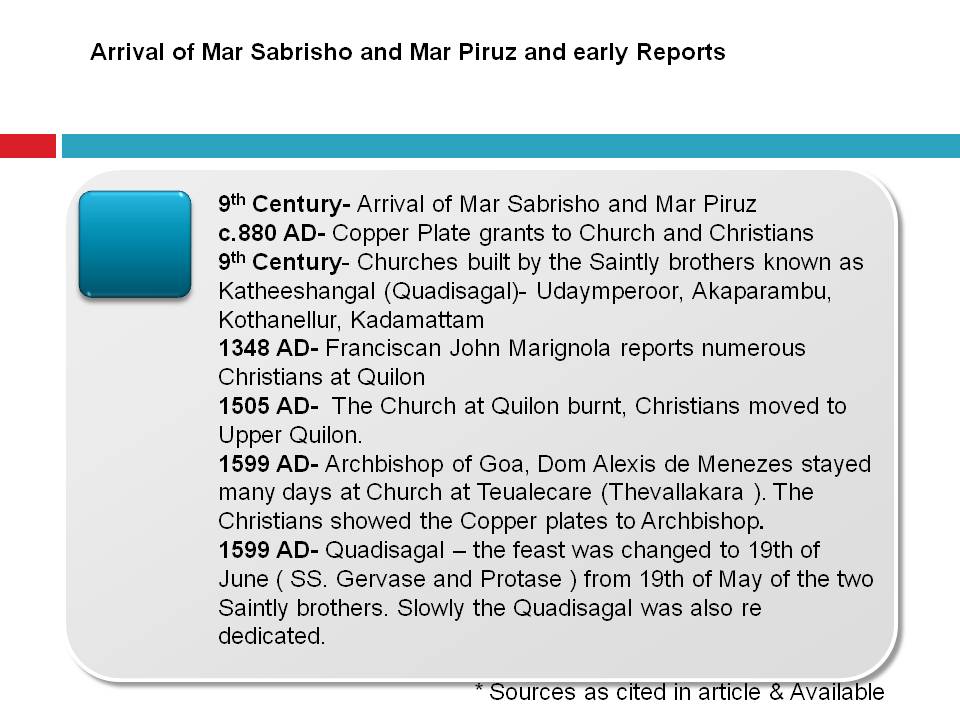
Most of the Portuguese accounts of Sixteenth Century mentions about the existence of Christian community before the arrival of Mar Sabrisho and Mar Piruz in Quilon. The spellings of the names of these Prelates are written differently such as Mar Sabrisho and Mar Piruz, Mar Sapor and Mar Prodh, Mar Xabro and Mar Prodh etc. The name which appears in the Copper plate granted in AD 880 is Marvan- Sapir-Iso. A local Syriac document written in eighteenth century by a Mathew, states that the Bishops Mar Sapor and Mar Parut (Piruz) came with the illustrious Sabr’isho to India. It is not clear if Sabr’isho was a merchant or one of the names used for the two saintly brothers.
This article analysis the 1) Earliest Reports about these Bishops, 2)About the name of these two Saintly brothers, 3) About the year of arrival4) Copper Plates granted in AD 880, 5) Katheeshangal (Quadisagal) , 6) About the Christians & Churches at Quilon , 7) Summary
1. Earliest Reports about these Bishops- Two Saintly brothers
| Testimony | Year |
| Bishop Mar Jacob Abuna | 1533 |
| Correa | 1564 |
| Dionysio | 1578 |
| Gouvea | 1604 |
| Bishop Francis Roz | 1604 |
| Mathew ( local document) | 18th century |
1.Bishop Mar Jacob Abuna
The earliest report about these two Bishops seems to be the testimony of the ChaIdean Bishop Mar Jacob Ahuna, in 1533. About 700 years ago, (i.e, in the course of the 9th century), according to Mar Jacob Abuna, two saintly brothers, natives of Armenia, came to Quilon. They went to Cranganore and thence to Ceylon from there. One of them was named Xaor and the other named Aproits. They brought from Ceylon big logs of wood belonging to a temple. They brought these to Quilon and made use of them for building a church in some ground they obtained from the king of the place. The church stood there when Mar Jacob Ahuna gave his testimony in 1533 AD.
2.Correa ( 1564)
According to Correa ( 1564) these two saintly brothers preached and converted many to Christianity. On the seaside there was a stone near where they used to pray. ( This is also mentioned by Castanheda, Barbosa ). They worked many miracles. They died and were buried in Quilon. According to Correa, their remains were still there.
3.Dionysio( 1578)
According to Dionysio ( 1578), he heard from the Christians of St. Thomas that these men came from Babylon. They also belonged to those Christians who had persevered in the faith after their dispersion and confirmed them in the faith. They converted others there by the number of the Christians increased. It was some 800—1000 years previously that that had happened during the time of Dionysio’s testimony. The first church they erected was a church at Quilon.
4.Gouvea ( 1604)
Gouvea ( 1604) connects the so-called Christian dynasty with the prosperity of the Christians which followed the arrival of these two men.
5.Bishop Roz Report ( 1604)
All the accounts and the general tradition of Christians of Saint Thomas mentions the place of arrival of these brothers as Quilon. Only Bishop Francis Roz (1604), Bishop of Angamale alone mentions their first landing place in Malabar as Malianquara (which for him meant “the land or port of Malabar”) which lay in front of Paliport ( North Pallipuram) to the northern side.
According to the oral tradition which Bishop Francis Roz heard among the Christians of St. Thomas, these brothers brought to that place (Malianquara) a big log of wood to build a church. In commemoration of this event the Christians used to assemble there from time to time with their prelates and celebrated Qurbana in great solemnity. According to this testimony, in the time of Mar Joseph, thirty or more years ago, over eighty thousand Christians of Saint Thomas assembled in that place. Bishop Francis Roz seems to be wrong here, as the feast he explains is the commemoration of the landing of Saint Thomas, the apostle at Maliamkara not of the arrival of these saintly brothers. This is clear from the letter of Amador Correia SJ (1564) published in “Documenta Indica”. Only eight thousand people assembled for the commemoration that year and it was not eighty thousand people.
The rest of the story, Bishop Francis Roz connects with Quilon.According to what Roz found in the Chaldean books, two brothers came to Quilon, built there a church and worked some miracles. What these miracles were, was not mentioned in the books. Tradition says thus: The brothers having no money to pay the workers, who had helped them to build the church, used to pay them sand as wages and this turned at once into rice. They built the church near the sea in the 100th year after the foundation of Quilon. Bishop Roz also goes on to speak of the Quilon grant, the Quilon Copper plates and the privileges accorded to the Quilon church by the king of the place.
According to him, this has happened some 679 years ago, as is known from the copper plates which are in the possession of the Tarega or the landlord of Tevalicare (Thevalakkara).
Finally Bishop Roz adds that the bodies of the two brothers lay buried in the church they had built. In some slabs of the tomb there is a writing in letters. The characters appeared to him Abyssinian and not Chaldean or Malabarian.
The Church after it was burned down was rebuilt by the Portuguese and only due to carelessness it go to the Diocese of Cochin. Hence its Vicar called Fr. Gregorio dos Reis put forth claims and levied the revenue for a year. This was what the Christians of Saint Thomas used to received for their church at Upper Quilon after they moved there. But the Bishop of Cochin gave orders that things should be settled as they were before.
The two brothers were popularly known as Quadisagal i.e., saints. Their feast was celebrated on the 19th of May. The Archbishop of Goa, during his visit to Malabar, changed the feast, fixing in its place the feast of SS. Gervase and Protase on the 19th of June according to the Roman calendar. These saints, whose names were similar to those of the said Chaldean brothers, were chosen in order not to displease the Christians.
6.Other References
Le Quien says that “These bishops were Chaldaeans and had come to Quilon soon after its foundation. They were men illustrious for their sanctity, and their memory was held sacred in the Malabar Church. They constructed many churches and, during their lifetime, the Christian religion flourished especially in the kingdom of Diamper.” ((Le Quien ‘Oriens Christianus’))
Le Quien and other historians make mention of them as workers of many miracles and Syrian Christians held them in great veneration. ((De Souza ‘Oriente Conquistado’ Lisbon 1710 II. Conq. I. div. II. para 16))
7.Local documents
A Svriac document written in Malabar at the beginning of the eighteenth century by a certain person named Mathew, recounts the tradition as following,
“In those days and in the days that followed, Syrian Fathers used to come to that town by order of the Catholicos of the East. and govern the diocese of India and Malabar because it was from it that the Syrians used to go to other parts until they were dispersed. Then in the year 823, the Syrian Fathers, Mar Sapor and Mar Parut (Piruz) with the illustrious Sabr’isho came to India and reached Kullam. They went to the king Shakirbirti, and asked from him a piece of land in which they could build a church for themselves and erect a town. He gave them the amount of land they desired, and they built a church and erected town in the district of Kullam, to which Syrian bishops and Metropolitans used to come by order of the Catholicos who sent them.”
2. About the name
| Testimony | Named as |
| Bishop Mar Jacob Abuna | Xaor and Aproits |
| Correa | Apreto and Thor |
| Dionysio | Two saintly men |
| Gouvea | Mar Xabro and Mar Prodh |
| Bishop Francis Roz | Sapor and Aprot |
| Mathew ( local document) | Mar Sapor and Mar Parut (Piruz) with Sabr’isho |
The spelling of both names is uncertain. The Chaldean Bishop Mar Jacob Abuna calls them Xaor and Aproito. Correa writes them as Apreto and Thor. Gouvea, calls them as Mar Xabro and Mar Prodh respectively ( also quoted by Raulin). Bishop Roz writes them as Sapor and Aprot.A local Syriac document written in eighteenth century by certain Mathew states that the Bishops Mar Sapor and Mar Parut (Piruz) came with the illustrious Sabr’isho to India.
The name which appears in the Copper plate grant is Marvan-Sapir- Iso. According to Mingana, it is the Syriac, Marvan Sabr- Isho, which means ” Our Lord Sabrisho”. Mar is the Syriac title of all Bishops and Sabrisho is a very common Syriac name meaning ” Jesus is my hope”. According to Mingana, therfore the name is not Sapor at all and what appears on the Copper plate is Sabrisho and this disposes the doubtfull hpothesis written by Burnelll, Rae and others.
Burnell ( The Indian Antiquary, 1874, P-310 ) mentions that in the charter of the Church, it is said to have been built by one Ishodatavirai. According to Mingana, the proper name is the well known Syriac name ” Isho dad” which is formed of a Syriac and Persian compunded meaning, ” Jesus gace” or ” Jesu-datus”.
Sapur and Pheroz are also Persian names. In the official list of the Persian dioceses, there was a Bishop of Pheroz and Sapur, holding the fourth rank in the East Syrian hierarchy. (( BO, Assemani II, p.49))
3. About the year of arrival
| Testimony | Year of Arrival |
| According to Malabar tradition | c.823 |
| Quilon Copper Plates | Granted in the year c.880 |
| Bishop Mar Jacob Abuna | c.833 ( 700 years before 1533) |
| Dionysio | c.778 (800 or 900 years before 1578) |
| Gouvea | c.780 |
| Bishop Francis Roz | c.925 ( 679 years before 1604) |
| Mathew ( local document) | c.823 |
Malabar tradition assigns the year 823. According to the Chaldean Bishop Mar Jacob Abuna some 700 years before 1533. Dionysio says 800 or 900 years before 1578, Goueva puts the year as 780. According to Bishop Franicis Roz 679 years before 1604.
Assemani believes that they were sent to India by the Chaldean Patriarch in about 992 AD. Le Quien ‘Oriens Christianus’ Paris 1740 col. 1275 gives the year 880
4. Quilon Copper Plates
There are five copper plates still in existence which contain the record of grants made to the Christians and others of Quilon. The first set of plates is dated the fifth year of Sthanu Ravi. This is dated Ca A.D. 880. The donor King gave certain perquisites and privileges to the Tarisa Church built at Quilon by Sahr’isho. The King gave some lowcast People as servants of the Church and exempted them from paying certain specified rates and taxes. He also gave them the right of entry to the market Any crime committed by these people would be tried by the Church. The Church was given also the administration of customs at Quilon, that is, the steelyard and weights and kappan ( probably the official seal).
A second set of plates were also given by King Ayyan and are of about the same date. The plates contain details of grants to the Tarisa Church, to the Jews, and to the Manigrammam.
Authentication of the Copper plates of Quilon : The Bishop Francis Roz report of 1604 gives some interesting details about an authentication done on the Copper plates of Quilon.
In 1601 October, by order of Dom Franics Ros, Bishop of Angamale, Cassanar ( Kathanar) Etymani copied and authenticated these Copper plates.
According to this testimony, it is said in these Copper plates that the king of Quilon gave to the Church or the Apostles the right over one percent of all things counted, measured or weighted. This is collected for the expenses of the church and also for the seventy-two honors.
The occasion for copying those plates was that the vicar of Quilon of the old Church which then came under the Diocese of Cochin claimed the whole of these revenues for the old church of Quilon. This Church during the time of authentication belonged to the Bishop of Cochin. Saint Thomas Christians, claimed that this was cheating, because from the same plates it is clear that the revenues were given not to the plot or to the walls of the church but to the Christians of Saint Thomas who possessed that church. The Christians of Saint Thomas had left that Church as they had transferred to Upper Quilon where they had a cross earlier.
The reason of the transfer, as is proved with testimonies sworn on the holy gospels, was that when the Portuguese arrived at Quilon, the Christians of Saint Thomas living there recognized them as people of one and the same law as themselves. These Christians saw them making the sign of the cross and so they accepted them. Afterwards the Portuguese had some quarrels with the Moors ( Muslims) , and the King intervened. Six or Seven Portuguese took refuge in the Church of the Christians of Saint Thomas. The King wanted to put the Portuguese to death and so he send a message to the Christians that he had nothing against them, as they are his vassals and that they should leave the church. But they did not want to leave but opted to die with the Portuguese. Hence the king burned the Church down and in it perished that Portuguese and forty Christians of Saint Thomas tighter with a deacon.
It was in these circumstances that the Christians moved to Upper Quilon and built a church there which they have now. And they used to levy the revenues which the said King had granted to the two Armenian brothers for the church they built. Because of the negligence of the Christians this revenue is not fully levied now, as is stated in the said olla. Finally Bishop of Diocese of Cochin, settled the issue ordering the rights to the Church of Christians of Saint Thomas.
5. Katheeshangal (Quadisagal)
The Churches at Quilon (?), Udaymperoor, Akaparambu, Kothanellur, Kadamattam (?) ,Kayamkulam, North Paravur are called as Quadisagal. The feast of these brothers were celerbated in 19th of May, which Menezes changed to 19th of June to that of SS. Gervase and Protase according to the Roman calendar. The Churches which were dedicated to Mar Sabrisho and Mar Piruz were later on re dedicated to All Saints and SS. Gervase and Protase.
6. About the Christians and Churches at Quilon
a) More details about Christians at Quilon from 14 &16th century records
The Franciscan John Marignola of Florence spent fourteen months at Quilon during the period April 1348- August 1349. He then returned to Europe via Mylapore, Ceylon and the Persian Gulf. He has maintained that Saint Thomas Christians ( as he uses) are much more numerous than the Mohammedans. As the Papel legate, he had received large gifts from the Christians. He also mentions that the Christians were the masters of the public weighing office.
In early 1500’s, according to Goes, there were some 2,000 families of these Christians in the whole Kingdom of Quilon. According to Empoli, in the town, itself there were 3000 of them residing around their Church and they were called Nazzareni Christians.
In Cochin, Vasco de Gama ( 1502) was visited by the queen of Quilon who came with the objective of establishing trade relations with the Portuguese. The King of Cochin was not averse to this, the Portuguese accepted the proposal and sent ships to load pepper. It was agreed to send two ships every year to take pepper. A Saint Thomas Christian named Matias ( Mathias) , living in the neighborhood of Quilon has helped the Portuguese in this.
Afonso d Albuquerque who came to India in 1503, made a peace treaty with Quilon, in which among the other things, arrangements were made to begin a factory in Quilon. In the “Commentarios” of Afonso d Albuquerque, it is mentioned that one of the clauses of this treaty was concerned with the judiciary rights of Christians of Quilon. This clause provided that the civil and criminal jurisdiction should be in the hands of the native Christians, as it had been previously. Antonio de Sa, the factor of Quilon was given the charge of exercising this power according to the counsel and advice of native Christians.
Albuquerque further recommend to the factor to provide well for the Church of native Christians which was called “ Our lady of Mercy” which was built according to these Christians miraculously by two saints, buried in two chapels inside the Church. There were three altars in it and three crosses, one of gold on the central altar, the two other of silver each on the other two altars. The Christians offered Albuquerque, the golden cross to be taken to King Manuel but the Captain declined to take it and accepted the silver cross. The Captain told the Christians that Cross would be a sign for the King that there are Christians in these part of India and that King would send ornamentations for the Church as it was customary among the Christians.
When Albuquerque, was about to leave Quilon, the Christians told him about their desire to get from the King of Quilon, all their rights and privileges restored. As noted from the Copper plate, previously the Christians had the right – that is the seal and the weight of the town was in their hands. The King took this right from them because of the fault of one person. Albuquerque answered that nothing for this was provided in the peace treaty and that he entrusted A de Sa, to speak to the sovereign of Quilon in the name of King of Portugal.
There are some documents which indicate that the Portuguese were also using the Church of Saint Thomas Christians at Quilon in 1505. In the same year the Church was burnt by Mohammedans merchants on their plot against their rival Portuguese. They attacked the Portuguese factor at Quilon at a time Portuguese where least prepared and killed the factor who had taken refuge in this Church as the Church was strongly built with stone and tiled roof. The Church was burnt down and the Mohammedans escaped after looting the factory before Portuguese military help came.
According to the information gathered by Bishop Francis Roz a century earlier ( as mentioned in his Report of Serrra 1604), some 40 Saint Thomas Christians and a deacon also perished in the fire. In 1516 a new treaty was signed by Quilon and Portuguese. This treaty besides ratifying the old judicial rights also made a provision that the church burnt down by the Mohammedans should be rebuilt at the expense of Queen of Portugal at her cost, in the original dimensions where the church stood. In 1520, the treaty was renewed and one of its clause stipulated that the queen should grant to the churches of the Christians, the rents and grants which had been formerly given to them. It appears from the second treaty that the burnt church was restored between 1516 and 1520 in accordance with the treaty of 1516.
In the Sixteenth century Jornada (1599) of Dom Alexis de Menezes, the Arch Bishop of Goa, the Portuguese historian Antonio de Gouvea mentions about the Olas of Copper sheets the Christians of Quilon showed him. Alexis de Menezes stayed many days at the Church at Teualecare (Thevallakara ).
b) More details about Churches at Quilon from 16th century records
It is difficult to make out from these Portuguese accounts on where exactly the first church of the community stood in Quilon.
In 14th century, there are references about two churches in Quilon, one dedicated to Saint Thomas ( was also called Our Lady of Mercy is some documents of sixteenth century) , likely that founded or rebuilt by the two Persian Bishops. The other of Saint George is known to have built by Friar Jordan Catalani. Though originally built for Latin use, this was taken over by the Syrians.
It is not certain that the Church, which was burnt by Mohammedans ( 1505) and rebuilt by Portuguese ( according to the treaty of 1516) was returned to Saint Thomas Christians or was used by Portuguese. It seems that this old Church where the saintly brothers were buried were used by Portuguese later and then went to Diocese of Cochin. In 1604, Bishop Franics Roz – Angamali diocese had under him, the new Church the Christians of Saint Thomas built at Upper Quilon, after the burning down of the old Church in 1505. The old Church which the Portuguese rebuilt was not under the jurisdiction of Bishop Roz, but was under the Bishop of Cochin, who had hardly any Saint Thomas Christians under him. This old Church is said to have taken by sea later.
One group of Portuguese authors maintain that the Church at Quilon was built by Apostle himself ( Barbosa, Castanheda, Goes, Barros) and another group says it was built by the two saintly brothers. (Abuna, Correa, Dionysio, Roz, Gouvea).
7. Summary
a) Reports about these Saintly brothers
| Testimony | Year | Named as | Year of Arrival |
| Bishop Mar Jacob Abuna | 1533 | Xaor and Aproits | c.833 ( 700 years before 1533) |
| Correa | 1564 | Apreto and Thor | |
| Dionysio | 1578 | Two saintly men | c.778 (800 or 900 years before 1578) |
| Gouvea | 1604 | Mar Xabro and Mar Prodh | c.780 |
| Bishop Francis Roz | 1604 | Sapor and Aprot | c.925 ( 679 years before 1604) |
| Mathew ( local document) | 18th century | Mar Sapor and Mar Parut (Piruz) with Sabr’isho | c.823 |
b) Reports about Christians at Quilon
| Reported by | Year | Gist of the report |
| Barbosa, Castanheda, Goes, Barros | 16th century | Church at Quilon built by Apostle Thomas |
| Abuna, Correa, Dionysio, Roz, Gouvea | 16th century | Church at Quilon built or rebuilt by two Saintly brothers, Mar Sabrisho and Mar Piruz in 9th century |
| Correa,Castanheda, Barbosa | 1564 | Existence of Christians at Quilon before the arrival of two Saintly brothers. |
| Mar Abuna and others | 1533 | Arrival of Mar Sabrisho and Mar Piruz in Quilon in 9th century. |
| Tradition | Churches built by the Saintly brothers known as Katheeshangal (Quadisagal)– Quilon (?),Udaymperoor, Akaparambu, Kothanellur, Kadamattam(?), North Paravur, Kayamkulam | |
| Many | c.880 | Copper Plate grants to Church and Christians in 9th century |
| Franciscan John Marignola | 1348 | Numerous Christians at Quilon and they are masters of the public weighing office |
| Portuguese Records | 1502 | Vasco de Gama agreement to load two ships of pepper every year from Quilon. Thomas Christian Mathias helped in this. |
| Afonso d Albuquerque | 1503 | Civil and criminal jurisdiction concerning them in the hands of the native Christians. Recommendation for the care of Church where the saintly brothers are buried. Silver Cross as gift to Portuguese King from Quilon. |
| Bishop Roz and other Portuguese Reports | 1505 | Church at Quilon burnt by Mohammedan merchants |
| Bishop Roz and other Portuguese Reports | 1516-20 | Church burnt was restored but used by Portuguese and gradually came under the Bishop of Cochin |
| Bishop Roz and other Portuguese Reports | ? | Thomas Christians moved to Upper Quilon and built a Church there. |
| Antonio de Gouvea | 1599 | Archbishop of Goa, Dom Alexis de Menezes stayed many days at Church at Teualecare (Thevallakara ). The Christians showed the Copper plates to Archbishop. |
| Synod of Diamper Records, Bishop Francis Roz | 1599 | Quadisagal – the feast was changed to 19th of June ( SS. Gervase and Protase ) from 19th of May of the two Saintly brothers. Slowly the Quadisagal was also re dedicated. |
| Bishop Roz and other Portuguese Reports | 1601 | Authentication of the Copper plates of Quilon due to a conflict between Thomas Christians at Quilon and the Vicar of their old Church which then came under the Diocese of Cochin. |
Note about the sources–
- Mundadan- ” Saint Thomas Christians 1498-1552″
- Mundadan-” Sixteenth Century Traditions of Saint Thomas Christians”
- Schurhammer ( 1934)
- Nedugant – “ Syond of Diamper Revisited”, Rome
- Mingana -“Early Spread of Christianity in India”
- Bishop Francis Roz Report- British Museum Manuscript BS Add MS 9853 titled “Report from Serra ( 1603/1604)” – Relacao da Serra – by the first latin prelate of Angamali.
Portuguese Records published in full
- Dr. Silva Rego – “ Antonio da, Historia das Missoes do padroado Portugues do Oriente, India Vol I ( 1500-1542)”
- Anonio da- “Documentacao para a Historia da Missoes do Padroado Portugues do Oriente”, India 12 Volumes ( 1947)
- Wicki Joseph SJ- “ Documenta Indica “ 7 Volumes, Rome ( 1948)
- Schurhammer SJ “ Franz Xaver, Sein Leben und seine Zeit” “ Die Zeitgenesischen Quellen zur Geschichte “ “ Epistolae S Francisci Xaverii” “ Historia seraphica da Ordem dos Frades Menores des “.
________________________________________________________________________________
Author can be reached on admin at nasrani dot net
Last revised- Dec 26th 2009.
________________________________________________________________________________
Can you include more on ramban pattu and veeradan pattu.
thanks
This article mentions about Kayamkulam Church which is founded by the saintly Sapor and Proth.
What are the other churches in “Kandeesangal’ ? I heard about the church in Udeymperoor and in Kadamattam. Is there any church which exist in the orginal name of Kandeesangal ?
I read that after Portuguese accused the Malabar church of heresy all the Kandeesangal has been renamed and re dedicted either in the name of All Saints or in the name of brotherly Italian saints among the Chaldaea Catholics. Does Jacboties also did the same thing ?
To: Felix Thomas
The “Kandeesangal”known in Jacobite church as Mar sapor ,Mar Afroth.
The Akapparampu Jacobite Church is named after them. It is a very old church.(A.D 825)
The Angamali Jacobite syrian church is also in their name.
Mar sapor’s tomp is in Marthamariam Orthodox church ,Tevalakara.
The Jacobite consider them as their own saints and believe that they came from the Persian branch of Jacobite Church. There is another story which says Mar Sabor is the guru of Kadamattattu kattanar .Most historians believe that they were Nestorian Christians.
Their is a church under Syro-Malabar Church in Kothanallor . The church’s name is Gerwasis Porthasis Church. The church is known in the locality as Kandeesangal Church.
Are they another name for kandesangal?
Could anybody provide more information in this regards?
Hi,
I’m interested in knowing more about St. Theresa’s Church. How does it look? Has it retained its old architecture? Is this Church currently administered by the Orthodox, the Syro-Malabar Catholics, or the Syro-Malankara Catholics, or the Church of the East?
And the same about the Church in Thevalakkara where Mar Sabor is buried. If the tomb of Mar Sabor is located there, can’t we get some understanding of who he was from the tomb? What does it look like? Are there any facets of the Church that point to an ancient Jacobite or Nestorian connection for Mar Sabor?
Finally, I’ve read statements stating that “Sabarimala” is supposed to mean Mar Sabor’s Mountain. Now, I don’t put too much stock in this, but I’m curious … is there any evidence for this? Did he establish any sort of “ashram” there?
Is their any conclusive knowledge on who that Metropolitan of Edessa was that supposedly sent Thomas of Cana to Kerala?
If I’m not mistaken his name was Mar Joseph or Uraha/Urafa. Well, does any sect maintain records on this? I see pictures of Mar Joseph on Knanaya sites — is that picture a relic of their past, or is it a recent invention?
Finally, if Mar Joseph came to Kerala (I think the legends say he accompanied Thoma), where was he buried. Does the tomb exist?
I had asked about ancient Christian graves and got some credible retorts saying that it is unreasonable to expect to find them because our ancestors might not have been so grave-crazy as our Semetic brothers… Well, Thoma of Cana and Mar Joseph were Semites, or at least were of Semetic cultural heritage … they must have wanted a grave… And since Thoma was the supposed father of the Knanaya — wouldn’t they, in their reverence, maintain the grave? So … where is it!?
Kothanalloor church was also established by Mar Sapir and Afroth, the east syrian twin saints. During the synod of diamper, the Portuguese banned using kantheesangal’s name for churches as they could not accept them as saints. As the syrian catholics were so attached to kantheesangal’s name, they introduced another twin saints from milan- St garvasees and St Prothasis as Kantheesangal. They renamed all Kantheesangal’s church under the Pazhayacoor community as either all saints ( eg. Synod of Diamper church )or St garvasees and Prothasees church !! (I have read recently that one of these twin saints were identical twins and the other not ).
Actually, Garvasees and prothasees are not the real kantheesangals of the nasranis.( katheesangals means twin saints ??) They were imposed by the Portuguese. They were not Jacobites also. They were from persian church which was established by St Thomas the Apostle. ( Jacobite church- Antiochian church was established by St Peter and they have no connection with St Thomas.
I think it is high time to rename the Kothanallor church and the Synod of Diamper church at Udayamperoor back on Mar sapir and Mar Afroth, the real Kantheesangal !!
Dear John / Thomas
St. Theresa’s Church is Orthodox church and it is believed as the resting place of these two pious saints. They had played a major role of revival of Christianity in Malabar coast. It is Mar Sabir who built the quilon port.
Most of the Kantheesangal’s are under Syro Malabar. During the synod of Diampor Arch Bishop Menezis accused these two saints of heresy and successfully renamed the churches as Thomas mentioned. There were no evidences to link these two saints to heresy or for making these kind of accusations. The attitude of Menezis was in lines with their approach of stopping the link Christians of this shore had with East Syrians. You might be surprised to learn that even St. Francis Xavier wrote about the importance of Kantheesangal specifically talking about a Church at Kodungaloor, which is very piously frequented by the Christians of St. Thomas, to be a consolation for these Christians and to increase piety
I join the opinion of Thomas. It is real pity that after this many years these churches are named at Italian saints or either in the name of All Saints. The Church at udayamperoor is important in history and it need priority re dedication. ALL THESE CHURCHES need to to re dedicated to the name of these saints who built it. Will the todays great priests listen to that. Since they know only destruction it might not be sensible to expect them to re dedicated these churches.
Dear John
I cannot give any hints on name of the Bishops who came with Knai. There are no records existing as far as i know . My understadning is the Mar Joseph or Uraha/Urafa is an invention by Knayi Jacobites in later century and the story got great fame and ciruclation among thekumbagoors.
As always printed by many the year of Knai Thomman landing is not AD 345 it is after AD800.
9th century Migration from West Asia to Kollam :
V.V Nagom Aiya in his state manual states “ In 822A.D. two Nestorian Bishops Mar Sapor and Mar Peroz settled in Quilon with a following .Two years later the Malabar Era began (824A.D.) and ws called after Quilon which was undoubtedly the premier city of malabar including Travancore and Cochin”
T.K.VeluPillai in the Travancore State Manual writes, “ Gopinatha Rao who assigns the latter part of the 9th century as the period of the reign bases his conclusions on he assumption that Kollam era was started in the memory of the coming of Maruvan Sobor Iso and a colony of foreign traders .”
T.K.VeluPillai in the Travancore State Manual “tradition says that St.Thomas preached there( in Syria) and in after times a party of Christian immigrants from Syria landed in the neighbourhood of the modern town( Quilon) a place now engulfed in sea just a similar party did at Crangannore ( in 3rd century under Thomas of Cana).Whether they came for purpose of trade or driven to seek shelter from the sword of Mohammed or for other reason cannot now be determined”
M.G.S.Narayan in his paper on Cera_pandya conflict in the 8th – 9th centuries which led to the birth of Venad writes, “ It is not surprising that the Chera king who was contemplating the development of the new harbour town at Kurakeni Kollam welcomed the foreigner and permitted him to settle down at the new harbour site .This was the period when th e Cera-Pandya conflict was developing in the south. Subsequently Vilinjam was retained in the Pandyan sphere of influence while the Vel country with new headquarters at Kurakkeni Kollam became a division of Cera kingdom..The foundation of Kollam in 825A.D. must have coincided with this victory of Cera in the Vel province.Therefore it is easy to understand the anxiety of the cera king to please foreign merchants and settle them at Kollam so that the harbour might grow quickly and compete effectively with Vilinjam further south which had passed under the control of the Pandya.This incident reveals the practical wisdom of the rulers and throws light on the economic –political motivations of men who promoted ideas of religion and culture.
The Syrian Christian merchants who took advantage of the situation were equally clever and resourceful .In the absence of materials for a detailed history ,it is difficult to ascertain whether Mar Sapir Iso was a merchant or a (priest) missionary. Perhaps he was both at the same time ans there was no inherent contradiction between the two roles.
Narayan M.G.S.,writes in Cultural Symbiosis that “ By the time of the Syrian Christian Copper Plates of the 9th century the foreign Christians and the Christians of Kerala had become part and parcel of the local village community.” This means that the migrant Christians did not remain as a separate group but rather they intermarried the Christians of Kerala and accepted the local cultural idioms. “The deity of the Tarsa Chruch was refered to the tevar.An important offering to the tevar was the sacred oil lamp as in the case of contemporary Brahmanical temples ,is an indication to the fact that their conception of religion was shaped by local culture.”
The members of Valiyaveetil family, the root family of Thlasserymanpurathu tharavadu, a migrant Syrian Christian family worked as commanders of Venad kings ,enjoyed the rights and social positions and got lands free of tax as guaranteed by the Tarisapally Chepped given by Venad King . Tharissapalli Chepped promulgated by the ruler entitled them to a fairly large extent of tax free land as well as social position .This family enjoyed authority over civil and criminal affairs .
Tharissapally Copper plates
V.N.Nagom Aiya in Travancore State Manual states , “In the same year(A.D.824)King Sthanu Ravi anxious to secure the pecuniary assistance from Christian merchants in efforts to repel the invasion of Malabar by Rahakas granted the Copper Plate” In this the king gave permission to mar Sapor to transfer to the …church and community at Quilon a piece of the land with near the city with the several families of low caste attached to it…”
TK Velupillai,in his State Manual states, “ Taking the copper plate as a genuine document it is seen that at the time Quilon was a place of great commercial importance.The guilds ,the Ancuvannam, and Manigramam possessed considerable privileges.It was in such a city that the grant conveyed a fresh hold to Christians .The authority of the Church were also invested with power of settling disputes among them and taking disciplinary actions in cases of malfeasance and misfeasance .The headmen of the castes and local governmental authorities were prohibited from in interfering in such matters. These concessions attest the spirit of religious toleration and cosmopolitan sympathy which characterised the acts of the ruling house of Travancore from the earliest times”.
“The grant was made with the consent of two of his chieftains and the members of the Six hundred” who formed the Parliament of the land.”
The copper plate grant made by Ayyan Atikal Thiruvadikal ,the king of venad , to the Tharissa Church was signed and delivered by him from the palace at Quilon.
Rao Bahadur LK Ananthakrishnayyar in his book Anthropology of Syrian Christians writes,“ The second charter was granted in 824AD to Christians of St.Thomas with the sanction of the palace major or commissioner of king Sthanu Ravi ,who is belived to be Cheramman Perumal .It is a legal instrument which confers a plot of land with several families of heathen castes on Mruvan Sabor Iso who transfers the same with due legal formality to the Tharisa church and community.”
“There was a political necessity for giving this remarkable position for the Christian community .At the respective dates of the Christian charter the Perumals had to fortify themselves against external enemies. There were fears of invasions .At such times the Perumals might have been in need of large sums of money either to bribe or fight the invaders and it would not be an improper inference from these facts that the trading foreigners may have satisfied Perumals wishes, and then have secured for themselves a higher standing in the land of their adoption”.
Mundadan A.M. History of Christianity in India states, “In South India any grant of privileges ,perquisites or land made by rulers was usually recorded on copper plates as these were more durable and permanent record than palm leaf strips”
M.G.S.Narayan, Cutural Symbiosis in Kerala , “A plot of land and a few families of settlers ,Tachars(carpenters), Vellalars(apriclturists), Ilavars( toddy tappers),Vannars( washermen) and vaniyars( oil mongers) are handed over to the church this time. It is interesting to note that the same method of handing over families to foreign settlers continued in Kerala in the later periods also ….In the case of the Syrian Church of Kollam also, it was according to the feudal principal ,proprietor of the land and master of settlers on land .The first set of plates clearly states that the governor had relinquished al rights to collect taxes from these settlers on church land .
There follows the stipulation that when market commodities are inspected for fixing customs duty , and when other official work like estimating price etc. are undertaken ,the church people are ot be associated with all such activities. This means that the church is treated as an important institution of the headquarters sharing powers of government on par with the Arunuruvar, Ancuvanam and Manigramam. Only the first item of seventy tow privileges .ie. earth and water on elephant back at the time of marriage , finds mention in the copper plates probably because it was taken for granted that everybody knew what the privileges were. Therefore it may be assumed that the rest of the privileges were also belonging to the same category. The chuch fathers were accorded the same status of military political chiefs of the country and evidently hey were prepared to accept such a position.
The final passage of the second set of plates brings out more clearly the relationship between Mar Sapir Iso , the chuch of Tarsa, Ancuvannam , manigrammam against the backdrop of the newly established city of Kollam. Noteworthy are the different concessions given to the church and the association of the church in government functions in Kollam along with the two mercantile corporations. These furnish an idea as to the organisation and activities of the church outside the field of religion. And the status the churchmen commanded .First they were exempted from one sixtieth duty on incoming articles and also engaged in trade.This is not surprising in a country where temples where engaged in banking and agricultural activities. The church is exempted from payment of slave tax for the slaves they purchased .This goes on to show that slave trade was common in ancient Kerala.
The Hindu temples are known to have been owning and tranfering Pulaya serfs along with land ,indicating that serfdom must have been very common.
The Church was given the custodianship of weights and measures and permitted to enjoy weighing fee These rights were granted earlier and renewed in the second set of copper plates.
This shows the trust native rulers had in the church because these privileges were enjoyed exclusively by the Hindu temple corporations.
Only the first item of the seventy two privileges ie. Earth and water on elephant back at the time of marriage finds mention in the copper plates because it is taken for granted that everybody knew what the privileges were.The Church fathers were accorded status of military – political chiefs of the country and evidently they were ready to accept such a position. Therefore it may be inferred that in the days of Aiyyan Atikal mar Sapir Iso and Christianity was Indianised to a large extent.Therefore the new west Asian migrant community must have given up their foreign practises.
Adv.TK VeluPillai, State manual writes, The kings of venad were excersising authority in such distant places like Chenagannur, Thiruvalla, Udeyamperoor and Punjar”.This might be a reason why the migrant familes recived special privileges from the local rulers of these regions when they migrated to these places in later times.
The three sets of signatures represented Jewish, Arabic and Persian groups respectively and it is possible that they included Jews, Muslims , Christians respectively as indicated by their personal names. This is again proof of the harmonious and peaceful coexistence of different creeds in anceient kerala.
Mar Sabore and Mar Proth
“In 822AD another set of migrants under Mar Sapor and Mar Peroz , the Nestoran Persians settled in the neighbourhood of Quilon ,they made a deep impression on the rulers of the land .These two immigrants says Dr. Milnae Rae from the historical grounds… are probably the last of the from the mother church in high Asia to South India”.
On both sides of the cross in the altar of Kadamattom Church which is 76cm long and 51cm wide is written in Pahlavi script two sentences and on the centre a small sentence. Pahlavi linguist, Jamshed Modi translated it as follows, “I have come to this nation from Ninevah as a bird. Mar Sapur writes ,the forgiving Misheha( God Jesus) who saved me from persecution”. The language is Persian while the place Nineveh belongs to modern day Iraq which has been under the control of Persian , Mesopotamian and Greek and Roman rulers in different periods of history. This clearly denotes the migrants were from Persian area.
Details about Churches established by Sabariso’s and the miracles he perfomed are found in Thomma parvam which is also called Rambanpaattu .It is said ramban paatu was written after the arrival of Portuguese and the Synod of Diamper as evident from lines 23 and 24 of Thomaparvam or ramban paattu.
The Synod of Diamper proclaimed mar Sabor and Mar Proth as heretics to which Carmelite preist Barnard Thoma kathanar protested and proclaimed the act as a great sin.
As in those times in Persia and Babylon the Nestorian heresy was in vogue these two saints mar Sabor and mar Proth who built many churches in Malankara( Kerala) were considered to be Nestorian heretics .The Synod of Diamper changed the names of the churches named after them as All Saints churches and changes the festivals and prayers and offerings conducted in November 1st in their names as the All Saints festival and offerings. As these two saints Mar Sabor and Mar Proth came from Persia /Babylonia which was under the influence of Nestorian heresy they were considered by the Synod of Diamper as Nestorian Heretics.
Though the invalid Synod of Diamper proclaimed the holy men Mar Sabor and Mar Proth as heretics the Christians of Malankara(Kerala) respected these saints and continued to receive blessings from them .
“According to decisions of Synod of Diamper these saints( Mar Sabor and mar Proth) of Malankara Nazranis were considered as schismatics and the churches the established were wrongly proclaimed to be established by St.Thomas .
The Viswavijnanakosam (Malayalam translation) Vol.3, mentions that “Kadamattokm church was founded by Mar Sabor also called Mar Abo who was a holy man with knowledge of medical sciences and powers to perform miracles established the church in the forest regions of Kadamattom in the 40th year of Kollam Era .He stayed there at first in a small home with a mother and a son .Afterwards he gained the rights of the local ruler of Kadamattom to build a church there .He later made the son of the home the priest of the Kadamattom church .Afterwards he left for Tevalakara and converted to Christianity a Hindu vaidyan family who were traditional ophthalmologists and then established a church there. It is said Mar Abo( Mar Sabor) died in Tevalakara. Mar Sabor is also considered as Marvan Saboriso who got the rights from Venad ruler to build the church at Tarsa .
Caaaptain, Maathews Pathisseril – USA
RE: Mar Sabor and Mar Aphroth
Perhaps the time has come for the Orthodox/Catholic/CoE Churches in India to re-establish various Churches in the name of Mar Sabor and Mar Aproth.
Even if they were from the CoE (and were “Nestorian”) who cares? (1) That is our Nasrani history (i.e., we were, originally, “Nestorians”) (2) The case of Mar Isaac of Nineveh provides a precedent: he (a member of the CoE) is universally held to be a saint by Nestorian and non-Nestorians alike, and his teachings have penetrated all Churches. Even the vigorously anti-Nestorian Coptic Orthodox Church.
can you give us some idea about Mar Isaac.
I agree with your opinion.
John,do we have any data regarding the Nestorian churches in Srilanka,Maldives.It might be possible to
correlate things from that data
RE: Mar Isaac of Nineveh, you can check wikipedia or google — there is plenty of data there. Basically he was a bishop/monk from the Church of the East. Born in Bahrain or Qatar. Very famous for his teachings on ascetism, prayer, etc. The Nestorians, Oriental Orthodox and the Eastern Orthodox all hold him to be a saint; I believe the Roman Catholics do as well. This is despite his belonging to the “Nestorian” Church! (Although some Jacobite authors tried to claim that Mar Isaac was a Jacobite — this is false and unhistorical).
As far as I know the only info we have on the Nestorian Churches of Sri Lanka, etc., are (1) reports of Cosmas Indicopleatus, and (2) the reports of various Muslim travelers. A Persian cross was also found there, apparently (as well as in Pakistan).
There is a book titled “Nestorian Missionary Enterprise” which talks about the presence of Nestorian Churches all throughout India, and not just in Kerala. Apparently many of the major Indian cities has Nestorian Churches/Monasteries (e.g., Kalyan, Patna, etc.). I’d have to dig that book up again to get you exact info.
Hi,
Mar Abo came from Middle East on invitation of Kollam King kuleshakara as an Authority for the Doctrine of Trinity on the Background of a pentecostal shivate Revival (focusing only the Holy spirit) of Advaida vedanta propounded by Adi shankara and were also instrumental in developing christian faith as an independent Religion.
Mar abo, who is taking his eternal rest in Thevalakara marthamariam church located at Kollam(Telephone Nos:+91 476 2875700,+91 98461 73403) . This St. Thomas Traditional Vedic church, which was renewed in Truth &spirit in 4th century, was built by Mar Sabor with orthodox canon, Liturgy and Rite after receiving the Tarsish-a-pali sasanam ,the earliest Historically available official sanction to built a place of worship in Kerala)
I belongs to this Marthamariam Orthodox Church,Thevalakkara, India-Pin Code 690524 and I wish to invite all of you in the Name of Mar Abo to this Church.
As of now we are preparing the History of this church and about Mar Abo who blessed and living with us in the Name of Jesus.Please help us to collect the more details,hope all of you can send mails to my mail ID [email protected] regarding Mar Abo and his family details or Marthamariam Church (St.Mary’s Orthodox Syrian Church,Thevalakkara.You can have a view of Mar Abo’s photo at this point of time in the web site http://www.stmarysorthodoxsyrianchurch-thevalakkara.in/9 (we will complete this web site soon)
Thanks to all and wishing you all the best.
Regards,
Mathew Vaidyan
Thamaravelil Veedu.
Mynagappally P O
Kollam – 690519
Telephone :+91 98461 73403
Hi,
You can have a view of Mar Abo’s photo at this point of time in the web site http://www.stmarysorthodoxsyrianchurch-thevalakkara.in (we will complete this web site soon)
Hi Mathew Vaidyan
Any evidences you can share for what you mentioned about Mar Abo, Mar Sabrisho etc ? How did the photo came in ?
You might remember seeing many photos of Cana Thommen which are artistic inspirations. I hope this is not like that. Can you share about the background on this ? Any historical documents about Martha Mariam Orthodox Church, Thevalakkara ? Was Martha Mariam Orthodox Church, Thevalakkara in kadheeshangal ?
Hi Eso,
Normally any one have the same doubt,earlier i also have the same doubt.In grace of god we found the (1)Oil painting inside the altara of Kadamattom church (2) Oil paing inside the Akapparampu Orthodox Church (3)In the devotional power one guy advised to an artist and confirmed each component of the picture(the person Name is Babu belongs to Thevalakkara (3) One Muslim girl came to church with his father and started crying once she had a look in the photo of Mar abo and she agreed the same person who blessed in the last night while sleeping.
Travancore state Manuals and Cheped are the main evidences.Most of the evidence get lost ,but still have government documents and Cheped(available in Kerala University,Kottayam seminary.
Regards,
Mathew Vaidyan
RE: Mathew Vaidhyan’s Post # 20236:
This utterly ridiculous post needs to be shot down, and I’m surprised no one else has done so.
To quote: “Mar Abo came from Middle East on invitation of Kollam King kuleshakara as an Authority for the Doctrine of Trinity on the Background of a pentecostal shivate Revival (focusing only the Holy spirit) of Advaida vedanta propounded by Adi shankara and were also instrumental in developing christian faith as an independent Religion.”
Really?!
Perhaps you should find better sources for your “research” — you’re just cut and pasting from the internet with no filter to discriminate the useful knowledge from the BS.
I remember reading this junk a while back from some Pentecostal saleman claiming to be from the Kaliankal family. Does such trite belong on NSC? Not without a fight …
Hi John Mathew,
Please have a look in the below link,and help me to get more details if you can.
http://en.wikipedia.org/wiki/Mar_Sabor_and_Mar_Proth
“St. Theresa’s Church”(Orthodox )located near to the sea shore at Kollam,has retained its old architecture.
Mar abo, his tomb in Thevalakara marthamariam orthodox church located at Kollam is Mar Sabor. This St. Thomas Traditional Vedic church, which was renewed in Truth &spirit in 4th century, was built by Mar Sabor with orthodox canon
Regards,
Mathew Vaidyan
Mathew Vaidyan
Dear All,
After long time am remembering the days spend with you to learn about Mar Sabor and Mar Affroth. Thanks for your patience and support extended to me during the discussions.
Mar Sabor picture is there in the top of Kadamattom pally – Althara (Madbaha)painted ( angadi koot as paint) and still it is there .
If anyone interested to have the pre printed book copy Thevalakkara palliyum parisudha Mar Aboyum – ,please share your mailing address to my Email ID [email protected] , will send the hard copy for your reference,suggestions.
Once again thank you and remembering all of you in prayers.
Regards,
Mathew Vaidyan
Thamaravelil
0091 9846173403
There are many evidences about the influence of syriac Christianity on Hinduism. Many historians suggests that the early Christianity planted by St Thomas the apostle got partly amalgamated with Hinduism for some time and it was the east Syrian missions who revived the Christianity from that. William Darlymple in his video documentary “Doubting Thomas” argues that Thomas the apostle became a daity in south Indian Hindu culture and suggests that “Murugan” is St Thomas. As we can see St Thomas story and Murugan story are closely associated with peacocks etc. We can also see many shivite centres were centres of Syriac Christians also.
But we cannot see any references about a King of Kollam inviting East Syriac missionaries to revive shivism. Definitely, shivism got influence from syriac Christianity.
T P Ealias, in his Doctoral Thesis submitted to the mahatma Gandhi University, (T P Ealias, East Syrian missions to Asia with special reference to Malabar coast from sixth century to sixteenth century AD and its influence on Indian religions and culture, Kerala, India, SEERI) discusses well about the Christian influence of shivism in South India. It seems that the south Indian belief about shiva is different from the north Indian belief which is as a god of destruction. Shiva and Phallic cults are as old as Indus valley civilisation. It was Adi Shankara who lived in Kerala in 7-8 century ad taught the adaitha theory- one God, taking Brahma, Vishnu ans shiva as three parts of it., amalgamating the south Indian Shiva into fatherly Bhrahma and incarnation of God Vishnu. This is clealy Christian influence.
Bhakthi movement of Ramanuja 7/12 century, teachings of Madhva of Canara, South India- 13 century, hymns of “Nayanars” (8 the century-showing a deep sense of sin) etc shows the Christian influence on Hinduism. A L Baham observes “the resemblence of Madhva’s system in 13 century to christinaity is so striking that influence,perhaps through the Syrian churches of Malabar is almost certain” (Basham, The wonder that was India, London 1988, p 333 as cited by T P Ealias.)
The Wikipedia article does not give any reference to what Mathew Vaidyan states. Anyone can put anything in Wikipedia. As Mr Easo says, the historical merit of the picture of Mar Abo is equal to that of the pictures of Thomas Cana, St Thomas the Apostle, Mahabali etc. unless some one can prove that the oil painting was created by some one who lived in that particular period.
knanaya tommen means a merchant and immigrants came malabar is true
same as mar sabor iso and mar proth group immigration is true
who are the people has the photos of knanaya thommen? none of other communites comming to prove excempt knanayas
knanayas are claiming they are orginal people without any mix till now
and we can evaluavate how validity in that
as far as i see i never see any foreign bishop kept relation to knanayas instead they have a good jacobite and orthodox relationship and i dont think they give any special validity toward exisiting knanaya community ..
and i think knanaya could have some other hidden stories to tell
marthomite orthodox or many syrian christian demoniation does mention the arrival of these two immigration reached malabars
and even nazaranes a jewish christians dispersed from jerusalam and seems reached malabar the earliy nazranes and many jewish convertes at the 1 st century among the crowd
but they intermarried mean just the matter that they really didnot practiced endogamy
actually there is no copper plate exist for knanaya thommen groups instead mar sabor iso and mar proth group has this evidence and still exist.
one expert told me that nestorian syle of christianity was more like hindus that they had temple like church and people came to worship that way
there was often been people reaching malabar from soourya armenaia those place reached malabar though arab ship.
people used to say shemil ninum methran vannu means biship often came to malabar from anthioh and conduct holy qurbana. and people used to say that metran was fair like blood on his skin that if we ever touch him can feel blood reddish skin on our fingures and beautiful
many syrian missionarries carried evagalize other and let them joined and mixed with them
so i think more that we connect things oursellves to hinduims we have indian culuture
know that there were also muslim communties exist in malabar and many immigrant intermarried and also converts came and all seems one
i would say we have clear middleastern in both nasranis and muslims mapplias dravidian and some other features among the communites
Dear M Thomas Antony,
Reply to post 20374 of yours dated Dec. 19, 2009……
I see your criticism to Mathew Vaidyan’s post which is another issue. But the comments that you have made to support your arguements are also neither fool-proof. I have some questions for you now.
“William Darlymple in his video documentary “Doubting Thomas” argues that Thomas the apostle became a daity in south Indian Hindu culture and suggests that “Murugan” is St Thomas. As we can see St Thomas story and Murugan story are closely associated with peacocks etc. We can also see many shivite centres were centres of Syriac Christians also.”….. Comment 1
My doubts:
Could u please explain or find the logic behind William Dalrymple’s arguement that St. Thomas is Murugan and/or vice-versa ??? Murugan is not just a south Indian deity/god/deni-god, but also worshipped in other parts of India, including North India and a part of the HIndu religious legends. In other parts of India is called ‘Kartik’ or ‘Kartikeya’. So he is not exclusive to South Indian Hinduism. He is said to be the elder son of Shiva (younger is Ganesha) and also the leader of the army of the Hindu Gods. So he is very well famous in all the country. Now has St. Thomas got anything to do with being the son of Shiva or any such legend ? Is he the leader of any army ? So how much sense does this connection of Thomas and Murugan make ? And what peacock connection were you talking about ? Where in Thomasine Christian history is peacock used in any religious symbol *as of antiquity* ???
And u said “we can see many shaivite centres were centres of Syriac Christianity also”. Do you mean *many* Syriac Christian centres were earlier Shaivite centres or vice-versa ??? Which were/are these ? What is the historical/archaelogical evidence to support this ?
“Definitely, shivism got influence from syriac Christianity.”………. Comment 2
What have you got with you to support this statement so definitely ? The Sangam Literature ? NO. That has nothing to do with Syriac Christianity, except for some writers and historians fantasizing [Ref: Bosco Puthur (ed.), 2003)]. What else ?
Now on T. P. Elias’s Doctoral Thesis submitted to MG University…….. From what I read that whats presented by you:
Sorry, I haven’t read the thesis BUT from what you have presented on the same, I would say it might contain some easily identifiable blunders on observations of Hinduism and Indian religious history. Shiva/Mahesh is worshipped primarily in both South and North Indian cultures as “god of destruction” and YES. Brahma is called the god of creation and Vishnu the god of sustainance. The South Indian version of Hinduism has massive Dravidian contributions and Shiva is/was not a god of the original Aryans or Vedic settlers in India but a god the Dravidians. The Aryans only had Brahman and Vishnu as their prime Gods besides Indra. Shiva was added in later Hinduism when the Vedic religion mixed with the Dravidian religions and gave a third god to look like a Trinity. Therefore Shiva is still a destroyer (from his Dravidian origins, seen ‘more negatively’ in North India) in both North and South Indian Hinduism. Ask any knowledgeable Hindu (not a westerner) and he will tell you this.
“Shiva and Phallic cults are as old as Indus valley civilisation. It was Adi Shankara who lived in Kerala in 7-8 century ad taught the adaitha theory- one God, taking Brahma, Vishnu ans shiva as three parts of it., amalgamating the south Indian Shiva into fatherly Bhrahma and incarnation of God Vishnu. This is clealy Christian influence.”……….. Comment 3
Wrong. Shiva and phallic culture is Dravidian contribution to Hinduism and not that of the later Indo-Aryan Vedic civilization. The already existing Dravidian cultures of Mohenjodaro and Harappa in the Indus Valley and elsewhere in India was destroyed by the incoming Aryan migrants and replaced by the Indus Valley Vedic civilization. So Shiva, Murugan, idol-worship, etc. were additions from the prior Dravidian culture. By the time Adi Shankara was born (7-8 cent. AD), the Aryan-Dravidian mixed culture had formed to give what we call Hinduism, which was/is very very different from the Vedic religion.
And when Hinduism teaches the Trinity to be a part of One God IT IS NOT any Christian influence !!!! It is a concept of the pro-monotheistic Vedic Aryans who believed in One God, before the advent of Christianity or Judaism or Islam. For them Brahma and Vishnu were the main ‘manifestations’ of the One God whom they called (still call) AdiShakti or Parashakti (Most Supreme Being or Power) which was formless and never any idol. They also later worshipped elements of nature as gods, like Indra (rain), Varun (wind), Agnidev (fire), etc… but as again originating from the One Supreme Being or Power.
Do you even know that the so-called Namboothiris in Kerala initially refused to worship Shiva for been an alien ‘god’ ? Ask the elderly Namboothiri priests they might tell u.
So that was a Monotheistic “religion” before Hinduism started to form (Ref: The Vedas). This monotheism later got clouded in Trinitarian concept when Shiva was added and looked like the Christian “Trinity”. For the Aryans there was no concept of destruction (Shiva) originally. Similarly, in Christianity there is no concept of a destroying force in the Trinitarian Godhead. So the early Vedic religion was in common with the roots of Judaism and then Christianity and Islam. So Monotheism is as old as the ancient wise civilizations. Could have being corrupted later as cultures intermingled and idolatory developed.
To a European writer and western mind everything thats monotheistic and Trinitarian looks a Christian contribution. This fallacy is also done by historians and writers who claim its Christianity who brought in the same into Hinduism which is not the case. Do they even know that its clearly written in the Bhagvad Gita, stated by Krishna (an incarnation of Vishnu) that Idol-worship is a sin and condemned ? That the Supreme Being must not be worhipped in any Idol ? So when Krishna was teaching this to Arjun, was he influenced by Christianity which hadn’t even existed then ? No. It was from the Vedic thought.
All literature/philosophy in Hinduism that sounds monotheistic is a manipulation or a wrong co-relation by historians that its Christian. When the Hindu philosophers or teachers were teaching monotheism they were simply going back to the real Vedic teachings and removing the confusions from Hinduism, NOTHING ELSE. Ask any wise person (Brahmin) who has learnt the Vedas. This was from their personal-divine experience and learning, like the Prophets in the OT and NT. The westerners got to learn a lot about India and Vedism and not just recent Hinduism.
Thanks
Dear Mr. Mathew Vaidyan,
“Mar Abo came from Middle East on invitation of Kollam King kuleshakara as an Authority for the Doctrine of Trinity on the Background of a pentecostal shivate Revival (focusing only the Holy spirit) of Advaida vedanta propounded by Adi shankara and were also instrumental in developing christian faith as an independent Religion.”…… Your comment
May I know what are you talking about ??? Please quote your reference for the statement you made (Not wikipedia). Quote scholarly articles, as first-hand sources please. And what is “Pentecostal Shaivite revival” ???? Sounds like an inter-religious conference to me.
If at all I know Christianity has not been an independent religion then that was the case till only about 100 AD or so when it was seen just as another sect of Judaism adhered mainly by Jewish believers in the Messiah and some pagans too. It started developing into a separate religion following the Jewish Council of Jamnia around 90AD wherein the Jewish Sanhedrin disallowed entry into synagogues to all those who believed in Jesus as the Messiah. Till then believers and non-believers were worshipping in the same place. Christianity then officially further separated out as a formal “religion” and developed after 300 AD following Emperor Constantine’s acceptance of Christianity as the official state religion of the Roman empire.
And what did Mar Abo do to make it an “independent religion” ??? There were already *bonafide baptized Christians* here when he arrived. Someone correct me if I’m terribly wrong.
Could you please also explain what is this “St. Thomas traditional Vedic Church” ???? What is “Vedic Church” ??!!! Please quote your sources (historical) that refer to these terms. Thanks.
Hi Thomas Antony,
In the altara of Akapparampu church ,Names mentioned below the Oil painting.”Mar Sabor and Mar Afroth”.
Kadamattom church was built by Mar Sabor and in Persian Cross “Mar Sabor and the Place: Ninaveh” mentioned.
Regards,
Mathew
Dear Jackson,
Thanks for your comments. As you know, history and historical analysis can never be fool proof unless there is strong evidence. History, as modern historiography testifies is based on discursive practices. Historical statements are made possible through explanations and interpretations. (Prof Scaria Zacharia,History/Story, no last words : a response, St Thomas Christians and nambudiris jews and sangam literature- A historical appraisal, Ed bosco Puthur, LRC Publications, 2006) History may change when new evidences emerge.
Your comments about “Murugan”. The name “Murugan” is used only in South India. Murugan may be karthikeyan in Hindu mythology, then why a new name Murugan ? As everyone knows, south Indian religious mythology is like a loose mixture of different legends and stories. These are loosely connected stories. Murugan of South India was appropriated into the Hinduism. William Darlymple ‘s argument is, Thomas was also connected to one of these legendary stories due to the similarity in the story. It is his argument. It may not be true. (I haven’t watched the video recently. So, I cannot comment about it correctly now)
The Ayyappan in Sabarimala in Kerala is also called “Murugan” by Tamils. Shall I repeat your own questions about this story? Was “Ayyappan” son of Shiva ? brother of Ganesa ? a leader of army of Hindu Gods ?
One of the bye products of the temple movement of the Brahminical variety was the appropriation of and incorporation of the local cults and practices into the system of Brahminical religious practices and doctrines. ( Kesavan Veluthathu, The Nambudiri community, A history, B Puthur )Probably that was how, “Ayyappan” and “Murugan” were amalgamated into Hindu legends and “Murugan” was appropriated as son of Shiva. Etc.
I did not say or quote anyone with any suggestion that St Thomas was the son of Shiva. The point is, St Thomas story was also amalgamated into the South Indian Hindu mythology and the Thomas Christianity was a bit mixed with Hinduism which was later revived by East Syrian missions. Historically also there are suggestions about correcting the doctrine of St Thomas Christians by Theophilus AD 345
.
Re. peacock, Murugan story and St Thomas story are connected to Peacocks. Peacock is well connected to the martyrdom story of St Thomas.(Marco Polo)There are ancient St Thomas Crosses with peacocks on either sides. Peacocks are seen on many Syrian Christian rock crosses in Kerala- eg. changanacherry, kuravilangadu etc.
Influence of Syriac Christianity on Hindusim/Shivism
What is your argument ? Is it that there is no influence at all?
Regarding “sangam” literature and “post sangam” literature, K Sadasivan comments that Christian influence in these literary works of the pre Christian era, that too before the arrival of St Thomas to Tamil Nadu, could not be traced, even after a dispassionate study of them. But the Christian influence in the works of the Christian era and the “post sangam” works could not summarily be rejected. Rev Dr G U Pope, P Thomas, Fr Innasi, Arch Bishop Arulappa etc support this theory. Rev Pope says, “ The East and the West have influenced one another in a very real and not yet thoroughly understood way from the earlier times. It is undoubtedly a noteworthy fact that from this Mylappore, on which the eyes of Christiandom have ever rested as the one sacred spot in India of Apostolic labour, comes the oriental book, much of whose teachings is an echo of the sermon on the mount” (Tirukkural, cited by K Sadasivan in St thomas Christians and nambudiris jews……,B Puthur)
A Grant observes “Humility, Charity, and forgiveness of injuries being Christian qualities are not described by Aristotle. Now, these three are everywhere forcibly inculcated by the Tamil moralist. These are themes of his finest verses. So far, then we may call this Tamil poet Christian”
Daivanayagam is another scholar finds Christian influence in Tamil literature.( A comparative study of the Bible, Tirukkural, and saiva siddhantha, Madras 1985 cited in B Puthur- St thomas christians……)
These shows a definite change is seen in literature pre and post arrival of Christianity in Tamil Nadu. That means, there is a control in the study. (compare this with your favourite Syrian Christian DNA analysis where there is no control group) There may be other scholars with other opinions and may have done studies and published papers. Why don’t you bring those into the discussions rather than stamping these arguments as blunders ? Note, T P Elias’s work is a peer reviewed, Doctoral thesis, done in SEERI. Have a look into SEERI’s website and go through their activities, quality of their work, their consultants etc and then say it is a blunder.
Re Trinity, why Sri Sankara had to reform Hinduism? I had discussed here in the past whether trinity was adopted by early Christianity from pagan religion. Trinity was there in the past, but why Sri Sankara had to reform Hinduism with the theory of One God ? As you have suggested, the Hinduism had got polluted with other cultures and sects. Sankara’s revival based on one God theory can be considered as an influence from Christianity in the locality in that era. I did not mean that the concept was invented by Sankara.
Re. your comments about Western writers and Indian writers. We can see the quality from those books itself. None of the western writers, even they are protestants who supported the Jacobite Syrian faction, commented the oath at “Coonan cross oath” was against the Patriarch of Rome. But see what is published about the content of the oath by those “high quality trust worthy Indian” writers of your opinion ?
You said, “So when Krishna was teaching this to Arjun, was he influenced by Christianity which hadn’t even existed then? No. It was from the Vedic thought.” It may be correct, but I may not be that confident in saying that. As I said earlier, history changes when new evidences are available. Several scholars are of the opinion that the Mahabharatha in the present form after going through several recessions is of the 4th or 5th century AD.A number of episodes of Christ’s life, as a king trying to kill the new borne- baby massacre of innocent children, miracles of walking on the water, multiplying food, healing the hunch-backed etc are attributed to the Krishna story also. The parallels are so many that it cannot be brushed aside as mere coincidence. We know for certain that ancient Indian writers even borrowed freely from others without acknowledging. Varaha Mihira who lived in 5-6 th century AD describes Romaka sidhantha or the Roman system where there are calculations based on meridian of Yavanapuri-city of the Greeks-though the sources are neither mentioned nor acknowledged- (T P Elias).
You may want to understand that the ancient Syriac Christianity was not confined to Kerala and its 7 ½ churches. There were so many ancient Syriac Christian churches all over South India and even North India. At one time point, Christianity was a prominent religion in the region and why one would suspect it did not have any influence on the culture?
Dear Thomas Vaidyan,
I have no doubt about the story of Mar Sabor and Mar Afroath. But my question is about the authenticity of the picture. Anyone can make a picture and say that it was Mar Abo. If there is some evidence that this picture was created by someone lived in that period, we can agree that it is real and authentic. You may have seen pictures of St Thomas, Thomas of Kana etc, but are they real ?
Dear Mr. M Thomas,
Thanks for your reply. I do not intend a negative but a constructive debate to learn more. Please take it in that regard. Further debate (if needed) on some notable points….
About Ayyapan: Though it doesnt suit this forum, I would still like to answer u doubts in short. From local Keralite Hindu traditions and legends, Ayyappan *is the son of Shiva* and Vishnu ! Yes, two males. But, yes the female incarnation of Vishnu called ‘Mohini’ is the mother of Ayyappa and Shiva the father. And other details I wont elaborate here. But Ayyapan is hardly known outside South India. Looks like a Dravidan-Aryan addition.
On peacocks on the St. Thomas Persian stone crosses (Nestorian crosses) : WHERE IS THE PEACOCK ??!!! Do you mean the figures on either sides on the top arch ? Those are not Peacocks ! They are just some characteristic figurines of Persian-style art/sculpture. Check other Persian arts, they are just not peacocks atleast. Atleast I havent read any archaeological interpretational data saying so. Well, the Syro-Malabar Church’s Kalyan diocese’s (which I belong to) symbol/logo has a modified version of the Nestorian cross which adds the peacocks to the base of it along with the lotus, to Indianize it. But the *original stone crosses* have NO peacocks….. I would like to learn more about this if Im wrong on this. Check the website below for its technical interpretation.
http://thenazrani.org/cross.htm
On T. P. Elias’s thesis: I’m not criticizing it as an authoritarian peer-reviewer, but just pointing out the additions to be made wrt the details on Hinduism and beliefs he has made, etc. Well, thats another topic and lets leave it for now as we dont need to debate on HInduism and likes here. Peer-reviewed articles are not ultimate scriptures and I understand this, as I myself come from a scientific background. It is always open for corrections and elaborations. Nothing to get defensive about it.
I have also read Bosco Puthur’s book u mentioned as reference atleast 5-6 times and read the debate in that, that indicates Thirukkural has a ‘Christian tone’ to it wrt aspects on virtues, etc. But there is also a criticism to this in the book that it may not be a Christian influence. Atleast it hasn’t been proved so far as the book suggests and u also stated. Again, there are various camps among historians as we know.
“Sankara’s revival based on one God theory can be considered as an influence from Christianity in the locality in that era.” (Your comment)………… What makes you say so ??? Adi Shankaracharya was a scholar or expert in the Vedams and Shastrams at the age of 8 and further commentaries (Bhashyams) by age 16. No where is it said or heard he had a ‘Biblical teaching’ background. That would never have been allowed in the then highly casteist Namboothiri society, rationally !! Its not even possible today in the 21st century unless someone is doing multi-religious degree or something ! When the Vedams themselves teach about the One-ness of God (Note please: the concept of Monotheism is absolutely there is the Vedas), why would one then neglect this source (the primary source for Shankaracharyar’s wisdom and learning) and attribute another source to his monotheistic teachings ? He could have seen and learnt the Christian monotheistic principles too. But the fact that you attribute his monotheistic teachings as influenced by Christianity is just not acceptable to me, especially when I can read about his background and more primary sources of learning.
Thats what I commented as to western historians misunderstanding monotheism in Hinduism (borrowed from the Vedams and original Aryan philosophy) to be borrowed from Christianity. When there is a more ancient source which we can track back to monotheistic concepts (more ancient than Christianity itself), lets accept it that that’s the source for monotheistic ideas in Hinduism (a religion that descends from Vedism). This is where I disagree that the Hindu literature influence with monotheistic overtones is simply *Christian borrowing*. No…. because there is a more ancient source, the Vedams, that teach monotheism, though they got clouded later.
Thats what also influenced Krishna’s teachings on anti-idolatory and dedication to One Supreme Power. So, just by dating the Mahabharata to the ADs doesnt mean Krishna also had Christian influence and Christ was Krishna or vice-versa because of similarity in some legends. The fact that separates Krishna from Jesus is the Passion, death and ressurection of Jesus, a historical event of the 1st cent AD, which has no similarity to any other individual in human history. Atleast not Krishna, AFAIK.
And for additional information. The Mahabharata is NOT dated 4th-5th cent. AD !! It is an historical epic that dates from Vedic time period starting from around 3139 BC (the Mahabharata War era) and the final touches to the *written text* was given till 4th-5th cent AD. The events that happened were actually far far early in the Dwaparyuga on the Vedic timeline. And Krishna’s timeline (thus the timeline for the Bhagvad Gita and teachings to Arjun) were in Dwaparyuga which preceded Kaliyuga. Kaliyuga started in 3102 BC as per calculations by Aryabhatta, the greatest mathematician and astronomer (born in 476 AD). Aryabhatta in his writings has noted these timelines and dates and calculations accurately. And Krishna was definitely born in the Dwaparyuga (approx, 3228 BC) thus, and thus the Gita is ascribed to the era before 3102 BC.
http://vibhanshu.wordpress.com/2009/01/05/timeline-of-mahabharata-3139-bc/
And Jesus was born around 6 or 7 BC. So, do we see any Christian influence to Krishna’s teachings (something that happened more than 3000 yrs before Christ) now or is it the Vedic teaching of pro-Monotheism ??? Okay, thats done I suppose !
And on “high quality Indian writers”: Nah, I think there are very few of them who are unbiased and really historically based. Same goes for western writers. Again, as I said historians have camps. And I dont have favourites. So yes, hope to hear on more debates soon, to learn more. Thanks.
Jackson
RE: peacocks, etc.
I don’t think we can take the peacock as proof of anything. West Asian art (e.g., the illuminated Rabula Gospels) definitely has peacocks on it (search online for examples). The Romans and Greeks also used peacocks on some images (Christian and pagan).
Regarding Christian influence on Indian culture. I think we have to do some more work on this because I don’t think there are any examples of Christian influence on Indian culture whether in Kerala or elsewhere. The hypotheses presented by various Indian Christian authors are just that — debatable hypotheses by sloppy, overenthusiastic cheerleaders.
It does seem that East Syriac Christianity was spread across India, based on some sparse references by East Syriac patriarchs. However, at the same time, we can’t take the premise that “Syriac Christianity was a formidable philosophical force” as an axiom and then say that there *must* be influence exerted by Christianity on Indian civilization. Why? Because the premise is not an axiom, not at this point in time at least. We have no evidence that Syriac Christianity was anything more than merely *present* in India. You can’t say that A is true hence B(A) is true — without first proving that A is true.
Zoroastrians were in India for a thousand years; did they influence Indian culture and civilization?
For example, an equally valid argument is that:
a. There doesn’t seem to be any mention of Syriac Christians (or any Christians or Jews) in Indian religious and/or philosophical literature.
Hence:
b(a). The claim that Syriac Christianity had an ancient significant presence in India is bogus.
I think it is highly significant that Adi Shankara never made any mention of Syriac Christianity, but rather addresses and responds to Buddhism and Buddhistic ideas. Yes, I’ve read Menacherry’s hallucination about the white dress of South Indian brahmins indicating that there was influence. Please! That argument is so weak that it warrants a retraction of his Ph.D. What sloppiness. What intellectual bankruptcy. If Syriac Christianity was a force in Kerala, then there must have been *some* mention of it.
Perhaps our ancestors were just a bunch of wordly immigrants and sons of immigrants back in those times, focusing more on our impure commercial ventures. Which is exactly how the Portuguese found our people several centuries into the future: a barely Christian people. So perhaps the Hindus don’t mention us because we simply didn’t present an intellectually sophisticated philosophy that could stand on the same footing as their beliefs. We weren’t competitors … just tolerated foreigners and half-breeds.
That’s my personal theory at least….
(As further evidence of how our people likely were back in the old days … we can look at the people who descend from the latest Syriac immigrations: the descendants of Mor Sabor and Mor Aphroth’s immigration — the people of Thevalakkara. I think I read about them in Jornada — they were mainly consumed with their own commercial ventures and business than in maintaining their religion.)
A useful link,
pbs
Dear All,
A VERY MERRY CHRISTMAS AND A HAPPY AND PROSPEROUS NEW YEAR TO ALL.
About Ayyappan and Murugan, all I am saying is those were Dravidian deities amalgamated to Hinduism appropriated to some known Hindu deities. Similarly, Thomasine Christianity might have got amalgamated to Hinduism also which might have created some similarities in legendary stories. Thomas and peacocks are strongly related. I have explained this below. Murugan is also related to Peacock. We do not know, since when the word Murugan existed ? If Murugan existed before Thomas, then still there would have been some mix up to identify Thomas with peacocks. I cannot remember how Darlynmple connected Murugan to Thomas. I cannot locate the video of William Darlymple in my archives to tell you exactly what he argues. I will come back with more information.
ST THOMAS CROSS AND PEACOCKS
The Persian Cross at Kottayam valiya palli shows two peacocks on either side on the top. I think part of it is not seen outside now due to erection of decorations but seen in old pictures. There is another cross with peacocks on either side is also seen in Santhome Chennai . Both these crosses are shown in the following link.
http://www.stthoma.com/museum/Sculptures/sculptures_carvings.php
In Kottayam Valiyapalli itself, there is a large granite arch at midway. In front of that arch, we can see two peacocks on either side of a cross on the right side and two elephants on either side of a cross on the left side.
As I have mentioned already, many granite Crosses of St Thomas Christian churches shows peacocks encrypted on it.
St. THOMAS AND PEACOCKS
The legendary story of martyrdom of St Thomas is also connected to Peacocks. There are three ancient accounts.
1 Marco Polo (AD 1293)describes it like this. St Thomas was praying outside his hermitage and around him, many peacocks which are plenty in that area. One of the idolators of that country being of the lineage of those called Govi shot an narrow on peacocks and it accidentally struck on the apostle on the right side and he died of the wound sweetly addressing the God.( Yule’s marcompolo pp 278 , 290, 291 cited in Apostle Thomas, A E Medleycot. )
2 John Marignolli (AD 1349) reports in another way. Apostle cut a tree in Ceylon and put it in the sea and ordered it to go to Mailapore where he wanted it to build a church. The tree arrived on the shore. The king and his army tried to move but they couldn’t. Then Thomas appeared riding on an ass, wearing a mantle of peacock feathers and claimed the tree and he could easily move the tree and the King became converted on this miracle. He was given enough land by the king to build the church. In the day, he builds church and night, retires where there are many peacocks where he was shot accidentally on the right side-similar to the wound of the Lord where he put his hand-( cited in Apostle Thomas, A E Medleycott)
3 Duarte Barbosa (AD1518)also mentions about peacocks in connection to the Apostle’s martyrdom. Barbosa narrates that St Thomas assuming the appearance of a peacock after being pierced by the arrow, raising into air and then turning into human form and falling to the ground. (An Account Of The Countries Bordering On The Indian Ocean And Their Inhabitants, Duarte Barbosa, 1518AD)
ANCIENT CHRISTIANITY IN INDIA WAS ALL INDIA, NOT JUST IN MALABAR.
Cosmas Indicapleustes- Topography Book III
Hambye translates from Greek and interpret the following
Cosmas speaks about three different communities in the west cost of India-
Ceylon- Persian merchants with a priest and a deacon
Malabar- had a Bishop
Kalliana near Bombay with a Bishop
(Hambye E R, Some fresh documents on medieval Christianity in India, Indian church history review 3, 1969)
According to Mingana, in the original text of Cosmas, he says about taprobane, male and calliana and the rest of India, the words rest of the India means there were Christians in the rest of India also.( Mingana, early spread of Christianity)
Fr Hosten ( Antiquities from San Thomae and Mylappore 1936) “there appears to have existed in the pre Portuguese India an unbroken line of Christian settlements from Sind down to cape comorin and mylapore. Sindu, orrhotha(Surath), Kalliana, Sibor, and the five marts of male the pepper country, parti, Manguruth(Mangalore), salopatana, Nalopatana, Pudupatana, also away from Sieldiba(Ceylon),Marollo and Kaber(kaveripatanam)”
Duarte Barbosa narrates about a church –Thomay palli-at Muttam near Cape Comorin-at this Cape Comory, ancient church of Christians which was founded by the Armenians and perform the divine services of the Christians, and has crosses on the altar.
There is a stone inscription also in Muttam of AD 1494 by the King of Travencore Unni Kerala Thiruvadikal giving tax exemptions and right to tax levy on boats for the benefit of the church.(Travencore archaeological series Vol IV Part II 176-81)
Fr Hosten reports about Christian communities in Thana and Gujarat according to Jordan catalane of severac.- Thana, Sopara,(sofala), and the third and the largest in Broach( Parroth).
We have already discussed about the St Thomas Cross at Goa. Fr Mascarenhas reports about a community in Goa called Thomse who are Hindus and their biggest religious festival is in early july according to the moon which has a similar pronunciation as dhukrana.( Mascarehas, St Thomas Christians)
According to Abd en Razzak, who visited India in AD1442, the Prime Minister of Vijayanagar was a Christian Nimeh Pezir. Ancient granite crosses have been found from anekkal etc.(Stewart, missionary enterprises – cited by T P Elias)
Fr. Hosten also reports about ancient Christian communities at c Kaveripattanam, vaipur vembar on the east coast besides Mailapore.
Farquhar hold the view that St Thomas preached in taxilla in sind before coming to Malabar. Mgr. Zaleski also writes about a church in Sind.
Butifilis, a place marked in an old map known as catlan map (AD1375) with an indication of a place in Orissa, as a Christian city with a Christian king called Stephen. The map contains a note-here reigns King Stephen, a Christian. In this land, lies St Thomas. It may be that Mailapore might have been in his kingdom or the author did not know where Mailapore is.(Stewart, Missionary enterprise, cited by T P Elias)
Marco Polo says, in the middle/central India, there were six kingdoms, of which three were ruled by Christian kings. Marco Polo also mentions that St Thomas preached in this region and then went to Malabar where he died where his body lies.( Travels of Marco Polo, 1906)
Cardinal Tisserant reports about Baron Textor de Ravisi who dealt with a mural inscription in a temple in Udaipur of Malwa Kingdom which gives a short account of consecration of a church, summary of the prayers and the names of kings ruled in the area.
Nicolo De Conti who visited India in the first quarter of 5 th century states, “here, the body of St Thomas lies honourably buried in a large and beautiful church; it is venerated by heretics who are called Nestorians, and inhabit this city to the number of a thousand. These Nestorians are scattered over all India as the Jews among us.”( Mingana, early spread of Christianity)
Assemani quotes Osorius and Jarricus about numerous Nestorian communities on the river Ganges in the central and east India.( Mingana)
Le Quinn (Orient Christianus, vol ii AD1273) quotes Ludovicus Gusmanus says that there were hundreds and thousands of Christians India spread among different kingdoms with their own Arch Bishop, Bishops and priests.( Abraham, Indian church)
Hambye reports about rock inscriptions in Kashmir near tenkse, on the eastern side of Leh, about Syriac Christian settlement in around 800 AD( Hambye E R, Some early Evidence concerning early and medieval Christianity in India, Indian Ecclesiastical review, 3, 1963, cited by T P Elias)
Christian influence
Uighur script as official language of Mongol empire denotes the cultural influence of Christianity in the region as Uighur script is similar to syriac script. Scholars are of the opinion that Uighur characters directly depended on syriac characters especially on the east syriac style. They regard this as the result of east Syrian church missionary activities in the region.(T P Elias)
Aramaic edicts of Asoka confirm the influence of Aramaic language and presence of east Syriac Christians in India.
Monogamy- in India- is it not Christian influence?
Indian culture followed polygamy from time immemorial. The concept of monogamy permeated after advent of Christianity in India. (T P Elias). We can see Portuguese influence in Christian and non Christian communities in Malabar in many aspects- P J Tomy’s article.
Re Sankara’s revival. Why did Sankara had to revive Hinduism ? Sankara realised the decay of the religion and the practice of worshipping many different Gods due to assimilation of deities of different cultures and tribes in India, when comparing the practices of the local Christians who have only one God. The Christian influence opened his eyes. The Hindus were happily practicing their religion. This is a possibility. Noone can confirm this was the reason. Even today, we can see Christian influence in Hindus. In my village in kuttanadu, some of the Nairs used to do animal sacrifices. This was gradually abolished by Christian influence. Still, I remember from my childhood period, sacrifice of birds is still practiced secretly in my village during the night.
My brother did some project work in Bhopal and he told me about the marriage ceremony of Hindus there with Muslim influence. Hindu religion and culture has accepted many things from other religions. It is a tolerant and accepting religion, as we all perceived well.
Re. Krishna’s teachings. You have agreed that the “final touches to the *written text* was given till 4th-5th cent AD”. Whatever Krishna taught in the past, whatever was the culture in 3000 BC, what is available now is the written text. The written text was finalized in 4-5 century AD which may have influence from Christianity. That is why, T P Elias commented about the similarities, “the parallels are so many that it cannot be brushed aside as mere coincidence.
I have read somewhere that the evolution of Sikh religion also has some Christian influence-especially, Thomasine Christianity. I do not remember it well now.
I agree with all of you, we need more studies. T P Elias himself comments, “the extent of this influence is not sufficiently probed”.
i m not aganist for anything. but i am just sharing some thoughts from an elder
he is also connecting things to hinduism to biblical lands or something that he is saying if he observed there are all same to him
more than we connecting things to west asia means it a j2 place semitic maker
jewish land ..he give importance to mesopotamia central asia
even christian immigration mentioning mesopotamian christians came to malabar
he is starting thing from abraham from central asia and his father therah similar 13 in hindi
genisis 10.its mentioning abut askenazi generations even before abraham all happening in central asia
so we feel biblical toward hinudism like jewish like culture we may notice can all start out from central asia.
even except abraham his father and ancient practice was idol worship and idol making than we think musiim is only in middleast
he is saying read old testment well
know that jewish ratham is simlar to hindu ratham rounding
he is saying yedhu krishnan means its mentioning yehudha something
so brahimns or some central asian moved to india could have connected to noah link
or brahimns from neftali tribe that they had smilar tradtion of making samagamana koodaram and how a hindu temple shoud be like
or if we read old testment exodus the yehowah telling how to make the worship place and rituals if we read may be similar to hinudism or i may say it more closer than anything else left
the abraham the central asian man moved to west asia and 12 tribe and arabs generation then only orginated from west asia
we may connect jewish and hindu people or priest only eating allowed food that all these i m saying there totall have some similarites each other from west asia , central asia to india culutre
but we cannot compare thing to hinduism to sryic christianity the accound of syrian missonaries syrian east/ west rite immigration, jewsh converts, immigrant and some hindus or local joined christianity
these are i m just sharing or presenting some ideas and i m not aruging at all
Dear Antony:
You’ve brought up some interesting points that ought to be investigated further — especially with respect to the unbroken line of Christian settlements from Sindh to Malabar. I understand that places like Patna, Kaylan, Ceylon, Goa, Mylapore and Malabar had settlements, but I never read about what you reference (continuous settlement) — an obvious gap in my knowledge that I need to address.
But some of what you wrote is a little (if not very) iffy. I realize that you’re referencing other sources and/or works, so please don’t take this personally.
For example:
1) “Aramaic edicts of Asoka confirm the influence of Aramaic language and presence of east Syriac Christians in India.”
This means absolutely nothing. Asoka’s use of Aramaic predates Christianity! Aramaic was nothing other than an Imperial language. There is absolutely nothing surprising that Asoka used it (as well as Greek), since his empire touched on the Western frontiers where India met Persia (which used Aramaic along with their native language as they slowly took over the older pre-Persian Aramaic-using empires) and Greece. This has nothing to do with Christianity or Syriac Christianity at all, and it annoys me when I read Indian “historians” and Church propagandists citing this as some sort of significant fact. It isn’t.
Especially when the operative religion here is Buddhism, not Christianity (let’s please quit trying to steal other people’s thunder). Asoka, being a Buddhist, was compelled to propagate his religion within and outside his Empire. Hence the used of vernacular languages, and imperial/global ones (Greek, Aramaic).
2) That the Goan Christians observed some sort of Dukrana in July. They may have observed such a Dukrana, but it is anybody’s guess whose Dukrana it is. Thomas you say? No way. The Dukrana of St Thomas is in December in all Churches that maintain the old Oriental traditions. The modern use of July for the celebration of Thomas is nothing other than an innovation of the *Western* (i.e., Latin) rite of the Roman Catholic Church. I’ll leave it up to you to confirm the details, but you’ll see I’m right. The Eastern celebration of Thomas’ martyrdom is in December. The Western rite of the RC also observed December in the oldest traditions of that Church; but when a conflict arose between another Saint’s memorial and Thomas, the Roman Catholic Church moved Thomas’ feast to July and made it a commemoration of the transportation of Thomas’ relics to Edessa. It does not celebrate it’s death in July—it is not a Dukrana.
I’m aware that the Syro-Malabar Church celebrates July as the Dukrana. I’m sure if you talk to the scholars of the Church, they can confirm that this is an error due to the unfortunate influence of (ignorant/insensitive) Latin prelates over the SMC. Perhaps this will be corrected one day so that the Dukrana will be celebrated as a proper Dukrana in December—a memorial of the Saint’s death.
3) Regarding other purported similarities, I don’t know. Elias may say the coincidences can’t be brushed aside, but nothing positive can be said either. There are many elements of various religions that seem similar, and may point to influence; or they may point to independent developments. I think it is still safe to say that despite the geographical distribution of Christians throughout India, and despite our presence for a long time, we have not really contributed much *that can be clearly identified* to the philosophical development of India. We may have been great soldiers, businessmen, agriculturalists, etc., but we were not religious debaters. There may have been recent influence — e.g., in education, the influence of Western Christians (certainly not *us*) in eliminating foolish practices such as human sacrifice, sati, etc — but these were not really due to *us*, but due to the more enlightened Europeans who came and helped India out of some bad trends that had unfortunately developed over the last two millenia. But did *we* do anything? I doubt it. If Adi Shankara was influence by *us* then I’d expect as least a *reference* to our community. Is there such a thing? No.
And another thing — it’s a hard sell to claim that Christian influence stopped animal sacrifice. I’m such those things were stopped by either (1) the various native doctrines of ahimsa that developed via Buddhism, or (2) foreign influence. The native Christians certainly have no positive track record on animal rights, with our wholesale slaughter of animals for various (copious) feast days.
Thanks John,
It was my stupidity to bring Aramaic edicts of Asoka into the discussion. It is out of place as they belong to BC 273-231. I was in a hurry to post a reply as I was working on 25-26 and 27 th. It was my mistake.
I agree with John Mathew. Most of the attempts to establish some kind of Syrian christian contribution to Indian philosophical thought are tenuous and not worth serious consideration.
Even the early western christianity did not have a rigorous philosophical underpinning until the Islamic scholars sort of spurred on the christian thinkers which culminated in the scholasticism in the 11th and 12th centuries with Thomas Aquinas and thomism forming the bedrock. Even then for an outsider Christianity is just another unremarkable personality cult based on myths and dogmas with no profound truths to offer in the absence of any open debates on metaphysics between different schools.
Instead of indulging in free association with all sorts of histories and mythologies we should be striving for an objective history of the SCs. At least for me The golden age of SCs was the last century prior to which we were an insignificant community in the context of the history of Kerala.
RE: Mapilla’s comments
Personally, I don’t think any religion (including Indian ones) can claim to have an advanced philosophical outlook which is uncontaminated by myth and dogma. Christianity’s greatness — in my opinion — stems from its teaching of repentance, forgiveness, etc., and not the various “philosophical” ideas that may have developed over the centuries by various Christians. And that greatness (the ethical side) was well-developed before this scholasticism of the last millenia; Syriac Christianity was a major contributor to that development (of course, it’s doubtful as to whether Indians had any part in that).
Regarding the golden age of the SCs and their significance. The book hasn’t been written on that; every book that’s been written on the topic seems to be drenched in pseudo-scholarship. But just because the SCs did not seem to have an influence on Indian philosophy does not detract from their worth. There are plenty of dead civilizations with grew up and died before having contact with others — their greatness is not diminished by their lack of propagation, at least not in my opinion.
No one knows much about the SCs in the old days. And without such knowledge we can’t claim significance or insignificance.
But from the small glimpses that we do possess (through the lens of the Portuguese, and through other reports, references, etc), it does seem that we were not insignificant at all. Whether we had ideas or great philosophies is only one facet of greatness; there’s also economic and military strength, longeivity, the fact that we preserved our religion *and* lived as brothers (or at least allies) with the Nairs (based on Jornada), etc., that do point to an interesting and significant past.
Did we influence Adi Shankara? Probably not. But who cares? Advaitism is not the last word in terms of philosophical sophistication (not to mention ethics). Perhaps it’s the (hypothetical) Persian in me, but I far prefer the dualistic philosophies…
To say there is little or no philosophical underpinnings in the Syriac liturgy is a misstatement–a gross underestimation of the work of the early (Syriac and Greek) Church Fathers. In this vein, I limit my comments to the ancient St. James Liturgy primarily used by the Oriental Orthodox family of churches, viz. the Malankara Orthodox Syrian Church and the Malankara Syrian Orthodox Church.
What little I know of liturgics and of philosophy, the marriage of these two elements is evident in the liturgy. For example, the Antiochian School and the Alexandrian School richly endowed a metaphysic in the divine liturgy which ran a veil across the holy of holies for the communicant to see the line of separation that exists between the physical world and the world of the departed, the saints, and angelic beings. And this metaphysical presence, whether formalized as Platonic dualism or Advaita clearly pre-dates the Roman scholastics by centuries. Work, however, must be done to determine how, not if, the Indianization of the Syriac liturgy evolved in Malankara-land. Was it simply para-liturgical, as some say, or more? Since the timeline of Hinduism in Kerala during the 9th c AD is still not securely anchored, more needs to be done for us to get a clearer picture of the cross-fertilization of Indic religious ideas with those of Indic-Syriac philosophical doctrine(s).
Clearly, a metaphysics exists…
Renu:
There is *zero* contribution from the Indians to the West Syriac Liturgy of St James. Nothing.
The East Syriacs may have incorporated some Persian elements but nothing Indian is known in that either.
The term “Indic-Syriac” is nonsense.
Now the discussion is turned to influence of Indian culture on syriac liturgy. The Syriac liturgy prevalent in Kerala was an Indianised one.
The West Syriac liturgy was introduced in Kerala only late. Even after the contact with the West Syriac Prelates of the Church of Antioch, the party of Mar Thoma I continued the old East Syriac liturgy until 1773 period(?) . So, it is only 300 years of contact with Indian culture.
Our forefathers- the mother church of all St Thomas Christians -used East Syriac liturgy here for millennia- from the time of the beginning or at least from the time of Bishop David of Basra AD 295)(Chronocles of Seert). Even though the St Thomas Christians were using the East Syriac liturgy, it was adopted to Indian culture and traditions
R H Connolly, in the Journal of theological Studies (Work of Menesis on Malabar liturgy, Journal of Theological studies, 15, p423 1914) argues that the procession to the sanctuary from the bema, when the mysteries of Eucharist had been set on the altar, was not practiced in Malabar probably due to the way of construction of churches in Malabar-without Bema etc. This is an adaptation to the local culture and practices.
The St Thomas Christians used unleavened bread made of rice and a type of crushed grapes instead of wine for the celebration of Eucharist-( Joseph the Indian to Venetians.AD 1504)- local adaptation depending on the availability.
For celebration of Eucharistic mysteries, “malka” was used in the East Syriac liturgy, but “Malka” was never used in Malabar. ( Interview with Arch Bishop Mar Aprem of the Chaldean Syrian Church of Trichur in Sathyadeepam Oct 15, 1997 cited by C Illikkamuri, Inculturation and Syro Malabar Church)
Even the syriac tunes used in Kerala was distinct from what is used in Mesopotemia.( Jose Kochuprambil, How far inculturated is the Syro Malabar liturgy, further possibilities of inculturation- Inculturation and the Syro Malabar Church)
These are pointing towards the fact that we had an Indianised liturgy- Indo Chaldean liturgy. It was not a pure East Syriac liturgy.
On the social life also, St Thomas Christians remained Hindus in culture keeping their Christian faith. I think this was the secret of the fellowship between Hindus and Christians before the arrival of Portuguese. The Portuguese had also commented that these St Thomas Christians are mere Hindus with Christian names. They kept the customs and rituals of the land. This is seen well in the rituals and customs related to marriage, funeral, baptism etc. The observations of sraddham, pula etc. use of thali, kudumi etc., art forms like marggam kali, church architecture, flag staff of the church, church processions- especially the pradakshinam-procession anticlockwise the church like what the Hindus do in their temples, prasadams-distribution of roasted rice, rice flakes and other food as a sacred gift from the deity in the churches as in Hindu temples, use of ornamental umbrellas, elephants, fireworks etc. in the church processions, edvaka yogam, desakkuri etc. in the church administration, fasting, bhajans etc- (the Portuguese had to ban some of the fastings of St Thomas Christians, like the fasting on Mondays by women like the hindus). Jose Kochuparambil, How far inculturated is the Syro Malabar liturgy, further possibilities of inculturation- Inculturation and the Syro Malabar Church )
To John Mathew,
Re Dukhrana on July 3rd, I agree with your argument that July 3rd is not the commemoration of the martyrdom of the apostle but the transfer of the relics to Edessa.But, July 3rd was observed in the past also.
Rev A J Maclean in 1898 refers to an East Syrian calendar from a manuscript dated 1443 which is obviously a copy of an ancient calendar as it describes three great festivals that of St Thomas, St George and St Cyriac and it is July 3 connected to St Thomas. These festivals are those of the primitive martyrs venerated in the East, for only such were entered in the earliest Church Calendars. (A E Medleycott, India and Apostle Thomas) Medleycott continues to say that the feast kept by the Syrian churches is not the festival of the martyrdom, but that of the translation of his Relics to Edessa, and this feast is kept on the 3rd of July the same day as in former times as mentioned in the East Syrian calendar.
The original St Thomas Cross in Mylappore had been reported to have sweated blood on the anniversary of the martyrdom many times after 1558. ( A E Medleycott, Duarte Barbosa etc) and the Roman church and the Syro Malabar church observes this day as miracle of Mar Thoma Sliba on December 18. ( Liturgical Calendar of Syro Malabar Church)
My understanding was that July 3 rd was observed as Dukhrana of St Thomas by the Jacobite and Indian orthodox churches also in Kerala. Is this not correct ?
To Jackson
Re Peacocks and St Thomas Cross.- another account
Incised peacocks appear on one of the Pahlavi inscribed crosses of Kottayam valiyapalli.. There are peacocks on the stone door lintels of several other ancient keralan churches, and the domed shrine discovered by two portuguese travellers in 1517 is supposed to have been decorated with carved plaster peacocks.( Susan Bayley, saints goddesses and kings,muslims and Christians in south Indian society 1700-1900, Cambridge University press, 1989)
Dear Antony:
I understand your points about the indianization of practices, but this is not the liturgy per se. The original poster (Renu) was making a comment on the philosophical sophistication of Syriac Christianity; I would not call it philosophical myself — it is more theological than philosophical — but I agree with the sentiment that Syriac Christianity is not devoid of intellectual merit (to the contrary).
None of what you mentioned really points to Indianization of the liturgy in an intellectual manner. Sure there was possibly a variance in practices from Mesopotamia, but at the end of the day we must admit that there remains no trace of any independent developments in Malabar (if any existed).
The Persians and Central Asians can claim some influence of the Syriac liturgy (ref: Buck); we can’t. Hence, to call the liturgy as “Indo-Syriac” as Renu did, is not accurate at all.
Regarding the Dukrana. Yes, July 3 commemorates the transfer of the relics. It’s questionable as to why the Indians — who hold Thomas to be our father — celebrate this at all!
The Jacobites/Orthodox celebrate the Dukhrana at the proper date of December; you can consult the Syriac Orthodox Church resources website for our calendar; the MOSC must also have an online calendar as well. At any rate, in every Church I’ve attended (Orthodox/Jacobite) the Dukhrana was always held in December and never July.
The ecumenical massacre of the old traditions may be responsible for why *some* of the Puthenkoor keep July 3, but the official date of the Duhkrana (i.e., the death anniversary) is definitely December for the Orthodox/Catholic Churches.
Reading the above paragaph, i may not technically speaking
but i m generally thinking if i look at the existing syrian christian or st thomas their features tells where they are from
sometimes southist are the good examples that they are feeling who they are
even if we may not hear from them about complicated observations hindu similarites all that
average looking knanayas are ready to accept they are from west asia
whatever the detailed history that they know
st thomas christiain may contain hindus along with west asian but some of the syrian christian cultures came from west asia
probably i would say early sryian christians non knanayas meant to accept hindu cultrures or convertes came in to the communiity but it may not drag us to say all are hindus and there is no credits for syric among us
Back to Mar Abo:
As some may know, Kollam has many families claiming to descend from the immigrants who came along with Mar Abo (Mar Sabor?) and Mar Aphroth. In Thevelakkara in particular there is a family (with the title Tharackan) that strongly maintains this; they are (historically) the priestly family of the Marth Mariam Church in Thevelakarra (the Church associated with Mar Abo, that contains his tomb).
I was talking to one descendant of this family, and he mentioned a family tradition that ascribed the name “Nisan Timotheos” to Mar Abo. I got to thinking and perhaps this is a confusion of the 8/9th century patriarch Timothy who may have reigned during the era of the Mar Sabor/Abo Mar Aphroth immigration.
Just putting this out there in case it helps jog anyone’s memory.
By the way, I visited the Church a few months ago; I couldn’t go inside as it was closed, but I went to the outdoor shrine of Mar Abo. It was tiled up with modern tile due to a renovation, but there was one exposed area that was not tiled. And on the older brick/rock that was exposed you could clearly see an equilateral cross engraved on the rock. The cross is a “Cross fleury” type (google this for more info), like our Persian Crosses but without the dove, base, etc.; just a cross.
Unfortunately there was no priest present that I could talk to to understand a bit more about this.
Has anyone seen similar inscribed crosses on Kerala Churches? This was about 50 cm above ground level, and less that 10 cm by 10 cm in size.
Dear John,
There are two types of Persian crosses seen in kerala.
The first type- the classical st thomas’s cross as in Mylappore, Goa, Muttuchira, kadamattom, and Kottayam valiyapalli (the cross with with syriac and pahlavi inscriptions)- the cross with a dove and lotus on the base. A variant of this is seen in Kothanalloor and kottayam valiyapalli in which the lotus is replaced with a flower with petals directed downwards.
The second type is the equilateral cross with no dove or petals- example the anciant persian cross at Alangadu, pallippuram-kokkamangalam, niranom, thiruvithamcode.
Is there a Persian Cross at Kaduthuruthy ?
See this link. USFCA
It may be a mistake by the people behind the website. I think the author got it wrong, Kaduthuruthy instead of Kothanalloor. This cross looks like the Persian Cross at Kothanalloor, but the background is different It may be that this cross was embedded on the wall as suggested by the website, now moved to the present site outside the church at Kothanalloor. Anybody knows Kaduthuruthy well please comment.
Re. Persian Cross without lotus and dove,
See the cross on the top of the church- Persian cross without a lotus and dove.
http://www.usfca.edu/ricci/events/lotusandcross/lotusandcross5.htm
Several of these Persian crosses on the base- Persian cross without lotus and dove.
http://www.usfca.edu/ricci/events/lotusandcross/lotusandcross10.htm
Similar cross on the base- Chengannur
http://www.usfca.edu/ricci/events/lotusandcross/lotusandcross8.htm
This design is seen on many open air rock crosses in Kerala.
Look up in the Nasrani article http://nasrani.net/2008/02/29/analogical-review-on-st-thomas-cross-the-symbol-of-nasranis/ for Parur Persian Cross and http://nasrani.net/2007/01/16/ancient-stone-crosses-of-kerala-saint-thomas-cross-nazraney-sthambams-persian-crosses/ for Niranom Persian cross, both are without lotus and dove.
RE: Rock Crosses
Dear Antony:
One of the captions on the pics you referenced above mention that the rock cross was erected and/or built by one of the Portuguese bishops in the 16th C — “possibly” based on an earlier model.
What evidence do we have that the rock crosses are Indian and not Portuguese introductions? Have you or anyone here, been to Churches in Europe, particularly Portugal? Do they have rock crosses or similar structures of any material like we have in Kerala? Has anyone dated our structures? We read that the Persian Crosses are from the 7/8th century; I assume this is via dating of the Pahlavi (or has any other more concrete analysis been done on the Persian crosses?). What about the open air rock crosses?
I’ve seen Menacherry’s take on the subject, but I’ve not been able to read about his methodology. How is he able to call our rock crosses Indian? Does he present any justification?
Dear John,
We have good evidence to prove that the open air rock cross at Champakkulam Kalloorkkadu church was erected at least in AD 1151 which was definitely 300 plus years before the arrival of Portuguese.
This is my parish church.
This rock cross is placed on the south side of the present church building, on the side of the river Pampa.There are inscriptions on the base of the cross in old Malayalam letters which is read as “This cross was erected on the east side of this Kalloorkkadu church. It was taken down after 670 years of building work, in 1821, when the madbaha was rebuilt. It was re-erected in 1857, when the cemetery was built.”
I have photos of these inscriptions.
These inscriptions shows that this cross was situated on the east side of the old church. About 650 years after the building work, this stone cross was taken down which is clearly dated as AD 1821 when the madbaha was refurbished. That means, it was in place in AD 1151.
The inscriptions also tell that it was re erected at the present site in AD 1857 when the cemetery was built.
Niranom church was the mother church of Champakulam church and it is believed that the original church was built in AD 427. With this inscriptions, we can assume that there was some building works done in AD 1151. After 670 years, madbaha was refurbished in AD 1821. In AD 1857, the cemetery was built.
RE: Mar Aphroth
We have at least some details about Mar Sabor. He’s sometimes identified as Mar Abo (whether correct or not), and his locale was Kollam, where a plethora of Churches and families recall his visit (Thevalakara, Kallada, Kundara, etc.) Kadamattom too has some connections with him.
But what about Mar Aphroth? Can any of the Northerners shed some light? Is there a similar pattern up in Ernakulam and the surroundings — any families up there claiming to be descendants of the 9th century immigration? Any Churches claiming to be founded by Mar Aphroth?
I guess with respect to the latter there are several: any of the “Qadeeshangal” Churches are part of this tradition. But anything pointing to Mar Aproth in particular?
Kothanalloor, Udayamperoor, Akaparambu etc. are such northern churches
Anything specific to Mar Aproth (e.g., along the lines of Thevalakkara, which houses Mar Abo’s tomb)? Does a tomb of Mar Aproth exist?
I recall several months ago some tombs were dug up at the Karthikapally Orthodox Church. The conclusion (at the time) was some East Syriac priests or bishops were buried there. Does anyone know what came of this?
Tomb of a Chaldean Metropolitan found in Karthikappally St. Thomas Orthodox Cathedral
Dear Sujith Philip,
Thanks for sharing this information.
It is very interesting to read the details of the tomb. It is assumed that this Metropolitan was buried before 1545 (AD 800-1545) It is not clear why they think it should be after AD 800.
Has the inscriptions been analysed ?
We know for sure that our Bishops came from Middle East. If this tomb is from AD 800 etc, it will be interesting to know whether this Metropolitan was Indian in ethnicity.
Has any autopsy been done to find the ethnicity of this Metropolitian ? Specifically, is he Middle Eastern or Indian. If it is found that he was Indian, then it is going to be an interesting finding. A forensic expert will be able to comment about the ethnicity by analysing the skeleton, the features of bones, skull, measurements etc.
Has any DNA analysis on bones or similar investigations been done?
Sorry,a lot of questions.
Yes, I’ve seen that, but that’s old info. Can anyone get a better pic of the “ancient” script at the Karthikapalli Orthodoz Church?
It doesn’t seems to be that old.
See this link.
http://www.haripad.com/karthikappally-church.php
it says the inscriptions are only 300 yrs old ?
But still it is worth investigating it further as historians say that we have documentation of burial places all Metropolitans post 1581 and this is unknown.
The inscriptions are not seen clearly on the pictures.
Re Rock crosses.
It seems that they are unique for Keralan churches.
Antoneo de Gouvea writes “ because of the great affection and reverence which these Malabari Christians have for the cross, which is so great that it even communicates itself to the gentles and is also venerated by them and they offer it their vowes and offerings; and no one can but see crosses in the whole of Malabar, even if it is in the most out of the way roads, which does not have its foot very well done, and inside it a place for the lamp which is lit throughout the night having the care to provide it with oil, not less the Christians than many gentles, which is not found in any other part of India and much less in Europe.”
This shows that this is rare in Europe also. These crosses were used by Christians and Hindus for veneration. They have arrangements for lighting as a religious ceremony/offering as in Hindu religious culture.They were lighted all night, providing fire for the ordinary people when fire making and preserving were a tedious task. The
Ref. Jornada of Dom Alexis de Menesis….Ed. Pius Malekkandathil, LRC Publications, 2003)
Based on my investigation of this issue via some friends, I’ve learned that the existing inscription refers to a priest Jacob being buried there. I think there was some confusion, because he was buried in a sitting position.
However, the investigators have run into some problems because there is some local obstruction going on … unfortunately, the investigations have stopped due to this. Perhaps if anyone here is well connected to the MOC Church, they can agitate and try to get the required approvals so that the investigations can continue.
So far, only the youngest inscription has been read by Dr. Varrier. There are some older ones that are remaining to be read … the obstructing parties are making that impossible right now.
Damned politics.
Pius Malekkandathil also opines that the Muttuchira open air cross is pre Portuguese.
Regarding Mar Sabor and Mar Aphroth,
Akaparambu church(jacobite) at Angamaly is named after Mar Sabor and Mar Aphroth.
The text below is taken from http://sor.cua.edu/ChMon/Ankamaly/AkaparambuMSaborAphroth.html
Its from the syriac orhtodox resources…
———————
Akaparambu Mor Sabor Mor Aphroth Church is one of the ancient churches of the Ankamaly diocese of the Malankara Syrian Orthodox Church. The church is located in Meykavu village in Alwaye Taluk situated on the northern boundary of Ernakulam District in Kerala, adjacent to the new international airport at Nedumbassery. In the title deed of the church and in ancient revenue and tax records the church is referred to as the Akaparambu Valiyapally.
Mor Sabor and Mor Aphroth are believed to be two saintly men who came to Malankara to preach the Gospel. They came along with a group of Syrian Christian immigrants lead by a merchant named Sapor Esho. They are said to have disembarked at Quilon (Kollam) in c. 822. They were preachers of the Gospel and it is believed that both were bishops. They established churches in Quilon, Kayankulam, Udayamperoor and Akaparambu. The church at Akaparambu is believed to have been established in A.D. 825. It is said that they were granted the land to build a church after a successful theological debate with the local religious leaders. The church was named after the martyr saints of the early church, Mor Sabor and Mor Aphroth, after whom the two were named. The church they established in Kayankulam was also named after these two saints. Both churches were popularly known as the ‘Church of the Qadishangal’ (Qadishangal being a corruption of the Syriac word for the Holy Ones, Qadishé).
Mor Sabor is believed to have been based at Quilon and Mor Aphroth at Udayamperoor. Some accounts suggest that Mor Aphroth was based at Kodungalloor. Mor Aphroth is believed to have been instrumental in the conversion of the royal family of Udayamperoor to Christianity. It is believed that the Villarvattom royal family—perhaps the only Christian royal family in Kerala was an offshoot of this conversion.
The records of the Thareesa church at Quilon indicate that the church was established by Sapor Esho. Historians suggest that the records refer to Sapor Esho, the merchant leader of the immigrant group, or Mor Sabor or perhaps both.
———————————–
RE: Mar Sabor/Mar Aproth; AD 52, etc.
According to: sor.cua.edu- Akaparambu Mor Sabor Mor Aphroth Church –
1. “The church also has an aluvilakku (a traditional lamp) which was made in A.D. 878 (an inscription on the lamp says that the lamp was made in Kolla Varsham 53). The lamp can hold 72 wicks in memory of the 72 disciples. The baptismal font of the church has been carved out of a single stone.”
Has anyone been to the Church at Akaparambu, and can you confirm this inscription above referring to ME 53?
A small aside … maybe it’s the skeptic in me, but perhaps this is where the “AD 52” date comes from … perhaps the year 52 does not refer to St Thomas’ work in India, but to the renaissance of Kerala Christianity that occurred due to Mar Sabor and Mar Aproth? I don’t doubt that Christianity existed in India prior — Cosmas Indicopleautus clearly proves that Christians did exist in Kerala from the 5th C at the very least — but I do doubt the insanely ancient dates that we hear casually thrown around.
2. The feast day of Mar Sabor and Mar Aproth at this Church has the characteristic that it is purely vegetarian. Do the other Churches that celebrate the memories of these saints follow similar practices? Does this indicate anything about these Fathers?
3. Again from the site:
“The main offering at this feast is the thamukku (a traditional offering in ancient Malankara Syrian Churches made of palenthodan bananas mixed with jaggery and avlose podi (a powdered form of rice). ”
This is interesting to me because at the Church in Chengannur there is an practice instituted by the Mukkathu family of serving avlose podi after Maundy Thursday (this is called the ‘avalnercha’). This is interesting because Mukkathu in Chengannur is a branch of Thulassery Manapurathu of Kollam/Kallada, which claims quite adamantly to be descendents of the Mar Sabor immigration. Perhaps I’m getting excited over nothing … perhaps the distribution of avlose podi is a common thing in Kerala, but I decided to mention it in case there’s some sort of a connection here.
See:sor.cua.edu
RE: my prior post
Regarding the Nestorian Mission to China, this says:
“(8) They are vegetarians : the Patriarch eats no meat. This looks like a Buddhist influence ; but we are told by Clement of Alexandria that St. Matthew, the Evangelist, was also a vegetarian, and so were all the great monks of the West.”
An interesting aside (for the Iconoclasts in the Protestant segments of the Nasranis):
I’ve written before about a scholarly article indicating that the Nestorians did use icons in the past. The above source reiterates this with:
“(2) They repudiate the use of images in general, although they retain the Sign of the Cross ; this is the second point of divergence between them and the Greek and Roman Churches. But this point cannot be insisted upon because the Nestorians used images (i.e. pictures) in 635 A.D., when they came to China with A-lo-pen. The Inscription says that they ” brought Scriptures and images.”
See: archive.org
Hello John
last month i visited the nearby catholich church to attend ordination ceremony of my friend. The catholic church is very next to this anicent church and it is also named after the same “qandheesangal” .
Below is a video of mural paintings inside akaparambu church at angamaly. at 00:17 can see the vilakku.
httpv://www.youtube.com/watch?v=Ey7j73o_mZ4
And i think the murals inside the church are one of the oldest in kerala.
Dear John Mathew, Chacko and others,
The Akaparambu Church murals when observed carefully for their style and design have a typically “Persian” flavour to it. Though the elaborate usage of red and green layout colours looks like an adoption from the Kerala Hindu temple murals, the paitings of people, nature, figurines, etc in them show physical characteristics (the Persian turban-style, dress, etc) like the ones seen in ancient Iranian/Persian paintings and styles. So its blend of Persian and local flavours suggesting the Akaparambu Church to be of the Mar SaborIso era.
This also indicates that there very well could have been Persian Christian immigrants who arrived with the Mar SabrIso group landing at Quilon and a branch of this group settling in the northern parts of Kerala and establishing churches there. Akaparambu Church is an historical example. And that Mar Proth being the leader of these northern branch of the Persian immigrants could be very well true.
Similarly, we know that Angamaly (where Akaparambu is) was once an important headquarter (correct me if I’m wrong) of the Nasranis in administrative and religious matters till the Portuguese messed it up all. No wonder, the archdiocese of Angamaly-Ernakulam is the oldest and most important one in the Syro-Malabar Church too till today. This possibly proves the East Syriac antiquity of Angamaly and its relations to various Syriac Christian groups/immigrants/churches till it started losing importance. I assume the Persian Christian immigrants of Mar SabrIso group were East Syriac Christians (of the COE Nestorian family).
Talking about avilose podi and paliyankodan banana (a combination which is my favourite 🙂 and such offerings I don’t know if it has anything to do with Persian Christian antiquity but these offerings are also made, up in north Kerala churches and distributed. I have had it so many times at the nerchas maded at palli-perunals and on festive occasions in our native place Churches in Thrissur dist. Related to Persian Christian traditions ??? No idea. Any more specific links to prove this besides the Mukkathu family tradition ? Is this practice famous in Churches in and around Quilon/Thevalakkara and families associated with the Persian descendents down south ?
Good to learn and discover such traditions and commonalities and look for such links between North and South Nasranis……
Dear Jackson,
I don’t know much about art history, but aren’t the square halos from the western European (i.e., Latin) tradition? Perhaps the murals represent an early confluence of the Hindu, Persian and Latin styles. Or perhaps square halos were also used in the east.
In the south, we have a tomb at Thevallakara Marth Marian Church which is reputedly the shrine of Mar Abo, who many here believe is Mar Sabor. Is there anything similar in the north?
Or perhaps Mar Aproth continued his work and went to the East Coast, and was buried in … wait for it … Mylapore? That’s my wild speculation for today.
John,
Are you suggesting that Mar Afroath went to Mylapoore and was buried there, so, it is not St. Thomas but Afroath who was buried in Mylappore?
Many ancient records say that St Thomas was buried in India- Gregory of Tours reports about visit of Theodore to the Indian Shrine of St Thomas in AD 590, King Albert’s embassy in AD 882, Marco polo AD 1293 etc without a specific place name Mylappore, but from the time of John De Maringolly, AD 1349, the place name Mylappore is attributed to the tomb of Saint Thomas. Even Bl. Oderick AD 1324-25 is reported to have visited St Thomas tomb at mobar at 10 days journey from Palumbum- Quilon. That means, at least, there was oral tradition in 1343 that St Thomas was buried in Mylappore. If it was Mar Afroath in AD 825+, then the oral tradition would have been to Mar Afroath who was also very popular and considered as a saint and so many churches dedicated to his name in Malabar.
Mar Abo is not Mar Sabour.
Niranom Chronicles says that it was Maravan- Mar Abo- who was buried in Thevalakkara. Maravan came to Kerala in AD 905 with Mar Denha. Niranom Chronicles talk about Mar Sabour and Afroath, but silent about their burial places, but clearly talk about the burial places of all four arrived with Mar Denha in AD 905. The author was reporting the available oral tradition at that time period.
There is no documentary evidence of the burial places of Mar Sabour and Mar Afroath. Their burial places are unknown or they might have returned to Babylon.
Dear Jackson
There are not many information easily available about the antiquity of Churches whether in South or North of Kerala. In that aspect the latest article on Champakulam Church was one of the best article which gives tradition as well as evidences. I am not sure if there are any evidences that suggest any East Syriac Bishops prior Abraham had any fixed See in Malabar. There are many claims from every where which lacks evidences. In fact there are also not any proper study about Angamaly am aware of.
In modern Syro Malabar Church Ernakulam was created as diocese after the creation of Kottayam ( today’s Changanashery) and Thrishur Vicariates. The first Bishop of Ernakulam Mar Aloysius Pazheparambil who was from Pulinkunnu, Allapuzha was one of the local leaders who fought for indigenous Bishops and separation from missionaries. In Syro Malabar Church Ernakulam gained prominence gradually and leadership provided by Mar Pazheparambil in comparison to the Bishops of then Kottayam(Changanashery) and Thrishur was one of the reason of the gradual emergence of Ernakulam. There have been many contentions and these as well as other diocese were created in consideration of geography, connivance and political situation.
Dear John
It seems to me that at least till the time of Mar Abraham there was no fixed See in Malabar. We may infer from the Churches dedicated to Mar Sabor and Mar Prodh that these Saints also might have travelled across all the interior regions. The references about East Syriac Bishops from 1490 also seems to indicate that they did not had any fixed see.
Mar Abraham built the Church at Angamaly dedicated to the East Syrian Saint Hormisdas. Did the prominence of Angamaly start from Mar Abraham time or did it happen because of Portuguese influence and proximity ?
Mar Sabor or Mar Prodh might have been to Mylapoor also. The Crosses there also might indicate that. There was some mention that the pre- Portuguese Church in Mylapoor was in East Syriac style. Mylapore is in the list of ancient churches which claimed Apostolic foundation, though we don’t read that in most of the currently circulated lists ( the list by Mar Thomas IV ( 1688-1728) and from the letter of priest Mathew in 1725).
RE- Tombs of Mar Sabrisho and Mar Piruz
I think that the Portuguese records are fairly clear on this. The tombs of Mar Sabrisho and Mar Piruz ( or Mar Sabor and Mar Afroth) were at the old Church in Quilon which was later taken by sea (?). Was this Church got destroyed due to some other reason ? Some of the reports indicate that this Church was dedicated to Saint Thomas the Apostle. Have this also been dedicated to the two saints and are Quadisagal ?
This Church was burnt by Mohammedan merchants in 1505. In 1516-20 period, this Church which was burnt was restored but used by Portuguese and gradually this came under the Bishop of Cochin.
The Thomas Christians at Quilon, after the burning of the Church, gradually moved to Upper Quilon and built a Church there which is the Thevallakara Church dedicated to Saint Mary. In 1599, the Archbishop of Goa, Dom Alexis de Menezes stayed many days at Church at Teualecare (Thevallakara ). The Christians showed the Copper plates to Archbishop. This Thevallakara Church was under Bishop Franics Roz in 1600’s. After the Split in 17th century Thevallakara Church was with Jacobites. In the Catalogue of Nasrani Churches article the list from DuPerron 1758 gives the Church dedicated to Saint Thomas the Apostle with Jacobites. ( I think this would be the old Church where the tomb was located.). This may mean after the split in 17th century the old Church at Quilon was under Jacobites. I remember reading some mention it was later taken by sea and some others as destoryed.
There was also another Church at Quilon dedicated to Saint George built by Friar Jordan Catalani. There may be more information we might not have encountered so far.
Re Angamali and Ernaculum
Yes, it was Angamali the first ever Bishopric see for St Thomas Christians. That was why, the Arch diocese of Ernaculum was renamed as Ernaculum- Angamaly when it was elevated to the see of the Major Arch Bishop.
Even though we had several Bishops from the Church of the East, there were no Episcopal see created by the Patriarchs of Church of the East. The Metropolitans were residing in wherever it was convenient, like Cranganore etc. It was in 1567, the first ever Episcopal see was created by the then Chaldean Catholic Patriarch Mar Abdisho. ( T P Elias, East Syrian Missions to Asia with special reference to Malabar Coast from sixth century to sixteenth century AD and its influence on Indian religions society and culture, Doctoral thesis submitted to Mahatma Gandhi University, Kottayam,Kerala, India, pp296-297, citing Xavier Koodapuzha and John Panicker, Joint International Commission for dialogue between the catholic Church and the Malankara Orthodox Syrian Church, Kottayam 2001, p 262) This may be because, the Chaldean faction of the Church of the East might have come in terms with the Roman church’s tradition of dioceses for Bishops.
It is not clear why he chose Angamali. Palayoor was also an important place. The Archdeacon George of Cross was appointed as a Bishop of Palayoor and co adjutor to Mar Abraham.
As Admin has commented, Ernaculum was not the first Diocese of Syro Malabar Church. It was created from the then two vicariates of Kottayam at Changanacherry and Trichur, by taking churches south of river Chalakkudi from Trichur and northern parts of Changanacherry. Later, when Mar Augustine Kandathil was the Bishop, Ernaculum was elevated as an Arch diocese and Mar Kandathil became the first Metropolitan . He has even used the title “Metropolitan of Malankara”.
I agree with thomas antony
Importance of angamaly as the center of syrian christains can be found in several documents. And there are also lot of events/traditions which supports that. Its importance was lost during the time period of portugese and after the invasion of Tipu sultan. And also syro malabar church ddidnt give much importance to Angamaly until recently.
Its said that “udheyamperoor soonahadose” was planned first at angamaly. But as angamaly was the center of syrian christians the Bishop was afraid about the presence of syrian christan warriors and felt that he will not get favourable result if its conducted at angamaly . Thats why he choose udhayemperoor where portugese army can reach in any time in case anything unfavourable happens.
There was a syrian christian seminary in angamaly which was destroyed by tipu, and also manuscripts of high importance were also burned down by him. Its after tippus invasion the seminary was shifted to kottayam where it exist till today.
Angamaly Padiyola – Which was created after the gathering of syrian christians from 72 churhces in malankara is of significant importance to Syrian Christians as it was the first gathering of such a kind in which malankara christians asked for a local bishop.
From below links you will get more informaiton on angamaly and its importance in nasrani history
http://sor.cua.edu/ChMon/Ankamaly/AnkamalyHVMary.html
http://www.angamalychurch.com/history.php
http://www.archdiocesechanganacherry.org/old/syromalabar.php
http://en.wikipedia.org/wiki/Tipu_Sultan
Its true that angamaly didnt have much importance in syro malabar church until pope renamed the Arch Diocse of Ernakulam to Ernakulam-Angamaly. As some historians says the importance of Angamaly church was knowingly reduced to decrease the influence of sysrian christan traditions and pracitices inside syro malabar catholich church(??? can we read it as the reason why kottayam and Trichur diocese was created first although Angamaly was the one which should have reestablished). Currently the Catholic church(st george forane church) of Angamaly is elevated to Basilica and its the biggest church in south India. Orthodox(syrian) church never had redcued its importance and still the angamalay diocise is the largest of the Syrian Orthodox dioceses in India.