
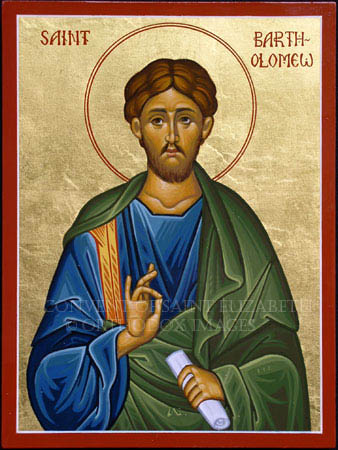
Mission of Saint Bartholomew, the Apostle in India

Mission of Saint Bartholomew, the Apostle in India
Mission of Saint Bartholomew, the Apostle in India: Two ancient testimonies exist about the mission of Saint Bartholomew in India. These are of Eusebius of Caesarea ( early forth century) and of Saint Jerome ( late forth century). Both these refer to this tradition while speaking of the reported visit of Pantaenus to India in the second century.
1. Mission of Pantaenus in India
Hundred and Twenty years after the traditional date of the martyrdom of Saint Thomas the Apsotle, a second Christian mission is reported to have reached India. According to Saint Jerome written in the fifth century, the great Church in Alexandria, which is the center of Egyptian Christianity sent its most famous scholar, Pantaenus, head of the theological School in that city, “ to preach Christ to the Brahmans and philosophers there”. (( Jerome- Epistola LXX ad Magnum oratorem urbis Romae ))
A deputation from India reached Alexandria some time in 179 or 189 AD. Because of the knowledge and learning of Pantaenus, according to Saint Jerome, they asked Demetrius to send him to India for discussions with their own Hindu philosophers. Demetrius decided that the Christian world mission is in higher priority then the advancement of Christian learning. So without hesitation he sent his most famous scholar from the theological school as a missionary to the East. Eusebius also gives an early account of this mission.
Both Eusebius and Saint Jerome has reported that Pantaenus found Gospel of Mathew reported to have left there in India by Saint Bartholomew. Some writers has suggested that having difficulty with the language of Saint Thomas Christians, Pantaenus misinterpreted their reference to Mar Thoma ( Bishop Thomas) as Bar Tolmai ( the Hebrew name of Bartholomew). Some others say Eusebius and Saint Jerome confused India with Arabia or Persia as was done by some other classical writers.
Interestingly, the pupils and successors of Pantaenus, Clement and Origen, write about India as if they know more of that land than passing myths and in no way confused it with Arabia and Persia. They may have heard this from Pantaenus himself. They speak of “Indian Brahmans” and “gymnosophists” and Clement writes discerningly of the difference between “Sarmanane” and “Brahmans” describing the former in terms that suggest the “hermits” or “holy men of India”. (( Clement- Stromata, 15 ))
2.Mission of Saint Bartholomew the Apostle in India
Two ancient testimonies exist about the mission of Saint Bartholomew the Apostle in India. These are of Eusebius of Caesarea ( early forth century) and of Saint Jerome ( late forth century). Both these refer to this tradition while speaking of the reported visit of Pantaenus to India in the second century.
According to Eusebius, Pantaenus, “is said to have gone among the Indians, where a report is that he discovered the Gospel according to Mathew among some there who knew Christ, which had anticipated his arrival: Bartholomew, one of the Apostles, had preached to them and had left them the writings of Mathew in Hebrew letters, which writing they preserved until the afore-said time”
Saint Jerome would have that Demetric, Bishop of Alexandria, sent to him India, at the request of legates of that nation. In India Pantaenus “ found that Bartholomew, one of the twelve apostles, had preached the advent of Lord Jesus according to the Gospel of Matthew, and on his return to Alexandria he brought this with him written in Hebrew characters..”
In these testimonies Eusebius appears to be not quite sure of what’s reported. Saint Jerome, while writing to Marcellus, acknowledge the primacy of Saint Thomas, the Apostle in India.
“ He ( Jesus) was present in all places with Thomas in India, with Peter in Rome, with Paul in Illyria, with Titus in Crete, Andrew in Greece, with each apostle and apostolic man in his own separate region. “. (( Jerome – “ Epistola LIX ad Marcellam’ ))
2.1 Opinion of Authors about Saint Bartholomew the Apostle mission in India
Previously the consensus among scholars was against the apostolate of Saint Bartholomew the Apostle in India. Majority of the scholars are skeptical about the mission of Saint Bartholomew the Apostle in India . Stililingus ( 1703), Neande ( 1853), Hunter ( 1886), Rae ( 1892), Zaleski ( 1915) are the authors who supported the Apostolate of Saint Bartholomew in India. Scholars such as Sollerius ( 1669), Carpentier ( 1822), Harnack ( 1903), Medlycott ( 1905), Mingana ( 1926), Thurston ( 1933), Attwater ( 1935) etc does not support this hypothesis.The main argument is that the India, Eusebius and Jerome refers here should be Ethiopia or Arabia Felix.
2.2 Kalyan – the field of Saint Bartholomew the Apostle missionary
The recent studies of Perumalil and Moraes hold that the Bombay region on the Konkan coast, a region which have been known after the ancient town Kalyan, was the field of Saint Bartholomew the Apostle’s missionary activities and his martyrdom.
The town of Kalyan, was an ancient port and it is supposed to be the Kalliana, the traveler Cosmas Indicopleuustes visited in the 6th century as he reports in his “Christian Typography”.
According to Pseudo- Sophronius ( 7th century) Saint Bartholomew preached to the “ Indians who are called Happy” and according to the greek tradition the Apostle went to” India Felix”. The word Kalyan means “felix” or “happy” and it is argued that the Kalyna region came to be known to the foreign writers “ India Felix” and its inhabitants, Indians “called the happy”
Perumalil interprets the “ India Citerior” of Hieronymian Martyrology as Western India, and the “India” of the Passio bartholmei as the Maratha Country. (( Perimalil “ The Apostles in India” ))
There are no local tradition about the mission of Pantaenus or the Apostolate of Bartholomew the Apostle in India. According to Moraes this is due to the fact that the history of Christians of Bartholomew got intermingled with that of the Thomas Christians ( the Syriac tradition is that, Saint Bartholomew preached in Armenia). According to Perumalil, Bartholomew Christians continued as a separate community till the coming of the Portuguese and got merged with the Christians of Bombay. (( Moraes “ A History of Christianity in India AD 52-1542 ))
________________________________________________________________________________
Last Update August 10th 2009.
________________________________________________________________________________
The Apostles, St. Pantaenus, St. Frumentius and St. Bartholomew are also connected with India.
Of these the missionary activities of St. Bartholomew in India is documented by early fathers such as St. Ambrose and Theodore
Saint Ambrose — “And when the hearts of the people of his neighbours sufficed not to him to receive his seed, he (St. Bartholomew ) through-pierced like in fleeing in to the last countries of the lands of India, and entered in to the temple where there was great company of sick people without number”
Theodore—– “The blessed apostle Bartholomew preached first in Licaonia, and after in India, and at the last in Alban, a city of great Armenia, and there he was first flayed and afterward his head smitten off, and there he was buried.
Do we have local traditions about the Apostloate of Saint Bartholomew or Saint Pantaenus, Saint Frumentius.
George Thomas:
I’m not so sure you can make such a statement with any degree of certainty.
If you look into these claims (St. Pantaenus, St. Frumentius and St. Bartholomew) you’ll find that the “India” the author is referring to is often vague.
“India” meant a lot of things to various people and much of the time, it was not our India. “India” could refer to Ethiopia, Arabia, or — the closest — Parthia and maybe North-west India.
With Frumentius and/or other Alexandrians, you can read the original accounts (e.g., Zacharias Rhetor), and learn that this India most likely was Ethiopia or maybe Arabia.
Pantaneus may have come to our India, but it’s not absolutely clear if he’s talking about our India. Many dispute this.
The tradition of St. Bar Tulmai is also unclear. If you look at the order of cities above, it certainly doesn’t seem to be our India.
Now, all the ancients weren’t so ignorant of “India”. Bardaisan definitely seems to know about our India (describing Brahmins and Buddhists), Cosmos Indicopleatus too (describes the geography of Malabar, plants, spices, etc.). And of course, the various prelates of the Church of the East knew about India — they’ve referred very specifically to our community several times in their letters, etc., over the centuries.
It’s hard enough trying to give substance to the claim that Mar Thoma came to India—this is very hard, and there is as of yet no decent evidence to support this. But the evidence for Mar Thoma coming is orders of magnitude better than the evidence for the others you’ve mentioned.
Dear John Mathew
Thank you. On further reading in case of Saint Frumentius, the term India was used vaguely and there are no continuity in traditions with modern India.
There are no local traditions in case of St. Pantaenus and St. Bartholomew.
Re. Bartholomew and India, see the following link.
http://konkanicatholics.blogspot.com/2006/08/st-bartholomews-india-connection.html
I am not sure about the credibility of the information. It is said that there were icons of St Thomas and St Bartholomew on the farcade of the 1806 church built by Portuguese in kalyanapura. This must be due to local tradition or any evidences. This story must be considered in the light of the finding of a Persian cross also in Goa.
Eusebius’s account of Pantenius tells about Bartholomew mission in India, Jerome tells that “Pantenius was sent by Demetrius to India so that he might preach Christ among the Brahmins and philosophers of that nation”. The mention of Brahmins certainly settles the place as India. (This is also quoted from the same blog.)
Again, I have read that there was a group of Goan Catholics joined the Puthencoor in Kerala at a certain point after the revolt in kerala- possibilities are they were originally syriac christians fully latinised by Portuguese and when there were problems with the relations with the Portuguese missionaries, they just joined an available syriac church.
Are there any other traditions or references available ?
Hi Antony,
wrt the Orthodox church in Goa, I visited that church in Ribandar this easter. Check out this site http://www.stalvares.com
It has an interesting history. But I doubt there being a syrian church/christianity prior to the Portuguese.
For Christianity in Goa prior to the Portuguese:
According to the coterie of the Hangal Kadambas, this is the story that after Vijayanagara ended Hangal Kadamba rule and he with his grandson fled to Goa, where his daughter, the widowed Kadamba king’s queen was residing. Later Jayesha for some reason is known to have converted to East Syriac Christianity in around the year 1400 and apparently may have taken the name Malankar I as we are told he named his son Malankar II. He was involved in timber business and may have had Malabar Christians as his customers, in Goa or in Haliyal.
Read the full story:
In the year 1347, Marapa, the governor of Konkana and the younger brother of the Vijayanagara king Harihara I attacked an already weakened kingdom of Hangal-500 that was ruled by Purandara Raya Deva (1315-1347), the Kadambarasa Maharaja of Hangal, son of Kavadeva (1260-1315). In the battle that took place, Purandara Deva’s son and yuvaraja (crowned prince) named Sankara Deva was killed while helping his father Purandara and young son Jayesha flee Hangal. The kingdom of Hangal was annexed to Vijayanagara kingdom and Purandara Deva and his grandson Jayesha fled to Goa and took asylum with his daughter the widowed young queen Veenomaih Devi at the Jayakesi I (1050-1080) royal compound at Velliapura in the same year, i.e.:1347. Queen Veenomaih Devi, who was childless, adopted her nephew Jayesha as her son and her successor; thereby Jayesha became heir of Hangal Kadambas as well as Goa Kadambas. Purandara Deva died in 1368 and Veenomaih Devi died in 1396 according to the death memorial stone at Velliapur that has been deciphered. The stone inscription names Veenomaih Devi queen of slain king Goa Kadamba Suriya Deva, son of Bira and the daughter of Hangal king Purandara Deva and the stone was set up by her adopted son Jayesha in the year 1396. Obviously Jayesha had also set up a similar memorial stone for Pruandararayadeva but the inscription had completely effaced over the years.
Veenomaih Devi, the Goa Queen had given all she had to her nephew Jayesha whom she had adopted as her son and heir and had raised him as her own at Velliapur. By the time Veenomaih Devi had died, Jayesha had already married. Having deprived of the Goa as well as Hangal kingdoms, he gave up worship in their temples for fear of Mohamaden trap, converted to Nazarini East Syriac Christianity. He named his son Malankar II and around 1400, they reinvented themselves from Royals to Haliyal Timber Lords dealing in local timber from Haliyal and in the vicinity. His descendants are still traced and apparently they were reconverted to Latin (Roman) Catholicism that the Portuguese practiced.
Dear Sujith:
No reason for doubt: Goa is one of those places were a Persian/Pahlavi Cross was discovered–which means that a Syriac Church definitely existed there at one point in time. In addition to Kalyan, Patna, Malabar and Mylapore, Goa also appears on lists that discuss the expansion of East Syriac Christianity into India—apparently Nestorianism (to use the term lightly) was dispersed throughout India in ancient times.
And, although I despise “oral traditions” (at least w.r.t. history) for completeness I’ll add that if you search on NSC you’ll find references to a Goan tradition of Syriac-sounding names, etc. I forget exactly where this is located … perhaps on the NSC page about the Persian Crosses.
But yes. I agree that Mor Julius Alvares didn’t seem to be connected with the pre-Portuguese Syriac Church of Goa… I haven’t seen to much biographical info on Mor Julius, but I think I saw it reported somewhere that he was a Brahmin convert to Christianity. Again, I can’t vouch for this info … I’m still looking for corroboration.
I believe the Qurbono was translated from Syriac into Latin for this group.
In 1886 the Padroado jurisdiction ended in South Canara but the Portuguese were trying to preserve their influence. Some parishioners of Kallianpur-Milagres, because of their close association with the Goan clergy, they preferred to be under the Padroado. When the Goan clergy suddenly left and priests of Propaganda Mission arrived, they filed a suit against the Propaganda and lost it, They associated themselves with Fr Anthony Alvares, a former Goan a Catholic Jesuit priest who was ex-communicated and later became the orthodox syrian bishop Mar Julius I of Goa. The dissidents separated from the Mother church under the guidance of the suspended Goan priest. ANOTHER GOAN PRIEST, Fr Zephryn Noronha, whom Fr. Alavares had brought to Bhramavar built a church of their own and dedicated it to Our Lady of Miracles at Brahmavar (St Mary’s Syrian Church) now known as St. Mary’s Cathedral.
Fr. Alvarez Mar Julius started the Bahmavar Mission in Karnataka in 1888. This mission was started in order to give spiritual leadership and help in the spiritual growth of those people who left the Roman Catholic Church and joined the Orthodox Church of Malabar.
(BRAHMAVAR IS ABOUT 60KM NORTH OF MANGALORE (AFTER CROSSING UDUPI ON NH17)
ALSO SEE:
Mar Thoma: The Apostolic Foundation of the Assyrian Church and the Christians of St. Thomas in India
Stephen Andrew Missick
http://marthomachurch.org
MD.
The Book of Esther 1:1 mentions India while defining the area ruled by King Ahasuerus. If this India is our India, then the comments of Jerome and Eusebeus carry merrit in as much as that they would have meant our India. King Solomon is supposed to have bought valuables from India, but the term India is not used. Anyhow, there is a general feeling that Christianity in India originated in Kerala. Now, if we accept that Kalyan area too was a very first center, it amounts that Indians are all one in that they never seriously bothered about spreading the WORD, be it Malayalees or Marathees. Christianity stands where it was 2000years ago. This is a fact we shall look into with priority.
Christianity may have it’s roots in Kerala, but according to the Bible , initial worship centre were all simple and non ceremonious. How did Christianity in Kerala , become so ritualistic ,with incense , and decorative robes and other paranephelia? Did they have some Jewish influence, obviously not from Peter as he was a simple fisherman and untrained as a priest, or is it from the influx of Jews from Israel?
The comments by Mini Flower creates confusion. (1) Christianity came to Kerala in 52 AD we believe. At that time we have no recorded evidence that incense was used. But using incense was a true custom followed as we read in Old Testament. New Testamen is the realisation of OT and hence using incense is not only desirable, but is a must if you are in the true Church. John’s Revelation too prove this. (2) The comment made on Peter by Mini Flower is really surprising. The whloe essence of Christianity is TRANSFORMATION. Peter was a fisherman once upon a time just like Paul was a persecuter and Matthew was a publican and sinner. Mary Magdalane was a sinner. But all these persons got transformed. Peter turned out to one who is a man catcher. Thomas too caught men. They all followed the true customs. Thomas would have certainly introduced incense in Kerala as well as all the rituals. If you read Acts of Thomas, you will learn that most of the present rituals are those followed by Thomas in India. Also, was not Peter trained for more than three years by none other than JESUS and later by HOLY SPIRIT? So he and other Aopostles are really possessing PRIESTHOD ordained by JESUS.
I see that some serious discussions are taking place about Syrian Christians. The DNA test will not prove anything. This is because there are many types with similar DNAS and Syrian Christians cannot logically claim any purity that could show up in the DNA research. The claim made here that St. Thomas did not or may not have visited and converted Jews is fundamentally incorrect. Christians were there during 2nd and 3rd CE as evidenced by the visit of an Alexandrian by name Pantaenus who found not just Christians in what is now Keralam but also found a copy of the gospel of the Hebrews that was being used by the community. The said visitor was a responsible theologian of old and was instrumental in establishing the theological school in Alexandria. His visit is placed at 190CE.
I could cite a few examples of Jewish religious cultural practices that were there until recently among the Syrian Christians. One was the kosher practice of leaving agricultural field uncultivated after seven years of cultivation. The other is strict observance of not eating any flesh that came from a non ruminating animal such as pig.There are also the Jewish custom of prayers five times a day that is now practiced by Muslims only.Then there is the observation of Sabbath. Remember that Sabbath was originally observed on Saturdays by Jews and from Friday evening to Sunday morning it was Sabbath although the Syrian Christians follow the normal Sunday routine. I know many families who until recently stopped all work on Saturday evening and resumed only on Monday morning. The Sunday in between was reserved not just for Mass (Roman Catholics) or Qurbana (Syrian Christians) but also for religious activities that included discussions and study of the holy books. I am not giving further details but Syrian Christians followed many Jewish customs up to the time of the Portuguese intrusion.
Regarding the practice of Hindu customs it cannot be anybody’s claim that there were no conversions from Hindus and vice versa. This happens in any society and has no special significance.
The Brahman conversions and related claims are not logical as at Thomas’ time Brahmans were rare the whole communities being either Buddhists or Jain. The Brahman origin of Syrian Christians is not tenable because of this. However wholesale conversion of Brahmans may have happened during the Portuguese intrusion and following the practice of the Portuguese all evidences may have been suppressed. I have lived in Goa for long and am familiar with the state of affairs there. The Brahman converts in Goa still call themselves Brahman Roman Catholics with great bitterness.
In India caste is prime however unjust or unacceptable they may be. Do remember that caste system is not so unique as the ancient Greeks and Romans all practiced it. Do read Plato’s Republic. Of course in those countries economic freedoms wiped out caste structures long back.
Regarding large scale conversions after the Portuguese intrusion it is a relatively new phenomenon and those converts are rare among the Syrian Christians and Syromalankara and Syromalabar communities. They have by and large remained as Latin Christians. Syrian Christians generally do not favor religious conversions although there could be exceptions. This incidentally is a Jewish practice as their religion does not practice conversion as the Roman Catholics and Protestant Christians seem to.
Lastly Jews cannot claim to be race as indeed no one in the human race can as the scientific theory today is that humans originated from a single mother in Africa several million years ago and the present distribution with many differing DNA is a product of migration and mutation of genes.
Dear Mr Mini M fowler, It seems you have very little idea about how Christianity has developed in the first two or three centuries. Christianity has much Jewish influences in it. It was the official religion of the roman empire. Naturally it has the influences of the roman empire too. It is not only the Christianity in kerala that is so ritualistic ,with incense , and decorative robes and other paranephelia even the roman catholic mass and orthodox mass of other countries also has the same.
Dear Babu George:
Would you be able to give an exhaustive list of every Jewish custom that the Nasranis followed, to your knowledge?
Although some of what you’ve written does not demonstrate anything (e.g., prayer five/seven times a day, is a feature of Christianity as well, that is still maintained by rigorous followers of the eastern/western rites), I think that there are many interesting observations (e.g., that the Nasrani’s observed OT dietary laws).
I’d like to know more because based on what I understand about our history, there are some distinct strains of peoples that seem to have produced the Nasranis:
1) the ethnic Persian followers of East Syriac Christianity that migrated and populated Kerala at various points in history.
2) Jews that, for some reason or another, merged with the Nasranis. The best example would be those Nasranis from the northern areas, Trichur, Kunnamkulam, Arthat, etc., who still maintain some “memory” of their Jewish past. But also, there are examples of grandparents who spoke of Kosher-like laws (e.g., not to mix milk and meat).
Note: This is apart from my own personal theory of the Southists being Black Jew converts to Christianity in the 15/16th century. Even if that is not true, and there is some other origin for the Southists, there is still the fact that many Nasrani families recall stories Jewish ancestry from their ancestors. And there is the presence of the J2 Cohen Model Haplogroup amongst some Nasrani families as well.
So I’m very interested in learning of true Jewish customs that existed amongst the Nasranis.
I recall reading an article about Jewish Malayalam, and learned that it contained many archaic names for God that are Jewish formulations in Tamil. As far as I know, those names are not used by the Nasranis:
“Another significant feature is the abundance of archaic Dravidian derivatives to denote Jewish concepts. The best examples are names for God, many of which are loan translations from Hebrew. Jews, Muslims, and Christians share the most popular form Thampuran ‘Lord’. Jews and Muslims share Padachavan ‘creator’. But Mulamudayon ‘the one at the beginning’, Oruvanayavan ‘the only one’, Sadakan ‘the doer’, Adimulamvayavan ‘the one who is the root cause’, and Adiperiyon ‘the great beginner’ are words for God used only by Jews. The typical Jewish concept of redemption is expressed by a special word coined from a Dravidian root “mil,” according to well-accepted morphological rules: Milcha ‘redemption’ and Mirchakaran ‘redeemer’ are frequently found in JMFS but are non-existent in general Malayalam. JMFS are full of variants of these two Malayalam words, sometimes altered beyond recognition.”
ref: http://www.jewish-languages.org/jewish-malayalam.html
Another link to the nestorian connection
http://www.sundaytimes.lk/110626/Plus/plus_07.html
Dear John Mathew.
In response to your post of of June 20th. 36306 i would like to response as follows.As far as I know no one has ever tried to do this comparison and it would appear to be a fascinating aspect of the Thomas Christians. Basically there are 613 laws that the ancient Jews considered sacrosanct. Many are customary laws in many religions even in Hinduism although they should have developed independently . I keep looking. But this should form the core of a Th.D thesis for a theologian.
Regards
B.George.
A book on Cochin Jews
http://www.himalmag.com/component/content/article/4538-the-cochin-mizrahi.html
As I was trying to figure out the name Nathaniel, in St.John;s gospel, I found information in Wikipedia, indicating that he was St. Bartholomew and this search led me to your website. I have bookmarked it.
I am a Catholic, from Mangalore, South Kanara, and presently living in Mumbai. Indians a re deeply religious, and take their faiths seriously. It is nice to know, that 2000 years ago, our people were more liberal, and interested in the views of others. I have heard of Kristu Purana, which originated in North Konkan, and in childhood we sang hymns which had marathi words. We were unaware of how these moved on the coast. It is nice to know, that your readers are taking this study seriously. May God help us to find the truth.
Not exactly connected with the post on this page but Dr. Mar Aprem gives some interesting historical information on one in party with Mar Alvarez:
http://www.orthodoxherald.com/2013/05/04/the-brahmavar-chaldean-connection/?utm_source=feedburner&utm_medium=twitter&utm_campaign=Feed%3A+orthodoxherald+%28Indian+Orthodox+Herald+-+Breaking+Church+News+And+Doctrinal+Information%29
Thanks Sujith for this informative post and the link to the video.
It is very interesting to know that there was an associate of Mar Alvares Mar Julius (Fr Antonio Francisco Xavier Alvares) named Fr Lois Maria Soares who joined the Church of the East.
It is known that Fr Alvares was a Roman Catholic Priest, who due to certain differences in opinions with the Roman Catholic Church, joined the Syrian Orthodox Church and became a Metropolitan. Now, we have to believe that there was another Priest Fr Louis Mario Soares who was an associate of Fr Alvares who joined the Church of the East and was consecrated as a Metropolitan Mar Basilios in 1899.
It seems that Fr Alvares and associates were against the suppressive rule of the Western Missionaries, similar to what we had in Malabar during the time. Fr Alvares was excommunicated by the authorities in Goa and he was attracted to the Syrian Orthodox Church in Malabar and joined them and became a Metropolitan. Fr Soares seems to have joined the Church of the East in India ( Chaldeans of Trichur).
The unhappy Latin rite Catholics of Goa at the time of Fr Alvares and Fr Soares may not have any knowledge that they were East Syrian Christians once, as their East Syrian heritage was completely erased by the Portuguese Missionaries. It was only recently, that after the excavation of the Saint Thomas Cross from Goa and related research by Rev Dr H O Mascarenhas and Rev Fr Cosme Jos Costa has raised more interest in the subject.
It is now known that the Latin Rite Catholics of Goa today were once Syrian Christians and it was the Portuguese who converted them to Latin Rite. They were also part of the Church of Saint Thomas, but succumbed to Latinisation fully where as in Malabar, there was strong resistance, probably because of the presence of leadership of the Arch deacons and also support of the certain local Kings. Due to the resistance, in Malabar, the church split into two, with one group became a uniate with the Syrian Orthodox Church of Antioch ( The Puthencoor) and the other remained a uniate to the Roman Catholic Church(The Pazhayacoor- todays Syro Malabar and the Church of the East in India).Those who undervent latinisation in Malabar resisted to adopt Latin rite and Latin language for worship and kept the East Syrian language and a mutiulated East syrian rite
Mar Aprem Metropolitan’s talk also throws light into the presence of Christians of Syro Chaldean rite in Thinnavely District, Dindigul, Thanjaor, pallithanam in Madurai, etc. This means that those Christians were also Thomas Christians persecuted by the Portuguese remained as small pockets, may have had contacts with the Pazhayacoor in 1900 period. It seems that when the Pazhayacoor evolved into Syro Malabar, the SMC leaders just ignored these community, but they were in contact with the Mellusians and Rochosians among the Pazhayacoor and became CoE in India.
It is sad that the then SMC leaders were so helpless to bargain for those Syro Chaldean brothers in Tamilnadu, when they negotiated for native Bishops in Malabar. Probably, they all might have joined the local Latin rite now.
It has to be noted that today’s Church of the East in India are followers of Mar Rokos and Mar Melus who were Chaldean Catholic Bishops appointed by the Catholic Chaldean Patriarch and Fr Antony Thondanattu was one among the delegates visited the Patriarch to get a Bishop from him. When Mar Rokos was withdrawn by the Patriarch because of the pressure from the Missionaries, Fr Thondanattu met the Patriarch of the non Catholic Church of the East and consecrated as a Metropolitan. Later, he remained loyal to the SMC fold and when Mar Melus came, he became active. When Mar Melus was also withdrawn by the Chaldean Patriarch, the community turned to the non Catholic Church of the East and became the Church of the East in India, but continued their old name “Chaldeans” which happened to be the name of their rivals in Iraq ! They kept the name Chaldeans as the term ” Syro Chaldean” was emotionally so attached to the Pazhayacoor group. Even today’s Syro Malabar also preferred the term Syro Chaldeans until the formation of Syro Malabar Church with Native Bishops.
Yes Mr. Thomas, interesting to hear of these politics during our ‘polarization’ times 🙂
Visit of St.Thomas is documented in Kerala and Kanyakumari. St.Bartholomew is reputed to have visited Northern coastal climes. Gondophares was a historic figure of Indo-Bactrian lineage and converted by St.Thomas.His successors
did not evince keenness in the religion.Instead the waning fervour increased through the initiatives of Bartholomew.There are no parchments indicating any meeting between the two Apostles as their fields were different and internal travel in the hinterland or through unexplored coasts could not be ventured.Christian predominance in the Morvi-Kalyan region is a sure indication of the Apostle’s visit.What happened to Bartholomew after his avocation is lost in the mists of time. Thomas’s martyrdom in Tamilnad is documented-not Bartholomew’s.It is said he suffered martyrdom.Atradition says he moved out after his christianisation to die outside the shores of India.
All evidence has been destroyed by Portuguese and Dutch fanatical priests. Maybe something exists in the custody of individuals who would never part with it or,is rotting in a forgotten archive waiting for discovery. These are fit subjects for deep research by scholars who have the mind for it.
Originality seems missing in Indian polity what with so much potential for serious analysis.Someone must have his doctoral thesis on, Advent of The Apostles to India and its environs.
I am doing some research on Jews. For the first time during my research I came across the fact that st. Bartholomew visited India. In my search, it is quite convincing that st. Bartholomew came to India.
Hello,
Could you please share some more details on that fact?
My family research found the Apostles traveling in a group. They broke up into teams and never went alone preaching at anytime based on the model of Jesus to go out 2 and 2. A southern team of Apostles left Persia for Arabia- a must visit to the sons and grandsons of Noah. From Persia Thomas and Bartholomew are documented in Yemen, Arabia, then off the southern coast of Arabia they went to Socotra Island preaching before leaving for India.(at the time of the monsoon winds to facilitate sailing to India). Your articles are fabulous I have learned so much from them. You are absolutely right about the mission of the Apostles to Jews first They sought out the “lost sheep” by Christ’s words, prophecy Isaiah 11:11, the genealogy of sons of Noah, and Rabbinical lists of the locations of Diaspora settlers. They went exactly to each one of these destinations.
From sec. 1, par. 2, the author states:
“A deputation from India reached Alexandria some time in 179 or 189 AD. Because of the knowledge and learning of Pantaenus, according to Saint Jerome, they asked Demetrius to send him to India for discussions with their own Hindu philosophers. Demetrius decided that the Christian world mission is in higher priority than the advancement of Christian learning. So, without hesitation he sent his most famous scholar from the theological school as a missionary to the East.”
While it is well known that Pantaenus was sent to India by Demitrius, neither Eusebius nor Jerome state that he was sent at the request of an Indian delegation, and I’m afraid this may be pure conjecture on the part of the author. Nor am I aware of any supporting evidence to show that Pantaenus was well known in India. However, I would be very pleased to know of any relevant source material in support of this, as it would be of great help to my research.