
Kerala Syrian Christian, Apostle in India, The tomb of the Apostle, Persian Church, Syond of Diamper – Coonan Cross Oath, Subsequent divisions and the Nasrani People

The origin of Syriac Christianity in India is closely connected with the evangelization of India by the Apostle Saint Thomas. This Apostolate is asserted both by literary and local ancient traditions.
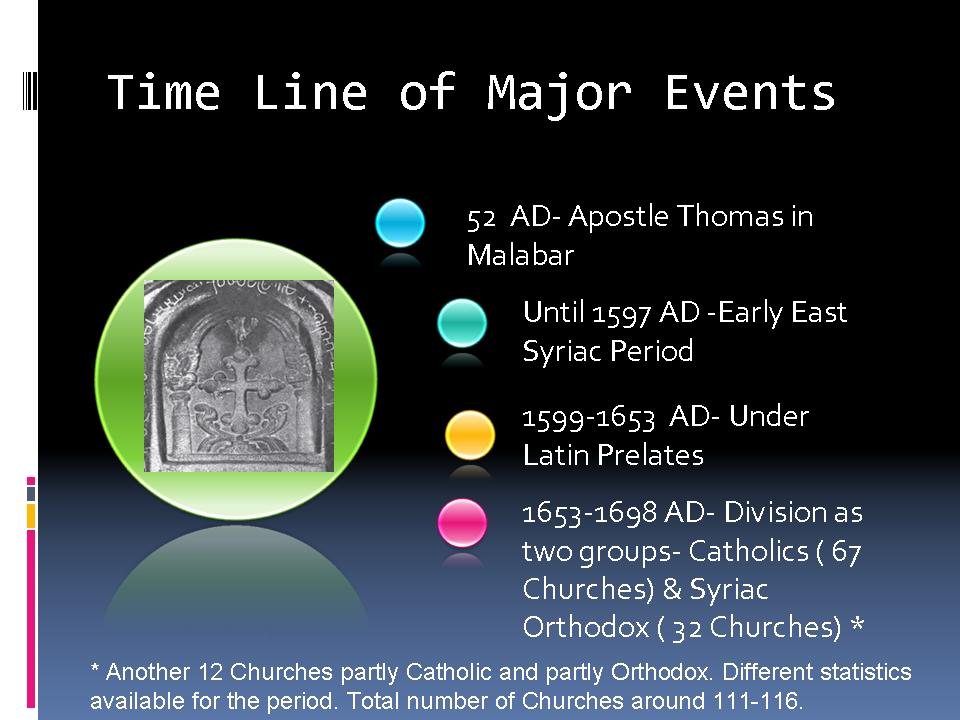
This article examines 1) Kerala Syrian Christian, 2) Saint Thomas the Apostle in India, 3) St Thomas Mission in India, 4) Who were the converts in First Century ?, 5) The Liturgy used by Saint Thomas Christians , 6) The tomb of the Apostles at Mylapore, 7) The transfer of relics to Edessa, 8 ) Hierarchical dependence on the Persian Church, 9) Syond of Diamper-Coonan Cross Oath, 10) Subsequent divisions in the Community, 11) Few Indian Origin MSS prior 16th century, 12) The Nasrani People, 13) Nasrani People Today. (( Last Update July 12th 2009. If any of the statements are misleading, please bring that to my attention. The general references are from 1. L Brown- “ The Indian Christians of Saint Thomas”, 2. Mackenzie GT –“ Christianity in Travancore”, 3. Medlycott-“ India and the Apostle Thomas”, 4. Mingana-“ The early spread of Christianity in India”, 5.Mundadan-“ The Arrival of Portuguese in India and Saint Thomas Christians under Mar Jacob”, 6. Mundadan-“ Sixteenth century traditions of Saint Thomas”, 7.Nedungstt-“ Syond of Diamper resvisted” 8. Placid- “ Thomas Christians”, 9. Placid-“Varthamanappusthakam”, 10. Perumalil, Hambye- “ Christianity in India”, 11. Tisserant- Hambye- “ Eastern Christianity in India”.
In the Syond of Diamper and subsequent happenings, many details are not included as the objective was to cover them in brief.))
1. Kerala Syrian Christian
The ancient Christians of India were known as Christians of Saint Thomas. They are also known as Syrian Christians, since they have been using Syriac for liturgical purpose with or with out admixture of Malayalam. (( The Thomas Christians, Placid Podipara ))
Anybody who is born in a Kerala Syrian Christian family are generally termed as Syrian Christians or Nasranis or Nasrani Mappilas Those who belong to the churches which follows East or West Syrian rite for their worship are generally termed as Saint Thomas Christians or Syrian Christians or Nasranis.
Syriac Christianity is a culturally and linguistically distinctive community within Eastern Christianity. It has its roots in the Near East, and is represented by a number of Christian denominations today, mainly in Kerala, India and in the Middle East.
The Church of Saint Thomas Christians was hierarchically dependent on the Church of Seleucia or better Seleucia-Ctesiphon, later on called as the church of Babylon or Church of East. The Christians of Saint Thomas were under the spiritual jurisdiction of the Patriarch of Seleucia- Ctesiphon ( known differently as Church of Babylon, East Syriac Church, Church of East, Chaldean Church, Assyrian Church ). Till the year 1597, these Christians were governed by the Bishops send by the Patriarch of this church. ( first Persia proper and then Patriarch of Seleucia- Ctesiphon).After the celebration of Syond of Diamper in 1599, the Church was made subject to the jurisdiction of Latin Bishops under the Patronage ( the Padroado) of the Portuguese Crown. The response of the Church from the part of the Archdeacon, the Kathanars and the faithful at large towards the policies of the missionaries and the Latin prelates was that of great opposition. Thus, there was a revolt and consequently a division followed in the Church with the historic Coonan Cross Oath in 1653 and subsequent happenings.
Until the middle of the XVII century, the Thomas Christians were all one in faith and rite. There after, divisions arose among them, and consequently they are today Catholics and non- Catholics of different rites, the latter belonging to different denominations. (( The Thomas Christians, Placid Podipara ))
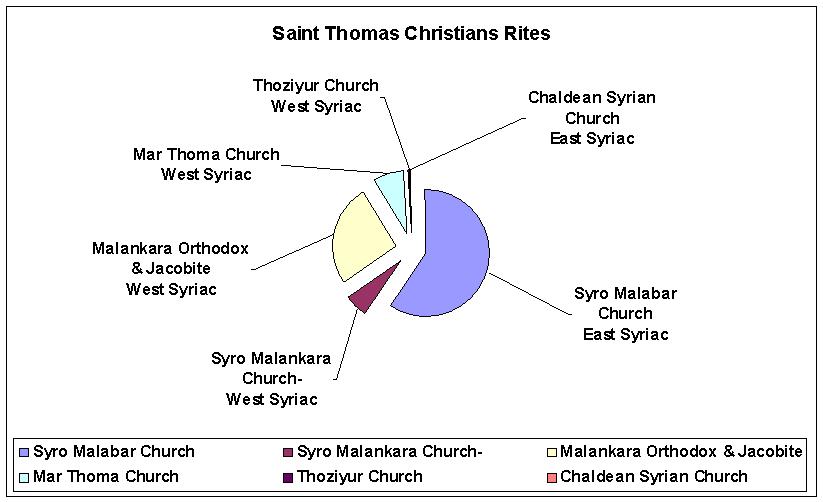
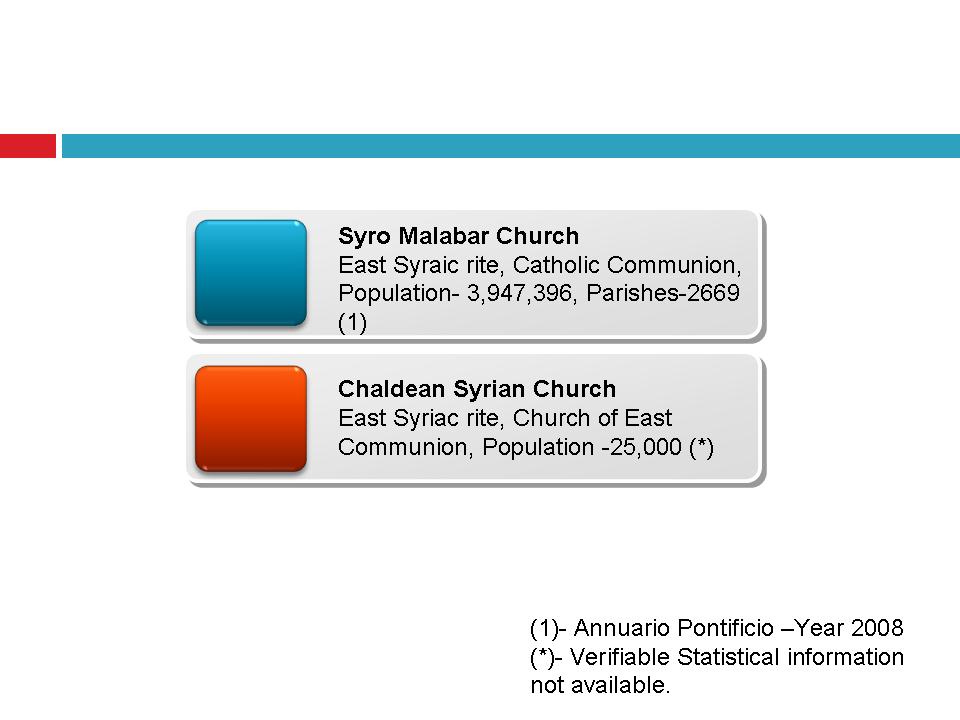
Syro Malabar Church and Chaldean Syrian Church are the Kerala Churches which follow the East Syriac rite.
Malankara Syriac Orthodox Church ( Jacobites) , Malankara Orthodox Syriac Church ( Orthodox) , Malabar Independent Syrian Church, Mar Thoma Church and Syro-Malankara Catholic Church are the Kerala Churches which follow the West Syriac rite.
Syro Malabar Church, Syro-Malankara Catholic Church are in communion with the Roman Catholic Church and are Sui iuris.
Malankara Orthodox Syriac Church ( Orthodox) is autocephalous and Malankara Syriac Orthodox Church ( Jacobite) is part of the Syriac Orthodox Church of Antioch, both accepting the spiritual jurisdiction of the Syriac Orthodox Patriarch of Antioch and latter under the Patriarchate.
Chaldean Syrian Church in India is part of the Assyrian Church of the East. Mar Thoma Church is in communion with Anglican Church and Malabar Independent Syrian Church is an independent church.
2. Saint Thomas the Apostle in India
Muziris and Nelcyndis -There is a great deal of evidence available to demonstrate the strength of commercial links between India and West Asian world during the period St. Thomas has arrived in Malabar. Gold and Pepper were the central articles of trade. Knowledge of monsoon was available and possibility of more rapid travel to Malabar coast was a reality during Apostolic time.
Southern India had maritime trade with the West since ancient times. Egyptian and Roman trade with India flourished in the first century AD. The monsoon winds which blow South – West from April to October and North-East from October to April, have influence on social, cultural and political life of Kerala. The knowledge that if the vessels are moved according to the trends of the winds a traveler from the Gulf of Aden can reach the Western coast of India or Kerala. With this discovery it was possible to reach Kerala from the Gulf of Aden in 40 days.
The discovery of the monsoon winds was very useful to the traders from Egypt, Syria, Greece, Rome and Arabia and it greatly facilitated the trade between Kerala and the western world. The southern coast of the Indian subcontinent (hypothesized by the Jewish historian Flavius Josephus to be the place mentioned as Ophir in the Old Testament) inevitably became a gateway from the Mediterranean world to the Far East.
The people there traded in teak, ivory, spices and peacocks, and the area was endowed with a magnificent coastline with numerous ports from Mangalapuram to Kodungallur, also known as Cranganore. In the ancient times it was called as Muziris in Latin and Muchiri in Malayalam. The trade routes brought with them not just riches but also stateless nations and nascent worldviews.
Muziris (Kodungallur) and Nelcyndis or Nelkanda (near Kollam) in South India, are mentioned as flourishing ports, in the writings of Pliny (23-79 AD). Pliny has given an accurate description of the route to India, the country of Cerebothra (the Cheras). Pliny has referred to the flourishing trade in spices, pearls, diamonds and silk between Rome and Southern India in the early centuries of the Christian era. Though the Cheras controlled Kodungallur port, Southern India belonged to the Pandyan Kingdom, that had sent embassies to the court of Augustus Caesar.
The Apostle in Malabar – According to tradition, Saint Thomas the Apostle came to Malabar and established Christian communities here. Though the tradition that the Apostle Saint Thomas preached the Gospel in South India and died there as a martyr can not be convincingly proved, there is much to say in favor of its historical value.
The Indian tradition of the Apostate is a combined tradition consisting of Malabar, Mylapore/Coromandel and the East Syriac Church. The earliest record about the apostolate of Saint Thomas is the apocryphal Acts of Judas Thomas, written in Syriac in the Edessan circle about the turn of the third century. A number of passages in other writings of the third, fourth and the following centuries speak in unambiguous terms about the Indian apostolate of Saint Thomas. The major Churches are unanimous in their witnessing to the Indian Apostolate of Saint Thomas from fourth century onwards.
Following are the early references to Saint Thomas in India arranged chronologically,
3rd Century: Syriac Acts of Thomas ( c 200), Clement of Alexandria, Syriac Doctrine of the Apostles, Origen ( c.231, quoted in Eusebius).
4th Century: Amobius ( 305), Eusebius of Caesarea ( d.340), Ephrem ( d.373), Gregory of Nazianzus ( d.389), Cyrillonas ( 396), Ambrose ( d.397), De Transitu Mariae.
5th Century: Gaudentius of Brescia ( d. after 406), Jerome ( d.420), Theodoret of Cyrus ( 427), Paulinus of Nola ( d.431), Martyrologium Hieronymianum, Balai ( c.460).
6th Century: Jacob of Sarug ( d 521), Passio Thomae ( c. 550), Gregory of Tours ( d.594)
7th Century: John of Saba ( c 630), Isodore of Seville ( d.636) etc
Acts of Thomas, St. Ephrem, Syriac Doctrine, Jerome, Gaudentius, Paulinus, Gregory of Tours, Calandars, Sacramentaries, martyrologies are testimonies about the Apostolate in India belonging to the Syrian Churches. The testimonies from Origen, Gregory of Nazianzus, Eu,sebius, St. John Chrysostom , liturgical books belong to the Alexandrian and Greek Churches.
The Ethiopian Calandar of the 12th Century belong to the testimony from Ethopian Church about the Apostolate in India.
Medlycott ( 1905), AC Perurnalil ( 1952), Vath ( 1925), Hambye ( 1952) are some of the detailed studies published on these texts .
3. St Thomas Mission in India
According to Indian tradition, Saint Thomas came by sea and first landed at Cranganore about the year 52 AD. He converted high caste Hindu families in Cranganore, Palayur, Quilon and some other places, visited Coromandel coast, making conversions crossed over to China and preached Gospel there. The Apostle returned to India and organized the Christians of Malabar under some guides from among the leading families he had converted and erected few public places of worship.
These first century churches established by St Thomas, according to tradition, were, from north to south: Palayoor near Guruvayoor/Kunnankulam, Cranganore (believed to be the ancient Muziris of Pliny, and the Periplus, on the north bank of Periyar River today), Paravur on the south side of Periyar, Gokkamangalam or Kokkamangalam, Niranam, Chayal or Nilakkal (the only inland church) and the Lakes or Kaayals, and finally Kollam. The visit of the Apostle Thomas to these places and to Mylapore on the East coast of India can be read in the Ramban Song of Thomas Ramban, the Verradan Pattu, Margam Kali pattu and others.
There is an opinion among the historians that St. Thomas, a Jew himself by birth, visited India in search of Jews settled here. According to the Act of Thomas, the first conversion was of a Hebrew girl at the court of King Gundaphor. There exists a strong tradition supported by historical, inscriptions, numismatics, archaeology, literature about the arrival of St. Thomas, his mission, death, burial and about the relics of his mortal body. No other country or people make such claim about St. Thomas mission, apostolate or his martyrdom.
The widely accepted belief is that during his mission he was killed by fanatics and was buried at Mylapore in the state of present Chennai (Madras), South India.
4. Who were the converts in First Century ?
According to tradition, Saint Thomas came by sea and converted high caste Hindu families, the Nambudiris, in Kodungallor, Palayur, Quilon and some other places. However, there is a doubt about who actually were the first converts. The tradition, the position accepted until recently that Namputhiris were the first converts, was questioned by W Logan. According to him, Namputhiri Brahmans did not reach South India until the late Seventh or Eight century. Jews were also in Malabar and they were also among the first converts.
Some of the prominent families which claim conversion from Namputhiris are Pakalomattam, Sankarapuri, Kalli, Kalikav, Koykkam, Madeipur, Muttodal, Nedumpally, Panakkamattam, Kottakali. The Thiruvankkodanmar who are now dispersed in Kundara, Palai, Valavur, Thumapaman, Piravam etc had Kudumi until three generations back. Some families from Karunagapply, Harippad, Kayamkulam maintain that they are Buddhist converts. Some other families maintain they are Jewish in origin and some others as descendents of the Persian Christians.
5. The Liturgy used by Saint Thomas Christians
The only definite ecclesiastical language Church in India had was Syriac unitl the arrival of western missionaries in India. The fact that not one of the scores of dialects spoken by India in first century has been used as an ecclesiastical language proves that the Christians of India had their spiritual relationship with Syriac.
Some historians are of the opinion that Thomas established the early liturgy here in Aramaic (Syriac). St. Thomas provided only the rudiments of the liturgy, but it contained all the elements which later on developed into the full structure. The prelate Bishop John from India in Council of Nicea conducted in 325 followed the Syrian-Chaldean liturgy. It is said that for keeping the uniformity Apostle introduced the liturgy in Syriac. Syriac, the classical form of Aramic was not unknown to the people of Kerala. The early presence of Jewish colonies, archeological evidences, coins and earlier Syriac writings attest that.
Given the ample evidence of East Syrian relation with Church of St Thomas Christians, there is a good probability that the liturgy was introduced by St Thomas in Syriac, as a sudden change of liturgy language in the first three centuries by any other missionaries was quite impossible.
The continued use of Syriac language for the Church is partly because they believed the language was close or similar to the actual language that Jesus and the disciples spoke. In fact, for this high-caste Indian Christian community, Syriac had the same social function as Sanskrit had for the neighboring Hindu high-caste society.
The Older hudra MSS contained three Anaphora for use in Chaldean Church. Mar Esai Hudra also contains three Anaphora. It is generally accepted that the Anaphora of Addai and Mari, Nestorius and Theodore were in use among Saint Thomas Christians at the time of Synod of Diamper in 1599 AD. (( Mundadan- “History of Christianity in India” p-199, Kanichikatil- “Divine liturgy in the vision of Narsai” p-107, Macomber – “The oldest known text of the Anaphora of the Apostles Addai and Mari” ))
6. The tomb of the Apostles at Mylapore
The Indian tradition, in which elements of the traditions of Malabar, Coromandel and the Persian Church intermingled firmly held that Thomas the Apostle died near the ancient town of Mylapore. His mortal remains were buried in the town and his burial place was situated in the right hand chapel of the Church or house known after his name. The Portuguese excavated it in 1523. Despite of this a number of Scholars who made a casual examination of the records made statements that the Portuguese excavations were “ unreliable”.
Beginning with the Acts of Thomas ( C.200), almost in every century there are one or more testimonies about the existence of tomb in India. The location of the tomb as given in Seventh century is ( Calamina or Qalimaya) and Myluph or Meilan ( 12th-14th centuries). From the end of 14th century onwards there are many references to the tomb and all these references are beyond any doubt, to the Church and tomb of the Apostle in Mylapore.
In the 16th century, the Portuguese were told of this burial place by the natives and others and were taken there by Armenian Merchants on a pilgrimage. This was in the year 1517. From that year onwards the Portuguese began to visit the place and even settled down in Mylapore. In a few years they discovered many other places and monuments in the vicinity of Mylapore such as the Big Mount and the Little Mount. In the year 1523, they excavated the tomb and found a few relics therein. (( Mundadan “ Sixteenth Century Traditions of Saint Thomas Christians. P-60-67 ))
The Portuguese could find only fragments of a skull and a few bones with some other things. If these were St. Thomas’s where were or are the other parts of the skull and the bones ?
7. The transfer of relics to Edessa
Saint Ephrem (+373), says that the body of Saint Thomas was translated from India to Edessa. Saint Ephrem and his contemporaries and those who preceded believed that they were of Saint Thomas brought from India. In India, the Saint Thomas tomb was almost found empty. Bickel ( Carmina Nisibina) concluded that a part of the relics was left in India while the rest was taken to Edessa.
An ancient East Syrian Calender has for July 3 an entry which says : “ July 3, Thomas who was piereced through by a lance in India….”. It also says his body is in Edessa where it was translated to by the merchant Khabin. “Chronicon Edessenum” , says that in the Greek era 705 ( 393 AD), on August 22, the relics of Saint Thomas were solemnly deposited in the Church dedicated to the Apostle in Edessa. The relics were already there years ago.
The “Acts of Thomas” hint at a stealthy removal of the body of the Aposlte to the west after his burial. The Accounts that speak of the translation of the body of Saint Thomas say that it was translated from India. Greogory of Tours ( +595) reproducing the words of the travellor Theodore, who had visited India writes, “ ..in that region of India where he ( Saint Thomas) first rested, there is a monastery and a church of admirable dimensions carefully adorned and kept up”. He also says that the remains of the Apostle Thomas were in Edessa.
Am’r son of Matthew ( Christian Arab writer, 1340), Marignoli ( Papel legate in China, 1394), Nicholas de Conti ( Italian merchant, 1425-1430) respectively refers to a monastery and a church when they deal with the tomb of the Apostle in Mylapore.
The Saracen writer, Muffazul ( 1358) mentions that the pilgrimage of the Saracen’s would not be complete unless they starting from Ceylon had visited “ the monastery of Mar Thomas” where there was kept “ the hands of Mar Thomas” “ one of the disciples of the Messiah”.
This monastery is none other than the one the East Syrian bishop who came to Malabar in 1504 mentions in their letter to the Patriarch. In the report they say that the house ( umra) of the holy Apostle Thomas in Mylapore began to be inhabited by Christians who were thinking of its restoration. (( Placid- “ The Thomas Christians” ))
8. Hierarchical dependence on the Persian Church
The “Chronique de Seert” informs us “ that during the Patriarchate of Shahlupha and Papa, say about AD 295-300, Dudi ( David), Bishop of Basrah, on the Persian Gulf, an eminent doctor, left his see and went to India, where he evangelized many people”. Many are supposed to have accepted his leadership and submitted to his preaching. David was considered by the chronicler, as one of the eminent doctors of the Persian Church. (( Mingana “ The Early Sprad of Christianity in India” ))
John of Persia and Greater India is found in the Syriac list of the Fathers of Nicaea in 325 AD. According to the history of Gelasius, writer in the second half of the 5th century, John the Persian was the Bishop of the whole of Persia and Greater India. Saint Ephrem who died in 373 AD, wrote many hymns on Saint Thomas and the references in these possibly imply the existence of Christian community in India established by the Apostle.
Towards 425 AD Mar Komai assisted by an Indian priest Daniel translated into Syriac the Epistle of Saint Paul to Romans. M’ana, the Bishop of Riwardasir ( Persia) about the year 470 sent a Syriac translation of the works of Diodore and Theodore to India. (( Mingana “ The Early Sprad of Christianity in India” ))
The “Christian Topography “ of the East Syrian monk Cosmas Indicopleuste, belonging to the 6th century, is the most important testimony of this early period. He visisted India between 520 and 525 and speaks of ZChristians in Scotra and tehri clergy, who were ordained in Persia: in Ceylon there was a Church of Persian settlers with a priest ordained in Persia, a decon and minor clergy: both at Male ( Malabar Coast) and Kalliana ( Kalyan near Bombay or Quilon ), a bishop ordained in Persia and a Christian community lived.
These accounts especially the texts of Cosmas Indicopleuste are a definite indication of the hierarchical connection of the Christians of India with the Persian Church. More information about these relationship is there in the letters of two Chaldean Patriarchs, Mar Ishoyahb III and Mar Timothy I.
J S Assemani, speaks of a certain Bod, who at the end of Sixth century bore the title of Periodiota ( Periodeutes) who seem to have come to India and Iran under the Catholicos Ezechiel ( 557-581). The title meant a delegate of a Bishop entrusted with teaching and visiting Christian communities, generally in country side or in regions situated away from centers. This mission is said to have been prompted from some heretical threat, perhaps even Manichaeism. This story which is not completely reliable, makes the Bod conversant with Sanskrit even to the extent of translating in to Syriac the Book of Kalibagh and Damnagh, according to the sources Asseamanii uses. (( Assemani “ Histoire Nestorienne” IV p-219-22, Hambye “ Some Eastern Evidences,”, p-187))
At the close of the 6th century, a certain Bishop Maruta ( also called Parwa) was ambassador of the Byzantine Emperor Maurice ( 582-602) to the Sassanid Emperor Khosrau II ( 590-628). In Seleucia- Stesiphon, the capital, he met the Eastern Patriach Sabrisho I ( 596-604), and received as presents from him perfumes and gifts, which used to be sent to the Patriarch from India and China. (( Mundadon “ Origins of Christianity in India ( 1st-6th Century)” ))
At the time of Patriarch Ishoyabb II ( 628-46) priests mostly belonging to the monastic order, and Bishops from his Church were sent to India: this indicates likely the strengthening of the existing bonds between the Indian Christians and the East Syrian Church. The custom of sending Middle East clergy to India lasted with ups and downs beyond the middle of 16th century. It appears that the Christians in India first depended on the Metropolitan of Perat d’ Maisan ( Basrah) and on that of Rew Ardasir in south west Iran since 5th century. How ever the Church in India obtained its own metropolitan see sometime in the 7th or 8th century presumably in Kerala. (( Rewardasir had the title of Metropolitan of Persia and the Islands of the sea. India as Metropolitan perhaps already under Catholicos Ishoyahb III ( 650-57) or Saliba – Sacha ( 714-28), but certainly since Patriarch Timothy I – Hambye- “ The Eastern Church “))
On two occasions Christian immigrants from the Persian empire, from Iran or Iraq landed in Kerala and joined the already existing community here. The first group reached about AD 774/795. It was led by a bishop called Thomas, perhaps the monk Thomas consecrated by Catholicos Timothy I. The second party of immigrants reached Quilon either in 813/825 Ad or a century later in 910 AD. They were lead by two Bishops called Proth and Sabor and by the merchant Sabrisho. (( Hambye “ The Eastern Church” ))
According to the only preserved Syriac manuscript written in Kerala during the medieval period the Metropolitan of India under Catholicos Yahballaha III ( 1281-1317) was in 1301 AD Bishop Jacob. The title of Metropolitan was “ Metropolitan and Door of All India” and in the Vatican MSS of 1301, the bishop is named “ Metropolitan and Director of the Holy Church in India “
9. Syond of Diamper and Coonan Cross Oath
The Portuguese, after initial professions of friendship, started a concerted effort to subject the Malabar Church to Roman obedience, replacing the Chaldean bishops with Portuguese ones and Latinizing the Malabar liturgy.
Mar Abraham, the last Syro- Chaldean Archbishop of the Thomas Christians died in 1597. George ( of Cross) , his Archdeacon, according to the custom and by virtue of appointment of Mar Abraham, took up the administration of the Archdiocese of Angamale.
Dom Alexis Menezes, Archbishop of Goa, summoned all the priests, other clerics and four lay men elected from each church, even from the churches he had not visited under the pain of excommunication in 1599 for the Syond of Diamper . About 130 ecclesiastics and 660 laymen ( elected and specially invited) met at Diamper in the territory of Kingdom of Cochin. The Chaldean Patriarch was condemned as a heretic and schismatic, and they were made to swear that they would not accept any bishop except the one immediately nominated by Rome.
Fr. Roz SJ was nominated as successor to Mar Abraham on Nov 5, 1599. Bishop Roz SJ, centralized in himself all the authority reducing almost to nothing the powers of Archdeacon. In 1608, the Archdeacon complained and did not get any reply. He was even excommunicated though absolved in 1615. This Archdeacon was George ( of the Cross), whom Mar Abraham had recommended to be his coadjutor and who was the nephew of the George ( of Christ), Bishop elect of Palayur. Quarrels again broke out between Archdeacon in 1618, when he was not made the Administrator when Roz SJ went to Goa. Bishop Roz SJ died on Feb 16, 1624 and was succeeded by Britto Stephen SJ.
Initially relationship was friendly between Bishop Britto Stephen SJ and Archdeacon. Archdeacon again wrote to Papal Nuncio in Lisbon complaining that no reply was received for the petition of 1608 and other things he requested Dominican Donato to be made the coadjutor to Brito SJ. The Nuncio recommended the petition and Rome nominated Donato as coadjutor to Brito SJ. But Donato was killed by pirates on his way to Malabar. Tensions increased between Bishop Brito SJ and Archdeacon. Brito SJ signed a document by which he could not nominate, remove or suspend any vicar nor excommunicate anyone with out the consent of the Archdeacon.
Archdeacon George ( of the Cross) died c 1634 and was succeeded by Archdeacon Thomas. Bishop Britto SJ died in 1641 and Garcia Franics SJ succeeded him. A regular fight ensued between the new Archbishop and the new Archdeacon Thomas. Bishop Garcia SJ had to yield to the Archdeacon in many things and it is said that the Archdeacon had secret correspondence between the Nestorian, Coptic and other Patriarchs, but according to some he wrote only to the Chaldean Patriarch.
In 1652, Ahatallah arrived in Mylapore who informed the Saint Thomas Christians that he is the Patriarch of All India and China who has all the powers given by Pope. In the name of Mary, Mother of God, he invited all the Thomas Christians to rally around him. The whole Thomas Christian community was roused and insurrections took place everywhere. Fr. Manoel de Leira SJ, from Mylapore informed the Portuguese about the movements of Ahatallah. The Portuguese authorities arrested and deported him to Goa via Cochin.
The Archdeacon reached Cochin with a number of soldiers and demanded to see Patriarch Ahatallah and to examine his credentials. He said he would not demand the Patriarch’s release if the credentials were found false. The Portuguese agreed first but soon they deported Ahatallah to Goa with out showing him or his credentials to the Archdeacon and his followers. The behavior of Archbishop Gracis SJ has been haughty. A false rumor was spread that Ahatallah was drowned by the Portuguese off the coast of Cochin. The Archdeacon wrote to the Portuguese Captain that they wont obey any Jesuit and let any other four religious order come and they are ready to obey with out hesitation. All moved to Mattancherry near Cochin tied a long rope as tradition says to the open ari cross called the Coonan Cross and holding the rope swore they would never be under the Paulists. ( ie, the Jesuits). All the Thomas Christians except a few ( 400 or 500 or 4000) adhered to those who had taken the Coonan Cross Oath on Friday, January 3rd 1653.
10. Subsequent divisions in the Community
A meeting was held at Edapally and then again at Alangat on May 22, 1653, twelve priests imposed their hands on Archdeacon Thomas calling him Archbishop Mar Thomas I. A letter said to be of Ahatallah was also produced. The meeting also provided four councilors to Archdeacon. Alexander Parampil of Kuravilangadu, Alexander Kadavil of Kaduthuruthy, George Vendur of Angamale and Anjilimootil Ittithomman of Kallicherry were the four councilors.
A manifesto was also produced and it was said that Jesuits did not paid attention to the mandate of Pope and that the Archbishop was ordained by the order and command of Patriarch Ahatallh who came by the order of Pope.
Rome send Carmelites in two groups under the Propagada Congregation to Malabar headed by Fr. Sebastiani and Fr. Hyacinth. Fr. Sebastiaini arrived first in 1655. He began directly deal with the Archdeacon, Mar Thomas I. Fr. Sebastianini gained the support of many, especially with the support of Alexander Parampil, Alexandar Kadavil and the Vicar of Muttam, ( the three councilors of Mar Thomas I were reconciled with Bishop Gracia SJ before the arrival of Sebastaini according to some Jesuit reports) . By 1657, the Carmelites had succeeded in reconciling forty-four churches. Chandy Perambil (Alexander de Campo) who was a relative and councilor of Archdeacon Thomas headed the movement. Except few Southist Churches none were ready to be under Jesuits.
Fr.Sebastaini, went back to Rome to submit the Report leaving behind Fr.Matheo. In his absence the other group of Carmelites under the Fr.Hyacinth arrived and negotiated with the Archdeacon Thomas . But since another Archdeacon was appointed by Bishop Gracia SJ and he was not ready to give up his position, Mar Thomas I resumed his former stand.
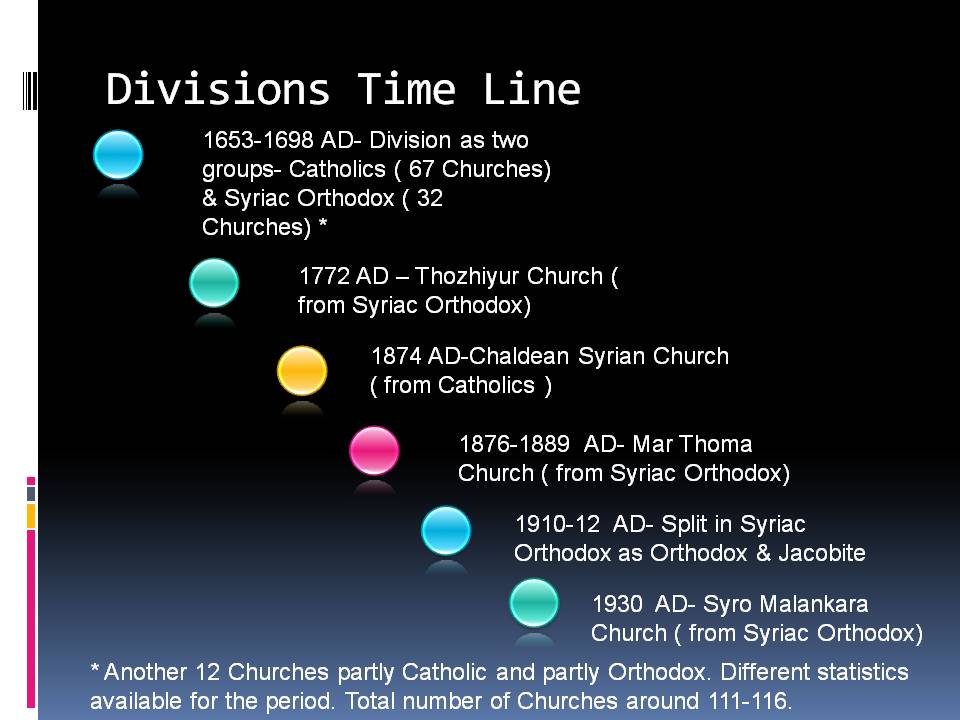
Sebastiani came back in 1661 as Bishop and Administrator of Cranganore. Bishop Gracia SJ had already died in 1659. Between 1661 and 1662 the Carmelites, got around eighty-four churches, leaving only thirty-two churches to the Archdeacon Thomas who was ordained as Mar Thoma 1. The author doesn’t know how “partial control ” churches are included in this list. (( Catholic Encyclopedia- “St. Thomas Christians”- Carmelite Period ))
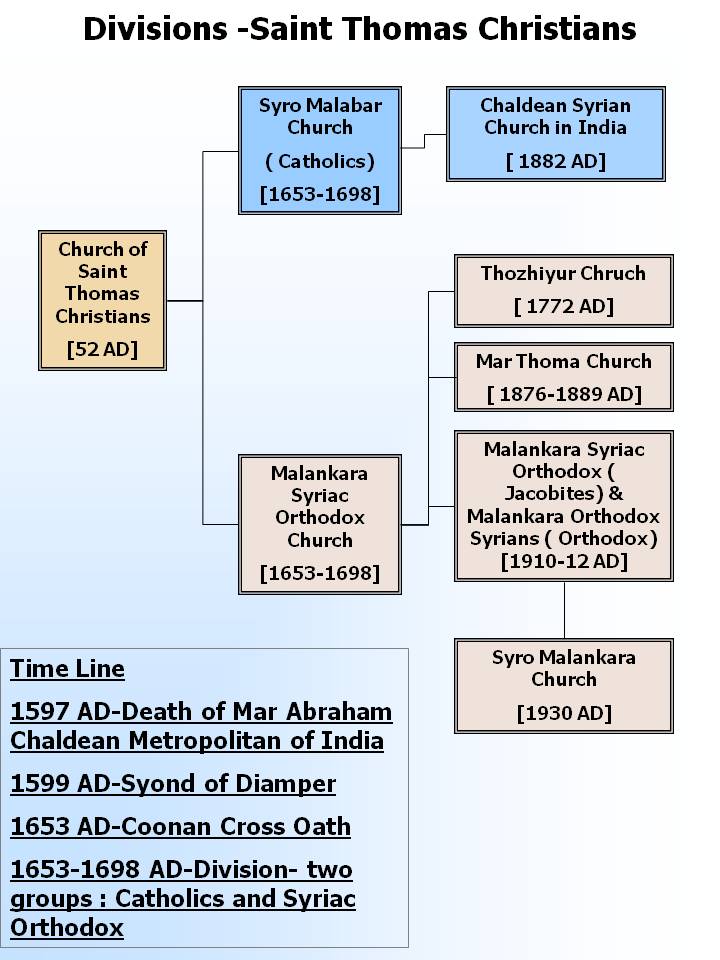
Based on this, these 84 Churches and their congregations where the body from which Syro Malabar Church have descended and the other 32 Churches and their congregation where the body from which Syriac Orthodox and their subdivisions Mar Thoma Church ( Reformed Syrians-1876 AD), Orthodox- Jacobite Split ( 1910-1912 AD), Syro Malankara Church ( 1930 AD) have descended. Chaldean Syrian Church ( from Catholics- 1874 AD) and Thoziyur Church ( from Syriac Orthodox- 1772 AD) has less population since there formation.
The Dutch defeated the Portuguese and captured Cochin in 1662 and forced all other Europeans to leave Malabar. The Carmelite Bishop Sebastiani had provided a list of eighty-four churches as under them to the Dutch Governor.Bishop Sebastaini, then consecrated Alexander Parampil as the Bishop. Fr. Matheo, who was a botanist, gained the favor of Dutch government and stayed back in Malabar.
In 1665, Mar Gregorius a Bishop send by the Syriac Orthodox Church of Antioch arrived in Malabar and was received by Mar Thomas I.
In the mean time, two new terms, Pazhayakuttukar to represent Catholic Syrians and Puthankuttukar to represent Jacobites also emerged. According to Paulinus of Saint Bartholmew, these names were already existing before the arrival of Mar Gregorius from Syriac Orthodox Church, that representations were already sent to Rome and that those who had decided to abide by the decision of Rome were called Pazhaykuttukar and others as Puthankuttukar.
In an another report, which was send to Propaganda by two Carmelite missionaries in 1698 AD, mentions that Syrian Christians as a whole had 107 parish churches and four other churches which were not parishes, thus making a total of 111 Churches. Of these, 67 belonged to Catholics: 32 belongs to the Syriac Orthodox: and 12 were partly Catholic and partly Orthodox. (( APF, Congregationi Particolari, Vol.30,f.807 ))
Succeeding centuries were eventful among both the Syriac Orthodox Jacobites and Catholics with periodic efforts for unity.
10.1 Succeeding centuries Among the Syriac Orthodox (Jacobites)
The Jacobites were governed by the successors of Mar Thomas I. Mar Thomas I was followed by Mar Thomas II, Mar Thomas III, Mar Thomas IV, Mar Thomas V and all related to Mar Thomas I and to one another. The Jacobites of India also received Bishops from Syriac Orthodox Church of Antioch. In 1676, Mar Andrew Alveus and in 1685 a Catholicos Mar Basil and Mar John came to Malabar. In 1741 Mar John came from Jacobite Patriarch. In 1751 Mar Basil, a Catholicos and Mar Gregory and Mar John came to Malabar. Mar Thomas VI succeeded Mar Thomas V in 1765. Mar Gregory and Mar John consecrated Mar Thomas VI as Mar Dionysius I.
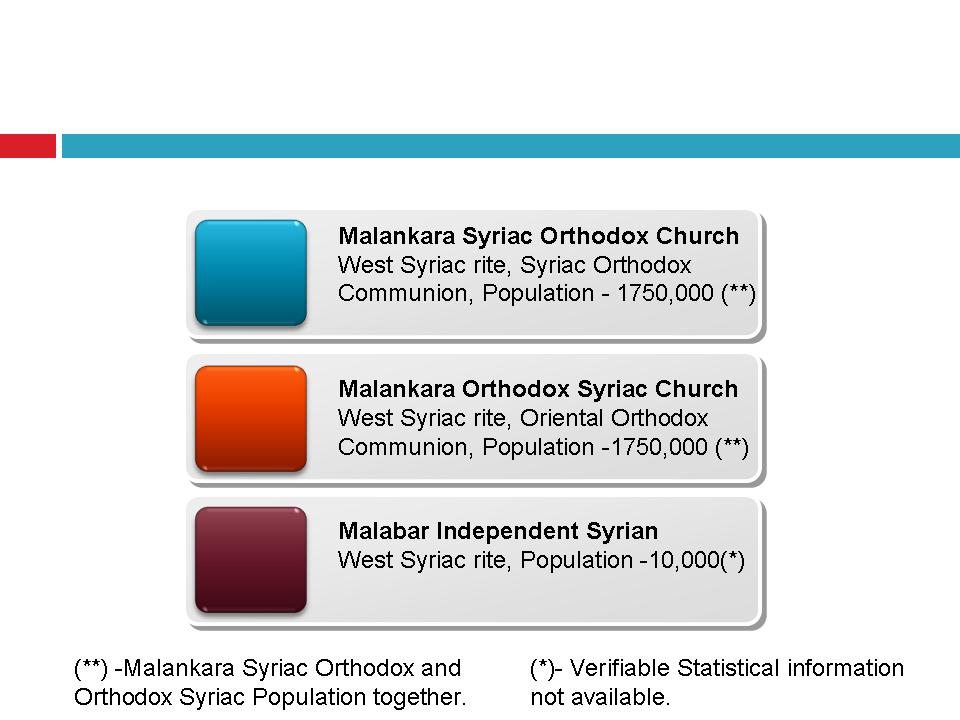
In course of time, the Syriac Orthodox Jacobites of India was eventually administered as an autonomous church within the Syrian Patriarchate. They gradually adopted the Western Syrian language and Antiochene liturgy.
The Anjoor ( Thozhiur) Church known today as Malabar Independent Syrian Church originated at the year 1772, when Mar Cyril was expelled from Travancore and Cochin by Mar Dionysius I. Mar Dionysius I was followed by Mar Thomas VII. He died in 1809 after having instituted his successor Mar Thomas VIII. Mar Thomas died in 1815 and was followed by Mar Thomas IX.
All the prelates from Mar Thomas I to Mar Thomas IX were related to one another. In 1815 an influential priest Rabban Ittoop got himself consecrated as Mar Dionysius II at the hands of Mar Philoxenos, the then Bishop of Anjoor Church. With government help he deposed Mar Thomas IX and took control. The same Anjoor Bishop again consecrated the Vicar Generals of Mar Dionysius II as Mar Dionysius III. The Anglican missionaries became very influential among the Jacobites during the regime of Mar Dionysius III.
Mar Dionysius III died in 1825 and Mar Dionysius IV succeeded him. To oppose the Protestant doctrine, Mar Dionysius IV got down Mar Athanasius from the Jacobite Patriarch. But he wanted to depose Mar Dionysius IV and the bishop of Anjoor and become the sole ruler of Jacobites of Malabar. He was deported from Malabar. The Jacobites and Anglican missionaries parted ways in 1837 after negotiations and some 6000/12000 Jacobites joined Anglican Church. They remained as a separate entity until they joined Church of South India.
The Jacobites friends of Anglicans were entertaining the desire to reform the Jacobite Church in Malankara according to the doctrine and practice of Anglican Church. They send a deacon, Mathew to the Jacobite Patriach. He was consecrated as Bishop Mathew Mar Athanasius. With the credentials of Jacobite Patriarch he reached Malabar in 1843 and proclaimed himself head of the Jacobites of Malankara. Mar Dionysius IV, informed the Patriarch about the Anglican tendencies of Mathew Mar Athanasius. Mar Qurilos was send to Malabar by Patriarch with blank papers. Mar Dionysius IV died in 1855 and Mar Qurilos was ordered to leave Malabar. Mar Stephanos also came from the Patriarch. Mean time Pulikottil Joseph, a priest who was managing suit against Mathew Mar Athanasius was consecrated by the Patriarch as Mar Dionysius V.
Mathew Mar Athanasius died in 1875 and his successor Thomas Mar Athanasius carried on law suits against Mar Dionysius V. Finally Mar Dionysius V got victorious and others, therefore formed an independent church, the Malankara Mar Thoma Syrian Church ( the reformed Syrians) , which introduced many doctrinal and liturgical changes of a western Protestant character.
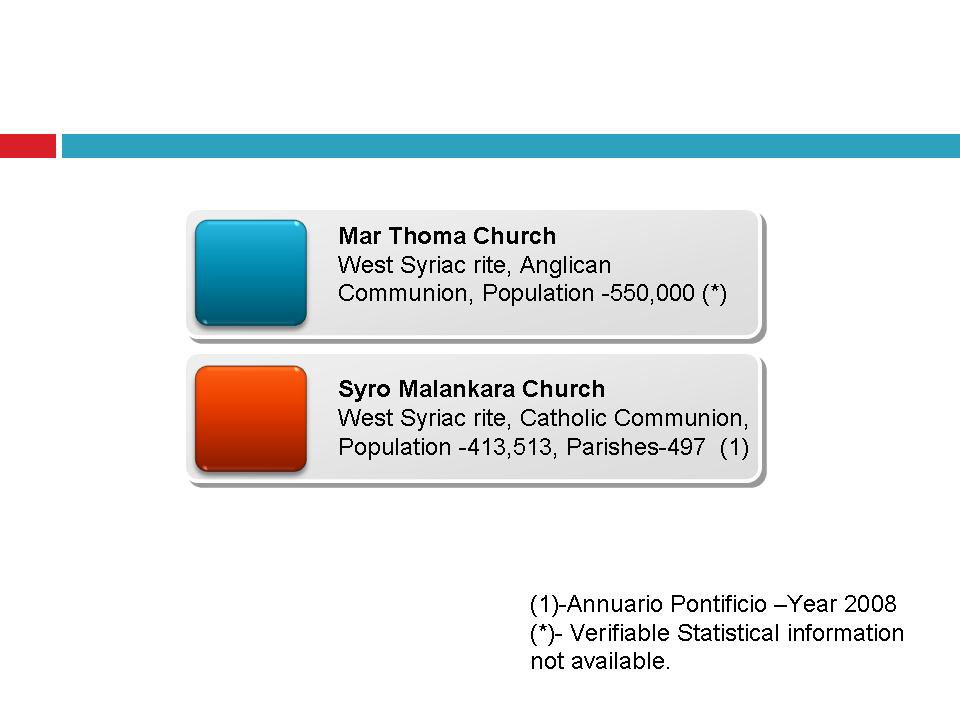
In 1912, there was a split among the Indian Syriac Orthodox Jacobites which resulted in two parties the Bishop Party and the Patriarch Party. The two sides were reconciled in 1958, but again split happened by the actions initiated by the Syriac Orthodox Patriarch in 1975. In the 1995 judgment of Supreme Court of India, it has been ruled that there is only one Orthodox Church in India and it is split in to two factions. These are known as Malankara Syriac Orthodox Church and Malankara Orthodox Syriac Church.
In 1930 the Syro-Malankara Church came into being as an Eastern rite of the Catholic Church when some Jacobites under the leadership of Mar Ivanios united with Rome; they continued the use of Antiochene liturgy.
10.2 Succeeding centuries Among the Catholics
The Catholic Syrians were ruled by Mar Parampil Chandy ( Alexander de Campo) . In 1674, he requested Rome to elect a coadjutor and proposed his nephew, Mathew for the position. Carmelites arrived in India in 1676, with special Dutch passports ( as Dutch wont allow any other European to work in their areas) and they were asked by Rome to elect an Indian. They elected Raphael Figueredo in 1677, who was not a Syrian Catholic but born as an Indian in the sense that he was a half caste Portuguese. This election shook the confidence Syrian Catholics had in Carmelites and quarrels started to arise. Bishop Raphael Figueredo was later suspended and Custodius de Pinho was appointed as the Vicar Apostolic in his place. Mar Parampil Chandy died in 1687. Raphael Figueredo and Custodius de Pinho died in 1695 and 1697 respectively.
In 1694, the nephew of Mar Parampil Chandy, Mathew was nominated as the Archdeacon under Padroado. In 1700, Angelus Francis was nominated as Vicar Apostolic of Malabar under Propaganda. Since no Portuguese Bishop would give him Episcopal consecration, he was consecrated by a Chaldean Bishop Mar Simon of Ada who arrived in Malabar. Ribeiro SJ was nominated as Archbishop of Cranganore in 1704. In 1704, many Catholic Syrians met at Kaduthuruthy and manifested their desire to be under Carmelites. Archdeacon Mathew and party was against Carmelites but all were asking a Bishop of their own rite. Catholic Syrians were given permission to pass under Propaganda, if they disliked the Padroado. Another Chaldean Bishop Mar Gabriel came in 1709 and some 22 churches of both Catholic and Jacobites joined him. The churches under Padroado was comparatively enjoying peace in consideration to churches under Propaganda jurisdiction. The representatives of 73 churches under Propaganda met at Angamale and they had a mind to reinstate the ancient office of Archdeacon. The Carmelitie Visitor Apostolic Lawrence Justiniani rushed to the place and put his signature on all their proposals except one.
Mar Cariattil Thomas ( Prelate 1782-1786), Paremmakal Thomas and Sankurikal George were Administrators under Padroado. After Mar Cariattil’s death Paremmakal became the administrator of Cranganore. Under him the representatives of all the 84 Churches assembled at Angamale and executed the famous Angamale Padiola.
When Paremmakal was living a deputation went to Chaldean Patriarch and one of them Pandari was consecrated as Bishop and send to Malabar. After the death of Paremmakal, Kattakkayam Abraham was elected as Administrator and Mar Pandari came out as his supporter. Sankurikal George was appointed as administrator in 1800. While Paremmakal was the Administrator of Cranganore, all the Catholic Thomas Christians were under him, ie under the Padroado jurisdiction. After his death they again began gradually divided between Padroado and Propaganda jurisdictions. This continued till the suppression of the Padroado jurisdiction in 1838 and when all came under the Propaganda.
In 1802, Propaganda nominated Guriel Mar John, the Chaldean Bishop of Salmas as Visitor Apostolic of Malabar to pacify them. In 1861 Mar Rokos Thomas came to Malabar and began to exercise jurisdiction. Fr.Chavara persuaded Mar Rokos Thomas to go back and accompanied him till Cochin where he took a ship to Basora in 1862. The Churches that had followed Mar Rokos Thomas were allowed to choose between Propaganda and Padroado ( restored) jurisdiction. A priest named Thondanatt accompanied Mar Rokos to Mesopotamia and he was consecrated at the hands of rival Patriarch ( Assyrian) and returned to Malabar. After coming back he started living like a priest. Mar Mellus Elias came to Malabar in 1874 and some 30 Padroado and 2 Propaganda churches followed him. Mar Abdiso Thondanatt also joined Mar Mellus Elias. Another Bishop also came from Chaldean Patriarch, named Mar Jacob and he went back to Mesopotamia chiefly due to the efforts of Nidhiry Mani Kathanar. Mar Mellus Elias was forced to go from Malabar in 1882 and before going back he entrusted his followers to Mar Abdiso Thondanatt and to Augustine ( a Chaldean Corepiscopus who had come to help Mar Mellus Elias) and in 1908 they received a Nestorian ( from the rival line Patriarch ) bishop, Abimlech Mar Timotheus and those who followed began to be known as Chaldean Syrian Church.
In 1887, two Apostolic vicariates of Kottayam (Changanacherry) and Trichur were created for Syrian Catholics.
11. Few Indian Origin MSS prior 16th century
Before the Syond of Diamper of 1599, there were many Syriac MSS in India, which contained extensive biblical, liturgical and patristic literature. The Syond how ever ordered the destruction of books and this order was actually carried out at Angamale, Chinganore and elsewhere. (( Mingana-“ The early spread of Christianity in India” ))
The following are a list of the surviving Indian MSS which has been preserved in various libraries as mentioned. This list is incomplete.
a) Codex Syriac Vatican N- XII– It contains a Church Lectionary of the Pauline Epistles. The Colophon gives the date that it was written in 1301 AD.
b) Codex Syriac Vatican N- XVII– It contains a Syriac New Testamnet written by Jacob, Metropolitan of India, in the town of Shingala ( Cranganore) in the Church of the Aposlte Thomas on a Thursday in the year 1510 AD
c) Codex Syriac Vatican N- IV– It is the book of the Prophets written on 18th February in the year 1556 AD by a priest Jacob, the disciple of Mar Jacob at the Church of Mar Shapur and Mar Yapot ( Piruz ?) at Phuraor.
d) Two Syriac MSS– Written in India by the Metropolitan Joseph in 1557 AD which containes the Synodical Canons of Addisho and the prayers of the novices .
e) Codex Syriac Vatican N- II– This holy book of New Testament was finished in the Church of our Lady Mary, the mother of light and life in the blessed town of Angamale on May 1558.
f) Codex Syriac Vatican N- III– Book written by George at the Church of our Lady Mary, the mother of light and life in the blessed town of Angamale on January 1558
g) MS Cod. Syr.Vat XXXV– This is dated 1562 written by Simon, son of Simon at the Church of our Lady Mary, the mother of light and life in the blessed town of Angamale.
h) Syr. MS No- 25 of Paris– This is written in 1504 AD after the arrival of Bishops from Mesopotamia.
12. The Nasrani People
In early Sixteenth century writings Christians of Malabar, appear to have spread over all the Kingdoms and principalities from the Southern portion of the territory of Calicut up to the northern half of the lands of the Quilon and to some extent even beyond that limit up to Cape Comorin. There were also Christians in Mylapor and Coramnondal Coast as attested by the traditions of Saint Thomas Christians.
They were found in greater numbers in certain localities and therefore these places came to be called as Christian localities and Cranganore and Quilon are two of them. The Majority of the Christians lived in interior regions called by the Portuguese the “Serra” and hence the Christians of Serra was the synonym for Thomas Christians in contradistinction from the new converts. The principle localities mentioned by some early sixteenth century Portuguese writers as Christian localities are Palyporam ( West of Vaikkam), Arretomto ( probably Arratungal), Maleas ( Malayattur ?), Turubuli ( Thodupuzha ?) , Maota ( Cherthala) , Batimene ( Wenmani) , Porca, Travancore, Pimenta, Tecancute, Paru, Cortute, Cartute ( Kaduthuruthy), Angamali etc. ((Mundadan-“ The Arrival of Portuguese in India and Saint Thomas Christians under Mar Jacob” ))
Some details are also mentioned in the letter send by the metropolitan Mar Jacob to the Chaldean Patriarch in 1504 AD after the arrival of four Bishops in Malabar. It states that “ The country in which Christians were living was called Malabar which had twenty towns, in all of which Christians lived with churches built in them. The three important of these towns were Crangol (Cranganore) , Palor ( Palayur) and Colam (Quilon). Nearby was the great and rich town of Calicut where idolaters were living. The Christians had abundance of everything and were meek and peaceful. Just previously they had begun to build new churches and some of them had taken up residence in Mailapore ( which was 25 days journey from Malabar, on the sea shore on the province of Silan, which is one of the province of India), with the intention of restoring the “House of the Holy Apostle Thomas” which is in that town.”
In the 1604 report of Bishop Francis Roz, the miracles associated with the churches of Palur ( Palayur) , Enamaque ( Enammakkel) , Mattam, Mattancher ( Mattancheri) ,Xaregate (?) , Balianate ( Velayanadu) , Mangate ( Alangad) , Paru ( Parur) , Corlengate ( Kuravilangadu) , Molandurte ( Mulanthuruthy) , Caramatete, ( Kadamattathu) Colingere ( Koanchery) , Muttam, Angamale are mentioned.
Bishop Roz ( 1604) , also distinguished five communities on the basis of the settlement of the Mylapore Christians in different places on the Malabar coast after their dispersion. These are Cranganore, Quilon, Todamala, Depur and Travancore Coast. Of these only the first two group kept their faith in some way or other while the others got lost to Christianity in the course of time. (( Mundadan-“ Sixteenth century traditions of Saint Thomas” ))
13. Nasrani People Today
Nasrani people today belong to various Christian denominations of the Saint Thomas Christian tradition belonging to Catholic, Orthodox and Protestant churches.
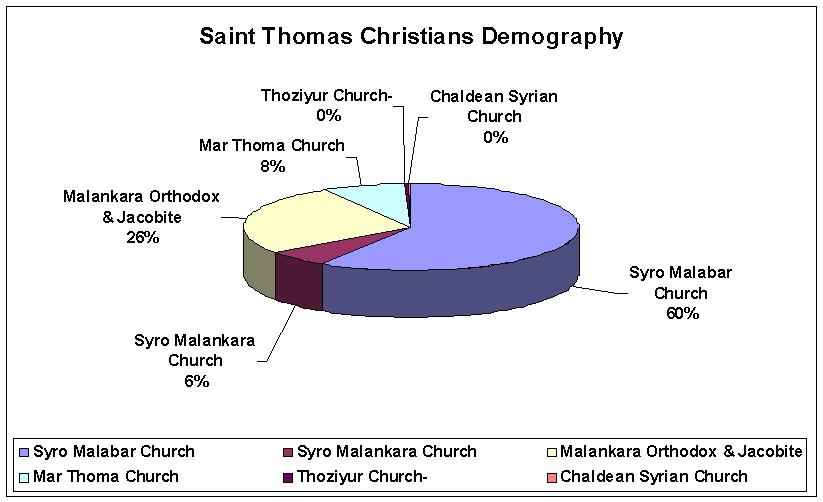
Nasrani people largely live in the districts of Kottayam, Ernakulam, Trichur, Tiruvananthapuram, Pathanamthitta, Alapuzha and Idukki in Kerala State. They have also migrated to other cities in India like Mumbai, Bangalore, Delhi etc. Others have migrated to the United States or work in the Middle East. Based on the Indian census report of 2004, there are presently approximately 5,000,000 Syrian-Malabar Nasranis from across the various denominations within the Nasrani community. Many Nasrani people own estates and engage in trade of rubber, spices and cash crops.They also take a prominent role in the educational institutions and healthcare institutions of Kerala and throughout India.
________________________________________________________________________________
Author can be reached on admin at nasrani dot net
Last Update: July 15, 2009
___________________________________________________________________________
The Nazarenes must recover and have their customs and traditions once again. THe purpose is to witness for other non Christians and Christians
Good compilation. Wonder why All Syrian churches today try to neglect the Nazraney name.
Nazarenes must unite.The early traditions and connection with the Apostle St. Thomas invokes interest in the history of these ancient body of Christians arises from more than one feature globally.
It is really sad and pathetic that the belivers of this community are divided based on the petty egos and divide and rule policy of methrans and thirumenis who doenost care about anything other than running businessess.
A very fair and impartial collection.
I must add that Jewish that the Jewish roots of Nazranis of kerala was lost during the Portuguese inquisition.
The inqusition in Europe was as much against Islam as aginst Jewish faith and whatever it represents.When the Portguese imported the same to India to tame the Nazranis it became more violent as it was for a period of time the uncalleged Imperial power in the old Kerla.I wish more research is done on this aspect.
great.good work.
Thank you for this site. I complted a doctoral work on this history.
Look forward to some contact!
JTM
We should preserve our traditions.
Christianity originated in the East. Westerners should not lose sight of this fact. Jesus carried out his ministry in the Middle East and most of the Apostles were martyred in the East. Even Saint. Peter and Paul established numerous churches throughout the East before dying in Rome. As Christianity grew and flourished, the churches planted by the Apostles in the East grew into the great Eastern Christian Tradition. It was in the East that the first seven Ecumenical Councils were held.We are part of the great Eastern traditions and we should preserve our traditions at any cost.
Can you give me some details about the seven very ancient Jewish Settlements in Kerala,prior to the arrival of St. Thomas in Kerala?
Dear George Nidhiry
Churches of St. Thomas (it will be better to call them villages where Christian faith was preached by an ancient man) lies along a trade route.
1. Starting from eastern sub port of Muziris at Chettuva lake (Palayur church is located on the shore of this lake)
2.then Maliyankara (it is doubtful whether Maliankara existed at that time. It does not matter at all as it could be at Kottuvallykad or Kuriapilly or Kottakavu which are parts of Maliyankara township) on the southern shore of river at Kodungallur
3.Paravur a few Km west of Kuriapilly, inside the ancient Muziris port
4.Kokkamangalam on the shore of Vembanad lake which has connection with Kodungallur lake
5.Niranam on the outskirts of Ancient Melkinda Trade Centre of Pandia Kings
6.Nilakkal near Sabarimala on the Melkinda-Madurai land trade route.
7.Quilon, the port city
Dear Rev. Dr. John T Mathew,
I’m interested in knowing more about your doctoral work on this history. Where can I find more info.? Is there an email address I could contact you on?
Thanks,
amprayilusa[at]gmail[dot]com
HI,
As I am a St thomas christiam (marthomite), i am tried to figure out the jewish decentent(nasrani) or early christian immigration mentioned in the article, deals with knayaya people only or St thomas christians?
I personally felt some of the people in our group or some our grandmothers does not really seems indian because of their features such as fair color, eye color which these people probably married to dark or brown like husbands.
These day it makes me thinks of these historical facts about immigrated people merged with indian people or converted other races like brahmins to christanity. Basically what i am tried to figure out that early christian immigration only deals with knayaya community or is it people among in St thomas christians? please sent me a reply.
thanks
what all are the evidances for st thomas coming to india?
Dear All,
After reading all the above comments I dare to give below some thoughts on the subject.
Originally Jesus prohibited the disciples to proclaim the gospel to the gentiles but only to the “lost house of Israel” (Matth.10:5).
Later on when the door was finally opened for the gentiles still the first preference all over the world was given to the Jews. The pattern was “to the Jews first and then to the gentiles”. (See Acts13:46, Rom 1:16, 2:9-10, 3:2).
Today even the most organized ecumenical churches state that the “primitive” Christianity was different from any of today’s church. The primitive Christianity was known as Apostolic Christianity or more correctly Judeo-Christian faith.
Initially the Judeo-Christianity was never considered as a separate religion but as a “heretic” sect within Judaism. This sect was named “Nazarenes” (nasranis in Malayalam) by the jews (Acts 24:5).
Thus we can see from the Biblical history that the nasranis were the converted jews!
There are several historical records to show that jews settled in India even before the time of Christ. But no body has mentioned this fact as mentioned even in the Bible!!
Read Esther 8:8-9. This was during the reign of the Persian king Xerxes who reigned during 485 to 465 BC.
”You may, however, write to the Jews whatever you like………. this happened on the twenty-third day of the third month, the month of Sivan. Mordecai called the king’s secretaries and dictated letters to the Jews and to the governors, administrators, and officials of all the 127 provinces from India to Ethiopia. The letters were written to each province in its own language and system of writing and to the Jews in their language and system of writing.”
This was a multi-ethnic and multi-linguistic empire with 127 provinces that spanned from Ethiopia to India (See Esther 1:1).
Of course this India is today’s Pakisthan. These jews came to India through the land trade routes existing at that time.
The Bible also hints about sea trades between India and Tyre during King Solomon’s reign (900BC).
Every three years ships from Tarshish and Ophir came to Aqaba where King Solomon had a big port (1 Kings 10:11,22).
There is no conclusion as to the exact location of Tarshish or Ophir. But wherever these could be, the ships came along the coasts of India.
Because among the items brought by these ships are mentioned peacocks, apes, ivory and almug trees (1 Kings 10:11,22). Even if we concede that ivory and apes can also be brought from Africa, the peacocks are found in India and almug tree (sandal wood) are found only along the Malabar coast.
Let us read what International Standard Bible Encyclopedia says about almug tree: “it was evidently a fine, close grained wood, suitable for carving. Tradition says that this was the famous sandal wood, which was in ancient times put to similar uses in India and was all through the ages highly prized for its color, fragrance, durability and texture. It is the wood of a tree, Pterocar pussantalinus (N.D. Santalaceae), which grows to a height of 25 to 30 feet; it is a native of the mountains of Malabar”(ISBN).
Only sandalwood can qualify the Bibical description of 1 Kings 10:12.
The jews and eventually, centuries later, Thomas came to Malabar coast through these sea trade routes.
So much for the descriptive history. Let us focus now on analytical history.
Why should Thomas come to Malabar coast unless there were Hebrews living here. All historians agree that Christianity spread in a very fast way because of the Jewish Diaspora through out all the known world.
If there were no Hebrew people it would be impossible to convince and teach the concepts of monotheism, sin, conversion, inner morality, Messiah, Kingdom of God, repentance and righteousness etc, the basic tenets of Bible, to foreign people.
The Jews were the spring boards for spreading Christianity. See Acts 15:21. See also that Paul could not make much advance among the Stoics and Epicureans in Athens in spite of Jews there (Acts 17:21).
Why should the Nasranis keep the Syriac language instead of the native language for 1900 years unless……?
This is a very important question. Instead of translating into the native language the nasranis kept the Syriac which shows that the early nasranis were Jewish and Persian Syrians!!!
So I could prove that
1) the primitive church was Judeo-Christian in customs and traditions in Jerusalem as well as in Kerala; that
2) earliest Christian converts were Jews called nasranis in Jerusalem as well as in Kerala; that
3) Thomas came looking for Jews in Kerala; that
4) Syriac was mother tongue for the Jewish and other migrants from Persia who settled as Kerala nasranis.
Or I could be wrong.
By the by, dear Nasrani, could you provide the proof that Syrian Christians used to keep the Saturday liturgy?
Early Christian Converts
Who were the early local Christian converts in Kerala when the Apostle Thomas came there? The first converts were of course the Jews who were settled in Kerala in the previous centuries because it is for them that Thomas came to Malabar. Who were the other local converts? We know from the Bible that God and Jesus Christ never discriminated people based on the color, class, caste, wealth, sex, social status etc. Thomas also would not do the same.
However certain practical elements would have made a BIG difference in conversion. If you go through the Bible one thing becomes clear. The Bible is mostly addressed to those who could read and write! This is not discrimination from God’s part but a practical blockade made by man himself.
All the prophets were men of learning. It is a common erroneous thinking that God’s people were all illiterate and uneducated. True, God often calls simple and humble servants but that does not mean that they are ignorant! For example Bible says “Moses was instructed in ALL the WISDOM of Egyptians and was powerful in WORDS and in works” (Acts 7:22) [emphasis added]. Many books of prophets especially Isaiah are considered among the best in the world of literature because of its language, literary style and grandeur. David’s psalms and Song of Solomon are still considered to be an inspiration for many poets. For example, consider many Malayalam devotional songs. Most of them are inspired by the Psalms.
All the apostles as well as the early Christians could read and write. All the epistles of the apostles were addressed to people who could read and write. Just like Moses, Paul was also a great man of learning. He studied in the most famous Jewish school of the first century; that of Gamaliel (Acts 5:34, 22:3). Paul knew his native language of Syriac as well as Greek (Acts 21:37) and Hebrew (Acts 21:40). Some scholars believe that he knew Latin as well since he was a Roman citizen. He knew secular Greek poets (Acts 17:28).
The earliest converts also could read and write because the Bible says that when the gospel was proclaimed in Berea in Greece the converts checked the Bible daily to prove it (Acts 17:11).
Most of the paintings of the apostles made by men show them as old and dirty. But the fact is just the opposite. Some of them were from well to do families. For example John and James, the sons of the Zebedee were comparatively from rich family as the Bible says that their father had “hired servants” (Mark 1:20). Whether rich or poor all the Jews are supposed to know reading and writing so that they can read the Bible daily and especially on Sabbaths (2 Timo.3:15).
Also remember, whenever Jesus was talking to the public He always said “it is written” to make authentic claims. That makes clear that His listeners knew the writings. Often He asked “what is written in the Law, what you read?” (Luke 10:26), “Did you never read?” (Matth.21:16). He told His opponents “you err because you do not know the scriptures” (Matth.22:29). It had been the Jewish custom to teach literacy to its followers so that they could read and meditate the scriptures. The Nasranis also made the same custom by making “pallikkoodams” along with the “pally” or church and hence Kerala’s literacy.
So if we know who could read and write when Thomas came to Kerala in the first century we will come to know who the first local non-Jewish converts were! Did ONLY the Brahmins know the art of reading or did other castes and classes know it?
History says that early Christians were reading the Gospel of Matthew in Hebrew (Syraic?) as well as the Syrian Peshitta Bible!
I am a Jacobite Syrian Christian.
Some of my mother’s side and father’s side are having fair colours and some are dark in colour and stoutly built figures.
Some women from my father’s side look like the women from Egypt.
I heard in the childhood my Father saying that his Grand Parents took wives from Brahmin families and the family name is thus came as “Kandissery” .They were business people making “Kopra” and oiling them.
From their colours and healthy figures, sometimes I feel that some Ethiopian jews also have intermariaged with the Brahmin families during the period after their arrival at Kerala.
I read in the internet sites that some black jews also came from Ethipia over to Kerala.
Any way, I am trying to get the exact history of my family background but away from home state due to governement service it is getting delayed. I am proud of being a syrian christian and still keeping the old tradition.
Lot of research is needed in this connection to know more about this traditional christianity.
Kindly inform more about “Syrian Christians”
Thanks,
Aniyan
.
To Mathew,
I am still not convinced the realistic possibility of your Grand father being weded a Brhamin since the said event is very ‘recent’. Even if assuming that you meant a great….(n) grand father I am still skeptic mainly due to my own experience given below:
My well respected, but not formally well educated uncle once said a similar thing which ofcourse he belives as truth, but most probably comes from the anicient propoganda that we were Namboodhiries.
Similarly even now some of the pious Roman Syrian cathoilc believe that “kantheesangal” always meant for Ss Gervasis and Prothasis of Milan. Infact Kantheesangal initially meant in Kerala for Sabor and Proth of Syria.
Coming to color:
I can safely say that none of the fair colored persons are purely Dravidens, otherwise they would have appeared similar to Tamilians.
Nazranis are now basically concentrated from Thrissur distrct to southwards.
Kottayam and Thrissur are basically Nasrani dominated areas.while Kochi(n) is concentrated with Latin Christian.
I heard about some “munnoottikkar”300ers and “Anjoottikkaar” among them.those goans,mangaloreans to kanyakumari down southwest coast are Latin catholics.
The problem in latin dominated areas are Nazaranis face a culture change with mixing with Latin.
This is a big problem in Ernakulam district especially-both syrian catholics or Orthodox/Jacobites etc faces this decay.
We shud make syrian christians in Ernakulam areas aware of our (Nazerenes)culture and traditions and stop mix marriages.Basically Ernakulam/Kochi Syrian Christians are those from Thrissur district.
Also the last census(source will post later) shows that Syrian Christians are facing Farzy(Parsis) Syndrome.where we are lossing our numbers. 🙁 wake up and keep our traditions.
Also there may be valuable Syrian Christian records been kept in Goa.
If Syrian Christians are believed to be a mix of the converted local people by St. Thomas the Apostle including the Royal family, the Jews, the Nambudiris and the migrated Christians from the Persian Countries,
My idea is that people still look like very fair complexion,brown hair and brown eyes other than black .
Therefore i just want to say that it probably happened like jews or perisian immigrants were married to any dark colored people together it seems a brown or just light complextion so that others cannot find out that they were jews or persian that came from other place due to persecuation or they don’t want to seem themselves foreginers in the new land
If they were plenty of brahmins converted i cannot find any influence of sanskrit and vegetarianism in our chiristian communities.
Anyway these articles give me a new perspective towards our christianity.
Thanks
I am intrigued by the debate, both informed and uninformed about syrian and Latin rites. This, I beleive is unnecessary.
However, I am in the process of re-consntructing the history of Thachil Mathew Tharkan, one of our ancestors. I come across mostly with only flatteries written about him. I am looking forward to getting some advise and direction about the possible materials that I can lay hands on to write the piece more objectively, wihhout euologising his virutes. He as a man, trader, advisor to the king as it is found in some literature etc
Dear Joseph
There is a book titled “Thachil Mathu Tharakan “ written by M.O. Joseph Nedumkunnam published by NBS.
Thachil Mathoo Tharakan is well remembered on his attempts at reunion of the Syrian Christian communities. He was a triumvirate of Travancore Government in 1800, was a trader and influential Christian leader.
Hope the above book might help you.
We are believed to be Dravidians as South Indians, but I have been noticing a phenomenon that many Ammachis and Appachans of our families, at least one of them have some non Dravidian features like long face , being tall, different eye color (pucha kannu).
I have seen families which their sons and daughters, some of them incredibly look black and some look very much fair.
This is because their parents, one of them look dark or other look fair
Like Nidhin Olikara said, we all look same but when I stand close to that some people I noticed some of their hair seems brownish naturally and it also happened on me too.
Also any dark color person among our community may not be a pure Dravidian
Therefore, other than being Dravidian ,there can be some other blood mixed among us .
It can be Brahmins mix and I never even seen any Brahmins for real or any Tharavads close to my hometown or any traditions been practicing and any information as Brahmins decedents .
It can be ancient Aramaic Israelites who mixed when they were settled in Kerala and become Christians by St Thomas.
I don’t think that Israelites or Persian immigrants from middle east didn’t have any ego facts to stay away from converted people .
We don’t know that knanaya people are in pure blood because their endogamous tradition actually does not seems to me as pure Syrians.Some of them told me that they have tradition like mylanchi for bride and special bathing tradition for groom. Where they get mylanchi in Syria if they brought that tradition from Syria .
And for their marriage they have also minnukettu. These traditions can be a best fit in high cast Hindu culture.
Again I have seen knanaites with dark complexion.
I searched websites showing Ethiopian Jews, if we look at them we cannot find any much differences between other Ethiopians . Also I got some Ethiopian friends in orthodox Christian belief. They have same church traditions like we have and the priest and bishops look same like ours. Their language is Amharic which they say that this language was spoken at the Jesus time.
Anyway I have been thinking about these facts since long time even before I visited this website and I cannot confirm anything without any solid proof therefore I can be wrong.
Again NSC site helps me a lot.
Thanks
Dravidians are not necessarily all that dark in complexion. Do not identify the dark castes in South India with Dravidians and all fair castes with Aryans. All castes, especially in South India are mixed. Much of the blood of darker castes or ethnic groups (e.g Tamils) is from negroid aboriginal tribes living here before the arrival of Dravidians. There is a theory that Dravidians are related to the ancient Mesopotamians. Dr Father Placid Podipara draws some interesting comparisons between Dravidians and Semitics. (E.g. compare “Ur” of Abraham the patriarch with “ur” in Darvidian mainly found in place name suffixes like Trichur).
There is a wrong notion that ‘Knanayas and Parsis’ are !00% endogamous. This is not true. They are generally endogamous. One can easily notice mixing. Ofcourse, the mixing won’t be admitted easily but ultimatly it will be admitted, often through humour.
I am doing one web site about syrianchristians, Is it possible to take some part of article form this site. Let me know about it
“Syrian Christians are believed to be a mix …….later amalgamated in to one patronized community known differently as Nasrani, Malabar, Malankara or Syrian Christians.” >
Can I get more evidence on this?
Dear Kessy
Did you read all the articles ? If not please do so.If you dont care to do so, i can articulate for you when i have mood and time.
There are some mentioning of a Manikka Vachkar, a shaivite scholar reviving Hinduism in Kerala. What period was this revival and to what extent it was successfull ?
“Christianity came to India long before it went to England or Western Europe, and when even in Rome it was a despised and proscribed sect. Within 100 years or so of the death of Jesus, Christian Missionaries came to South India by sea. They were received courteously and permitted to preach their new faith. They converted a large number of people, and their descendants have lived there, with varying fortune, to this day. Most of them belong to old Christian sects which have ceased to exist in Europe.”
Jawaharlal Nehru – Glimpses of World History (1934)
I am looking for a copy of Cochin State Manual.Can you guide me where can i find it.
Thanks
Dear All
This article gives an impression that all the problems are creation of colonialists and it doesnot give a consideration of the contributions by colonialists.In fact the inside leaders of Nasranis played major role than Colonialists in all the divisions and supressing that is not a good approach.
Thankyou for this wonderful write up. This site give me a very decent understanding about St.Thomas Christianity. I have a question on the usage of the term ” Syrian Christians” . I understand “Nasrani” is the old and widely used term to refer these Christians, When did the term ” Syrain Chrsitians” came in to usage ?
On Malabar / Malankara terms
I understand Malabar is the term used to denote people in this coast or in general terms to refer the people of all modern Kerala from ancient time.It is seen in Syriac writings and is there any other reference in the first century on the usage of the term Malabar.
Malankara term derived from the township of Maliyankara around the south of the river periyar.It is belived that its one of the ancient settlment of nasranis.Again the Maliyankara township could have been developed only in end of first century .
My question is about the usgae of both the terms among Nasranis. Syro Malabar and East Syrian traditions churches use the term Malabar and the churches with West Syrian traditions use the term Malankra.
Is there any specific reasons for this ? Has this also been developed to create unique identities as a measure to divide the people.
Please enlighten me. Can some more info be provided on St Thomas relics and transfer to Edessa.
my dear friends, it is clear now that Christians in India are not the invention of rome.
it is the time to recapture the beliefs individually, later it will be collected as a group. the Christians in India will emerge to its glory at the end of Time. because only they keep the word of jesus and obey his father YEHOVAH, this is the name of god referred to middle east Christians(Indian Christians).Romans made Christians into non secure situations. and even they inserted Pagan Culture into Christianity.they forcedly remove the old testament from bible. and the punishment for them will be so Hard to survive. the time is so near to the world.
my dear Christians now it is the time to gather our beliefs of our forefathers and our tribes.
every Christians should study the bible (old testaments and New testaments). never make make Fun of any other religion in world. if some one came to your home town of other religion, give them our sacred place to pray. never force any other religion believers to convert to Christians.
“The right of “the Curved Sword”, that is the right of carrying arms which was not granted to the Jews…”. I heard that the earlier Nasrani churches used to have a place to keep the swords of believers who attend the Qurbana. Can some reference and credible information be shared ?
Going to any brahminical ancestory is beyond my scope, nor it does not make any impact on most of the people in and around here.
Have you ever thought of brahmins? Step into every ones shoes and take pride in christianity
BGfromNZ
See of Seleucia-Ctesiphon, said to be founded by indirectly by Saint Thomas the Apostle.
How can indirect founding possible. What are the legends associated with this founding ? Is the records exist as Saint Mari and Saint Addai as founding figures.
Dear Justin
This is reference to your question on Manikka Vachakar.
The Christians of the India suffered persecution. Though it was not very common, there were incidents of persecution. A palm leaf manuscript titled “Keralathil Margam Vazhiyute Avastha” which was codifed in 1806 give some indication to those one such persecution. There is a mentioning of migration of Christians to Malabar from different places in India. There is a passage in the above quoted manuscript “The Vallala converts to Christianity in Kaveripoopatanam (The Puhur City of Cavery River) were persecuted by their king. So 72 families embarked on a ship and came to Korakkeni (Kollam), where there were Christians”. This is referring to a situation before the fifth or sixth century presumably.
Manikka Vachakar is belived to be a teacher and sorcerer of Shaiva Sidhdhantham .He came to Kollam and converted back to Hinduism 116 persons belonging to 72 families from Puhur, 4 of about half a dozen families subsequently came from Coromandel Coast (perhaps from Puhur itself) and 20 families of local Christians (presumably from Quilon). These details can be found in many ancient Kerala manuscripts. This might have happened at the end of first century.
Dear BG
The Brahmincal ancestry or the noble orgins are some what widely accepted through out the history. Of course these people are proud on their Christian orgin. Nasranis don’t live in isolation.Not today and not in history. The places they are in you can find the nobles to low castes of Hindu community.
If you happen to heard about the local history and historical events in these places you will know the importance they had played in past. In fact in history you can find Nasranis taking mediator roles in issues involving hindu castes and vice versa also. I can recollect a quite recent event involving the church in which the local Nambothtiri family took initiative in mediation . The same way you can find Nasrani families taking initiatives involving mediation concerning temples. ( All fight for ownership of churches and temples ).
Don’t look at Kerala situation thourgh a typical North Indian lens.
This is reference to the comment of Anon dated July 11th 2007
It is not coincidental that all the Seven churches or communities established by St. Thomas in Kerala are on the trade routes.
6 of them lie on sea or very near to sea trade routes. Eastern sub port of Muziris at Chettuva lake ( Palayur) , Southern shore of river at Kodungallur (Maliyankara or Kottakavu), Inside the ancient Muziris port (Paravur), Shore of Vembanad lake (Kokkamangalam), Outskirts of Ancient Melkinda Trade Centre of Pandia Kings (Niranam), Quilon.
The only inland village is Nilakkal near Sabarimala. That is on the Melkinda-Madurai land trade route which should be frequented by traders.
Isnt this shows a great inclination to some details about the early converts. Even after 2000 years we find Nasranis dominating in trade. In Kerala there are no trade castes in Hindu caste system.In north India we can find trade caste layer in hindu caste system. Till the arrival of Arabic muslims the trade was mostly dominated by Nasranis.
I think this makes a strong point worthy of consideration in discussions on Nasranis orgin.
[…] here’s a web site that describes the history, culture and traditions of the syrian christians of kerala […]
Dear Sunil
According to the – Genealogies of the Twelve Apostles- Thomas was of the house of Asher. -The Acts of Thomas- work dating from the 2d cent along with many other records, tells how when the world was partitioned out as a mission held among the disciples. India fell to “Judas Thomas, also called Didymus. and narrates his adventures on the way. his trials, missionary success, and death at the hands of Misdai, king of India” (The Apocryphal Acta, 224 ff).
The Preaching of St. Thomas relates a fantastic adventures of Thomas in India, and the Martyrdom of St. Thomas in India There are also records on transfer of relics of Thomas from India to Edessa.
In Eusebius’ second century- History of Christianity-, he reports that King Agbar of Edessa sent a letter to Jesus begging a cure for some bodily infirmity. Jesus replied that he could not come to Edessa, but at a later date, would send one of his disciples to cure the king.
The person who was sent by Saint Thomas the Apostle to Edessa in order to heal King Abgar, who had fallen ill was Addai .He and Saint Mari are credited with the Divine Liturgy of Addai and Mari.
The story of Addai, the apostle of Edessa, accounts for the growing Christian communities in northern Mesopotamia and in Syria east of Antioch. The legend of Addai is embodied in the Syriac document- Doctrine of Addai-, which recounts the role of Addai and makes him one of the 72 Apostles sent out to spread the Christian faith.
How Abgarus of Edessa and Jesus had corresponded was first recounted in the 4th century by the church historian Eusebius of Caesarea and it was retold in elaborated form by -Ephrem the Syrian-.
The See of Seleucia-Ctesiphon or the Church of East or Assyrian or Chaldeaon, founding is attributed in directly to St.Thomas in this way.
Dear Xavier Kalangara
I am interested in knowing more about Dravidians relation to the ancient Mesopotamians. Can you share some details to help novice like me on Dr Father Placid Podipara comparisons between Dravidians and Semitics. I didnot understand the “Ur” comparison.
Syriac Chrisitanity was marginalised and persecuted.As mentioned in the article latin and greek cultures were protected by Roman and Byzantine empires. Why was Syriac Chrisitanity not protected by these empires ? What was the relegion situation in Persia before Muslims ?
For the past several years I have witnessed an ongoing crisis of identity within Christians, which is evident in every churches and even cults. This is often reduced to the battle between “Conservtives” versus “Progresives” or “Traditionalists” versus “Charismatics,”
The issues involved are multifaceted and complex. I have tried to make my own contribution to this debate, with varying degrees of success. Now I’d like to address it from a new perspective, i.e. as a kind of outsider, for that is indeed what I have become. I am glad that I came across this NSC site. As a newbie for the past few days I have been carefully reading the various articles and comments step by step as a new born trying to learn walking.
I appreciate the effort of Admin aka code named Nasrani and all others involved in running and actively participating in this. I learned few things over the last few days, NSC is a silent revolution. The presence of NSC don’t limit in this web site. They are their in most of the places you discuss. Closely following, watching and sometimes guiding you to think, react and learn in right direction. Its marvelous. The standard, the Knowledge and more importantly the culture NSC people has bring in to the table is indeed very much appreciating. I must also say that I have learned that it is with the active involvement of NSC people many of the forums of this ignorant community is running with some manners and good attitude.
I like the message this article provides. The message of an outlook of a great heritage and tradition which has been inherited with out overly exaggerating or highlighting any denomination.
Here are some of my two cents,
Theophilus (surnamed the Indian) — an Arian, sent by Emperor Constantius (about 354) on a mission to Arabia Felix and Abyssinia — is one of the earliest who draws our attention to the Christians of Malabar coast. He had been sent when very young a hostage a Divoeis, by the inhabitants of the Maldives, to the Romans in the reign of Constantine the Great. His travels are recorded by Philostorgius, an Arian Greek Church historian, who relates that Theophilus, after fulfilling his mission to the Homerites, sailed to his island home. He visited other parts of India, reforming many things — for the Christians of the place heard the reading of the Gospel in a sitting, etc.
This reference to a body of Christians with church, priest, liturgy, in the immediate vicinity of the Maldives, can only apply to a Christian Church and faithful on the adjacent coast of India, and not to Ceylon, which was well known even then under its own designation, Taprobane.
The people referred to were the Christians known as a body who had their liturgy in the Syriac language and inhabited the west coast of India, i.e. Malabar. This Church is next mentioned and located by Cosmas Indicopleustes (about 535) “in Male (Malabar) where the pepper grows”; and he adds that the Christians of Ceylon, whom he specifies as Persians, and “those of Malabar” (the latter he leaves unspecified, so they must have been natives of the country) had a bishop residing ordained in Persia.
Isnt the Theophilus account on CA 354 worthy of two cents ?
On what basis we can say St.Thomas introduced the liturgy in Syriac. It is kind of unbelivable to me. If St. Thomas had established liturgy in Syriac for sure we could have defintly preserved that. For example consider the latin church. Latin church still uses and presevre latin as a vechile of their traditions.I am not convinced on this. I think if Syriac was the initial liturgy we could have still used that.
Do we have any proof for this claim
Dear Justin / Cheriyan
The Syrian Christians have a tradition that this infant Church was persecuted during Manika Vachakar revival . “It is said that the Syrian Christians were sorely tried by a heathen conjurer the poet Manika Vachakar and that 96 families yielded “ ( Madras Journal xiii. 119.)
Some of these people lived in a village near Quilon until recent years, Madras Journal, xiii. 146. Some of the Nair families in Quilon are believed to be from Nasrani stock.
Dear Eapen,
I agree that the statement that Thomas introduced the liturgy is outlandish. The history of the liturgy does not extend back to apostolic times — at least there is no proof of that!
However, one must admit that all liturgies have changed over time. The Latin Church has most definitely *not* preserved their liturgy– it has been modified and changed over the centuries. A few centuries ago the Latin Church had different liturgies in different dioceses even. The same with the Syriac Liturgy — the Liturgy of St. James had been modified several times by different groups. I’m not sure about the Liturgy of Mari and Adai — I haven’t researched much about that.
But, to say that if Thomas gave us a liturgy we would have maintained it is a bit far off! For instance, our community didn’t do a good job of preservation of anything, given that we, the Nasranis of today, can’t even justify out history prior to the 10th century or so.
In theory Apostles obeyed the command of Jesus during last supper “do this in memory of me”. The belief is from Apostolic times the elementary stages of liturgy started evolving. Apostles performed the liturgy in the houses of Christians.
Besides repeating the action of Jesus, using the bread and wine, and saying his words (known as the words of the institution), the rest of the ritual seems to have been rooted in the Jewish Passover Seder, and synagogue services, including singing of hymns (especially the Psalms, often responsively) and reading from the Scriptures (Bible).
This clearly shows that liturgy developed during a primitive church stage.
It is in 4th century church established a Biblical canon, a manner of things were read during the liturgy besides the Prophets.
A book called the Apostolic Constitutions, from the fourth century, shows an outline for the liturgy which is incorporated in almost all Western and Eastern rites.
If St.Thomas came to Malabar he must have definitely introduced the elementary stages of the liturgy. That might not be a full structure. We do have some historical evidences to claim that was in Syriac which is discussed in this article as well as in some other article in this site. There are no other evidences to claim we used any other language. Till the time we don’t have any evidences to make claims in Sanskrit or Urdu or Malayalam or Taiml ( Most of these languages are of very late origin) it would stand as Syriac.
Hi ,
The only way we can be reasonably sure of the brahminic ancestry of atlest a few of the Syrian Christians families would be to conduct a DNA test and compare to those of the Namboothirs. Otherwise it is difficult to convince anyone of the same .
George
Dear George
What i understand from many of the comments and discussions here from the veterans of Nasrani patrimony is that none of the 27 or so DNA tested Nasrani’s have any relation with Namboothirs.
From the small sample size there are strong Jewish pattern including levite . I looked at the published data on FTDNA project and none had last name of the ” traditional families ” who claim Brahmin ancestry.
Those who makes claims should prove that also. Atleast a honest effort need to be done to stop illogical claims. I dont know why they are hesitant on conducting tests.
I have also not seen thekkumbagors ( Cnai’s) conducting tests. Are their any specific reason why Cnai’s and the so called traditional families not conducting DNA tests ?
It was Cheran Dynasty which was spread up to Western Ghats and was in power till 8th century. Ashoka’s edicts mention an independent dynasty known by the name Ceraputta, who were outside Ashoka’s empire ruling Kerala. The unknown author of Periplus of the Erythraean Sea mentions Chera as Cerobothra whose capital is Karur, while Pliny, the Roman historian of the first century, calls it Caelobothras. Religiously the Cheras people were Budhist and that’s the only reason why Maurian empire spared Chera’s from invasion as seen in the Ashoka edict.
According to several scholars, the Jews first arrived in Kerala in 573 BC. ( De Beth Hillel, David (1832) in his book “Travels “ , Lord, James Henry (1977) in his book “The Jews in India and the Far East” )
The story of Brahmin conversion of Syrian Christian is a base less claim to take pride and to prove inheritance in a Buddhist region.
The all Nasrani history is most deficient in objectivity, charged with bias and sentiments, showing a sort of haste and hurry to reconstruct a magnificent and self-glorifying story, exhibiting some sort of complexes and impatience to well-meant criticisms. Missing links are easily conjured up, with “community patriotism” and poetic/romantic imagination playing a large role.
(a)many myths and legends, (b) some fragmented truths here and there that can be pieced together, and (c)some other splinter truths that can’t be put together.
Namboothiri story is unable to stand the test of scrutiny. Some of us validly argue that Namboothiris were a in high position and they were not in need for conversion to a foreign religion. Others may advance paradoxes in demographic statistics then and now. Yet others may say Namboothiris were non-existent in Kerala then. All these are valid reasons to deny the Namboothiri claims.
Jesus himself was a lower class man born into very poor circumstances. His disciples (including Thomas) too were low-born. And, in Palestine, their “target groups” were lowly men and women, sinners and prostitutes. That being so, how come Thomas abruptly shifted this Christian paradigm in Kerala, got onto a different platform and adopted a pick-and-choose policy to cover only Namboothiris for the benefit of salvation?
I mention this paradox just to illustrate how even carefully contrived reconstructions fail to appeal to common sense.
Similar is the case with the much-maligned Portugese persecution. True, there was an inquisition in their own territory of Goa for political reasons. But, in Kerala, no. You can bring any “reference” to “prove” the phenomenon in Kerala, including foreign quotes (which are based mostly on indigenous folklore and hearsay). And reliance on such references and “testaments” will perpetuate the error for time without end. Even AD 52 is not buttressed with evidence.
Ramban songs and Buchanans were far removed in time from the events they narrate.
There are attempts on the part of “historians” abroad for constructiong missing links in quite many stories, like the Mary Magdalene story, Jesus’ brother story, etc, and present their discoveries as “cogent” stories with or without their filmy presentations to gain fame and fortune.
They are deliberate attempts at cheating. I am not in the least hinting any such dishonourable intention on the part of the Nasrani community to falsify history.
I also take this opportunity to add that my intention in recording this note is strictly honourable and that it is not for offending anybody. And certainly, I should not be accused of being a wolf-in-sheepskin, a frequently-used accusation by priests whenever they dont like someone.
Finally, the community should develop the essential humour and equanimity to laugh at itself now and then.
What are those pictures of stone and others . Is it Anglo-Saxon Chronicle ? Please include pictures description .
Dear Asarthose,
Your statement that ‘… a magnificient and self-glorifying theory….’
I missed these self-glorifying ones. Please would you point out one or two?
You also mention that the Inqusition did not reach Kerala. If so, what about almost all of our Syriac books and documents destoryed by ‘bonfires’ by Bishop Menezes. This is just one amongst many.
.
‘….
Dear Ethak,
Your statement that the C’nais have not conducted tests are wrong. They have done so and I believe that you can see them under ‘Hapalog L’. Hapalog L is of African origin.
Interestingly, I came to understand from a Jewish Christian that when the Israelites left Egypt during the Exodus years it was not just the Hebrews who marched out, but also freinds and inlaws of theirs. They collectively became one ethinic group.
May I add that DNAs are not always conclusive proof of Hebrew heritage. Further, I have seen non Hebrew/Israeli/Jewish people have more love for Hebrew/Isreaeli/Jewish people than even Jews have.
Dear George,
DNA tests so far prove that the Syrian Christians are not connected to the Namboothiris in their paternal side. However I may point out that Prof. George M. says that DNAs of Namboothris and Jews and Syrians Christians have a connection.
I have requested for more details but have not heard so far.
Dear Alex Mathew,
Syrian Christianity did not fortunately enjoy royal or imperial patronage as much as Roman or Greek Chrisitianity. Syrian Christians were and are of Jewish/Hebrew stock.
Which king or Emperor would be ‘foolish’ enough to support the Jews? The only one who did so was Cyrus the Great. I learn that the word ‘Syrian’ is from the name ‘Cyrus’ and not the country Syria. Someone please correct me if I am wrong.
The religion of Persia before Islam was ‘Zorastrianism’.
Dear Asarthose
Conversion to Christianity in the early century was not based on social needs or material benefits .It was purely based on once spiritual requirement of the individual .Otherwise what is the need for people like Paul or King Constantine to accept christianity.True, Jesus was born into a lower class family. But this is to humble the rich and noble of that time who were expecting “messiah” as an upper class king. This is not at all accidental but part of God’s great plan.
What is wrong in believing that upper class Brahmins turned to Christ after hearing the gospel of light. Though I am here showing the hollowness of your theory I am not a subscriber to the Brahmin origin theory.
Dear Itty,
I don’t mean to offend you. But you better do some checking about Emperor Constantine’s reason for leaning or being converted to Christianity. I think history is not treating him kindly.
Dear Itty,
You mentioned that Jesus was born into a ‘lower class’.
It is true that Jesus was far more supportive of the poor than the rich. But I never had the feeling or belief that Jesus was born into an economically lower class. Joseph was a carpenter and one of the brightest aspects of Jewish culture was that there was ‘dignity of labour’ in being a carpenter.
Even the giant intellect St. Paul who was a student of a very great Jewish Rabbi/Scholar was a ‘tent maker’. We of Indian background can not comprehend this. We tend to look down on manual labour. This was not true during Jesus’s time.
Dear Vincent,
The Nasranis were not interested in convertions to Christianity because they were a very inward looking religious group.
It was and is disobidience to the word of Yeshua to spread the ‘Good News’. But to me it is far better not to convert than to convert and then ‘back stab’ poor Harijans..
As earlier stated by me, there are cases of Syrian Christians having converted Harijans/underprevilaged community members but when it came to the topic of marraige of the children of these underprevilaged community members, not one Syrian Christian stepped forward to marry a ‘Harijan’.
We are castist and racist and we are going to pay the price for being so. I think we have already started paying.
I am thoroughly impressed with the knowledge here . The insights into this article / articles here and comments was well worth the the time to read it. I thank you for posting such awsome information.
Hey!…Thanks for the nice read, keep up the interesting posts..
The passages of time and human progression leaves in its wake remnants of ethos and imprints from the past. Extant in fragments and pieces lay these ethos and imprints largely forgotten by the original people, and sometimes obscured by official versions of historical narration. One such is the fragment of the nasrani tradition of Kerala.
It was always been amusing to deceipher the Nasrani tradition.
Isn’t it highly unlikely that the ancestry of the Syrian Christian community of Kerala can be traced to Namboodiris (among others) given that its largely accepted that there were no Namboodiris in Kerala around the 1st century AD. The caste of Namboodiris was created by the Maharajas owing the an absense of a domestic temple priest caste. The dependence on priests having to be brought in from Tamil Nadu created this need and it was addresses many centuries later.
Dear Admin,
Reference your article titled ‘Defining a Kerala Syrian Christian’, you state that the ‘Acts of St. Thomas’ says that the first converts to Christianity in India were the Malabari Jews.
I have heard this so many times but have failed to read it in the ‘Acts of St. Thomas’. Please would you advise as to how I can get to read this passage’.
Dear Shalini,
It is nice to have a women write in this forum. One was wondering as to why there are no women writers and presto! there you are.
YOu must have read or heard about the ‘false statement’ made by Hillary Clinton about her last visit to Bosnia and about the ‘sniper fires’. I don’t think she lied but made a ‘mistatement’. There is a fine line between a ‘lie’ and a ‘mistatement’. When a human is under stress then the line is difficult to be seen. Clinton did not see the line. As the world knows, she was never under any sniper fire but yet she claimed that she ducked sniper fire and ran for her life. All false.
Similar is what our forefathers said. In their anxiiety to pass on to their children a ‘decent’ heritage which will have meaning in the Indian context they fabricated the Namboothiri story. So many books by various families (Kudumba Charitram) have been printed based on this. Often I can’t meet the eye of these members preciously holding on to their books.
This is sad, very sad and even comically tragic.
My own father and my father in law have told me that each of them are of Namboothiiri heritage.
Dear George,
Here’s an English translation of the Acts of Thomas:
Can you find the section on the first converts from Malabar being the Jews? I couldn’t find it by a simple keyword search of the article, but perhaps you can.
http://www.earlychristianwritings.com/text/actsthomas.html
–Iovannis
****The Acts of Thomas*****
Oxford: Clarendon Press, 1924
“According to the lot, therefore, India fell unto Judas Thomas, which is also the twin: but he would not go, saying that by reason of the weakness of the flesh he could not travel, and ‘I am an Hebrew man; how can I go amongst the Indians and preach the truth?’ And as he thus reasoned and spake, the Saviour appeared unto him by night and saith to him: Fear not, Thomas, go thou unto India and preach the word there, for my grace is with thee. But he would not obey, saying: Whither thou wouldest send me, send me, but elsewhere, for unto the Indians I will not go”
“and they had a favourable wind, and sailed prosperously till they reached Andrapolis, a royal city”
when the apostle was come into the cities of India with Abbanes the merchant, Abbanes went to salute the king Gundaphorus, and reported to him of the carpenter whom he had brought with him”
I searched the whole book but could not see Malabar or Jews. Strange assumptions though.
I couldn’t find the King of Mazdai mentioned in Acts of Thomas. Can a summary be given.
Dear George,
I completely agree. It is rather comical to see the need to claim superiority in the varnashram, especially given that only a minority of genes can be said to belong the Aryan-Dravidian line at all. In fact one of those (slightly dubious) genetic testing things (Genebase if remember right) concluded that about a quarter of my Father’s genes could be traced to Russia! Furthermore, given the ‘inter-mixing’ that took place I wonder how acceptable our ‘mixed’ ancestors were to our supposed Naboodiri relatives.
Dear George, John & BG
There is no explicit mention of converts as Malabar Jews as a passage or as a statement based on my understanding in what is “considered” as or close to the original version which is recovered as full text.
1] In all the versions ( languages) and even the fragments the first convert is a Hebrew Girl in India.
2] Some fragments from different codex has many tales of St. Thomas travels through India and places like Socotara, Malavar ( Malabar ) etc and about the converts. It has been discussed in theological papers and been quoted in few books as this way. When I get a copy of that I can upload the same.
3] Overall it talks about conversion of atleast Six or more Indian Kings. The names are Syriac (Mazdai, Vizan, Manashar, are good old Persian names) which etymologically can be interrupted with South Indian names considering the translation issues.
The most authoritative work on selecting the original version and the primitive language has been done by Prof. FC Burkitt. The original Syriac version is dated around 200-250 AD. There are clear references about Acts of Thomas by St.Ephraim.( AD 306). Jacob of Serug ( AD 451) wrote a poem on the Palace which St Thomas built in Heaven for the King of India.
Though Gregory of Tours ( AD 521) made a translation, all the mainstream Christian tradition rejects the Acts of Thomas as apocryphal, and the Catholic Church finally confirmed the Acts as apocryphal at the Council of Trent ( AD 1545)
The versions preserved in Kerala are mostly or part of translation from Latin. This is due to the burning and lack of preservation.
Some of Prof FC Burkitt observations.
a] There is a lack of interest in controversy against the Jews in Acta Thoma. Considering the other works of the same period at a time when establishment of the early Church claim to be the true heir of the Covenants, it was important. The Acts is silent on controversy against Jews. (May be because of its popularity with Jewish Christians) . The similar period work of Aphraates “Demonstrations” which is also of East Syrian origin has elaborate polemic against the Jews.
b] FC Burkitt makes an observation on his book based on his conversations with a friend that the contents are much of the ethical type which an Indian convert would naturally be disposed to admire.
Dear Tom
The link John gave is Greek translation. There should be Mazdai mentioned their may be spelt differently.
A full critical discussion of Acts of Thomas involves the primacy question ( Syriac- Greek) , languages ( Syriac, Greek, Latin, Ethiopic, Arabic, Armenian ( some in full, some fragments and different codexs with differences and versions ) ) and grammar etc which would be out of place here at that level. The story is consistently same in all languages and codex’s that the preaching of Apostle Thomas in India and his martyrdom in India. Detailed analysis of most of these can be seen in Oxford Journal of theological studies series.
A synopsis from “Early Christianity Outside the Roman Empire”
“I. At the beginning we are told how the Twelve Apostles divided the countries of the earth among themselves by lot, and that the lot which fell to Judas Thomas — Judas the Twin — was India. But Judas Thomas did not wish to go and preach to the Indians, so our Lord appeared to an Indian merchant named Habban, a servant of King Gundaphar, and sold Thomas to him as a slave. Thomas and Habban go of by sea and disembark at the town of Sandaruk (or, Sanadruk).
Here they find that the King of the place is making a great feast to celebrate his only daughter’s marriage, and they go in with the rest to the feast. At the feast Thomas sings a curious Hymn : he also prophesies the violent death of one of the guests, an event which comes to pass that very night. The King hears of this and forces Thomas to go in and pray over the bride. He does so and then departs. But when the bride and bridegroom are alone our Lord Himself appears to them in the likeness of Thomas and persuades them both to a life of virginity. In the end the King also is converted, and the young people join St Thomas in India.
II. Meanwhile Thomas and Habban had gone on to King Gundaphar in India, and Thomas agrees to build a palace for the King. But all the money that is given him for the palace he spends among the poor. When King Gundaphar discovers it he is very angry, and casts Thomas into prison till he shall make up his mind by what death he shall die. Now that very night Gad, the King’s brother, dies and is taken by angels to heaven : there he sees a magnificent palace, which is the very palace that has been built for his brother by the Apostle. So Gad begs to be allowed to come back to life that he may buy the palace from the King, as he does not know its value. This is granted ; but when the King hears the tale he understands and believes. Thomas is set free, and the King and his brother are both baptised in a bath-house and receive the Eucharist.
III. After this Judas Thomas brings to life a youth who had been killed by a devil in the form of a black snake.
IV. Next an ass’s colt, of the stock that served Balaam the prophet, comes and speaks and directs Thomas to the city. At the gate of the city the colt falls down and dies, having performed its mission.
V. In the city Thomas delivers a beautiful woman from the attacks of a devil. The woman is baptised and she receives the Communion.
VI. During the ceremony a young man’s hand withers, and he confesses that he had killed a woman who would not live a life of virginity with him. On his repentance he brings Judas Thomas to the dead woman’s body, and by means of the Apostle she is brought to life again. She then describes the torments of the unchaste that she had seen in hell, and the episode closes with an exhortation.
VII. After these things while the Apostle is preaching in India, the General of King Mazdai comes beseeching him to free his wife and daughter from evil and lascivious devils. Judas Thomas leaves his converts under the care of the deacon. Xanthippus (ar, Xenophon) and goes with the General. On the way the horses of their chariot break down, but four wild asses come to be harnessed in their stead, and with their help the devils are driven out and the women healed.
VIII. Soon after this a noble lady, by name Mygdonia, the wife of Cyrus, a kinsman of King Mazdai, is converted by Thomas to the life of virginity. Cyrus is in despair ; and when his personal influence fails to move Mygdonia, he goes and complains to the King, who sends and arrests Thomas at the house of Sifur the General. Thomas is scourged and sent to prison, where he sings a Hymn of praise”. But Mygdonia remains firm, and secretly visits Thomas in the prison with her nurse Narqia : there he baptises them and celebrates the Eucharist. In the meanwhile King Mazdai and Cyrus, who regard the conversion of
Mygdonia as due to magic and enchantment, agree to let Thomas go if he will tell her to be as she was before. Thomas warns them that it will be useless, and that neither his persuasion nor tortures would change her new spirit : this is proved to be the case, and Mygdonia refuses to listen to the Apostle when he pretends to tell her to go back to her husband.
After this Thomas returns to the house of Sifur the General and baptises him and his family, and gives them also the Eucharist : at the same time Mygdonia converts Tertia, the wife of King Mazdai. Mazdai now becomes seriously angry and drags Thomas off to prison again, but on the way he converts Vizan, the King’s son. In the prison the Apostle makes his final address, beginning with the Lord’s Prayer. Manashar, Vtzan’s wife (who has just been healed of a long sickness by our Lord
Himself appearing to her in the form of a youth), joins them in the prison, and the Apostle baptises Vizan, Manashar, and Tertia. In the morning Thomas is brought out and condemned to death by the King : he is taken outside the town and after a
short prayer is speared by four soldiers. Before his death he ordains Sifur and VizSn, and the converts continue in the faith after being encouraged by a vision of the ascended Judas Thomas. ”
Those who are interested in further reading I would suggest “ India and the Apostle Thomas” by E. Medlycott and “ Early Christianity Outside the Roman Empire” by F C Burkitt which are based on Syriac text.
Dear Tom and Admin.
A great deal of research into the origin of Acts of Thomas reveals that the Acts were composed in Greek and early rendered into Syriac. Becoming scarce or being wholly lost in Greek they were re translated out of Syriac into Greek. But meanwhile the original Greek of the Martyrdom had survived separately, and is still present. As to other versions the Latin Passions-one probably by Gregory of Tours have been much adulterated. The Acts also have Ethiopic versions of some episodes, and there is also an Armenian one of which little use has been made.
However, versions are of little account in this case, where there are comparatively good authorities as the Greek and Syriac for the whole book.
Occurrence of words in Acts of Thomas
——————————————————-
Misdaeus (mazdai) 57
Malvar (Malabar) 0
Jews 0
Gundaphorus 7
Mylapore 0
Brahmin 0
——————————————————-
Dear BG
What is the source of this great deal of research ? It has been a unanimous opinion among the scholars that The Act of Thomas is an original Syriac composition. It is the oldest non biblical monument of Syriac literature.
Read the works of “ India and the Apostle Thomas” by E. Medlycott and “ Early Christianity Outside the Roman Empire” by F C Burkitt
“The argument commonly relied upon for regarding the Acta Thomae as ‘ Gnostic ‘ is the occurrence of certain mystical and very imperfectly understood expressions in the prayers and invocations. Some few of these have disappeared in Syriac from the text as preserved in the British Museum MS. used by Wright, and many more have been left out in the Sachau MS. at Berlin : but in some cases at least the queer phrases in the Greek are the result not of heterodox doctrine but of the ignorance or helplessness of the writer” FC Burkitt
The discussion of etymology is not a word count for Act of Thomas. It involves critical details and the niceties of Semitic grammar and scholarly effort.
Even in all the greek translations you will see the acknowledgement of original as Syriac.Why most of non academic works are translations from Greek is marketing, as Greek is the most adulterated version it sells good these days.
Don’t think of Act of Thomas as some odd codex written in 200 AD. The large number of codex and fragments dated as early as 200 till 16th century discovered in full or partial from most of the early Christian centers in almost all the languages prevailing to centuries such as Syriac, Greek, Latin, Ethiopic, Arabic ( among Copts) , Armenian doubtlessly prove the wide circulation Acts of Thomas had in the Orthodox circles of Christianity.
Dear Admin and others
I do have some questions which I expect an answer. I need an acceptable answer no matter its scientific or theological, the only norm I put to the fore is it shouldn’t abuse my commonsense.
1) Who was the king known as Misdaeus (mazdai) in Indian History?
2) Does the setting and ambience of the Acts of Thomas relate to South India?
(strong Greco-Roman influences in the text do not allow that)
3) Does the description of the place of St. Thomas’ martyrdom [in the Acts] would suggest Mylapore as the town of king Mazdai?
4) Is it a Greek missionary theologian named Clement of Alexandria (ca. 150—235) who was the first Christian scholar to acknowledge that St. Thomas went to Parthia?
5) It is also said that St. Thomas evangelized Parthia, and in the fourth century his relics were claimed to be at Edessa in Mesopotamia. In that case how was the body found in Mylapore by the Portuguese in 16th century?
6) St. Thomas was however buried on the coast. Armenian Christians discovered his grave in the sixth century and a church built on the site, today’s Santhome Church. Info taken from official St. Thomasmount.org, tell me what should I believe?
7) If I say St. Thomas Christianity is built on slender foundations what can only be called Thomas romances, such as reflect the vividness of our forefather’s imaginations rather than the prudence of rigid historical facts can someone say no? Respond with a conscious and rational touch.
8) St. Thomas mount in Chennai are now selling sacred Thomas sand by kilos, claiming that Thomas walked all over that area. Can this be justified?
Living under myths cannot be justified in any way.
Dear BG,
You are serious, permit me to be not serious.
About 1982/1983 I would jog/walk up the St. Thomas Mount every day wearing a green tracksuit. I was only 23 years or so old and was more interested in girls than Thondaachen. I must have done this hundreds of times. From atop the mount I would go down to the military contonement barracks and then go back home.
In a lighter sense, I now realize that I may the closest Nasrani to Thondachen.
Little did I realize in those days that one day I would be a fan of his. Thondachen’s spirit must have really rubbed deeply into me.
Dear BG,
If people believe that Thondachen walked over the area, let them do so. If the earth is held sacred let them do so. There is no harm provided it helps a person to be a better Christian.
Dear Shalini,
May I suggest that you compare your father’s DNA results with the ‘Syrian Christian’ DNA base. Along with the Syrian Christians about 3 Namboothiri DNAs are also available. I think all the 3 or so Namboothiri ones are ‘Q’ hapalog and I read somewhere that the ‘Q’ originated in Siberia.M is from Polynesia/Indonesia etc.
May be the ‘Russia’ you are talking about is related to ‘Siberia’. As repeatedly said, there are some (but very little) Namboodhiri DNAs in us. I think a comparision by you will be interesting. If you have problems locating the Syrian Christian DNA site you may contact the Admin or me.
Try to tell us whether it was Y DNA tested or not? We are interested (but not knowledgeable).
Shalini,
Could you describe in brief about your father’s DNA results. His Y-DNA and mt-DNA haplogroups and also comments from the project dept. if any on the results. If I’m not wrong He is either Q or R or R1a (with levite matches ?). Since I’m a biotechnologist and also population genetics and genealogy is my interest and related to my profession and studies I will try to help you or direct you on the same as Mr. George said about the Syrian Christian DNA project.
Dear BG
I don’t know in what meaning you stated living under myth. The beginning of St. Thomas Christianity did not happen in Stone age. It is not something said to took place before the beginning of recorded history. Neither it is perceived to be false.There is no myth element involved.
These questions and observations has so much similarity with Pariwar forum questions and Hamsa musings. Another similarity is with the observations of some white racists who believes Apostolic Christianity was not for Indians. I am not saying these are non tolerable questions. I am just sharing based on the experience in being few places earlier.
My point is why there is a separate weighing machine for Nasranis ?. Whats wrong in beliefs, if that makes a person a better human.I think George is very much right in his this statement.
All of these groups i mentioned ignore that we exist in Southern India and a comparative historical consideration need to be done with our neighboring communities such us Hindus, Muslims and Jews. They all expect us to show case copper plates, edicts, poems, hymns, records etc in a continuous manner, if possible in an yearly basis from AD 52 onwards on every thing happened and on every account. They completely ignores the wealth of information but harper on something or other as claiming to be critic.
Your questions 1 to 5 are related to Act of Thomas. I will come up with a write up on Act of Thomas and try to provide some observation on these and some other questions relating to Act of Thomas.
Question 6- It is not something which I can even try to answer. I would suggest to check out the source since you know from where you got it.
Question 7. “St. Thomas Christianity is built on slender foundations what can only be called Thomas romances, such as reflect the vividness of our forefather’s imaginations rather than the prudence of rigid historical facts can someone say no? “
St. Thomas Christianity is not something which was hidden till modern age. It has been attested by the Early Church fathers and by the liturgical calendars of more than half a dozen ancient churches. At any rate, if there was no historic foundation, surely we don’t exist this way. If there is no historicity to Mylapoor our forefathers could not have accepted this. They would have indicated some place in Malabar. Where pepper grows, from times immemorial there exist a community called Nasranis or St. Thomas Christians. They observed Dukrana, the feast of Martyrdom of Mar Thoma as a holiday as a custom since the beginning.
All ancient churches admit our tradition, some of them even from unknown period has St. Thomas Indian mission embodied in their liturgy. Neither did any Persian or Mesopotamian ancient church or sect ever made claims on our origin. The foundations are so solid and that’s the simple reason why we exist today.
“St. Thomas mount in Chennai are now selling sacred Thomas sand by kilos, claiming that Thomas walked all over that area. Can this be justified? “
Every year, till the coonan cross oath in 1653, at least once in his life time, every Nasrani made a pilgrimage to the tomb of the Apostle at Mylapore. It was a custom to give alms for this pilgrimage for the Nasranis. The consideration of Sand as a kind of sacred by the Christians of Malabar was mentioned by Marco Polo. Its not a new practice. Alas, he did not write about selling the sand in his book of travels, which of course is a new practice, just one of those great practices our indigenous leaders, the custodians has started..
Let me quote from Roman Breviary, which is the liturgical book of the Catholic Church containing the public or canonical prayers, hymns, the Psalms, readings, and notations for everyday use,
“Through Thomas the Apostle a splendid mansion was built for India in the heights of heaven. Through Thomas the Apostle the Indians took up the spiritual weapon of baptism… Through Thomas the Apostle the country of India was washed from her stains…..Through Thomas the Apostle Churches and sanctuaries were constructed throughout India, in which prayers and praises are offered to Christ, the King.”
I don’t know if these meets your consideration I hope I did not abuse your common sense.
Dear Admin
I am not rude; graciously I want to say that i did not find answers for any of my queries. Hosting a website doesn’t make any one an expert either. Let me repeat, who was the king Mazdai in Indian history and where did St. Thomas Die?
I also believe that reading critical websites won’t put my faith in Jesus down. I do love those challenges and bashing, certainly it’s a tedious task to locate answers. The basic confrontation I come across is with in my own cocoon, where a dark, short and ugly looking Marthomite family member simply claims a Brahmin or Middle Eastern ancestry is simply intolerable. Prior to jumping to this beautiful country I was in the Middle East for quiet long and had very good colleagues from Lebanon, Syria, Iraq and even from Afghanistan. Mallus have such a distinctive phenotype that they can be easily located from a bunch of other sects.
An extract of the Pope, addressing a crowd at St. Peter’s Square
“Thomas first evangelised Syria and Persia and then penetrated as far as western India, from where Christianity reached also South India”. Pope Benedict feels the area St Thomas evangelised was not south India, but what he called “western India” corresponding roughly to today’s Pakistan.(Acts of Thomas clearly depicts such an area)
Should I think Pope was foolish and dumb to say that? or should I think that they hate to say that St. Thomas came to the bloody Indians.
Selling sand does not create a better Christian? It’s a profit involved venture. I still have an invoice of Rs 4500, issued from a Christian Dhyana Kendra during my last trip to India. Unfortunately my mother is a damn strong advocate in church advices. A dull and blind faith she finds in priests and spiritual activities, perhaps she perceives them as next to God.
Dear Admin
“They all expect us to show case copper plates, edicts, poems, hymns, records etc in a continuous manner”
Its not their fault, its just because most of us are whistle blowers claiming to be aristocrats, prime movers, Brahmin converts, middle eastern origin, viewing other casts as lower and many more, obviously this provokes some one to see a few solid evidences for the claim.
“If there is no historicity to Mylapoor our forefathers could not have accepted this”
Please read my points too…
1. There was no king by name Mazda whose Queen was Theresa in Madras when St Thomas was martyred.
2. Had St Thomas been buried in Mylapore the Christians in South India would have thronged to his tomb from 1st century onward.This had never happened till 16th century when the Portuguese made it important. History does not speak of any traditional Christians from Mylapore claiming their origin from StThomas time
3. In 1522AD when the tomb at Mylapore was excavated by the Portuguese a full skeleton of a body with an earthern pot was found This was contrary to the belief in all the ancient churches that the holy relics were removed to Edessa in 232 AD
4. The name of the place where St. Thomas was buried is Calamina according to various records available as on date. There is no such place in Madras .Calamina does not mean any thing in Tamil, where as Mylapore means place of peacocks. An extract from page 279 of the Cochin Manual by Mr C. Achutha Menon on this subject is very relevant. “Two of these writers Dorotheas, Bishop of Tire and St. Jerome make Calamina a town in India, the scene of the Apostles martyrdom. This town is identified with Calama mentioned by Nearchus on the coast of Gedrosia, which was under the rule of Gondaphorus; though this identification is disputed, it cannot be identfied with any town in South India with an equal show of reason.
5. The tomb at Mylapore is in North South direction as opposed to the Christian tradition of East-West direction. It was the practice of Mani followers to bury their death in North-South direction, facing the Northern Star according to their faith.
6. The Mar Thoma Cross (Bleeding cross), installed in St. Thomas Mount at Mylapore bears all the characters of a Manichean cross; i.e. a white dove on the top, six petals facing downwards and six petals facing upwards at the bottom of the cross signifying light world (petals facing upwards), and dark world (petals facing downwards
7. There are two such crosses of similar description in the custody of Jacobites in the Kottayam Valliyapalli, which are supposed to have been surrendered by the Knanaya Christians in Kerala when they joined the Jacobite church after giving up the religion preached and practiced by Mani. The similarity of these crosses proves their common origin.
8. When the tomb at Mylapore was excavated in 1522AD, a statue similar to that of Mani’s description was unearthed with a cross and a Babylonian Bible in his left hand. These types of statues are common in churches founded by Mani and his followers.
9. The heap of ruins on St. Thomas mount spurred the religious curiosity of the Portuguese. Excavations conducted on the spot proved that the church on the hill was of Armenian origin constructed about 530AD. The Armenians were in possession of the shrine for a very long period. These Armenian merchants in Madras were not Christians of St Thomas origin.
10. On clearing up to a depth of sixteen spans of the grave in July 1523AD, some bones of the skull and some of the spines were found with an earthen vessel at the foot of the tomb. The Cathedral of Ortona where the relics of St. Thomas were shifted from Edessa in 1144 AD bear testimony of a silver bust of St. Thomas which contained his skull. This skull of the Apostle enclosed in a silver casket was exposed for public veneration during the feast of St. Thomas, (Pg. 74 of the book, “In the steps of St. Thomas”). There is also another casket of his relics kept separately. Hence they cannot be excavated from the tomb at Mylapore in 1522 AD. If the relics of St Thomas were removed in the 3rd century AD to Edessa, how can the skull remain intact in the tomb at Mylapore in the 15th century? This proves beyond doubt that the tomb at Mylapore is not that of St. Thomas.
11. There are five crosses similar to the one at St. Thomas Mount, Mylapore, two in Valiapally Church, Kottayam, one at Kadamattam , one at Muthuchira ,Malabar, and the fifth at Anuradhapura, Ceylon. The three crosses i.e. one at St Thomas Mount Madras and two at Valiapally, Kottayam bear Sassanian Pahlavi inscriptions almost identical. The Pahlavi inscriptions on these crosses were one, which existed during the rule of Narassahi Shah in Persia (293-302AD). This is not evidently the language that could be used by St Thomas in the 1st century as claimed in the case of St.Thomas Cross at Mylapore.
Pahlavi was the language used by the people who had migrated from Persian Gulf from the 4th century AD. This is further supported by the similarity of alphabets on the Alangad Cross and the Manachean Crosses. Though the alphabets are the same, the Crosses are different in appearance, which again signifies people of two different faiths, unified in a common language. Incidentally it is worth mentioning that St.Thomas in Mylapore is connected with a peacock and the Bleeding Cross itself shows carved images of peacock. It was Mani and his disciples who knew the art of transforming themselves into peacocks and fly in the air. Hence Subhra-Mani (light- Mani) was always associated with a peacock .It was Mani’s chief disciple Ammon while attempting to fly as a peacock was shot by an arrow by a hunter and he died. He was buried in Mylapore, which in olden times was a trading centre known for export of peacocks and peacock feathers. The Armenian merchants who used to trade with Middle East countries were followers of Mani and had long established trade connections with the Chettys in Tamil kingdoms, like Chola, Chera and Pandy.Their head quarter was Kanchipuram; In the 3rd centuryAD they had established a Church in Mylapore, which was later destroyed due to persecution of Mani followers by Hindu and Muslim Rulers.
The Portuguese excavated this area in the 16th century and hit history when they found remnants of an Armenian Church and a cross. They proclaimed them as of St. Thomas origin though the evidences unearthed clearly pointed towards Manachean origin.
Dear BG
I believe in fair games and fair deals. If you are not a Nasrani, you don’t need to pose as one to get answers to your queries. I have been very active in different forums and stopped that due to lack of time, after realizing that Nasranis are more interested in cheap politics and blame games. Thats what you see generally in our forums. Inter denomination fights, political bashings. More than anything what has harmed St. Thomas Chrsitianity, is our inter denominational fights and the efforts to prove ones new found alliance as legitimate.
I don’t know if I have interacted with you earlier in any forums, but I must say I had made some posts or other in most of the internet forums I am aware where these topics are discussed. Most of the time, it was the Pariwar folks learning bits and pieces of St. Thomas Christianity. We continue to exist as an ignorant community.
We neither dare to face challenges. When large number of the Nasranis continue to exist as careless, as silent spectators on the fate of 2000 years old traditions and heritage fading out with in the hands of our great indigenous leaders, our concern is mostly on targeting Nasranis than others. Its not that we hate Pariwar. It is a kind of decision on priority and on doing what needs to done at the best you can do as a combined effort.
Most of the Authors including me you see in NSC are amateurs. All of us are lay and none of us has got any answers to the hundred questions we had from clergies . In fact in some orkut communities I have seen more than 100 clergies who doesnot even seem to care to answer any of the questions members post. Our clergy be it Syro Malabar or Jacobite or Orthodox or Mar Thoma has more challenging tasks to do which you read regularly in news papers. Some of them are trying to make the word “ Incluturation” a none decent one to use in future.
On a personal note other than Prof. Menachery, I have never got any positive answers or help from anyone so far in NSC activities.This runs completely independent as a collaborative effort of all of us, with out any help from any denomination or denominations.
I did gave you two books which are available free in Internet to read, which considers the various aspects of Act of Thomas in detail. You seem to have some answers to your queries.
I agree with you that hosting this website doesnot make me an expert and neither do I consider myself an expert. This has been a passion for sometime. I am not alone. Most of us in this forum are very passionate about St. Thomas Christianity. Though I take care of the hosting, coding and other things, i am not running this. It has been a collaborative effort since beginning.
We are all learning on our own by sharing and exchanging views and information.As I said our primary target is with in the community than outside. It is the most sensible decision considering the time and effort we have to do as you rightly pointed on locating answers. I do very well know that there are people in this forum, who knows many aspects of St. Thomas Christianity better than me. Its always learning and that’s the way I like to put it.
I would like to explore some of your comments,
1. “a Brahmin or Middle Eastern ancestry is simply intolerable.”
We have the DNA project going on and if you find it intolerable you need to question it on the DNA findings or on giving other views on the different similarities, traditions. It is not one thing you need to question. There are hundreds of evidences which some of that you can see in this site on different articles and comments. Let me tell you it is not easy to challenge and question St. Thomas Christianity. Just by being a green-eyed monster, no one can claim it as intolerable irrespective of what faith, ideology you believe in.
2. Pope Benedict XVI statement
I did not see anything wrong in Pope Benedict XVI statement. I see it this way, it was atleast helpful to certain extent, as it has made some of the Nasranis to look at St. Thomas Christianity more seriously. Pope Benedict XVI neither question Nasranis or the basics of St. Thomas Christianity. It is some Pariwar news paper columnist who extened his statement that in directly Pope referred St. Thomas as the “Apostle of Pakistan”. Some times, I think that mostly its our clergy who are more ignorant. I may be wrong.
One of Pope Benedict XVI greatest contribution so far is “ The Spirit of the Liturgy “ which is the greatest work on the Liturgy ever written.
Pope Benedict XVI in this profound and beautifully written treatment of the great prayer of the Church in Page number 162 writes,
“ Chrsitianity spread as far as India, Central Asia and China. In the early middle ages there were about Seventy Million of the faithfull in this ritual family ( meant “Chaldean”) which suffered irretrevial losses through Islam and the Mongal invasions. At any rate, the Syro-Malabar Church still continues to exist in India. The Chaldean liturgical family goes back to the Apostle Thomas and to Addai and Mari, disciples of the Apostles. There is no doubt that it has preserved very ancient traditions, and the tradition that the Apostle Thomas was a missionary in India definitely has to be taken seriously at the historical level.”
When you or some one considers Pope’s statements as worthwhile point to question St. Thomas Christianity, can we expect that to be fair with proper consideration of other statements ? Don’t tell me that you would only like to take a piece of statement as a quotation, if you find it can be usefull to raise eyebrows.
If the intention is to look at the ecclesiastical support to the tradition, be gracious to consider other statements of the same Pope Benedict XVI and other Popes worth while.
Pope Paul V erected the diocese of San Thome of Mylapore in 1606, “because there lay buried the body of St. Thomas.” [ Quote from the order]
Again Leo XIII in his Apostolic Letter, of Sept. 1886, extending the Episcopal hierarchy in India speaks in the following terms:-
“It has been the constant tradition of the Church that the duty of discharging the apostolic office in the vast regions of the East Indies fell to the lot of St. Thomas. He indeed it was, as ancient monuments testify who….travelled to Ethiopia, Persia, Hyreania and finally to the Peninsula beyond the Indus…India never altogether ceased to revere the Apostle, who had deserved so well of that country.”
3. “claiming to be aristocrats, prime movers, Brahmin converts, middle eastern origin, viewing other casts as lower and many more, obviously this provokes some one to see a few solid evidences for the claim.”
As I said being a green-eyed monster don’t help here. History is basically based on the available references and footprints. Its not an easy job to change, what’s been accepted as history.The experiances from N. Jha’s and N. S. Rajaram’s proposed decipherment of the Indus script clearly shows that only carefull work can question the long established facts.Hindutva revisionists sentiments dont help much in history.
Btw, am planning a write up on Act of Thomas and as I said I will try to make observations on your questions. Mean time, I will post some answers to your queries here as well.
Dear Admin
Polite answer!
Having said so I remember a programming tutor of mine who never answer to the issue I address. For e.g. If I ask about MIS or DSS he will take me to the origin of Microsoft and how Bill marketed the first GUI and then a good deal about Oracle and DBA @##!$#$#%!%#%#%%
If you ask me what I hate the most is, I would say *religious fundamentalists* and no matter it’s from Pariwar or Islam and some sightless believers of Christianity.
I am not challenging you or demanding an answer. You and I and most of us here know there are many chronological disorders in the events we believe or made to believe by our church and its institutions. If my questions are frustrating frankly I am ready to end my queries and consent to what you guys state. However innocently I have built an acquaintance with many of the writers here including you (admin).
Anyway appreciate your time and patience.
Dear BG,
These are the books I used mainly to answer your queries,
1] “ India and the Apostle Thomas” by E. Medlycott – [Available free on Internet]
2]“ Early Christianity Outside the Roman Empire” by F C Burkitt -[Available free on Internet]
3] “ The Nazranis” by Prof George Menachery [Available on libraries]
Your questions were mainly in three heads
1] On Act of Thomas
2] Mylapoor
3] St. Thomas Cross
I am not considering the 3] St. Thomas Cross and your quotations to link Manichianism [ More than story writing such statements need proffs, other wise it will be looked as it is from a green-eyed monster ] as there is another article “Analogical review on St Thomas Cross- The symbol of Nasranis”. I will take it up there.
1] On Act of Thomas
Question-1) Who was the king known as Misdaeus (mazdai) in Indian History?
Sewell in his “Dynasties of Southern India” shows how common it was for kings to affix or prefix the term Deva to their names and that the name Mahadeva itself occurs very frequently. It is by no means unreasonable, therefore, to conclude that the name of the king who had St. Thomas martyred was Mahadeva, which would be popularly contracted into Mahadeo. “Now” remarks Bishop Medlycott in “India and the Apostle Thomas’, “if the name Mahadeo be passed through Iranian or Persian mouths, it will probably assume the form of “Masdeo” owing to the similarity of sound with the Iranian Mazdai, the outcome would be Masdeo, and would appear in Syriac as Mazdai”.
Question -2) Does the setting and ambience of the Acts of Thomas relate to South India?
(strong Greco-Roman influences in the text do not allow that)
Act of Thomas versions of which exist in Syriac, Greek, Latin, Armenian, Ethiopian, and Coptic. It was composed in the 2nd or in the beginning of the 3rd century at Edessa. It is a legend and has undergone udeltaration, but is based on tradition, and has a historic foundation.
The tradition says that St. Thomas first came to North India, to the palace of King Gondophares,after some years of Apostolate there, when he got the intimation of our Lady’s death, he went to Jerusalem. On his 2nd journey, he came to South India, worked in Malabar for many years and then went to the Coromandel Coast,where he died at Calamina (i.e. Mylapore), under King Masdai.
It is an established fact that Act of Thomas original codex was written in Syriac.
In Act of Thomas we read St. Thomas preaching all around “India” converting many Kings. Till Gondophares coins were discovered no one considered historicity for Act of Thomas.
As a result of the excavations conducted in North India about the year 1830, certain coins have been discovered which prove beyond doubt that there was a king named Gondophares of a Parthian dynasty. These coins are preserved in the Lahore Museum. This king has been mentioned in no record except the Act of Thomas .
Several such coins have been discovered in Kabul, Sindh and the Punjab. The inscriptions on these coins are in Greek and in an Indian language. Numismatists confirm that these coins were minted between A.D. 10 and 50. These were not excavated or unearthed by Nasranis.
A votive inscription of the same period was discovered in Peshawar in 1857, called the Takhti-Bahi inscription.
There is another established historicity in Act of Thomas. In 1902-03, a coin bearing the name Gad was unearthed at Charbade. This may be the same Gad mentioned as the brother of Gondophares in the Act of Thomas.
Nowhere else has that name been heard of. Gondophares might have been the last king of his dynasty. The powerful Kushan kings who succeeded him may have obliterated his name from history.
Coming to South India, FC Burkitt, makes lot of observations on how the ambiance set in Act of Thomas is similar to South India than North India. Act did not talk about one King or one Kingdom.
We read in “The Acts” that the General, who heard of St. Thomas preaching “throughout India”, came to him in a cart drawn “by cattle”. Bishop Medlycott in “ India and The Apostle Thomas “ points out how travelling in a bullock-cart is characteristic of South India, whereas if the incident had occurred in the north, the horse would have been introduced on the scene.
Gondophares, for instance, is figured on his coins riding a horse, not seated in a cart drawn by oxen.
Further, the fact of “Mygdonia (Queen) using the palki or palanquin” is also peculiar to South India.Their are other observations too. I have to check some more books.
Read it with the observations made by FC Burkitt. Most of the names in Act of Thomas are Syriac in orgin. We the Syriac Christianity exist in South India. Hence it is clearly proper to conclude that The Act of Thomas clearly mentions about South India. This is by considering only the versions which are generally accepeted as from the orginal codex.
Question- 3) Does the description of the place of St. Thomas’ martyrdom [in the Acts] would suggest Mylapore as the town of king Mazdai?
The “Acts of St. Thomas” says that the Apostle died at CALAMINA. Calamina is an ancient name given to the place of St. Thomas’ martyrdom. Mylapore was dedicated to the goddess Kali, and after her name it was called Caliani or Caliana. When translated into other languages, it became Calamina. Other places like Caliangore, Kaliarkoil, Calian, Calicut…. were dedicated to the same goddess.
When Cosmas visited India in the 6th century, Mylapore-a centre of trade-was known by the name Caliana. (This is the explanation of Fr. Bernard, T.O.C.D.,) Bishop Medlycott thinks that Calamina a compound of kalah and elmina; kalah is the name of a port, the existence of which in the vicinity of India is historically beyond doubt, and elmina in Syriac means a port.
Dr. Burnell suggests that Calamina is in fact Choramandalam the Realm of “Chora,” this being the Tamil form of the very ancient title of the Tamil Kings who reigned at Tanjore. This name occurs in the forms of Cholamandalam or Solamandalam on the great temple inscription of Tanjore (IIth century).
Dr. Macleane suggests that Calamina is a corruption of “Coromandel,” the name of a small village north of Madras, which has come to be applied to part of the Eastern coast.
Rev. James Doyle believes Calamina was an ancient town at the foot of St. Thomas’ Mount, that has wholly disappeared with the vicissitude of the times.
Let me repeat, At any rate, if there was no historic foundation, surely the St. Thomas Christians would not have accepted this. They would have indicated some place in Malabar.
Question- 4) Is it a Greek missionary theologian named Clement of Alexandria (ca. 150—235) who was the first Christian scholar to acknowledge that St. Thomas went to Parthia?
Please see the article “St. Thomas, India mission- Early reference and testimonies”. I want to keep this simple than going back and forth on what’s been already stated on this site. If you would like to explore the point further, can you put that in the article to discuss.
I do have answers to your other questions. I will take that up later, as the first priority is always my daily bread.
Between i like the hint about your programming tutor.I gave you the sources before hand and did ask you to read. If you want me to read and summarise that for you, then you have to listen to me. Remember, there should be fair deals and fair games.
Dear BG,
Though I do not live in the world of cinemas, certain dialogues I hear from them go with me to the grave. In one old Malayalam movie Rajan P Dev’s character tells Murali’s character, “Manassilaakathilla ennu vashi pidikkaruthu kunje”, that is, do not be so stubborn, child, to say that you WILL NOT understand. (Forgive my poor skill of translation).
This is what came to my mind when I read your responses in here. That in spite of several Biblical, archaeological, historical, traditional, logical and numismatic evidences provided in various articles and comments in this site, still people say that Thomas Christianity in India is a smoke.
One has to be sincere and honest in ones approach to study any subject. In Malayalam there is a proverb that says “Amme thalliyaalum randu paksham”. If you slap your mother still you will get 2 groups of people, one supporting you and the other opposing you. Discussions will go on and the real issue will never be addressed.
This is the case on any subject. Take the case of St. Thomas apostleship to India. There are propagandists (with websites) who want to deny this historical fact and there are traditionists who “blindly” say that Thomas came here. A sincere and open approach will be to collect all the available evidences, analyze them and come to a logical conclusion.
To pick and choose from here and there is not a professional approach. The selection of the list of history books you have given under the article of “Snippets…..” reveals a propagandist attitude, not a scholarly attitude.
Especially I was shocked to read K.S. Latourette. If your summarization of his book is correct then KSL will have to restudy his history subject! Just read the article titled “Maritime” in this site and other related articles and see whether the land (spice route that connected to the silk route) and sea (Hippalus route) trade routes existed long before the 4th century between Malabar and the western world. Pepper mentioned in the Periplus of the Erythrean Sea (first century) cannot go from the coast of Malabar to the western parts all by itself. It has to be accompanied by some human beings on a ship!
Other than the first book and the book by Cardinal Tisserant you mentioned in that list NONE of the others prove your point in any substantial way!! (I depend on the correctness of your summarization).
I remember a story. There was a lazy son. His father one day told him to go to the river and fish with a fish hook. The lazy son went to the river, saw a small snake, came back and told his father that there is no fish in the river only snakes. Father took him to the river searched for fish and hooked a few.
We need the same patience and perseverance of the above father of the story to study something that happened 2000 years before. Definitely that will not be an easy task. We should not stop studying when we see snakes before we see fish.
Dear BG, we have one problem here. You are mixing two issues here. You confuse between the BIOGRAPHY of St. Thomas and the HISTORICITY of his apostleship to India. Both are different, though related, issues.
That is why immediately after describing the Mylapore issue you mentioned “7) If I say St. Thomas Christianity is built on slender foundations what can only be called Thomas romances, such as reflect the vividness of our forefather’s imaginations rather than the prudence of rigid historical facts can someone say no? Respond with a conscious and rational touch”. (This is from your comment on 28th March).
You are connecting Mylapore issue with the entire Thomas Christianity.
Let us take a parallel from the history. Alenxander the Great, an important historical figure breathed his last in Babylon. Till today debates are going on among historians as to whether he died because of sudden fever or killed through food poisoning. Historians do not agree. However, because of this, no one denies the fact that he came to India! I doubt you will dare to say “If I say Alexander’s Indian conquest is built on slender foundations what can only be called Alexandrian romances, such as reflect the vividness of the Greek historians’ imaginations……………..”?
The only difference in this parallel is that Alexander since he was a powerful political figure was accompanied by royal historians to record all his achievements whereas Thomas an unknown Jewish figure in India (at that time) came silently in obedience to his Master’s command, worked diligently without any royal announcements and sacrificed himself in fulfilling his duties.
Today looking at the Greek influence in the North West India will somebody claim that this was not due to Alexander’s effort but because of certain Greek migrations that happened about 300/400 years afterwards?!
Today sensible historians agree that there was a king Gondophorus in the Indo Parthian kingdom. We do not have much biography of this king like where his dead body was disposed, when he was married etc. Will this lack of biographical details somehow negate his historicity? No.
In British history we study about one William Wallace, a Scottish farmer who united the Scottish farmers against a stronger English military. (See Mel Gibson’s Brave Heart which used a lot of poetic licenses). We do not have again much biographical details of his life. But that does not diminish his historicity.
No one knows where Moses was buried after his death (Deuter. 34:6). Does it make Moses a fictional character? No. His biographical details do not affect his historicity.
The same goes with Hammurabi and Nebuchadnezar of Babylon.
There was a time in history when Europe was gripped by the relics mania! People competed to produce more and more relics of the Christian saints from the Middle East. I read somewhere that at one time they produced even TWO “original” and “genuine” skulls of the same saint!!! Both skulls, (one or both fake of course), did not reduce the historicity of the saint.
It is well and good if we have more biological details of Thomas’ life. But the historicity of his apostleship to India does not depend on his full BIO-DATA. So please do not mix Mylapore issue with the Thomas Christianity.
I have more to say. But Admin and Jackson have covered them. We are all learners here.
To conclude, “Manassilaakathilla ennu vashi pidikkaruth BG”.
Dear BG,
1] Act of Thomas- Continuation
BG- 1] “There was no king by name Mazda whose Queen was Theresa in Madras when St Thomas was martyred.”
Unfortunately Act of Thomas is not written in Tamil. When Indian names passed through Iranian or Persian mouths it will assume its forms. For instance, you can see how the ancient Tamil cities were described by the early Chinese visitors in their writings. How many of the early writings has the same form name mentioned ? If I am not mistaken I know only about Marco Polo’s Book of travelogue which gives clear names to all locations in Indian history. That might be something due to the long time he has spend on the soil and the understanding and eye to the detail approach. The Syriac version has the queen named as “Mygdonia”. What I understand from the references is it can be a problem of taking different forms.
BG- 4] “The name of the place where St. Thomas was buried is Calamina according to various records available as on date. There is no such place in Madras. Calamina does not mean any thing in Tamil, where as Mylapore means place of peacocks”
I quoted couple of reference I read about Calamina. There are many more. There has been lot of work done in Nasrani history and I can tell you that on this subject itself, if we start collecting it would be more than a 50 page document.
Since you quoted a local tradition, let me share something local with you. There is still another suggestion based on a local tradition which the fishing folk in the place have preserved. It is stated when the Portuguese arrived at Mylapore in search of St. Thomas’ tomb, their ship was approached by a number of fishermen in their catamarans filled with a species of fish which was plentiful at that season. The Portuguese made signs inquiring what this place was, and the fishermen thinking they wanted to know the name of the fish with them, replied Cala meen.
The Portuguese who had learnt from tradition that the place where the Apostle was martyred was so called, exclaimed, “Yes, yes, that is what we want.” It is probable that the early travellers met with the same experience and mistook the name called out by the fishermen for the name of the place, and recorded it as such in the accounts of their travels, Cala meen becoming easily Calamina in Latin and its allied languages.
Does this makes sense to you ? When you write peacock stories while talking about Syriac literature, I also have the same question you have now.
Btw, Hunter in the Imperial Gazetteer of India states that the name Mylapur is spelt variously-Mayilapuram, or Peacock town; Malaipuram, or Mount Town; Meliapur, Mirapur (by the Portuguese); and Meelapur.
The issue here is we are talking about Syriac writing not about Sangam literature.
2] Mylapoor
BG- 5) “ It is also said that St. Thomas evangelized Parthia, and in the fourth century his relics were claimed to be at Edessa in Mesopotamia. In that case how was the body found in Mylapore by the Portuguese in 16th century? “
There are two things here. One on St. Thomas evangelization and the other on Mylapoor.
Some critics, losing sight of the evidences, suggest that as some authorities mention Parthia as the country evangelized by St. Thomas, and others India, the term ‘India’ had a vague signification in ancient times.
They fail to see that the Apostle might easily have been connected with both, as is narrated in the tradition preserved in the “Roman Breviary “and the “Roman Martyrology” that he preached not only to the Parthians, but also to the Medes, the Persians, the Hyrcaneans, and the Bactrians and finally betook himself to the Indians, where he ended his days by gaining the crown of martyrdom;
The mention of his connection with one of these countries by any writer need not necessarily be taken to exclude the others,so as to require a forced explanation of the term “India.”
I don’t think that the Portuguese ever found the body of St. Thomas. The remains of the Apostle had remained buried in India for a time. They were thence removed to Edessa, and finally that they were buried anew at Edessa. St. Ephrems hymns and the various Eastern Christian writing attest the fact. Read St. Ephrems hymns on how Satan cries on bringing back the relics of Apostle who was killed in India. Read about how the Edessans thanked the Indians. The Portuguese disregarded the ancient Syriac writings and after careful search they were able to locate the place of Martyrdom.
Unaware of the historical data now available regarding the remains of the Apostle, they assumed that the tomb at Mylapore yet held the entire remains.
BG-3) “In 1522AD when the tomb at Mylapore was excavated by the Portuguese a full skeleton of a body with an earthern pot was found”
As a fact the authorities at the Cathedral of San Thome claim to possess only a very small portion of the relics, consisting of a fragment of a bone and the extreme point of a lance.
May I know your source of the unearthing details ? Some time back I read the available authentic accounts on excavations conducted.
It has been a habit of some sections to mix many things to create confusion. The excavations happened from a period of 1521-1523 .
FYI, many Sculptures, carvings has been unearthed so far from St. Thomas Mount. It was not done in one day. Owing to Muslim or Hindu persecution between 1430 and 1500, the reaming Christians had to leave Mylapoor and they are believed to have dug many of their heritage in and around before they fled.
It is a Church which claim to exist from the beginning of Christianity in India and there might be many skeletons which can be excavated with little effort.
There is also a most impressive representation of the Holy Virgin and Child in this Church which is believed to be one of the seven portraits painted by St. Luke brought by St. Thomas to India. It was rediscovered in about the same place along with the Cross. It is also said that some time ago a local artist was employed to retouch the picture, and was struck blind while attempting to do so. Another version is that the artist’s endeavours to renovate the picture were frustrated as the paint would not adhere to it.
Dear Admin and George
Disappointed to see all your theologically stimulated answers which are extremely subjective and biased. I may not be true but most of your writers had the last doubts about heliocentrism and hated to acknowledge the Kepler’s laws of planetary motion and Darwin’s evolution concepts. I am not an Atheist or a hopeless superstitious Indian, but some how got involved in this petty forum.
Bishop Medlycott thinks that…
Dr. Burnell suggests that…
Dr. Macleane again suggests that
Rev. James Doyle believes that…
Openly, a minimal analysis of your statements acknowledges my interaction with someone who irrationally maintains ignorance to the laws of nature.
According to the Acts of Thomas, the first converts made by Thomas in India were Malabari Jews
– from NSC article “defining a Syrian Christian”.
JESUS how could you write that?
Analyzing the chronology and events in Acts of Thomas
Before moving any further I wish to discuss the Acts of Thomas and its contents, which may further pour light into our debate so that we have a much idea of the foundations of St. Thomas Christianity.
We will start with Gnosticism
(Britannica Concise Encyclopedia)
The term, based on the Greek gnosis (“secret knowledge”), was coined in the 17th century, when it was applied liberally to ancient Christian heretical sects, especially those described by their orthodox contemporaries as radically dualistic and world-denying, and those who sought salvation through esoteric revelation and mystical spirituality.
The syriac form of Gnosticism grew up in the valley of the Euphrates. Here Christianity appears to have been introduced only about the middle of the second century and to have been unaffected by greek philosophy. Syriac Gnosticism in fact bears a much closer resemblance to the Gnosticism which appeared in the colossian church than to the speculative Gnosticism of Alexandria. Going to the Indian context, the story tells how a King gave a great feast to celebrate his only daughter’s marriage. When the bride and bridegroom is alone our lord himself appears to them in the likeness of Thomas and persuades them both to a life of virginity.” On another occasion “a young man’s hand withers and he confesses that he had killed a woman who would not live a life of virginity with him. On his repentance he brings Thomas to the dead woman’s body and by means of the apostle she is brought to life again. There is a similar glorification of poverty. Thomas agreed to build a palace for King Gundaphar but instead of doing so he spent the money among the poor. Thomas was cast into prison, but the king on hearing the dream of his brother Gad, in which he saw a magnificent palace in heaven which was the palace built by the apostle repented and was baptized.
Unlike bible Acts of Thomas is a symbolic mysticism to an extreme level of Gnosticism which has no proper origin. Inconsistencies are numerous, whilst the concepts are a predominant influence of a Hellenic philosophy.
It must not be supposed that Syrian Gnosticism has produced nothing better than the superstitious and unspeculative “Acts of Thomas”. There is also a contemporary work now believed to be written by Philip, a disciple of Bardaisan, which perhaps exhibits Gnosticism at its best. It explains the origin of the cosmos and its exclusion of those who were not created for good and are called “tares” from all hope of salvation. The universe according to this author is composed of elemental beings, which constitute the primitive matter of all things.
Time don’t spare me, wish to continue soon… but dear joseph george anna I would like to say
—open your self imposed blindness “kannu thurakku mone, at least in your 50sss, there isn’t much time left!
BG-8] “in 1522AD, a statue similar to that of Mani’s description was unearthed with a cross and a Babylonian Bible in his left hand. These types of statues are common in churches founded by Mani and his followers “
Your statement is completely wrong. This is not something which is found during the excavations between 1521 to 1523.
A statute which is kind of a double-figure made out of stone dating from a period of 4th to 6th century has been unearthed in AD 1729. Some people call it one of the King St. Thomas has converted. Others call it a statue of St. Thomas and Bartholomew as it is double figured.Its s stone statue and on one hand Its holding a book or an instrument which is not very clear.
It was quite fascinating that you found a similarity with Mani. May I ask what you know about this Mani ? Which Church you heard similar things are their ?. Please don’t just write stories and post it here.
I wonder if it would really been the Apostle Thomas and Bartholomew.
BG-6) St. Thomas was however buried on the coast. Armenian Christians discovered his grave in the sixth century and a church built on the site, today’s Santhome Church. Info taken from official St. Thomasmount.org, tell me what should I believe?
There is a flux of traders Syrian, Armenian, Jews always in Malabar through out the history. Before Arabs and Muslims dominated the trade they were their everywhere. Many of them might have visited St. Thomas mount with Nasranis. I don’t know about the Armenian Christians you are talking who re constructed the Church at Mylapoor.I will not be surprised in learning, if any Armeinian Christians were involved in reviving or rebuiliting the already existing Church there at any time. There are many examples of Armenian Christians involvement in Church re-building in Malabar. There is nothing great in Armenian involvement in Mylapoor if so, as there are many examples from Malabar.
BG- 9] The heap of ruins on St. Thomas mount spurred the religious curiosity of the Portuguese. Excavations conducted on the spot proved that the church on the hill was of Armenian origin constructed about 530AD. The Armenians were in possession of the shrine for a very long period. These Armenian merchants in Madras were not Christians of St Thomas origin.
When Portuguese came their it is said that a Muslim fakir was taking care of the tomb. Even Marco Paulo mentioned in his book of travels that the Muslims in Malabar reverence the Apostle Thomas as a Prophet and held pilgrimage to the tomb.
Do you know that the Pala Cathedral Church was built by an Armenian ? From where did you get the assumption that Armenian’s were not their in Malabar.
There was already a place of Christian worship in St. Thomas’ Mount in the early middle ages and that the Armenian presence just attest that the Church on the Coromandel Coast was identical with that on the Malabar Coast.
BG- ] . Had St Thomas been buried in Mylapore the Christians in South India would havethronged to his tomb from 1st century onward. This had never happened till 16th century when the Portuguese made it important. History does not speak of any traditional Christians from Mylapore claiming their origin from StThomas time.
There is a tradition that soon after the death of the Apostle there was a persecution at Mailapur and that the Christians fled thence to the Malabar coast.
St. Gregory, Bishop of Tours, in his “In gloria Martyrum,” a work which he revised in 590, shortly before his death, recording the testimony of one Theodore who visited the tomb in India, writes:
“Thomas the Apostle, according to the narrative of his martyrdom, is stated to have suffered in India. His holy remains (corpus), after a long interval of time, were removed to the city of Edessa in Syria and there interred. In that part of India where they first rested stand a monastery and a church of striking dimensions, elaborately adorned and designed. This, Theodore, who had been to the place, narrated to us.”
Dr. Medlycott points out that the evidence here clearly implies the existence of a narrative or acts of the martyrdom of the Apostle which declares that he suffered martyrdom in India, the existence of the first tomb of the Apostle, a church of large dimensions covering the Indian tomb, a monastery adjacent, the monks of which no doubt conducted the services at the shrine, the further knowledge that after the remains of the Apostle had remained buried in India for a time they were thence removed to Edessa, and finally that they were buried anew at Edessa.
As Dr. Medlycott remarks, these facts embrace all and even more than is necessary to establish the fact of the early knowledge of the existence of the Indian tomb of the Apostle, while they are confirmed by later evidences.
The record of the next visit to the tomb in India is found in the Anglo-Saxon Chronicle, where King Alfred is reported to have sent in 883 an embassy to Rome and also to St. Thomas in India, in fulfillment of a vow made at the time he was besieged by the heathen Danes. Eminent modern writers of English history are quoted as recording the incident as an ascertained fact of history and not as legend.
Marco Polo and Friar John of Monte Corvino (and remained there more than one year ) both visited the tomb in 1292 or 1293 and their testimonies are brought forward clearly explaining how Nasranis frequent the tomb of Apostole.
Blessed Odorie of Pordenone (1324-1325), Bishop John de Marignolis (1349) and Nicolo de Conti (1425-1430), speak of “the houses of St. Thomas (=Bes-Thoma, in Syriac) in a city, on the sea coast named Meliapur.”
In “Origin of Christianity in India “ Father Benedict Vadakkekara explains the insistence of Indian Christians over centuries to visit the Mylapore tomb on the Coromandel Coast on July 3, when the Monsoon is at its peak and many other things.
There are families who hold tradition that they moved from Mylapoor to Malabar. The Portuguese did not made anything important. They heard about Mylapoor only from Nasranis. Arabs and Muslims has taken over the monopoly of trade decades before Portuguese arrived in Malabar.
D’Arsey in his “Portuguese Discoveries, Dependencies and Missions in Asia and Africa”, referring to this tradition, says:
“St. Chrysostom writes that from the earliest times of Christianity, the tomb of St. Thomas was, in the East, as much venerated as that of St. Peter at Rome.
To this very day, and from time immemorial, the city of Meliapour, to which the Christians of India have given the name of St. Thomas, sees, every year, the two neighbouring hills covered by a multitude of Christians, old and new, who flock thither from the coasts of Malabar, from Ceylon, from the most distant parts of India, and even from Arabia, to deposit their offerings and to pray at the shrine of the Holy Apostle
BG- 5. The tomb at Mylapore is in North South direction as opposed to the Christian tradition of East-West direction
Let me take a break. Can you explain about the said Christian traditions? Can you explain the significance and some reference of what you stated ?
Please go through my posts too. I am an extremely busy person trying hard to interact with u guys. Any way its interesting, but sad to know that i am writing stories and you are producing facts. I think you are a priest who does not believe the followers!
Dear BG,
Take it easy. Relax! The subject we discuss is not at all easy. Serious brain storming is a weighty matter.
We need to be strong personalities. I am aware that we have covered some interesting and useful grounds. Let us be nice to each other yet debate. Admittedly, not all can do this.
Dear Admin
Most of your articles are not fit for human consumption. You are doing exactly what our clergy and forefathers did… misleading. If we are here to know our ancestry, I just feel that the admins need to be unbiased first, or we have to start our own nasrani forums.. not a big deal. I am operating 3 commercial websites…and always wonder what these guys are doing with open source and extinct 52kbps techs for a little website like this.
The calamine story is so impressive that, I just wanted to chuck away all my luxurious existence and follow your preaching as such like a modest beggar. You should have told a better story like for example, the fisher folks were suffering from severe itching or chicken pox and the Portuguese found some zinc oxide and ferric oxide in the sand, hence made a beautiful lotion for them named “Calamine” or the present calamine lotion. So that was the south Indian place of St. Thomas’s martyrdom “calamina”. Cala meen as said by the poor fisher folks, is it black fish? kala means black in Hindi. Tamilians never learn hindi, even now!
There are many non-schooled sort of answers that I may comment later… bit busy. Meanwhile George you are a very impressive man, wish we two could have some champagne one day
Deare BG,
I recd. a message from a freind saying that ‘you sound like a RSS’ man. It was not from the Admin.
You may be suprised to know that the vast majority Nasranis are pro Hindu. They respect and some even love Hinduism.
We have to try our best to see that this does not happen. Did you ever see anything anti-Hindu in this forum?
Dear BG
I do take positive criticism. But not the ones which are generated because of some or other not so good emotions and impulses.
We know what we are doing. I explained you during the discussion on the article,” Copper Plates” that it is our intention to run this as non moderated forum. Our intentions stand as it is and there are no compromises on that. I also did tell you, that you or anyone irrespective of being a Nasrani or not are most welcome to participate.
Having said that let me also tell you, if we don’t know how to handle, we would not be encouraging so.
If you were running three websites you should know 52kbps is the modem speed. Its not the bandwidth of any website. If you don’t know, perhaps you might need professional help in your business. You should also be knowing that you are leaving information’s such as your IP (which can guide to your address in Open Source) etc when you post the comments
I understand you have some or other issues. In your analogies on some zinc oxide and ferric oxide in the sand on Calamine are you trying to throw some lights to issues. I am not an Esthetician to suggest solutions and its not my intention also.
I am up for debating or exploring the points you are bringing. That doesn’t mean that you need to show off your issues here.
For the sake of arguments don’t just bring in monstrous symptoms here.
You better need to learn more before you start vomiting propaganda here. None of us claim to be experts but this is not a place for propaganda and to say crap when you don’t have justifications.
Sorry about the language and for being harsh. As I see, your interest is not finding out the realities from your quotations, but rather showing of a kind of irritating cutaneous behavior.
Joseph George and George Mathew did remind you of better way of debating.
Back to the topic >
What is the theologically simulated answer ? I have quoted credible sources. Let me also tell you if you are not aware, we do know the sources of your information. Arguments are easy but it is not an easy task to identify the original source. Don’t just think after reading some quotations here and there, of which the sources you are not aware, gives right to do mudslinging.Those are not going to be encouraged here.
What is wrong in sharing Bishop Medlycott thoughts or Dr. Burnell suggestions or Dr. Macleane opinions ? If I quote Shoshamma’s thoughts and Thankachan’s beliefs does it account a satisfactory answer. Were you expecting those quotations ?
Bishop Medlycott is known in Syriac circles for a decade research he conducted on this subject. He has written one of the most beautiful collection of Syriac hymns.
Dr. Burnell is the former archeological director of India. A great enthusiastic explorer and scholar who has left his marks be it on anything related to Archeology in South or North India. Talk to any students of archeology to find out what Dr. Burnell means to them.
Dr. Macleane ICS is a world famous anthropologist, whose theories you might have studied in your schooling with out knowing the sources.
On Calamine, you quoted some peacock stories as authentic. I shared with you the observations from some of the experts on the topic. I also told you about Cala meen which is also as much authentic as peacock stories. I would like to leave what Cal meen to your exploration. When you write these stories, it does make sense to visit the place and gather some information. Also don’t forget to ask those folks why they call the fish Cal- meen ? May be you can find out is it because of their knowledge of Hindi or because of some other reason.
Dear Admin
I did sit back and viewed all my comments. Of course some were annoying, but still I believe that they are subjects for a good debate.
Sorry if I did hurt some of you in my comments and I will do my best to avoid such circumstances
Cheers and have a nice time, BG
Dear BG
I am also an occasional visitor like you and many others in this web site for the last 5-6 months. We never demanded answers from the administrator or any body else. We did given comments, suggestion and only prompted others to give answers because we wanted to participate in this constructive debate .
You, in your own words, are “annoying”. Then what is the purpose of this annoying comments ? Copper plates are no material for you!. Did you expect the administrator or anyone else to provide you proof in the form of “English palm leaf scripts” or the entire events of nasrani history from first century onwards, including the martyrdom of St. Thomas recorded live in a CD ?
Since you are supposed to be a Marthomite , why don’t you provide some proof yourself ?.Don’t tell us that you got only peacock feathers and a bottle of itching lotion!
The ‘Nasranis’, Essenes and the ‘Qumran’ sect/community and the Dead Sea scrolls:
“Among the terms by which the ‘Qumran’ community [Yahad] referred to themselves was ‘Keepers of the Covenant’, which appears in the original Hebrew as ‘Nozrei ha-Brit’. From this term derives the word ‘Nozrim’, one of the earliest Hebrew designations for the sect subsequently known as ‘Christians’. The modern Arabic word for Christians, ‘Nasrani’, derives from the same source. So, too, does the word ‘Narorean’, or ‘Nazarene’, which, of course, was the name by which the ‘early Christians’ referred to themselves in both the Gospels and the Acts of the Apostles.”
– Baigent and Leigh, ‘The Dead Sea Scrolls Deception’
Ref: http://www.mystae.com/restricted/reflections/messiah/elite.html
The Qumran sect was an ancient Jewish sect who also probably called themselves as ‘Nazarenes’ similarly to the Jewish Christian ‘Nazarenes’ and the word ‘Nasrani’ used by our community is an arabic word used by the Arabs to denote the above group of early Jewish Christians. Similarly the Qumran sect members, and Nasranis of Kerala as per the Tamil poet Manimekkalai of 2nd-3rd cent. AD are called Essenes or Essanavaadikal (Essenic sectarians). The Qumran community and the Jewish Christian Essenes are historically know to be ascetics of high spirituality opposed to Rabbinic orthodox Judaism and also vegetarians and abstainers from alcohol. The Dead Sea scrolls deal with the community.
Another piece of history from the Jewish Encyclopedia has it that there was a group of Jewish Christians who fled Jerusalem during the second temple destruction of 70 AD to Pella in Jordan and thence were lost to date due to further dispersal. Similarly the Qumran community is also said to be dispersed at around 68 AD by the Romans. One must note that Jews also arrived in India/Malabar during this time too as per traditions among them hence there seems to be a high probabilty of those Jewish Christians also arriving here. Otherwise they wouldn’t be lost today as reported by Jews of Israel.
If the above fragments of information are read, put together in the light of ‘Kerala Nasrani community’ who claim Brahmin heritage (ascetics, vegetarians) and also a Jewish heritage, then certain missing links can emerging with relations to our History and origins.
There seems to be some common underlining links of the Qumran sect (ascetic, vegetarian, messianic), the Essenes and the Kerala Nasranis who seem to have similar characters in origin and history.
The term ‘Nasrani’ and it’s origin and usage in the Quran and the Qumran community of Jewish Christians
The scholars of the Dead sea scrolls initially pointed out that it was the QURAN that documented the term ‘Nasrani’ 1400 yrs ago The amazing thing is even arabs who traded in the christian lands called them as the people of the cross and did not know what `NAZARENE“ of the bible meant. The Quran began to identify these christians as ‘Nasrani’ (nasorean,nazarene). (Note the word used is indeed ‘NASRANI’).
The Dead sea scrolls points out the monotheistic inclination of these early Christians `NASRANI,NAZARENE`. The writtings from that time in the scrolls are a witness to this statement. It was actually after the destruction of jerusalem in 70 AD that the Helenized form of christianity began to appear, borrowing concepts from mithraism and paganism and other helenic mythologies.
Note that the Quran does not use the word “christians“or anything like that though Christianity and Christians were very much present then. The Quran actually uses the word “Nasrani“ or “nassara“ for the early Jewish Christians. Only untill recently it became clear as to why Quran has used this word and not ‘christians’. When the dead sea scrolls were discovered early last century(1940s)scholars were not fully able to translate all of them.In late 80s and early 90s the full translation started to come out. After that it became clear in the western christian world that it was not the “Cross“ which was the symbol of early christians but it was the “Fish“ which was their symbol. Hebrew and arabic are related languages of Aramaic and so both sound, and also in many respects mean alike and ‘Nasrani’ is an Arabic word.
There is a place at the southern coast of Sinai peninsula in Egypt near the Red Sea even today which is called as “Ras Nasrani“. This place has been inhabited by people who speak arabic and according to them the place is named because when you go out on the sea to fish you will see small fishs in groups passing by and as in their language they are called “nasrani“ thus this place came to be known as ‘Ras Nasrani’.
This tells us that Quran already knew of these ancient Jewish Christian community who were called ‘Nasranis’ by others and their relation to the Qumran community of Essenes and that they were monotheists and different from other Pagan christians. All of this is also described in the Dead Sea scrolls.
Dear Itty
History is a branch of knowledge that records and analyzes past events, that does not means that every events are taped and digitized and archived on high end storage servers. When records and analysis are prepared through assumptions it can go wrong. That’s how interpretations and debates pop up. That makes way for biased and unbiased thoughts.
Anyway I enjoy this one man brawl against some who even advocates domestic schooling and some thinking of producing more babies and some even hating the same creeds and origin..
No wonder there are around 30 denominations of Christians in a small state like kerala.
Dear BG,
I do agree with you that we can’t assume things. But we can’t just wait for ‘facts’ to drop into our laps. That will not happen. We have to hence make ‘leaps’ and be exposed to new ideas. I always suspected that the early disciples may have fled to India (I have even half jokingly stated this earlier), now Jackson is comming forward with the same thought. He is after the ‘missing link’ and so am I.
These are original thoughts, not taken from any books or lectures. So we have to continue to brainstorm.
Dear All,
I have already described some points and information on the Nasranis and the relation to the Jewish Essenes and the Qumran community. Below are few more comparative points which show striking similarities of Kerala Nasranis to the above groups as per scholars.
Nazarenes as we know is a term for the early Jewish followers of Jesus who were a distinct community separate from Judaism yet similar. They were different from the Ebionites who also were Jewish followers. They are know to have accepted gentiles also into the fold of Believers. The first usage of the term ‘Nazarenes’ is in Acts of Apostles. Below are some startling facts of the sect which is perfectly matching the beliefs of Kerala Nasranis.
The Essenes (possibly from ‘Ossim, meaning “Doers of Torah”) are/were those who wrote or collected the Dead Sea Scrolls. The Dead Sea scrolls describes the Messianic and ascetic (Brahminical) beliefs of these Christian Jews. I have already provided related link and information on the same.
1). The Essenes called their “religion” as “THE WAY” as in Acts which when translated in Malayalam is gives the famous word “MARGAM”.
2). These Qumran sect/ Essenes referred themselves as the “followers of The Way”. Kerala Nasranis historically call themselves “MARGAVASIS” (same as above). The other name of the Essenes was the “New Covenenters”, ‘Children of Light’, etc… which describes early Christians perfectly. They also referred to themselves as ‘Yachad’ or ‘community’ and called each other brothers or sisters. Kerala Nasranis in early centuries till the time of divisions were one community. Nasranis are referred collectively as ‘ Vishvasigalude Kootaayma’ or ‘Community of Believers’ in some Qurbana prayers, same as the Essenes. The prayers also refer to the Believers as ‘Sahodari, Sahodaranmaru’ in Qurbanas or otherwise.
3) The Essenes were opposed to Orthodox Rabbinis Judaism and Pharisees and also were against the Romans, Hellenistic and Pagans like Greeks and were monotheistic. Kerala Nasranis were one and united till the portugues era against Western Pagan version of Christianity and were part of the Eastern Church for ecclesiastical purposes. Even after western influence the community fractionated into factions some opposing westernization.
4). The Essenes and Jewish Christians were labelled as “‘Judaizers'” by the Pagan western Christians like Romans and termed heretics and despised. Kerala Nasranis were also termed as “Sabbath-keeping Judaizers” by the Portuguese.
5). The Essenes were abstainers from meat and alcohol and lived spiritual and ascetic lives. This is strikingly similar to Brahminism and could probably explain the Brahmin-origin claims of many Nasranis. Similarly kerala Nasranis some of most spiritual and conservative Christians and higly religious people as compared to western christianity.
The Tamil poet Manimekkalai mentions about many of 2nd-3rd cent. Kerala Nasranis as been Essenes or Essanavadigal. How if there were no Essenes Jewish Christians in malabar in those early times much before Knanayas landed !
The Dead Sea Scrolls excavated from the Qumran caves describes about the Essenes, their beliefs, “Way” of life and that they were called Nasranis (in arabic) or Nazarenes (in eng.).
Ref: http://www.mystae.com/restricted/reflections/messiah/elite.html
Below is an article on the Nazarenes by Dr. James D. Tabor who is Professor and Chair of the Department of Religious Studies at the University of North Carolina at Charlotte where he has taught since 1989. He received his Ph.D. from the University of Chicago in 1982 in New Testament and Early Christian Literature. He previously held positions at the University of Notre Dame (1979-85) and the College of William and Mary (1985-89). His research interests have focused on the historical Jesus, Christian Origins and ancient Judaism.
http://www.religiousstudies.uncc.edu/jdtabor/ebionites.html
The term ‘Nasrani’ is Arabic word used by Arabs for these early christians as I said earlier, and if we as Kerala St. Thomas Christians are called Nasranis then read all above and entire available Nasrani history together. We can get sure answers for our heritage !!!
Dear All,
I have already enlisted the points of similarity between the Essenes and the Kerala Nasranis. However I missed out on an important point.
The Essenes had in their possession and used the Gospel of Mathew in Hebrew language (check Mr. James D. Thabor’s work). Similarly history reports that the Kerala Nasranis also possessed a copy and were familiar with the Gospel of Mathew in Hebrew and this fact is attested by Panteus of Alexandria (Egypt), a missionary, who visited Malabar in 180 AD. This is noted by Eusebius of Caeserea, 325 AD, in his work ‘Ecclesiastical Historia’ (History of the Church).
Looking at the historicity and literature aspect of the Gospel of Mathew it was written in Hebrew/Aramaic by apostle Mathew for the Jewish Christians who were Torah observant and used by them. And again if Thomas Christians of Kerala are reported to have this Gospel in Hebrew/Aramaic much earlier than 180 AD then most of it’s early members must be Jewish Christians who were well versed in Hebrew/Aramaic. Had they been Aryan Brahmins they would have translated it into a Sanskrit version and not used a foreign language Gospel in Hebrew/Aramaic.
Dear Jackson,
In your above points you mentioned “Kerala Nasranis were also termed as “Sabbath-keeping Judaizers” by the Portuguese” as your 4th point.
Could you provide the reference for that? I was searching for that reference without success.
This is not a light statement if the Portuguese have called us the “Sabbath keeping Judaizers” because that will definitely show us who we are.
Dear Jackson,
There are two points, I request you to comment,
1) What is the context of the Tamil poet Manimekkalai mentioning about the Essenes. Are you sure it is ‘Essenes’ and not ‘Easuu’ for in Tamil Easuu means Yeshu. I guess you may not have a ready response to this.
2) It is suprising to me that the word ‘Nasrani’ if Arabic in origin. I was under the impression that it came from the first mention of the ‘Nazerite vow’ given by Yahoweh to Moshe. This vow included abstaining from liqour and not cutting hair.
From the NT we read that Yeshua was from Nazerath. Which implies that this village/small town was named in connection with men who were under Nazrerite vow.
It is my supposistion that Yeshua would not have limited himself to any particular sect such as a Nazerite. Yeshua was called ‘ Jesus of Nazerath’ because he came from the village “Nazerath’ and perhaps not because he belonged to the sect of hyper puritan Jews called ‘Nazerites’. Perhaps the village ‘Nazerath’ was once or currently under heavy ‘Nazertie’ influence. This does not mean that Jesus was a Nazertie.
I can not suppose that Jesus would have limited himself to any sect such as the Nazerites. My main foundation for this supposition is that Jesus was not ‘monastic’ (I don’t mean to say that monastism is bad) but met life head long, meaning he wined and dined with prostitutes, outcasts, taxcollectors and supped with the rich. Maybe I am wrong here, he took up monastic life in the early years and then after gettting sufficient discipline, he met life head long but somehow this does not ring true of Jesus nature to me.
He knew (or did he not know) that his time on planet earth was only 33years and he wanted maximum interaction with man which means that he would have avoided monastic life. Or is it possible to be monastic yet in heavy interaction with men of the outside world? Was not Mother Teresa kind of monastic yet in super interaction with the outside world?
The point I was driving at was that how did we get the name ‘Nasrani’?, is it because we were followers of the Man from Nazerath or is it because our followers were of the Nazerite sect which predates Yeshua.
Or did the Nazerite sect fleeing persecution from the Middle East to Malabar did combine with the followers of St. Thomas who were otherwise normally called ‘Nazerenes’ as per the ‘Act s of the Apostles’?
As a topic of debate I will say that from the word ”Essenes’ in the Tamil poem, it appears that the connection is to the Nazerite sect (Brahmin connection, no meat eating etc…) and not to Nazerenes as per the Acts of the Apostles. The word Essenes in the Tamil poem if found ‘reliable’ is of great importance for unfolding the truth. Yet it is only one word, can only one word be so important?
I’m not sure whether I have mentioned the following on this forum before, but thought it would be relevant to the discussions on the origin of the name “Nazranee”.
Dr. Ray A. Pritz, a Jewish Studies scholar has also commented on the origin of the name “Nazarene” in his thesis/book “NAZARENE JEWISH CHRISTIANITY From the End of the New Testament Period Until Its Disappearance in the Fourth Century” (The Magnes Press, The Hebrew University, Jerusalem, 1988). According to Dr. Pritz, “We would normally have considered that the name comes, of course, from “Jesus the Nazarene” and that Jesus’ title comes from the town of Nazareth. It’s not quite so sure that that’s the case actually. It’s, first of all, very unusual for any group to be called by the name of the town of their founder. Secondly, there is an etymological problem in getting from the name Nazareth which in Hebrew is “Naztrat” to the name “Nazarene” which is in Hebrew “Notzri”…..Many scholars feel that the title “Nazarene” for Jesus actually goes back to the prophecy in Isaiah chapter 11, where Isaiah says that out of the rot of Jesse would spring forth this branch, which in Hebrew is “netzer”. From that, it is quite possible to arrive at the adjective title “Notzri”…….”
Dear Achayan,
Your point is now one of the three posibilities.
How can one say that the ‘Nazerene Christians’ dissappeared when they were there in Persia and Malabar. Can’t understand that statment of yours!
By the way I was told by a Persian accquaintace that Urmiah is in Iranian Azerbaijan. There is now a modern independent country called ‘Azerbaijan’ but Iran also has a province/district called jAzerbaijan. It seems the famous lake there is salty and that one can float in that lake. What we learned earlier was that Urmiah was very buitiful and it had a good lake (with fresh water). Got to learn further.
About two hours ago, I also talked to a Kurdish colleauge and asked her to get more information about the Nasranis of her area. She did mention that the Kurds and the Nasranis were always fighting with each other in the past. I am really active, am I not?
This is contrary
Dear George,
That was not my statement, it was Dr. Pritz’s! In fact it is the title of his book (based on doctoral research, I think). The Nazarenes he referred to, who disappeared, were those of the early Jerusalem Church. It should be interesting to investigate any possible connection between the period of this disappearance and the period when other Nazranee groups, such as the one in Malabar as well as others, were strengthened through migrations…
Limited preview of contents of the book “Nazarene Jewish Christianity: From the End of the New Testament Period Until Its Disappearance in the Fourth Century” is available at:
http://books.google.com/books?id=vh84AAAAIAAJ&printsec=frontcover
See contents, especially from page 11…
See also:
http://www.amazon.com/exec/obidos/ASIN/9004081089
Dear Joseph George,
‘Sabbath-keeping Judaizers’ was the term used by Claudius Buchanan (1811) for Nasranis when in Malabar in his writings. Prof. Menachery has also written on this in his works.
Ref: Claudius Buchanan (1811 AD), ‘Christian Researches in Asia: With Notices of the Translation of the Scriptures into the Oriental Languages’. 2nd ed. Boston: Armstron, Cornhill.
The earliest mention of Sabbath (Saturday) keeping was by Eusebius in 300 AD (in early christian writings) by the sect known as the Ebionites/Nazarenes, who Eusebius says also worshipped on the first day (Sunday).
I guess that statement by Buchanan and those by Menezes are some of the biggest overlooked evidence as to who we are !!!
Dear George
One confusion I guess which must be cleared is that the ‘Nazerites’ and the ‘Nazarenes’ are/were two different groups of people. Nazerites were NEVER a separate sect in Israel, NEITHER were they opposed to Rabbinic Judaism nor did they abstain from meat (but only from alcohol and hair-cut). They were essentially the most ascetic Jews holding a vow (something like a Brahmachari) and within the fold of Judaism and observing all Halaka and Jewish laws and were since the times of Moses.
That is not the case with Essenes, they were a historical distinct sect within Israel society comprising of priests of Zadokite-line, Pharisees, etc… who separated and were opposed to mainstream Rabbinic Judaism and its harressing laws interpreted by biased teachers. Essenes/Qumran sect developed in later BCs (~300 BC or so) after the Babylonian exile period ended. In the Christian period of apostles times they are known to be Messianic and called as ‘Nazarenes’ still following Essenic lifestyle (including meat abstinance by some among them). Jesus is doubted to belong to this Essenic sect or atleast have common ideas and opposed to the Jewish Orthodox Rabbinism of his times same as Essenes. But Nazerites were never so. Thus Jesus was NEVER a Nazerite but could have been an Essenic atleast in views as he is known to have consumed wine. Essenes customs changed as time evolved yet they were ascetics and always a separate sect. From them arose the Jewish Nazarene sect as a continuation as many Essenes accepted Jesus as the Messiah. Dead Sea scrolls attest this fact. And it was this community who were called ‘Nasranis’ in Arabic.
The South Indian epic of Manimekalai (written between 2nd and 3rd century CE) mentions the Nasrani people by the name Essanis/Issanis or Essanavadhigal (‘Issana’ sectarians) referring to one of the early Christian-Jewish sect within the Nasranis called Essenes as also attested by scholars. Unfortunately only this work mentions Nasranis as Essanis (Essene sectarians in english). This Essanis term has nothing to do with Yeshua or Esauu, atleast this interpretation is not said by scholars of Sangam but the Essenic sect interpretation is held true by them for Nasranis.
‘Manimekalai’ was written by Seethalai Saathanar, and is one of the masterpieces of Tamil Sangam literature and belongs to The Five Great Epics of Tamil Literature hence a very important and reliable work for reference.
“Kanchi or Kanchipuram was an important city that had trade connections as early as second century B.C. Sangam poems describe the city as lotus- shaped, and Manimekalai the great Tamil epic was set in this city.” (‘The Hindu’, Friday, Jan 5, 2007)
“With the disappearance of the Jewish-Christian community of Jerusalem at the time of the rebellion (A.D. 67-70), the question about circumcision and the observance of the Law ceased to be of any importance in the Church, and soon became a dead issue. At the beginning of the second century St. Ignatius of Antioch, it is true, still warns against Judaizers (Magnes., x, 3; viii, 1; Philad., vi, 1), but the danger was probably more a memory than a reality. During the rebellion the mass of the Jewish Christians of Palestine retired beyond the Jordan, where they gradually lost touch with the Gentiles and in the course of time split up into several sects. St. Justin (about 140 AD) distinguishes two kinds of Jewish Christians: those who observe the Law of Moses, but do not require its observance of others — with these he would hold communion, though in this all his contemporaries did not agree with him — and those who believe the Mosaic Law to be obligatory on all, whom he considers heretics (Dial. Cum Tryph., 47). If Justin is describing the Jewish Christians of his day, as he appears to do, they had changed little since Apostolic times. The accounts of later Fathers show them divided into three main sects: (a) the Nazarenes, who, while observing the Mosaic Law, seem to have been orthodox. They admitted the Divinity of Christ and the virginal birth; (b) the Ebionites, who denied the Divinity of Christ and virginal birth, and considered St. Paul as an apostate. It should be noted, however, that though the Fathers restrict the name Ebionite to the heretical Jewish Christians, the name was common to all; (c) an offshoot of the last infected with Gnosticism (cf. art. EBIONITES). After the middle of the fifth century the Jewish Christians disappear from history.”
(Ref: Catholic Encyclopedia, article on Nazarenes)
Personal Observation: In the above extract, the 67-70 AD period is the period of second destruction of Jerusalem and when Jews and the Qumran sect people (Essenes/Jewish Christians) are known to have been dispersed. Some of these are known might have arrived in Kerala alongwith the (Malabar) Jews. It is also mentioned above that they went beyond Jordan as I described earlier. Finally by 15th cent. AD they are said to have disappeared (or was only their identity wiped out and replaced by some other identity?) !!! How and where and Why ??? That is the exact period when the Portuguese Inquisition period was on including in India and Malabar. So does that mean that the Nasranis were also targeted and their customs and identity wiped out or replaced by a false one ?
We know that it was the Portuguese who did this to our community as testified in the Synod of Diamper Canon (1599) and as stated by Menezes that he did so to disprove our Jewish origins and impose that we were local converts. The Nasrani identity crisis and confusion seems to be created henceforth. So I guess that gives us a hint to our pre-portuguese identity as to who we were then (and are) !
Dear Joseph George,
There is another evidence in the Jesuit writings of the western missionaries in India and Malabar of the Portugese against Malabar Christians.
St. Francis Xavier and other Portuguese are known to have arrived in Malabar in 1544/45 AD. On seeing the way of life of then Nasranis St. Francis wrote a letter in about 1546 AD to the then King of Portugal, D. Joao III, to install the Inquisition in Malabar. He also is known to have written in his letter that the then Christians “followed Jewish and Moorish (Semitic) ways and customs” which was setting a bad example for the conversion of other pagans/heathens and affecting Portuguese mission.
The above extract is from the Jesuit letters which can be found in many book references of that period of Church history and is also put up on an article on this forum somewhere. So that is another piece of evidence for our identity and heritage which was wiped by the Inquisition. Note that in Malabar the Inquisition affected not just Nasranis but also the Jews who were displaced from Kodungallur as per History.
Re: Sabbath-keeping Judaizer
This *may* not be as significant as it seems. The term “Judaizer” was used a lot throughout Christian history, including during the “wars” between the Jewish Christians and the nascent “orthodox/catholic” Christians (who eventually won the war…).
But more recently, it gained prominence during the Catholic Inquisition, where the Catholic Inquisitors used to label *any* custom that wreaked of Judaism (where true or not) as being a Judaizing custom.
So, for the Portuguese Inquisitors in India to describe us eastern Christians as “Judaizing” may only point to the eastern customs which were probably alien to the western Catholics.
Re: Our relationship to Jewish Christians
I think these links are very interesting.
If these links are in fact true, it is highly fitting that the Liturgy of St. James/Ya’cob was introduced (or, according to some theories, re-introduced) to India by the Syriac Orthodox Church in the 17th century, since it is *that* liturgy (one of the oldest, if not *the* oldest) that was written by one of the main proponents of Jewish Christianity—St. James.
Dear Jackson,
Thank you very much for the reference. Please bear with me if I sound too critical. Could you pinpoint the exact page where it says that the Portuguese called us “Sabbath keeping judaizers”?
I searched in the google books and tried to look in the ‘Christian Researches in Asia” but could not locate that phrase. I saw the passage where he says the Armenians were Sabbath keepers as I mentioned in one of my earlier comments. (Yes, some of the pages were missing in the google book preview. So it could be in those pages).
Please note that I am collecting and accumulating evidences, both strong and weak, which weigh the Balance (or weighing scale) of Namboothiri-Hebrew more on the side of Hebrew. But I want to sift and test these evidences before deciding on them. That is why I am curious about this.
I was also unable to see that phrase in the Diamper Synod Decrees (Geddes). From the reading of the decrees one thing was clear; that Bishop Alexis De Menesis was a meticulous person who noticed even the minute “heretical” (from his point of view) elements in the Nasrani faith. So if the Nasranis were keeping the Sabbath then definitely Menesis would have made a strong decree against such a Jewish practice. But he is silent on this.
Menesis was in Malabar in 1599 and Buchanan was in Malabar in 1806. So is it not doubtful what Menesis did not find in 1599, Buchanan found in 1806?
But there are clear hints in the Diamper decrees to show that the Nasranis were keeping the Sabbath long time ago. But through the centuries they lost the spiritual aspect of it. Thereafter what they got was only certain hang over features of Sabbath by the time Menesis came here and he prohibited even these in his decrees. I have explained these in my one erlier comment:
http://nasrani.net/2007/12/30/thomas-malabar-connection-the-jewish-heritage-a-biblical-analytical-approach/#comment-823
Dear Jackson,
It should not be impossible for us to get the actual ‘citation’ of Esseenes in the Tamil Epic. Actually we should have have with us written in the ancient Tamil script the actual words. This would be perhaps the earliest reference to our heritage.
Considering that Malayalam is the daughter of Tamil, it is heartening that the ‘mother’ has acknowledged existence of the Esseenes. After we get to see the citation, we should try find out what hapened to the Esseenes in Malabar. Did they go back to the Middle East or did they die in Malabar with no children (Hey! I remember that I may have read somewhere that the Esseenes were unmarried people or that very few of them married) or are we the full or part descendents of the Esseenes.
Those of us in Chennai can please get the citation from Tamil Literature/Language students/teachers. It is very important that we should have this reference in hand and critically study it.
Meanwhile, are you sure that “Moorish’ means Semetic and not Islamic?
The then Islamic Spain and Turkey etc. were Moorish but not Semetic.
Dear Jackson,
Thanks! I see your difference between ‘Nazerite and Nasrani’. From your perspective, I agree with you.
But to me they are one and the same, though I hate long hair on me and do enjoy some whisky and beer provided my 20 year old son does not know about it.
Dear Joseph G.,
After having gone thru’ Buchanan’s work there is indeed not a single direct statement with regards to Syrian Christians from Malabar termed ‘Judaizers’ BUT he describes in length of Armenian Christians who migrated from Persia and Mespotamia who were Sabbath-keepers and Judaizers having been Christians since the apostolic period in Pg. 259 of his work, ‘Christian Researches in Asia’, 1811 AD. These Christians are also recorded in various other works of historians to have migrated from Persia to India and particularly South India and Malabar and settled with the other Syrian Christians since ancient times. So is it these migrant group that is described as Sabbath-keepers by the Portuguese in Malabar who became have become a part of the Nasrani community ? Sounds vague but could give some hints. Read on for some info I stumbled over from a site…..
“Soon after the ascension of Christ three of His apostles, Thaddeus, Bartholomew and Jude, successively preached the gospel in Armenia.” (“Armenia, a Martyr Nation”, (1918) p.67). Note Armenia was a part of then ancient Persia and were also called ‘Persians’ then.
“As one glances over the Armenian Church calendar he is struck not only by the array of sacred feasts, but also by their frequent and severe fasts. It is further noteworthy that they not only keep Sabbath in the commemoration of Christ, but Saturday also in memory of the finished work of creation. (“Armenia, A Martyr Nation” pp.26,27).
There appears to be no record of the time and circumstances surrounding the first migrations of Armenians to India. But Firth, in his “Introduction to Indian Church History” (p.34) reminds us that in the seventh century Mesopotamia and Persia came under Moslem rule. These changed circumstances may have caused Armenian Christians to migrate to India where Christianity was tolerated. Both J.W. Kaye in his book, Christianity in India (1859) and Rev. Richard Collins in Missionary Enterprises in the East, refer to an Armenian merchant by the name of Thomas Cona as settling on Malabar Coast towards the close of the eighth century. The early Portuguese writers also give his nationality as Armenian, calling him Thomas Conares. So were these also part of the Nasrani community ?
Similarly presence of Armenian Christians from Persia in South India esp. the Coromandel is known by the presence of their tombs. There are also references from travelers and historians of Armenian Christian settlements in South India either as refugees or missionaries or traders. It could be these Christians joined and became one with the Nasranis of Malabar since their time of migration. What about the Persian Christians who migrated in 7th to 9th cent. AD under Mar Sabr Iso ? They could have also included the former group. The Mar Sabr Iso group is said to become one with the rest of Nasranis in Malabar.
Now since History proves including Buchanan that such Armenian Christians from the Persian empire were very much here as migrants in South India then where did they disappear as of today or did they fuse with the Malabar Christians over the period of their settlement ? Why not ?
While recently carrying out research in India the author received this interesting comment from Pastor Paulose Varghise, himself a convert from Syrian Christianity to Seventh-day Adventism:
“In Kerala we have a group of people called Chaldean Syrian Christians. They claim that they are the descendants of Thoma of Canna …. These people also agree that their forefathers kept the Sabbath on the seventh day of the week.It was my privilege to take the Adventist message to these people and they never disagreed. But the question why they observe Sunday is due to the pressure and practice of the present age.”
(Ref for above Info: http://www.temcat.com/Bible-Battle/inquisitive-4.htm)
So I guess the fact behind the statement in many articles stating that Nasranis were Sabbath keeping Judaizers seems to come from the above tradition of Persians/Armenians who also might have very well become one with the Nasranis in early times since their settlements.
Below are few points/extracts which I found important in this discussion from the work of Claudius Buchanan (1811 AD), ‘Christian Researches in Asia: With Notices of the Translation of the Scriptures into the Oriental Languages’. 2nd ed. Boston: Armstron, Cornhill. Extracts from the relative pages are as follows. My views are in brackets.
Pg. 107:
Comments by Kerala Nasranis as said to the Portuguese: “We are of the true faith, whatever you come from the West may be, for we come from the place where the followers of Christ were first called ‘Christians’.”
(The Nasranis state that they come from another place probably West Asia/Syria/Palestine coz that’s where the early followers were first called Christians not Malabar surely)
Pg. 126-127:
Buchanan says: “In every church and in many of the private houses of the Syrian Christians there are manuscripts in the Syriac language; and I have been successful in procuring some old and valued copies of the scriptures and other books, written in different ages and in different characters.”
Pg. 138:
Describes the visit of Buchanan in Angamali in January 1807. He writes that there he found both Syrian Christians and Jews living in the same street and a Jewish synagogue and a Syrian Church close to each other and says it to be an interesting spectacle.
(That indeed explains close relations between the two groups above and both living in the same street is note worthy as said by Buchanan)
Pg. 139:
Mentions that the Syriac version of the Scriptures was brought to India much before 325 AD and of an ancient date.
(Proving Syriac language and eastern traditions came to Malabar much before Knai Thoman grp of 345 AD but by whom? An earlier group of Jewish Christian migrants?)
Pg. 142:
Talks about the Syrian Christian tablets 6 in number and engravings in Persian or Babylonian language. The oldest of this grant plates is witnessesed by four Jews of rank and with a suffix to their names as ‘Magen’ or ‘Chief’. The names are engraved distinctly in old Hebrew charcters.
(Why will a Christian Tablet also carry names of Jewish witnesses in Hebrew if they don’t have relations to the Jews ?)
Dear All,
Let us see some more contradictory points which clearly distinguishes Namboothiris from Nasranis.
Those revisiting and rechecking Nasrani History and traditions may kindly consider these points too.
1). “Speech style” – a distinguishing factor
Namboothiris have a distinct dialect that is so much a part of their culture. As in any other speech form, culture has its overwhelming influence over the Namboothiri dialect too. They also have a peculiar intonation, diction and style of delivery in ordinary conversation.
1. Phonology
Observing the phonological (sound) system of the Namboothiri dialect, the striking point that one notes is, the tendency for Sanskritization. Aspirated stops like ph in “phalam” (result) and dh in “dhanam” (wealth) are pronounced as such by the older generation, while among the non-Namboothiris, this distinction need not often be strictly maintained.
2. Lexicon
The lexical items that are typically characteristic of Namboothiri speech, are large in number. Most of them are closely associated with the ever-so-many rituals that they used to observe.
MAATTITHAM :
The word “maattitham” itself is somewhat Namboothiri parlance and is indicative of imminent disaster. There are some house (Illam) names which have “maattitham” and if pronounced, it is believed to lead to some disaster or accident that day. Uttering the same in the morning makes it even more severe. Therefore, in ordinary conversation, only an alternative name is used. Often, the actual names can be seen only in official records, and many may not even know what it is.
Similarly, there are many animals and fruits, the names of which also have “maattitham”. This belief is true among non-Namboothiris also. For instance, the word “maarjaaran” is used instead of the common word “poocha” for cat, and “swaanan” instead of “patti” or “naaya” for dog. Similarly, though the common name for jackfruit is “chakka” which has got “maattitham”, it is called “panasam”, and “choriyan” (one that gives itches) for elephant yam (“chena”). One has to be particularly careful in the mornings of auspicious days, not to utter such words.
2). Scriptural Teaching and Recitation characteristic:
Namboothiris, who are entitled to recite Vedams, have evolved a rich and diversified culture of Vedam recitation. Their recitation is quite different from traditional vedam recitations in other parts of India. This is due to a variety of features, such as the pronunciation of Sanskrit in Kerala. An Important feature is “nasalization” with the Proto-Indo European (PIE) accent, a feature of Malayalam in general which seems to be relatively ancient. (In Sanskrit it was called “anunaasika athiprasaram”) Another reason may be that a much larger percentage of Malayalam words is of Sanskrit origin than is the case with Tamil. It may also be connected with the isolated development of the Namboothiri tradition, which was not exposed to contact with other traditions.
3). Proto-Indo European (PIE) accent and nasalization seen exclusively in Namboothiris only:
The Namboothiris are acknowledged as being among the foremost vedic scholars of India. In fact, among all the various Brahmin groups in India, it is “only” in the vedic chanting of the Namboothiris that one can find a relic of the PIE (Proto-Indo-European) language (in the form of some specific raised accent). This ancient oral tradition of Vedic chanting is getting extinct after merging of the erstwhile Princely ruled states of Cochin and Travancore to the Indian Union in A.D. 1947 in them.
(Above information is from the Namboothiri Encyclopedia and the Namboothiri official website)
MY COMMENTS…
.
We don’t even see a hint of such an accent or style of speech or nasalization in speech in the Syrian Christians, which is peculiar to the Namboothiris alone and also recorded as a historical point which differentiates them from all other communities. Why don’t we see atleast some of the above peculiarities if Syrian Christians are from the same stock ? We hardly see any Syrian Christian who can even pronounce Sanskrit texts or literature perfectly and clearly (like a Namboothiri does) unless the person has specialized in Sanskrit, let alone seeing the above characters. Yet the accent and styles/phonology is restricted only to the Namboothiris. I have seen many Nasranis can’t pronounce Sanskrit words even faintly, forget clarity, which says that their tongues are not sharp or flexible enough. It is blunt and thick which causes the difficulty in the pronunciation. This is a characteristic of non-Aryans and non-Vedic groups. The word ‘Sanskrit’ itself means “Clear and Perfect Speech/Tongue”. A Big question: WHY ? Any thoughts…
Dear Jackson,
Wow! you are good! But you can not rest. You got to keep ploughing. Go. go, go, go, go……
Dear Theresea,
As and when convinient to you, please try to get to read about ‘Gold Meier’ (forgive spelling), she was the the leader of Israel/PM and a women. I certainly don’t want you to go to such an extend as she went for her people, but you can get a good feel of ‘utter dedication’.
Dear All’
Some more notable points:
1). The palms and feet of the Namboothiri bride were decorated with henna (“Mailaanchi” – Losonia inarmis).
This tradition of applying mailanchi/henna for the bride among Nasrani women is seen exclusively only in the Knanaya bridal traditions and not in the non-Knanayas.
2). While eating meals, Namboothiris sit facing east or west, south is permissible if unavoidable, but North is a TABOO ! Serve all the required food in the beginning itself, since serving again to polluted leaf is considered bad or additional leaf may be used. This is a part of their daily rites or ‘Nithyakarmangal’.
The only casteist practice related to food in the Nasrani community is, not sharing food/water with the lower castes. That is true for any community which ‘considers’ itself ‘high/privileged’ in the caste hierarchy. The above mentioned practices/taboos are simply not prevalent/observed. How much ‘Namboothiri’, are Nasranis then ?
3). Namboothiris are strict vegetarians traditionally and about Nasranis I need not elaborate how diametrically opposite they are in been elaborate non-vegetarians. Many Nasranis are simply ‘allergic’ to vegetarian food and cannot do without meat/fish.
The strong tendency of meat-consumption is a characteristic of the Israelites/Hebrews mentioned in the OT Books of Bible wherein Hebrews complain against Moses and Yahweh for not getting meat to eat.
.
(Numbers 11: 4-6) “And the mixed multitude that was among them fell a lusting: and the children of Israel also wept again, and said, Who shall give us flesh to eat? We remember the fish, which we did eat in Egypt freely; the cucumbers, and the melons, and the leeks, and the onions, and the garlic. But now our soul is dried away: there is nothing at all, beside this manna, before our eyes.”
(Numbers 11: 18- 22) Yahweh says to Moses, “And say thou unto the people, Sanctify yourselves against to morrow, and ye shall eat flesh: for ye have wept in the ears of the LORD, saying, Who shall give us flesh to eat? for it was well with us in Egypt: therefore the LORD will give you flesh, and ye shall eat. Ye shall not eat one day, nor two days, nor five days, neither ten days, nor twenty days; But even a whole month, until it come out at your nostrils, and it be loathsome unto you: because that ye have despised the LORD which is among you, and have wept before him, saying, Why came we forth out of Egypt?”. And Moses said, “The people, among whom I am, are six hundred thousand footmen; and thou hast said, I will give them flesh, that they may eat a whole month. Shall the flocks and the herds be slain for them, to suffice them? or shall all the fish of the sea be gathered together for them, to suffice them?”
(Deut 12: 20) When the LORD thy God shall enlarge thy border, as he hath promised thee, and thou shalt say, I will eat flesh, because thy soul longeth to eat flesh; thou mayest eat flesh, whatsoever thy soul lusteth after.
It was the above meat and fish lusting character of the Hebrews/Israelites that causes Yahweh to give a long list of allowed and forbidden foods which later developed into the Jewish ‘Kashrut’ food laws. All the above are also characters which define a Kerala Syrian Christian (The original thread article). And still His people say they are not His own, not among the Hebrews !
Some are of the opinion that early Aryans were meat eater. That may be true for some martial/warrior class communities like Kshatriyas, who are allowed to eat meat. Early Vedic Aryans were largely Vegetarians especially the Priestly class (Brahmanas) and vegetarianism is a part of the pre-Noahide laws (period before the great flood). Similarly Namboothiri Brahmans are considered to be the most ancient, orthodox and earliest Vedic Brahmans among all the Brahman groups in India and if they are strictest vegetarians then that explains it all.
Dear Jackson
While reading the papers of few secular and community writers i came across two views,
1. The view that Nasranis before the arrival of Portuguese and British were placed very above Nairs and in some regions they were considered at par with Namboothiris. The colonization of West especially the alliance of Nasranis with British and their accumulation of western practices widened the separate identity of Nasranis. During the course of time Nasranis were downgraded in social rank by the Hindu community because of their changing colors and Nair’s were elevated in social parlor.
2. Nairs and Nasranis were considered at par in society. With the alliance of Nasranis with West they gained in power and their started a Brahminsation of the Nasranis for social recognition.
Can you or anyone share opinions on this ?
The above posts from you were very informative.
In Kerala the Brahmins arrived much later than the Christian traders or missionaries came,that is the main reason that christian culture and ethos were able to shape the future of Kerala and Christians are playing a prominent role in all parts of society
Dear Cheziyan:
That is an exaggeration, and is possibly wrong.
It’s easy to make such statements, but do you have any evidence? The earliest we can date anything pertaining to Christianity in Kerala is the 7-8th century AD, which is after the Brahmins came, even taking a late date for Brahmin arrival. Adi Sankara’s time is about then.
Sure the Christians like to say we came back in the first-fourth centuries: but talk is cheap! The Brahmins say similar things to prove their antiquity in Kerala. At the very least, Aryan religions (Buddhism and Jainism) arrived in Kerala earlier than Christianity: large swaths of Kerala are known to have been domains of Buddhism.
Show me how Christians have shaped Kerala for everyone? Sure, for us Christians, our lifestyle was shaped by Christianity, but there are millions of others who probably had little impact from us. Certainly in arts and culture we had next to no obvious impact.
You’re playing fast and loose with history.
Very interesting comments Jack!
I think you have done a good research on the subject
Dear Cheziyan,
You are more or less correct when u said that Nasranis were considered ‘at par’ with the Namboothiris/Nairs in ‘social standing’. But any reliable historian, experts or article writer when writing on the above topic writes that : ‘Nasranis were considered at par in social standing or more correctly “IN NOBILITY” or class hierarchy in the existing Hindu society which was casteist’. Swami Vivekananda remarked on Kerala calling it ‘A madhouse of castes’ and therefore this ‘caste consciousness’ was like a ‘flu’ and easily caught. And this caste system rigidized only after the Namboothiri hegemony period was estbd. (post 7th or 8th cent. AD). And before this a caste structure is highly improbable and therefore the nasrani claims of been Namboothiris of 1st cent. AD refuted even by historians.
Similarly it is said in earlier times Nasranis would take a bath if polluted by the touch of a Nair and if true says that both belonged to different stocks in origin largely but later were considered at par with them in nobility because many Nasranis are said to have taken up military occupation under Hindu Kings in later centuries as trade clout declined due to Arab/Musilm takeover . Note that the Jews of Malabar also were part of such militaries like Nasranis and is strikingly similar. That doesn’t explain either that nasranis were ever Brahmins. Similarly this point too is another proof which can disprove the Brahminical origins of Nasranis because as per Vedic rules a Brahmin is never supposed to resort to weapons or ‘shastram’ and that is the exclusive duty of Kshatriya Aryans. But we do have Brahmin illams who are Kalari experts but they are different class among the namboothiris and developed in later centuries among those who did not practice Vedam studies, performing rituals, etc. They also have a specific name but I don’t recollect it now.
And it ‘may be’ right to say that Namboothiris Brahmins arrived as a bunch after 7th cent. AD or so but all Brahmins are not Namboothiris and this term itself is hardly a century old. There are references in Sangam period literature (200 BC-200 AD) of some Priestly class people in Chola and Chera (Kerala) kingdom performing priestly duties to Kings for their needs and thus highly favoured and respected. But these Brahmins are not said to be a settled or influential people. Similarly the identity of these Priests is not yet settled by historians because there are evidences that there was a Greek/Roman pagan temple in Kerala too in those early times. Similarly the duties that these priest performed is said to be a 6-fold duty which when seen carefully is strikingly similar to the 6-duties of the Israelite Priests (if u need details I can elaborate them, do tell me) ! Yes, no surprise either ! Hence it is not still settled whether they were Vedic Aryans or some other Priestly group. (Ref; Bosco Puthur, editor). So it’s just considered widely that there were Brahmins or Priestly class people in Chera Nadu then and then were also the Iyers, Iyyengars, etc. around in Chola Nadu who arrived much earlier since atleast 300 BC. But again we don’t have any Iyer claims or heritage…..
And hence here Mr. John Mathew is also correct in his view.
Dear John Mathew,
Yes Buddhism was very dominant in South India and there were established centres of Buddhism in South Kerala especially. The word for ‘church’, i.e. ‘Palli’ is itself from Pali language (of ancient Buddhist religion) and not Malayalam and means a ‘fort/palace’ in Pali language.
There is another reason given in history for Brahmin conversions. To counter the spreading clout of Buddhism some of the Aryan Brahmins are said to have accepted Christianity under Thomas or later under the subsequent eastern missionaries, because as we know Christians were then highly respected in the society in Kerala by the Kings. Thus it is seen as an attempt wherein some Brahmins did convert because Aryanism was not holding a sway on the local populace then, hence they are said to have Christianized and at the same time continued with their Brahminical/pagan practices. Thus history cannot be totally rejected but such minor conversion incidents have been blown out of proportion (if above account is true) and overhyped and again as Cheziyan said for ‘social recognition’ and ‘acceptance’ which the Kings themselves provided to Nasranis earlier, but in terms of privileges only, and not for inventing origin stories !
I guess those Kings need to “resurrected” and brought back to tell the truth ! [;)]
Dear Jackson,
I’m interested in your reference to a Greco-Roman pagan temple in Kerala. Could you please point me to a reference on this? I’d like to learn more.
Dear John Mathew,
The reference is as under :
“The expanding Greek settlers from Roman egypt had a temple dedicated to Augustus Caesar in Muziris/Kondungalloor as testified by the 4th cent. Peuntingerian table. (Ref: A. and M. Levi, ‘Itineraria picta’, Rome, 1967)”.
I have some related information on this foreign colonization of Malabar. Similarly u may also find some useful info from the below extracts from Bosco Puthur’s compilation book of research articles.
Topic writer: Pius Malekandathil, Dept. of History of Goa University
Other historians and research work writers/publishers and names of literary works related will be mentioned in subsequent posts.
Let us also see as to who could those ‘Priestly class’ people could be, an attempt from me for all to analyse.
Dear ALL,
Who are the Brahmins or Priestly class people that our history says of 1st cent. AD ? Read on…
Possible Greeks or Hellenists :
Ancient Malabar had contacts with the Roman empire which included Greece and Egypt (Alexandria port) since 1st cent. AD till about 400 AD after which Sassanid/Persian contacts began with matters of trade and maritime. Between the Roman empire and the East was Antioch in Syria, frm where traders used to travel to Greek city of Seleucia and parthian city of Ctesiphon (banks of euphrates) and thus traders moved eastwards. Similarly Alexandria in egypt was extensively used for trade with India/Malabar which had a heavy traffic of Indian/Egyptian/Greek/Roman/Jewish merchants to and fro from Egypt to Malabar (muziris/kodungalloor).
There are reports and documents proving such merchants in Kerala still preserved. Hellenistic (greek) traders had colonies in coastal India at Muziris and Kaveripattanam.
In Sangam Literature (300 BC – 300 AD) references to Yavanas (greeks) coming with gold and wine in ships and returning with pepper is mentioned, Akam 149 and Muziris was an important port for them, Akam 57. Some of these settled here and were employed as bodyguards/palace guards to local kings. (Ref: Mulaipattu)
The expanding Greek settlers from Roman egypt had a temple dedicated to Augustus Caesar in Muziris/Kondungalloor as testified by the 4th cent. Peuntingerian table. (Ref: A. and M. Levi, Itineraria picta, Rome, 1967).
Greek personal names are also mentioned in the ‘Acts of Judas Thomas’ with reference to Gondophares’ kingdom in NW and South India. Xanthipus, a deacon in the kingdom and Sifur, a presbyter. there is mention of a priest of the temple of Apollo made bishop and another greek, Asaphorus made priest in the kingdom.
So where these the greek priests and religious of Godnophares’ kingdom converted by Thomas and what our tradition says as ‘Brahmins’ been among the first converts ? Or where these priests and their names, Greek equivalent to Aryan Vedic names ? We have but few evidences of their presence in the kingdom confirming our tradition.
Conti…….
Aryans in Kerala/South India since 500 BC:
Before the 7th or 8th cent. AD migration of Namboothiris there were Brahmins/Priestly class people in South India including Kerala and Tamizhagam. The Namboothiri migration is said to have occured via. the western coast of India from North and thru’ Karnataka. There there were migrations of Aryans to the South and a major chunk of them entered Kerala/Tamizhagam through Tamil Nadu ever since 300 or 500 BC as written by historian K. K. Pillai.
He also argues that not all of these Brahmins in Tamilagam came from north and the existence of age-old divisions of Vadamar, Brahatcharanas and Ashtasahasram among the Brahmins of the South is indicative of the fact that only some Brahmins came from north and others had been absorbed frm among the natives of Tamizhagam and given status of Brahmins. These could include local Dravidian people too.
There was heavy traffic between North and South India thenas early as 300 BC via. the Dakshinapatha. As Kautilya/Chanakya mentions, items like Chaurneyam (a kind of pearl specially found in Periyar or Churni river) used to enter North India in the 4th cent. BC thru’ this route.
By 3rd cent. BC, Jains, Buddhists and Brahmins (all from Aryan stock) entered Tamizhagam whose influence is seen in the Tamil Brahmi inscriptions and in Sangam literature where references to North India cities and empires is made.
References to Brahmins in Sangam Literature
The Sangam work is dated 300 BC- 300 AD. Tolkapiyar, a Brahmin associated with the 2nd Sangam period (200 BC) mentions of the 6-fold duties of the Brahmins of Tamilagam. Lets come to this later.. It says of these people performing sacrifices and prayers to God and in-turn enjoying royal patronage and tax-free villages from the rulers for permanent settlement.
References to Brahmin presence in Chera kingdom, a part of then-kerala is also plentiful. But its not clear who were these Brahmins. Paranar, Kapilar and Palai Gauthamanar were some Brahmin poets who eulogized the glory of Chera kings in their songs. Chera kings used to follow the advice of these Brahmins and perform sacrifices. There is a literary work called ‘Padittupathu’ which mentions the land of the Cheras been abundantly blessed and prosperous due such priestly sacrifices. Kapilar mentions of these Brahmins receiving gold from the Chera kings for their duties. Padittupathu is one of the oldest works of Sangam literature.
There is also an inscription discovered from north karnataka dating to 3rd cent. AD which shows that the southward movement of Brahmins along the west coast started quiet earlier.
Thus there were Brahmins/Priestly people in Kerala and Tamilagam (Iyers/Iyyengars) who were not well-off as of the Brahmins later but were performing duties other than as priests. So it cud be these priestly groups of Tamilagam whom St. thomas converted and they cud have been the ancestors of the Iyers or some other indigenous priests. And after the persecution of christians in the later centuries in the Pandyan kingdom these converts must have escaped to Kerala and thus the legend of Brahmin converts also entered the Kerala Nasrani community thus giving fused traditions. But one must note that only the St. thomas christians and the Jews of malabar were traders largely till arabs took over and the other Hindus never were a trading community. So speculations remain.
The 6-fold duties of the Priestly class
The functions of the Priestly people as said in records and literature was:
1) Study of the Scriptures, 2) Teaching the scriptures, 3) Conducting sacrifices, 4) Officiating as priests in sacrifices, 5) Giving gifts and blessings to others, 6) Receiving gifts.
When we look at these duties they seem to be exactly the same as the duties of the Levites of Israel or the Israelite priestly duties.
1) Study of the Torah/Tanakh/Laws
2) Teaching the Laws to the other men
3) Performing sacrificial duties in the temple, (exclusive for Aaronite levites) a duty of chief priest.
4) Officiating as priests or helping the chief priest (for other non-aaronite levites)
5) Distributing blessed sacrificial parts to people after the sacrifice. Blessing the Israelites was the main duty of the Aaronite levites as mentioned in the OT book of Deut.
6) Receiving tithes/gifts from people and land from kings for residence and the Israelite priests never paid taxes.
Since the duties of those early Brahmins/Priestly people in Kerala/Chera kingdom is exactly same as the duties of the Israelite priests we cannot say for sure that these priests were exclusively Aryan Brahmins.
Sangam work and Christianity… any relation ?
I already mentioned about some Priestly people having mention in the Sangam literature. Let us see what the Sangam scholars and students of the same have to say on this. Basically Sangam is a literary work and not historical record of events and chronologies. It is composed of hundreds of poems to deities, kings, humanity, etc. The scholars of Sangam do agree that there are references to caste people in the Sangam era but these priestly people according to them where never an established or settled Brahmin group in the then-Kerala. The refernces to these Brahmins are to Brahmin poets and priests of temple if u read and analyse. U will also see that these Brahmins were favoured by local Kings and ‘given’ honour and they were mainly poets or artists in the Kings courts. There are neither any evidences of these Brahmins as settled with families and forming gramams or villages of their own. So those Aryan Brahmins seem to be ascetics or missionaries of North having come down south as missionaries of Buddhism, Jainism or Brahminism. So also no dates or places are mentioned of settlements if at all again because it is a poetic literary work.
Similarly since the Sangam work is dated 300 BC- 300 AD and was composed by poets of Tamilagam then surely it should have mentioned Thomas Christians and their way of life since some claim that it was these Brahmins of Sangam era of Tamilagam (including Kerala) who were converted.
But there is no reference in Sangam of any Aryan Brahmins of this era either from Cheramandalam or Tamilagam accepting Christianity or St. thomas been mentioned ! Sangam scholars even say that some Nasrani historians claim that it was these Brahmins mentioned in Sangam that converted but if this is true then why is there not any mention in Sangam of these ‘Brahmin Christians’ ? Thus the Brahmins of Sangam literature were neither estd. ppl nor did they ever convert or were converted by St. Thomas in the 1st cent. AD/ 52 AD as per their own historians and scholars. Or were they too few to be mentioned ?
The above posts are too exhaustive and therefore I request u all those interested in the topic to kindly go thru’ each of them and self-analyse. And comments are welcome.
Similarly I have some other info on who actually are the Hindu converts in the Nasrani community as of old and related evidences. I shall deal with them after the above info is understood. Please do inform after going thru’ the above to proceed.
Dear Jack,
It’s convenient if you could provide links so that we can refer to those sites or pages. This also gives an option for the readers to skip and see what you really want to say. Why don’t you pre-arrange with admin and publish an article regarding this topic of “Brahmin” so that others can comment on the same, including me.
Nasrani.net has become a part of all of us. Better we too help to run it smooth. Also it struggles to download sometime.
Just an opinion
Cheers BG
Dear Jackson,
‘…. And after the persecution of christians in the later centuries in the Pandyan kingdom these converts……”
Your above statement is new to me. Please can you comment!
Dear Mr. Biju George from NZ,
The matter I have posted is not a copy-past matter from some website or from a single page of an article. I already mentioned my reference (and some more are coming up), and since it’s a hard copy Book and matter not available online yet, I have selected and compiled, relavent matter from various research articles published by historians in the book and presented the same here as I possess one. Since u seem very much interested and also others I always suggest that u buy a personal copy of this book from the available sources/stores. This book is a very good work on almost all aspects of Nasrani History and related matters and is absolutely neutral for studying and comprehensible even for a new-comer to this topic and our History. So do get it as it is also affordable at Rs. 200 or less.
(Book titled ‘St. Thomas Christians and Nambudiris, Jews and Sangam Literature – A Historical Appraisal’ (2003), Editor: Bosco Puthur, LRC Publication, Kochi.)
And about struggling to download I think Admin has given the reasons for the same. So also at a net speed of 64 kbps with mine, it takes less than a minute for me to download so I think it’s not a big problem. And for a reason like this we can’t give an excuse of skipping something written as u said because it’s high time Nasranis stopped “skipping” ! I hope u won’t disagree here ! And what is written was understandable for me in the book so I don’t think we have any less smart Nasranis here that what is said is not understandable. Nasrani.net is indeed become a part of us for the same reason because matters are not suspicious or loosely stated. Good opinions anyways.
Regards.
Dear George mathew,
Yes that statement is true and has an evidence for support and as I said it comes in the next part which I will post within a day or two after Mr. Cheriyan and Mr. John are clear of the above posts as they were the ones who initiated the topic. Please do bear with me.
Dear Admin,
I have on earlier occassions highlighted the importance of ‘farming/agriculture’ as the only means of preserving our ‘Nasrani’ identity. Another very important (actually they go hand in hand/parallel with farming/agriculture) is the concept of ‘Joint/Extended families.
We had joint/extended families during the yesteyears. Now, it is considered ‘unsuitable’. Unless importance is given to the joint/extended families, the Nasrani legacy will be lost forever. This is not at all a ‘favorite topic’ for the best amongst us. But it is crucial for our survival. There is no problem to achieve it if we take a ‘Bible based attitude’ for day to day living.
Let us atleast address the issue.
Dear jack
Regarding the skipping, please take this as only a part time activity. We have lots of main stream stuffs to do, e.g. our professional studies (Venturing with Active.D and Citrix, even then I find some time on the comments of my brothers) helping kids, spending time with family and lots more. So as a dedicated person like you I just think that you should be more specific. End of the day none of us should be losers.
Cheers for your efforts.
Dear Jackson,
Earlier we had breifly discussed about the reference of the Esseenes in Sangam (?) literature/poetry. I had requested for some more information, but nothing came about. Wonder, if you can throw some light on the Esseenes in Sangam (?) literature/poetry? Atleast (when convinient) can you quote that specific part pertaining to the ‘Esseenes’ in the poetry?
Also, how can one be sure that the matter of ‘Esseenes’ was not added much later.
We have to pursue the ‘Esseenes’ matter as much as we can, not only will it help in matters of historic research, but also ‘Esseenism’ may be found to be very agreeable to our thinking, eg. Vegetarinism, non-violence, ascetic living etc.. are all very familiar to us Indians.
There are so many people who claim to be gifted in locating lost gold ornaments/people, can not at ateast one of these ‘seers’ tell us what happened in the past? Is it unchristian to contact a ‘seer’? I am informed that an achen in Potta has the gift, then can not Achen be contacted?
Dear George,
I had posted some additional info on the Essenes and where exactly is that mention made in Sangam work. That reference/work is of Sangam period (300 BC – 300 AD) so hopefully it’s not corrupted and is considered authentic among literary works and by the Sangam scholars. That too I had mentioned. It must be somewhere in that discussion thread. Also what I stated further was all I could get myself hence may not be sufficient literature-wise. But I guess we need to get some experts on Sangam for details. If u could try or anyone here with info on same may elaborate. As and when I get more info I shall post surely.
About consultations I don’t know and do not personally believe men more than God whatever the results or signs they may perform. No I’m not judging them. And I had also stated long time back that ‘Read the omens carefully of what’s happening today’ and we will understand what God is revealing as never was before ! And if this is understood I don’t think we need any human ‘seers’ because the ultimate authority is speaking ! We just need to ‘Listen’ to what He is saying to us (for all our doubts and questions no matter how silly it is) and the answer should be given if the connection is established. This too is a part of Essenic faith I guess ! Who else is a better historian and also a greater witness to all history ? Yahweh alone ! I may sound ‘out-worldly’ as Mr. John once said, but that’s my opinion and my faith. Therefore I neither agree nor disagree with you on this. And if God uses men for the same as u suggested then that too will happen no doubt.
Regards
Dear ALL,
I have already described with references as to the topic of the possible ‘Brahmins’ or Priestly class people of the early era of our history. So also the following information deals with the actual known Hindu converts in the Syrian Christian community with manuscriptal/documental evidence to support the same. References are stated alongwith.
Dear ALL,
The Hindu converts in the Syrian Christian community:
There are documental evidences for proving the existence of Hindu converts in the Syrian Xian community who largely were from Tamil Nadu (Coromandel coast) and ancient Thiruvithancode who later migrated to Kerala and joined the Kerala St. Thomas community. These were/are largely the Vellala and Dharia Chettiar converts of the early centuries.
The St. Mary’s Church, a half-church established by St. Thomas himself is probably one of the oldest Syrian Church of original Hindu style and resembles temple architecture in construction. It is in direct control of the Catholicos of the Orthodox Syrian Church of Kottayam. The land of 20 cents on which is stands was donated by the then Venadu ruler whose name is unknown.
Rev. Fr. K. M. Oomen, the Parish Priest of this church (as in 2003) says that St. Thomas converted 64 Hindu families and there was a colony of Syrian xians in Thiruvithancode which consisted largely of Dharia Chettiars/Chettikal converts to Christianity (Ref: Ibid., p. 41). But now there is only one family from these converts remaining named Thekkaiveedu or Thirusayikka Chettikals (Christians).
Another traditions among this group of converts holds that St. Thomas took 64 families of these largely Chettiar converts to Nagercoil, crossing the ghats thru’ the Aravamozhi pass thus confirming oral tradition with proofs. Many of these familes are either mixed with the other Surianis around while still many others reverted back to Hinduism during the Shaivite revival under Manikkavachakar while others moved to other areas in Kerala.
These Chettiar Christians of Thiruvithancode when threatened by Muslim invaders and conversions to Islam moved out to Aayur, Kundara, Kayamkulam and Karunagapalli. These were/are part of the Syrian Church (even today). These Chettiar converts if not today in ancient times had studs in their ears and tuft of hair on their heads (Kudumi). These ancient tamil christians were once followers of Jainism.
So the Kudumi (tuft of hair on the head) wearing Surianis in our traditions and folklore and history are most likely none other than these Chettiar Christians among the early converts.
References for above information:
F. Arokiasamy, ‘Indianization of Christian Art in Tamil Nadu: Sculpture and Architecture’, (unpublished Ph.D thesis, Madurai Kamaraj University, Madurai, 1999).
C. V. Cheriyan, ‘The Indian Churches of St. Thomas’, 1967.
Campbell, ‘Anthropology of Syrian Christians’.
S. Padmanabhan, ‘The oldest church in Tamilnadu’, Indian Express, December 25,1992.
K. Sivadasan, Head of the Dept. of History of Manonmaniam Sundaranar University, Thirunelveli.
(He is the original composer of the article written above an extract of which I have presented)
Continued from above…………
Copper plate, Manuscripts, documental evidences:
The copper plates issued in 880 AD by the then Venad ruler, King Sthanu Ravi and prince Ayyanadigal (Ref: T. K. Joseph) to the Mar Sabriso group was given to the Tarisa Church built at Kollam by Sabriso. The plate refers to the church, the leaders of the Jews at Kollam and the leaders of Manigramam or the indigenous Christians of Kollam, who were there before the arrival of Sabriso and group. There are 72 grants in the plates to both the Nasrani Sabriso group and Jews issued separately.
A migration from the Coromandel coast (TN) to Kollam in the 4th cent. AD on account of persecution is mentioned in a palm-leaf manuscript (thaliyola grantham) entitled ‘Keralattil Marga vasiute Avastha’ or ‘The Affairs of Christianity in Malabar’ preserved in a Syrian Christian family known as “Karuthedathu”, in Mavelikara, Travancore. The manuscript gives the precise Christian era and dates. As per the same, in 239 AD the Chettiar/Vellala converts to Christianity of Kaveripattanam were persecuted by their King. Hence, 72 families embarked on a vessel and came to Kollam where there were already christians (Note that this 72 family migration theory is strikingly similar to the Knai Thomman group migration following persecution).
It is further written in the manuscript that “in AD 315, a sorcerer called Manikkavachakar came to Kollam and reconverted back to Hinduism, 116 persons of 8 of the 72 families of converts from the Coromandel coast and 20 families of local indigenous Christians of Kollam”.
Manigramam traders association of TN/Coromandel had its branch and activities at Kollam and Kodungalloor even in the 14th cent. Thus confirming manigramam traders were present at various ports across Coromandel and Malabar and were working in association with other west asian Nasranis and Jews. Maingramam is considered to be an ancient trading community or town consisting of the Hindu converts (Chettiar/Vellala Christians) who migrated to Malabar from the Coromandel coast (TN) and also of the Jews of Anjuvannam and the Mar Sabriso group of Christian Immigrants. References to these is seen in the Copper plate grants to the Nasranis and the Jews.
Excavations at Kaveripoompattanam/Kaveripattanam in TN and researches conducted suggest the name ‘manigramam’ was used by a community/association at the place Kaveripattanam which was an ancient port for trade. The excavations at the place indicate that the place is still called Manigramam. The indigenous Christians or local converts from Coromandel (Manigrammakar) are also said to be followers of a version of Christianity blended with hinduism and zoroastrianism (probable Manicheans)existing alongwith other Christians as said by historian H. Gundert in his work ‘Ancient Documents’ which is widely debated. Knai Thoman group is also said to be linked to this Manigraman group. (Ref: Bosco Puthur’s book as stated earlier).
References for above :
Rev. Dr. K. S. Mathew, Research paper on ‘St. Thomas Christians in Malabar from the 9th to the 16th centuries’.
Hermann Gundert, ‘Ancient Documents’ and ‘Madras Journal of Literature’.
T. K. Joseph, ‘Kerala Society Papers’,Trivandrum, 1997.
Dear Jackson,
Thanks!
I hope to have a ‘neutral mind’ as far as ‘seers’ go. I know that there are a lot of ‘frauds’ outthere, but I also suspect some with the gift. To be honest, I don’t know, but prepared to try and have been trying since the last 3 or 4 decades.
Dear Jackson
Very interesting and informative postings quoting a number of sources. It would be great if you can articulate the same as an article when you have free time. We also don’t write much about the warrior heritage of Nasranis. A sixteenth century Raja of Cochin was said to employ a particularly large unit of Syrian “harquebousiers”. According to an account by Gouvea ( Histoire P -253) the unit had a strength of 50,000. Many of our old churches were built by Hindu Kings as rewards for warrior services of the community. There are lot of family traditions and evidences especially among those Christians with Panicker honorary titles.
After examining the documents mentioned I have a doubt. This I read from few sources that, this Church was probably founded by Persian Christian Refugees fleeing from their native land to escape the terrible persecutions which the Sassanian Government instituted against them, first recorded in 327 A.D, and again, much more seriously, in 343.
Dear Vincent,
This statement of “founding of Christianity in India by Persian Christians in 4th century” is made based on the historical parallel of the Persian Zoroastrians, who fled Persia and eventually migrated to the western shores of the Indian subcontinent, where they finally settled.
The Persian Zoroastrians, who, at the beginning of the eighth century, fled to Western India ( known us Parsis) to escape the sword of Islam, gives this conjecture a certain plausibility, but most importantly we must consider that there are no scrap of actual evidence for even an or a large scale immigration of Persian Christians to South Indian shores in fourth century exists.
The Sassanid Empire of Persia were suspicious of Christians mostly because of their perceived ties to the Christian Roman Empire. But we see that, those Christians loyal to the Patriarchate of Babylon after the break of with Church of Rome were tolerated and even sometimes favored by the Sassanids.
There is less evidence for it, than for the Church of St. Thomas.
Thus we see that there is less evidence for such a founding by Persian Christians comparing to the early Christian writings and for the traditions of Church of St. Thomas Christians.
Further, the theory is now quite untenable and questioned due to lack of evidences.
From the documentary evidences which we have, we see that,
1] Bishop David, was sent from Mesopotamia to India towards the end of the third century, and
2] John, Metropolitan of Persia and India, in the first quarter of the fourth century, was present at the Nicene Council
It is now very much clear that, whatever one subscribe to the Apostolate of St.Thomas in India, the Christian movement in India was already in existence some considerable time before the Sassanian persecution broke out, ruling out founded by Persian Christians possibility.
Though we can not rule out migration of Persian Christians, from the evidences detailed, we see that Christian movement in India was in existence much before that. If such a large scale migration happened in 4th century, the primary reason it eventually ending up on shores of South India might be the existence of Christians of St. Thomas.
John, the English translation of the East Syrian Liturgy of Addai and Mari can be found below
Syro-Malabar – English translation
(Its kind of difficult to read, as it is in book let format, please go by the page numbers)
If you have an orkut id, you can check out Orkut, its the same in a more readable form.
Church of East
http://www.liturgies.net/Liturgies/Other/LiturgyOfTheAssyrianChurch.htm
Chaldea Catholic
http://www.kaldu.org/14_Reformed_ChaldeanMass/PeopleBook_Eng.html
http://www.kaldu.org/3_chaldean_culture/TheAnaphora_ApostlesAddai_Mari.html
An Explanation of Syro Malabar Mass (Video) can be found below but they are in Malayalam
httpv://www.youtube.com/watch?v=MJ55IjOm9tg
httpv://www.youtube.com/watch?v=NF5yMN9SdsY
httpv://www.youtube.com/watch?v=MtF5ENLP23Y
httpv://www.youtube.com/watch?v=HjKl9RwktAU
httpv://www.youtube.com/watch?v=nocd50UpLxI
Hello Friends let me know from were i get free down load Orthodox Suriyani (Syirac) Qrbana song or any other Syirac songs pls frorward to me
Dear Nixon:
For starters, you could check out:
http://malankaraorthodoxchurch.in/index.php?option=com_zoom&Itemid=204&catid=39
For completeness: could anyone point me to a similar repository of East Syriac (Church of the East or Syro-Malabar) songs?
Is there an online East Syriac prayer book (with an English translation for those of us who are linguistically-challenged…)?
All what is said about Manigramam,Church in Thiruvithamcode, represent the influence of Mani’s religion spread in Kancipuram, Mylapore and surrounding areas in 200-300 AD. They were converts of Mani,a new religion formed by mixing Chritianity ,Buddism,and Hinduism. Mani was known as SUbramani meaning one who believed in light as the first existence.His followers finally accepted Christinity or Hinduism later.A good number of them are now members of Syrian Christian Community in Kerala.They were mostly Chettys, trading community who used to keep accounts of the Revenue of Chera Rulers. They used to stay outside the palace called Manigramam so the word Mani gramam chettykal , referred to in Tharisapally Cheppeds.
The Thirivithamcode Church in South Kerala is often represented as one founded by ST Thomas.If one goes through the history of Mani’s religion spread in Kanchipuram and surrounding areas and the history of Manigramam people from200AD, it would be clear that those (Chettys) who migrated to Kerala had constructed a church in Thiruvithamcode. Mani’s religion being a mix of Christianity, Hinduism and Budhism,those people who migrated to kerala either accepted Hinduism or Christianity after Mani’s religion became extinct in later years.The Chettys (Veluthedathu and Karuthedathu)mostly traders ,near Kaveripattanam Quilon and Malinkara nea Kodungalloor had established a kingdom called Kanchipuram, centre of silk production .They also traded in peacock feathers , so the name Mylapore.They had a church on the site where the present Sant Thome Church Stands.The Church recostructed by the Portugese ,also the Manachean Cross unearthed from the site,bear all evidences of Mani’s religion mixed with different religion including Christianity.(The Cross on Little Mount and the phalavi writings, the dove at the top of the cross,the petals representing dark and light world, etc show the origin as of Persia ) . I am not going in details since my main subject is the Church at Thiruvithamcode. The Malankara Nazrani history shows only seven Churches founded by St Thomas and not 7 and a half. as believed by many Christians.(Ara in Tamil means important).Thiruvithamcode was added when the Chettys of this Church accepted Christianity .
Most of the Buddhist/Christian themes are in the pre-Christian Nikayas the rest show influence from the Mahayanists. I have written several books on this subject @ Fatherandsoneastiswest.com
Just to give district-wise demographic details following the statement about ‘Kottayam and adjoining districts’. The Christian population is 19 % according to 2001 census.
The largest number lives in Ernakulam district; almost a fifth of the total Christian population of Kerala. Kottayam, Trichur, Tiruvananthapuram and Pathanamthitta follow in that order. Of course this includes Latins also.
However I think when we speak about the distribution of Christian population we should remember that the districts of Pathanamthitta to Trichur, which have 40 % of the total population, had among them about 70 % of the State’s Christian population. In this the Latin segment would be significant only in the western parts of Ernakulam and Trichur. Therefore I feel that when we speak about Nazarani population we should refer to this belt rather than “kottayam and places around”!
I was looking for a response from somebody other than a christian but it seems that others are not concerned or have no opinion.As syrian christians,our concerns,as they appear from the comments,to establish our ‘sawarna’ superiority over the locals?
there are some facts from history most of the writings are imaginations or hypothesis based on some facts from here and there. all these imaginations and fantasies are based on a unprovened myth that st.thomas preached in malankara.
the catholicos of persia claimed that he is the catholicos of great india ie. afganistan..this is believable, that there reigned a king gudnaphar.
but malankara…people can only make fantasies and imaginations?…a problem of lack of recorded history….
P E Easo comment dated Jun 20 and 21 2008 about Manigramam,Thiruvithamcode Church, Manachean Cross etc…What factors are these theories on Manichean influence based ? Any refernce works about Manichean influence ?
Dear Luke,
You can read Whitehouse’s “Lingerings of Light …” (available on Google books) which describes Manichaeans in Kayamkulam and Kadamattom. It says that the Thiruvanthamcode Christians were a community that rejected Manichaeanism.
I’m not sure about Easo … he seems like an evangelical fanatic, with few valid credentials.
Correction: I mistakenly referred to P.E. Easo as an evangelical fanatic with dubious credentials. I apologize for this error—I had confused M.M. Ninan (who wrote an article relating Hinduism, Roman Catholicism and Manichaeanism as Christian heresies) with P.E. Easo. Now, Ninan, *is* an evangelical fanatic with no credentials…
It was a stupid mistake. It does seem that P.E. Easo has cited his source for the claim that the Knanaya are converts to Christiantiy from Manichaeanism: an article Mr. P.V. Mathew titled “Sugantha nadu Nasrani History”.
Has anyone seen the work by P.V. Mathew?
I have one comment … Easo claims that the Persian crosses are Manichaean. I don’t know if this is true or not; certainly Burnell (who did believe in Manichaeans in Kerala) admitted that the inscriptions on the crosses seemed Christian and not Manichaean. But then again, Manichaeans revered Christ.
At any rate, it is interesting that Kadamattom Church has a Persian Cross in it, and it was (apparently, according to Whitehouse) in an area with Manichaeans.
Luke:
RE: Manichaeans in Kerala
(1) Whitehouse, (2) Logan’s “Malabar Manual”, and (3) Burnell’s articles (you can find them on Archive.org if you search through the Asiatic Reseaches and Indian Antiquary journals) all discuss this issue.
P. E. Easo also discusses this, citing P. V. Mathew. However, I’m unsure of whether P.V. Mathew is trustworthy. One individual claims that P. V. Mathew’s work is a work of fantasy that cites “supernatural inspiration” as his source of knowledge, which makes me a little hesitant to trust either source until I can read P.V. Mathew’s work myself and see what his evidence is.
I think many of the arguments of Mr Easo have no basis. It is full of myths and imaginations. See his arguments.
1 He claims that St James liturgy was brought to Kerala by Babylonian immigrants in AD340 and ever since, Nasranis were using St James’ liturgy!! He is not quoting any evidences.
2 Historical evidences prove that Mar Sabour and Mar Afroath were Jacobites!! No mention of any evidences.
3 Due to the emphasis given by Mani to ‘Light as a life giving force’, he is popularly known as Subra (light) Mani.-
He is mixing things. “Subra mani” is a Hindu deity. The finding of the same spelling mani does not prove that this is the Persian Mani. The pronunciation of n in subra mani and mani of Manichaeism are different. Anything with spelling mani is not Manichaeism. The Syriac Christian name Mani was also compared with Manichaeism by someone earlier! The Syriac Christian name Mani is Emmanuel.
4 He is talking about ‘The lost years of Jesus’, by Elizabeth Clare Prophet, (first printed in 1987). We all know about the authenticity of these kinds of books. There are plenty of books out there describing Jesus married to Magdalene etc.
5 He is connecting peacock with Manichaeism. Peacock is strongly associated with Hindu mythology. What are the evidences that link peacock with Manichaeism? I have visited many so called Manichaean websites and I have not come across with any lotuses or peacocks etc with them.
6 Mr. Easo is talking a lot about St Thomas’ Cross as Manichaean cross.
Have Manicheans ever used a cross for worship or veneration? The neo Manichaean researchers are linking the presence of Nestorian crosses and other Christian artefacts in china as an argument that if Persian Christianity can come to china, Manicheans also could have reached there.
I had contacted a few European neo Manicheans a while ago regarding use of cross and one of them replied, why would Manicheans use a cross?
The statues excavated in China etc connecting it to Mani looks like Buddha. I think these are imaginations of some researchers. One of the statues excavated shows Mani sitting in the posture of Buddha on lotus flower. We have never seen lotus as a symbol from Persia. It is a symbol of India and Buddhism. I think that statue is Buddha and people are stretching their imaginations to show that it is Mani. The sitting posture is the same as we see the statues of Buddha everywhere.
Many of Easo’s arguments are seen in M M Ninan’s book. Ninan says that “Mani brought the Manichaean cross to Kerala, abandoned during sixth century and resurfaced as Mar Thoma Cross”. He has bravely put a reference also for this. Indian Express, Friday April 24, 1998. It is only a news report about the unholy war that held in SMC against full restoration of East Syriac liturgy. It was an argument of the latinisation faction which was just reported in the newspaper Indian express. !! http://www.indianexpress.com/ie/daily/19980424/11450224.html
This reference itself proves the quality of that book. See how damaging these kind of dirty political tricks done by various factions of our churches to the real history. Now, people might quote Ninan in other books and papers.
I do not know the authenticity of Whitehouse etc about Manichaeism in Kerala. ? The places where St Thomas crosses excavated like Kottayam. Muttuchira, Kothanalloor etc are not in the list of Manichean villages as described by Whitehouse. They are not strongholds of Knanaya Christians also.
7 “Mar Ivanios was the most qualified among all the bishops in the Orthodox Church. He corresponded with the Pope of Rome and made attempts without the knowledge of the Church authorities to bring the entire people of Bethany Ashram (Bishops, Priests, nuns and common people), under the Pope”.
How twisting his stories are? As far as I understand, the Synod of the IOC deputed Mar Ivanios to talk to Roman Church but by the time Mar Ivanios made arrangements for communion, the IOC got some favourable court order and the church leadership withdrew from the plans and Mar Ivanios decided to stick on to his dialogue and deal with the Roman church. If someone has any other info re this please share.
8 “When Bishop David and others first arrived in Malankara they had installed a cross which is now in Alangadu Church. This is the only cross where the word, “Suraya”, is recorded. The Pahlavi inscription on the cross is similar to the one existing during 293 to 302, when Narassahi Shah ruled Persia”.
Here, he is authenticating the Pahlavi language and cross. He also authenticates the Persian cross at Kadamattom where as he is accusing Mylappore cross as Manichaean even though they are similar. No consistency or logic.
9 All his references are recent articles.
Overall, my first impression about Mr Easo’s article is that it fails to provide sufficient trustworthy evidences at all. Basic features are anti Catholicism, pro Jacobite, anti knanaya, inconsistency and no logic.
Dear M.T. Antony,
Yes, I agree that the majority of what Ninan writes seems to be useless and wrong (e.g., the Jacobites being in Kerala from the 4th century), and I do agree that the anti-Oriental “Latin” faction of the Syro-Malabar have their own vested interests. And it goes without saying that I view Ninan as borderline retarded. I’ve not seen P.V. Mathew, but if Easo considers him as a venerable source, that can hardly be a ringing endorsement!
But, then again, there is Whitehouse, Burnell and Logan. The former may have been a rabid anti-Catholic, but he also seemed to want to support the St. Thomas story. So I doubt he has a vested interest in advancing Manichaeanism. Burnell seems to have been an honest archeologist (i.e., he believed in a possible Manichaean past for our people, but at the same time did not distort his reading of the Persian cross). And Logan just reported matters as he heard them; I don’t see any reason for him to advance the Manichaean angle either.
There’s a lot of mystery in our prehistory, not to mention the scant if not non-existant references to a body of Christians in Kerala by other Indian sources. Add to that the presence of Buddhism and Persian communities (Nestorian, or other), and general Indian philosophical open-mindedness. I don’t think we can definitively rule out Manichaeanism.
I came across this site quite accidentally a few days back. There is a lot of information both as comments and articles. I do have a few open questions after reading the comments and wikipedia on http://en.wikipedia.org/wiki/Manichaeanism.
In 291, persecution arose in the Persian empire with the murder of the apostle Sisin by Bahram II, and the slaughter of many Manichaeans.
In AD 296, Diocletian decreed against the Manichaeans: “We order that their organizers and leaders be subject to the final penalties and condemned to the fire with their abominable scriptures”, resulting in martyrdoms in Egypt and North Africa (see Diocletian Persecution).
By AD 354, Hilary of Poitiers wrote that the Manichaean faith was a significant force in southern France.
In AD 381 Christians requested Theodosius I to strip Manichaeans of their civil rights. He issued a decree of death for Manichaean monks in AD 382
Manichaeans had an intermittent existence in the west (Mesopotamia, Africa, Spain, France, North Italy, the Balkans) for thousand years.
CONSIDERING THE METHODOLOGY USED TO CALL ST.THOMAS CHRISTIANS, CAN WE CALL WESTERN CHRISTIANITY MANICHIEAN ?
Thank you T. Antony and J. Mathew.
Easo and Ninan should put a caveat that there is neither logic nor any evidence and these conclusions are based on their premonition and intuitive powers..
RE: Manichaeanism
It’s also worth reading “On Some Pahlavī Inscriptions in South India” by Arthur Coke Burnell (on Google. Books, of course!). Burnell is quite critical of Indian civilization itself (e.g., Indian math, geometry, architecture, etc., were all borrowed from the Greeks and/or Persians), and critical of the Syrian Christians (e.g. ignorance and superstition, etc.), but he’s definitely a scholar and can back up what he says with copious references and reasoning. It’s worth reading just to read the footnotes and to learn of his references.
Just for kicks you should read page 3 for his scathing review of Claudius Buchanan (“His simplicity was boundless.”).
Dear Mr.Thomas Antony,
You only are twisting stories. No one can imagine that IOC planned to join catholic church. Especially vattasseril mar dionysius who was ruling at that time. There is another story behind.
Mar Ivanios desired to be a catholicos. He was senior and qualified enough academically. After the funeral of HH Geevarghese I, Ivanios pointed to Mar Dionysius about the election of next catholicos. But dionysius wanted the more junior Geevarghese mar Gregorios to be the next catholicos. So he pretended to be deaf. Then Ivanios came to know that his dream will not come true.That was the reason for him to convert to the Roman church. He tried his maximum to pull others also to the rite.After dionysius passed away, the disciples of ivanios started claiming that IOC deputed ivanios to make ties with rome.
Also there is a fact that ivanios wanted to confess on his mistake at his death. He did not allow any rite priest to do the kumbassaram. He asked to bring a bethany orthodox priest. No one knows what he had confessed to that priest.
Dear Abraham,
If I were wrong, I am sorry. This is what I have read somewhere. That was why I wrote- “….As far as I understand, the Synod of the IOC deputed Mar Ivanios to talk to Roman Church but by the time Mar Ivanios made arrangements for communion, the IOC got some favourable ………If someone has any other info re this please share.”
See, I have not confirmed what I said and invited more information from people like you who know better.
You are also admitting that there was a story like what I said-see your own posting-“….After dionysius passed away, the disciples of ivanios started claiming that IOC deputed ivanios to make ties with rome…..”
So, don’t blame me for that story.
If I was twisting the stories, I would not have asked others to come forward with more information.
Let us see whether someone else come with something new about this.
Dear M.T. Antony & Abraham:
I’ve read the same thing as what Antony reported; however, as it was by a Syro-Malankara author (who have their own bias, like all of our groups) I didn’t give it much credence. But I also don’t give much credence to the Orthodox stories either (bias, etc.).
Does anyone have conclusive evidence on this (irrelevant) matter? Was there a Synod, and was the non-Patriarchal Orthodox faction looking to enter into a relationship with another Church? I’ve also read (I think by a Syro-Malankara author) that the non-Patriarchal Orthodox faction was looking to the Russian Orthodox, but I can’t see that as likely (although it would add an interesting third jump into the Puthenkoor’s history: Nestorian -> Chaldean -> Jacobite -> Melkite!).
At any rate, the Syro-Malankara did quite well after leaving the Orthodox mess. Apart from one brief lawsuit (since Mar Ivanios seems to have tried to taken Church property with him; they lost the lawsuit of course), they’ve had peace, and autonomy (although not Patriarchal status, of course). And have thrived, with an Ashram that produced some very high-quality English translations of the Western Syriac Rite and it’s prayers. (While us Orthodox have to deal with incompetently-done partial English translations of *some* prayers, not to mention that wasteful court case that is essentially over a big fairy tale).
Anyways … evidence anyone?
J. Mathew, Always there are multiple reports about the same event. Any conclusive evidences in this ? Why did Syro Malankara preferred to have a separate structure. ( than joining Syro Malabar ) ?
Thanks to Thomas Antony and John Mathew for information. Is “Sugantha nadu Nasrani History” a book ? If there are some leads, I can find out what is written in this ?
Another question, can some one suggest a good scholarly book on Manichaeism ?
Dear Jacob George:
In response to your question: “Why did Syro Malankara preferred to have a separate structure. ( than joining Syro Malabar )?” you would have to ask Mar Ivanios this. Note: I believe the Knanaya members of his flock, ended up joining the Syro-Malabar. Of course, the Knanaya seem to have always been a confused group of people …
My cynical answer is that many Church schisms in Malankara were due to politics and the desire for power, title, and perhaps access to Church funds. Joining the Syro-Malabar probably wouldn’t have gotten Mar Ivanios either of the latter. He would be just another bishop in that Church—and that, from a different rite.
But perhaps Mar Ivanios felt that the Malankara Church was not developing sufficiently under the Patriarch of Antioch, and sought a different spiritual head. He wanted to keep his rite, but be under a more stable Patriarch.
Or perhaps he wanted to rejoin Rome, like his Chaldean ancestors (but to the dismay of his earlier non-Ephesan Church of the East ones!), but wanted to keep the West Syriac rite that he and his more recent ancestors had been using?
Who really knows anymore?
The funny thing … if we can’t even get stories from the last century right, how can we hope to get stories from 500 years ago straight. Not to mention 1000 years ago. And 1950 years ago seems downright impossible.
Dear John Mathew
Yes. If we cant get stories from the last century right, how can we hope to get stories from 500 years ago straight !!
Keeping the West Syriac identity can be the reason. That would have been done by being in Syro Malabar Church also. May be some one can explain if it was the decision of Mar Ivanious or others in Catholic Church.
Dear Jacob George:
You wrote: “Keeping the West Syriac identity can be the reason. That would have been done by being in Syro Malabar Church also.”
I doubt it — the latter is an East Syriac Church.
RE: Syriac Tradition
Here’s a good article, by the master (Brock) himself.
The Syriac Tradition by Sebastian Brock
The Syro Malankara decided to remain as a separate rite because SMC is East Syriac rite. They wanted to keep the West syriac rite.
Mar Ivanios was a Metropolitan in the IOC when he joined Catholic communion. He did not achieve anything more by joining the Catholic communion. So, I do not think it was for gaining anything.
I think the version of Syro Malankara is more logical.
The important thing we need to know is- was IOC in a difficult situation at that period due to the apparent split between Pro and anti patriarchate groups needing for a stable international allegiance?
If the story was as Abraham suggested, Mar Ivanios should have opted for a choice where he can get a better position. As everybody agrees, he was the most qualified Bishop at that point, he could have got a better position from the Patriarchate wing rather than RC?
I think the people who know this issue, should respond with available evidences. If IOC version was correct, why IOC website is silent about this issue?
Dear M. T. Anthony:
Although I strongly disagree with Abraham’s angry statements, I also think it’s quite naive to say that Mar Ivanios did not gain anything by joining the Catholic Church. By joining, the leader of the S-Malankara became a Major Archbishop, rather than a mere Metropolitan. That is a significant upgrade. That era was a golden era of the Indian Orthodox Church—the Church abounded with plenty of highly qualified scholars, who were taught directly by the old masters of the West Syriac tradition in Malankara: Konat Malpan, his descendents, Mar Gregorios and his descendants. Mar Ivanios would have been just another competent Metropolitan in a sea of competent Metropolitans. By splitting, he gained significantly. I’m not claiming that this is the *truth* — I’m merely claiming that one shouldn’t be blind to the politics that have been a key part of our people for at least 500 years.
I have little faith that many of the schisms of the Malankara Church were ever done on principle. The first schism, between the Pazhayakoor and Puthenkoor, one can understand as a desire to retain (1) rite or (2) independence. But the schisms of the Mar Thomites, the Malabar Independent Syrian Church and the Syro-Malankara all had quite a bit of politics involved — none were purely done due to principle, and all of those resulted in a power boost for the perpetrators. And all, except for the MISC, resulted in an attempt by the schismatics to grab property and cash reserves (the IOC/Jacobites honed their legal teeth during their lawsuits against the Mar Thomites and the Syro-Malankara).
The onus is on those who claim that the Orthodox Church was looking to enter into foreign communion at a Parumala Synod: is there proof? I’d like to see it because I can not see this as likely, since the Orthodox Church (the IOC, rather) has always been (1) fastidiously Oriental Orthodox and (2) extremely keen on maintaining the independence of the Malankara Metropolitanate.
But who really cares … this is all 20th century trivia. Let’s go for the pre-15th century gold…
As well, I must say that Abraham’s pov is not that of the IOC; it is his personal opinion. I don’t think the IOC or the Jacobites care about the minor schism of the SyroMalankara, and certainly none have much to say on the topic. The only main problem was the significant amounts of property and money that the Syro-Malankara tried to take with them — which were all properly returned to the Orthodox after a lawsuit.
John,
I do not know much deatils, but Mar Ivanios became just a Metropolitan only. At that time point, no one even in the Syro Malabar would have thought about independence or Major Arch Bishopric position.
The theme of independence and Sui irus status came in Syro Malabar Church only during the period of Cardinal Tisserant when he was the Prefect for the Congregation for Oriental churches (1940-59). Fr Placid Podipara was his secretary when he was an apostolic visitor in SMC.
In a memorandum submitted by Fr Podipara, he requested Cardinal Tisserant about an ecclesiastical head to SMC- Door of All India- thar’aa d’kolah hendo -when there were two metropolitans in SMC- (Changanacherry and Ernakulam). At that point, SMC was like a few dioceses following East Syriac liturgy. It was these efforts and Tisserant’s support that made the Vatican to elevate the SMC as a Major Archi Episcopal Church in 1992.
Syro Malankara was elevated to Major Archi Episcopal status only in 2005.
So, Mar Ivanios was not made a Major Arch Bishop or Catholicose, he even might not have dreamed about that status. By joining the communion with Catholic Church, I think, Mar Ivanios was reduced to a mere Metropolitan of one of the Eastern Rites in the catholic Chuch. This is what made me think that Syro Malankara version may be correct. In the Wikipedia article about Syro Malankara church, they are citing the date of the synod also-
“On 1 November 1926, the Episcopal Synod held at Parumala near Tiruvalla, Kerala, decided to open negotiations again with Rome for communion with the Catholic Church in order to establish peace in Malankara. The Synod authorised Mar Ivanios, the then Bishop of Bethany, to make necessary correspondence with Rome regarding communion. He earnestly followed up the mandate of the Synod.
The Second Catholicos expired on 17 December 1928. Moran Mor Baselios Geevarghese I succeeded the late Catholicos. On the day following his installation, he consecrated Mar Theophilos of Bethany and Mar Gregorios of Pampady as Bishops. In the meantime, the civil court’s decision on the litigation for Vattipanam was declared in favour of the Malankara Orthodox Church. This was a civil legal backing up for the Church and the Bishops of the Malankara Orthodox Church stepped out from the endeavours of communion with Rome. But Mar Ivanios stood firmly for the efforts of regaining communion with the Catholic Church”
Let someone who has access to IOC history and details of the synods etc comment whether this claim is correct or not.
Dear Luke,
“Sugantha nadu nasrani history” seems to be a book published from Cochin in 1984. I do not know more about it. I think PV Mathew has written a few more books and one of them is “Acta Indica” about which some has commented in another website-Sharbtho- that it is fictionally inclined. Acta Indica also talks about manichaeism.
The propagators of manichaen theory are some Priests based in Ernaculam. If you are somewhere in Ekm, you can contact one of those in the Arch Diocese of Ernaculam who may be able to give you more information.
It would be great if you could gather more information and share with us.
I have read “Sugantha nadu nasrani charithram” as a kid. To call it history you’ll have to be on some dodgy skunk from Idukki. P V mathew was smoking while he was writing it. It is a book of about 600-700 pages you have to read to believe the audacity to pass it of as a well researched nasrani history.
From what I can remember it starts from the beginning of history itself …when Adam and his people called sons of God (?) were flying around in the sky, snatching and raping some lesser beings who were earth bound. By the way these sons of God were giants and lived for at least 800 years. But before your BS meter goes of the scale PVM gives a few scientific explanations for this curious phenomenon of flying giants that includes the existence of a planet between Mars and Jupiter which reduced the gravitational pull on earth resulting in gigantism and flight…..These claims are all backed up by copious reference material and footnotes including Ramayana where Ravana was also a flying giant. According to him this also explains the lost world of Atlantis, pyramids, the huge walls found in Bermuda triangle(???) and many more unsolved mysteries.
To say he is obsessed with Manichaeism is an understatement. This is were his original research reaches new heights. Using his unmatchable historical inference skills he comes to the conclusion that Al biruni, Aryabhatta, the author of manimekalai, the author of Acts of Thomas and a few other note worthies are one and the same person …….Mani. He also goes to considerable lengths to portray this multi talented renaissance man with multiple personalities as a pathalogical liar, theif and a con artist.
Guaranteed mind blowing hilarity from start to finish.
Thank you very much Mappilla,
Your review of the book is very interesting. Many people have published books citing this PVM book. Now we can understand the historical value of those books- Easo , Ninan etc.
BTW, anyone know who is this PVM ? his backgrounds etc ? On reading Mappilla’s comments, it is interesting to know more about him.
Can we able to see a unified syrian catholic church and a unified orthodox church in Malankara in this century . pray to god to avoid more splits . Its not only the prelates butalso the laity responsible for this splits . Ego clash between various families / groups is a main cause for splits in the church .
Personally, I see the disunity as a good thing … it gives us more options.
For example, I’m Orthodox, but I’m dismayed to no end by the infection of crypto-protestants (laymen, priests and even bishops) in my Church (both Syriac and Malankara Orthodox). And due to this I have to put up with people who agitate for choirs, prayer meetings, useless Sunday schools, etc.
The existence of other Syriac Churches (Catholic, or Orthodox; East or West; Indian or Middle Eastern — I don’t care) gives me the option to bypass my own, when my own becomes too saturated with heterodox idiots.
So … Malankara, please let’s have some more schisms. One that I’m waiting for is an ultra-Oriental schism… I don’t care if it’s Catholic, Orthodox or “Nestorian”.
Dear Admn.
there has not been any historical evidence to the Namboothiri origin of Syrian Christians, it is rather a myth, believed to be propagated by potuguese during there short stint as colonosers of malabar coast. there objective was to attract high cast hindus to roman church as the Syrian christians were considred as lower cast by cast hindus. subsequently syrian churches has adapted these propaganda theme as their history, as a tool to attain certain social mobility.
According to the recent findings, on the basis of excavations and other scientific methodes by renowned kerala historians, the namboothiry brahmins or malayala brahmins as a communitty appeared /evolved? reached, in the malabar coast during the period between AD800 to 900. this clearly shows the ahistorisity of the conversion of nambothiris in AD 52 by St. Thomas
The Historisity of St Thomas has been another issue of contention,.till now the papal council in Rome has not aprooved this version. another aspect, which has to be noticed is tha it is Col. Munro, who insisted Travencoore kings to treat syrian christians, the hitherto considered to belower cast , as equal to middle cast touchble hindus (like nairs ).
Dear Kishore
A good number of authors on early history of Saint Thomas Christianity took it for granted that the Apostle converted high caste Brahmins into Christianity during first century. These were mainly based on the arguments from traditions. In our time, with the help of epigraphy, literary sources and excavations conducted in different places in kerala modern historians like Prof. Elamkulam came in to the conclusion that “ the ancestors of the present day Nambudiris established their temple centered gramas in the span of 8th -9th century in Kerala. Many of the temples in Kerala were constructed only by 9th-10th centuries of Christian era “.
These findings about Nambudiris and organized Hindusim as we see today established in Kerala in 9th-10th century are debatable to some extent. The Nasrani origin from Nambudiris / Jews is a subject which needs serious research. These varied viewpoints are debated in many forums.
Your comment “believed to be propagated by potuguese during there short stint as colonosers of malabar coast. there objective was to attract high cast hindus to roman church as the Syrian christians were considred as lower cast by cast hindus. subsequently syrian churches has adapted these propaganda theme as their history, as a tool to attain certain social mobility.” is simply a propaganda material with out any historical backing.
The Portuguese conquest, their interactions with the community, and the social status of the community etc are documented to some extent. I request you to read the Acts of Synod of Diamper convened on June 1599, which is a good source .You can also get some information about the Plates and Privileges community had before the arrival of Portuguese. In the Sixteenth Century the Raja of Paravur tried to give similar privilages to the Nairs of his state but the Christians rose in armed revolt and forced him to change his mind. In 20th century begining one Latin Christian of Karunagappalli was prosecuted for daring to use silk umbrellas in a wedding procession and for spreading cloths on the path. ( Kerala Society Papers ( 1931), Series -8 )
For a deeper understanding, see the Syond of Diamper proceedings – Decree II, Decree XIII etc which prohibits the Superstition that those who touch even Nairs, should wash themselves. In the background of social situation that existed in Kerala till last century, do we need to talk more about the argument that social status of the community was propagated by Portuguese for evangelization ? There are other decrees/ recorded history which clearly shows the social status of the community. Of course, you can find some more information in different comments and articles.
In fact, according to some, this esteemed social status was one reason which prevented the evangelization in Kerala. Moreover it is an outstanding fact (though not widely acknowledged) that Christian faith is the oldest in Kerala. The social situation and the hurdles created by local kings would have made large conversion to Chrisianity nearly impossible.
As you can see from the decrees of the Syond of Diamper, the Christians here did not follow the Law of Nambudiris or Law of Jews. They abided by the Law of St. Thomas.
The historicity of Saint Thomas and how Rome see this are already discussed in few comments in this same article.
Dear M Thomas Antony
PV Mathew has published five books in Malayalam. These are, Mar Thoma Anthem in 1974, Mar Thoma and Mani in 1977, Sugantha Nadu Nasrani history in 1984, Chera History in 1989 and Nasranis of Kerala in 1991. The theme of all these books is based on Manichaeism. The content as heard is similar to what is mentioned by Mappila. I have not read any of these.
It is a shame that controversies were triggered by these kinds of works, which are imaginative to a greater extent. Taking inspiration from these P V Mathew series, one PK Mathew published an article in the Catholic periodical Assisi, saying that Saint Thomas Cross was Manichaean. This was the starting point of Controversy. P K Mathew, in fact twisted, Dr. Burnell’s translation to make it suit to his theories. I don’t know why this article came in Assisi or was there something else behind all these ?
Since then many articles and leaflets came in Catholic periodicals (Shalom Times , Vachana dhara etc) as well as secular newspapers by laymen, priests of Liturgy Action Committee ( association of Ernakulam priests) about Manichiinsim with varied arguments which are absurd. Then we had scholars taking these up and disproving all of these arguments on by one. There was an essay by Kariyilakkulam that P K Mathew purposefully twisted the translations of A C Burnell and published it in Assisi to create the controversy.
Dear Admin & Namboothir/Jewish syrian christians,
I simply dont understand what you are upto.I wonder whether, trying to connect your geneology to namboothiry or jews , makes you something better than other ‘lesser human beings’. As far as my understanding about christian faith, also about other 2 semitic faiths,concerned, God createed Adam (men) and Eve (woman) he didnt make any lesser or superiour beings in the begining. and thats the beauty and the power of semitic theology…
I wish you would have a minimum commonsense to understand that the concept of brahmin is a part of hindu theology /mythology about the creation of humankind, accordind to that god made some people superour to others. Its a scientifically proven fact that a man’s appearence, built ,colour , food habits, and even the thought process has been, to a great extent, shaped by the geography and enviourment, occupation and other surroundings…and these factors shape up the particular culture/practices of communities. Brahmins are not a racial group its merely a cultural entity, tell me whats in common with the kashmiri brahmins and kerala brahmins, appearnce wise nothing, food habits kashmiri brahmins are non vegetarians like bengali brahms and oriya brahms kearal brams are veggies . Apperence vise kasmiri brahms are more like any other live in that geographical area . and keral brahins more like any other people in kerala you can dark skinned and fair skinned brahms anywhere they have no commom features in fact most of the punjabi non brahmni hindu communities ,jats ( an OBC community) of noth India are more fit into the anthropometrical descripition of Indo aryan people than any other …
in the case of jews. they never claim that they are created as superiour to others, they believe its due to the their forefather Abraham , who obeyed the God , they are blessed by God. If you claim youe self as brahmin then you dont have any right to be a christian, coz God created Adam then Eve …. he never created any untouchable, It s man who created inferiors so that there can be some superiours……………
By the way I myself born into a namboothiry family .I frequently argue with & ridicule many of my stupid elder who still think (even in this era when humans thinking of settling in other planets) that they are created from the Head god…. and seeing your exitment and enthusiasm to establis brahmin origin , I pity you……………..
Hi Kishore,
Its very noteworthy that u believe in the concepts of equality and the power of free will.Nobody denies these.The only need and reason to delve into geneology and like is to find out about the origins of Kerala
Christians.Its very essential to do this “now” because there is an oft quoted phrase “Christianity is a foreign religion”.By understanding our identity further ,we are actually able to negate such prejudices
because whether you like it or not this community is the main link Christian communities in the year
1 AD .If I dont find and fight for my identity nobody will.I definitely dont want anyone from this community to be referred to as Christian converts from low castes(Ive seen that a lot from rabid Hindu sites).
Everywhere u go people think that people convert to Christianity only for 2 reasons
1) To escape from the caste system
2) By force
Well wake up India ,the Nasranis havent become Christians because of those two reasons.Solving the
Nasrani puzzle can uncover probably other crypto Christian communities in India.Hence its very essential now more than ever to understand our identity .
Anoop,
nothing would satisfy those hindu extremists , and you should know their intentions are entirely different. even if you produce ample evidences thye would be still spitting the venom against minorities. Instead we should challenge them asking “who the hell are you to ask me” nobody is here at anybodys mercy.
then you need to go for some basic readings on cast , I like to repeat it again that, cast in not race. cast is more a cultural entity. please read R. S sharma or DD kosamby, fro getting a general idea about how cast groups has proliferated in the early medival India. Brahmns settled in godavay basin aroung 6 century AD are suppose to be the first indo aryan settler in the south india. then they migrated to coastal karnatak and northen part of kerala in the following centuries. it is believed by historians that, they converted many drvidians into brahmin fold…
by the way what you mean by lower cast ? are you still following hinduism????????
Dear Anoop and Kishore:
I think you both make interesting points. However, I have a few comments:
1. Some people look into their ancestry to give themselves a “boost” (e.g., if one person has no achievements of his own, he may attempt to “justify” his worth by claiming his “ancestors” were great). While others look into their ancestry in order to understand their past. I’m sure there are both classes of people over here at NSC. Kishore seems to paint all of us as being in the former class — this is not true. I think many of us are bonafide Christians without any casteism, and are just researching these matters so we can better understand how our ancestors lived.
2. Anoop: how does one “fight” for his identity? I don’t understand this statement. If some fascists claim that you are a convert, who cares? In the final analysis, it is true that at least two of your ancestors must have converted to Christianity. Now, whether that ancestor was a “caste” Hindu, a Jew, an Assyrian, a Persian … may be a different thing — but all must have been converts. And who cares? If your ancestor was a dalit convert or a Jew convert, does it make any difference under the principles of Christianity? As Kishore commented, *no* it doesn’t. Christianity doesn’t weigh converts based on their original class; at least, Gentile Christianity (Catholic, Orthodox, Church of the East) doesn’t. And who knows why they converted? You don’t know for a fact why our Indian ancestors converted to Christianity. Was it because they married an Assyrian/Persian/Arab foreigner? Was it because they liked the teachings? Was it because they wanted to escape the cruelty of the caste system? Who knows. And who cares. If you want to fight for something, it should be *against* those who imply that the soil of India is restricted to only one caste or religion. As opposed to the cowardly path of saying “Well, our ancestors were Brahmins/caste Hindus so we’re exempt from your tyranny against foreign religions”.
3. 1 AD, eh? Please. The earliest we can attest the presence of Christianity in Kerala is the 4th century (Cosmas Indicopleatus). Better yet is the 7th century from where we have our beloved Pahlavi Crosses. Or even better is the 10th century from where we have graves (Manarcad). Even better is the 14th century from where we have actual Churches that we can visit today, and manuscripts that we can read. The 1 AD, 52 AD, etc., is nothing more than fiction (at least until we get better evidence).
Dear John,
I didn’t mean all but a majority of the people around here are aggressively claiming as brahmin converts. Those who are still searching for identity , instead of trying to connect their geology to brahmins, they should try connect it to Germanic race or something more than these indo Aryan nomads, and much above in the racial superior theory ladder, why not go for the best!
Syrian Christians are one of the well established, and hard working community , excelling in every spheres of life, which has contributed a lot to the kerala society. they are the torch bearers of malayalm/keralam all around the globe. they should be proud of their identity, as Syrian Christians, instead of wasting time digging past and come up with ridiculous theories that makes them laughing stocks in front of others.
Yeah John ,
I agree.The only intention was to get rid of some of the stereotypes regarding being a Christian.Most of the times when people get to know Im a Christian ,the first question that comes to their mind is why did I convert.Its not that it matters too much but the airs I get from these guys,its bloody irritating.I wonder how the low castes survive in India.Ive gone to parts of Delhi where only Muslims live and parts where only
Hindus live.The attitude in some parts of the North is like,Muslims only breed ignorance and dirt .Muslims where in majority speak the same of their Hindu brethren.In Kerala,I personally know of some Christian families who are not accepted into Marthoma and Orthodox churches because their ancestors are Pullayans.
And regarding “fighting” for my identity,I just mean standing up for my beliefs.Cause ultimately,its my beliefs and ideologies that define who I am.If I dont do that,some else will define me.
As for Year 1 Ad ,Ok the idea could be far fetched for a multiple of reasons beginning with Jesus was crucified in Ad 7 as per some historians(The concept of AD timeline falters under such revelations).
Basically the intention was just to say that,Ive been here a long time I am as local as anyone on these lands.
Dear Mr. Kishore,
Posting after a really long time on NJC though was reading posts.
Origins of Kerala Nasranis represents a “mosaic/colage” no doubt, as represented by history (real one, not stories). And since we are one community, intermarrying; irrespective of those “genealogical origins” none of us can claim a so-called “pure single descent”. Of course no sensible human being can claim that because a pure descent or race as such never exists ! Its in minds like Hitler’s !
But what we are interested here is to go back into the true identity of our community roots dusting off the stories and seeing how our ancestors might have possibly lived ! By all means I believe they were far better and more faithful Christians than, us though negatives would be there ! They have suffered persecutions more than us today and have still passed on the faith and traditions. This is exactly why we honour them and want to know more of them…. What drove them to this great faith and zeal !
So its a journey (sincere for some, fooling around for others) into the “way of life” which is by means of history, genealogy genetics and archaeology besides others. These are called “modes” of researching which are not ends in themselves and therefore must lead to something useful and positive.
You can clearly see around who are stuck to the means and who are looking forward towards the larger picture.
It is ultimately a quest to simplify ourselves, that what had been complicated by confused and prejudiced minds. It has to do with humbling ourselves to a more truer Nasrani identity than talking superiority tongue which is not the gist of all the research and digging.
And at the end of the day every child loves to know and remember always, who his or her parents are because we look up to them as role models, as guides, as the source of our very existence. So is the case with our distant parents (ancestors), without whom you and I would not have been existing at all to discuss all this !
Let’s not mix religion and emotional sentiments into analytical studies and research. Both are best kept separate until its best judged to be good to merge them. Christianity is not a rigid defined religion of do’s and dont’s, neither is learning of one’s origins and ancestors unchristian, provided the intentions are good. So let’s be more responsible and real-world Christians than just book-defined ones.
Shalom, Shlama !
Dear Anoop,
I dont find any reason why we should go around convincing the critics and assaulters if we know our faith and our national sentiments well.
We are far better Indians than these destructive extremists. We dont have to prove to them anything.
Remember, to a believer no proof is needed and to the one who does not no proof is sufficient. So we dont have go on adopting and projecting unwanted customs and change beliefs just to prove our point to them !
For this we first need to be strongly rooted in our own faith and traditions. Then no one else will ever be able to question us !
Dear Kishore,
I am a Syrian catholic. Not jewish or Brahmin, but an Indian. You need not portray, your community- Brahmin Namboothirys, in low light. That would be sterio-typing. There are good people in all communities. It was not they who claim superiority, but it was the rest who crowned them so. This complex could not get immunity to Christianity in Kerala, either, as you read the contributions here.
Dear Josh,
I never intend to paint any person in low light but the politics of a community .I criticised the believes they follow the practices they had been and still following
I partially agree with your opinion-” it was the rest who crowned them so”, then Why the ‘rest ‘ are not crowning other communities? Why they are attributing this superiourity tag to brahmns alone?
the answer would be either brahmins are born superior; which doesnt stand any scientific or logical test or its brahmns themselves manipulated so. By reading indian histoy we have every reason to believe the later point. brahmins make use of their advantage of a controll over the language (sanskrit) and very successfully inculcate this to the unconsious mind of others..
..
Hi Brothers/Sisters in the Messiah,
It is true that majority of Nazranis are jewish in origin but this does not matter much. What matters the most is where you have accepted the Messiah. The Messiah is the Way, the truth and the Light; no one goes to the Father except through Him. The best thing that can be done is to obey the commandents the the Messiah has quoted from the Old Testment, to love the Lord with all your heart, with all your soul , with all your mind and with all your strength (Deut 6:5) &love your neighbor as yourself (Lev 19:18 ).
Blessed is He who comes in the name of the Lord.
Check this youtube video, ( from the video details)
The Syrian Christians of Kerala ( Nasrani ) have very old traditions for their marriage having many rituals taken from the ancient Hindu tradition. The symbolic tying of the Chain (called Thali for Hindus and Minnu’ for Syrian Christians) around the brides neck with a silk thread (Mala) by the groom as last part of the service in church is such an act. The thread is made using 7 separate silk threads taken from the Mantra Kodi, the gold thread bordered Pudava or silk Sari. (Giving Pudava to the bride by groom also is taken from Kerala Hindu tradition). This work of making thread is done on previous night of wedding day. The brother- in- law of groom has the right to take out each of the 7 silk threads from the sari. These are twisted and stuck together by the aunts and the whole family will be chatting, laughing telling old stories!
httpv://www.youtube.com/watch?v=IamkWWVL1XA
,:’ that seems to be a great topic, i really love it .*~
http://www.newworldencyclopedia.org/entry/Saint_Thomas_Christians
This article deals with Saint Thomas Christians and the various churches and denominations that form the Nasrani people
The Nasrani Menorah or Syrian Cross also known as the Mar Thoma cross
The Saint Thomas Christians are a group of Christians from the Malabar coast (now Kerala) in South India, who follow Syriac Christianity. [1][2][3][4] The different groups and denominations within the St Thomas Christians together form the Nasrani people. Their tradition goes back to the beginnings of first century Christian thought, and the seven churches that are believed to have been established by Saint Thomas the Apostle. The Nasrani preserved the original rituals of the early Jewish Christians, such as covering their heads while in worship and holding their ritual service on Saturdays in the tradition of the Jewish Sabbath. They also believed that the Romans killed Jesus [5][6][7]. The Saint Thomas Christians of Kerala succeeded in blending well with the ecclesiastical world of the Eastern Churches and with the changing socio-cultural environment of their homeland.[8][9][10][11], becoming Hindu in culture, Christian in religion, and Judeo-Syro-Oriental in worship.[8] The Portuguese started a Latin diocese in Goa (1534) and another at Cochin (1558), in the hope of bringing the Saint Thomas Christians under their jurisdiction. The Portuguese Catholics, who were especially opposed to the Judaic traditions of the Nasrani, held a synod in 1599, at which they ordered the burning of Nazrani texts and imposed Latinization on the Saint Thomas Christians. The Portuguese padroado was extended over them, and from 1599 until 1896, they were under Latin bishops. Divisions within the Saint Thomas Christians arose between those who accepted the Latinization and those who chose to adhere to the Syriac church.
Christian Jewish tradition
An old church in Kerala
These early Christian Jews believed in Jesus as the Christ, but followed Jewish traditions and called themselves Nazaraeans or Nazrani, meaning Jews who followed the Nazarene Messiah (Jesus). The term Nazaraean was first mentioned in the New Testament in Acts 24:5. The term nasrani was used essentially to denote Jewish followers of Jesus from Nazareth, while the term Khristianos “Christian” was initially used largely to refer to non-Jewish peoples (“gentiles”) who followed the Christ (Acts 11:26).[29] Until the advent of the Portuguese in the 1500s, the proto-Jewish-Nasrani ethos in Kerala thrived with Jewish customs and the Syrian-Antiochian tradition.[29]
The Nasrani preserved the original rituals of the early Jewish Christians, such as covering their heads while in worship. Their ritual services (liturgy) was and still is called the Qurbana (also spelled Kurbana), which is derived from the Hebrew Korban (קרבן), meaning “Sacrifice.” Their ritual service was held on Saturdays in the tradition of the Jewish Sabbath. The Nasrani Qurbana was sung in the Suryani (Syriac) and Aramaic languages. They also believed that it was the Romans who killed Jesus [5] because, historically, Jesus was crucified; the official form of execution of the Jews was typically stoning to death, while the official form of execution of the Romans was crucifixion. [5] The architecture of the early church reflected a blend of Jewish and Kerala styles.[5]
Colonialism and Saint Thomas Christians
The Portuguese started a Latin diocese in Goa (1534) and another at Cochin (1558), in the hope of bringing the Saint Thomas Christians under their jurisdiction. The Portuguese Catholics were especially opposed to the Judaic traditions of the Nasrani Christians, describing them as Sabbath-keeping Judaizers.[31] In 1599, Archbishop Aleixo de Menezes of Goa convened the Synod of Diamper in Kerala.[32] There he ordered all the texts of the Syrian Nasranis, including the Gospel of Thomas, the Acts of Thomas, and the Nasrani Aramaic Peshitta Bible (known today as the Lost Aramaic Bible, based on the Jewish Targum and including the Gospel of the Nazoraeans), [33][34] in order to erase all legacies of antiquity and Jewishness.[31] Amongst several accusations, the Nasranis were accused of not worshipping images of saints and biblical figures.[31] The Portuguese imposed the teaching that the Jews killed Jesus, and introduced the Latin liturgy and practices among the Thomas Christians.
The Portuguese refused to accept the legitimate authority of the Indian hierarchy and its relation with the East Syrians, and appointed a Latin bishop to govern the Thomas Christians. The Portuguese padroado was extended over them, and from 1599 until 1896, the Saint Thomas Christians were under the Latin bishops who were appointed either by the Portuguese Padroado or by the Roman Congregation of Propaganda Fide.
The only Nasranis who preserved some elements of their Jewish origin were the Knanayas, because of their tradition of being endogamous within their own community and therefore preserving their Jewish tradition.[8]
Hi all,
The priceless copper plates of the Cochin Jews (now in the Paradesi Synagogue in Mattancherry) was a major topic of discussion at the Kochi-Muziris Biennale. Jewish artist Joseph Semah’s installation featured a 22-metre wooden table with 72 copper plates wedged in rows. Read more at:
http://jewsofcochin.blogspot.ca/2013/07/cochin-jewish-copper-plates-theme-of.html
There seems to be a dispute between Puthenkoor and pazhayakoor factions regarding the fate of Mar Ahtalla, the syrian bishop who came to Malabar in 1653, an was the immediate cause of the Coonan Cross oath. The Pazhayakoor says that according to their tradition they believe he was drowned by the Portuguse. But J Kollamparambil’ by his research and through his book ‘The St Thomas christian revolution of 1653’ has established that he was a sent to Goa on 3 January 1653 and from there on 30 January 1653 to lisbon on board the Ship Nosa Senhora Da Graca and reached Lisbon on 14 February 1653. The Portugal King ordered to sent him to Rome. On the way to paris he died in paris on 26 March 1654 and is buried at the Jerusalem chapel of the Cordeliena Church in Paris. The church register also has some note about him.
A request to the readers
Please try to get the and photographs of this Cordeliena Church in paris, its jerusalem chapel and the relevant page of the death register, if any one who reads this has any contacts in paris.
Nasrani should remember The Past and don’t forget it.
I really liked to read about St. Thomas the apostle of Jesus. I t was very grateful for me to tell about such great apostle who came to India and spread the good news to the faithful in India.
Is there a online text of the Codex Syr Vat 2 and Codex Syr Vat 17 available ? Either a pdf file in Estrangelo script or in some english translation ? if somebody knows, please, PLEASE reply to oomenwong at free.fr
Genetic history of community
https://keralasyrianchristiannasrani.com/
Very informative! It’s interesting to learn about the Nasrani community’s history, migration, and contributions, especially in education and healthcare across Kerala and India.