
NSC NETWORK
Saint Thomas Christians- Chronological Events from first century to twenty first century
The main references are from, Mackenzie “ Christianity in Travancore” ( 1901), Placid “ The Thomas Christians” ( 1970), Brown “ The Indian Christians of Saint Thomas” ( 1956) , Tisserant “ Eastern Christianity in India ( 1957) and Mingana “ The early spread of Christianity in India” ( 1926), Mundadon “ History of Christianity in India” Volume I (1984) , Thekkedath “ History of Christianity in India” Volume II ( 1982) , Malekandathil “ Saint Thomas Christians and the Indian Ocean”, Menachery “ The Nazranies” ( 1998).
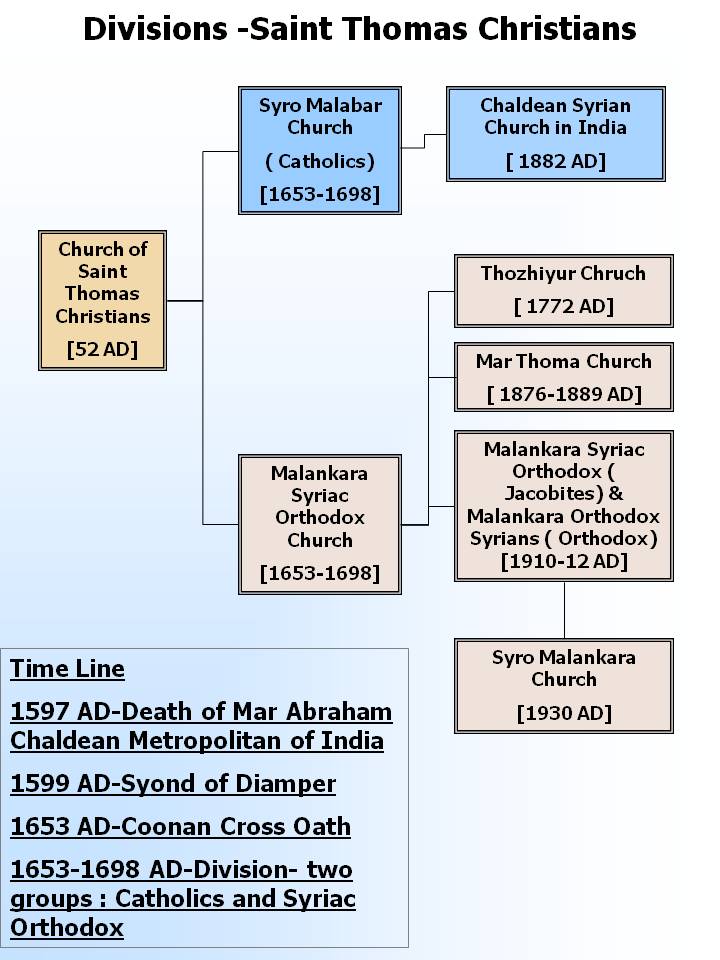
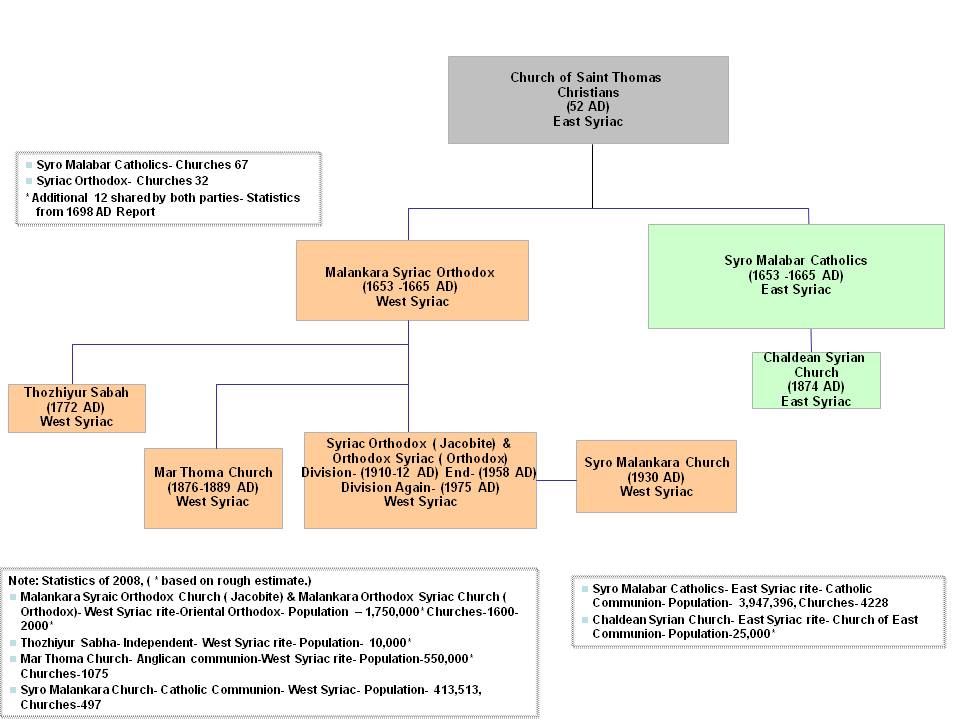
Contents
• PART A – FIRST MILLENIUM
• PART B- PERIOD FROM 1001 AD TO 1500 AD
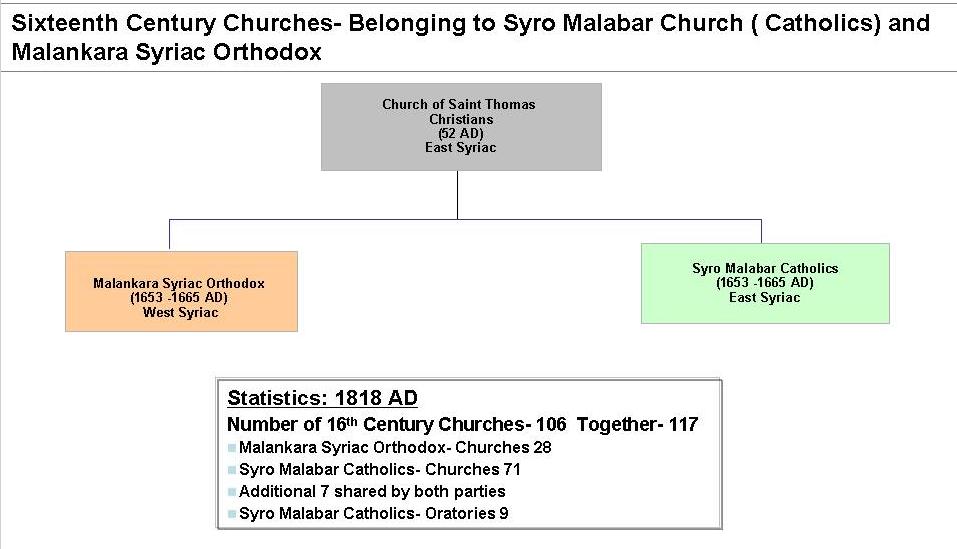
• PART C- PERIOD FROM 1500 AD TO 1599 AD
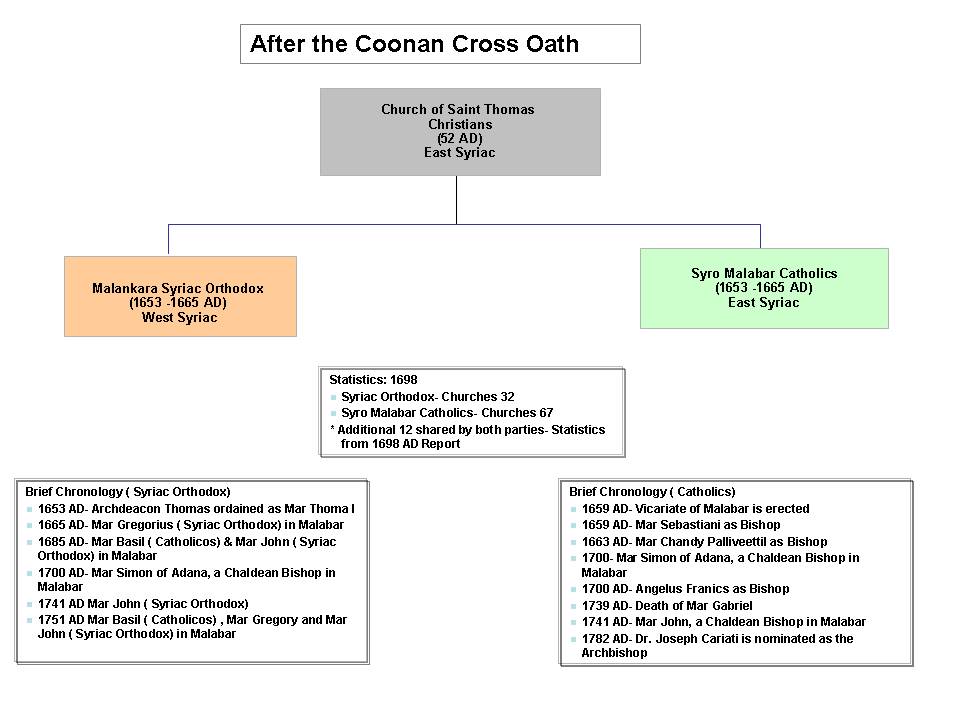
• PART D- PERIOD FROM 1600 AD TO 1663 AD
• PART E- SUCCEEDING CENTURY AMONG CATHOLICS ( SYRO MALABAR CHURCH)
• PART F- SUCCEEDING CENTURY AMONG JACOBITES ( MALANKARA SYRIAC ORTHODOX CHURCH)
• PART G- THE DIVISION CHRONOLOGY FROM CATHOLICS ( SYRO MALABAR CHURCH)
• PART H- THE DIVISION CHRONOLOGY FROM JACOBITES ( MALANKARA SYRIAC ORTHODOX CHURCH)
PART A – FIRST MILLENNIUM
| EVENTS | YEAR |
| Saint Thomas the Apostle at King Gondaphares in North India | c. 40 AD |
| Saint Thomas the Apostle lands at Cranganore | c. 52 AD |
| Saint Thomas the Apostle builds churches or communities ( Palayoor, Kodungaloor, Parur, Kokamangalam, Niranam, Nilackal, Kollam) | c. 52-72 AD |
| Martyrdom of Saint Thomas the Apostle at Mylapore, India | July 3rd. 72 AD |
| Mesopotamia and Assyria become Roman provinces | c. 98-117 AD |
| Kuravilangadu Church founded | c. 105 AD |
| Pantaenus visits India | c. 190 AD |
| Sassanians become a major power | 232 AD |
| Bishop David leaves Basrah for India | c. 295 AD |
| Pallipuram Church founded | c. 290 AD |
| Ambazhakad Church founded | c. 300 AD |
| Aruvithara Church founded | c. 301 AD |
| John of Persia and Greater India attend the Council of Nicaea | 325 AD |
| Bishop Theophilos visits India | c .354-356 AD |
| Yonan, a monk, priest visits the Monastery of St.Thomas in India | c. 390 AD |
| North Pudukad Church founded | c. 400 AD |
| Puthenchira Church founded | c. 400 AD |
| Syond of Seleucia, Archbishopric of Seleucia- Ctesiphon | 410 AD |
| Archbishop of Seleucia- Ctesiphon assumes the title of Catholicos | 421 AD |
| East Syrian Catholicos Ahai deputed to handle piracy of ships returning from India and Ceylon | c. 421 AD |
| Syond of Markabta- The Church of Mesopotamia becomes Independent from Antioch | 424 AD |
| Mar Komai assisted by an Indian priest Daniel translated in to Syriac, the Epistle of Saint Paul to the Romans | 425 AD |
| The Indian Church is firmly connected with Seleucia- Ctesiphon | 450 AD |
| Akaparambu Church founded | 450 AD |
| Angamali Church founded | 450 AD |
| Ma’na of Riwarddasir ( Persia) sent a Syriac translation of the works of Diodore and Theodore to India. | 470 AD |
| Muttuchira Church founded | c. 510 AD |
| Kaduthuruthy Church founded | c. 510 AD |
| Enammavu Church founded | c. 510 AD |
| Udayamperoor Church founded | c. 510 AD |
| An East Syrian Monk, Cosmas Indicopleustes visits South India | c. 535 AD |
| Mattam Church founded | c. 550 AD |
| Chambakulam Church founded | c. 550 AD |
| East Syrian Monks Abraham Kashkar, Bar Sahde visits South India | c. 550 AD |
| Periodiota Bod visits South India | c. 560 AD |
| Theodore, a Frankish monk visits Mylapore | 590 AD |
| Edapally Church founded | c. 593 AD |
| Chalakudy Church founded | c. 600 AD |
| Mylakombu Church founded | c. 600 AD |
| Dispute between India and Seleucia | 650-60 AD |
| Kolenchery Church founded | c. 650 AD |
| Moozhikulam Church founded | c. 650 AD |
| The Metropolitan See of India is created | 714/728 AD |
| Patriach Thimothy called the Archen ( Archdeacon) head of the faithful in India | c. 800 AD |
| Bishop Thomas Cana arrives in Malabar | 825 (?) AD |
| Mar Sabrisho and Mar Peroz arrive in Malabar | c .825/880 AD |
| Kayamkulam Church founded | c. 824 AD |
| Athirampuzha church founded | c. 835 AD |
| The Syrian Church of India is granted full status (Patriarch Theodosius ) | c. 852/858 AD |
| Patriarch Theodose mentions Archbishop of India | 852 AD |
| King Ayyanadigal granting two set of copper plates to Mar Sabrisho and Tarisapalli | c.880 AD |
| King Alfred’s embassy to Mylapore | 883 AD |
| Kottayam Church founded | 890 AD |
| King Rajasimha Perumal granting Thazhekad Sasanam rock edict | c.900 AD |
| Nagapuzha Church founded | 900 AD |
| Manjapra Church founded | 943 AD |
| Mavelikara Church founded | 943 AD |
| Kadamattom Church founded | 950 AD |
| Pazhuvil Church founded | 960 AD |
| Arakuzha Church founded | 999 AD |
| Nediasala Church founded | 999 AD |
| Kottekad Church founded | 999 AD |
| Kunnamkulam Church founded | 999 AD |
PART B- PERIOD FROM 1001 AD TO 1500 AD
| EVENTS | YEAR |
| Kanjur Church founded | 1001 AD |
| Kaduthuruthy Cheriapally founded | c. 1001 AD |
| Pala Church founded | 1002 AD |
| Muttam Church founded | 1023 AD |
| Cherpunkal Church founded | 1096 AD |
| Vadakara Church founded | 1096 AD |
| Bharananganam Church founded | 1100 AD |
| Changanacherry Church founded | 1117 AD |
| Mar John, Archbishop (?) of India visits Rome | 1122 AD |
| Thripunithara Church founded | 1175 AD |
| Cheppadu Church founded | c. 1175 AD |
| Chengannoor Church founded | c. 1175 AD |
| Kudamaloor Church founded | c. 1175 AD |
| Ernakulam Church founded | c. 1175 AD |
| Kothanalloor Church founded | 1220 AD |
| Mulanthuruthy Church founded | 1225 AD |
| Kothamangalam Valiapally founded | 1240 AD |
| Karthikapally Church founded | c. 1240 AD |
| Kuruppumpady Church founded | c. 1240 AD |
| Marco Polo visits Malabar and Mylapore | 1293 AD |
| Friar John of Monte Corvino visits India | 1293 AD |
| Haythonous, a Norbertine canon, visits Malabar | c. 1300 AD |
| Alengad Church founded | 1300 AD |
| Muthalakodam Church founded | 1312 AD |
| Mar Jacob is the Metropolitan and Director of Church in India | 1315 AD |
| Friar Jordan Catalani visits Thana, near Bombay | 1321 AD |
| Friar Oderico de Pordenone visits Thana and Malabar | 1321 AD |
| Friar Jordan Catalani visits Quilon | 1322 AD |
| Friar Jordan Caralani becomes the first Latin Bishop of Quilon | 1329 AD |
| Njarackal Church founded | 1341 AD |
| Koratty Church founded | 1381 AD |
| Friar John Marignola visits Quilon | 1348-9 AD |
| Poonjar Church founded | c. 1381 AD |
| Alleppey Church founded | 1400 AD |
| Nicolas de Conti visits Mylapore and Malabar | 1415-38 AD |
| Pope Eugene writes to Thomas the emperor of the Indians | 1439 AD |
| Kanjirappilly Church founded | 1450 AD |
| Kothamangalam Cheriapally founded | 1455 AD |
| Kudavechur Church founded | 1463 AD |
| A Saint Thomas Christian, Joseph goes to Mesopotamia | 1490 AD |
| Division of the world mission lands between Portugal and Spain by Pope Alexander V1 | 1493 AD |
| Joseph comes back in Malabar with two Bishops, Mar Thomas and Mar John from Mesopotamia | c.1496 AD |
| Vasco de Gamma’s first landing in India near Calicut | 1498 AD |
| Cabral at Calicut | 1499 AD |
PART C- PERIOD FROM 1500 AD TO 1599 AD
| EVENTS | YEAR |
| Franciscan Friars at Cochin | 1500 AD |
| Mar Yahballaha, Mar Denha and Mar Joseph arrive in Malabar | 1501 AD |
| Vasco de Gamma’s first meeting with Christians of Saint Thomas | 1503 AD |
| Dominican priests at Cochin | 1503 AD |
| Cochin falls under Portuguese rule | 1503 AD |
| Cranganore is captured by the Portuguese | 1504 AD |
| The Latin Bishopric of Funchal is created with jurisdiction over Portuguese India | 1514 AD |
| Jewish migration from Cranganore to Cochin | 1514 AD |
| The tomb of Saint Thomas is re-discovered at Mylapore | 1523 AD |
| Saint Francis Xavier’s first visit to Malabar | 1523 AD |
| A Persian Cross ( Saint Thomas Cross ) rediscovered at Mylapore | 1523 AD |
| Vasco de Gamma buried at Saint Francis Church, Fort Kochi | 1524 AD |
| Goa diocese is erected ( Parishes- Kannur, Cochin, Quilon, Colombo and Sao Thome ( Madras) ) | 1534 AD |
| Goa is made a suffragon bishopric of Funchal | 1539 AD |
| Franciscan Fr. Vincent De Lagos starts the Cranganore Seminary | 1540 AD |
| Saint Francis Xavier in Travanocre | 1544-5AD |
| Dominican monastery founded in Cochin | 1548 AD |
| Mar Jacob Abuna, the Chaldean Metropolitan stays at Saint Antonio Monastery Cochin | 1549 AD |
| First Jesuit house in Cochin | 1550 AD |
| The Chaldean Church is united with Rome | 1552 AD |
| Death of Saint Francis Xavier | 1552 AD |
| A Jesuit College opens at Cochin | 1552 AD |
| Mattancherry palace built by Portuguese for King of Cochin | 1555 AD |
| Chaldean Bishops Mar Joseph and Mar Elias reach Goa | 1556 AD |
| Pope Paul IV erects the diocese of Cochin | 1557 AD |
| Goa made Archbishopric and Cochin a suffragan bishopric | 1557 AD |
| First Jesuit mission among the Syrian Christians | 1557-60 AD |
| Chaldean Bishops Mar Joseph and Mar Elias arrives in Malabar | 1558 AD |
| The King of Cochin publishes an edict of tolerance in favor Of Christian converts | 1560 AD |
| Chaldean Bishop Mar Joseph made to go to Europe | 1561 AD |
| Chaldean Bishop Mar Abraham arrives in Malabar | 1563 AD |
| Mar Joseph returns to Malabar | 1564 AD |
| Mar Abraham escapes to Mesopotamia | 1564 AD |
| Mar Joseph send back to Europe | 1565 AD |
| Mar Abraham comes back to Malabar | 1565 AD |
| Archdiocese of Angamaly erected | 1565 AD |
| First Council of Goa | 1567 AD |
| Jews shifted to Mattancherry | 1567 AD |
| Synagogue of white Jews built in Cochin | 1568 AD |
| Chaldean Bishop Mar Joseph dies in Rome | 1569 AD |
| Second Council of Goa | 1575 AD |
| Vaipicotta Seminary of Jesuits started | 1577 AD |
| Mar Simon comes to Malabar | 1577 AD |
| Augustinians reached Cochin | 1579 AD |
| First Synod of Angamaly convoked by the Metropolitan Bishop Mar Abraham | 1583 AD |
| Third Council of Goa | 1585 AD |
| Fourth Council of Goa | 1592 AD |
| Alexis De Menezes becomes Archbishop of Goa | 1595 AD |
| Death of the last Chaldean Metropolitan of the undivided church of Saint Thomas Christians- Mar Abraham’s death – St. Hormis church, Angamaly | 1597 AD |
| Alexis De Menezes begins his vist in Malabar | 1598 AD |
| Synod of Diamper | 1599 AD |
| Fr. Franics Roz SJ becomes the Bishop of the Syrians | 1599 AD |
PART D- PERIOD FROM 1600 AD TO 1663 AD
| EVENTS | YEAR |
| Padroado rule imposed on Saint Thomas Christians | 1600 AD |
| Franics Roz SJ was appointed as the first Latin bishop of Thomas Christians | 1601 AD |
| Second Synod of Angamale convoked by Franics Roz | 1606 AD |
| Angamale again becomes an Archbishopric | 1608 AD |
| Erection of diocese of Cranganore | 1609 AD |
| Limiting Pastoral Jurisdiction of Nasranis to Malabar by Metropolitan of Goa | 1610 AD |
| Death of Bishop Francis Roz | 1624 AD |
| Dominican Seminary at Kaduthuruthy | 1624 AD |
| Edappally Ashram started for the Religious Community of St. Thomas Christians | 1626 AD |
| Fr. Frnacis Donati in Malabar | 1628 AD |
| Thomas de Campo becomes the Archdeacon | 1637 AD |
| A monk called Athallah, reaches Mylapre, not allowed to enter Malabar | 1652 AD |
| Coonan Cross Oath at Mattancherry, Cochin | 1653 AD |
| Mar Thoma I ordained bishop at Alangad by the laying of hands by 12 priests | 1653 AD |
| First Carmelite mission to Malabar | 1657 AD |
| The Vicariate of Malabar is erected by Pope Alexander VII | 1659 AD |
| First Latin Vicar- Apostolic of Malabar is consecrated Bishop Sebastiani | 1659 AD |
| Bishop Sebastiani lands at Cochin. Second Carmelite mission in Malabar | 1661 AD |
| Quilon is captured by the Dutch | 1661 AD |
| Cranganore is captured by the Dutch | 1662 AD |
| Cochin is captured by the Dutch | 1663 AD |
| Bishop Sebastiani consecrates Bishop Mar Alexander de Campo (Mar Chandy Palliveettil ) and leaves Malabar | 1663 AD |
PART E- SUCCEEDING CENTURY AMONG CATHOLICS ( SYRO MALABAR CHURCH)
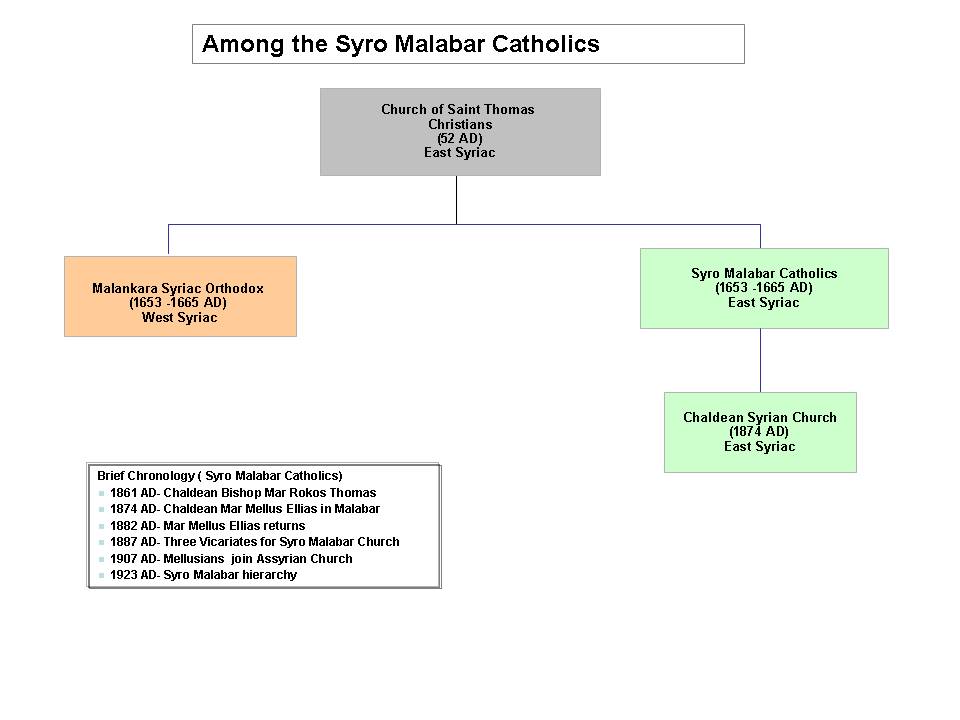
| EVENTS | YEAR |
| A seminary is founded at Verapoly | 1682 AD |
| Angelus Franics is nominated Vicar Apostolic of the Catholic Syrians | 1700 AD |
| Mar Simon of Adana, a Chaldean Bishop arrives in Malabar | 1700 AD |
| Death of Church of East Bishop Mar Gabriel | 1730-1 AD |
| Mar John, a Chaldean Bishop comes to Malabar | 1747 AD |
| The Seminary of Verapoly is revived | 1764 AD |
| Dr. Joseph Cariati is nominated as the Archbishop of Cranganore | 1782 AD |
| Dr. Joseph Cariati dies at Goa | 1786 AD |
| Cochin is captured by the British | 1795 AD |
| The first Anglican missionaries arrive in Travancore | 1816 AD |
| A congregation of Syro Malabar Carmelite territories founded | 1829 AD |
| The Apostolic Vicariate of Verapoly is created | 1838 AD |
| Mar Rokos Thomas, a Chaldean Bishop from Mesopotamia arrives at Cochin | 1861 AD |
| Mar Rokos Thomas returns to Mesopotamia | 1862 AD |
| Mar Mellus Ellias, a Chaldean Bishop from Mesopotamia arrives In Malabar | 1874 AD |
| Mar Mellus Ellias , excommunicated by Rome, leaves India | 1882 AD |
| The Seminary of Puthenpally becomes the central seminary for Syrians and Latins | 1886 AD |
| The Catholic Hierarchy is established in India | 1886 AD |
| The Apostolic vicariates of Kottayam and Trichur are created for Syrian Catholics | 1887 AD |
| Two new apostolic vicariates are created at Ernakulm and Changanacherry. Changanacherry replaced that of Kottyam | 1896 AD |
| The Mellusians of Trichur joined the Assyrian Church of East | 1907 AD |
| The Apostolic Vicariate of Kottayam is created for the Catholic Syrians of Southist community | 1911 AD |
| The Syro Malabar hierarchy is erected | 1923 AD |
| Mar Ivanios and Mar Theophilos become Catholic | 1930 AD |
| The Syro- Malankara hierarchy created | 1931 AD |
| The Seminary of Puthenpally is transferred to Alwaye | 1933 AD |
| Mar Severios, Syriac Orthodox Bishop of Niranam become Catholic | 1937 AD |
| Mar Dioscoros, the Syriac Orthodox Bishop of Southists becomes Catholic | 1939 AD |
| Syro Malabar diocese of Palai is erected | 1950 AD |
| Jubilee celebrations of Saint Thomas and Saint Franics Xavier | 1952 AD |
| Cardinal Eugene Tisserant, visits Malabar | 1953 AD |
| Syro Malabar diocese of Tellicherry is erected | 1954 AD |
| The jurisdiction of the Syro Malabar hierarchy is extended in Travancore and Cochin, in Madras State and in Mysore State | 1956 AD |
| Syro Malabar diocese of Kothamangalm is erected | 1956 AD |
| Restored Liturgy in force and Holy Qurbana changed to Malayalam from Syriac | 1962 AD |
| 19TH Centenary celebrations jointly by Catholics, Jacobites, Marthoma, CSI churches | 1972 AD |
| Pope John Paul II visits India | 1986 AD |
| Syro Malabar Church raised to a Major Archiepiscopal Sui iuris Church | 1992 AD |
| Syro Malankara Church raised to a Major Archiepiscopal Sui iuris Church | 2005 AD |
PART F- SUCCEEDING CENTURY AMONG JACOBITES ( MALANKARA SYRIAC ORTHODOX CHURCH)
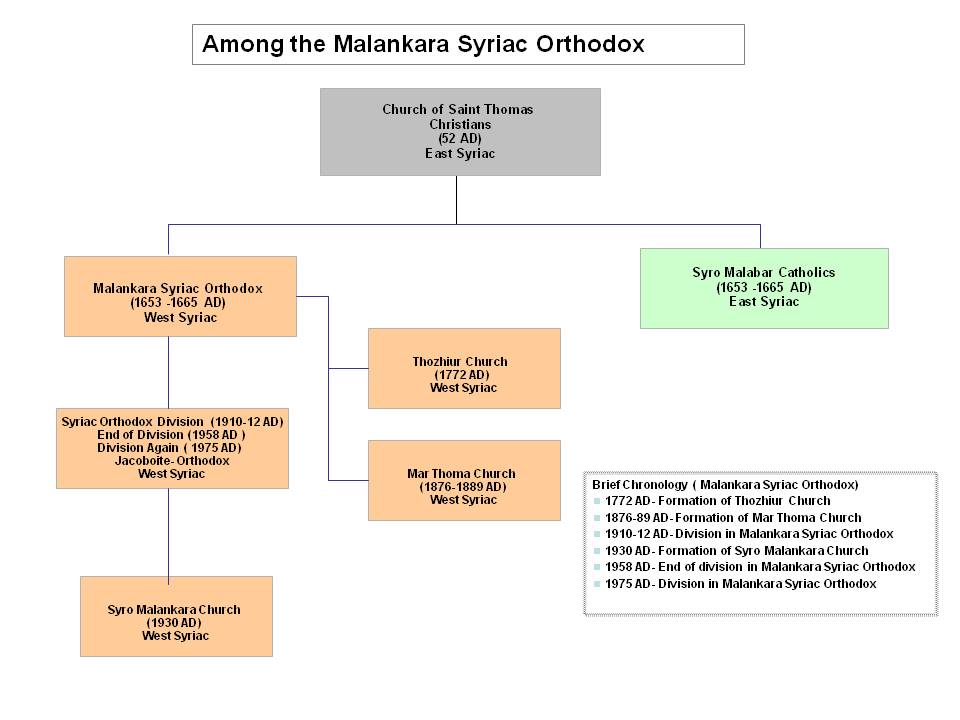
| EVENTS | YEAR |
| Mar Gregorios, the first Syriac Orthodox Bishop comes to Malabar | 1665 AD |
| Mar Gregorios and Mar Thoma I died | 1670-3 AD |
| Second Syriac Orthodox mission, Mar Basil ( Catholicos) , Mar John came to Malabar | 1685 AD |
| Mar Simon of Adana, a Chaldean Bishop arrives in Malabar | 1700 AD |
| Mar Thomas IV tries to unite with Rome | 1704 AD |
| Mar Thomas IV died | 1728 AD |
| Death of Church of East Bishop Mar Gabriel | 1730-1 AD |
| Mar John, a Syriac Orthodox Bishop comes to Malabar | 1741 AD |
| Mar John, a Chaldean Bishop comes to Malabar | 1747 AD |
| Mar Thomas V tries to unite with Rome | 1748 AD |
| Mar John, the Syriac Orthodox Bishop who came in 1741 was deported | 1751 AD |
| Third Syriac Orthodox mission, Mar Basil ( Catholicos) , Mar Gregory and Mar John to Malabar | 1751 AD |
| Mar Thomas V died | 1765 AD |
| Mar Thomas VI succeeded Mar Thomas V | 1765 AD |
| Mar Thomas VI was consecrated as Mar Dionysius I at Niranam by Syriac Orthodox Bishops Mar Gregory and Mar John | 1772 AD |
| The Anjoorians ( Thozhiur- known today as Malabar Independent Syrian Church) formed by the expulsion of Mar Cyril by Mar Dionysius I from Travancore and Cochin State | 1772 AD |
| Cochin is captured by the British | 1795 AD |
| Mar Dionysios I becomes Catholic for six months | 1799 AD |
| Mar Dioscoros, a Syriac Orthodox bishop comes to Malabar | 1807 AD |
| Mar Dionysios I died | 1808 AD |
| Successor of Mar Dionysios I, Mar Thomas VII died | 1809 AD |
| Mar Thomas VIII succeeded | 1809 AD |
| Mar Thomas VIII died | 1815 AD |
| Mar Thomas IX succeeded | 1815 AD |
| Mar Dionysius II consecrated by Mar Philoxenos of Anjoor ( the non- hereditary indigenous Bishop ) | 1815 AD |
| Mar Dionysius II deposed Mar Thomas IX | 1815 AD |
| The first Anglican missionaries arrive in Travancore | 1816 AD |
| Mar Dionysius III consecrated by Mar Philoxenos of Anjoor ( Anglican missionaries become influential among Jacobites) | 1818 AD |
| Mar Dionysius III died and Mar Dionysius IV consecrated | 1825 AD |
| Mar Jacob is send to Malabar by the Jacobite Syriac Orthodox Patriarch | 1825 AD |
| The first Syond of the Malankara Syriac Orthodox ( Mavelikara)- Mar Dionysius IV Officially acknowledged the jurisdiction of Patriarch of Antioch | 1836 AD |
| A breach occurs between Malankara Syriac Orthodox and the Protestant missionaries and both parted ways and divided common properties | 1837 AD |
| Some 6000/12000 Jacobites joined Anglcian Church | 1837 AD |
| Mathew Mar Athanasius arrives in Malabar and tried deposing Mar Dionysius IV | 1843 AD |
| Mar Kurillos, a Syriac Orthodox bishop comes to Malabar after Mar Dionysius IV informed the patriarch about the Anglican tendencies of Mathew Mar Athanasius | 1846 AD |
| Mar Kurillos deported and Mar Dionysius IV died | 1855 AD |
| Mar Stephanos, a Syriac Orthodox bishop arrived | 1855 AD |
| Court ruling asking Anglican missionaries to leave the affairs of Malankara Syriac Orthodox free | 1857 AD |
| Mar Kurillos failed in court cases to recover the churches from Mathew Mar Athanasius | 1857 AD |
| Pulikottil Joseph consecrated as Mar Dionysius V | 1865 AD |
| TheSyriac Orthodox Patriarch Peter VII, reaches Malabar | 1875 AD |
| Mathew Mar Athanasius excommunicated | 1875 AD |
| Mathew Mar Athanasius died, Thomas Mar Athanasius succeeded | 1875 AD |
| Mar Dionysius V assumes the title of Metropolitan of Malankara | 1876 AD |
| The Second Malankara Syriac Orthodox Syond ( Mulanthuruthy) | 1876 AD |
| Six more Bishops consecrated in Malankara Syriac Orthodox Church and six eparchies Created. | 1876 AD |
| Mar Dionysius V and party victories in Court case | 1876 AD |
| The Marthoma Church comes into being — Thomas Mar Athanasious before then they were known as Reformed Jacobites. | 1876 AD |
| A delegate of the Syriac Orthodox Jacobite Patriarch of Antioch resides in Malabar | 1908 AD |
| Mar Dionysius V died | 1909 AD |
| The Syriac Orthodox Patriarch of Antioch, Abdallah visits Malabar | 1909 AD |
| The Syriac Orthodox Jacobites of India split into two parties( Under Mar Dionysius VI called as Bishop Party and under the Patriarch called as Patriarch Party | 1910-12 AD |
| The Southist Jacobite bishopric created in Chingavanam | 1910 AD |
| The deposed Syriac Orthodox Jacobite Patriarch Abd-ul-Massih comes to Malabar and erects a Catholicosate | 1912 AD |
| Two Bethany Congregations founded by Fr. PT Givargjeese | 1919 AD |
| Mar Dionysius VI visits Syrian Orthodox Jacobite Patriarch and a Catholic WestSyrian Bishop | 1924 AD |
| Mar Ivanios and Mar Theophilos joined Catholic Church | 1930 AD |
| The Syrian Orthodox Patriarch of Antioch , Elias III, comes to Malabar | 1931 AD |
| The Syrian Orthodox Patriarch of Antioch, Elias III dies in Malabar | 1933 AD |
| Official contacts with Catholicos Party of the Malankara Syriac Orthodox and Greek Patriarchate at Constantinople | 1956 AD |
| End of the division among the Malankara Syrian Orthodox of India | 1958 AD |
| Supreme Court decision in favor of Bishop Party ( known as Orthodox) | 1959 AD |
| 19th Centenary celebrations jointly by Catholics, Jacobites, Marthoma, CSI churches | 1972 AD |
| Split in the Malankara Syriac Orthodox Church of India resulting from the actions of Syrian Patriarch ( Jacobites & Orthodox) | 1975 AD |
| Supreme Court judgment that there is only one Orthodox Church in India with two faction | 1995 AD |
PART G- THE DIVISION CHRONOLOGY FROM CATHOLICS ( SYRO MALABAR CHURCH)
From Catholics ( Syro Malabar Church) – Formation of Mellusians ( known today as Chaldean Syrian Church )
| EVENTS | YEAR |
| Mar Mellus Ellias, a Chaldean Bishop from Mesopotamia arrives In Malabar | 1874 AD |
| Mar Mellus Ellias , excommunicated by Rome, leaves India, entrusted followers to a Chaldean Chorepiscopa | 1882 AD |
| The Mellusians of Trichur joined the Assyrian Church of East | 1907 AD |
PART H- THE DIVISION CHRONOLOGY FROM JACOBITES ( MALANKARA SYRIAC ORTHODOX CHURCH)
From Jacobites ( Malankara Syriac Orthodox Church) ) – Formation of Thozhiyur Church ( known today as Malabar Independent Syrian Church).
| EVENTS | YEAR |
| The Anjoorians ( Thozhiur- known today as Malabar Independent Syrian Church) formed by the expulsion of Mar Cyril by Mar Dionysius I from Travancore and Cochin State | 1772 AD |
From Jacobites ( Malankara Syriac Orthodox Church) – Formation of Reformed Jacobites ( known today as Malankara Mar Thoma Syrian Church )
| EVENTS | YEAR |
| A breach occurs between Malankara Syriac Orthodox and the Protestant missionaries and both parted ways and divided common properties | 1837 AD |
| Mathew Mar Athanasius arrives in Malabar and tried deposing Mar Dionysius IV | 1843 AD |
| Mathew Mar Athanasius excommunicated | 1875 AD |
| The Marthoma Church comes into being — Thomas Mar Athanasious before then they were known as Reformed Jacobites. | 1876-89 AD |
From Orthodox ( Malankara Orthodox Syriac Church) – Formation of Syro Malankara Church
| EVENTS | YEAR |
| Mar Dionysius VI visits Syrian Orthodox Jacobite Patriarch and a Catholic West Syrian Bishop | 1824 AD |
| Mar Ivanios and Mar Theophilos joined Catholic Church | 1830 AD |
Split as two groups known today as Orthodox and Jacobites
| EVENTS | YEAR |
| The Syrian Orthodox Jacobites of India split into two parties( Under Mar Dionysius VI called as Bishop Party and under the Patriarch called as Patriarch Party) | 1910-12 AD |
| End of the division among the Malankara Syrian Orthodox Jacobites of India | 1958 AD |
| Split in the Syriac Orthodox Jacobite Church of India resulting from the actions of Syriac Patriarch of Antioch ( as Jacobites & Orthodox) | 1975 AD |
| Supreme Court judgment that there is only one Orthodox Church in India with two factions | 1995 AD |
25 Responses
Thomas Andrews Chakramakal
Post : 20158
George
Post : 24806
*Mar Ivanios and Mar Theophilos joined Catholic Church*
Is it 1830 or 1930 ??
Tommathew Thomas
Post : 37012
You have omitted an imporatant event, the 1952 Jubilee Celebrations of St.Thomas Christians.
Pope Pius XII initially opposed to declare the nineteenhundreth year of arrival of St.Thomas in Kerala, for “lack of evidence”,sent Cardianal Tisserant,the head of Oriental Congregation, as Pope’s representative to participate in the celebrations.Pope had earlier proclaimed the same year as
Jubilee year of St.Francis Xavier’s arrival in India.With the patronage of Cardinal Tisserant,the
spring of Syro-Malabar Christians started.
B.George
Post : 37064
Lack of evidence is not unique to St. Thomas. I was reading through some Jewish literature of recent origin. It is about Israeli archaeological finding of the real grave of St.Peter in present day Israel. Of course the Roman Catholic church would never accept this. I find the evidence rather convincing as there are other graves nearby said to be of St.Mary, Martha and Lazarus!Now the question arises. Did St.Peter go to Rome during his last days? We must learn to keep an open mind. Everything in the world cannot be divinely ordered and inspired.
Dear B. George,
I would be very interested to read the evidence found for the tombs of the Apostles Kepha (Peter), Maryam, Martha and Lazar in the Jerusalem area. Would you supply further details of these publications please? For example, titles, publication dates, authors, publisher and ISBNs if available.
Thank you.
Best regards,
Steven.
B.George
Post : 37244
Dear Steven,
The literature on the subject is extensive. I have chosen the most informative but quotation of the whole is beyond the scope of this post . But please make a Google search for “The Discovery of Peter’s Tomb in Jerusalem” By F.Paul Peterson. I am sure you will find all you want.
Even if I was a Catholic which I am not I would never have accepted the story of Peter’s burial in Vatican since Paul’s epistles do not speak of Peter’s whereabouts excepting their meeting in Jerusalem.
Regards
B.George
Dear B. George,
Thank you for these references, which I have looked up:
http://www.aloha.net/~mikesch/peters-jerusalem-tomb.htm
Very interesting reading. The inscription in question is casually written, but the consonants read in Aramaic ShM`WN BR YWNH, i.e. “Shem`on Bar Yonah”. In archaeology, the context of finds is key to their interpretation. Pictures of the other biblical names Maryam and Martha and Lazar are given from the same funerary context, but their inscriptions are less distinct, see:
http://biblelight.net/DF-table28-fot78.jpg This image shows the consonants: M(R)T’ WM(R)Y’ i.e. “Ma(r)tha waMa(r)ya”.
If the context is really an early Christian cemetery (as it appears to be) and these other NT names are also found in the same context, then the identification of this inscription with Shem`on Bar Yonah seems to have a very good scientific basis.
I am persuaded by early Christianity and quite devoted to that, but I am certainly not persuaded, and I am not ashamed to be sceptical of its later Greek, western and modern forms. As soon as Christianity was adopted by the political elites of the early 4th century AD, truth was thrown out of the window.
Best regards,
Steven.
thomas
Post : 39779
The Syrian Church of India is granted full status (Patriarch Theodosius ) c. 852/858 AD. I want to know more details about this
Jessop
Post : 205538
Yes I second the above. What does it mean?
Kurian Joseph
Post : 207143
Where in is the details of Palackal Thomma Malpan and the Pallippuram Seminary?
How can the History of the Nazanis be complete wihout the History, the Contributions and the initiatives of Palackal Thomma Malpan?
Manu
Post : 238854
Kurian Joseph,
Even i like to know more abt Pallipuram church.. WHat i understood is that the church was build in 3rd century AD.. Here its stated 290 AD.. yes its 3rd century.. But how they got the figure 290 AD ???
Nidhiry
Post : 287336
Gentlemen,
It seems that there were some Chaldean seminaries and monasteries in Malabar before the arrival of the Portugeues. These were abolished by the Portuguese It is known that one such seminary and one monastery were functioning at Kuravilangad.
Can anybody give some information on these seminary and monastery?
NIDHIRY
dr.abraham p.sam
Post : 294153
It must be a reality that there must be monastries and convents in the early church as they are the mainstay in our system.
the early history must have been destroyed or spoiled due to faulty material or storage .let us hope some body bring some information.
dr.abraham p.sam
Dear dr.abraham p.sam,
Early Christianity was an eastern religion based around wandering teachers who lived off of the land and sometimes from the hospitality of friends. They taught disciples and engaged in debate with other religious leaders and scribes. John the Baptist and our founder and God, Isho` Meshiha both exemplified this ascetic way of life which is vividly described in the gospels.
It may surprise you to hear that the first Christian monastery was invented centuries after Christ. The first Christian cenobic monasteries appeared in Egypt c. AD 320. These first monasteries were started by a Coptic monk called Abba Pachom near Qena in Upper Egypt. Then the monastic idea began to spread rapidly. The first monastery in Mesopotamia was founded by Mar Awgin of Clysma, on Mount Izla near Nisibis in c. AD 330. Further details can be found by clicking on the link under my name above and scrolling to the brief article I have written about Mar Awgin under the date AD 362 – 363. I have provided references there, should you wish to dig further into the background of these historical events.
It is also interesting to read the partly legendary Acts of Yehudi Thoma (Thomas) which were originally composed in Syriac. These acts have been edited and translated into English by William Wright, (this book is available to read on-line, or as a free download). Book details:
Wright, William 1871. ‘Apocryphal acts of the apostles’ 2 volumes, London & Edinburgh. Reprinted by Georg Olms, Verlag Hildersheim, Zürich, NY 1990.
In the Syriac Acts of Thomas, Mar Thoma is depicted as a wandering teacher who comes to India at the command of Marya Isho Meshiha. The ascetic lifestyle of Mar Thoma is that of a wandering teacher, the same lifestyle more or less, as is described in the gospels.
With best wishes,
Steven Ring.
Mathai Varghese
Post : 296873
Dear Dr. Abraham,
You wrote ‘..It must be a reality that there must be monastries and convents in the early church as they are the mainstay in our system…”
I am not sure of above. YOu should be aware that the unique thing about us Malabar Nazerenes was that there was no ‘eccelestial setup’ as in the West or Ethopia/Egypt/Persia etc.. We had our Jaathi Moopans as our leaders and priests and there is no record of Bishops and similar within an eccelestial setup.
Indeed, the CoE did have an eccelestial set up and it can be argued that we Malabaris came under the CoE. It can also be argued that the ties with the Persian CoE was weak,as our faith and beliefs were leaning heavily towards Indian/Hindu cutlure. The Synod of Diamper was thick with allegations that we followed much pagan practices/traditions. Can you imagine an eccelestial set up in Malabar in full communion with the CoE of Persia?
Monastries and convents are ‘Institutions’ and can come only in an eccelestial setup, as it alone can support administration of these institutions. Small ashrams would have been possible, but not monastries and convents.
Information so far obtained, shows that we were and are not a homogenious group and like the early church, we were of different origins, beliefs and traditions. It was the Inquisition which tried to bring us under one belief and faith. This did not last for long.
Mathai Varghese
Post : 302442
Dear Mr. Steven Ring,
You wrote ‘..It is also interesting to read the partly legendary Acts of Yehudi Thoma (Thomas) which …”
Kindly advise as to why you use the words ‘partly legendary’ in the above. I have read the ‘Acts’ and I am no scholar (and my head spins). I understand your choice of ‘partly legendary’. Yet, I would like to have your reasons.
This book is vital to us Malabar Nazerenes and heavy scholastic work on this is long overdue. Can you please oblige?
Kuruvilla Cherian Amprayil 107.46.132.51 not found
Post : 303985
‘NIDHIRY’ wrote (Post : 287336) :
“It seems that there were some Chaldean seminaries and monasteries in Malabar before the arrival of the Portugeues. These were abolished by the Portuguese It is known that one such seminary and one monastery were functioning at Kuravilangad.
Can anybody give some information on these seminary and monastery?”
Dr. Mar Aprem Metropolitan of the Chaldean Syrian Church of The East in India may have reliable information in this regard. Has this matter been discussed with Dr. Mar Aprem?
There are mentions in many European authors that there were monasteries in Angamali, Kuravilangadu, Mailappore and Edappalli.
Joseph, the famous Indian cathanaar has mentioned in AD 1501 that there were in Malabar, hermitages with monks dressed in black clothes, who live in chastity, and also nuns.
Read section 5b About the Clergy and 5c Monasteries and Nunneries in the article ‘The Story of Joseph the Indian, a Historical appraisal…..’
Monk Younan who came to Malabar in AD 905 along with Bishop Mar Denha, Rabban and Maravan as described in the Chronicles of Niranam, was based in the monastery at Kuravilangadu and later buried in the Church at Udayampeeroor.His tomb was demolished by the authorities and remains of his and other three or four persons in a pot and buried in the church at Udayampeeroor.
I have heard that there still a place called Younakkuzhy near Kuravilangadu.
.
Dear Mathai Varghese
Re Post : 302442
What you have asked for: A proper critical edition and an English translation of the Syriac Acts of Thomas is a difficult thing and a lot of work. If this work were to be done, how many people would really read it and appreciate it these days? The work is a monument of Syriac literature and one of the earliest extant Syriac literary texts. The scholars Paul-Hubert Poirier, F. Bovon and P. Geoltrain have shown interest in this work and produced French translations and bibliographies for the AT, but I don’t know if any of these intend to critically edit and translate the AT.
The late William Petersen was one of the most recent scholars to look into the Acts of Thomas. He did not edit or translate it, he merely commented on it. He says, (‘Diatessaron’ p. 213) that there are six known Syriac manuscripts that contain these Acts, reference:
William L. Petersen, ‘Tatian’s Diatessaron’ Supplement to Vigiliae Christianae Vol. XXV ISBN 900 409 469 5 E. J. Brill, Leiden 1994, pp. 213-215.
Despite what Bill Petersen wrote, in my part-time amateur studies into the Syriac tradition so far, I have managed to identify 13 manuscript copies of this work. However, not all of these copies are complete and due to wars etc., not all of them can be accessed. About 8 of these 12 manuscripts are potentially accessible to me.
Kind regards,
Steven.
Dear Mathai Varghese
Re Post : 302442
I forgot to answer your question about the legendary nature of the Acts of Thomas. Initially, some scholars thought that the AT was an entirely legendary tale, however this view has gradually changed over time. More recent research has found certain connections to real historical people in the AT. There are also other features in the AT like the one I pointed out above, which suggest that the AT is at least partly historical, or perhaps it developed from an historical work.
Best wishes,
Steven Ring.
Mathai Varghese
Post : 305298
Dear Mr. Kuruvilla Cherian,
I am happy to be corrected if it is established that there was a seminary in place X and monastry in Kuruvilangad. However, I would advise to be very careful in the usage of the words ‘seminary’ and ‘monastry’. These are English words and strongly indicate institutions. A pro Western leaning would conviniently translate the Indian word ‘Ashram’ into ‘Monastry’ or ‘Seminary’.
For instance during the years around AD 1599, the title and name ‘Arch Deacon George’ comes up importantly in our history, subtly making our mindset ‘Western Christian’, while the the priest’s title and name would have been ‘Jaathi Moopan Geevarghese’. Arch Deacon George is not the same as Jaathi Moopan Geevarghese’. Is Bombay the same as Mumbai? If one uses the word ‘Bombay’ today, then it reveals the inside of the user.
My accessment (with no evidence) is that there was an small Ashram in Kuravilangad where the presence of the Persian CoE was noticable/evident and this Ashram (after the arrival of the Portugeese) was conviniently denoted as ‘Monastry/Seminary’ just the way that Jaathi Moopan Geevarghese is named today as ‘Arch Deacon George’.
Bombay smacks of Colonial British India and Mumbai smacks of Saffron Shiv Sena. They are not the same, though the GPS coordinate are the same.
This is a little difficult for me to express, but I am trying!
I will even venture out to say that the Ashram would have been in the same ‘plot’ of the Jaathi Moopan’s house/palace, the same entity as his house.
Mathai Varghese
Post : 306700
Dear Mr. Steven Ring,
Thanks for the info.
Initially, when I read (in English) the AT, I mentally dismissed it as a ‘legend’ and not as facts. How can a snake talk in AT?
Acts of Judas Thomas, Act 3 “..The snake saith to him: “I am reptile, the son of reptile and harmer, the son of harmer; I am the son of him, to whom power…”
If Jesus said in Luke 10:19 “Behold, I give you the authority to trample on serpents and scorpions, and over all the power of the enemy, and nothing shall by any means hurt you…”, then why should I have a problem in not believing in a talking snake in AT?
In Numbers 22: 28, a donkey talks to Balaam.
I am not saying that the AT should or should not be Scripture, but saying it is a very important book for us Marthomites. It is sad, that you, a non Marthomite know much much more of this book than us. We have a long long way to go.
Dear Mathai Varghese,
So, I’m interested in your post above. Does anyone know what a Nasrani ashram was like and how it functioned?
This interests me because there were other kinds of ascetic Christian community (i.e. not cenobic monasteries as such) which existed in the Middle East up to the 7th or 8th century AD. So, I wonder how Nasrani ashrams compare to those?
Best regards,
Steven.
Mathai Varghese
Post : 308575
Dear Sir,
Difficult to answer right away, about the Nasrani Ashram. This is probably the first time this subject is even being addressed. Need much information. But I can cast information into the ring and ones who are gifted in ‘synthesizing’ can put together subject. Mine is only an attempt by an amateur.
An Ashram is a Hindu/Jain/Buddhist word for a place of religious retreat/fellowship, usually under a guru. Some to all Syrian churches in Kerala have their own ashrams. For instance the Marthoma Syrian Church has an Ashram in Sihora, Madya Pradesh and the ‘Reeth (Syro Malabar Catholic Church) has an Ashram in Kurushumallai in Idukki Dist., Kerala.
Prior to the Inquisition in AD 1599 and after, Nazerenes were led by the ‘Jaathi Moopans’ or the ‘Heads of the castes’ or for a Westerner to understand, it would be ‘Head of the clans’. The Malabar Nazerenes were highly family and clan oriented and strong evidences of this orientation/structure exists even today in modern Kerala.
The priestly families like Pakalomattom, Kalli etc.. were the religious leaders and these families were also the elite with possible large agrarian land holdings. In the main house or near the main house of the Jaathi Moopan was the ‘Ashram’ where people resided as guests/members, for spiritual and physical/medical reason. Attached to such estates were also the ‘Pallies’, which then meant ‘place of learning’ and which today means ‘church’.
So it was a ‘combo kit’ having the 3 entities,
1)Main household of the Jaathi Moopan, with his immediate and extended family, servants etc..
2) Ashram, where the guests/members resided for spiritual and medical(?) reasons, usually fed from the kitchen in the main house.
3) Palli to accommodate for worship a few hundred people on the 7th day and the 1st day.
The Bible as we know it today was simply not freely available to the masses then. The priestly families would just have had a few copies of the Bible and that too not the entire collection of the Book, but just individual books here and there. Because of this, I would imagine that the priestly households were the center of focus on religious matters. Religious studies and liturgy was of-course in Syriac and so guests/members often resided there, as knowledge in religious Syriac was uncommon. This place would have been commonly (and collectively?) called ‘Palli’ than Ashram.
Today, people in Kerala do not say ‘I am going to the Ashram for worship’, rather they say that I am going to the Palli for worship! Ashram is a place where those seriously into religion reside and pursue their calling. Young students and seniors from other places would have resided in these small religious centers and such religious centers would be called a small Ashram.
It is further possible, that the word ‘Ashram’ was not used, but rather the word ‘Palli’ was used. As Palli means ‘Place of learning/studies’, it can also include ‘Place of residence of those engaged in learning/studies’.
A very popular usage all over India would be ‘Gurukulam’, which is the place where the teacher lives with his extended family and also were students learn and live, sometimes under the same roof. The concept of Gurukulam should have extended to the Malabar Nazerenes. The key words of the Malabar Nazerenes Ashram/Palli/Gurukulam would have been ‘Family of the sub Jaathi Moopans and the Chief Jaathi Moopans’.
Mathai Varghese
Post : 308577
Dear Mr. Steven Ring and the Administrator,
May I suggest that the Admin. of this forum request Mr. Ring to write an article on the ‘Acts of Thomas’.
Participate – Your opinion-Leave a Response
NSC NETWORK is a non moderated forum. All are welcome to participate in the debates. We encourage comments, critiques, questions, additional information,corrections and suggestions. We also encourage participants to provide answers/ideas to questions raised on articles or on posts/comments.Links/Videos/Pictures of value to readers are most welcome.We request that please stay on topic, respect other people’s opinions, avoid profanity, offensive statements or anything else that might otherwise violate our policy. Please understand that we reserve the right to edit or delete posts/comments for any reason we deem appropriate. By submitting a post/comment here you grant this site a perpetual license to reproduce your words and name/web site in attribution.
Please note that NSC Network may, in our sole discretion, reject posts/comments for any reason we deem appropriate. Please try to post on relevant discussions and we may in our discretion move discussions to relevant threads.
Get NEW Articles by e-mail / Enter your e-mail
Nasrani Syrian Christians NETWORK Snapshot
- All of us are proud Indians. But it does not prohibit us from seeking our roots and heritage. All humans belong to one big family,...
- Myself a Syrian Christian from Kunnakulam - Kerala, gave my DNA for tesing to the Genographic Project. (Geno 2.0) The paternal res...
- Dear Dipak,
Politly, let me say that it is you who miss the point. There is no body here who is claiming that he or she is sup...
- Thank you Arun for those kind words. I am in total agreement with you.
Isn't it about time people stopped trying to claim 'what...
- International man of mystery >> http://sharbtho.blogspot.in/2013/05/the-georgios-mystery.html...
- Callucera is the ancient Kallissery palli were many events related to Malankara Nazranis occurred....
- Dear Brothers & Sisters,
It is very interesting to read the comments. It was very informative. I realized that as human bei...
- Yes Mr. Thomas, interesting to hear of these politics during our 'polarization' times :)...
- Thanks Sujith for this informative post and the link to the video.
It is very interesting to know that there was an associate o...
- Not exactly connected with the post on this page but Dr. Mar Aprem gives some interesting historical information on one in party w...
- Dear Mathai Varghese,
There's no doubt regarding the Middle Eastern 'genetic' Connection (i wouldn't say Jewish) of the Malayal...
- Dear Sunny,
You use the word 'Orientals'. It has a very wide meaning. China/India is part of the Orient, so is Japan, so is Pe...
- 'Cangnarpalli' is definitely Kanjirapally. The "Kanjirapally Pazhayapally" belonging to the Syro Malabar Catholic Church was conse...
- I read somewhere that Mar Thoma went towards 'Socotra' near Yemen from Parthia, but wind became hostile and the ship sailed to Mal...
- Dear Jacob,
I too shared you view, until I read the book 'The Jewish Background of the Indian People' by Abraham Benhur. After...
- It is extremely unlikely that Saint Thomas the Apostle visited Kerala in the 1st century AD, though one may argue that the circums...
- Actually the information provided by Mr Joseph regarding the 1st, 2nd and third generation churches is true. What he meant through...
- This forum is primarily a pro oriental forum, intended to showcase articles from members of the community about Nasranis and St. Thomas Christianity.
- We features different authors, with different opinions,with a passion to express them.
- The primary objective is to build awareness about Nasrani culture, traditions, heritage and for sharing different perspectives of history / relevant information’s concerning the community
- We promise to do our part in delivering the most informative, interesting articles possible, but we need a strong community to help nurture it. So subscribe today, and let us know what you think.
-
Objectives
↑ Publish, Share, Publicities articles concerning heritage, traditions, culture and historical research.
↑ Provide an overview of history from contributing articles and citing books of well known authors.
↑ Publicities and provide review for works of well known authors, historians and projects concerning the community and society at large.
↑ Providing review of articles published by authors about the community.
↑ Highlighting the contributions of the community to the society.
↑ To provide awareness about the community, history, pilgrim centers and analysis of news concerning the Syrian Christian community.
↑ To build unity among different denominations of St. Thomas Christian community through collective efforts. -
Guideline
↑ Posts aligned with our objectives are most welcome, regardless of opinion.
↑ Please, post your opinions on relevant articles. Its good to have related discussions along with the article for the benefit of readers. Complete list of the articles are listed in the Archives page and please use that for identifying discussed topics.
↑ Posts concerning issues which are of importance and on general topics, please use the relevant discussion pages.
↑ We encourage comments, critiques, questions, additional/ related/missing information, suggestions and corrections.
↑ We also encourage participants to provide answers to questions raised on article or on posts.
↑ Please stay on topic, respect other people’s opinions, avoid profanity, offensive statements or anything else that might otherwise violate our policy - If you would like to colloborate please drop us an email.
The formation of the St. Thomas Evangelical Church and the St. George Syrian Orthodox Cathedral,Karingachira near Thripunithura is not mentioned.