
Major Arch Bishop Alencheril Mar Giwargis II Bava-The Patriarch of Syro Malabar Church and The Gate of All India- A Discussion on The Historical Hierarchical Status of The Church of Saint Thomas Christians

INTRODUCTION
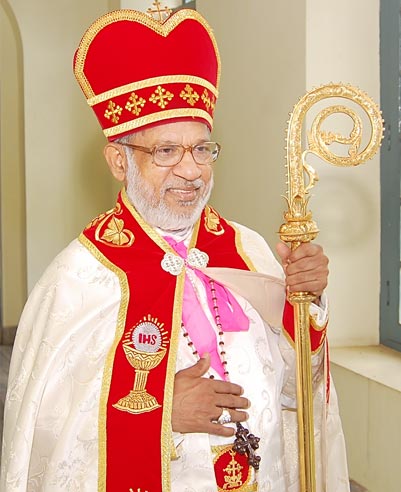
Major Arch Bishop Alencheril Mar Giwargis II Bava-The Patriarch of Syro Malabar Church and The Gate of All India- A Discussion on The Historical Hierarchical Status of The Church of Saint Thomas Christians :Syro-Malabar Church is an Eastern Catholic Church in communion with the Pope of Rome. It is an Apostolic Church founded by Saint Thomas, one of the twelve disciples of Jesus. Syro Malabar Church is the largest group of Saint Thomas Christians. The term Syro Malabar was coined by the Western Missionaries to denote ‘the Syrian Church of Malabar’- those catholics that follow the Syro Chaldean rite.
Sui iuris Churches. (( 1. http://en.wikipedia.org/wiki/Sui_iurus_chuch, also http://en.wikipedia.org/wiki/Eastern_Catholic_Churches#cite_note-28, accessed on 18/06/2011))
These are the Eastern Rite Churches that are in communion with the Roman Pontiff, the Pope. They are Churches of their own particular law. Syro Malabar Church is one among the 21 sui iuris Churches in the Universal Catholic Church. They consists of 6 Patriarchal Churches, 4 Major Archi Episcopal Churches, 3 Metropolitan Churches and 9 other sui iuris churches.
Patriarchal Churches are the fully developed particular churches with a Patriarch as the head with its own synod and territory. The synod elects the Patriarch and inform the Universal Pontiff, the Pope of Rome. Major Archi Episcopal Churches have a Major Arch Bishop as the head, slightly inferior to the status of a Patriarch. The synod elects the Major Arch Bishop, but needs confirmation by the Pope. Pope can reject the election.
Patriarchal Churches in Catholic communion.
1. Coptic Catholic Church based in Cairo
2. Maronite Church of Lebanon
3. Syriac Catholic Church of Beirut
4. Armenian Catholic Church
5. Chaldean catholic Church
6. Melkite Greek catholic Church
Major Archiepiscopal Churches of Catholic Communion.
1. Syro Malabar Church
2. Syro Malanakra Church
3. Romanian Church
4. Ukrainian Greek Catholic Church
Metropolitan Churches in Catholic Communion
1. Ethiopian Catholic Church,
2. Ruthenian Catholic Church and
3. Slovac Greek Catholic Church
Other sui iuris Churches in Catholic Communion
1. Albanian Greek Catholic Church,
2. Belarusian Greek Catholic Church,
3. Bulgarian Greek Catholic Church,
4. Byzantine Church of the Eparchy of Krizevci,
5. Greek Byzantine Catholic Church,
6. Hungarian Greek Catholic Church,
7. Italo Albanian Catholic Church,
8. Macedonian Greek catholic Church and
9. Russian Catholic Church.
THE SYRO MALABAR CHURCH IN THE CATHOLIC COMMUNION
Thomas Christians were part of East Syrian Church. They came into direct communion with the Church of Rome through the Chaldean Patriarchate with the arrival of Mar Joseph Sulaqa and Mar Elias in AD 1554. Historically, the title of the head of the Church of Saint Thomas was the ‘Metropolitan and the Gate of India’. Ancient documents vouches this. (( 2.Placid Podipara, The Hierarchy of Syro Malabar Church, Ch IV in Collected works of Rev Dr Placid Podipara, vol I San Jose Publications, Mannanam, pp 666-667 ))
After the infamous Synod of Diamper in 1599, the Church of Saint Thomas Christians became subjected to Latin rite Bishops. The Latin Missionaries broke the historic connection of Thomas Christians with the Patriarchate of Chaldeans and downgraded the ancient Church of Christians of Saint Thomas into a mere suffragan of the Arch diocese of Goa of Latin rite. Later, the Metropolitanate was reinstated and Arch Diocese of Kodungalloor was created with Western Prelates. (( 3. Joseph Thekkedathu, History of Christianity in India, Vol II p75 )) Even though the Thomas Christians were subjected to Latin rite prelates in Latin Rite hierarchy, the community consolidated under the leadership of the Arch Deacons as a separate rite with its own liturgy and traditions. The Missionaries began to impose Latinisations in their rite of worship and tried to eliminate the authority and status of the Arch Deaconate and thereby dishonoured the status of their ancient Church of Malabar. The community secretly tried to get Prelates from the Patriarchate of Chaldeans and other Eastern Churches. The missionaries used their political power to prevent Thomas Christians from contacting with any Oriental Churches and they even arrested and deported Mar Ahatalla, a Bishop of Syriac Rite arrived in Mailappore. (( 4. Joseph Thekkedathu, opus cit pp94-95 ))
Thomas Christians rose up and revolted against the Portuguese in AD 1653 and consecrated the Arch Deacon Palliveettil Thomas as the Bishop of Thomas Christians. This revolt was nearly complete and that changed the politics. (( 5. Joseph Thekkedathu, opus cit pp 91-94 )) Rome intervened and Carmelite Missionaries were sent to win the Thomas Christians back. Carmelites could convince the majority that the local church needs Bishops and the consecration of the Arch Deacon Thomas was invalid as the consecration was conducted not by any Bishops, but by twelve priests only. Many leaders of the community rejoined the missionaries and later, due to political reasons, Portuguese Missionaries had to leave the country and they consecrated Palliveettil Chandy Cathanaar as the Bishop for the Catholic Thomas Christians in 1663. (( 6. Joseph Thekkedathu, pous cit pp96-100)) Thus, the majority of Thomas Christians consolidated under the native Bishop Palliveettil Chandy, keeping their Syro Chaldean rite of worship. It is reported that Bishop Palliveettil Chandy applied the historic title ‘The Metropolitan and the Gate of all India’. This title denotes a Quasi Patriarchal status with all India jurisdiction. (( 7. Rev Dr Placid Podipara, The Hierarchy of Syro Malabar Church, in Collected works of Rev Dr Placid Podipara CMI, Vol I p 719 ))
This community of the Catholics of Syro Chaldean rite became the Syro Malabar Church. After Bishop Palliveettil Chandy, the Catholic Syriac Christians had to continue under Latin Bishops until 1896. But, they continued their struggle for independence, autonomy and to protect their Syro Chaldean Rite. As a result, the Syro Malabar Hierarchy was established in AD 1887 with the erection of Kottayam and Trichur vicariats for the Catholic Thomas Christians, separating them from the Latin rite Catholics. (( 8. Leo XIII Quod jam Pridem, 20 May 1887, cited in Marthomma Christianikalude Sabha Noottandukaliloode, (Mal), Rev. Dr Kurian Mathothu, Rev Fr Sebastain Nadackal, Palai, p111 )) In 1896, native prelates were appointed in Kottayam and Trichur vicariats and also in the newly created Ernakulam vicariat. (( 9. Pope Leo XIII, Quale Rei Sacrae, 11 August 1896, cited in Marthomma Christianikalude Sabha Noottandukaliloode, (Mal), Rev. Dr Kurian Mathothu, Rev Fr Sebastain Nadackal, Palai, p114 )) In 1923, Ernakulam vicariat was elevated as an Arch diocese and the church became a Metropolitan church. (( 10. Pope Pius IX, Romanae Pontifices, cited in Marthomma Christianikalude Sabha Noottandukaliloode, (Mal), Rev. Dr Kurian Mathothu, Rev Fr Sebastain Nadackal, Palai, p115 )) In 1992, Syro Malabar Church was elevated to a Major Archiepiscopal Church with Padiyara Mar Anthonius I as the first Major Arch Bishop. (( 11. Pope JohnPaul II, Quae majoris christi Fidelium, 16 December 1992, cited in Marthomma Christianikalude Sabha Noottandukaliloode, (Mal), Rev. Dr Kurian Mathothu, Rev Fr Sebastain Nadackal, Palai, p126)) The first and second Major Arch Bishops were nominated by the Supreme Pontiff, the Pope of Rome. During the time of the second Major Arch Bishop Vithayathil Mar Giwargis I, the Holy Synod of Syro Malabar Church was given full powers including election of the Father and Head of the Church. This is the first time, the Syro Malabar Church was executing its powers to elect the Father and head of the Church canonically. This event actually denote the recapturing of the old status of ‘Metropolitan and the Gate of All India’ which was lost due to Latinisations.
The Holy Synod of Syro-Malabar Church that consists of 44 bishops, commenced on 23rd May 2011, has elected Mar George Alencherry, the Bishop of the Eparchy of Thakkala, as the Father and Head of the church, The Major Arch Bishop.
The title Major Arch Bishop in unknown in Thomasine Christian tradition as it is a title of the Latin Church. The Antiochian Rite Syro Malanakara church in Kerala which was also elevated to Sui iuris church by Rome calls their Major Arch Bishop as Catholicose according to their tradition. Many Syro Malabar faithful wish to call him Patriarch as per the eccelsiological and cultural tradition of Thomasine Christianity in India. The Thomas Christians were ecclesiastically and hierarchically part of the Patriarchate of Chaldeans. As the Syro Malabar Church was bifurcated from the Patriarchate of Chaldeans due to political reasons, the church deserves the same title.
A SHORT BIOGRAPHY OF MAR GIWARGIS II BAVA. (( 12.http://www.maralencherry.smcim.org/profile.html))
Mar Giwargis Alencherry was born in 1945 in Thuruthy in the Arch Diocese of Changanacherry. Two of his brothers are Priests and a sister is a nun. He had his initial education in local schools and joined the seminary in 1961 at Parel, Changanacherry and then at Saint Joseph’s Pointifical Seminary Alwaye. He passed his degree in Economics with second rank from Saint Berchman’s College, Changanacherry. He was ordained as a Priest in 1972 by the Late Major Arch Bishop Padiyara Mar Antonius I Bava. He then worked as the assistant vicar at the Cathedral church of Changanacherry and Director of the Archdiocesan Faith Formation department. Then he served as the secretary of the Commission for Catechism of the Kerala Catholic Bishops’ Council . He was sent to Paris for higher studies and obtained his Doctorate in Biblical Theology at Sorbonne University and the Catholic Institute.
From 1986, he served as the Director of the Pastoral Orientation Centre of the Kerala Catholic Bishops Council and as a Professor at Saint Thomas Apostolic Seminary and Oriental Institute, Kottayam. He became the protosyncellus of the Metropolitan of Changanacherry in 1994 and in 1996, he was consecrated as the first Bishop of Thakcalay, a mission diocese of the Syro Malabar Church.
As a Bishop, he served the Church as the secretary of the Syro Malabar synod, Chairman of the Commission for Catechism of the Syro Malabar Church, and Chairman of the CBCI commission for laity. He is an author of several articles and books in various languages. He is proficient in Malayalam, Tamil, English and French.
Mar Giwargis has been described as a simple man who even uses public transport to travel. He is well known for his down-to-earth approach that he has even visited all the houses in his diocese!. He is considered as a person with traditional view of the Church. He wears a Sleeva (traditional cross) on his rudraksha seed garnet that reflects the Indian tradition profoundly.
INTERESTING OBSERVATIONS ABOUT THE ELECTION
First in the history- recapturing the Historical autonomy.
This was the first ever election of the Father and Head of Syro Malabar Church after the power of election was given to the synod. All the previous Major Arch Bishops were nominated by the Pope. This is an event marking the full evolution of Syro Malabar Church into sui iuris status claiming its historical autonomy and individuality.
Pontiff who had his formation in Syro Malabar Rite.
This is the very first Major Arch Bishop who had his formation as a Syro Malabar Priest. All the predecessors, even though they were Syro Malabar in origin, were trained and ordained as Latin rite priests and then re-implanted into the Syro Malabar Church. This factor will give a new direction to the church leadership in the light of its history and tradition.
Unity of the Holy Synod.
There were many speculations in the media about the election of the Major Arch Bishop on the grounds of regional and other preferences and it is reported that even one of the Bishops also have responded to these kinds of talks in the printed media and put forward names of a few candidates. (( 13. www.ibnlive.in.com/generalnewsfeed/news/synod-to-elect-major-archbishop-to-commence-on-may-23/695369.htm )) A group of clergy also released a press notice before the election raising issues with the background of the differences existed in our Church on the way of celebrating the Holy Qurbana.
Under these circumstances, the election process caught wide attention and many were anxious that these may even put the Church in turmoil. But the Holy Synod completed the election process on the first day itself and the required 2/3 majority was obtained on the second round of voting itself, as reported by the Curia Bishop. (( 14.http://www.ernakulamarchdiocese.org/admin/cms/docs/n_high/222.pdf; Mar Bosco Puthur, Curia Bishop and administrator of Syro Malabar Church, Mar George Alencherry, the new Syro Malabar Major Arch Bishop, Circular about the election of the Major Arch Bishop.))
Obedient to the Synodal decisions
The elected person was one among the Bishops who fully obeyed the decision of the Holy Synod about the celebration of Holy Qurbana. When the whole church was divided about the way of celebration of Holy Qurbana ad orientum- facing the altar- versus ad populum- facing the people-, the Holy Synod unanimously decided to follow a compromise formula by celebrating the initial prayers ad populum, the anaphora ad orientum and the final prayers ad populum- the so called 50:50 formula (( 15,Synodal News Vol 7, nos 1&2 1999, 61, cited by Dr M Kochupurackal, Liturgical development in the syro malabar church, Syro malabar Church since the eastern code, Ed F Elavuthinkal, Mary Matha Publication, Trichur 2003, pp148 )) Mar Giwargis was one among the few Bishops who fully obeyed and implemented the synodal decision.
Divine influence.
This election process clearly shows the explicit involvement of the Ruha D’ Kudisha in the Church. The election result was surprising that the incumbent was not a prominent candidate as speculated. The Election process was so quick and smooth and the synod was united in selecting a person without any preferences or prejudice. Divine influence is prominent that the members of the Holy Synod were instrumental in the plans of the Ruha D Qudisha, in having the incumbent one of the Bishops who fully obeyed the decisions of the Holy Synod even sacrificing his own views, one who had his formation of clerical life in the Syro Malabar rite itself and in the unity of the Holy Synod in the background of differences about restoration and reformation.
God has shown us the divine intervention here by selecting a Bishop who obeyed the Synodal decision! God is teaching us the greatest lesson of obedience, as Our Lord Isho Mishiha showed us. The Almighty God is giving us a clear message of obedience.
EVOLUTION OF HIERARCHY IN THE CHURCH OF SAINT THOMAS
Thomasine Christianity and East Syrian Church
Thomas Christians in India were part of the East Syrian Church. East Syrian Church is the communion of churches founded by Apostle Thomas. Apart from Indian Church, the other Thomasine Churches are the Church of Fars, Church of Edessa and the Church of Selucia Ctesiphon. The Assyrian Church was one of the very first churches established in Biblical times. Acts of Apostles mentions about the presence of Assyrians on the day of Pentecost. (Acts 2,9) Very ancient syriac writings such as ‘The Doctrine of Addai’, ‘The Chronicles of Arbela’ and ‘The teachings of the twleve Apostles’ mentions that Saint Thomas sent Thaddeus and Mari to preach Abgar Ukkama the Black, the King of Assyrians at Osrhoene.(Edessa) (( 16. Stephen Andrew Missick, Mar Thoma, the Apostolic Foundation of the Assyrian Church and the Christians of Saint Thomas in India, Journal of Assyrian Academic Studies, vol XIVNo 2, 2000, pp35-36 citing Alexander Roberts and James Donaldson, Eds. The Writings of the Fathers down to AD 325: Ante Nicene Fathers vol 8 Peabody, Massachusetts, Hendrickson Publications 1994, p657-672 ))
Eusebius, the father of Church history also witnesses in AD 325 that he personally searched the state archives of the Assyrians in the capital city of Edessa and found official records of this Apostolic visit. (( 17.Stephen Andrew Missick, Mar Thoma, the Apostolic Foundation of the Assyrian Church and the Christians of saint Thomas in India, Journal of Assyrian Academic Studies, vol XIVNo 2, 2000, pp35-36 ))
It is believed that Apostle Thomas personally founded the Church of Fars and the Church of Malabar and his disciples Mar Addai-Thaddeus and Mar Mari founded the Church of Selucia-Ctesiphon and the Church of Edessa. But Church of Selucia Ctesiphone acquired supremacy as it was the capital of Persian Empire and the Catrholicos Patriarch was based there.
Indian Church was subjected to Church of Fars initially which was a Metropolitan Church. East Syrian Patriarch Isho Yahb III(650-660) elevated the Indian Church also to a Metropolitanate and made equal in status to the Metropolitanate at Fars and thus came directly under the Patriarch. (( 18. A Mingana, The Early spread of Christianity in India, The Bulletin of John Rylands University Library,Vol 10,p 496 )) This Metropilitan of India was called Metropolitan and the gate of India.
Metropolitan and Gate of all India ( Metropolitan v-thara d- kollah hendo)-The Throne of Saint Thomas
The Metropolitan of the Church of Saint Thomas was called Metropolitan and gate of All India. The Syriac manuscript written in AD 1301 in Cranganore- the vatican Syriac codex 22- use the title The Metropolitan of India. ‘ …..And in the time of the Bishop Mar Jacob, Metropolitan and director of the Holy see of the Apostle Saint Thomas , that is to say, our director and the director of all the holy church of Christian India…..’ (( 19.A Mingana, Early Sperad of Christianity in India,The Bulletin of John Rylands University Library, Vol 10 p 501,))
Here, the usages- ‘the director of all the holy church of Christian India’- and ‘Metropolitan and director of the Holy see of the Apostle Saint Thomas’ are important, as they denote the concept of the throne of Saint Thomas and a quasi Patriarchal status.
The term Metropolitan and the gate of All India has been reported by many authors including Rev. Paulinus De Bartholomew, Rev Campori S J, and so on. (( 20. Placid Podipara, The Hierarchy of Syro Malabar Church, CH IV, in Collected Works of Rev Dr Placid Podipara, vol I p667 -668 citing Archives Roman of the Society of Jesus., GOA, 65 f 4,))
Metropolitan of Angamali, the ‘Rabba d Kolhon Apeskope u Metropolite’- Superior of all the Bishops and Metropolitans.
When the second Chaldean Patriarch Mar Abdisho appointed Mar Abraham as the Metropolitan of Angamali, he conferred the title ‘Rabba d Kolhon Apeskope u Metropolite’- Superior of all the Bishops and Metropolitans. ((21 Mar Abdisho’s letter to the Arch Bishop of Goa on 24/08/1567. The original in syriac is preserved in ARSI Gallia 95-1, f 197.See fascimile in Documenta Indica vol II p 41. Italian translation in A Rabbath, Documents inedits pour servir a l’histoire du Christianisme en Orient II Paris, Leipzig 1910, pp432-434 cited by Jacob Kollamparampil, Sources on the Hierarchical structure of the Saint Thomas Christian church in the pre diamper period, p 171, in ‘The life and nature of Saint Thomas Christian church in the pre diamper period’, Ed B Puthur, LRC Kochi, 2000)) Mar Abdisho in his decree nominating Arch Deacon George of Christ as the Bishop of Palayur and Suffragan to Mar Abraham, seems to have authorised Mar Abraham to assemble all the Metropolitans and Bishops and also to elect and consecrate Bishops. (( 22 Mar Abdisho’s decree dated 25/08/1567. Portuguese translation in ARSI Goa, 1011, f 463, J Wicki, Documenta Indica VII,pp703-705 cited by Jacob Kollamparampil, , Sources on the Hierarchical structure of the Saint Thomas Christian church in the pre diamper period, p 171, in ‘The life and nature of Saint Thomas Christian church in the pre diamper peroiod’, Ed B Puthur, LRC Kochi, 2000 )) By this, the Metropolitan of Angamali was given autonomy and authority over other Prelates.
Patriarch of India- the testimony of Joseph, the Indian
Joseph , the Indian Cathanar’s narrations in AD 1501 before the signoria of venice describe about the Patriarch of India. Joseph was interviewed by the House of Lords of Venice where he explained the hierarchical structure of the Church of Malabar.’They have a Supreme Pontiff called Catholoica, twelve Cardinals, two Patriarchs, Bishops and Arch bishop’s. Joseph also mentioned that he was ordained as a Priest by this Catholica. (( 23.Narrations of Joseph, the Indian, Ch 5 Italian, latin and Dutch texts, Antony Vallavanthara, India in 1500 AD pp168-9,231.))
We can see from the History that Joseph was ordained by Catholicos Simon, the Patriarch of the East, in AD 1490.The famous syriac letter of the three Bishops Mar Yohannan, Mar Yakkob and Mar Denha in AD 1504 to the Patriarch of Babylon testifies this fact. (( 24. Alphonse Mingana, Early Spread of Christianity in India, The Bulletin of John Rylands University Library, vol 10 p468, H Hosten, The saint Thomas Christians of Malabar AD 1490-1504, Kerala Society Papers series 5 Ed T K Joseph,pp225-226))
Joseph clearly confirms that this Pontiff is called Catholica. The Catholca appoints Patriarchs, one for India and one for China. (( 25. Narrations of Joseph, the Indian, Ch 5 Italian, latin and Dutch texts, Antony Vallavanthara, India in 1500 AD pp168-9,231.))
Here, Joseph is clearly stating the hierarchical relations and structure of theChurch of Saint Thomas Christians. Their Supreme Pontiff is the Catholicose at Babylon. Under him twelve cardinals. It is unclear, if this position is called Cardinal exactly, as Cardinal is a title in the Roman Church. There can be misinterpretation of words due to language barrier. We can assume that there was a twelve member council immediately under the Catholoicos. This reminds us about the 12 canonists under Paremmakkal Thomman Cathanaar, the Governor of the Catholic Syrians. (( 26. Antony Vallavanthara, India in 1500 AD, foot note 72, p274 )) Joseph is clear about Patriarchs of India and China under the Catholicos.
Special privileges to Metropolitan of India- Quasi-Patriarchal status ?
We have to remember that The Metropolitan of India was given special privileges due to the fact that they are far away from the Patriarchate. Patriarch Theodosius (852-859) stipulated that the Metropolitans of India and China need report to the Patriarch only once in six years rather than every year for the other Metropolitans. ((27. T P Elias, East Syrian Missions to Asia with special reference to Malabar coast from Sixth century to Sixteenth century AD and its influence on Indian Religions Society and Culture, Doctoral Thesis of Mahatma Gandhi university, Kerala, India, p 292))
From this , we can assume that the Metropolitan of India had a certain autonomy and it seems that the Patriarchate considered the Indian Church as a Particular church. Could this special privilege made the Metropolitanate as a Quasy Patriarch ?
If we follow the subsequent history, we can see Mar Ahathalla arrives to Mailappore claiming that he was the Patriarch of India appointed by the Pope. (( 28. Joseph Thekkedathu, The troubled days of Francis gaecia, pp 51-52)) Also, Mar Andrews- Kallada Mooppan arrives in AD 1676 claiming that he was the Patriarch appointed by the Pope. (( 29. Lingerings of Light in the dark land, being researches into the past history and the present condition of the Syrian Church of Malabar, Thomas Whitehouse, p 199)) If Patriarch was not a familiar title, they would not have made such claims as a Patriarch and the faithful would not have accepted them.
CONCLUSION.
The Syro Malabar Church is a Major Archi Episcopal Church. It is unlikely that Patriarchal status will be conferred to Syro Malabar Church in the present circumstances. We have seen that the Syro Malabar Metropolitan had the title of The Metropolitan and the gate of India and the Director of the See of Saint Thomas, which are quasi patriarchal titles with All India jurisdiction. Historically, we can see the Patriarchate of Babylon giving special status to the hierarch of Indian Church to report only once in 6 years, conferring a special privilege and the status of a particular Church. Overall, as Rome has bifurcated the Indian Church from the Patriarchate of Chaldean on political grounds, the hierarch of the Christians of Saint Thomas should also have the same title. On these grounds, we have all the rights to call our Father, the Major Arch Bishop Alencherril Mar Giwargis II Bava , as the Patriarch of Syro Malabar Church on a wider sense.
Picture Courtesy : SMCIM website (http://www.smcim.org)
(Thanks to Dr Joseph Alumkal and Mr Mathew Mailapparampil for valuable suggestions.)
___________________________________________________________________________
Author M Thomas Antony can be reached by email at – m dot Thomas dot antony at live.co.uk.
____________________________________________________________________________
I am very happy that there was a historical vote in Syro – Malabar Church. Thank God, and let God help us solve our differences in Syro Malabar Church. Major Arch Bishop Alencheril Mar Giwargis II Bava is wonderful and humble bishop. The next new Archbishop should know the Syriac Language because we are labelled as Syrian Christians. Although we are Syrian Christians, we do not know the Syriac Language, that is shame to us. So, every Syrian Christian should know the Syriac Language.
I fully agree with Br. Joseph. The institutions run by Syro-Malabar churches should start offering Syriac language as a second language in all schools as well as colleges. Our children should be taught Syriac language in the Sunday classes from lower classes itself so that when they are teenagers they should be proficient in the language and they should be able to read write and speak the language. This will also generate job opportunities for few syriac language teachers in the state. It is a shame that we call ourselves Syrian Christians and many people are not even aware of their own language, traditions and culture.
The first native bishop of Marthoma x’tians was Parambil Chandi kathanar…..parish member of muttuchira church who was buied at kuravilanagadu..Not Palliveetil chandi kathanar
Hi Thomas Anthony,
Why the ‘II’ ?. I havenot heard of any Bishop named Alencheril Mar Giwargis I. Also what I have heard is Catholics use their family name, like Alencheril,vithayathil etc. So unless there was a Bishop from the same family why do you give the ‘II’instead of ‘I’?
In Orthodox church, the Catholicos is called 1st or 2nd only if they have the same name, like Baselious Marthoma Mathews 1 and his successor Baselious Marthoma Mathews II.His successor was Baselious Marthoma Didimos I.
Very true Annie .the syro malabar church is just trying to to imitate and copy the syrian orthodox practice and also by calling the head of their church as “Bava” from wer did it come from alll of a sudden ? From orthodox ?
Hi Annie,
Thanks for your comment. I can very well see your logic.
Please note that the terminology Alencherril Mar Giwargis II Bava is not an official terminology. It is my personal opinion only.
As we all know, East Syrian Patriarchs were called Mar Thimothy I, II, III, Mar Jaballaha I, II , Mar Sabrisho etc When the same name repeated, the suffix I , II etc are applied. As far as I know, they do not use their family names and they even change their own names.
According to East Syriac tradition, when a monk become a Bishop, he changes his name. – example the Prelates came to Kerala with Joseph, the Indian in AD 1490 were two monks with the same names Joseph from the monastery of Blessed Eugene. They were consecrated as Bishops by Mar Simon, the Patriarch of Mosul and called them Mar Thomas and Mar Yohannan. The next Patriarch, Mar Elias in AD 1503 consecrated Rabban David as Mar Jaballaha, Rabban Geroge as Mar Denha, and Rabban Masud as Mar Jacob and sent them to Kerala with Mar Thomas and Joseph, the Indian Cathanar.
The present Father and Head of Syro Malabar Church is Major Arch Bishop Mar Giwargis II. His predecessor was Major Arch Bishop Giwargis I . To identify these two people, I have put their family names also. Thus, Major Arch Bishop (title) Vithayathil ( family name) Mar Giwargis I and Major Arch Bishop ( title) Alencherril (family name) Giwargis II.
Please do not compare this with terminologies ‘His Holiness Moran Mar Baselios Marthoma Mathews I and II’. Here, ‘Baselios Marthoma’ is not a family name. It is the title of the Head of the Indian Orthodox Church. Mathew is the name of incumbent.
Baselios Marthoma Mathews I was Vattakkunnel Kurian Mathew. When another Mathew- Puthen veettil Idikkula Mathew became the next Catholicose, he became Baselios Marthoma Mathews II.
Syro Malabar Church has its origin in East Syriac tradition, but it was evolved in a Latinised environment. We can see it in all aspects of Syro Malabar Church. We cannot forget the history.
In Roman Catholic Church also, at the level of Supreme Pontiff, they change the name and they don’t use the family name. When Cardinal Joseph Ratzinger became the Patriarch of Rome, he chose the name Benedict and thus, Pope Benedict XVI.
Let us hope that future Fathers of Syro Malabar Chuch also change their names on occupying the position, following the traditions of the East Syriac and also of Rome.
M Thomas Antony im sorry to tell u this I dont see any east syrian traditions in your church its fullly latinized .I hope and pray that the syromalabar church begins to follow the traditions of the east syrian church completely .
Dear John,
Thank you for your comment.
Yes, I agree, Syro Malabar Church is a latinised Church. It is sad. But we can see some light at the end of the tunnel. Syro Malabar Church is trying to get rid of the Latinisations and restore the authentic traditions. Let us pray the Lord that the authentic Syro Malabar traditions be restored fully. It may be difficult due to a section of strongly latinised clergy, but there are a few pockets where very authentic east Syriac traditions are fully restored.
Latinisations were part of colonialisations that destroyed or aberrated many authentic traditions. This is a problem of Modern world where stronger parties try to impose their ideas everywhere. Christianity is not an exception, as all are humans.
See the Syrian Orthodox churches in Kerala. When Syro Malabar Church was latinised, the Malankara Syrian orthodox and Jacobites got Antochianised or West syriacised. When Syro Malabar Church became latinised, it did not adopt the Latin rite but adopted certain Latin elements into the East Syriac rite but sadly, the Malankara Churches fully lost their original rite and moved over to a new rite.
When people say Syro Malabar Church is a uniate church to Roman Catholic Church, we cannot deny that the Malankara Orthodox and Malankara Jacobites are uniates to the Syriac Orthodox Church of Antioch. I would also say, the Syriac Orthodox Church of Antioch is a section of East Syriacs who became uniates to the Greek Church of Antioch.
Now, the Malankara churches are uniates to another uniate church !
Syro Malabar is not a uniate Church. Syro Malabar Church is an Apostolic Church founded by Saint Thomas the Apostle. It came into communion with the East Syrian Church in the first few centuries. East Syrian Church was politicaly alienated from the Churches in the Roman Empire including the Patriarchate of Antioch. Church of the East always considered the Patriarch of Rome as Primus Inter pares which can be seen in many many documents. The visit of Ramban Sauma, the Apostolic delegate to the then Patriarch of the East, Mar Jaballaha III to Rome in AD 1287 and 1288 and many other events and documents before and after are examples of this communion. Syro Malabar Church also continued the same but in the modern World, colonialism polluted that communion which is the cause of the latinisations. Thus, Syro Malabar Church is not a uniate but continued the age old communion with the Church of Rome but succumbed to colonialism to an an extent.
Another sad thing is even the Malankara Orthodox churches are also slowly imitating Syro Malabar Church in certain pious activities. I went to Parumala church last year. My observations prompted me to think that they were studying for Syro Malabar Church !
Over the Antiochene West Syriacisation, they are looking for a few latinisations also.
Let us pray together for the de-latinisations of Syro Malabar Church and de-antiochinisations of the Malankara Orthodox churches to promote the authentic Thomasine Christianity of Malabar coast.
M Thomas thanks for the reply.Can i tell that syromalankara church is the best example for a syrian church to keep up traditions of the west syrian or the antiochene practice at the same time being in full comunion with the see of Rome?. Beacuse they have all traditions peserved of the antiochene church including their vestments ,liturgy ,Altars glad to see the absence of latinization i n the malankaracatholic church .
Mebin:
I believe there is a letter between the East Syriac Patriarch and the Indo-Persian Christians of SW India, where the latter were instructed to elect a candidate for bishop from their own community.
If this is true and I’m not recalling this incorrectly, then perhaps that anonymous bishop is the actual first native Indo-Persian bishop of our community.
Hi Thomas antony…
As i heard that former Major arch bishop of Syro-Malabar church was Major Arch bishop Mar Varki Vithayathil…right….his name is not goerge or vargees or geevargegees…then how can you call him as Giwargees I….
Hi Mebin John,
I understand there is a bit of confusion about Palliveettil Chandy /Parambil Chandy.
Both the family names- Parambil and Palliveettil are used by different authors. The western authors used the term Parambil and hence the surname Alexander de Cambo.
But the tomb of Mar Chandy on the madbaha of Kuravilangadu church says Palliveettil Chandy.
The conflict is due to the claim of Palliveettil and Pakalomattom families that parampil belongs to them. I have read that there is a Parampil branch of Pakalomattom family in Muttuchira and a Parampil branch of Palliveettil family in Kuravilangadu. Pakalomattoms claims that Parampil Thomas (The archdeacon) and Parampil Chandy (Bishop Chandy) were of Parambil branch of Pakalomattom where as Palliveettils claims that they are of Parambil branch in Palliveettil family. Sorry, I have nothing to do with Pakalomattom and Palliveettil families.
Paremmakkal Thomman Cathanaar uses the terms Palliveettil Thoma Arch Deacon for Parampil Thomas and Panamkuzhackal Chandy methran for Parambil chandy. Panamkuzhackal is a branch of Palliveettil family.
I have used the term Palliveettil because it is the term I have heard in my childhood from the elders and also from the testimony of the inscriptions on the tombstone in the madbaha of Kuravilangadu Church.
Dear John Mathew,
It was Patriarch Thimothy I (779-823) who wrote to Indian Christians that they should confirm the election of the Metropolitan by the faithful in the presence of suffragans, to the Patriarch first and then only to the local Kings.( Ibn Attib, The Law of Christians, cited by Fr Placid Podipara The hierarchy of Syro malabar Church, in Colledted works of Rev Dr Placid Podipara CMI, vol 1 p666, ).
Until the time of Patriarch Thimothy, there was a custom of enthroning the Metropolitan by placing the letter of the Patriarch on his head.( Corpus Scriptorum Christianorum Orientalium, Textus, 167, pp 119,118; versio 168, pp 120-121, cited by Placid Podipara, opus cit.,)That means the enthronement was also local. This give an indication that until at least the time of Patriarch Thimothy I, there was a custom of electing the Metropolitan locally. So, they might have been natives.( I am not forgetting that there is possibilities that the Prelates could be from Persia)
Patriarch Isho Yahb III ( 650-660) wrote a letter to the rebellious Metropolitan of Riwardashir, Mar Simeon( A Mingana, Early spread of Christianity In India, The bulletin of John Rylands Universdity Library, vol 10 pp463-464) and mentions that ‘you closed the doors of the episcopal ordination for the people of India’ for ‘perishable gains’- ? simony. Christians of India were denied Bishopric ordination for money. This indicates that until that time, it would have been Indians who were consecrated as Bishops on submitting some money to the Metropolitan.
Mr. Thomas, You seem to have good knowledge about the history of Syro Malabar Catholics, I am from Panamkuzhackal family, I would like to talk and get some insights
johncy panicker:
Varki/Varghese are Indian variants of the name Gewargis which is a Syriac variant of the original Greek name Giorgios.
In light of this, how is Antony’s terminology flawed?
Thanks John Mathew for clarification.
Varkey and Varughese are Malayalam variants of the Syriac name Giwargis. The name George became popular only after the arrival of the Europeans. Still, Varkey and varghese were popular in the older generation.
The Late Major Arch Bishop Mar Varkey Vithayathil was born in 1927. His official name was Varkey. The liturgy of Syro Malabar Church was in Syriac at that time and I presume that Mar Varkey might have been baptised as ‘Giwargis’.
I still remember, when I was a young boy, the name of the Pope in a Latin rite Church very close to my home mentioned as ‘Pope Paul IV’ whereas in my own Syro Malabar parish church, it was ‘Mar Paulose Papa’.
The Syro Malabar liturgy always used the Syriac versions of the names, even after it was translated to vernacular in 1968. Even Mar Varkey Vithayathil was remembered in the Holy Qurbana as ‘Mar Giwargis Metropolitan’ in many Syro Malabar eparchies.
re: Varkey, Varughese etc, These names are NOT derived from george. These names correspond to ‘George’ ie GEORGE is the English equivalent of Varki, varghese etc. Variki, varghese etc are derived from the original Greek name ‘Giorgos in get,gather etc Gioirgios when written in Malayalam retained its g sound as in get, gather etc. \\\\\\\\
Re: varki, varghese etc,As stated earlier, the name originated from the greek name ‘GIORGIOS’, that name when translated into Malayalam, became Givarghese or geevarghese.(Do not bother about the spellings in english- vargheses can be spelt in myriad ways like Varughese, worgheses,Varghis etcetc They are all one and the same name). In Malayalam. when two vowels appear one after another, they are joined by a’V’ OR VA’ sound, Ex Thiru-Ananthapuram is spoken and written as Thiru-v-ananthapuram. so GIORGIOS became GI-V-ORGIOS and then Geevarghese, This geevarghese is the name with which children are baptised, But later for daily use, it gotshortened by omitting the ‘gee’ part just varghese. This varghese (albeit with different spellings) became the standard or most used name for gee varghese,
VARKI or VARKEY — People shorten names in daily use as we have seen that GEE VARGHESE got shortened to VARGHESE, This Varghes got further shortened and became VARGHE. Malayalam is a Dravidian language and it became /or got separated from Tami/Tamil like language only by 10th cdentury, So our ancestors spoek that language. You may observe, Tamil had no ‘GA’ SOUND- It had no ‘BA’ sound, Instead of BA they used PA’ sound or rather instead of B, P was used. Even now, the name BATA for ex. is written in Tamil as PATA.. Similarly, the K sound was used for G , ‘ golmal’ became kulumal and Guruthwam became Kurutham and many in central travancore talk of konom for GUNAM!. Similarly, VARGHE became VARKI.The impre ssion in some quarters that VARKI was the original name and that Vargheses is the stylised version derived from Varki is not correct.
To be totally accurate, let’s not forget that Varghese is a variant of Giorgios via Syriac.
It’s not as if the name came to Malayalam/Tamil directly from Greek. The oldest usage is Gewargis which is almost a transcription directly from the Syriac (gywrgyws, I believe).
Dear K Verghese,
Your description regarding the name Varghese is quite interesting. My official name is Varghese. Thanks for your findings.
Aji Matthew
Antony is cleverly weaving the web that Catholics are the first and the best Christians of Kerala. He wants to state that Catholics are the Syrian Christians. But Syrians are Syrians. Catholics, under the mafia raj of Menezes brought the Syrians under their control. Tthe Syrians revolted against it. Again with money and political power they took a major part of Syrians to their side. Syrians, on the other side who lacked a bishop when their believers joined with bishops installed a Bishop. That led to the divisions, thrones, fighting among the Christians of Kerala. All these are proved facts. It is absolutely revealed that Catholics never had a footing in Kerala before the coming of Vasco De Gama. So I request you that please do not make statements against the truth.
Aji Matthew
Dear Aji Mathew,
With all respect, could I ask you to read my articles without your prejudice please ?
I have never stated anywhere that Catholics are the first and the best Christians in Kerala.
I have never stated anywhere that all the Catholics are Syrian Christians.
In fact, I do not use the term ‘Syrian Christians’, I use ‘Syriac Christians’. Syriac Christians are called by that name because of the use of Syriac language in their liturgy. (It is also to be noted that the term ‘Syriac or Syrian Christians’ was first coined by the Europeans, not by any of the Thomas Christians.)
I agree that Catholics never had a strong footing before the arrival of Vasco Da Gama, but if you study the subject carefully, you will also understand that the whole of Thomas Christians were in communion with the Pope of Rome through the Patriarchate of Chaldeans since the arrival of Mar Joseph Sulaqa in AD 1554. It is also documented that the initial period of contact with the Portuguese was friendly especially with Mar Jacob who arrived in AD 1504.
But, you will have to agree that majority of Catholics in Kerala are Syriac Christians and also the largest group of Syriac Christians in Kerala are Catholics. The rest of what you have jotted above about the revolt and the aftermath can be found in my own write ups here.
We all agree that this division was unfortunate and we all should try to find unity among the different groups. It is worthless to claim about who is better, who is first, who is majority. It is sad that the Thomas Christians were divided because of the politics of the opposing European Christian groups who tried to get people in their side by promoting hatred against each other and to keep them divided.
From this, I see no reason for your comment.
I support Thomas Antony that all the Syrian Christians should come together on a common platform . This is the need of the hour. Let us all work towards that goal. It could start with all the bishops of the churches with syriac background( Syro Malabar, Syro Malanakara, Syriac orthodox, Jacobite syriac orthodox, Marthomite, Chaldean Church of the East, Malabar Ind. Syrian church of Thozhiyur etc ) coming together and forming a small working group. They can commission a group of eminent people to write the history of the Indian Syrian Christian community without any bias and prejudices. Of course we may have to give up some of the so called “truths” we were clinging on to and also teaching the same to unsuspecting community members by various churches to reinforce those “truths”. A lie told many times will not make it a truth.Truths and facts you can not change, but you can twist them to serve your goals. But in this era of internet how long you can keep them ignorant of the facts. Those churches are actually exposing their own biases and prejudices.
Let us hope that we all give up all our false claims for the good of the community and for its unity.
Dear Antony,
You have to understand where the puthenkoor are coming from. Most have been indoctrinated that they and their west syriac rite is the original form of christianity in india. I myself was duped by the pseudo historians for a long time. And a strong anticatholic bias exists in the puthenkoor due to, as far as I can see, an inferiority complex that goes back to the series of semi-legit semi-illegit ordinations of puthenkoor bishops which really can’t be proven.
So you have these two forces that screw up the puthenkoor and cause them to have an allergic reaction when they hear of the achievements of the syriac catholics–such as the maintainence of the old rites of our ancestors.
Now, not all puthenkoor are like this, but a lot are. I still shudder at the idiotic posts I made on nsc while coming to terms with reality (for me, though I long knew we were nestorians originally and that the west syriac orthodoxy in kerala was a novelty, but I refused to believe that the catholics in kerala were anything other than ‘converts’. Then I physically entered a smc church in india, and saw the east syriac. I knew then I was wrong!).
The Puthenkoor faction always cook up stories to cover up faults and their lacunae.PUTHEN KOOR itself means new allegience.
PAZHAYA KOOR IS ONLY SYRO MALABAR CHURCH.
A visit to Marth Mariam Forane Church at Kuravilangad built around 350 AD and the tombs of Arch Deacons who ruled the St.Thomas church in Kerala is testimony to these facts.
ONLY THE LATIN CATHOLIC CHURCH CAME HERE AFTER PORTUGUESE.
East Syrian words are found even in the West Syrian liturgy of Jacobite/Orthodox churches due to the influence of Syro Malabar Church.
How will these people explain the presence of statues of Mother Mary at Manarcad Jacobite Church and the inscription of ‘Mishiha kalam’ on a tomb inside Manarcad Church.
‘Mishiha Kalam’ is found only in the liturgical calender of Syro Malabar Church.
I challenge Mr.Aji to show such a ‘Mishiha Kalam” in West Syrian or Antiochean Liturgy.
Due to latinisation policy of Portuguese an unfortunate divide occured in the Syrian Church.
Our forefathers have fought against it.Mani Kathanar and others have fought against it.Ithaco Kathanar of Idappally died in jail protesting against ‘Parangis’
THEY WERE ALL SYRO MALABAR PRIESTS FIGHTING FOR LEGITIMATE RIGHTS OF SYRIANS.
Opposing Latinisation is not opposing universal Catholic Church.
@ John Mathew
Have to respectfully reject the statements of John Mathew.
MOSC history is more in lines with the Syro-Malabar version, acknowledging the Persian/Assyrian connection.
Jacobite version, do not concede the presence of Persians in Malankara. According to them, Malankara Nasranis were always under the Universal throne of Syrian Patriarch.
The anti catholic mentality of the Jacobites/Orthodox ;is because of the overly inappropriate misadventures of the Syro-Malankara Reeth.
From, approx 1820 till 1890’s, the Malankara Church, was reeling with the Marthomite-Anglican issue.
From 1912 – 1956, the Jacobite- Orthodox tussle and the restart of it from 1970.
I would be amazed, at the capacity of the Orthodox/Jacobite leadership in finding time to indoctrinate their masses ( that too anti-catholic).
And the activities of Syro-Reeth. Oh, that’s just soaked gun powder!!!!
Also, let’s forget, Mathu Tharakan and his cronies.
@ Anto
Pazhyakoor and Puthenkoor are terminologies invented by Syro Malabar historians.
‘Koor ‘ means rite, and since few of the Syro –Malabar churches use East Syrian liturgy, that doesn’t mean, the ones who had to adopt West Syrian are in anyway inferior or NEW.
I would still owe great gratitude to my forefathers for adopting the beautiful West Syrian Liturgy , over the East Syrian ones.
And ‘cooked up’ stories, show me one church in kerala, that knows not to cook???
And this is classy !!!
http://berchmans.tripod.com/chridx.html
Anto:
Let’s not be extreme to the point of distortion. The Syro-Malabar Church in its current form did not exist in Kerala from ancient times either. It uses the old original rite, but as Antony explains, bears the marks of the several centuries of contact it had with Western Catholic missionaries. I don’t believe those marks are necessarily bad or good; but they exist.
Also, to be complete, the Pazhayakoor consists of both Churches in India that use the East Syriac Rite: the modern day Syro-Malabar Church and the modern day “Chaldeans”, i.e, the Church of the East.
The original Church in Malabar, prior to the arrival of the Portuguese was the Church of the East, which was in the century before the Portuguese arrived, variously in communion with the (a) Church of the East, (b) the Chaldean Church of the East (which was in communion with Rome).
So, yes, we had connections with Rome prior to the Portuguese arrival. No, that connection does not extend back to the inception of Christianity in India.
The Syro-Malabar Church and the Chaldeans are the two descendants of the original Indian Church that are most faithful to the original rites. Hence the term Pazhayakoor is justified.
The Puthenkoor are the descendants of the original Indian Church that are not faithful to the original rites, except via whatever is common between East and West Syriac rites, and perhaps a more rigorously “eastern” aesthetic, which comes due to its affiliation to a completely Oriental Church. But they are not using the original rites, hence “Puthenkoor” is justified.
Finally, I’m sure “Meshiha Kalam” is a western innovation in India, coming via the Latin AD terminology. In genuine Syriac Churches, the era of Alexander is used (“year of the Greeks”), not AD or “Meshiha Kalam”.
And the statues one finds in old Nasrani Churches are also remnants of our affiliation with the Latin Catholics. They don’t prove anything.
I agree though that the priests of the Syro-Chaldean Church in India (not the “Syro-Malabar” which I think is an innovation, a recent term), such as Mani Kathanar, etc., were great fighters for the Syriac Christians. If the unity that Mani Kathanar and Mar Dionysius envisioned occurred, then all Nasranis would have been far better off. But let’s not forget that the “Syro-Malabar Church” also had a lot of people who tried to go in the opposite direction.
Anto,
I appreciate your boldness and interest to challenge me. I request you to read the official history told by government of Kerala Christians and history told by major churches of Kerala. Then make statements and challenges. You can simply notice that Catholic Church has a clear list of bishops all over the world. You cannot find any such list in Kerala. The burning of all historical books by Meneziz and the capturing of churches show that he was afraid of history and the churches were not of Catholics. Regarding your saying about Manarcad Church, I will enquire and tell. Kindly read the history, I request you.
Aji Matthew
Finally, I’m sure “Meshiha Kalam” is a western innovation in India, coming via the Latin AD terminology. In genuine Syriac Churches, the era of Alexander is used (“year of the Greeks”), not AD or “Meshiha Kalam”.
………………………………………………………………………………………………………………………………………………………………..
The East Syrian liturgical Calendar is unique. The year is divided into periods of about seven weeks each, called Shawu’i; these are Advent (called Subara, “Annunciation”), Epiphany, Lent, Easter, the Apostles, Summer, “Elias and the Cross”, “Moses”, and the “Dedication” (Qudash idta). “Moses” and the “Dedication” have only four weeks each.
Anto:
The use of AD, or era of the Greeks, or whatever has nothing to do with the liturgical calendar, so don’t confuse the two.
The former is a method of reckoning dates. AD is not an “eastern” method. The Syriacs tended to use the “era of the Greeks” (i.e., dating from the era of Alexander the Great). So if you see Meshiha Kalam in old Kerala Churches, that is likely a vestige of our Latin-influenced past.
Anto,
Do you mean that “mishiha kaalam” is a kaalam(period) in the East Syriac Liturgical calendar like sleeha kalam?
I have heard that there are East Syriac inscriptions on a tomb stone in Manarcaud church. I have personally visited Manarcaud church but I could not find this. It seems from the post of Anto that this tomb is inside the church. I think Anto has got confused with east syriac inscription and east syriac liturgical calendar. Anto, please clarify.
As John has commented, I am not too surprised about finding East Eyriac inscriptions in Manarcaud Church, as the so called Puthencoor group continued to use the Latinised East Syriac liturgy for long period and they resisted the West Syriacisation. The adoption of West Syriac rite was gradual. Even during the time of Mar Dionysius,(964ME-AD 1789 period) the Puthencoor was celebrating the ash wednesday, according to the Latin rite as reported by Niranam grandhavari.
Moreover, the Church at Manarcaud and Puthuppalli were Pazhayacoor Churches under Bishop Palliveettil Chandy. Both these churches joined Puthencoor only in AD 1701 when a non native Bishop was consecrated as the auxilliary to Bishop Palliveettil Chandy.
Dear John,
“Mishiha kaalam” is not necessarily a post Portuguese appellation, if what I assume about the inscriptions at Kanjoor Church is correct.
Kanjoor Church was renovated in AD 1403. During this renovation, some four beams of the old church were retained as they were strong enough. This is inscribed on a wooden beam in the church.
“Mishiha pirannittu 1403 kalam annu kollam 577 am andu mithina masam ancham thiyathi akkara vethyethy maari kazhi palaka panathu. 78 am andu thulam masam 8 nu utharam kayattiannu naduvile cheelanthy 4 nn churulu maariyittilla. Kumbha masam pazhe kanakkil 12 kunika tharachu vithanam vacha vappalasserril assari kele kunjittunnaman ithu ezhithu”.-
In AD 1403, that means Kollam ME 577 the church was renovated, but the old 4 beams were not changed. The utharam- (the wooden beams that forms a phrame as the base of the roof structure)- was laid in 578 ME. (Still today, laying of utharam is an important event in building a house in Kerala with religious ceremonies.) This is written by the woodsmith Vappallssery kunjittunnaman.
The question is when was this sentence inscribed. It is not talking anything else other than the renovation in AD 1403. If it was inscribed during a later renovation as an existing oral or other tradition, they would have commented about other renovations also. So, I think these were written during the renovation in AD 1403. If this assumption is correct, “mishiha pirannittu” usage to denote AD was existent in Kerala in AD 1403 period.
Further examples of post Portuguese usage of “mishiha pirannu” are seen in Champakulam, Kaduthuruthy etc.
Champakulam- In champakkulam church the inscription on a beam- mishiha pirannu 1730 kalam Thamalloor Ittykkuruvila Kathanaar icheelanthy paniyichu.
Kaduthuruthy- In kaduthuruthy Valiyapalli, it is written ‘maaron eecho mishiha pirannittu 1570 kumbha matham……….- AD 1570 Kumbham
Kanjoor granite inscription- Mishiha kalam 1838 julai 28 nu Kochi kodungalloor roopathakalude defotha pishotha govarnadorachan kaalam cheytha aandil, oru rasakku 100 ka vaka bechittundu- a sum of 100 moneys has been set up for celebration of a raza for the memmory of the Governer (of the Catholic Syriac Christians) of Kochi – Kodungalloor dioceses who passed away in AD 1838 July 28.
Perhaps I’m being too narrow in calling it a “Portuguese” introduction. As we all know, western catholics were in India prior to the portuguese. I think as early as the 12th century, right?
Let me correct myself then. I think it is likely that this non-Syriac dating system of “meshiha kalaam” is a result of western influence. It is not Syriac, and there doesn’t seem to be many examples of other native usage other than the 1400s inscription — and that is still modern, after our contact with western Catholics.
Dear John Mathew,
Your statement that the Western Catholics were in Keralam even before the Portuguese intrusion interests me. I assume of course that by Western Catholics you mean the Roman Catholic Church. A 12th century date is also mentioned. I will be interested in getting a reliable reference regarding this. I had read somewhere that a Roman Catholic Bishop had visited and probably stayed in a place near present Quilon in the period indicated by you. I would request you to cite a reliable reference to see more details and to confirm that the same date and place are also correct. Thank you
B.George
Dear B. George,
Please read about Jordanus; plenty of sources exist, but you can start at *cough* wikipedia. The date here is the 1320s. Sorry, I was off by close to two centuries.
Regarding pre-Portuguese influence.
Something to me is fishy that the murals at Cheppad are obviously European, yet they date to 600 years ago. Perhaps they are a remnant of early Roman Catholic contact in Kerala from the era of Jordanus? Or perhaps they are just younger than 600 years.
Dear John Mathew,
Thanks for the reference to Jordanus. I have also seen earlier references to visit by notionally Roman Catholic (RC) persons with the additional mention of priesthood. Cosmos Indicopleustes 6th century is one such. He was a Greek from Alexandria and therefore may not have been RC. The claim that Thomas Christians were under RC Church at various points of history is very unconvincing. I think the first contact was after the Portuguese intrusion. My arguments that RC church had no contact with Thomas Christians is based on two aspects of European Christianity that profoundly affected the RC Church namely Crusades (1095 to 1291)and Reformation (1330 to- 1649). If there were any Pre- Portuguese influence that RC church had over Thomas Christians then vestiges of these two events would have been there in some form in the Thomas Christians. Crusades was anti Islam and this continues in the western mind even today. There never were any such feelings among the Thomas Christians in recorded history except perhaps in matters regarding trade in a secular sense. Protestant philosophy in Thomas christian communities of today is but a few centuries old. Therefore the arguments in favor of serious RC influence on Thomas Christians before the Portuguese intrusion does not appear to be logically sustainable. B.George
Dear B. George,
I don’t take much stock in silly arguments about whether we in India were ever “under” anyone else. The truth is we were always “under” someone else, and that someone was, for the vast bulk of our history, the Catholicos-Patriarch of the “Nestorian” Church of the East. It was only until the Chaldean influence over Malabar that we were “under” the Pope.
However, I wouldn’t discount other influences. The major influence on the Thomas Christians other than the Church of the East, was the Church of Rome, due to the heavy influence of the Portuguese.
But there is also a likelihood that Catholic “influence” may have arrived via Jordanus.
Certainly the murals at Cheppad, if they are 600 years old, are a testament to this.
Dear B.George,
Your thoughts regarding the RC connection and Kerala Christians are correct. Isn’t it strange to see that Catholics, Jacobites and Chaldeans try to put Kerala Christians under their yoke? God has kept a church in this land. Jesus told that the gates of hell cannot triumph over it. It was so. But later Catholics came to conquer, then for wanting bishops we went under other thrones and dominions. I think what we should do is to go back to the old rugged cross, and have the independent local churches as it is showed in the epistles and leave these thrones and bishops away.
Aji Matthew
I agree wholeheartedly with what Aji has written. The pseudo-thrones of the apostles, the error of celibacy which for some reason has infected Christianity despite its Hebrew roots (where celibacy is shunned as an unnatural mode of living), etc., should be done away with and we should have independent Churches revolving around priests who serve the Holy Mysteries. This would at least get rid of those unholy bishops and their antics. It probably wouldn’t get rid of the unholy antics of priests … though I think that is far more controllable than the problems of episcopal Christianity.
Fr. Cheeran makes an interesting case for the Periodeutes (i.e., Chor-bishops which were married priests) being the main “administrators” of the historic Churches of Malabar.
Of course, I doubt this would fly today. The majority of Christians in Kerala are far too involved with their allegiance to the fictional thrones of the various pseudo-patriarchs.
Re; George and Varghese. How are they the same name?
We have found that the original greek name for varghese is GIORGIOS. If the ‘G’ is pronounced like ‘g’ in gem, gentle etc with the ‘j’ sound for ‘g’, then it could be written as JEORJIOS or GEORGEOS- pl cancel the greek suffix ‘OS’ and we will get GEORGE . What does George mean? We know ‘Geo’ means earth-the words- geography, geology etc are derived from it. George meant one who makes his living from the earth.- in the old days, a farmer.
Incidentally, ‘George’ is not a name found in the Bible -yet it (george and varghese) is one of the most popular or common names for syrian christians,- I wont go so far as mr Olikara that it is the most common name. I did a bit of minor research and to me it appeared that THOMAS has an edge over other names-not surprising since St Thomas was the apostle who converted the first Christians of Kerala, we are known as Thomas Christians and the Thomas name appears several times in the Bible.
john mathew is correct.We got the Greeek names via syriac. In fact we got the gospels also via syriac. But the origins/originals of our names are from Greek.-names like Pathrose, Paulose, Markos, lukos etc. though we got them via syriac
k verghese
My humble prayer is that this should not be a forum to condemn others with whom we disagree- we should commend the good works of others- we don’t necessarily have to agree with others but our disagreement, if we want to show should be couched in kind and gentle words. I am not suggesting that we are NOT doing that but we have to be careful. We belong to many denominations. To each one, his or her denomination may appear to be the best or more correct. That should not make one look down up on or condemn other denominations or other people’s beliefs.
As Mr B. George suggested, we should try to keep an open mind in these discussions. Let a hundred flowers bloom. Let us carry every body with us and try to get a clearer understanding of our culture, beliefs etc.
If celibacy practiced in the church is an error, what would be the response to: ” Jesus answered, ‘This teaching does not apply to everyone, but only to those to whom God has given it. For there are different reasons why men cannot marry: some, because they were born that way; others, because men made them that way; and others do not marry for the sake of the Kingdom of heaven. Let him who can accept this teaching do so.” [Mathew 19:11-12]
Let those who have received His grace and remain in the grace practice celibacy. As Jesus said, this is only to those to him God has given it.
John Mathew
Jul 18, 2011 8:18
Post : 38227
I agree wholeheartedly with what Aji has written. The pseudo-thrones of the apostles, the error of celibacy which for some reason has infected Christianity despite its Hebrew roots (where celibacy is shunned as an unnatural mode of living), etc., should be done away with and we should have independent Churches revolving around priests who serve the Holy Mysteries. This would at least get rid of those unholy bishops and their antics. It probably wouldn’t get rid of the unholy antics of priests … though I think that is far more controllable than the problems of episcopal Christianity.
Fr. Cheeran makes an interesting case for the Periodeutes (i.e., Chor-bishops which were married priests) being the main “administrators” of the historic Churches of Malabar.
Of course, I doubt this would fly today. The majority of Christians in Kerala are far too involved with their allegiance to the fictional thrones of the various pseudo-patriarchs.
SMCA:
“This teaching does not apply to everyone” says it all. Celibacy as practiced by the Orthodox and the Catholics is implemented as a rule for all bishops (and with western rite catholics, priests as well). This is an innovation which was not present in the “Church” from the earliest era of Christianity.
The Hebrew religion places a premium on the family: that is, marrying and raising children. Ascetism — celibacy — was viewed at worst as an aberation, and at best, as something that only a few should attempt (“This teaching does not apply to everyone”).
With Christianity, one can look at St Peter, who was married. And many of the early Christian fathers, Saints, martyrs, and bishops were married as well. Celibacy — as a rule, which is not was Jesus says in your isolated quote above — is a latter innovation. And the absurd idea of priestly celibacy only arose in the west because of the corruption of some priests who were leaving properties of the Church to their children.
The whole idea is total innovation, and a perverted innovation at that, with no substantiation from either the Gospels, nor the early Church fathers.
(And SMCA, this is not an anti-Catholic perspective; it also attacks the practice of enforced celibacy that is found in my own Orthodox Church, and other Oriental Churches.)
Regarding celibacy and Matthew 19:11-12.
There is every indication that these verses have suffered from tampering (western cultural adaptation) during translation from an Aramaic original into Greek.
If you look at this verse in the Syriac of the Peshitta, it reads differently. Taken fully within in the preceding context, the Peshitta can be translated as follows:
‘He said to them, “This word is not sufficient for everyone, except those to whom it is given. There are those faithful ones who are born from their mother’s womb, and there are those faithful ones who are faithful due to men and there are those who decide to be faithful ones themselves because of the kingdom of heaven. For him who finds that enough, it will be enough.” ‘
My translation of the Syriac also fits with the preceding context of verses 8 – 11, if one sees the context as a teaching about marital fidelity. I believe this to be the case, if you read our Lord’s teachings in these verses without preconceptions.
This reading without any reference to celibacy finds historical support from eastern Christianity where once even the monks were allowed to marry without reproach.
This teaching is a very precious one to me. I am appalled at how many lives may have been impacted needlessly by this and the many other grievous defects found in the Greek version. May God confirm his word, to whom be praise.
Steven Ring.
Thank you for sharing that clear translation Steven. I wonder why, however, the various Syriac Churches still view celibacy as a form of life that ought to be encouraged via a rule, if they have access to such clear exposition?
I always found this single quote in the Gospels that seems to encourage celibacy to be very strange and problematic, primarily because it seems to be wholly at odds with Hebrew (and general Oriental … or general human for that matter) views of the proper nature of life (i.e., that it involve procreation to propagate the image of God that is in humans).
However, I wouldn’t put too much stock in the Oriental monks you refer too. I believe that (allowing monks to marry) was a move by an East Syriac bishop who wanted to appease the Zoroastrian rulers (who, liked the Jews, valued the propagation of the human race, and viewed celibacy as perversion). I believe this reform was quickly quashed by latter East Syriac leaders. So I don’t view the East Syriac Oriental Christians, who attempted to carbon-copy the Greeks whenever they could (as the council instigated by Maruta demonstrates), as purveyors of the original Judeo-Christian religion.
Why do all eastern and western churches, protestant and catholic churches orthodox and unorthodox alike require numerous things in their rules which are forbidden in the gospels? Why is there no difference between their behaviour and values and those of other folks who do not profess any faith? Could it be that they are not really Christian at all?
I am a dissident when it comes to all forms of modern Christianity. I am not persuaded that any of it is genuine.
Steven Ring.
What Bible teaches about celibacy is 1 Corinthians 7:28
“But even if you do marry, you have not sinned; and if a virgin marries, she has not sinned. Nevertheless such will have trouble in the flesh, but I would spare you.”
1 Corinthians 7:27-29
So it is clear that no has the to forbid marriage. More than that Forbidding marriage is
1 Timothy 4
The Great Apostasy
1 Now the Spirit expressly says that in latter times some will depart from the faith, giving heed to deceiving spirits and doctrines of demons, 2 speaking lies in hypocrisy, having their own conscience seared with a hot iron, 3 forbidding to marry, and commanding to abstain from foods which God created to be received with thanksgiving by those who believe and know the truth.
Forbidding marriage is demonic teaching.
Aji Matthew
Even though I would have disagreed a few months ago, I substantially agree with what Steven Ring writes. A cursory reading of Jeremiah or Hosea or the Gospels is sufficient to throw off any affinity for rite, ritual and cult that I once had.
But religion aside, I still enjoy NSC because it is looking into the history of the Nasranis, and I am, culturally, a Nasrani.
RE: The Peshitta of Mathew 19:12
Steven, you translated this verse as: “He said to them, “This word is not sufficient for everyone, except those to whom it is given. There are those faithful ones who are born from their mother’s womb, and there are those faithful ones who are faithful due to men and there are those who decide to be faithful ones themselves because of the kingdom of heaven. For him who finds that enough, it will be enough.” ‘”
Could you confirm which Syriac text you used?
I ask because in Murdoch’s and Lamsa’s translations (not the best, I know), “eunuch” is used. I will check my revision of the Syriac Peshitto published by the British Foreign Bible Society to confirm what that rev has in Syriac, but I thought I ask you as well.
I translated the Peshitta Syriac text of this verse from a text identical to the BFBS text. The other translations agree with the (mis-)translation decision found in the Greek. The word in question is mhaymane=faithful ones. According to the lexica, (which I do not dispute) this Syriac word can also mean eunuch, but I allege based upon the context in Matthew 19 of a teaching about marital fidelity, that the simple translation ‘faithful ones’ is the correct one.
Steven Ring.
References (see for example http://www.dukhrana.org):
1. Jessie Payne Smith1902, p. 255
2. Costaz 2002, p. 76
3. Jennings p. 116 who mentions the another place in the NT where the Greek translator used eunuch to translate this word, Acts 8.34 – an equally questionable translation decision given the devotional journey this foreign official was making and the fact that he was entrusted with money, not women.
4. Hassan bar Bahlul p. 1019 who mentions another gospel verse Lk12.42 where the same Syriac word mhymana is translated ‘faithful’. It used as an adjective to describe the steward of a house, not a keeper of the harem.
As is my custom, I also take historical evidence into account when considering Syriac texts and their interpretation. This is no exception. The 4th century work called the Liber Graduum discusses Matthew 19.12. The Syriac comments in question extend from column 377 line 26 to column 380 line 12 in Kmosko’s edition of 1926. From these comments it is clear that the author interpreted the meaning of the key Syriac word as ‘faithful ones’ not ‘eunuchs’. Secondly and also from the 4th century but this time arguing from silence, Mar Ephrem a famous celibate, an evangelist for virginity and a gospel commentator, never once comments on this passage in Matthew. In this case, his silence is quite significant I think.
From the Catholicos Mar Aqaq’s see in the 5th century onwards however, the situation changes. An increasingly Hellenized eastern Syriac church, changed its mind and adopted the Greek miss-translation of this passage in Matthew. This much is certain from the synodal canons of Catholicos Mar Aqaq dated AD 486, (Chabot 1902, Syriac text p. 56) and from the explanations of the later gospel commentators including Isho`dad of Merv in the east Syrian tradition (9th century AD) and Dionysios Bar Salibi in the west Syrian tradition, (12th century AD).
Steven Ring
References:
Chabot, Jean-Baptiste 1902 ‘Synodicon Orientale’ Paris.
Kmosko, Mihály 1926. ‘Liber graduum’ Patrologia Syriaca, part 1, tome 3, Paris.
Leloir, Louis 1958. ‘L’Évangile d’Éphrem d’après les oeuvres éditées’ Corpus Scriptorum Christianorum Orientalium, volume 180, subsidia, tome 12. Louvain.
Thanks Steven.
I think your historical evidence is important, because one can also read Matt. 19 an observe this sequence:
1. teaching on marital fidelity
2. disciple says it may be better not to marry
3. Jesus says then reports the verse in question
So an advocate of the aberrant custom of celibacy may claim that #3 is in response to #2 (“if … then it is better not to marry”) and not #1.
Of course, the weight of the evidence is on the side that counters celibacy:
1. The works you’ve reported on the Syriac versions of the Gospel, commentaries, etc.
2. The fact that Hebrew culture was not too fond of modes of life in which procreation was not attempted
3. Peter (at least) was married
About the sequence in Matthew 19. This is how I interpret the Syriac; Our Lifegiver first teaches that it is wrong to divorce and marry another woman which was a common practice in that society. Furthermore, looking at the text of v9 more carefully, he was not making a general statement, rather he was forbidding *them* from divorcing *their* wives. From this also, it is clear that some of the disciples were already married. Then his disciples ask him the question about whether it is appropriate to take a wife at all, (v10). He replies by saying that not everyone can live without a wife. Then (in my view knowing that many of his disciples were already married, he commented on the difficulty of remaining faithful to a wife) he says that some are able to remain faithful anyway, some are enabled by society and others are enabled by their faith. He then finishes off by saying that one of these factors should be sufficient for a man to remain faithful to his wife.
This interpretation takes no liberties with the Syriac text of the Peshitta, neither does it contradict the practice of the apostles. It is also corroborated by the later practice in the Syriac church until the 4th century. After that time the misunderstanding of these verses caused by the Greek translation became more influential as the eastern church was progressively Hellenized.
Our faith is an eastern one, not a western one. In my view the western approach to Christianity contradicts what our faith is all about, introducing many poisonous foreign ideas (like celibacy) which twist what it means to be a true disciple of Isho` Meshiha.
Steven Ring.
I should qualify my previous post by affirming that celibacy is not forbidden, (Mt19.11). However, the point I am making is that celibacy was not taught by our Lord as a Christian ideal. Rather celibacy is an option which does not add or detract from the Christian lifestyle as taught by Christ.
Steven Ring.
Steven, you have summed it up correctly by saying ‘I should qualify my previous post by affirming that celibacy is not forbidden, rather celibacy is an option.’ This was clarified by our Lord himself: “This teaching does not apply to everyone, but only to those to whom God has given it”.. We shall not invent excuses to justify those teachings we find difficult to practice. This teaching of our Lord is further elucidated by St. Paul. “A man does well not to marry……. I tell you this not as an order, but simply as permission. Actually I would prefer that all of you were as I am; but each one has a special gift from God, one person this gift, another one that gift. Now, to the unmarried and to the widows I say that it would be better for you to continue to live alone as I do. [ I Cor.1-8]”
SMCA, in his magnificent ignorance, wrote: “We shall not invent excuses to justify those teachings we find difficult to practice.”
There is no excuse being made. The reading is from the Syriac text of the Gospels, and is substantiated by the culture of the Old testament! As opposed to the so-called “teaching” of celibacy which is a latter-day innovation of pagan-infused “Christianity”.
On the other hand, what is the justification of celibacy? The latter-day teaching of Greco-Roman Fathers? If this is Christianity — the religion that claims to follow the teachings of Jesus — why do we invoke the interpretations of pagan converts to Christianity. Moreover, there is no justification of celibacy from the Old Testament. All the patriarchs were literally patriarchs — *fathers*. The prophets had wives as well. St Peter, the Chief of the Apostles, according to Orthodox/Catholic Christianity, was married.
Why do you invoke Paul’s lifestyle, and conveniently ignore a far greater individual, Peter, and the legitimate Apostles who actually knew Christ?
Why? To justify an innovation in Christianity — celibacy — which was only brought on in the priesthood due to economic factors and not due to legitimate doctrinal/scriptural foundation.
I’m hardly anti-Catholic, nor anti-Orthodox, but there is absolutely no justification for celibacy *as a rule*. It’s unnatural, and at odds with the culture of the Old Testament, which Christianity inherits to a greater degree than the Greco-Roman culture of latter day converts (ref: the neutered priest cults of the Greeks, and the various pseudo-fathers of the Church who reportedly resorted to self-mutilation of their body as some example of “devotion”. Where in the Old Testament did God ever tell man to mutilate himself by removing an organ. Absurd!).
I noticed that a comment by Aji Matthew I was emailed has not appeared yet, even though later comments have.
He showed from 1 Corinthians 7:27-29 and 1 Timothy 4:1-4 that prohibiting marriage is specifically condemned in the NT. I agree. No disciple should be forced either to marry, or to remain celibate. This is a personal choice and a freedom Christians should have. To teach otherwise is to teach a religion inconsistent with the faith as it set out in the NT.
Steven Ring
Hi,
What Ive understood from the forum is that a vast majority of influence towards Christianity
came via the Arabian Sea.What do u think about the chances of Christianity having reached us via
the Silk route.The legend of Gundapheres can well be explained that way
Search in pursuit of truth shall be made by the soul filled in Holy Spirit, and not by mind filled with worldly limitations. First of all, did any one prohibit marriage? “As the scripture says , “For this reason a man will leave his father and mother and unite with his wife, and the two will become one.” There is a deep secret truth revealed in this scripture, which I understand as applying to Christ and the church. But it also applies to you: every husband must love his wife as himself, and every wife must respect her husband.”[Eph. 5, 31-33] .
After a reading of the above, some will argue that St. Paul wanted everyone to marry; and prohibited remaining unmarried. Different teachings were made in different contexts at different times, all inspired by the Holy Spirit to fulfill the divine plan for the mankind. Let those who have received the grace from Lord, submit their ‘soul filled in Holy Spirit’ entirely to God to serve him in this world refusing the wishes of mind and body, for the Kingdom of heaven (Mathew 19:11-12).
SMCA
RE: Silk Road Christianity
I think that Christianity reached *India* via different routes. In Kerala and Tamil Nadu, it seems that the sea route was the main mechanism for Jews and Christians to arrive; at least, there doesn’t seem to be any evidence of other migrations yet.
But there were other Christian settlements in India as well. Kalyan, Goa and Patna were two others that are mentioned by East Syriac prelates. Kalyan and Goa are candidates for arrival via the sea due to their geography, but Patna may have been a fruit of Silk Road evangelization.
I think there may also be a case for other Christian settlements that would form continuity with the Silk Road, e.g., in the Indian territory that is now termed “Pakistan”. The Taxila Cross may or may not be evidence of this (if it is in fact a Christian cross).
I think there are books on the topic of Christianity on the Silk Road. I don’t recall any right now, but I do recall reading books on this topic long ago.
I think SMCA’s second comment is far more balanced. I agree that there are some that choose to be celibate. My objection is to the forced rule of celibacy which is unnatural and has no precedent in the religion of the Old Testament. Enforced celibacy, eunuchs, etc., are the product of pagan civilizations, e.g, the priest cults of the Greco-Romans. Celibacy doesn’t seem to have much credibility in pure Semitic religion, e.g., Judaism, Samaritanism, Islam.
Re: Did anyone prohibit marriage?
Well unfortunately, there are those who forbid marriage and they may have altered the words of scripture in Greek translation to achieve that aim. The Nestle Greek text of Matthew 19.12 reads:
“and there are eunuchs who were made eunuchs by men”
There is a note of compulsion (force) found in the Greek here.
However, there is no compulsion or force found in the Peshitta Syriac text, which reads:
“and there are those faithful ones who are faithful due to men”
The Syriac literally reads “who are faithful from men”
As several comments above have pointed out, the text of Peshitta Matthew is consistent with the teaching of Paul on marriage, i.e. that it is optional. We have a God-given freedom to choose. However the translated Greek text of Matthew shows signs of tampering to introduce the idea that it is OK to compel some people to be celibate.
Steven Ring.
Dear John Mathew,
Re. Your post on Silk Route as a route for Christianity 2nd Aug.2011.
Such a possibility cannot be ruled out altogether.However I am quite familiar with Goa and Patna. In the case of Goa there is no evidence or reference to Christianity prior to the Portuguese intrusion. Therefore it should be ruled out. There is no reference to Goa at all in Silk Route literature. Regarding Patna it is a traditional seat of Buddhist and Hindu education and culture in historical times. But there are no vestiges of ancient Christianity here or in Bihar or nearby Jharkhand.
There are some references to a Bishop having been in Kalyan again a place reasonably well known to me both in literature and as a place. There are no vestiges of Christianity here either. I have started thinking that the reference could have been Kollam which will then become acceptable. The Portuguese were not known for their linguistic skills. Therefore this is possible and the reference could have been a linguistic and translation error.
You seem to be on the lookout for Silk Route literature. I suggest your reading William Dalrymple- “In Xanadu, A Quest.”The book contains extensive references and you could enrich your knowledge on Silk Route from these references.
B.George
The comment above about that we were “under” the chaldean patriarch or pope before the arrival of portugeese is not correct. Yes its correct that we have connections with the church of the east and the liturgy we followed was east syriac liturgy. But we were completelly native christians known as “malankara nazranees” to the outside world. The only connection we have with the Church of the East was only eccumenical relationship. That means if we have to post a new priest or to give baptism we used to right letters to the Church of the east. Then some bishop from the Church of East will come to malankara and ordein the new priest. After that we used to give him something as a present. Most of the time this may be a kizhi of money. Apart from this we dont have any connection with them. These bishops while comming may take some scrolls of the bible and those scrolls what we got like this was the onlly bible knowledge we have. Sometimes our priest known as kathanars also visited persia and they used to copy the writings and prayers used in mass, that also the required parts only. Anyhow the church in malankara or the malankara nasranees always like to live autonomous. The church is of the belivers not the priests. The priest is just like an employer sometimes reffered as qurbana thozhilalikal. The church body decides the things and kathanar has not much role in the decissions of the church body. It was the arkadeakon or the jadikku thalavan of the pakalomattom familly has to make the final decission.
My point is even though the inbetween the the Chaldean church of the east has relationships with pope its doesnot means that the malankara nasranees also went under him. May be he has influence in the chaldean church but not in kerala. The best evident is there in the udayamperoor sunnahadose or the synode of diamper. Here when the archbishop of goa John de menesses argued about the importance of St.Peter and so the Pope and tried to make them under the Pope the arkadeakon said that ” Pathrosine njangalkariyilla. Njangal “Thoma” yude chollum vazhipadum noki jeevikkunnavar anu” . If we were already under pope or we have some connections with rome then he wont make such a statement and he will happily join the pope. Yes currently the main pakalomattom familly is in syro-malabar but he joined them long after the koonan cross oath.
Also one more point is there. The malankara nasranees were against on ordeining a bishop in kerala untill the arrival of portugees. It was after the arrival of portugees and the seperation as the catholic and arkadeakon party that the arkadeacon party(ie, Jacobyte,Orthodox,Marthoma and the catholic sect known as Syro-malankara) thought about the ordeining of a bishop in kerala. Before that all the malankara nasranees (including the catholic session and arkadeakon session) was against it and they refused the offer given by the Church of the East that ordeining a bishop in malankara so that they can reduse the difficulties in reaching here over period, by saying we have arkadeakon and we dont want any other head. they may be thought that if we got a bishop here then we may lost our autonomousity and the arkadeakon will lost his importance.
Anyhow still you can see the autonomousy maintained by the old arkadeacon party while selecting new bishops or to give higher authority to the priest or a bishop. The holly synode has to decide these things and as per the decisions making in the synode the bishops, catholicose or patriarchese giving the orders.
I am happy that our Syro-malabar brothers also returned to this autonomousy by making the decission of ordeining Mar George Alencheril as the Major Archbishop as per the decision of the holly synode.
Ref: John Mathew,
The argument that Christianity of Kerala came from Tamil Nadu can be a trustworthy statement, I think so. And the opinion about Taxilla cross can be too trustworthy. King Solomon had a throne of ivory and definitely it would be from India. Moreover when a foreign visitor met the Christians of early centuries asked them where from they came, they replied that they came from Tamil Nadu. When Peter was preaching on the day of Pentecost, there were people of more than 16 groups. I believe that Almighty God has brought Jewish people from all over the world to hear the proclamation of the gospel. Therefore we can assume that there could be Jewish Keralites(there were Jewish colonies in Kerala at that time) over there, they came back and spread the gospel here. Somebody has told me that the book Hortus Malabaricus has some kind of insights regarding it.
Aji Matthew
” i.e. that it is optional. We have a God-given freedom to choose.” More than an option, celibacy for the Kingdom of heaven is a vocation. Let those who have received grace for this vocation serve God as a celibate, thus freeing themselves from all limitations of own family and worldly desires. Let us pary to the Lord of harvest to give us more labourers to labour for His kingdom.
Steven : You claim those who forbid marriage may have altered the words of scripture. Can you be more precise, in terms of documentary evidence on who are those and what have been altered and when ? According to your finding was that before the Canon of scripture was decided ? As you may aware the translations are not always from Hebrew to Greek for eg: Hebrew to Latin by Saint Jerome and this by Saint Jerome was even criticized in those times as people believed that divine inspiration had occurred when the translations were made to Septuagint ?
You were hardly referring a BFBS text for Peshita ? What is its antiquity ?
Its is not strange that Anti-Catholics deceive the strategy of The Pot Calling the Kettle Black by making self translations of the Gospels.
Catholics and Celibacy
Some of the apostles, including Peter, were married.For centuries Catholic priests were allowed to marry. Some of the early popes were married. Celibacy, for priests in the Western Latin Rite, did not become mandatory until the early Middle Ages. These are all true statements…
Anti Catholics considers priestly celibacy as a dogma or doctrine—a central and irreformable part of the faith, believed by Catholics to come from Jesus and the apostles.
These people are often surprised to learn that even today celibacy is not the rule for all Catholic priests. In fact, for Eastern Rite Catholics, married priests are the norm, just as they are for Orthodox and Oriental Christians.
Even in the Eastern churches, though, there have always been some restrictions on marriage and ordination. Although married men may become priests, unmarried priests may not marry, and married priests, if widowed, may not remarry. Moreover, there is an ancient Eastern discipline of choosing bishops from the ranks of the celibate monks, so their bishops are all unmarried.
The tradition in the Western or Latin-Rite Church has been for priests as well as bishops to take vows of celibacy, a rule that has been firmly in place since the early Middle Ages. Even today, though, exceptions are made. For example, there are married Latin-Rite priests who are converts from Lutheranism, Anglicanism and Episcopalianism. The Anglican priests now joining Catholic Church are married priests.
As these variations and exceptions indicate, priestly celibacy is not an unchangeable dogma but a disciplinary rule. Celibacy in the Latin Rite is purely a matter of discipline. It came to be thought that priests could better fulfill their duties if they remained unmarried.
Another, quite different confusion perhaps created here by purposeful self translations is the notion that celibacy is unbiblical, or even unnatural. This is false. The vocation of celibacy is explicitly advocated—as well as practiced—by both Jesus and Paul.
So far from “commanding” marriage in 1 Corinthians 7, in that very chapter Paul actually endorses celibacy for those capable of it: “To the unmarried and the widows I say that it is well for them to remain single as I am. But if they cannot exercise self-control, they should marry. For it is better to marry than to be aflame with passion” (7:8-9).
Paul even goes on to make a case for preferring celibacy to marriage: “Are you free from a wife? Do not seek marriage. . . those who marry will have worldly troubles, and I would spare you that. . . . The unmarried man is anxious about the affairs of the Lord, how to please the Lord; but the married man is anxious about worldly affairs, how to please his wife, and his interests are divided. And the unmarried woman or girl is anxious about the affairs of the Lord, how to be holy in body and spirit; but the married woman is anxious about worldly affairs, how to please her husband” (7:27-34).
Paul’s conclusion: He who marries “does well; and he who refrains from marriage will do better” (7:38).
Paul was not the first apostle to conclude that celibacy is, in some sense, “better” than marriage. After Jesus’ teaching in Matthew 19 on divorce and remarriage, the disciples exclaimed, “If such is the case between a man and his wife, it is better not to marry” (Matt 19:10). This remark prompted Jesus’ teaching on the value of celibacy “for the sake of the kingdom”:
“Not all can accept this word, but only those to whom it is granted. Some are incapable of marriage because they were born so; some, because they were made so by others; some, because they have renounced marriage for the sake of the kingdom of God. Whoever can accept this ought to accept it” (Matt. 19:11–12).
Notice that this sort of celibacy “for the sake of the kingdom” is a gift, a call that is not granted to all, or even most people, but is granted to some. Other people are called to marriage. It is true that too often individuals in both vocations fall short of the requirements of their state, but this does not diminish either vocation, nor does it mean that the individuals in question were “not really called” to that vocation.
In fact, the Catholic Church forbids no one to marry. No one is required to take a vow of celibacy; those who do, do so voluntarily. They “renounce marriage” (Matt. 19:12); no one forbids it to them. Any Catholic who doesn’t wish to take such a vow doesn’t have to, and is almost always free to marry with the Church’s blessing. The Church simply elects candidates for the priesthood (or, in the Eastern rites, for the episcopacy) from among those who voluntarily renounce marriage.
Panicker wrote: “But we were completelly native christians known as “malankara nazranees” to the outside world. The only connection we have with the Church of the East was only eccumenical relationship. That means if we have to post a new priest or to give baptism we used to right letters to the Church of the east. Then some bishop from the Church of East will come to malankara and ordein the new priest. After that we used to give him something as a present. Most of the time this may be a kizhi of money”
This is nothing more than a series of word plays by a nationalist trying to obfuscate history and present the Kerala Church as something totally native.
This is absurd. This notion of vague “ecumenical” relationships is a modern idea, that two “Churches” could have a relationship without some deeper connection in terms of dogma and doctrine. Patriarchs don’t just send bishops and ordain priests without those priests being a part of that Church: this doesn’t ever happen, and to suggest it is invoking fantasy.
Every bit of evidence suggests that, from the 4th century onwards, at least, the Church in Kerala was a part of the Church of the East. The oldest artifacts in Kerala are inscribed in Pahlavi, there is evidence of immigrations of Persian Christians, references to Persians in Kerala, etc. Plus there are letters from East Syriac Patriarches that refer to the Church in Kerala as being in their jurisdiction. Moreover, there is a letter that suggests that native bishops from the Indo-Persian Christian community were raised in Malabar.
Please temper your nationalism with some historical accuracy.
The term “Malankara Nasranis” is akin to the term “Malankara Christians”, Nasrani being an Eastern term for Christian.
Georgekutty:
No one is doubting that the Eastern rite Catholics do not follow the discipline of having celibate priests. The discussion here was about how enforced celibacy (enforced since it is a rule for monks and, in the West, priests to be celibates) seems out of place and may be the product of distortion added to Christianity via Greco-Roman culture.
1. There is no antecedent in the culture of the Old Testament that indicates that celibacy is in any way needed to fulfill the law. It is not cited as a way of life that brings one to God. None of the Prophets nor the Law teaches celibacy at all.
2. As Steven indicated, the teaching from the Peshitto seems to suggest that the term “eunuch” in the Greek does not necessarily have a witness in the Syriac Bible.
I think it is uncontroversial that the Greek Gospels have undergone modification over the ages as Semitic Christianity was absorbed and “inculturated” to Greco-Roman civilization (where virgin priests, eunuchs, etc, were a feature). The addition of teachings advocating that one become a “eunuch” seems to be a prime candidate for this, since it is at odds with the generally procreative culture of the Hebrews.
And lest you think that I’m an “anti-Catholic” I’m not. Although I’m “Orthodox/Jacobite” by birth, my general sympathy lies with the Church of the East, the Chaldeans and the Syro-Malabar Church.
Steven:
Out of curiosity, have you looked at other Syriac sources, eg., Kiraz’ comparison of various editions of the Syriac Gospels, or have you found fossils of the Old Syriac of this teaching elsewhere? How about the East Syriac edition? Just wondering.
Georgekutty wrote:
“Another, quite different confusion perhaps created here by purposeful self translations is the notion that celibacy is unbiblical, or even unnatural. This is false. The vocation of celibacy is explicitly advocated—as well as practiced—by both Jesus and Paul. ”
1. “purposeful self-translations” is hardly accurate. Steven reports what the Peshitta says, and he bolsters it with reference to early Syriac tradition (ref: 38837). Steven even reports the Syriac word, “mhaymane”, used in the Peshitta, which anyone who knows Syriac will recognize as the common word for “faithful”.
2. The vocation of celibacy has absolutely nothing to do with the religion of the Hebrews. There is nothing in the Old Testament that comes close to advocating this so-called “vocation”. On the other hand, celibacy was the norm for many priests of the Greco-Roman pagan religions. And eunuchs were common in the courts of the pagan cultures of the East and West. Did the Jews or Samaritans view such a lifestyle as healthy or normal? Show me something from the OT that demonstrates this.
3. You cite Paul, but I’ll raise you *legitimate* disciples of Christ: Peter, etc.
4. Finally, to an Orthodox/Catholic Christian, Jesus Christ is God. Hence, claiming that Jesus was a celibate is meaningless: how does God take a wife?
Since it is not of Hebrew origin, it is unsurprising that enforced celibacy (among the episcopy and, later in the West, the priesthood) only appears on the scene after the ex-pagan Christians of Greece, Rome, Egypt, Syria, etc., started to dominate and crowd out Hebrew Christians.
Concerning the comparison of the gospels edited by Dr. George Kiraz, I do not have a copy of his book. However, I do have separate copies of the Old Syriac editions, (Cureton 1858, Lewis 1910) and a copy of the Peshitta gospel edition compiled from 42 Mss and 4 previous printed editions. Some of the Mss used in this edition are very old, dating back to the 5th and 6th centuries, (Gwilliam & Pusey 1901) from which the BFBS edition was extracted. I also have the edition of the Harklean gospels (Wight 1778) and copies of printed East Syrian Peshitta gospels of various dates and also of East Syrian gospel Mss. So, I think I have a reasonable grasp of my biblical sources.
I have already indicated and cited Syriac patristic sources and four Syriac lexica in connection with my English translations of the passage in Matthew 19. See my earlier comments above; 38426, 38832, 38837, 38869, 38872 & 39594.
Steven Ring
Editions mentioned above:
Cureton, William 1858, ‘Remains of a very antient recension of the four gospels in Syriac’, John Murray, London.
Gwilliam, George Henry & Pusey, Philip Edward, 1901. ‘Tetraeuangelium sanctum’ Clarendon Press, Oxford. See Mt19.12 on page 116. Book available from: http://cpart.byu.edu/?page=99&sidebar
Lewis, Agnes Smith 1910. ‘The old Syriac gospels, or Evangelion Da-Mepharreshê’ Williams and Norgate, London.
White, Joseph 1778. ‘Sacrorum Evangeliorum versio Syriaca Philoxeniana: ex codd. mss. Ridleianis in bibl. coll. nov. Oxon. Repositis’ 2 volumes, Clarendon, Oxford.
RE: Eunuchs
We’re in luck, Kiraz’s Comparative Edition of the Syriac Gospels can be found at:
http://books.google.com/books?id=fYwFh8GGnesC&printsec=frontcover&source=gbs_atb#v=onepage&q&f=false
Page 281 has the verse in question; M 19:12.
Three of the editions (Old Syriac Sinaiticus, Curetonianus, Peshitta) employ the common Syriac word for faithful (mhymna). The fourth (the Harklean) employs the Greek term eunuch transliterated into Syriac.
Perhaps someone who knows could comment on the antiquity of these four editions. I would be willing to bet that the Harklean, the one with the Greek transliteration, is the latest. And if so, that might explain why Payne-Smith lists faithful, and *secondarily*, eunuch as equivalents of “mhymna”. Perhaps the “eunuch” came via retroactively aligning mhymna with the purported meaning of “eunuch” if one references the Greek.
As well, it would be interesting to understand the Semitic root for mhymna — hymn — and what it’s meaning was. I believe the Hebrew word for faithful is very similar, whereas the Hebrew word for eunuch is something completely different (srys — one of the three Syriac words for eunuch, not mhymna, is similar to it). So all of this points to a strong possibility that the use of mhymna in Syriac for eunuch was only done retroactively to align the Syriac Gospels with the Greek, in terms of meaning.
I’m very surprised by the unquestioning attitude of some regarding this matter. Read up about what eunuchs were, and how they were created and employed. This is something that is totally at odds with what the Old Testament teaches. Mutilation of the human body, removing from it the procreative ability — this is something that I can’t see any parallel for in the Bible. To suggest that God taught that one ought to be a eunuch is very strange.
Moreover, if one reads about the great heros of the Old Testament — the prophets and the patriarchs — who were they? They were family men — literal, fathers. Did their being fathers and family men contribute negatively to their knowledge of God? When the Hebrews turned from God, did the prophets talk about their lack of acetism or lack of virginity? Not at all! It was their lack of charity, their lack of protection of the poor against oppression, their lack of friendship with God and his creation. There is criticism in the Prophets of fake religion and ritualism, versus nothing on the topic of the inferiority of the family man/woman as compared to the ascetic. Who are the ascetics in the Old Testament anyways?
To those who cite Paul, let’s not forget one critical fact: Paul was a Hellenized Jew who persecuted Christians. He was not a disciple of Christ, and the culture he followed was separated by several centuries from the culture of the Hebrews in the Old Testament. And to those who cite the Church Fathers: ditto. They were all ex-pagans, using translations of scriptures (Greek, Latin and Syriac), some of which have variant meanings. Are these the people whose teachings we should adopt instead of what the true patriarchs — Abraham, Isaac, Jacob, etc. — lived and did? This makes no sense.
John: Celibacy is not any distortion added to Christianity via Greco-Roman culture. There were many early church fathers in Greek, Roman, Syriac tradition who were celibate.
1) The Chief priest of traditional Roman religion at the time the Gospels were written were married. Also many of the priest hood in roman empire were married. There was nothing much consistent as any “rule” among them and it were undoing changes with many cult advancements until the time the canons of scripture were finalized.
2) An example of ministerial celibacy can also be seen in the Old Testament. The prophet Jeremiah, as part of his prophetic ministry, was forbidden to take a wife: “The word of the Lord came to me: ‘You shall not take a wife, nor shall you have sons or daughters in this place’” (Jer. 16:1–2). Of course, this is different from Catholic priestly celibacy, which is not divinely ordained; yet the divine precedent still supports the legitimacy of the human institution
3) In Catholic Church, in the Western Latin Rite, the celibacy becomes mandatory only at the early Middle Ages. The canons of the Scripture were decided much before that. How can there be any scenario such as some distorted the scripture in early centuries to support the celibacy. Such claims are nothing but bigotry.
4) There is nothing unBiblical or unnatural as Matt. 19:11–12 and various teaching of Paul implies. We have the complete survived manuscripts of Bible available for translation when the canon of new testament become official: Codex Vaticanus and Codex Sinaiticus of 4th century.
5) I don’t take Steven’s inference in face value due to a number of reasons.
a) He has used a BFBS text for Peshita and his own inference
b) As far as I know there are no copies of Diatessaron of the Gospels ( Greek translation- 2nd Century)
c) The Old Syriac manuscripts of NT which survived in parts are Curetonian and Sinaiticus and some what differs with each other. ( 3rd Century)
d) The Peshita revisions of NT (4th century onwards) are revisions on Old Syriac with Greek. So I don’t see any such variations.
e) Many of the Syriac church fathers were celibate.
f) Ephrem, himself a celibate wrote against heresies and it is quite natural for him to write nothing about celibacy as it is not a dogma. His commentaries are on the Diatessaron of the Gospels which is the Gospels in a single narrative.
g) Simply as Gospels need to be consulted in conjunction with the teachings of the Apostolic churches.
6) Paul is no less authority ! It is the earliest written experience of faith decades and may be half a century before the anonymous Gospels were written. Unlike the Gospel writers who carefully drafted many decades after Jesus life, Paul wrote in the heat of the moment, managing controversy, and sometimes contradicting himself, but at the same time offering the best reflection of those time. The Gospel writers, Mark and Luke are followers of Peter and Paul respectively. Of course the texts of the Gospels were anonymous with many versions and the selection and attribution is done by Irenaus and other early church fathers. What do they teach ? The Gospels are authoritative simply because they were believed to be the writings of the Apostles. They are part of the rule of faith but not source of it and to be consulted in conjunction with the teachings of the Apostolic churches.
Paul’s authority is not questioned by me at all. In fact, his recollections of the gospel text which he included in his letters, more closely match the Peshitta Syriac text than they do the secondary Greek version typified by codices Vaticanus & Sinaiticus. The Greek version has been altered in many places relative to the Aramaic & Syriac originals to remove references to Hebrew and oriental culture and to erase (miss out) whole sections of gospel texts in order to promote the Roman view of the world. The gospel quotations of both western and eastern saints bear testimony to the mutilation of the gospels. This is something I have written about and published. Details can be found on my website if you wish.
The Diatessaron is (or was) a harmony of the Syriac gospels as they existed in about AD 170, vulgarized in places quite gently by Tatian using an Old Latin (or similar Greek) text. The Syriac texts Tatian harmonized were similar to the Peshitta, but they were not as revised as the Peshitta text we are more familiar with, as published by Gwilliam & Pusey / BFBS. Again, I have written, given and published papers explaining how all this was worked out.
Celibacy is a way of life open to the faithful, just as marriage is. In times of persecution, married Christians and their children are far more vulnerable and this is sufficient grounds in my view for the apostles and early saints to suggest celibacy as an option in such situations, (but it is no grounds to mandate celibacy at any time).
Catholicism is distasteful to me, just as Protestantism is. Both are western and hellenistic, both systematically contradict many aspects of the original faith as set out in the gospels and in the writings of both early eastern and western saints. Both branches of hellenistic institutional religion and the cenobitic monastic system are no older than the 4th century in origin and there is a gulf as wide as the Atlantic between those ideas and the earlier, non-institutional oriental Christian faith I am researching.
Steven Ring.
To be clear, the views on Paul and the Church Fathers are my own. I don’t put much stock in anyone who came after Christ. This is a personal theological point of view: if I view Christ as God, it would be absurd for me to even consider the teachings of lessor, inferior, faulty individuals, when I already have the word of God himself. This is a serious defect of Orthodox/Catholic/Protestant Christianity: the reliance on innovative teachings that often supersede or attempt to correct and clarify the existing precepts given to man by God. This makes no sense to me at all. Interestingly, it is a Catholic translation of the Bible — The Jerusalem Bible — that has finally shed sufficient clarity to me as to what was said in the Bible, that causes me to reject the innovation of modern Christian teaching. If one reads even a fraction of the Prophets, I think it is very difficult to them stomach the teachings of the Church Fathers, as they are pure innovation. All of this brings me back to an earlier thread here on NSC attempting to identify the Jewish aspects of the Nasranis; previously I rejected these ideas, now I’m very interested in this, especially since the early Christians of Malabar had very close contact with Jews (e.g., many of the signatories on the copper plates that we posses are Jews).
And I have a good enough understanding of Christian history to understand that various processes occurred in the early centuries AD in which the Hebrew culture and religion that was a vital part of early Christianity was replaced with Greco-Roman influences. This Hellenization of Christianity started with the Hellenization of the Jews which occurred in the centuries BC. But, whereas Judaism was not significantly altered by the Hellenic influence, early Christianity — due to the fact that pagans and others converted to it — definitely did so. If you look at the modern Churches, Orthodox, Catholic, Oriental or Nestorian, there is significant influence of pagan cultural systems. The hymns of the Syriac Church, for example, are an import of Akkadian, Assyrian, Aramean modes. And the bogus philosophical controversies of the various councils were products not of the Hebrew component in Christianity, but the Greco-Romans.
My point on celibacy is this: even discounting the possible corruption of Gospel texts, celibacy has very little precedent in the Hebrew religion. The Hebrews strongly advocated the reproduction of the image of God that is man. Regarding the prophet Jeremiah God specifically gave him a rule and the reason, if you should decide to actually read the full quote. That is fully self-explanatory and does not in any way serve as a precedent for the general rule of celibacy that is viewed as a somehow “higher calling” by some in Christianity.
“You shall not take a wife for yourself nor have sons or daughters in this place. For thus says the Lord concerning the sons and daughters born in this place, and concerning their mothers who bear them, and their fathers who beget them in this land: They will die of deadly diseases, they will not be lamented or buried; they will be as dung on the surface of the ground and come to an end by sword and famine, and their carcasses will become food for the birds of the sky and for the beasts of the earth (Jeremiah 16:2-4).”
Man has free will and can choose what path he desires. As long as one strives to know and love God, I don’t think there is anything about celibacy or married life that makes one or the other better in any sense. But certainly, when one reads the Old Testament, it is clear that married life is the general rule for the Prophets, high priests, priests, and the masses: celibacy is a very rare exception, and when it is cited there’s a clear reason for it.
I have got a copy of the new testament translation made by Konattu Malpan from the Syriac . I made a translation of it. He said:-Not all are powerful for this word except one who received the[gift]. It is because there are eunuchs who were [indeed] born as eunuchs from the womb of their mother, there are eunuchs who are made by men, and there are eunuchs who made themselves eunuchs for the sake of the kingdom of God. Let he who is able to be powerful be powerful.
From the translation we can assume that celibacy is a gift to some and there should not be any force regarding it. Force for celibacy is the doctrine of demons
“Now the Spirit expressly says that in latter times some will depart from the faith, giving heed to deceiving spirits and doctrines of demons, 2 speaking lies in hypocrisy, having their own conscience seared with a hot iron, 3 forbidding to marry, and commanding to abstain from foods which God created to be received with thanksgiving by those who believe and know the truth.” I Timothy 4:-3
Do we have English translation of Sapra for use? Our young generation who is not fluent in Malayalam would like to use the English one if available.
God bless…..Darly Abraham
“Bless the Lord”, Partial English translation of the Divine Praises or Liturgy of the Hours, used in Syro-Malabar Church.
Kottayam: Denha Services 41, 1996; 1/8 crown; pages 368; price US $ 17.99; Rs 145/–(in India); ISBN 81-904135-8-9
Available to buy here-
http://www.nasranifoundation.org/books/orderbooks.asp
See book number 41.
Arthur McLean’s “East Syrian daily Offices” is available in archives.org
Steven:
As a Mar Thoma Nazranee I had been an enthusiastic participant on this forum several years ago (from 2007) but have been keeping away for some time now as I felt disgusted with the bigotry and arrogance expressed frequently by one or two participants; that they apparently were otherwise knowledgeable persons who ought to have known and behaved better, and that they were allowed to post many times in this vein, was troubling. Your presence and scholarly contribution to discussions on this forum (and elsewhere) was brought to my notice recently, and I have had the opportunity to go through many of your posts…. I appreciate your spending time on this Nazranee/Nasrani forum and sharing your knowledge through informative and educative posts in spite of having had to face some hostility initially; it is gratifying to note that the postings subsequently have apparently become more civil. I thought therefore of writing again, with reference to your posting.
Regarding your post 38426 and subsequent related posts regarding the mistranslations / tampering / western cultural adaptation of Mathew 19: 11-12: you are apparently quite right. There is a Hebrew translation that agrees with your translation, and I thought it may be relevant to mention it here. I am referring to “The Hebraic-Roots Version Scriptures containing The Tanak and Ketuvim Netzarim, translated out of the original Hebrew and Aramaic by James Scott Trimm”. (http://www.amazon.com/Hebraic-Roots-Scriptures-Institute-Scripture-Research/dp/0958435391/ref=sr_1_1?ie=UTF8&qid=1314592800&sr=8-1)
I understand the translator-author is a Messianic/Nazarene of Jewish origin. I am not sure how far I could or would agree with all aspects of his teachings, but I would not question his mastery over Hebrew, Aramaic and English languages.
In the Hebraic-Roots Version Scriptures, Mathew 19:11-12 reads as follows:
11 But He said to them: All cannot accept this saying, but they to whom it is given.
12 For there are faithful ones, which were so born from their mother’s womb: and,
there are faithful ones which were made of man, and there are faithful ones which are
self-made faithful ones, for the Kingdom of Heaven’s sake. Whoever can accept, let him
accept.
In the footnotes to the above passage, it is mentioned that in the Aramaic (OS and P), the word here is ambiguous and can mean “eunuch” or “faithful ones”/”believers” and that it is apparent from the Torah (Deut. 23) that “eunuch” cannot be the correct reading here.
There is another place (in Acts) where the same word translation is applied. Acts 8:27 (NKJV) reads:
27 So he (Phillip) arose and went. And behold, a man of Ethiopia, a eunuch of great authority under Candace the queen of the Ethiopians, who had charge of all her treasury, and had come to Jerusalem to worship,
In the Hebraic-Roots Version Scriptures, the corresponding passage reads as follows:
27 And he arose, went, and he met a believer who had come from Ethiopia–an
official of Kandake, queen of the Ethiopians. And he was in authority concerning all of
her treasure, and had come to worship in Yerushalayim.
In footnotes to the above passage it is mentioned that the man in Acts 8:27 appears to be a proselyte to Judaism since he seems to be making the Torah required pilgrimage to Yerushalayim (Deut. 16:16). The Torah, however, forbids a eunuch both from becoming a proselyte Jew, and from worshiping at the Temple (Deut. 23:1); all eunuchs are excluded from the assembly of Israel. The word for “eunuch” in the Aramaic manuscripts of both this and the previous passages is “M’HAIMNA” which can mean “eunuch” but can also mean “believer” or “faithful one” as it clearly means (and perhaps makes more sense) here.
What are your views/translation of Acts 8:27, Steven? There are other passages too where similar translations have been implemented in The HRV Scriptures for which too I would like to know your views. We could discuss these on this forum or another one according to your convenience.
Kuruvilla Cherian
Dear Dr Kuruvilla Cherian,
Concerning Acts 8.27 and the Ethiopian.
The way I read the Peshitta Syriac of this passage is that Luke was describing the Ethiopian official as a faithful Jew making a devotional visit to Jerusalem. However, a Greek translator may have looked at this statement and read the ambiguous Syriac word mhaymana as ‘Eunuch’ instead of ‘faithful’. Hence the Greek text says ‘eunuch’ and the various English versions just reproduce this.
I am not saying that a Greek translator *definitely* got it wrong, but I am saying that this looks very fishy to me. It looks like translator’s mistake. If it is a translators mistake, then it would be further evidence that:
1. Acts was originally written in Syriac (as Acts 1.19 already suggests because Hqal dma is Syriac, not classical Hebrew – Payne-Smith 1902, p. 155) and later translated into Greek by someone else, (because Luke would not likely have mistaken his own work in Acts 8.27).
2. It also shows how valuable the Peshitta Syriac NT is as a guide to the original Syriac texts of the four gospels and Acts.
I would like to credit the very capable English translation of the Peshitta NT done by Paul Younan, who has also kindly made his monumental work available on-line free of charge and without any copyright restrictions: http://www.peshitta.org/pdf/Actsch8.pdf. Here you can see how he translates this verse and I agree with his English rendering of it.
Best regards and thank you very much for your kind feedback,
Steven.
The Malayalam translation of Syria Bible done by Konattu Malpan translates Acts 8:27 is “Napumsaka” the word for Eunuch in Malayalam.
Aji Matthew
Malayalam translation of Sapra is available on the following link:
http://www.praarthana.org/liturgyofthehours/sapra
The site has Malayalam prayers of Syro Malabar Church , Latin Church and Malankara Orthodox Church.
This is not related to the post, but can someone say, from which root words these names have come from? Are they really Christian names or Hindu names?
Koshy
Cherian
Chandy
Kurian
Kuruvilla
All the names are originally used by Syriac Christians in Malabar. Hindus do not use these names at all.
From my minimal knowledge:
Cherian:
From Zacharias (its Hebrew or Syriac equivalent). The “an” at the end denotes masculine third person. Krishna in Sanskrit would become Krishnan in Malayalam.
My Grandmother used to say that Cherian is from “Cheriya (Little) Yaakob”. There are two “Yaakob”s and the little one is James (please correct me if I am wrong). I have not heard this version outside my family. If anyone has, please do let me know.
Koshy
From what a friend told me once, Joshua or Yoshua. It is interesting to note that this name is not used by Syro-Malabar Catholics.
Chandy
From Alexander.
Kurian
St. Cyriacus, who is known as Kuriakose. I know that the letter “Y” once were used to denote the sound “U”.
Kuruvilla
St. Cyril. Again the “Y” to “U”.
Attn: Steve & Kezhakken
Someone once told me that Cherian is the shortened version of Katcherian or Khatcherian, a popular Armenian christian surname. The person said it means “bearer of the cross.” I have not been able to confirm this version.
The current primate of the Armenian Orthodox church’s Lebanon diocese is Bishop Kegham Khatcherian.
On a lighter note, Apple founder Steve Jobs’s adopted mother was an Armenian christian. Her original surname was Hagopian.
Steve,
These are all traditional Nazranee Christian names. Their Western equivalents and Roots/Origins are generally considered to be as follows:
Nazranee Name(s): Koshy (also, Eenashu, Easow)
Western Equivalent: Joshua
Root: Hebrew Yehoshu’a יְהוֹשֻׁעַ
Nazranee Name(s): Cherian (also, Cheriyan, Kuncheria, Karia, Scaria)
Western Equivalent: Zachariah
Root: Hebrew Zekharyah זְכַרְיָה
Nazranee Name(s): Chandy (also, Idiculla)
Western Equivalent: Alexander
Root: Greek Alexandros Αλεξανδρος
Nazranee Name(s): Kurian (also, Kurien, Kuriakose)
Western Equivalent: Cyriac
Root: Roman(?) Cirieco (or Kyriakos?)
Nazranee Name(s): Kuruvilla (also, Kuruvila, Korula)
Western Equivalent: Cyril
Root: Greek Kyrillos Κυριλλος
For a more extensive list of male & female Nazranee names with their Western equivalents and Roots/Origins, see:
http://www.rocksea.org/kerala-christian-names-origin-english-equivalents/
Kuruvilla Cherian
Steve
All these names are completely Christian origin from West Asia or Greece.
Cherian
In the olden days, a person is known as son of somebody. eg. Robertson, Edison etc. In other cultures,similar suffixes were used. Any name ending with “ian” is Armenian. Cherian is the short form of an Armenian name, Khatcherian or Khcherian where Khat is silent. An oridnary person was forbidden to pronounce Khat. So, the name was pronounced as Cherian for the last 2000 years. Khatcherian means “carrier (son) of Cross” (an Armenian priest told me this). If you have any Armenian friends, you can check this. Similarly, in Greek “os” mean son, in Russian or Eastern Europe “ic” means son. For Sacharias, Armenians call Zacharian. Kizhakkan wrote Cherian is a Malayalam name meaning small.
Then, why there is no name like Valiyavan (Big man). The priest would never allow that as a Baptismal name. Since there are many West Asian and Greek names are in Kerala, it can be well concluded that Cherian is an Armenian name and may have been brought to Kerala by Armenian immigrants.
Koshy (Koshie)
I don’t know the real meaning of Koshy, but name most likely related to Kosher. Koshy seems to be Persian origin. I know similar name, Kosic. The equivalent of Joshua in Kerala is Easo (Isho).
Chandy
Everybody knows Chandy came from Alexander, the Great. A similar variant is Sandy or Shandy.
Kurian
Definitely Armenian variant of Greek name, Kuriakos or Kyriakos meaning “belong to the Lord”.
Kuruvilla
May be related to Kyriakos. I hope the meaning of villa is “home” in this context.
Kuriakose is Quriaqos, an assyrian name which is from Cyriacus which is Cyril (wiki Kuriakose)
Facts
1. Quriaqos is a commonly used name among Assyrians
Ref. Google will bring up many profiles in linkdin, facebook etc (eg. Giwargis Quriaqos)
2. ‘Mar Kuriakos’ was an assyrian village looted (no information about how many were killed) during the assyrian genocide of 1842 by kurds
Ref. http://www.aina.org/martyr.html
3. Altogether there are 21 Saints with this name
Ref. Wiki, http://adultera.awardspace.com/CHRON/SYR/09.html
4. Nasranis name their sons after Mar Quriaqos, a 3 year old baby who was martyred with his mother after confessing their faith.
As per Nasrani Calener 1st & 2nd July are the feasts of this monther and Child
“Yolethe (Juliet) was a very rich widow of nobility in Ikonium, a province of ancient Roman Empire. She was beheaded during the persecution of Diocletian. To the surprise of all her 3 year old child also courted martyrdom confessing his faith as his mother was severely tortured by his persecutors.”
Ref . http://www.nasranifoundation.org/calendar/dr/reflection_15July_1.html
T. Cherian,
Please read my post. I have mentioned that Cherian is most probably from the Hebrew or Syriac equivalent of Zacharias. The second theory (which is not really popular at all), is that there are two Yaakobs (James and Jacob) and Cherian refers to James as we have Chacko for Jacob.
“Kuruvilla – May be related to Kyriakos. I hope the meaning of villa is “home” in this context.”
Villa and home? In a traditional Syriac Christian name that probably dates back hundreds of years?
Cyril is Kurilos in W. Syriac.
And yes, Cherian and Kurian as Armenian;just as Sumbramanian, Nedumchezhian, Kurichian and Pandian are.
Think of it, even the term “Armenian” sounds so, Armenian.
Dear Vargees Mani,
Can you help me in finding out the root of the name mani which is common in kerala nasranis? There is no biblical name similler to that. Is it from the ancient religion of Mar Mani( Manicheanism) that was present in kerala in the ancient times?
Kezhakken:
Come on, don’t ridicule the Armenian possibility. The Armenians had a thriving community even in Chennai. The Orthodox connection also cannot be overlooked.
A prominent Armenian family in Chennai was called Shawmier. And, some think that the current Chamier’s Road in Chennai was actually Shawmier’s Road. Yes, Chamier is also an English surname. But don’t tell me that like Pandian and Nedunchazian, it is Swamiyar’s Road or, in Tamil, Chamiyar’s Road. No offence, please!
I don’t think Cherian is Zacharia. We have a few variants of Zacharia, and all of them start with the ‘K’ sound or ‘Sk’ sound.
And, surely, as you said, villa and Kuruvilla do not seem to have anything in common. 😀
Dear Johncy,
It is from Immanuel which is Hebrew(Emmanuel in English, Manuel in Spanish/Portuguese)
Immanuel -> Immani -> Mani (when droping Im)
Isaiah 9.6 “unto us a child is born, unto us a son is given”
Immanu is ‘with us’ ‘El’ is for god / Elohim.
As per Jewish theology this is about the son of Hezekiah.
Wiki Immanuel for details.
Thanks
what is the need to mimic eastern sounding names to major arch bishops title? syro malabar catholics that we are, we cannot go back to full easter rituals and practices. it will attract lot of opposition. i know that in kottayam they support this. but, please remember our church is what it is now because of the latin rite as well. our church now have the best of both worlds. western and eastern. now, we are neither italian nor armenian(eastern). we are Malayalees,Nasranis.. we can see the difference..our people are definitely different and does not feel “we are the same” with other syrian christian groups like jacobite,orthodox,marthoma etc. and this jacobites or orthodox, they are more closer to hindus than our people. they practice black magic and other “seesma” heretic things although they may try to act justifying they are the true church.. their internal fights are also famous. but, I don’t want to stress on that. in brief, syrian catholics are now what we are . we have no returning back. anyone trying to do so, will be risking the unity of our church. this is because, in ernakulam,thrissur,alappuzha district and all they intermarry between syrian catholics and latin catholics. there are same families in these areas with same family name but in different rites. the closeness to latin rite is more in ernakulam and thrissur coastal belt. i know the same with syro malabar people intermarry with syro malanakara who are different from us, as they are jacobites who now respect papacy.
in essence, stop chaldeanization,stop latinization. stop ecumenism with heretic churches even if they are known as co-brothers like jacobites. let churches be independent.
Dear Devassykutty Arakuzha,
I am sorry that you did not like the eastern appellations used in the write up. I think it depends on how you look at Syro Malabar Church. If you take the argument that the majority of Catholics are Latin rite and, in order to continue as Catholics, we need to adopt Latin traditions, then there is no need for the existence of Syro Malabar Church. But, if the Syro Malabar Church want to exist as a separate particular church, we have to show our individuality and identity. The Universal Catholic Church is a communion of 21 individual churches.
Your observation is right. We cannot go back to full eastern rituals. It is not practical also.
But, we need to recapture those good practices that are lost due to undue Latinisations.
Now, even Vatican understands that the Latinisations impossed by the western missionaries were not correct. That was why, various Roman Pontiffs strongly asked us to recapture our roots of faith and worship. Due to the Latin formation of our leaders and the blind imitation of the western culture, this has attracted lot of resistance.
If Syro Malabar Church want to exist as what it is now, she has to have an individuality and identity. Otherwise, it is only an ethnic group. That is what separates the SMC from many other groups. Many Syro Malabarians also think it is an ethnic group. That is why, they want all the Latinisations while they want a separate existence.
I do not think Syro Malabar church is an ethnic group. We need to understand and promote our identity and individuality. We do not need to copy the Latin Rite. We have a very rich Apostolic faith and traditions that were handed over to us by our forefathers who received it from our father, Apostle Thomas. We are the witnesses of the Apostolic Christianity planted by Saint Thomas in India. Apostles are the real witnesses of Lord Isho Misiha and the Mysteries of Salvation. We have received our faith from Thomas Apostle in the cultural milieu of South India. So, we have an oriental liturgy with Indian adaptations. The ignorant Portuguese missionaries did not understand a Christianity other than Latin rite. That was the cause of the imposed Latinisations.
We do not need to go back to AD 1500. All we need is to recapture our rich traditions.
When the Syro Malabar Church was elevated to a Major Archiepiscopal status, nobody bothered about our traditions. That was why, a western title was imposed on us. When we decided to appoint a Curia Bishop,nobody bothered about our traditions. We just copied the Latin rite. We had an Arch deacon for centuries who did the same functions as that of the Curia Bishop. We could have named the Curia Bishop as the Arch Deacon. When the church was elevated to Major Archiepiscopal status, many of our leaders wanted to name the seat as Cochin claiming that Cochin is the major city. Nobody has thought about our traditional seat of Angamali or Cranganore ! Luckily, Rome opposed to the argument for Cochin and insisted to add Angamali, as Angamali was first ever named seat of the Metropolitan of Thomas Christians. (In AD 1567, Mar Abraham was appointed as the Metropolitan of Angamali for the Saint Thomas Christians by Mar Abdisho, the then Patriarch of the Chaldeans with the approval of the Pope Pius IV. Until then, the Metropolitans of Saint Thomas Christians were not assigned a specific seat.)
Those who argue for modernisations and Indianisations are not bothered about any real Indianisations in our liturgy. A few of the Syro Malabar Bishops adopted ad populum mode of celebration of our Holy liturgy only because the Latin rite adopted ad populum after the Vatican Council II. It was just an imitation and copying of Latin rite while all other oriental Catholic rites continued their ad orientum mode of worship. If we are adopting Indian mode of worship, it is ad orientum. So, where is the argument for Indianisations ?
As the eminent Roman Catholic Scholar William Macomber observed in 1970s itself, the Syro Malabar church leadership was on the path of exterminating our wonderful rite in the name of Indianisation with an aim to merge with with Latin rite of India, once they are also sufficiently Indinaised.
Nobody is asking for chaldeanisations. It is the Latinisers who accuses that these efforts to recapture our rich traditins as Chaldeanisations. We have to stop Latinisations.
people should understand that we are not all st.thomas converted christians. most of the conversion to suriyani christianity occured between 8 and 15th century. the anthropology does not lie. we are the people of this land. we are not arabis or jews of middle east. what is with this fake easternization and other things?
the native christians converted by st.thomas will be very less and they were jews as what we know in kerala. and they were never separate from hinduism prevalant in Kerala. syrian christians are, some of the families or groups. rest are the products of conversion after portugese and or the dutch calvanists,bible society . for eg: thachil family history says they are converts from hinduism in 13th century. same with alappat palathinkal like families. we are in obsession with dry arabia and israel which can offer nothing but medieval period and slavery. keep syro malabar church isolated from middle east influence. it is unwanted. heresy grows with eastern influence. changanasseryism is wrong.
Dear Varghese Alookkaran,
Our rite does not have anything to do with our ethnicity. I think many people get mixed up with rite and ethnicity. Whoever we are- if we are dravidian, jewish or arabic, we have a rite, which is East Syriac. There is no question about it.
Thomas Christians have always been under the jurisdiction of the Church of the East.There is plenty of documentary evidence to show the connection of the Church in India to the Church of the East. Alphonse Mingana, after studying numerous ancient documents and manuscripts, commented that “any attempt to speak of early Christianity in India as different from the East Syrian church, is, in our judgement, bound to fail”. (Alphonse Mingana, Early spread of Christianity in India, The Bulletin of the John Rylands Library, vol 10 p440 ).
Then what is the reasoning for all of us to change our rite to latin rite ?
When the Portuguese arrived in Malabar, they found a flourishing Christian community here, lead by Bishops from Babylon. The initial period was friendly but later, they began to find mistakes in the faith of the Thomas Christians and accused heresy . They forced the Thomas Christians to conform with Roman rite. The Thomas Christians resisted against this religio cultural invasion. Even when they yielded with the spiritual authority, they vehemently resisted for any change in their rite. The Portuguese missionaries, as a last resort, convened a diocesan synod at Udayampeeroor( Diamper) in which, they forced the Archdeacon and the Cathanaars to obey to the decisions of the synod which was meant to Latinise the Church of Saint Thomas. Synod of Diamper was definitely a forceful and illegal invasion of Portuguese Missionaries into the affairs of Saint Thomas Christians. The Archbishop of Goa had no jurisdiction over Saint Thomas Christians. Without any special mandate from the Roman Pontiff, he forcefully entered the Archdiocese of Angamali and convened the Diocesan Synod of Diamper. The conduct of the synod was invalid and illegitimate. The Christians were intimidated and threatened with serious punishments to make them obey. (Jonas Thaliath, The Synod of Diamper, pp172-173 )
They have indeed done some corrections in the spiritual and cultural life of saint Thomas Christians. But many of their boasted corrections are due to ignorance about the Eastern Christianity. For example, they found the Thomas Christians going to Church and praying several times in a day, like the Muslims. They were ignorant about our Yama Prarthanas. They considered this as a heresy and promoted certain other pious activities of the latin Rite. They found very strict fasting rules of Thomas Christians and tried to dilute it. But, I agree, certain malpractices like untouchability, certain Hindu practices similar to witchcraft etc were corrected. These are no reasons for us to get converted to Latin Rite.
I think the Latinisation of Syro Malabar Church became easy after the natives were made Bishops. When the foreigners were ruling us, we were united and we vehemently resisted Latinisations. What Menesis and Ros couldn’t do, were easily done by our native Prelates. They were Latin trained. Many of them thought that Syro Malabar Church was an offshoot of the Latin rite. That was why, they wanted to merge with the Latin rite creating a single rite for India. If we take the argument of single rite in India, it should be Syro Chaldean, not Latin, as the Latin rite is definitely foreign to us where as the Syro Chaldean, as many scholars say as ‘Indo Chaldean’ is an inculturated rite adopting many Indian religio cultural elements into the East Syriac rite.
There nothing called ‘Changanacherryism’. What is accused as ‘Changanacherryism’ is what the Roman Curia asked us to do. We believe that those guidelines are under the influence of the Holy Spirit.
Our obsessions are clearly visible in our iconography. The blonde blue-eyed Jesus that we worship and admire is too blonde to be honest. Also I think the Syro Malabar Church should be divided in to two Syro Malabar and Malabar Latin Church both should have a common governing body which may be called Malabar Catholic Church. This would bring atleast a temporary halt to the latinization. Let people intermarry, but don mix latin with syriac. Re Introduce Syriac Raza on Sundy evening mass or first mass in the mornign or alteast twice every month or atleast 2nd saturdays for those who honour their heritage. If our priests were facing the altar for 1900 years then why should it change now ?
Out of my interest in Church History & related topics, I have started a BLOG by name Antiquity of Indian Christianity and begun publishing write ups on the subject.
http://antonyka.blogspot.com/
Please visit / follow the blog and express your valuable comments..
The first two articles on the subject ‘ Validity of Saint Thomas Tradition’ have since been published and the remaining ones will be published later.
Helo Thomas Antony sorry for the delay for my reply .History says For the establishment of Muttuchira church “Myal Pazhoor namboothiripadu and Mamalasseril Kaimal bought first five christians to this area in AD550 they are Kurisumkal,Nadakal,Kuzhivayalil(Kuzhivelil),Muricken and Parampil..Our Parambil chandi belongs to this family…then it has written that parmpil chandi was ordinated at kaduthuruthy and celebrated his first ponthifical mass at his own parish muttuchira..Chandi methran was the parish member of muttuchira,he born in 1615 as the son of Muttuchira Parampil kuriakose and Kuravilangadu kudakkaseril agnes..he celebrated his first ponthifical mass at Rooha D Khudisha church muttuchira ,after that he got a great sent off from his own parish he was followed by 50 priests,1000 marthoma nasranies,and 500 hindus upto kuravilangadu church.Mar Sebastiani clamimes that.He used to write his records in the name”parambil chandi”….If u know syriac go and read inscriptions at his tomb it is written that “parambil chandi” then natives of kuravilandau later re write his name palliveetil in malayalam….they tried to hide parampil frm der
We propose all our ‘Syro Malabar’ intellect to converge somewhere for discussion and for collective thoughts and insights-sharing at some one point focused, than scattered and unheard. It is the need of the hour to prove our heritage, as valuable not only to India, but to world, though when it is facing tougher challenges.
We need friendly sharing on our prayer, request for more freedom in India for continuing our proven evangelization fervor further, which contributes about 75% of Missionaries and evangelists all over India.
So please come in to converge at Face Book site ‘Syro Malabar Catholics’, where meaningful discussions are taken place, and we are indented to plan possible action-oriented programs by ‘concerned SMCians’ based on consensual decisions to work for needed improvements with the Church’s present plight, to eradicate many anomalies which are natural in the course of 2000 years of it’s voyage, without blaming anybody, rather.
It is an open invitation to join hands to share and work together for our BELOVED CHURCH. Please come in and share your thoughts… fair treatment is assured…
Is it necesary that a prelate of Malankara Nazranis should know Syriac?
When and who started calling us Malankara Nazaranis as Syrian Christians?
What is the Main Message of Pentacost?
Is it not that God wants to communicate with us in our own Toungues (Acts 2 :6) ?
Is it not that the languages other than Malayalam are instrumental in continuing rift among the Malankara Nazaranis? (Eg. Chaldean Syriac, Western Syriac,Latin, English etc?)
The main hinderance Malankara Nazaranis have for unifying and thriving are definitely these languages forcibly enforced on our forefathers by foreigners. They never new the meaning of that was going on in the churches.
After all, Language was created as a tool of disunity at Babel, and it is also now. We should give enormous thanks to Lord almighty if he decides to give next Pithaavu also who can manage internal things of the church in our own blessed language.
The Lord who has advised us to throw away our eyes that cause us hinderance will not be angry if all the Malankara Nazranis throw away the avoidable languages for unity.
https://www.youtube.com/watch?v=e1EsH-IFZic
In the above vedio, a Syriac priest Father Jacob Kurian goes out in support of the belief that the Malabar Nasranis are Jewish in heritage. Notice that the priest is wearing his official vestments and his black head cap. It is now official,as far as one Syriac church and there are more Syriac churches to go…
Hi George Kalli illath,
I am not subscribing to your opinion.
If our intention is creating divide, not only language, but religion, faith, cast, creed, sect, denomination, nationality, color, politics….. and so many other aspects are tools for this end.
Language comparatively less divisive, since it nurture unity among, as same creed, with same dialect.
AND language of liturgy create a stronger bond among the specific rite, nurturing tradition and heritage. Syriac was the language of liturgy from the beginning, bonding them together TILL PORTUGUESE jeopardised the unity with forcing Latin and Latin SYSTEM of Vicariaths.
Rites, as traditional faith-groups based on heritage, language of liturgy and common precedents, traditions generally helpful for Christianity to survive and grow. This is why Catholic Church never allow any rite to be merged or extinct but thrive with it’s distinctive character, traditions, language based liturgy. When a rite is destroyed, that much Christians are destroyed or dispersed to other faiths, not necessarily to Christianity at all.
And if common single language can create unity, why after even 400+ years the Puthercoor-Pazhayacoor estrangement has not healed ? Thomas Christians of Malabar(Malankara) are of common Syriac-based liturgy, speak Malayalam as common language. Why no unity ?
Except Syro Malabar CHurch, others like Marothomites, Jacobites, Orthodox are all using Syriac for liturgy, while speaking Malayalam as mother tongue for centuries. WHY no unity between?
Pazhayacoor has practically abandoned syriac language for their liturgy,but puthiyacoor are still clinging on to their West Syriac Language craze. Some fanatically claim that to be the Lords language.
Whatever it be, the Puthen coor is restless for four hundred years due to illogical acts of bringing to Malankara West Syriac Liturgy ,and accepting the West Syrian Prelate as the Successor of St.Peter,fully knowing that he is not so.
Once puthencoor realises the fault and rectifies them all their problems will be solved. TRUTH SHALL MAKE THEM FREE..
Also the Pazhaya coor should realise their deviations. specially violation of the third and fourth of the Ten commandments which crept in during Portugese times.
Most of the families have relatives belonging to other Nasrani denominations. They belong to one family when at homes and occassions involving relatives, But are unfortunately compartmentalised as belonging to different sects when they go for worship. Whose interest is it?
Dosen’t it showi us that people who are less than one percent in number have succeeded in keeping us divided to maintain their narrow interests.
+Dear Shri Mathai Varghese,
The dress and cap that is worn by the Reverend Father does not in any way give any indication of our Jewish lineage.
It is well known that consequent to the burning of the copies of Malankara Nasrani Liturgy records by the Portugese, four Diyakons visited Jerusalem and brought in the liturgy and practices, dress etc. that prevailed there, to be used in Malankara. -Hence named Puthencoor.
We all know who our forefathers are,and those who do not know are free to draw their own conclusions.
There is no doubt as to which all churches in Malankara derive their origin from St. Thomas. These Churches can without disturbing their entity make suitable climate for unity by initiating some minor action such as
1.Make a unified text for the prayers in Malayalam to be conducted at home and on common social occassions.
2, Make a Unified dress code for all the priests , suitable for the Malankara Climate. This will help all of us to respect all our priests ,irrespective of their affiliation.
Similar suggestions should be welcomed and studied by the church leadership, and I am sure that such action will create a congenial atmosphere for further UNITY of our Great community.
What does it mean to face the Altar without reconciling with ones own brother?
Dear George,
The Achen in the video is possibly a Jacobite or their sister church ‘Patriachees’. They follow the Antiochen traditions, though their real heritage is Thomasine. This happened due to a ‘quirk’ in our history. The front of the ‘juba’ is not buttoned at the ‘breastbone’, but on the side, towards the shoulder blade. This is uniquely from the Levant, ie. Antiocha and Mesopotamia. According to Katz. the black cap is of Jewish heritage. This has been discussed in this forum some years ago.
The CoE has strong roots in the ‘Children of Israel’. So, I will claim that the dress is Israelite juba.
I think Syriac language as language of liturgy can make our bond stronger than Malayalam. Now it is Malayalam, still there is rift ! Rift is not based on language, but on issues, theology etc.
If we sort out such differences, unity is no problem, and language cannot divide us.
Latin and English ?
We are talking about Orientals, I think.
Dear Sunny Allan,
The language which was used by SyroMalabar was Chaldean Syriac while that is being used by the Puthencoor Churches is Western Syriac.
To a lay christian, Both are “FRENCH”.
The differences in theology are minor and more concerned of to Theologians and their discussions are going on for years together mainly due to disputes regarding the number of Horns their Rabbits have..
A layman is little concerned whether it is Transubstantiation or Consubstantiation or Theory of Mystery that is accepted in a church.
He has little to do with the imacculate conception and other disputes related.
All that He is concerned is to Have Holy Mass and to Pray for his needs to God, Jesus, Mother Mary,Saints, and also plead for his departed.
No one among the laymen are concerned about the theories flying around the above.
Dear Sunny,
You use the word ‘Orientals’. It has a very wide meaning. China/India is part of the Orient, so is Japan, so is Persia, so is Qatar. What exactly do you mean by Orient?
In my context, Israel is Orient and from Israel rises Judeo-Christian values. I will accept an Orient as mine, if the Judeo-Christian values stem only from the Israelite BIble. Can you please be definitive and clear cut as me?
When is the film on St Thomas going to be released
Can someone get me information on the same
warm rgds