
Lifestyle of Kerala Syrian Christians

The way of life or lifestyle of the Syrian Christians of Kerala or St. Thomas Christians or Nasranis, as they are called, is best described by the term ‘Margavasis’ or ‘Followers of the Margam (Path)’ used by them, and speaks for their identity as one of the most distinct and a unique community of Christians. The Thomasine connection and their Jewish or Hebraic heritage in a well blended local keralite culture and atmosphere speaks for their lifestyle. It may be recalled that the Nasranis who confronted the Western Christians described their way of life as ‘Marthomayude Margavum Vazhipatum’ or ‘The Way and Traditions of St.Thomas’. They said: “We follow the way of Thomas and you follow the way of Peter” to distinguish themselves from the western christians. The Canon of the Synod of Diamper (1599) bears testimony to this declaration of the community members.
Social Culture and Lifestyle of Kerala Syrian Christians
St. Thomas Christians were classified into the caste system in accordance with the Hindu tradition, with special privileges for trade, granted by the benevolent Hindu kings and were considered at par with the upper-caste Hindus of Kerala in nobility. People in Hindu kingdoms, regardless of religion, were expected to strictly abide by stringent rules pertaining to caste and religion. This is why St. Thomas Christians had such a strong sense of caste and tradition, being the oldest order of Christianity in India and thus shared many social customs in common with their Hindu neighbours.
Many Syrian Christian practices are distinctively eastern and early western missionaries found them primitive and ignorant in their point of view terming them as heretics. The caste consciousness is prevalent till today among the Nasranis. There are many other Hindu traditions followed by Christians such as dowry system, decorations with rice flower, forty-one day observance after a death in the family. The ceremonies after child-birth, like initial feeding of the newborn with powdered gold and honey, solemn rice feeding (Chorunnu ceremony), tying of an amulet around the waist (arannyaanum) are all Hindu customs while those related to child-birth purification and related observances are Jewish and comply to the Mosaic laws. Beliefs such as those in astrology and horoscopes are also rarely prevalent. Nevertheless the Hebraic or Jewish Heritage is also preserved to such an extent that the westerners, especially the Portuguese, termed the Nasranis as ‘Judaizers’ and also have been known to degrade their original Semitic customs and practices to a large extent. What remains today are probably just few remnants of the original Heritage.
Names of Syrian Christians and related aspects
Their names are Biblical names mostly of Hebraic origin like Yohannan or John, Ousep or Joseph, Mathayi or Mathew, Yakob/Chacko or Jacob, Elias, Aharon, etc. for men, and names like Mariamma or Mary, Soshamma or Susanna, Rosa, Anna, Elsy, etc. for women. Some Armenian and Greek names are also used that are prevalent in the Middle East, making them distinctive unlike the other Christian communities. Examples of Armenian and Greek names are Kurian, Cherian, Alexander (Chandy), Jose, Kuriakose, Paulose and Varghese or Varkey or George (Greek: Georgios). Similarly, a person’s full name consists of first/own name, father’s name and to this is added the family name or surname. The naming convention for children is also similar to that of Sephardic Jews. However in recent times there has been a trend of using Indianized or Hindu names also by some.
Language
Their mother tongue is Malayalam same as the local language of Kerala. However many Syriac words are also used eg. e.g., Mishiha (Christ), Eesho (Jesus), Sleeha (Apostle), Mar (holy), Sleeba (cross), Qurbana (sacrifice/mass), Koodasha (sacrament), Mamoodisa (Baptism), sKaasa (chalice), Mad’baha (sanctuary), Ashaan (teacher), Malakha (angel), etc. Until the 1960s the Nasrani Qurbana was sung in the Aramaic-Syriac language. Many of the tunes of the Syrian Christian worship in Kerala are similar to ancient liturgical tunes of Middle-east and Orthodox Jewish chants ((Ref: Israel J. Ross, ‘Asian Music’)).
Early history of the community also mentions of the Kerala Nasranis been in possession and well aware of the Gospel of Matthew in Hebrew, indicating that some of the early forefathers of the community might have been well versed in Hebrew and Aramaic in addition to Tamil before the Malayalam language developed fully in about 1000 AD.
Profession
Professionally, since ancient times, Nasranis are famous as a community of mercantile traders and agriculturists like the Jews. Many Nasranis, even today, own large estates and engage in trade of rubber, spices and cash crops since as of old. Similarly, many others are hard-working agriculturists and farmers. Some are prosperous and own large masses of land in Kerala. They also take a prominent role in the educational institutions of Kerala and throughout India. Many are also professional money-lenders, financers and in related fields similar to the Jews who took on to such professions in medieval Europe. There are many Kerala Nasranis of renowned fame in almost all arenas like Politics, Media, Literature, Business, Arts and Entertainment, Science and Technology, etc.
Manner of Property Inheritance & Family life
Nasrani society is strongly patriarchal and inheritance is patrilineal. The father is the head of the family and is often called as ‘karnavar’, a title which is also given to the eldest male member in the family.
Property is traditionally divided among the sons. The most notable is the age-old tradition, that the youngest son is given the family house (tharavadu veedu) where he stays with the parents which is in contrast to rules in almost all other communities in Kerala and is strikingly similar to ancient Hebraic/Jewish property inheritance pattern. However, in view of the recent Indian Supreme court decision in favor of equal division of property, the future division of property will change.
Marriage customs
Many local Hindu and Jewish customs are followed. Both the Hindu women and the Nasrani women at the time of marriage have a locket tied around their neck by the bridegroom called Thali or Minnu. The Minnu of the Christians is traditionally in the form of a leaf consisting of 21 beads and a Cross in the centre made of 7 small beads. The minnu is initially put on a string made of seven strands of thread taken from the Manthrakodi.
The ceremony of ‘minnu-tying’ ceremony is/was also practiced by the Cochin Jews and only points to inculturation. The minnu is traditionally tied by the groom around the neck of the bride with a knot and subsequently, another knot may be tied by his sister (if present) to form a reef-knot, a custom shared with the Brahmins in Kerala and also seen among the Cochin Jews. There are also certain Jewish practices and customs related to marriage which are readily seen among the Southists and also in some of the Northists, like the bridal canopy (Huppah), ‘mathuram kodukal’ (giving sweet to the bride/bridegroom), etc. Arranged marriages are common. The position of the bride standing on the right side of the bridegroom, the bridal garment/veil (manthrakodi) and exchange of wedding rings have possible origins from Jewish temple rites and customs as described by Prof. George Menachery.
Dressing manners of the Nasranis
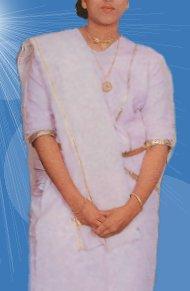 The traditional dress of Syrian Christians is more or less similar to the local Keralite style which includes Mundu or loincloth with or without Kasavu, and Jubba or Kurta for men. Similarly another piece of small cloth called may be used called ‘rendaam-mundu’ or ‘thollmundu’ which is put on the shoulder. Syrian Christian women have a peculiar traditional dress in white called ‘Chatta-Mundu’. The Chatta or jacket is used to cover the upper part of the body with full or half sleeved white blouse. The Mundu is a white, seven yards long, one and a quarter yard broad garment for the lower body. The mundu has a number of fringes, forming a fan-like appendage called ‘Njori’ at the back ( hip portion) rendering their dress highly modest as well as artistically elegant. While going out, they throw over their shoulders and bosom another piece of cloth called ‘Kavani’. However this traditional dress is today only used by the elderly women.
Origin of Chatta-Mundu of Syrian Christian women
The white colour of the Chatta-Mundu seems to be due to an influence from the traditional white attire of upper caste Hindus in Kerala. The mundu seems to be of local South Indian origin while the njori is worn by South Indian Brahmin ladies other than Syrian Christian women in Kerala. The Chatta or the V-necked, jacket-type blouse is of a disputed foreign origin which is probably West Asian as it is also worn by Muslim mapilla women of Malabar and the Malabar Jews but not by Hindu women. and the appears to be a modified version of a Jacket worn by early West Asian traders and Syrian Christians were known to be mercantile traders by profession as the Jews and Muslim mapillas. However the women from the latter communities wear coloured or decorated ‘chatta’ unlike the Nasrani women who wear white.
Ornaments
Syrian Christian women wear a variety of ornaments which includes various kinds of necklaces, Pathakamala, bracelets, bangles or Vala, anklets or Thala, loin ornaments like Aelas and girdles or Aranyaanam, Kunukku or Mekkamothiram, etc. Nasal ornaments (Nasabharnam) are considered a taboo by them and not worn, considered to be a characteristic of lower castes.
Mekkamothiram and it’s origin
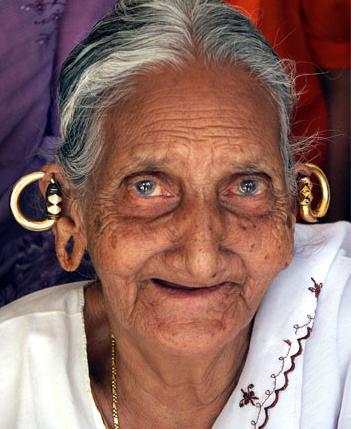 The Mekkamothiram or Kunukku is the most peculiar traditional ornament worn by Nasrani women. It is a heavy gilt, circular gold ear-ring worn on the upper ear lobes. The origin of the ear-ring is thought to be of ancient Biblical times. Similar kunukku-like, moon/sun shaped circular ear-rings are known to be worn by ancient Israelite or Hebrew women (Gen 35: 4) borrowed from surrounding pagan cultures. These ear-rings were said to be images of Gods and crescent or circular, in honour of the Sun and the Moon-God which was worshipped in ancient pagan Egypt and Arabia ((Ref: Jerome Biblical Commentary, Pg. 35)).
The same tradition seems to have been passed-on to the Malabar Christians alongwith other Hebraic heritage and customs. A Mekkamothiram-like ornament is known to have been worn by Cochin Jewish women also, in addition to the Nasrani women in a similar fashion.
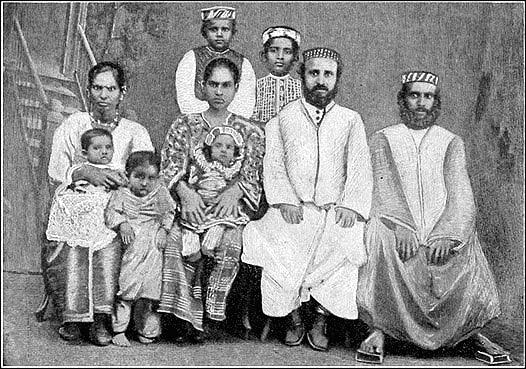 Picture of the Cochin Jews showing women wearing a Chatta-Mundu-like dress and the Mekkamothiram (Picture from the Jewish encyclopedia)
Ancient attire of Syrian Christians
The attire widely used today by Nasranis seems to be of recent past centuries influenced by local culture. However in ancient days of bygone era there are evidences of Syrian Christians using an attire, similar to those of ancient middle-eastern people of Assyria, Persia, etc., which many seem not be aware of. Evidences of such usage of dress and ornaments which is not seen today is found in Government records and publications.
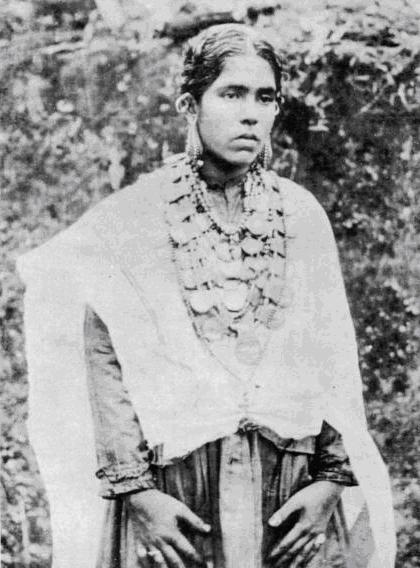
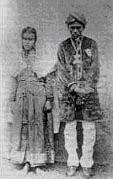
Ancient Malabar Christians (( Photo published in the ‘Cochin Government Royal War Efforts Souvenir’ in 1938 )) ——————————-Syrian Christian Bride ((EDGAR THURSTON, K. RANGACHARI ‘Castes and Tribes of Southern India’, Madras: Government Press, I909))
Deathbed blessing
The blessing given by the father on his deathbed to the children by Jews and Nasranis are similar in text. Among the latter group, this is more prevalent today, among the Knanayas.
For Nasranis: “God gave his blessing to Abraham, Abraham to Isaac, Isaac gave that to Jacob, Jacob…to my forefathers…to my parents….and my parents to me….and now, dear son/daughter, I give it to you”
For Jews: “Blessed art thou, O Lord our Lord, and God of our ancestors, God of Abraham, God of Isaac, and God of Jacob, and the great mighty and the revered God.”
Dietary aspects and observances of Nasranis
The uniqueness of the community is also reflected in the food observances and certain customs which directly or indirectly point to a Jewish influence on the same. Certain food practices also seem to have originated from and are in accordance with the Jewish ‘Kosher’ (Hebrew: kashrut) food laws as described in the Torah and the Old Testament Books of Leviticus and Deuteronomy and observed to this day by many Nasrani families. Spices and condiments occupy an important part of any dish. Local food and tastes also form a major part of the diet but the Syrian Christian cuisine is unique in certain respects. It also need not be described that majority of the Nasranis are predominantly non-vegetarians, in contrast to their Hindu neighbours who are either strict or predominant vegetarians.
1). Many Nasranis are traditionally known to be abstainers from pork meat and pork is still considered a taboo in many families which is an important Kosher practice. This practice became less prevalent following the Portuguese era and western influence.
2). Fish without fins and or scales are generally not eaten and considered taboo. Similarly certain varieties of shell-fish, clamps, crab, etc. are also not consumed by many.
3). Dairy products like milk or curd are traditionally not consumed with fish or meat and is a Jewish custom in origin. Instead coconut milk is used as a substitute in preparations.
4). Animals slaughtered for consumption is generally done by the Nasranis as per the Kosher or Halal method and meat obtained in this manner is generally preferred by them.
5). Nasranis are also expert grape-wine makers and widely consume wine in contrast to their neighbours of other faiths. Wine is generally prepared weeks in advance for festivals like Christmas and Easter. It must be noted that wine-making is not an Indian but Mediterranean and middle-eastern in origin.
6).It is believed that the Palappam and Kallappam were derived from an ancient Jewish food. Similarly the Pesaha appam or Kalathappam are also similar to unleavened bread used for Pesaha Vyazham or Maundy Thursday to commemorate the Israelite Passover feast.
Besides the above Jewish influences on the Nasrani diet there are certain casteist practices also prevalent. Nasranis generally never shared or accepted food or water from those of lower castes. This is less prevalent today. During Sadhyas or meals traditionally served on plantain/banana leaves, Nasranis have a custom of folding-in the left end of the leaf to resemble a double-leaf. This practice is due to an ancient royal privilege granted by kings to Nasranis wherein they were privileged to eat on double leaves (placed over each other). Many are unaware of this tradition today. Similarly, vegetarian sadhyas or meals prepared for ‘Chathams’ (day of remembrance of the dead) in Nasrani families is or was done usually by Tamil Iyer Brahmins.
Syrian Christian Art forms: Dance and Folksongs.
Syrian Christians of Kerala had developed their own art forms like the other religious groups in Kerala. However, the art was heavily influenced by local culture and traditions which was interpreted and blended in a Christian scenario to give unique forms of dance or folksongs. They are known to have been developed somewhere during the 15th or 16th cent. AD. These include Margamkali, Ramban pattu and Veeradian pattu. Another form was of Christian theatrical art called the Chavittu nadakam.
Margamkali
Margamkali is a very ancient and the most popular art dance performance prevalent among the Syrian Christians of Kerala. The word ‘margam’ means ‘path’ and it was meant for the propagation of Christian religious ideas. The form of the art was the result of direct inspiration from the indigenous culture. The real source of inspiration for Margamkali was Kalaripayattu and Sangamkali which was very popular when the Christian community had developed the form in later centuries of pre-Portuguese era. The Christian soldiers used to pass free time performing Margamkali and the subject usually was/is the arrival of Mar Thoma and his proselytization activity in Kerala.
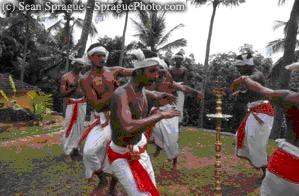
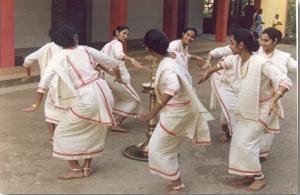
[Margamkali performed by male/female performers]
Margamkali was performed mainly by men on festive occasions, especially during the time of marriage. But later it came to be performed by women as in Thiruvathirakali style. The dance is performed by 12 members moving in a circle around a lighted oil lamp. The oil lamp denotes Christ and the dancers symbolize his apostles.
The songs of the Margamkali are composed in modern Malayalam. The dancers sing themselves while performing the dance. Unlike other dance forms of Kerala, Margamkali lacks musical accompaniment. The traditional text of the song is an elaboration of the activities and martyrdom of St. Thomas in Kerala. Later many other songs were also added to the original test.
Margamkali is often presented as a stage item today and also for Art competitions at the school and college levels.
Ramban Pattu and Veeradian pattu
There is a time honoured tradition in Malabar which is handed down from generation to generation in the form of the songs of the Nasranis as the Rambanpattu . The other tradition comes from Veeradian pattu which is performed by a Hindu caste on festivals and occasions of the Syrian Christians.
The Ramban pattu and such type of other ballads are using Malayalam language called Vattezuthu, and this type of dialect is known to be used in 15-18th century AD. According to the Ramban pattu, St. Thomas went up the Malayattoor mountain to converse with the Lord and pray.
The Brahmin conversion theory is mainly supported by the above folklore songs, originally composed orally by a disciple of St. Thomas and written by Thomas Ramban Maliekal in 1600 AD or later. Thomas Ramban is considered a descendant of one of the first Brahmin converts to Christianity as per tradition. Literary scholars like Mahakavi Ullor S. Parameshwara Iyer and Chummar Choondal (Ref: Bosco Puthur, ‘St. Thomas Christians and Nambudiris, Jews and Sangam Literature’, 2003) the above folklores were all written in 15th cent AD or later. Hence the folksongs are not considered as historical evidences but only folklore by historians and literary scholars which obviously have influences from indigenous culture and later century oral traditions.
Chavittu Nadakam
An offshoot of theatre, this form of play was prevalent among the Christian community spanning from Kodungallur to Ambalappuzha developed in the 16th cent. AD. Training is provided to performers before staging the play. The master is known as Annavi. The whole play is performed through musicals. The main characters sport broached dress, head-dress and crowns. The soldiers sport hats fitted with quils. The bell and drum are two instruments used as back ground score. Most of the times the stories related to Christianity or Biblical stories are played. This art is largely extinct today.
Religious Lifestyle of Nasranis
Syriac Christianity in Kerala and the Middle-east with which the former has ecclesiastical relations, is older than Rome according to the St.Thomas tradition. It began as an Oriental religion. There are even references relating the Kerala Nasranis to the Essenic Jewish sect due to some similarities in the beliefs and practices of the two communities. However Essenes are non-existent today as a community, to be found only in history pages.
The Nasranis have a special identity. Their customs and manners are different from those of other Christian groups. While the Church in the West is still evangelical, in India the focus of the Main Line Church is social. There is also a strong ecumenical movement. Today Kerala Syrian Christians are a prosperous community commanding extraordinary political clout to an extent. The religious practices of this group were shaped in the place of origin and are dominated by church services which follow traditional Semitic patterns.
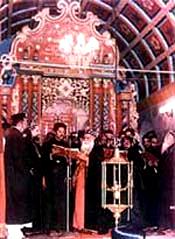 Syrian Christians have strong and active religious organizations and a majority of the people attend Sunday Church services. Church services are conducted in Malayalam with some segments often in Syriac. Baptism or Mamoodisa is practiced as the sacrament of initiation. The Episcopal Churches emphasize child baptism and use sprinkling of water in the name of the Triune of God. Believer’s baptism by immersion in water is practiced by Pentecostal groups. The Lord’s Supper is celebrated by various groups and the Aramaic word Qurbana (Hebrew: ‘Korban’) which means “sacrifice” is used for the practice. Women cover their heads while in Church with their garment which is a Semitic practice. The Nasrani Church has a separate seating arrangement for men and women as in Jewish synagogue style.
The mainline Churches also practice Kayyasturi/Kaimutthu (in Malayalam), an oriental custom meaning ‘Kiss of peace’, which enhances the celebration of the Lord’s Supper. It is done by a form of handshake. The ‘Kiss of peace’ is a sign of respect and friendship and has its roots in the Jewish Temple worship.
The manner of celebration of the Lord’s Supper varies from denomination to denomination. Syrian Christians use several accessories such as the bells, the veil, the altar, the cross the coverings and the candles.
Syrian Christian priests have elaborate dresses used during liturgy and wear cassocks, caps and beards as seen also in West Asia.
Church-centred life and Synagogue-centred life:
The Nasranis and Cochin Jews are two communities grown in parallel in Malabar. The life style of the Jews was synagogue centred. The Nasranis also have similar lifestyle centred in their churches. 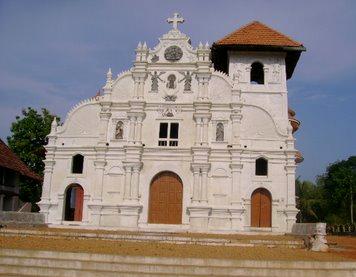 The clergy-laity relationships are very strong. It is well known that every Nasrani church irrespective of the denominations have committee meeting after Qurbana (mass). It had been the Jewish custom to teach literacy to its followers so that they could read and meditate the Torah scriptures. The Nasranis also made the same custom by making ‘Pallikkoodams’ along with the pally or church with Catechism or ‘Vedupadesham’ as it is called, for scriptural and religious studies. Similarly the archdeacon was the head of the Church and Palliyogams (Parish Councils) were in charge of temporal affairs similar to the Jewish Sanhedrin Council. They have a liturgy-centered life with days of fasting and abstinence. Devotion to the Mar Thoma Cross is absolute and churches were traditionally modelled after Jewish synagogues with local blends.
The age-old Nasrani tradition of offering a part of the first-fruits and grains first harvested, to the church, on certain festive occasions is an ancient Israelite practice of making similar sacrificial offerings. The term used is ‘Kazhchaveppu’ which literally means ‘Offering’.
Syrian Christians celebrate all Christian religious days. The more conservative and orthodox people maintain Lent for twenty four days prior to Christmas and fifty days prior to Easter, the ‘Moonunoyambu’ or 3-day fast of Ninevites, etc. Those who do so eat only vegetarian meals and refrain from consuming alcoholic beverages during Lent. Easter or Passion week is very important. There are special Church services on Palm Sunday and also every evening including Good Friday and Pesaha (Maundy Thursday), there is a special Church service with Holy Communion. Good Friday is of great significance and Church services start at nine o’clock in the morning and continue on to three o’clock in the afternoon. On Easter Sunday Church service starts at around three o’clock in the morning and concludes with Holy Communion. Easter breakfast and family get together is in the traditional manner.
Syrian Christians are also known to have high devotion towards saints like St. Thomas, St. Sebastian, St. Joseph and St. George (Geevarghese) which is found across denominations. There are novenas and special prayers and pilgrimages made in honour of the same. Malayattoor pilgrimage in honour of St. Thomas on Good Friday and Dukhrana (July 3) days, pilgrimage to Edapally church in honour of St. George and chicken-sacrifice are commonly observed. Similarly the feast of St. Sebastian is also celebrated by many Nasrani churches and commonly called as ‘Ambu Perunal’ or ‘Pindi perunal’ in some regions of Kerala and is an integral part of Church festivals other than Easter and Christmas. Church festivals in Kerala are celebrated with great pomp and show and in a grand manner with processions, decorative lamps and umbrellas (pattkuda) and traditional music and drum-beats similar to temple festivals.
The Divine Office and the Liturgy of the ‘Hours’
Traditionally the Nasrani religious day begins after sunset with prayer observances. This is purely an age-old Jewish tradition, wherein a day is counted from sunset to sunset, divided into eight equal ‘Hours’ or ‘Vigils’ and related prayer sessions.
Nasrani prayers are sectionalized as per the ‘Hour’ observed and they are called as ‘Yaama prarthanas’ and include Psalms and other prayers and can be found in traditional Nasrani prayer books. Thus the divine office is organized as Lelya or Nocturns, Sapra/Sapro or Morning prayers (also called Matins) and Ramsha/Ramsho or Evening prayers (also called Vespers). The above pattern is also observed by almost all Churches of Eastern tradition of Christianity which have common Semitic pattern.
The day begins after sunset with the vigil or ‘Hour’ of Ramsha alongwith other prayers, recited in the evenings, generally at individual ‘family units’ (kudumbakoottaayma), in a Church parish, by organizing prayer meetings called kudumbaprarthana. This is followed by the Lelya at night which is today generally observed by the religious and ascetics/priests, followed by rest and then follows the Sapra at dawn of next day. This may be followed by the Liturgy of the Word and Qurbana (Mass) at church. Thus one religious day, from sunset to sunset, is of the above order. These are traditionally observed by the entire community to this day.
Conclusion :
The St. Thomas Christians of Kerala blended well, the ecclesiastical world of the Oriental Syriac Church with the socio-cultural environment of their homeland. Their social and religious lives are not much distinguishable from each other and thus the community and it’s members are some of the most conservative and religious people. Thus religious views largely govern the daily lives of most Nasranis as observed in their religious and social lifestyles. However it remains to be said that much of the rich heritage is fast degrading which can be contributed to factors like lack of awareness or disinterest in preserving the same and also due to migrations of many of the community members to places far from their homeland. Thus the preservation and continuation of the Nasrani heritage has become the urgent need of the day, lest this almost two millenia old identity of the community is wiped-off only to be found in pages of history.
Many thanks to Mr. Joseph George & Mr. George Mathew for the suggestions.
_____________________________________________________________________________
Author Jackson John can be reached on mjjackson_12 at yahoo dot co dot in.
_____________________________________________________________________________
thanks for keeping us updated about every aspect of nasrani way of life.
Sad that most of the life style is becoming extint.
Brisbane Australia- Can you pl write to me about Nasrani. I am writing a book in my Language Sinhalese on History of Food, and I have already mentioned a little bit about nasranis and their food. I would like you to give me more information from a very 1st had expeereicne. my email is [email protected] – +61 0433198497- Glad to have come across the FB post.
Hello Milton,
See if you can get this book – The Suriani Kitchen – by Lathika George. Suriani refers to the language (Aramaic) used in the liturgy of the nasranis.
Best regards,
Tom Mookken.
I think the church shown in the article is the one in Aroor, which happens to be a Latin rite church. Hope I am wrong as the entire article is on Syrian Christians of Kerala.
very glad to see this site. I feel the owners of this web site are proud of their(our) traditions, and My whole hearted congrations.
ome elder women in the districts of Kottayam and Ernakulam wear Chatta and Mundu.>>>>>>>>>>>>>>>>>>>i think it is worn by ladies in districts like Idukki,Pathanamthitta….than ernakulam
There is a famous movie called “Chattakkaari”. It is about an Anglo Indian girl. Is there any connection with Anglo Indians and Chatta? I think an Anglo Indian woman used to be called as Chattakkari. So I am wondering whether there is any connection with Syrian Christians’ dresses and old Portuguese/British costume?
Your doubt seems to be correct. The Chatta and Mundu (with its njori at the back) seems to introduced by Portuguese in Kerala. Many of the christian traditions boasted about were imposed on the community by the imperial /colonial powers, but we are ashamed to admit it and always try to find roots in further past history.
The word ‘Chattakkari’ mentioned by Sunish George has nothing to do with ‘chatta’ the dress. The word is derived thus: chattam+kaari. Chattam is related to the word ‘margam’ or ‘The Path’ denoting the Christian faith. People who embraced the new ‘chattam’ were called chattakkar. Compare this with ‘margavaasi’.
There is no relationship between Anglo-indian costumes and Syrian Christians. Chatta in Malayalam means any stitched garment. Other communities used to use a covering garment above chatta (kavani or neryat or thorthu – all are kind of a stoll) but Anglo Indians did not use a stoll and the name chattakari might have originated thus.
Older system had only woven clothes but not stitched ones (even now major temples do not allow devotees to go in with a stitched garment). Before the arrival of Portuguese Syrian Christians dressed exactly like upper caste Hindus and had a kudumi as well. Whether the change in attire benefited the community is a matter of debate. (It was supposed to be one of the listed “un-appoved” practices in Synod of Diamper).
sir
but the mundu with njori is seen among old ladies in tamil nadu and also in andhra pradesh……i think its a dravidian custom that is followed by christians in kerala
I would like to know the origin of “Mekkamothiram”, “Kunuk” (heavy gilt gold ring) and “Girdles Aranjanam” of Syrian Christian women and “Silk Jubba”, Kasav Mundu” etc. of men.
Is it originated from Brahmin culture or is from migrated Jewish culture?
When I read the Chapter “Genesis & Exodus”, in the Bible the children of Jacob were asked by Moses to borrow the ornaments of Egyptians while they flee from Egypt.
Is the “Kunuk or Mekkamothiram” have any relevance with Efgyptian culture? Please clarify.
Mathew George
None of this are per see Indian orgin. The orgin need to be researched .
The Mekkamothiram and it’s possible origin
And what are the exact origins of this exclusive ornament ? Do only Syrian Christian women wear this ? Well No…. Read on..
The Mekkamothiram or the crescent moon-shaped/incompletely circular ear-ring worn by Syrian Christian women on the upper ear-lobes is yet another result of Egyptian influence on the Israelite/Hebrew culture carried on to Malabar Christians….
The link below is to the wiki link image of the Cochin/Malabar Jews originally from the Jewish encyclopedia …. Note the Jewish women wearing the Mekkamothiram (esp. the centre woman) on the upper ear-lobes…..
http://en.wikipedia.org/wiki/Image:Cochin_Jews.jpg
Note the chatta-mundu worn by them though one of them is colourful another one’s is white and sleeved similar to our women’s dress and V-necked…. well this dress is argued by historians to be of west asian origin which is debatable….. one addition we have is the njori or the fan behind the mundu of suriani women.
The mekkamothiram-like moon/sun shaped ear-ring is mentioned in the Bible OT in the book of Genesis 35: 4 and other OT books worn by the Hebrew women of ancient
times…. see below what is this ear-ring ?
http://www.blueletterbible.org/tsk_b/Gen/35/4.html
“these earings are also said to be images of Gods and crescent in honour of the Moon-God” (worshipped in egypt/arabia)…..
Reference to above statement : Jerome Biblical Commentary, Pg. 35, under the sub-title ‘Jacob at Bethel (Gen 35: 1- 15)’ commentary.
So the Mekkamothiram seems to have its origins in this moon-shaped ear-ring of the Hebrew women borrowed from Egyptian or other pagan cultures ….. its worn by Cochin Jews and Suriani women of Malabar but not by any other women of Kerala including Nairs/Brahmins (If I’m not wrong).
The Nasrani Chatta-Mundu and it’s possible origins
There is an article in the Book ‘Anthropologica’ in which historians/experts/research publishers say that it was only the Syrian Christian women who wore and were privilged to wear the Chatta/jacket since olden times and this upper-body covering was only later adopted during colonial period by the upper-caste hindu women only and still not for lower-caste women. Again proving that the Nasrani women were fully dressed since old, even before colonial rule of British or Portuguese though their Hindu counterparts starting using the top dress only later.
Read on the orkut forum link below for the discussions on this topic.
Orkut Link
Dear Jackson
Your interpretations of covering the top do not go in line with the caste system or any dressing codes either. There are many Interesting facts about the mode of dress; from centuries only a single loin cloth was girdled round the waist leaving the upper part exposed. In this respect males and females, rajas and nobles, rich and poor all were same. You can even watch pictures of old Rajas or ministers who never covered their upper part of body. Well even namboodiri antherjanams were not allowed to cover their upper body in the strict sense of the term. They were given a thorthu which they took over the shoulder of one arm and tied below the underarms on the other side…when in 1932 Parvathi Antherjanam wore a blouse it was considered outrageous.
Till recent most upperclass grandmothers wore that mola kutcha dress…but inside the house they moved about after tying a particular type of blouse that exposed the stomach n shoulders…at the same time while lower caste women went about in public without anything on top till as lately as the 1960s, upper caste, mainly nairs and ambalavasis, covered themselves by wrapping a mel mundu like a shawl.
As a general rule Christians in Kerala were not categorized into the horrifying caste system. But the economic environment did not put them down either. As said though Christians and Muslims were allowed to perform their own customs and practices. That did not mean that even Christians had access to all upper-class sweekarana muris (guest rooms). Where as Nairs practiced a limited form of Aayitham with Christians but were prohibited from taking food with Christians. You can find this in any authoritative work on earlier Kerala or even in some movies.
So Jackson to conclude, if the king and ministers never covered the upper part nor did the antharjanams, do you assume it’s a privilege for Christian men and women to cover their body parts, its sheer ignorance on the ruling class or a generosity in blessing.
I am neither putting down nor boosting any sect, guess to be an unbiased writer.
(Christians represents Syrian)
Dear BG,
I agree when you say that the caste Hindus of Kerala till recently were minimal with regards to dress and all that u have mentioned wrt their dressing manners is true. But this does not hold true for the Nasranis who were/are a unique community with a separate identity outside the Hindu caste system, though having certain shared elements wrt social customs and practices.
A large section of the Nasranis are descendents of migrant settlers with much of preserved West Asian Heritage, to be specific Hebraic/Jewish heritage. And even in the dress manners of the community this heritage has/had to have logical contributions thus making the community modest even in dress sense since old. Thus the dressing manners of the Nasranis was not something ‘granted’ to us, but an inherent part of our heritage and that is the point I would like to make.
So also we know that, Syrian Christians were merchants/traders by profession, hence an international community. Similarly been Immigrant settlers the Nasrani after having settled alongside their Hindu brethren need not strip off his/her dressing and other manners just to socialize. Thus, that the Nasrani was modestly dressed (atleast women) was neither out of ignorance on the part of Kings nor a generosity in blessing, but it was an essential part of Nasrani heritage and local Kings never dared to strip those inherent privileges/manners off, primarily because of the wealth Syrian Christian tradesmen contributed.
When someone is making you rich, you do not meddle with them and their lives. You sensibly allow them to continue in their ways as long as the person is beneficial to you. This is the basic reason why the Nasranis were utmost respected by local Kings and considered at par with the Hindu upper-castes (for social recognition in Hindu society) because Nasranis were wealth contributing tradesmen.
If I’m not wrong you made the same point as I made,framed differently, wrt dressing manners atleast.
Dear jack!
Well blended and aromatically seasoned, but feel it’s over cooked. But as you said the ruling class dared to get involved into a trading class’s culture and aspirations are infatuated and unreasonable. After all they are refugee immigrants and not comparable to present stage immigrants who has to qualify in terms of education, skill and health. Obviously there were traders and merchants along with Thomas cnana (the first flow of Christians, including merchants, mechanics and of course skilled migrants, to south India AD 345 – Syrian literature) who landed for a safer pasture. This does not guarantee that millions of Christians were traders and aristocrats, if that was the case, most of the world MNCs and corporations should have originated from Pala, iranjalakuda and pathanamthitta. Christians prior to the arrival of Portuguese did not form any part of Travancore aristocracy as per records.
A sizable number of Christians reached kerala in the seventh and eighth centuries as refugees from Eastern Roman Empire. The defeat of the Byzantine regime and the Muslim expansion resulted in the end of Christianity in Eastern Roman Empire, Jerusalem, Syria and Persia to Morocco. From my interpretations that’s why we can’t find any churches or Christian monuments prior to the seventh century in kerala.
Words cannot express the perimeter of persecution faced by Jews and Christians in that era. One has to express gratitude for the compassion shown by our rulers rather articulate a supercilious statement like “dare” since most of our Rajas were obsessed by the so called “salkara priyam” phenomenon.
Lastly, most of the writers here adhere to a position held in conscious opposition to other views. Also they want to be contained by a conservative position that may be held either because it has not been challenged or the questionings are ignored.
Dear BG,
The point you have mentioned about the Thomas of Cana and his group been the ‘first Christian immigrants in Kerala’ is as per the limited knowledge and informational database of most Syrian Christians and this is ignorance of History. There is a migrant history before this group. Read on…
Much before the 345 AD migration there is another migration having occured much earlier somewhere in 1st cent. AD (52-72 AD) during the proselytization period of St. Thomas in India. This is the first migration of Jewish Christians in Kerala who are reported to have come to Malabar with St. Thomas himself and made to settle in Trichur-Kunnamkulam region. This migrant group were not refugees but trade settlers who flourished in Kunnamkulam/Arthattu and later under Islamic persecutions by Tipu Sultan and likes were scattered beyond Kunnamkulam too. It is this group first referred to as ‘Essenes’ (A Christian Jewish sect) described by poet Manimekkalai in 2nd-3rd cent. AD. And these were/are not Knanayas/Southists who came later in 4th cent. AD. This overlooked historical fact is also supported by oral traditions in many Nasrani families from Trichur dist. till today and also documented in church histories of Trichur and Kunnamkulam/Arthattu by authorities and church leaders.
I have already written a brief description on this community of Jewish Christian traders the first migrants in Kerala under the title ‘Northist Southist debate’ on another thread with references. Read up.
Dear Admin
its so nice to see our dear mallu brothers and sisters interacting. But i do have a problem with the site download speed. I am on a high speed broadband (2MBps/Sec), but sometime it takes even one minute to download. After all its a text based site.
Please do something in this regard
Cheers, BG
Dear Jack
“as per the limited knowledge and informational database of most Syrian Christians and this is ignorance of History”
Your so called advanced knowledge is entirely based on Ammamachi and Appacha tales which have no position in an educated atmosphere. Please read this…
———————————————————————————–
* A History of the Expansion of Christianity *
—K.S. Latourette
In this book the possibility of Christians coming to India by any route before the third century is impossible. It also confirms the traditional date of 345 C.E. for the first migration.
———————————————————————————-
* The Chaldean Syrian Church of the East *
—Dr. Mar Aprem, Metropolitan of the Chaldean Syrian Church of the East of Trichur
in this book it admits that there was a church in India in the middle of the sixth century when Cosmas Indicopleustes visited India…. According to Cosmas, Christians existed in Male and at [Quilon] where a bishop, ordained in Persia, lived.”
——————————————————————————–
* Christian Topography *
—Cosmas the Alexandrian
The author was a theologian, geographer and merchant who traded with Ethiopia and Ceylon. He visited Malabar in 520–525 C.E., and in gives the first acceptable evidence for Christian communities in India.
——————————————————————————-
* The Encyclopaedia Britannica *
in its article “Christians of Saint Thomas”, says, “The origins of the so-called Malabar Christians is uncertain, though they seem to have been in existence before the 6th century A.D. and probably derive from the missionary activity of the East Syrian (Nestorian) Church
——————————————————————————-
* The Decline and Fall of the Roman Empire *
—Edward Gibbon
Writing about the Syrian Christians of Malabar, in says, “The difference of their character and colour attest the mixture of a foreign race…. Their conformity with the faith and practice of the fifth century world equally disappoint the prejudices of a Papist or Protestant
———————————————————————————-
* Marco Polo’s Asia *
—Leonardo Olschki
In this book it declares, “The Nestorians of India … venerated St. Thomas as the patron of Asiatic Christianity and not of Indian or kerala Christianity
——————————————————————————————-
* Eastern Christianity in India *
—Eugene Cardinal Tisserant
Thomas of Cana—or his bishop from Edessa, Joseph – can be said to be the founder of the church in Malabar, gives the date of the first event as about 450 C.E., and it is because of the union that the Church of the East can be said to be the first Christian church in India.
———————————————————————————————
“In this India there is a scattered people, one here, another there, who call themselves Christian, but are not so, nor have they baptism, nor do they know anything about the faith: nay, they believe St. Thomas the Great to be Christ”
– attested by Bishop Jordan, the French Dominican friar who was sent to Quilon by Pope John XXII, in 1330
There is also the evidence of the Persian “St. Thomas” crosses made of black granite, that have been provisionally dated to the seventh or eighth century
now its up to you jack, of course if you want to…
Dear BG,
Strange and interesting reading, particularly about the ‘St. Thomas to be the Christ’. Ofcourse, we have to take all this in our stride.
But different views/perspectives are good to know. A lady from Denmark remarked to me that ‘In India parents blind their children so that they can be better beggers’.
Dear Jackson,
You are possisbly providing the vital missing link between us Nasranis and the Essenes as mentioned in the Tamil Classic. I always thought about the high similarlity between the Essenes and the Brahmins of India.
India would have been the natural port of call for persecuted Essenes (a Jewish sect which believed in non violence and vegetarinism) in which port religion was so advanced that vegetarinism and nonviolence were esteemed.
But you have not (not your fault) given any historical supports/evidences. The available evidences must be studied and published. It is regretabble that we are hearing of this for the first time after so many months of communicating in this forum. We are so helpless in pursuing leads. We can at best only brainstorm.
The NSC can approach all the Syrian Churches and request for thorough research work. I think this may be feasible.
Dear BG,
Since u provide book references claiming that it is impossible for a Christian migrant group to arrive in Kerala before 345 AD, let me ask you a few questions. Why does it become impossible first of all ?
History says vaguely of trade relations of Middle-east with India since times of Solomon (~1000 BC). How if there were no trade routes for traffic ? By Airways ? Hope you also know of the Hippalus trade winds discovered in 45 AD which further boosted trade between western coast of India and Meditteranean world and middle-east. The writers and travellers u have mentioned themselves describe all this. So also St. Thomas is said to have arrived in kerala by such a trade route. And if St. Thomas could come here why does it become so very impossible for other Jewish Christians from middle-east to accompany him in his mission or for whatever reasons ? Logical isn’t it ? Read the entire History of Kerala from 1st century or before and not just post-portuguese and post-Knanaya history u will know of the different people having made kerala their home since old or atleast landed here for trade or whatever reason. Kerala/South India was not alien to the rest of the world and neither did Knanayas or Marco Polo make it famous.
And why did the Knai Thoman group have to come to Kerala only if this was an unknown land ? They were fleeing persecutions and coming to Malabar. Why did they choose to come to Kerala if it was an alien land with alien people ? The answer may be .. because they must have been aware of their kinsmen or other Jewish Christians already peacefully existing here and flourishing (The group I already described). And India was never hostile to Jews. Will a person fleeing persecution wish to go to an alien land where none of his own people reside and is not sure of his safety ? Again logical isn’t it ? Think over it ….. Need not reply and debate because I don’t want to. I only make you think.
Dear George
Yes whatever I described may be faint missing links which I cannot substantiate solidly because History doesn’t. But the information is from family histories and church histories combined and also attested by Church authorities.
My own family history speaks of Jewish ancestry. Once I happened to ask elders in my family about our origins and it was they who stated of us, as been descendents of Jewish converts having come here with St. Thomas himself in the 1st cent.and made to settle here. They have never read Nasrani History books or surfed the Internet then how can they make such claims/ideas with such surety. They are even averse to a possibility that we could have been local converts, a fact well attested by our West Asian looks and features. My family is from a village in Trichur far from urbanization and hence have not caught up with the Namboothiri fever of wealthy Nasranis. And rarely do we find Nasrani families claiming Jewish ancestry today with such surety and pride discarding even the Brahmin origin theory when the majority is for Namboothiri conversion theory. I felt it was something to be given a thought and now I am probably understanding what they state is true and not fables.
We must also note that its easy to cook up a Brahmin origin story for social recognition but not that easy to maintain a Jewish heritage and ancestry claim for 2000 yrs. Because claiming Jewish/Hebraic descent may not give one social acceptability in a Hindu casteist society like Kerala but claiming Brahmin origins surely does, which I need not describe we can see it all over . This is the foremost point I have to make rather than about the date of arrival of Nasranis in Kerala, etc…
Dear BG,
I agree that relying on stories propagated by one’s ancestors is neither “scientific” nor scholarly.
However, at the same time, your quoting of various books doesn’t amount to evidence either. While I haven’t seen the book by K.S. Latourette, it is highly laughable that such a person would declare something as simple as the propagation of Christianity to Kerala in the early decades/centuries AD to be impossible! (As a mathematician, I’d love to see what a (mere) historian views as “proof” of an event’s impossibility!). The purported statement of Eugene Cardinal Tisserant is also “interesting”—is there really any proof of Bishop Joseph of Edessa that such a conclusive statement can be made?
The fact is many of the historians you’ve quoted, and many of those that I’ve read, are armchair scholars. They may have came to Malabar and interviewed some local “expert” (i.e., some village priest or a provincial bishop) and gotten some kind of story that they then print in Europe to form our history.
A historian’s statement (or an ammachi’s, for that matter) is pretty much worthless unless they’ve uncovered some sort of archeological evidence to substantiate the statement. Now … the genetic tests that have been done recently, and the various inscriptions that we can get our hands on — those are something to talk of!
(Personally, I’m waiting for some evidence to substantiate my wishful thinking that we were all, in fact, Manichaeans before converting to the Church of the East … and that St. Thomas the Apostle was Thomas the Apostle of Mani… but that will probably have to wait a few centuries for Kerala Christianity to finally dissolve in modern secularism and religious apathy…)
Dear John,
Who was ‘Thomas the Apostle of Mani’? Do you mean ‘Thomas the Aposlte of Manicheans? Was there such a person? Why the suffix ‘Apostle’ to a non Chrisitian?
It is getting complicated for my poor brain to take in all this. But then, I need to have the resources to beat your theory to pulp or best of all to have the inner strength to simply ingnore your theory on the grounds of ‘not worthy of a reaction’.
By the way, you would have notice the name ‘Mani’ amongst the Nasaranis. It appears not the same as ‘Mani’ in Tamil or Malayalam. It is a masculine name. I have sometimes worried whether we were related to Manicheans. Oh God! I hope not, that will destory everything, yet we must know.. the truth! Do you have anything to say about this Nasrani name Mani? Our Syrian Christian Church/religious society would not have probably approved this name if it was after that Manichean Mani.
But I read that this guy Manichean or whatever his nam, even swayed the ‘high society of Europe’ and it was fashionable to be called a ‘Manichean’.
Dear Jackson,
You should be very proud that your family claimed Hebrew heritage unlike the others. I understant that you are in Orkut. I don’t have time to be there. However, I registerd yesterday. I understand that I missed some interesting matters in Orkut. Be with this forum and enlighten us.
I have pushed some of my freinds into Kabbalah (ancient Jewish spiritual thinking now popular in the US/Israel) but find insufficient time to read and understand it. Did you know that Kabbalah sages would actually go into villages for nothing and share with the inhabitants their wisdom.
The Essenes, the Kabbalah sages and may be even the Gnostics (were all Gnostics bad?, who decides what is bad?) are to me the pride of Judaism. The Essenes claimed that God did not tell Moses to sacrifice animals to Him. I can not understand how a compassionate Yahoweh can ever approve the sacrifices of animals by the Hebrews. Here I touch basis with the Essenes and the Nazerenes. Hence my special interest in them. I can not even understand how a compassionate Yeshu could eat meat and fish?
Dear BG
This site is mostly run on Open Source and in a 56 Kbps connection rate, its supposed to take more than a minute to download. Even though its mostly text based, we have lot of content ( posts and comments) which makes the total file size high. Hence it takes long time to download.
In 1.44Mbps, the highest sized page should not take more than 8 seconds to download. Since you are in 2 Mbps it should not take longer than 5 seconds.
Open Source has its limitations.I have made some changes to reduce the size and some clean up to reduce the time to download. I hope that will be of help.
Dear John
its also laughable that some one like you who has never seen kerala talks much about its history. Any way keep writing… but it seems like a lawn mover talking about interior design…
The first thing we Nasranis need to learn is ‘not to laugh at’ our own brethren when they are providing information and help build-up the community or a discussion unless he/she is a biased fan of a particular group/sect. Since many Nasranis today are outside Kerala does that make them lose their right and duty to discuss their heritage ? It speaks of ego and false pride and is not enjoyed on a public forum. Healthy criticism is helpful and constructive but when it is blended with sarcasm its only destructive.
No person is born with a history book in his hand or a document for outright evidence. All are learners. Had this not been the case, we would not been discussing our heritage much of which is degraded and lost.
So also, those criticizing and laughing are themselves providing references of comments by Europeans and foreigners on our community and heritage, many of whom through history have desperately only tried to distort our heritage (I need not provide examples. we have plenty such classical types thru’ history).
We need to learn to trust our own people first before trusting the rest of the world.
Dear George:
Re: “Our Syrian Christian Church/religious society would not have probably approved this name if it was after that Manichean Mani.”
Is that why names like Alexander, Julius (and other Greco-Roman pagan names) are adopted, not only by laymen, but also by bishops? How about Hindu/Buddhist names among our people?
I don’t know about the origins of the name Mani in Kerala. Some say it comes from Emanuel, but since I don’t know how to read/write Malayalam, I can’t even begin to analyze it.
And yes, I meant Thomas the apostle/disciple of Mani the prophet of Manichaeanism. (Note: apostle/disciple are not restricted to Christians. And moreover, I respect the Gnostics—even the downright weird ones—and so I have no problem using the term.) I don’t know if he existed, but there seems to be some literary evidence for him. So, at the very least, I’d say he’s as real as, or possible more real than, Thomas of Cana.
I shouldn’t have said that I thought we were *all* Manichaeans… *all* was incorrect. Rather, I think our society in Kerala was non-homogeneous, with Jews, Nestorians (so-called … I’m just using the term as a short-hand for “member of the Church of the East”), possible Jacobites (since the two tended to travel together, despite their enmity, because they were, after all, genetic Assyrian brothers), Manichaeans, and of course, Buddhists, Hindus and Brahmins.
I think the possibility of Manichaeans in Kerala is not low. We know Kerala had a strong, if not dominant, Buddhist presence in ancient times (with the Mavelikara-Kayamkulam-Karunagapalli area being a major center). And Cosmas I./Pantaeus mention colonies of “Persians” in Kerala/Ceylon. And we know we had a Persian/Eastern Christian community (speaking Syriac, in common with the Manichaeans…). Combine that with the Zoroastrian presence (since some of those copper plates supposedly have Zoroastrian signatures, if I’m not mistaken), and I think it—at least—supports a Manichaean hypothesis.
Then there’s 18th/19th century reports of a side-community of people that lived along side the Syrian Christians, but who had “strange” practices that were somehow thought to be related to the Manigrammamkar of Kollam.
Dear John,
It was only 5 years ago, when I was 45 years old that I first heard of ‘Abraham Malpan’ and that was from a Syro Malabar person none other than my ex-boss ‘Mr. Xavier Kalangara. He was very suprised that a staunch Marthomite like me had not even heard about Abraham Malpan. Xavier will vouch for this. I remember the laugh that Xavier gave at my ignorance (I am not criticising, I now know that mine was really laughable). This happened in Doha.
I too dont’ read and write Malayalam but can manage speaking.
As Jackson said, this is the case of hundreds, if not thousands of Keralites who grew up outside Kerala which is not our fault. But we all have this love for Kerala and our lost heritage. I think the Psalm/Bony M should go like this…. By the rivers of America, there we sat down…. … we remember Kerala…..’
Dear Jackson,
“I have already written a brief description on this community of Jewish Christian traders the first migrants in Kerala under the title ‘Northist Southist debate’ on another thread with references. Read up.”====
Where may I please get the above writing. Apologise if I have asked anything wrong.
Dear BG and all,
It looks like a ‘quiet day’ on this forum. Everyone is busy with other things. Let us warm up this forum with some good comments and insights. We are after big game and let not ‘small matters’ upset us great Nasranis. Cheer up and let us loose that scowl from our faces. Hey John! what are you dong up there?
Does anyone know of the chitpavan brahmins of Maharashtra .Rumour has it that their ancestors were Jewish.They are very fair and well built eg Ajit Agarkar.Maybe if we were to correlate their arrival in India to
the Nasranis we may end close to clarity on the issue of Jewish migration
Dear Anoop,
You are more or less correct on your comments about the Chitpavans or Kokanastha Brahmins that they could be Jewish. Many of friends are from this community and thus I have read much on their history and customs which is also shrouded in mystery. Their genetic testings also have been done and they are related to Ashkenazi (eastern european/ caucasian) Jews. I
Their paternal ancestry results are more or less similar to our genetic results and those of Jews and their maternal results are closer to Europeans, thus the combination results in their relatedness to Ashkenazis. Thus the fair complexion and light eyes are common in them. Paternally atleast they are closest to Jews like us.
Dear Anoop and Jackson,
Apart from the ‘ Chitpavans’, there are also ‘The Yadavs, The Afridis and even the Parsis. and some more Pathan like tribes in Afghanistan and Pakistan’. Nothing is proven, but there are some interesting theories and clues.. The Yadavs are a mighty caste in India and the implications can be pretty interesting if proven. I read an interesting article in the web about this, but let us remember that all in the web can not be trusted.
I will agree with Dr. Grant’s observation made around 1840 that what is important are those who acknowledge their Hebrew heritage and maintian them rather than identifying those who were but are dis-interested.
If as you say the Yadavs are related to the Jews (if possible please cite some references),then its highly possible that Lord Krishna is one also as he was a Yadav.The circumstances surrounding his birth are strangely similar to the ones surrounding Christ’s.
In 1989,there was an incident a Cross was found near Sabarimala.Many started claiming it as one of the 7.5 churches.This led to demand by the Christians stating that they wish to start a church reestablish the church there.A commotion ensued people being divided on religious faultlines.
Later as per web reports the Cross mysteriously disappeared.
Does anybody recount the incident and the whereabouts of the cross.
Somebody said the symbol of the cross came much later,so if St Thomas didnt use the cross to establish the church,with what proof can we say that it belongs to the 7.5 churches.
The ‘Nasranis’, Essenes and the ‘Qumran’ sect/community and the Dead Sea scrolls:
“Among the terms by which the ‘Qumran’ community [Yahad] referred to themselves was ‘Keepers of the Covenant’, which appears in the original Hebrew as ‘Nozrei ha-Brit’. From this term derives the word ‘Nozrim’, one of the earliest Hebrew designations for the sect subsequently known as ‘Christians’. The modern Arabic word for Christians, ‘Nasrani’, derives from the same source. So, too, does the word ‘Narorean’, or ‘Nazarene’, which, of course, was the name by which the ‘early Christians’ referred to themselves in both the Gospels and the Acts of the Apostles.”
– Baigent and Leigh, ‘The Dead Sea Scrolls Deception’
Ref: http://www.mystae.com/restricted/reflections/messiah/elite.html
The Qumran sect was an ancient Jewish sect who also probably called themselves as ‘Nazarenes’ similarly to the Jewish Christian ‘Nazarenes’ and the word ‘Nasrani’ used by our community is an arabic word used by the Arabs to denote the above group of early Jewish Christians. Similarly the Qumran sect members, and Nasranis of Kerala as per the Tamil poet Manimekkalai of 2nd-3rd cent. AD are called Essenes or Essanavaadikal (Essenic sectarians). The Qumran community and the Jewish Christian Essenes are historically know to be ascetics of high spirituality opposed to Rabbinic orthodox Judaism and also vegetarians and abstainers from alcohol. The Dead Sea scrolls deal with the community.
Another piece of history from the Jewish Encyclopedia has it that there was a group of Jewish Christians who fled Jerusalem during the second temple destruction of 70 AD to Pella in Jordan and thence were lost to date due to further dispersal. Similarly the Qumran community is also said to be dispersed at around 68 AD by the Romans. One must note that Jews also arrived in India/Malabar during this time too as per traditions among them hence there seems to be a high probabilty of those Jewish Christians also arriving here. Otherwise they wouldn’t be lost today as reported by Jews of Israel.
If the above fragments of information are read, put together in the light of ‘Kerala Nasrani community’ who claim Brahmin heritage (ascetics, vegetarians) and also a Jewish heritage, then certain missing links can emerging with relations to our History and origins.
There seems to be some common underlining links of the Qumran sect (ascetic, vegetarian, messianic), the Essenes and the Kerala Nasranis who seem to have similar characters in origin and history.
Dear Annoop,
I got this information from a web site rather seriously done. Ofcourse, I can not vouch for it’s correctness. The theory is popularized by a gora researcher and a lover of Indian history/traditions/Hinduism.
It connects the word Yadav with Juda and puts forward many dozen other similarities between the Hebrews and the Yadavs. Please hunt for this site in the web. You may try “Yadav and Hebrews’ or Yadav caste and Jews’ etc..
I last read this article about a year ago and hope it is still there.
Also I made an earlier error. The connection between Hebrews and Parsis was not quiet right. The connection is between Zoroaster and the Hebrews. Dr. Grant in this book ‘The Ten Lost….’ writes about the connection. My source is from that book. As you know that Zoraster was the most important person in Zorastrianism but the religon precedes him.
Hi George,
Thanks for the response,will seek out the same.
The parsi’s (followers of Zoroaster) worship fire.I read somewhere (similar predicament as you) that one of the magis was from Iran and he went to see the Christ.The fire that they worship is said to be gifted from that visit .Could be hogwash,but just felt like sharing this with you.
Dear Anoop,
I too heard about the cross incident at Sabarimalai from my aunt but I think it was around 1984.
My maternal great father Kochuommen Polachirackal built the Sabarimalai temple as a contractor and the same was completed by his son in about 1904/1906. They were ofcourse Nasranis. There was a huge loss of about Rs. 30,000/ which the king approved great grandfather to take from the treasury. But he refused on the ground of ‘honour’.
Many do not know that it took a ‘brave Nasrani’ to venture into building this Hindu (?) temple which even the Hindu’s could not dare go to in those days, leaving alone pitching tents and do the actual construction. I trust John Mathew’s mother would know this as she knows our family and she is from the same village as my mother/mine.
Ofcourse, we have all heard about the ‘talk’ that ‘Sabari’ was really ‘Sabor’ the Nasrani who came from the Middle East in the 8th century. But honestly, we do not have any evidences, but it is worth a serious study.
Dear Anoop,
Error! The temple was completed by Kochuommen Polachirackal’s son-in-law who was a priest in the Jacobite/Orthodox Church. This was by about 1906.
Hi George ,
Some Blogs you might enjoy
parayilat.blogspot.com
jmatthan.blogspot.com
Ever thought of how the sound zha came into malayalam as in pazham.The Tamils pronounce it as palam.Travelling around some parts of India ,I noticed that the telugus resemble us malayalees more than the Tamils.The Maharashtrians resemble the Telugus more than the north Indians.
Anoop,
I think that the cross was found at Nilackal and not a Sabarimalai. Though Nilackal is at the vicinity of Sabarimalai, it is not quiet Sabarimalai.
Hi George,
Was this cross fabricated as claimed by Hindus.The cross suddenly disappeared….thats why its kind of giving me a creepy feeling.If it were present,we could have got some carbon dating tests done on it.
It was nice reading about your connection with the temple.
Two thousand years in India , and not much literature to show for it.Now thats a bit sad.
Dear Jackson,
I notice from ‘Orkut’ that you use the Hebrew word ‘Ben’. That takes some courage to do so. How many families like yours claim Hebrew heriatge in Trichur? just an approx. will do. Have you done DNA tests?
Dear George,
I was in Kerala till few months back and after really enquiring about families in my native place I found there are many of Jewish claims in Trichur-Ernakulam belt but some of these outwardly are inclined to the famous ‘Brahmin’ claim for reasons best known to those who can understand why it could be so. The number could be innumerable as almost all related and unrelated families of mine I asked about our origins were spontaneous to mention about a Jewish ancestry and origin,some did it atleast vaguely. I will give one example of my Dad’s elder brother (my velyachan) who said all this to me first and also his wife (my velyamma). His wife is from a very famous Nasrani family of Trichur. the ‘Attokaran’ family . She also describes the same ancestry of many Nasranis from the area of been Jewish converts. Similarly my Velyachan also specifically mentioned that ours was one of those many Jewish Christian families who came here with St. Thomas.
Now these people are from a remote village and have never read history books or surfed the net for ancestry details then how accurate they were to describe those events of 1st cent. AD, evidences of which we are getting now ! Similarly there are many such families in the Trichur-Irinjalakuda-Chalakudy-Angamali-Kodungaloor area who have Jewish claims. (My native is Chalakudy in Trichur). Then the famous ‘Pulikottil’ family who have originated from Trichur and branches of which are found upto Kottayam are also with Jewish claims and found in different denominations. There are many more families in my native village itself who have such claims, then the entire region will surely have innumerable such families, family names of which I prefer not to mention here. Similarly many of these families, except the wealthy and influential ones, do not have written kudumbacharithrams hence the confusion with Brahmin claim is cancelled out.
Another fact I would like to mention is it is also in Trichur area that you will find desperate attempts of Nasranis for Indianization and Hinduization which is outwards only. Some of them have recently started making geneaology records but are desparately adding the ‘Brahmin’ origin story to it which is laughable. A dig into their family traditions and customs will tell who they are.
Similarly, my grandmother and mother also have certain customs related to Saturday observance. We are told as part of an ancient tradition not to do certain things on Saturdays like oiling the hair or cutting of hair or nails, stitching and some other laborious works. I can only realize this as a remnant of ‘Sabbath’ observance now after having collected information from History. History is not all that vague if we try to co-relate and seriously study it with unbiased intentions. Surely Brahmin converts need not have observed such Jewish traditions to such details. Similarly some of the Mosaic laws are also observed, like those related to childbirth purification for 40 days( for male) and 60 days(for female) which terminates in Baptism, some Jewish marriage customs, certain dietary practices, etc.. It took me more than 4-5 yrs. to collect all these observations of mine from experiences which are largely overlooked today. Pfffffffff !!!!! But I also thank my elders who preserved this traditions for realizing the truth without much confusion. Now I’m pretty much sure of my ancestry and heritage and also of those like ours around.
Now all the above study needs to be done on a professional level by collecting info by those dealing with History and community studies and research.
As u said the DNA test is remaining which I will do only after a couple of months for few reasons.
I know, this is a very old post. But, some of the thinks he claims are true in our area. Mylacompu-Kothamangalam-Arakkuzha foranes considerably differ in culture and customs from Ernamkulam-Thrissur or Changanassery/Pala/Kanjirappilly dioceses.
And..Jackson – most of your christians are mixed with Latin catholics in Ernakulam and Thrissur districts. In fact, even my own parish at Muvattupuzha has at the least 30% of Latins from Varappuzha-Kottappuram dioceses. So, what is with the purity claims? There is a thin narrow line that separates Latin and Suriyyani types in Cochin region. For e.g. “Kolenchery”(It’s a family name) originally are from Kalady area, but in Mathilakom, Kodungallur they are pure Latin Catholics. These Latins know there origin. IMHO, Ernamkulam diocese must be unified with the Latin diocese for all these reasons.
Dear Jackson,
Thanks for your detailed comments. I have interacted with lots of Nasranis but few are really interested in our heritage but for people like you, Xavier, Ampravil Achayan etc.. We have to stay connected (and bonded). We need a commen Vision and our heritage must be ‘Jesus Centered’. If He is not in the center, then we take up a ‘laughable’ cause.
In me there is no problem to keep Jesus in the center and move forward with a Hebrew heritage. But I notice that many Nasrani’s may have a problem here. Simply believing in our Nasrani heritage will not be enough. I dream about a day when the center/main branch of the menorah will be a clear cut cross.
Even if we may not achieve further forward steps, let us atleast hold on to what we already have. I strongly believe that we have to stay in touch and even bond.
You know, I am crazy about the Menonites and the Amish and the Hattarites I always believed that they are exceptionally very good people. Just this morning I was told by a white Canadian that they are ‘good people’. There is decadence all around here in the west, but these people are like roses blooming in garbage. I can not possibly imagine anyone else in this world who can live so buitiful lives. I shake my head in wonder as to how can people live such pure lives? Maybe those in Bhutan can be considered as challengers.
Dear George,
Lets not try to have ifs and buts in the Nasrani Vision and Heritage, doubting our God. If what comes is from Yahweh it will be fulfilled and those who rebel must realize that they are rebelling against the ‘Hand of God’ when He is revealing us the Truth. We are indeed His children both or either as the Chosen Ones of Jacob and the Chosen Ones by the Messiah, as Christians. He the Father will best reveal His plans for His children if we only “listen” to Him. This calls for solid faith and those waivering will fall-off like the chaff from the grains.
If I am not wrong in reading the omens then the “Process” has already begun for restoring the true Believers and the New Israel under the Messiah which was never before as such, in History !
Dear Jackson,
A few months ago, I was introduced to a new phrase ‘Progrssive Revalations’. It means the Christian/Spritiual levels attained by an individual based upon God revealing to him truths step by step. We are unable to take in the full truth as we ‘can not handle’ it. So slowly year by year or generation by generation the truth is told to us.
I think this Nasrani matter has also been a Progressive Revelation to us. An average reader of this forum has now some knowledge of what did and did not happen to our history. I further suspect that the bigger fishes are yet to be caught.. The big fishes may get away but let us try….
Why don’t we make the ‘most illogical and unscientific and absurd and uncool’ thing of actually praying for atleast one big fish to be caught. I going to do this and why don’t you? Remember that the Glory is for Jesus.
Has anyone tested the genetic makeup of a pakalotmattam family nasrani????The following excerpt is taken from http://www.ayrookuzhiyil.org/pakalomattom.html.
The confusion was created when the word Nampoothiri was used in the Palayur conversion story. Nampoothiri Brahmins are the Maratha Brahmins, who came as invaders to Kerala. Parasuramas rules in the Narmada Valley of Maharashtra. A Malwa king named Parasurama is supposed to have invaded Kerala and brought the Brahmins by force. “Illam” the word came from Marathi word “Illu” which means house. As they came by rowing in boats they were called Nayambu = Row, and Nayambu – Thiris. This coming of Maratha Brahmins to Kerala, may have happened in the 4th and 5th centuries and by 6th century they got the caste Name Nampoothiri. By 8th century Sankaracharya a Nampoothiri is seen carrying his Sankara Dig Viyayam throughout India.
In the Sanghakala works we come across Brahmins by name “Anthanar”. The second century Sanghakala poet Kapilar was a Anthanar Brahmin. The anthanar is used even by Ramapurathu warrier in his Vanchipattu. Agsthya and Tholkapiyar B.C. IInd century to A.D. IInd century the precursors of Tamil literature were Brahmins. In B.C. second century itself the King Chandragupta Maurya resigned and came along with sanyasis and Brahmins to Sravana Belagola in South Karnataka and lived there. Another 150kms of travel and the Brahmins could reach Kerala. The Parasurama legend shows large scale migration of Brahmins to Kerala. Chanakya, the Black Brahmin Prime Minister of Chandragupta Maurya in B.C. 3rd century was a South country is Kollam. In the Panthrirukulam story Vararuchi, one of the Navaratnas of Vikramaditya (AD. 320-360) is shown as visiting Kerala. All this shows that Brahmins were only Pandits and not the ruling class. The early chaldean and mesopotomian languages also indicate Indian religion and the word used is Brahmin.
These are the Brahmins met by St. Thomas in Palayur. The epithet Nampoothiri was a later addition in the 16th century. Hence when we read Nampoothiri it may be understood as Brahmin or Anthanar.
Dear Anoop,
Please advise your support for the claim of Brahmins/Namboothiris meeting St. Thomas at Palayur. I do certainly admit that there is a strong tradition regarding a Namboothiri heritage. But remember that it was a tradition to give ourselves some local identity and place in highly/extreme casteist society as in Malabar.
A few weeks ago, I notice in a Wiki page that somebody with bad intentions had stated Nasranis as ‘casteless’ in sanskrit. In Hindu India, the effect of ‘casteless’ is the same as ‘outcaste’. You may then ask as to how the ‘Malabari Jews’ survived? They were much smaller in number for any comparison.
well with a genetic test base of 25 people ,it just isnt possible to conclude whether there actually were Brahmins inducted initially into the fold or not.We need to to have a bigger and varied test base.
It is highly probable that most of those tested may be Knanayites,hence the results would seem logical.
I am trying to be as impersonal as possible here and whatever be the truth I will accept it .
Legends are meant to be assessed and filtered because in most instances we get a 10 to 20% truth from them.That is the only reason why I asked if Pakallomattam folk got tested.
Dear All,
Since this Palayoor conversion topic has emerged let me put forth some facts apart the age old ‘stories’.
First of all the conversion of Hindu Brahmins at the Palayoor incidence by St. Thomas is more of a misinterpretation by vested groups, of another incident which is supposed to have actually taken place.
Anoop, I don’t know if u are from Thrissur area u may be knowing what I am going to put forth and if you are from another native then do read up on the following, before we come to conclusions. Read it across denominations.
Arthattu St. Mary’s Church or THE PALAYOOR CHATTUKULANGARA CHURCH
The present Arthatt St. Mary’s Orthodox Syrian Church is believed to be the pioneer Christian Community founded by St.Thomas in the first century A.D. The prominence given to this church by the early historians, circumstantial evidences, and the later historical records bear witness to this tradition. Palayur or Paloor is listed as the place where St. Thomas established a Christian Congregation.”The facts about the present Palayur is not suitable to connect the St. Thomas mission. But some vested groups deliberately connect the present Palayur with the St. Thomas mission from the second half of 19th century onwards . It is either by lack of historical mind or a deliberate and organized attempt to propagate anachronism.”
Some facts about Arthatt and Palayur
1. The Church at Arthat is dedicated to St. Mary, The Mother of God, while that of present Palayur, to St. Kuriakose, a Saint who lived around fourth century A.D, and was introduced to Malankara only in the fifth century. It is impossible to buildup a church in first century by St. Thomas, in memory of a fourth century saint in anticipation. But it is more reasonable to believe, the Church at Arthat which was dedicated to St. Mary, as a permanent monument of St. Thomas mission.
2. The present Palayur village is on the sea level, and during the formative years of Christian era, was believed to be, under the sea. The nearness to the sea, the sandy soil, and the presence of oceanic fossils also bear witness to this fact. But Arthat is the first high land from the sea level in the Palayoor region, which was known as Jewish Hill or ‘Juda Kunnu’.
3. The sentiment towards Arthat still exists in the minds of believers irrespective of denomination; and there are seven churches of different denominations at the small village of Arthat itself. There is no such sentiment towards the present Palayur.
4. There are several random references in many historical books about the St. Thomas connection of Arthat Church. (For e.g. ‘Sakthan Thampuran’ by Puthezhathu Raman Menon, III Edition P. 291)
5. When Tippu Sulthan turned against the prominent ancient Churches of Malabar, he burnt the ancient Church at Arthat, but the Church at present Palayur left unmolested. This shows that Arthat was the prominent Church of this region even in eighteenth century i.e at the time of Tippu’s invasion.
6. Francis Buchanan (1800 A.D), and Claudius Buchanan (1806 A.D), two Anglican Delegates who visited Kerala to enquire the position of the St. Thomas Christians in nineteenth century had visited many important Churches of Kerala including that of Arthat. But it is to be noted that they never visited or even mentioned the Church at the present Palayur. However there is a reference about the Chavakkad cross church, which was under the ecclesiastical jurisdiction of Arthat Church. This shows that even in the 19th century there was no such claim associated with the present Palayur.
Now read on the following and one will understand what actually was the Palayoor miracle by St. Thomas of throwing water in the air or was it a different version, corrupted later.
Emergence of the name ‘Chattukulangara’
There is an historic legend behind the origin of the name Chattukulangara to the ancient Palayoor. Palai-ur or Paloor was the ancient name of this region. When the apostle St. Thomas reached Arthat the people were reeling under the onslaught of a drought. They had tried to dig a pond. But though they dug a deep and wide area they could not get a drop of water. St Thoma understood their frustration and anxiety. He walked down to the center of the site and with a whip (Chatta) he struck the ground, water gushed out and the place has always had abundant water since then. The words Chatta + Kulam that is whip + pond later became the name of the town – Chattukulangara.
Due to various reasons like religious persecution, changes in the politcal and econoic policies of the ruling authority, business and commercial purposes, numerical growth of the Christian community etc., there took place a number of domestic migrations from the Chattukulangare Angadi (Baazar). This domestic migration caused the growth of the church to the neighbouring provinces.
Origin of the Nazrani Village- Kunnamkulam
The people of Chattukulangara who were scattered about by the attack of Tipu settled down in the regions of Kottapadi ,Kunnamkulam, Pazhanji, Chelakkara, Angamaly, Kuravilangadu etc. The feudal lords of Kunnamkulam welcomed the traders from Chattukulangara. They Participated in the development of Kunnamkulam town in all means. The trade links between Tamil and Kunnamkulam brought the influence of Tamil on the region Kunnamkulam is said to be derived from the tamil form Knnamkulagarai which means a place having Kunnu(Hills) and Kulam(ponds). The name seems appropriate because on the limits of the town lie Aduputty hills on the east ; Kizhoor hills on the west; mission hills on the south and Prokulam hills on the north. The several ponds are Eenjakulam, Ayyamkulam, Padinjarekulam ( Western pond) and Thorakulam. Some of this ponds have been filled up to construct new buildings. The town built by the settlers from Chattukulangara is in the shape of a cross. The base of the cross is the Eastern Bazar and the other arms of the cross are constituted by the West, North and South Bazars. In each arm of the cross there is a church. St Thomas New church on the Eastern arm. St Lazarus old church in the west, St Mathias Church in the south and St Lazarus church ( Chiralayam Church) in the north. These four arms were the hub of commercial activities. The place was dined with godowns and full of traders.Hundreds of bull carts lined the roads to load goods. Today these places are quieter. Better facilities became available in the parayil region which has now become the trading center of Kunnamkulam.
Online Ref: http://www.malankaraorthodoxchurch.org/historyofkkm.htm
The above extract is from the Kunnamkulam church history provided by the Malankara Orthodox Church’s official website. The place Kunnamkulam/Palayoor/Arthattu in North Thrissur was and is a prominent Syrian Christian centre and was once a flourishing trade centre for both the Jews and the Nasranis. The Palayoor Market and the Jewish Hill (and synagogue?) even today here are living testimonies. Brahmin settlements in Palayoor are famous but of not a very early date atleast not as old as the St. Thomas time.
The pond wherein the miracle of St. Thomas took place is not actually a Brahmin pond of Hindus but one used by the Jews of the area of the time, ‘Judakulam’. And the name Kunnamkulam is itself derived from the ponds and the Kunnu (Jewish Hill) in the area. Arthattu is a place at Kunnamkulam. And Palayoor is a nearby place wherein the miracle is not actually supposed to have occured. This becomes from the above explained tradition and history of the place. Note that there is Jewish pond even today at Payyangadi, Kannur maintained by the archaeological dept. which is extreme North Malabar.
Another important point is Kunnamkulam is the place where the first Jewish Christian settlement took place in 1st cent. AD who were settled by St. Thomas himself following the migration (I dont have a written evidence but this topic was dealt with earlier). These Jewish Christians were predominant traders in the area and later under Islamic and Tipu’s assaults were dispersed and persecuted.
Few points for discussion:
1. Let us hold for now the Namboothiri conversion at Palayoor is true. How come a foriegner (St. Thomas) was first of all, allowed to enter an area (pond) wherein Hindu Brahmins were taking bath. Didn’t they care for their ritual purity then ?
2. How could St. Thomas preach the gospel by doing just a miracle of throwing water in the air for the sake of converting people ? Doesn’t it go against the teachings of Christ who never performed a miracle just to console people and convert them ! how could his disciples do that ? Infact Christ when was asked for a sign to prove He was God’s Son refused to give a sign to the Pharisees/Scribes. Then how will Thomas do it if the incident doesn’t have a more meaningful purpose and another truth !
3. The pond that is described is most probably the pond used by the Jews of the region wherein another Jew (St. Thomas) was surely allowed. And the ritual bathing that the incidence describes is the ‘Tebilah’ which is a Jewish ritual bath (Ref: Bosco Puthur, ‘St. Thomas Christians and Nambudiris, Jews and Sangam Literature’, 2003). And the throwing of water in the air miracle seems to be the ‘Chattakulagara’ incidence by St. Thomas as described above. Similarly the Brahmins that seem to be converted are none other than the Jews present at the spot then and surely must have included the Priests and the Levites among the Jewish community. It goes beyond logic and common sense that Thomas will ignore Jews and his own people and instead go to the gentiles and that too specially and exclusively the Brahmins alone. Was he casteist, surely not !
4. If still everything else including the Church authorities of the area seems false and still supports the Namboothiri conversion myth then the incidence and the miracle atleast for me is not in the spirit of the teachings of Christ. Surely gentiles also must have converted later knowing this incidence but they must have been very few and Brahmins still rarer. If it is otherwise then we terribly lack a single evidence other than stories and some Kudumbacharithrams which mention the same.
Thus what seems true is that there has been a translational error and still worse, a misinterpretation.
Well that seems highly plausible.If there were no brahmins at that time, what was the religion of the people then????If there were no brahmins then there must have been no nairs then as Nairs are Brahmin derived.The question that arises is “who all composed the kerala community then”.
From a personal side…the predecessors of the nasranis were probably Jews as you mentioned.
A lie must have been inflated over two millenia and converted into the truth.
How much did we contribute to the Malayalam language????the sound zha …where dos it come from.The language used in those times was Tamil and tamilians cant pronounce the sound.
As per experts Malayalam is only around 1000 years old.
Dear Anoop,
Well I guess you are not aware of the project details. There are surely 27 samples and it’s not conclusive but of course a good starting indicator. Now let me explain.
Of all the samples only the Knanaya samples are all of ‘L’ haplogroup and this is not a Jewish result which says that Knanayas are genetically not Jewish as per the samples till now. There are 8 of them and not a single Knanaya is showing any Jewish ancestry result even faintly. And it’s another myth that Knanayas are Jewish exclusively.
Then the other samples… Those are NON-KNANAYAS / Northists and their results are perfectly Jewish. Many of these have Jewish Levite matches (the R1a samples) and the J2 samples. Some J2’s are having Cohen gene markers which means they are Israelite Priests Aaron’s descendents. Not a single Knanaya has yet been tested as R1a or J2 Jewish. How do u explain this ? The non-Knanayas are having the Jewish DNAs. The R1a and J2 samples u see are all non-Knanaya samples.
Similarly u asked if any person of Pakalomattam heritage has been tested. YES.
Mr. Jacob the project administrator is of a Pakalomattam heritage and branch. And his result is J2 with Cohen marker which is exclusive for Israelite Priests. Now co-relate things if u can.
And of all the 27 samples not a single sample till now is related to the Indians/Brahmins/Namboothiris. Almost all are middle-eastern/Jewish/Hebraic. And u should also be aware that alomst all these 27 samples (families) had Namboothiri/Brahmin origin claim. Now they may be stunned to see their ancestry as largely of Israelite Priestly origin. That Knanayas still are far from any Jewish results sounds illogical but is true as broad daylight.
Thanks for that update.But as with the Chitpavans,is it not possible that well these ancestors were the ones performing the rites in kErala then…coz Brahmins werent present then.If brahmins werent present .then who did the priesty duties then????
I’m sorry to irritate thee with questions.I understand your logic
Dear Anoop,
The presence of Namboothiris is disputed at that time, but yes there are reported to be Brahmins in South India, in Kerala and Tamil Nadu of course. The society was not rigid as we see today and caste system was fluid. Buddhism was the dominant religion then and there were Dravidians and Aryans too. Iyers and Iyengars are known to have come in the BCs but does Syrian Christian History claim origins from them ? NO. the converts surely must have included Brahmins and other loacl castes but few. The community was strengthened in folowing centuries by various migrations of middle-easterners.
The language then was tamil, yes. Malayalam developed only in 1000 AD. Sanskrit was used only by the Brahmins. Aramaic/Hebrew in liturgy used by us today may have been our language at home too but in society Tamil was surely used. There are words common in Tamil and Hebrew. Then came the influence of Sanskrit. The sound ‘zha’ is an archaeic Sanskrit contribution and non-keralites cannot pronounce it. But that this is ancient sanskrit sound, was an info given to me by my Maharashtrian Brahmin friend who can easily pronounce it. He also said this Sanskrit sound is not in use in today’s sanskrit. There are comments by historians who explain Syriac had a vast influence when languages were developing in ancient India and Kerala bcoz Syriac/Aramaic was the lingua franca of middle-east in those early times and India had contacts with the same for trade, hence the influence.
Dear Anoop
I have many Chitpavan friends too and they too have probable Jewish ancestry. That is to an extent proved by their DNA studies wherein they are shown to be related to Ashkenazi Jews like us. So may be there is some missing link with us.
Thanks for that info,another thing I felt compelled to ask is that Keralites resemble ethiopians the most.
Since you might have access to their genetic info…can u please check if there is a relation here.
Thanks again for all help.
This is just a correlation i stumbled upon…..that all languages are inherently related.
Peter means Rock
Peter as per Syriac and Greek is Pathros
Rock in hindi is………..Pathar.
Which language is older Syriac or Greek or are they one and the same.
Dear Anoop,
From what I know, Keralites do not have connections with the Ehopians. The Ethopians are a handsome people and their colour is ‘gorgeous’. If at all you see some crinky hair amongst the Nasranis, they are not Ethopian but middle eastern.
Calgary has now lots of Ethopian Orthodox Christians. They are comming here from Ethopia every day. I read in the article Ampravil Achayan sent that the Falasha (black Ethopian Jews) are not genetically Jewish from the very early years. They are certainly Jewish but not from the ‘Exodus or Davidic’ years. They converted to Judaism about 1500 years ago.
***
Guys younger to me can certainly call me only by name and no suffix like ‘Achayan’ to be added. Don’t take me seriously about the Achayan matter.
Dear Anoop:
The work for rock in Hindi (as a derivative of Sanskrit) and Greek should be similar (Peter, Pathr, and Pitr ) since they are Indo-European languanges are are definitely related.
I’m no Syriac expert, but rock in Syriac is not *Patros*. Syriac (being a Semitic language) is not related to Greek or Hindi. If there’s any similarity in the sound or form of words, it is probably due to cultural exchange. For example:
1. The Syriac Christians had considerable exchange with the Greek Christians which is why the Syriacs sometimes use Greek forms in their language. For example, Kurielison is a Syriacization of the Greek “Kyrie Eliason”. The true Syriac would be Moran Ethraham.
2. Similarly, Patros is not Syriac! It is a Syriacization of the Greek Peter. The true Syriac would be something like Kephas.
3. In the Orthodox Thubden we remember “Mar Ivanios” — this is none other than John Chrysostom. *But* Ivanios is not Syriac — it is a Syriacization of the Greek form of John. The Syriac would probably be Yuhanon.
I don’t know how precise one can make a claim that one language is “older” than another, since every language has archaic forms that can be traced back (this is similar to the bogus claim in our Syrian Christian matrimonials that one hails from an “ancient family” — can’t every family be traced back arbitrarily far to an ancient monkey in Africa?). However, Syriac descends from (I believe) the Akkadians and that civilization appeared before the Greeks.
Dear Jackson:
Regarding the possible non-Jewish origin of the Knanaya … this may not be as surprising as it seems. I’ve read an anthropology paper that investigated the Northist-Southist divide by looking at old attitudes of both the Northist and the Southists regarding the other. And what the author found was symmetry: *both* groups claimed to have authentic Semitic origin, and accused the other of being from “polluted” stock. The author even reported that in the old days, the Northists would not allow their kids to even play with the Southists on account of this pollution!
I don’t know why, at the present day, it is only the Southists that claim Semitic heritage, but I’m not surprised by the genetic results since the Knanaya story only dates to the 17th century.
\p(e)-ter\ is pronounced PEE-ter. It is of Greek origin, and its meaning is “rock”. Variant of Petros. Biblical: one of the 12 apostles, Peter the fisherman has an impulsive nature as well as rocklike faith. Jesus said of him, “Upon this Rock I will build my church”. In Catholic tradition, the first pope. The play “Peter Pan” has made the name popular. Pieter is a Dutch form; Petrov and Pyotr are Russian; Pierre is French; Boutros is Arabic. See also Pernell. Artists Piero della Francesca, Peter Paul Rubens; Russian emperor Peter the Great; actors Peter O’Toole, Peter Krause; Peter Rabbit; film directors Peter Jackson, Peter Bogdanovich; tennis player Pete Sampras.
Peter has 21 variant forms: Boutros, Par, Peder, Pedro, Pekka, Per, Petar, Pete, Peterson, Petr, Petre, Petros, Petrov, Pierce, Piero, Pierre, Piet, Pieter, Pietro, Piotr and Pyotr.
For more information, see also related names Cephas, Ferris, Parkins, Pekelo, Perkin and Piers..
You are right when you say that Cephas is the hebrew version or Syriac version of the name.I mean to say that they just didnt transport the sound to the sister language ,instead they found the word meaning Rock
in the sister language and assumed that as that as the version of Peter.Thanks for the suggestion.
Browsing the internet sometimeback ,I found the name John Prescott.This person was the Bishop of the Indian Christians a very long time back ie b4 the portuguese came.Funny but no one ever mentions him in our records.God knows what name was corrupted to achieve “John Prescott”.
Ever wondered how foreigners came to be called firangis.I believe the word foreign itsel is a corruption of the word firang.
The portuguese when they came to Kerala were called Parangi’s .A very funny sound ,but it came about because Europeans were of Frankish blood and Parangi is a corruption of Frank.
Parangandi(the nut) is called so coz the prtuguese were the ones who brought it from Brazil.
Dear Anoop,
I think you have it in reverse regarding Peter and Cephas!
You say:
“You are right when you say that Cephas is the hebrew version or Syriac version of the name.I mean to say that they just didnt transport the sound to the sister language ,instead they found the word meaning Rock
in the sister language and assumed that as that as the version of Peter.Thanks for the suggestion.”
Since Jesus and his Apostles spoke Aramaic, I think the correct order was:
1. Jesus referred to his disciple Simon as a rock using the Aramaic word “Cephas/Kephas”
2. When Greek Gospels were written, instead of using the original work “Cephas” they translated Cephas (rock) to Greek–Peter. I don’t know if Peter was used by the Greeks as a proper name before this (does any culture have the name “rock” as a proper name? … Maybe the Italo-Americans with “Rocky Balboa…”).
3. Peter becomes a major name in Greco-Roman Christianity, and via intercourse with the East, Patros/Boutros, etc, becomes a major name in the East along with its original form, Kephas. Although, I don’t see many people using Kephas any more, I do know many of the Syriac fathers used the name in its original form.
John
Dear John,
Your reading about the anthropology paper about the Northists and Southists divide is very interesting. I think it certainly needs exposure in this forum. Can you somehow get that article? Please!
Dear Anoop,
Your assumption that one needs Brahmins to do priestly duties is not correct. There are many occassions where Nairs, Harijans, Ezhavas etc. do the priestly duties. Do you see any Brahmin in any Ezhava function doing priestly duties?
At school, they make us believe in ‘Stereotypes’. In real life we have to spend a lot of energy and shed lots of tears to ‘DE-LEARN” what we learned at School.
Dear All,
The following orkut Nasrani community link is to a detailed piece of work I have collected on who could be the Brahmins/Priests in 1st cent. AD Kerala. The information is from various Kerala historians, research scholars and books. It describes who actually could have been those Priests in our history. There are also documental evidences and manuscripts which prove, who are the Hindu converts in the Nasrani community and where they are from. There is simply not a single mention of Namboothiris been converted in the entire work of all historians. Kindly read the entire discussion for info on the above topic and references are provided in the same. I think that should explain on the recent discussion. (The link below is safe)
http://www.orkut.com/CommMsgs.aspx?cmm=3509349&tid=2585171071396965873&na=4&nst=1&nid=3509349-2585171071396965873-2587223973422657009
I wonder why the organizers of this site dont approach the metropolitans of the Major Churches of Kerala with these findings and ultimately do a better funded and scientifically better analysis of our anthropology.
Otherwise this will end up like a free for all.
About the tests, cant these tests be conducted in india,
I have a doubt about the jewel Mekkamothiram.Does it mean jewel from Mecca.As per my knowledge its
moon shaped .The people of Mecca were moon worshipers.
You can also see the influence of the Mecca belief on Islamic countries as the moon is visible on their flags
Dear Jackson,
Reading your comment I understant that there are more than 1 Cohen DNA find in the Syrian Christian data base. I think there are only Jacob and his brother who according to Jacob and you are Cohen.
Jacob did the test for his brother to confirm the ‘quality’ of his own test result. We are satisfied about that but the fact is that we can for practical reasons consider that there has only been 1 Cohen find out of 25 or so though recordically there are 2 out of 25 or 27. Am I correct?
Dear Anoop,
It will be difficult for the ‘Metropolitans’ to fund or to show interest in this matter. As I mentioned earlies, their hands are tied by church traditions and beliefs. Generally speaking, they can seldom be ‘innovative’ or take ”bold decisions’.
As individuals, they can be brave, but once they become Metropolitans, it is not at all easy. It is a very complicated matter and as far as the Marthoma Church goes, it is we the members who are responsible for this issue.
We love to do what is ‘politically correct’ and not what is the ‘truth’. Christostm Thirumeni would be the most probable one to take bold steps, but he is retired now. I guess too late!! Irenius Thirumeni is known for his love for Syriac, we (you, me and others are welcome) can contact him.
Bearing this in mind, we can however try!
Dear George
U are right and let me put it this way that till now only the Manakalathil family members are tested to be Cohens, whoever it is, hence it is considered as a single family sample. But let me also say that some other J2 samples are also somewhat, though not perfectly, matching Cohen Modal haplotype. Hence it may say that the J2’s are not any other middle-eastern J2’s but Hebrew/Jewish J2 type. Thus they can be considered as variants of the CMH. There is no perfect Cohen sequence that we can say is perfectly Cohen from Aaron but if minor variations exist between samples then they are close matches though not perfect Cohens indicating some distant relatedness in origins. As of now we cannot be sure as the samples are very few to draw such co-relations or state in terms of percentages. Similarly when we get more J1/J2 samples with Cohens then it becomes more confirmatory that there are considerable Cohens among us.
Let me say another genetical statistic, that in any ‘general’ Jewish population in any part of the world, Cohen Levites (thus Aaronites) form approx. 5% of the Jewish population, as per research on different Jewish groups. Similarly there is a Levite Modal Haplotype shared by Ashkenazi non-cohen Levites of R1a haplogroup origin and variants of this also are seen in the Levite Jews. Similarly the R1a samples of our Nasrani database is closely/perfectly matching this LMH of Ashkenazi Levites, as the sample may be.
Read the link below on more info about Cohen and non-cohen Levites.
http://www.khazaria.com/genetics/abstracts-cohen-levite.html
So also I read a couple of research articles which state that the Cochin Jewish maternal heritage is predominantly Indian/Asian as any other Indians which is also seen in our results by the predominant M* haplogroup (mtDNA) which indicates admixture. The maternal results are almost similar for Nasrani samples too as of now with M* type mtDNA. The R* haplogroup mtDNA in our results is an exception of non-Indian maternal heritage. R* is near-eastern in origin.
This is in reference to Anoops definition of illams, as a marathi word for house. I am not sure of other people in the community, but we refer to our family name as “Koonthily veetil Knknanpilly illam”. When I had mentioned this to many of my friends they used to ask me if I was some kind of Brahmin. Do other people in this community refer to their family in terms of illams they belong to.
Our family is found in plurality in Thazhekad, the place of the Thazhekad sassanam.
Dear Alphy,
I guess you are from Thrissur dist. near Ashtamichira-Thazhekaad because the family name ‘Koonthily’ is found in this area of Thrissur. Well my family and relatives are close to this place at Chalakudy.
Well I also have one of my paternally related family with the family name ‘Meledath’ at Koratty-Chirangara. They too use either the above family name or ‘Meledath Illam (House)’ or simply state their family name as ‘Illam (House)’. But I have never heard or known, of them claiming any Namboothiri ancestry/claim. In the sense, the term ‘illam’ used may be to denote the english word ‘House’ , the latter is generally used today. Thus illam may have been used by such families in ancient times to denote some priestly descent (Hindu/Jewish). Similarly I have also stated earlier that many such families related to mine and others from the region strongly claim Jewish ancestry/heritage while many others recently have newly found Namboothiri claims. These Brahmin claims are seen in many ‘kumbacharithrams’ without a single evidence and only derived from legends and folklore. So also there are Syrian Christian families which have family names common to other Nairs and Namboothiris and also Muslims around in Kerala but that does not necessarily indicate common origin/ancestry.
Similarly the term ‘illam’ is derived from the sanskrit word ‘Alayam’ meaning abode/house. The term ‘illam’ is also used in Sri Lanka to denote a House/Family/Home. So it is not something exclusively for Namboothiris/Brahmins, though generally used by them only today in Kerala.
Dear Jackson,
Just sharing something with you. My maternal greatgrandfather had bought/purchased/accquiered lots of prime residential and farming lands old aristocratic Nairs and Pottis (Namboothiri’s). Even after 60 to 100 years of him having accquiered these lands his heirs are known by the old Hindu names like ‘Ramapattil John’ or ‘Ramapattil Jacob’ etc…The family names of the old Hindu families have stuck.
Chembakasseril is an old Potti/Namboothiri family name but that name is also the name of my Nasrani cousins who today live in that house and property.
So, I would not be suprised if names (suffixes) like ‘Illams’ have a similar origin. Then ofcourse, there are people who put in ‘famous family names’ of other families for their own families. This is ofcourse to deceive others or stems from some inferiority complex (as in the book ‘Hatter’s Castle’ by A.J. Cronin’.)
Dear Jackson, Thank you for your informative reply, its good to hear that you are from close by Chalakudy. and Yes I am from Thazhekad and from the Koonthily Tharavad. I never heard my grandparents mention anything about Brahmin lineage. I do know that our ancestors where ‘nattupramanikal’, and one of my great-great grandfather was gifted gun by the Kochi maharaja to maintain law and also had kalari foot soldiers. He acted as the judge and held court in the immediate area and was assisted by a Nair. But that is more recent history of maybe 400-500 years back. About ancient past I don’t have much information.
But I do know that the Thazhekad sassanam gave special rights and privileges to two merchants. I had couple of questions regarding that, perhaps you or others in the community could help me answer them
1. I see different dates for the Sassanam, the dates I read varied from 340-360 AD to 800 – 1024 AD and some show it even later, what dates do you think they belong to.
2. The order gave rights to the two merchants, Irvi Chathan and Chathan Vadukan, of Manigrammam. What and where is manigrammam. I had initially thought that Manigrammam was a place, but some notes I read point to it being a Traders guild, and was not unique to one city but was found in many cities. Other similar guilds existed like Anjuvannam, Nagarattar, Aihole and Nanadesi in South India. Do you have more information on them?
3. What differentiated these guilds from each other, was it their trade speciality or ethnic composition.
4. From one of your posting, I gather that Manigrammam guild consisted of mixed backgrounds with both Christians and Hindu Chettiars. Do you have more information on this?
5. Was the Anjuvannam guild exclusively for the Jews or were others communities also part of it?
Thanks for you contributions.
Dear Jackson,
A small matter. What do you mean by ‘R* is near-eastern in origin’? Where is this ‘near-easte’?
Dear George,
Near East = Middle-east + few more surrounding countries/region.
The distinction between near east and middle-east is very thin and often overlaps. Near eastern region stretches from Anatolia (Turkey) in the West to Caucasia in the North to West Persia (West Iran) in the east to Jordan/Egypt in the South. Arabia is excluded. Thus it is an extension of middle-east minus Arabia. The map can be seen below. R type mtDNA originated here and is thus exclusively non-Asian/non-Indian in origin as against M type. However R and it’s sub-branching types (B, F, J, K, etc.) is seen largely in Europeans (~75%) and Middle-east people (except Arabs).
Thus if R* is seen in our community it indicates a middle-eastern maternal lineage also in addition to M which is Indian/South-Asian. M* mtDNA is found Iran and eastwards into India. Check the maps and charts of various mtDNA and Y-DNA lineages and distribution/origin below.
http://en.wikipedia.org/wiki/Ancient_Near_East
http://en.wikipedia.org/wiki/Haplogroup_R_(mtDNA)
https://www3.nationalgeographic.com/genographic/atlas.html
Dear Jackson,
I am not sure whether Jethro can be called a ‘Hebrew’ as in the Bible. When you get some time please check on this. Jethro may have his forefather as Abraham, but that will not make Jethro a Hebrew. If that is the case, then many Arabs are Hebrews too!! Which does not make sense.
But what does some meant by indian there is noting specifically we can say is indian.dravidians hypothesis says they similar to samaritian race disappeared in middleeast long time ago. In north india there is Aryans who are iranian or German in orgin. Only somekind of aborginals found in india i think are negrotoids people and then all migrated one and aborgianal mixed to became lot of indian like people. There should be dna to know the difference of aryans dravidians negrotoids syrians westasians and jewish or israelites. based on family history says as brahmin stories there are many evident pesian or middleeasten looking people even in my family and in many family branches and nobody doesnt know anything like knanaya but eveybody believe in st thomas as it orgin
Dear All,
We have 5 R2 results in our database who are all Northists. And 2 of these (last two in the list) are perfect matches with each other among the total 5.
Now speaking about genetic distance, 2 of the R2 samples as I said which are perfectly matching each other, are having marker values close to an R2 Jew from the Jewish genetic database while they are bit further from the Indian R2. There is still a third sample which seems closer to Armenian R2 based on genetic distance than local Indian R2. So genetic distances are playing some tricks here and we can speak in terms of relative distance as of now only. But all the 5 R2’s are not inter-related nor clustering together to say they are from a single ancestral community, they seem to come from different regions including Indian (North?).
Since R2 is a somewhat mysterious haplogroup and fewer yet scattered in presence to assign to a particular region, we cannot be sure of it’s Indian origin-relation to us. But note that R2 is considered typical of communities of/in/from Iran/Persia. But we still cannot read it as an Indo-Aryan marker because plenty of Jews too carry this hgp. R2 also seems prone to mutations hence can be misleading in deriving conclusions of a 2000 yr. old past ancestral stock.
Dear All,
Another thing I missed on the L hgp. discussion. There is a sample of some ‘Kollenore’ tested as L in the Nasrani database and he is a Northist from Trichur. But the surprise is his L is almost perfectly matching the two Knanaya L3 samples (just with one marker negligible difference of the 12 markers) and far from the other Northist L’s (L1). When we get atleast a 10 or 11 marker match (of total 12) to another sample the two samples are considered related in origin/stock. So we have for a surprise (in the long list of surprises) a Northist L ‘almost perfectly’ matching a Southist/Kna L. Thus this non-Kna sample is also from all probabilities L3 if classified. Now that is something very striking that we missed ?!
Dear kezakkan, Still in US I have close contact with knanaites. Back home if i was sourrounded by Othodox knanaites now i m with lot of knanaites chatholics. I am really have a same curiocity . Do address this dna project and enouroage them to do it so that u all should get a lot of members to say and conclude anything. When it comes to jewish matters u all are not unfamiliar . I think lot of them will easily come forward to do these test and it is part of your identity as you guys claim
Dear Philip,
I have not so far heard of Inidan Aryan’s being German in origin. From the little I know for long, the Aryan”s are originally from Central Asia, one branch migrated to Persia, one continued further south to India. While all this was happening, there was migration from Central Asia towards Germany.
It seems a large fresh water lake was drying up and this drove the migration. There are ofcourse other theories about Aryan migration. The old concept of ‘Aryan Invasion’ to India is not as popular as before, it is now ‘Aryan Migration’. Also, there are insuffiicient gentic proofs to support Aryan migration from Central Asia towads Germany, Persia and India.
The Aryan Invasion theory was popular with the Britich because they wanted to kind of justify their presence in India. The Aryan Invasion theory gave a background to this. The white man came years milliniums ago and now the white man has come again, the white man has always been superior to the blackman, blackmen, accept you fate.
Divide and Conquer – the British Art of Conquest
The Aryan Invasion theory also achieved in dividing India into two major racial groups, ie. the Aryan and the Dravidian. This ensured that the Punjabi would not become close with the Tamilian. The British achieved what they wanted.
Dear George
I just wrote it because i had different kindsof information regarding Aryan . one thing that lot of them ofcourse saying indo european or sanskrit to it eurpean language connections. Some say yes like i heard now aryans are just the iranian exist there before muslims there. But i have questions out of that iranians or aryans who are parsis? I heard some thing nazi group or hitler group belived in aryan supermacy. I wrote in the above comment as may be iranians or germans in orgin. But some say there is lot of people in eastern europe to pakistan area are of aryans. I met some Bosnians in a work place they look exactly like hindi people even once they told once that they were indians. so all these ideas get twisted i think aryan may have eupeon connections. I think boby deol or sanjai dutt have some german or eastern european looks than those iranian middleeastern people just opnion
Dear Sungeo,
I don’t think we are coming to conclusions or anywhere near. We are discussing the results of our project wrt information received from the Project head and ftDNA and not our own opinions. Discussions are not conclusions, so also we are miles away from thinking in terms of conclusions. And finally I guess most of your doubts put forth are discussed earlier, u may read it not necessarily as conclusions because we don’t have any experts here. U may perhaps get one for further help. So also u can contact the project head for clarifications.
Let me also add that a particular haplogroup is found throughout the world in different communities and ethnic groups with varying marker differences be it Chinese, Aryans, Europeans or Middle-easterners. We have J2, R1a, etc… in all these people. So what is more important is not ‘just’ the haplogroup but it’s values, ‘MATCHES’, sub-types which gives insights into ancestries because ultimatley starts from One ‘Adam’ (need not be scientific). All this indeed says we are a mixed group as u said.
And u also know of many Nasranis who rejoined Hinduism under influences of ‘revivalists’ in the early past and I don’t elaborate on this so it’s logical to have shared genes and features. Society was indeed fluid as u said.
So also Judaism was not a result of a ‘Race’ as Aryanism/Vedism was, thats why u see Jews so very different amongst themselves today. So also all hebrews and Israelites were never ‘Jews’ and came from varied backgrounds into the Israelite society.
So also confusion is not intended because we are trying to come out of it after centuries and we get confirmatory results as obtained for some results till then surely we cannot run helter-skelter trying to connect ourselves to all different people on earth ! So we need patience most importantly as u rightly said but not weirdness in relating to things.
We have claims in our community relating to either Namboothiris (read Brahmins/Aryans), Nairs or Jews/Iraelites (as far as I have read and heard) and it will be better if we resolve our results between these claims unless we get some strongly out-of-the-world results/matches. I am still to hear someone claiming Assyrian, Arab, European, etc.. descent so these cannot be taken in our major stride of comments or we will end up concluding we are a ‘Global community’ which will be worse and senseless than our past claims.
Let’s wait and watch (if someone is growing impatient)….
As of now in Indian society, ancestry testings and studies are largely considered with some ‘stigma’ attached and some really get very critical including supposedly wise people ! So also genetics and Biotech is just in it’s infant stage in our country coz of lack of Govt. funds, support and encouragements to researchers, scientists and students of same. I have experienced all these and u also may be hearing and reading them. But genetics has of course started with disease detection studies in India.
Also when a lay Indian hears the word “DNA” he either is not aware what its is or connects it to paternity dispute cases, Criminal offenes like rape investigation or something like that. Hillarious, because these are just a branch of genetics a fraction called ‘Forensics’. But they are not to be blamed it is the Govt.’s duty to encourage and bring such things to the forefront of professional fields or we will all still be as mysterious as we were 2 centuries back. And India lags on this scientific front and therefore we don’t have any good and reliable institutes to do similar studies wrt ancestries and origins. All is sponged in the West. But hopefully things will be better with some really good centers like RGCB gaining momentum. Also note that the Human Genome project is not at all an Asian/Indian contribution hence this problem for us as of now.
Hi Jackson,
Some time back a guy from England tested(pure Brit),funny thing his result claimed that hes descended
from Genghis Khans clan.There are lot of Khans in Germany(pronounced Kahn) most notably Oliver Kahn(German goal keeper).
After the Dnas for Northeast Christians were tested,some of them realised there Jewish roots.A lot of them reconverted back to Judaism.Its highly probable in Kerala as well.There is bound to be discrimination as well.Before such tests are undertaken on a large scale,combative measures have to be taken against any perverted ideology.Any how the truth should never be hidden.
Hi Anoop,
Thanks for sharing that famous Genghis Khan’s info. There are plenty of people with this Genghis khan “fellow’s” genes in them across Central Asia, North India, China, etc… He was a Mongol king. And from his related people and clansmen we got the Mughals of India. Similarly plenty of men on earth today as per geneticists carry his signature genes… all a result of the Invasions of the Mughal/Mongol rulers and conquerers upto Europe too (as is proved from the incident u narrated).
About the Northeast Christians having Jewish roots as far as I have read from the Jewish info they have not yet proved to have a genetic evidence because they have refused for any kind of genetic testings it seems. They converted to Judaism based on traditions and claims and have not yet been genetically proved. Anyways that’s another case.
And even if we are proved to have Jewish roots we don’t have to commit that ‘Historical Blunder’ of going back to Judaism. Never atleast for me !!! As a Christian we have Jesus as our master and Saviour whom the Jews reject and hence spriritually they are not our brethren but the gentile who accepts Christ is. Mind that statement and divisions on such lines I completely call weird like converting to Judaism or something like that. Nevertheless the fact that we have Jewish/Hebrew roots should make us more responsible ‘Christians’ to protect and guide our gentile brethren better and be perfect Christians as we inherited from the apostles and forefathers and stop living with excuses as most of our community members are doing, that is the ‘crux’ of this entire matter and discussion !!!
Dear All,
Firstly thanks to Mr. sungeo for providing that link to the Nair DNA project. I found some statements put by them there as unavoidable and important hence presenting here.
The below is mentioned in the ‘Results’ section of the Nair project:
” Our sample currently has no cohesion and all our members diverge. This is indicative of how diverse the Nair Paternal lines are. But right now, our sample size isn’t statistically large enough to draw inferences.
Such divergence could be the result of the fact that Nairs were Matrilineal, and didn’t care much about their Paternal lineage. It could also indicate the fact that most immigrants into the region in ancient times, joined the Military to improve social standing and were eventually absorbed by the Nair community during the British era. Right now, it is an open issue. ”
So it’s clearly also said by them that various immigrant people also joined the military class/group and eventually were absorbed into the Nair fold. That also mentions that Nairs have heterogenous patrilineal ancestries. Note that there were Nasranis also who were in such military and were held at par with the Nair nobility in class. So it points that there might have been few such Nasranis who crossed over to the Nair fold over time as stated in our tradition. Similarly few from there must have crossed over here. So also those who were in origin from Nair converts, after having gained such military class status started carrying on Nair heritage with them for social gains.
Whatever, from their own comments it’s clear Nair society is Patrilinealy varied, involving some immigrants also added to their fold over time and we know of who are the various immigrant groups in Kerala society since ancient times. Thus all the above reasons could be for seeing J2 and R1a as u said. R1a is firstly an Indo-European marker and then another type is the Levite R1a. So it’s no wonder they have R1a coz we know patrilinealy few Nairs are descended from Namboothiri fathers or may be thru’ the joining of those Nasranis into the nair fold. I have still read of few Nair families who have many Nasrani-specific customs. So it all seems a jigsaw puzzle for now whose pieces we are gathering.
Hi Sungeo,
Our intention here is to verify the DNA results at hand, draw inferences and finally scrutinize the claims and theories.
1. “There is not doubt that we are a mixed community and you should accept that we do not have a homogeneous history.”
Assuming that the usage of “we” is to refer to Knanaites, the sentence is incorrect. The Knanaite claim has been that they are the descendants of 72 families from outside Kerala (origin varies with version – from Israel to Lebanon) and that the community has been endogamous ever since. But the four Knanaite samples available so far has mtDNA result as M*. Claim and result do not correlate. From the maternal side *all* Knanaites (from the samples) are Indian and most likely Southern Indian.
Since you are familiar with the Assyrian Familytreedna project already, you might point out that there is one M* result there. But that is because an Indian joined the project. Please check the geographical distribution of the samples from their page.
How come Assyrians don’t have a single M and all Knanaites have M?
2. “I can see a Thomas Kuzhiamplavil in Syrian Christian DNA project. His DNA is tested as L. I know the history of Kuzhiamplavil family. They claim that their first century convert was a Namboothiri. They also claim that their first century feminine side was Jewish.”
There is L1, L2 and L3. L1 – South Indian, L2 – European, L3 – ???. Most(4) of the L3 results in ftDNA project are Pakistanis. Check the names in YSearch. Rest are Knanaites.
Whatever be the claim, their results does not suggest either. Most likely they are native Indian or if you really want to stretch it too far, Arab tribal.
3.”Check out the results of Nairs here: http://www.familytreedna.com/public/nair/
They also have J2’s and R1a’s.”
Nair J2 is not Cohen Modal. Nor are their R1a Levite. This has already been discussed.
4. “Check out the results of Jewish DNA as well and see how wide and varied their DNAs are.”
Diverse yes, but L no. But definitely Cohen Modal J2s and Levite R1as.
4. Regarding occurrences or L1(Sub haplogroup L found mostly in Indian and extremely rarely outside) in Knanaites. How do you explain this? Will you attribute their ancestry to a Konkani or a Tamil worker(reference to profession is uncalled for)? Please check once with Raju Makil (note the family name) and Sundeep Abraham once, before you do so.
5. Regarding occurrences of L3 in Knanaites. Most of the other L3s are from Pakistan. This is the only area that needs to be investigated.
6. “And research should be done in a research institute like Rajiv Gandhi Institute of Biotechnology”
The mismatch in the results as compared to the claim of Jewish ancestry is glaring. Too far obvious and too far aligned towards South Asian origin.
From the samples seen so far, maternal ancestry of Knanaites is Indian, typically Southern Indian. Significant part of paternal ancestry is also Indian, typically Southern Indian. The rest of the paternal ancestry clusters with other Northists, Pakistanis and Arab tribal but not anywhere near that of any of the Jewish results.
To generalize and come to a conclusion, we need more samples. So we want the KANAIM project in ftDNA to be opened up. But this project, in spite of having 13 valuable samples, has not revealed it’s results to the public. The project has been around for years, if I remember correctly. This secrecy, along with the four samples that we have seen so far makes myself very very suspicious. The reason that results are hidden *could* be that the results do not conform to the lofted claims in the project “Background” or “Goals” pages. I am assuming that you are a Southist. Can you please contact and request Sundeep to open up the results? We want to see the truth and nothing else.
regards,
Kezhakken
Dear Kezakken and All.
Please get it clear that all J2 Jews are never Cohens. The Cohen J2 is seen only and exclusively for descendents of the Biblical Aaronite (The first High priest of Israel) or some close relative of that line as per Jewish geneticists and that is what is proved. Cohens are only a small fraction of the entire Israelite/Jewish society and thus for that matter a fraction of Levi tribe people. There are plenty of Jews who are J1/J2 without the Cohen gene and that only says they are the other Israelites other than Aaron’s descendents. So the other Jews are of course from other haplogroups including J2 without cohen. Similarly R1a Levites are just another small group of Israelites/Jews from Levi tribe. There are other Jews who are R2, Q, G, I, etc… a big diverse pool who are from other 11 tribes.
The first confirmatory test to detect whether a population is Israelite/Jewish in roots is to detect for presence of Cohen samples. That was how the Bene Israelis of Maharastra were identified who have the purest Cohens in the world Jewry and hence were restored. The fact that Cohens are present in a community indicates the community has Jewish origins (need not be 100%) and non-Cohens indicate the other Israelite tribes most probably. It is completely logical that only a largely Jewish population will contain Aaron’s descendents for performin priestly duties for others who are general Jews from other tribes. It is also logical that just these Levi tribe Israelites did not come to malabar alone but also included other tribes. And the fact that almost all our J2’s and R1a’s are showing a sought of clustering together closely indicates relatedness in origin/stock. Few exceptions may arise as sample size increases.
And let me also say that among all the Indians who have R1a the Chitpavan Brahmins of Maharashtra are also showing some close relation to our R1a’s and studies on their community has also proved their relation to Ashkenazi Jews and is widely known. So again that confirms most of our R1a’s are not the local R1a’s because of nearness to Levite R1a with some of our R1a’s having many perfect matches to Levites from Eastern Europe/Russia. Confirmed local DNAs are seen from the L1 results of few Northists. R2 group guys are showing varied origins so it’s debatable as of now.
Dear Sungeo:
What you’ve written is interesting: especially the part about the possible Manichaean origin of the Knanaya.
However, when you report that the Knanaya were baptised and brought into mainstream Christianity by the Portuguese, I have one seemingly conflicting point:
Anjilimoottil Itty Thommen Kathanar (the partner of Thomas Archdeacon, or Mar Thoma I, of the Koonon Cross Revolt) was reportedly a member of the Knanaya community. I find it hard to believe that a person baptized and brought to Christianity by the Portuguese would be such a strong advocate of rebellion. Would a new convert have East Syriac expertise (as would be required of a priest in those days)?
Now, I’m not disagreeing with your premise of conversion: it’s fascinating and I’m interested in exploring this. Perhaps the Manichaeans were brought into Christianity by the Nestorians — that would make more sense to me since both were avid users of Syriac, as well as shared a common culture rooted in Persia.
However, one further sticking point (for me) is that the Manichaeans were anti-Jewish (viewing the Hebrew God as separate from the “Christian”/Manichaean God—sort of like George!, although they viewed the Hebrew God as being an evil god) … it’s hard for me (but not impossible) to believe that they would switch from an anti-Jewish to a pro-Jewish mindset.
As an aside: I once read a book by a British writer in the 19th century (I’ve been trying to dig that up again so I can cite it, but I’ve been unlucky so far) which discusses a parallel community of people who lived along side the Syrian Christians and who the author describes as being practitioners of the occult. However, this community was reported to exist in places like Kayamkulam and Kollam (a good place for Manichaeans since those areas used to be strong Buddhist zones). As well, the book discussed how the community was absorbing itself within the Nair community and the Syrian Christian community, giving up its former practices.
Hi Jackson,
The occurrence of Cohen-Modal in an Indian community is already being noticed outside and is generating curiosity. Archiver Ancestry
regards
Kezhakken
Interesting premise you have there Sungeo,methinks that the Knanayas could have come from
North India.They came at around 300Ad.As archeologists think that Pakistan and the like were converted
by St Thomas ,these people could most probably have come from there.Analysing their DNA ,I believe its possible to pinpoint their location of Origin,correlate with other Dna matches in Pakistan ,maybe we could
come close to the Kingdom of Gondapheres.
The only fallout would be how to accomodate our St Thomas tradition with the above
Yes, Mr. Kezhakken I read that long time back and the Jews are also really excited about this as I read in one of such a discussion wherein they have mentioned that Mr. Jacob is one among the many ancient Jewish settlers of Malabar and today from the Syrian Christian community.
Dear Sungeo,
I too don’t reject the Brahmin tradition held but what is the actual meaning/origin behind this word claim ‘Brahmin’ is what is not understandable. Brahmins mean Priests in local language and Priests are not exclusive for Aryans/Hindus.
Well, there are many families claiming Namboothiri heritage specifically but on what basis ? Oral folklore or Kudumbacharithrams written not before 16th or 17th cent. AD ? Then is that an evidence is what is unacceptable. If we knew exactly that we are of Brahmin/Namboothiri descent then we should be carrying all those ‘hallmarks’ of a Namboothiri also. But apart from a caste consciousness and some attitudes and few external Hindu customs we don’t have any other evidences to support our claims and hence cannot infer we are so. Caste consciousness was seen in all communities foreign to native India. If we have families claiming so strongly a Namboothiri/Hindu Brahmin descent then they should also provide other details like the Gothram, Griham, Vedam-type, Desam, Pravaram, etc. before conversion but I dont’ think any Nasrani can provide that. If some family can then we can verify the Brahmin claim because if they hold and pass on their Brahmin origin claims for generations they should also have passed the other details. Where are these evidences ?
Similarly namboothiris have very specific and rigid customs and practices and also their phonetics/language etc. all which I have described earlier in detail, which is simply not seen in majority Nasranis. Why ? Where is the PIE accent and nasalization styles in Nasranis if they are Namboothiris ? Why can’t many of them even pronounce Sanskrit properly which distinguishes an Aryan/Brahmin from all other castes ? Don’t tell me all these things were lost after conversion but just the oral claim remained.
Another thing u mentioned is Nasranis were bestowed with privileges. That thing itself proves we were “made privileged”. Had we been Hindu Brahmins we wud have been ‘inherently privileged’ and there wud not be a need to ‘grant privilege’. Or were they ‘outcasted’ becoz they converted and then restored with privileges ? If that is so then how true is your statement that Hindus would still consider us “equal” to Brahmins. They would abhor us as per caste rules if we would have been majorly from converts from their stock ! The term ‘bhrashtu’ is very horrific and translates to ‘excommunication’ after breaking from the community for whatever reasons among the Brahmins. Still another tradition claims we were considered at par with the Nair nobility in society. So does that make us Nairs ? So nair or namboothir… what are we exactly ? Some others say that in earlier times we would perform a ritual bath if polluted by Nairs. Why so if we are from the same stock of Nairs ?
Similarly note that most Nasranis had been professional overseas traders/merchants well in contact with different kinds of people. And for Namboothiris (or for any Brahmin group) it is a TABOO to even cross seas for whatever reasons specifically trade and only today is this scenario changing slowly due to modernization because trading was a profession of the Aryan Vaishya caste only. Another point which dismisses Namboothiri/Brahmin claims. I have never read of Namboothiris/Brahmins as expert traders/merchants but yes of Nasranis it’s true.
Therefore read that statement carefully wherein u have said… “And Hindus too have traditions where we were GIVEN equal status to Brahmins.”…… probably the answer lies there in the word “GIVEN” and not “Inherited”. And ‘Given’ also means it happened over a period of time !
Some nasranis have attitudes of been some white superior race completely foreign to Indian culture which is another weird thing. I have personally heard some Roman Catholics (RCSC) saying in ignorance they are from Rome/Romans hence called Roman Catholics… another example of sheer ignorance. How long should we allow this, is upto this generation to decide sensibly !
Which is the first reliable historical work/source or document or anything like that before 16th or 15th cent. AD that says the first converts were Brahmins from Pakalomattam, Shankarapuri, etc. so that we can count it as an evidence ? Then where did we get these from ? We can find the truth if we really want to. It’s not about criticism but about not been fooled/blindly-led. Age of Feudalism is over and we no longer have to listen to influential and power holders who are most probably the first creators of such myths. Go to a poor Nasrani family and ask him his origins. He will either dismiss the topic or be least interested in such myths and will most probably know in his mind the lost version of the truth. It is money and power that defines things in society over time, which creates and invents new theories (which clearly lack logic) for self-recognition and also which probably gave us the new definitions, for nobody to question us as our community prospered.
So note the “wide swingings” in claims over different periods in history to suit local lavour and as per local social make-up. Of course there have been some converts into the community in later centuries till today from Hindus and these have evidences but what about the majority claimers who are early Christians ? Where from is the “source” of these claims and How and when and from where, is the question that continues to be unanswered !!
Dear Jackson,
I think you will be best to answer Sungeo. If there are any repeitions, please overlook and repeat your points once again. Sungeo has however, made a good question.
My brief answer to Sungeo is that ‘the DNA finger of suspicion is pointing to the Hebrews/Jews’ and this is backed by Prof. Nathan Katz, old traditions, written records of Dr. Grant, Rev. Buchanan, commen sense, logic,.The pesence of Cohen and Levite DNAs amongst us is strong proof. However, I agree that the last word is yet to be said. The K’nite development is a great suprise to me. Possibly we can expect more suprises.
Jacob our DNA guy is the least interested in our heritage and religous ‘wranglings’. HE is of the opinion that our heritaga has a strong Jewish/Hebrew origin with undertstable mixes down through the centuries.
Jackson, please go ahead…..
Dear Sungeo,
I know that you are one of the writers of articles in this column and so are far ahead than us regarding knowledge of many thngs.
The presence of Cohen and Levite DNAs usually or must mean that other Semetic or Jewish DNAs must also be available in the results tested. In our case J2s seem to be there. But as you pointed out, how do one know that these are Hebrew/Jewish/Israeli.
I understand that the J2s (non Cohen ) now available are not having any matches with with the Jews. This may be because our J2s are very old. The matching ones would have been destroyed years ago. The second destruction of the temple in Jerusalem in 72AD alone resulted in the massacre of 100,000 jews (this fig. seems too high, so I must confirm it).
A legend and belief that is fairly strong and timetested is that we are descendents of the black Malabari Jews who were in Malabar since about the time fo Solomen. In which case our J2s will be very old. I have tried to get my hand on the DNA results of the black jews but have failed. Perhaps Jackson or Kezakken with their contacts and knowledge can try.
We have so far spent a lot of energy bashing the Namboothiri heritage and generally have discounted it. Now we can take up ‘Armenian’ heriatage, as you may want.
Now, I must tell you that 99% of the Nasranis would not know ‘what is Armenian’ heritage means or who are Armenians. I suspect that those in Chennai will know more about Armenians than Keralites. Because there is a very important commercial street in Chennai called ‘Armenian Street’.
Again there is the thought now that the Knites are not of Jewish or Hebrew heritage. This may be true from the DNA side. But remember that the Jewish Rabbis and traditions hold Jewishness to come from the mother’s side. The K’nites may be from Parthia and their mother’s Jewish.
Dear George and Sungeo,
I have presented here and also long time back on orkut communities various points for comparing what is right and what is less right (I won’t say wrong). And to repeat all those is really exhausting please forgive me. Sungeo u the points very well.
About J2: Genetics holds that J2 has originated in the Northern Fertile Crescent and due to migration of the original stock and various religious groupings thru’ history u will see them in almost all communities that migrated from this region. Again I’m talking about matches now. If these J2’s are of Vedic Brahmin origin then why doesn’t our J2’s match the Indian J2’s ? It’s nowhwhere even close. The best method to know what is the source of our J2’s then go on ‘y search’. Take one J2 sample result of non-Cohen sample, feed the values and check for genetic matches. Specifically check the genetic distance report and u will know it’s not the Indian type. It’s not the Italian, Greek or other type. So also I won’t say confirmatory it’s of Jewish type because I see most of the Jewish results are not uploaded in ‘y search’ for studying matches. So also I don’t find any Nasrani family claiming Roman, Greek. Assyrian, descent !
For resolution we have two claims- Brahmins/Namboothiris and/or Jewish. Please stick to resolve between these two or we will completely lost and this project will be totally meaningless !!! Cohens I don’t think are Vedic people ! So it’s Jewish. So other non-Cohen results more or less have to be Jewish with a possibility only so far. Simply Cohens or Levites cannot exclusively settle in a place is logical. Mr. George u have stated some important points please go thru’ them, combine tradition, history, and now science and see the final picture or everything will be senseless. And we already have plenty of confusions so please avoid with new claims and origin theories like Italian, Greek, etc… Please I can’t comment on this point.
Also check the same for R1a results. And above all go thru’ all the discussions we have done so far on this topic. Any other doubt please go ahead.
Dear Jackson,
Thanks to you on behalf of all of on this forum.
Dear Sungeo,
I too have read that the “Jewish origin” myths of the Knanaya (and the Syrian origin ones before that, and the Persian origin ones, etc.) are only a few centuries old (at most). I believe 50 years ago (or so) some people with good imaginations in the Southist community (both Orthodox and Catholic) started publishing some fantastic accounts about the Jewish origin of the Knanaya — I believe the Knanaya Catholic bishop even discouraged the publication of those accounts (advice which was unheeded) … and now we have a grossly distorted Syrian Christian history.
So that I can do my due diligence and check sources, could you please point me to your references that indicates the Knanaya were Manichaeans? This is incredibly interesting to me … I’ve always wondered what happened to the Manichaeans in Kerala, and found very little info.
Dear Sungeo:
I think I found one source:
1911 Britannica article on Manichaeanism:
“But even in the 15th century there were Manichaeans living beside the Thomas-Christians on the coast of Malabar in India (see Germann, Die Thomas-Christen, 1875).”
Anymore?
Dear Admin,
Me think that you should encourage a write up or article about the ‘Manichaeans’ and their relationship to the Nasranis in the NSC. Some will seriously object to it.. But I think we should take this bold step. This does not mean that we subscribe to the views of the Mancihaeans or that we are fond of them.
It only means that they were a community living besides us and the people should have the right to know about them. This will help.
As John said, it truly interesting and I too have thought about what happened to the Manicheans. Perhaps John or Kizahakken themselves may be willing to do a write up. Ofcourse, they can expect criticism, which is very needed.
Dear All,
The first and foremost thing that is to be understood is that we cannot just look at the DNA project and it’s outcome/results without studying our History, Traditions, Cultural and religious background and our Heritage. First we must be having a good knowledge of the rest of the part before we jump to genetic studies of a community. Because genetics is there as a ‘support’ for traditions and culture and never the other way so the latter is more important but not complete without the former (genetic data). Well let us keep aside genetics for sometime and analyse certain things…. (I will come back to this)…
Now looking at our history, traditions and lifestyle (both religious and cultural) since early times (not recently invented ones) we get a common, inevitable and most evident bottomline almost in all of these that our Hebraic/Jewish/Semitic heritage is very strong (or strongest). Similarly no one can deny the Judeo-Christian roots of our community and it’s origins even before Christianity was established in the West. So who were these first followers who accepted the Messiah, for whom Thomas came looking for and baptized ?
There is not a single statement in the entire Church history or writings that says Thomas was ever called a ‘disciple to the Gentiles’ (not even faintly) as Paul is called so (Book of Romans, NT). Why so, if we say Thomas baptized so ‘many pagans’ in his mission (atleast in India) ? Thomas is indeed called an apostle to communities in Persia and India in early church writings. But where is it written/held that he evangelized predominantly gentiles/pagans. And if an apostle of Christ is to go to Persia and India why will he go if there are no first of all Israelites in these places and thus in accordance with the commissioning by his Master Yeshua who says “to go rather first to the lost sheep of Israel”. Lost then means Israelites were lost in spirit and not physically and thus to be restored back to Yahweh thru’ Christ. Indeed some pagans may also have accepted Christ surely coz the covenant was extended indeed later !
And if God was the one who dispersed and scattered Israel in various nations, will He also be not the One who knows where they are, and send his messengers to seek them and restore them back ?!!This is a very good eye-opener for unbelievers to see God’s plan better.
The Heritage as the biggest evidence:
It is crystal clear that our Heritage is Judeo-Christianity. So if many of our early founding forefathers were not Hebrew Christians then were from did such a strong Jewish Heritage come from ? If we argue it came with the eastern missionaries, then were did they get it from, if they too did not have roots in Jewish Christianity ? Go steps backwards in time and see the answer.
And which other Christian community in the world has such strong Hebraic/Jewish customs (some even to great details in accordance with the Mosaic laws) than the Kerala Nasranis ?!! Do/did the Italians, Greeks, Assyrians, Turks have/ever had today or 2000 yrs. back, even a percent of such evident Hebrew customs and traditions ? Then how on earth can we relate to them in origins ? Does the Nasrani culture have even a fraction of Greek or Assyrian or pagan Roman heritage ? I cannot subscribe to this theory now then even faintly.
Why if the Nasranis were largely pagan converts, oppose western missionaries and their version of Christianity till today ! Why did they always remain loyal to their ancient heritage and eastern church liturgy. Had the early nasranis been predominantly gentiles in origin our version of Christianity would have been “very different” and almost in line with pagan christianity (I think I need not explain this).
So also why does anyone think that a community has to observe Jewish customs till today if their roots are not Jewish/Hebraic ? I’m talking of the early Nasrani community and not the later/recent Hindu converts in our community.
In the NT we read that Gentile converts were not required to abide by the law and follow Jewish ways as the Jewish Christians did. Then if we are largely Gentile converts why, why and why do we follow/followed Judaic customs ? So much so we were termed heretics and abhored by the westerners and again i need not explain whom the western christians termed as heretics, of course those who had Jewish roots and heritage ! If not why did we not latinize or adopt their nuances and become one with them ? Why the Koonan Cross oath and all those strifes and struggles and mayhems for preserving this unique Nasrani identity !!!!
On this NSC network itself we have had articles like ‘Cultural similarities between Syrian Christians and Jews’, ‘Lifestyle of Kerala Syrian Christians’ and some other comparative studies by Prof. Menachery on related aspects. So also comments by travellers, historians like Prof. Nathan Katz are also good evidences. Why all this similarities and commonality to such depth between a Christian community and the Jews alone on so many aspects and no other people (except for some inculturations which again are not very ancient) ???
Atleast let’s not forget that in history many Nasranis have also lost life and property by the hands of the Islamic invaders (who were anti-Jewish) and by the atrocities of colonial ‘preachers’ (who were anti-semitic).
Kindly sit and consider the entire picture of the community and various points that many of us have discussed here and then combine the above with the DNA project results and then say whether we are Italians, Turks, Greeks, Namboothiris OR……. ??? I won’t fill the blank now because still many are clueless and not ready to understand whatever the reasons !
Dear Jackson,
Now I too believe that we are of Hebrew/Israeli/Jewish heritage. But that does not deter me seeking answers to some questions.
I do find some Greek influence amongst the Jacobites/Marthomites and wonder where did it come from. When Buchanan came to Travancore seeking the Syrian Christians, he too observed and wrote very briefly about Greek Christian influence amongst the Jacobites in their worship services.
I do not know how this came abou, the influence is there but very limited. Perhaps it can be attributed to the fact that Greek culture prevailed in the then civilized world .Even super mighty Rome was greatly influenced by Greek culture.
Anyway, fi you can find an answer to this, please let us know. When the Jacobites/Marthomites bishops are consecrated, they use a Greek word while they lift the Bishop who is seated on a throne (?). Ofcourse, the word Jesus and Christ are all Greek too! But how did the Greek influence creep into the worship service?
Dear George:
Sorry to interrupt …
Greek was an important language for the early (non-Jewish) Church; all ancient Churches have some influence from the Greeks. The influence of Greek on the Jacobites and derivatives of the Jacobites is due to the fact that the Jacobites of Kerala were strongly influenced by the Jacobites of the Middle East—“strongly influenced” is perhaps too weak: the two churches are, for all intents and purposes, identical. So the Greek influence on the Syriac Orthodox Church of Antioch got transfered to Kerala when Mar Gregorios Abdul Jaleel came over in the 1600s. (Which was before Claudius Buchanan came over…).
Now, how does it come into our worship? All available evidence suggests that the Liturgy of St. James (used by the Orthodox, Syro-Malankara, and Mar Thoma Churches) was first written in Greek, and then translated into Syriac (although some maintain that it was first written in Syriac and then translated into Greek—for various reasons this is not seen as being correct by most historians).
Hence, we have “Stoumen Kalos” and “Kurieleison” and “Axios” and other such words. Also, many (if not most) of the Church fathers were Greek or from Hellenized civilizations — hence the names of our bishops are often Greco-Roman.
The Greek influence on our Church is nothing more than the general Greek influence on all of (non-Jewish) Christianity. Actually … due to Hellenization, there is also Greek influence on the Jews too.
isn’ that Stoumen Kalos” and “Kurieleison are syriac or aramic? I saw the these in the grossary at the back of marthoma aradhana kramam . a page the says aramic or surani words and it’s malayalam meanings next to it.
No—those two words are most definitely Greek and not Syriac/Aramaic. The author of your book either didn’t know (a common phenomenon in many religions) or didn’t want to bother making a new section for just two Greek words.
The Syriac for Kurieleison (Lord have mercy) is Moran Ethraham.
(You can even go to a Greek and say Stoumen Kalos and he would have a vague idea of what you were saying. Kyrie Eleison is, along with Amen, the most common trans-denominational trans-cultural word in Christianity).
The presence of these two words is cited by historians and scholars as being the reason why the Liturgy of Mar Yacob was originally written in Greek and not Syriac.
Dear John,,
Thanks!
“Also, many (if not most) of the Church fathers were Greek or from Hellenized civilizations — hence the names of our bishops are often Greco-Roman.”
I have noted that most of our bishops have Greek based names like ‘Cooreleous, Thadeseous, Alexander, Irenius, etc.. I am pretty certain that the Jacobite church of the Middle East was ofcourse of Jewish/Hebrew origin, based on what Dr. Grant has written. That part of the world was highly Hellinized and I presume that our Church fathers were of Jewish/Hebrew in stock but with Hellenized names. Your valuable comment please.
Also I wonder what the names of the bishops of the grand old lady (Nestorian) church ‘The Church of the East’ were? Were they also Hellenized? If not inconvinient can you please give some sample names.
Dear John,
I saw the movie ‘Fiddler on the roof’ and find it buitiful and well made. The focus is on traditions and it is not discounted in the movie.
If I have a dream for us Nasrani’s it is fairly similar to the one in the movie. They were not rich but have a rich family life centered around their Torah. I think some decades ago, we Nasranis had a similar life. As someone said in this forum, it was wealth that may have changed that life and taken us to where we are now.
Dear George:
The Jacobite Church is a descendant of the Church of Antioch (the other main one being the Greek Orthodox Church of Antioch; there are others that claim descent from the Church of Antioch as well–they are all Catholic). Antioch was an interesting part of the world where various cultures mixed, the Greeks, Romans, and various Semitic peoples (including the Jews). I think they mixed, not only culturally, but also genetically: remember, Alexander the Great (the progenitor of Hellenism) was big on mixing peoples together, and that resulted in people being less mindful of “caste” or “purity”. Probably that was how the Jews started to become a mixed race (which is another thing that makes the Knanaya claims so laughable: racial “purity” never really existed except in the minds of people like the Nazis, etc.).
Now for the early Church fathers, remember one thing: that era was after Christianity became a Gentile religion—it was after the era of the Jewish Christians (the Jewish Christians having lost the battle to Gentile Christianity). So the fathers of the Church (the “One Apostolic Catholic/Orthodox Church” of the Nicene Creed) were of many races: mainly Greeks, some Syrians (Assyrians/Arameans), some Romans, some Ptolomeic Egyptians, and probably some descendants of Jews. They were not solely (or even mainly) Jewish Christians, in general. That is why, in some of my earlier posts, I harp on the fact that it is funny that (1) some Nasranis like to amplify Jewish/Hebrew heritage while (2) belonging to Churches that are descendants of the very people that destroyed (or at least reduced) Jewish Christianity.
Dr. Grant was referring to those members of the Assyrian Church of the East (Nestorians) that were stuck up in Urmia. They are not the only Nestorians, but perhaps they were a special community of Nestorians that claimed some kind of origin from Jewish ancestors. Similarly, the Jacobites consisted of many different groups of peoples, including the Assyrians and the Arameans (who are not Jewish—they were the descendants of the ancient conquerors of Israel who—among other things—replaced Hebrew with the foreign language Aramaic.
Now, for the names of the Assyrian Church of the East’s prelates, you’ll be happier to know that they are from a far less Hellenized culture … some did come from Greek-speaking areas, including their hero Nestorius. And they certainly revere the early Nicene fathers who were predominantly Greek (with some Syriacs, and a few Romans too). But, since they were in the anti-Greek anti-Roman Persian Empire, they were free from Greek-envy. So some of their fathers’ names are: Mar Babai (their great teacher), Mar Isaac, Mar David, Mar Joseph, Mar John, Mar Simeon … you get the picture: bona fide eastern (non-Greek) and Old Testament names. You can surf the web for “Catholicos-Patriarch of the East” to find a list of names. You will definitely be happy when reading them.
Although the names don’t point to a genetically Jewish origin, they do point to a culture of people who really liked the Old Testament. The Assyrians felt they were the descendants of people like the Ninevites (people whom YHWH was angry with), and rather than be ashamed of such a pagan past, they honored it and took it upon themselves to atone for the sins of their fathers by rigorously observing fasts like the Rogation of the Ninevites (us Jacobites and the Syro-Malabar Catholics continue to observe this fast: I personally observe it even more rigorously than Lent…).
Anyway there is an emphasis that kerala christians as suryani christians someone probabaly going to think that those forefathers came from syria or israelites who speak aramic in general then ofcouse Jews. just my opinion
Dear John,
Impressive! thanks!
Your observation that the Nestorians that Grant was dealing with were perhaps an isolated tribe is difficult to accept as I believe that Grant was clear about the church and people he was after.
But I will pursue the matter.
I suspected that the COE did not have ‘Hellinistic names for the church fathers. YOu seem to agree with my suspicion. I have also seen the names you have listed as names of the fathers of the COE. But we need some strong debate on this.
It may also mean that the names of the church fathers of the Marthoma Church have today names that were allien to us before the Portugeese came.
It may be time now for the Marthomies to go back to ‘Mar Babai (their great teacher), Mar Isaac, Mar David, Mar Joseph, Mar John, Mar Simeon for the naming of their future bishops.…and I am not sure if the Yacoba and the Orthodox folks will desire it for their bishops.
I wonder what the names of the Bishops of the Chaldean Church of India are?
Anyway i wonder about those words and also i checked it again and these words along with other 40 surayani word on that pages and specifically it gives the malayalam meaning, There is an introduction says the suryani words that are using in Holy Qurbana Thaksa and it’s meaning
Stoumen Kalos –nammukku bhangiyooda nilkkam
Kurieleison– karthaava njankalodu karuna chyanama
it not for any debate just curious about it whatever it is syriac or greek
Dear Philip,
In my opinion (I believe that it is shared by many in this forum) is that the Nasranis of Malabar are not only of the original stock that was physically around St. Thomas in about 52AD but includes folks from small to large waves of immigrants/refugees from the Middle East and Persia. Most famous of the refugees being ‘Knai Thomas and his group and Mar Sabor.
Many (even Syrian Christians) do wrongly believe that the name Syrian Christian is related to the country Syria. We as a community have a long way to go to know our own heritage. I am now forced to agree with an unpopular judgement upon the Nasranis made by a cousin‘… the Nasrani does not use his brain…’.
Please note that the black Malabari Jews were Aramaic speakers and the refugees who came in were also probably Aramaic speakers.
Dear John Mathew,
I found it compelling to comment on one of your statements that “the Jewish Christians having lost the battle to Gentile Christianity”.
The answer is NO and if yes it’s an optical illusion for the physical eyes ! That too is a part of plan of Yahweh wherein Christianity is predominantly consisting of Gentile origins. So the biblical prophecy is been fulfilled and fulfilling that “the ‘rest of the Jews’ shall not believe in the Messiah until and unless the complete number of Gentiles also accept Him” ! Only when the gates start closing for the Gentile ministry and no more of them accept Yeshua as the Universal Messiah then will the time be right for the salvation of the remnant Jews. Remember the verse in the OT that “The sceptre must return to Judah” and all the House of Jacob shall unite, both the House (two sticks) of Joseph and of Judah as One (one Rod) to rule the world, as it was in the time of King David. And that ROD is YESHUA !!!
So it is only that the heart of the Jews is ‘hardened’ and their eyes ‘closed’, as the prophets said, till the salvation reaches the Gentiles also, who are equally entitled for Grace and then the sceptre must return after the mission is complete. Otherwise how else do we see the One God of all Universe do justice even to the non-jews who too are his children ?! It is this way as it is all written …Makhtub !
It is neither a battle nor a war, It is the masterplan of Yahweh thru’ Yeshua, again fulfilling his words in John 4: v 22, which say “For Salvation indeed comes from the Jews” !
So if anyone sees that Hebraic Christianity has ‘lost’ to Gentile Christianity it is because God has destined so and that too for an appointed time only as per his plan ! The Mother is been ‘silenced’ for the prosperity of Her Daughter after which the latter will be restored under the true guidance of the former so that no one boasts of his or her own merits ! How wonderful a plan to show once again that Israel is indeed the First born of Yahweh and shall never be abandoned to Hades ! And the Hebrew Christian will be tested far greater than the Gentile believer because what must remain should be purer than fine gold !!
Dear George:
That is why I keep on arguing with you that the Mar Thomite Church fathers did not intend to go back to First Century Christianity! They merely re-wrote the Orthodox faith along the lines of the Protestant Reformation. If they wanted to go back to pre-Portuguese Christianity they would have done like the Church of the East in Kerala and revert to the East Syrian rite — but they did not! They kept the West Syrian rites, customs and names and just made it compatible with Protestant/CMS teachings.
Anyways, I don’t want to debate this. How about you do this: next time you are in Kerala, purchase a Taksa (the Priest’s text) for the Mar Thomites and for the Jacobites and for the Nestorians. Compare and contrast them. I have done this (I never trust people or even books—I always go to the source). Then you can find the roots of why I’ve written what I’ve written. If I ever make it to Calgary I’ll bring all three with me and look you up and I can show you the differences and similarities in person if you like.
The bishop of the COE in India is named Mar Aprem. But Greco-Roman names are not foreign to them, e.g., Timothy is a name of their great patriarch of the 12th century (I think). And Tim is a Greek name.
Also, to be clear, the Greco-Roman names are not alien to us: they are the names of Universal Church Fathers. That they were Greek or Roman or Egyptian or Syrian does not make them foreign.
Let me make brainstorm in general i alway been hearing syrian chruch ,suryani or people saying we came from Syria. One time one indian missionory talk on an interview in an American christian channel N/S indian christians that there was othodox in south india compared to north india and our ancestors came from Syria due to perscutation things like that. i heard lot of times from knanaya mouth that we came from Syria. Also one more name i heard Anthioh i think some where in Syria. i heard from knanaya orthodox saying our chruch headoffice in Anthioh. So just mentioning i have heard from all these word from different people at different times
Dear Philip:
The term “Syrian” refers to the fact that the rites of our church belong either to the East Syrian or West Syrian traditions (the use of Syrian liturgies, language, and customs). The term does not, generally, connote anything more than that.
Of course, many of us Syrian Christians descend from peoples who come from the Middle East (Assyrians, Arameans, Jews, Arabs, etc). Mar Andrews came in the 17th century from the Middle East with his brothers; his brothers married locals and fathered two major Orthodox/Jacobite families (Mar Gregorios of Parumala descends from one of these families). Another Mar Cyril came from the Middle East in the 19th century; his brothers married local Indians; one of his descendants is a bishop in the Mar Thomite Church. There were probably several other cases of this too. Going back further, we have Mauravan Sabrisho who came from Persia/Middle East with several colonists—many of the Syrian Christians in Kollam, Kallada, Kundara descend from them. Then there was Thomas of Cana who supposedly fathered a gigantic segment of the general Syrian Christian community (recall Sungeo’s comment that originally, it was the majority Northist community that claimed legitimate descent from Thomas of Cana).
To repeat, the term “Syrian” does not refer to the nation Syria. It refers to the Syriac language whose speakers cover a large area of Mesopotamia, including Edessa (the classical center of Syriac culture), TurAbdin, Urmiah, Tigris, Antioch, and of course India. The original speaks of the Syriac language were the Assyrians and the Arameans.
People, especially in Kerala, are fast and loose with the details … they seldom do any research into anything (especially “missionaries” … who have depressingly low levels of intellectual ability) and so make silly, absurd claims like “we came from Syria” and so on.
The “head office” of the Syrian Orthodox Church (the “Jacobites”) used to be in Antioch in the distant past, but has since migrated. It’s currently in Damascus, I think. The “head office” of the Assyrian Church of the East is in Chicago. All other Kerala Syrian Churches (there are five) have their “heads” in Kerala, having split from the former two patriarchates over the last five centuries. And of course to be complete, my buddies, the Manichaeans (so-called “heretical” Syrian Christians, it can be argued) are all dead or have converted to mainstream Christianity.
Dear John
Having said in depth, would you be able to please give me a bit more detail about this mass numbers in our community. I think it amounts to appr. 4-5 million nasranis. Do you believe that all of us are a sort of Assyrians, Arameans, Jews and Arabs.
Bit absurd, even then I would like to listen from you (since I believe that you are the one who could speak more than any one in this forum, including the Admins. Some understandings you possess seems to be remarkable). Of course the above said creeds had social blends with locals, but I strongly perceive with the finest presented logic and interpretations (my own, don’t believe in deceptive stories) would emphasis that majority of us are local Dravidians (can be upper and lower caste Hindus).
If you ask me how do I look? I would say “a sort of Dravidian”. But my kids are so fair and cute; they appear like what ever you mentioned above. There are charming and fair figures in every creed. That doesn’t mean that black and ugly ones are from Tamil Nadu or Sudan and cute ones are from Middle East and north india. Some where in this forum George gave a hint that he looks like a Middle East guy (long face, green cheeks). It’s hard to judge unless we see a snap of his.
I have some lower caste Hindu friends who look better than Hindi movie stars. I just can’t believe that their creators were from the Middle East. For example you can have a glimpse of the pilgrims visiting Malayatoor church and tell me how many of them have lineages to the above creeds.
Dear John,
Personally I don’t give importance to either ‘East Syrian Rite’ or West Syrain Rite. We need ‘Rites’ and I am of the opinion that we should ‘re write Rites’ as per the progressive revelations given to us by Yahoweh. This may mean editing it as often as is neccessary.
With all respect to my Marthoma forefathers who created the Marthoma Church (from a certain perspective only) I don’t think they had it in them the vision to follow the ‘First Century Christianity’ in it’s depth of meaning and practise. They only had a vague picture that it is wiser to follow First Century Christianity than the Angiican Church.
The warning words of our Metropolita telling Rev. Buchanan ”….. don’t touch (meddle) with our dignity’ would have been’ screaming in Prof. Kaithayil and Prof. Malpan’s and the other elders ears. They would not have sold themselves to the Anglcians. Yes!! They would have admired many things of the Anglicans but not to the extend of selling their identity (like Easow) to the Anglicans.
There is a clear line between admiration and selling ones identity.
You mentioned about some ‘court documents’. If ture, it is truly sad, that when people or churches go to court, they do a lot of things that are wrong. Court documents may say a lot of thing which do not have a direct bearing on the central issue.
It is now upto us, to built up the fallen walls Nehemiah did it, did he not? I want to believe, that is what we are doing. Remember that we love and respect our forefathes but also remember that they were not perfect This realizatin is key to the whole issue. In case you stick to your views that all that our forefathers did was right, then we will not reach anywhere.
We have to make them proud by being better than them. Every father desires his sons to be better than himself and not dogmatic aping of all what they did. You need to be traditonal, while at the same time improving upon traditions.
I even suspect that there is jealousy between a mother and her daughter, but never a jealousy between a father and his sons.
So let us builtup and repair the broken down walls, meaning let us be daring to have a new Rite and to renew our heritage and traditions.
Dear BG from New Zealand
I am a little confused as to who you are? Just yesterday, a senior advised me that a Jew/Nasrani can be identified by his behavior pattern! You don’t fit that pattern. Am I wrong?
Dear BGfromNZ:
I think we have to separate *creed* from *genes*! We all follow creeds foreign to India—as far as we know, there is no natively Indian creed! Everything the Nasranis follow comes from the Syriac peoples.
There is some evidence that our “patriarchal” DNA comes from the Middle/Near East, as Jackson and others have mentioned. Plus I do believe that the stories surrounding Mar Gregorios’ ancestry and that of Mar Cyril of the Mar Thomite Church are correct — after all, these immigrations and marriages happened in the last 4 centuries and have been well recorded (as far as I can see). And there are some indications of large migrations of people from the Middle East in the 8-10th centuries (I don’t believe that Thomas of Cana came over earlier than that — I think a lot of Kerala Church history dating is bogus…). And there are some indications of conversions and mixing between the Jewish inhabitants of Kerala and the Syrian Christian community.
*All* of these things would have left an impression on our gene pool, although I don’t think it would make us look any different in general.
If I understand genetics properly, when I examine my “patriarchal” DNA, it is telling me who my father’s father’s father’s father’s … father is. It isn’t telling me anything about my closer relations: my mother, or my mother’s mother or father, my father’s mother’s mother or father, and so on. My point: just because my patriarchal DNA says I am J2, or I have the Cohen Modal type, or am a North Indian Brahmin, or whatever, does not mean too much with respect to who *I* am and how *I* look because that patriarchal DNA ignores far more relevant data: my mother’s DNA and my close ancestors that are not in my patriarchal line.
For example, suppose John has a Black Mother and a White father. His Patriarchal DNA would read that he comes from one of the “European” types (those Near Eastern peoples who went westward), but *he* would probably look like a fair black person. And if he goes and marries a Black, and his son marries a Black and so on, then his great-great-grandson (via the pure male lineage) would still have a “White” patriarchal indicator, yet probably look as black as black can be.
*That* is obviously what happened to us! *One* single Assyrian, or Jew, or whatever, came over, had some fun with some native girls (as sea-men are prone to do), or maybe married a local Aryan/Dravidian/Munda/Adivasi girl. In doing so, he left his mark on his descendants — all of his male descendants (via the male line; son, son’s son, son’s son’s son) would have a J2 or R1a haplogroup, while looking just like the natives.
So we are obviously not Assyrian; however, the odds are, after several generations of mixing around, many of us have Assyrian patriarchal DNA and Indian matriarchal DNA. And, patriarchal societies being what they are, we all inherit the religion of our Assyrian ancestors.
Personally, my search for my ancestors is out of a desire for knowledge, not identity. I know who I am … even if my patriarchal DNA said I was Chinese or Sudanese or Jewish or whatever, the most I will do is thank that distant relative for his contribution to my genetic makeup, and continue on my merry way living the way my mother and father (far far closer to me than that fore-father!) taught me. Which is *exactly* what the general Malayali Syrian Christian does. He may go to the Church of his ancestor (or some schismatic faction related to that Church), all the while following the local Indian culture and customs that his recent ancestors lived according to.
By the way, as far as I know I never talked about people “looking” Assyrian, or white, or whatever. I was talking about the creeds and rites of the Syrian Christians in an earlier post. And I mentioned that there is some evidence of migrations from the Near/Middle East. But I fully recognize the single important fact that, regardless of the foreign origin of the migrants, there descendants were “diluted” via inter-marriage with Indians, so that now, several generations later, their descendants are more likely to look Indian and not Assyrian. Just like the Cohens in Africa look more like Africans than European or Palestinian Jews—because no matter who their fore-father was, their fore-mother was an African as were many of their recent ancestors.
Dear George:
You are a moving target!!! On the one hand you are interested in First Century Christianity, but on the other you are interested in reformation and re-writing our rites! I fail to understand how the two can be reconciled: the West and East Syrian rites are the oldest rites in existence. How can we reform an old rite to get an older rite? It can’t be done… unless you have access to a time machine!
Also, remember one more thing: Mar Dionysius (the prelate who spoke to Buchanan) was pure Orthodox/Catholic (back then, we were using a mixed liturgy composed of East Syriac, West Syriac, and Latin components—due to the lack of a printing press we had to make do with what we had!) … not an ounce of Protestantism or pro-Protestant leaning in him. So I don’t put too much stock in the belief that Malpan was paying any heed to Mar Dionysius! When Malpan started doing his thing, we was cast out from the Orthodox community — no one, other than his own pupils (who liked Protestantism), associated with him!
Finally, regarding the court cases: the fight between the Mar Thomites and the Orthodox during the 19th century were legendary! The fight was two pronged: in the courts and on the streets (i.e., brutal violence occurred). This part of our history doesn’t get spoken about because the Mar Thomites and the Jacobites have a close genetic relationship, but there are quite a few stories of murders and assaults back in those days. It was serious business: the Orthodox felt that we already lost a lot to the Catholic missionaries, and we didn’t want to risk losing it all to the Protestants.
Dear John,
No conflict between First Century Christianity and ‘Editing’our Rites’.
I will not blame you one ounce if you don’t see things as I do, in fact, I admire the way you snapped onto it.
The last divinely inspired Christian word is yet to be said. One of the greatest of all Christian acts was the abolition of slavery. That is why, way back I wrote in this forum that the ‘Gettysburg Address must be included in the Holy Bible’. (some may think that I am pro American).
Our NT is weak about anti Slavery. I suspect that many early Nasranis/Christians did have slaves. But it took us another 1800 years to fully admit that slavery is a sin.
Just last month the Pope called the usage of plastic bags a sin. But 30 years ago, the same Pope would have gone around shopping with plastic bags in his hands. That is why I marvel at the Catholic Church. She is orthodox and yet not hesitant to reform.
Reformations are acts of the Holy Spirit. It need not happen only to good and pious persons. The NT clearly tells us that the Holy Spirit came to all people. The key words to understand this issue is ‘Progressive Revelations’. In the fullness of time, Yahoweh will open our eyes to many things written and not written in the Bible. Yahoweh also said that in the last days, he will write his law upon the hearts of men’. This means further revelations from Yahoweh superseeding the Bible will come.
Now it can be legitimately argued (mostly by the conventional /established churches) that this will create chaos with every group claiming that Yahoweh has revealed certain things to them but not to others. There will not appear to be a uniform Christian Code,
Confirmed, that this will happen. But let us be brave for the Holy Spirit is no fool.
Dear John,
Your comment to John may leave him with the impression that the main/tap root of the Nasrani is not Jewish/Hebrew/Israeli.
It may be true that we may have Assyrian or Syrian or Armenian blood but it is only to a small extend.
Without our Jewish/Hebrew/Jewish heritage, we are lost (as the father says in ‘Fiddler on the Roof’.) We should certainly admit that we are mixed but emphasise that our tap/main root is Jewish/Hebrew. All are welcome, even if their DNA says that they are ‘L’ or K9.
Actually I loved reading Jackson’s latest comment. Well written. He knows what he is writing and who he is.
Dear George,
One of the main things I’ve learned from my interaction with people on this site is that the question of what the Nasrani is is highly variable — some believe that the Jewish culture is at the center (like you), others believe that it is Catholic/Orthodox Christianity (which is *not* Jewish), others believe that it is the synthesis of Middle Eastern religion and culture with Indian culture, and so on.
To say that Hebrew culture is at the “main tap root” of the Nasrani is representative of only one opinion. I’m sure many of us grew up hearing our parents illustrate ethical concepts from the Ramayana, and Mahabharata, in addition to the Bible. I know I did. I don’t think any Israeli would have.
I find the Hebrew origins to be fascinating, especially since I’ve always been enamored by the Old Testament. However, our community is an Indian one not an Israeli one. Our religion is Christianity, and not Judaism.
When I said that Gentile Christianity “won the war” I meant that modern Christianity (Catholicism, Orthodoxy and Protestant) is Gentile Christianity. Jewish Christianity died out, along with Gnostic Christianity, within two centuries after Christ.
Now, the issue of whether there is come mechanism behind all of this, is not something I’m concerned with. I respect Jackson for his knowledge of genetics and history, but I found his comments to be too “other-worldly” for my taste.
I don’t believe that there is a chosen race. I’ve read history, and my understanding is that the Jews and their religion is a descendant of earlier polytheistic religions. I personally believe there is One God out there somewhere, and that he has talked to all peoples. I don’t believe that he singled out the Jews, but I do believe that the Jews believe that they are a chosen race. I don’t care about what they believe though. I believe that the essential truth of monotheism has come out throughout history as people come to realize that there is One force out their somewhere that makes everything work and that loves us. This is where I’m coming from. I’ve synthesized science and spirituality into something that is consistent to me. So myth-driven talk (about chosen races, etc) is something I can’t accept, nor do I feel aligned with them.
Anyways, I don’t want to argue or debate this, because it’s in the realm of opinion and not fact. Just wanted to state mine…
I think mixing is there but it still not that the boat sink in the Indian pond yet. and these middle eastern group man or women did marry to Dravidian man or woman in order to have a closer looks of a kerala guy. I met a knanaya guy he is dark as hell and but he is strongly belongs to a strict knanaya community. i saw his son and he look like that either.
but i think i can really find those Persian look on somebody. I don’t know how but I just feel it that way. I think a good number of people in Syrian Christian got the look and they know each other in a way they feel something similar each other and it is still connecting each other I believe but still nobody come up with how is this happened yet.
I saw lot of middle eastern type guys other than knanaya group. first time I thought those guys dropped out from knanaya community but its not they do have a good family history since long time. so I don’t believe in knanaya claims. that why I even tryout this website to see what is the conclusion we gona come up with. I don’t believe these looks came from paternal side I think these look people getting from mothers side too.
I think some paternally cannot find it middle eastern but he still got the influence and behavior tastes feelings of middle eastern from his mother side if his mother is kind of Persian and I have seen this phenomenon in many families.
It not only in Syrian Christian community but in Muslim community some are the descendent of Arab immigrations I think. In my opinion mamooty is an Arab descendent with some Dravidian influence in it . Sorry if I am overexposed I just brainstorm or open my mind little bit to NSC community. Sorry if I am wrong
Dear George
It’s wonderful to know that Jews/Nasranis have a particular behavioral pattern. The best choice you have is to keep away from those crook seniors. Having said so let me explain a little. From my point of view, the Marthomites here in New Zealand are a super sect who does all these hospital and rest home shit and vomits cleaning. You hardly find any other sect of Indians doing that. Did you mean that?
Contrary to what I have said, the truth is that I have some sort of lineage to your cult. One more thing you have to understand is that far-off from these this forum, there is an out side world with successful Indians (Christians, Hindus and Muslims). John speaks rationally just because he is among that populace.
George another fact is that what Hindus and Muslims perceive about Nasranis. Go and have a exploration on that. When they send their kids to a SF college in Madras or Banglore, the first advice for them is “be careful, there will be students from Pala and Kottayam.
I have noticed from your comments that you are always inconsistent and wavy. Because technically your versions are not compatible to shoot against some rationally erected comments. Perhaps you seem to be a retired man spending your good time on this forum, just judging the time you spent here. I do write when in office(tea or lunch time) or away from home (from my PDA), frankly I have a restraint from my family when linking to “Religious Blogs”. I also do write technical blogs related to my profession (IT analyst working for the Government)
Any way nothing grumpy, pleased to see all these fine people here.
Cheers
B. George
Dear George
Your interpretation about slavery is wonderful. If we go through all the four Gospels, OT and NT, plus the death and resurrection of Christ they are not consistent either. I dont want to go any further into St. Thomas history.
In Mark’s gospel, Joshua is not a god, and he is not even good. In Matthew’s gospel he becomes a god incarnate, born of a virgin. In John’s gospel he becomes the Greek ‘logos’ incarnate.
There is much internal contradiction in the Matthew gospel, and this all indicates that the manuscript was subject to heavy redaction by reactionaries during a time of backlash (backlash always accompanying reform, as we see time and time again throughout history). The end result of all this conflicting editorial activity is that there is also evidence for moral double standards in the finished manuscript. In the Sermon on the Mount we are told to never, ever call anyone ‘a fool’, which is name calling. This sort of thing is strictly prohibited. But apparently you can call someone a dog, which is also name-calling. It is clear from the Matthew gospel, that while ‘fool’ is out as name-calling, calling someone a dog is just fine. We are told never to hate, but rather to love our enemies. Do good to those who persecute you, bless those who persecute you, so that you can be children of God. Never, ever repay evil with evil, but rather with good. This is after all the famous Sermon on the Mount. And we know, that while dog name calling is alright, ‘fool’ is definitely out, being expressly banned, after all.
However, you can call Pharisees ‘fools’ and you can curse them, repay them evil for evil, because they were persecuting you, right? So we can summarize the great morality of Christ, as presented in the Matthew gospel, using the following formula.
Do as I say, not as I do.
Dear BG,
YOu missed my point.
I believe that the Bible is inspired by God and written by the hand of man. Since it is written by the hand of man it has inconsistencies. and limitations.
Some take every word of the Bible as the truth in all ways, some take the spirit of what the Bible says. Anything that contradicts the core, ie. ‘ Love your enemy, do good that hates you’ is against the spirit of the Bible. This is the key sentence to judge by.
Yes! the Bible may have been altered (intentionally or unintentionally) ever so slightly but the spirit of it has not changed. It is now established that the book of Isaiah that we have today and what was circulating 2000 years ago is almost identical. Isaiah contains the great prophesy ‘… unto us a son is born, unto us a child is given and he shall be called Eternal God, Evelasting father…..’
We Nasranis don’t have to worry much about Bible alterations – intentional or unintentional. We gave the world the Bible and we gave the world Christianity. From the practical point of view, there is no difference between what we gave and what is circulating now. Our instinct, heart and guts tells us this.
But a tribesman from Vietnam may think that the words in the Bible have been subsequently altered by people since it was written. He is entirely new to the Bible and hence this apprehension. To such a tribesman (either living in the natural or concrete jungle) we have to witness in person and explain. As a Nasrani, it is your responsibilty, more than a gentile christian. You know well that the Gospel of Matthew as read by our very early forefathers and what is now circulating is practically the same.
Anyone who rejects the Bible on the grounds that it has been manipulated is just finding a reason to set the Book aside. Read the Bible and best of all listen to a Jew read the N.T.
I always talk about Jews because they are key to many good things.
Dear BG,
YOu have been consistently misjudging me. I am doing two jobs (one full time of 40 hrs plus 23 hrs parttime plus a conract accounting job at home which needs atleast 1 hr every day. I work 7 days a week non stop, in this I have to find time to go to social visits, shopping, church etc. I write this just to show how far you have misjudged. I don’t have proofs to show you, but search your heart, I mean you no evil.
But God is my first love and our Nasrani heritage my second and my wife knows this and she has no complaints. If I did not have an understanding wife, my pathway would have been different. I admit so.
I have learned a lot at this forum which I would have never ever learned elsewhere. Yes! your are right. John looks at all rationally, I look at all spiritually. Our perspectives are different but we respect each other.
Dear Philip,
Some days ago Jackson wrote to me or to us all that it is all wrong to say that Middle Eastern people are all fair and sharp featured. Those in the Gulf know that there are many middle eastern people who look just like Malabaris. Even many Persians look like us. But I will admit that most are fairer.
When the Hebrews came out of Egypt, they would not have been fair skinned as the Egyptians themselves would have been dark skinned.
An interesting point regarding our appearance is that we are growing taller. In 1974, I was 6feet 3inches and the tallest human in a radius of about 100 kms. In 2006 April when I left Doha Marthoma Church, I was pushed back to 4th place and if my son is counted then to the 5th place.
We intially thought that Nasranis are short. But better food and living conditions are making us taller.
I have seen it in middleeast Arabs and semi Arab. there are really Arab mixing going on with those people and lot of them now looking sort of Indian like people but when we get closer we see them their culture and language got them an Arab identity, may be Arabs can have many wives and one Arab wife another may be African like or any dark tone ones. I told those knas as dark which I meant they are still kananites but they got an obvious Dravidian identity. Therefore these facts we look at we can understand how different types of keralites originated even Hindus when they are in north most they look lean long hair fair or nice brown something close to a Caucasian look but the same Aryan Hindus came south when they mixed with Dravidians they got fat body structure, round face noise curly hair may be short, average skin tone things like that but they all almost having artistic Indian culture. I know it not all about the fair color but we feel what is the original looks and what is the mixed ones. I also think whatever the mix we are the bible and the Syrian church holding our identity because most of them were middle eastern but got married those converted ones or vice versa at early times and being in that Syrian church and living in Syrian Christian community And it just some opinion
Dear John,
Please would you advise about below,
You had a few days ago commented that ‘all the while, you were aware of our Hebrew/Jewish heritage, but you wanted solid proof of it and hence…..’.
Now it appears to me that you are saying that ‘…we are a mixed community of Jews, Arabs, Armenians etc…’. Can you please clarify!
Dear George,
I don’t think a wise person like you or anyone else needs to prove himself or what he is doing professionally and what as leisure or what as his duty. Surely not to street-smart, mannerless and self-apponted judge kinda people. And if someone feels compelled to judge you or others it’s purely because his/her own stand is questioned and things or thoughts go against that person’s conventions.
And also I would like to say that others judge us just because we give them the right to do so. It is our choice not theirs, to judge us. And another part of Nasrani identity is his self-respect when he knows what he’s doing is for the good and right. Just don’t mind the small pebbles or stones that come the way. It’s really not worth stumbling upon them even carelessly. Guess u got my point, carry on with full spirit as you are ! 🙂
Dear George:
Regarding my comments that you asked me to comment on … I think that a lot of different civilizations and peoples contributed to the genetic makeup of all of us. As you know, various peoples have come to Kerala in the past including the Arabs (as demonstrated by the Muslim Mappila community, as well as the Kufic inscriptions on our own cheppads), Assyrians/Arameans (as demonstrated by our East/West Syriac religion), Armenians (a more recent group of allied co-religionists who probably came over as merchants), the Chinese (as demonstrated by our use of Chinese boats—junks, hats, and pots—the “Cheeny Chetty”), the Portuguese and the British (I’m sure we have some of their DNA floating around … it’s inevitable), the Mundas, Adivasis, Aryans and Dravidians, as well as others.
So — yes, quite likely our community is a mixed mess of genes from around the world, much like many communities that lived on the “highways” or “cross-roads” of ancient times. Remember, with DNA testing—as far as I understand it—we can only examine at most our “patriarchal” and “matriarchal” lines. So, we can tell who our father’s father’s father’s … father is and our mother’s mother’s mother’s … mother is— but we can’t branch off and check in on any other arbitrary ancestor.
For example, although your patriarchal marker is J2, there’s no stopping your mother’s father from being Cohen—you can’t test for that, because the lineage of your mother’s father is neither in your matriarchal or patriarchal DNA (… again, I’m no expert, this is what I understand from a cursory reading of the subject). To test for that, you must get your mother’s father’s son’s son’s son tested, for example.
So although (1) our religion is Syriac and (2) our culture has a good dose of Hebraic traditions (immersed in a sea of Hindu and other traditions) and (3) our patriarchal DNA indicates J2 or Cohen, that still does not exclude genetic contributions from other peoples and races.
And just because our religion is Christianity with a dose of Hebraic traditions, we can’t discount philosophical influences from others either. (After all, religion is inherited purely on a patriarchal basis, so for example, although my mother is of Mar Thomite origin, I carry no influence from that). For example, some old Churches in Kerala have astrological signs on them (unless they’ve been destroyed by renovations). Perhaps that’s a Manichaean influence. Other Churches have feast days that are exclusively vegetarian — another possible Manichaean influence. Who knows what soup of influences make up our people!?!
Lets not fuel issues. Initiate your own leadership and co-ordinate the group. That may make one impressive.
Love those who hate you, Christ said; preaching is to follow, it’s not
“Do as I say, not as I do”.
This is the place where I can’t agree to most. They preach one thing and do one thing. Some hate west yet live in west and make out of it. Some act as good Christians yet hate others for very simple reasons. Just have a watch on any forums, some arguments pops up personally, when subjects get elevated out of parameters.
Since we have never seen each other, bit of description about each other, for example what we do, where we are, just builds a rapport and brotherhood, rather than settling our egos and knocking each other. Also don’t preach about self identity and respect. After all we know who we are “kuzhikal vettu, para, dividing as fast as a virus, a few characteristics to mention.
Dear John,
Thanks!
I will agree that we are a ‘mixed group’ but only to a limited extend . In the hpothical case, my mothers brother’s son is represented in the tests results with Jacob. It is not neccessary that my DNA should show the paternal lineage of my mother.
But as heavily discussed, there appears only low mixture in patriachal genes are concerned. Biologically it is good if there have been Arab, Persian, Hindu etc. mixture as that may help us free from diseases and perhaps helped us reach the stage of atleast 6 million today.
The German Jews who were pretty orthodox, had their ‘mother’s DNA’ poorly represented by Judaism.
Please would you advise what is a ‘cheppad’ in your ****’Kufic inscriptions on our own cheppads
*****.
What has happened to your DNA test results? This DNA business is really like opening a can full of worms!
Dear Kizhakken and Jackson,
1.1 miilion (about) Jews slaughtered by the Romans in Jerusalem in 72AD is like slaughtering about 15 million Jews today as far as ‘DNA stocks’ are concerned. It is very highly probable that vast families/tribes would have been entirely slaughered as Josephus points out.
If the 1.1 million salughter was done at Alexandria upon the Jews in 72 AD, then the impact would have been much less on the Jewish DNA stock pile, because Jerusalem was the nerve center and hub of Jewish DNA stockpile.
Ms. Bonnie S. (the chief Administrator of the J2 – Jacob reports to her and she is a Jewess) or her office/colleauges remarked to Jacob that his particular J2 Cohen is very ancient. This may be due to the 72AD slaughter or that his forefather did come to Malabar to ship teak wood for King Solomen.
1.1 million slaughterd is unbelievable. And tragic is the targeting of the Davidic line by Ceasar. I hope some Davidic DNA has escaped and survives today! Has any effort been made to trace Davidic DNA? This should not be impossible but very difficult.. I guess the DNA guys have all this in mind!
Dear All
Lets not get emotional in arguments. Although everyone prefers to believe what is true, we often disagree with each other about what that is in particular instances . May be that some of the most fundamental convictions in life are acquired by carelessness means rather than by the use of reason.
Even a atheist and theist can respect the directness of a path, even when they differ to accept the points at which it begins and ends.
We all recognize that our beliefs about ourselves and the world often hang together in important ways.
We all those here are spending time learning more about St.Thomas Christianity for a great cause. Lets personal difference not be a hindrance to the great effort and time everyone is putting.
I used my liberty as admin for editing few comments and hope that everyone will co-operate.
Thanks to Jackson, for sharing the DNA test results,analysis and encouraging all to conduct tests. Quite a lot of literature and analysis has been presented in various comments.
Let me share some observations from different writers in connection with the claims of the settlement of the Jews in Malabar.
“The Cochin Census Report, 1901,” as quoted by Thurston in “Castes and Tribes of Southern India, 1909”, says that they “are supposed to have first come in contact with a Dravidian people as early as the time of Solomon about B.C. 1000, for ‘philology proves that the precious cargoes of Solomon’s merchant ships came from the ancient coast of Malabar.’
It is possible that such visits were frequent enough in the years that followed.
Mr. Logan, in the “Manual of Malabar”, writes that ‘the Jews have traditions, which carry back their arrival on the coast to the time of their escape from servitude under Cyrus in the sixth century B.C.’
The same fact is referred to by Sir W. Hunter in his ‘History of British India.’
He speaks of Jewish settlements in Malabar long before the second century A.D. A Roman merchant that sailed regularly from Myos Hormuz on the Red Sea to Arabia, Ceylon and Malabar, is reported to have found a Jewish colony in Malabar in the second century A.D.
Mr. Whish observes that “the Jews themselves say that Mar Thomas, the Apostle, arrived in India in the year of our Lord 52, and themselves, the Jews, in the year 69! In view of the commercial intercourse between the Jews and the people of the Malabar Coast long before the Christian era, it seems highly probable that Christianity but followed in the wake of Judaism. The above facts seem to justify the conclusion that the Jews must have settled in Malabar at least as early as before the first century A.D.”
The very fact that St. Pantaenus found in India a copy of the Gospel of St. Matthew written in Hebrew lends support to the view that it must have been from the Christians of Jewish orgin of the Malabar Coast.
At the same time we do have evidences of Prelates originating from Mesapotmia from ancient times. There has been a flow with the trade routes and due to persecutions to Malabar coast for many decades. Not all are Jews and there would be many Assyrians and others arrived in Malabar. We do have evidences of various other trade settlements in Malabar in ancient times.
Many existing literature shows that we welcomed people from every sect to our fold through out existance. But at the same time there are evidences than claims to show that the Church established by St. Thomas might have been predominantly from Jewish diaspora.
We are the members of 2000 years old Syriac Christianity which is in state of flux. Atleast in my point of view we have more responsibility towards the survival and keeping the natural, organically developed liturgical traditions alive.
Of all the present individual communities of the Christians in Near East, the Syriac churches present the greatest challenge and of course greatest interest even to an outsider.
Syriac Christian literature is spread out in time, spanning more than 1700 years and it is dispersed geographically through the Near East, China and India
I think we should try to share more information about the ancient liturgies, the rites, history before we loss them completely.
Some time back Joseph Geroge mentioned about an article sharing the results of the DNA test and as an encouragement for people to take the test. I think Joseph is busy. If Jackson can share an article about the DNA test results and the basics of DNA which is spread across many comments in an article it can be definitely helpful.
Dear George:
By “cheppad” I was referring to our copper-plate cheppads, which supposedly contain Kufic inscriptions (Kufic script was the predecessor to Arabic—it is the missing link from the Syriac script to the Arabic script, so to speak) in addition to Hebrew ones.
I believe our people are mixed—many of us (if not all) many have a J2 or Cohen ancestor, but these people married native Indians eventually! They had to—to prevent an undesirable inbreeding problem (and natural sexual drive being what it is) they would eventually have started to take wives from India. The Assyrians and others in the Middle East were likely not a bigoted as modern Malayalis are: I’m sure “inter-marriage” was not the big bad evil thing that modern irrational Malayali parents make it out to be.
Plus, go to Church and look around: our people have a variety of shapes and sizes and are inhomogeneous.
/******
We Nasranis don’t have to worry much about Bible alterations – intentional or unintentional. We gave the world the Bible and we gave the world Christianity
********************/
Dear George
A tribesman from Vietnam may be wiser than many of us here. Just wonder if Christianity has come from your village in Thiruvalla or Kanjirapalli? Where people still believe that all St. Thomas Christians came from Syria and rest are Namboodhiri converts.
The world will not accept those pagan ideas of Heaven, hell, daemon possession, sacrifice, initiation by baptism, the Holy Spirit, monotheism, immortality of the soul, and many other… if you mean some thing is contributed in this way, that may be true.
Recently I had to attend a seminar on teamwork. I was the only Indian out of 20 natives. We had a small activity of choosing 6 out of 10 survivors when world ended. There were many options like, a biochemist, an athlete, a pregnant lady, a third year medical student (black extremist) and a catholic priest. Out of instinct I included the catholic priest and this ignited a massive giggle when the answers were read out.
Christianity was a product of its time and place and does not belong exclusively to east or west nor catered by George Mathew or his village back in India (*hey George Achaya just kidding*).
Bit about bible too.
Before the origin of bible there were many myths of virgin mothers and birth of Sons of God.
Eg. Romulus is described as the Son of God, born of a virgin.
Augustus is described as the Son of God, born of a mortal.
Scipio Africanus is described as the Son of God, born of a mortal woman and many.
Ancient Pagans believed in various levels of divinity, with miraculous powers, coming down and going up to its home in the sky. Divine beings cared about people, listened to and answered their prayers. Even Acts of Thomas has many of these Pagan ideas in it.
Once we educate ourselves what others has to say about our religion, or check is there some thing else other than what we are taught, of course we can interpret stuffs in a better way. Unfortunately most of us are interested in the Chepads privileges and Namboodiri origins. Perhaps it’s a source of “jada”.
My point is we have to keep our culture and religions with us, but to move along in a different country or sect; we have to be more vibrant, adaptive and secular.
Dear All:
Re: the Synod at Diamper and the “Book of Persian Medicine”
Supposedly the Synod outlawed a book called the “Book of Persian Medicine”.
Can anyone confirm this and has anyone seen this book?
Thanks.
Dear George and John
As far as I understand the Manichians were very proud of their connection to India. Since Apostle Thomas was the founder of the Christian church in Malabar, some of the early Christian writings has been manipulated to include their view. We can see that some of the fragments available were distorted to some extent. Manichian heresy has been rigorously fought by the Christians and East Syrians. May be because of this persecution they took care in preserving their manuscripts. Some of the early eastern writings has been preserved only by Manichians.
Manichian missionary history claim that Mani teached either in India or Eastern Iran for some months. AE Medlycott in the book “India and the Apostle Thomas – an enquiry with a critical analysis of Acta Thoma” analysis these arguments and proves that Mani never came to India.
There is a reference from Theodoret on Manichaism in India. Theodoret, the influential Christian bishop of Cyrrhus , Syria (423-457) say Mani did not go to India but he had send a disciple to preach on the already existing Christian community. The disciple was named Thomas and some say he got converts around AD 350.
There were persecution against Manichians notably from AD 291 in Persia. In 381 AD Christians requested Theodosius I, the Roman emperor to strip Manichaeans of their civil rights. He issued a decree of death for Manichaean monks in 382. There is a view that a sect of Manichinas arrived Malabar during the period.
The subsequent history of Manichain communities in India is not much known. Manichian missionaries might have defiantly benefited the maritime trade route with Malabar and Persian Gulf, but it was the East Syrians who controlled the routes which makes their movements restricted. I remember reading the Church of East Bishops keeping vigilance on ports to prevent Manichians going to India in 6th century ( Could not locate the source now ). Even if Manichians came here later on due to the active presence of Church of East, it might have been difficult for them to be keep away from main stream Christianity.
Thekumbagor oral tradition put the same period to their beginning in Kerala. Some writers has maintained that to fled persecution many landed in Malabar in 4th century. The history of Manichinas in other places where they fled from Persia speaks of them concealing their identity for avoiding repulsions.
There is not much evidence for this and as far as I understand it has been a topic of interest among some scholars for long time. In the present situation it has been more of a subject of academic interest.
The arrival of Cnai Thomman might have been around AD 800 as accounted by many historians. (Dionisio (AD. 825) , Diago de couto (AD 811), Burnell (774 AD ). The legend has been shared by both Southist and Northist till the arrival of Portuguese.
There is a remark from Arab historian Al-Beruni in A.D. 1000 : “The majority of the Eastern Turks , the inhabitants of China and Tibet, and a number in India belong to the religion of Mani”.
Al- Beruni talks about a community which is in less numbers in comparison with others. Southist are very less in numbers in compariosn with Northists. But we dont have any evidance of any separte existiance of Southist community in Kerala in ancient times. All the literature as far as i know of Southist are mostly after the arrival of Portuguese. The crdibiltiy of Al- Beruni statement is not known as another figure Manika Vachakar adds confusion. He was a Shivaite hindu (? ) reformer who might have lived before 9th century.
http://nasrani.net/2007/02/13/defining-a-kerala-syrian-christian/#comment-1310.
Dear All:
Re: Pahlavi inscriptions on the Mar Thoma Crosses
Does anyone know whether any Syrian Church used Pahlavi?
I’m trying to investigate the claim that the Mar Thoma Crosses are Manichaean. This claim is often made by the anti-Chaldean faction of the Syro-Malabar. Similar claims are also made by Protestant groups who wish to discount Indian Christianity.
I personally don’t care—I want to know the truth and will revere the crosses regardless. Does anyone know whether either the East or West Syrian Church used the Pahlavi script? Some Jacobites claim Pahlavi was never used by the East Syrian Church, and so ipso facto the crosses are West Syrian: such over simplifications may satisfy some Jacobites but I am not convinced.
All I know is that the prophet Mani claimed to be the Paraclete and Manichaean and Christian iconography often drew the Paraclete as a dove — which the Mar Thoma cross has at the top. That and the Pahlavi inscriptions (if any of the Syrian Churches or quasi-Churches used Pahlavi, I would bet on it being the Manichaeans) makes me think the claim has something to it.
The “Christian” tone of the Pahlavi inscriptions need not be proof against Manichaeanism: remember, the Manichaeans (like all good Gnostics) held themselves to be the true Christians and of course revered Christ.
Any input would be welcome!
Dear John,
I am not an expert at any level.
I have read a book on SYRIAN CHRISTIAN TRADITION published by the Author Mr. P.E.Easo first in 1992 and a second edition in 2001. In chapter 6 he describes a bit of Manicheanism. Except few points the author describes the nasrani history exactly as we believe.
Chapter VI
The followers of Mani in Tamilnadu were mostly Chettys . Being a business class people they enjoyed lot of favours from the kings. In fact they had a separate State known even today as Kanchipuram in Tamil Nadu. They had trade relations with Armenian Merchants . A good number of them had settled down in Kanchipuram, Mylapure and other trading centres in Tamilnadu for business and had business relations with local Chettys. They were followers of Mani and had constructed their own churches. The church in St Thomas Mount is believed to belong to them. The relevant portion from page 53 of the book ‘In the steps of St Thomas’ by Rev. Fr. Herman D’Souza states “The heap of ruins on St Thomas Mount spurred the religious curiosity of the Portuguese. Excavations conducted on the spot have led historians to the belief that the earliest church on the hill after the one built by the Apostle was that of the Armenians erected about A.D.530. These Armenians were in very long possession of the shrine.” The Portuguese for the first time
Chapter VII (points 6, 7 & 13)
6.The Mar Thoma Cross (Bleeding cross), installed in St. Thomas Mount at Mylapore bears all the characters of a Manichean cross; i.e. a white dove on the top, six petals facing downwards and six petals facing upwards at the bottom of the cross signifying light world (petals facing upwards), and dark world (petals facing downwards). These are evidences that this cross is not the one used by St Thomas. Moreover the writings on the cross are in Pahlavi language (Persian), which is neither the language spoken by St. Thomas nor the local language (Tamil). The decoding of the language on the cross speaks about Mani’s philosophy and origin, the dove bringing pure light into this world.
7. There are two such crosses of similar description in the custody of Jacobites in the Kottayam Valliyapalli, which are supposed to have been surrendered by the Knanaya Christians in Kerala when they joined the Jacobite church after giving up the religion preached and practiced by Mani. The similarity of these crosses proves their common origin
13. There are five crosses similar to the one at St. Thomas Mount, Mylapore, two in Valiapally Church, Kottayam, one at Kadamattam , one at Muthuchira ,Malabar, and the fifth at Anuradhapura, Ceylon. The three crosses i.e. one at St Thomas Mount Madras and two at Valiapally, Kottayam bear Sassanian Pahlavi inscriptions almost identical. The Pahlavi inscriptions on these crosses were one, which existed during the rule of NarassahiShah in Persia (293-302AD). This is not evidently the language that could be used by St Thomas in the 1st century as claimed in the case of StThomas Cross at Mylapore
Para following the bulleted points
The History written by the Portuguese and others, that the Bleeding Cross at St. Thomas Mount is one carved by St. Thomas himself, is a distortion to cover the identity of Manachean Christians who had joined hands with the Portuguese to establish their claim as original converts by St. Thomas .Pahlavi was the language used by the people who had migrated from Persian Gulf from the 4th century AD. This is further supported by the similarity of alphabets on the Alangad Cross and the Manachean Crosses. Though the alphabets are the same, the Crosses are different in appearance, which again signifies people of two different faiths, unified in a common language
John Mathew said
” although your patriarchal marker is J2, there’s no stopping your mother’s father from being Cohen—you can’t test for that, because the lineage of your mother’s father is neither in your matriarchal or patriarchal DNA (… again, I’m no expert, this is what I understand from a cursory reading of the subject). To test for that, you must get your mother’s father’s son’s son’s son tested, for example
If I understand genetics properly, when I examine my “patriarchal” DNA, it is telling me who my father’s father’s father’s father’s … father is. It isn’t telling me anything about my closer relations: my mother, or my mother’s mother or father, my father’s mother’s mother or father, and so on. My point: just because my patriarchal DNA says I am J2, or I have the Cohen Modal type, or am a North Indian Brahmin, or whatever, does not mean too much with respect to who *I* am and how *I* look because that patriarchal DNA ignores far more relevant data: my mother’s DNA and my close ancestors that are not.
These points i want to emphasis and i feel these points are important
Hi Philip,
If you are trying to analyze a single person’s DNA, what you are attempting to day is correct. Y amd mtDNA results will not say much.
But for an endogamous community, assuming that marriages are not selective or are random enough, a considerable number of samples will provide a fairly accurate picture of the gene pool. Because every individual inherits from the same pool – due to endogamy, that too proportionally – as marriages are not selective across Haplogroups. I don’t think Haplogroup is yet a criteria for marriages.
This is what the Nasrani project is collecting and what the KANAIM project is hiding.
regards
Kezhakken
Dear BGfromNZ:
Thanks for providing the link to the book by Easo: I had never seen that before. I want to get a copy of that book at take a look at who he cites for proof for these very interesting theories.
I think Church historians in Kerala have been pretty lazy … most works I’ve read seem to start from a post-Portuguese standpoint and then extrapolate backwards according to their own biased position.
Does anyone know if there are any genetics studies of the Chettys of Tamil Nadu?
Dear BG,
I will happily reply to your posting, but no more statements from you like ‘… t he Marthomite nurses do shit and vomit cleaning etc. in N.Z or whereever…’. That was bad taste. Let us have a debate, not mud slinging etc. I fear I sometimes see poison in your words… maybe I am paranoid….
You should adapt, you should be flexible, you should be prgamatic, but your core values must never be compromised. If you can live in New Zealand worshipping Yahoweh (not a Maori god) and if you can maintain a good family relationship, meaning your father and mother lives with you and not in an ‘..old aged home’ and your sons and doughters and their spouces live with you, then you don’t have to carry with you form Kerala to New Zealand your Nasrani or Nair or whatever culture/heritage.
The above is only an example. What we see in the West is abscense of culture/traditions/heritage. It has reached such a stage that it is not possible to raise your children based upon basic values like chastity, respect for elders, taking care of the handicapped at home etc.. This is also not to mean that things are okay in Kerala, but surely it is better than in the West… I know you can argue on this for a long time, but the fact is that old parents do not get sent to old aged homes as often as in the West.
A Kerala girl may loose her virginity before her marraige, but she does not get to sleep with 5 males before she is 25. School girls do ‘blow jobs’ and donot consider it a serious wrong as sexual intercourse. The trend is ‘Blowjobs’ are okay!
Can you imagine one of the daughters in ‘Fiddler on the Roof” do such things? That is why Yahoweh and traditions will have to play a most important part in ones life. No just to prevent sexual sin, but greater sins like neglect of ones aged or handicapped family members etc..
Dear George:
I don’t want to argue about this (I prefer you argue with BG…), but I wanted to make one point. You mentioned “caring for the handicapped” as one of the Eastern/older virtues. I beg to disagree… there may be various differences between the old world and the new world with many positives from the old being absent in the new. But, let’s give the modern secular scientific rational world it’s due: in terms of taking care of the weak and feeble, the modern attitudes of decency far outweigh the old attitudes (still prevalent in older parts of the world) whereby the sick and handicapped are thrown away into “colonies” on the outskirts of society. You do *not* see this in the west.
Also I don’t agree with you about sexual “sins”: people have been doing the things you say for a long long time in the east and west, in ancient and modern times. For you to say that things are worse in the new world is only an indication of the freedom people get in the new world. There is no superiority in the east on this. People in small-town rural Kerala may be less promiscuous only because everyone’s eye is on them—not because of any inherent moral or cultural superiority. I’ve personally seen cases where men and women from “nice, ancient, strongly religious” families in Kerala move down to the U.S. (where they are free) or Madras (where they are free from the eyes of society) and start to do the *very* things you speak of. Finally, the movie “Fiddler on the Roof” is a movie that was about the pogroms that the Jews faced. It was not a historical movie discussing the sexual habits of Jewish females in medieval times. If you want to discuss that, you should look at sociological works, and not films. By the way George, if you had grown up in the West, you would know that Jewish girls have long been famous for those same “special” skills that you referred to in your post to BG.
Cuckoldry, adultery, premarital and “adventurous” sex (i.e., Kama Sutric-style activities) have *long* been a part of human society. Again, read a little history to see that the same things you see going on now have gone on throughout history. Just because village boys and girls don’t do it under the eyes of their community in Kerala, doesn’t mean they won’t do it when no one is looking. If you want to enforce virtue, you need a police state—but would you really want to live in that?
At the end of the day, if you raise your kid properly, he or she will be “virtuous” whether in the East or in the West, whether in Mavelikara or in Bangalore. And there are virtuous girls in *all* societies. But, just being a Nasrani and going to Church and speaking Syriac and believing you’re a Hebrew descendant does not necessarily mean your kids will turn out alright. In my observations of Malayalis in the West over the past 20 years, I’ve noticed a lot of contradictory things which leads me to believe that far more work is needed in raising a kid than simply adhering to traditions and culture. Many of the girls that I knew growing up that came from highly traditional homes ended up with the most “adventurous” sexual lives, while many of the non-religious girls ended up living normal lives. There is no guaranty that living the Nasrani lifestyle (whatever that is: it’s been in flux for the past two millenia) will result in excellent children that never have sex except when told to do so.
I have seen some people in TV saying i am Jewish so what. some where i saw some are homosexuals. I remember in my humanity class i saw a boy friend and girl friend when they introduced themselves they told to everybody in that class they are from Israel but i don’t know they are exactly Jews. they were wearing modern dressing got colored hair things like that. i think those modern Jewish youth sort of look European and living in highly western culture. Like George Mathew mentioned some activities it is very popular in the west and i don’t know who are really except from it . Just some thoughts
Dear John!
Author also states this information in Appendix B (Periods of Biblical Imortance after Christ)
40AD
St. Thomas visited the Palace of Gondaphorus along with Habban
48AD
St. Thomas returned from North India to Jerusalem at the time of ascension of St Mary.
52AD
St Thomas arrived in Kodungalure(other names: Muzris, Muchiry,Maliankara,Santrok,Antropolice,Moyri Kotta) via Socorta. There is one section of people whe believe that he came to Kodungaloor in 68AD along with Jews when Jerusalem was attacked by the Roman kings. However the tradition of Syrian Christians is that he came to Kodungaloor in 52 AD.The Jews migrated along with St Thomas were believed to be those settled in Chattukulangara(Kunnamkulam). Those People constructed the Kunnamkulam Arthattu Church.
72AD
St Thomas was killed in 72AD at Calamina in the land of Mazda(Masdai) on the coast of Persian Gulf in Arabia. This place was part of Greater India as already stated earlier. There is a StThomas Dayara and also church in the name of StMary at Calamina. This place is a port between Oman and Behrain in the island of Muhrak(Aruthus or present Arath). This is the place where King Mazda had his palace on the Arabian Coast in Persian Gulf. Bar Ebraya Catholicose of Persia and India (1225-1286AD)who was on the throne of StThomas for 22years recorded ” Mar Thoma was killed on the hill near Calamina. The dead body was buried in Calamina itself”. Alexander Severesus writes “St Thomas was killed with a spear made up of pine wood at Calamina. He died out of the wound at abdomen and was buried at the same place.” Calamina is a Persian word.
These were the information sources of his book
1 Christian Church by Rev.Fr.Inchackalody, Trivandrum 1954.
2 In the steps of St Thomas by Rev.Fr. Herman D’Souza,M.A.Med.Phd,
3 The secret Doctrine Vol.1&11,Theosophical University Press,
4 The lost years of Jesus Christ by Elizabeth Clare Prophet, 1987
5 Sugandha Nadu Nasrani History by Mr P.V.Mathew ,Cochin, 1984.
6 The Christians of Kerela by Mr Antony Korah Thomas, Malaysia, 1993.
7 Kanikunnam -Plathanam family history by Rev Fr. Iduculla, M.A, BD, GST, BEd.Menayathil, Ranny, 1993
8 Family Histories of Vadakedathu, Thumpamon by Mr Jose (Alexander Jacob), I.P.S, and also Thazhamon family, Ayroor by MrCherian Kurunthottiyathu.
9. The Cochin State Manual by Mr. C. Achutha Menon ,Government of Kerala,1995.
10 Mattancherry Palace by the Director General of Archiological Survey of India,New Delhi, 1997.
11 The Christian Churches in Kerala by Mr. K.U.John, November1995
Cheers
BG
Dear George
It seems John has given an appropriate answer. Religion is only a tiny part in parenting. The rapport and relation you build with the kid is very important. It shouldn’t be a father kid relation; rather I take it to a level of friendship (you may not accept). Along with food feed them those moral fibers of life.
Many key beliefs(culture, tradition…) have to be questioned and perhaps abandoned since we have a close relation to paganism which cannot be accepted in this century. At any cost I don’t want to teach my kids exorcisms, the many miraculous healings, bringing dead people back to life, transfiguration and so on. As far as I am concerned, it is the core teachings of Jesus which emerge from the gospels, undiluted by Pagan materials.
It goes without saying that children are most likely to pick-up on character-building practices if they see you doing them yourself (be materialistic and adapt to the prevailing positive circumstances of your sorroundings). Kids learn from watching their father’s decisions and listening to logical explanations. If I did follow our culture of spanking and smashing the kids, I would not have been here to write this blog. NZ jails have TV and floor heating but no computer. A more rational approach would be to use techniques like Distraction, Time-Out, removal of privileges, which really works well.
I can speak hours on this approach of parenting which may not be of your taste, but I believe in that and for me it’s more like a modern approach.
*abscense of culture/traditions/heritage*
Have you seen any old people sleeping on streets in any of these countries. We have a cute old age home near to our home (it looks like a star hotel). The difference is we are more like relationship oriented. No wonder we still have people in their 30s depending on their parents for a living. Unlike our custom majority of the old people are on superannuation and of course with a mortgage free home(worth crores of rupees) and from the childhood they want to be independent. They can do that because they are financially and emotionally free. This independency perhaps made their GDP and per-capita income much bigger than third worlds.
What are the traditions you say, is it cleaning shit with left hand and patting on some ones shoulder? Or watch margam kali daily instead of viewing current affairs on TV?
Too many things to speak, really no time bro
See you soon
Dear BG and John,
Well, I see that you don’t see what I see. Both of you talk only of parents influence on chldren. True, that is important but it is not all. Mordern Nuclear Family concept conditions our minds to think the family means ‘Father, mother and chldren’. The child (for that matter everyone) needs a much wider circle.
There is an English saying ‘You need a village to make a boy into a goodman’.
Majority of the Nasrani’s are today ‘nuclear family members’ hence it is understanable that they can’t think outside the ‘box’. It is not just this adult generation that is at fault, but even their parent’s generation. The problem has not been sufficiently addressed and hence insufficiently understood. For the vast majority of the Nasrani’s the thought process is ONLY NUCLEAR FAMILY.
The first point for recovery from an illness is to admit the illness. If you insisit that there is no illness, then there is no point trying a cure.
Dear Admin,
“Jesus Lived in IndiaThus begins Holger Kersten’s book “Jesus Lived in India”. This German book is a thorough, methodical and authoritative examination of the evidence of …”
Please try to read the book but for heaven sake, do not ever beiieve a single word in it. However, it will broaden your knowledge of Manicheiesm. It talks about the Manicheins being Hebrew in heritage.
I read the book about 25 years ago but today I had a brief discussion with a senior who about a month ago finished reading the book. I don’t think it’s available in the USA or Canada but it is available in India. A good Jain freind is the owner of the book and keeps the book well covered and neat believing he is giving Jesus high honour.
The Muslims will ofcourse love the book as it shows the tomb where Jesus is buried in Kashmir. It certainly is a very convincing book.
You or Jackson can read the book and laugh at it.
The book has sold a lot and has many ‘convincing photograpshs’.
I am certainly trying to keep the K’nites in the ‘Jewish Christian’ fold.
Dear John,
You see, we are not the only fools. Our parents have also been very foolish. Many of them do not still have an idea what are traditons. When I say, we have to follow traditions, we have to often go back several decades or even centuries and get hold of it.
The OT is a remarkable book. For it does not shy in finding faults with the fathers. It is commen to read in the OT ‘… for our fathers sinned against you O God…..’
When many of us have not seen good traditions, then how can we ever follow good traditions. We seems to have the task of building up the broken down walls of Jerusalem right from the foundation!
Without a clear vision of the walls and the city, there is no point in discussing tradtions. The vision must come first.
Dear Phillip.
Generally the Jews in the USA and Canada do much better than others in almost every field. Many say it is because of their high ‘IQ’. I don’t believe in it. I think it is because of their discipline.
I also know a Jew who is a ‘strip teaser’. He is a person who dances naked in front of others, including women.
There is a good line seperating ‘intelleigence and discipline’. A key to understanding the success of the Jews is to understand the line seperating ‘Intelligence and Discipline’.
One of the key factors contributing to Discipline is ‘Traditions’.
Dear George:
I would have loved to have lived in a setting where I could be with my grandparents and uncles and so on. However, it was not to be. And so, instead, I was raised by my parents alone.
And personally I feel that there was, in the end, no problem with that. My parents loved me and taught me all they knew and we had a very close family unit. My parents were simultaneously my parents, grandparents, uncle and best friends — I’m sure it was very hard for my parents to achieve all roles, but they did so. The nuclear family is not a choice, often, but a result of economic necessity. And *many* people have adapted to make it work. Similarly, many lazy people have expected their community or their village to help rear their kids only to end up disappointed, far too late. In the end, the more *robust* solution is for the individual parents to work hard at child-rearing and not expect other relations in the village (who often have conflicted interests and jealously, despite blood relationships) to pick up the slack.
You have pigeon-holed me into someone who hates or at least is ignorant of tradition, culture and history: that is far from the truth. My position is this: there are many ways to raise children. Even if you have a village to help, if your parents don’t care or are lazy, there is no point to the village sometimes. However, regardless of the method of child-rearing, if one’s parents are devoted, the child will turn out alright. The essential ingredient is the parent: the village is a bonus that can help. It can also hinder. There are many cases of how too many inputs have screwed up individuals.
Nothing is foolproof George. And quoting an often used English cliche does not amount to a proof of anything. I’ve seen people from India, Italy, China who have been utterly messed up by toxic family and village politics. And I’ve seen people raised by single parents who have turned out very well.
Anyways, I’ll stop debating here because the issue is multi-dimensional and nonlinear and there’s no point to discuss this further.
Dear George
/*
basic values like chastity, respect for elders, taking care of the handicapped at home
*/
Who are doing this in kerala, ask your conscience first. Justify your arguments, ask for yourself “am I right?”
NO would be the answer.
The sex encounters you mentioned do not fit here. Whats chastity though? Do you need addresses of those Nasrani women who have auto drivers and taxi drivers as partners (most of their spouses are in gulf). *Comoooon George* the problem is you can’t source information from these sort of sections. Either you are in a conservative group back in kerala or from a backward village or are reluctant to blend with these people and engage and watch their movements. Most often I will be in India having lowest to the highest level of friendship. I know the pulse and I am not that aged as you are. Better blow jobs are done in kerala, the trend says more of a kamasutra influence.
/*Regarding the old parents*/
Why do you want to imprison them in the rooms for ages as soon as they loose their mobility? Don’t you feel nice to see them going around in mobility scooters, shopping and watching movies and spending their time outside. For me they seem happier than our old parents who are tied up in those stinking beds till death.
So are you with your old parents George?
No!!!!!!!!!!!!!
Why do you preach stuffs which you can’t accomplish?
Hey you are working more than 70hrs which means that you don’t even have time to look after yourself.
Lacks so much of logical input in your comments bro, even then I am commenting just because you seem to be an excellent hardworking malayalee (not nasrani)
Dear BG,
When we debate or try to put forward an idea, we need not neccessarity have to practise it. We think about it, discuss about it. I am debating not preaching, if that will help.
You are seeing me as a preacher and not a debater. I can debate with you about the evils of the dowry system and yet take dowry on a personal level.
I surrender on this subject.
Dear John
I am posting some observations on your queries on Mar Thoma Cross in the “Analogical review on St Thomas Cross- The symbol of Nasranis “ to avoid repetitions and to keep it on flow..
I can tell you one thing for sure. The International Congress of Orientalists held at Oxford in 1925 was attended by eminent authorities who had spend a lifetime on similar research. They clearly pointed out that no inference can be made to the cross with Manichaeism or Nestorianism or that matter something else in future. I read the proceedings and don’t remember exactly the wordings to quote. Literally they had called off efforts to prove it with heresy.
In Kerala, we run late some times . Negative publicity is good at times as we don’t have anything to hide. As far as i know situations has even changed with Ernakulam priests.It may take some more time.
Dear BG
There are errors in Mr. P.E.Easo book which could have been avoided if some more works were consulted.
We talked about Calamina. Don’t mix things as you early did.
I had a look at few of your comments in Wiki, You tube etc. What is the reason for your hatred against Nasranis ?
Dear George
I was not interested in Manichaeism. I generally read what all I gets around Eastern Christianity. Few months back I read a book written by an Anglican ( some Anglicans has real problem with St.Thomas) trying to prove St. Thomas never came to India. In one page, while trying to prove St. Thomas never came to India, he wrote St. Thomas Aquinas never preached India. It was indeed true ! There are some people like this, which we cant help.
About Southist, I just shared few things commonly talked. In “India and the Apostle Thomas – an enquiry with a critical analysis of Acta Thoma” there is a chapter on “Did a Disciple of Manes go to India ?’ analyzing many historical documents available about Manichaeism.
“King of Persia, hearing of Manes’ whereabouts, had him captured in the village where the second dispute took place. He was ordered to be executed, and his skin stuffed with straw was hung up outside the city gates, as Socrates, the Church historian, who wrote about 450, mentions.” The tragic death of the author did not, however, kill his errors.”
St. Epiphanius concluding the narrative (Oper.c.,col.47) says:
‘This man so died and left the disciples I have mentioned, Adda, Thomas, and Hermeas, whom before his death he had sent to different places. Hermeas, with whom many are acquainted, went to Egypt; nor indeed is this heresy so old as to prevent those who had spoken to Hermeas, the disciple of Manes, from narrating to us what concerned him. Adda went to the further region [which here implies the countries east of the Euphrates], Thomas to Judea, and from these the sect
has acquired vigour and growth down to our days.’
St. Epiphanius writes that the disciples of Mani, Adda, Thomas, and Hermeas went else where. I see it more of an academic subject.
Dear Admin:
Thank you very much for your thorough responses to my queries—and for referring me to the 1925 conference! I will definitely try to dig up the proceedings of the 1925 conference to enlighten myself further, before asking old questions that may have been answered already!
Thanks!
John
Dear BGfromNZ, thanks for sharing the Appendix B, from the book of Easo.
What struck me was in 72AD, The author mentions that “St Thomas was killed in 72 AD in Calamina and that Calamina is a port between Oman and Behrain in the island of Muhrak(Aruthus or present Arath).
This is the place where King Mazda had his palace on the Arabian Coast in Persian Gulf. Bar Ebraya Catholicose of Persia and India (1225-1286AD)who was on the throne of StThomas for 22years recorded ” Mar Thoma was killed on the hill near Calamina. The dead body was buried in Calamina itself”.
It so happens that I have lived almost 22 years of my life in Bahrain and on the very island of Muharraq, which used to be called Aradous. It was suprising to see a place that I lived in all my life being linked to St Thomas.
But, the author mentions that St Thomas was killed on the hill on Calamina. I can assure you that Muharraq has no hill, it is a very flat Island and pretty small in size. But Muharraq used to be major centre of Nestorian, which had come to dominate the southern shores of the Gulf.
The names of several of Muharraq’s villages today reflect this Christian legacy, with Al-Dair meaning ‘the monastery’ and Qalali meaning a ‘monk’s cloisters’. Church records show that it was the seat of two of the five Nestorian bishoprics existing on the Arabian side of the Gulf at the time of the arrival of Islam. It is uncertain when the two bishoprics were dissolved though they are known to have survived until 835 A.D.
http://www.nestorian.org/bahrain_history_-_pre-islam_.html
http://en.wikipedia.org/wiki/Al_Muharraq
Also check out this below link on info about early christianity in the gulf
http://www.archdioceseofcolombo.com/news.php?id=269
Dear John,
Apologise if I am seen trying to corner you into a ‘pigeon hole’ called ‘anti traditions’. You are certainly for traditions.
Dear Jackson,
I went through those ‘Egyptian pictures’. I have this commment,
There is fequent remark in the article that some of the Jews/Hebrews were blonde and blue eyed. I don’t disagree with that, because I see many Lebaneese muslims and Chrisitans who look fairer than Italians or Spanish. But the fair color they have now is more from marrying gentile fair girls in Russia and Poland etc..
But a thing I have been observing is that, todays Jews in Israel are kind of uncomfortable with their fair colour. As you know, many are from Russia, Germany and Poland and they are really fair. Against the backdrop of the darker Arabs and local Middle East Jews and the hot climate of Israel, their blonde skin and blue eyes look out of place. This appearance of theirs re-enforces the belief in the local Arabs in taunting t hem ‘ … you don’t belong here, you go back from where you came from….’.
A feeling I get is that the fair Jew in Israel is like a poor black Polar Bear trying to hunt in the Artic Circle. Poor guys, I really wish they had my dark brown skin and large eyes. They could then more easily establish that they are the sons of the soil.
Dear Admin
I dont hate “nasranis”. Definitely I cant tolerate the attitudes of many… firstly I want to eliminate the Namboodiri story, second the self glory attitude and thirdly I wish we could be more compassionate with other sects and classes. Except this forum I see daily how our people are suffering in different parts of the world, hospital jobs, driving taxis and buses…even in India when the price of ruber was down.
Regarding youtube and wiki comments, it was a time when I was a profound reader of “hamsa” and “Christian aggression” which did influence me a lot. Many of the websites say nasranis are “paraya converts” which is not believable either.
Also most of the world famous rationalist and atheist are nasranis… I did not accept your calamina story just because I have gone through this book. Whome should I believe? I see the profile of Easo more acceptable. I think the author’s family is well versed in Vedic Mathematics and Syrian history. When rest of the history he wrote is perfect, why did he make a mistake of 72AD and Mylapore.
Dear Alphy
Would you be able to do a research on the said area. Speaking to old locals, visiting libraries.
We will get something…
Dear All,
I had sometime back wanted to know as to where the name ‘Mani’ (as in our Kerala Congress leader K.M. Mani) come from. It looked suspiciously same to ‘Mani’ of Manichaeism. K.M. Mani is from Pala and there are plenty of Marthomites going by the name Mani. I was then wondering if the name was from ‘Hinduism’.
From Wikipedia, titled ‘Manichaeism’ I read as follows,
“Mani is a Persian name found in all three Aramaic dialects and therefore common among its speakers’.
Since it is Wikipedia, I am unable to accept it at it’s face value.
Dear Alphy,
Regarding ‘hill’ in Bahrain, I have the following comment,
As you know, Qatar is very near Bahrani and in many respects both are similar to each other. Particularly both being highly encompassed by sea, Bahrain is an island while Qatar is almost an island. Further both the countries are very low lying. and has a distance of less than 80kms from each other.
While you drive from Doha to the west coast of Qatar towards the petro plants on the coast, you will certainly notice ‘hills’. It come as a suprise to many as ‘Qatar’ is considered very low lying. But on closer examination, you noitce that they are not hills as commenly understood, but are hills created by sea water receding down. Tiny islands of about 10000sq feet or more began to be slowly exposed as the seawater receded. These ‘hills’ may be from 50 to 75meteres tall and they stand out against a background of total flatness. It is interesting that there are sea creature fossils all around that are hundreds to thousands of years old.
So, the hills in the story you have heard may have been a reality. Bahrain may have also had such hills since it is so georgraphically close to Qatar. Just may!
By the way, have you heard the storty that once there were lush tropical lands in Bahrain and that even today there is a strong underground river flowing from the mountains of Turkey. Perhaps storeis cooked up but anyway interesting. i have also heard that at one time Bahrain was an important trading port for the Christians.
Dear George Achaya!
I think admin too said that there are no relevant data to support manichaesim in Kerala.
********Catholic Encyclopedia ************************
History in the East
Notwithstanding the bitterest persecution by the Sassanides in Persia as well as by the emperors at Rome, Manichæism spread very rapidly. Its greatest success was achieved in countries to the east of Persia. In A.D. 1000 the Arab historian Al-Beruni wrote: “The majority of the Eastern Turks, the inhabitants of China and Tibet, and a number in India belong to the religion of Mani”. The recent finds of Manichæan literature and painting at Turfan corroborate this statement.
Within a generation after Mani’s death his followers had settled on the ****Malabar Coast ****and gave the name to Minigrama, i.e. “Settlement of Mani”. The Chinese inscriptions of Kara Belgassum, once thought to refer to the Nestorians, doubtless have reference to the existence of Manichaeism.
The great Turkish tribe of the Tuguzguz in 930 threatened reprisals on Mohammedans in their power if the Manichaeans in Samarcand were molested by the Prince of Chorazan, in whose dominion they were very numerous.
Detailed information on the extreme Eastern Manichæans is still lacking. In Persia and Babylonia proper, Manichæism seems never to have been the predominant religion, but the Manichæans enjoyed there a large amount of prosperity and toleration under Mohammedan rule. Some caliphs were actually favorable to Manichæism, and it had a number of secret sympathizers throughout Islam. Though not numerous in the capitol, Bagdad, they were scattered in the villages and hamlets of the Irak. Their prosperity and intimacy of social intercourse with non-Manichæans aroused the indignation of the Puritan party amongst Mani’s followers, and this led to the formation of the heresy of Miklas, a Persian ascetic in the eighth century.
Dear George:
In an article on Syrian Christian names, I read that the name Mani is a variant of Emanuel. I believe that is what most people believe when they name their kid Mani.
However, articles by Syrian Christians are sometimes like Wikipedia — too much “original research” and too little substantiated fact.
Mani may be a Persian name that finds itself in Aramaic dialects—but the question is: do the Syrian *Christian* Aramaic speakers of the Middle East use the name Mani? And if so, do they use it as a variant of Emanuel or does it have the same origin as the name of the Prophet Mani (or is it in honor of him)?
Since many of our names track the names of our Syrian Christian brothers in the Middle East (i.e., Gewargis, Mattay, Thoma, etc.) it’s possible our usage of Mani came from them. Or … maybe not.
Admin?
Dear BG
About “calamine” I quoted the works of a number of scholars with their names and observations. Adaptations and my reasoning were very limited and used only when it got in to pure stories. There are number of works which discuss these things and some of them were produced after decades of research.
Here on Mr. Easo, book i don’t think he has consulted many of the writings which discuss this in detail. I was not questing the credibility of Mr. Easo, but pointed out the lack of consultation of many scholarly works and reference. Mr. Easo is one of those Nasranis who spend time in writing about us and we have also used some of his detailed observations in the article on the Copper Plates.
Alphy, has a vary valid observation. Keeping in mind Alphy suggested ,lets look at what A. E. Medlycott who has spend a decade of research has to say.
“ Amr’, son of Matthew, a Nestorian writer, who flourished about 1340 (Assemani, Bibl. Oriental., tom. iii. p.580), hands down the Nestorian tradition (ibid., tom. iv. p.34) regarding Saint Thomas in India: ‘His tomb stands on the peninsula Meilan in India, to the right of the altar in the monastery bearing his name.’ The topographical details would denote information brought back by a pilgrim or merchant who had seen the place. Correctly enough, mention is not made of the body, but only of the tomb; the church is implied while the altar and monastery are mentioned; the position is fixed on the seaboard; and a corrupt form of the name of Mylapore is given.”
From AD 250 we had Bishops from Persia coming to Malabar, is it possible that Church of East is not aware of the claims which are so close to them ? From very ancient times the oriental tradition and Nasrani traditions go hand in hand be it Apostolate or on liturgy or on heritage.
These are places where Church of East had churches, priests. Christians in that part of Persia down to past the middle of the seventh century, must certainly have known if at any time it held the Apostle’s tomb. A claim so much nearer home would not have been overlooked by them; they certainly would not have come to India to search for it.
Assemani (Bibl. Oriental., tom. iii.) publishes several letters of the Nestorian patriarch, Jesuab, A.D. 650-660, the extracts are taken from letter No.14 (p.130) addressed to Simeon, bishop of Revardshir, the Metropolitan of Persia at the time; the first refers to the Christians at Merv, the second to those at Carmania.
“There were, then, Nestorians in the town and province of Karmãn; if they never left any intimation to posterity that the Apostle’s tomb was in their midst, it is unlikely any later suggestion will induce a scholar to place it there.
We owe it in fairness to the writer of the paper to add that having received from us a copy of the above passages, he reproduced them by way of rectification in a note published in the Indian Antiquary, 1904, p. 31, under the heading Miscellanea. This phase of the question may now be considered closed.”
Even the letters written between AD 650-660 from the Bishops who hold juridisction in these places were discussed in detail “Indian Antiquary”, 1904, p. 31 as per Medlycott .This phase of the question are considered closed long time back.
Dear BG
I have removed your repetitive post from the earlier discussion in ” Defining a Kerala Syrian Christian”. It was you who terminated the same discussion there. I have no intention of repeating the same things in every article and dont have time for that kind of plays.
As i told you earlier, we encourage discussions provided if it can be conducted with basic etiquettes. Certainly we dont have time to waste talking again and again about things which has been settled long time back by many authors.
Don’t mix multiple things in historical discussion and don’t float from one point to another with out examining the arguments. That just implies lack of understanding of whats been put forward. Historical discussions are conducted based on references. Please don’t think of us people who have nothing to do.
Dear John
Mani is persian name which variants are still in use. It has been used by oriental Christians. I agree with you that it has been used by us just like the other names.
Church of East ancient scholars has the same name while fighting against Manichain heresy.
Mar Joseph one of our Persian prelate in 1500 has been send back by Portuguese because he refused to ordain priests who doesnot know Syriac. They were that religious. It is only the same Christians who fought rigorously against the heresy. With the active presence of Church of East and with out any evidences Manichain allegations don’t appear sensible to me.
From the history of Church of East or Jacobites or any other eastern sect, we can easily find how liberal the prelates were with Manichians.
I don’t know about any reference other than Theodoret, bishop of Cyrrhus , Syria (423-457) on Manichism coming to India. He was talking about 3rd century.
But St. Epiphanius concluding the narrative (Oper.c.,col.47) gives the following locations Adda ( Euphrates) , Thomas ( Judea) , and Hermeas- (Egypt ) as quoted earlier.
As far as I know all the articles including Catholic Encyclopedia uses this as base. Some authors consider both, some doesnot and some only one depending on the partiality or weighate based on the individual.
I don’t give much weightage to Al-Beruni statement because of the local historical figure Manika Vachakar.
Dear Admin
Just out of curiosity are you a historian? Like a tamil mozhi “yellam therinjathu mathiri pesre”
You now say catholic encyclopedia works on a diffferent fact. Hey you also don’t think that we too have nothing to do.
Dear Admin,
I was wondering what your opinion of W. Germann’s allegation (as reported by the 1911 Encyclo. Britannica’s article on Manichaeanism found at: http://www.1911encyclopedia.org/Manichaeism) that Manichaeans lived beside the St. Thomas Christians in the 15th century? Does the Synod of Diamper make any reference to Manichaeans? How about the “Book of Persian Medicine” that was (supposedly) denounced at Diamper?
I understand and have read that in the Middle East, Gnostic Christians, Manichaeans, and Bardaisanites were persecuted by Christians and Muslims (with the Church of the East taking a dominant role thanks to its dominant position in the East). However, since in Kerala the Christians were, after all, a minority in a sea of Buddhism (in early times) and Hinduism (both of which were probably not hostile to Manichaeanism), I don’t think the Christians would have been in a position to severely persecute the Manichaeans. Moreover, being allied speakers of Syriac, perhaps the Manichaeans would have been seen as being somewhat close to us and hence it would not have been wise to actively persecute them (after all, minorities often stick together, until they become strong enough to fight!).
I’m not speaking from authority, obviously (just “brain storming” as George Mathew puts it!). But I think there might be more to this than meets the eye. I don’t think the Persian crosses are Manichaean, however, since like you mentioned, (1) the inscriptions seem very Christian (although, the Manichaeans had some Christian beliefs) and (2) Pahlavi was also used by Nestorian/Jacobites Christians (thanks Admin, for pointing this out!). But I also think that the absence of Manichaean monuments in Kerala is not proof against Manichaeanism either: after all, Christian monuments in Kerala haven’t been dated that far back, and the existence of our manuscripts also only goes back to the 13th century (as far as I can see from the SRITE project). Also, Buddhist monuments have turned up in Mavelikara after being buried in paddy fields for several centuries—perhaps there are similar buried Manichaean monuments…
Dear BGfromNZ, I now reside in US, but I will see if some of my arab friends know anything more, But I am sceptical if they will find details. But they have a better chance of finding anything in mostly Shia Bahrain then in vehemantly Wahabi Saudi. The shiites do respect prophets and holy men, but I have not heard anything about a tomb to St Thomas in Muharraq. We have heard of a tomb of Job of the old testament in Salalah, Oman but nothing about St Thomas.
But another interesting thing I noticed not related to St thomas, was most of the villages, Galali, Dai, Samahij mentioned as Nestorian centers are now Shiites centers in Bahrain, as also other locations on the East coast of Saudi. Its looks as if all the Nestorians have converted to Shiism. It is interesting that they choose to be Shia rather than be Sunnis , the creed of majority of the Arab world.
Dear George,
If you go to Google maps or Google earth and see the terrain of Muharraq island you will see that it is pretty flat with no hills. The neighbouring island of Bahrain (called Awal in the olden days) has an elevation at Jebel Dakhan at a height of 122m. I am not familiar with the topography of Qatar, but Bahrain does have a depression right in its middle, which used to be a lake/sea. Many belive that is how Bahrain(land of two seas) got its name, its an island surrounded by sea, with a sea inside it.
And yes Bahrain had several oasis in around the island, being fed by an underground aquifier. It used to be called the land of a million palm trees. Infact the aquifier had so much water that in the olden days fresh water used to spring out from the shallow sea bed around Bahrain. And people used to collect the fresh water in goat skins from the sea!! But now with excessive use of ground water, brackish water has started to seep into the aquifier, and many of the lush palm gardens are dying. Some also belive Bahrain to have been the location of the Garden of Eden.
Dear Alphy,
I have also heard about ‘Bahrain’ being the Garden of Eaden. Qatar has also several places that are below sea level. The ‘hills’ in Qatar would easily vanish as it is susceptible to erosion. It is not made of granite or laterite etc. but mostly calcium rich earth, the top was once a sea bed, the roads much below were also sea bed.
I am not suggesting that St. Thomas got killed in Bahrain, I should have made that clear. I only suggested that there could have been about 2000 years ‘hills’ in that area you specified and today they would have vanished.
Dear John
I did not read W. Germann’s book and don’t know what is the basis of allegation.
Synod of Diampoor has Nine Actions with multiple degrees in each actions. No where any accusation of Manichaeans is mentioned, not in any degrees or anywhere else as passage or allegation. In every degree multiple times you will find mentioning of Nestorian and accusations.
Action 5 ( ?) Decree XIV , commands that the Syond knows this place is full of books written in the SuriayaniTongue by Nestorian heretics with blasphemies and false doctrines etc
It declares that no Person, of what quality and condition so ever, shall from hence forward presume to keep, translate, read or hear read to others, any of those books.
18 syriac books are banned. In “Persian Medicine” , the accusation was it contains methods for casting out of Devils,mixing some Godly words with others enormous sins, joining the merits of Nestorius and his followers, many times etc.
Syond of Diampoor degrees are mostly all about accusing the Church as Nestorian and then some positive steps on social practices ( Slavery abolition etc,) and Excommunication threat to defaulters.
As you are aware. Aleixo Menezes before the Syond of Diampoor had personally visited most of the major churches. If there was even a tiny remaining of Manichiansm, he could have used the same as the weapon for allegation than a questionable Nestorian to change the liturgical traditions.
There was also very active presence of Catholic missionaries before the Syond and after in 14th and 15th centuries. I dont think this is something which will go un noticed.
This is my take on this,
Even if we ignore the account of Theophilos the Indian, (d. 364), that no doctrinal errors are in Church of Malabar and consider the account of Theodoret, bishop of Cyrrhus , (423-457), may be we can try to link it with the tradition of arrival of some families today known as Southists.
Lack of evidences and further references makes it less credible. May be it can be supported with the kind of division existing between Southist and Northist, some of our rivalry stories and works based on the same and that matter lack of a proper reason for division etc.
In that case, one has to ignore the account of St. Epiphanius.
Even if a community existed it might have slowly adapted in to Mainstream, like many people pointing out the example of Southists during the course of time.
The Syrian Christians have a tradition that this infant Church was persecuted by another sect. or can be the same so called Manichians.
“It is said that the Syrian Christians were sorely tried by a heathen conjurer (the poet Manika Vachakar?- Historians call him as a Shivite revival person in the end of first millennium- a figure after Adi Shankara who converted many Nasranis to his sect-) and that 96 families yielded .” (Madras Journal xiii. 119. )
These are different things. Btw, I am a staunch oriental and that doesn’t make me an authority.
Issues, allegations are always part of every community.We have been continuously observing the cycle of allegations in every community. They are generally used for mixing up many things for some reason or other. As a community we are well experianced in this and has one of the most complicated history, because of claims and allegations.
In my opinion our emphasis should be more on learning about the aspects of St. Thomas Christianity and on Orientalism, than educating controversy makers with in using these kind of venues.
Dear All,
These discussions are great and intellectually stimulating!
I had been told that I am a SyrChr Nasrani but was in dark as my family never followed it seriously or told such interesting stories except when I read kudumbacharitram several years back when I was a college student and also at the time I got married (bride has to be a SyrChr!). I am from Protestant backround and married an Orthodox girl. There were some upheavel in my immediate family because all were Protestents or Brthern types. I just could’nt understand at that time.
My avid interest in History and Christian History brought me here and this is a good find.
Great place.. Keep the discussions flowing..
Dear Skay,
Glad that you found the site interesting. But remember that in order to make things useful for others, you must also please contribute thoughts and articles. This is how the system works.
NSC,
I have also been in ill informed about my SyrChristian roots as I belong to a non-denomational church and grew up (and still reside) in an arab land where i did not see our culture being practiced however I still have a lot of marthomite relatives (including a few achens on both sides) but these articles have been very helpful since I have been able to understand why so many things are done in a peculiar way in my family.
I have a ‘Kudumbamcharithram’ book on our extended family but sadly it’s in malayalam though I will make an effort to decipher it as much as possible.
To add something intresting, my dad has often been mistaken to be a middle eastern person due to his face shape and color.. he has a long square face and fair skin..
Keep up the good work, it’s quite intresting to know the past!
GTJohn
Dear GTJohn,
Welcome to NSC and do contribute with valuable inputs, articles and discussions. I guess u have gone thru’ the discussions in some important threads which are more informative than the article itself sometimes.
Then on deciphering your kudumbacharithram, do take a word of ‘caution’ of not solely relying on the same and it’s contents because almost all family histories have been written in the past few centuries only (post 16th cent. AD). And I almost bet that ur family records too will contain those famous Brahmin/Namboothiri conversion ‘stories’, Shankarapuri, pakalomattam links, etc, etc.. This is the general pattern of most Suriani family records. So if ur interested in actual history go beyond the above things yet take them in ur stride of studies with a ‘pinch of salt’.
And since u have described that ur father looks and is called ‘middle-eastern’ it is most probably true. And don’t henceforth think that people have ‘mistaken’ on this part because that is what ‘many/most’ Nasranis are, middle-eastern in roots (partially, completely or whatever percentage).
Do get back after u have deciphered ur family history and let’s also know the same if there is something different. Regards.
Jackson John
Dear Jackson,
Thank you for your words of caution. I can see that there is a lot of speculation around here but for me, what intrigued me is how so many traditions are being still carried on .. like how my dad always said that I should be called Thomas (his father’s name) and not by my first name. I found that peculiar till i read on this site that it was a tradition…eitherways, I will post back if I find some intresting tidbits!
Regards
GTJohn
Dear GT John,
May I also suggest you do a DNA test with ‘Family Tree DNA’. For a starter do a ‘Paternal 12 marker test’. The address and details are somewhere in these pages or site. It will cost you about US 150 dollars. Perhaps, if you contact the admin. of the ‘Syrian Christian DNA’, Mr. Jacob, you can even hope to get is still lower.
Note:
Indo-Israeli Relations. – Wikipedia
The world’s first Jewish-Hindu-Muslim interfaith leadership summit,spearheaded by Hindu and Muslim organizations in India and Jewish organizations in Israel, as well as the American Jewish Committee, was held in New Delhi on February 2007. The chief Rabbi of Israel, Yona Metzger, was actively involved in the dialogue, together with Swami Dayanand Saraswati. They stated that “The Jewish and Hindu communities are committed to the ancient traditions of Judaism and Hindu dharma respectively, and have both, in their own ways, gone through the painful experiences of persecution, oppression and destruction.”, among others.[44] Mertzger quoted:
“For thousands of years we have marched on parallel causes and have now built bridges of cooperation between the two religions. Jews have lived in India for over 2000 years and have never been discriminated against. This is something unparalleled in human history”.[45]
Margam Kali -The theme of the dance is the stories related to the life and contributions of St.Thomas.
httpv://www.youtube.com/watch?v=TyrLNPLD5DY
many of the things doesnt beat correct.for eg: grape wine made by nazarenese? LOL!ofcourse,now a days most syrians do make wines in their houses.
Hi All,
I am back with more exciting news.
Please refer to the link .Apart from the interesting discussion, there are two documents attached, namely : “DNA-2.doc” and “Kna+Ancestry+Project+Report.pdf”.
Google Groups
First of all, Knanaites themselves are well aware of the fact that the DNA results do not fall in line with the claim. This seems to have confused them a lot. One person goes to the extent of attributing the presence of Indian results to cuckoldry. Many might find this amusing, but I do not.
Knanaites, as a community are brain-washed from birth to believe that they have non-Indian origin. The claim is arduously propagated and is reiterated ad nauseam. The claim eventually becomes a belief, which does not require backing evidence any more. Unfortunately, enough evidence has landed up in the hands of Knanaites and non-Knanaites which make a mockery of the claim. The Knanaite reaction to this is to cling on to the claim or belief as it is for them, at the expense of self-respect.
Now, please refer to the document “DNA-2.doc”. This is based of inputs from dnatribes.com.
1. Four samples are mentioned. 2 are undoubtedly Indian. Other two have European affinity than Mediterranean or Indian. None has any similarity whatsoever to any Jewish population. The author of the word document mentions that “Kna-3” has the greatest affinity to a Jew. But that is only a fraction as compared to other affinities. The clear pattern that emerges here is that a significant part of male ancestry – which I am assuming is being tested here – is purely and entirely Indian. If a community wants to attribute half of its population to adultery, then we need to remind them that is an extremely unlikely scenario. The truth lies elsewhere.
2. Even though the evidence is overwhelming, the author harps the old tune.
“It is a unique blend of Jewish, Arab, Indian and many other people”. Why does he put Jewish ancestry first, Arab second and Indian as the last? We so far have not received a speck of evidence to support the claim that Knanites have any Jewish blood in them.
The second document starts of with the claim and desperately tries to fit it somewhere alongside the DNA results. It talks a lot without any evidence. The document – very diplomatically – refuses to mention the Jewish angle. Instead it mentions the affinity towards the Mediterranean population, which is the same for most of the South Indians. Also, it is interesting to find that the document puts people from Pakistan as the group closest to Knanaites. This conforms to the Haplogroup L3 results, which is typical of West Pakistani tribal.
My observations :-
1. To what activity can the Knanaites attribute their maternal Indian ancestry to? If adultery, then how do they do that?
2. The L3 results are curious. Although the DNA results have been obtained from various sources, there is a constant pointer towards West Pakistan. This is very close to Iran, but yet not quite there. In my opinion there is a big missing piece that needs to be unearthed. Now, what could that be?
thanks,
Kezhakken
I read all the discussions on Knanaya. I felt there was some kind of reluctance from all to go beyond the claims in a historic level. I felt the people here know the answers but don’t want to give details. Other than Kezhakken everyone seems to hide more than what they say. Who are Knanaya ? Why do they do forgery and make all claims ? Why the northists side with them ?
Dear KK
Deal with the faults of others as gently as with your own. It’s a Chinese proverb
I have couple of Marthomite relatives as well friends who have family history written linking Namboodhiri ancestry.
As long as there are insecure “chosen” fools – of whatever race or ethnicity – running around proud about how God blesses them over all others, how their origin is from holy land, or some other such thing, we all will never be well.
We have to remember all of humanity is “chosen,” and the entire universe is the “Holy Land.”
Enough is enough. We need to get over this childish division trip. It is simply the ridiculous human ego that wishes to constantly assert that “God” is checking out and rewarding above all any particular individual or group. In case St. Thomas evangelised a community in Malabar does it mean we are in god’s buddy list? We all need to drop all such egos. We are not black, white, brown, yellow or red. We are not Americans, Israelis, Germans or Japanese. We are simply people, human beings, inhabitants of God’s own country, sorry INDIA, world power of the next decade.
And remember this above all: our racial or ethnic “history” is not “God’s Word.”
Cheers BG
Dear BG
That has nothing to do with what I am trying to find in historic level. Anyways thanks for your time. I eagerly waits for a united church. I dont want that at the expense of zealot faith our forefathers kept alive during those odd days. In a historic level there do are evidences for Namboodhiri ancestry. Not elaborating as it has nothing to do with Knanaya history. Any thoughts on historic level ?
so that means according to some of you guys, oral tradition of knanayas are forged and St Thomas tradition is perfect right? What proof do you have to say that St.Thomas came to kerala and converted your ancestors? I would say that St.Thomas didnt convert your ancestors and the syriac christianity that you see in kerala now is formed by our forefathers (knai thomman and his group).
use this simple theory to understand the origin of Knanayas:
All migrant communities in Kerala created a sub-community associated with them.
White Jews created a subcommunity called black Jews and they mostly are with black skin compared to pure blooded white Jews.
Namboothiris created Nair community, a native indian stock with dark to white skin – Or shudras according to some people.
Similarly, Knanaya community dictated the direction of Christianity in India and as a result of their migration, the Syriac Christianity dominated rather than the so-called Indian Christianity if such a thing existed.
All non-Knanaya christians are just like Black Jews or Nairs, a subcast formed from Syrian migrants.
Immigrant communities are small in numbers, see the statistics below
Namboothiris = 3 lakhs
Nairs = 35 lakhs
Black Jews = 5000?
White Jews = 300?
Knanayas = 2.5 Lakhs
nonknanayas = 25 lakhs
Until recently all northists were claiming that their ancestors were brahmins. Now they are creating stories about their Jewish origin. LOL…. you guys are infirior about the jewish origin of Knanayas….Now u guys want to connect you with Jews since they dictates the economy of America and America is ruling the world…world is a small villege now…nomore geographical boundaries…So you guys now need a better story that fits new circumstances…logic is simple….LOL
Biju John: “….Now u guys want to connect you with Jews since they dictates the economy of America and America is ruling the world….”
Right. This is the way world moves. When some thing is more useful/relevent we all try allign to that by finding reasons/data. That doesnot mean people are cooking data. People just concentrate more on that point of veiw because they wanted that.
To Biju and Anon,
The Northists of a not so distant era invented the ‘generalized’ Namboothiri ancestry stories because the circumstances and social system demanded that for caste hierarchy though some of them are really from a local Brahmin background and this was applied for all Northists for various reasons (valid or not). These may sound as justifications so be it. Similarly there are many Northists who are very well aware of their Semitic heritage and ancestry (Jewish, Persian, Assyrian or whatever) and what we see today are just evidences to support the same and nothing new.
But I think this is very different from what the Southists cooked up and that too without a single sensible ingredient in it and still continues as we see now from the latter quarters just to malign the former. And if people would have understood what actual history, evidence and science and genetics means they wouldn’t have continued with such foolish comments whose time has gone. Or may be they know the facts very well and what we see around is just a reflection of insecurity and intimidation, bcoz of hollow claims been exposed !!??!! Whichever is true such people shouldnt continue in their hollowness and be more mature in approach to discussions, atleast on NSC, since some recent posts are copy pasted as from Orkut.
Anon,
I would like to add to ur statement…. That the earth is Round… Things/People may go around, get modified/altered but finally come to the same true earlier place as it was all at the start ! And heavens know how this relates to cooking as someone said here !!
Biju John
You have got the history of the Black Jews vs White Jews in Kerala quite wrong. The former (Black Jews) were the first ones to arrive…during King Solomon’s reign or possibly following the destruction of Solomon’s temple at Jerusalem according to their tradition. They formed a thriving community of merchants and traders. Their leader Joseph Rabban was given a charter of privileges and rights around the 9th cent. AD. Following certain internal quarrels as well as adverse political events in Malabar such as the Muslim takeover of the spice trade, persecution by the Portuguese and Tipu Sultan’s invasion, they fell on hard times.
The White group arrived much later around the 16th century. The 2 groups quarreled at some point and remained separate.
I guess those numbers (if indeed they are accurate) don’t tell everything.
I know of the DNA results of a Knanaya Catholic friend. He has maternal lineage of a typical dravidian female. So it might endorse the fable of a Veluthedathu nair mother. However how does it matter?
Syrian christians might have originated from various castes and communities. Given the fact that Budhism was prevalent in Kerala during the early centuries, some of the early converts would have been Buddhists. Some “intelligent” lower castes might have opted to become Christians to escape social discrimination. It is also possible that some or many Syrians Christians got converted (re-converted ?) into Hinduism during the Hindu revival times (espoused by Sankara (8th century), Manickavasagar (9th century) et al). Common DNA could have been caused by such conversions/re-conversions?
Biju John; ” so that means according to some of you guys, oral tradition of knanayas are forged and St Thomas tradition is perfect right? ”
First up of all you have to give some evidences on calling knanayas. There was no community called knanayas till 20th century. Do you know when you guys started claiming urself knanayas ?
That was not about oral tradition of thekkumbhagor. That was about a forgery done by thekkumbhagor. Two plates awarded to Mar Sapor and Mar Prodh who were part of the northist community went missing during Portuguese custody. Later on we hear that, this two plates which were missing were thekkumbhagor plates and in 18th and 19th century when proper translation was not available of Quilon plates, thekkumbhagor faked the contents of Quilon plates recorded earlier and started claiming it was translation of their missing plate. In 20th century this forged claims reached its zenith and it attracted the attention of some scholars and they ridiculed the claims . Some fanatic hindu websites even today makes fun of this forgery. As usual the thekkumbhagor response always lacks self respect.
Biju John; “What proof do you have to say that St.Thomas came to kerala and converted your ancestors? ”
Don’t have time and space to write in detail. It is not something which started in 20th century. You can read the writings of early church fathers.
Biju John; ” I would say that St.Thomas didnt convert your ancestors and the syriac christianity that you see in kerala now is formed by our forefathers (knai thomman and his group). ”
knai thomman ( if he ever ) came to Malabar at the end of first century. What is this knai thomman and group ?
It is a legend claimed by both Northist and Southists, which lacks recorded evidences.
Biju John; ” use this simple theory to understand the origin of Knanayas: ”
What you have written is historical blunder. Do read up history books !
Biju John; ” White Jews created a subcommunity called black Jews and they mostly are with black skin compared to pure blooded white Jews. ”
When did White Jews arrive in Kerala ?
The Paradesi Jews or White Jews originally came mainly from the Middle East and Europe. Predominantly from nations such as Holland and Spain, and they even came bringing with them the Ladino language. They are sometimes called White Jews refers to relatively recent Jewish immigrants (15th Century onward).
Biju John; ” Namboothiris created Nair community. ”
History is not like Veltuthedath dhobi story. Do read up.
Biju John; ” Similarly, Knanaya community dictated the direction of Christianity in India. ”
Thekkumbhagor got a Jacobite bishopric in Chingavanam only 1910 and a Catholic bishopric in Kottayam after much politics in 1911. With just a history of 300 years how did they dictated the direction of Christianity in India.
Biju John; ” Immigrant communities are small in numbers, see the statistics below: ”
Who took the count ? Most of the figures are imagination.
This is from the sensus report of Kerala Government on community wise population of scheduled tribes in kerala. If they ever wish to use thekkumbhagor imagination what can they claim .
Adiyan = 10208
Arandan = 119
Eravallan = 2071
Hill Pulaya = 3092
Irular, Irulan = 18698
Kadar = 1882
Kammara = 104
Kanikkaran = 13724
In 300 years if some one claim that the people we see in Ranni, Kaduthuruty and Uzhavor are Paradesi Jews, we have to belive that before 1000 years they were monkeys.
The History of Thekkumbhagor
Northists and Southists : A Folklore of Kerala Christians by RICHARDM ICHAELS WIDERSKI
There are no historical documents which mention about Knai Thomman.
The earliest document to mention a division is a letter sent by the Jesuit Penteado (c.
1518) who remarks that there was a dispute between the two sons of Thomas of Cana (Mundadan 1970, 97 n. 35). The letter does not name the sons nor does it state that their fight led to a social division; it only hints at a Cain-Abel conflict in the nascent community.
Monserrate, in 1579 makes the first reference to Thomas of Cana’s two wives. He records no Northists or Southists, just an ignominious division.
In 1603 the Jesuit J. M. Campori, in the train of Archbishop Roz as he made his episcopal tour of villages in Malabar, wrote a letter to the Jesuit general Aquaviva giving variants of the two-wife story and a picture of Northist-Southist relations (Ferroli 1939 : 295-301) :
. . . It is said, further, that this thomman brought his wife from Babylon, and that later on at Cranganore he took a woman of the country for his concubine; or according to others he took his legitimate wife from among the Thomas Christians, and a slave as his concubine.
It is from this foreigner it appears that two races of those St. Thomas Christians were issued;
although the first and greater part of these Christians descend from those who St. Thomas baptized at Mylapore and who later on, being violently driven away by wars, passed over to the Malabar
coast.
That Quinas Thome [Thomas of Cana], who professed the same faith, joined them and as he was rich and powerful he obtained great privileges from the King and put up his own capital or metropolis at Cranganore.
In the two castes we have mentioned everyone pretends to descend from the legitimate wife, and contends that those of the opposite caste are descendants of the slave. Therefore they don’t intkrmarry and in the bazaars they have separate churches for each caste.
They communicate in everything else, nevertheless there occur amongst them frequent quarrels and
strifes. This year there were so profound dissensions between two bazaars of different castes, that it was impossible to affect their reconciliation. They came to blows and on both sides some were
wounded and killed.
The King of Cochin on whose territory were these two bazaars, sent his Nairs [Nayars] against the most aggressive; their bazaars were destroyed and plundered, but the two parties were not appeased.
New murders were in contemplation, new calamities threatened the unfortunate community. But by the grace of God, the Lord Bishop put a stop to these mortal feuds.
From this its clear that, only in 1600, the division even got a name. From the record of Jesuit Penteado (c. 1518) the arrival of Knai Thomman is around AD 1400.
The social changes of the late nineteenth century included the advance of the Syrian Christians in economic power and social position.
By obtaining Western style education and pioneering land in the interior they challenged the Nayars for preeminence in the social life of the Malayalam-speaking regions.
This advance exacerbated the divisions within the Syrian Christian community. During the late nineteenth century there was agitation for the establishment of separate parishes
and dioceses for the Southists within both the Roman Catholic and Jacobite denominations (Vattukuzhy 1973).
Accompanying this agitation was a loud claim of Southist social and cultural uniqueness.
Southist writers such as E. M. Phillipose wrote polemical articles in Christian journals and attempted to establish publications strictly to air the Southist case (Uthupan 1958, 42). This (” unfortunately,” writes Leslie Brown) led to the establishment of a Southist Jacobite bishopric in Chingavanam (1910) and a Southist Catholic bishopric in Kottayam (191 1).
Northist/Southist legends, whether authentically old or fabricated for polemics, entered into print during this period. The battle between Northists and Southists over ecclesiastical hegemony in both Catholic and Jacobite denominations is the context of some of the narratives cited earlier. Older members of both groups still recall the harshness of the fight and complain that the other party waged the battle unfairly.
Some Southists assumed an outside position the more to make the division their own
Taking his inspiration from the essays of E. M. Phillipose, Joseph Chazhikaden conceived and promulgated a bold Southist legend. Chazhikaden was a representative of the strongly Southist area of Uzhavoor in the Diwan of Travancore and after the formation of Kerala in 1956 in the Kerala State legislature.
He was a noted wit whose sallies were widely reported in newspapers and are still alive in oral tradition. In 1939 he published a Malaylam book whose English title, The Syrian Colonisation of Malabar, is not an exact rendering of its main Malayalam
title, Tekkumbhagasamudayam Charitram [History of the Southist Community].
The book is a rambling collection of evidences for the noble origins and tradition of the Southists. A major section is devoted to a remarkably extended division narrative.
Chazhikaden’s Southists are unique from the most ancient time and their uniqueness is not Christian but Jewish. They are, in fact, the original Hebrews preserving that race and culture against a history that forever pushes for dispersal and the breaking of the vow.
Quoting copiously from the Bible and from a potpourri of ancient historians and contemporary scholars, Chazhikaden tells a story of the migrations and tribulations of the Southists which leads to their emerging as the Southists of the Kerala Christians. Chazhikaden tells the legend from the Southist side but because he has assumed a far greater historical ambit for his people, his narrative merges, however fancifully, with the general history of the Near East and India. He can therefore interconnect Southist history with Roman, Jewish and Persian history, and make it seem a part of the flow of events generally recognized. Chazhikaden’s book brought forth sharp condemnation from the
Northists (Kurmanakan 1941) and ambiguous support from Southists.
He ” carefully ” revised the book for republication in 1961, but never consented to or made an English translation. The book is still readily obtainable today from the Knanaya Catholic diocese bookstore in Kottayam. Contemporary Southists (Knanaya) tell Chazhikaden’s legend.
A Knanaya Catholic lay brother delegated by the bishop in Kottayam to answer my questions on the origins of the Knanaya and their customs narrated the Northist/Southist story after Chazhikaden but never acknowledged the source. Mrs. Theresa Mathews, a Knanaya lady residing in Kenya, published in 1980 a pamphlet, The Knanayas or Southists, which repeats the gist of Chazhikaden’s narrative, stating that she has ” drawn profusely from The Syrian Colonisation of Malankara.”
A high-ranking counselor of the Knanaya bishop informed me, however, that he had advised Mrs. Mathews not to publish her pamphlet. The same priest, an excellent scholar of Kerala Christian history, listened to a delivery of the Chazhikaden legend without disagreeing, yet later informed me that the story is incorrect and very misleading. Other Knanaya expressed serious reservations about Chazhikaden’s work, and offered ” older” versions of the division legend in its place. The Northists, or non-Southists, continue to deliver narratives and publish pamphlets (e.g. Jose 1983) refuting and ridiculing Southist pretense, such as Chazhikaden’s.
Today there simply is a multiplicity, a pluralism, of legends in Southist story. The same person may utter a fiercely partisan version then later criticize that version and offer a conciliatory alternate. There is no way to be sure that this was not always the case; that the content of individual legends says nothing definite about the identity of the teller
A legend may be snatched from the air and presented to make a point in a discussion.
A person who has not lived in this environment cannot easily assess the role of the division legends in forming the expressing identity, which may be far less fixed than it is convenient for an outsider to assume and that’s the success of Thekken stories.
Reality of Today
DNA test results are once again opening up the ficticious story that was created 300 years ago by some people propogated today in the name of Kanaya. ( usage of the name is 35 years old- before that they were thekkumbagor). The apt name of the community is Chazhikadacharithans. Another prominent thekken story creator Bishops family is placed under typical dravidian DNA in the ftdna database.
Who are they
( to be cont)
All this arguing forth about Jewish Namboothiri and such and such. As far as the making up of Namboothiri ancestry and Jewish ancestry, if you look at the Family tree DNA project (non-Knanaya)syrian christians (India/Kerala), geneticially its proven that paternally at least 4th of the subjects so far do have indo-european DNA (R1a1 the same DNA as Namboothiri males) and another 4th have Jewish and/or middle eastern DNA (J2 the same DNA as Jewish malayali males), while another 4th have the dravidian DNA (L) and there are a few other mixtures making up the rest.
http://www.familytreedna.com/public/SyrianChristiansOfIndia
http://www.familytreedna.com/public/SyrianChristiansOfIndia&fixed_columns=on
We have our tradition that St. Thomas the apostle evangelized India, I see no falsity there, its our tradition and we don’t need to prove to anyone its historical value, as it has value for us in our culture. We already know he is a real historical figure whose existence is proven by numerous sources. They need to prove to me that he couldn’t of visited India and established the Indian christianity that Biju John seemed to scoff at. I have a suspiscion that this website is being inflitrated by these hindutvist trouble makers that infest other Indian sites and masquerade always under a alias and try to spread RSS propaganda and this type of rhetoric is straight off their websites. Us malayali christians do not concern ourselves with communal matters and get along with everyone. Though while we’re playing nice the RSS in India is out making propaganda against us to spread, there method is to start rumors to make people think its the truth. They even have some fellow who claims to be syrian christian a disgruntled C I Isaac a Head professor at CMS college as their lackey and mouthpiece to denounce syrian christians and play Uncle Tom against them. Next time do not pay any attention to some of these posters as their is a tendency for frustrated hindutvist types to inflitrated Indian and christian websites and play games with the people there. Bottom line, syrian christians have Indo-european ancestry, middle eastern ancestry, dravidian ancestry and probably some tribal adivasi ancestry, We are a true representation of Kerala and India as a whole.
This BG,KK,Biju John,Shobi Ipe all may be one person.So much hate is in the air.Their intentions are clear.It is upto the administractor to take suitable action
Dear Mr. Chacko,
The one part which I would humbly like to correct you on is the R1a1 grp. people in our project. Many of these R1a1 samples are not of the Indo-Aryan type and far from Namboothiri R1a1 sequence markers. But generally speaking R1a is an Indo-European marker as u said. But our R1a1 samples are speaking of the Jewish Levite type of R1a/R1a1 as per the markers and genetic similarity and some other R1a1 are of East European affinity and not Indian/Aryan R1a1 type. Please contact Mr. Jacob the project admin if u have further doubts.
Similarly L grp. is not exclusive Dravidian but also found in Indo-Aryans. Rest u have got it correct.
Regards
Dear Itty:
I don’t think those individuals are the same person—they are saying different things. And moreover, some of their comments (e.g., Biju John) are so ridiculous, they should be here so others can see the effects of ignorance.
And Shobi Ipe, I believe, wrote a good counter to Biju John. Unfortunately, he copied Biju’s statements in responding to them, so it doesn’t read properly.
Shobi in particular points to a useful fact: the Knanaya legends have only sprung up recently, making Biju John’s absurd statements about “pure” races or whatever look completely bogus.
We can’t just blame critiques of Syrian Christians on the BJP/RSS … there are many (especially convert communities in India, and Protestants) who doubt our history, including some of us. I for one doubt a lot about our history, and am searching for evidence to support the stories that I’d love to believe. Moreover, our history has not been told fully. There are plenty of dark periods in our history for which we know nothing—which makes the confident talk of some of us look silly.
Dear Mr. Jackson,
Thank you for being so polite in your corrections of inconsistencies you found in my statement. I find some of what you said a little confusing, which I might have to talk to the syrian christian group administrator about. R1A1 is a Indo-european marker, which would include Eastern Europeans, as well as Central Asians (Afghan Tajik Armenian Persian etc), there is no special R1A1 mentioned that distinguishes groups that easily. That is why genetic articles consistently say upper castes(north Indian origin and sout Indian Brahmins) have a close genetic affinity to europeans, meaning eastern europeans who most likely carry this marker as opposed to western european who most likely carry R1B haplotypes.
As far as Jewish elements having this marker, the ancestors of the Jews who would of mixed with the early indian christians were not yet affected by the Jews sojourn in Eastern europe and Russia where they acquired the R1a1 marker, most of the eastern or sephardic Jews (barring the Tat or Persian Jews) have the middle eastern J2 marker. I’m concerned if we have namboothiri ancestry or not, it seems to irk some of the hindutvist types that we even mention a brahmin possibly converting to Christianity (gasp, it does happen). I know it happens, as recently as my great great grand uncle was a namboothiri who got married into our family and became a jacobite christian, so I greatly doubt we can discount brahmin conversion to satisfy hindutivst sensitivities at any means possible.
L haplotype does appear in uppercastes (uppercaste meaning ultimately of north indian/indo european origin, not the “uppercaste” south indians) sometimes infrequently as there were dravidians in the north before the indo-european “migrations”, but it is mostly found among the lowercastes of the north and the dravidians of the south irrespective of caste.
This has been my understanding, but maybe there is somewhere else you might of come across the information you’re presenting. Thank you again, please have a good day.
Thanks to all for this effort for finding our roots
I see from the Syrian Christian ftd that we have some Jewish roots on the basis of J2 Cohen and some Brahmin roots on the basis of R1a.
What % of J2 in the project is actually J2 Cohen? I think it’s reasonable to say that if 10% of the sample is J2 Cohen, then around 10 % of our top level ancestors (Those who were at the points of intermix) were semitic.
Another point, according to this link
http://www.scs.uiuc.edu/~mcdonald/WorldHaplogroupsMaps.pdf
both the Arabs and Persians show E3b in their samples. This is also true of the Sephardic Jews. (http://www.farhi.org/files/Avotaynu_Sephardic_DNA_Study.pdf ) . I may be wrong, but I assume E3b is also a semitic marker which would mean than at least a small % of us should have that. I am ruling out the ‘I’ and R1b markers as I guess this may come from the north of these regions(Persia and Arabia) or is a recent mix.
Maybe we will find E3b as we collect more samples.
Another interesting point not related to this discussion, is the Nair project. Some of them are having the Q haplogroup which according to the map originated in middle Russia. Maybe some of their Nepal ancestry story is true.
Dear Itty
Biju John and KK can be southist who are trying to air their cause. May be different causes.
The much said endogamy is not even a century old.
In 1986 after investigation Rome asked to abandon this new practice but this has been resisted and not implemented by Southist priests and bishops after repeated directions.
The community has been mostly made stupid by brainwashing through Chazhikadan stories. There story is just misfortunate and miserable.
Watch this video,
httpv://www.youtube.com/watch?v=_YOUsnBQqQM
Hey Itty
Your presumption that 4 or 5 commentators are the same is a bizarre. Any one with normal reasoning can guess the distinctiveness of all these folks. Hope you can clarify with the admin about the IP from where comments are logged.
Congragulations for keeping and updating these informations. Proudly we are syrian catholic (Nasrani’s) and we must keep our tradition.I used to wear mundu+Juba in kottayam to make sure that still I am proud of my ethinity and syrian catholic tradition.
If we can start a meuseum regarding NASRANI’S it will be a great thing for our future generations.
http://thottupuram.blogspot.com/2007/09/ich-7-st-thomas-christian-revolt-of.html
Check the link out
Pls update me of the latest discussions and religous debates.
TY
Is there any historical data on Syrian Christians from Kunnamkulam and Arthat or even Kottapadi for that matter as I come from that area. I have already read the ones on Tipu Sultan and Kunnamkulam Syrians…but is there more????
Refugees?? Look up/google the Manigramman in southeast asia(malayasia, indonesia, philipines and such). Groups of the Manigramman, merchant guilds from dravidian south india, some are described as West Syrian merchants from Kerala (I suspect the were actually nasranis) who were very involved in the trade in southeast asia among the indic reached nations. Most only refugees? No, no, I think not. First of all we are the indigenous people of Kerala, at least in the maternal if not a good portion of the paternal we are the descendants of local keralites who came to faith in Christ whether through St. Thomas or through later syriac missionaries. Though we are thankful for the local kings and people who took the syriac/persian immigrants in, as the dravidian culture was a welcoming one, we were also valued as soldier and merchants and loyal ciitzens who brought wealth and prestige to whomever’s kingdom they were part of, no violent uprisings or rebellion ever came from this community. Humbleness is good, but acting as if we brought no value is not.
Hi,
Few updates
1. Please refer to http://groups.google.co.in/group/knanayafamily. “Knanaya Christians, a hybrid people of Indian and Jewish descent, carved a unique niche for themselves in India”. This change to hybrid from pure is a welcome one. Search the forum for “DNA” for some interesting reads. The KANAIM project admin is a delusive fanatic, even when his own Y-DNA result is typical South Indian. It is really sad.
2. Please refer to http://www.familytreedna.com/public/Y-Haplogroup-L/default.aspx?section=yresults. The three Syrian Christian L results (two Southerners and one Northerner) have been grouped into a separate bucket of L3. This is on the basis of 385a (DYS) which is 7. I searched the internet as much as I can and could find only Syrian Christian results which had 385a as 7 – that is one more in YSearch (http://www.ysearch.org/haplosearch_view.asp?haplo=L&viewuid=FQUFK&p=0). So it looks like the missing piece (L3 with 385a as 7) is common to both Northerners and Southerners. This is different from North-West Pakistani L3 as in which case, 385a is generally 9. Pallan and Kallar castes in Tamil Nadu have reported L3 results, but the value of DYS markers are not known. If anyone has any information on the Tamil L3, please do share.
3. There are two Syrian Christian Qs in YSearch. One looks Jewish. The closest match for the other one is a Namboothiri.
Kezhakken.
Hello ,
What is the History of Syrian Christians of Pala,Kuravilangad,Bharananganam,Athirampuzha etc ?Are they the migrants from paloor(palayoor) to kuravilangad?Is there any DNA tests done?replies from someone from pala or nearby areas knows?
Hi Paalakkaran Avirachen,
I’m a Kanjirapally Nasrani, with about 3/4 rth of my genetic links derived from the Pala – Bharananganam – Aruvithura tradition. (i.e., almost all women in my ancestral lineage are from the Meenachil Taluk). From the little research i’ve done on the Syrian Christians of the Meenachil Taluk, i understand that the they derive their ancestral lineages from two distinct traditions – one of Palayur -Kodungalloor and the other of that of Nilackel (Chayal). The two oldest churches of the Meenachil Taluk- Kuravilangad (in the western side of the Taluk) and Aruvithura (in the eastern side) are the daughter churches of the Palayur and Nilackal congregations respectively. According to church traditions, both these churches were established in the 4rth century, though there are no valid evidences supporting this. The earliest scientifically verified date of their founding is 11nth/12lth century AD (this is confirmed by secular historians also).
Ancient Syrian Churches in the Taluk such as Poonjar, Bharananganam, Palai,Kidangoor and Cherpumkal are the daughter churches of the Aruvithura church, thus boasting Nilackal traditions, while the remaining ancient churches in the Taluk – Ramapuram, Ilanji, Kothanalloor and Muttuchira are the daughter churches of Kuravilangadu, with Palayur – Kodungalloor heritage.
So, today’s Pala Nasranis are the fruit of the genetic and cultural fusion of Nasranis belonging to two different backgrounds. One originally from the Cochin side (Palayur- Kodungalloor) and the other from Central Travancore region (Nilackal/Chayal). You may confirm these facts from the family histories of Nasranis in the region, which trace their roots to either Nilackel or Kodungalloor – Palayur.
Note that the term ‘Achaayan’ that is commonly used by Pala Nasranis is derived from the Nilackal heritage.
Some Useful links-
Kottayil Kovilakom-Manorama
Maldives Royal family
Wow, very interesting stuff Anoop, I never realized there was a christian kingdom called Kottayil Kovilakom, or that a King of Maldives had become christian or indian (goan, malayali?) christians had invaded Maldives, keep up the fascinating articles.
Cheers
Jim
Where can I find the PDF file of Holy Qurbana Kramam of Marthoma Sabha?
i dont beleive that the christians in kerala are decendents of jews. then why dont they look like thm. the jremaining jews of cochin and the jews of maharastra all look like real jews whereas the kerala chrisitians look like hindus and many look like low caste hindus. almost most of u are converts from hinduism for different reasons.
Wow Dinesh, and you have done such indepth studies of these rarely seen cochin jew or jews of maharastha to be a expert on what a jew looks like huh?(sarcasm if you didn’t get it) Oh these pariwar types such frustrated pathetic little trolls. Go do something creative, idiot and stop being a bother on decent people’s pages.
mr chacko this is not fair…just because i gave a differnt opinion does not make me an idiot. regarding indepth studies i wud like to tell u that i belong to tripunithura(cochin) royal family and we have centuries of close contact with syrian christians and jews. my ancestors have played a very big role in the history of nasranis. i agree that syrian christians were in par with other savarnas like nairs. but i have read about many instances where low caste hindus have converted to christianity to escape from theendal(a very hardcore form of untouchability). low caste hindu women who were not allowed to cover their upper torso were free to wear a chatta when they got converted. they cud enter roads which was forbidden to them when they were hindus. i
iam not saying all of u r converts form low caste. i strongly believe that may of u espacially from the orthodox syrian community r what we say in malayalm ‘tharavadis’ iam sorry if i have offended u . my interest in kerala christian history brought me to this site. i used to feel that kerala christians espacially the orthodox people were proud about their inidan culture and indianness. but when i read about how people want to find some link to jews and the middle east i got angry….
Dear Mr. Dinesh Varma,
Your opinions are accepted in all logical sense but I have certain things to add to your “opinions” and make u ponder on certain similar aspects u raised…..
1. The ancestry of Nasranis: No, not all are Jews, not all are Hindu converts, not all are middle-easterners, etc. etc….. Nasranis are a heterogenous community with varied origins and many even mixed down the centuries of the above mentioned groups! We DO NOT maintain casteism when it comes to marriage alliances like the Hindu castes. So its logical a Nasrani is not a ‘puritarian creature’ by lineage. No ethnic community on earth for that matter can tace back to a single racial group for that matter, scientifically and historically. So whatever view is said is part of the truth, not ‘THE truth’.
Yes, so…. there are converts from all above mentioned groups of “human creatures” among the Nasranis. No-one is desperately “inventing” anything here. This site and such efforts are to unearth facts and not promote stories that makes people happy. You may take a thorough tour of this site and learn things for yourself if really interested since I read somewhere in your earlier post u are interested in Kerala Christian history. So yes, all thats around here is a part of that “history and heritage”…. like it or not Mr. Varma!
2. Whatever the caste was in the long distant past of whichever Nasrani descendent, today its irrelevant, so no one takes offence here on that, neither is anyone proud to meaninglessly boast of being a ‘tharavadi’ (though we all do like an occasional pat on our backs for something not of our making).
We all know how ‘tharavadi’ people are in today’s society and its the character/spirit of an individual that renders him ‘tharavadattvam’ or ‘kulamahima’ and NOT his genetic lineage. The latter is a distorted casteist disenlightened theory. Sorry to disagree. Its like the Vedic definiton of a ‘Brahman’. The one who “knows” the ‘Truth’ (Brahman, the Supreme) is a ‘Brahman’….. irrespective of lineage and virtue of birth. U should be knowing this atleast and all the other stories attached, which I won’t go into detail, with the Vedic scriptures. Rest of the definitions are made by societies and men for “feel-good” factor.
3. On your comments of Indian-ness: An Indian’s Indian-ness is not determined by his lineage or community heritage and history. Nasranis today from India, as any other community member in India, would still be valid holders of an Indian passport, if thats the criteria of “Indian-ness” !! I don’t know how else does a person’s lineage affect his “Indian-ness” or alienate/associate him. Childish thought I believe. Its determined from his/her contribution to that history and to the Indian society he/she lives in.
Now a question for you Mr. Varma……..
You got “angry” because u read about our middle-east connections and heritage (which is as much part of us as our Indian heritage). Tell me why do the so-called upper caste Hindus all over India (which includes the Varmas and Nambudiris in Kerala) are so proud about their “Aryan” heritage ??? Aryan just means ‘noble’ in Sanskrit which was distorted to mean a ‘race’ in casteist Indian society later. And as we all know, the Indo-Aryans are migrants into India in early Vedic history. So does your pride/association/claim of being of Aryan descent diminish/increase your “Indian-ness” ?? I could even see that pride in ur statement when u were explicitly stating your relation to the Tripunithura royal family. Just by virtue of birth isn’t it ? So now think and say what defines “Indian-ness”! So when the Aryan castes in India were/are linking themselves to ‘Indo-European’ or ‘Indo-Aryan’ migrants, should someone get “angry” ??? Definitely not. Its part of History.
Unearthing history is a part of learning and preserving it for better understanding of one’s past and heritage which forms a part of one’s identity. Its not as u said “some people are ‘trying’ to find links”. Its a learning process which was lying dormant otherwise.
Whether knowledge/facts make someone angry or happy is not the aim of this approach or this site or all those concerned here.
Hope the above “opinion” of mine has pacified your “anger” and kept your interest still going in Kerala Nasrani history with all its shades and dimensions. Thanks and Good Luck !
Jackson
RE: Jewish origins.
I agree with Dinesh’s sentiments in that it is quite annoying to see people distort/invent history (for whatever reason). But I think that Jackson sum’s up quite nicely what most balanced people have in mind: they are merely trying to understand some of their origins. And, for the Nasranis, some of those origins are in West Asia. This has been demonstrated by various genetics tests — some Nasranis definitely have patriarchal origins in the Middle East. That is, *some* of our distant ancestors came from places like Persia, Assyria, and Palestine. And these ancestors settled in India, and due to the tolerance exhibited by Indian society they prospered, intermarried with Indians, and formed this community of Indian Christians called the Nasranis.
Now, if someone feels that they are “superior” by claiming West Asian origin, then they should look to West Asia and see the shambles it’s in and realize that perhaps West Asian society isn’t as superior as one would think.
Personally, regardless of the place of origin of *some* of my ancestors (“some” is the operative word, since a genetics test only indicates one’s father’s father’s father’s … father, and not every lateral ancestor in one’s tree, e.g., not one’s mother’s father, or ones fathers’s mother’s father, etc), I’m very happy that they made their way to India, and became Indian (culturally, and genetically via intermarriage), because there’s no way I’d like to live in any Semetic hell hole. And if they had stayed in West Asia, they’d likely be fodder for any of the plenteous genocides that occurred in West Asia. If you talk to some of the descendants of the latest Syriac immigrations (i.e., the Mar Sabor / Mar Aphorth one) who still have living traditions of the immigrations, they came to India to escape persecution, and they came and readily intermarried with Indians. These folks have no claim to purity, and as far as I know, have no interest in idiotic notions like purity, and endogamy.
A small quibble with Jackson’s statement:
“our middle-east connections and heritage (which is ***as much part of us*** as our Indian heritage).”
Perhaps this depends on one’s perspective; however, at the end of the day every Nasrani is more Indian than West Asian. Due to intermarriage, and so forth, the percentage constitution due to our “Indian” ancestors (i.e., those peoples that our West Asian ancestors intermarried with when they came to India) likely exceeds that of our West Asian ancestors.
A small quibble with Dinesh’s statement on the physical characteristics of Indian Jews:
Perhaps what you say is true with respect to Paradesi Jews (White Jews), but I’ve seen pictures of the Black Jews (Channamangalam, (sic?)) and they don’t look any different from regular Kerala Hindus and Christians.
It is really a great blessing that ‘the ancestral ways’ of Nazrani Christians are highlighted for the public. i Congratulate the organzers and expect the continuation. God bless you.
Where can a test be done in Kerala?
Nice info by the way,can be a little more specific though,If there is a reformation in the church,we need an insignia and an awareness cultured in from young.
it’s great to know about all this website
I read all discussions It is very helpful. Can you please explain about the connection between East Syriac Church and Syro Malabar Church.
Please read this.
https://www.nasrani.net/2012/01/19/patriarchate-of-india-evolution-hierarchy-among-thomas-christians/
I am thrilled to read this fairly detailed account of the lifestyle of Syrian Christians of Kerala. My dearest friend was from this denomination and my association with him dates back to 1944- World War II days -he fromUnfortunately he passed away in 1986 but my close affinity with his family continues to this day.
While we were together for only for about 20 months, it seems as if we have been together all our lives. It has been more like two brothers than just friends. And surprisingly we never discussed any thing about religion, caste or life styles, though I do have photos of the family. The one memorable precept that we shared from that period is: “who is man to judge another man?”
So it was great to read this historical and cultural life the community. I would love to read more about them any day. Many thanks and regards to the author.
Sorry I missed typing after “..World War II days-he from..”
It should read “… he from extreme South and I from extreme North of India in the days when all South Indians were ignorantly called ‘Madrasis’ by Northerners.
I am honestly so grateful to this site as it has helped me alot learning about this community in accordance to my sociology project all i need is just one answer that can anyone provide me with the name of famous and living authors of the community for the interview of my documentary .
Dear Shruti,
You could get in touch with Prof.T.V.Varkey. He is a Syrian Catholic Christian, and one of Kerala’s leading authors. The English translation of his magnum opus “Maanju Pokunna Thalamurakal”(The Vanishing Generations, will be released in September 2017. This novel chronicles the story of seven generations of a Syrian Christian Family. Prof. Varkey’s contact details are as follows:
Prof. T.V.Varkey
Jyothis
Elamana Jetty Road
Trippunithara
Kochi – 682301
Kerala.
email: [email protected]
Mob: 98478 37454
Tele: 0484 2775631.
regards,
A.K.srikumar
Genetically Kerala Christians are a Mostly a mix of Brahmin and Nairs probably contributing about 70 – 80%, 20 – 30 % from Lower Castes and 0 – 10 % (Assyrians from Turkey plus Jews). There is lot of variation within the christians itself. I have listed a sample below. The individual below seems to be similiar to Rajput and Brahmins (Makes sense as Nairs descend from https://en.wikipedia.org/wi…and are related to Jats and Rajputs ). So overall the dna seems to correspond with primary input from Brahmins and Nairs along with some Middle Eastern DNA. DNA can be tested on https://www.23andme.com/ and can be uploaded on to http://www.gedmatch.com for detailed analysis.
Based on DNA Analysis the most prevalent haplogroups are below:
Haplogroup R1a – 30%, Haplogroup J-M172 – 24%, Haplogroup L-M20 – 18%, Haplogroup R-M124 – 13%, Haplogroup H – 9%, Haplogroup Q-M242 – 4%, Haplogroup R1b– 2%.
I don’t think the forty-one days observance after death is something we got from the Hindus. Many Christians abroad also observe forty days after the death of someone from their families. It is a Biblical thing. Jesus ascended to heaven on the fortieth day after his death. That is the origin. The reason why we don’t observe it on the fortieth day is because we think it’s a bad omen to do Qurbana on the fortieth day, the day the departed will leave the Earth, and we observe his departure only on the fortyfirst day.