
Ancient Churches , Stone Crosses of Kerala- Saint Thomas Cross, Nazraney Sthambams and other Persian Crosses

Ancient Churches , Stone Crosses of Kerala- Saint Thomas Cross, Nazraney Sthambams and other Persian Crosses: Kerala has many churches of antiquity. Many lists exist about the ancient Churches and its year of foundation. There are mainly two types of rock crosses in Kerala Churches broadly classified as St. Thomas cross and Nazraney sthambams. There are also Persian crosses in other forms such as seen in Niranam and North Paravur Churches.

Ancient Churches , Stone Crosses of Kerala- Saint Thomas Cross, Nazraney Sthambams and other Persian Crosses
This article focus on 1.) Ancient Churches of Saint Thomas Christians in Kerala with year of foundation 2) Ancient Stone Crosses of Kerala 2.1) St. Thomas Cross- Locations of the Crosses in India- About the Saint Thomas Cross 2.2) Nazraney Sthambams -Locations of the Open Air Crosses- About the Open Air Crosses 2.3) Other Persian Crosse- Kottakkavu ( Parur) Cross- Niranam Cross-Nilakkal Cross.
1. Ancient Churches of Saint Thomas Christians in Kerala with year of foundation
According to tradition Saint Thomas, the apostle established Seven Churches or communities in Kerala. These are Palayoor, Cranganore, Paravur, Kokkamangalam, Niranam, Chayal and Kollam.
It has been suggested that the inland movement of St. Thomas Christians from the initial locations started from 3rd century onwards as part of their agrarian activities to bring more forest under cultivation. This resulted in erection of several churches at inland parts. In the succeeding centuries migrating Persian Christians and some local Christians concentrated more of their activities on the coast. The native St. Thomas Christians penetrated more and more to the inland parts. The immigrants from West Asia, who settled down in India at different periods of the history got intermingled and emerged in to the mainstream Saint Thomas Christians Community.
The important churches which were erected during this period based on tradition are as follows, (( Based on the Catalogue mentioned by Pius Malekandathil – “St. Thomas Christians and the Indian Ocean “, pp 186,194-95,198-99.
– George Menanchery- ” The Nazranis” . The list is complied with additional details.The year of foundation are based on traditional dates.))
| Church locations & Events | YEAR of Foundation |
| Saint Thomas the Apostle at King Gondaphares in North India | c. 40 AD |
| Saint Thomas the Apostle lands at Cranganore | c. 52 AD |
| Saint Thomas the Apostle builds churches or communities ( Palayoor, Kodungaloor, Parur, Kokamangalam, Niranam, Nilackal, Kollam) | c. 52-72 AD |
| Martyrdom of Saint Thomas the Apostle at Mylapore, India | July 3rd. 72 AD |
| Kuravilangadu Church founded | c. 105 AD |
| Pallipuram Church founded | c. 290 AD |
| Ambazhakad Church founded | c. 300 AD |
| Aruvithara Church founded | c. 301 AD |
| North Pudukad Church founded | c. 400 AD |
| Puthenchira Church founded | c. 400 AD |
| Chambakulam Church founded | c. 427 AD |
| Akaparambu Church founded | 450 AD |
| Angamali Church founded | 450 AD |
| Mattam Church founded | c. 480 AD |
| Muttuchira Church founded | c. 510 AD |
| Kaduthuruthy Church founded | c. 510 AD |
| Enammavu Church founded | c. 510 AD |
| Udayamperoor Church founded | c. 510 AD |
| Edapally Church founded | c. 593 AD |
| Chalakudy Church founded | c. 600 AD |
| Mylakombu Church founded | c. 600 AD |
| Kolenchery Church founded | c. 650 AD |
| Moozhikulam Church founded | c. 650 AD |
| Kayamkulam Church founded | c. 824 AD |
| Kothanalloor Church founded | c.826 AD |
| Athirampuzha Church founded | c.835 AD |
| Kottayam Church founded | 890 AD |
| Nagapuzha Church founded | 900 AD |
| Manjapra Church founded | 943 AD |
| Mavelikara Church founded | 943 AD |
| Kadamattom Church founded | 950 AD |
| Pazhuvil Church founded | 960 AD |
| Arakuzha Church founded | 999 AD |
| Nediasala Church founded | 999 AD |
| Kottekad Church founded | 999 AD |
| Kunnamkulam Church founded | 999 AD |
| Kadaplamattom Church founded | 10th century |
| Kanjur Church founded | 1001 AD |
| Kaduthuruthy Cheriapally founded | c. 1001 AD |
| Pala Church founded | 1002 AD |
| Muttam Church founded | 1023 AD |
| Cherpunkal Church founded | 1111 AD |
| Vadakara Church founded | 1096 AD |
| Bharananganam Church founded | 1100 AD |
| Changanacherry Church founded | 1117 AD |
| Thripunithara Church founded | 1175 AD |
| Cheppadu Church founded | c. 1175 AD |
| Chengannoor Church founded | c. 1175 AD |
| Kudamaloor Church founded | c. 1175 AD |
| Ernakulam Church founded | c. 1175 AD |
| Mulanthuruthy Church founded | 1225 AD |
| Kothamangalam Valiapally founded | 1240 AD |
| Karthikapally Church founded | c. 1240 AD |
| Kuruppumpady Church founded | c. 1240 AD |
| Alengad Church founded | 1300 AD |
| Muthalakodam Church founded | 1312 AD |
| Njarackal Church founded | 1341 AD |
| Koratty Church founded | 1381 AD |
| Poonjar Church founded | c. 1381 AD |
| Alleppey Church founded | 1400 AD |
| Kanjirappilly Church founded | 1450 AD |
| Ramapuram Church founded | 1450 AD |
| Kothamangalam Cheriapally founded | 1455 AD |
| Kudavechur Church founded | 1463 AD |
| Elanji Church founded | 1522 AD |
| Poonjar Church founded | 1542 AD |
In 1578, there were about Sixty Churches for Saint Thomas Christians in Malabar. The number of Churches increased during the course of time, and by the year 1644 there were about 94 of them. (( Joseph Thekkedath- “ History of Christianity in India” Page- 25 ))
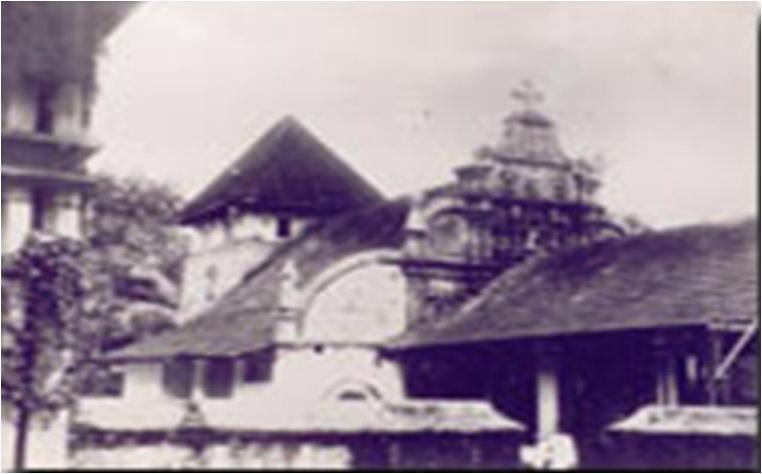
The Church buildings conformed to the Malabar style of architecture. The early builidings were built entirely of wood. Teak wood buildings are said to last for four hundard years as remarked by Fr. Paulinus in eighteenth century. Most of the old churches are beautifully decorated with plaster decorations, most commonly appearing the Virgin and Child. There are also crosses on various floriated designs and angles, images of male and female beings, half man, half fish, holding a ship above their heads. There are also images which has no religious significance such as man shooting a tiger etc.
The ancient Churches externally looked like non- Christian pagodas, the only distinction being the crosses that were put on the roofs and in front in the open air. The Churches also had flag staff. A flag hoisted on such a staff indicates that a feast is being celebrated in the church. (( Placid- “ The Thomas Christians” page-86 )).
Ancient Churches , Stone Crosses of Kerala- Saint Thomas Cross, Nazraney Sthambams and other Persian Crosses
2. Ancient Stone Crosses of Kerala
There are two types of rock crosses in Kerala Churches broadly classified as St. Thomas cross and Nazraney sthambams. There are also Persian crosses in other forms such as seen in Niranam and North Paravur Churches.
There is a local tradition which states that Mar Sabrisho and Mar Peroz made a good number of conversions, built new churches and erected open air- crosses. (( A Mingana – ” Early Spread of Christianity in Indai p-508))
2.1 St. Thomas Cross
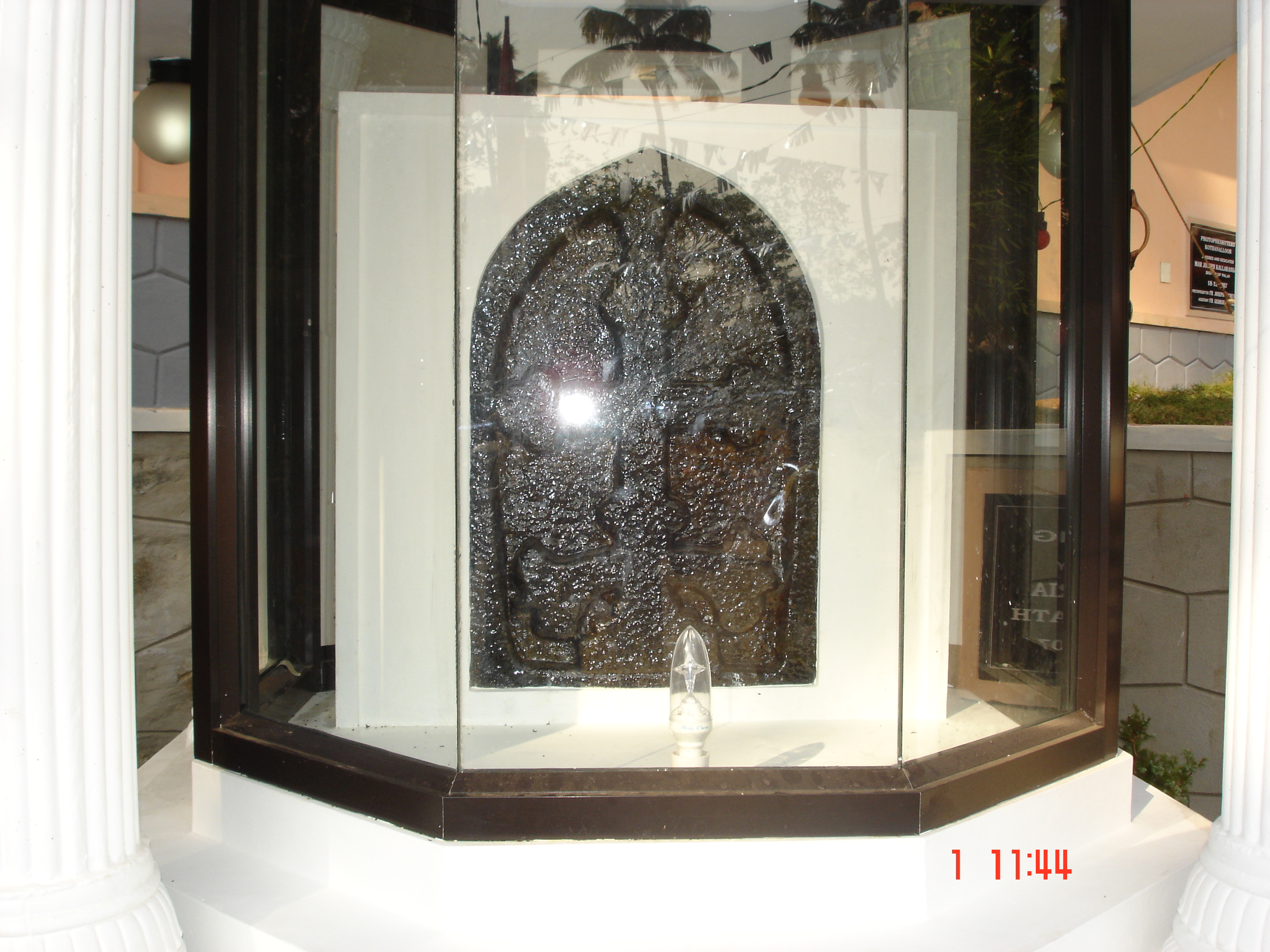
The small interior type rock cross is called St Thomas cross or Persain Cross. These crosses are found at the following locations in India, St. Thomas Mount ( Madras), Kothanalloor, Kottayam [ 2 nos ], Kadamattam, Muttuchira, Alangad and Goa.
Similar crosses are also discovered from Anuradhapura [ 2 nos ], Sri Lanka and Taxila, Pakistan. (( More details about Taxila cross is not known ))
Locations of Saint Thomas Crosses in India
The Saint Thomas Mount Church is at Our Lady of Expectations Church, under the Latin Catholic diocese of Chingelpet ( Madras-Mylapore). The Kadamattam cross is at St. George Syrian Church of the Malankara Orthodox Church. The Muttuchira cross is at Holy Ghost Church, under the diocese of Palai of the Syro Malabar Church. The Kottayam crosses are at St. Mary’s Church under the Southist diocese of Kottayam of the Syriac Orthodox Church.The Kothanalloor cross is at St.Gervasis and Prothasis church under the diocese of Palai of the Syro Malabar Church. The Alangad cross is at St. Mary’s church under the diocese of Ernakulam- Angamaly of the Syro Malabar Church. The Goan Cross is at Pilar Seminary Museum, Goa.
The Churches except the Kottayam belongs to the Northist under the Syro Malabar Church and Malankara Orthodox Church. The oldest of these churches are the Mylapore and Muttuchira Churches.The Mylapore Cross is considered as the oldest in India. Based on the type of the script used most of these crosses are attributed belonging to between sixth and eight centuries. Only the second cross of Kottayam, which has a Syriac inscription is dated as belonging to tenth century.
About the Saint Thomas Cross
This Cross been venerated by all St Thomas Christians from ancient times. They have inscriptions in Pahlavi (Middle Persian) and Syriac which indicate that they date to before the eight century.
These carved crosses are located inside the churches and are very decorative. These are not typical crucifix and are a plain cross which doesn’t show Christ on the cross. In Eastern Christianity and Syrian Christianity, the plain cross is the symbol of the triumph of Christ’s life over death. It is of symbolism in Eastern Christianity.
These crosses are also sometimes called Leaved Crosses or Persian crosses as they symbolize at the bottom a set of leaves. The leaves usually flow upwards either side of the base of the cross symbolizing the cross as the tree of life. But some of these crosses from Kerala the leaves are downward pointing. This is indigenous and this symbolism and tradition is not find in Persian or Middle East or even in Byzantine art.
2.2 Nazraney Sthambams

The giant open air rock cross are called Nazraney Sthambams. The plinth of these crosses represents lotus petals and lotus flowers and has a square base. It also has a variety of iconographic motifs, including elephants, peacocks and various other animals, depictions of the Holy Family and of the Crucifixion, to name a few.
Locations of the Open Air Crosses
These crosses are found in Kottekkad, Enammavu Mapranam ( Holy Cross Church Mapranam under the Thrissur diocese of the Syro Malabar Catholic Church), Puthenchira ( St.Mary’s Forane Church under the Irinjalakuda diocese of the Syro Malabar Catholic Church) Parappukkara (under the Irinjalakuda diocese of the Syro Malabar Catholic Church), Veliyanad (under the Changanacherry diocese of the Syro Malabar Catholic Church) , Kalpparambu (under the Irinjalakuda diocese of the Syro Malabar Catholic Church), Angamaly ( Under the Eranakulam- Angamaly diocese of the Syro Malabar Catholic Church), Kanjoor ( Saint Marys Church ), Malayattoor (Under the Eranakulam- Angamaly diocese of the Syro Malabar Catholic Church), Udayanperur Under the Eranakulam- Angamaly diocese of the Syro Malabar Catholic Church), Kuravilangad ( Under the Palai diocese of the Syro Malabar Catholic Church), Uzhavoor ( Under the Kottayam ( Southist) diocese of the Syro Malabar Catholic Church), Chungam ( Under the Kottayam ( Southist) diocese of the Syro Malabar Catholic Church), Muttuchira ( Under the Palai diocese of the Syro Malabar Catholic Church), Kudamaloor ( Under the Palai diocese of the Syro Malabar Catholic Church), Niranam (St. Mary’s Orthodox Syrian Church under the Niranam diocese of the Malankara Orthodox Syrian Church) , Kothamangalam, Chengannur, Thumpamon, Chathannur and many other places.
About the Open Air Crosses
These crosses are very large, freestanding crosses which are found outside the churches. They are usually aligned to the west end of the church. On festival days and during processional days, people process around these crosses. People also burn coconut oil as an act of offering and reverence at the base of these large crosses on their pedestals.
The plinths represent lotus petals and lotus flowers as the cross is sitting on top of a lotus flower. There is a square base, it’s a circle on a square with a cross on top. The circle as the lotus flower represents the divine, heavenly aspect, on the square which represents the earth.
There are depictions of the holy family. There are imags of Mary and the Christ Child, also of the Crucifixion in these crosses. There is a variety of iconographic motifs including fish, various animals, elephants. The elephants are very much part of an Indian context.
There are even archway’s in older churches which shows two elephants either side of the cross on a plinth. The elephants are coming to venerate the cross. And on the other side of the archway, there are peacocks sitting either side of the cross. This represents the indigenisation of stone crosses and Christian symbols in India.
2.3 Other Persian Crosses
There are other ancient Persian Crosses found in Churches. The Author doesn’t know about studies of these crosses.
Kottakkavu ( Parur) Cross
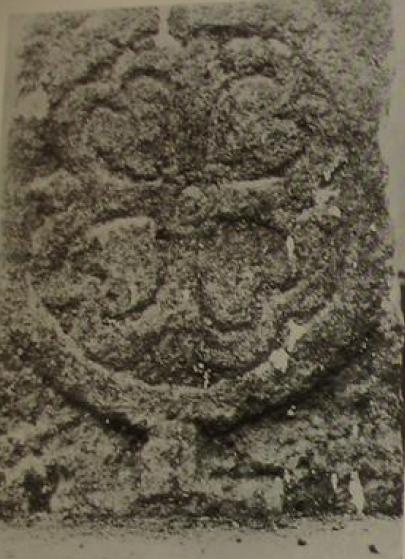
The Saint Thomas Kottakkavu Church at North Paravur under the diocese of Ernakulam-Ankamaly of the Syro Malabar Church has an ancient Persian Cross.
This cross is engraved on granite stone believed to be done by Mar Sabore and Mar Prothe about 880 AD . This is now preserved in the chapel in front of the church.
Niranam Cross
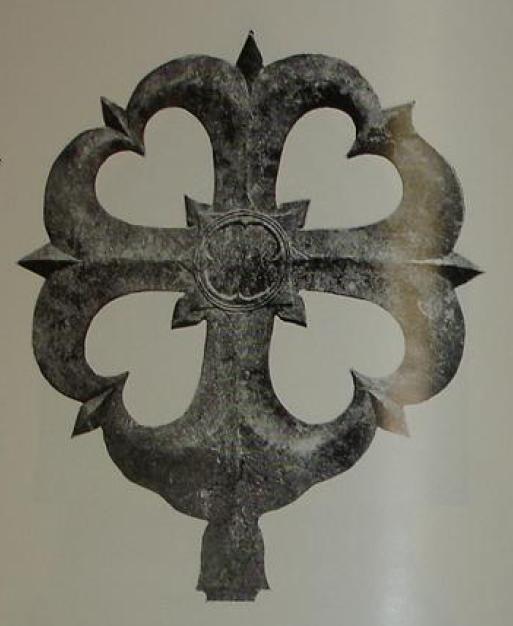
There is another Persian cross at St. Mary’s Orthodox Syrian Church, Niranam under the Niranam diocese of the Malankara Orthodox Syrian Church.
Nilakkal Cross
There was an ancient cross found from Nilakkal. A part of which is said to be at Kuvappalli. This came from the ruined Christian settlement of Nilakkal. It is said that it has an inscription in Roman or Greek capitals, but that is so illegible to read. The other portion of this cross left at Nilakkal was not found by Fr. Hosten when he visited the site again in 1924. (( The Author doesnot know if this is same as Saint Thomas Cross ))
Further Reading–
1.Vazhuthanapally-“Archaeology of Mar Sliba”
2.Thadikkatt-” The Cross in different traditions”
3.A E Burnell- ” Some Pahlavi Inscriptions in South India”- Kottayam Cross
4.A Mingana-” The Early spread of Christianity in India”- Muttuchira Cross
5.ASR Ayyar-” A New Persian Cross from Travancore”- Kadamattam Cross
6.T K Joseph-” Another Persian Cross in Travancore”- Kadamattam Cross
7.T K Joseph-” A Pahlavi inscription around the Cross”- Kadamattam Cross
8. Varghese Pathikulangara-“Mar Toma Sliba, Saint Thomas Cross, Short Explanation, historical and Symbolical
9.Varghese Pathikulangara- “St.Thomas Cross – The Flowery Cross”
10.E W West-” Inscription around Crosses in South India”
11.CPT Winckworth-” A New Interpretation of the Pahlavi Cross- Inscriptions of South India”
12.George Menachery- “Ancient Kerala Christian Art”
13.Geo Thadikkatt-” Liturgical Identity of Mar Toma Nazrani Church”
14. Ken Parry -“Stone crosses of Kerala”
15.George Menachery- “Rock Crosses of Kerala”
16.Gerd Gropp-“Die Pahlavi Inschrift auf dem Thomaskreuz in Madras”- Mylapore Cross
17.Herman D’Souza- ” In the steps of Saint Thomas”
Pictures–
1. Kothanalloor cross at St.Gervasis and Prothasis Church, Kothanalloor under the diocese of Palai of the Syro Malabar Church. Many thanks to Thomas Antony for the picture.
2. Open Air Cross at St.Marys Church, Kuravilangadu, under the diocese of Palai of the Syro Malabar Church.
3. Persian Cross at Saint Thomas Church, North Paravur under the diocese of Ernakulam-Ankamaly of the Syro Malabar Church.
4. Persian Cross at St. Mary’s Orthodox Syrian Church, Niranam under the Niranam diocese of the Malankara Orthodox Syrian Church.
________________________________________________________________________________
Author can be reached on admin at nasrani dot net
Last Update- August 03/2009
________________________________________________________________________________
Although I donot have the right to suggest, since I myself commenting anonymously, I feel that if you reveal yourself, your writings will be considered more authentic by readers. I am well aware of our social system which might made you be anonymous. But, it is clear that you are an expert in what you write, which seems to be your first interest too, and perhaps the best expert available online and so I feel you should/can make yourself visible.
I have one suggestion. Please provide captions for the photos giving details of its exact location so that novice like me can make better use of it.
Hope that there are numeours readers for your posts, though, sadly, I see no other comments. We Nasranis are too busy in making a living and often do not have enough time for this type intellectual efforts (though we are much better compared to other communities in Kerala). This I say from my own experience. I could not study/research much about my ancestors, our traditions and history as I was too busy in my other studies/career till my 25th age. (But this was not the case with my ancestors. They are very aware of this tradition and proud of it, though at my younger age I wondered why). Only last year onwards I found the time to reflect and make connections of my childhood learnings about our culture and now I am proud for being a Nasrani. I still believe that many people of my age are like what I was one year before. And this blog will help these younger generation. As is always the case with written materials, I hope that many people will find this blog useful at a later time when they have time to think about their ethinicity, ancestors etc. They may not be able to do it now as their preference is diffent now.
Can you write about ‘Qhatheesangal’? I am aware that there were numeorus churches for them till the Synd of Udayamperoor. Now very few, especially in Syro malabar.
Thanks for providing this kind of information.Your efforts are great. May god be with you.
This reminds me of the views shared by Menachery.
No other community in Kerala has such a huge monumental stone structure.The indoor counterparts of these crosses have the earliest carvings in Kerala of the national flower lotus and the national bird peacock.
Perhaps even the national animal tiger is first depicted in Kerala art in church sculpture. There was no rock carving in South India prior to the period of these indoor crosses. The motifs, message ,and images on these crosses and their pedestals display a remarkable degree of Indianness and Malayalee Thanima or identity.
Vedic Hindu Gods and Goddessess like Ganesha, Vishnu, Shiva, Sapthamathas , Jeshta etc. appear in the art of the central Guruvayoor/Palayoor-Quilon part of Chera country only after the 11th-13th centuries, and even in the Salem-Erode section, and the Trivandrum-Cape Comorin section Vedic Hindu deities appear in art only as late as the 9th century A.D.
This is in response to the comment of Anon,
I presume this comparison is with Hindu Vedic structures.
Modern Scholars are of the opinion that Buddhism was the flourishing religion in Kerala till 9th century.
Are their Buddhist rock structures and carvings which date prior to St. Thomas cross in Kerala? Is there any comparison being made with Buddhist structures ?
As a large no. of enquiries are coming about Kerala and Indian christian art the following also may be useful, for those interested. Excuse the length of the post , pl.
Draft of Article in CBCI KCBC Apostle St. Thomas St. Francis Xavier Jubilee Volume, 2003 By Prof. George Menachery
Christian Contribution to Art and Architecture in India
01.01 Intercultural nature of all art:
What art and architecture is purely indigenous? There is no art or architecture – no sociocultural formations of any significance, anywhere in the world – relating to a nation, a region, a religious or racial or linguistic group – that is fully local or indigenous. The art and architecture of India – secular or religious – is no exception. Thus Church Art and Architecture of India from the commencement of the Christian presence on these coasts at the dawn of the Christian era have been to a greater or lesser degree influenced by those of other nations and religions as they in turn have been influenced by Indias wealth of artistic and architectural traditions. All the nations and cultures that came into contact with India – the Egyptians, the Phoenicians, the Greeks, the Romans, the Moguls, the Parthians, the Iranians, the Arabs (of Pagan, Jewish, Christian, and Islamic persuasions), and the Europeans of a later date including the Portuguese, the Dutch, the Danes, the French, and the English have all left their mark on the society and culture of India, as has also been done by the eastern countries and cultures.
01.02 Aspects of art here studied:
The topic “Christian Contribution to Art and Architecture in India” is indeed vast and complicated, as most other topics in this volume are. In addition to the necessity of discussing the chronological, geographical, and denominational aspects, the styles, varieties, types, and schools as well as the genres, localities, media, approximate dates, materials used, purposes and uses, to name but a few details, of each object, and each group of objects, of art and architecture have to be considered.
01.03 Chronological divisions of Christian Culture:
Take for example the chronological divisions. The history of Christianity in India and hence of Christian culture may be said to roughly fall into certain epochs or into various periods: e.g. a) the first few centuries Indian and Persian influence, b) the Padroado period, follwed by c) the Protestant centuries, and the d) the Propaganda period, e) periods and pockets influenced by personnel from different regions of Europe and America, and, f) the post independence period. The nomenclature employed to describe these periods does not necessarily signify that all the trends appearing in each time-span were only specific to the source/s indicated by the epochs designation. In general we may treat the story of chrstian art and architecture in India by dividing it into 1) the Pre-European period, 2) the 16th to 18th Century developments, and finally 3) the modern period.
01.04 Regions:
Among the geographical divisions with special reference to Christian art and architecture must be studied Malabar i.e. Kerala, the Konkan belt and the areas under predominant Portuguese influence even upto Mumbai and Vasai along with Portuguese pockets elsewhere, locations associated with the Mogul court, Bengal, the French pockets, and the Carnatic with special reference to the Tamil country, and many other areas of Anglo-American influence.
01.05 Genres:
Again, consider the genres. While performing arts like song, music and dance, and literary arts like poetry, or the drama or rhetoric do not come under the purview of this article, many genres of fine arts like architecture, sculpture, painting must be discussed. So also objects utilizing or made out of different media or materials like stone (granite, laterite, marble, sandstone), wood, metal and metal alloys (gold, silver, iron, bronze, brass), pigments (wooden panels, murals, frescos, canvasses, cloth paintings, colouring of statues and other wooden objects), ivory, bone, glass, precious stones, shell, plaster, straw, nutshells, leaves, bricks, mud, clay, concrete, …all claim our attention.
01.06 Items of artistic and architectural significance:
There are a large number of items of artistic and architectural significance in the religious and domestic / civil life of Indian Christians which come under one or more of the divisions and categories adumbrated above. F.i., in the churches there are ever so many types of roofs, ceilings, facades, porticos, verandahs, naves, chancels, altars, altarpieces, statues, candlesticks, pillars, doors, doorways, architraves, pulpits, crosses, cross pedestals, chalices, censers, censer-boats, bells, belfries, books, book-illustrations, and bookmarks, bibles and bible stands, choirs, tabernacles, monstrances, railings, wall paintings, wooden panels, cloth paintings, vestments, beams, rafters, processional umbrellas, canopies, chariots,… and a thousand and one other objects to be considered. And there is a plethora of household utensils and features of domestic and civil architecture to be considered.
01.07 A viable scheme of study:
Of course it would be next to impossible to at least cursorily deal with even a fraction of all this. Hence it may be more practical to make an attempt to discuss the main instances and trends in the chief centres of Christian art and architecture then and now, such as (1) Kerala upto the 17th century, (2) the Mogul court, (3) the Goan circle and pockets of Portuguese influence, (4) other regions, (5) some notable architectural landmarks, (6) some remarkable works of art, (7) the 20th century. However in an article of this size even these topics could not be discussed in any detail.
02.01 Kerala Upto the 17th Century:
The location of the state of Kerala on the western seaboard, at the centre of the international highway of seaborne trade connecting the East and the West, [and the North with the South] made it a meeting point of many worlds, a melting pot of races and creeds, from early times.1 The Hindu monarchs and chieftains of the Sangam and post-Sangam period ruled over a fertile agricultural tract the peace and safety of which were guaranteed by the Western Ghats on the one side and the Arabian Sea on the other. The land itself was [for long] a secret shared between the sea and the mountain, an illegitimate child of the two natural forces, protected by and provided for by them in a special way.2 But already we find in the first centuries B.C.E. / C.E. that while the monsoon route connected Muziris (Cranganore) directly across the Arabian Sea with cities in the west (e.g. Alexandria, Aden) the West Coastal route gave its ships ready access to the Indus3 and to countries to the North and Northwest in Asia and Europe.4
02.02 Foreign influences:
It would appear that the impact of her trans-Arabian-sea visitors were much more pronounced in the case of Kerala than that of her mainland neighbours, during and after the Sangam age. This contact with the countries west has paved the way for considerable influence of the societies and cultures of those lands and their peoples on every phase and aspect of the life of the inhabitants of Kerala. Thus from the arrival of Vasco da Gama in 1498, Portugal, the Netherlands, France, and England have had a great deal of influence on the people of Kerala not only in the matter of material cicumstances of life but also in the field of ideas and ideologies. One of the strongest areas where this influence is manifested is in the field of Kerala art and architecture in general and Christian art and architecture of Kerala in particular.
02.03 Pre – European period:
Christian art and architecture in Kerala in the pre-European periods had developed obtaining nourishment from two sources: one, from the countries in the near-east including perhaps Greece, Rome, Egypt and the other Middle East countries from which ideas and practices were imported by missionaries and traders, and two, the indigenous forms and techniques of art and architecture that existed in the land.
02.04 Nature of Keralas cultural heritage:
By a happy mingling of these two streams already by the arrival of the west in Kerala there was existing here a strong tradition of Christian art and architecture which was notable for its aesthetic as well as pragmatic excellence. The Portuguese, the Dutch, the French and the English and also the missionaries from Germany, Italy, Spain, Belgium &c. brought with them their own art traditions which resulted in adding certain features to the already existing structures and traditions without trying to or succeeding in totally replacing the cultural heritage of the Christians. Hence today one can see a harmonious blending of the East and the West in the Christian art and architecture of Kerala although examples are not altogether lacking of attempts made to implant certain incongruous elements into Kerala’s cultural formations.
02.05 Two-fold approach:
Hence to understand and estimate the quality and quantity of Kerala Christian art and architecture it may be best first to analyse the nature of such art and architecture at the coming of the Portuguese in 1498 and thereafter to study the items introduced by various western administrators and missionaries, along with their varieties and spread.
02.06 Two pictures:
Two pictures are available about the churches and churchbuilding activities of the Christians of Kerala at the beginning and end of the sixteenth century. At one end we have the account given by Joseph the Indian and the letter written by the four bishops in 1504.5 At the other end of the century we have the documents of the Synod of Diamper in Malayalam as found in many old Kerala churches6, in Portuguese in the work of Gouvea7, and in English in the work of Geddes8.
02.07 Similarity of Hindu and Christian places of worship:
The tale of how Vasco da Gama went into a Hindu temple in Kerala and mistook it for a church and venerated the idol of Bhagavathi (?) mistaking it for an image of the Blessed Virgin Mary would have clearly illustrated the similarity of the Houses of God in Hinduism and Christianity in Kerala had we any assurance that Gama already knew about the shape of Devalayas in the land from his many spies and scouts.
02.08 State of affairs at the beginning of the 16th century:
The description of the reception given to the bishops at the beginning of the 16th century by the faithful sheds considerable light on the state of the churches, the Christians and their cultural and artistic traditions: …they were received by the faithful with great joy and they went to meet them with joy, carrying before them the book of the Gospel, the cross, censers, and torches…9. And they, the bishops consecrated altars…10.
02.09 At the end of the 16th century:
In the Synod of Diamper, 1599, there were represented more than a hundred churches of the St. Thomas Christians. This indicates the existence of a very large number of churches already at the coming of the western powers to India. The description of the visits of Archbishop Dom Menezes to various churches before and after the Synod throws some light on the structures and arrangements of the churches before western elements and types were introduced into Malabar.11 It may be remembered that the churches and all their belongings were the property of the parishioners and each church was built completely from the parish revenues and subscriptions from the local faithful. A student selected from the parish and educated by the parish was the vicar in each parish. It was only after the Synod that westernisation of institutions and structures commenced / gained momentum. The bishops started to have any say whatsoever in the affairs of the parishes only much later, and even today in most Nazraney Churches the parish retains a great deal of autonomy.
Hence as has already been remarked to understand and estimate the quality and quantity of Kerala Christian art and architecture it may be best first to analyse the nature of such art and architecture at the coming of the Portuguese in 1498 and thereafter to study the items introduced by various western administrators and missionaries, along with their varieties and spread.
03.01 The three objects in front of the Kerala church:
There were three striking objects of significance in front of the typical Malabar churches, either inside the courtyard or just outside it: (1) the open-air granite (rock) cross which the present writer has christened Nazraney Sthamba, (2) Kodimaram (Dwajasthamba) or Flag-staff made of Keralas famed teak wood (e.g. at Parur), and often enclosed in copper hoses or paras (as at Changanassery, Pulinkunnu, or Chambakkulam), or made out of some other wood or other material, and (3) the rock Deepasthamba or lampstand. Sthambas or pillars of some type or other are to be found among the Budhists, Jains, Hindus, etc. in India.Such pillars and structures were part of the Christian heritage of Kerala much before the ascendancy of Vedic Hinduism in these parts , although J.Ferguson does not appear to have known or cared for the rock monumental Sthambas of Kerala .12
03.02 Open air granite crosses:
The ubiquitous cross of Malabar churches is best represented by the rock crosses, mostly outside the churches. The open-air rock-cross of Malabar is an obelisk, a tall stone column, with four, sometimes decorated, slightly tapering sides. Rome has many obelisks (from Egypt and East, but no originally cross-bearing structures decorating the piazzas and squares); London has one on the banks of the Thames lovingly called Cleopatras Needle; Paris has one at the place d la concorde; and even New York has one in the central park. Many memorials like the Washington Memorial are obelisk-shaped. The Asoka Pillar and other such Indian pillars were influenced by the Graeco-Parthians, under Egyptian-Persian influence. The Nazraney sthamba is a direct descendant of the obelisk, and much closer to it than the other Indian pillars- in shape, method of constuction and transportaion, method of erection, function, and solar symbolism. The Roman obelisk, bearing crosses today, have been converted to Christianity, while Keralas cross-shaped obelisks were born Christian13. The obelus and the double -dagger reference marks in printing may be profitably recalled here. Such obelisk crosses continued to be erected mostly in front of churches even after western ascendancy without much change although a few changes in the motifs on the pedestals etc. could be noticed.14
03.03 The three-tier gabled indigenous architecture of Kerala churches, which lacked facades until the coming of the Portuguese, immensely gains in richness, symmetry, and beauty because of the open-air rockcrosses, some of them more than 30 feet in height including the intricately carved pedestals, and monolithic shafts. No other community in Kerala has such a huge monumental stone structure. The indoor counterparts of these crosses have the earliest carvings in Kerala of the national flower lotus and the national bird peacock. Perhaps even the national animal tiger is first depicted in Kerala art in church sculpture. There was perhaps no rock carving in South India prior to the period of these indoor crosses. The motifs, message, and images on these crosses and their pedestals display a remarkable degree of Indianness and Malayalee Thanima or identity. Vedic Hindu Gods and Goddessess like Ganesha, Vishnu, Shiva, Sapthamathas, Jeshta etc. appear in the art of the central Guruvayoor/Palayoor-Quilon part of Chera country only after the 9th-13th centuries, and even in the Salem-Erode section, and the Trivandrum-Cape Comorin section Vedic Hindu deities appear in art only as late as the 9th century A.D.15
03.04 The base with a socket, the monolithic square and slightly tapering shaft with cylindrical terminals, the horizontal piece forming the arms with a double (hole) socket in the middle, and the capital with a cylindrical bottom end are the four members of the open-air cross. They are so well chiselled and proportionate that when put together the socket and cylinder arrangement enables the cross to stand by itself. However for the bigger crosses, pedestals in the form of sacrificial altars or Ballikallus are found, often carrying exquisite reliefs of the flora and fauna of the land in addition to scenes from daily life and biblical scenes. The cross which represents the supreme Bali (sacrifice) or Mahabali appearing on the Balikkallu or sacrificial altar most appropriately represents the Calvary events and sheds plenty of light on the ideological, historical, cultural and technological bent of mind of the forefathers.Compare with the base of the Obelisk of Theodosius, Constantinople,.A.D.390.
03.05 The obelisk is a ray of the sun – here a ray of Christ (of Horus -Xt. the sun-God). This ray helps the lotus near – universally depicted on such crosses to blossom forth representing in a typical Indian poetic conceit the grace received by the sin – bound human soul (panka jam) from Christ. Lotus representing the sun is found in other early Indian art also.The half dozen interior Pehlavi inscribed crosses, some of them surely of pre- 7th century origin, which were mostly tombstones before they were put up on the altars, have generally the dove (Holy Spirit) depicted on top of the clover or flowertipped equal-armed Greek cross, in addition to the lotus at the bottom. In this three piece (Thri-kanda) cross one might, perhaps, with considerable effort read the lotus represented Brahma (Father), the flowery cross (Son), and the dove (Holy Ghost). But the lotus has more universal and more diverse implications in the various eastern creeds.
03.06 The arrangement to hold wicks found on the crosses may be related to the necessity to preserve fire, and the effort to make it available to the common people in the dim past, when Homakundams were rare in Kerala or beyond the reach of the common folk. It is perhaps in connection with the need to preserve fire that the oil-Nerchas and oil Araas or chambers of the churches, and the compound -wall rocklamps are to be evaluated. The oil related objects in the churches also indicate the connection of this Christianity with the trade of the land, especially oil-trade. The bell like arrangement on some crosses also are noteworthy. Veneration of the cross, angels, Adam and Eve… and of course the Indian Cross itself are some of the religious carvings on these structures.
03.07 Deepasthambas and Deepams: . The square or polygonal shape of the individual pieces in the granite or rock lampstands at Kallooppara, Niranam, Kundra, and Chengannur churches indicate the antiquity of such lampstands in the churches. Unlike in the churches, in the temples the tradition of these lamps continued and thus developed in to the present-day round shape of the pieces. In art history generally the simpler forms make their appearance first, and refinements and complications indicate a later date. Even when the tradition of lampstands declined in the churches, many open-air crosses had wickholders incorporated into them, with the advantage that wind and rain did not put off the flames. Church walls still display rows of rock lamps. Inside the churches the tradition of bronze lamps continued vigorously, representing a variety of shapes and types, and some lamps having even hundreds of wickholders, e.g. the Aayiram Aalila lamps at Arthat or Angamaly.
03.07 In front of the church the third interesting object is the flagstaff, sometimes covered with copper paras. Every festival is announced with the Kodiyettu or flag-hoisting, a tradition going back to early Buddhist times at least. All these three objects in the courtyard of the church have a variety of liturgical functions associated with them.
03.08 Baptismal Fonts:. Crossing the portico or mukhamandapam one enters the Haikala or nave beyond the huge doorway with intricately carved doorpanels called Aanavathils. Either in the nave or in the little room set aside as baptistry one comes across the rock baptismal font. There are interesting rock baptismal fonts at Edappally, Kanjoor, Mylakkombu, Muthalakkodam, Changanassery, Kothamangalam, Kadamattom etc. The similarity of these baptismal fonts with illustrations of the fonts used for the baptism of Constantine (4thC.) and Clovis (Rheims C.496) is remarkable. All the old baptismal fonts are of granite or very hard laterite. They are all huge in size indicating that baptism by immersion must have been the order of the day. Many of the dozens of old baptismal fonts depicted in the STCEI15 & the ICHC16 were probably of a date prior to the decree of the Synod of Diamper which made permanent fonts more or less compulsory. Although most of the old baptismal fonts/ baptistries are found near the west end or middle of the nave on the northern side – Kaduthuruthy(Big), old Edappally, old Kanjoor, Changanassery (Southern side), in many churches, mostly Jacobite/Orthodox they are today found close to the sanctuary e.g. Angamaly (Middle-church), Kallooppara.. They are exquisitely carved with reliefs of the baptism of Christ, Mary feeding the Child, angels, or Indian crosses. There are also wonderful motifs of leaves, the basket pattern, coir pattern, etc. engraved on these stones. By the way the very Malayalam word Mammodisakkallu indicates a font made of stone. Another term is mammodisath-thotti. The Holy Water Font is called Annavella Th.-thotti, also generally of stone.
The Architraves and doorposts in many churches are good examples of south Indian rock-carving. (e.g.old Kayamkulam, Chengannur, Kanjoor). But the rock-baptismal fonts are the real pride of many an old church.16
03.09 Another aspect of church architecture that has scarcely been affected by the later types from abroad is the old three tier gabled wooden roofing with the highest roof for the Madhbaha or Sanctum Sanctorum and the lowest for the Mukhamandapam or portico with the nave or Hykala having a roof of middle height. Although the rock crosses, the flagstaffs, the rock lampstands, the baptismal fonts, and the three tiered roofing pattern have not been much affected by the western visitors and administrators many of the objects found inside the churches and the very appearance of the inside have undergone many changes after the arrival of the Portuguese and other westerners. Let us look at some of these changes.
04.01. There is an interesting description of Kerala churches in the account of Joseph the Indian, c.1500. The Christians have their churches, which are not different from ours, but inside only a cross will be seen. They have no statues of the saints. The churches are vaulted like ours. On the foundation is seen a big cross just as in our place. [May be the open air cross?] They have not any bells. 17 There is much truth in the statement of George Varghese: But once these churches came under the jurisdiction of the Portuguese in the sixteenth century, the ornate monumentality of the European churches was introduced into the small temple-like Syrian Christian churches, which even did not have windows in the early past. The baroque and ornate altars with statues and foliages replaced the Chaldeo-Syrian altars, which were in fact only stone-tables with nothing more than candles, Chalice and the Holy Book on them, the bare necessities for observing the Holy Mass. Despite unpleasant frictions with the Portuguese, both in political and ecclesiastical matters, this was the golden era of Church Art in Kerala. They introduced the Romano-Portuguese style, which was assimilated with such artistic and structural finesse by the artists of Kerala, so that it created some of the finest pieces of artistry in the Nazraney school. Later, the British also were equally enthusiastic in introducing their skills and forms into the Church Art of Kerala. Hence, from a conservative perspective, the art in these churches may appear eclectic, with diverse traditions, both western and eastern, superimposed one over the other. The exclusively Asiatic symbols like stone lamps, flag masts, stone-crosses, arched entrances etc., untouched by the foreign hands, co-exist with the Renaissance frescoes, and the Baroque Art of Europe in the same church-complex. There is, in fact, an underlying unity behind this apparently confused juxtaposition of images, symbols and monuments; this is due to the fact that as universal archetypes, images and symbols of religions, both in the west and in the east, have many common elements.18
04.02. Among the additions which took place in Kerala churches with the advent of Europeans might be counted paintings and sculptures on a large scale, imposing altarpieces or reredos; rostra or pulpits, statues of all sizes, types and shapes; plaster mouldings and pictures; huge bells and belfries. Murals and frescoes on a very large scale make their appearance as well as paintings on wood panels and clothe. But the most apparent introduction of the Portuguese was the facades they put up between the portico and the nave in order to impart a Christian appearance to the churches.19
04.03 . The mural tradition of Kerala is ably represented in the churches of Kerala. Many pictures depicted on the walls of Kerala churches may be older than the well known Mughal and Rajput paintings.20 Some interesting murals, all of which use only pigments extracted directly from natural objects like leaves, laterite stone, &c., are to be seen in the churches at Angamaly, Akapparambu, Paliekkara, and Cheppad. Silparatna esp. its Chitralakshana division , the Sudhalepavidhana etc. deal in detail with the colours and additional materials and their application in Indian mural painting. It is interesting to note that the early paintings and iconography of Kerala churches strictly adhere to the concepts of Indian sages and craftsmen on these matters. Interesting old-time wooden panels are seen at Piravaom, Kottayam, Changanassery and Ollur churches. The vast interior of the Ollur church has thousands of square feet covered with frescos.
04.04. Today we have a few churches and places of worship in Kerala which adhere more or less to one or other of the classical christian architectural styles like the Basilican, Romanesque, Byzantine, Gothic, Baroque, Rococco, etc. but more often than not the churches built in the twentieth century are combinations of various styles, both eastern and western. Elements of Saracenic, Hindu, Jain, and Buddhist origin are also common. And there are a large number of churches which are like any other place of assembly such as a Cinema-house, an international conference centre, or a town-hall, or Kalyana Mandapam.
04.05. Kerala churches built, restored, or reconstructed after the 16th century have many features in common with such structures elsewhere in India, esp. in Goa and environs, and as such are not treated separately.
05.01 Portuguese Influence and the Goan Circle:
After the arrival of Vasco da Gama and more especially after the commencement of Portuguese ascendancy in India two distinct patterns of Christian art developed, one within the areas of Portuguese influence, mostly along the coasts of the peninsula, and the other at the Mogul (Mughal) Court in the North.
05.02 Twelve years after the arrival of da Gama at Calicut in Kerala Alphonso de Albuquerque brought Goa under Portuguese rule in 1510. Thirtytwo years later Francis Xavier arrived in Goa in 1542. Christian communities began to grow up in Goa. In the words of Mathew Lederle, S. J. :21 It was a characteristic of the Lusitanian period that the newly gained Christian Faith found expression in feasts, customs, songs, dances. In Goa grew up what has become up to now the only complete form of Christian art in India, comprising both the sacred and the profane, encompassing the whole of human life. We speak of the Indo-Portuguese Baroque. This phrase is not to be taken in too literal a meaning. Though being predominantly Baroque, it was not restricted to Baroque nor to Portuguese. Almost any form of European religious art of the 16th to 18th centuries and cultural traditions of various countries left their traces in Goa. The Portuguese were great builders and promoted architecture more than any other form of fine art. The Christian art of Goa reached its climax in church building. [For some illustrations cf. Thomas Encyclopaedia,Vol.1.] These churches were elaborately decorated; they expressed the Baroque ideal of making visible here on earth the heavenly darbar, centred round the Eucharistic presence of Christ among his people.
The composite Indo-Portuguese culture which developed in Goa [and elsewhere in India] over more than 450 years of Portuguese presence in this locality of Indias West Coast, is a fascinating but vast subject..with…the shapes which European Baroque, with the Christian art and architecture which came with it, took in the hands of the Indian artisans and craftsmen who had their own repertoire of skills, styles and motifs, developed through millennia of building and carving – the unique, locally developed style of the Hindu temple and its companion lamp-tower…22
05.03. Cochin continued to be the Portuguese capital in India until 1530. Western style forts, houses, churches with their spires, and monasteries began to be built in Cochin and Goa. Fort Manuel at Cochin was enlarged and the Mattanchery Palace, now called the Dutch Palace was constructed and gifted to the Maharajah of Cochin for the favours granted. In Cochin even today can be seen many of the churches and convents the Portuguse built – such as the St. Francis church, the first European place of worship in India perhaps, where Vasco da Gama was first buried, although the church itself became afterwards a Dutch church and later an English church and finally came to be under the Church of South India. It is a protected monument today under the Archaeological Survey of India as is also the so-called Dutch Palace not very far from it. In this locality can also be seen the Santa Cruz Cathedral, the palace of the Bishop of Cochin, the St. Bartholomew church, the Dominican church and the St. Pauls church.
05.04. Already by 1542 Francis Xavier writes that Goa is a city entirely of Christians, something worth seeing. There is a monastery of friars,… he continues, and a noble cathedral with many canons, and many other churches. City planning and building activity continued apace so much so by the end of the 16th century Goa is compared to Lisbon and is termed the Rome of the East. And Francois Pyrard has this to say: The buildings of the churches and palaces, both public and private, are very sumptuous and magnificent. The Se Cathedral begun in the middle of the 16th century, some years after the completion of the first church of St. Catherine of Alexandria, and the church of Our Lady of the Rosary are examples of the earliest large-scale building activity in Goa. The latter brings to mind the contemporary need for a church to be also a fort at the same time.
05.05. The ecclesiastical furniture of that time was artistically formed altar pieces, pulpits, statues, sepulchres, tombstones, chairs, tables, confessionals. Special attention was given to the sacristies, their ceilings, their walls, their almirahs. [See the illustrations in Vol.II (1973) and I (1982) of the Thomas Encyclopaedia.] Even now a large number of excellent statues both in churches and in homes are still available, done in wood or in ivory, the delight of the tourist and the souvenir collector. These statues betray their European artistic inspiration, but they also show the hand of the local artisans. Some figures have local face expressions. In a large stucco representation in the Margao church, the Virgin in standing on a peacock which may have been influenced by the presentation of Parvati standing on a peacock. Goa had a developed art of painting, first done by Europeans, then taken up by local craftsmen. Often the paintings were on wood, as it was difficult to get a good canvas. Murals too are to be found, as also work in precious metals. The most outstanding piece of craftsmanship done in Goa is the reliquary of St.Francis Xavier executed in Goa in 1936-37. Embroidery too, was encouraged. The Indian contribution to Goan art is more in the decorations than in the church structures, which on the whole, kept the forms of their European origins.Though the employment of Hindu artisans to produce objects of Christian worship was forbidden by ecclesiastical and secular authorities, both Christian and non-Christian artists were employed even by religious orders.23
The new Euro-impressed, Indian Baroque made its first appearance in Kerala, where Catholic churches came up on the Indian temple plan [Kerala architectural plan], giving full scope to the native wood-worker to show on a wider scale than he was accustomed to , his carving skills while sculpting church-ordained motifs and themes. These skills were to meet, in a dazzling display of gold painted wood carving, the challenges of crafting ceilings, outsized altars, retables and pulpits in numerous churches in Goa and other Portuguese territories on the West Coast.24
05.06. The tower of the Augustinian monastery, the Jesuit hospital, the Bom Jesus Basilica cloisters and the shrine of the saint, the church of St. Peter, the Santa Monica, Rachol, Pilar are only some of the edifices which must be studied for their architectural features and artistic treasures. And many other churches and public buildings in the various divisions of Goa still proclaim the glory of Golden Goa as sung by Luis de Camoens in his celebrated epic Os Lusiadas.25
05.07 The Hellenistic inspired Gandhara school of art and the Indo-Persian creations of the Mughal period have been claimed as Indian art. The European-Christian inspired art of Goa, too, has to get its place among the various forms of Indian art.26
It is remarkable that Goan art reached its highest development during the 17th century, a period of political decline, and of a growing Hindu dominance of Goan economy. The Christian art of Goa was carried on not by political patronage but by the devotion of the people. (For this section cf.E.R.Hambye, S.J., Christian Art in Goa-Some Reflections, Journal of the Asiatic Society of Bombay, XIL-XIIL,1966-67, New Series, pp.194-202).27
06.01.The Mogul Court and Christian Art 28:
The Christian art in Goa grew up within a Christian community reflecting the socio-cultural mood of this community. Something quite different developed in Northern India at the court of Akbar(1556-1605). The Mohammedan empire in the North was different from the various smaller political powers in the South of India. Akbar, open to other religions, invited Jesuit priests to his court. They aimed at gaining influence at the highest cultural and intellectual level. Jesuits stayed at the court from 1550-83,1591,1595-1603. They could even continue their stay when Aurangzeb ascended the throne in 1658.
As there were no large Christian communities in the North there was no need for big churches. The Jesuits made good use of paintings, and especially engravings which were more easily available and transportable. These gifts were appreciated for their artistic qualities and for their religious contents. For example they presented to Akbar a copy of Plantins Polyglot Bible printed in 1569-72 for Philip II of Spain, illustrated with engravings by Flemish artists of the school of Quentin Matsys.
Akbar ordered his court painters to copy the new art. They copied, adapted and in some cases created new pictures, a happy blending of Christian content and local forms. Throughout the period there was interest in and preference for religious themes. This continued even when secular pictures reached India through officials of the East India Company and the Dutch embassy. Religious pictures in India at that time referred mainly to mythology or they showed human beings who were not divine. The Gospel scenes appealed as they showed the divine through human forms. They were religious paintings with historical motives. The Jesuit mission at Agra succeeded not only using art as a very effective missionary medium, but also in founding a new school of painting. This was profoundly influenced by Western techniques and was in a way of Christian art, yet it was also free enough and copious enough to be a genuine and almost a major element in the art-life of its time and place.(J.F.Butler, op.cit., p.66) At present, upto one hundred Christian pictures of the Mughal period are still in existence. Besides paintings, ivory and wood work, statues and panels with Christian themes were produced at that time.
Along with the general decline in creativity during the period preceding British rule in India, Indian Christian art also lost its impetus. Of the works of the later period some have their origin in Pondicherry, Vishakapatnam and other centres of French influence.
Some Sources for Christian Art in the Mogul Court:
Space does not permit the present writer to go deeper. However exhaustive information on this phase of Christian art in India can be obtained from the Sir Edward Maclagan, The Jesuits and the Great Moguls, London 1932. The chapters dealing with the first, second, and third missions to Akbar (II, III, IV), and the fifth chapter dealing with Jahangir, must be read. But more especially chapter XIII entitled Culture and Language (pp. 190 – 202) and chapter XV, The Missions and Mogul Painting (pp. 222 – 267). The works by Fr. Hosten also has a great fund of information on the present topic.
Attention of the reader is invited to these illustrations in Maclagans book: The first Jesuit mission arguing before Akbar (Narsingh); The Good Shepherd (Maskin); S. Matthew (Kesho); The court of Jehangir, including a Jesuit priest; Shah Jahan and a courtier, with Christian symbols (Bichitr); S. Cecilia (Nini); The inn at Bethlehem; An Indian artist drawing the Madonna (Kesho); and Figures from Durer.
The interest shown by Akbar and Jehangir in the missionaries and the western paintings was not unmixed. For example see this passage in Jahangir and the Jesuits, London, 1930: While he (Jahangir) prized the sacred pictures which the Fathers gave him, not, as they fondly imagined, out of veneration for the subjects represented, but because he had a passion for works of art and curios of all kinds, and especially for pictures, of which he was not only an enthusiastic collector, but a very competent judge.
Indian Christian Art in Modern Times:
When the third period of Christian influence in India began, its missionary method was pioneered by William Carey in Bengal, stress was laid on literature (the Bible) and education. The fine arts were neglected; compared with the previous period there was less interest in music, drama, feasts and festivals.Church buildings showed often the influence of the country of origin of the respective missionary society. Still, as regards painting there have been more creative attempts during this modern period than ever before. We find two types of paintings: those done by non-Christians and those done by Christians. This corresponds to two efforts at understanding Christ in relation to Indian traditions. Non-Christian painters expressed their search and insights in relation to the person of Christ, Christian Painters interpreted Christ through the means of Indian traditions. Christian painting in India, and especially its modern period is excellently treated by R.W.Taylor, Jesus in Indian Paintings, Madras, CLS, 1975.
Contributions of Non-Christians to Indian Christian Art.
Members of the modern renaissance movement in India showed great interest in Christ, especially during the early religion based period, above all in the Brahmo Samaja movement of Bengal, and then again in the Gandhian movement. The first modern school of art in India, the Bengal School of Art centred in Shantiniketan, was through the Tagore family closely linked with the Brahmo Samaja movement. Also Gandhijis influence was felt at Shantiniketan. C.F.Andrews lived there for some time.
Nandalal Bose studied under Abindranath Tagore and exercised great influence in the Bengal School. Of the Christian painters Angaelo da Fonseca and Vinayak S. Masoji studied under both of them. One of the recurring themes of Nandalal Boses Christian paintings is the cross. Representations of Christ on the cross and his passion, his love of the humble and the low, along with the representation of the incarnation (Christ and his mother Mary) will for many an artist be the medium through which they express their own ideals and struggle, their experiences and insights.Jamini Roy, for several years chose Christ as a main theme for his paintings. He did not belong to the Bengal School, but drew his inspiration from Bengal folk art of Western Europe. K.C.S.Paniker carried on the spirit of India in a modern form. Intense in his colours and expressive in his form he was often drawn to Christian themes. R.W.Taylor sees in his Christian paintings a pronounced social dimension and a tendency largely towards the events of the passion.(R.W.Taylor, op.cit., p.78). It was also Paniker who said, and this shows one of the reasons why he was attracted to paint Christ, If you scratch Christ there is the carpenters son, something authentic.(Taylor, ibid, p.73). P.V.Janakiram specialised in wash and tempera techniques and later in sculpture and reliefs. Christian themes are recurring in his works. The most often portrayed theme is the cross, followed by the theme of the Virgin and the Child. Christian themes with these artists share their place of predominance with many other themes and there are many artists who never painted any explicitly Christian subject, yet the number of those who did is astonishingly great.
Christian Artists in Modern Times
During recent times several Christian artists have come forward to express their Christian Faith through the medium and form of Indian art. The comprehensiveness and openness with which this is done is something new. The newness is in this that the artist, not always consciously perhaps, regards the traditional and contemporary forms of Indian art as his own also. He is not an intruder into something not related to him. Still he has to do a pioneering job. Christian paintings now in use in homes and churches are to a large extend western and often than not of an inferior quality. The artist can in a visible way express the ideal of the integration of the Christian community in the country. He can also contribute towards activating an Indian orientation of the Christian communities. The people using religious art in India are not always attuned to modern trends in painting. Indian Christian works of art are more accepted if they are linked up with one of the periods of the past: Ajantha, Mughal, Neo-Bengali. Experience shows that the artists themselves undergo a change. We can recognise the development of an even greater individuality, a more personal note as the years go by.This requires that the individual artist finds encouragement, enlightened sympathetic criticism – and also patronage. Art can only progress if the artists can also live from their art. The purchase of original works for homes and institutions is a very realistic way of promoting art.
The Christian artist in India is confronted by a number of difficulties. The popular, widely accepted bazaar art shows that many are satisfied with cheap, artistically inferior works of art, as their artistic taste remains underdeveloped. It is a widely spread opinion that representations related to a historic religion have to show the religious events and persons in a historically true setting, in something like a photographic presentation. But with the exclusion, perhaps, of the shroud of Turin, we have no historically correct representation of Christ. Besides the art of painting is different from the photographic art. An artist expresses in colour and form what he feels, how he understands. He does this through the media which are congenial to him, the media from his own culture. In Western modern art, Christ is portrayed in many ways; he is seen as the leader of masses, the redeemer, the man of sorrow, the bringer of peace besides all the various other forms Christian Faith or the inspiration of his person suggests. He is depicted in realism, impressionism, expressionism, cubism and many other trends of painting. An Indian artist will look at Christ through Indian eyes and this will give his discovery meaning, form and beauty.
In the Bible, for example, in the childhood narrations of Christ, passages are expressed as midrash. Midrash means research.The sacred writer searched the old scriptures for passages which would interpretatively depict a present reality. That the child was brought to the temple 490 days after the angels announcement to Zachariah depicts the 490 years mentioned by Daniel and supposedly required till the coming of the Messiah. The child brought to the temple is therefore the Messiah. Should one not speak of a cultural midrash also? Searching in the treasures of a given tradition, modern and ancient, the artist takes the language of this tradition to explain his own insights. As there are many traditions in India the Christian artists in India may speak in many ways of the one reality of his Faith.
As the Christian influence in the shaping of Indian traditions is a minor one, the symbols of these traditions will therefore not always adequately express Christian meanings. While Christians in India have a preference for typically Christian symbols (e.g. the cross) or at least neutral symbols (e.g.flame, flower, gesture of offering), they are reluctant to accept symbols with a typical Hindu cannotation (e.g.the word OM). Art India, Pune a publishing centre for Indian Christian art, prints pictures with various symbols, the same amount at the same time. It is possible, therefore, to determine the likes and dislikes of the buyers.It has to be kept in mind that most symbols, in the course of centuries, have been given various meanings. Let us take the symbol of the peepal tree. Ancient Indian tradition represents the cosmos in the form of a giant, inverted tree. This tree, a peepal tree, buried its roots in the sky and spreads its branches over the whole earth. It represents creation as a descending order. There have been interpretations which were pantheistic and therefore not acceptable to Christians. There were also other interpretations fully agreeable with Christian ideas. This gives the symbol a certain ambivalence. A Christian can see in the inverted peepal tree a representation of creation in a descending order. This can point to Christ, as He, through Him and for Him all things were created, appeared as man and Saviour. The peepal tree reminds then of the first creation and of the new creation brought about by the coming of Christ. (In this sense the peepal tree has been used for a Christmas card by Sr.Veera Pereira.)
Symbols become part of a culture; they stay even when philosophies change; they are then reinterpreted.This holds good also as regards basic concepts, e.g. karma,maya,etc. Symbols may even have been given tantric interpretations with erotic meanings, even shocking erotic meanings. But this does not mean that these symbols are necessarily connected with such meanings. If a symbol is reinterpreted, it is done in the hope that the new meaning can hold its ground, does not lead to syncretism, and strikes a new cord in the depths of ones soul.
The number of Christian artists who struggled to present their Faith through the medium of Indian culture is considerable. One of the great pioneers is Angelo de Fonseca, a Catholic of Goan origin who grew up in Pune and studied under Abanindranath Tagore and Nandalal Bose. When he left Shantiniketan, Abanindranath gave him the commission, Now go out and paint churches. It was only towards the end of his life (he died in 1968) that the general climate had changed in favour of Indian art. He worked for many years in the inspiring atmosphere of the Anglican Khrista Prem Seva Ashram, Pune. His more than 500 paintings show how he grew in his work, how he left the early Bengal School influence and developed his own style- mainly,harmonious,impressive,with its clear lines and the preference for earthen coloured shades. A.da fonsca freely shared his wide experience when an altar had to be erected, an ecclesiastical vestment designed, a church built, vessels to be used. He pointed our how much, genuinely good, was available in the small shops of the cities and in the bazaars.
Alfred D.Thomas, an Anglican, from Uttar Pradesh, depicted Christs life and ministry. His Christ had the ideal male body of classical Indian sculptures,with broad shoulders and narrow waist. His Christ was soft but not feminine. His women had the fully flowered female forms of the classical tradition.
Vinayak S.Masoji, born 1897, at Kolhapur, a member of the United Church of Northern India, studied at Shantiniketan, and became the Director of its Kalabhavan. He painted, modelled, worked with leather, wood and in Batik. He wanted to express a message that India could understand. In the Mughal style of painting he found a method suitable to tell stories, in his case to retell biblical events in an Indian setting. A biography is now being prepared and published by friends.
Angela Trinidade, comes from a distinguished artist family of Bombay. She painted Christs life in the Ajantha style, a wide step away from the Western techniques of her father, often called the Rembrandt of the East. Later she changed and painted in triangular forms. She explains this to be the result of a religious experience she had. Now she wants to express everything in this triangular trinitarian form.
Frank Wesley, a Methodist from Northern India, lives at present, like A.D. Thomas and Angela Trinidade, outside of India. He intends to paint the external rather than the historical Christ, to paint Him with Indian feeling.(c.f.R.W.Taylor, op.cit.p.135). Frank Wesley likes to use symbols. He is a gifted artist,able to use various styles and methods. In this way he conveys an idea more than he reveals himself.
The most popular Christian artist in India at present, (popularity here means demand for her paintings), is Sr. Genevieve, now at Bangalore, a nun of French origin. She likes to give importance to lines and to striking colours. (There are two pictures by her in the Thomas Encyclopaedia II, 1973.) Her figures, often the humble, the meek in the spirit of the Gospels, have an intense quality of Indianness. She painted many scenes of the Lords life, especially Christmas scenes. She has prepared huge compositions, slides series, film strips, and the Old Testament series of the NBCL Centre, Bangalore. Sr. Genevieve, in more recent years, has raised a voice of warning against the use of Hindu symbols, which she regards, to a large extent, as unsuitable for use in Christian paintings.
Sr. Genevieves disciple, Sr. Claire from Andhra Pradesh, a convert from Hinduism, is a member of the same religious congregation as Sr. Genevieve. Sr. Claire has great talent, her paintings are attractive, simple, and full of feeling. At Nueremberg, Germany, a calendar for 1976 with her pictures was published. She writes about these pictures, I love our Mother Mary so much that you will find her on all my pictures. Recently she has worked with cloth also and for silk-screen printing and painted two sets of stations of the cross.
Jyoti Sahi, Catholic from Bangalore, had some ashram experience and has a wide cultural background. He built his home, an artists ashram, in a village near Bangalore. He wrote ( 19.2.76) about a prospective chela, I would teach the person what I can, but would expect the person to be fully involved in my work, that would be not only painting, but helping in the village, doing things about the house, even gardening at times, helping me to teach others – you know, the sort of creativity events I am increasingly involved in. It would be good if he thought of the possibility of religious art being his profession eventually. Jyoti Sahi combines art with theological reflection. His lectures at the Jnana Deepa Vidyapeetha, Pune are greatly appreciated. For him the symbols of the Hindu tradition are to be creatively interpreted. It can be said about him, that he searches for the Unknown Christ in Hinduism. Missio, Germany, published a beautiful calendar with mandalas (symbols helpful for meditation) in 1975. This was received as a gift of the Indian Church to a Church in the West, in a spirit of partnership.
Due to shortage of space we can mention only the names of other Christian artists: A. Alphonso, Madras; Sudhir Bairagi, Bengal; Frederick Chellappa; Anthony Doss; F. N. DSouza; Eustace Fernandes, Bombay; John W. Gonsalves; Taba Jamyang, Mussoorie; Peter Lewis; K.N. Misra, Lucknow; Lemuel Patole, Bombay, (now – 1976 – in the USA); Albert O. Pengal, Bombay; Duckett J. Prim; G. D. Paul Raj; Olympio C. Rodrigues, Bombay; V. M. Sathe; G. R. Singh; Sr. Sylvestra, FMM, Madras; Sr.Theresa, O. Carm., Sitagarha; Marcus Topno (+), Ranchi; Joseph V. Ubale (+), Bombay; W. Vandekerckhove, SJ, Ranchi.
In the field of painting modern Indian Christian art has achieved considerable results. As regards statuary, most of what is produced is on the level of artistically inferior plaster-of-Paris production. The artistic level of the 17th century has not been reached. The more extensive use of wood, metal and ivory for statues would mark a big step forward. The present (1976) mood for function and utility does not include sufficient encouragement for the promotion of embroidery and woodwork.
Conclusion:
A number of other artists and a large number of objects of art and architecture aught to be dealt with in this article. Some areas and locations are almost left out. But it is hoped that a general appreciation of the origin and development of Indian Christian art, its variety, its spread, its influence could be gained from what has been attempted here.
Notes:
1. M. G. S. Narayanan, Cultural Symbiosis in Kerala, Trivandrum, 1972, p.1.
2. Id., p. vii.
3. George Menachery in Kodungallur : City of St. Thomas, Kodungallur, 1987, p.4, et.sq. of 2000 reprint.
4. Id. p. 19, n.3 which refers to the many relevant maps in Bjorn Landstorm, The Quest for India, Stockholm, 1964 and in the Atlas by G.M. in Menachery, George (Ed.), The St. Thomas Christian Encyclopaedia of India, Vol. I, esp. those dealing with the Journeys of St. Thomas, Marco Polo, B. Diaz, & St. F. Xavier.
5. We quote from the edition by Schurhammer, Georg, The Malabar Church and Rome, Trichinopoly, 1934, the relevant portion of which is reprinted in the Indian Church History Classics, Vol. I The Nazranies, Ed. G. Menachery, Ollur, Jan. 1998, pp.526 – 529.
6. Cf. Scaria Zachariah, Udayamperur Soonnahadosinte Kaanonakal, in Malayalam, 1998.
7. Jornada, Lisbon and Coimbra, 1606. A new English translation is being published by the LIREC, Mount St. Thomas, Ernakulam.
8. London, 1694; reprinted in Vol. II of Hough, History of Christianity in India, pp.511 – 683; and a new rendering in Menachery (Ed.), The Nazranies, pp. 31 – 112.
9. Schurhammer, op. cit. p.526, col.2 in The Nazranies.
10. Id., ibid.
11. Geddes, op. cit., passim. Visits to Mangate (Alangad), Cheuree (Chowara), Canhur (Kanjur), Molandurte (Mulanthuruthi), Carturte (Kaduthuruthy), Nagpili (Nagapuzha), Diamper (Udayamperur),Paru (Parur), are quite illuminative in this respect.
12. History of Indian and Eastern Architecture, London, 1876. Quoted by Menachery, George in Pallikkalakalum Mattum (Malayalam), Trichur, 1984, p.60.
13. This writer during interviews on Radio Vatican in 1975 and 1978.
14. For these thoughts vide G. Menachery, Pallikalile Kala, Mathrubhoomi Weekly, March 1978.
15. For details Pallikkalakalum Mattum and also paper by Menachery, G., Social Life and Customs of the St. Thomas Christians in the Pre-Diamper Period, Mt. St. Thomas, June 1999. Printed in The Life and Nature of the St. Thomas Christian Church in the Pre – Diamper Period, Ed. Bosco Puthur, Kochi, 2000, pp.188 – 203. Also the writers papers at the World Syriac Conferences and the Societas Liturgica Congress reproduced in various issues of the HARP, Kottayam (Ed. Dr. Jacob Thekkepparampil) and the St. Thomas Christians Journal. Rajkot ( Ed. Mar Gregory Karotempral).
16. For hundreds of illustrations dealing with the art and architecture of Kerala Christians see Vol. II of the STCEI (alternately the Thomapedia) and the Nazranies.
17. India in 1500 A. D. about Joseph the Indian by A. Vallavanthara, Trivandrum, 1984, chapters 4 and 5.
18. His unpublished paper Construction of Images in the Art of Early Christian Churches, presented at Trichur and Kottayam which may be seen on the ICHR website. Also see articles by Dr. James Menachery and P.Andrews Athappally in the STCEI, II, Trichur, 1973.
19. From Yule Ed. Cordier, Travels of Marco Polo , Vol. II, London, 1926 reproduced in the STCEI, II, pp.12, col. 2 ff.
20. George Menachery, Malayala Manorama, Sunday Supplement, April 19, 1987.
21. Unpublished article written by Mathew Lederle (21.2.1976) for the St. Thomas Christian Encyclopaedia of India now scheduled to be included in STCEI Vol.III.
22. T.P. Issar, Goa Dourada The Indo-Portuguese Bouquet, Unesco aided work, Bangalore,1997. This interesting volume has an excellent collection of photographs dealing exhaustively with the art and architecture of the Goan Circle along with many insightful comments.
23. Lederle, op. cit.
24. Issar, op. cit., p.35.
25. There were constructed in Goa hundreds of churches, chapels, wayside crosses and statues, monasteries, and convents in the 16th, 17th, and 18th centuries. For example 25 churches in Ilhas, 25 in Salcete, 7 in Marmugao, 27 in Bardez, and dozens in other locations including Old Goa. Other Portuguese territories also had their own share of churches in these centuries. Cf., f.i., An Illustrated Guide to Goa, Furtado,1922 (pp.183 ff.). Also cf. the many other guides, ecclesiastical directories, and publications.
26. Lederle, op. cit.
27. Lederle, op. cit. As this pathbreaking article written in 1976 by. Fr. Lederle for the St. Thomas Christian Encyclopaedia could not be included in the 1982 volume by this writer and as it did not see the light of day during the authors lifetime large portions from it are being reproduced here for the first time.
28.Lederle, op. cit.
29.Lederle, op. cit.
30.Lederle, op. cit.
Some light on the raised questions may be found in the following article by Prof. George Menachery in “Christian Contribution to Nation Building”:
Art and Architecture of the Ancient Christians of Kerala
Foreign Influence on Kerala Art and Architecture:
Kerala Murals older than Rajput and Mughal paintings
Paper presented by Prof. George Menachery at the National Seminar – Calicut University 2002 on WESTERN IMPACT AND NEW SOCIO-CULTURAL FORMATIONS IN KERALA FROM THE XVI CENTURY: European Influence on Church Art and Architecture of Kerala
1.1.1 What art and architecture is purely indigenous? There is no art or architecture – no socio-cultural formations of any significance, anywhere in the world – relating to a nation, a region, a religious or racial or linguistic group – that is fully local or indigenous. The art and architecture of Kerala – secular or religious – from the sixteenth century onwards is no exception. Thus Church Art and Architecture of Kerala from the commencement of the Christian presence on these coasts at the dawn of the Christian era have been to a greater or lesser degree influenced by those of other nations and religions as they have been influenced by Kerala’s wealth of artistic and architectural traditions. All the nations and cultures that came into contact with Kerala – the Egyptians, the Phoenecians, the Greeks, the Romans, the Arabs (of pagan, Jewish, Christian, and Islamic persuasions), and the Europeans of a later date like the Portuguese, the Dutch, the French, and the English and even other Europeans have all left their mark on the society and culture of Kerala, as has also been the case with mainland Indian groups.
1.1.2 The location of the state [Kerala] on the westwern seaboard, at the centre of the international highway of sea-borne trade connecting the East and the West, [and the North with the South] made it a meeting point of many worlds, a melting pot of races and creeds, from early times.1 The Hindu monarchs and chieftians of the post-Sangam period ruled over a fertile agricultural tract the peace and safety of which were guarenteed by the Western Ghats on the one side and the Arabian sea on the other. The land itself was [for long] a secret shared between the sea and the mountain, an illegitimate child of the two natural forces, protected by and provided for by them in a special way.2 But already we find in the first centuries B.C.E. / C.E. that while the monsoon route connected Muziris (cranganore) directly across the Arabian Sea with cities in the west (e.g. Alexandria, Aden) the West Coastal route gave its ships ready access to the Indus3 and to countries to the North and Northwest in Asia and Europe.4 .
1.1.3 It would appear that the impact of her trans-Arabian-sea visitors were much more pronounced in the case of Kerala than that of her mainland neighbours, even during and especially after the Sangam age. This contact with the countries west has paved the way for considerable influence of the societies and cultures of those lands and their peoples on every phase and aspect of the life of the inhabitants of Kerala. Thus from the arrival of Vasco da Gama in 1498 Portugal, the Netherlands, France, and England have had a great deal of influence on the people of Kerala not only in the matter of material cicumstances of life but also in the field of ideas and ideologies. One of the strongest areas where this influence is manifested is in the field of Kerala art and architecture in general and Christian art and architecture of Kerala in particular.
2.1.1 Christian art and architecture in Kerala in the pre-European periods had developed obtaining nourishment from two sources: one, from the countries in the near-east including perhaps Greece, Rome, Egypt and other Middle East countries from which ideas and practices were imported by missionaries and traders, and two, the indigenous forms and techniques of art and architecture that existed in the land.
2.1.2 By a happy mingling of these two streams already by the arrival of the west in Kerala there was existing here a strong tradition of Christian art and architecture which was notable for its aesthetic as well as pragmatic excellence. The Portuguese, the Dutch, the French and the English and also the missionaries from Germany, Italy, Spain, Belgium &c. brought with them their own art traditions which resulted in adding certain features to the already existing structures and traditions without trying to or succeeding in totally replacing the cultural heritage of the Christians. Hence today one can see a harmonious blending of the East and the West in the Christian art and architecture of Kerala although examples are not altogether lacking of attempts made to implant certain incongruous elements into Kerala’s cultural formations.
2.1.3 Hence to understand and estimate the quality and quantity of this European influence on Kerala Christian art and architecture it may be best first to analyse the nature of such art and architecture at the coming of the Portuguese in 1498 and thereafter to study the items introduced by various western administrators and missionaries, along with their varieties and spread …
3.1.1 Two pictures are available about the churches and churchbuilding activities of the Christians of Kerala at the beginning and end of the sixteenth century. At one end we have the letters written by the four bishops in 1504.5 At the other end of the century we have the documents of the Synod of Diamper in Malayalam as found in the Kerala churches, in Portuguese in the work of Gouvea6, and in English in the work of Geddes7.
3.2.1 The tale of how Vasco da Gama went into a Hindu temple in Kerala and mistook it for a church and venerated tha idol of Bhagavathi (?) mistaking it for an image of the Blessed Virgin Mary would have clearly illustrated the similarity of the Houses of God in Hinduism and Christianity in Kerala had we any assurance that Gama already knew about the shape of Devalayas in the land from his many spies and scouts.
3.2.2 The description of the reception given to the bishops by the faithful sheds considerable light on the state of the churches, the Christians and their cultural and artistic traditions: “…they were received by the faithful with great joy and they went to meet them with joy, carrying before them the book of the Gospel, the cross, censers, and torches…”8. “And they, the bishops consecrated altars…”9.
3.2.3 In the Synod of Diamper, 1599, there were represented more than a hundred churches of the St. Thomas Christians. This indicates the existence of a very large number of churches already at the coming of the western powers to India. The description of the visits of Archbishop Dom Menezes to various churches before and after the Synod throw some light on the structures and arrangements of the churches before western elements and types were introduced into Malabar.10
4.1.1 There were three striking objects of significance in front of the typical Malabar churches, either inside the courtyard or just outside it: the open-air granite(rock) cross which the present writer has christened Nazraney Sthamba or Flag-staff made of Kerala’s famed teak wood(e.g.at Parur), and often enclosed in copper hoses or paras(as at Changanassery, Pulinkunnu, or Chambakkulam), or made out of some other wood or other material.Stambas or pillars of some type or other are to be found among the Buddists, Jains, Hindus, etc. in India.Such pillars and structures were part of the Christian heritage of Kerala much before the ascendancy of the Vedic Hinduism in these parts , although J.Ferguson did not know or care about these11. …
4.1.2 The ubiquitous cross of Malabar churches is best represented by the rock crosses,mostly outside the churches.The open-air rock-cross of Malabar is an obelisk ,a tall stone column,with four,sometimes decorated,slightly sloping sides.Rome has many obelisks (from Egypt and East, but no cross-bearing structures decorating the piazzas and squares); London has one on the banks of the Thames;Paris has one at the place d’ la concorde; and even New York has one in the central park. Many memorials like the Washington Memorial are obelisk-shaped. The Asoka Pillar and other such Indian pillars were influenced by the Graeco-Parthians,under Egyptian-Persian influence. The Nazraney sthamba is a direct descendant of the obelisk., and much closer to it than the other Indian pillars- in shape,method of constuction and transportaion , method of erection , function, and solar symbolism. “The Roman obelisk,bearing crosses today, have been converted to christianity , while Kerala’s cross-shaped obelisks were born Christian”.The obelus and the double -dagger reference marks in printing may be profitably recalled here. Such obelisk crosses continued to be erected mostly in front of churches even after western ascendancy without much change although a few changes in the motifs on the pedestals etc. could be noticed.
4.1.3 The three-tier gabled indigenous architecture of Kerala churches, which lacked facades until the coming of the Portuguese, immensely gains in richness symmetry, and beauty because of the open-air rockcrosses,some of them more than 30 feet in height including the intricately carved pedestals, and monolithic shafts. No other community in Kerala has such a huge monumental stone structure. The indoor counterparts of these crosses have the earliest carvings in Kerala of the national flower lotus and the national bird peacock. Perhaps even the national animal tiger is first depicted in Kerala art in church sculpture. There was no rock carving in South India prior to the period of these indoor crosses. The motifs, message ,and images on these crosses and their pedestals display a remarkable degree of Indianness and Malayalee Thanima or identity. Vedic Hindu Gods and Goddessess like Ganesha, Vishnu, Shiva, Sapthamathas , Jeshta etc. appear in the art of the central Guruvayoor/Palayoor-Quilon part of Chera country only after the 11th-13th centuries, and even in the Salem-Erode section, and the Trivandrum-Cape Comorin section Vedic Hindu deities appear in art only as late as the 9th century A.D. …
4 .1.4 The base with a socket, the monolithic square and slightly tapering shaft with cylindrical terminals, the horrizontal piece forming the arms with a double(hole) socket in the middle, and the capital with a cylindrical bottom end are the four members of the open air cross.They are so well chiselled and proportionate that when put together the socket and cylinder arrangement enables the cross to stand by itself. However for the bigger crosses,pedestals in the form of sacrificial alters of Ballikallus are found, often carrying exquisite reliefs of the flora and fauna of the land in addition to scenes from daily life and biblical scenes.The cross representing the supreme Bali (sacrifice) or ‘Mahabali’ appearing on the Balikkallu most appropriately represents the Calvary/Bethania events and sheds plenty of light on the ideological ,historial,cultural and technological bent of mind of the forefathers .Compare with the base of the Obelisk of Theodosius,Constantinople,.A.D.390.
4.1.5 The obelisk is a ray of the sun – here a ray of Christ(of Hours -Xt. the sun-God). This ray helps the lotus near – universally depicted on such crosses to blossom forth representing in a typical Indian poetic conceit the grace received by the sin – bound human soul(panka jam) from Christ. Lotus representing the sun is found in other early Indian art also.The half dozen interior Pehlavi inscribed crosses, some of them surely of pre 7th century origin,which were mostly tombstones before they were put up on the altars ,have generally the dove (Holy Spirit) depicted on top of the clover or flowertipped equal-armed Greek cross,in addition to the lotus at the bottom.In this three piece (Thri-kanda) cross one might, perhaps, with considerable effort read the lotus represented Brahma (Father), the flowery cross (Son), and the dove (Holy Ghost). But the lotus has more universal and more diverse implications in the various eastern creeds.
4.1.6 The arrangement to hold wicks found on the crosses may be related to the preservation of fire ,and the effort to make it available to the common people in the dim past, when Homakundams were rare in Kerala or beyond the reach of the common folk.It is perhaps in connection with the need to preserve fire that the oil-Nerchas and oilAraas of the churches, and the compound -wall rocklamps are to be evaluated.The oil related objects in the churches also indicate the connection of this christianity with the trade of the land,especially oil-trade.The bell like arrangement on some crosses also are noteworthy.Veneration of the cross,angels,Adam and Eve… and of course the Indian Cross itself are some of the religious carvings on these structures.
4.2.1 Dwaja-Sthampa – The square of polygonal shape of the individual pieces in the granite or rock lampstands at Kallooppara,Kundra, and Chengannur indicate the antiquity of such lampstands in the churches.Unlike in the churches ,in the temples ,the tradition of these lamps continued and thus developed in to the present-day round shape of the pieces. In art history generaly the simpler forms make their appearance first , and refinements and complications indicate a later date. Even when the tradition of lampstands declined in the churches, many open-air crosses had wickholders incorporated in to them, with the advantage that wind and rain do not put off the flames. Church walls still display rows of rock of lamps. Inside the churches the tradition of bronze lamps continued display rows of rock lamps. Inside the churches the tradition of bronze lamps continued vigorously, representing a variety of shapes and types, and some lamps having even hundreds of wickholders, e.g. the Aayiram Aalila lamps at Arthat or Angamaly, Kottekad.
4.2.2 In front of the church the third interesting object is the flagstaff, sometimes covered with copper paras. Every festival is announced with the Kodiyettu or flag-hoisting, a tradition going back to early Buddhist times at least. All these three objects in the courtyard of the church have a variety of liturgical functions associated with them.
4.3.1 Baptismal Fonts. Let us now climb and go across the portico and enter the Haikala or nave beyond the Aanavathil to look at the rock baptismal font in the baptistry.
4.3.2 There are interesting rock baptismal fonts at Edappally, Kanjoor, Mylakkombu, Muthalakkodam, Changanassery, Kothamangalam, Kadamattom etc. The similarity of these baptismal fonts with illustrations of the fonts used for the baptism of Constantine (4thC.) and Clovis (RheimsC.496) is remarkable.
4.3.3 All the old baptismal fonts are of granite or very hard laterite. They are all huge in size indicating that baptism by immersion must have been the order of the day. Most of the old baptismal fonts depicted in the STCEI & the ICHC were probably of a date prior to the decree of the Synod of Diamper which made permanent fonts more or less compulsory. Although most of the old baptismal fonts/ baptistries are found near the west end or middle of the nave on the northern side – Kaduthuruthy(Big), old Edappally, old Kanjoor, Changanassery (Southern side), in many churches, mostly Jacobite/Orthodox they are found close to the sanctuary e.g. Angamaly (Middle-church). They are exquisitely carved with reliefs of the baptism of Christ, Mary feeding the Child, angels, Indian crosses, etc. There are also wonderful motifs of leaves, the basket pattern, coir pattern, etc. engraved on these stones. By the way the very Malayalam word Mammodisakkallu indicates a font made of stone. Another term is mammodisath-thotti. The Holy Water Font is called Annavella Th.-thotti.
4.3.4 The Architraves and doorposts in many churches are good examples of south Indian rock-carving. (e.g.old Kayamkulam, Chengannur, Kanjoor)But the rock-baptismal fonts are the real pride of many an old church.
5.1.1 Another aspect of church architecture that has scarcely been affected by the later types from abroad is the old three tier gabled wooden roofing with the highest roof for the Madhbaha or Sanctum Sanctorum and the lowest for the Mukhamandapam or portico with the nave or Hykala having a roof of middle height. Although the rock crosses, the flagstaffs, the rock lampstands, the baptismal fonts, and the three tiered roofing pattern have not been much affected by the western visitors and conquerors many of the objects inside the churches and the very appearance of the inside have undergone many changes after the arrival of the Portuguese and other westerners. Let us look at some of these changes.
5.1.2 There is an interesting description of Kerala churches in the account of Joseph the Indian, c.1500. “The Christians have their churches, which are not different from ours, but inside only a cross will be seen. They have no statues of the saints. The churches are vaulted like ours. On the foundation is seen a big cross just as in our place. [May be the open air cross?] They have not any bells.”
5.1.3 There is much truth in the statement of Gerge Varghese: “But once these churches came under the jurisdiction of the Portuguese in the sixteenth century, the ornate monumentality of the European churches was introduced into the small temple-like Syrian Christian churches, which even did not have windows in the early past. The baroque and ornate altars with statues and foliages replaced the Chaldeo-Syrian altars, which were infact only stone-tables with nothing more than candles, Chalice and the Holy Book on them, the bare necessities for observing the Holy Mass. Despite unpleasant frictions with the Portuguese, both in political and ecclesiastical matters, this was the golden era of the Church Art in Kerala. They introduced the Romano-Portuguese style, which was assimilated with such artistic and structural finesse by the artists of Kerala, so that it created some of the finest pieces of artistry in the Nazrany school. Later, British also were equally enthusiastic in introducing their skills and forms into the Church Art of Kerala. Hence, from a conservative perspective, the art in these churches may appear…7 eclectic, with diverse traditions, both western and eastern, superimposed one over the other. The exclusively “Asiatic” symbols like stone lamps, flag masts, stone-crosses, arched entrances etc., untouched by the foreign hands, co-exist with the Renaissance frescoes, and the Baroque Art of Europe in the same church-complex. There is, infact, an underlying unity behind this apparently confused juxtaposition of images, symbols and monuments; this is due to the fact that as universal archetypes, images and symbols of religions, both in the west and in the east, have many common elements.”
5.1.4 Among the additions which took place in Kerala churches with the advent of Europeans might be counted paintings and sculptures on a large scale, imposing altarpieces or reredoes; rostrums or pulpits, statues of all sizes, types and shapes; plaster mouldings and pictures; huge bells and belfrys. Murals and frescoes on a very large scale make their appearance as well as paintings on wood panels and clothes. But the most apparent introduction of the Portuguese was the facades they put up between the portico and the nave in order to impart a christian appearance to the churches.
Notes:
1. M. G. S. Narayanan, Cultural Symbiosis in Kerala, Trivandrum, 1972, p.1.
2. Id., p. vii.
3. George Menachery, Kodungallur the…, Kodungallur, 1987, p.4 of 2000 reprint.
4. Id., p.19, n.3 which refers to the many relevant maps in Bjorn Landstrom, The Quest for India, Stockholm, 1964 and in the Atlas section by G.M. in Menachery, George (Ed.), STCEI, I especially maps dealing with the Journeys of St. Thomas, Marco Polo, B. Diaz, F. Xavier, &c.
5. We quote from the edition by Schurhammer, The Malabar Church and Rome, Trichinopoly, 1934 the relevant portion of which is reprinted in the Nazranies (ICHC, I), Ed. G. Menachery, Ollur, 1998, pp. 526-529.
6. Lisbon and Coimbra, 1606.
7. London, 1694; reprinted in Vol. II of Hough, History of Christianity in India, pp.511 – 683; and in Menachery (Ed.), The Nazranies, pp. 31 – 112.
8. Schurhammer, op.cit., p.526, col. 2.
9. Id., ibid.
10. Geddes, op.cit., passim. Visits. to Mangate (Alangad), Cheuree (Chowara), Canhur (Kanjur), Molandurte (Mulanthuruthi), Carturte (Kaduthuruthy), Nagpili (Nagapuzha), Diamper (Udayamperoor), Paru (Parur), are quite illuminative in this respect.
11. Sir James Fergusson, History of Indian and Eastern Architecture, London, 1876. Quoted by Menachery, George, Pallikkalakalum Mattum, Trichur, 1984, p.60.
12. India in 1500 A. D., A. Vallavanthara, Trivandrum, 1984, chs. 4 and 5.
13. Construction of images in the Art of Early Christian Churches-K.George Varghese
Thanks a lot for sharing the “Ancient Kerala Christian Art” and “Christian Contribution to Art and Architecture in India” articles.
You may refer the following for exhaustive information on the Rock Crosses of Kerala:
1. Thomas Christian Architecture, Dr. E. J. James Menachery, The St. Thomas Christian Encyclopaedia of India, Vol. II, 1973, Trichur, Ed. Prof. George Menachery.
2. Kerala Church Architecture, P. Andews Athapilly, The St. Thomas Christian Encyclopaedia of India, Vol. II, 1973, Trichur, Ed. Prof. George Menachery.
3. “Pallikalile Kala”, George Menachery, Mathrubhoomi Weekly, March 28,, 1978
4. “Pallikkalakalum Mattum,” (Malayalam) George Menachery, Trichur, 1984
5. “Granite Objects in Kerala Churches,” Prof. George Menachery in “Glimpses of Nazraney Heritage”, Ollur, 2005.
FOR PICTURES OF STONE CROSSES:
There are more than hundred photographs of the Granite Crosses and the relief and round sculptures on them in 1. The St. Thomas Christian Encyclopaedia of India Vol. II alias The Thomapedia. and 2. The Indian Church History Classics, Vol. I “The Nazranies” – both edited by Prof. George Menachery.
Some sites: http://www.indianchristianity.com, http://www.nazraney.com, http://www.menachery.org.
Dear enarsea:
I’ve read a few articles by Prof. Menachery (basically, what I could find on the internet), and I’ve not been extremely impressed.
He’s obviously done much research, certainly it seems that he’s done more research that any other individual on Kerala Nasrani history. And he writes fantastic history: stories that anyone would love to believe. And I would never deny him the accolades he deserves for bringing the study of Nasrani history out of the (often perverted) clutches of Church historians, and into more scholarly venues.
But … what kills it for me is I’ve never seen his sources! Has he done carbon dating (or whatever other process) of the monuments he claims to be over 1000 years old? His claim that “Christianity is older than Hinduism in Kerala” is interesting — but he doesn’t offer proof with substantially strong foundations. Sure, his theories may sound possible, but are they in fact correct? One needs more evidence, or at the very least substantial citations of prior work by scholars, archeologists, etc.
Other than the works of Dr. Menachery, is there anyone else that did a scientific study of these artifacts? Or perhaps my limited familiarity with Menachery’s work is at fault: in that case, has anyone read his more substantial printed works, and can they provide some insight into the proofs that Menachery offers?
Has anyone else read “MACKENZIE :CHRISTIANITY IN TRAVANCORE”?
Thanks for Enarsea for the links!
The author seems to have a pro-Catholic bias; however, he offers justification for what he writes. Plus, he has a slew of references from a diversity of sources. This text ought to be required reading for anyone studying Nasrani history; I think it’s incredible.
To M. Thomas Antony: it also offers some evidence for the theory that the Nasranis weren’t necessarily always Nestorians, even prior to the Chaldean schism. He offers some evidence that suggests that periodically, over the millenia, some Syrian priests of West Asia have submitted to Rome, eg., Pope Gregory III.
Although I don’t think one can say that we were always continuously in communion with Rome, we certainly did have periods of communion, when our counterparts/leaders in West Asia decided to enter into communion (even before Sulacca and the Chaldean movement of the 15/16th century).
The book is excellent. It has some problems (the author takes a small number of unscientific leaps of faith), but it contains copious citations.
John Matthew: w.r.t. .“MACKENZIE :CHRISTIANITY IN TRAVANCORE.”
The complete book is available at the BOOKS page of http://www.indianchristianity.com on the net.
I thought I would just add this also: Sorry if I am cluttering the space. For those who have not seen any rock cross of Kerala pl. refer http://www.indianchristianity.com HOMEPAGE. At the top the left hand picture shows a full view of the Ollur open air G.cross. Scrolling down the page the pedestals of the Ollur Cross, one of the Angamaly crosses (again only the pedestal), and the pedestal of the Changanassery cross can be seen.
Dear Enarsea:
It seems that the entire Mackenzie book is not on the page; a large fraction of it is, but it seems to be missing some pages (e.g., the part that refers to footnote 95).
Do you, or does anyone out there have a copy that they could share?
Thanks!
Dear John Mathew
I hope you have checked this link at Indianchristianity.com. I think all the pages are there as i read them some time back. Incase if you prefer a PDF version, which can be downloaded check this out. It is also included in the Nazranies edited by Prof. Menanchery. By the way, the then British resident was not a pro-catholic, he is infact reported to have omitted several notes/ observations put forward by Catholic Syrians.
Dear Admin,
Yes, I’ve checked the link; however, it seems that page 2 is cut of (“Go” is the last word, and it seems to end mid-sentence). Also I’ve looked for the part of the text that refers to footnote 95, to no avail. The text seems to jump from p. 2 to p. 3. I spent a few hours going through his end notes — an incredible amount of historical and scholarly info can be found there. In particular, note 95 was a little interesting and I wanted to find the text that referred to it, but couldn’t.
Am I missing something?
Also, Google books doesn’t seem to have a pdf … am I mistaken?
By the way, Mackenzie was British, but he was also a Roman Catholic (at least according to another reference—I could be wrong). At any rate, his text seems to be written by a Catholic (he certainly does not seem to be Protestant) but, unlike other authors, he doesn’t seem to express any overt bias: he seems very scholarly, and defends most of his points by appeal to either evidence, or citations w/ analysis of those citations. I think his work isn’t perfect (omissions, dismissing some theories too quickly, leaps of faith in some circumstance), of course, but it’s the best I’ve seen thus far.
Dear Admin:
Re: Mackenzie and Catholicism.
You can find corroboration in Adrian Fortescue’s work “The Lesser Eastern Churches” on p. 368 footnote 1:
“Mr. Mackenzie, who is a Catholic, compiled the chapter on Christianity in the Travancore State Manual…”
Not that it diminishes the value of his work — not in the slightest. In fact, one hardly finds the nauseating prejudice of Protestant writers in his work (with respect to the latter, it is no surprise that Protestantism infected the Nasrani community, when one reads the horrible, misleading propaganda of the low church Anglican “missionaries” who came to, essentially, disrupt and misguide the Puthenkoor). Of course, Catholic writes have been known to write distortions too — e.g., Fortescue himself, despite being a knowledgeable scholar, can’t seem to stop denigrating the “heresy” of Eastern Churches and their Fathers, even as he attempts to writes their history as a scholar. And then, we can’t forget the Orthodox distortions, in which our *proven* Nestorian/Chaldean/Roman pasts are effectively written off as just “influences” from mere “visitors”.
Dear John Mathew
I don’t know if it is some bug with google books. Try this link – download PDF. Yes page -2 is missing in IndianChristianity.com
I was not talking about MacKenzie from his denomination perspective ( What you said on MacKenzie is new information for me). MacKenzie, wrote this for chapter on Christianity for the Travancore State Manual. The.story was that, MacKenzie omitted the notes/ observations from Catholic Syrians, when the draft was privately circulated for correction with some reason that, they didn’t want to give offence to anyone.
This being a state document, was published by the Government press on 1901. MacKenzie’s writings were taken later by latin church ( Mylapore and Cochin diocese) in India and Catholic Syrians seemed to have been challenged to prove their Orthodoxy. “The orthodoxy of the St. Thomas Christians- A review of ‘some elucidations’ by the bishop of cochin : together with some vatican documents and notes on the syrian church in malabar” by C. J. George Cathanar published in 1904 has some of these notes and critical examination of MacKenzie’s statements.
Dear Admin,
Thanks for the link … however, I’ve not been able to download it! Perhaps it’s a US vs Canada thing? So you’re actually able to download the full pdf with that link? I just get a 404 error; searching for the book directly yields a “No Preview”.
Perhaps the fact that the paper was going into a State Manual helped to keep the tone neutral; however, on my reading of it, I was amazed at some of the evidence he gave. I’ve always dismissed most Indian Catholic authors, and their claims of our ancient connection to Rome, because it seemed to much of a stretch. However, Mackenzie gives some excellent examples of prior intercommunion between the East Syriac “Nestorian” Church and the Roman Church—which makes it entirely possible that there must have been periods when Malabar was, vicariously through it’s parent West Asian Church, in communion with Rome.
I’ve started to look at our history in a new light. Underlying my new understanding is Bar Hebraeus’ conviction that the Catholics, Jacobites, and Nestorians were all orthodox in the most important sense, with their differences being trivial. With that neutralization of my prior “animosity” towards the RC (due to propaganda about their book burning, torture, etc., in Kerala — stories that I now feel were probably grossly exaggerated), I re-read the Diamper proceedings. What I understood is that it really seems like Menezes, et al., were actually trying to help us. It’s obvious that the Syrian “Fathers” didn’t do a good job of keeping the entire Malabar Church strong. The stories of far flung Churches with no regular priests, degraded rites, etc., make that amply clear. Plus, the maltreatment of southern dioceses by archdeacons and metropolitans glued to the luxury of Angamaly is in stark contrast to the Latins who sent their clerics anywhere, at their own expense.
I’m sure there must have been some political motives as well, that’s the nature of humans, and it was certainly a nature shared with the Nasranis (who have copious examples of corruption to eliminate any claim of total righteousness!) and the Syrians. But ultimately I believe the Portuguese helped the Nasranis, and both the Catholics and the Orthodox of Kerala owe a debt of gratitude to them. Too bad the Orthodox entered into a positive feedback loop of anti-Catholic animosity, which ultimately screwed them up (Protestant influence that continues to this day). Perhaps the old dream of Mar Mani Kathanar and Mar DIonysius—a shared seminary and college—will come to fruition yet… but the Puthenkoor will have to cure itself of its Protestant infection before that can occur, I suspect.
Dear John,
You are right. A few pages are missing on the web page( between page 2 and 3 on the web page) but it is complete in the book “The nazraneys” Ed by Prof. George Menacherry. If you send me an e mail on [email protected], I can share the information missing.I think the story of the Bishop John brought over by Ezhechiel and the import of three jacobite Bishops Basil, Gregory and John by the Dutch and the following disputes with them etc are described in “Whitehouse”‘ book.
Re Mackenzie,
Nidheerickal Mani kathanaar was involved in the issue.The Government of Travancoore decided to publish a state manual containing tne exhaust history of the state and the then British resident in Travancore took over the charge of thr history of christianity.He was naturally under the influence of European missionaries and european historians but sent questionnaires to the local syrian christians including vicar apotles at Changanacherry and Ernaculam.Both Bishops at Changanacherry (Mar Makil) and Ernaculam ( Mar Pazheparambil) and the Proir of CMI monastery at Mannanam requested Mani kathanaar to take up the task. He did extensive research work and sent a thesis but without that, Mackenzie published his book. Upon Mani kathanaar’s letter to Mackenzie, he added those findings as an additional note on the revised edition. (ref.Father Nidheeri, a history of times, byAbraham M Nidheeri, 1971) See the foot note 116.
Nidheerickal Mani kathanaar argues that Mar Sabour and Mar Afroth were Catholic chaldeans with evidences. I would be very interested to see his 86 page thesis sent to Mackenzie. Does anyone know whether it is available anywhere ?
The evidences presented by Nidheerickal Mani kathanaar was satisfactory to Mackenzie-“that is the therory put forward by these two syrian priests. The tone is hostile to the portuguese but the arguements deserve consideration on their merrits and certainly the attitude of St Francis Xavier towards these christians is a point which cannot be explained away”( ref. foot note 116, mackenzie)
I have great problem with google books. I can find the read and download pdf buttons on some books but not all, esp mackenzie, another book by Kollamparambil etc.
Dear M. Thomas Antony:
Yes, I agree, we need to find the thesis by Mar Mani. It might have the original citations about Mar Sabor and Mar Aproth, and other elements of our history.
Does anyone out there have it? TItle?
GRANITE OBJECTS IN KERALA CHURCHES: An Investigation into their Distribution, Antiquity, and Significance.
Prof. George MENACHERY,
Indigenous advances in archaeology , numismatics , anthropology , epigraphy , geography and ocean studies , geology , art, architecture,culture, literature , folk arts, place name studies , etc. in recent years have shed considerable new light on the origins and situation of early Christianity in Kerala and as such serve scholars as meagrely used but excellent resource tools for Kerala historical studies in general and Thomas Christian studies in particular . Perhaps this is the place where we might once again stress the importance of the study of local history , and the necessity for following an interdisciplinary approach, and for publishing scholarly findings in Malayalam and in the popular media for the ordinary Nazraney who is only too eager and extremely enthusiastic to learn about one’s own roots, and stress also the compulsions of modern Kerala society where it is necessary and even essential to collaborate with secular scholars even in the investigation of matters relating solely to Church History, Art, or Culture .
Rock Objects in Kerala Churches:
The present paper is an attempt to survey examples of rock-work in the art and architecture of the churches of Kerala in the light of recent studies and surveys, and to essay their significance for the study of Kerala history and culture. The St. Thomas Christian Encyclopaedia of India , Vol.II, April 1973, (hereafter STCEI II), and the Indian Church History Classics , Vol.I (i.e. The Nazranies), January 1998, (hereafter ICHC I) may be consulted for some one thousand illustrations, a large number of which bearing on Christian art and architecture in India . In those volumes there are scores of pictures of rock objects from churches. Rock art in churches, represented by the Nazraney Sthambam or rock obelisk cross, the rock Deepa Sthambam, or lamp-stand, rock pedestal of the copper-sheathed Dwaja Sthambam or Kodimaram /flagstaff, are all found in front of the typical early Nazraney churches. There is also the exquisitely carved baptismal font or Mammodisakkallu in the baptistery, often situated at the west end of the nave, immediately after the portico or Mukhamandapam, beyond the main door called in Malayalam Aanavathil, which last often with granite doorposts and architraves. (However of late, especially in the west-Syriac tradition of Kerala, the baptismal fonts are to be seen near the altar to the right of the congregation, in keeping with the universal trend,where more and more Churches are allowing unbaptised persons to come near the altar.) True, these objects will only cover the front courtyard of the church and just take us beyond the threshold of the nave into the baptistery; but then we must stop with that for the present; although there are also a few statues, doorposts, Gopurams, pillars and tablets with reliefs, and architraves all in stone which deserve our attention.
Flights of Rock Steps:
Places of worship in Kerala as in many other climes were generally constructed on hilltops or the highest available spot in a locality, except of course those on the sea-coast and river banks. It is found that the reputedly earliest churches were on the sea shore, or on the shore of the lakes or Kayals and rivers. Later churches were constructed in the interior at High Places. People reached these places of worship navigating the steep slopes, afterwards replaced by granite steps. The Thrissur Vadakkunnathan temple of Pooram fame is still reached by climbing the slopes, but most churches today have constructed granite flights of steps and side roads leading to them. The churches at Ollur, Kuravilangad, Uzhavoor, Parappur, Ramapuram, Kaduthuruthy (both churches), Kottayam (Valiya Palli), Palai (Old Cathedral), Parel, and Changanassery are reached by going up the flight of rock steps or Nadakkallus. There are many churches with Sopanams with balustrade like handrails on either side or without those handrails, all carved out of rock (e.g. at Parur and Kothamangalam. By the way the Parur Sopanam, at least one of the carved hand rails, was seen last week in a broken condition!)
There are three striking objects of significance in front of the typical Malabar churches, either inside the courtyard or just outside it: the open-air granite (rock) cross which the present writer has christened Nazareney Sthambam; the Dwaja Sthambam or flag-staff made of Kerala’s famed teak wood (e.g. at Parur), and often enclosed in copper sheaths / hoses or Paras (as at Changanassery, Pulinkunnu, or Chambakkulam), or made out of some other timber or other material; the Deepa Sthambam in granite as at Kundra, Kallooppara, Chengannur, and Niranam. Sthambams or pillars of some type or other are to be found among the Buddhists, Jains, Hindus, etc. in India. Such pillars and structures were part of the Christian heritage of Kerala much before the ascendancy of Vedic Hinduism in these parts, although James Fergusson either did not know or did not care about these .
Rock Crosses:
The open-air rock-cross of Malabar is an obelisk, a tall stone column, with four, sometimes decorated, but without inscriptions,slightly tapering sides, with arms added. Rome has many obelisks (from Egypt and the East) which have been sometimes made into cross-bearing structures decorating the piazzas and squares (e.g. in front of the St. Peter’s Basilica in the Vatican). Others are near the Lateran , in the Piazza dell’ Esquilino , in Piazza dei Cinquecento , in the Piazza del Quirinale , near the Piazza di Spagna ( near the Propaganda Fide) , near the Piazza del Popolo , near the Piazzo di Montecitorio , and in the Piazza Minerva .
London has one on the banks of the Thames (Cleopatra’s Needle) as one gets down from the Houses of Parliament; Paris has one at the place d’ la Concorde; and even New York has one in the central park. Many memorials like the Washington Memorial are obelisk-shaped. The Asoka Pillar and other such Indian pillars must have been inspired by the Graeco-Parthians, under Egyptian-Persian influence. The Nazraney Sthambam is a direct descendant of the obelisk, and much closer to it than the other Indian pillars – in shape, method of construction and transportation, method of erection, function, and solar symbolism. The Roman obelisk, bearing crosses today, have been converted to Christianity, while Kerala’s cross-shaped obelisks were born Christian . The obelus and the double-dagger reference marks in printing may be profitably recalled here. The Celtic rock crosses with their peculiar shape and intricate carvings are in another category.
The three-tier gabled indigenous architecture of Kerala churches , which lacked facades until the coming of the Portuguese, immensely gains in richness, symmetry, and beauty because of the open-air rock crosses, some of them more than 35 feet in height including the intricately carved pedestals, and monolithic shafts. No other community in Kerala has such a huge monumental stone structure, and no other Christianity has such a universal and huge emblem in front of the churches, except the obelisks of the Vatican and Rome which of course were not originally Christian symbols, but were later Christianized by the addition of crosses at their top . The indoor counterparts of these open air crosses have the earliest carvings in Kerala of the national flower lotus and the national bird peacock. Perhaps even the national animal tiger is first depicted in Kerala art in church sculpture. It has been said that there existed no rock carving in South India prior to the period of these indoor crosses . The motifs, message, and images on these crosses and their pedestals display a remarkable degree of Indianness and Malayalee Thanima or identity. Vedic Hindu Gods and Goddesses like Ganesha, Vishnu, Shiva, Sapthamathas, Jeshta etc. appear in the art of the central Guruvayoor/Palayoor-Quilon part of Chera country only after the 11th-13th centuries, and even in the Salem-Erode section, and the Trivandrum-Cape Comorin section Vedic Hindu deities appear in art only as late as the 9th century A.D.
The rock open-air cross employs three sets of sockets and cylinders. The base with a socket (cavity), the monolithic square and slightly tapering shaft with cylindrical terminals to fit the sockets, the horizontal piece forming the arms with a double socket (one cavity above and one below) in the middle, and the capital with a cylindrical bottom end are the four members of the open air cross . They are so well chiselled and proportionate that when put together the socket and cylinder arrangement enables the cross to stand all by itself. However for the bigger crosses, pedestals – in the form of sacrificial altars or Balikallus – are found, often carrying exquisite reliefs of the flora and fauna of the land in addition to scenes from the daily life of the early Keralites and biblical scenes. The cross representing the supreme Bali (sacrifice) or Mahabali appearing on the Balikkallu most appropriately represents the Calvary events and sheds plenty of light on the ideological, historical, theological, cultural and technological bent of mind of the forefathers. Compare with the base of the Obelisk of Theodosius, Constantinople, A.D.390.
The Obelisk and the Rock Cross:
The obelisk is a ray of the sun – here a ray of Christ (of Horus – Xt. the sun-God). This ray helps the lotus near – universally depicted on such crosses to blossom forth representing in a typical Indian poetic conceit the grace received by the sin – bound human soul (panka – jam) from Christ. Lotus, representing the sun is found in other early Indian art also. The Buddhist Padmapada concept also comes to mind. The half dozen interior Pehlevi inscribed crosses, some of them undoubtedly of at least pre 7th century origin, which were mostly tombstones before they were put up on the altars , have generally the dove (Holy Spirit) depicted on top of the clover or flower tipped equal-armed Greek cross, in addition to the lotus at the bottom .
In the three piece (Thri-kanda) Pehlavi cross one might, perhaps, with considerable effort read the lotus represented Brahma (Father), Vishnu, and Shiva. The arrangement to hold wicks found on the open air crosses may be related to the preservation of fire, and the effort to make it available to the common people in the dim past, when Homakundams were rare in Kerala or beyond the reach of the common folk. It is perhaps in connection with the need to preserve fire that the oil-Nerchas and oil Araas of the churches, and the compound – wall rock lamps are to be evaluated.The oil related objects in the churches also indicate the connection of this Christianity with the trade of the land, especially oil-trade. The bell like arrangement on some crosses also is noteworthy. Veneration of the cross, angels, Adam and Eve… and of course the Indian Cross itself are some of the notable religious carvings on these structures.
Deepa Sthambam:
The square or polygonal shape of the individual pieces in the granite or rock lamp stands at Kallooppara, Kundra, and Chengannur indicate the antiquity of such lamp stands in the churches. Unlike in the churches, in the temples, the tradition of these lamps continued and thus developed into the present-day round shape of the pieces. In art history generally the simpler forms make their appearance first, and refinements and complications indicate a later date. Even when the tradition of lampstands declined in the churches, many open-air crosses had wick holders incorporated into them, with the advantage that wind and rain do not put off the flames. Church walls still display rows of rock lamps (Kanjoor, Angamaly, Ollur). Inside the churches the tradition of bronze lamps continued vigorously, many churches still displaying rows of bronze lamps, representing a variety of shapes and types, and some lamps having even hundreds of wick holders, e.g. the Aayiram Aalila lamps at Arthat, Akapparambu, or Angamaly. The lamp, be it in bronze or rock, represents Christ who is light, as does the rock cross which is a ray of the Sun or Christ shining from the East.
Dwaja – Sthambam:
In front of the church the third interesting object is the flagstaff, sometimes covered with copper Paras. Every festival is announced with the Kodiyettu or flag-hoisting, a tradition going back to early Buddhist times at least. The flag-staff at times has a carved rock pedestal. All these three objects in the courtyard of the church have a variety of liturgical functions associated with them, into which we are not entering at present .
Granite / Stone Baptismal Fonts:
Let us now climb and go across the portico and enter the Haikala or nave beyond the Aanavathil to look at the rock baptismal font in the baptistery. As we enter the church the huge doorways flaunting Aanavathils or elephantine doors or door for elephants have Architraves and doorposts displaying good examples of south Indian rock-carving. (E.g. old Kayamkulam, Chengannur, Kanjoor). But the rock-baptismal fonts are the real pride of many an old church.
There are interesting rock baptismal fonts at Edappally, Kanjoor, Mylakkombu, Muthalakkodam, Changanassery, Kothamangalam, Kadamattom etc. The similarity of these baptismal fonts with illustrations of the fonts used for the baptism of Constantine (4thC.) and Clovis (Rheims c.496) is remarkable. All the old baptismal fonts are of granite or very hard laterite. They are all huge in size indicating that baptism by immersion could have been the order of the day. Most of the old baptismal fonts depicted in the STCEI II & the ICHC I were probably of a date prior to or very near the promulgation of the decrees of the Synod of Diamper which made permanent fonts more or less compulsory. Although most of the old baptismal fonts/ baptisteries are found near the west end or middle of the nave on the northern side – Kaduthuruthy (Big), old Edappally, old Kanjoor, Changanassery (Southern side), in many churches, mostly Jacobite/Orthodox they are found today close to the sanctum sanctorum e.g. Angamaly (Middle-church), Kallooppara. They are exquisitely carved with reliefs of the baptism of Christ, Mary feeding the Child, angels, Indian crosses, etc. There are also wonderful motifs of leaves, the basket pattern, coir pattern, etc. engraved on these stones. By the way the very Malayalam word Mammodisakkallu indicates a font made of stone. Another term is Mammodisath-thotti. The Holy Water Font is called Annavella Thotti also often in stone.
[Here permit us by way of digression to mention a word about Asoka the Great and Taxila the major source of Indian sculptural tradition, other than Mathura. Alexander the Great and his general Selucus both westerners were in Takshashila or cut stone (Taxila) in Gandhara, the land of Gandhari and Shakuni on the banks of the Indus, before the architect and builder Thomas arrived in those parts. The daughter of Selucus supposedly married Chandra Gupta Maurya. Their (?) son Bimbisara was the father of Ashoka the Great. Was Ashoka a foreigner? Until James Pincep deciphered the writings on an Ashoka Pillar in the 19th century, our knowledge even of this great Indian emperor was minimal. Compared to this our knowledge of Apostle Thomas’ Indian sojourn must be considered quite adequate. But that is another story.]
The national emblem of India is derived from one of the Ashoka pillars. One can see this emblem of four lions and the wheel on any Indian currency note in one’s pocket. Those lions of Ashoka roared not in hostility but in love. The roar of these four lions for love we next hear from the amazingly attractive ancient rock baptismal fonts of Malabar, at Edappally, Kanjoor, and elsewhere. These four lions support the hemispherical basin of the font, as the Ashoka lions were supporting a globe, in the very same manner in which the Egyptian obelisks were supporting the shining disk of the Sun. But in the midst of our other interests we failed to give our ears to these voices and to preserve these great Malabar lions, an endangered species, indeed, in our own midst. For at Edappally e.g. the stone baptismal font was dismantled into three pieces and strewn about the courtyard of the church, at the mercy of the innumerable pilgrims and pick-pockets frequenting the spot. At Angamaly one could still see (i. e. before the huge new church was built) the old baptismal font in many pieces near the priests’ kitchen. In Punnathra the font is used to collect rain-water, a euphemism this writer has been using for a salty human out – pouring. At Kudamaloor in 1970 to photograph the font once used to baptize the Blessed Sr. Alphonsa this writer had to rescue it from the many layers of plaster on the wall. This list it is not necessary to prolong. Cry, the beloved country. font>
Antiquity and Significance
Although to investigate the antiquity of art objects in Kerala is a complicated exercise, and a discussion of their significance is even more tricky, let us proceed with some observations here in this regard, most of which have already been made from time to time, in one form or other, by the present writer, hoping that others would travel farther along these and other roads, and would indeed find better paths…… As the time and space allotted this paper have long been overrun we will have to be content with a few pointers only.
A schoolboy definition of philosophy is “the contemplation of the unknown”. And theology thus becomes the contemplation of (the unknown) divine. What follows is merely some stray thoughts on the antiquity and significance of the rock objects in the churches of Kerala.
The Unique Place of the Cross in Kerala
The ubiquitous cross of Malabar churches is best represented by the rock crosses, mostly outside the churches. This open-air granite cross is the central point of many liturgical observations and ceremonies and processions. Festival related and liturgical processions in Malabar are of at least four kinds: certain Pradakshinams or processions starting near the altar end at the Mukhamandapam or portico of the church; many others, importantly, enter the courtyard and go round the rock cross, others go round the church, still others wind along the valley-roads and Angadies surrounding the church-hill, commencing and concluding at the foot of the rock-cross. In every procession processional crosses occupy places of honour. In funeral processions also the cross is at the forefront of the procession.
The Kerala Christian gets up in the morning making the sign of the cross, and goes to bed making the sign of the cross. Not only that. The night prayer before going to bed “Yudanmarude Raajavaaya Nazraayakkaaran Ishoye” is a translation of the INRI on the cross of Jesus. The sign of the cross is made at the four ends of the bed before retiring at night. The sign of the cross is made on doors and entrances with the ash on Ash Wednesday, now Ash Monday. The Way of the Cross is a favorite devotion of the Malayalee.
St. Thomas is the Old Man of the Cross or Kurishumuthappan. Wayside chapels are Kurisu Pallies. There are large numbers of crosses in gold and silver and other metals and in wood and cloth and paintand ivory and every other imaginable medium in every church. There are crosses adorning the triple facades of the churches or triple Monthayams. The cross and the crucifix are to be seen everywhere in the churches. The cross is the symbol of Christianity in Kerala, especially when it is recalled that there were no images other than the cross in Kerala churches before the advent of the Portuguese.
Another Significance
Tree worship, characteristic of pre-historic, primitive, and aboriginal communities must have been common at the time of the arrival of St. Thomas in India. Sangham literature has many descriptions of kings, especially the Moovarachars – the Cheran, the Cholan, and the Pandyan – planting, nourishing, and celebrating their own dynastic trees, and of cutting down and destroying the sacred trees of the enemy . The tree, like the pole and the tower represents the axis mundi and connects heaven and earth, and sometimes even hell . The sacralisation of a spot was often achieved by the planting of a tree like Arayal, or the setting up of a stone, or the building up of a tower – as the means of communication between man and the divine, between earth and heaven. This idea is perhaps well represented in the obelisk and in the open-air rock cross of Kerala. Before a place could be inhabited it must be created and the establishment of the cross creates sacred space, around which people could stay and live. Was this the meaning behind Thomas the Kurisu Muthappan, and Sapor and Proth the Kandeesangal planting crosses all over the place, initiating Chrstian places of residence and commencing Christian Congregations and Communities.
Certain other ideas which could be read into the rock objects have already been mentioned in this paper, and as such are not being gone into again.
Procedures for assessing Antiquity
How old are the rock objects in the Kerala churches? Have their antiquity been measured scientifically? What are some of the means at our disposal to measure the antiquity of these objects? These are a few questions which ought to be discussed.
As the maximum possible age of Christian artefacts cannot be more than two millennia, and will be in most cases only 1500, 1000, or even less years, certain kinds of scientific tests could not be conducted with any hope of obtaining reliable results even were the necessary facilities available here for conducting such investigations. The possible lack of the presence of organic material (such as wood, bone, charcoal) on these objects has been pointed out by certain archaeologists and associated scientists as reasons for the inability to precisely fix the dates of such objects . However it may be possible to get better results in the future if experiments could be conducted with international collaboration. However the State and Central governments and departments of archaeology must have a positive approach to these studies.
One of the methods used today is based on typology. Using this method Kerala archaeological departments and archaeologists and historians associated with the study of Kerala artefacts have come to the conclusion that the Pehlevi crosses are most probably of a period between 3rd and 7th centuries, although some of these crosses are replicas of the earlier crosses and hence might belong to the 9th or 10th centuries. While a member of the Archaeology Advisory Board of the Government of Kerala (1975 – 1982) this writer had many opportunities to discuss these matters with archaeologists from India, and also with archaeologists in Britain, Egypt, Rome, and elsewhere during wanderings abroad, and their views have helped to formulate these tentative conclusions, although final conclusions could be arrived at only after more systematic consultations.
The history of the royal Sassanid language provides another clue. The Sassanid,the dynasty that ruled Persia from 226 to 641 CE. had Pehlevi (Pahlavi in Parthian) for their official language. Since the language itself ceased to exist soon after the decline and fall of the Sassanid dynasty around mid 7th century original objects with the script could not be later than say 4th or 5th century CE. Hence the Pehlevi crosses could not be later than the 7th century at the latest.
There are listed in the Diocesan Directories and elsewhere the accepted dates for the establishment of the various churches in Kerala. Choosing only the pre-Diamper (i.e. 16th C. and earlier) churches mentioned in the Malayalam records of the Synod and Gouvea’s Jornada , the churches founded in different centuries could be chronologically classified . Also each Malabar church acknowledges a mother church; by going from mother church to mother church until arriving at the first seven churches the chronological position of a church could be decided vis-à-vis other churches . This will help decide the approximate date of the church.
The copper plate grants, the rock inscriptions, the wooden beam inscriptions, the Granthavaris, the statements of missionaries and travellers, folklore, the Song of Thomas Ramban , Margam Kali Pattukal , Pallippattukal , Kurishinte Pattukal etc. also have clues to the establishment of churches, and directly or indirectly to the establishment of the Rock Crosses &c. All these aids must be intelligently utilized to decide the dates of the rock objects in churches.
The tools are there, the persons are there, only our firm will is required to compile an authentic history of our land and our Church. Let us wish ourselves Good Luck!
==============================
Dates of Churches: from those dates, Contents page of Pallikkalakalum Mattum, KHA paper repro. In PalliKK…, Shadabdhi Smaranika..
Kurishu and kurishumuthappan,
Typology…
Pehlavi Crosses….
Diamper and Baptismal fonts…
72 privileges…
In every metal, wood, clothe, ….
Kurishupalli, kurishadi, kurishu Varakkuka, Edges of bed, INRI at bed time prayer,
Axis Mundi, Centre of the world, Hierophany, Sacred space, Near sacred space, Eliade, Coomaraswamy, Eluvathingal,…
Jyothi Sahi..
Theology of the cross..
Mahabali..
Panka-Jam..
Veneration of the cross everywhere…
======================================
A recent instance is the discovery of a large selection of artefacts such as a Chera coin with elephant, ankusha, bow & arrow of the 1st. century CE, a portion of an amphora, shards of pottery, bricks used in construction, ringwells, beads, rouletted ware, b&w ware… all from the early historical layer during excavations conducted by Dr. Shajan and Dr. Selvakumar at Pattanam near Parur on the south bank of the present Periyar river, a few miles to the south of Kodungallur. Roberta Tomber of the University of Southamton, Dr. M.G.S Narayanan, Dr. P.J.Cherian and many others believe that this was the site of the ancient Muziris of the first century Greek and Roman writers. Cf. their papers presented at the seminar conducted by the Kerala Historical Research Society, Sahitya Academy, Trichur. Also see the Administration Reports of the Royal Cochin Archaeologists, Rama Pishariti and Anujan Achan for pre-independence years, reprinted in George Menachery, ed. The St. Thomas Christian Encyclopaedia of India, Trichur, 1973, left col.,p.53 to right col., p.159. Cf. “Numismatics at the Service of Historical Research,” papers presented by G. Menachery at the Madras and Karur congresses of the Numismatic Society of Tamilnadu and at the Thrissur, Kanyakumari, and Veliyanad conferences of the Numismatic Society of South India. Some of these papers may be read in the issues of the HARP, Kottayam (Ed. Dr. Jacob Thekkepparambil); The St. Thomas Christians Journal,Rajkot (Ed. Bp. Gregory Karotemprel); and the many issues of the electronic journal ‘Light of Life,’ 2003 – 2004, New York, N.Y. One such work is the ‘Anthropology of the Syrian Christians’, L. K. Anantha Krishna Ayyar, 1926, Ernakulam portions from which have been reprinted in ICHC I, pp. 485 et. sq. The excellent translations of the Tharisappalli Christian plates of 849 CE and the Jewish plates in Cultural Symbiosis, M. G. S. Narayanan, Kerala Society Papers, 1972 are essential tools for all students of Early medieval Kerala history and culture. See “Roads to India,” article by Maggie G. Menachery in the St. Thomas Christian Encyclopaedia of India, II,Trichur, 1973, Ed. G. Menachery. This topic is elaborately treated in Chapter I of Kodungallur:.. G. Menachery and W. Chakkalakkal, 1987,(reprint 2000), Azhikode. A. C. Perumalil SJ, The Apostles in India, Fact or Fiction?, 1952, Patna elaborately deals with the first century Roman and Greek contacts with India and Kerala. K. S. Matthew and collaborators have much on early and middle second millennium ocean trade. The tectonic plate below the area from Palayoor to Parur is supposed to be the largest one in Kerala and as such earthquakes &c. were quite rare in this area, helping the development of a continuous civilization here, giving birth to the growth of Muziris and other famous international trade centres down the centuries. Cf. Menachery, notes to Chapter I of Kodungallur: above. The Malayalee ought to study the Sangham literature with some enthusiasm as it is the common heritage of all South Indians. The reluctance of certain historians and authors, especially of the secular historians and scholars of Kerala , to refer to the Sangham literature is somewhat beyond one’s comprehension. The neglect especially of the beautiful lines of the Aka-nanooru, the Pura-Nanooru and the Pathittuppathu has no justification except the prejudices of such persons. How come the avoidance of passages from the Sangham literature in the text books of Kerala? The mysterious loss of the first and tenth Pathu of the Pathittuppathu must be more vigorously investigated. Each of the place names in the Palayur area f.i., such as Chowghat (Shapakkadu), Orumanayoor, Puthumanassery, Arthat, Chemmanur carry some historical significance and as such ought to be scrutinized by the student of Kerala history. Cf. G. Menachery, Aashamsa, in Chemmannur Kudumba Charithram by Major Cherunny, Guruvayur, 1999. The many efforts to throw light on Kerala historical problems from an investigation of local history and folklore must be enthusiastically encouraged. See “Introduction,” G. Menachery, in George Emmatty, “Kuttikalkku Kerala Charithram,” 2003, H & C Publishing House, Thrissur.
For more thoughts on these aspects of Syrian Christian historical and cultural studies the curious may refer among other sources the many end-notes by this writer in Chapters I and II of George Menachery & W. Chakkalakkal, Kodungallur: City of St. Thomas, 1987 (reprinted as Kodungallur: Cradle of Christianity in India, 2000), Mar Thoma Pontifical Shrine, Azhikode. Certain efforts have been made to utilise the expertise of secular scholars and institutions in these fields by conducting seminars, workshops, courses of lectures &c. on related areas by the Institute for Lay Leadership Training, (Estd. 1967) Thrissur; LRC, Kakkanad; Pontifical Seminary, Mangalapuzha, etc. For more references also see “Introduction” by the present writer in ‘Angamaly Rekhakal’(Malayalam, = Angamaly Documents) by Varghese Angamaly and Jomon Thachil, Merit Books, Cochin, 2002; “Introduction” by G. Menachery, in Dalitbandhu N. K. Jose, “Adisthana Keralam,” Vaikom, 2001; introductory article “Kerala Patanathinu Oru Kaivilakku” by G. Menachery in The ‘Naalagamam of Palakkunnel Valiachan,’ Alleppy, 2001 &c. The museums set up / being set up at Mt. St. Thomas, Kakkanatt; Bishop’s House garden, Cochin; Jeevass, Alwaye; Palai; Ernakulam as well as the exhibits from the Christian Cultural Museum of Trichur (1980) now being displayed at the Palayur Museum could shed considerable light on these aspects of the question. The lists of exhibits at the Christian Cultural Pavilion, Kanakakkunnu, Trivandrum (First World Malayalam Conference), 1977; Christian Cultural Exhibition, Trichur Pooram Exhibition, 1978; Christian Cultural Exhibition, Malankara Golden Jubilee Celebrations, SEERI, Kottayam, 1980 also may be helpful here (Pallikkalakalum Mattum, G. Menachery, Eiffel books, Trichur, 1984). Including historical and even quasi-historical studies, works, “souvenirs” &c. on families (e.g. Kudumba Charithram), churches (e. g. Palli Mahathmyam), parishes, places (e. g. Sthala Puranam), persons (autobiographies, biographies), institutional and organizational commemoration volumes.
The popularity of the many Christian historical and cultural museums and exhibitions is an indication of this.The huge crowds of lakhs and lakhs of people who enthusiastically assembled and exuberantly cheered the 1983 Cultural Rally and the 2004 CBCI Conference Historico-Cultural Programme at Thrissur were quite heartening. As these ideas have more than once been expressed from this very platform it is not perhaps necessary to go into that again. And the good news is that already substantial steps have been taken in this direction at least in a few quarters. Cf. f. i. the LIRC publications Ed. Dr. Bosco Puthur containing the proceedings of the Pre-Diamper Seminar and the Seminar on Brahmins, Jews, and the Sangham.
Published from Trichur,Ed. G. Menachery. Published from Ollur, Ed. G. Menachery.
The Diocesan Centenary Celebrations Volume of Trichur “Shadabdhi Smaranika” (1987-91) has some two hundred related pictures. The Kanjirappilly Diocese has published an interesting volume of text and pictures. The Kottayam Diocese has a number of publications in the field to its credit. The Ollur Forane Church St. Anthony Octingenary Celebrations Souvenir (1996) has dozens of pictures. Of late many other dioceses and parishes have published useful works with quality visuals. Naturally, concerning recent works, one could speak of only those works which have come to one’s attention.
“Christianity Older than Hinduism in Kerala,“ paper by G. Menachery, World Syriac Conference, SEERI, 2002, published in the HARP and afterwards in the St. Thomas Christians Journal and recently in the Light of Life.
James Fergusson, History of Indian and Eastern Architecture, London, 1876, passim. 135 ft., brought from Heliopolis in 37 A.D. Sixtus V ordered its placement before the basilica, employing it is said 900 men, 150 horses, and 47 cranes for the operation.
Oldest obelisk in Rome ( from Thebes, 15th C. BCE) brought by Constantius II,357.Set up here by Sixtus V in 1587. 48 ft.
Incorporated into the monument for the 500 Italian soldiers fallen at Dogali.Shifted to this spot by Pius VI in 1786 only. 47.5 ft.
The hieroglyphics were incised after bringing to Rome.
78.5 ft. Augustus brought it to Rome from Heliopolis and was dedicated to the sun. Most obelisks have various sun connections.
72.5ft. high. Brought to Rome by Augustus to celebrate his victory over Cleopatra.
The hieroglyphic on this small obelisk relates to the last
of the independent Pharaohs, ally of Zedekiah the last king of Judah in the Bible.
G. Menachery,1975 & 1978 in the course of
interviews at Rome broadcast by Radio Vatican.
Cf. Article “Kerala Church Architecture” by Andrews Athapilly in the STCEI II, 1973; and “Thomas Christian Architecture” by E. J. James Menachery in the same.
With their typical three tiered gabled roofing, which is the harmonious blending of the Kazhukkol, Vala, Sheelanthi, Thulam, Monthayam,and Pattika, reflecting the great skill of the Kerala Moothasari or carpenter.
Vide notes 17 to 26 supra.
The Pallava rock carvings of Mahabalipuram are either posterior to or contemporary with the Pehlevi crosses. In any case in Kerala no rock carvings have been noticed before these Pehlevi crosses.
K. V. Soundara Rajan, Art of South India: Tamil
Nadu and Kerala, Delhi, 1978.
Aja – Eka Paada: – Thonda Mandalam, 8th C.; Chola
Mandalam, 11th C.; Paandi Mandalam, 13 th C.; Kongu –
Chera Nadu, -.
Ananthashaayi:- Thonda Mandalam, 6th C.; Chola
Mandalam, 5th C.; Paandi Mandalam, 8 th C.; Kongu –
Chera Nadu, 8th C.
Ardhanaari:- Thonda Mandalam, 7th C.; Chola Mandalam,
9th C.; Paandi Mandalam, 13 th C.; Kongu – Chera Nadu,
9th- 10th C.
DakshinaaMoorthy:- 7; 9; 9; c.8.
Ganesha:- 8; 8; 7; c.8.
Harihara:- 8; -; 8; 11.
Jvarahareshwara:- 10; -; 9; 13.
Jeshta:- 8; 9; 8; 11.
Lingotbhava:- 8; 8; 8; after 11.
Sapthamatha:- 8; 9; 8; 14.
Thrimoorthi:- 8; -; 8; 8.
This socket and cylinder arrangement of the rock crosses can be easily studied if one examines the recently discovered pieces of the rock cross at the Changanassery Cathedral Cemetery or the pieces in the Eastern church compound at Angamaly. In spite of requesting the church and convent at least a dozen times from 1971 to 2004 the pieces of the rock cross at Angamaly are still in a discarded condition there, approachable only in the hot summer when the grass withers away or when the snakes take a holiday.
In 1980 while establishing the Christian Cultural
Museum, Lourdes Cathedral, Trichur the present writer
came across all four pieces of a granite open
air cross underground in the sandy compound surrounding the
Enammavu Church (c. 500 CE). This was taken to the Cathedral on the eve of the inauguration of the Museum. Other office bearers of the Museum Committee, including its
chairman who was the V.G. of Trichur then, waited with many bags of cement and two masons and helpers to put up the
cross in front of the Museum. But when the four pieces
were unloaded from the truck and put in place
utilizing the sockets and cylinders carved out on the
pieces the cross stood by itself sans aid of mortar or mason! Such experiences enabled the writer, when he was shown three pieces of the fallen cross collected at the Changanassery Cathedral Cemetery a few years ago by the Cathedral Vicar, to request him to look for a fourth piece, which was eventually discovered as a result of the old vicar’s search. The discovery by this writer of pieces of a cross submerged in mud at Kalpparambu (1978?) led to its re-erection, once again providing the writer a chance to study the techniques employed in carving such crosses.
These are the aspects which should have been discussed in detail in connection with the significance of the rock objects had we not already hugely exceeded the allotted time and space. The discovery of the St. Thomas Mount ‘bleeding cross’ while digging the premises is well known. The Alangad cross (see picture and description in ICHC I, Ollur, Jan. 1998, p. 576 reproduced from the Light from the East, Chicago Bi-Monthly, 1953 with the caption: ‘Persian Cross on tomb of Mar Jacob, Alangatt, India’.) remained for very long in the cemetery. The size and inscriptions on the other such crosses also show that they were tombstones before they were removed to the altar / wall. The ‘Tree of Life’ theory and the ‘Great Rivers’ theory can hardly hold water archaeologically and sculpturally in the case of the vast majority of rock crosses where the lotus or the Pookkallu of the Kerala sculptor is only too well depicted, and finds comparison with the lotus on the Balikkallus of temples. But in theological and theoretical interpretations such ideas can perhaps help. Cf. unpublished doctoral thesis “Thomas Christian Architecture,” by Dr. E. J. James, Calcutta University, 1980. Also his article on the same topic in the STCEI,II, 1973 and the unpublished doctoral thesis on Nazraney culture submitted by Ms. Joicy James Menachery, Mysore University, 2004. In Pathittuppathu, Second Pathu, Pattu One, the tree of protection of the enemy Poonkkadambu is cut off at the king’s command. In his introduction to Pathittuppathu G. Vaidyanatha Iyer speaks of this custom, p.xvi (Kerala Sahitya Academy, 1961).Similarly in his introduction to Puranaanooru P. R. Parameswaran Pillai also speaks in detail of this custom, p.xxxii (Kerala Sahitya Academy, 1969). The tree of protection or the tree of victory was generally Venga, Punna, Veppu, etc. Also cf. James Fergusson, Tree Worship.
The idea of axis mundi as understood by various peoples is elaborated by Mircea Eliade in his Encyclopaedia of Religions and elsewhere in his Cosmos and History: The Myth of the Eternal Return (trans. from the French , Harper Torchbooks, New York, 1959 &c.) and in his Sacred and the Profane : The Nature of Religion, (trans. from the French , Harper Torchbooks, New York, 1959 &c.)and his many other books and articles such as Pattern in Comparative
Religion (trans. Rosemary Sheed, Sheed and Ward, London and New York). Mircea Eliade’s thoughts were unknown to me, and
his works could not be found in the libraries of even some major seminaries. However after being introduced to the wealth of his thoughts by Fr. Elavathingal I have become an addict of his works. I find Jyothi Sahi and others greatly influenced by these thoughts ( e.g. Holy Ground, Jyothi Sahi, Pace, 1998). Another writer who should be the constant companion of the student of Indian and Indian Christian art is Ananda Coomaraswamy (e.g. Art and Swadeshi, Ganesh and Co., Madras). There are a number of old editions of books by Coomaraswamy in the Public Library, Trichur and elsewhere in many of the major seminaries.
Finally the attention of the listener is drawn to Anthony Kalliath, “Paths of Contextualising Indian Spirituality”
in Christian Contribution to Nation Building: A Third Millennium Enquiry, Ed. S. Ponnumuthen, CBCI-KCBC, Alwaye, 2004, esp. pp. 193-194 and related notes.
Vide note 40 above.
See note 40 above. Space does not permit us to go into the details of these observations. May be another time.
Carbon-14 has a half-life of 5,730 ± 40 years—i.e., half the amount of the radioisotope present at any given time will undergo spontaneous disintegration during the succeeding 5,730 years. Basically this means that half of the original amount of C14 in organic matter will have disintegrated 5730 years after the organism’s death; half of the remaining C14 will have disintegrated after another 5730 years and so forth. After about 50,000 years, the amount of C14 remaining will be so small that the fossil can’t be dated reliably. Under optimum conditions it has proved to be a versatile technique of dating fossils and archaeological specimens from 500 to 50,000 years old.
In f.i. Scaria Zacharia, Udayamperur Soonnahadosinte Kanonakal, Edamattam, 1998; Samuel Chandanappally,
Christian Culture (Mal.), Kottayam, 1979.
Gouvea, Jornada, Coimbra, 1606; in English Geddes, London, 1694 (fully reproduced in ICHC I, 1978). Recently LIRC has published a new translation of the Jornada by Pius Malekandathil.
Cf. the paper on “Sculptures of Kerala”, G. Menachery,
Kerala History Association, Ernakulam, 1983 where churches founded in each century from the Ernakulam area are listed: Akapparambu (16th Century), Kudavechoor (15th C.), Koratty (14), Chendamangalam (13), Chowara (12), Kanjoor (11), Vadayar (10), South Paravur (9), Moozhikkalam (7), Udayanperur (6th C.), Angamaly (5th Century), and Ambazhakkad in the 4th Century.
Another approach is seen in G. Menachery, Kodungallur… 1987 (p. 41 ff. of 2000 reprint): Take one particular instance: The church at Ollur near Trichur used to be one of the wealthiest in the whole of Kerala. This church was founded only in 1718, one of the first important churches established after 1599. Before 1718 the people of Ollur used to go to Pazhuvil church for Mass, which Church was founded in 960. Before that, tradition Goes they used to go to Enammavu church founded in 500. The nearby Vadakkan Pudukkad church was founded in 400, separating from the Palayur church of 52 AD. What is important is that the people of all these places unanimously subscribed to the truth of the Chronology, although time has brought about great changes in the status of each place, and yet the traditions concerning the origin of each church is recognised by all the churches unanimously… “Thus these traditions have no less value than documents written on paper or stone.” The Shadabdi Smaranika of Trichur Diocese has a similar approach in one of the articles by G. Menachery, 1987, where the 19th section closes with the remark: That the followers of various faiths and castes of a land unanimously accept certain historical realities increase the credibility of such tradition based beliefs.
A 1926 English translation of the Song, by T.K. Joseph, has been published in 1931 by Fr. Hosten s.j., reproduced in the Nazranies, p.520 ff. Fr. Bernard T. O. C. D. gives the Malayalam version, Pala, 1916.
Excellent English translations of many of the songs are given by Anantha Krishna Ayyar in his famous Anthropology of the Syrian Christians, Ernakulam, 1926. This portion is reproduced in the ICHC I, pp. 485–508. For the Malayalam see P. U. Lucas, Kottayam, 1910, reprinted in Purathanappattukal by Jacob Vellian and Cummar Choondal, Kottayam, 1980.
Ibid.
On dates from the fourth century:
(Disclaimer: this is merely a hypothesis, for which I would like comments from knowledgeable people; I’m not claiming anything I write as fact.)
As we all know, many of our Churches in India report their construction in the fourth century. Although I’d like to believe this, I don’t have much confidence in these dates — after all, we don’t have anything Christian in Kerala dating back to before the 8th century at the earliest (our Pahlavi Crosses). (We don’t have anything Jewish dating to before the 12th century).
I think what is more likely is that the “4th century” is actually calculated from the Malayalam era. And then later, sloppy historians simply confused things.
For example, if you look at the history of the St Thomas Orthodox Church in Kadampanad (http://www.kadampanadstthomascathedral.com) you’ll see they report 325 AD as when they received an influx of migrants from Nilackal who founded the Church. Now, the identity of these immigrants are not lost — it seems we do know that a supposed branch of Kaliankal (“Pallivathukkal”) immigrated from Nilackal (via Kanjirapally) to Kadampanad in the 11th century. Interestingly, the 11th century is nothing other than 325 years (or so) after the ME. So it is the “fourth century” after the founding of the ME.
I believe some sort of massive calamity occurred in Nilackel in that era which caused massive migrations of Syriac Christians away from that center; this seems to be reported in various family histories (of course, this is not the best source of information). These immigrants left and likely founded new churches elsewhere — a possible source of the plethora of “4th century” Churches that we now see.
There are also a bunch of 10th century Churches — e.g., the Kayamkulam one, Mavelikara, etc. — these are possibly the fruits of the Mar Sabor / Mar Aphroth immigration.
Does anyone have any comments on this? Counter arguments in favor of fourth century dates, or other examples that bolster what I’ve written?
Hi John,
I did read your hypothesis, and it does make a lot of sense. Well, i’m no expert in this subject (of the History of the Syrian Christians) but am a curious researcher who is extremely eager to know about the Origins of the Syrian Christians. I belong to one among the many branches of the parent ‘Valiyaveettil family’ of Kanjirapally, who were the first Christian settlers of the region. The farthest ancestor our family can trace to is one ‘Thommi’ who migrated to Kanjirapally from Nilackal (Chayal) sometime in the early or mid 14nth century. His descendent of the 4rth or 5th generation from him built the “Pazhayapally” or the Old church of the Syrian Christians of Kanjirapally which was consecrated in the year 1449 AD. I’m of the 22nd Generation from “Thommi”, and we still maintain a clear line of genealogy starting from Thommi (Not just my family, but almost all other families that branched out from the Parent “Valiyaveettil” family of Kanjirapally – and this make up almost half of all the Syrian Christian families of Kanjirapally!!). There is also another ancient family with the same name “Valiyaveettil” that branched out from our main family in the late 1300s/early 1400s and settled in Aruvithura (Erattupettah) and subsequently merging with the ancient body of Nasranis there.
The Aruvithura Church is widely accepted as one of the oldest Churches in Kerala, built in the 4rth century AD. It is also known as the parent mother churches of almost all the ancient Syrian churches of Eastern Kottayam district, such as of Palai, Poonjar, Bharananganam, Cherpumkal and Kindangoor. Certain extant documents which the church maintains and the ancient traditions surrounding the church, clearly point to the Aruvithura Church being a daughter congregation of the ‘Chayal Church”, that branched out from it at some point of history. (Note that Chayal church is traditionally identified as the Nilackal Church). Now, going by your hypothetical view that the 3rd/4rth century dates traditionally attributed to most of the inland churches in Kerala are possibly from the Malayalam era (Kollavarsham – AD 825), the Church would have been built somewhere in the 12lth century. Now this makes a lot of sense , as it must be understood that there was a mass migration of people from Madurai and other places in Tamil Nadu, under the leadership of a runaway Pandyan Prince, who later established his Kingdom in Aruvithura-Poonjar region, which, in the course of time came to called the “Poonjar Kingdom”. There are extant records and documents under the custody of the ‘Poonjar Royal family’ that substantiate this theory. Since the Nasranis were expert tradesmen who were often supported and encouraged by Kings and local rulers, the King would have brought a large group of them along with him, as he expected trade and commerce in his ‘newly set up Kingdom’ to flourish under the community. After all, Aruvithura was the commercial capital of the Kingdom of Poonjar for centuries! To add, it must be noted that there are absolutely no convincing evidences supporting the existence of the Aruvithura church prior to the 11nth/12lth century.
Now concerning the ‘Madurai/Tamil Nadu’ origin of the Syrian Christians who are of the Chayal/Nilackal heritage – It must be understood that the place “Nilackal” was never associated with “Chayal” probably until the beginning of the 20th century. Only the name “Chayal” was known to the Nasranis as one of the seven places where Saint Thomas established a congregation in the 1st century. (This was known through the 17nth/18nth century Ramban Pattu etc). Note that Nilackal is strangely the only ‘inland’ place (rather inland church) among the 7 places where Saint Thomas is believed to have visited and set up congregations, as every other place (Niranom, Kokkamangalom, Palayalur, Kollam, Paravoor and Kodungalloor) are either on the coast or very near to the coast. The assumed ‘recesses of Nilackal’, in the deep highland forests of the Western ghats could never be a place of civilized human settlement in the early centuries, as it was thoroughly isolated from the civilized world of those days, and that it was in the middle of dark jungles where savage beasts like panthers, tigers, wolves, elephants and many other animals wandered day and night. Also Nilackal never had an alternative name like ‘Chayal’. Chayal was the obvious name for another port town in the eastern coast of Southern India, called ‘Kayalpattinam’ (Kayal, which is also spelt as Chayal, is a short name for Kayalpattinam which is a port town close to the present day Thoothukudy in the Tirunelveli district of Tamil Nadu). Chayal, was the chief port of the Pandyan empire on the Eastern coast, along with Quilon (Kollam) on the western coast. These two ports experienced heavy influx of Foreign traders and migrants, chiefly from the Middle east and West Asia who later settled in these places.The historic Manigramam and Anjuvannam merchant guilds in these places were proofs for that. Both Kollam and Chayal still have a large Muslim population of Arab/Middle eastern origins, who are clearly the descendants of foreign settlers.
It is interesting to note that Marco Polo visited the port town of Chayal in the 13nth century, and has mentioned in his travelogue that he had visited a group of Nestorian Christian (Nasranis) settlers in Chayal, and that he had seen the church where body of Saint Thomas rests. This reinforces the hypothesis that there were Syrian Christians in Chayal in the early centuries. Now, how did these Christians disappear from the eastern coast? There’s absolutely no trace of any Syrian Christian community in the region even up to this day. This would lead us to conclude that the ancient Nasranis of Chayal migrated out of the place. Now, to where they migrated does not remain as an unsolved mystery – They moved westwards through Madurai, and crossed over to the present day Kerala via the mountain passes of Nilackal, and then spread further West to the foothills and midlands like Aruvithura, Poonjar, Kanjirapally, Palai, Bharanganam, Ayroor, Malapally, Kadampanad, Thumpamon, Puthupally and Niranom. (Note that most of the early Syrian Christian settlers of all these places trace their ancestry to the “Nilackal” Syrian Christians). Would this hypothesis not explain the reason for the cultural homogeneity of the Syrian Christians of Central Travancore, irrespective of their present denominations? (I mean, the cuisine, language etc and of course the term “Achayan” which the Central Travancore Syrian Christians alone use!)
hello jacob
i am also belonging to valyaveetil family…..we belong to “thalavady kanjirappally kudumbam”….we live in mundakayam
I always feel to laugh after seeing Kerala Christians, especially Syrian Christians, trying to make fake history about their parishes. Many times, they ignore the real history and try to make a fake one. Actually there is not enough written Syrian Christian history before 16th centaury (before the Portuguese came to Kerala). Very few churches still have few documentation on the walls/stones in old Tamil or Sanskrit languages. By the way Malayalam is not an old language. In ancient Kerala, Tamil and Sanskrit were the languages spoken. If there is some old documentation, then it should be in old Tamil or Sanskrit. I agree some churches like, Champakulam (Kalloorkadu), Kuravilangadu, Palayoor, Aruvithura, etc got some old documentation on the walls/stones in those languages. We had written Kerala Christian history, which was destroyed by the European political/missionary personals, who invaded Kerala churches in the 16th centaury.
Well, what I am trying to say is, none of the churches in Kerala has any documents explaining how the church was administered in Kerala before the Portuguese came; what was the social life system of Kerela Christians, from where the finance came for the churches to run, etc.
First of all, how many parishes were there in Kerala before Portuguese came? We believe that there were 7 and a half churches founded by St.Thomas, then came the 2nd generation churches like, Kuravilangadu, Champakulam (Kalloorkadu), Angamaly, Edappalli, Aruvithura, Mylakombu, Kaduthuruthy, Udayamperur etc. 2nd generation churches were founded between 4th and 6th centuries. Then came the 3rd generation churches like, Chalakkudy, Manarkadu, Koratty, Changanacherry, Athirampuzha, Kayamkulam, Kottayam, Alappuzha etc. The 3rd generation churches were founded between 7th and 12th centuries. After that, western missionaries came to Kerala and there were many churches built. Basically, they took control of the Kerala Christians and churches, destroyed traditional Indian style churches and rituals, destroyed Kerala Christian history, and implemented western style churches and rituals.
Let us think about the past centauries before the Europian invasion of the churches. Who was ruling the Kerala Christians and Churches, which was spread across many small kingdoms? Some people many say that the representatives from the Patriarch of Antioch. In order to send and get a message from Antioch, which is in western Syria, it probably took a whole year. Someone needs to take a wooden boat, which is controlled by the wind, probably from Muziris (ancient Kodungallore port), or from Berekke (ancient port at Purakkadu, south of Alleppey) or may be from old Kollam, to somewhere in Mesopotamia (ancient Iraque), then from there on horse or camel to western Syria. It probably took the see journey part itself six – seven months, then the horse/camel journey through land another six months. Who knows how often there were boats between ancient ports in Kerala coast and Mesopotamia? So it was impossible for the Patriarch of Antioch to fully control Kerala Christians. What I am saying is, probably the ancient Kerala Christians were controlled by selected personals from Kerala Christians itself. I am assuming there were major priests in the seven churches, and other ancient churches like Champakulam (Kalloorkadu), Kuravilangadu, etc. It is believed that Kodungallore, Palayoor, Angamaly, and Kuravilangadu were the Administrative centers of ancient Kerala Christians.
Now, how did the churches run in Kerala before Europeans came? From where did the finance come? Almost all the ancient Kerala churches were built probably by the help of the landlords (Hindu kings). For example, Champakulam (Kalloorkadu) was built many times by the help of Chera (Kollam) and Chembakassery (Ambalappuzha) kings. So these landlords gave lot of land to some churches, especially Champakulam (Kalloorkadu). It is believed that Champakulam church had thousands of acres of land (mostly paddy fields in Kuttanadu) between 10th and 15th centauries. So, probably the finance to run the Kerala churches came mostly from Champakulam church (In old days, Champakulam was called Kallorkadu and Sampathkulam, which is land of money). This church gave twenty thousand Travancore Ana (old currency in Travancore kingdom) to Blessed Kuriakose Elias Chavara and with that money Blessed Chavara bought the Mannanam hill and founded the Monastery. Also, I just wanted to remind everybody that before the Europeans came to Kerala, the main sources of income for the ancient Kerala kings were from rice and coconut cultivation, and exporting spices. British brought rubber trees to Kerala in 19th century from Amazon rain forests in South America. Tapioca was brought to Travancore by the Portuguese during the time of Sri Moolam Thirunal Maharaja. Kuttanadu was the most paddy cultivated area in Kerala may be until early 20th century. Ancient Kerala Christian families were not wealthy until the Europeans came, except for some families here and there, mostly in Kuttanadu area, who were friendly with the Hindu landlords and the Brahmin communities (Hindu landlords and the Brahmin communities controlled the land, trade and the ancient ports). Those Christians mostly owned land and helped the kings with the ports.
So, in conclusion, many of the written history books about ancient Kerala Christians are not true and they were written recently. Also, most of the churches and Christians in Kerala became wealthy after the European rule/influence started in Kerala. Many churches/communities that say about their old history are mostly not true. By the way, the ancient history (real or fake), or the wealth won’t guaranty heaven.
Joseph:
Could you explain where you got your info regarding 1st, 2nd, 3rd, etc., generation Churches, and the lands they possessed? I’m interested in understanding this further.
Also, you wrote: “Some people many say that the representatives from the Patriarch of Antioch.” Perhaps you mean Patriarch-Catholicos of Babylon. I don’t think anyone who has seriously looked at our history would claim that the Patriarch of Antioch had anything to do with the St Thomas Christians of Kerala until the 17th century.
John,
I just mentioned some facts based on our strong belief. There are no evidences to prove our past history. This site has many false information documented. Years mentioned for foundation of churches are not correct based on our belief. For example, this site shows Kuravilangadu church was founded in 105 AD, but the parishioners say 337 AD. Also, this site shows that Pallippuram as the 2nd church founded after the churches founded by St. Thomas, that too in 290 AD. What I heard and read in newspapers, Pallipuram is only thousand years old. Another wrong information is regarding Kalloorkadu church at Champakulam. Parishioners say that the church was founded in 427 AD, some even say that 427 AD is the year the church named after Mother Mary (before that the church was named after Holy Little Children) and the church was founded the same time or before Kuravilangadu was founded. Anyway, I just wanted to point out few of the wrong info mentioned on this site. Again, it’s all based on our belief and there are no evidences to prove.
Well, about 20 years back I visited Kalloorkadu church and talked to then vicar. He explained to me the vast land the church had in old times. He said there are old Travancore documents in Trivandrum and the documents in Ambalapuzha Temple that says about it.
Well, regarding the Patriarch, my non catholic friends say the Patriarch of Antioch. You are saying Patriarch Catholicos of Babylon. Who is correct, who is wrong, and where is the evidence?
Joseph:
I understand your perspective regarding dates. I think the bulk of Malabar Churches sprang up around the Mar Sabor/Mar Aphroth immigration and activities. I’m not so sure about what we hard prior, and there’s no evidence I’ve seen concerning that.
I’m non catholic (i.e., orthodox). This is not an issue of opinion. We have letters by the Patriarchs of Babylon which show that the Church of the East was in close connection with Indian Christians (i.e., they were our ecclesiastical Mother Church). I’ve referred to this several times here, and this can be found in the literature. There is no doubt that the CoE was in contact with Malabar. There are letters from West Asia indicating this; moreover, all old Syriac texts in Kerala are East Syriac. Even the earliest Jacobite texts in India are in the East Syriac script; that is, the Jacobites in India re-copied the West Syriac texts into their own familiar Syriac hand.
At the same time, there is *nothing* at all to indicate any connection with Antioch. I’m not anti-Antioch by any means. Personally, I am far more aligned with the West Syriac rite then the East. I find the East Syriac rite to be thoroughly unappealing and static, compared to the organic nature of the West Syriacs. But this can’t contaminate history. Antioch came into the picture in the 17th century. Most people who are familiar with the evidence understand this; some die hard fanatics don’t. It’s not a Jacobite/Catholic issue; it’s an fanatic/scholar issue.
Note about the current list of Churches and the description-
I won’t vouch for the veracity of details in the list of Churches, their traditional dates of foundation and the description. The above list of 69 Churches is just a draft. The list was not carelessly drafted. Each church and the foundation year is based on sources which are not authentic or ancient, and hence are bound to be imperfect. I am also not aware of any authentic or reliable studies on this.
In fact, there is no agreement about Seven Churches itself. To my knowledge what I have included is one of the most recent list on Seven Churches often repeated by many Catholic sources. What we generally read as reported for the initial locations by this century writers and what is recorded in 16th century documents are different. Possibly more discussion can help to provide a more realistic picture.
Fortunately, we have some information about the Churches when Portuguese came here and after. The map of the Churches visited by Dom Alexis Menezis during 1599 gives the Churches existed in Malabar.
There is no way that one can claim every Church which exists currently at one particular place is the extension of the oldest Church which existed there. It varies case to case. The only two churches which can definitely claim pre- Portuguese architecture are the Thiruvithamcode Church ( under Orthodox) in TN and Chenganoor Church ( under Orthodox and Mar Thoma Church) in Kerala. All the other Churches are of pretty modern architecture and in my opinion just want to cash in using the hype of 7 churches.
Dear Joseph
On your questions about Kuravilanagad, Pallippuram, Champakulam Church in the list.
Kuravilanagad Church- There is no doubt that this Church was one of the oldest in Malabar. I am not aware of any 16th century document which exactly dates the Church foundation. To my knowledge it is only mentioned in early records as one of the oldest Churches in Malabar prior to Portuguese arrival. Based on the documents of 18th/19th Century, this Church had more fame than any other Church in Malabar ( at least when we have more records). I am not aware of any information based on which one can accurately make a statement about the year of foundation. Local people from there does say the Church was founded in 105 AD. Check this link-Palai diocese.This claim is no different from any other old Churches claim.
Pallippuram – Pallipuram or “Church town” at Cochin is very near to the Cranganore. There is also another Pallipuram at Allapuzha where reportedly the Cross from Kokamanagalm landed. There are some records from 16th century onwards about both of these. I have to check my sources on this.
Champakulam- Champakulam Church is said to be founded in 427 AD. I have to correct this.
If you or anyone has more information in any of the Churches, it would be certainly helpful to get a clear picture.
Dear Joseph- Would appreciate if you have more details on this,
1. walls/stones in old Tamil or Sanskrit languages- Where do we have inscriptions in Sanskrit language ?
2. 1st generation/ 2nd generation/ 3rd generation Churches- I am not aware of any tradition recorded as first generation or second generation churches. Are you aware of any such information? The Seven Churches list which is not unanimous in itself is not very old. Many writers have lately expanded this idea but there is no agreement on the 1st generation churches and most of the list we generally see don’t agree with the recorded documentation.
Ref: Fake history by Syrian Christians as suggested by Mr. Joseph
1) PALLY HISTORY: How did he arrive the list with respect to 1st, 2nd, 3rdcentury churches? These calculations are propagandas created by vested interests. If you consider the geographic location of the respective churches which itself is enough to disprove these claims.
(I) Take the case of Palayur Pally (Chavakkattu pally) which has been promoted as one such Pally founded by St. Thomas. This so called Palayur pally is dedicated to KURIYAKOSE SAHADA who was a 4th century martyr .The tradition of Kuriyakose sahada was introduced in Malankara later in the 5th or 6th century. It is unlikely that St. Thomas founded a church and postponed its dedication to 5th century till the tradition martyrdom of Kuriyakose sahada reach Malankara.
(II) It is very appropriate to study about the coastal formation of Malankara to understand the veracity of these claims. It is true that most of the coastal land of Kerala today formed by recession of sea(by several miles) after the great flood of 1341.Take the case of Kuttanadu (majority), which was converted or ready for cultivation after the above mention flood. The sandy soil and the oceanic fossils indicate that most the present coastal belt of Kerala was under the sea during the formative years of Christian era. It is absolutely correct if we take the case of the above mentioned Chavakkadu pally (Palayur).This is applicable to most of the 7 churches which St.Thomas said to have been built.
(III)Now take the case of Chattukulangara/Arthat church which is situated on the first high land near to the sea in the Paloor region. This area was some time called “Judakunnu”. We can learn more about this pally from two visitors who wrote about it. The first visitor was Dr. Francis Buchanan who visited during 1800 AD. When he visited he found a magnificent Pally without roof. This was the Pally burned by Tippu-chattukulangara/arthat pally. Before the attack this pally was shared by Malankaranazranies and Romo-syrians. After the attack the palliy was kept vacant due to the quarrel between Malankara Nazranies and Romo –Syrians. Francis Buchanan also talks about pally at Chavakkattu and residents of Chavakkattu town. This palli is now known as Palayur pally which was originally known as Chavakkattu pally (at the time of Buchanan visit).During this time Chattukulangara palliy and Chavakkattu pally were shared by Malankaranazranies and Romo-syrians. But it was not a peaceful situation .Then came the Shakthan thampuran initiative to solve the issue and Malankara Nazranies got their mother church and Romo-syrians got Chavakkattu pally (which was a Kurisupally of Chattukulangara pally).Rev. Dr .Claudius Buchanan (1806) the great scholar who narrated about Nazrani district in his famous book’ Memoirs of Dr. Buchanan’ describe about the Chattukulangara pally as most important and he presented a gift of a large gold medal to this mother church in the name of all Syrian church in Malayalam. What are these two visits indicate? It is interesting to note that there is no information about the present day Palayur/Chavakkattu pally as a pally founded by St .Thomas .If there is any information or importance attached with this so called Palayur palliy existed during this time, then there would have been some kind of reference/writings/visits by these venerable men. It shows that the vested interest manipulated the story after these visits.
2) OLD DOCUMENTATION: Many churches in malankara have foot notes but that does not make serious documentation. These documentations are in old Grantha lipi/Vattezhuthu/Tamil but not in Sanskrit .Sanskrit is new as far as documentation is concerned. We have the earliest documentation/edict in Sanskrit is from the time of Pusyamitra Sunga.
The only documentations of some importance are Thirissapally cheppedu of Thevalakkara pally and the inscriptions on the so called Persian/Manichaean cross. As far as the first one is concerned it indicates some knowledge about the Malankaranazranies. The second one, we need more studies to attribute it to Nazranies. We can not consider Iravi Cortan (or Govardanan!)cheppedu as exclusive cheppedu of Malankaranazranies.
3)FINANCIAL STATUS OF MALANKARANAZRANIES: There are many writings by travelers/Prelates indicating the status of Nazranies which suggest the argument put forward by Mr. Joseph most probably wrong. Colonial powers not enriched the Malankaranazranies rather used them for their political and economical benefit.
4) PALLY ADMINISTRATION: Why do majority take help from substandard literature/interpretation produced by colonial historians to understand the Pally administration when we have the Acts of apostles and early travelers clearly describe about it?
http://talentsglobal.org/2009/10/08/evolution-of-episcopacy-in-malankara-jeevan-philip/
Ref: Fake history by Syrian Christians (cont. of post: 21166)
1) West syriac/East Syriac: It is an old argument propagated by respective parties without looking into its merits to prove respective sides. East syriacs say that they have documentation but they are not keen to understand that these documents are not older than 13th century (Most of them date after 1700 A D). On the bases of this they argue that Malankaranazranies had relations only with Nestorians. How far it is true?
The other group say Malankaranazranis had relations with Antioch from the beginning since the church of the east were under the jurisdiction of Antioch .They also suggest that they have an East Syriac branch which was in charge of Malankaranazranies. It is true that some of the prelates came from this branch. They also put forward the Buchanan bible the best proof of their West Syriac connection. But the former group argues that it is brought by some of the prelates during later years without much proof.
So what I am saying is that both parties need to search for more evidences to prove their arguments. Is there any other method to understand this situation? Let us consider the documents before 13th century. But unfortunately we have no clear documentation except some references of visits /representations. It is not worthy enough to make a conclusion on the basis of this information.
It is appropriate to look into the linguistic shift taken from old Syriac to west/east Syriac. This may some time indicate what happened. We all know that old Syriac used Estrangelo script before the linguistic shift into west/east Syriac after 8th century. West Syriacs developed ‘Serto’ while east Syriacsdeveloped ‘Madnhayo ‘script. Though there is not much difference between them the respective parties developed identities based on this. But interestingly the Nestorianism spilt the eastern church in to two groups one accepting Nestorianism and other rejecting it. The group rejected Nestorian belief continued its earlier belief and relation with Antioch .This put propagators of East Syriac in a difficult position. There is no logic in the argument that no Madnhayo Syriac orthodox ever visited Malankara.
When we search documents based on Syriac script we find Esrangelo inscription on the Persian cross which indicate an early connection from old syriacs. That means the syriacs before the linguistic shift visited Malankara. Then how can one argue that there is no visit from Antioch .That is why I suggest visits by all group of syriacs including Manicheans(because Manicheans also used old syriac) .There is no clear demarcation existed during this time.
But note that these are visits not hierarchical connections as propagated by these groups. These groups are making fake claims and turning Malankaranazrani history a laughable one.
2)There is another interesting thing I wanted to suggest to these groups is all about our Alexandrian connection. After the Coonen kurisu sathyam Malankaranazranies send letters to Patriarchate of Alexandria, Antioch and Yerusalem .What made them to do so? How did they come to know about these patriarchs? More interestingly Malankara Nazranies followed apostolic/Alexandrian tradition of consecrating bishops by 12 Kahnoosas. Those Romo Syrians who opposes these practices of Malankaranazranies skillfully avoid discussing what is written in The Bible. Another practice of Malankaranazranies is also worth mentioning that before 1789 they used to celebrate Qurbana without wearing Kappas. The decision on wearing the kappas was arrived on the meeting at Puthenkavu on1789 (Niranam Grandhavari).kindly note that the practice of celebration of qurbana without wearing kappas was from Coptic Church. (Varthamana Pusthakam –paremakkil thomman kathanar-a prominent romo-syrian).
The Alexandrian connection is often mentioned—without any proof.
What evidence do we have with respect to this? Do we actually have the letters that were sent to the Patr. of Antioch and Alexandria? I’ve not seen such letters, only the typical line that Mar Thoma I sent the appeals. What are the oldest details with respect to the appeals that Mar Thoma I sent out? Perhaps this reference to Alexandria and Antioch is just a bit of creative retroactive history writing by the Miaphysite Nasrani historians? You know, the sort of face-saving junk that even the Catholics engage in when they try to prove that we were Catholics and not Nestorians in the oldest of times in our Church. Such re-writing of history—whether by the Puthenkoor or Pazhayakoor—is an affront to our ancestors and fathers (like Mar Sabor and Mar Aproth) who were *Nestorians*. (I use Nestorian in the weakest possible sense here as merely one who regarded Mar Nestorius as an orthodox father; with no comment on what the Christology of Nestorianism actually was, which is controversial because some say that the evidence suggests that even Nestorius was not a Nestorian. Well, I’m not touching that here. I’m just using the lightest possible definition — a Nestorian is one who does not regard Mar Nestorius as a heretic, which excludes all Churches other than the Church of the East.)
The only person from Alexandria who came to Malabar and for whom we have actual evidence is Cosmas — and he was a Nestorian. Anyone from the Monophysite/Miaphysite Patriarchates of Alexandria and/or Antioch? Nope … at least none that has left a trace.
In fact, the *ONLY* connection between the Miaphysite Syrians and Malabar — prior to Mar Gregorios Abdul Jaleel — is a letter of Mar Simeon of Beth Arsham which supposedly references Malabar in his discussions of the Yemeni Jews. I haven’t seen this letter, but this is the *ONLY* solid connection that I’ve seen.
Contrast this flimsy connection with the solid connections between the East Syriac bishops and Malabar, and anyone — even the most dullest of people — will see through the nationalist re-writing of history that people like Jeeven like to engage in.
At the end of the day, unless one is a casteist and/or a racist, what’s the problem with the Malabar Church being a suffragan sea of the East Syriac Church?
Do you really need to believe that our fathers in India had an independent liturgy in order to sleep at night? If so, doesn’t the lack of any shred of evidence disquiet you in the least? Do you dismiss the efforts of Mar Sabor and Mar Aproth, for example, just because they were non-Indians? If so, then what about Mar Thoma, who was also not an Indian? What is the point of this nationalist rewriting of history?
In response to Jeevan:
1. He wrote: “When we search documents based on Syriac script we find Esrangelo inscription on the Persian cross which indicate an early connection from old syriacs.”
There is nothing conclusive to be ascertained from the Estrangelo inscription on *ONE* Persian cross. Why? The Estrangelo could have been written at any time in history by anyone. Note: the Estangelo appears on no other cross other than ONE single cross. Perhaps that’s an indication of it’s novelty.
2. I used to like to believe the “Madhenhoyo Orhodox” connection that Jeeven tries to establish. You can read my (embarrasing) posts to that effect right here on NSC. All I can say is that none of the Madhenhoyo Orthodox mention Malabar. Not even Bar Hebraeus, the great scholar. India is conspicuously absent from any Syriac Orthodox literature prior to the 17th century. Paulose Mar Gregorios dig some research in to this, and couldn’t find anything either.
3. The Buchanan Bible is a 12th century Bible, according to scholars. I won’t even debate the issue of whether it was written in India or the Middle East, since that would be a fool’s debate. There’s no proof either way. The only thing I’ll stress is: *12th* century. All you can establish with the Buchanan Bible is that there may have been Madenhoyo Syriacs in Kerala at the 12th century. Is there any other proof to this effect? Nope.
4. Jeevan says there is only a 13th century MSS from India to demonstrate the East Syriac connection. Sure, perhaps. But there is also the letters from the East Syriac Church that indicates that they knew about Malabar far before the 13th century. The recent discussions on NSC pertaining to the Prelates from the East Syriac Church who visited India demonstrate this.
5. The Pahlavi Cross is the oldest Christian monument in Kerala. And it’s written in Pahlavi. How much Jacobite literature exists in Pahlavi?
6. Let’s exclude the Buchanan Bible for a second, since it’s inconclusive as to where it was written and when it was brought to Kerala. Now, what’s the picture? Nothing other than East Syriac right up to the 17th century.
7. If there was an Alexandrian connection, why is Syriac the language being used? So is Jeevan suggesting:
a) the Indians used to use Estrangelo and Pahlavi
b) AND they used the coptic style of celebrating the liturgy and ordaining people
c) AND they had some sort of Indianized liturgy
If you can prove this Jeevan, you’ll expose perhaps one of the greatest examples of cross-cultural fertilization ever seen in Christianity.
Mr John Mathew .
I would like to personally correspond with you. If inclined, do drop a line at suraj underscore iype at yahoo dot com
Mr. Iype,
If you have some information to present that corrects my stands taken here in this thread, then I — and likely many here — would be interested in seeing it. I hope you have something objective to present.
I am a “Jacobite” (i.e., a Syriac Orthodox, or a “Patriarkis” to use that silly nomenclature), and love the West Syriac rite and it’s fathers (perhaps not, however, some of its prelates which is another story…) — but I don’t put much stock in the ridiculous distortion of history that the recent Indian Jacobite “historians” like to engage in, trying to prove the Malabar connection to the West Syriacs from times pre-Mor Gregorios Abdul Jaleel. In this respect, I regard the Malankara Orthodox as superior — they have no problem acknowledging the debt the Malabar Church owes to the East Syriac Church. They don’t dismiss the efforts of our early fathers (genetic and spiritual) from the Persian Empire and the later Chaldean Catholic ones.
Some of my compatriots in the Jacobite Church seem to like to dismiss the overwhelming East Syriac presence in Malabar (as judged by what evidence exists) as mere “recent Nestorian influence” — a stand that I find highly offensive and insulting. The proof these sham historians provide is non-existent, as far as I can see based on the “objectively” obtained evidence I’ve seen. (What I mean here, is evidence gathered by scholarly sources, and not partisan fanatics, whether Puthenkoor, or Pazhayakoor, Indian Orthodox or Syriac Orthodox.)
The Alexandrian hypothesis is similarly flawed. What is this based on? Pantaneus? It can’t be Cosmas because Cosmas was a Nestorian. And it shouldn’t be the foolish stories of Indians visiting the Coptic Church, because those reports likely referred to Ethiopians or Arabs, and not proper Indians. Is it this notion of whether a cap was used by Malabar priests that Jeeven makes a fuss about? Jornada seems to indicate that the Malabar priests did use a cap back when the Ports were observing us. Then what? The style of ordination? Do we even have evidence of how prelates were ordained in the past by the Malabar Church?
Regarding this story about Mar Thoma I’s appeal to the centers of Antioch, Alexandria and Babylon, I think that’s a bit of fiction. Show me the appeal, or show me the oldest sources that describes this incredible event whereby two Miaphysite Patriarchs were consulted by our Nestorian and/or Chalcedonianized quasi-Nestorian fathers of the 16th century. I don’t buy it, mainly because I haven’t seen the source. But also because of how utterly ridiculous the scenario is.
The modern Indian Christians seem to be very good at taking an iota of BS and amplifying it and repeating it, until its veracity is taken for granted by the masses. Witness how the “Knanaya” fiction is now taken as fact by all of our Church historians. Utterly nauseating — no wonder why our history is so screwed up.
But — if there’s something I’m missing, please fill me in. I’m open to anything if it has some basis — and where that basis is not some faulty Indian Church pseudo-historian.
Dear Mr John Mathew,
Although it has nothing to do with this thread and is not relevant to it, I am a Malankara Orthodox ( of the Catholicosal faction that is) Christian with an amateur interest in Church History.
I think I have read enough of “Church” historians to distrust most of them now, as you imply one really needs to sift through the chaff when it comes to the History of Christianity in Kerala.
And in many ways it is not unique to India, look at the Maronite thesis of always being in communion with Rome. When history and doctrine are mixed, you are bound to have an inedible mix.
I found your comments interesting and refreshing, so I thought I would write to you and discuss some points in a bit more depth.
Ref: Fake history by Syrian Christians.
1) Alexandrian connections: I have already discussed about Alexandrian connections in this site earlier. Now I don’t want to repeat. But I shall give briefly the points which forced me to arrive this conclusion.
I) Malankara (Muziris)-Alexandrian trade: There are lot of reference indicating that there existed a trade route touching Muziris and Alexandria. (Periplus of erithryan sea, George wood cock, Pliny etc.)
II) The pantaneous story. (of course I am not forgetting story of Bartholomeo) the excellent example of Alexandrian connection. Your logic about the geographical region is also applicable to your early east Syriac documents/visits.
III) Cosmos Indicopletus: From Alexandria, there is no proof that he was a Nestorian. Some authors guessing about his allegiences, but nothing concrete have been un earthed.
IV) The letters send by Malankara Nazranies: Most of the historians write about this. James Hough clearly state that Coptic patriarch was the first one to react. Of course John need source. (Is this applicable to him also?).But I am more concerned with what happened later. There was an Ahathalla (Arabic name for Greek Thevodoros), later an Abdul Jaleel. How come these people just appeared among Malankaranazranies? It is like some Indian mythological stories or some cross starts bleeding. If these Patriarchs are not received any letters or they hadn’t had any contacts why would they come to Malankara Nazranies. How many similar cases one could find in history?
Now from malankara nazrani side, if they didn’t know about any other patriarchs other than John’s one this unprivileged Hindusthanies would have been Romo Syrians or Assyrians. Which did not happened because they knew pretty well about Christendom.
V) Most of the East Syriac documents describe the relation through Kodungaloor (or other) not Muchiry which indicate a later day visits.
VI) Consecration by 12 kahnoosas: this is a practice followed by apostolic churches in their early period. Many writers like Fr.Dr.V.C.Shamuvel (the famous professor and church historian) Charles Gore etc clearly write about this.
‘’’’’Mark, the evangelist appointed with Hanania the Patriarch, twelve presbyters to be with the Patriarch. So that when he died they should choose one of the 12 presbyters (kahnoosas) and the other eleven should lay their hands upon his head and bless him, and make him patriarch. Afterwards they should elect another eminent man and make him presbyter with themselves in the place of him who had been made patriarch and they might be always twelve”””””” (Charles Gore: the Ministry of Christian church (Alexandria), 1887.
Now take the case of Malankara Nazranies after the historic Koonan kurishu sathyam, they conscecrated Marthoma I like any early apostolic church did. The relations/visits by Alexandrians in the early period of malankara nazrani history helped them in this consecration. The Roman propaganda forced Malankara Nazranies to ask for re-consecration otherwise it was unnecessary. They made a blunder at the behest of colonial power in turn they still suffer today.
VII) KAAPPA (The covering vestment kahnoosas use while celebrating Qurbana): I have clearly mentioned about this in my previous post .The Malankaranazrani Kahnoosas never used kaappa during the celebration of Qurbana until the decision was made in a meeting at Puthenkavu 1789(Niranam grandhavari).The crusader of Romo Syrian cause Paremakkil Thomman Kathanar clearly state that this practice was from Coptic church. (I don’t understand John’s‘’’’’CAP””” and Jornada, can he be little more specific)
There are many authors like Dr. Neal, Day, Rev.Fr.Kuriyakose oic., George Wood cock etc. talk about our Alexandrian connections.(I have discussed this in my earlier posts, John’s logic was simple that he don’t accept it because they are not worth believable persons or he can not trace the source. I think, for John the propagators of Palayoor pally stories are more believable than these credible men. John has pre determined agenda (COE) to prove like any Roman/Antiocian and that is why he is adamant on East syriacs when many practices, visitors indicate otherwise. (To be continued.)
Jeevan:
You’re right, there is something fishy about how the Syriac Orthodox got involved in Kerala. I don’t know the answer to this and would like to understand this better. However, I can’t just start immediately accepting that the Syriac Orthodox had historical connections to Malabar, because there is no historical evidence.
My point:
*1* Yes, there must be something more to how the Jacobites came to Kerala. I don’t believe the story of the appeals sent by Mar Thoma I to the various Eastern Patriarchates, because I’ve seen no evidence for it. I don’t disagree with what you’re saying because I don’t think it’s possible. Rather, I would like to see it better investigated. You are just proposing theories, and are not going into the matter looking for proof. So I just don’t like your methods, not your premise.
You wrote:
“II) The pantaneous story. (of course I am not forgetting story of Bartholomeo) the excellent example of Alexandrian connection. Your logic about the geographical region is also applicable to your early east Syriac documents/visits.”
It is *ONE* example, and not a good one. It is not conclusive as to which “India” Pantaneus is talking about. And *no*, my critique does not apply to the East Syriacs at all. The East Syriacs are the only people who talked about Malabar explicitly. All of our examples of foreign prelates from the 5th century onwards are East Syriac. There is not one post-5th century figure who was either a Jacobite or a Copt. Not one. If you have any names, then present them.
You wrote:
“III) Cosmos Indicopletus: From Alexandria, there is no proof that he was a Nestorian. Some authors guessing about his allegiences, but nothing concrete have been un earthed.”
Fine, but what did he write? He wrote about there being Persians on the Male coast. Not Copts. Not Greeks. Not Jacobites. But Persians. And at the time he wrote, the Persians were generally of the East Syriac. And all the latter day observations of the Malabar Christians, from the 9th through the 13th centuries showed that we were Nestorians.
Again, if you have even one single example of a Copt or a Jacobite referring to Malabar, present it!
Otherwise what you are reporting is fluff.
Jeevan, if you want to prove your point you’ll have to do some work and actual research. You can’t just come up with fiction and advance that as the truth. That’s not how it works. The East Syriac side has plenty of evidence to support their claims. If you wish to be able to debate with the “big boys” you’ll have to get out of your little grade-school antics of write cute little stories, and rather come up with something solid.
To be sure, of course there is a possibility of Jacobites, Copts, Manichaeans, or whatever, being on Malabar along with the East Syriacs. I’m sure many would like to believe it. But before we start to take such romantic fantasies seriously (read through NSC and you’ll see how I came onboard spouting such romanticism), we need evidence. So far, no evidence exists other than possibilities, and unanswered questions.
The starting point should be to get solid (as opposed to vacuous) answers to the following questions:
0) What do we really know about Mar Ahatallah?
1) Probe into the origins of this “Alexandrian” ordination method and see if:
a) it is purely Alexandrian
b) what it’s history in Malabar is
2) Do we still have evidence of what Mar Thoma I sent out? Do we have letters authored by Mor Gregorios Abdul Jaleel, or by the Patr. Antioch, concerning how they heard the appeal?
Ref: Fake history By Syrian Christian.
Now John has got the same Fever like Thomas Antony .He is changing the statements to accommodate his views. But it is a futile exercise. He talks about Pantaneous & Cosmos and accept that their writings are not concrete. Then why did he add it in to his “Avanazhi”?
You talk of Big Boys. Who are they? Romans? I am not afraid my dear, I am a Malankara Nazrani.
Before asking clarifications answer me the points I have raised in my previous posts. I can promise you I won’t leave this discussion without answering all your objections.
Research? Shall I need to answer? Does John really know about research? (His logic …I have not seen the documents so it can not be existed!!!!!!)
Tail piece.
Tomorrow morning I am going to Delhi and I will not be able to answer/discuss these things at least for 25 days. I am giving John next 25 days to research and prove his points or disprove my objections.
Jeevan:
You have not introduced anything useful to the discussion, and have not presented any basis for anything you’ve said. What you’ve done is:
1) write down some fiction
2) claim it to be true
3) state that you don’t need proof
By “big boys” what I mean is people who have some basic standards of intellectual ability so as to form cogent arguments. You do not possess this. What you are is an intellectual child, possessing neither knowledge, nor logic, not the ability to acquire either.
I’ve not presented anything that I claim to be true; I’ve not presented any alternative histories.
What I’m saying, you intellectual infant, is this:
1. The East Syriac side has evidence, hence it has some basis for it’s claims.
2. Your side has presented no evidence.
Hence, I would weight (1) more than yours. I never said what you said is impossible. I merely ask, what is your evidence? What is your proof?
Get that through your thick, uneducated skull.
(Note: I never said that Cosmas’ writings were not concrete. In fact, I believe Cosmas to be the earliest witness of Kerala Christianity. He saw Persians there, not Copts, and reported it as such. Hence, you have no support from Cosmas. Pantaneus, on the other hand, is ambiguous and hence can not prove not disprove your claims.)
How old are you? Have you passed elementary school yet? Go and ask your daddy for some help with this, Jeevan, since you’re obviously a child.
Ref: Fake history by Syrian Christian
Now this fellow turning this discussion in to personal one .This has been his practice in this thread. When he can not answer he uses his dictionary to call the opponent all sorts of names. Thanks, I consider it is his culture.
Now quickly, go through the argument he put forward. He first reiterates that Cosmos was a Nestorian. When I suggested that it cannot be said so because there is no evidence, he changed his positions. Now he argues that cosmos clearly indicate that there was a bishop from Persia. Please read once again and find out what exactly he might have said. Then read my small article in ‘’talentsglobal.org’’(link is given in previous post)and find out what exactly Cosmos is indicating with your intellectual capacity.
John, please don’t jump in to conclusion until we discuss East Syriac history in detail. By that time please have patience to answer me about your…. CAP….thing and Jornada. Alexandrian practice of ordaining bishops is a well known thing in Christendom .Also please note that I never said in my posts(Anywhere since beginning)that I don’t need proofs, but I don’t accept manipulations. There are many methods to find out veracity of these proofs like the one in the case of PALAYUR PALLY stories
I have read the name of the churches in the list. It is noted that our Church, St.Marys Church, Palluruthy, Cochin-682006, Ernakulam which build in 1191 AD was omitted. It may be noted that our church was participated in the “Udayemperur Soonahadose”. This may be notified
Ref: FAKE HISTORY BY SYRIAN CHRISTIANS (Let us discuss John Mathew’s so called East Syriac history)
East Syriac documents: before going into details one should have basic idea about old Syriac and the linguistic shift taken place after 8th century. The old Syriac used Estrangelo script i.e. before 8th century. The east syriacs developed ‘Madnhayo‘ while west syriacs developed ‘Serto’. But the Persian church split into two groups; one accepting Nestorianism and other rejecting it. The group rejected Nestorianism continued with their old belief and relation with Antioch .But interestingly they used east Syriac script (Madnhayo) while continuing with old traditions. It is also to be noted that there is no much difference except slight difference in script and some pronunciation.
It is appropriate to study the early history of Eastern Church to understand the so called east Syriac documents. The origin of Christianity in Persia still shrouded in legends. But the origin of Christianity in Edessa can be considered as apostolic one. We cannot attribute it to Seleucian church or any other part of Persia. It is certain that the originators of the Persian church were Addai and Mari. It is obvious that the church at Seleucia were independent as like any other church in Christendom .The relation with church of Antioch started from when they ordained Abrosius (185-201) as Kohnoosa. I am not sure about that whether we could call him a metropolitan or not because the church at Seleucia was in its early stage. Why the church Seleucia did took help from Antioch.
The church at Seleucia was at its infant stage when it started its relation with Antioch .This was during the end of 2nd century. There was an interesting development taking place during this period. Earlier Christendom had kahnoosas and shimshonos to perform duties. When the population increased the number of kahnoosas also was increased. This end up in creating a position called Reesh kohane (chief priest or bishop).Earlier the kahnoosas had the power to ordain a priest. This was the practice followed by early Christendom .The position of Reesh kohane was given to more than one person in major cities.i.e the earlier practice were not ordaining monarchial reesh kohane/bishop. This can be seen in writing of early church fathers. It is interesting to notice that St. Ignathios of Antioch was the early propagators in favor of Monarchial Bishops. During this period Rome had at least three bishops calling themselves Bishop of Rome. It was Antioch first developed practice of monarchial chair for a metropolitan city. The rest of the Christendom followed it. This was during the mid of 2nd century.
Now one can understand the request made by a junior church to a senior one. It is also being told us that Abrosius was at Antioch on a good will visit at the time of Mari’s death. The other thing which one should notice that the church at Seleucia were not a product of apostolic work which also explains the situation .If this is the case how can one suggest that the church of Seleucia was under Antioch. But Antiochians may ask why did the church of Seleucia approached Antioch not Edessa. to answer this one should go deeper in to evolution of episcopacy in early Christendom .As I stated earlier movement in favor of monarchial bishops were started from Antioch and it already established its prototype .It was early centre of Christian thought .These things gravitated Seleucia towards Antioch. This connection was misunderstood by historians and reported that the church of Seleucia was under Antioch in its early stage.
The next heads of the church at Seleucia were Abraham (201-213), Yacob (213-231) andAhod Abuei (231-246).Abraham was consecrated at Antioch .Death of Qom Yesu due to political reasons between Roman empire &Persian empire forced Antiochian fathers to send letter to Jerusalem fathers asking them to consecrate Ahod Abuei as Kahnoosa of Seleucia .But the understanding fathers of Jerusalem went a step further and gave him the authority to appoint other Kahnoosas. This was an act perfectly according to the practice of apostles. We get this information from our great scholar, philosopher BAR EBRAYO. But interestingly we get little different information from CHRONICLE OF ARBELA .It says that Ahod Abuei was the Bishop of Arbela during the reign of Shapur l and there was no bishop at Seleucia during this period. It took many years to get even a bishop for Seleucia according to this chronicle. That means church of Seleucia was a far junior church to church of Arbela or church of Edessa .Also please note that the CHRONICLE OF ARBELA is considered as a manipulation(not whole but part) by Alphonse Mingana in 1907. Acording to Fr.Dr. V.C. Shamuel there was no bishop at Seleucia till towards the end of 3rd century. But our Roman Catholic historian Fr.Dr.A.M Mundadan skillfully avoid discussing about the early period in his book “History of Christianity in India” .It is also noted that the division of Persian church according to Mundadan is the heresy or schism from roman church. He skillfully forgets the Madhonoyo Persians (How idiotic our church historians are!!!!)
Now consider the information we get from Nicaea Sunnahadose. There we get information about special status given to Antioch, Alexandria, Rome &Jerusalem but not a word about bishop of Seleucia though bishop Papa and bishop of Edessa also attended the Sunnahadose.
How ever the Seleucian church managed to conduct a synod in order to control the affairs of the eastern church with the help of Mar Marutha of Maipherqat the personal envoy of Roman emperor Arcadius to the enthronement of the Persian emperor Yazdegard .The council adopted the Nicene Creed and elevated the bishop of Seleucia the Grand Metropolitan and head of all bishops. But it was not an easy way .Though forty bishops attended the council many of them objected to elevation of a junior church/chair to the head of all bishops. This reflected in 421 Dad-ishu was in chair. He was imprisoned by Persian authorities instigated by rebel bishops who challenged his primacy .With the help of offices of the ambassadors of the Byzantine Emperor Theodosius ll he was liberated. He was persuaded to continue at the office by council of bishops held at Markabta in 428 AD. In this council the decision was taken to elevate the Persian church to an autonomous church. But if we read the history further we could see that many bishops from senior church of Arbela, Fars, Susa etc. objected to the supremacy of bishop of Seleucia. It is also important to note that the church of Persia divided in to two groups; one accepting Nestorianism while other continuing with orthodox beliefs. The church of Seleucia turned Nestorian at the time of Acacius(485-498).but interestingly Yezdad the metropolitan of Fars never accepted or followed the Nestorian way of theology of the grand metropolitan of Seleucia .Again you can see the struggle between Catholicos Ishuyab lll (650-660)and Mar Shimun ,Metropolitan of Fars. Ishu Yahb accuses in one of his letters” closing the doors of Episcopal ordination in the face of many peoples of India and impending the gift of God for the sake of perishable gains which feed bodily desire. As far as your province is concerned, since your revolt against ecclesiastical canons, the priestly succession has been broken for the people of India (which India?).”
Our Philosopher bishop Dr. Paulose Mar Gregorios traces this independent and insubordinate stance of the Metropolitan of Rewardisher (Fars) up to the time of Patriarch Timothy l (779-823) in the early nineth century. All these point to the fact that The Metropolitanate of Fars was not Nestorian till it was run over by the Muslims. Now the truth is that the chair of Seleucia was not in a position to exercise its power even in Persia, how can it exercise in Malankara? (To be continued)
Ref: FAKE HISTORY BY SYRIAN CHRISTIANS (Let us discuss John Mathew’s so called East Syriac history)
East Syriac documents: before going into details one should have basic idea about old Syriac and the linguistic shift taken place after 8th century. The old Syriac used Estrangelo script i.e. before 8th century. The east syriacs developed ‘Madnhayo‘ while west syriacs developed ‘Serto’. But the Persian church split into two groups; one accepting Nestorianism and other rejecting it. The group rejected Nestorianism continued with their old belief and relation with Antioch .But interestingly they used east Syriac script (Madnhayo) while continuing with old traditions. It is also to be noted that there is no much difference except slight difference in script and some pronunciation.
It is appropriate to study the early history of Eastern Church to understand the so called east Syriac documents. The origin of Christianity in Persia still shrouded in legends. But the origin of Christianity in Edessa can be considered as apostolic one. We cannot attribute it to Seleucian church or any other part of Persia. It is certain that the originators of the Persian church were Addai and Mari. It is obvious that the church at Seleucia were independent as like any other church in Christendom .The relation with church of Antioch started from when they ordained Abrosius (185-201) as Kohnoosa. I am not sure about that whether we could call him a metropolitan or not because the church at Seleucia was in its early stage. Why the church Seleucia did took help from Antioch.
The church at Seleucia was at its infant stage when it started its relation with Antioch .This was during the end of 2nd century. There was an interesting development taking place during this period. Earlier Christendom had kahnoosas and shimshonos to perform duties. When the population increased the number of kahnoosas also was increased. This end up in creating a position called Reesh kohane (chief priest or bishop).Earlier the kahnoosas had the power to ordain a priest. This was the practice followed by early Christendom .The position of Reesh kohane was given to more than one person in major cities.i.e the earlier practice were not ordaining monarchial reesh kohane/bishop. This can be seen in writing of early church fathers. It is interesting to notice that St. Ignathios of Antioch was the early propagators in favor of Monarchial Bishops. During this period Rome had at least three bishops calling themselves Bishop of Rome. It was Antioch first developed practice of monarchial chair for a metropolitan city. The rest of the Christendom followed it. This was during the mid of 2nd century.
Now one can understand the request made by a junior church to a senior one. It is also being told us that Abrosius was at Antioch on a good will visit at the time of Mari’s death. The other thing which one should notice that the church at Seleucia were not a product of apostolic work which also explains the situation .If this is the case how can one suggest that the church of Seleucia was under Antioch. But Antiochians may ask why did the church of Seleucia approached Antioch not Edessa. to answer this one should go deeper in to evolution of episcopacy in early Christendom .As I stated earlier movement in favor of monarchial bishops were started from Antioch and it already established its prototype .It was early centre of Christian thought .These things gravitated Seleucia towards Antioch. This connection was misunderstood by historians and reported that the church of Seleucia was under Antioch in its early stage.
The next heads of the church at Seleucia were Abraham (201-213), Yacob (213-231) andAhod Abuei (231-246).Abraham was consecrated at Antioch .Death of Qom Yesu due to political reasons between Roman empire &Persian empire forced Antiochian fathers to send letter to Jerusalem fathers asking them to consecrate Ahod Abuei as Kahnoosa of Seleucia .But the understanding fathers of Jerusalem went a step further and gave him the authority to appoint other Kahnoosas. This was an act perfectly according to the practice of apostles. We get this information from our great scholar, philosopher BAR EBRAYO. But interestingly we get little different information from CHRONICLE OF ARBELA .It says that Ahod Abuei was the Bishop of Arbela during the reign of Shapur l and there was no bishop at Seleucia during this period. It took many years to get even a bishop for Seleucia according to this chronicle. That means church of Seleucia was a far junior church to church of Arbela or church of Edessa .Also please note that the CHRONICLE OF ARBELA is considered as a manipulation(not whole but part) by Alphonse Mingana in 1907. Acording to Fr.Dr. V.C. Shamuel there was no bishop at Seleucia till towards the end of 3rd century. But our Roman Catholic historian Fr.Dr.A.M Mundadan skillfully avoid discussing about the early period in his book “History of Christianity in India” .It is also noted that the division of Persian church according to Mundadan is the heresy or schism from roman church. He skillfully forgets the Madhonoyo Persians (How idiotic our church historians are!!!!)
Admin,
What is the problem? Don’t prevent anyone from answering or prevent others from reading it.This shows how week you are in the subject. I sincerely ask you to counter my points with logical arguments and evidences not a hide and seek game.Healthy discussion always bring out the truth.
Grow up please
jeevan
Dear Jeevan
Your above posts on the East Syriac liturgy went to spam folder. It was neither due to something I did nor because I did not like the post.Now, after seeing your comment, I searched for it and moved it back from spam folder. There is absolutely no intention to prevent or hide any posts because its not palatable to me in your perception.
can u please clarify whether the st.thomas christians of kerala followed east or west syrian liturgy,beleif ,smthing like that?????
was all of them were following eastern (chaldean) rite?
Jose:
There is ample evidence that indicates connections to the East Syriac Church to the 9th century.
The evidence that ties the West Syriac rite to India begins in the 17th century with Mor Ivanios Hidyatullah. Nothing else exists prior to that.
Or at least no concrete evidence of any west syrian influence prior to 17th century. But there are many pointers (documentations and mentions) to the east syrian influence from 9th to 17th century…pretty long time I say!
Joyal jose,
Please wait ,let me discuss the documents and history chronologically ,then I will come to your liturgical issues. Feel free to question me if I am wrong but only with logical arguments and evidences-no manipulated evidences.
John & Sujith ,
Not too fast, wait until we discuss those so called East syriac Documents,Please.By the way can you people give me some Idea about your so called Documents? It will save my time !!!
Dear All,
There is an old church in Maramon ( Marthoma Church Maramon near Kozhencherri, Pathanamthitta District, Kerala , where Reformation action first started in Kerala.
Abraham Malpan on Sunday, August 27, 1837 conducted the Holy Communion service in Malayalam at his home parish at Maramon. Clergy, who supported him also did the same thing in various other parishes on the same day. Every year on the first week of October, there was a church festival at Maramon, connected with a saint who died in 1685 at Kothamangalam. During that time a wooden image of that saint (they called it ‘Muthappen’) was taken around in procession and people used to venerate that saint by offering prayers and ask for intercession. In 1837, Abraham Malpan took the image and threw it into a well saying, “Why consult the dead on behalf of the living?” (Isaiah 8:19). So when the festival came there was no image to be taken out for procession.
This Church is believed to be established on 28 August, 1440 (Chinghom 12, 616 M.E.) . Five MarThoma Metrans ( MARTHOMA 13 th, 14 th, 15 th, 16 th & 20th ) were the members
(Palakunnathu Family ) of this Church. The rear side of the Church ( Mukhavaram is full of different
achitecture. Also Western side of this Church ( now it is in AMM up School Compound ), there is a
large and old Stone Cross and Kalvilakku which has old insription on it. Can any expert can inspect
all these things and provide some information regarding these historic monuments which till today
no body seriously studied,
Dear Mathew Zacharia,
Very interesting information. There are only a few Open air Granite Crosses with inscriptions on it. Champakulam Cross and the Cross at Koratty are examples. In Muttuchira, there is a granite slab inscription about the erection of a Cross there.
It is sad that no one has taken any interest in studying about the inscriptions on the cross at Maramon church. Are there any pictures available on the net ? Is there a website for this church ?
I have personally visited the Church at Maramon and the open air granite cross and the kalvilakku.
I could not find any inscriptions on the cross.I have spoken to the Vicar of the Church and a few people around also.
There is a persian cross inscribed on the top of the kalvilakku- the equilateral cross with floral decoration around.Is this what Mathew Zacharia mentions as inscriptions ?
Have I missed anything ? Can anyone please provide any more information?
FAKE HISTORY BY SYRIAN CHRISTIANS (continuation)
We have considered the early east Syriac history in detail and found no considerable evidences to show that Malankara Nazranies were under Nestorians. Then how did this misconception creep into our history books. To understand this we need to go even deeper in to its developments and related politics.
Now take each so called evidences put forward by Church historians of different denominations in favor of East Syriac subjugation of Malankara Nazranies in order to find out respective authenticity of their claims.
1) CHRONICLE OF SEERT:-It is claimed that’’ Chronicle of seert’’ refer about Malankara church.
‘’’The learned Bishop Dudi of Basra left his See on the Persian Gulf and proceeded to India where he converted many people to the Christian faith’’’ with this passive reference in Chronicle of seert which’s origin is itself is not sure, created such an irresponsible stories by so called church historians to prove their vested interest. Read
‘’’ It is not clear when the Chronicle of Seert was written. It cannot have been written earlier than the ninth century, as at one point in the text the author quotes the Nestorian patriarch IshoʿBar Nun (823-4). Some scholars believe that the Chronicle is the work of the ninth-century author Ishoʿdnah of Basra, who is known to have written a three-volume ecclesiastical history. Others put the date of composition as late as the eleventh century.
Now suppose this is a true representation of history (for the sake of historians of Roman Catholic, Orthodox, Coe or any), then one need to consider the geographical region called India. Probably these so called historians might have forgotten to consider(or conveniently for the sake of their respective churches) the world Map according to Herodotus (450 BC) Eratosthenes (200BC) Strabo (18 AD) Ptolemy (150 AD).Those times even eastern part of Persia were called India. Even Marco Polo called Abyssinia as middle India in 1298AD, and then one with basic intelligence can understand the veracity of these so called church historians claims.
2) JOHN THE PERSIAN: – This is another interesting manipulation by Malankara church historians whom are eagerly searching for evidences. They claim that there was a bishop called John the Persian represented Indian church. Today majority of church historians attach the word India to Malankara church not even looking at its geographical perspective. Their argument is based on the History of Gelasius of Caesarea (395) collected by Socrates Scholasticus/Gelasius of Cyzicus in the fifth century. But historians differ on the opinion on whether the term ‘’’”and Greater India”” were there in the original text. If it was there what would be the surety that it indicates Malankara considering the time and geographical understanding during that era.
‘’’’According to H.Gelzer ,PATRUM NICAENORUM NOMINA, Leipzig,1898 the lists contain only “”john the Persian/of Persia”” NO MENTION OF INDIA, Gelasius Cyzicus(475AD) may have added”” INDIA”” to the original text !!!!! The way in which we create history !!!!
Read T.V.Philip in his book East of the Euphrates: Early Christianity in Asia
””” The Council of Nicea was called together by emperor Constantine and it was a council of bishops in the Roman Empire. It was very unlikely that a bishop from Persia had attended the Council of Greek bishops, officially representing the whole of Persia and great India. We need to remember that it was only in the Synod of Isaac in AD 410, almost a century later, that the Persian church, with some modifications, accepted the decrees of the Council of Nicea. Moreover, it is very doubtful that the various Christian congregations in Persia became a nation wide community by the time of Nicea so that one bishop could represent the whole of Persia. In all probability the inclusion of ‘John of Persia and Great India’ was a later interpolation to convey the truly ecumenical character of the Nicene Council.”””
3) CHRISTIAN TOPOGRAPHY:- Cosmas Indicopleustes narrated in his book Christian topography, book 3
“”””””The gospel has been preached throughout the world. This I state to be definite fact, from what I have seen and heard in the many places which I have visited .Even in Taprobane there is a church of Christians, which clergy and body of believers, but I don’t know whether there are any Christians in the country beyond it. In the country called Maale where the pepper grows, there is also a church, and at another place called Kalliana there is moreover a bishop, who is appointed from Persia. In the island of Dios-Korides which is situated in the same Indian Seas, and where inhabitance speak Greek, having been originally colonists sent by Ptolemies who succeeded Alexander the Macedonian, there are clergy who receive their ordination from Persia, and are sent to the island, and there is also multitude of Christians…””””””” this quotation is from J.W. McCrindle
This is being the translation different church historians manipulate things in favor of their vested interests. It is very interesting to read from ADMIN of this site “”””. 535 AD- A Persian Bishop (whose name is unknown).
Cosmas Indicopleustus mentions an anonymous Bishop in Malabar who was ordained from Persia, One among the former travelers to India, the Alexandrian Cosmas Indicopleustes who passed Malabar in AD 535, saw there, the Christians, Priests and Bishop.
In his “Christian Topography” he writes, “In the island of Taprobane to the interior India (ad interiorem Indiam), where the Indian Ocean is, there exists a Christian Church where clergy (clerici) and faithful are found; whether further also I do not know. So also is Malabar, as they call it, where the pepper grows. But (also) at Calliana (they call it thus) there is a bishop generally ordained in Persia “
How hilarious people create history !!!!
Actually no one till convincingly proved that where” Kalliana” is, but Dios-Korides is convincingly identified
http://books.google.co.in/books?id=RqdPcxuNthcC&pg=PA326&lpg=PA326&dq=dioskorides+another+name+of+socotra&source=bl&ots=b6-WGwQanb&sig=_71_05
Stupid church historians say it is kollam/kalian/konkanam without any evidence. But there is some indications given by some historians, which we will be discussed when we take up MYLAPORE MYTH. What exactly cosmos might have described. Let us understand the situation here. He was a merchant traveler describing about Christian believers and their geographical spread. He start with Thaprobane and made a passive reference that he do not know whether any Christian towards further east of it .Again he talk about Maale which is certainly our Malankara where pepper grows. But it is logical to believe that he could not find any bishop appointed buy Persians at our Malankara that is why he didn’t mention it. But he certainly mentions about Kalliana and Dios –Korides because he find bishops (Reesh kohane) appointed from Persia. Now if Dios-Korides can be away from Maale, why can’t Kalliana be little away something like ’Calamina ’’which many historians identify with Dilmun.
4) MAR KOMAI AND HIS INDIAN HELPER DANIEL THE INDIAN:- Iso’Dad of Merv((9th century) refer to one Indian priest who helped him in translating St. Paul’s Epistle to the Romans from Greek to Syriac .Again one Mar Mana a writer(Pahlavi) of the last quarter of the 5th century ,is said to have send his translations of Diodorus to different countries ,including India(wow! this is also from Chronicle of seert which itself is a questionable manipulation by Nestorians in 9th or 11th century)Only vested interest can take this as an evidence to prove that Malankara church were under the Asserians without considering the geographical orientation of place called India which has a length of 1200 Parasangas!!
5) MAR MARUTHA:- Story goes like this that our “”Khatha Nayakan”” goes to meet Patriarch(Catholicos) Shabrisho I (A.D.596-604) and received as presents from him perfumes and other gifts, which used to sent to the Patriarch from India and China. So Indian church historian’s logic say Malankara Nazranies under Patriarch Shabarisho. Let us go little deep asking which Marutha visited Patriarch. Our great Roman Catholic Historian Rev.Fr. A. M. Mundadn says Mar Marutha who was Ambassador of the Byzantine Emperor Maurice(A.D.582-602) to the Sassanid Emperor Khosrau II(A.D.590-628) visited the Patriarch. Mundadn as well as Research scholar of Orthodox church Rev. Fr .T.P.ELIAS copy pasted it from “Some Eastern Evidence Concerning Early and Medieval Christianity in India ”by Mr. E. R. Hambye.
But I have mentioned about this Ambassador Bishop in my earlier posting that this Mar Marutha of Maipherqat (bishop during 399-410) was ambassador of eastern Roman empire during the reign of Arcadius(395-408) and Theodosius II(408-450) to Persian emperor Yesdegerd I(399-421).It is very unlikely that this Mar Marutha ,the ambassador Bishop met Patriarch Shabaisho who reigned during 596-604.This ambassador Physician(he was a Mesopotamian physician) Bishop was instrumental in helping Bishop Izhaq to conduct a synod in 410 A.D. He visited Persia as a special envoy of Arcadius to the enthronement of Yesdegerd II (399) and again came to help with the reorganization of the Persian church (409) .The synod was conducted not at the chairman ship of any bishop but under the Marzban or provincial governor !!!! He even took our feeble Catholicos to King Yesdegerd II to get an order from him favoring the synod and catholicos. Now Mundadan and Elias project historically impossible meeting of Patriarch Shabarisho with Mar Marutha.(See How the so called Syrian Christians create History!!!!).
Now let us check any other Marutha lived during the period when Patriarch Shabrisho(596-604) was in chair so that he could share the gifts send by so called subjugated Malankara Nzranies as our great historians of Syrian Christians describe.Yes there was another Marutha lived during this period.Mar Marutha of Takrit, Maphrian of Madnhayo Syriac Orthodox.(He was Maphrian from 628-649).Is it possible Mar Marutha(even in his younger age) of Takrit from rival group of Madnhayo syriacs visted a Nestorian Catholicos to get his share of gifts which is sent from India. More over him was not an Ambassador Bishop as described by E.R.Hambye. So it is also out of question. Now every secular historian knows that propagandist writers of church history tend to make this kind of mistakes.
Dr. Paulouse Mar Gregorios in his book “”The Indian Orthodox Church-An Over view”” put another angle of this story that “””””Marutha (Ex.600 A.D.) of Takrit who later became the west Syrian Mphriana of the east received gifts from India and China. Orthodox Church also takes their dig in the pool. For the sake of argument let us agree with Mar Gregorios, but what is the surety that the gift sent to Catholicos is from Malankara. It is illogical or foolish if we argue that “”India”” described in these manuscripts/books/Manipulations is Malankara When India represent a vast geographical region comprising Abyssinia ,east of Persia to far east with many kingdoms, races, cultures and languages. On the basis of this only a propagandist Historian can say that we were under East Syriacs
6) THIODORE THE MONK:- It has been noted by church historians like Mundadan that St. Gregory ,bishop of tours, wrote around AD 590 in his In Gloria Martyrum which is a Hagiographic work that a certain monk called Theodore visited the place where St.Thomas buried in India and found a monastery and church of striking dimensions’ elaborately adorned and designed. But we know that it took so many centuries till Portuguese to understand that our St. Thomas buried in Mylapore and about the striking dimensions of elaborately adorned church.The way in which people collect evidences !!!!
5) MAR MARUTHA:- Story goes like this that our “”Khatha Nayakan”” goes to meet Patriarch(Catholicos) Shabrisho I (A.D.596-604) and received as presents from him perfumes and other gifts, which used to sent to the Patriarch from India and China. So Indian church historian’s logic say Malankara Nazranies under Patriarch Shabarisho. Let us go little deep asking which Marutha visited Patriarch. Our great Roman Catholic Historian Rev.Fr. A. M. Mundadn says Mar Marutha who was Ambassador of the Byzantine Emperor Maurice(A.D.582-602) to the Sassanid Emperor Khosrau II(A.D.590-628) visited the Patriarch. Mundadn as well as Research scholar of Orthodox church Rev. Fr .T.P.ELIAS copy pasted it from “Some Eastern Evidence Concerning Early and Medieval Christianity in India ”by Mr. E. R. Hambye.
But I have mentioned about this Ambassador Bishop in my earlier posting that this Mar Marutha of Maipherqat (bishop during 399-410) was ambassador of eastern Roman empire during the reign of Arcadius(395-408) and Theodosius II(408-450) to Persian emperor Yesdegerd I(399-421).It is very unlikely that this Mar Marutha ,the ambassador Bishop met Patriarch Shabaisho who reigned during 596-604.This ambassador Physician(he was a Mesopotamian physician) Bishop was instrumental in helping Bishop Izhaq to conduct a synod in 410 A.D. He visited Persia as a special envoy of Arcadius to the enthronement of Yesdegerd II (399) and again came to help with the reorganization of the Persian church (409) .The synod was conducted not at the chairman ship of any bishop but under the Marzban or provincial governor !!!! He even took our feeble Catholicos to King Yesdegerd II to get an order from him favoring the synod and catholicos. Now Mundadan and Elias project historically impossible meeting of Patriarch Shabarisho with Mar Marutha.(See How the so called Syrian Christians create History!!!!).
Now let us check any other Marutha lived during the period when Patriarch Shabrisho(596-604) was in chair so that he could share the gifts send by so called subjugated Malankara Nzranies as our great historians of Syrian Christians describe.Yes there was another Marutha lived during this period.Mar Marutha of Takrit, Maphrian of Madnhayo Syriac Orthodox.(He was Maphrian from 628-649).Is it possible Mar Marutha(even in his younger age) of Takrit from rival group of Madnhayo syriacs visted a Nestorian Catholicos to get his share of gifts which is sent from India. More over him was not an Ambassador Bishop as described by E.R.Hambye. So it is also out of question. Now every secular historian knows that propagandist writers of church history tend to make this kind of mistakes.
Dr. Paulouse Mar Gregorios in his book “”The Indian Orthodox Church-An Over view”” put another angle of this story that “””””Marutha (Ex.600 A.D.) of Takrit who later became the west Syrian Mphriana of the east received gifts from India and China. Orthodox Church also takes their dig in the pool. For the sake of argument let us agree with Mar Gregorios, but what is the surety that the gift sent to Catholicos is from Malankara. It is illogical or foolish if we argue that “”India”” described in these manuscripts/books/Manipulations is Malankara When India represent a vast geographical region comprising Abyssinia ,east of Persia to far east with many kingdoms, races, cultures and languages. On the basis of this only a propagandist Historian can say that we were under East Syriacs
ADMIN,
It seems my post having comment no.34295 having 9 points went to spam folder .kindly recover the post
thanks
jeevan
7) MAR SABOR AND MAR APHROT AT KURAKKENIKOLLUM( around 825 AD):-Migration of these Christians to Kurakkenikollum due to religious intolerance in Persia/Armenia will not be taken as East Syriac subjugation theory since we do not know where did these people belong or which section of Christianity they represented. We have no documented evidence other than the Tharisappally Cheppedu which was seen by Menezez himself from Tharisappally (Thevalakkarapally-Read Jornada ).If Eastern syriac had any bishops in above mentioned name then there might have been some documentation available since history of East Syriacs is pretty well documented during this period.
It is interesting to read ADMIN’S argument that””””” Le Quien says that “These bishops were Chaldeans and had come to Quilon soon after its foundation. They were men illustrious for their sanctity, and their memory was held sacred in the Malabar Church. They constructed many churches and, during their lifetime, the Christian religion flourished especially in the kingdom of Diamper.”””” Now who was “”Le Quien “” ?
’’’’Michel Le Quien (Boulogne-sur-Mer 8 October 1661–Paris 12 March 1733) was a French historian and theologian. He studied at Plessis College, Paris, and at twenty entered the Benedictine Abbey of Saint-Germain-des-Prés, where he made his profession in 1682. Excepting occasional short absences he never left Paris.’’’’’ Which is the source? How did he arrive his conclusion?
8) LETTERS OF MAR ISHU YAHB III (650-660) :-It is said that the patriarch wrote a letter to the Metropolitan of Rewardashir Shimun “””closing the door of Episcopal ordination in the face of many peoples of India and impending the gift of god for the sake of perishable gains which feed bodily desire as far as your province is concerned, since your revolt against ecclesiastical canons , the priestly succession has been broken for the people of India “””
Most of the historian are putting this forward as the evidence to prove that the Malankara church were under Patriarch of Babylon . But most of them fail to recognize that if this letter shows that the India refers to Malankara Sabha then that is enough to show that Malnkara Sabha was not under the Catholicos of Seleucia .I have already described about the politics behind the formation of the grand Metropolitan of Seleucia in my earlier post that most of the senior churches of Persian Empire objected to the enthronement of a junior church to a grand metropolitanate. Metropolitan of Fars(Rewardshir) was also objected to the Nestorian theology of the metropolitan of Seleucia. i.e. this put propagators of only Nestorian connection of Malankara in a difficult position. The independent stand of Fars continued till it run over by Muslims in 8th century.
But , can it be possible that a name “India” in a letter said to have been written by a disputed authority possibly indicate a remotely placed church called Malankara or could anyone take it as evidence of a subjugation theory? Various literature related with old geographical knowledge indicate that the proposal by these church historians will make one of the blunders in the Malankara church history.
9) LETTERS OF MAR TIMOTHY I(779-823):- This letter has been reported by IBN-AL-TAIYIB a Nestorian monk, writer, philosopher, priest in his book “Fiqu an-Nasraniya” (around 1049).Based on E. R Hambye’s “Some eastern Evidences” Dr. Mundadan argue that the letter is clearly addressed to malankara church and Arkn, their so called Arkidiaoqon.
The first letter he talk about deal with the election of Metropolitan which means he specifically taking to a particular church in the sub continent called India. i.e. he is talking to a particular church existed in those various kingdoms of India which spread over 1200 Parsangas. Now think about a metropolitan writing to his followers advising certain church matters addressing the people by calling the subcontinent’s name (wow!!). It is logical to say that the metropolitan either has no knowledge about the church or he is writing to some Indian congregation near to the Persian Empire (like somewhere in Afghanistan, Pakistan, Northern India, etc.).Otherwise he would have used the particular church name or the place name so as to distinguish the congregation from multitude of races, region, local kingdoms & nationalities. If the first premises is applied and letter was definitely to Malankara church then he was trying to establish his authority over a new found congregation like Patriarch of Rome’ s appointment of Jordan Catallani as a bishop of Quilon when he informed him about the Christianity in India. But the interesting thing is that the Pope send three letters addressing (a)one to all Christians of India (b)to catholic converts from paganism (c)one addressed to the Nazcarini(nazrani) Christians of Quilon which means the inference arrived by the so called historians are not reflects the facts.
The second letter is even more interesting as stated by Dr. Mundadan because it addressed to one “ARKN” which is the abbreviation of the Syriac arkidiaqon borrowed from Greek.
We all know that the position called Archdeacon mean head of deacons or shimshonos as far as history of Orthodox Church concerned with a little exception of Coptic orthodox where some times laity also gets this position. The letter which said to have been written to ARKN of India (Which India?) by Patriarch Timothy according to A.M. Mundadan””some canonical abuses that had crept into the Christian community of India, especially in the matter of Ordination of Metropolitans, bishops, priests and deacons”” (see the patriarch discusses these issues with head of shimshonos-and do we used to select Metropolitans, bishops, priests and deacons?).If any body is kind enough to call him a proxy of Bishop should tell me why Malankara Nazranies would be ruled by a position (Role&Meaning) which is unheard in all Christendom.
It is logical to suggest that this letter (if it is true) might have been written to a congregation some where in Indian subcontinent near to Persian Empire where there may be a practice of electing Metropolitans, Bishops, Priests and deacons existed. It is definite that the place or the church Patriarch Timothy mention in his said letters certainly not Malankara since we have no evidences indicating a full fledged hierarchy during this period. It is only an imagination by overenthusiastic Malankara church historians. There may be some vested interest to prove their church allegiance also played a catalyst role in this historic blunder.
Another point to be noted here is the practice of Coptic Orthodox Church appointing laity as Archdeacon. If we read this along with Malankara church’s earlier connections with Copts ,its practices such as consecration by twelve Kahnoosas gives us an entire different possibility. The said Arkn may be of Coptic origin and the Timothy becomes an imposter like in the case of Roman pope and Jordan catallani. This practice of stealing sheep is not a new thing in the world of Christendom (especially by Romans)!!!! But chances are rare since the Arkadiakon itself a 13/14th century invention in Malankara.
Now we have discussed the so called evidences, documents etc.(up to the period of patriarch Timothy) of early subjugation theory of east syriacs. This is enough to show the veracity of claims of these so called church historians. The Smc, Orthodox, Coe or Jacobite historians all are alike in giving importance to their respective churches rather than finding the historical truth. The way in which Syrian Christian historians write history is pathetic and made Malankara Nazranies a laughable stock in front of secular and scientific thought.(to be continued)
Sir,
i would like to know the source in connection with the foundation Kadamattom and Kolenchery Churches ?? COuld u please tell me the primary source of this.. I think those dates are not correct…
Please clarify me on this..
Regards
Manu Kuruvilla
There are 2 different dates mentioned for foundation of church in Poonajr as 1381 and 1542. which one is correct.
Sir,
Can u please tell me the source on the date of foundation of Pallipuram church as 290 AD.
Actually the information provided by Mr Joseph regarding the 1st, 2nd and third generation churches is true. What he meant through this classification was nothing but the “branching out” of these churches from their older mother churches. To make it further clear, the 1st Generation churches are those that are believed to be founded by Thomas the Apostle in the 1st century. The 2nd generation churches are those that branched out from these “7 Thomasine mother churches”. For example, the famous Kuravilangadu church is believed to be a daughter church of the Palayur church, as it was built by those who had migrated from Palayur to Travancore, in the 4rth century. Similarly, the Aruvithura Church , which is almost as old as Kuravilangadu, is again a 2nd generation church that branched out from the 1st generation Nilackal Church (Chayal).
And, Obviously, the 3rd generation churches are those that further branched out of the 2nd generation churches. An ideal example of this is the Palai church, which is more than 1000 years old. It is a daughter church of the 2nd generation Aruvithura church, which is only 10 miles from Palai.
These facts are completely based on church history and firmly held traditions of the Syrian Christians Parishioners of these places.
Secondly, what Mr John Mathew says regarding the Syrian Christian Church in Kerala is true, when seen in the light of genuine history. The Malabar Church had strong links with the “Church of the East” or the East Syriac Nestorian Church which was headquartered in Edessa (Modern day Urhai, Southeastern Turkey). The arrival of Mar Sabor and Mar Proth in AD 800s clearly indicate strong links that existed between the Malabar Christians and the Chaldeo – Syrians. The East Syriac Qurbana, which is nothing but the “Divine Liturgy of Addai and Mari” was widely used by the early Syrian Christians. The present day Assyrian Church of the East is the direct continuation of the original ancestral faith of the Kerala Syrian Christians. The Chaldean Syrian Church, headquartered in Trissur, of which a small number of the Saint Thomas Christians are part, is credited to be the one denomination that remains true to the original ancestral faith.
It is extremely unlikely that Saint Thomas the Apostle visited Kerala in the 1st century AD, though one may argue that the circumstances in the 1st century were highly favorable for the apostle to have reached the Kerala coast and spread the Christian faith. The arguments supporting my view are given below:
1. The earliest account linking Thomas the apostle with India is the apocryphal book “Acts of Thomas”, which was written in the 3rd century AD. However, the book does not mention about the Malabar coast, but refers to the Far Eastern frontiers of the Persian empire as India (North India).
2. The unanimous testimony of early Christian historians state that Thomas preached among the Persian and the Parthians, and does not mention about India.
3. The Church of the East (Nestorian church), which is today called “The Assyrian Church of the East” has a strong tradition which claims Thomas is their founder. Now, since the Kerala Syrian Christians were governed by the Assyrian Church of the East from as early as the 6th century, they too were influenced by the “Thomas story”, which, over a period of time, led to their believing that Apostle Thomas was their founder.
4. The Apostolic tradition of the Malabar church was not something that was widely talked about or recognized, prior to the Synod of Diamper. Though people may argue that the “Ramban Paattu” is an ancient proof that validates the firmly held beliefs of the Nasranis, the Songs’ authenticity is really doubted by historians, in the sense that it was edited years after the Synod of Diamper.
There are many more evidences that prove the Traditional Thomas theory false. Unfortunately, we aren’t willing to give away our often exaggerated and falsified traditions for the truth!
Dear Jacob,
I too shared you view, until I read the book ‘The Jewish Background of the Indian People’ by Abraham Benhur. After this reading, I have sat up and for the first time, started thinking outside the box.
I do not claim or deny that Abraham is a scholar, but I do believe that we have to harshly and critically study the book, for it throws out very very very challenging questions and issues.
Let us start by DISPROVING his book. A strong debate is worthit.
I read somewhere that Mar Thoma went towards ‘Socotra’ near Yemen from Parthia, but wind became hostile and the ship sailed to Malabar. Check out such leads and we may stumble upon truth.
Eusebius and/or Pantaneus of the 4th Century say/imply that the Mar Bartholomew (Apostle) did visit Malabar. So, if Mar Bartholomew, then why not Mar Thoma?
To me, it really does not make a difference whether it was Thomas or Bartholomew, I am happy that we have an Apostolic heritage. My gut feeling is that both came. Ha!! We have double Apostolic heritage!
Dear Mathai Varghese,
There’s no doubt regarding the Middle Eastern ‘genetic’ Connection (i wouldn’t say Jewish) of the Malayalee Syrian Christians. The results of the DNA tests conducted on a few Nasrani specimens seem quite surprising.The revelation that 25% of the Syrian Christians display Middle Eastern (Could be Persian, Assyrian or Jewish) Paternal lineage compels us to revise our existing theories and beliefs regarding our origins. The results also imply that the settler community of Middle Easterners who came to Kerala in waves of sporadic migrations starting at least from the 6th century, did intermarry the Local converts (who converted to Christianity under the influence of the Nestorian missionaries), and eventually transformed into an ethno-religious community, who became strictly endogamous.
Anyways, thanks for your suggestion. i will try getting a copy of that book, and learn what he has said.
And regarding the Bartholomeow legend, I too have come across this story somewhere – don’t exactly remember where i read it from. “Foxes Book of Martyrs” (which is supposed to be the best and most reliable book on early the life of Christian Leaders- their missionary activities and martyrdom) also says that Bartholomeow came to India and Preached the Gospel. But again, it doesn’t mention that he came to Malabar. It talks about the Northwestern part of India which shared borders with Parthia/Persia. However, some people claim that Bartholomeow came to Kerala, and since “Bar Tholmay” was his name in Aramaic, the people of Malabar mistook it for Mar Thoma, and this corruption finally consolidated to become a strongly held tradition.
Finally, Soccotra, which is a remote island off the Yemeni coast, also had an East Syriac tradition, as the original inhabitants of the island were Nestorian Christians, until Islam rose to power in the Hejaz. This is a fact noted by many Arabic historians of those time. May be this Nestorian link would have led to their having the same “Thomasine claims” as we have in Kerala.
But the one thing i strongly feel is that, we Nasranis should be openminded and objective towards our research and study regarding out origins. We shouldn’t be afraid to accept the truth about our ourselves, our ancestral origins etc. Unfortunately, most of us are desperate to prove somehow, the ‘Thomasine connection’ of the Kerala Syrian Christians. We are undoubtedly one of the oldest Christian communities in the world, as there are ample historical evidences to validate this claim. But, our Thomas connection need not be true!
Would like all those interested in the Tharisappalli Copper Plate Grants of 849 CE and about the presence of the Jews, Christians, Muslims, Zoroastrians in the port towns of Kerala and about the royal (72) rights and privileges granted to Christians &c. and for a comprehensive view of Kerala Society in the first millennium to read the “tharisappallippattayam” by Raghava Varier and Veluthatt Kesavan published by the NBS, Kottayam, 2013. It has some good reproductions of all the pages of the Grant in addition to reproductions of amny of the earlier articles and readings on the topic. It has been strongly recommended as essential reading of his students by Professor George Menachery, and for all Malayalam and History PG students of Malayalam Sarvakalasala, Kerala University, M.G.University and the Calicut University.. It is a must read for the readers of your site.
Hi,
I am Clarence Elavathingal. My Parish is Palayoor. I would like to know more about our Family especially this time when a Family Member of ours is going to be canonized very soon.
I am in Qatar and my contact No. is 0097455512871
email. [email protected]
Let us all pray for each other
Dear Friends,
It is said that St. Thomas built or established seven and half churches in Kerala. What does it mean? Does it mean that he was really involved in constructing the building for a place of worship or converting people and establishing christian communities or both? Which is the half church? Why it remained as half? Please can some one clarify this?
Thank you.
Tarsakan versus Nasrani — Kollam versus Kodungalloor
In Kerala Society Papers (I forget where), it is mentioned that there are two distinct Syrian Christian heritages in Kerala (this is not counting the Southists): one calls themselves “Tarsakan” and one “Nasrani”.
Recall: Tarsa is the Persian word for Christian (one who fears God), and is the likely root of “Tarsapally” in Kollam: the Pally of the Tarsakans.
Recently I’ve read the Madras Journal of Literature + Science (found via Google Books) Vol XIII Parts I and II (1844-4). On p 170 of the pdf there is a statement that: prior to 80 years ago (i.e., 80 years prior to the 1840s) the practice of the Syrian Christians was to name which of the founding communities they came from. Two example names are provided: (1) Korankani Kollam is used as the identifying community, and (2) Mahodevapattanam is used as the identifying community.
Perhaps it’s insane for me to ask this in 2014, but perhaps some folks have grandparents around (or letters from their ancestors) that they may be able to comment: has anyone else heard about this way of identifying one’s community?
Also, what is interesting is this: the Kollam+environs Christians have very living traditions of having come from West Asia. E.g., Thulassery Manapurathu + descendant familes, Muthalalys, Thevalakkara families, etc. But I’ve never encountered this with the more northern Christian families.
As well, in the Northern side, the Pakallomattom families are found: but they don’t exist (historically, apart from recent migrations) in the South. In the South one is either from (ancestrally) Kollam or Nilackal.
Or is this just my lack of exposure?
Dear John,
I was actually thinking about a theory that is close to what you’ve mentioned. Your observation that most of the Nasrani families of Central Travancore (Kollam – Pathanamthitta – Kottayam side) trace their ancestral origins to either Nilackel or Kollam is infact valid. I come from a branch of a large Nasrani family who were clearly one of the last families to migrate out of Nilackel in the 1300s, and there are authentic records in the form of genealogies and royal records/grants supporting this (the genealogy is that of the Valiyaveettil family of Kanjirapally, which is the biggest recorded genealogy in Kerala). And, it must also be noted that the ‘Nilackel heritage’ of Nasranis is directly linked with the ‘Chayal’ or ‘Kayalpattinam settlement of the Nasranis, to which the legendary traveller Marco Polo testifies in the 13nth century. More research on the Kayalpattinam connection of the Syrian Christians would help clarify doubts.
Yeah, so the point i was trying to make is that, all the Syrian Christians of Kerala trace their ancestry strictly to one of the 3 ancient/medieval seaports of Southern India – Kollam, Kayalpattinam and Kodungalloor. That is, majority of the Syrian Christian families of Central Travancore trace their roots to either Kollam or Kayalpattinam (i.e., Chayal/Nilackel) while the majority of Naranis living in both the Northern Travancore and Cochin regions have Kodungalloor roots. Remember that the three ports were known for extensive trade and commerce between South India and the Levant/Arabia. Would like to have your comments on this, John.
The rest of the 7 places attributed to the traditional visit of the apostle – i.e., Paravur, Palayur, Kokkamangalam and Niranom (which certainly were ancient settlements of the Nasranis, as per genuine history) could be second generation settlements that later extended out from the three major ports on both the Malabar coast and the Eastern coast of India.
Dear Jacob,
Thanks for replying: in fact, reading your comments on Kayalpattinam in another thread inspired me to start reading up on these topics agian, and one night, and that’s when I stumbled on the Madras journal article.
Since you’re from the Valiyaveettil family I have some questions. There is also a family in Kadampanadu (“Pallivathukkal”, one of my ancestral lines) that claims Nilackal heritage. And I’ve come across websites of other families that claim “Kaliyankal” heritage, that trace their origin to Kadampanadu Pallivathukkal. As well, if I’m not mistaken, they claim that Kanjirapally’s Valiyaveetil is also part of the Kaliyankal family.
Have you heard of this? In the histories that you’ve read of your family, what are the earliest facts about? Apparantly, a statue in a Kanjirapally Syro-Malabar Church is claimed to come from Nilackal, right? Have you seeen it? Can you describe it? Since your family has Nilackal connections, have you ever visited the area?
Regarding Kayalpattinam, I’m very interested in learning more of what may exist on this topic. Most of what I’ve seen is that it’s a major Muslim center: perhaps an indication that “Mappilas” (of any sort) used to frequent the area. Not that this is controversial: we already know that East Syriacs had a monastery in Mylapore, and that they had communities in Indonesia. So it is no surprise that both the S-East and S-West coasts had settlements.
Could you please highlight the history of Kadisha Syrian Church built by Mar Sabor and Mar Proth in Kollam. They are also referred as Kadishngal. There are also inscriptions in old script. Ownership of this with Muthalalys of Malayil family.
Can anyone help me in identifying the ancient nasranis/christians lineages of ADOOR . Also do help me where to find the books on census which will have the records of the ancient christians of ADOOR. The help extended will be immensely appreciated.
@ Adoor Ninan,
You may search for the Nasrani history of Kadambanad, as the Syrian Christians of Adoor and its surrounding regions are the descendants of those who are linked with the Kadambanad church. Also read the histories of Thumpamon, Mavelikkara, Niranom churches.
Kindly help in searching the Nasrani history of Kadambanad. Also do help me and tell me where to search the same. Thanks.
Dear John,
Glad to know that you did some research on Kayalpattinam and the ancient/medieval Nasrani settlements on the Eastern coast. Sadly, even the experts of Nasrani history often neglect this topic.
The original Valiyaveettil family of Kanjirapally has branched out into several dozens of families today, that are predominantly established in places in and around Kanjirapally and Aruvithura ( a town in the eastern region of Palai Taluk). Tradition says that the family was founded by one ‘Thommi Mappilai’, who, with his family members and belongings fled the hills of Nilackel and moved some 40 Kilometers northwest, to settle in the present day Kanjirapally around mid 1300’s. Many old copies of family history (some as old as 300 years, which i believe, are still in the possession of a couple of Nasrani families of Kanjirapally) make mention of a statue of ‘Umma and Mahesa’ (Mother Mary & Jesus) that this ancestor carried along with him from Nilackal. This statue is known to have been installed in the ‘Pazhayapally’ of Kanjirapally (today’s St Mary’s Syro Malabar Church, which was established in the year 1449). But the statue is said to be built into an existing wall in the alter of the church, long time ago when the structure was renovated, and hence cannot be seen now. I’ve made several visits to the church right from my childhood as i hail from Kanjirapally. It is the mother church of all Syrian churches in the Kanjirapally Taluk, and a good majority of Kanjirapally Nasranis, being part of the Valiyaveettil lineage, venerates the Pazhayapally as the living symbol of their Nilackal heritage. Also for your information, all the known descendants of the Valyaveettil heritage belong to the Syro-Malabar Catholic church.
John, regarding the ‘Kadambanadu Pallivathukkal’ family, i too have come across this information on one of the family/church sites (i don’t remember the name of the site). It is highly logical to conclude that most Syrians of Kadambanad trace their origins to Nilackal, considering the proximity of the place to Nilackal. Also, there existed highland and inland routes/paths connecting both Nilackal and Kadambandu, through which the ancestors of the royal family of Pandalam migrated from Madurai to Central Travancore sometime in the 11nth/12lth century AD. (I hope you know that Pandalam Rajahs are the descendants of a run away Pandian prince of Madurai). Also many other ancient churches around Kadambanad, like Thumpamon, Ayroor, Mallapally etc have Nilackal links.
I personally don’t think its possible for any family with Nilackal roots to have Kaliyankal (Kalikavu) heritage at the same time, as the Kaliyankal family is traditionally linked with the ancient northern Nasrani center of Palayur. I’m sure you are more aware than anyone else about the southward migration of this family along with Sankarapuri, Kalli and Pakalomattam to Kuravilangad, and then to parts of the present day Pathanamthitta district. So if at all the Pallivathuckal family has connections with Kaliyankal, it would be derived from the migration of Kuravilangad Syrians to the region, and not at all from the Nilackal stock. There’s absolutely no reason for Nasranis to migrate from Kuravilangad or Palayur to the thickly forested region of Nilackal, that too in the late 1st millennium/early 2nd millennium. Even today, the Nilackal region is kind of inaccessible due to its difficult terrain, thick forests and wild animals, Forget the early centuries! And John, the inaccessibility of Nilackal hills from its western side (i.e., from the midland Kerala side) was another reason that led me to explore the possibility of a Nasrani migration from the opposite side- i.e., from Tamil Nadu.
I’ve visited Nilackal twice in the last two years, with the sole objective of locating the site of the “Lost church” of Nilackal (from where my ancestors migrated to Kanjirapally/Pala side some 650 years ago), and also to study the topography of the region to see whether migrations from the Tamil Nadu side was possible by any means. I was able to locate the traditional site where the Nilackal church is said to have stood, following the information provided by some historians on Nilackal. Though i couldn’t make thorough investigations because of practical difficulties, i could confirm, both with the help of literature and physical observation, that Nilackal, being close to the border between Kerala and Tamil Nadu was a junction between the two regions. The routes had been previously used by a number of people including the Royal families of Pandalam and Poonjar, Thulukkar Muslim traders, Vellala Chettiyars, Pillais and other Tamil groups from Tamil Nadu – all of whom migrated to Central Travancore in the early and mid 2nd millennium.
Also John, i should say that i’m not the only one who’s attempted such historical expeditions to Nilackal. My paternal great grand father was the leader of a group that escorted a german historian/archeologist named Father George Schuharmer to Nilackal in 1924. Fr. Schuharmer was Vatican’s representative commissioned to validate the historicity of the ancient 7 Churches, which are believed to be built by Thomas the apostle in the 1st century. Infact, Many Kanjirapalliites of the previous generations have been zealous about Nilackal, and some have even gone to the extent of attempting to destroy the Sabarimala Temple (which is very close to Nilackal) fearing that Nilackal would be subject to Hindu encroachments, if the growing prominence of Sabarimala wasn’t curbed. Please read about the ‘Sabarimala temple Arson’ case of the 1950s and you’l get to know how zealous (and fanatical) our ancestors were, to protect our Nilackal Nasrani heritage.
I’l try posting the link of some photographs i took during my visit to Nilackal.
Hope this helped!
Jacob sir i think you have deep knowledge about the christian ancestory. It will be very kind of you if you could help searching the Nasrani history of Kadambanad. Also do help me and tell me where to search the same. Thanks.
Dear Adoor Ninan Veerapillil Tharakan,
I’ve been learning about the Nasrani history of Kadambanad and its neighboring churches for quite some time, and was able to collect some valuable information from a handful of reliable sources. From what i’ve understood, the history of Kadampanad starts with the establishment of the Pandalam Kingdom, of which Kadampanad is part.
Before we begin, we need to understand that there were Syrian Christian settlements along the Coromandal cost, from Kanyakumari up to Mylapore, as attested by several travelers and historians including Cosmas Indecopleustes and Marco Polo who visited the East Coast of India in the 6th and 13nth centuries respectively. A major settlement along the East coast was that of Chayal or ‘Kayal’, also known as ‘Kayalpattinam’, which is close to the present day Thoothukkudy. Kayal, along with the neighboring port of Korkai were the chief trading ports of the Pandyan empire on the east coast. Kollam was the Kingdom’s chief port along the West coast. Korkai and Kayalpattinam made excellent ports as they were situated on the mouth of the river Tamirabarani, which made an estuary before Joining the Bay of Bengal. Tamirabarani was called ‘Taprobane’ in Greek, though most ancient traveler mistakenly use the word to refer to Sri Lanka. Cosmos Indicoplasteus, who visited the place in AD 522, stated that there was a well established community of Persian Christians (Nestorians) at Taprobane, who were ruled by bishops appointed from Persia. He also goes on to say that the natives of the land and their King were Heathens. This helps us to deduce that the first Christian colony at Chayal comprised Persian Christian traders who settled in the port town at least by the 5th century. The Christian community at Kayal prospered under the Pandyan rule, who favored the community for their contributions to the Kingdom’s trade. There are evidences for dravidian castes such as the Vellalars (the landed aristocracy of Tamilagam who engaged in both agriculture and trade) to have adopted Nestorian Christianity and assimilated into the Nasrani community in Kayal. (An evidence could be the term ‘Vadugan’ that was used to tease a Syrian Christian. “Vadugan” is a term traditionally used for the Vellala Pillais of the Pandyan Kingdom, and the term is playfully used by the upper caste Hindus of Kerala to refer to a Nasrani. Today, it is replaced with words like ‘Nasrani’ and ‘Mappilai’).
Now, the Royal families of Pandalam and Poonjar have originally descended from the same branch of the Tamil Pandyan Royal family of Madurai that fled Tamil Nadu, following political turmoils in the region caused by certain invading groups. It was during this time that a branch of the Royal family of Madurai ran away towards the mountains in the West (towards Kerala), seeking a land where they could dwell safety and establish a New Kingdom. The Royal family was accompanied by traders, merchants, farmers, officers and soldiers etc. who were loyal to the family. These included various groups such as the Vellala Pillais (who are still seen in the Pathanamthitta and Kottayam, districts of Kerala – they are now recognized as Nairs), Thulukkar Muslims (Muslims of Turkic descent such as Rowthers etc. Rowthers were soldiers and cavalrymen in the Madurai King’s Army. They are still seen in large numbers in the town of Kayalpatinam. Many also live in the eastern regions of both Kottayam and Pathanamthitta districts as well), Kanannur Chetties (Chettiyar traders of Tamil descent) and the Syrian Christians, who were mostly traders and merchants. The group is believed to have passed through the Hills of Nilackal and Sabarimala before parting into two groups – one moving westwards towards Pandalam – Adoor side to establish the Pandalam Kingdom, while the other moving Northwest towards Aruvithura – Poonjar direction to establish the Poonjar Kingdom. Now the Royal family that split into two groups, also saw the group that accompanied them split into two.
Thus, we see that the Poonjar Royal family was established in the year AD 1152, and the Pandalam Royal family, in the year AD 1174. As per the records, the Kadampanad Church (the oldest church in the Pandalam Kingdom, which later became the mother church of many other Syrian churches around the region such as Thumpamon, Kudassanad, Mavelikkara, Chengannur etc) was built in ME 325 (AD 1150), or say around that period. The Aruvithura Church (the oldest church in the Poonjar Kingdom, and the mother church of all the Syrian churches in the Eastern half of Kottayam district such as Palai, Kanjirapally, Bharananganam, Cherpumkal, Poonjar and Kidangoor) was built somewhere in ME 300s (AD 1100s). Note that Aruvithura church is the oldest church in the Poonjar Kingdom. So, not only that the Kingdoms of Poonjar and Pandalam were established around the same period, but the principal Syrian Churches of these Kingdoms also were established around the same time. The two churches are mother churches to almost all churches in Pathanamthitta and Kottayam districts, and have a strong link with Chayal (which is wrongly identified as Nilackal, though the only possible link with Nilackal is that the migrating group from Tamil Nadu passed through the hills of Nilackal on their way to Kerala).
Now, the last wave of migration of Syrian Christians from Chayal took place in the early 14nth century (this is rightly mentioned in most of the Syrian church histories of Central Travancore), due to an alleged attack by “Vakripuli Perumpatta” as mentioned by the documents of family histories and recorded history of various churches, such as the Kanjirapally church. Vakripuli Perumpattam is often referred to a Muslim invader named Fakruddin Poligar, who is believed to be a chief in the army of Malik Khafur, the general of the then Delhi Sultan Alahuddin Khilji, who ordered invasion of Madurai and other Tamil Kingdoms in the early 14nth century. Historically speaking, a Muslim Kingdom was established in Madurai shortly after the invasion, which came to be called the ‘Madurai – Ma’bar Sultanate’. The Sultanate that unleashed violence against Non muslim communities in Kayal and other regions of the Pandyan empire, lasted from AD 1335 – 1378. It was during this period that the remnant Syrian Christians of Kayal, who obviously were persecuted, fled the area forever and moved westwards, to the other side of the Western Ghats (Kerala), where their kinsmen had moved along with the fleeing Royal family some 200 years before. They pursued the same route through Nilackal, and spread to the thriving Kingdoms of Pandalam and Poonjar, and joining the already established Syrian Communities in the region. This migration had in fact reinforced the Syrian Christian community of the region, and thus came to be remembered by the ancient churches here. New Churches such as Kanjirapally came up as the result of this migration. My ancestor- one Thommi Valiyaveettil is said to have come to Kanjirapally as part of this migration, in the early 1300s. I belong to the 22nd generation from this ancestor Thommi, who is also the direct ancestor of 35 mega families in Kanjirapally, and of 19 families in Aruvithura (Erattupetta), that together number more than 15,000 individuals! I also happened to hear about one ‘Valiyaveettil family’ in Kudassanad near Pandalam, who also claim to have reached Pandalam from Chayal in the 1300s. It is highly possible that they are actually related to our ancestor Valiyaveettil Thommi!
Now, in the 1660s, the Syrian Christian community of Kerala experienced the first division (schism), which saw the Nasranis of Poonjar Kingdom and its neighboring places becoming the Pazhayakuttu (now the Syro Malabar Catholic) and those of the Pandalam Kingdom, the Puthenkuttu (now, various Malankara denominations such as Jacobite, Orthodox, Marthoma and Syro-Malanakara Catholic). In spite of this denominational division ,the Nasranis of Chayal tradition have a lot in common, such as cuisine, dialect, names, and of course the term ‘Achayan’ that they alone use to address the elderly men of the community. The term Achayan is not used by the Syrians of North Travancore or Cochin, and is therefore a contribution of the ‘Chayal Syrian Christians’ who occupied much of Central Travancore in 2 separate waves of migration – one in the 12lth century and the other in the 14nth century!!
PS: The years of founding of both Aruvithura and Kadampanad churches are wrongly given to be in the 4rth century. Both were founded in the 4rth century ME (Malayalam Era) also called Kollavarsham. Kollavarsham began in the year AD 825.
Dear Jacob,
Thank you for posting these very important pieces of information.
I am quite keen to know more about the your argument of two waves of migration of Christians from Kayal pattinam to Malabar and also about the term Taprobane attributed to Kayil Pattinam.
Please eleborate more about your findings.It will be very helpful to other readers also.
Dear Dr. Thomas Antony,
Please go through this article written by a Nair Historian, who’s an expert on the local history of Kanjirapally – Palai regions. These are some shocking facts unknown to most, if not all; including us who’ve been taking so much effort trying to figure out the origin of the Nasrani race!
Here it is:
http://thekkumkoor.blogspot.in/2010/07/blog-post.html
Dear Jacob,
Thank you for presenting your excellent research.
I was wondering whether you could go into more details on the different names, cuisine, culture, found in the Nilakkal Nasranis. Are common features found in both the Kanjirapally and Kadampanad descendents?
Also, there must be many families that descend from Nilakkal, and these may all have different lineages. But all I’ve heard of, that mentioned their Nilakkal heritages, are (a) your Kanjirapally family, and (b) the Kadampanadu Pallivathukkal family. Yet, there must be many more such families.
A strange parallel is the Kollam Nasranis: Thulassery Manapurathu, Muthalaly, and Thevalakarra Tharakan are the only three families that claim descend from the Kollam immigrants from Nineveh.
What names feature prominently in the Kanjirapally communities?
Thanks
John
Dear John,
Please go through this article written by a Nair Historian, who’s an expert on the local history of Kanjirapally – Palai region. These are some shocking facts unknown to most, if not all; including to us who’ve been taking so much effort trying to figure out the origin of the Nasrani race!
http://thekkumkoor.blogspot.in/2010/07/blog-post.html
Note that the Kanjirapally – Palai Syrian Christians he’s talking about are representative of all Syrian who claim the Nilackal heritage! He even connects these Christians with Kollam, which was the ‘seat of the head Bishop’ in Kerala!
Dear Jacob,
I can’t read Malayalam very well. Is there any way you can report on the more interesting facts of that article? Especially the connection with Kollam!
I have read the histories of Thulassery Manapurathu, and they mention in passing that the Kollam immigrant families maintained connections with the inland Nasranis for joint trading enterprise.
In Kadampanadu there is a “Pallivathukkal” family that claims descent from Nilakkal, via Kanjirapally. There is another family that is a spin off of Kadampandu Pallivathukkal that claims that Kanjirapally Pallivathukkal and Kadampanadu Pallivathukkal are all connected via a common “Kaliankal” heritage. The Kaliyankal heritage seems suspicious, since they claim to come from the same lands of the Pakallomattom, and I cant imagine that historical data could have been maintained so well. But it is interesting that there is a claim that Kanjirapally and Kadampanadu Nasranis have a common NIlakkal heritage. Some even claim that the root family in Nilakkal was called Pallivathukkal — on the one hand it seems to back up the connection between the two families (Pallivathukkal being a shared name), but on the other than it contradicts the Kanjirapally-side claim that Periaveetil/Valiyaveetil is the root, which seems logical. So my question is whether Kadampanad Pallivathukkal is just a branch of Kanjirapally Pallivathukkal, or whether it is an independent migration from Nillakal.
The dates mentioned are wildly exaggerated..only few church can corroborate these dates….
Kuravilangadu church…According to tradition prevalent church was founded in 345 A.D…also according to pakalomattom family history…..
Dear John Mathew ,
I have not come across any earlier reports about Tharakan family’s claim to be descendents of Kollam
immigrants from Nineveh. The only people who claim that they are descendents of Kollam
Judeo christian immigrants from Nineveh are the present day “West Kallada Thulassery Manappurathu” family whose ancestors reached Kollam in the early 9th century. They were given the “Tharissappally chepeds” and many associated privileges and titles by the Venad kings. They were the custodians of the weights and measures of the kingdom and hence were also given the title of “Muthalay” by the Venad King. Many of the present day Thulasserry Manappurathu family members donot use this title any more. The Malyalam era “Kolla Varsham” was started by these immigrants in AD 825 and they introduced names of the month such as Chingom( Tamilised version of the word LEO which was originally used for that month in the middle east from where they came ) and so on. At Kollam the family was known as Valiayaveettil family and then they migrated to Kallda due to the war between Venad kings and the Tamil kings and set up their tharavad renamed as thulasserry
manappurtahu on the banks of the river Kallada where you can see the Martha Mariyam Syriac church built by this family and other historical monuments. Unfortunately we donot discuss much about this migration which happened in the eraly 9th century and the subsequent history. It is high time the syriac christian historians took up this very seriously and come out with a detailed report on this.
Joy Thomas
Dear Joy Mathew:
From what I’ve determined over the years, there are at least three families that claim descent from Marwan SabrIsho’s immigration to Kollam in the 9th century:
1. Thulassery Manapurathu
2. Kallada Muthulalys
3. Thevalakkara Tharakan
There are many families possessing “Tharakan” titles; I’m talking about the Thevalakkara one.
It is highly illogical to presume that only one single family, Thulassery Manapurathu, is descended from that immigration. There were bound to be several males in that immigration, from a variety of Persian/Syrian families. They each likely took Indian brides, and started families in Kerala. Some maintained their history (like the above), and others (more) just absorbed into the background of Kerala Nasranis of Kollam and environs.
And also, it is illogical to think that only the 9th century immigrations produced Persian-Indian Christian families. From Pantaneous, Cosmas, and letters from East Syriac patriarchs, we know that Persian merchants inhabited the East and West Indian coasts. These individuals intermarried with Indians and formed a large part of our ancestry.
It is impressive that Thulassery Manapurathu maintained it’s records (although I don’t think their records are so great: from their internet articles they mainly only start recording history after their arrival to Kallada, and the emigrations of their branches), but they are likely not unique.
Let’s not forget that Thevalakkara Church possessed many copper cheppads. I don’t think the Thulassery Manapurathu NOR the Kallada Muthulalys possessed cheppads.
Dear Joy Thomas,
One more note: I have full agreement with your sentiment that Christian historians should study the Kollam families in more detail.
Unfortunately, the Northern regions have attracted more interest (Kottayam, etc.) probably for political reasons, while the Kollam-centered South — despite our greater provable antiquity — is ignored, as is the Nilackal/Kanjirapally/Kadamapandu/Chayal communities.
But at the end of the day, the Thevalakkara Nasranis, and the Kollam/Kallada Nasranis are the oldest historical communities in Kerala that have some evidence and living tradition of their origins from West Asia. They are true fossils of the past. Historians should study them, and document what records, stories, etc., they possess. This is not a legendary immigration, but a real one. And one that produced the great revival of Nasranis in both the North and South—witnessed by all of the great Churches dedicated to the Holy Mar Sabor and Mar Aproth.
Dear John,
The Kanjirapally Pallivathukkal family (My paternal great great grandmother belongs to this family) is clearly an early offshoot of the Valiyaveettil (Periyaveettil) mega family, who are believed to be the earliest Nasrani settlers of Kanjirapally. The family doesn’t identify itself with the “Kaliyankal” family. So, one can be sure about the two Pallivathukkals being two distinct families with no connection at all. If at all there is a connection, that would only be through the Valiyaveettil family. Also, note that the word “Pallivathukkal” simply means ‘at the church’s doorstep’, which has been commonly adopted by new families that branched out from their mother families and settled close to the entrance of the church built in their respective towns/colonies. I know of another “Pallivathukkal” family based in Ramapuram near Palai, who again has no connection with Kanjirapally Pallivathukkal. (Note that the Kanjirapally and Ramapuram Pallivathukkal families have better chances to be related to each other, since both entire belong to the Catholic faction; Kadampanadu one is Non Catholic)
Yes let me tell you what the Nair historian wrote in his interesting article. In fact he doesn’t identify himself as a Nair, but as a Vellalar Pillai (a caste originally from the Coromandal coast of Tamil Nadu belonging to the Vysya group, comprising traders and farmers. They are said to have migrated to Central Travancore, particularly to the present day Taluks of Palai and Kanjirapally in several sporadic waves of migration starting from the beginning of the 2nd millenium. Also these Vellalar Pillais gradually assimilated into the Nair community, and are treated as regular Nairs today ). The historian cum gyneac surgeon by name Dr. Kanam Sankara Pillai says that most of the Nasranis of the region are the descendants of land owning Vellalar Pillais who had a severe contention with the local ruler (The Meenachil Kartha and related clans) and went to Kollam to convert to Christianity. Kollam, he says, was the chief centre of Christianity those days, where the ruling bishop was based. Since converting to christianity was termed “Margamkoodal” (Margam simply means ‘the way’. Note that “Margamkali” comes from this word), these Pillai converts were called “Margapillai” by fellow caste Hindus, and the present word “Mappilai” is a corruption of this original term. Note that the Muslims of Northern Kerala are also called Mappilais, but this, he says, was a later adoption, as Christianity predated Islam in Kerala.
I asked Dr Kanam about his source, and he said there was an old Nair/Vellalar Pillai lady who lived in Chirakkadavu, near Kanjirapally, who preserved old narratives that have been passed down for several generations, and it was she who told him about it. It seems this account is widely believed and accepted in the local Vellalar circles.
Some interesting facts i’ve noticed – both the Vellalar and the Nasrani migration (such as of the Valiyaveettil family) is said to have taken place around the same period (between 12lth century and 14nth century; note that there were several waves of migration for both the groups). Also, the route of migration was common for both; that is, from the port cites of Korkai and Kayalapattinam (Chayal) along the river Tamirabharani (believed to be the “Taprobane” of Cosmas Indecopleustes – the 6th century historian who visited India and testified to the existence of Persian Christians in the coastal South India) up along its tributary that flows through Tenkasi, and crossing over to the other side of the Western Ghats (to Kerala) through the Sengottai – Punalur pass. Both the Vellalars and the Nasranis (of the so called “Nilackal” heritage) are known to have taken this route (Note that this was the most common route connecting Kerala and Tamil Nadu). May be they would have spread to Kanjirapally – Palai in the north through the forests of Nilackal, which falls in between Punalur and Kanjirapally – Palai. (You can check it out on Google maps)
Here’s another possibility of the “Chayal” migration i’ve been thinking about for quite some time. (Please get your google maps ready, as this involves some real geography). The migrants from Chayal and other places in Coromandal, upon crossing over to Kerala, moved from Punalur down along the river Kallada (note that the Kallada river originates near Punalur, close to where the aforementioned tributary of Tamirabharani originates; basically both the Tamirabharani tributary and the Kallada river originate from either sides of the same hill that connects Kerala with Tamil Nadu) to its origin, which is Thevalakkara, where it joins the Ashtamudi lake. Now, the mouth of the Kallada river is Thevalakkara, and the mouth of Thamirabharani is Kayalpattinam (Chayal). The Punalur – Sengottai pass is where the two rivers originate, with one flowing towards the Malabar coast and the other towards Coromandal. And naturally, the inland trade routes connecting the ancient ports of Kollam (in Malabar) and Korkai – Chayal (in Coromandal) would logically be along these two rivers, with the ‘crossing over’ point being the Punalur – Sengottai pass.
Now, here’s another interesting observation:
As mentioned earlier by Mr. Joy Thomas, his family (i don’t remember if it is the “Thulasserry Manapurathu” family or the “Thevalakkara Tharakan family”) which is believed to be the oldest family among the Thevalakkara Christians, was originally called the “Valiyaveettil family”, and the family adopted their present name many years after their settlement in the region. Well, can this lead us to thinking that the Valiyaveettil mega family of Kanjirapally & Aruvithura (which are the oldest families in these 2 places, with a genuine recorded history) and the Thevalakkara Valiyaveettil family are branches of the same family/colony of Christians that migrated from Chayal via Punalur??? Note that there’s another Valiyaveettil family in Kudassanadu (near Pandalam) that claims Nilackal heritage (Chayal). Also, there’s another Valiyaveettil in the nearby town of Mavelikkara that holds similar claims. So “Valiyaveettil” happens to be the ‘original name’ of several ancient Nasrani families based in places starting from Thevalakkara in the South, up to Kanjirapally and Aruvithura in the North. Is there a possibility of all these families coming from the same colony of Coromandal Christians that migrated from Chayal via Punalur, and then spread both westward and Northward up to Thevalakkara and the Meenachil river respectively?
The term “Achayan” has been traditionally used by all the Nasranis from Kollam (Thevalakkara) in the south to Northern Kottayam (Meenachil) in the North. Also, the traditional dialect of Malayalam spoken by the Christians of this region/belt is more or less the same. The culinary practices too are quite uniform. But there’s a drastic change in both culture, tradition and dialect of Syrian Christians North of the Meenachil Taluk. (i.e., starting from the Moovattupuzha Taluk in Ernakulam district up to the Northernmost Syrian settlement of Kunnamkulam, in Trichur district). These differences are pronounced, and i believe this is because of 2 separate origins of the Nasranis of the two regions. Those Nasranis from Moovattupuzha up to Palayur/Kunnamkulam may have spread from the ancient settlement of Kodungalloor, which was another major port of the 1st millennium, along with both Kollam and Chayal.
Dear Jacob,
Regarding Pallivathukkal in Kadampanadu. I have not seen anything by that particular family on their heritage, but I have seen things by their branches. For example: http://www.mundupalathinkal.org/history.php
This is where the claim that links Pallivathukal of both Kanjirapally and Kadampanadu comes from. And there are further links on that page that speak of the Kaliankal families they’ve identified (both Kanjirapally and Kadamapandu are on this list).
If we say that there is some truth in this (as always with Nasrani, there is some kernel of truth that gets distorted) perhaps they split from Pallivathukkal of Kanjirapally (since they claim that they came from Nilakkal *via* Kanjirapally).
Do you have any details on the Pallivathukkal family of Kanjirapally, when it originated, and the divisions? Kadampanadu Pallivathukkal claims that they came to Kadampanadu from 11 to 14th centuries (depending on who you read). If Kanjirapally Pallivathukkal existed in the 14th century, then perhaps that was the root of both.
I would not make any assumptions based on the religious affiliation because there is no Syro-Malabar presence in Kollam (apart from what exists due to recent immigration). Since the unfortunate religious divisions only occurred after the split in the families, it is natural that they would have different affiliations.
I tried some Googling to see if any Kanjirapally families have done DNA tests, and I found one family from near Kanjirapally that tested to be L. Perhaps this corroborates the Nair historian?
The similar use of Valiaveetil is very curious — since many Nilakkal familes claim to use it, as does the Kollam Thulassery Manapurtha root. However, the Kollam Valiyaveetil is (by claim) a descendent of the Marwan Sabr-Isho immigration, and not a Chayal/Nilakkal family.
I think there are three strains of Kerala Nasranis (at least):
(a) Nilakkal (which seems to be the most pervasive, when you look at it, consisting of all the dispersions you noted)
(b) Kollam (which has large dispersion as well)
(c) Cranganore (which seems to get the most attention, due to the political/priestly power of Pakallomattom)
I believe that the first two are likely the older groups, but that the Cranganore strain has the most emphasis due to their prominence in recent generations. I.e., all the schisms seem to come from them, the last seat of the bishops from West Asia were all in the northern Churches, etc.
There are probably more smaller strains (e.g., Thiruvithamcode, and perhaps immigrations from Goa, northern India, etc., when those communities started to collapse).
Anyways, Jacob, thanks for this great information! I have to digest it further!
Dear John,
The Kanjirapally Pallivathukkal family, according to reliable sources of family histories including their own, got separated from the parent Valiyaveettil family centuries after the period of settlement of the latter in the region, which itself took place in the 14nth century. So this rules out the possibility of Kadambanad and Kanjirapally Pallivathukkals having direct connections with each other. John, i would say the claim by the Kadambanad Pallivathukkal as well as its associate families that they are descendants of the Palayur “Kaliyankal” family is itself a false one, as it is *impossible* for the Kaliankal mega-family to be related to Nilackal/Chayal in anyway. The argument that Kaliyanal migrated from Palayur to Kuravilangad in the 3rd/4rth century, and that a section later migrated from Kuravilangad to Nilackal/Chayal, clearly looks like a fabricated story. First of all, I have serious doubts about the widely accepted date of establishment of the Kuravilangad church/congregation, which is 4rth century AD. Well, the actual date could be 825 AD (the Malayalam year) + 4rth century, which is 12lth century. Note that the actual period of establishment of most of the pre-Portuguese inland churches in Travancore is from 12lth – 15nth centuries. (I have some convincing external evidences and logical arguments to support this view; one of them being the period of establishment of all Kingdoms of Tamil/Coromandal origin in Travancore such as Poonjar, Pandalam and Meenachil that have traditionally maintained close connections with almost all prominent Nasrani congregations of Central Travancore).
Also there’s absolutely no logic in the path of migration claimed by the Kadampanad Kaliyankal. It cannot be so that they who were based in Kuravilangad, migrated to Chayal which is 300 Km away in the Coromandal coast, and later migrated back to Kanjirapally in Kerala, and finally to Kadambanad. John, i believe the Kadambanad Pallivathukkal is definitely one of the Chayal Nasrani families who came to Malabar in the 14nth century and settled in Kadampanad around the same time (as the local church history and most family histories state), but i seriously doubt their links with the Kaliyankal family. This would have been a later addition/fabrication for better status/recognition, as the Palayur – Kuravilangad lineages have always received undue importance as you pointed out earlier. And about the Kanjirapally connection, this would also be a later addition, since the Kanjirapally congregation has traditionally been recognized to have the strongest/most authentic claims of the Nilackal heritage (Note that the widely circulated stories on Chayal such as the attack of ‘Vakripuli Perumpatta’ etc originated from Kanjirapally, and these’ve been recorded in 300+ year old manuscripts preserved by certain families in the area). Well, I would attribute this to the relative isolation from the Nasranis of other origins that the Kanjirapally congregation has enjoyed for centuries. Geographically too, the place enjoys a high degree of isolation – You can see on Menezes’s Jornada (1606) Map that the Kanjirapally congregation is the easternmost one among all Nasrani congregations of the early 1600s.
Yes you’re absolute right John! I too have come to this conclusion that the entire Nasrani race originated from the 3 1st generation settlements on both the Coromandal as well as on the Malabar coasts – 1. KODUNGALLOOR (the chief port on the Malabar coast and the capital city of the Chera kings).
2. KAYAL (the chief port of the Pandyan empire on the Coromandal coast, and the Pandyan capital city in the 1st millennium) 3. KOLLAM (an important Pandyan port on the Malabar coast). Well, this argument would also be consistent with the view that the early Nasranis were traders/merchants who were patronized by Kings and rulers.
And ofcourse, you have other minor strains such as the one’s you mentioned. The isolated Nasrani pocket of Arthatt – Kunnamkulam could also be a minor strain. Or they could be another early offshoot of the Kodungalloor colony.
I’ve made another very interesting observation on the Palayur – Kuravilangad Nasranis which i wish to share another time!
Dear Jacob,
I agree that the history linking Nillakal families to Kaliankal is likely a fabrication. It’s also hard to reconcile that a branch from Kanjirapalli came to Kadampanadu because of the following:
a. Kanjirapalli Valiaveetil starts at 14th C
b. some references to Kadampanadu Pallivathukkal claim 12th century
c. Kadampanadu palli claims to be founded in the AD 300s
d. Mavelikara Puthicavu palli was founded AD 1050
e. Mavelikara Puthiacavu palli was founded by Kadampanadu emigrants
If (c) is modified so AD is ME, then Kadampanadu palli is founded in AD 1100s.
Within some tolerance (b) through (e) are consistent, plus/minus a few hundred years. Say the Nilakkal/Kadampanadu migration occurred earlier in the 900-1000s, then it all is roughly consistent. But it is hard to resolve (b) through (e) with (a), since Kanjirapalli Valiaveetil is too late in history (1300s+).
The Valiaveetil (Kanjirapally) history claims that statues of St Mary and Jesus were brought from Nilakkal to Kanjirapally. Do they still exist? Have you seen them?
I would also imagine that crosses, and perhaps liturgical texts were brought. Do you know anything about what ancient articles exist in Kanjirapally?
Do you know if anyone from Kanjirapalli Valiaveetil has taken a DNA test?
If we assume that the Kayal Nasranis were the product of intermixing between Native Indian Christians and Persian Christians, it would be interesting to see if both the Kayal and Kollam Nasranis maybe even have common genetic background (Persian Christians).
Come to think of it: this is ridiculous of me to suggest. “Persian Christians” were likely not monolithic, but were comprised of a diverse group of people, including Iranians, Assyrians, Arabs, Central Asians, Chinese, Turko-Mongolians, etc., all following a common religion with diverse racial backgrounds.
There are a few families by name Pallivathukal, surrounding Muttuchira Church. Is that family connected to these people..
Dear John,
Please note that Kadambanadu, which boasts a Chayal/Nilackal heritage, is just a few Kilometers north of Thevalakkara. Most churches in the present day Pathanamthitta/Southern Alappey districts, if not all, are believed to have branched out from the mother church of Kadambanadu. Thumbamon, Kudassanad and Mavelikkara are a few examples . This would mean that these churches too partake of the Chayal/Nilackal heritage of their mother church. Now, the churches at Niranom, Mallapally, Kallooppara, Vaipur and Puthupally (pre portuguese Syrian congregations immediately north of Pandalam – Kudassanadu) also claim Chayal roots. (Though Niranam is widely believed to be built way back in the early 1st millennium. But i am of the opinion that the Niranom church was built in the early 2nd millenium. The Niranom congregation grew in strength as a result of the southward Christian migration from Northern Nasrani centers such as Kodungalloor, Palayur and Kuravilangad that took place in several stages). And in the east, as i’ve been going on parroting, Kanjirapally, Poonjar, Aruvithura, Bharananganam, Palai, Cherpumkal and Kidangoor churches clearly have Chayal/Nilackal roots. This makes almost all churches from Kadambanad (close to Thevalakkara) up to Kuravilangad (does not include Kuravilangad though; Kuravilangad originally boasts Palayur – Kodungallur heritage) linked to Chayal/Nilackal in some way or the other.
I would say that the Meenachil Taluk, having hosted Christian migrants for centuries, gradually became the point of confluence of the two great Nasrani cultures – the Kodungalloor – Palayoor heritage (of the North) and the Chayal/Nilackal heritage (of the South).
Dear Jacob,
I agree with some of your observations regarding the presence of migrants from Tamilnadu called Vellala Pillai community in Kollam. This is a recorded fact in the history and they were called “Manigramakar”. They were into trading along with another Jewish merchant guild called “Anchuvannam ” Both these Vellala Pillai community or Manigramakar and Jewish community or Anchuvannam were a significant community in Kollam. The Judeo christian migrants from Nineva in the ninth century to Kollam has no connections with these two communities other than trade realations. In the Tharissappally cheppedu which was given to the 9th century Persian migrants by the Venad king (which is at present in the possession of Devalokam aramana at Kottayam and Pulatheen Aramana at Thiruvalla) mentions the presence of these comminities at Kollam. The route taken by the Vellala Pillai community to Kollam is any body’s guess as there are no documents to support that and so I donot know if the views expressed by Mr. Jacob that they came through Shencottah-Punalur pass to Kollam and then moved over to Kanjirappally etc are correct. So let us not mix up the history of these two distinct and well documented communities present in Kollam ie., Vellala Pillai and Persian migrants to Kollam at that time. The 9th century persian migrants are an entirely diiferent community and let us not try to speculate on a well recorded hiistorical fact and club this community with the Vellala pillai community.
Joy Thomas
Dear Joy Thomas,
I’d like to know about the authenticity of your family’s (the parent Valiyaveettil family) claim that they’ve descended from the Persian Christian families that migrated to Kollam in the 9nth century. Has this been recorded anywhere, such as in early manuscripts, or in any other external records such as genuine church histories (of the Thevalakkara church for example) or historical documents with Temples//Royal families etc? I have no doubts regarding the migration of Persian Christians to Kollam, as the Cheppeds corroborate this, but what about the link between the Persian Christian community and the Thevalakkara Valiyaveetil family? Is the so called connection based on oral traditions alone?
I tried to connect the Thevalakkara Valiyaveettil family with the Coromandal Nasrani community based on some simple observations. Of course, i have never asserted that there is a relation, but have only tried to explore the possibility of any such connection, in the light of some genuine history.
Let me add some of my arguments below, in a crisp and concise manner:
1. It is an established fact that the Vellala Pillais of Central Travancore migrated to the region from Tamil Nadu through the Punalur – Shengottai pass. Many authentic documents such as family histories of Vellalar families and local temple histories have recorded this.
2. Punalur – Shengottai pass was the most important inland trade route connecting the two Pandyan ports of Kollam and Kayal (Chayal). Note that Kollam was the chief Pandyan port on the west coast, and Kayal was their port capital on the Coromandal/East coast. There were ancient Nasrani communities in both Kollam and Kayal from as early as the 6th century, as recorded by the early Nestorian traveller Cosmas Indecoplesteus. The Kalliana and Taprobane of his travelogue ‘Christian Topography’ are widely believed to be Kollam and Kayal (Tamirabarani) respectively.
3. Most of the early Portuguese records on the Kerala Nasranis mention that large sections of the community are descendants of those migrated from the Coromandal coast. Now, this migration would have most certainly taken place through the Punalur – Shengottai pass.
4. Kadampanadu is regarded as one of the oldest Nasrani settlements in Pathanamthittta – Southern Alappuzha districts, as it is claimed to be the mother church of many churches in the region such as Kudassanad, Thumpamon and Mavelikkara, among others. This congregation claims to have originated from an early wave of migration from Chayal (Nilackal), which means that the earliest Nasranis of Kadampanad are migrants from the Coromandal coast.
5. Since it is a fact that an early wave of Coromandal Christians moved to Kadamapand, the most likely path (since paths along rivers/water bodies were the most convenient land routes those days) they would have taken to reach Kadampanad from Punalur would have be along the river Kallada, which originates from Punalur, and finishes its course at Thevalakkara, which is about 17 Kilometers south of Kadampanad. Also note that certain streches of the river Kallada flows just 5 or 6 kilometers South of the Nasrani settlement of Kadampanad. (Places on the banks of Kallada such as “Mannady” and “Thazhathu Kulakkada” are only 5 Kilometers away from Kadampanad)
6. Thevalakkara being another Nasrani settlement, with dispersed populations of the descendants of the Persian Christian families that migrated to Kollam in the 9nth century, would obviously have been known to the migrating Coromandal Christians. A colony of these Coromandal Christians would thus have settled in Thevalakkara, which is also the mouth of the river Kallada.
7. The name “Valiyaveettil” appears to be very common as the ‘original family name’ of many early Nasrani clans in different places in Central Travancore that boast a Chayal heritage – For example, the earliest Nasrani settlers of Kanjirapally, early settlers of Aruvithura, settlers in Mavelikkara, in Kudassanad, in Chengannur (Puthenkavu) etc. Since an early settler family in Thevalakkara (The Thulassery Manapurathu family) also claims to have descended from a parent “Valiyaveettil”, this obviously leads us to speculations about the family having some Coromandal connections.
Dear Joy,
Since you know about the Kollam migrants, can you answer a few questions:
1. Are Kallada Muthulalys and Thulassery Manapurathu related? None of them indicate this, but they both are claimants to the migration. The former has a Church in Jonakapuram, and the latter has a strong historical tradition but no artifacts, etc., as evidence. A third family in Thevalakkara can claim that the plates were in the possession of their community.
2. The Thulassary Manapurathu history online claims that a little known fact is that some descendants of the migrants became Hindus and Muslims. Do you know of this and are there further details?
3. Thulassary Manapurthu online histories claim that they have documents in Persian script. Do you know of this? Have you seen them?
it is a fact that many christians were converted to hinduism at the time of adi sankaracharyar. around AD 800 ,because christians were here before adi sankaracharyar.
Dear John,
Do have a look at this page from Geni.com.
http://www.geni.com/people/Valiya-veetil-Koshy-Nayinar-Kollam/6000000009447422060?hc_location=ufi
The page is on the earliest traceable ancestar of the Thulasserry Manapurathu Family. Interestingly, the link of this page was sent to me by Dr. Kanam Sanakara Pillai, an amatuer Vellalar Historian. Note that the surname ‘Nainar’ is clealry a Saivite Vellalar name, which could be easily confirmed using the internet. Note that there was a Saivite religious revival among the Vellalars and other groups of Tamilakam (which included parts of Kerala as well) somewhere in the 8th and 9nth centuries, and the name Nayanar was common those days.
Hi Jacob,
That’s interesting: I had actually seen that Geni page a while back, and I was curious about the “Nayinar” name.
If you go through the history pages of the Thulassery Manapurathu family, they describe that the immigrants had connections with the “inland” Christians, for trade etc. And there was a letter from an East Syriac patriarch authorizing marriages between Indians and Persians (for some reason, people thought they needed to ask for such permission, despite the cosmopolitan nature of the Church of the East).
There is also a reference to what they call a “little known fact” that some amongst the Persian Christians became Hindus and Muslims.
Menezes mentions that the Nairs of Thevalakkara believed the Christians to be their brothers.
Since the Persian Christian immigrants to Kollam were not endogamous, perhaps the people they married were the community you describe?
Another interesting fact is that the Thiruvithamcode Christians called themselves “Tharisayal”. If that is a corruption of “Tarsa” (Persian term for Christians, meaning “God-fearers), perhaps that indicates a connection between the Indian Christians of the Tamil coast and the Persian migrants—who probably populated both coasts?
Yes John, but the surname ‘Nainar’ would simply point to the Vellalar origin of the family. (This is so obvious as Nainar comes from the word Nayanar, a common surname among the early Saivite Vellalars). Doesn’t this actually imply the absence of a Persian/West Asian connection of the Family?? Also note that Thevalakkara was a traditional settelment area of the Vellalar migrants from Tamil Nadu, as per the accounts of local Historians.
There’s a 500+ year old mosque in Kanjirapally called “Nainar Masjid”, which is built close to both the 560 year old “Pazhayapally” (OIdest church of the Nasranis) and the Ganapathiyar Kovil (Hindu Temple) of the Vellalars. As per the oral history maintained by certain Vellalar groups (now Nair), both the early Christians and the Muslims of Kanjirapally were of Tamil Vellalar origin – the fomer from Vellala Pillai subcaste (and hence the name “Mapillai”) and the latter from Vellala Chettys. Note that the Pillais were traditionally agriculturalistic, and the Chettys were traders.
Today, the vast majority of Hindu Vellalars of Travancore have mixed and mingled with the Tulu derived Nair community (The Nairs bearing the surname “Pillai” are originally Vellalars). This would explain why many Nair groups consider the Nasranis to be of equal status. According to a reliable family history i’ve read, the early Nasranis of Kanjirapally wore a tuft on their head (kudumi, which was commonly worn by the Vellalar/Nair groups), and wore studs on their ears. Such customs and practises vanished following their interaction with the Catholic Portuguese.
John, another interesting lead could be the “Valiyaveettil” family name of the earliest traceable ancestor of the Thulasserry Manapurathu family. As we’ve discussed earlier, the earliest Christian clans of Kanjirapally & Aruvithura are also known to have borne the name Valiyaveettil, along with other clans in Kudassanad (near Pandalam), Chengannur and Mavelikkara. All these places have been known for their early Vellalar settlements. And John, i’m pretty sure that there were strong links between the early Christians of Thevalakkara and Kadampanad, which would explain the ‘inland interactions’ of the Thevalakkara Christians. Note that Kadampanad is just a few Kilometers north of Thevalakkara, and is the geographical gateway to the Northern settlements of Chayal heritage (Mavelikkara, Niranom, Puthupally, Mallapally, Kanjirapally, Aruvithura, Bharanaganam, Palai, Cherpumkal and Kidangoor). This would probabaly explain the preeminence of the Kadampanad Church in the local histories.
Could the present name “Nainan” have its origin in the Vellalar surname “Nainar/Nayanar”?? Note that Nainan is used only among the Southern Nasranis, and it is totally unheard of in Ernakulam and Trissur districts.
Dear John,
Yes, i dont disagree with your argument, as it does appear logical.
But let me list a few points regarding the Kollam Nasranis:
1. The Name “Nainar” isn’t just a Dravidian name, but is exclusively Vellalar, as per Vellalar Historians. Nainar finds its origin in name “Nayanar”, which was used by the group of Hindu Shaivite revivalists who exclusively belonged to the Tamil speaking Vellalar community. The name used among Muslims (such as of the Muslim community in Kanjirapally) only means that the early Muslims were Vellalar converts, much like the Syrian Christians in the region are also believed to be. Also, the Vellalars have been strictly Patriarchal, and therefore, a paternal genetic link from the Persian Christians would not permit the continuance of their “Vellalar heritage”, as indicated by the surname “Nainar”.
2. Kollam is traditionally known to be a stronghold of the Vellalar community. Many secular historians argue that the “Tharissapally Chepped” was a “Vellalar Chepped”, originally issued to Vellalar immigrants from the Coromandal coast. Some Vellalar historians (such as Dr Kanam S. Pillai) argue that the Hebrew and Kufic inscriptions of the Cheppeds were later additions by European historians including Herman Gundert, to hide the Vellalar ancestry of the Nasranis, and insert in its place, a fabricated version of History. They also provide plenty of evidences corroborating the ‘fabrication theory’ of the Cheppeds.
John, there’s no doubt regarding the existence of a Persian/Nestorian mission with a Bishopric in Kollam by the late 1st millenium – early 2nd millenium, since there certainly were Kollam centric conversions of natives into Nestorian Christianity around that period. Also the ‘conversion story’ of the Vellalar Pillais of Meenachil says that they went to Kollam to convert, since the port town was the seat of Christianity those days. But my question is, do we really have reliable historic evidences that confirm the existence of a Persian Christian community, that later intermarried with the local converts? Or could this be just another myth, like that of the Nampoothiri conversions by Saint Thomas? Let us also take note of the fact that the Nestorian ‘Church of the East’ was a purely missionary church, that launched overseas missions in Persia, Arabia, Socotra, India, Ceylon, Southeast Asia and China, in the latter half of the 1st millenium. And they’ve carried out conversions mainly among the native populations in all these places.
And John, has any member of the Kollam Nasrani group taken a DNA test? What are the results?
when I was young people around used to call our elder grandfather as nanar and other near by same age Christians as nanars ,like valiyakochu nanar,kunjappan nanar. does it has anything to do this
Dear Jacob,
There are two facts here:
1. The report of West Asian ancestry
2. The report of an ancestor named “Nainar”.
These have to be reconciled in some way; I don’t think they necessarily have to conflict. Unlike the Southist community, the families of the Kollam region have no mythology they are trying to advance: there is nothing they have historically tried to gain via their roots. They’ve had a long tradition of priesthood, have a major Church that was their family Church, and they have traditions of their origins that they’ve documented. They have no tradition of staying separate from anyone. So I don’t discount their reports of Persian ancestry. It is a fact that Persians came to Kollam, and their descendants must have gone somewhere. Not being endogamous (no Christian community maintains such a concept other than the Southists), they quickly absorbed into the Indian communities, and the only echo of their origin is this faint report of Persian heritage. So I take that at face value.
A name (in this case Nayanar) may just be a name. First, what is the origin of the name Nayanar? Is it an old Dravidian name that many communities may have used? It can’t be so strongly Hindu/religious, since as you’ve indicated the Muslims also have used the name. Persian Christians used Zoroastrian names as well: Aphrahat (“Farhad”), Cyrus Marwan (“Maherwan”) are three basic examples. It is possible that Indian common names may have been used by our ancestors. There is a paper online about a Chinese trade document that refers to the head of the Christians in Kollam — it is not a traditional Christian name at all, a native name rather.
Perhaps the migrants married with Indian Christians, and adopted native names?
After all, although the patriarchal ancestors were Persians (or Jews, in other cases), they only represent *one* single line that would have gotten diluted after intermarriage with Indians.
How many Indian Christians speak Persian, Syriac, Greek or Hebrew, despite their remote ancestry? Rather, we speak Malayalam (and Tamil) historically: the language of our mothers.
About the name Ninan,i have the same notion.
Not all will be of this Vellalar heritage.The st Thomas “legend” can be examined by looking through the family history books of the above families.If there is explicit mention of Mar Sabor and Vellalar heritage in the books, then it is plausible that other ancient christians will maintain their origins from Kalikavu,Kalli etc families (maybe to inhibit mixing)
Hi Abraham,
I’d like to know your family name, as well as the place of their origin. Do they claim, Chayal/Nilackal or Kollam roots?
Thanks.
About Vellalars converting to Christianity,I have read about it in a book about Nanchinad.In this ,it is mentioned that
those Vellalars from Kollam converted to Christianity during probably the time of Mar Sabor.Also there seems to be a Vellalar community who were converted to Christianity much earlier than Mar Sabors arrival.They were given by the ruler of the place to the immigrant Christian merchants as agriculturists,gradually merging with the community.
Also,there is a discussion of a revivalist called Manickavachakkar debating and converting to Hinduism about 120 person s from this mixed community.If any one is interested,I can scan and send the KCHR book (specific paragraphs) about the same.
kindly send the details of that vellalar community converting to christians…it is a fact ther too in kothamangalam,kolencherry etc
Dear Jacob Joseph,
We’d like to hear more on the local traditions in Kothamangalam – Kolencherry areasthat mention about the Vellalar conversion to Christianity. Are these things mentioned in any extant documents such as Church history etc? Kindly share.
You know, it is now becoming increasingly clear that the Nasranis of Kanjirapally – Palai area are the descendance of Tamil speaking Vellalar Pillais and Chettys who migrated from Coromandal in the 1st half of the 2nd millennium. I strongly suspect the ancestry of my own family to be derived from the Vellalars.
in a family history I have heard a similar way but different presentation , when the Meenachil kartha was intimidated by Vellalas he called kottayam christians for help and they helped him to suppress them and for that he allowed them a church which was destroyed everyday in the night by vellalars and so Kartha himself sat there till the construction was complete.
Dear Anoop,
Can you please give the details of the KCHR book you had mentioned and also if possible please send me the relevant paragraphs form the book.
Thanks
Joy Thomas
Joy Sir,please send me a ping at [email protected]
will send you the scanned paragraphs
Think the books name is Social Changes Among Vellalas of Nanchinad.
Have sent to all who requested
I believe that there was a settlement or village grouping called Manigramam.I strongly suspect that this grouping was caused by Manikavachakkar
Dear Jacob,
Your points are very interesting.
While I don’t believe it likely that European missions would have been able to fabricate the cheppads (they would need to know Pahlavi, Judeo-Persian, and Kufic at least; and also they would have probably — in the interests of fabrication — have made the names a bit more strongly Christian, whereas now its hard to tell whose a Jew, Zoroastrian, Christian or Muslim in some of the names), the fact remains that to my knowledge there are no genetic tests from the Thulassary Manapurathu or Kollam Muthulaly families. But there is a strong tradition.
There is one Thevalakkara test, which is R1, which I believe can be an indication of “Aryan” origin. I have no expertise or even minimal knowledge in this area, so this is a very dubious thing I mention with no credibility myself.
I guess we’ll have to wait to see if any of the Kollam/Kallada/Thevalakkara families that claim Persian descent take a test.
It would be interesting to also know how the Cheppads moved from Thevallakara to Kottayam/Thiruvalla. Does anyone know? As of Jornada (16th C, I think) the plates were kept with great security by the Thevallakara community.
John
I infer from your website and elsewhere that the St.Thomas Cross may have had its artistic origin the Middle East many centuries ago as a fusion of Christian and Eastern symbolism. Thank you so much for your scholarly posts.
I am researching the origin of the St.Thomas Cross symbol and would like to hear from the researchers about whether a list of ancient churches and crosses of Kerala and Mylapore are available with scientifically established dates.
Actually it was a fake history, there was no any church in CE 40 to 50.
It was built on hindu temple. there is no any church have stambh infront of church.