
Traditions and rituals among the Saint Thomas Christians of Kerala

Traditions and rituals among the Saint Thomas Christians of Kerala
Saint Thomas Christians were often referred by the traditional name Nasranis.
1. Nasrani
The term Nasrani or Nazrani is derived from an Arabic word Nazraya, which means Nazarene or Christian. ((Oxford talking dictionary, 1998 gives Nasrani as the spelling and meaning as Christian. The spelling – Nazrani is also used common )).
Another possibility is that Nasrani comes from Arabic word Nazranya, which is derived from Greek Nazarenos. The word Nazarene might have been derived from Hebrew word, Nazer. The Syriac speaking Churches retained Nazraya in Syriac, and Nasran in Armenian, while the name ‘ Christians’ given by the gentiles in Antioch ( Acts 11: 26:28:1 Pet 4:16) eventually replaced Nazarene, as the designation of the Greek and Latin speaking Church (( Dr. Geo Thadikkatt; Liturgical Identity of the Mar Toma Nazrani Church ))
2.Social Life of the Syriac Christians of India
This article examines some of the traditions, rituals and social life among Nasranis. Most of these traditions and rituals exist even today among the community.
Syrian Christians were a highly mobile occupational and geographical group, whose main occupation were in Agriculture, Commerce and Military Service. It appears that Syrian Christians had a long cultivating past of warrior skills and serving the local ruling groups.
The ability and usefulness of the first Christian groups were recognized not only by the grant of land by local rajas but by the grant of concessions and privileges recorded on copper plates. They were given charge of the collection of revenue for the rajas in certain places. They controlled the lucrative pepper trade industry and in Quilon and other ports acted as brokers and port revenue officers.
In the fourteenth century, Marignolli found that they were in charge of the public weighing office in the Quilon Customs.
The ruler of Venad ( Travancore) granted Syrian Christians seventy two rights and privileges usually granted only to high dignitaries, including exemption from import duties, sales tax and the slave tax. A copper plate grant dated AD 1225 further enhanced the rights and privileges of Nasranis.
Marthanda Varma reported to have recruited several thousand Syrian Christians in to his army during his campaign of conquest in North Travancore. Travancore state trading monopolies depend heavily on the skills of experienced Nasrani traders based around important market towns like Kanjirapally, Mavelikara, Chertalai. These traders played important roles in processing pepper and forest based commodities for export. In Cochin Syrian Christian prelates participated in the installation ceremonies of rulers.
During absence of prelates from Mesopotamia they looked at local rulers and kings to adjudicate disputes or renew the authority of their metrans. It appears that a gradual inculturation of Hindu themes embodied among Nasrani culture during the process.
During the course of time some Hindu traditions has also become an integral part of Christian rituals making significant life events. Milk boiling ceremony that take place during the blessing of a newly built house, the groom tying a golden jewellery called minnu ( thali- cross- the thread for the minnu are taken from the wedding cloth ) around brides neck during the marriage ceremony and the yearly celebration of sradham feast commemorating the death of a relative are some of them.
When an immediate family member is dead, the family was considered under pollution until a special feast called Pulakkuli was given, which took place a few days after the funeral, usually ten days as with Namputhiris, but among the Southists it was after eight days. (( In 1939 Southist diocese decided to abolish this practice ))
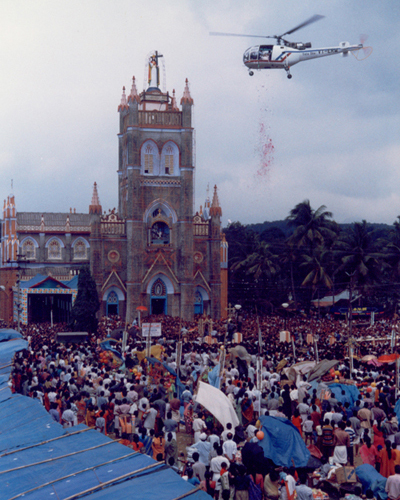
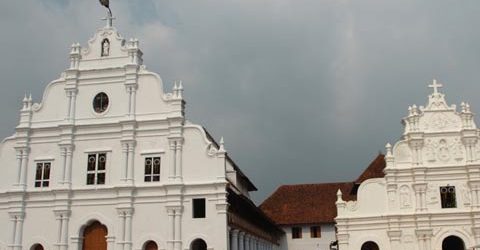
In some areas the ties with Hindus and Nasranis were reciprocal each taking part and having roles at both Hindu and Christian festivals. In some areas Christian Churches and Hindu temples were constructed on virtually adjoining sites. In due course some of the Christian churches resembled Hindu temples from outside and Jewish Synogue from inside.
Their liturgy was in Syriac, their prelates looked to Mesopotamia for conformation, their clergy ( kattanars and metrans) presided over their rituals such us celebration of feast days and Eucharist.
3.Traditions and rituals among the Saint Thomas Christians of Kerala
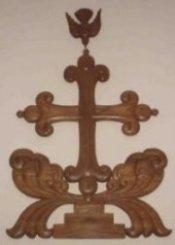
1. The symbol of the Nasranis is the Persian cross, also called as Mar Thoma Sleeba in Malayalam.It is not very clear from which century onward this cross was in use. According to J Raulin, up to 16th century, the Saint Thomas Christians did not use any other image except the Saint Thomas Cross in their Churches. (( Raulin F – Historia Ecclesiac Malabaricae ))
2. Covering their heads while in worship. This is tradition among the Jewish descendents of Abrahamic religion. This is observed by the entire Nasrani people until this day.
3. Their ritual services (liturgy) was and still is called the Qurbana (also spelled Kurbana), which is derived from the Hebrew Korban (קרבן), meaning “Sacrifice”.
4. The Nasrani Qurbana used to be sung in the Suryani (Syriac) language. Until 1970s most of the churches followed Syriac liturgy.
5. The architecture of the early church reflected a blend of Jewish and Kerala styles.
6. Pesaha, the ritual supper which is the narration of the Paschal event is celebrated amongst Saint Thomas Christians. The observance of Pesaha at home is an unbroken tradition which only the Saint Thomas Christians has in the whole Christian world. It is the real Paschal catechesis in the families. ((Qurbana- The Eucharistic Celebration of the Chaldeo- Indian Church Dr. Varghese Pathikulangara ))
7. The Churches has a separate seating arrangement for men and women.
8. Many of the tunes of the Syrian- Christian worship in Kerala are remnants of ancient Syriac tunes of antiquity.
9. The “Holy of Holies” is divided by a red curtain for most of the time and is opened during the central part of the Qurbana.
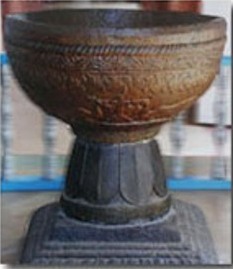
10. The Baptism is still called by the Hebrew-syriacterm Mamodisa and follows many of the ancient rituals of the ceremony. In 20th century it is referred to in Malayalam as njana Snanam (Bath of Wisdom).
11. Most of the Nasrani’s even today use Biblical names like Jews. Biblical names along with Greek, Armenian, Syrian names are the popular names in Nasrani Community through out existence. They prefix and suffix Kerala names to these traditional names. The naming convention is also seen among the Sephardic Jews, whose customs may have been imbibed by the Syrian Christians in Kerala.
12. Immediately after a Child was born, a priest or male relative would shout in the child’s ear ‘ Maron Yesu Mishiha’ ( Jesus Christ is Lord ) and the child would be fed with three drops of honey in which a little gold had been rubbed.
13. Another surviving tradition is the use of “Muthukoda” (ornamental umbrella) for church celebrations, marriages and other festivals. This can be traced back to a Syrian Christian Aristocrat Mar Sapir Iso who lived in the ninth century. Even today traditional drums and Arch decorations and ornamental umbrella are part of the church celebrations. Because of the harmonically co existence of religions in Kerala this became quite popular with other communities also.
14. Saint Thomas Christians were given the right to access Hindu temples and sacred territory. Some prominent Nasranis were patron and sponsors at Hindu temple festivals. They also acted as pollution neutralizers.
15. Nasranis and Hindus maintained their individuality in Kerala aware of and accepting similarities and differences. Boundaries between Christians and Hindus are blurred in some cultural sphere such us house building, astrology, birth and marriage ( use of sandalwood paste, milk, rice and areca nut)
16. The inner life of Nasranis is significantly ordered by liturgical obligations and by its specifically Christian ethics. Death rituals express Christian canonical themes very distantly especially in the ideas concerning life after death and the anticipation of final judgment.
17. Christians were also given some honorific titles. “Taragan” is a word derived from the word for tariff. “Panikkar” denotes proficiency in military training. The most common name of the Christians were Nasrani Mappila’s.
18. The Church of Saint Thomas Christians accepted the East Syriac liturgy from an early period and along with the liturgy, the systems of ecclesial government, such as Metropolitan, Archdeacon and Yogams had their organic development in relation with East Syriac Churches.
Books to read further :
Kerala Kristiya Sahityam by Dr. P J Thomas
The Anthropology of the Syrian Chrisitans by Ananta Krishna Ayyar
The Indian Christians of Saint Thomas by Leslie Brown
_____________________________________________________________________________
Author can be reached on admin at nasrani dot net
Last Update – 05/09/2009. I have re arranged this article and statements about Sabbath etc were removed as sources were not find authentic.
_____________________________________________________________________________
Even though am commenting anonymously.
I appreciate your works.Its very commendable and you comes out as expert in what ever you do.Who ever you are am sure you are quite successfull in your filed.It would be great if you reveal your identity.We need more people like you among us who are ready to do selfless service.
laity is always with tradition and heritage, though they are not heard by latinised priests.
I was quite dumb founded when I read that before the Portuguse invasion the nasranis were wont of keeping the “The ritual service…..on Saturdays in the tradition of the Jewish Sabbath.”! What a surprise! I was researching on the sabbatarians throughout the previous centuries (especially in Europe)and it never occurred to me that they could be found here in our dear Kerala.
After the destruction of the Jerusalem temple, as per the history, the jewish christians known as nazaraens escaped to a town called Pella beyond the Jordan river. They stayed there for long and got confused with the ebionites who were part of the Essenes. While the Essenes never accepted Paul and the gentiles the Nazareans accepted both though they held on to the Bibical commandments unlike the Hellenists.
So viewed in this way, and reading your Judeo Christian origin of Nazranis in Kerala we can presume that some of these nazaraens, under more Roman persecution migrated to Kerala through the trade routs.
Christians and Nasrani / Kristyone and Nasraye
“So Barnabas went to Tarsus to look for Saul; and when he had found him, he brought him to Antioch. For a whole year they met with the church, and taught a large company of people; and in Antioch the disciples were ” – Acts 11:25-26
When Jerusalem was sacked by the Romans under Titus in 70AD, many Christians found themselves in Antioch. As the above citation from Acts states, they were first called Christians in Antioch. This name became popular in the Greek speaking world, and later the West. The term for Christians in the Syrian East however, was based on the Syriac word for Nazareth, the town where Jesus grew up.
The Nasraye, as they came to be known, spread out through all the East. From his seat in Mesopotamia, St. Shemoun bar Saba’e, was known as the leader of the Nasraye. Eusebius of Caeserea is also known to have spoken of the Christians of the Syrian East as the Nasraye. Other documents from Persia also recall the name Nasraye used instead of “Christian.”
Among the Arabs, we find the term Nasrani being employed; in fact, when the Qur’an refers to Christians, it calls them by the
name Nasara, not Mesihiyeen. This is also the case among the Kerala Christians who are likewise called Nasrani. Moreover, in other lands such as Malaysia and Indonesia, the local word for Chrsitians is Nasrani, most probably brought to these communities by Muslims who interacted with Christians of the Syrian East.
Hello Everybody
Enjoy the following links,
Liturgy of Saint Thomas Christians
Traditional Songs of Saint Thomas Christians @ Saint Thomas Cross
Maarggam Kali of Christians of South India- Saint Thomas Christians
Syro Malabar Church, SMC, Syriac Qurbana, Chants in East Syriac
Malankara Orthodox Syrian Church ( IOC) Syriac Qurbana, Chants in West Syriac
AND FINALLY FROM HERE WE GO TO NUMBER GAME !!
Indian Incultration of Christianity ?- Some pictures
THE DISTORTION OF CHRISTIANITY IN INDIA BY THE CO CALLED INCULTURATION.
THE NEW ERA OF CHRISTIANITY IN INDIA AFTER THE END OF COLONIAL PATRONAGE !!!!
John Mathew claims that the word ‘Nasrani’ is an Arab identification of the Malabar followers of Yeshu. I and many the world over disagree and it is not even an issue other than in this ‘NSC forum by John and perhaps by Admin’. Their attitude now seems to say ‘keep the Malabar Nasrani away from their Jewish heritage… at any cost..’.
The word ‘Nazaerenes is the same as Nasranis’. The English is ‘Nazerene and the Malabari is ‘Nasrani’, just the same way ‘Christian’ is in English and ‘Christiyani’ is in Malayalam.
Now read on, what I have sourced from Jerome and Epiphanius.
Quotations begin:
The first believers in Yeshua were a Jewish sect known as “Nazarenes” or in Hebrew “Netzarim” (Acts 24:5). The “church father” Jerome (4th Cent.) described these Nazarenes as those “…who accept Messiah in such a way that they do not cease to observe the old Law.” (Jerome; On. Is. 8:14).
Elsewhere he writes:
Today there still exists among the Jews in all the synagogues of the East a heresy which is called that of the Minæans,and which is still condemned by the Pharisees; [its followers] are ordinarily called ‘Nazarenes’; they believe that Messiah, the son of God, was born of the Virgin Miriam, and they hold him to be the one who suffered under Pontius Pilate and ascended to heaven, and in whom we also believe.”
(Jerome; Letter 75 Jerome to Augustine)
The fourth century “church father” Epiphanius gives a more detailed description:
But these sectarians… did not call themselves Christians–but “Nazarenes,” … However they are simply complete Jews. They use not only the New Testament but the Old Testament as well, as the Jews do… They have no different ideas, but confess everything exactly as the Law proclaims it and in the Jewish fashion– except for their belief in Messiah, if you please! For they acknowledge both the resurrection of the dead and the divine creation of all things, and declare that G-d is one, and that his son is Yeshua the Messiah. They are trained to a nicety in Hebrew. For among them the entire Law, the Prophets, and the… Writings… are read in Hebrew, as they surely are by the Jews. They are different from the Jews, and different from Christians, only in the following. They disagree with Jews because they have come to faith in Messiah; but since they are still fettered by the Law–circumcision, the Sabbath, and the rest– they are not in accord with Christians…. they are nothing but Jews…. They have the Goodnews according to Matthew in its entirety in Hebrew. For it is clear that they still preserve this, in the Hebrew alphabet, as it was originally written. (Epiphanius; Panarion 29)
Quotation over:
Above, you may kindly note the word ‘Minaeans’ appearing. As you know, the Minaeans are Yemenites. There is research material which connects the Black Jews of Malabar with the Yemenite Jews. Geographically, Yemen is far more closer to Malabar than Alexandria/Persia/Assyria.Let the reader come to his own inference/s.
Dear All,
The term “Nasrani” as such is indeed Arabic in *lingual* origin. But to which people (All Christians with semitic links?) does this term refer to is to be seen.
Below is a link to the persian christians official website showing a printed article of 1968 on certain Christians of Iran. It mentions about a group of Christians in Northern Iran and Southmost Russia (towards Caucasia) in the Caucasian mountain areas who ARE STILL BEEN CALLED AS “NASARENES”. These christians are called Nazarenes/Nasarenes even by the Iranian Govt. and other Iranian people (and other non-nasarene christians), and they are early converts since times of the apostles, whose origins are disputed.
http://www.farsinet.com/iranbibl/nazarenes.html
It is the Quran that first mentions the term “Nasrani” for followers of Jesus, that the writers encountered around Arabia or middle-east. Also for additional information, there is another term “Masihi” in the Quran for followers of Jesus, too. So both the term Nasrani and Masihi are used. Refering to the same people (ethnically) ? Cant say. Read more.
Masihi (or Messianic) stands for those *Gentile/Pagan* believers who believed in the Jewish Messiah (Mishiha or Masiha). Yes, this is the original meaning in Arabic/Quran literature held by the scholars. Btw, Messianic is not related to what we hear of Messianic Jews today. Then…. what is Nasrani ? One interpretation goes like this…. “Nasrani”…. from “Nasra” (arabic for Nazareth). Meaning those (who exactly?) who followed Jesus of Nazareth, the Nazarene. There is no final interpretation.
So why two different terms have been used to denote the same community of followers ? If indeed they are same and homogenous ? This boggles even Quran scholars. I dont know what they have debated elaborately, though.
Next. Nazarene is the english term for the Hebrew ‘Netzarim’ denoting the early Jewish followers of the Messiah. Nazarene is also pronounced Nasarene… ‘z’ replaced by ‘s’ as in semitic languages there is no ‘z’ sound. Also there is no ‘z’ sounds (pronounced ‘zed’) in Malayalam. Instead it becomes ‘sed’. Similarly all words in english containing ‘z’ carry the sound of ‘s’ in Semitic languages and in Kerala. Thats for lingual comparison.
There is actually the term “Nasrani” existing in Hebrew (possible Aramaic influence?) literature, besides Arabic, also used besides the actual hebrew term ‘Netzarim’ for Nazarenes. And in Hebrew, Jewish Hebrew speakers understand “Nasrani” to be same as “Nazarene” or “Netzarim”, meaning for early Christians having Jewish origins. To be specific, in Hebrew usage, ‘nasrani’ means a person who was born into a Jewish family but decided that he/she does not want to be Jewish anymore. Meaning, the person left his/her family and religion for whatever reason. Meaning Jewish apostates. This information I learnt, is from an actual Hebrew-speaking Jew. I need to back it up as and when I find more solid reference. But I cant doubt a Hebrew-speaker for now.
Yeah, and there is a place too called “Ras-Nasrani” in the Sinai Peninsula. The name derived has some historicity attached to it. There is a species of *fish* that the locals there call as “Nasrani”. This is believed to be from the fish symbol the early Jewish Christians had for their community. Fish is one of the symbols existing today in Christianity. U may google it, info is available online. This info is insufficient for any conclusion or linking.
So over the time, it appears, that the term Nasrani *could have* referred to actual early Jewish Christian Nazarenes or communities or churches across the middle-east containing them. And in due course of time the term came to be generalized or became an umbrella term to include even Gentile converts as Islamic/Arabic influence spread across the middle-east. As is the case we see in Malabar Nasranis. So that means Nasrani *could linguistically mean*….. “Jewish Christian”…. but the fact is, as of today, all Nasranis are NOT of Jewish origins. Generalization of the term, I would call, down the timeline.
George:
I’m impressed that you found some sources. Good for you.
Are you aware that I presented these same things a few weeks ago? See post 17455 for my reply.
George:
Please see Post- 17455.
I would say one as a syrian christian would think more to an indian. we are actually going to dicriminated even inside indian by our own fellow other communities except muslims i think. because muslims also have the natives and immigrant muslims mixed and having their community
In south india who are the ones getting the seats in school and colleges goverment posts goverment school teachers, airport costoms all are low caste or hindus in the first row which i think south india stands for.
If we think indian and go to a goverment office for any reason and i think nobody will accept you as anything indians instead u have to pay something to get things done. i think they will see as nasranis sort of mock sense.
if people go for tv anchor or movies hindus are in the front line or in cricket how many leading syrian christian who think as true indian lead on those feild. only now days we see some changes.
In north the aryan world and a syrian chrisitan got there as an indian i dont know how well we accepted there either. its true that we kinda feel indian becaue of indian local influences on us.
our identitiy is quiet well as marthomite orthodox jacobite so on christians in kerala and we are in those community. and we have got influenced by many middleeasterm immigrants , converted jews/ isrealites mixed with some indians as we living as kerala chrisitans for centuries and some hindus and namboothris melt on us on those later centuries
Some times i think we cannot all the way to kill our identity and devoted ourselves as indians . even aryan migrated as indians have a special recogniztion because they are part of the india history. whoever that go through these issiues will come to know the value of our identity and should preserve our history and our identity as syrian chrisitans which is a Judeo chrisitnaity
Dear John,
I read the posts. I think you know in your heart too that the Nasrani’s main root is Jewish but you are claiming to search/look for proofs that the Nasrani is Jewish.
Actually, you are not going to see the proofs, even if they are thrush in front of you written in font size ’30’, because you have realized that public acknowledgement of your heritage belief will remove you from your ‘comfort zone’. Your Jacobite doctrines does not give any accomodation for a Jewish heritage. You are unable to be a “Jewish Nasrani’ and still be a Jacobite. That is your problem and also my problem for I am also my brother’s keeper.
By the way, do not belittle Prof. Nathan Katz. He is not prof. of Jewish History, but Prof. Of Religious Studies at Florida Internation University…. Miami’ (http://www.indojudaic.com/). Give him some allowance for knowing what he is talking.
Further, your dismissal of Dr. Asahel Grant is really biased and working against you. YOu are not even giving credit to him for doing the extra extensive research on the Persian Nasranis with the blood of his dead wife who died because of the research.. He led an expedition sponsered by a leading Church of the USA and had the backing of the British Govt. Further his book has survived for 200 years and is even now in print.
Dear Jackson,
The ‘Nasrani’ has certainly included gentiles not of Jewish origin, for instance some Namboothiries, perhaps some Nairs, some Chettians, Harijans etc… All are welcome into the Nasrani family. But that is not the point.
The point is, should the Nasrani follow ‘Gentile Christianity’ by acknowledging ‘Sunday’ as the Shabbath or follow the original Jewish Nasrani beliefs of ‘Friday Sunset to Saturday Sunset’ Shabbath.
The day of the Shabbath is only one of the issues. There are 100s of other related issues.
As someone wisely remarked a few days ago in this forum ‘.. knowledge is to be put to use, not just read..’
George Mathew, I have earlier asked you some questions hoping that you would answer. You conveniently opted out, and now that you again posted the same “junk” you have repeatedly posted here , which was repeatedly examined also.
Are you such an ignorant fool who don’t have any understanding about Christianity in India ?
I have so far tried to deal with you patiently, but let me tell you that you don’t deserve any such consideration.
Did in any of the testimonies of early church fathers about the Apostolate mention about Nazoraeans in India ? Did any of the early east Syrian accounts which have reference to India mention Nazoraeans ? Did Cosmas Indicopleuste mention about Nazoraeans in Malabar ?
Did any of the letters Patriarch Ishoyabb II mention Nazoraeans ? Did any of the Copper plate grants or any records mention Nazoraeans in Kerala ?
Are there any records which mentions Nazoraeans in Kerala in first millennium ? When did you see the reference of Nasrani in Kerala started ? Where ? How it has started to represent the entire Saint Thomas Christians ? Are their any reference which mentions that the term was used in Malabar before the Arabs and Turks came ?
You quoted Saint Jerome and Epiphanius. Saint Jerome even speaks of Brahmins in India. Did he give a testimony about Nazoraeans in India? .Further more I can quote many quotations about Nazranis from Goranron, Eusebius etc, how the name derived and what has been mentioned in different studies etc. The paper John Mathew provided deals with this in detail.
To understand how it is related to Saint Thomas Christians, can you give me any early account about Nazoraeans in India ? What are the appellations used to represent Christians of Saint Thomas ?
Some time back I have mentioned about the only “ Jewish Christianity” which existed in India. That was followed by those newly converted Jews who took refuge in India in Seventeenth century. These Jews were converted to Christianity in Spain and Portugal. They went to India and other Portuguese colonies since they were looked upon with suspicion and were given the treatment of second class citizen in Portugal. They were said to be forcefully converted and have kept some Jewish practices.
Perhaps you can try to find them and ask them the last question about Sabbath and the other hundred issues you harp on.
.
Oh George, what a small mind you possess.
Everything is a conspiracy theory with you. George, if you talk to most Eastern Catholics or Oriental Orthodox people, you’ll find a deep respect for Judaism. There is nothing in my religion that conspires against me; I think I’ve written about the Hussoyo genre of prayers and how they come from the Jewish rites.
All of that is very good and well. But the time of extremism that you profess — blind fanaticism born of ignorance — is not something I’m have any sympathy for. You follow pseudo-scholars making quick and fast claims — this is not my way. I’m very conservative, George. Deeply conservative. I don’t trust Katz because I’ve read his work, and much of it plays fast and loose with the truth. Moreover, he’s ignorant of Eastern Christianity — this is a severe impediment to anyone trying to make statements about the Nasrani community of Kerala since our longest dated documented histories show East Syriac Christianity.
A. Grant was responsible for more than just his wife’s death — thousands of Nestorians died due to his blundering foolishness. His work, and that of the other meddling Protestant missionaries, contributed directly to the death and genocide perpetrated on the Nestorians by the Kurds. The man was a jack ass, a fool. You can read “Nestorians and their Rituals” for a detailed account — a more scholarly one, though imperfect — on the Nestorians and also on A. Grant. At least read it George. If anything it will expand your mind. You can reject it if you wish.
And another thing. Go and purchase the Artscroll Siddur or something so you at least sound Jewish. Right now, your patched up pseudo-Jewish BS really makes you look so amateur. I’m positive no Orthodox Jew worth his salt would come close to you in any kind of meaningful way — you could claim Kohanim ancestry all you want, they won’t let you in their temple sanctuary. Maybe you can convince your pseudo-Jew Messianics, but not a real bonafide Jew.
Dear George Mathew,
Comment by you: “The point is, should the Nasrani follow ‘Gentile Christianity’ by acknowledging ‘Sunday’ as the Shabbath or follow the original Jewish Nasrani beliefs of ‘Friday Sunset to Saturday Sunset’ Shabbath.”
THIS IS NOT A POINT AT ALL !! The concept of “Sabbath” as a day of rest or ceasation from labour is a 100% Hebraic/Judaic concept. It does not pour over to Christianity and as such there is no such “Christian Sabbath”. It was “invented” later for theory. So Sunday is not at all the “Sabbath” day. This is not what is meant by Sabbath. Some fools try to say so just to deride Judaism and establish Christianity as the other established religion, wiping off Judaism. This they justify by stating Jesus’s resurrection and thus saying Sunday replaced Saturday as the Sabbath. No, No, No. Saturday is still the Sabbath (for those concerned).
Sunday is the “Lord’s Day” when He rose from the dead and thus this day is when we commemorate the Eucharistic mysteries. This is attested and held true in the Acts of the Apostles. The early Christians (as seen in the NT) clearly marked “Saturday as Sabbath” and *Sunday as the Lord’s Day*, as distinct and separate.
Acts 20:7 “And upon the first day of the week, when the disciples came together to break bread, Paul preached unto them, ready to depart on the morrow; and continued his speech until midnight.”
In the above the Eucharistic gathering is on the ‘first day of the week’ which cannot be Saturday then, but Sunday. As the disciples were Jewish and still continued with Saturday Sabbath (seventh day)… thus Sunday (next day) is the first day and the day for Eucharistic gathering. Here clearly we see Sunday is not the day the disciples were “resting” or “not preaching” but doing otherwise. So for them and for Christianity factually, Sunday is NOT the Sabbath. Later century modifications and edicts were released with political and anti-Judaic motives to establish Christianity’s *empirical superiority*. I am not bothered with this, nor do I buy later century “invented” definitions.
There are many such verses in the NT (esp. Acts) which describe Saturday as the Sabbath and not Sunday. Sunday is stated in the NT to be the Lord’s Day for ‘breaking of the bread’ (Qurbana).
So we are not doing anything wrong, except mixing up terms and terminologies and sounding like *pseudo-victims* for something which does not exist.
So my point, Sunday is NOT the Sabbath. Saturday still stands as Sabbath (for Jews and for Christians who already have practices in their families since ages passed down). Even many Jews do not observe all of their practices, forget the rest. Those who claim “Sunday is Sabbath” are simply historically and religiously wrong and confused with the basic concept of “Sabbath” for that matter. Nothing has replaced anything. Moreover, there are testimonies by early Church Fathers (3rd and 4th cent. AD) that both Saturday and Sunday had it’s own separate significance for all Christians, esp. Eastern Christianity then (except in Rome and Alexandria). Just google it, u will find the references and sources.
So, hopefully this issue is resolved. Actually, it wasnt an issue at all. For almost all Christians Sunday as Sabbath means lazying at home, having a feast and gulping down gallons of alcohol. Pinne palliyil pogan samayam ondengil pogum, vaya noki thirichi varam and get back to feasting….thats it. This is not Sabbath !! This generation knows nothing to make claims and assertions.
Now coming to practicality. Did your family ever have or has or have you even heard of any “Saturday traditions” from your family oral traditions or any practices in your family since ages that makes Saturday special ? Or forget all the practices for now, did ur family even have an oral tradition claiming Jewish origins before u took a DNA test ? If yes, u can advocate. If not, u stand pointless. Something done recently by you is not *heritage*, though u can start all over again from other sources. Still its not the original source, mind you, its second-hand.
My family (I’m sure many others too will have) does have some of such and other Judaic practices, passed down from elders. Yes. Till today, and u know them. That is exactly what is ancestral heritage we talk about. Not what is something newly added-on or must be added in future with changing times and up-coming archaelogical and scientific evidences. Anyway, I would like you to answer to my questions and comment on the “Sabbath” aspect also. And that Saturday is the Sabbath is what I first learnt from my grandparents and not online or from books or evidences. Now ur turn, and hope you take my criticism in the right spirit. You know what I’m speaking. Thanks.
Jackson
As elders and ministers of the Word through music and teaching Scripture for several decades, we wholeheartedly agree with you that Sunday is not the Sabbath. However, we also would challenge you to look harder and deeper — seek out why David and Jonathan were watchers/keepers of the Sabbath for even up to 3 days, because they knew they must watch for the lunar, (new moon) the beginning of the new month, and also Sabbath.
We have kept lunar Sabbath now for the past nearly ten years, after making the mistake of listening to the many teachers/pastors/evangelists, etc. tell us many things that were not entirely correct because they, themselves, misunderstood and followed the traditions of men over and above what the Word of the GOD of Israel, Yahweh, really said through his servants. Everything made so much sense when we were ready to take a look at the Scriptures from a Hebraic perspective more, and receive enlightenment from those who really did understand and teach the full counsel of YHWH. Yes, it even mentions the days that the Sabbath should be kept on eve. before the 8th (erev Shabbat or the 7th of each new month – according to lunar), then also on the 15th, 22nd, 29th. Erev Shabbat starts at sundown the evening before so often when studying about this people will say the 7th, 14th, 21, and 28 when they are really meaning the evening the day before the true Shabbat (1st, 8th, 15th, 22nd 29th). The bible confirms this, and even the Talmud tells at least a couple of times how they always sent watchers to see when the new moon was visible so they knew when the new month/new sabbath really would be! Yahshua was never in disagreement over the Sabbath because they were keeping the Sabbath according to the New Moon at the time he was living. This is well researched and found to be true by Josephus and many other great historians and theologians. Of course this was before the Hellenists came in and took over, forcing their religion on the people so that the true disciples of Yahshua fled into hiding in caves (essenes, nazarenes). It has been quite a journey, and now that we are 70 and 73, after searching from the days of our childhood when we were both raised Lutherans sought to know and love the Truth more than the lie. May everyone seek diligently to find what the Scriptures really say and teach about the Sabbath, now instead of later or never… Blessings and Shalom.
Dear Admin,
You have a point, in that I had opted ‘out’ but I came back. For that I apologise. I guess, I will also have to say, I won’t again come back.
But I will try to answer your question. In the book ‘The Ten Lost Tribes’, you will find very clear reference to ‘CoE’ members being called ‘Nazerenes’. In fact, the Patriach’s other title is ‘Head of all the Nazerenes’ or something very close to it.
In all probability, you will note that official writings of other churches with reference to the CoE have certainly avoided the use of the word ‘Nazerenes’. The word ‘Nazerene’ is certainly something which non Nazerene churches are not comfortable with at all. YOu will even notice Buchanan using the word ‘Nazerene’ only once for the Syrian Christians, just once in his whole book. Other western writers of the 1800s and 1900s have not even once mentioned the word ‘Nazerene’ when they write a book on the ‘Syrian Christians’ of Malabar. They are all allergic to it or are threatened by it. It is like calling ‘Namboothiries’ as ‘Thirumenis’ by a Muslim writer.
White racist people call coloured or brown/black men as ‘Hey boy!’, which is done to avoid giving these brownies or blackies their due ‘respect’. The entire Bible that you hold in your hands today, do not contain even one single reference to the word ‘Esseenes’, yet this single word ‘Esseene’ is of utmost and extreme importance in the ‘Good News’. Why was this word not anywhere in the Bible? It was because it is a very very politically unsound word to have on ‘record’. The thought is ‘… do not mention the word ‘Esseene’ and the people would not start asking questions about them…’. Simple logic.
So is the word ‘Nasrani’ in our context. The Western and the Arab writers intentionally underplay/noplay the word ‘Nasrani’ just for the same reason why you are called ‘Hey Boy’ by racist whites or the word ‘Esseene’ is abscent in the Bible.
And by the way, I do not even for an istant believe that our forefather’s would have adopted the word ‘Nasrani’ for calling themselves based upon what the Moors or the Muslims call them. The gap between the Muslim and the Nasrani has always been very wide (and unbridgeable) and it is unlogic to presume that ‘Oomen Yohanan’ callls himself ‘Nasrani’ because the muslim calls him ‘Nasrani’.
If you do not ask me anymore questions or have me comment on anything more, I am out of this forum. You own this forum and I guess it is impolite if I strike at the heart of things.
Dear Jackson,
Whether the ‘Shabbath’ is or not to be spilled over to Christianity, please read Acts 13:42-44,
‘…42 So when the Jews went out of the synagogue,[a] the Gentiles begged that these words might be preached to them the next Sabbath. 43 Now when the congregation had broken up, many of the Jews and devout proselytes followed Paul and Barnabas, who, speaking to them, persuaded them to continue in the grace of God.
44 On the next Sabbath almost the whole city came together to hear the word of God
Dear Jackson , I know that many jew in america are not care about any of those jewish practice. Many jewish people have just their last name as jewish but some may not care about it. when my wife studying nursing exam and about jewish practice that when a jewish patient in hospital a nurse should aware of are written. So even in christianity i dont think sabbath is applicable but i think it s important nasranis should stay away from eathing pork but many are eating it
Jackson:
When you have a moment, could you provide a list of the specifically Jewish practices that your family has a tradition of following? If I recall correctly, you are from the North, hence I’m very interested in learning more about your family’s traditions.
As you know, many people claim they follow “Jewish” practices, but their claims are ambiguous at best, and often weak. Since you have excellent knowledge of Christianity, however, I’d trust your results a great deal more than the neo-quasi-Jewish claimants we often see on this site (for whom stretching of truth is no problem…).
Regarding the use of Nasrani term outside Kerala, I came across below from “Narrative of a tour through Armenia, Kurdistan, Persia and Mesopotamia” By Horatio Southgate
“One word more of terminology, and we will resume our course. Nasrani is an Arabic term, applied, when used in Mesopotamia, to Christians generally, and meaning apparently the same with Nazarene, or followers of the Nazarone. In Persia, on the contrary, I had been accustomed to hear it constantly as the distinctive title of the Nestorians. “
It is painful to know that the brainwashed fools (=educated people) of present generation requires books and articles of ‘scholars’ who know nothing other than organising ‘reported’ events that fits their logic and their wish. They forget that we can trust our parents and who in turn trusted their parents and that is what an oral tradition and belief is. Older generation never lied about God (commandment 2) as they really believed in God and were god fearing. My advise to many of you (especially to John and Admin, who have never been in Kerala much and who might turned into religion only because their non nasrani (corrupted) parents want their children to be ‘good and studious’) that you who are abroad may have a lot of time to think and preach and hence make others followers, but for gods sake, please please donot corrupt the tradition and so the facts by your selfish quotes from book whom you donot know nor they didnot know nasrani.
Please let not the real naazrani to be felt deceived by some vested intrested people comfortable living in the western countries.
Are there any “Nasrani=Jew” adherents out there who are not functionally retarded like “Achayan” and George Mathew?
“Achayan” you don’t have either (1) facts nor (2) tradition on your side. Only fantasies, possibly created to compensate for your own inferiority complexes.
Point me to just *one* fact/tradition that indicates it is I that is “corrupt”.
My parents are Nasranis, and I can visit the graves of my Nasrani forefathers for quite a few generations. You redefining Nasrani doesn’t change that.
Enough insults though — since your own existence serves as it’s own insult. Point me to one tradition of the Nasranis that conclusively proves we were Jews.
Are you circumsized, by the way? Probably not — damned moron coward that you likely are. And hypocrite too — seeing as how you’re also from abroad.
Dear all,
Little knowledge is harmful to everyone who are responding to this site. One should continuously read the whole bible to know the exact meaning which are hidden in it. It is crystal clear that the “Nasranies” are real Jews who followed “Christ – The Saviour”. So why these arguments. To know about the nasranies, one should read a lot and should check their Blood samples whether is cohen or not. So I request all of you to read the “Torah – Old testament” and the “New Testament” to know more. Apostle Paul said that every day is good and there is no special day for the Lord. Circumcized or not circumcized is not the real issue. The Nasraene – The Yeshua said “I am not to change the law, but to fulfill it”.
Shalom!
Mathew George
Mathew:
This notion of the Bible having hidden meanings is not Christian nor is it Jewish — it is Gnostic. Is that what you are?
This matter is not as easy as you seem to imply. Have you even read the Bible? Such definitive information as who the “Nasranis” are is *not* in there. Scholars have been addressing these topics for a while…
Also, how does a DNA test impart knowledge? What is this — are you trying to supplement your stupidity with a DNA test?
And why is Cohen ancestry so important? Jesus was of the *Davidic* line — *not* a Cohen. Or is Levi the only tribe worth belonging to in your new worldview? Benjamin is no good for you? Judah? The other nine? You are judging the Jews — telling them what a true Jew is.
Does the New Testement even talk about the tribal affiliations of the Apostles? How about the Prophets? Were they all Levi? Again, you are talking about reading the Bible — apart from the bits and pieces your Pastor (since you’re obviously some kind of Protestant idiot) may have given you, have you even read the Bible?
You seem to be an ignorant coward. If you truly believed in Judaism — the Law — then you’d abide by it. Go and get circumcised, and then let’s talk about you being Jew.
Mathew,
‘Checking’ “Blood samples” and only carrying a “Cohen” gene sequence one can detect a Jew huh ? Sounds like some testing for disease or diabetes…. hahaha. Can u define and explain for all the “half-knowledged” people on this forum how can “blood sample” checking be done ? And yeah what/who is a “Cohen”? And also, how do these “blood samples” detect the rest of the Jewish people who are not “Cohens” (Also read what John Mathew has asked) ?
I mean what about the remaining 94-95% of the world Jewry that doesnt possess a Cohen gene marker ? They are not Jews huh ? Interesting ‘revelations’. And those tested positive for a “Cohen gene” alone are Jews ! That means just 4-5% of the existing Jews today are actually Jews. Rest are idiots eh ?
The best I have read till today and that too justified using the Bible ! Lovely. “Old Testament” is called “Torah” huh ? This is what you learnt “by reading a lot” ? What did u read this in ? Manorama or TOI ? Nah….
The Jews do not have anything called “Old” Testament. They will kick you if you go saying this to them… “Old”. And what you are refering to as the “Old” Testament is called “TANAKH” and not “Torah”. The Torah (meaning the Law or Teachings) are the First Five Books of the scriptures (both Jewish and Christian), the Pentateuch. Genesis (Bere’Shith), Exodus (Shemoth), Leviticus (Vayikra), Numbers (Bamidbar) and Deuteronomy (Devarim), these FIVE BOOKS are called “THE TORAH”.
Then… not all the Books that are present in the Complete Bible (Catholic/Orthodox only) as “Old Testament” are found in the “Tanakh”. And the Tanakh is neither New nor Old. It is one as whole (not split as the Christian Bible). The Tanakh “consists” of the Torah (Law), Nevi’im (Prophets) and Ketuvim (Writings). More details…. “read a lot” and find out as u rightly said !
It is “crystal clear” that Nasranis “are real Jews” huh ? The actual Jews are again morons, isnt it ? Buy a new “crystal”, asap. It doesnt look “clear”. People like you are serious hurdles between Judaism and Christianity, who know neither, except throw crap around. Specially when u claim ur “full-knowledged”, blaspheming using the scriptures.
Well, I clearly see you “claiming Jewishness” and you dont even know the fundamentals of Judaism. What is the Torah, what is Tanakh, who is a Cohen and the other Jews ? And u call the Tanakh (or Torah as u know it to be) “Old” too. Great ! That itself shows how “Jewish” u are and where your “knowledge sources” stem from. The Jews asap need a Rabbi like you probably, so that they become “real” Jews (as per your standards).
“Little knowledge is harmful to everyone who are responding to this site.” — ur comment
Now say who judges, who has so-called “little-knowledge” ? Now I have another saying for you up my sleeves…. “Half Knowledge is dangerous”. You fit well.
Shalom, “Mr. Pseudo-Jew” !
Admin:
You wrote: “Some time back I have mentioned about the only “ Jewish Christianity” which existed in India. That was followed by those newly converted Jews who took refuge in India in Seventeenth century. These Jews were converted to Christianity in Spain and Portugal. They went to India and other Portuguese colonies since they were looked upon with suspicion and were given the treatment of second class citizen in Portugal. They were said to be forcefully converted and have kept some Jewish practices.”
This is interesting …
Does anyone have any knowledge on the first documented account of Pesaha in India? Did the East Syriac fathers observe it? Did the Portuguese observe it? The Dutch or British?
I’m very curious about this since Pesaha, after all, is the only custom the Nasranis possess that might *possibly* be Jewish in origin.
My Dear Friends,
Special thanks to John Matthew, Matthew George, Achayan and others.
The discussion is very interesting.
Let me inform you one thing.
I know some old christian families settled currently in Northern Kerala who think that their ancestors are from Jerusalem.
It seems they do not want to show it as a matter of Prestige, unlike others.
(They are not in Kottayam Diocece and not from the group of Thomas The Cannanite.)
For them Jerusalem is a a sad memory especially when we speak about the city of Jerusalem.
They use a golden star in their home during prayers and keep it in their study tables and dining rooms.
For them it is a symbol of God.
Somewhere in Psalms David calls God as his Shield.
They call this star ”magandhaavid” which is equivalent to Shield of David.
They do not like (it seems) to attend Latin Mass and prefer Syro Malabar Qurbana.
They say that some Jerusalem ‘touches’ (only a small percent) are in this Qurbana.
According to them currently many Roman Concepts are present in this Qurbana.
There is a mysterious story in these families related to some Old Goan Bishops.
It seems their fathers possessed something either in material form or in brain which challenged those Bishops.
Because of some hidden reasons their fathers were shifting places along Kerala.
I do not know it fully, anyway it is not relevent here.
Moreover they decorate their home with 7 armed lantern which implies the burning bush that was seen by Moses.
I have not seen Jewish homes, but my friend told me that he has seen similar lanterns in Jewish homes.
For these christians, Pesaha is the most important festival.
They will not celebrate Onam or any other related festivals unlike other Christians. For them Onam is a Hindu Festival.
Their children should select the names only from their family tree.
It has several complicated rules.
As seen in Gospel of St Matthew, remember the naming of St.John. They were not supposed to call him John because of the same rules.
The girls are not allowed to use any type of spots on their forehead.
Even though they are catholic they do not celebrate in front of human saints.
But they respect them.
For them there is only one God, the God of Israel and Jesus Christ his messenger and Son.
Creating any images either of saints or of any bishops or humans are prohibited by ‘unwritten laws’.
Pictures used to decorate rooms are mainly paintings from Bible events, mainly from Old Testament.
Thier prayers are done by facing the direction of Jerusalem.
They bury their dead bodies in such a way that when resurrect his face should be towards Jerusalem.
If they do some heavy sins ( Mortal Sins?) they weep by looking towards Jerusalem.
I hope this little information is helpful to this forum.
John Matthew, who are these people?
These practices are some what different.
Are they belong to Jewish Christians?
Allen: It would be nice if you included some specifics, such as family names, or at least where in the North you are talking about.
Otherwise, this is just another story in a sea of hearsay and fiction that plagues most accounts of Nasranis and their allied communities.
If you could provide some specifics, some more detailed info, that would help people in investigating this.
Also, regarding the non-observance of Onam, the lack of marks on the foreheads of girls, etc., that can all be explained by an evangelical Protestant origin… — is that the case here? If you read about the bona fide Jews of Kerala, it seems they were, as the saying goes, Indian in culture, Jewish in religion. That is, like the other old communities of Kerala (Hindu, Muslim, Christian), they likely observed Kerala customs in general.
But there are a lot of modern claimants to Judaism, many of whom are just the products of Protestant missionary activity.
So … do you have any specifics that you could offer? There’s an awful lot of vague “my friend said”-type of info in what you’ve written; difficult for anyone to make a definitive statement based on such hearsay.
Dear John Matthew,
Thanks for your reply.
There are many villages in the boarder of Cannanore District in Kerala and Koorg Hills of Karnataka.
We can not find any other churches like Latin, Malankara or CSI and others in those zones.
It was one region which I specified.
There are some families. Not all.
There, Christianity implies Syro Malabar Church.
It comes under Arch Diocece of Tellicherry.
Initially there Qurbana was in Syriac.
Now they use Malayalam like others.
The second zone is in Calicut city.
They come under Thamarassery Diocese.
This is a Syro Malabar diocese.
There also I have seen some families.
One day I attended a funeral in one of those families.
They were using the five chapters from the Book of Lamentations in Hebrew (or Syriac?) for the Prayers till the Priest arrive in a strange tone.
Later Priest used normal Syro Malabar prayers.
Is it a common practice?
Is it good to send their family names here in public?
They do not want to prove to others that they are of Jewish Origin.
I was telling about an observation which I saw.
I felt something different there.
Moreover I thought writing this information would be helpful to the people who use this forum.
Are these ( all which I mentioned above) Protestant practices?
Anyway they are different…
It may be surprising, but it is true..
The word or title ‘Nasrani’ means ‘Christian’ in the Iraqi dialect of Arabic.
The Kerala Nasranis owe much to the Middle East, especially to the area
north of Iraq, bordering Iran, Turkey, and Syria. It is mostly here that the
church officials had a strong base, whether belonging to the Church of
the East, Syriac Orthodox, or Chaldean Catholic. Besides, plenty of Jews
lived in this area.
I got this meaning of ‘Nasrani’ from ‘A dictionary of Iraqi Arabic’, which
is a true and authentic account of Iraqi Arabic.
This would strongly connect the Kerala Nasranis to the middle east, to
the Fertile Crescent.
Is it proper for you catholic people to call yourselves syrian christians? Arent you the people who left the Syrian Christian fold and allied with the Roman marpapa scared of the Portuguese threat?
As I understand the actual/true syrian christians in kerala are those who took the oath of the koonen cross and rejected catholicism. The rest who call themselves so are interlopers.
Further, if you are catholics why do you still call yourself syro-xxx catholics? Common wisdom is that it is to differentiate yourselves from your poorer Latin catholic cousins. Would this be correct?
Personally I am a non-believer, though my parents are Orthodox and Marthomite.
Anil:
If you don’t know anything about the history of Christianity nor believe in it, then why do you bother to write such ignorant posts.
By population, the total number of believers of Syriac Christianity who are in communion with Rome (that is, they use the Syriac rites, but are in communion with the doctrines of the Church of Rome) far exceed the total number of Syriac Christians that are not in communion with Rome.
e.g.,
1. Maronites
2. East Syriac Chaldean Catholics
3. East Syriac Catholics in India
4. West Syriac Catholics in the Middle East
5. West Syriac Catholics in India
Except for #5, each one is a *huge* Church, whose populations (on their own) far exceed the total number of Indian Syrian Christians who are not in communion with Rome (the Orthodox in India).
So, by population, it is the Catholics who have more adherents who honor the Syriac traditions.
Now, in terms of history in India, the Koonen Cross revolt is not fully understood because it was not documented well. Were the Syrian Christians in India rebelling against Portuguese excesses, the Latin Rite, or the Pope of Rome.
The first two are certain. The last has little evidence. Why? Because before the Portuguese messed with the Indian Syrians, the Indian Syrians were already in communion with Rome via their on-and-off connection to the Chaldean Catholic Church (from the 1500s). And after the Koonen Revolt, the Indian Syrians were still a) using hybrid Catholic-Syrian rites, and b) still putting great value on whether a Syrian prelate came with Papal authority.
It was only after the Indian Syrians (the non Catholic faction) were more solidly in communion with their new head and their new Antiochian rite, that they started to shun the Pope of Rome.
In case there’s any doubt, I’m not a Catholic. But history is history.
Correction to the above: #4 and #5 are relatively small Churches. But 1-3 are very large Churches on their own.
Hi friends,
One of my relative is getting married.
They are desirous for a Nasrani traditional marriage, with dress, ornaments, rituals, food, customs etc.
Whatever followable today….
I will be thankful to them to contribute by historical insights, any photos of ancient marriages, dress code, importantly rituals: inside the Church hall and outside(spiritual and temporal), names of dishes etc.
Thanks,
Sunny Alan
It would be nice, if some one could throw light on the belief that the Namboothiris from 7 Illams in Kerala were converted in to christianity by St. Thomas, because according to some historians there were no namboothiries in Kerala during the 1st centuary A.D.
Thank you
J.M.O
the term Nasrani needs more clarifications, because some groups in ancient Israel kingdom was known in the same name,the life style, food habits and the socio- political culture of suriyani nazrani community would show some similarity with jewish communites . It is sad to say that most of the community members are still proud of their fake namboothri ancestors, not on the redemption process
The following works may be found to be of considerable use in studying the history, culture, heritage of Thomas Christians. 1. The St. Yhomas Christian Encyclopaedia of India, esp. Vol.2, 1973, ed. Prof. George Menachery. 2. Indian Church History Classics, Vol.1″The Nazranies”, 1998,ed. George MenacherySome books are on the site http://www.indianchristianity.com, e.g.GEDDES: A short history of the Church of Malabar together with The Synod of Diamper.
G.T. MACKENZIE: Christianity in Travancore.
GEORGE CATHANAR: The Orthodoxy of the St.Thomas Christians.
MEDLYCOTT: India and The Apostle Thomas.
There are three articles on the Jews of Cochin in the latest issue of the New York magazine Cafe Dissensus:-
One is about Cochini-Jewish cuisine by Bala Menon;
http://cafedissensus.com/2014/12/31/the-cochini-jewish-cuisine/
Another one is on Judeo-Malayalam songs by Dr.Barbara Johnson,
http://cafedissensus.com/2014/12/31/malayalam-zionist-songs-of-the-kerala-jews-inspiration-from-indian-cinema-and-political-music/
and another on synagogue architecture by Prof. Jay Waronker.
http://cafedissensus.com/2014/12/31/indias-synagogue-variety-architecture-history-and-context/
my name is Lince.I have a doubt.as catholics have their main church in vatican,rome does st.thomas christians of kerala have a head church in a foreign country?